Error in Table
In the original publication [
1], there was a mistake in Table 3 as published. The values of “Radius” and “Thickness” in Table 3 were incorrect. The corrected
Table 3 appears below.
Table 3.
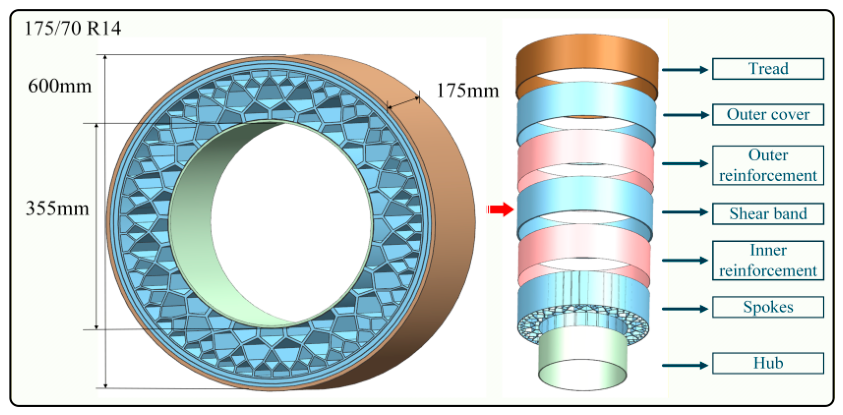
Structural diagram of NPT.
Table 3.
Structural diagram of NPT.
| | Tread | Outer Cover | Outer Reinforcement | Shear Band | Inner Reinforcement | Inner Cover | Rim |
|---|
| Radius (mm) | 292.5 | 286.19 | 285.58 | 276.69 | 276.08 | 272.8 | 177.8 |
| Thickness (mm) | 7.5 | 6.31 | 0.61 | 8.89 | 0.61 | 3.28 | 5 |
| Material | Synthetic rubber | Polyurethane | High-strength steel | Polyurethane | High-strength steel | Polyurethane | Aluminum alloy |
Text Correction
In Section 4.2, second paragraph, the value “635 mm” was incorrect and has been replaced with “600 mm”. A correction has been made to Section 4.2, second paragraph.
The simplified non-pneumatic tire (NPT) model has an outer diameter of 600 mm and a thickness of 43.75 mm. The road surface dimensions were determined based on the wear distance, with a length of 10 m, a width of 0.3 m, and a height of 0.1 m.
Citation Error
The in-text citation numbers [6–15] were incorrect. The following correction has been made: the numbering of citations [6–15] has been reordered according to their correct sequence of appearance in the text.
The corrected citations are as follows:
Therefore, a systematic revolution in tire technology has become urgent. Non-Pneumatic Tires (NPT), which replace the traditional air cavity with a solid supporting structure optimized through biomimicry or topology (such as flexible spokes or honeycomb cells), fundamentally eliminate the risk of blowouts, while offering significant advantages such as low rolling resistance and high design flexibility. NPT is seen as an important technological direction to address the tire performance and safety challenges of the new energy vehicle era.
However, the unique spoke support structure of NPTs, while providing performance advantages, also introduces new scientific challenges. Under complex dynamic loads, the force transfer mechanism between the discrete spoke structure and the continuous tread is not yet fully understood, leading to fundamentally different ground pressure distributions and wear behavior mechanisms compared to traditional pneumatic tires. Studies have shown that optimizing the spoke or shear band structure can significantly improve ground pressure distribution. For example, Wei et al. [6] decoupled the compression stiffness and shear modulus through shear band design, effectively reducing the peak ground contact pressure and making its distribution more uniform; Deng et al. [7] found that spoke damage significantly affects the radial stiffness and ground pressure distribution of the tire. These studies reveal that the wear of non-pneumatic tires is closely coupled with their ground pressure characteristics. However, existing studies mostly focus on the mechanical properties and pressure distribution under static or quasi-static conditions and have not systematically revealed the transient evolution of ground pressure and the resulting wear mechanisms under dynamic rolling conditions, particularly those involving slip and temperature rise. The lack of such mechanism studies has become a key theoretical bottleneck restricting the widespread application of NPTs in new energy vehicles.
Current research on tire wear performance mainly uses experimental testing and finite element simulation methods. Although experimental testing can directly reflect tire wear behavior under real road conditions, it has limitations such as long testing periods and high costs [8]. More importantly, experimental results are often influenced by various variables such as vehicle speed, driving routes, driving habits, and environmental factors (e.g., temperature and humidity), leading to large data scatter, which makes it difficult to meet the high efficiency and accuracy requirements of modern tire development. With the rapid development of computer technology and numerical simulation methods, finite element simulation has become an important technical tool for tire wear research. For example, Zhang et al. [9] proposed an intelligent tire information system based on three-axis accelerometer and strain gauge signals, which analyzes the dynamic response characteristics of the tire during operation to identify changes in tread wear status. Wang Guolin et al. [10] constructed a tire wear state model by setting different tread thicknesses and using Gaussian Process Regression (GPR) algorithms to extract strain signal features, achieving reverse estimation of wear volume. However, these “indirect wear state identification methods” or “equivalent thickness reduction methods” do not consider the dynamic evolution of tire geometry during the wear process and thus fail to accurately reflect the uneven distribution and local development mechanisms of wear under multiple working conditions. This has become a major bottleneck in the current numerical simulation of tire wear. Therefore, developing a numerical simulation method based on geometric dynamic updates is an important direction to improve simulation prediction accuracy [11].
In addition, in the study of rubber friction and wear mechanisms, scholars such as Jian Wu et al. [12–14] have conducted systematic research on the wear behavior of aircraft tires under high-speed and high-temperature conditions. From both theoretical and experimental perspectives, they revealed the influence of slip speed on frictional temperature rise and wear rate, confirming the key role of frictional heat effects in the wear process. Zuo et al. [15], based on the Archard wear theory and ABAQUS 2020 software, established a simulation framework for the high-speed rolling wear of pneumatic tires and proposed a polygonal wear prediction model, further advancing tire wear research. However, the existing wear simulations and methods based on the Archard model are mainly focused on traditional pneumatic tires, with significant gaps in wear simulation research for non-pneumatic tires. Specifically, due to differences in the ground load transfer mechanisms between non-pneumatic and pneumatic tires, existing wear simulation methods for pneumatic tires are not directly applicable to non-pneumatic tires. Additionally, current simulation methods generally treat wear and frictional heat generation processes independently, ignoring the dynamic coupling relationship between them in actual rolling contact, which limits the accuracy of wear prediction.
The numbering of multiple citations was incorrect. The following corrections have been made:
Original citation 15 and 16 has been corrected to 16.
Original citation 17 has been corrected to 17 and 18.
Original citation 18 and 19 has been corrected to 19 and 20.
Original citation 20–22 have been corrected to 21–23.
Original citation 23–25 have been corrected to 24–25.
Original citation 31 has been corrected to 30.
Error in References
There was a mistake in the reference list. Original reference 29 has been removed. In addition, original references 6, 7, and 8 have been updated.
- 6.
Wei, Y.; Pan, F.; Du, J.; Xiang, J.; Chen, Y. Tensegrity metamaterial-based shear band structure for non-pneumatic tires. Forces Mech. 2025, 100341.
- 7.
Deng, Y.; Wang, Z.; Liu, T.; Liang, W.; Shen, H.; Xiao, Z. Static and dynamic mechanical characteristics of honeycomb non-pneumatic tire under structural damage condition. Eur. J. Mech. A/Solids 2023, 102, 105120.
- 8.
Cho, J.R.; Choi, J.H.; Kim, Y.S. Abrasive wear amount estimate for 3D patterned tire utilizing frictional dynamic rolling analysis. Tribol. Int. 2011, 44, 850–858.
With this correction, the order of some references has been adjusted accordingly.
The authors state that the scientific conclusions are unaffected. This correction was approved by the Academic Editor. The original publication has also been updated.