


Abstract
DNA recombination is a fundamental biological process that encodes genetic information for organism development and function. In this study, we construct left-symmetric algebras arising from DNA insertion operations. That is, we define a modified insertion operation by weighting the simplified insertion. It generalizes the left-symmetric algebra constructed from the simplified DNA insertion operation. We prove that the algebra (over a field of characteristic 0, with R being an infinite free semigroup generated by DNA nucleotides ) forms a left-symmetric algebra if and only if the function f satisfies a certain multiplicative condition for all positive integers m, n, and p. A key example of such a function is , where and k is a fixed positive number, which effectively models length-dependent DNA insertion dynamics. This work contributes an algebraic framework that may be useful for quantitative modeling of DNA recombination processes.
MSC:
17D25
1. Introduction
Genetic information is obtained through DNA recombination. Recombination provides the genetic program for the development and functioning of all living organisms. The algebraic formalization of DNA recombination is represented in the form of a linear space over a field of characteristic 0, where R is an infinite free semigroup generated by the set of DNA nucleotides . The schematic model of non-homologous DNA recombination can be represented in the form: , where two chromosomes and c participate in non-homologous recombination. The algebraic formalization of the above recombination, with respect to all possible insertions of DNA c in DNA , defines the algebra of simplified insertions. Let . Then X can be presented as , where . The operation, defined in [1], is given by
where a is an arbitrary element in ; and , where , , and are monomials in . This operation → is called the operation of left simplified insertion. And it satisfies the left-symmetric identity . (Notice that the categories of the left-symmetric and right-symmetric algebras are equivalent [1].) The operation of simplified insertion was first introduced by Bremner [2], and it is an algebraic formalization of the operation of normal insertion in the theory of DNA computing. This algebra defined on is a very important class of non-associative algebras. In the interdisciplinary field of mathematics and biology, the study of non-associative algebras has become an important branch. They have previously been applied to population genetics in the well-developed theory of genetic algebras, see [3]. In 2016, Tian abstracted evolution algebras from biological processes, demonstrating the direct impetus that biology provides for the development of mathematical theories [4]. Later, Vidal et al. constructed genetic evolution algebras based on Gibbs measures, offering new perspectives for modeling complex genetic dynamic processes [5].
As an important class of non-associative algebras, left-symmetric algebras (also called pre-Lie algebras) have attracted sustained interest due to their rich algebraic structure and wide-ranging applications in geometry [6], mathematical physics [7,8], and combinatorial algebra [9,10]. In 1890, A. Cayley first introduced rooted tree algebras into the study of left-symmetric algebras, see [11]. By the 1960s, left-symmetric algebras began to emerge in geometric and algebraic contexts such as convex homogeneous cones [6] and affinely flat manifolds [12,13] and the deformation theory of associative algebras [14]. In addition, remarkable progress has been made in the theoretical and geometric generalizations of left-symmetric algebras. To extend the theory to more general coefficient rings and incorporate symmetry variants, Bakalov et al. [15] proposed the concept of left-symmetric pseudoalgebras, from which several algebraic forms have been developed, including left-symmetric superalgebras [16,17]. As a geometric generalization, left-symmetric algebroids have been extensively studied [18,19,20], with the concept of Nijenhuis operators defined on them [20]. Researchers subsequently studied left-symmetric algebras, focusing on issues such as their structures, classification, and important applications in different fields [21,22,23]. In this paper, we construct new left-symmetric algebras through DNA recombination to enrich the research field.
The left simplified insertion left-symmetric algebra is infinite-dimensional as a vector space. However, one finds that there are only finitely many types of DNA in nature. Therefore, in this paper, we modify the simplified insertion operation by introducing a length-dependent function. This operation does not reduce the dimension of the vector space; rather, it ensures that the insertion probability approaches zero when the fragment length is large enough. Moreover, it is similar to ordered constraint semigroups [24] in the sense that both extend the original algebraic framework by imposing constraints, thereby making the operations more consistent with realistic scenarios.
The paper is organized as follows. In Section 2, we recall left-symmetric algebras and the simplified insertion, and prove that the simplified insertion satisfies the left-symmetric identity. We then examine the intermediate version of the insertion operation proposed by Bremner [2] and demonstrate through a counterexample that it does not satisfy the left-symmetric identity. And we prove that the operation of synchronized insertion given in [25] does not satisfy the left-symmetric identity, either. In Section 3, we specify the conditions under which the simplified insertion operation satisfies the left-symmetric identity. In Section 4, we give the definition of modified simplified insertion and construct a new left-symmetric structure for the modified simplified insertion. Specifically, we define a new operation of insertion as follows:
where , , and , denote the lengths of x and y, respectively. This operation is called modified simplified insertion. Then is a left-symmetric algebra if and only if satisfies the following:
where . For example, if the operation is given by
where k is a fixed negative integer, then is still a left-symmetric algebra. And the new genetics generated by the left simplified insertion can be suppressed by this coefficient if m or n is large enough. Finally, we illustrate properties of these left-symmetric algebras and certain applications in genetics and molecular. In Section 5, we summarize the main results, limitations, and future directions.
2. Definitions and Notions
In this section, we mainly recall the definitions of left-symmetric algebra and the simplified insertion operation. And we show that the simplified insertion operation satisfies the left-symmetric identity.
2.1. The Left-Symmetric Algebra
Let be a field of characteristic zero. Let A be an algebra over . For elements x and y in A, the bilinear product is denoted by . Given three elements x, y and z, we denote the associator of these elements by the following:
Definition 1.
A left-symmetric algebra A is an algebra whose associator satisfies
And the identity is called the left-symmetric identity.
From the perspective of DNA insertion, the left-symmetric identity indicates that swapping the order of the first two inserted fragments does not alter the outcome of the triple-insertion operation. This property ensures that, regardless of the sequence in which multiple DNA fragments are inserted, the algebraic representation of the recombination process remains consistent.
Example 1.
- (1)
- Every associative algebra is a left-symmetric algebra with the left-symmetric structure given by the following:Obviously, .
- (2)
- Let A be the vector space of smooth functions. For f and g in A, we set . It is easy to check that A is a left-symmetric algebra.
2.2. Languages and Simplified Insertion
Assume that I is a finite set. Let S be a finite non-empty set, denoted by . A word over S is a finite string , where and . For , we have the empty word denoted 1. We denote the length of w by . We write for the set of all words, and any subset of is called a language.
Let be the free associative algebra over generated by S.
Remark 1.
Notice that is a basis of . Then all elements in are linearly independent and every element in can be expressed as a linear combination of the elements in . More precisely,
Consider the operation of DNA insertion of one word into another. This provides a method for combining DNA molecules that are well-studied in molecular genetics. Given , we consider all insertions of x into y:
Note that we allow both and to be empty.
Firstly, we recall the simplified insertion.
Definition 2.
The simplified insertion of x into y is the linearized form of this operation, that is, the sum of all insertions, as
where , and , .
We can define a new operation of multiplication on by
where , . And we extend it to bilinearly. In detail, if and , where and , then
The associator for this new operation, that is simplified insertion operation, is defined as usual by the following:
Example 2.
Let and . Then and
Theorem 1.
The algebra is a left-symmetric algebra whose associator is defined by (4).
Proof.
Let
Using (2), we obtain
Then
Hence, we obtain
The monomials in the correspond precisely to insertions of x and y into z at distinct positions separated by at least one letter; the same set of monomials occurs in the . Indeed, there is a natural bijection between the monomials of and that swaps the insertion positions of x and y while maintaining the result. Hence, . We immediately obtain the following:
It still holds when
where and . Using (3), we obtain
Then
Hence
Therefore, the left-symmetric identity holds on . □
Remark 2.
We consider the following open problem given in [2] by Bremner.
Problem: An intermediate version of the insertion operation is obtained when we regard the set-theoretic definition as producing a set rather than a multiset. That is, on words and with we define
where . We then consider the following operation:
What are the polynomial identities satisfied by this operation?
One checks that this operation does not satisfy the left-symmetric identity . We present the following counterexample. Let and Then and hence Similarly, That is .
Remark 3.
Recall another DNA insertion operation, the linearized version of the synchronized insertion introduced in [25]. We show that it does not satisfy the left-symmetric identity , either.
where is defined by
Without loss of generality, we choose the simplest case of the linearized version of synchronized insertion in which S contains one letter: Then the synchronized insertion becomes
where
Let and where and . Then Hence, it does not satisfy the left-symmetric identity.
The linearized form of synchronized insertion also fails to satisfy the left-symmetric identity in the multi-letter case. Let and Then
3. Adjacency Constraints and Subspace Properties
In this section, we mainly study whether a subspace of the left-symmetric algebra (from Section 2) remains a left-symmetric algebra when considered as a linear space.
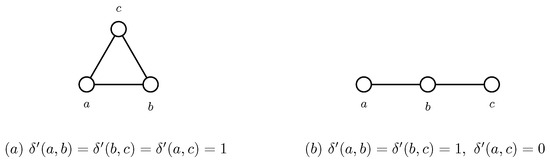
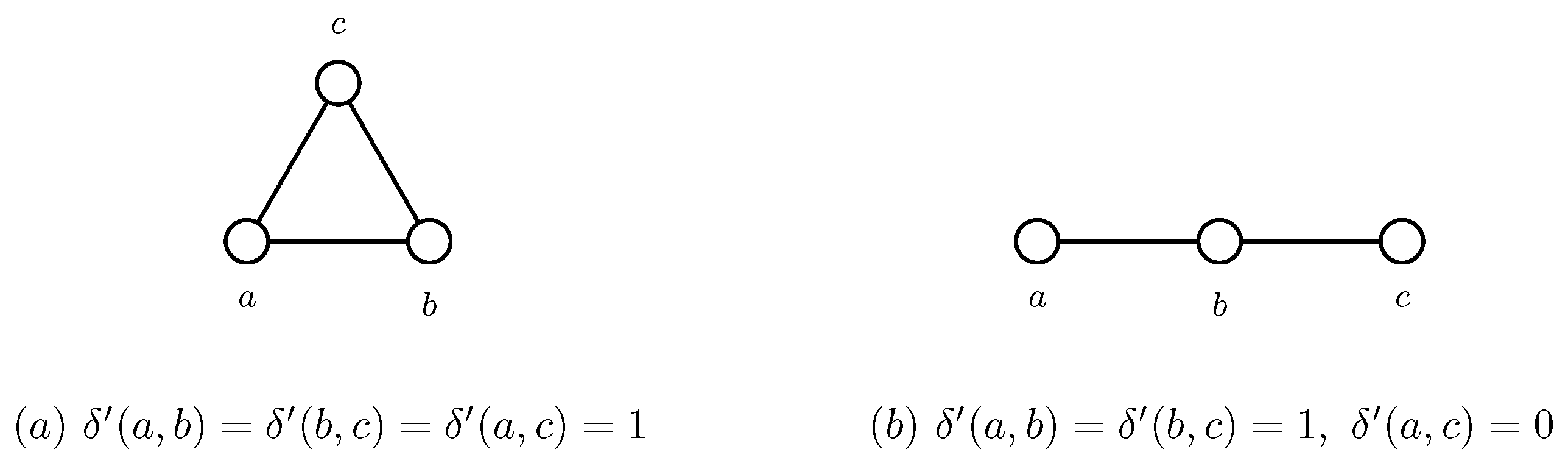
Set . From a biological perspective, certain DNA insertion operations fail to yield specific DNA fragments. Therefore, we introduce the function by
for any . That is, we say that and can be adjacent in a word if there are some words like and therefore ; otherwise, . In particular, we set . Then we consider the operation
We give examples to illustrate the role of the function .
Example 3.
Notice that is the associative algebra over generated by S. Consider the subspace of for which there exist such that .
Theorem 2.
Let ,
- (1)
- If , then the operation ⤏ satisfies the left-symmetric identity.
- (2)
- If and , then the operation ⤏ satisfies the left-symmetric identity. If and , then the operation ⤏ is associative. It obviously satisfies the left-symmetric identity.
- (3)
- If and for all , then the operation ⤏ is non-associative. However, it satisfies the left-symmetric identity. If there exists such that , and its adjacency graph can be decomposed into a family of adjacency subgraphs that satisfy the left-symmetric identity with , then the operator ⤏ satisfies the left-symmetry identity; in other cases, the operator ⤏ does not satisfy the left-symmetry identity.
Proof.
- (1)
- Since and for , the operation obviously satisfies the left-symmetric identity.
- (2)
- If and for all , then the operation satisfies the left-symmetric identity by Theorem 1.If and , then the operation obviously satisfies for .
- (3)
- We discuss the validity of the left-symmetric identity for the operation on S by classifying the cardinality of S and the value of .
Case 1. , i.e., . We divide this case into four subcases according to the number of pairs satisfying .
Subcase 1.1. for any . Then the operation satisfies the left-symmetric identity by Theorem 1.
Subcase 1.2. for any . Then the operation obviously satisfies the left-symmetric identity.
Suncase 1.3. There exist two pairs of elements in S such that for . Without loss of generality, assume and . Then . Hence, the operation satisfies the left-symmetric identity.
Subcase 1.4. There exist two pairs of elements in S such that for . Without loss of generality, assume and . Then and . Hence, it does not satisfy the left-symmetric identity.
Case 2. . We prove this case by mathematical induction on the cardinality of S. When , the conclusion has been verified. Assume the conclusion holds when . We now consider the case .
Subcase 2.1. for all . Then the operation satisfies the left-symmetric identity by Theorem 1.
Subcase 2.2. There exist such that and its adjacency graph can be decomposed into a family of adjacency subgraphs that satisfy the left-symmetric identity. For any , two situations arise. If do not come from the same subgraph, then the associator , which satisfies the left-symmetric identity. If come from the same subgraph, then the left-symmetric identity is obviously satisfied by the inductive hypothesis.
Subcase 2.3. If the adjacency graph cannot be decomposed into such subgraphs, then it does not satisfy the left-symmetric identity by the inductive hypothesis. □
Example 4.
- (1)
- Let , and . Set and , then and .
Then
Hence, it does not satisfy the left-symmetric identity.
- (2)
- Let , and . Set and , then .
Then
Hence, it satisfies the left-symmetric identity.
Corollary 1.
Let be the adjacency graph associated with , where the vertex set and the edge set . Then
- (1)
- If G is a complete graph (i.e., for all ), the operation ⤏ satisfies the left-symmetric identity.
- (2)
- If G is not a complete graph but can be decomposed into a family of adjacency subgraphs that satisfy the left-symmetry identity with , the operation ⤏ satisfies the left-symmetric identity.
4. The Modified Simplified Insertion
In this section, we mainly introduce the modified simplified insertion and establish the core Theorem 3.
4.1. The Modified Simplified Insertion
Definition 3.
We define the modified simplified insertion as follows:
where the function is given by . Then, we have the following:
Example 5.
Let and , then .
4.2. The Left-Symmetric Algebra for Modified Simplified Insertion
Theorem 3.
is the left-symmetric algebra where is defined as (8) if and only if f satisfies the following conditions:
for any .
Proof.
Let be the basis vectors of . Let
Then , , . We obtain the following:
Then
Denote and as
respectively. Hence, we obtain the following:
From (10), we observe that the beginning term of is with the coefficient and there are no other terms containing . The remaining terms are those in which both x and y are inserted into z and separated by at least one letter of z. Therefore, by Remark 1, for ∀x, y, z, if and only if and . This directly implies the following:
Since are the basis vectors and any element in is a linear combination of such monomials, the result extends to all elements in . Hence,
for any . □
Remark 4.
If we denote as , then we have
That is
and
Example 6.
Let . Set , , and . We obtain the following:
Then
Hence,
It satisfies the left-symmetric identity.
We compare the properties of the four types of DNA insertion operations in Table 1.
Table 1.
Algebraic properties of different DNA insertion operations.
4.3. The Existence of f
Recall that f satisfies the following equations:
where
Equations (13) and (14) admit a broad family of solutions, the general form of which is characterized by the following proposition.
Proposition 1.
Let be an arbitrary non-zero function. Define the following:
Then f satisfies (13) and (14).
Proof.
For any ,
Hence . Similarly,
Hence f satisfies (13) and (14). □
Example 7.
We choose a symmetric bilinear function given by . For example, where k is a fixed positive number. Let . Then
Hence, f satisfies (13) and (14).
Example 8.
Assume that the function is defined by , where . Then
Hence, f satisfies (13) and (14).
Example 9.
- (1)
- Let , where is a constant. It is the same as the simplified insertion.
- (2)
- We can easily check that f satisfies the (13) and (14), where f is defined as follows
Corollary 2.
Let in (13) and (14). Then we get . Hence, f is symmetric, i.e.,
Based on Proposition 1, we compare the algebraic properties of three characteristic functions that satisfy condition (12) in Table 2.
Table 2.
Comparison of algebraic properties of f.
4.4. Application in Genetics
The algebraic framework of left-symmetric algebras constructed from DNA insertion operations provides insights into DNA recombination mechanisms. The operation of the modified insertion with functions establishes an algebraic foundation for the quantitative study of length-dependent insertion, such as in mathematical descriptions of transposition processes. And the constraint condition
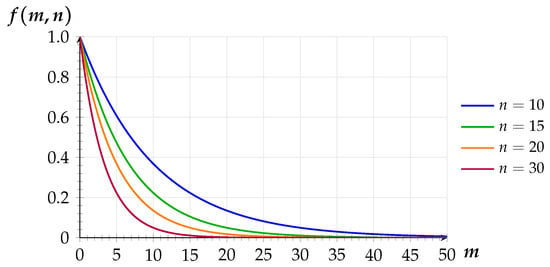
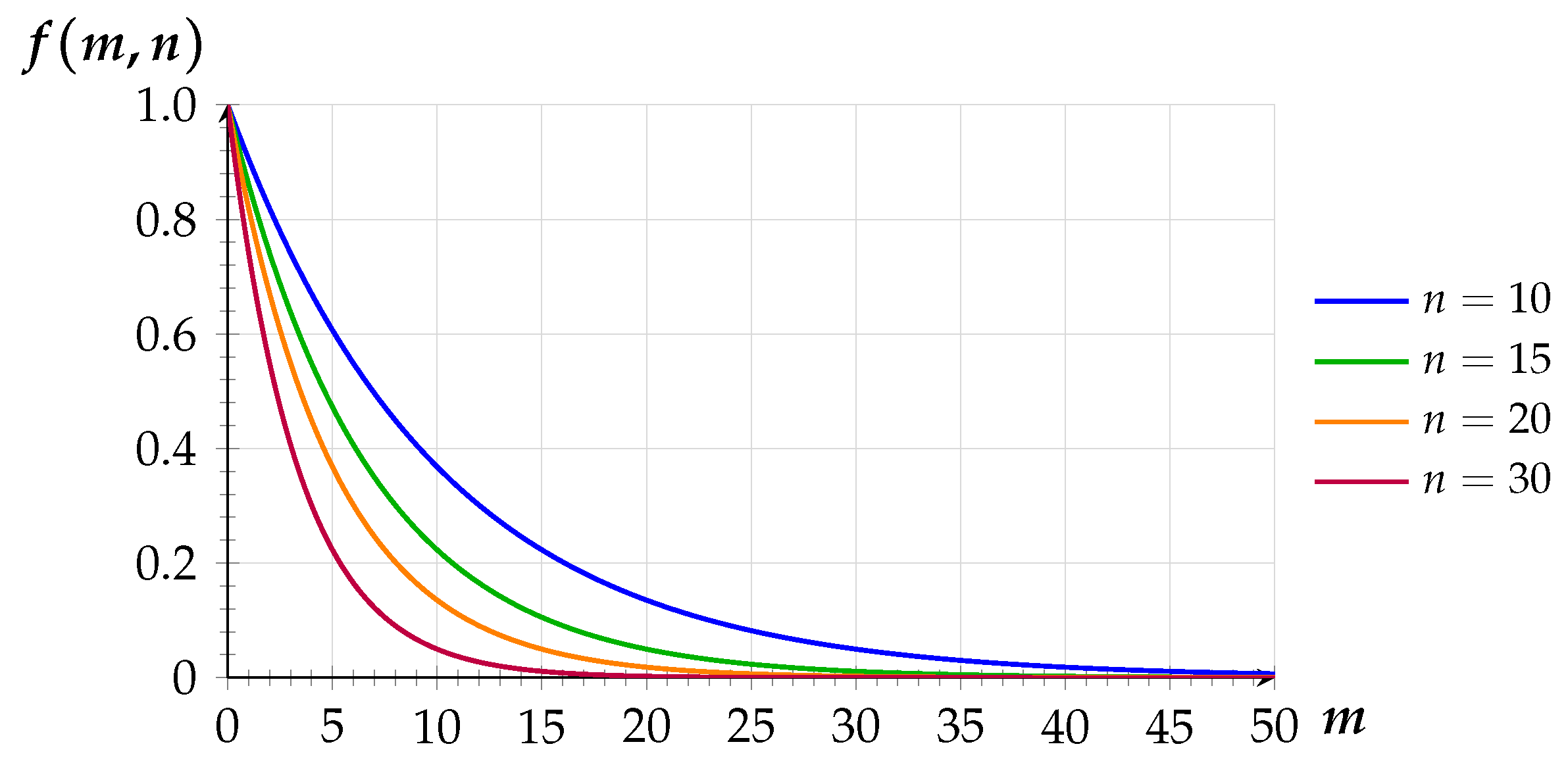
provides a mathematical model for transposon expansion dynamics and selection pressure. This can be interpreted as a model assumption. Then we consider a simple example: , where . From Figure 2, we can clearly observe that decays exponentially with the increase in fragment length. In other words, when the fragment length is sufficiently large, the new genetic features induced by the left simplified insertion can be suppressed by coefficient adjustment. This finding provides a mathematical basis for relevant studies in biological genetics and genomics.
Figure 2.
The trend of the coefficient .
5. Conclusions
In this paper, we construct a new class of left-symmetric algebra structures from DNA insertion operations. The main result is Theorem 3, which states that the algebra is left-symmetric if and only if f satisfies
for any . While this formula is structurally similar to associativity-type cocycle conditions [14], it is not imported from abstract theory; rather, it is derived as a necessary and sufficient condition for the DNA insertion operation to satisfy the left-symmetric identity. This derivation also provides a novel interpretation of this cocycle condition in genetics.
However, the proposed algebraic structure remains a theoretical construct and has not yet been validated against real-world DNA recombination data. Future research may seek to deduce the specific form of the function and verify its predictive performance. Furthermore, the functional equations for f are formally analogous to studies on the stability of bi-derivations and bihomomorphisms in Banach algebras and approximation problems of homomorphisms and derivations in Lie -algebras [26,27]. This, in turn, paves the way for further exploration of left-symmetric algebras arising from DNA insertions and their related stability problems.
Author Contributions
Methodology, C.Y., Z.W. and J.W.; validation, C.Y., Z.W. and J.W.; formal analysis, C.Y.; writing—original draft preparation, C.Y.; writing—review and editing, C.Y. and J.W.; visualization, C.Y.; supervision, Z.W. and J.W.; project administration, Z.W. and J.W.; funding acquisition, Z.W. and J.W. All authors have read and agreed to the published version of the manuscript.
Funding
The work is supported by the National Natural Science Foundation of China (No. 12471038).
Data Availability Statement
Data sharing is not applicable. No new data were created or analyzed in this study.
Conflicts of Interest
The authors declare no conflicts of interest.
References
- Sverchkov, S.R. Algebraic Theory of DNA Recombination. In Proceedings of the ISCA 2nd International Conference on Bioinformatics and Computational Biology, BICoB-2010, Sheraton Waikiki Hotel, Honolulu, HI, USA, 24–26 March 2010; pp. 98–102. [Google Scholar]
- Bremner, M. DNA computing, insertion of words and left-symmetric algebras. In Proceedings of the 2005 Maple Conference, Waterloo, ON, Canada, 15–17 July 2005; pp. 229–242. [Google Scholar]
- Reed, M.L. Algebraic structure of genetic inheritance. Bull. Am. Math. Soc. 1997, 34, 107–130. [Google Scholar] [CrossRef] [Scilit]
- Tian, J.P. Invitation to research of new mathematics from biology: Evolution algebras. J. Top. Funct. Anal. Algebr. Contemp. Math. 2016, 672, 257–272. [Google Scholar]
- Coletti, C.F.; de Lima, L.R.; Luiz, D.A. Infinite-dimensional genetic and evolution algebras generated by Gibbs measures. J. Math. Phys. 2025, 66, 053302. [Google Scholar] [CrossRef] [Scilit]
- Vinberg, E. Convex homogeneous cones. Transl. Am. Math. Soc. 1963, 12, 340–403. [Google Scholar]
- Kupershmidt, B.A. What a classical r-matrix really is. J. Nonlinear Math. Phys. 1999, 6, 448–488. [Google Scholar] [CrossRef] [Scilit]
- Connes, A.; Kreimer, D. Renormalization in quantum field theory and the Riemann-Hilbert problem. I: The Hopf algebra structure of graphs and the main theorem. Commun. Math. Phys. 2000, 210, 249–273. [Google Scholar] [CrossRef] [Scilit]
- Sun, Q.X.; Zhu, Q.W. Cohomologies, non-abelian extensions and wells exact sequences of λ-differential pre-lie algebras. J. Geom. Phys. 2024, 204, 105280. [Google Scholar]
- Chapoton, F.; Livernet, M. Pre-lie algebras and the rooted trees operad. Int. Math. Res. Not. 2001, 2001, 395–408. [Google Scholar] [CrossRef]
- Cayley, A. On the theory of the analytical forms called trees. Collect. Math. Pap. Arthur Cayley 1890, 3, 242–246. [Google Scholar]
- Koszul, J.L. Domaines bornés homogenes et orbites de groupes de transformations affines. Bull. Soc. Math. Fr. 1961, 89, 515–533. [Google Scholar]
- Matsushima, Y. Affine structures on complex manifolds. Osaka J. Math. 1968, 5, 215–222. [Google Scholar]
- Gerstenhaber, M. The cohomology structure of an associative ring. Ann. Math. 1963, 78, 267–288. [Google Scholar] [CrossRef] [Scilit]
- Bakalov, B.; D’Andrea, A.; Kac, V.G. Theory of finite pseudoalgebras. Adv. Math. 2001, 162, 1–140. [Google Scholar] [CrossRef] [Scilit]
- Chen, H.; Hassan, O. Left-symmetric superalgebra structures on an infinite-dimensional Lie superalgebra. Algebra Colloq. 2023, 30, 429–438. [Google Scholar] [CrossRef] [Scilit]
- Benayadi, S.; Bouarroudj, S.; Ehret, Q. Left-symmetric superalgebras and Lagrangian extensions of Lie superalgebras in characteristic 2. J. Pure Appl. Algebra 2025, 229, 104343. [Google Scholar] [CrossRef] [Scilit]
- Liu, J.; Sheng, Y.; Bai, C.; Chen, Z. Left-symmetric algebroids. Math. Nachrichten 2016, 289, 1893–1908. [Google Scholar] [CrossRef] [Scilit]
- Liu, J.; Sheng, Y.; Bai, C. Left-symmetric bialgebroids and their corresponding Manin triples. Differ. Geom. Its Appl. 2018, 59, 91–111. [Google Scholar] [CrossRef] [Scilit]
- Liu, J.; Sheng, Y.; Bai, C. Pre-symplectic algebroids and their applications. Lett. Math. Phys. 2018, 108, 779–804. [Google Scholar] [CrossRef] [Scilit]
- Burde, D. Left-symmetric algebras, or pre-Lie algebras in geometry and physics. Cent. Eur. J. Math. 2006, 4, 323–357. [Google Scholar] [CrossRef] [Scilit]
- Liu, D.; Hong, Y.; Zhou, H.; Zhang, N. Classification of compatible left-symmetric conformal algebraic structures on the Lie conformal algebra W(a,b). Commun. Algebra 2018, 46, 5381–5398. [Google Scholar] [CrossRef] [Scilit]
- Xu, C. Compatible left-symmetric algebraic structures on high rank Witt and Virasoro algebras. J. Algebra Its Appl. 2022, 21, 2250086. [Google Scholar]
- Palakawong na Ayutthaya, P.; Lekkoksung, N. Ordered constraint semigroups: A novel class of algebraic systems. J. Math. Comput. Sci. 2025, 37, 201–213. [Google Scholar]
- Daley, M.; Kari, L.; McQuillan, I. Families of languages defined by ciliate bio-operations. Theor. Comput. Sci. 2004, 320, 51–69. [Google Scholar] [CrossRef]
- Khan, S.; Park, C.; Donganont, M. The stability of bi-derivations and bihomomorphisms in Banach algebras. J. Math. Comput. Sci. 2024, 35, 482–491. [Google Scholar] [CrossRef] [Scilit]
- Cho, Y.J.; Saadati, R.; Vahidi, J. Approximation of Homomorphisms and Derivations on non-Archimedean Lie C*-algebras via Fixed Point Method. Discret. Dyn. Nat. Soc. 2012, 2012, 373904. [Google Scholar] [CrossRef] [Scilit]

Disclaimer/Publisher’s Note: The statements, opinions and data contained in all publications are solely those of the individual author(s) and contributor(s) and not of MDPI and/or the editor(s). MDPI and/or the editor(s) disclaim responsibility for any injury to people or property resulting from any ideas, methods, instructions or products referred to in the content. |
© 2026 by the authors. Licensee MDPI, Basel, Switzerland. This article is an open access article distributed under the terms and conditions of the Creative Commons Attribution (CC BY) license.