
Skip Content
You are currently on the new version of our website. Access the old version .
  • 1.6
    Impact Factor
  • 22 days
    Time to First Decision

Axioms, Volume 15, Issue 1

2026 January - 82 articles

Cover Story:

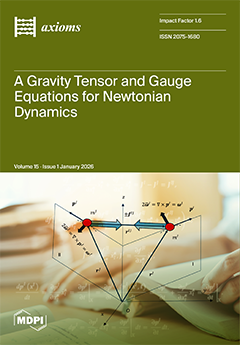
Masses mI and mJ, identified by position vectors rI and rJ, move along their orbits with momenta pI and pJ and interact via the gravitational force fIJ. The curl vectors ωI and ωJ of the momenta are related to their angular velocities ω̃I and ω̃J about their curvature centres of their orbits.

Using the law of energy conservation, gauge equations for Newton’s law of gravitation are developed. These equations reveal that the gravitational force fIJ and the curl pI of the momentum in Newton’s gravity play analogous to the electric field E and magnetic B in electromagnetism. This formulation demonstrates that Newton’s gravity to be governed by gauge theory, addressing the long-standing view that “Newton’s gravitation is an exception of Yang–Mills gauge theory”. The developed framework provides a new approach for analyzing dynamic interactions in gravity fields. View this paper

  • Issues are regarded as officially published after their release is announced to the table of contents alert mailing list .
  • You may sign up for email alerts to receive table of contents of newly released issues.
  • PDF is the official format for papers published in both, html and pdf forms. To view the papers in pdf format, click on the "PDF Full-text" link, and use the free Adobe Reader to open them.

Articles (82)

  • Article
  • Open Access
106 Views
18 Pages

22 January 2026

Some properties on large contractions in metric spaces are proven. In particular, such contractions are proven to be asymptotically regular. In addition, if the metric space is complete, then the sequences that they generate are bounded, Cauchy, and...

  • Article
  • Open Access
111 Views
30 Pages

Nijenhuis Operators on 2D Pre-Lie Algebras and 3D Associative Algebras

  • Xiaoguang Zou,
  • Xiang Gao,
  • Chuangchuang Kang and
  • Jiafeng Lü

22 January 2026

In this paper, we describe all Nijenhuis operators on 2-dimensional complex pre-Lie algebras and 3-dimensional complex associative algebras. As an application, using these operators, we obtain solutions to the classical Yang-Baxter equation on the co...

  • Article
  • Open Access
99 Views
31 Pages

Truncating and Shifting Weights for Max-Plus Automata

  • Jelena Matejić,
  • Miroslav Ćirić,
  • Jelena Ignjatović and
  • Ivana Micić

22 January 2026

In this paper, for any real number λ, we transform the complete max-plus semiring R into a commutative, complete, additively idempotent semiring Rλ, called the lower λ-truncation of R. It is obtained by remov...

  • Article
  • Open Access
81 Views
12 Pages

Adaptive Pinning Synchronization of Switching Networks with Arbitrary Topologies

  • Isaac Leonel López-García and
  • Juan Gonzalo Barajas-Ramírez

21 January 2026

We propose a novel design approach for pinning control of a dynamical network that achieves synchronization despite switching between arbitrary topologies. Unlike existing approaches, we consider weighted, directed, and even unconnected topologies as...

  • Article
  • Open Access
111 Views
25 Pages

Modus Tollens in the Setting of Discrete Uninorms

  • Isabel Aguiló,
  • Pilar Fuster-Parra and
  • Juan Vicente Riera

21 January 2026

This study focuses on the Modus Tollens (MT) property induced by discrete uninorms. Specifically, we identify the set of necessary and sufficient criteria for a discrete implication function to comply with this logical property. This rule of inferenc...

  • Article
  • Open Access
94 Views
15 Pages

20 January 2026

This research explores two novel geometric concepts—nearly convex points and locally nearly uniformly convex points within the frameworks of Banach spaces and Orlicz spaces equipped with the Luxemburg norm. First, we establish the general chara...

  • Article
  • Open Access
67 Views
17 Pages

20 January 2026

We consider the Poisson stable solutions and their exponential attractiveness for the linear difference equation z(n+1)=Az(n)+g(n) and semi-linear difference equation z(n+1)=Az(n)+G(n,z(n)). Via Shcherbakov’s comparability principle, we show th...

of 9

Get Alerted

Add your email address to receive forthcoming issues of this journal.

XFacebookLinkedIn
Axioms - ISSN 2075-1680