1. Introduction
The Lindley distribution, originally introduced by Lindley [
1] and later rediscussed by Ghitany et al. [
2], has attracted considerable attention in recent decades owing to its tractable form and useful applications in lifetime and reliability analysis; see Ghitany et al. [
3]. Recent research has introduced several extensions and generalizations of Lindley-type models, further enhancing their applicability across diverse engineering and physical contexts; see, for example, Qayoom et al. [
4]. Meanwhile, censoring mechanisms, such as progressive and hybrid schemes, have become increasingly important in reliability studies, as they offer greater experimental control and enable the efficient use of incomplete lifetime data; see Balakrishnan et al. [
5]. Collectively, these developments highlight the need for more generalized models and advanced estimation strategies capable of handling complex censoring structures while preserving statistical efficiency. However, despite its popularity, the single-parameter Lindley model often lacks the flexibility required to adequately capture diverse data behaviors observed in practice.
To address this limitation, Chouia and Zeghdoudi [
6] proposed the XLindley distribution as another version of the traditional Lindley law. By mixing exponential and Lindley distributions, the XLindley distribution exhibits greater flexibility in its hazard rate structure and tail behavior, allowing it to accommodate a wider range of empirical data patterns. Its statistical properties, including explicit expressions for moments, hazard rate, and distributional characteristics, demonstrate the potential of the XLindley distribution as a competitive model for reliability studies and survival analysis.
Assume that the lifetime variable
Y is continuous and distributed as
, where
represents the scale parameter. Following Chouia and Zeghdoudi [
6], the probability density function (PDF) and cumulative distribution function (CDF) are given, respectively, by
and
with associated reliability function (RF) (at a distinct time
), denoted by
, as
and hazard rate function (HRF), at
, denoted by
, as
The reliability characteristics of a lifetime distribution play a central role in assessing the performance of electronic systems and are widely employed by reliability practitioners. Accordingly, in this study, the reliability metrics
and
are treated as unknown lifespan parameters. Recently, numerous research studies have investigated several inferential issues for the XLindley distribution; see Alotaibi et al. [
7] and Elbatal et al. [
8], among others.
The primary objective of a reliability practitioner in life-testing research is to terminate the experiment before all units fail. A hybrid censoring scheme combines features of both Type-I (time-strategy) and Type-II (failure-strategy) methods. However, a limitation of conventional Type-I, Type-II, or hybrid censoring approaches is that they only allow the withdrawal of test units at the final termination point, but not at intermediate stages of the experiment; see Balakrishnan and Kundu [
9]. In practice, intermediate removals may be desirable to balance shorter experimental duration with the need to observe extreme lifetimes, or to permit early-removed units to be redesigned and reused in subsequent studies. Such considerations motivate the development of progressive censoring schemes. Among these schemes, the progressive Type-II censoring scheme (P-T2-CS) has been extensively employed in reliability investigations.
A P-T2-CS is particularly useful in industrial and biomedical settings, as it allows planned removal of surviving units at various stages of the experiment. Suppose
m failures are to be observed from
n identical units, where
. Let
denote the predetermined removal scheme. At the first failure time
,
of
units are randomly outside the test. At the second failure time
,
of
units are withdrawn, and so forth. Upon the
mth failure, the remaining units
are removed, and the test terminates; see Balakrishnan and Cramer [
10]. One drawback of P-T2-CS is that when inspection units are extremely trustworthy, the experiment may become excessively long. To mitigate this, Kundu and Joarder [
11] introduced the progressive hybrid censoring Type-I scheme (PH-T1-CS), where the test ends at
with
a predetermined censoring time. However, if only a small number of failures occur before
, PH-T1-CS becomes ineffective, often rendering parameter estimation infeasible or unstable.
To address this restriction, Cho et al. [
12] introduced the generalized progressive hybrid censoring scheme (G-PH-CS), which extends PH-T1-CS by ensuring that a minimum number of failures are always observed. This framework provides greater flexibility, enabling both reduced test duration and lower costs associated with unit failures. Let
denote the ordered times of failure generated from a continuous distribution with CDF
and PDF
. Suppose
is a predetermined censoring time,
d is the failure size up to time
, and let
be fixed integers under a specified removal scheme
, such that
. Finally, the experiment terminates at
Thus, three censoring cases may occur:
If , the test ends at (Case 1);
If , the test ends at (Case 2);
If , the test ends at (Case 3).
Hence, the joint likelihood function (LF) of
, denoted by
, is given by
where
for
, and
. The main advantage of the G-PH-CS is that it guarantees the observation of at least
failures, even when the experimenter initially intends to capture
failures. This flexibility makes the method particularly attractive in practice.
To illustrate the practical implications of a hybrid censoring design, consider a lifetime testing experiment for light bulbs. Suppose n identical light bulbs are placed on test, and the experimenter is interested in observing failures to assess product reliability. Due to time and cost constraints, the experiment is terminated either when a pre-specified time is reached (Type-I censoring) or when a fixed number m of bulbs have failed (Type-II censoring), whichever occurs first. For example, the test may stop after 500 h or once 20 bulbs fail, whichever condition is satisfied first. Such a scheme ensures that the experiment does not run excessively long while still guaranteeing the observation of a sufficient number of failures for meaningful statistical inference. This setting naturally motivates the use of hybrid censoring and reflects realistic reliability testing scenarios encountered in industrial applications. Moreover, if some surviving bulbs are deliberately removed at intermediate failure times for inspection or reuse, the experiment follows a G-PH-CS, as considered in this study.
An important feature of the G-PH-CS is that it guarantees at least
failures, even when the censoring plan permits up to
failures to be recorded. This safeguard enhances the reliability of the collected data and makes the scheme particularly well suited for studies where premature termination may otherwise occur. Owing to these practical advantages, the G-PH-CS framework has received considerable attention and has been applied to a variety of lifetime distributions. Notable applications include the inverse Weibull entropy model by Lee [
13], the Weibull distribution by Zhu [
14], the Rayleigh model with competing risks by Singh et al. [
15], inference on shape and scale parameters by Maswadah [
16], and, most recently, the Chris–Jerry model by Alotaibi et al. [
17].
Although Lindley-type distributions have been extensively studied in reliability modeling, most existing works focus on uncensored data or simple censoring schemes, leaving limited methodological development for progressive hybrid censoring. This represents a critical gap, as hybrid censoring designs frequently arise in engineering and physical sciences experiments, where tests are often terminated by a combination of failures and time constraints. Furthermore, while classical inference methods for Lindley variants have been proposed, few effort has been made to systematically compare frequentist and Bayesian approaches within such complex censoring frameworks.
At the same time, the recently introduced XLindley distribution has attracted attention for its ability to accommodate diverse hazard rate shapes and for its suitability in real-world reliability applications. Despite this promise, its inferential properties under advanced censoring schemes remain underdeveloped.
This study is therefore motivated by the dual need to (i) incorporate realistic censoring mechanisms into reliability analysis and (ii) leverage the modeling flexibility of the XLindley distribution. By developing and analyzing generalized progressive hybrid XLindley censored data, we construct a framework that not only mirrors practical testing environments more closely but also extends the methodological toolkit available to reliability practitioners. The main contributions of this work are fivefold:
Develop maximum likelihood estimation procedures for the model parameter and associated reliability indices, and establish their asymptotic properties for rigorous inference.
Construct Bayesian estimators under a gamma prior distribution, implemented via the Metropolis–Hastings algorithm with a symmetric squared-error loss function.
Design efficient numerical algorithms for parameter estimation and reliability evaluation, ensuring computational feasibility under complex censoring schemes.
Conduct a simulation study to investigate the proposed estimators’ superiority in terms of bias, efficiency, and coverage.
Validate the proposed inferential frameworks through two real-life data applications from physical and engineering contexts, demonstrating superior model fit and enhanced applicability.
The structure of the paper is as follows.
Section 2 and
Section 3 describe the LF-based and Bayesian estimation approaches.
Section 4 compares the proposed methodologies by simulations.
Section 5 analyzes two datasets representing rainfall records in New South Wales and vehicle fatalities in South Carolina. Concluding remarks are offered in
Section 6.
3. Bayesian Inference
The gamma distribution can accommodate a wide range of subjective or empirically motivated prior specifications; see Kundu [
22]. Despite its appeal, the selection of an appropriate prior often remains a challenging task. As emphasized by Arnold and Press [
23], no universally accepted criterion exists for prior choice in Bayesian inference. Since the XLindley parameter
is constrained to the positive real line
, the gamma prior arises as a natural and mathematically coherent option. However, the prior PDF of
, say
, becomes
where
.
The posterior PDF (say,
) of
using (
6) and (
10) is
where ∁ is given by
The symmetric squared error loss (SEL) function is employed because it penalizes estimation errors equally, yielding the posterior mean as the Bayes estimator and ensuring balanced inference. This property makes SEL particularly suitable for reliability analysis, where underestimation and overestimation are of comparable importance. Nevertheless, in situations where the costs of these errors differ, alternative asymmetric loss functions, such as the linear-exponential loss or general entropy loss, may be adopted, depending on the practical requirements of the analysis. Owing to the structure in (
6), the integrals in ((
11) rarely admit closed-form solutions, rendering analytical evaluation infeasible in most practical cases. To solve this issue, we utilize the MCMC methodology to generate Markovian draws from (
11)). From these samples, we compute the Bayes estimates and construct the associated BCI and HPD intervals.
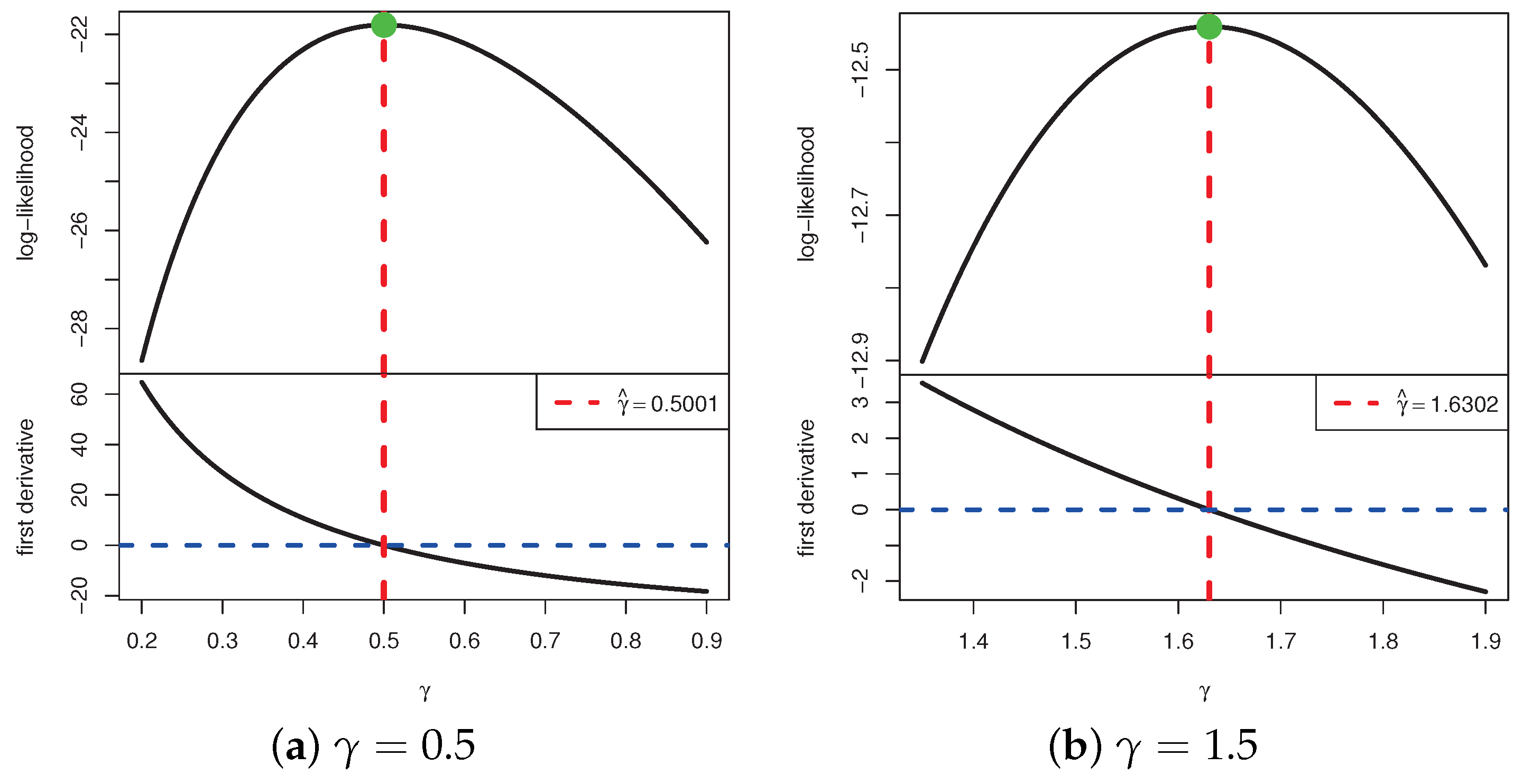
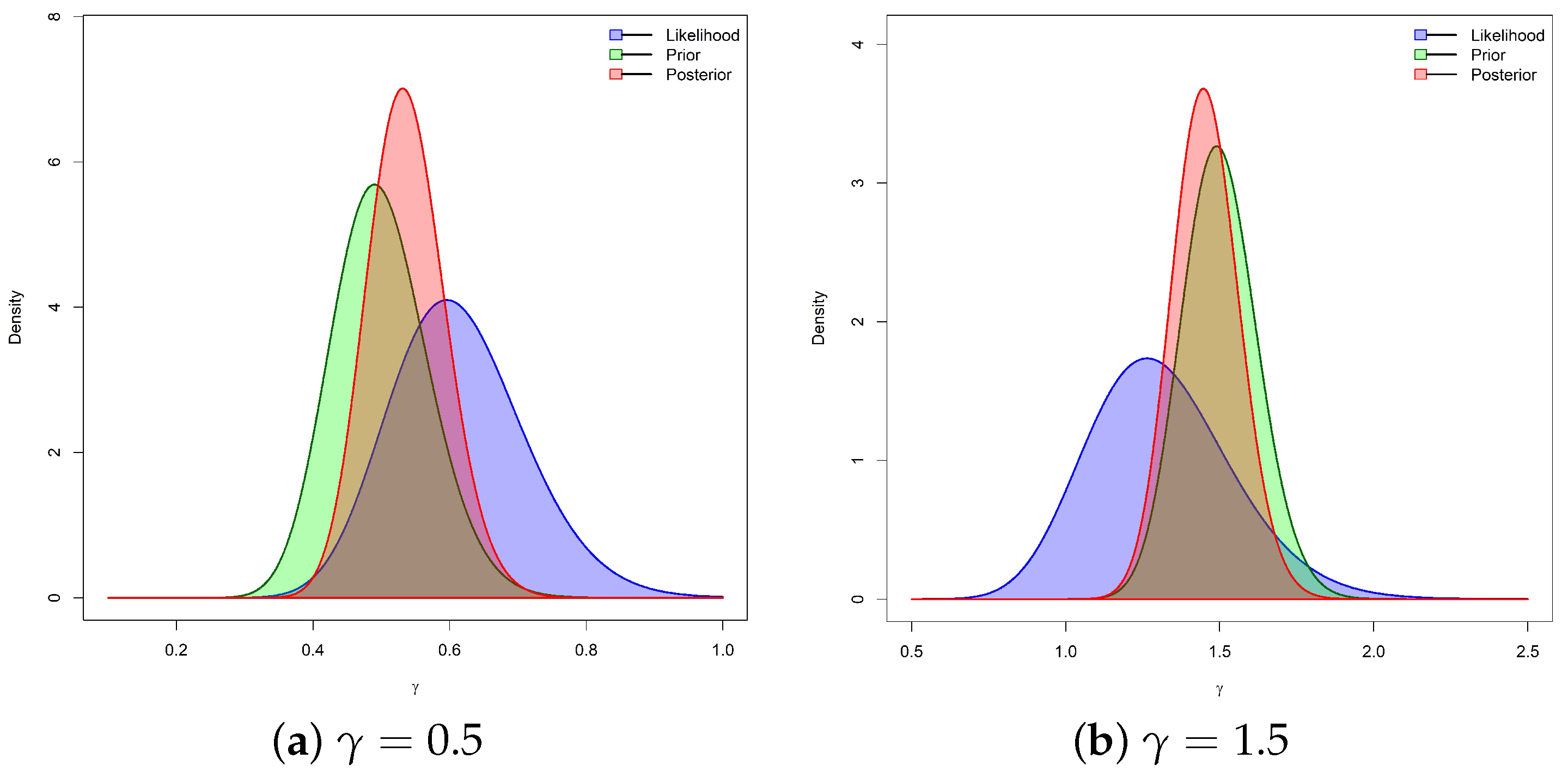
Using the same censoring setting used in
Figure 1,
Figure 2 further illustrates that the posterior distribution in (
11) closely resembles a normal density. Consequently, in Algorithm 1, the normal proposal density within the Metropolis–Hastings (M-H) algorithm for updating
is utilized. This choice ensures efficient sampling and facilitates reliable computation of Bayes point (or credible) estimates for all unknown parameters.
| Algorithm 1 MCMC Sampling for |
- 1:
Input: Initial estimate , variance estimate , total iterations , burn-in period , confidence level - 2:
Initialize - 3:
Set iteration counter - 4:
while
do - 5:
Generate candidate - 6:
Compute - 7:
Generate - 8:
if then - 9:
- 10:
else - 11:
- 12:
end if - 13:
Update and by replacing with - 14:
- 15:
end while - 16:
Discard first samples (burn-in) and retain - 17:
Compute posterior mean estimate - 18:
Compute HPD interval: - 1.
Sort retained values as - 2.
For each compute - 3.
Find - 4.
HPD interval
- 19:
Redo Steps 17–18 for and
|
Posterior inference for the parameter is carried out using a random-walk M–H algorithm with a normal proposal distribution of the form where denotes the estimated standard deviation of the MLE of , obtained from the inverse of the observed FI matrix. The scaling factor b is selected through an adaptive tuning procedure during an initial burn-in phase to achieve a target acceptance rate between and , which is commonly recommended for one-dimensional random-walk algorithms.
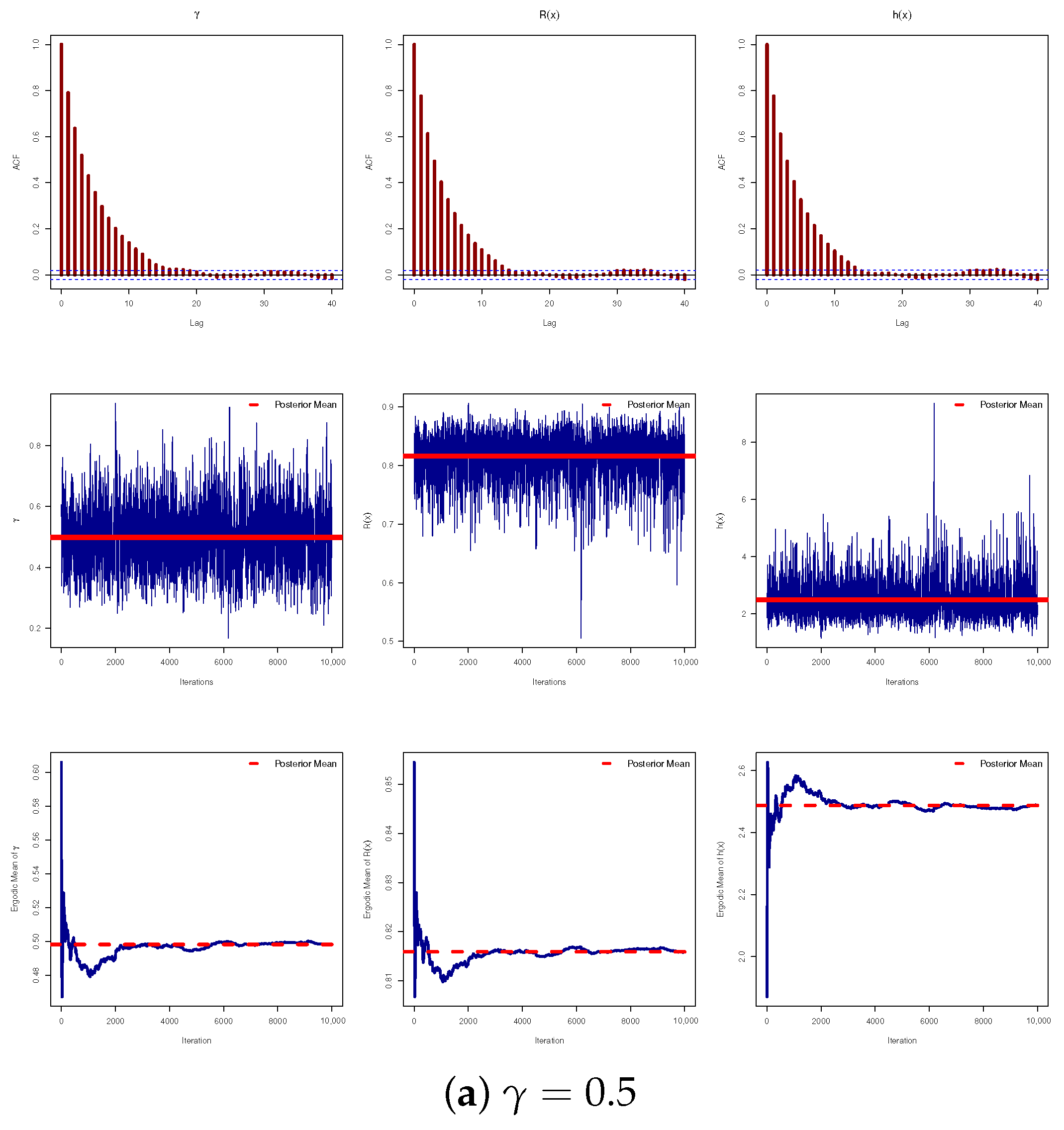
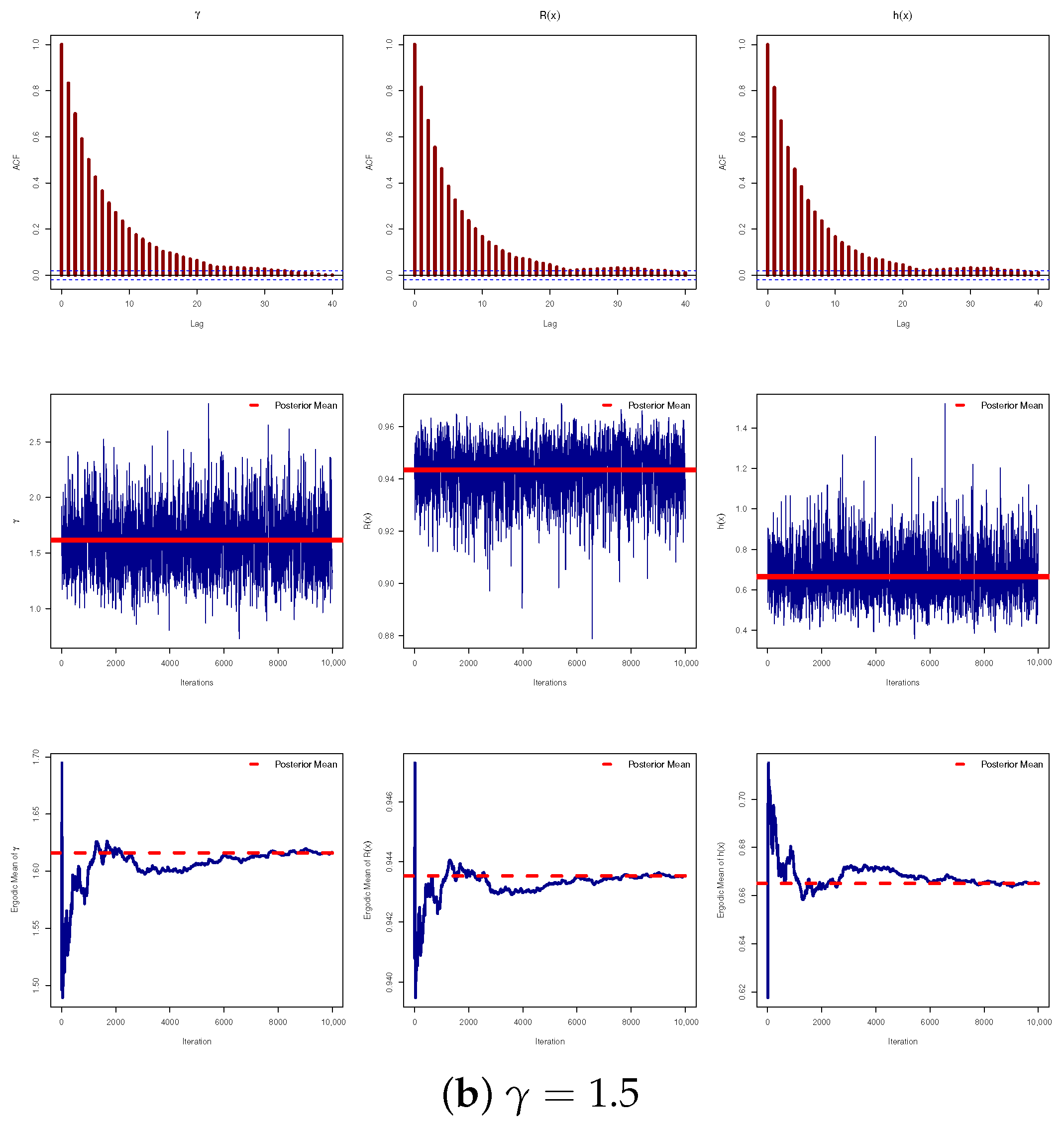
Figure 3 reports standard MCMC diagnostics for
,
, and
under two representative settings,
and
. For each parameter, the autocorrelation functions (ACFs), trace plots, and ergodic averages are shown to assess mixing and convergence. The ACFs decay rapidly toward zero, indicating limited serial dependence and satisfactory mixing of the chains across all parameters. Trace plots exhibit stable fluctuations around constant levels after a short transient period, with no evidence of multimodality or nonstationary behavior. The posterior means remain well centered within the sampled trajectories. Moreover, the ergodic averages stabilize quickly, suggesting that the chains have reached their stationary distributions and that Monte Carlo error is well controlled. Overall, these diagnostics provide strong evidence of reliable convergence and robustness of the MCMC algorithm across different values of
.
Figure 3.
The ACF, Trace, and Ergodic diagnostics of , , and .
Figure 3.
The ACF, Trace, and Ergodic diagnostics of , , and .
5. Real-World Applications
In this section, two real-world datasets, one on physical studies and the other on engineering, are analyzed to demonstrate the practical utility of the proposed estimation methods. These applications can be represented as
Physics Application: The monthly rainfall records from the Carrol rain gauge station in New South Wales serve as an important measure of regional climate variability. This information is valuable for tracking long-term weather patterns, guiding land use decisions, and supporting sustainable farming practices. This example records monthly rainfall (in millimeters) observed at the Carrol rain gauge station, New South Wales, Australia, covering the period from January 2000 to February 2007; see
Table 8. This dataset was reanalyzed by Alotaibi et al. [
25].
Engineering Application: Analysis of vehicle fatalities in South Carolina offers an important perspective on regional variations in traffic-related mortality. Such examination is essential for enhancing transportation safety measures and allocating resources effectively to reduce preventable loss of life.
Table 8 reports the number of vehicle fatalities across (in day) thirty-nine counties in South Carolina during 2012 (www-fars.nhtsa.dot.gov/States); see Mann [
26].
Table 8.
Data points of physics and engineering applications.
Table 8.
Data points of physics and engineering applications.
| Application | Times |
|---|
| Physics | | 0.80 | | 0.80 | 1.80 | 3.00 | 4.70 | 4.80 | 5.10 | 5.90 | 6.40 | 6.60 |
| | | 6.70 | | 6.90 | 7.60 | 7.70 | 8.02 | 9.50 | 10.1 | 11.2 | 12.0 | 12.7 |
| | | 13.9 | | 14.0 | 15.0 | 15.4 | 17.3 | 17.7 | 17.9 | 19.4 | 19.7 | 20.4 |
| | | 21.1 | | 22.7 | 23.8 | 23.8 | 24.5 | 24.5 | 25.7 | 27.2 | 28.6 | 29.2 |
| | | 29.7 | | 31.8 | 31.9 | 32.0 | 32.2 | 32.5 | 33.1 | 33.9 | 36.5 | 37.2 |
| | | 37.7 | | 39.4 | 39.5 | 41.6 | 41.6 | 42.5 | 44.5 | 46.3 | 49.5 | 49.9 |
| | | 50.2 | | 50.7 | 51.6 | 52.5 | 53.9 | 55.2 | 55.2 | 55.8 | 57.2 | 59.0 |
| | | 59.7 | | 62.3 | 62.8 | 65.8 | 67.9 | 71.6 | 73.7 | 73.8 | 75.5 | 76.1 |
| | | 84.0 | | 85.7 | 98.7 | | | | | | | |
| Engineering | | 0.1 | | 0.2 | 0.3 | 0.4 | 0.4 | 0.5 | 0.6 | 0.6 | 0.8 | 0.9 |
| | | 0.9 | | 0.9 | 0.9 | 1.0 | 1.2 | 1.2 | 1.3 | 1.3 | 1.3 | 1.4 |
| | | 1.5 | | 1.6 | 1.6 | 1.7 | 1.7 | 2.0 | 2.0 | 2.2 | 2.3 | 2.6 |
| | | 2.7 | | 3.1 | 3.3 | 4.8 | 4.8 | 5.0 | 5.1 | 5.2 | 6.8 | |
Prior to applying the theoretical estimation procedures, the suitability of the XLindley distribution was examined using the BC dataset, summarized in
Table 8. This preliminary assessment utilized the Kolmogorov–Smirnov (
) test along with its corresponding
p-value to evaluate the goodness of the model; see the code script reported in
Appendix B. In addition, the MLE of
, along with its standard error (SE) and 95% ACI-NA/ACI-NL intervals (including the interval widths (IWs)), was computed (see
Table 9). The results demonstrate that the XLindley distribution offers an excellent fit to both the physics and engineering datasets.
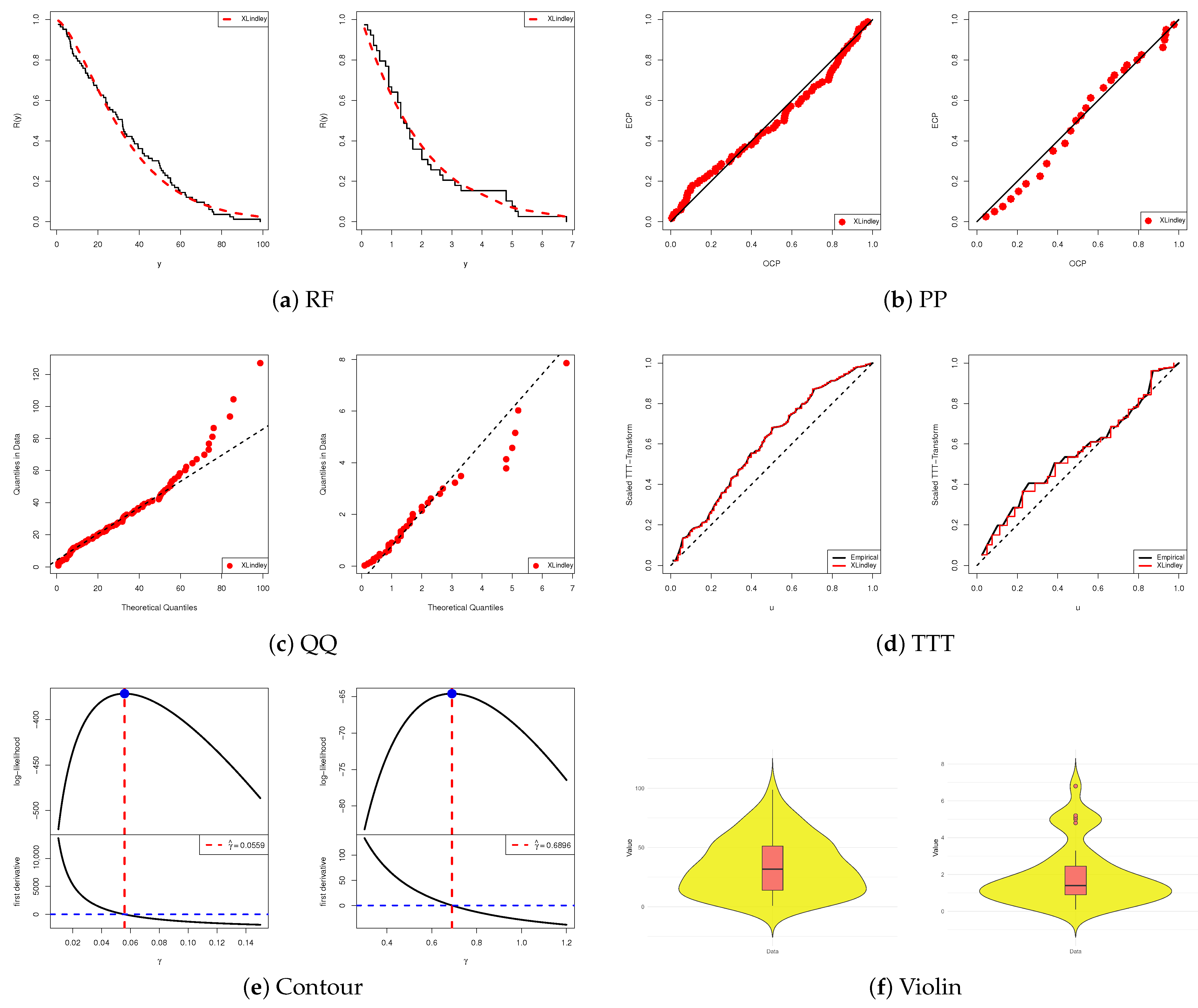
Using graphical visualization for conveying model-fitting,
Figure 5 shows diagnostic plots for both datasets, including (a) empirical and fitted survival functions
, (b) probability–probability (PP) plot, (c) quantile–quantile (QQ) plot, (d) empirical and fitted scaled–TTT lines, (e) likelihood contour map, and (f) boxplot embedded within a violin representation.
Figure 5a–c confirms that the XLindley distribution adequately characterizes the observed data in both physics and engineering applications. Moreover,
Figure 5d indicates an increasing hazard function, consistent with the XLindley theoretical shapes. The contour maps in
Figure 5e further confirm the existence and uniqueness of the MLE
obtained from the physics and engineering datasets, justifying its use as an initial value in subsequent numerical routines to enhance computational efficiency and estimation accuracy. Finally,
Figure 5f shows that the physics dataset exhibits moderate right skewness, while the engineering dataset exhibits strong right skewness. For clarity and better visualization of the fit results, the numerical summaries previously reported in
Table 9 are presented graphically in
Figure 5.
To calculate the acquired estimates of
,
, and
for the full physics and engineering datasets, G-PH-CS samples were generated under different specifications of
and
, with
for the physics data and
for the engineering data (see
Table 10). Since no prior information on the XLindley
parameter was available for these datasets, Bayesian estimation was performed using
and
.
In
Table 10, both point estimates (with SEs) and interval estimates (with IWs) of
,
, and
were obtained via maximum likelihood and Bayesian approaches (see
Table 11). For consistency, results are reported at
for the physics data and
for the engineering data. The findings indicate that Bayesian estimates—particularly those derived from the Markovian sampling process—consistently outperform their frequentist counterparts, yielding smaller standard errors and narrower intervals, thereby demonstrating greater inferential efficiency.
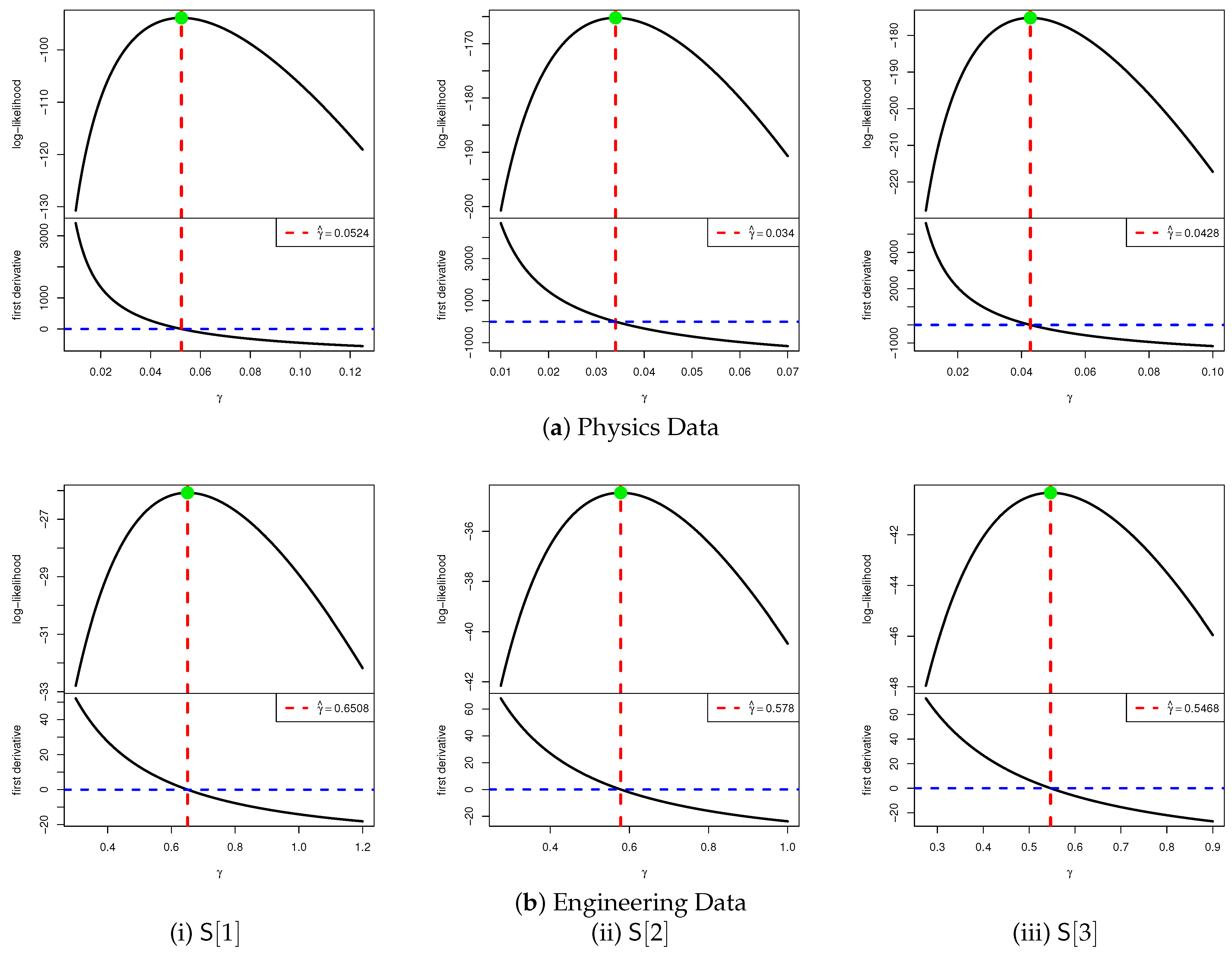
To illustrate the existence and uniqueness of the proposed MLEs
,
Figure 6 displays contour plots of the log-likelihood equation of
under the censoring schemes
, generated in
Table 10. Across different values of
and for all G-PH-CS datasets in
Table 10,
Figure 6 confirms that the estimates
exist and are unique. These results are matched with the same in
Table 11 and further suggest that the values of
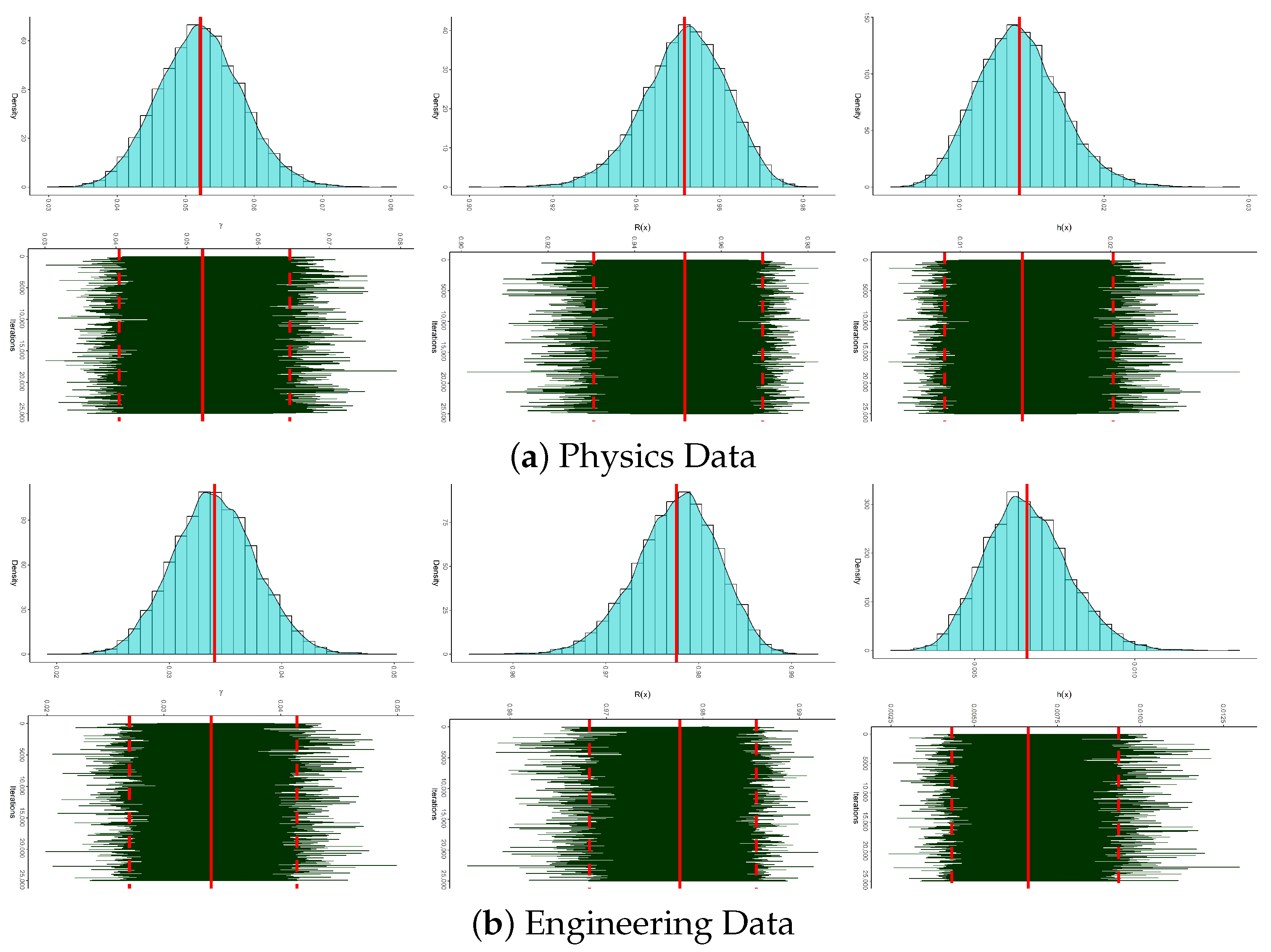
obtained for each sample can serve as effective initial values in subsequent Bayesian iterations. To evaluate the Markov convergence chain samples of
,
, and
, trace and posterior density plots are presented in
Figure 7. The subplots in
Figure 7 are based on
from the physics and engineering datasets as a representative case.
Figure 7 shows that the 30,000 residual MCMC-based iterations for each parameter have sufficient convergence. They also reveal that the posterior estimates of
,
, and
behave symmetrically, negatively skewed, and positively skewed, respectively. Furthermore, descriptive statistics—including the mean, mode, first three quartiles, standard deviation (SD), and skewness—of
,
, and
are summarized in
Table 12. All calculated metrics in
Table 12 confirm and validate the convergence trends seen in
Figure 7.
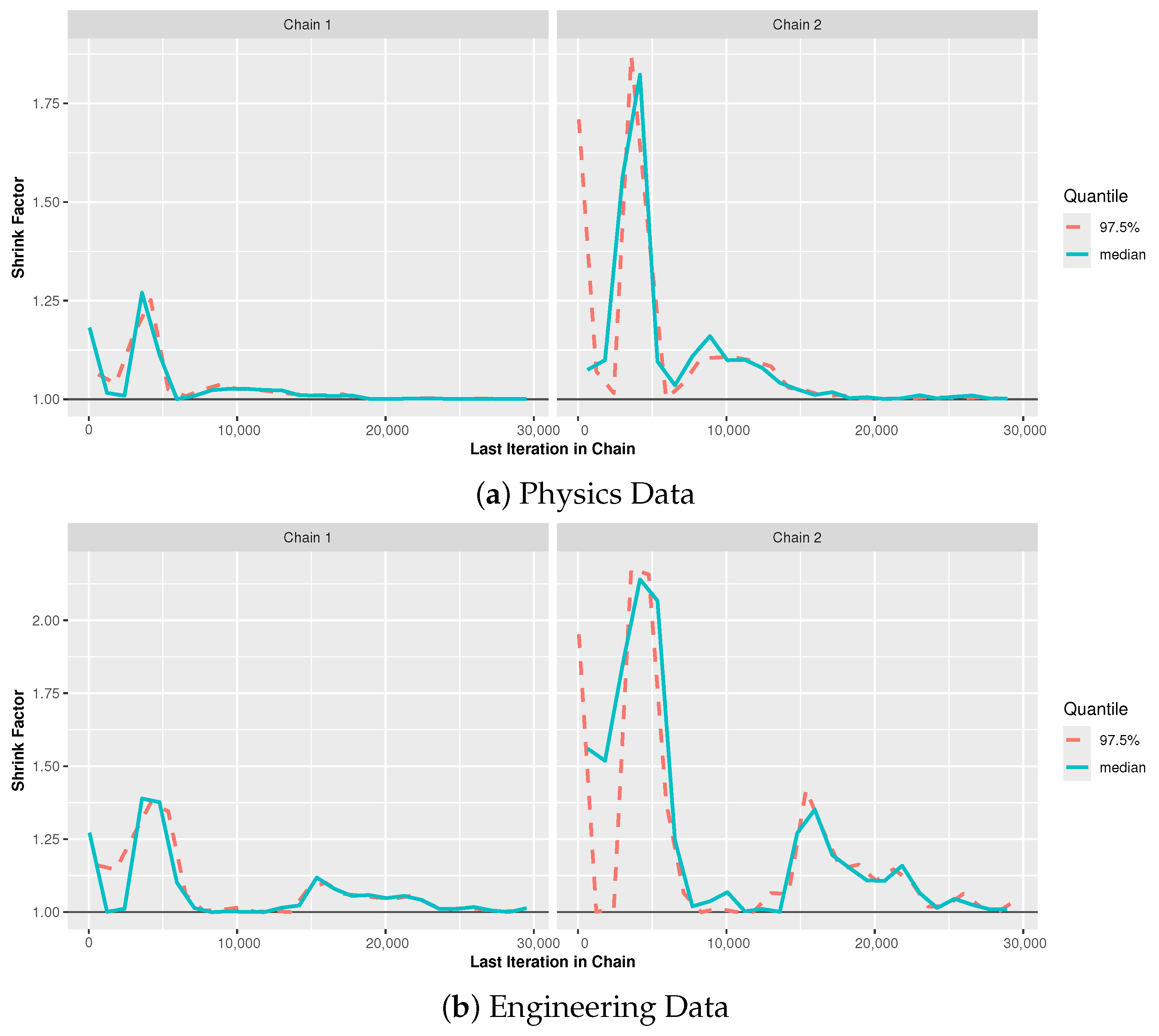
Again based on
from the physics and engineering datasets as a representative case, in addition to trace plots depicted in
Figure 7, convergence of the MCMC chains was formally assessed using the Gelman–Rubin potential scale reduction factor based on multiple parallel chains with dispersed initial values; see
Figure 8. The PSRF values were all close to one, confirming satisfactory convergence and adequate mixing of the MCMC samples.
6. Conclusions, Practical Recommendations, and Future Research
This study developed a comprehensive and flexible reliability inference framework for the XLindley distribution under the G-PH-CS, addressing both theoretical and practical challenges commonly encountered in censored lifetime experiments. The main findings, recommendations, and potential research of the study can be summarized as follows:
6.1. Conclusions
Likelihood-based inference was established, and MLEs along with their ACIs were derived for the model parameter, reliability function, and hazard rate. In parallel, a Bayesian inference framework based on gamma priors was formulated, providing coherent uncertainty quantification and complementing the classical approach.
Extensive simulation studies demonstrated that both classical and Bayesian estimators perform reliably across a wide range of experimental configurations, including different threshold times, sample sizes, censoring limits , and censoring schemes. The estimators consistently exhibited low bias, small mean squared error, reasonable interval lengths, and coverage probabilities close to nominal levels, confirming their robustness under repeated sampling.
Applications to real datasets from physics and engineering further illustrated that the proposed procedures are not only theoretically sound but also effective for modeling real-life failure mechanisms under realistic censoring constraints. By embedding the XLindley distribution within the G-PH-CS framework, the study broadened the applicability of hybrid censoring methodologies and provided practitioners with a flexible and reliable tool for lifetime data analysis.
An additional advantage of the proposed censoring framework is its inherent robustness to extreme observations. By terminating the experiment once at least failures are observed—even when failures are initially planned—and the G-PH-CS naturally limits the influence of excessively large lifetimes, which are often regarded as outliers in reliability applications. This design-based robustness yields stable likelihood-based inference without explicitly invoking robust likelihood formulations.
6.2. Practical Recommendations
From a practical standpoint, the results provide actionable guidance for designing efficient life-testing experiments under G-PH-CS. The simulation findings indicate that no single censoring scheme is universally optimal; rather, the choice should be guided by the practitioner’s primary inferential objective and operational constraints.
When the main goal is accurate estimation of the model parameter, right-censoring schemes are recommended due to their ability to retain informative early and mid-range failure times while reducing testing duration. For inference on the reliability function, left-censoring designs are preferable, as early failures carry substantial information about survival probabilities. Estimation of the hazard rate benefits most from middle-censoring schemes, which preserve failure information around the central portion of the lifetime distribution and provide balanced local information.
In real testing environments, censoring strategies are rarely selected solely to maximize statistical efficiency. Instead, practitioners must balance inferential precision against experimental cost, testing time, and logistical considerations. Middle-censoring designs often offer a reasonable compromise, delivering stable inferential performance across multiple targets while maintaining manageable experimental costs.
6.3. Future Research Directions
Several promising directions emerge from the present work. First, although the current study focuses on statistical efficiency, future research could formalize the design of censoring schemes by incorporating explicit cost functions and efficiency criteria, leading to optimal cost–efficiency trade-offs under G-PH-CS.
Second, the inherent robustness of the proposed censoring framework motivates further extensions that explicitly integrate robust likelihood techniques, such as M-estimation or divergence-based approaches, to enhance performance in the presence of severe outliers.
Additional extensions may include multivariate lifetime models, accelerated life-testing experiments, competing risks, and more complex system reliability structures. Exploring Bayesian model comparison, hierarchical prior formulations, and adaptive censoring strategies also constitutes valuable future work.
Overall, the proposed framework provides a solid methodological foundation for reliability analysis under generalized progressive hybrid censoring and opens several avenues for further theoretical development and practical innovation.