Article

Mississippi Valley-Type Mineralization in the Atlasic Beni Snassen Belt (Northeastern Morocco): Petrography and C-O-S-Pb Isotopic Evidence for Basin Evolution Linked to Africa–Europe Collision


1
Geology and Sustainable Mining Institute, Mohammed VI Polytechnic University (UM6P), Benguerir 43150, Morocco
2
Laboratoire Géo-Patrimoine, Géo-Environnement & Prospection Minière et Hydrique, Faculté des Sciences, B.P. 717, Oujda 60000, Morocco
3
Laboratory of High Energy Physics, Astrophysics and Geosciences, Faculty of Sciences Semlalia, Cadi Ayyad University, UCA, P.B. 2390, Marrakech 40000, Morocco
4
Instituto de Geociencias UNAM-Campus Juriquilla, AP 1-253, Querétaro CP 76230, Mexico
5
Department of Geosciences, University of Arkansas, 340 N Campus Drive, Fayetteville, AR 72701, USA
6
Institute of Life-Earth-Environment (ILEE), University of Namur, 61 Rue de Bruxelles, B-5000 Namur, Belgium
7
Geology Department, California State University, San Bernardino, CA 92407, USA
*
Author to whom correspondence should be addressed.
Minerals 2026, 16(4), 376; https://doi.org/10.3390/min16040376
Submission received: 1 March 2026 / Revised: 27 March 2026 / Accepted: 30 March 2026 / Published: 1 April 2026
(This article belongs to the Special Issue Genesis of Mississippi Valley-Type Ore Deposits)

Abstract

The Beni Snassen belt (northeastern Morocco) hosts several Mississippi Valley-type Pb-Zn ± Cu occurrences localized along the Variscan basement/Lower Liassic carbonate interface within the Atlasic foreland system. This study integrates geological observations with organic petrography and C-O-S-Pb isotopic systematics to constrain the origin of mineralizing fluids, metal source, and ore-forming processes within a basin-scale metallogenic system. The host sequence consists of unmetamorphosed, dolomitized Pliensbachian carbonates with marl interbeds and organic-rich black shales. Mineralization is structurally focused along ENE-WSW and E-W faults and occurs as massive calcite-galena veins, “en échelon” tension gashes, vug fillings, and solution-collapse breccias. Ore-stage calcite exhibits restricted isotopic variability (δ13C = −4.7 to +1.2‰; δ18O = 14.9 to 19.7‰), consistent with rock-buffered basinal fluids and extensive fluid–carbonate interaction. Calculated δ18OH2O values indicate precipitation from evolved saline brines variably mixed with meteoric waters. Galena δ34S values (−20.9‰ to +10.3‰) reflect thermochemical sulfate reduction (TSR) under fluctuating redox conditions. Pb isotope compositions define a tight linear cluster between upper crust and orogene growth curves, indicating a predominantly upper crustal metal source, notably Triassic dolerite–diabase lithologies, with a possible contribution from organic-rich black shales. High-reflectance pyrobitumen (VR0 up to 4%) indicates thermal conditions exceeding those predicted by local burial history, supporting long-distance migration of hydrocarbon-bearing metalliferous fluids from overpressured basin compartments, most plausibly the adjacent Neogene Guercif Basin. Fault reactivation during Late Miocene transtension fostered basin-scale fluid focusing and ore deposition. Hence, the Beni Snassen district represents a basin-integrated MVT system involving crustal metal leaching, organic-assisted metal transport, TSR-mediated sulfur reduction, and structurally focused fluid flow. These results refine metallogenic models for the Atlasic belts and highlight the exploration potential of structurally reactivated foreland basins hosting coupled hydrocarbon-hydrothermal systems.

1. Introduction

The decarbonization of global energy systems has intensified demand for critical and strategic metals, many of which are subject to supply limitations arising from geopolitical and geological constraints. While carbonatites and alkaline complexes have traditionally been targeted for such commodities, sediment-hosted hydrothermal systems, particularly Mississippi Valley-type (MVT) deposits, are increasingly recognized as alternative or complementary resources. These epigenetic, carbonate-hosted Pb-Zn ± Cu ± Ba ± F deposits form through basin-scale circulation of saline brines independent of contemporaneous magmatism and are temporally linked to major geodynamic events, such as the assembly of Pangea and Alpine-Laramide orogenesis [1,2]. Although historically exploited for Pb and Zn, MVT systems commonly contain a range of strategic metals (Ag, Cu, In, Ge, Ga, Cd, and Co) that may be recovered as by-products. The rising demand for these elements has stimulated renewed interest in MVT systems, broadening exploration strategies to encompass both primary sulfide mineralization and associated supergene enrichment zones.
The Moroccan Atlas range represents a major metallogenic province for MVT mineralization in North Africa. More than 100 deposits and prospects are recognized, grouped into two principal hydrological domains: the Jurassic Pb-dominant Atlas province and the Cretaceous Zn-dominant Diapir Zone province [3]. The Atlas province hosts several large and high-grade deposits, notably Touissit-Bou Beker (>100 Mt at 4% Pb, 3.5% Zn, <1% Cu and 120 g/t Ag) [4,5], Upper Moulouya (>30 Mt at 4% Pb) and Jbel Bou Dahar (>30 Mt at ~4% Pb, ~4% Zn) [6], highlighting the metallogenic fertility of the region.
At the northeastern margin of this province, the Beni Snassen belt contains multiple MVT occurrences concentrated along the Variscan basement–Lower Liassic carbonate interface. Their spatial proximity to the world-class Touissit-Bou Beker district (Figure 1), combined with comparable geological settings, structural architecture, and mineral assemblages, points to a common metallogenic framework. However, no comprehensive study has yet addressed the origin of mineralization in this belt. This contribution provides the first integrated assessment of the Beni Snassen MVT system, combining geological observations with organic petrography, C-O-S-Pb isotopic constraints to elucidate fluid sources, metal provenance, and ore deposition processes, with direct implications for regional metallogenic models and exploration targeting across the Atlasic belts.

2. Geological Setting

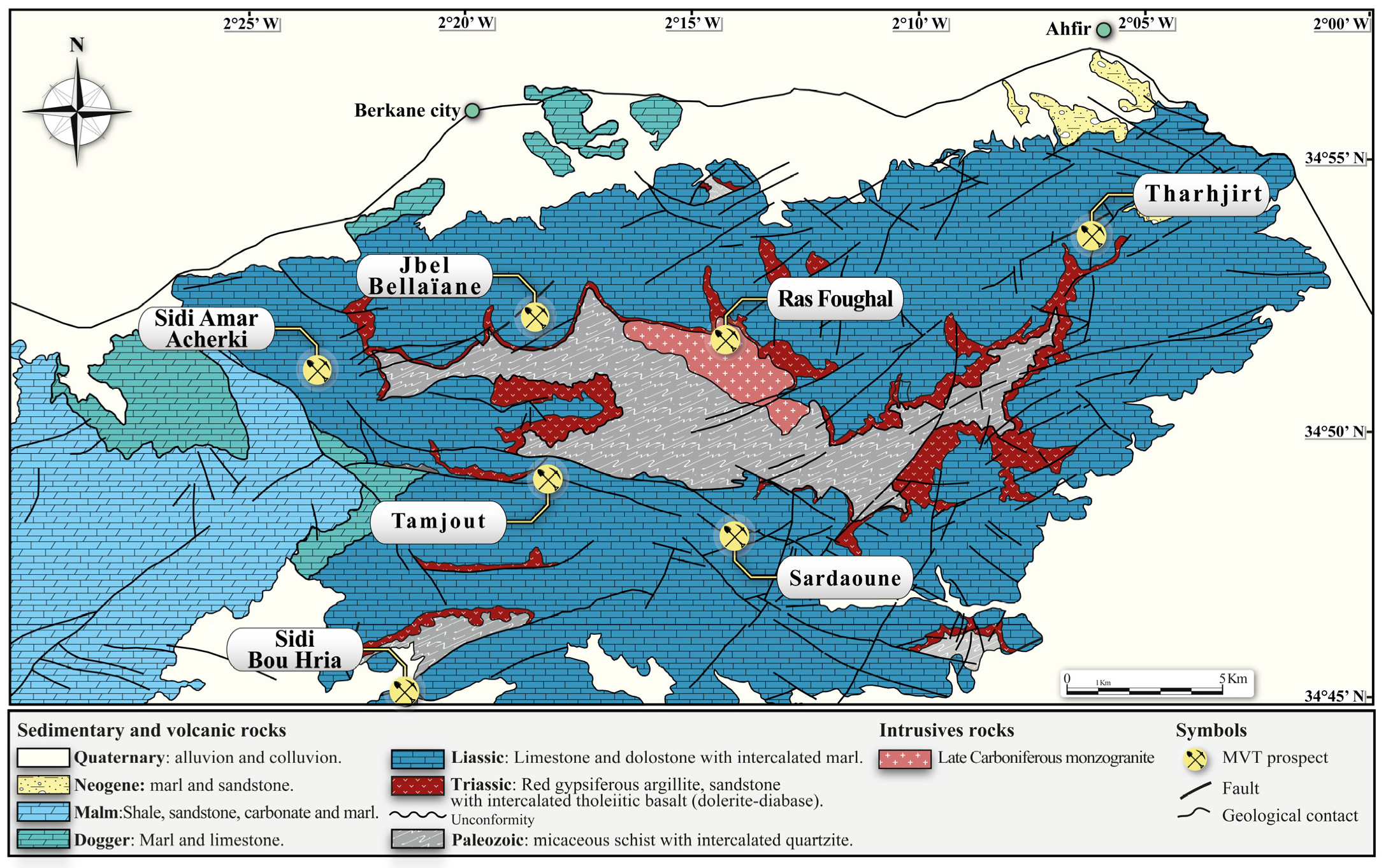
The Beni Snassen belt is an E-W-trending, structurally segmented Mesozoic–Cenozoic foreland basin that developed within the Atlas domain in response to crustal loading during Cenozoic Africa–Europe convergence [8,9,10]. The belt is bounded by the Triffa trough and Kebdana massif to the north, the Beni Bou Yahi chain to the west, the Neogene Guercif-Angad Basin to the south, and the Traras chain of Algeria to the east (Figure 1). Structurally, it is subdivided into western and eastern tectonostratigraphic domains; the latter hosts the investigated MVT prospects and forms the focus of this study. The western domain is dominated by Upper Jurassic strata forming a perched syncline, whereas the eastern domain corresponds to a ~30 km long and ~15 km wide N60°-trending antiform (Figure 2).
The Mesozoic–Cenozoic evolution of the Beni Snassen parallels that of the broader Atlasic system and reflects three major geodynamic stages that influenced basin architecture and fluid circulation. An initial Triassic–Early Jurassic rifting phase, linked to the breakup of Pangea and opening of the North Atlantic and Maghrebian Tethys, established extensional basin architecture [3,11,12,13,14]. This was followed by Jurassic–Cretaceous post-rift thermal subsidence and passive margin sedimentation [15,16,17]. Subsequent Late Cretaceous to Cenozoic compression related to Africa–Europe convergence resulted in inversion, uplift, and reactivation inherited rift structures [10,18]. Progressive exhumation of the Paleozoic basement generated a structurally complex framework favorable for basin-scale hydrothermal circulation and MVT mineralization.
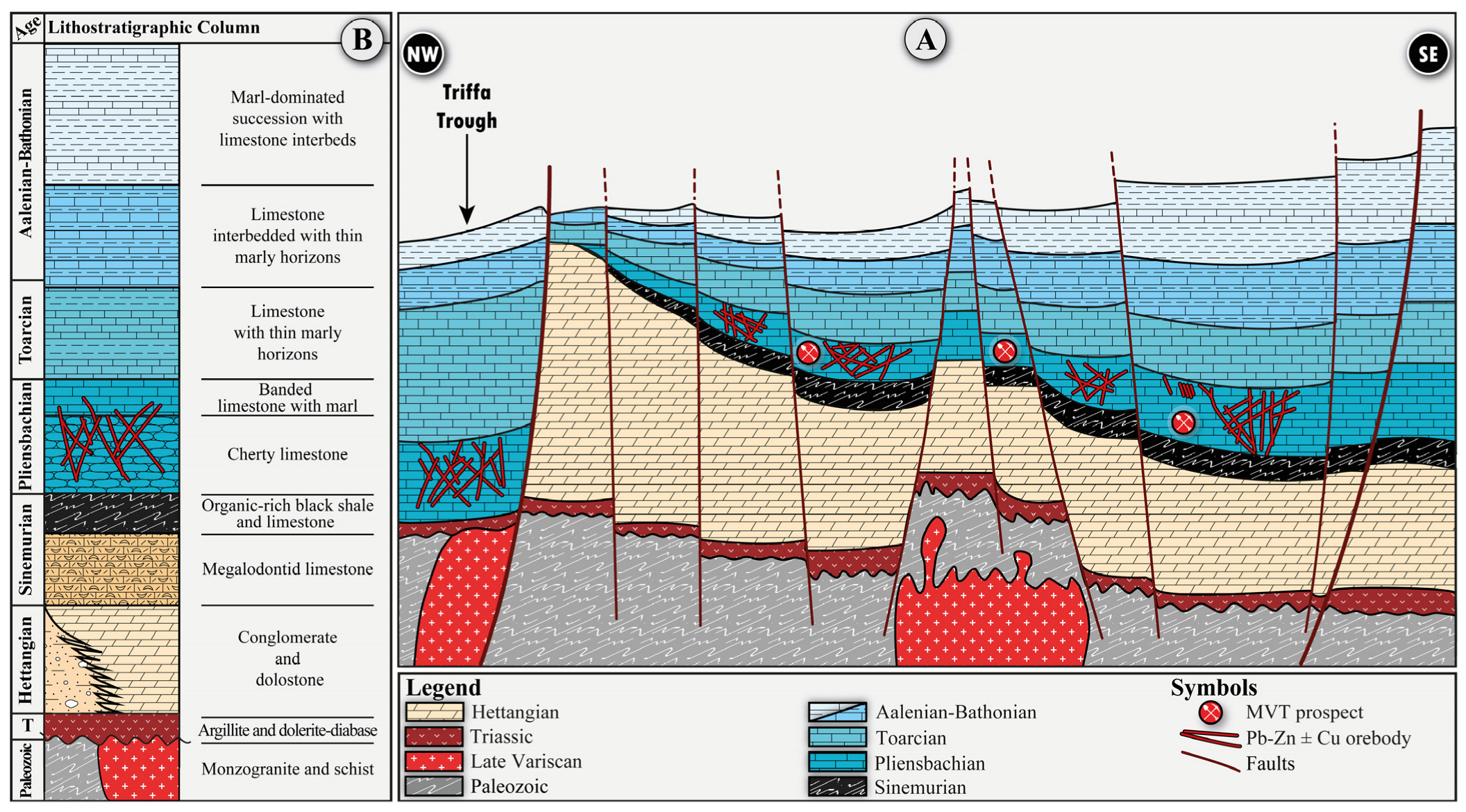
Stratigraphically, the belt comprises a Paleozoic basement unconformably overlain by Mesozoic to Quaternary sedimentary sequences (Figure 2 and Figure 3). The basement is sporadically exposed as small inliers within the eastern domain and consists of Devonian-Visean [19,20] turbiditic flysch (arenites, wackes, siltstones, pelites), locally intruded by a Late Carboniferous calc-alkaline monzogranite dated at 308.2 ± 2.7 Ma based on LA-ICP-MS U-Pb geochronology on zircon [21]. Low-grade regional metamorphism is indicated by phyllosilicate assemblages.
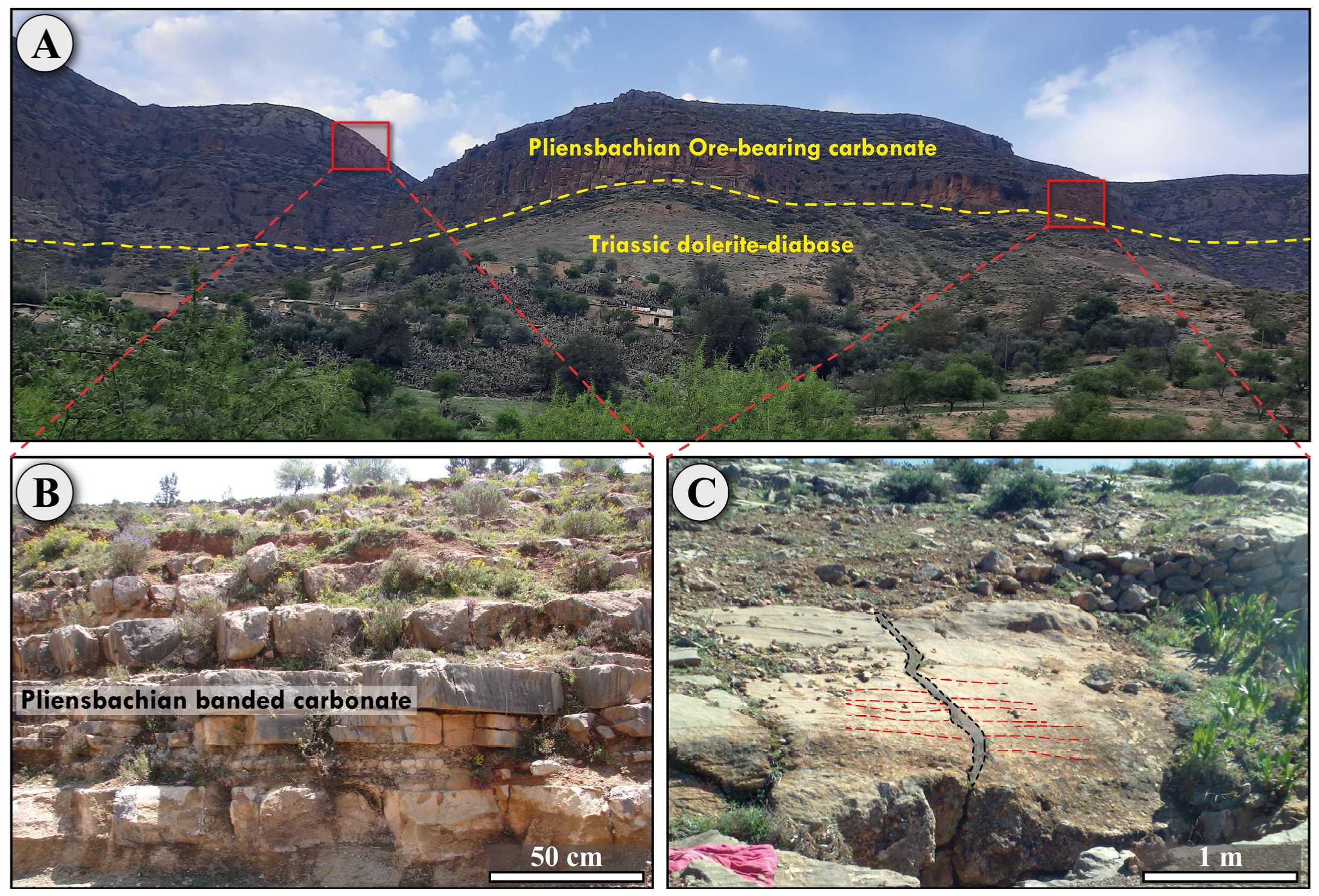
The overlying Triassic syn-rift succession (400–500-m-thick) includes red beds, salt-bearing argillites, and Central Atlantic Magmatic Province (CAMP) basaltic flows, grading upward into a Jurassic–Cretaceous post-rift sequence comprising Hettangian–Bajocian carbonates with marls interbeds (Figure 4), Bathonian–Oxfordian siliciclastic deposits (sandstones and sandy clays), Kimmeridgian–Tithonian carbonate platforms, and Lower Cretaceous sandstones [23,24,25]. Tertiary deposits rest unconformably on both Paleozoic and Mesozoic units and consist of Middle Miocene marls and sandstones, as well as Late Miocene marl-rich olistostromes. Quaternary continental sediments locally cap the stratigraphic pile.
The structural framework of the mineralized carbonate sequence is dominated by ENE-WSW and E-W-striking reactivated Atlasic faults, with subordinate NNW-SSE structures (Figure 1 and Figure 2). These faults produced a “piano key” horst-and-graben architecture and extend to depths exceeding 3 km [26,27]. This tectonic configuration exerted first-order control on basin architecture and sedimentary infill, fluid migration pathways, thereby controlling the timing, localization, and efficiency of mineralizing processes.

3. Mineralization Styles, Hydrothermal Alteration, and Paragenesis

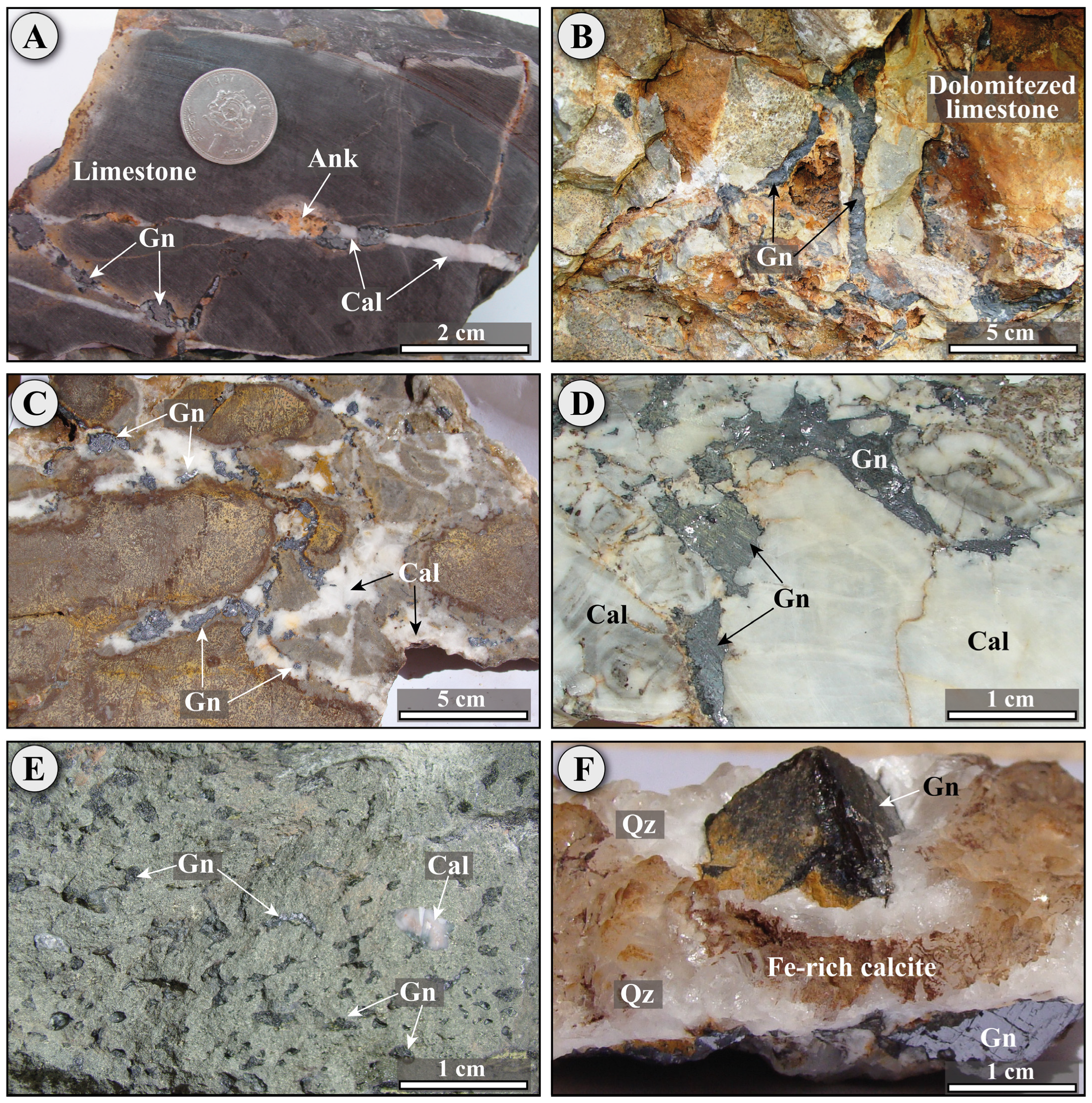
The eastern segment of the Beni Snassen belt hosts numerous MVT occurrences that were historically exploited on a small scale using artisanal mining methods, leaving behind abandoned galleries (Figure 5) and shallow excavations developed for targeting Pb-Zn ± Cu extraction. Notable prospects [28] include Sidi Bou Hria, Tamjout, Sidi Amar Acherki, Jbel Bellaïane, Ras Foughal, Tharhjirt, and Sardaoune (Figure 2). The Pb-Zn ± Cu mineralization is spatially associated with a major unconformity that separates Lower Liassic (Pliensbachian) sedimentary rocks from the underlying Variscan crystalline basement. Although mineralization affects all Lower Liassic stratigraphic levels, Triassic carbonates and dolerite–diabase host only sparse and uneconomic Pb-Zn disseminations (Figure 5).
Economically significant Pb-Zn ± Cu mineralization is hosted primarily by Pliensbachian massive to nodular cherty limestones and occurs as massive calcite-galena vein infillings, veinlets, “en échelon” tension gashes, vuggy pore spaces, and solution-collapse breccias localized along ENE-WSW and WSW-NNE fault systems (Figure 5). Individual veins commonly reach up to 100 m in length and several tens of centimeters in width and correspond to dilatational segments within dextral strike–slip fault systems. Vein margins are sharp and locally surrounded by halos of disseminated pyrite and galena-calcite ± quartz veinlets.
Across the district, ore deposition is strongly controlled by a multiscale fracture network, with shattered and brecciated zones acting as high-permeability conduits for mineralizing fluids. Consequently, sulfides are localized along fault zones, within solution-collapse breccias (Figure 5C,D), and as replacement bodies adjacent to faults and breccia margins, with the bulk of the ore hosted by veins and veinlets (Figure 5A,B) related to dextral strike-slip fault systems. Irrespective of mineralization style, the vein assemblage is remarkably uniform and dominated by galena and calcite with subordinate pyrite, sphalerite, chalcopyrite and quartz, reflecting a coherent hydrothermal system.
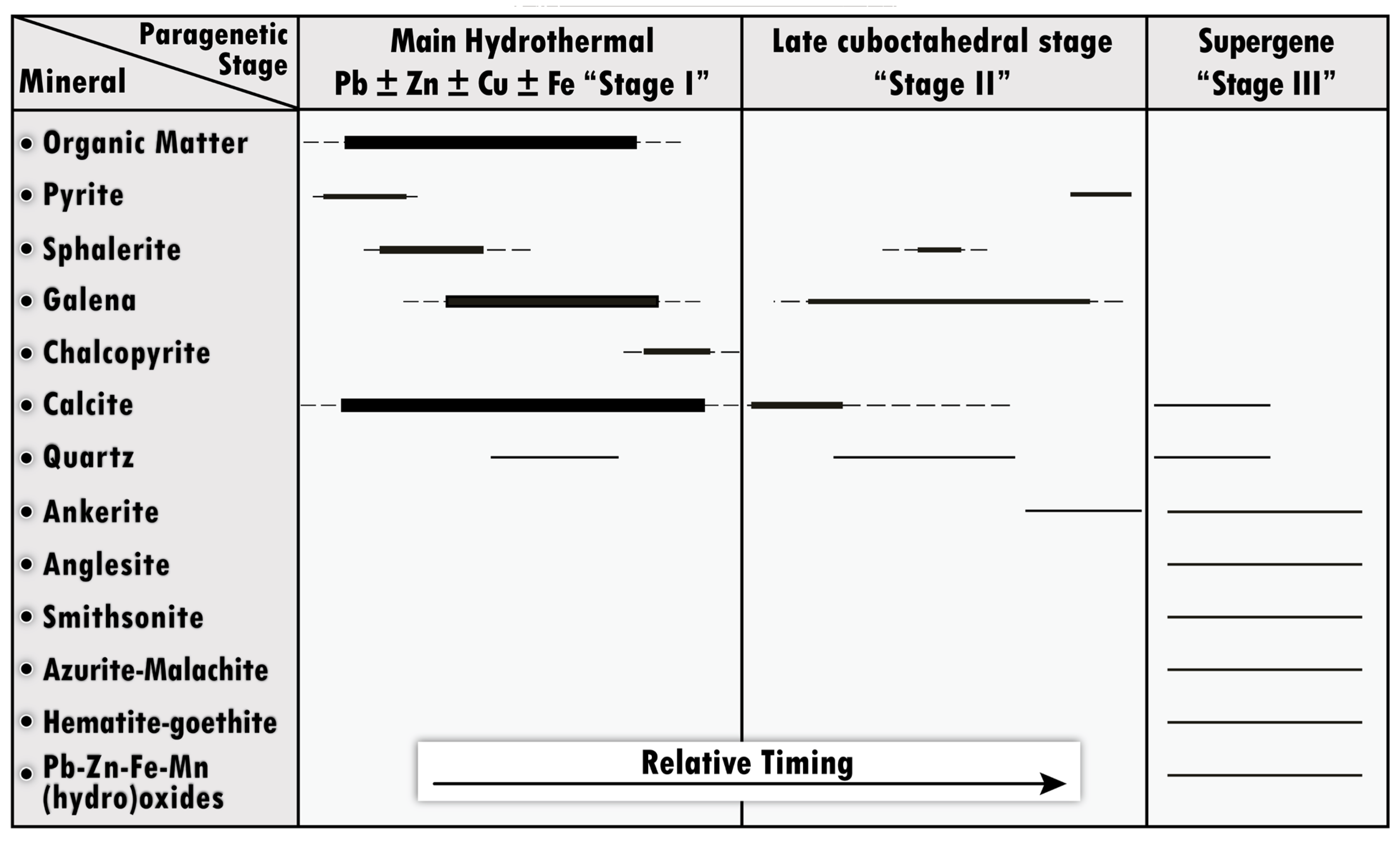
Paragenetic relationships reveal a three-stage mineralizing history characterized by overlapping hydrothermal and supergene processes (Figure 6). The earliest stage, referred to as the main-stage ore, is Pb-rich and dominated by pyrite and galena, with minor sphalerite and chalcopyrite, commonly associated with solid pyrobitumen. Gangue minerals are primarily hydrothermal spathic calcite, with subordinate quartz. The second stage, termed the late cuboctahedral stage, is volumetrically minor and characterized by vug-filling galena occurring as cubic crystals with octahedral modifications, locally encrusted on quartz and calcite (Figure 5F). Although texturally late, this stage is interpreted as the product of waning hydrothermal activity within residual open spaces and tectonically generated fractures, rather than a distinct mineralizing event. The third stage corresponds to a supergene overprint resulting from weathering of primary sulfides, producing secondary Pb-Zn ± Cu carbonates and oxides, including malachite, azurite, cerussite, smithsonite (“red calamine”, [29]), as well as Fe- and Mn-(hydr)oxides, ferroan calcite, and minor quartz. The overall paragenetic evolution reflects the combined role of structural focusing and fluid–rock interaction, as well as supergene processes in shaping MVT mineralization in the Beni Snassen belt.

4. Sampling and Analytical Methods

Representative samples of sulfides and associated gangue minerals from the main-stage ore and, to a lesser extent, from the cuboctahedral stage were collected along two belt-scale traverses, extending ~50 km E-W and ~20 km N-S (Figure 2). Sampling targeted both underground workings and fresh surface exposures to ensure optimal preservation of primary mineralogical and geochemical signatures. Sulfide and calcite separates were obtained by meticulous handpicking from crushed material to achieve high-purity concentrates (>99%). The sampling spans all stratigraphic ore-bearing horizons, from fine-grained Pliensbachian cherty limestones to massive carbonate and shaly units. This comprehensive dataset was acquired as part of a broader regional assessment of Moroccan MVT deposits [28], providing a robust foundation for evaluating fluid sources, metal distribution, and ore-forming processes at the belt scale.
Organic matter concentrates were prepared following the procedure of [30], including extraction, preparation, and polishing of transparent kerogen smear-mounts. Polished rock slabs and standard polished petrographic thin sections were also examined to document the spatial and textural relationships between organic matter and mineralization. Vitrinite reflectance (VR0) measurements were conducted primarily on vitrinite and solid bitumen to constrain thermal maturity. Bitumen reflectance (BR0) values were converted to equivalent vitrinite reflectance using the equation of [31]. Maximum vitrinite reflectance values (VR0max) were calculated from random reflectance measurements using the relation VRo max = (VRo random × 1.09) − 0.034 [32]. Furthermore, peak paleotemperatures (Tpeak) were estimated following [32] using the equation Tpeak (vitrinite reflectance geothermometers, VRG) = 0.00782 ln(Rv) + 1.19.
Stable carbon, oxygen, and sulfur analyses, together with radiogenic Pb isotope measurements, were performed on mineral separates spanning the complete paragenetic sequence. Carbon and oxygen isotope measurements were carried out at the U.S. Geological Survey (Colorado) using conventional gas-source mass spectrometry, with data reported relative to V-PDB and V-SMOW, respectively. Oxygen isotope compositions of the mineralizing fluids (δ18OH2O) were calculated using the calcite-H2O fractionation equation of [33], assuming an average precipitation temperature of 120 °C as constrained by fluid inclusion data [28]. This approach enables a direct comparison between fluid isotopic signatures and regional reservoirs relevant to MVT mineralization. Sulfur isotope compositions were determined using a continuous-flow EA-IRMS system, consisting of Carlo Erba 110 elemental analyzer coupled to a Finnigan MAT Delta S isotope ratio mass spectrometer. Isotope ratios are reported as per mil (‰) deviations relative to the Canyon Diablo troilite (CDT) standard. Analytical precision, based on replicate measurements, is better than ±0.2‰ (2σ).
Lead isotope compositions were determined on galena separates using conventional dissolution and filament-loading techniques, with isotopic ratios normalized to NBS-981 standard. Complementary whole-rock Pb isotope analyses of selected host lithologies were performed at the University of the Basque Country after ion-exchange chromatographic separation and subsequent analysis by MC-ICP-MS. Analytical accuracy and reproducibility were assessed through repeated measurements of certified international reference standards, ensuring robust constraints on metal sources and crustal contributions.

5. Results

5.1. Petrography and Reflectance of Organic Matter

Organic petrography and vitrinite and pyrobitumen reflectance measurements were performed on ten representative samples from bitumen-rich Pb-Zn ores and associated Sinemurian carbonaceous black shales (Figure 3) considered potential metal source rocks. Maceral identification followed the ICCP classification scheme, distinguishing vitrinite, inertinite (including semi-fusinite), and liptinite groups. Reflectance measurements were conducted on randomly oriented vitrinite grains and solid bitumen (Table 1).
The organic assemblage is dominated by vitrinite (average 54.1 vol. % mmf, range 42–53 vol. %) and semi-fusinite (average 46 vol. % mmf, range 32–58 vol. %), with abundant bitumen occurrences. These constituents were identified using polarized reflected-light microscopy based on morphological criteria and subtle reflectance contrasts. The absence of liptinite reflects advanced thermal maturity. The occurrence of centimeter-scale spherical bitumen bodies indicates hydrocarbon mobilization and migration, consistent with hydrocarbon-assisted hydrothermal processes in the MVT system.
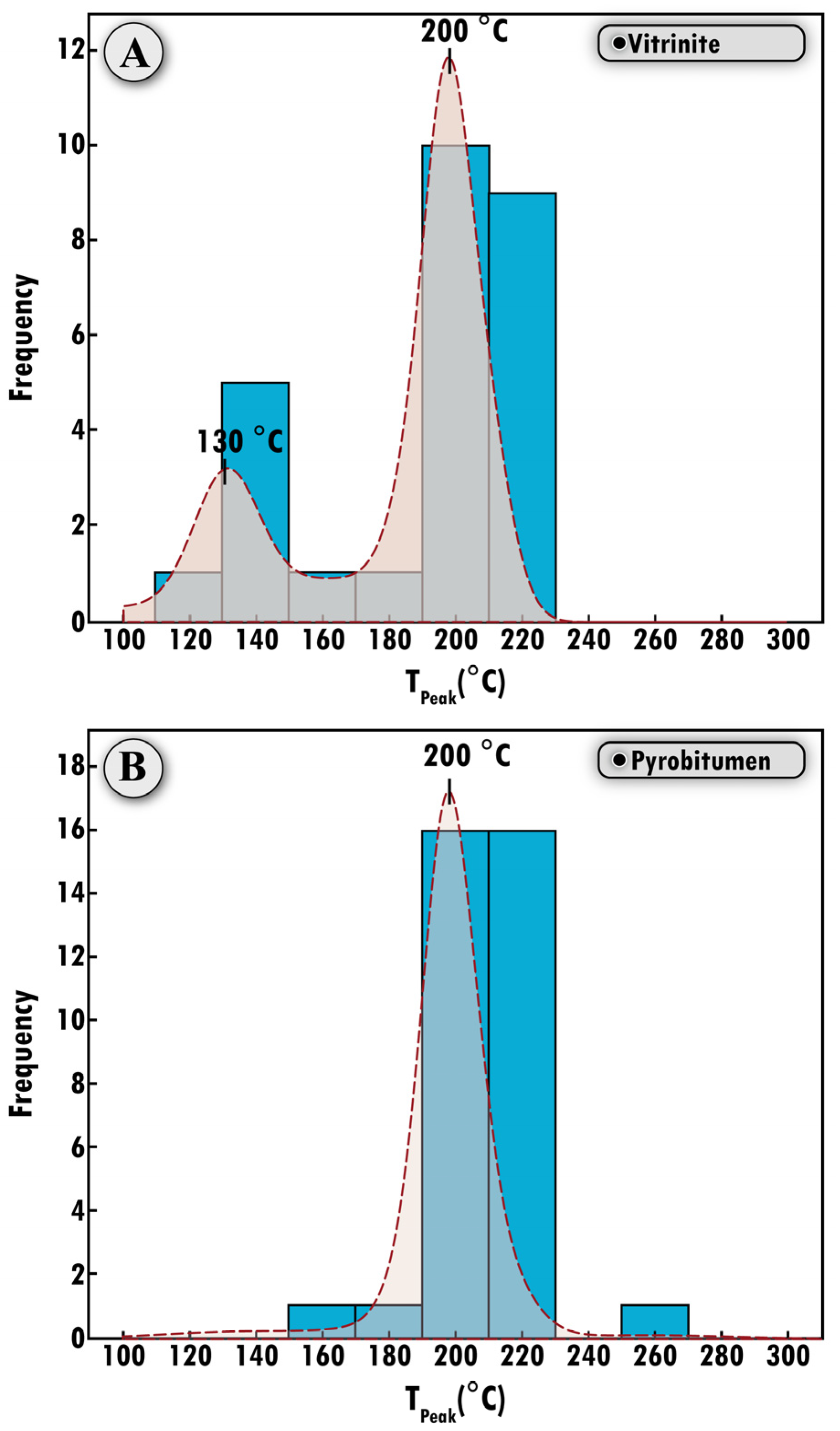
Mean random vitrinite reflectance (VR0) values range from 0.65 to 2.60% (mean = 1.85%; Table 1), whereas pyrobitumen reflectance (BR0) spans 0.93 to 4.13% (mean = 2.00%; Table 1), confirming pyrobitumen classification. Paleotemperature estimates based on the [32] calibration yield mean Tpeak values of ~200 °C (Figure 7), suggesting that mineralization occurred under elevated thermal conditions associated with hydrothermal fluid circulation and enhanced metal solubility. The VR0 cumulative frequency distribution (Figure 7A) shows a dominant temperature population centered at ~200 °C and a subordinate peak near ~120 °C, the latter consistent with fluid inclusion microthermometry [28]. Similarly, BR0-derived temperatures display a principal mode at ~200 °C and a secondary discrete peak at ~260 °C (Figure 7B).

5.2. Carbon and Oxygen Isotope Compositions

Carbon and oxygen isotope compositions of calcite were determined to constrain fluid evolution and carbonate-fluid interaction within the Beni Snassen MVT system. A total of 28 samples were analyzed, including 25 ore-related calcite separates from the main mineralized prospects and three powdered whole-rock carbonate samples from the Pliensbachian host sequence. Analytical data are presented in Table 2 and illustrated in Figure 8.
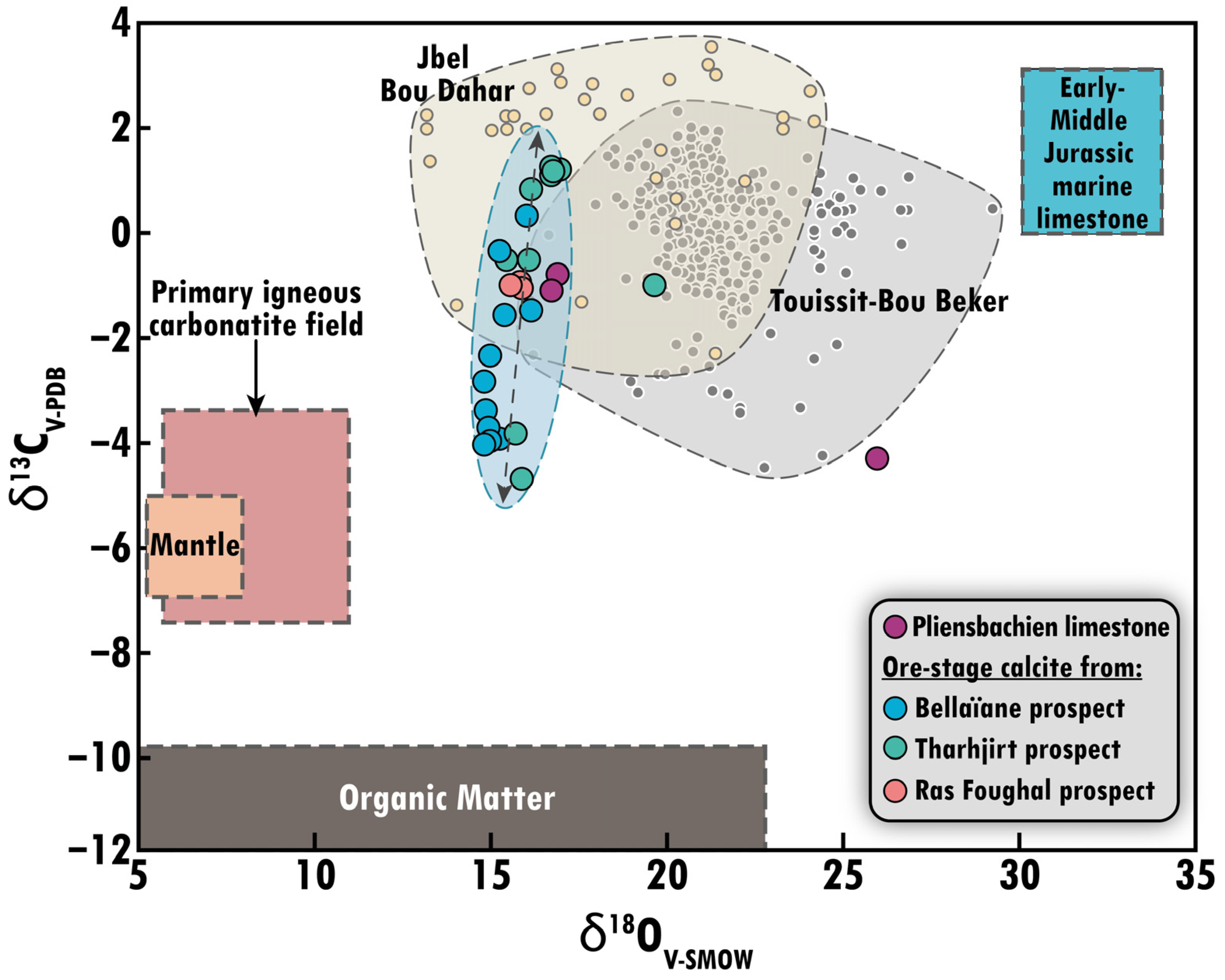
The dataset reveals substantial variability with δ13CV-PDB values from −4.7‰ to +1.2‰ and δ18OV-SMOW values between 14.9‰ and 19.7‰. Remarkably, the δ13C and δ18O signatures of the host limestone overlap those of the associated ore-related calcite, suggesting isotopic buffering and substantial interaction between mineralizing fluids and the host carbonate reservoir. Comparison with isotopic data from the Jbel Bou Dahar district reveals partial overlap, although more depleted δ13C values (down to −5‰, Table 2) in the Beni Snassen system indicate a greater contribution from isotopically evolved or mixed fluids.
Overall, the δ18O-δ13C data indicate (i) isotopic homogeneity across the study area, consistent with a regionally integrated hydrothermal circulation system, (ii) systematic 18O depletion relative to Lower Jurassic marine limestones, pointing to precipitation from heated basinal fluids, and (iii) broadly uniform isotopic compositions among stratigraphic ore horizons, implying precipitation from a common or closely related fluid source throughout mineralization.

5.3. Sulfur Isotope Compositions

Sulfur isotope compositions provide key constraints on sulfur sources and redox processes within the mineralizing system. A total of 46 selected samples were analyzed, including 37 galena separates representative of the paragenetic sequence of mineralization and nine gypsum samples from the Triassic salt-bearing red beds. Analytical results are reported in Table 3 and illustrated in Figure 9.
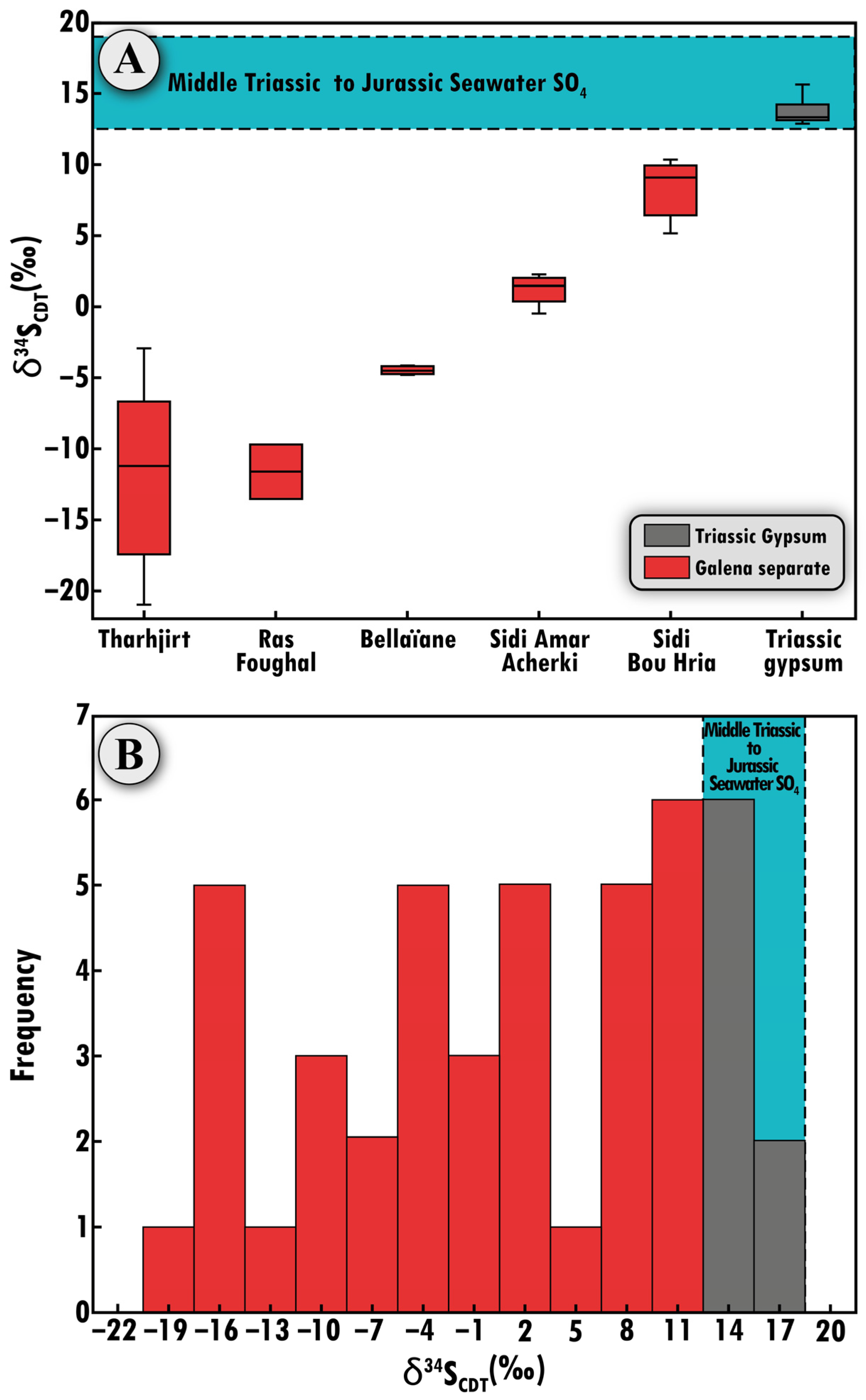
Galena separates display a wide range of δ34S values, from −20.9 to +10.3‰, with significant inter-prospect variability. The highest δ34S values characterize galena from the Sidi Bou Hria prospect (+5.1 to +10.3‰; mean = 8.2 ± 1.4‰, n = 11), whereas the lowest values are recorded at the Tharhjirt prospect (−11.3 to −20.9 ‰; mean = −17.1 ± 3.3‰, n = 3). The remaining prospects display intermediate δ34S compositions. In contrast, gypsum from the underlying Triassic red beds yields δ34S values between 12.7 and 14.5‰ (mean = 13.4 ± 0.8‰, n = 9), consistent with Middle Triassic to Jurassic seawater sulfate compositions (i.e., 13 to 20‰; [38,39]). Taken together, these δ34S compositions provide an isotopic benchmark for assessing sulfur reservoirs and reduction processes involved in MVT mineralization.

5.4. Lead Isotope Compositions

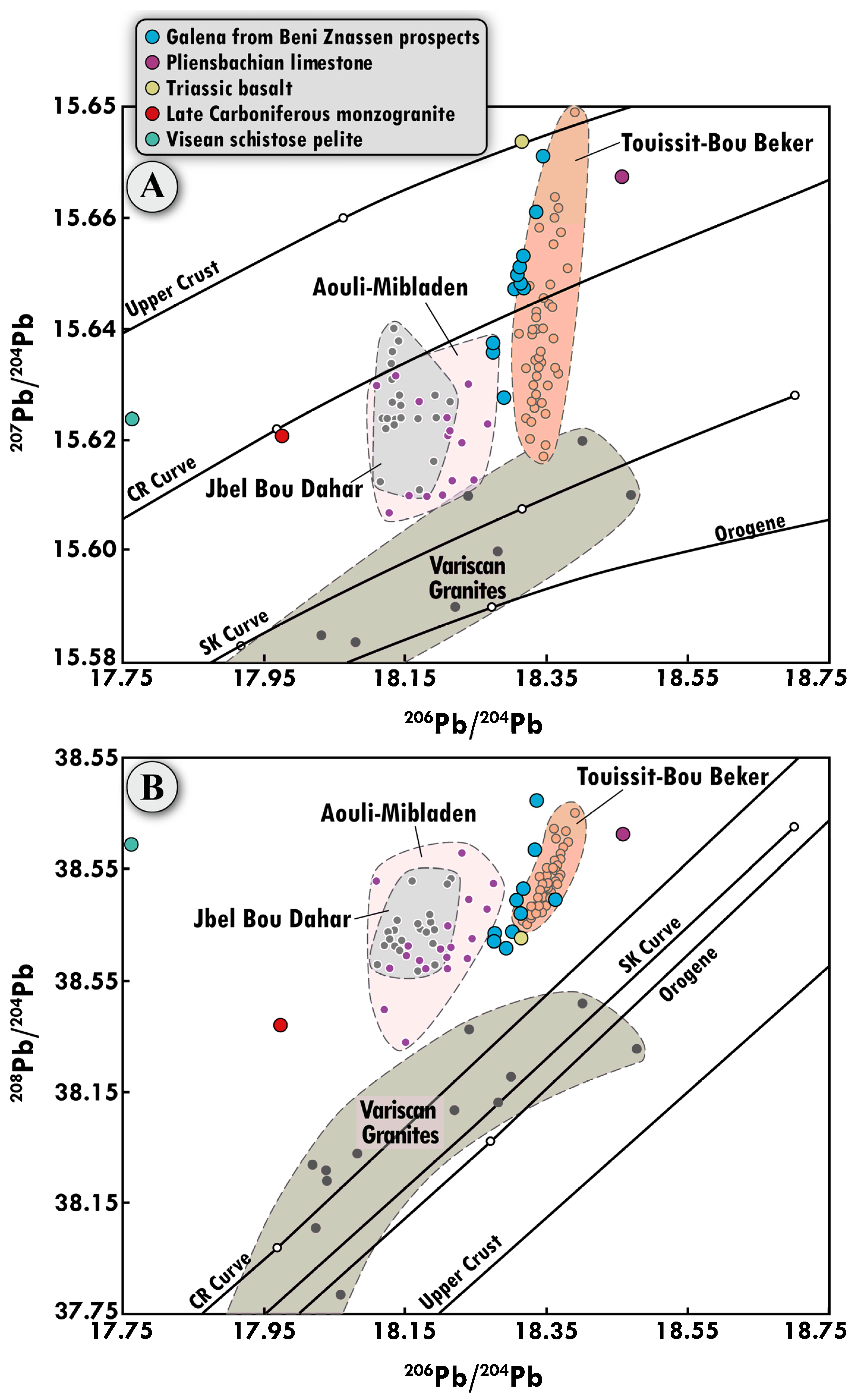
Lead isotope systematics were investigated to constrain the source of metals involved in the MVT mineralizing system. Seventeen representative samples from the main prospects were analyzed, comprising 13 galena separates and four bulk samples of unmineralized igneous, sedimentary, and metamorphic host rocks considered potential crustal Pb reservoirs (Table 4, Figure 10). Comparative evaluation of ore and host rock Pb isotope signatures aimed to (1) constrain the primary source(s) of lead and associated metals, (2) delineate hydrothermal fluid migration pathways at the district scale, and (3) assess the extent of isotopic modification induced by fluid–rock interaction [5]. Initial Pb isotope ratios of bulk-rock samples were age-corrected, assuming a Miocene mineralization event ([3], this study). For regional context, compositional fields of major Moroccan MVTs from the Atlasic system [3,4,5] are shown for comparison.
The Pb isotope compositions of ore and associated host rocks define a tight linear array with 206Pb/204Pb(i) values ranging from 17.76 to 18.46; 207Pb/204Pb(i) from 15.62 to 15.67; and 208Pb/204Pb(i) from 38.26 to 38.61. All data plot between the Upper Crust and Orogene growth curves of [41], suggesting a predominantly upper crustal source for Pb and associated metals. This interpretation supports large-scale basinal fluid circulation through crustal lithologies (Figure 10). In comparison with other Moroccan MVT districts, the Beni Snassen compositions partially overlap those of Touissit-Bou Beker and Aouli-Mibladen but remain clearly distinct from the isotopic field of Jbel Bou Dahar (Figure 10).

6. Discussion

6.1. Age of Mineralization

As is typical for North African MVT systems, the Beni Snassen belt lacks datable hydrothermal minerals suitable for direct radiometric age determination. Consequently, the timing of ore formation is constrained indirectly from stratigraphic relationships, basin evolution, bitumen migration, magmatic events, and supergene overprinting within the broader context of regional tectonics.
Primary sulfide mineralization cuts across Pliensbachian carbonate strata, establishing a post-Pliensbachian timing and defining the lower temporal limit for ore formation. The upper limit is constrained by supergene mineral assemblages produced through oxidative weathering of primary sulfides. Radiometric and thermochronological evidence indicates that supergene processes persisted at least into the Late Miocene, thereby bracketing mineralization between Pliensbachian deposition and Late Miocene exhumation. Kinematic indicators, including well-developed horizontal slickensides on vein walls (Figure 5C), record dextral strike-slip deformation, interpreted as post-Miocene in age [22]. This structural overprint suggests that ore formation occurred within a dynamic tectonic setting marked by a progressive transition from a compressional to transtensional stress regime linked to Africa–Europe convergence. This tectonic framework likely enhanced permeability and fluid focusing. Regionally, the inferred Late Miocene age is consistent with a major metallogenic pulse responsible for the formation of major MVT deposits across the Atlasic domains and adjacent European basins, suggesting that the Beni Snassen mineralization formed as part of a broader convergent-margin hydrothermal event.

6.2. Origin(s) and Source(s) of the Ore-Forming Fluid and Carbon

In addition to constraints provided by organic matter maturity, oxygen and carbon isotope systematics of ore-stage calcite provide important insights into the evolution and redox conditions of the hydrothermal system responsible for MVT mineralization in the Beni Snassen belt. The district-wide isotopic homogeneity indicates a large-scale, internally coherent fluid regime rather than isolated hydrothermal cells. The overlap in δ18O and δ13C compositions between host limestones and ore-stage calcite reflects significant fluid–rock interaction under rock-buffered conditions.
The systematic depletion of δ18O values relative to Jurassic marine limestones indicates precipitation from warm basinal fluids and/or from fluids that underwent significant mixing with isotopically light meteoric waters during basin-scale migration. This interpretation is consistent with fluid inclusion trapping temperatures and salinities (~120 °C, >15 wt % NaCl equiv.; [28]), as well as vitrinite reflectance (VR0 = 2.7–3.0%) within the catagenic window. Nonetheless, the well-defined co-variation between δ18O and δ13C values of ore-stage calcite (Figure 7) further supports mixing between at least two fluid reservoirs. Such mixing, particularly along basement–cover unconformities, is recognized globally as a key driver for ore precipitation in sediment-hosted hydrothermal systems [42,43] and provides a plausible mechanism for ore precipitation in this setting.
Calculated δ18OH2O values (0.2 ± 1.0‰), estimated at 120 °C based on fluid inclusion constraints [28], and the [33] fractionation equation, correspond to compositions typical of modified connate brines, deeply circulated meteoric waters that evolved during a prolonged residence in siliciclastic sequences, or fluids influenced by organic reactions [44], consistent with a composite basin-derived hydrothermal system. A metamorphic fluid contribution is ruled out, given the absence of regional metamorphism in the host succession. Several lines of evidence indicate the involvement of organic-derived fluids. Pyrobitumen occurrences, typical of hydrocarbon generation and commonly coexisting with hydrocarbon-bearing fluid inclusions in MVT deposits [4,45], together with the occurrence of the Sinemurian organic-rich black shales and δ13C values down to −5‰ in ore-stage calcite, strongly support incorporation of isotopically light organic carbon into the mineralizing fluids. Burial-related dewatering and catagenetic degradation of black shales could have generated reduced, acidic fluids capable of transporting Pb and Zn as metal–organic complexes, thereby supplying both metals and isotopically light carbon to ore-stage calcite. Concurrently, oxidation of organic matter during thermochemical sulfate reduction (TSR) may have produced additional organic water components, further contributing to the isotopic signature of the mineralizing fluids. Experimental and natural system studies demonstrate that below ~200 °C, such as those that prevailed in the Beni Snassen belt hydrothermal system ([28], this study), dissolved organic ligands form stable aqueous complexes with metal and other inorganic species, thereby enhancing metal solubility, migration, and eventual sulfide precipitation [46,47].
The integration of C-O isotopic data with previously reported fluid inclusion microthermometric constraints [28] suggests a multi-component hydrothermal system dominated by evolved basin-derived saline brines that mixed with meteoric and waters during mineralization, with an additional organic influence on both sulfur and carbon signatures.

6.3. Source of Sulfur and Mechanism(s) of Sulfide Ore Deposition

Sulfur isotope compositions provide key constraints on both sulfur sources and redox processes within the mineralizing system. In the Beni Snassen belt, δ34Sgalena values are consistently lower than those of coeval marine sulfate, indicating that ore-stage sulfide sulfur was not directly inherited from seawater sulfate but instead reflects isotopic fractionation associated with reduction processes and/or intermediate basin reservoirs.
Reduction of sulfate to sulfide in sedimentary basins commonly occurs either via microbial sulfate reduction (BSR) at relatively low temperatures (typically <80 °C) or by thermochemical sulfate reduction (TSR) at elevated temperatures (150–200 °C). Although sulfur isotope fractionation has been used to distinguish between these two mechanisms [48,49], substantial overlap in fractionation ranges renders unequivocal discrimination difficult [2]. BSR generally produces isotopically light sulfide (δ34S < 0‰), whereas TSR may generate modest negative shifts relative to the parent sulfate reservoir [50]. In the Beni Snassen hydrothermal system, fluid inclusion microthermometry and vitrinite reflectance values indicate a high thermal regime, locally approaching 200 °C, thereby rendering BSR improbable as the dominant process. The wide range of δ34S values is therefore interpreted to reflect sulfate reduction operating under variable physicochemical conditions, most plausibly via TSR, within reservoirs that were variably open or closed to sulfate replenishment.
Positive δ34Sgalena values, which are lower than those of contemporaneous Jurassic seawater sulfate (δ34S = ~15–22‰; [39]), are consistent with rapid TSR of marine-derived sulfate or dissolved pore-water sulfate. Conversely, negative δ34Sgalena values fall within the range typical of open-system sulfate reduction [51,52,53,54,55] and may record incorporation of isotopically light sulfur, possibly derived from earlier BSR or pre-existing reduced sulfur reservoirs within the basin. Collectively, these patterns indicate that sulfide precipitation was governed by a complex sulfur cycle involving multiple reduction pathways, fluid flux, and variable redox conditions during mineralization.
Moreover, the close spatial association between sulfide mineralization and organic-rich black shales further suggests that thermally degraded organic matter contributed to sulfate reduction. Organic components released during maturation could have promoted TSR, generating H2S and simultaneously contributing isotopically light carbon to ore-stage calcite (δ13C down to −5‰, Table 2). In this framework, metal-bearing basinal brines interacting with organically reactive carbonate host rocks, at temperatures > 100 °C, produced H2S through TSR, leading to rapid precipitation of Pb-Zn-Cu sulfides upon mixing or redox destabilization.

6.4. Source of Metals, Controls on Fluid Flow and Fluid–Rock Interaction

Lead isotope compositions provide robust constraints on the source(s) of metals and on the extent of fluid–rock interaction within the mineralizing system of the Beni Snassen hydrothermal system. However, their application to infer the provenance of associated metals such as Zn and Cu and other metals relies on the assumption that Pb was derived from the same source reservoir and transported and precipitated by the same hydrothermal fluid [56]. This assumption is generally valid for sediment-hosted systems, given the similar complexation behavior of Pb, Zn, and Cu in chloride-bearing basinal brines [57,58]. Within MVT systems, Zn-Pb metals are typically mobilized from composite crustal reservoirs, including sedimentary units and crystalline basement rocks, through prolonged interactions between migrating hydrothermal basinal fluids and host lithologies, along major structural conduits [3]. Thus, Pb isotope compositions primarily reflect the integrated crustal reservoirs tapped during regional fluid migration.
In this context, interpretation of the Pb isotope data is based on uranogenic (207Pb/204Pb versus 206Pb/204Pb) and thorogenic (208Pb/204Pb versus 206Pb/204Pb) covariation diagrams, with reference to the model growth curves of [41] for orogene, upper crust, and mantle reservoirs. Deviations from these curves reflect U-Th-Pb fractionation histories distinct from average crustal evolution [56]. The orogene curve approximates average continental crust characterized by 232Th/238U ratio = 3.8 and μ (238U/204Pb) = 9.74 [59]. In thorogenic space, ore compositions plot slightly to the left of the orogene growth curve, near the ~0.4 Ga model age, whereas in uranogenic space they lie between the orogene and upper crust curves (Figure 10). Although the linear trend could be consistent with mixing between contrasting Pb sources prior to precipitation [4,5,60], the close isotopic overlap between ore samples and Triassic dolerite–diabase lithologies indicates that these rocks likely constituted the principal Pb source in the Beni Snassen system. By contrast, the Visean schist basement, Late Carboniferous monzogranites, and overlying Pliensbachian carbonates display isotopic compositions that diverge from the ore field, suggesting limited to no involvement in Pb supply (Figure 10).
Furthermore, organic-rich black shales, although not analyzed isotopically in this study, may have contributed to the metal inventory. Thermal maturation and catagenesis of organic matter can release previously adsorbed trace metals and generate organic ligands capable of transporting Pb and Zn as metal–organic complexes in saline basinal fluids. Collectively, these data support a metallogenic model in which evolved basinal brines scavenged metals primarily from Triassic magmatic lithologies, with a possible complementary contribution from organic-rich black shales, during prolonged regional fluid circulation. Fluid migration and metal precipitation were strongly governed by structural architecture, particularly reactivated fault systems and basement–cover unconformities that acted as high-permeability conduits and sites of fluid focusing.
On the other hand, the close spatial relationship between Pb-Zn ± Cu orebodies and ENE- to E-W-trending fault systems, notably dextral strike-slip structures, indicates that these regional discontinuities facilitated upward hydrothermal migration of deep-seated metalliferous brines. This structural control highlights the intimate link between hydrothermal fluid flow and tectonic reactivation. Ore deposition is therefore interpreted to have occurred during a tectonic regime characterized by a progressive transition from compression to localized transtension associated with Africa–Europe convergence, providing the driving forces for focused hydrothermal circulation, and optimal conditions for fluid mixing, redox reactions, and precipitation within the basin.

6.5. Pyrobitumen as Evidence for Basin-Scale Migration of Metalliferous Hydrothermal Fluids

The genetic link between organic matter and MVT mineralization is well established [61,62,63]. Widespread occurrence of hydrocarbon- and brine-bearing fluid inclusions within ore-stage gangue minerals (calcite, dolomite, fluorite, quartz) and sulfides, particularly sphalerite, provides compelling evidence for the involvement of hydrocarbon-rich basinal fluids during mineralization. These fluids played a key role in metal mobilization and transport as stable aqueous organic complexes and contribute to redox reactions driving sulfide precipitation.
In the Beni Snassen belt, the intimate spatial relationship between Pb ores and pyrobitumen strongly suggests that hydrocarbon-rich fluids directly contributed to ore formation. VR0 values lower than 0.75% record burial temperatures of ~130 °C, consistent with fluid inclusion microthermometric data [28] and the paleogeographic evolution of the host basin. In contrast, higher VR0 and BR0 values reaching up to 4% indicate significantly elevated thermal conditions that cannot be explained by post-Pliensbachian burial alone. The lower VR0 values are therefore interpreted as reflecting in situ diagenetic maturation, whereas BR0 values approaching 4% correspond to a high-maturity to overmature stage (dry gas window) where pyrobitumen represents a residual product of hydrocarbon cracking. These data imply expulsion and long-distance migration of gas generated in deeper basin compartments.
Reflectance values approaching 4% correspond to thermal regimes equivalent to burial depths exceeding 6 km, typical of rapidly subsiding basins or thermally perturbed environments related to magmatic or metamorphic processes. The absence of significant post-Pliensbachian magmatism or metamorphism further excludes localized heating as the primary cause. Instead, these thermal conditions are compatible with the burial and subsidence history of the adjacent Neogene Guercif basin, where thick sedimentary and documented hydrocarbon and systems are present [45,64].
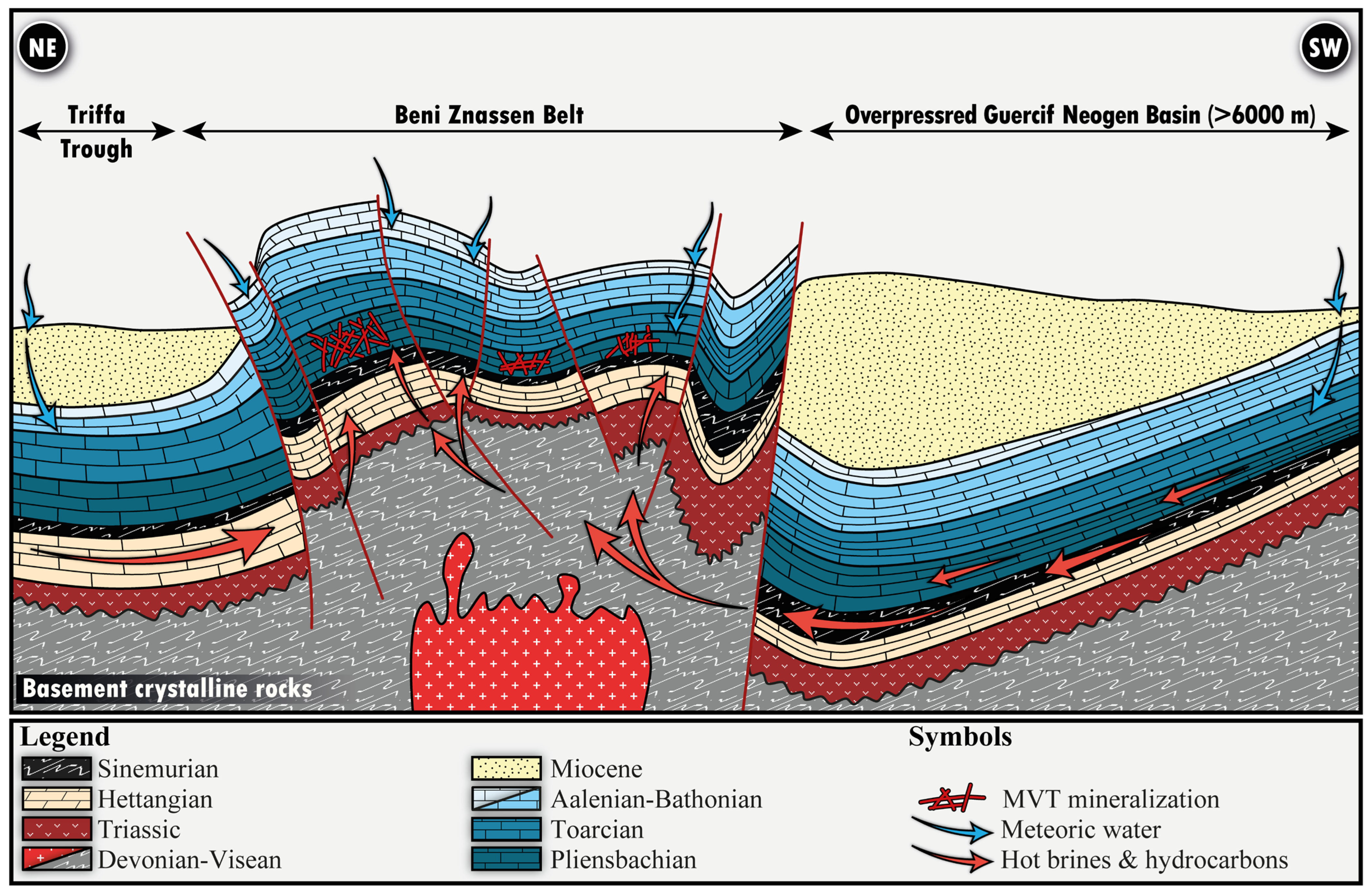
We therefore interpret the pyrobitumen in the mineralized zones as representing mobile hydrocarbon-bearing metalliferous fluids generated in deeper, overpressured parts of the Guercif basin and subsequently transported through the transcrustal ENE-WSW and E-W faults (Figure 11) into the structurally controlled traps of the Beni Snassen belt during petroleum expulsion and migration. The close spatial relationship between the Guercif and Beni Snassen basins (Figure 1), together with their structural connectivity through regional NE-SW-trending faults, and the localization of mineralization within the same Lower Liassic carbonate host formations, may suggest a close genetic relationship between the two systems. In addition, the temporal overlap between ore formation and regional hydrocarbon migration [44] permissively supports a common paleogeographic and metallogenic evolution.

7. Metallogenic Model and Concluding Remarks

An integrated dataset combining field relationships, petrography, and C-O-S-Pb isotope geochemistry supports a basin-scale fluid model for the Beni Snassen MVT system, linking crustal metal reservoirs, evolving basinal brines, hydrocarbon maturation, and tectonically driven fluid circulation within the Atlasic foreland basin.
The combined δ13C-δ18O systematics and previously reported fluid inclusion microthermometric data [28] support a predominantly single-stage hydrothermal evolution involving mixing between evolved oxidized saline brines (>20 wt % NaCl equiv) and meteoric waters, followed by extensive fluid–rock interaction along the fluid flow path during basin burial and diagenesis [4]. Highly mature pyrobitumen and depleted δ13C signatures in ore-stage calcite with values down to −5 ‰ demonstrate involvement of organic-bearing fluids. Mineralization is interpreted to have occurred during the Late Miocene basin subsidence, hydrocarbon maturation, and Alpine tectonic reorganization, when rapid sedimentation in the Guercif Basin (5 m/Ka; [65]) and thrust-front migration generated overpressured compartments and large-scale brine migration [64,65,66].
Regionally migrating, oxidized chloride-rich brines ascended along ENE-WSW to E-W faults and the basement–cover interface, scavenging metals predominantly from Triassic dolerite–diabase magmatic lithologies, as supported by Pb isotope overlap. Organic-rich shales may have contributed additional metals and organic ligands, enhancing metal solubility at 120–200 °C. Sulfide precipitation was triggered by mixing with meteoric waters and thermochemical sulfate reduction within reduced carbonate environments, producing variable δ34S signatures and rapid deposition of galena, sphalerite, and subordinate chalcopyrite.
This model emphasizes the synchronous operation of metal scavenging, organic-assisted metal transport, structural focusing, fluid mixing, and TSR within a tectonically reactivated foreland basin, refining metallogenic interpretations for the Atlasic domain and comparable hydrocarbon-bearing basins worldwide.

Author Contributions

M.B. Conceptualization, Methodology, Formal analysis, Data curation, Funding acquisition, Project administration, Writing—review and editing, Validation. W.B. Formal analysis, Data curation, Writing—review and editing, Validation. M.I. Formal analysis, Data curation, Writing—review and editing, G.L. Methodology, Data curation, Validation, Writing—review and editing. A.P. Writing—review and editing. L.B. Data curation, Validation, Writing—review and editing. K.Z. Data curation, Writing—review and editing. J.Y. Funding acquisition, Writing—review and editing, D.M. Conceptualization, Formal analysis, Data curation, Writing—review and editing. E.M. Writing—review and editing, Validation. All authors have read and agreed to the published version of the manuscript.

Funding

Financial support was provided to M.B. by the Moroccan “Programme d’Appui à la Recherche Scientifique” (PROTARS II/P23/33), a NATO Collaborative Research Grant (EST.CLG.979371), and a Fulbright Postdoctoral Fellowship.

Data Availability Statement

Data will be made available on request.

Acknowledgments

This contribution is dedicated to the memory of T. Naciri, whose work significantly advanced the geological understanding of the Beni Snassen belt. The first author gratefully acknowledges Y. Héroux for invaluable guidance in organic petrography and for insightful discussion on the relationship between organic matter and MVT mineralization. This research was undertaken during a Fulbright research stay at the U.S. Geological Survey, Denver, Colorado. The authors sincerely thank D. Leach for hosting the visit and C. Johnson for assistance with C-O-S-Pb isotope analyses. Thoughtful reviews and editorial guidance by C. Zhou significantly improved the earlier version of the manuscript.

Conflicts of Interest

The authors declare that they have no known competing financial interests or personal relationships that could have appeared to influence the work reported in this paper.

References

  1. Leach, D.L.; Bradley, D.C.; Huston, D.; Pisarevsky, S.A.; Taylor, R.D.; Gardoll, S.J. Sediment-Hosted Lead-Zinc Deposits in Earth History. Econ. Geol. 2010, 105, 593–625. [Google Scholar] [CrossRef] [Scilit]
  2. Leach, D.L.; Sangster, D.F.; Kelley, K.D.; Large, R.R.; Garven, G.; Allen, C.R.; Gutzmer, J.; Walters, S. Sediment-Hosted Lead-Zinc Deposits: A Global Perspective. In Economic Geology 100th Anniversary Volume, 1905–2005; Hedenquist, J.W., Thompson, J.F.H., Goldfarb, R.J., Richards, J.P., Eds.; Society of Economic Geologists Inc.: Littleton, CO, USA, 2005. [Google Scholar]
  3. Bouabdellah, M.; Levresse, G.; Boukirou, W.; Potra, A.; Samuelsen, J.R.; Caracausi, A.; Italiano, L.; Klügel, A.; Yans, J.; Castorina, F. Basin Inversion, Drifting and Hyper-Extension in the Central Atlantic Ocean and Maghrebian Tethys as Fluid Driving Mechanisms for the Superimposed Base Metal Mineralization Events in the Jbel Bou Dahar Carbonate-Hosted Pb-Zn-Ba Deposits (High Atlas, Morocco). Chem. Geol. 2024, 670, 122451. [Google Scholar] [CrossRef] [Scilit]
  4. Bouabdellah, M.; Sangster, D.F.; Leach, D.L.; Brown, A.C.; Johnson, C.A.; Emsbo, P. Genesis of the Touissit-Bou Beker Mississippi Valley-Type District (Morocco-Algeria) and Its Relationship to the Africa-Europe Collision. Econ. Geol. 2012, 107, 117–146. [Google Scholar] [CrossRef] [Scilit]
  5. Bouabdellah, M.; Niedermann, S.; Velasco, F. The Touissit-Bou Beker Mississippi Valley-Type District of Northeastern Morocco: Relationships to the Messinian Salinity Crisis, Late Neogene-Quaternary Alkaline Magmatism, and Buoyancy-Driven Fluid Convection. Econ. Geol. 2015, 110, 1455–1484. [Google Scholar] [CrossRef] [Scilit]
  6. Bouabdellah, M.; Sangster, D.F. Geology, Geochemistry, and Current Genetic Models for Major Mississippi Valley-Type Pb–Zn Deposits of Morocco. In Mineral Deposits of North Africa; Springer International Publishing: Cham, Switzerland, 2016; pp. 463–495. [Google Scholar]
  7. Torbi, A.; Gélard, J.P. Paléocontraintes Enregistrées Par La Microfracturation, Depuis l’Hercynien Jusqu’à l’Actuel, Dans Les Monts Du Sud-Est d’Oujda (Meseta Orientale, Maroc). Comptes Rendus De L’académie Des Sci. De Paris 1994, 318, 131–135. [Google Scholar]
  8. Jacobshagen, V. Geodynamic Evolution of the Atlas System, Morocco: An Introduction. In BT–The Atlas System of Morocco: Studies on Its Geodynamic Evolution; Jacobshagen, V.H., Ed.; Springer: Berlin/Heidelberg, Germany, 1988; pp. 1–9. ISBN 978-3-540-39104-3. [Google Scholar]
  9. Beauchamp, W.; Barazangi, M.; Demnati, A.; Alji, M. Intracontinental Rifting and Inversion: Missour Basin and Atlas Mountains, Morocco. AAPG Bull. 1996, 80, 1459–1481. [Google Scholar] [CrossRef] [Scilit]
  10. Frizon de Lamotte, D.; Saint Bezar, B.; Bracène, R.; Mercier, E. The Two Main Steps of the Atlas Building and Geodynamics of the Western Mediterranean. Tectonics 2000, 19, 740–761. [Google Scholar] [CrossRef] [Scilit]
  11. Frizon de Lamotte, D.; Leturmy, P.; Missenard, Y.; Khomsi, S.; Ruiz, G.; Saddiqi, O.; Guillocheau, F.; Michard, A. Mesozoic and Cenozoic Vertical Movements in the Atlas System (Algeria, Morocco, Tunisia): An Overview. Tectonophysics 2009, 475, 9–28. [Google Scholar] [CrossRef] [Scilit]
  12. Rachidi, M.; Neuweiler, F.; Kirkwood, D. Diagenetic-geochemical patterns and fluid evolution history of a lower jurassic petroleum source rock, Middle Atlas, Morocco. J. Pet. Geol. 2009, 32, 111–128. [Google Scholar] [CrossRef] [Scilit]
  13. Ziegler, P.A.; Cloetingh, S.; van Wees, J.D. Dynamics of Intra-Plate Compressional Deformation: The Alpine Foreland and Other Examples. Tectonophysics 1995, 252, 7–59. [Google Scholar] [CrossRef] [Scilit]
  14. Piqué, A.; Abderrahmane, S.; Mostafa, A.; Hoepffner, C.; Bouabdelli, M.; Laville, E.; Chalouan, A. La Géologie Du Maroc. 2007. Available online: https://www.researchgate.net/publication/236164502_La_Geologie_du_Maroc (accessed on 1 March 2026).
  15. Sahabi, M.; Aslanian, D.; Olivet, J.-L. Un Nouveau Point de Départ Pour l’histoire de l’Atlantique Central. Comptes Rendus. Géosci. 2004, 336, 1041–1052. [Google Scholar] [CrossRef] [Scilit]
  16. Le Roy, P.; Pique, A.; Le Gall, B.; Ait Brahim, L.; Morabet, A.M.; Demnati, A. Les Bassins Cotiers Triasico-Liasiques Du Maroc Occidental et La Diachronie Du Rifting Intra-Continental de l’Atlantique Central. Bull. De La Société Géologique De Fr. 1997, 168, 637–648. [Google Scholar]
  17. Ellouz, N.; Patriat, M.; Gaulier, J.M.; Bouatmani, R.; Sabounji, S. From Rifting to Alpine Inversion: Mesooic and Cenozoic Subsidence History of Some Moroccan Basins. Sediment. Geol. 2003, 156, 185–212. [Google Scholar] [CrossRef] [Scilit]
  18. Beauchamp, W.; Allmendinger, R.W.; Barazangi, M.; Demnati, A.; El Alji, M.; Dahmani, M. Inversion Tectonics and the Evolution of the High Atlas Mountains, Morocco, Based on a Geological-Geophysical Transect. Tectonics 1999, 18, 163–184. [Google Scholar] [CrossRef] [Scilit]
  19. Marhoumi, M.R. Etudes Palynologiques Des Séries Dinantiennes de La Meseta Marocaine: Conséquences Stratigraphiques et Structurales. 1984. Available online: https://toubkal.imist.ma/handle/123456789/2871 (accessed on 1 March 2026).
  20. Benabdellah, A. Étude Géologique et Métallogénique de La Partie Orientale Des Beni Snassen. Serv. Geol. Maroc Rabat 1952, 321, 13. [Google Scholar]
  21. Chopin, F.; Leprêtre, R.; El Houicha, M.; Tabaud, A.-S.; Schulmann, K.; Míková, J.; Barbarand, J.; Chebli, R. U–Pb Geochronology of Variscan Granitoids from the Moroccan Meseta (Northwest Africa): Tectonic Implications. Gondwana Res. 2023, 117, 274–294. [Google Scholar] [CrossRef] [Scilit]
  22. Naciri, T. Etude Lithostratigraphique et Structurale Des Beni Snassene Orientaux (Maroc). Ph.D. Thesis, Université Mohamed Premier, Oujda, Morocco, 1986. [Google Scholar]
  23. Mehdi, M. Stratigraphie Intégrée, Analyse Séquentielle et Micropaléontologique Du Jurassique et Du Crétacé Inférieur de l’avant-Pays Oriental (Maroc). Ph.D. Thesis, Mohamed I University, Oujda, Morocco, 1995. [Google Scholar]
  24. Cattanéo, G. Les Formations Du Jurassique Supérieur et Du Crétacé Inférieur de l’avant-Pays Rifain Nord-Oriental (Maroc). Ph.D. Thesis, Université de Bourgogne, Dijon, France, 1987. [Google Scholar]
  25. Naciri, T. Evolutions Sédimentaires, Environnements et Contrôles Dans Le Lias-Dogger Des Béni Snassen Orientaux (Maroc Nord-Oriental). Ph.D. Thesis, Mohamed I University, Oujda, Morocco, 1994. [Google Scholar]
  26. Khattach, D.; Mraoui, H.; Sbibih, D.; Chennouf, T. Analyse Multi-Échelle Par Ondelettes Des Contacts Géologiques: Application à La Carte Gravimétrique Du Maroc Nord-Oriental. Comptes Rendus Géosci. 2006, 338, 521–526. [Google Scholar] [CrossRef] [Scilit]
  27. Gout, R.; Khattach, D.; Houari, M.-R. Etude Gravimétrique Du Flanc Nord Des Béni Snassen (Maroc Nord-Oriental): Implications Structurales et Hydrogéologiques. Bull. De L’institut Sci. 2009, 31, 61–75. [Google Scholar]
  28. Bouabdellah, M.; Ouahhabi, B.; Boudchiche, L.; Naciri, T.; Benalla, M.; Chaieb, M. Métallogenèse Des Gisements de Type Mississippi Valley Du Lias Des Beni Snassen Orientaux: Apports Des Isotopes Stables. In Proceedings of the Deuxième Colloque sur le Jurassique Marocain (CJM2), Marrakech, Morocco, 21–22 April 2004. [Google Scholar]
  29. Bouabdellah, M.; Boukirou, W.; Potra, A.; Melchiorre, E.; Bouzahzah, H.; Yans, J.; Zaid, K.; Idbaroud, M.; Poot, J.; Dekoninck, A.; et al. Origin of the Moroccan Touissit-Bou Beker and Jbel Bou Dahar Supergene Non-Sulfide Biomineralization and Its Relevance to Microbiological Activity, Late Miocene Uplift and Climate Changes. Minerals 2021, 11, 401. [Google Scholar] [CrossRef] [Scilit]
  30. Henry, A.L.; Anderson, G.M.; Heroux, Y. Alteration of Organic Matter in the Viburnum Trend Lead-Zinc District of Southeastern Missouri. Econ. Geol. 1992, 87, 288–309. [Google Scholar] [CrossRef] [Scilit]
  31. Landis, C.R.; Castaño, J.R. Maturation and Bulk Chemical Properties of a Suite of Solid Hydrocarbons. Org. Geochem. 1995, 22, 137–149. [Google Scholar] [CrossRef]
  32. Barker, C.E.; Pawlewicz, M.J. Calculation of Vitrinite Reflectance from Thermal Histories and Peak Temperatures. In Vitrinite Reflectance as a Maturity Parameter; ACS Symposium Series; American Chemical Society: Washington, DC, USA, 1994; Volume 570, pp. 216–229. ISBN 9780841229945. [Google Scholar]
  33. Zheng, Y.F. Calculation of oxygen isotope fractionation in anhydrous silicate minerals. Geochim. et Cosmochim. Acta 1999, 57, 1079–1091. [Google Scholar]
  34. Aboutahir, N. Pétrographie et Géochimie Des Dolomites Du District de Touissit, Hôte de La Miniéralisation Du Type de La Vallée Du Mississippi (Maroc Nord-Oriental); École Polytechnique de Montréal: Montréal, QC, Canada, 1999. [Google Scholar]
  35. Rddad, L.; Bouhlel, S. The Bou Dahar Jurassic Carbonate-Hosted Pb–Zn–Ba Deposits (Oriental High Atlas, Morocco): Fluid-Inclusion and C–O–S–Pb Isotope Studies. Ore Geol. Rev. 2016, 72, 1072–1087. [Google Scholar] [CrossRef] [Scilit]
  36. Veizer, J.; Ala, D.; Azmy, K.; Bruckschen, P.; Buhl, D.; Bruhn, F.; Garden, G.A.F.; Diener, A.; Ebneth, S.; Godderis, Y.; et al. 87Sr/86Sr, Δ13C and Δ18O Evolution of Phanerozoic Seawater. Chem. Geol. 1999, 161, 59–88. [Google Scholar] [CrossRef] [Scilit]
  37. Jenkyns, H.C.; Jones, C.E.; Gröke, D.R.; Hesselbo, S.P.; Parkinson, D.N. Chemostratigraphy of the Jurassic System: Applications, Limitations and Implications for Palaeoceanography. J. Geol. Soc. Lond. 2002, 159, 351–378. [Google Scholar] [CrossRef] [Scilit]
  38. Claypool, G.E.; Holser, W.T.; Kaplan, I.R.; Sakai, H.; Zak, I. The Age Curves of Sulfur and Oxygen Isotopes in Marine Sulfate and Their Mutual Interpretation. Chem. Geol. 1980, 28, 199–260. [Google Scholar] [CrossRef] [Scilit]
  39. Kampschulte, A.; Strauss, H. The Sulfur Isotopic Evolution of Phanerozoic Seawater Based on the Analysis of Structurally Substituted Sulfate in Carbonates. Chem. Geol. 2004, 204, 255–286. [Google Scholar] [CrossRef] [Scilit]
  40. Armistead, S.; Eglington, B.; Pehrsson, S.J. PbIso: An R Package and Web App for Calculating and Plotting Pb Isotope Data. Can. J. Earth Sci. 2023, 61, 1–15. [Google Scholar] [CrossRef] [Scilit]
  41. Zartman, R.E.; Doe, B.R. Plumbotectonics—The Model. Tectonophysics 1981, 75, 135–162. [Google Scholar] [CrossRef] [Scilit]
  42. Garven, G.; Appold, M.S.; Toptygina, V.I.; Hazlett, T.J. Hydrogeologic Modeling of the Genesis of Carbonate-Hosted Lead-Zinc Ores. Hydrogeol. J. 1999, 7, 108–126. [Google Scholar] [CrossRef] [Scilit]
  43. Raffensperger, J.P.; Garven, G. The Formation of Unconformity-Type Uranium Ore Deposits; 2, Coupled Hydrochemical Modeling. Am. J. Sci. 1995, 295, 639–696. [Google Scholar] [CrossRef] [Scilit]
  44. Sheppard, S.M.F. Characterization and Isotopic Variations in Natural Waters. Rev. Mineral. Geochem. 1986, 16, 165–183. [Google Scholar]
  45. Bouabdellah, M.; Castorina, F.; Bodnar, R.J.; Banks, D.; Jébrak, M.; Prochaska, W.; Lowry, D.; Klügel, A.; Hoernle, K. Petroleum Migration, Fluid Mixing, and Halokinesis as the Main Ore-Forming Processes at the Peridiapiric Jbel Tirremi Fluorite-Barite Hydrothermal Deposit, Northeastern Morocco. Econ. Geol. 2014, 109, 1223–1256. [Google Scholar] [CrossRef] [Scilit]
  46. Kharaka, Y.K.; Hull, R.W.; Carothers, W.W. Water-Rock Interactions in Sedimentary Basins. In Relationship of Organic Matter and Mineral Diagenesis; Gautier, D.L., Ed.; Society of Economic Paleontologists and Mineralogists Short Courses: Austin, TX, USA, 1985; Volume 17, pp. 79–179. [Google Scholar]
  47. Giordano, T.H.; Kharaka, Y.K. Organic Ligand Distribution and Speciation in Sedimentary Basin Brines, Diagenetic Fluids and Related Ore Solutions. Geol. Soc. Lond. Spec. Publ. 1994, 78, 175–202. [Google Scholar] [CrossRef] [Scilit]
  48. Machel, H.G. Bacterial and Thermochemical Sulfate Reduction in Diagenetic Settings—Old and New Insights. Sediment. Geol. 2001, 140, 143–175. [Google Scholar] [CrossRef] [Scilit]
  49. Machel, H.G.; Krouse, H.R.; Sassen, R. Products and Distinguishing Criteria of Bacterial and Thermochemical Sulfate Reduction. Appl. Geochem. 1995, 10, 373–389. [Google Scholar] [CrossRef] [Scilit]
  50. Barré, G.; Thomassot, É.; Michels, R.; Cartigny, P.; Strzerzynski, P.; Truche, L. Multiple Sulfur Isotopes Signature of Thermochemical Sulfate Reduction (TSR): Insights from Alpine Triassic Evaporites. Earth Planet. Sci. Lett. 2021, 576, 117231. [Google Scholar] [CrossRef] [Scilit]
  51. Ohmoto, H. Biogeochemistry of Sulfur and the Mechanisms of Sulfide-Sulfate Mineralization in Archean Oceans. In Early Organic Evolution; Springer: Berlin/Heidelberg, Germany, 1992; pp. 378–397. [Google Scholar]
  52. Ohmoto, H. Isotopes of Sulfur and Carbon. Geochem. Hydrothermal Ore Depos. 1979, 509–567. [Google Scholar]
  53. Vikre, P.G.; Poulson, S.R.; Koenig, A.E. Derivation of S and Pb in Phanerozoic Intrusion-Related Metal Deposits from Neoproterozoic Sedimentary Pyrite, Great Basin, United States. Econ. Geol. 2011, 106, 883–912. [Google Scholar] [CrossRef] [Scilit]
  54. Basuki, N.I.; Taylor, B.E.; Spooner, E.T.C. Sulfur Isotope Evidence for Thermochemical Reduction of Dissolved Sulfate in Mississippi Valley-Type Zinc-Lead Mineralization, Bongara Area, Northern Peru. Econ. Geol. 2008, 103, 783–799. [Google Scholar] [CrossRef] [Scilit]
  55. Ohmoto, H.; Watanabe, Y.; Ikemi, H.; Poulson, S.R.; Taylor, B.E. Sulphur Isotope Evidence for an Oxic Archaean Atmosphere. Nature 2006, 442, 908–911. [Google Scholar] [CrossRef] [Scilit] [PubMed]
  56. Tosdal, R.M.; Wooden, J.L.; Bouse, R.M. Pb isotopes, ore deposits, and metallogenic terranes. Rev. Econ. Geol. 1999, 12, 1–28. [Google Scholar]
  57. Morris, N.; Potra, A.; Samuelsen, J.R. Tracing the Origin of Metal Ions in Mississippi Valley-Type Ore Deposits: Constraints from Lead Isotope Studies of Black Shales from the Midcontinent United States. Econ. Geol. 2024, 119, 1355–1368. [Google Scholar] [CrossRef] [Scilit]
  58. Henley, R.W.; Truesdell, A.H.; Barton, P.B. Fluid-mineral equilibria in hydrothermal systems. Rev. Econ. Geol. 1984, 1, 66. [Google Scholar]
  59. Stacey, J.S.; Kramers, J.D. Approximation of Terrestrial Lead Isotope Evolution by a Two-Stage Model. Earth Planet. Sci. Lett. 1975, 26, 207–221. [Google Scholar] [CrossRef] [Scilit]
  60. Cumming, G.L.; Kyle, J.R.; Sangster, D.F. Pine Point; a Case History of Lead Isotope Homogeneity in a Mississippi Valley-Type District. Econ. Geol. 1990, 85, 133–144. [Google Scholar] [CrossRef] [Scilit]
  61. Kesler, S.E.; Jones, H.D.; Furman, F.C.; Sassen, R.; Anderson, W.H.; Kyle, J.R. Role of Crude Oil in the Genesis of Mississippi Valley-Type Deposits: Evidence from the Cincinnati Arch. Geology 1994, 22, 609–612. [Google Scholar] [CrossRef] [Scilit]
  62. Macqueen, R.W.; Powell, T.G. Organic Geochemistry of the Pine Point Lead-Zinc Ore Field and Region, Northwest Territories, Canada. Econ. Geol. 1983, 78, 1–25. [Google Scholar] [CrossRef] [Scilit]
  63. Wu, Y.; Zhang, C.; Mao, J.; Ouyang, H.; Sun, J. The Genetic Relationship between Hydrocarbon Systems and Mississippi Valley-Type Zn–Pb Deposits along the SW Margin of Sichuan Basin, China. Int. Geol. Rev. 2013, 55, 941–957. [Google Scholar] [CrossRef] [Scilit]
  64. Benzaquen, M. Étude stratigraphique préliminaire des formations du bassin de Guercif. Etude Stratigr. Préliminaire Des Form. Du Bassin De Guercif 1965, 22, 114–128. [Google Scholar]
  65. Krijgsman, W.; Hilgen, F.J.; Raffi, I.; Sierro, F.J.; Wilson, D.S. Chronology, Causes and Progression of the Messinian Salinity Crisis. Nature 1999, 400, 652–655. [Google Scholar] [CrossRef] [Scilit]
  66. Bernini, M.; Boccaletti, M.; Gelati, R.; Moratti, G.; Papani, G.; Mokhtari, J. El tectonics and sedimentation in the Taza-Guercif Basin, Northern Morocco: Implications for the neogene evolution of the Rif-Middle Atlas orogenic system. J. Pet. Geol. 1999, 22, 115–128. [Google Scholar] [CrossRef] [Scilit]
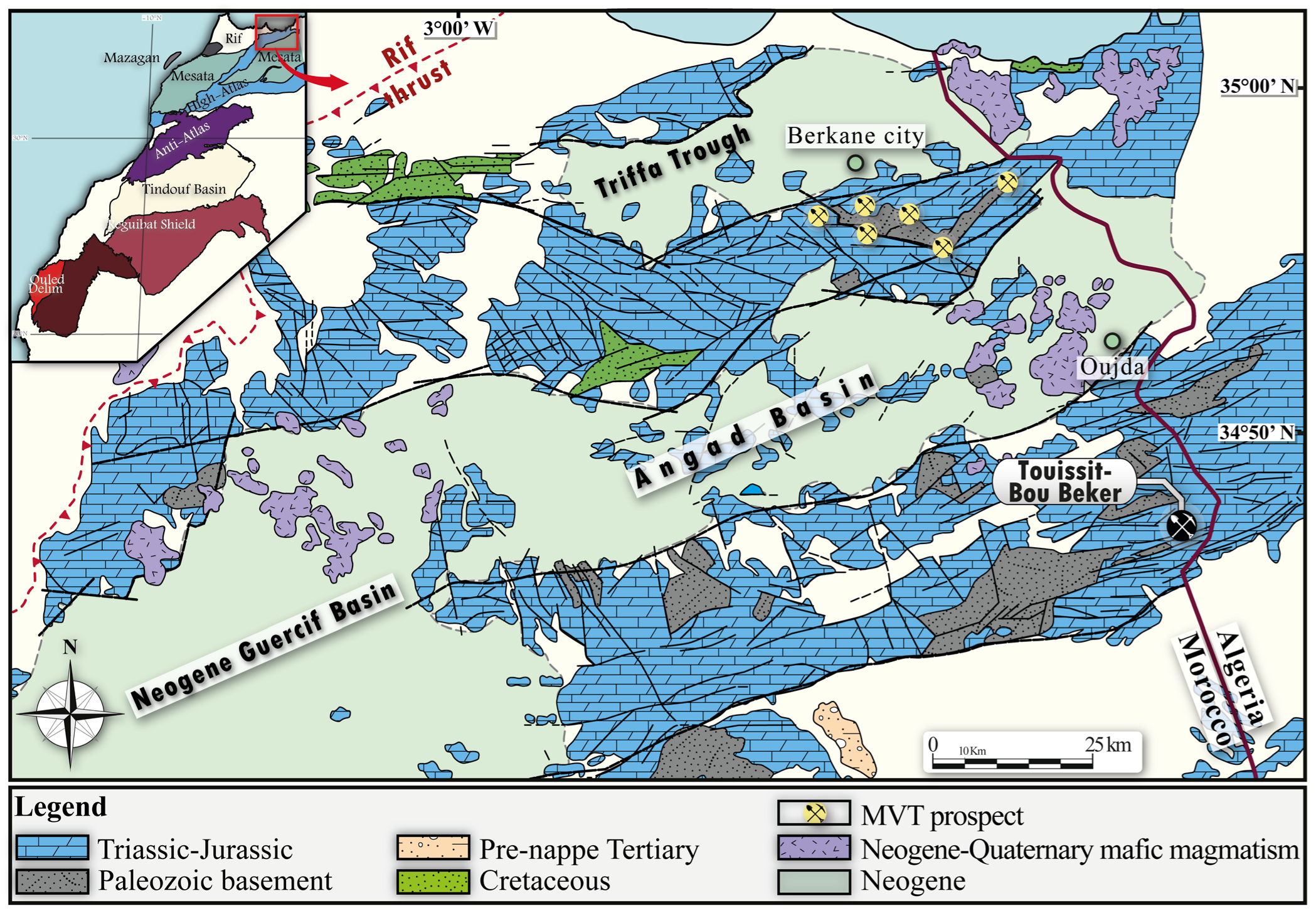
Figure 1. Regional geological map of northeastern Morocco showing the location of the Beni Snassen belt, regional-scale faults, and the distribution of major lithologic units within the Atlasic system (modified after [7]). The inset map situates the investigated area within the broader structural framework of Morocco.
Minerals 16 00376 g001
Figure 2. Geological setting of the Beni Snassen belt illustrating the location of the main Mississippi Valley-type prospects in relation to major lithostratigraphic units, igneous bodies, and structural elements (compiled from the 1:50,000 geological maps of the Berkane and Ahfir sheets).
Minerals 16 00376 g002
Figure 3. (A) Representative NW-SE cross section through the eastern Beni Snassen belt showing the main lithostratigraphic units and the occurrence of Mississippi Valley-type mineralization (modified from [22]). (B) Idealized stratigraphic column summarizing the main lithostratigraphic units and the relative stratigraphic position of Mississippi Valley-type mineralization in the eastern Beni Snassen belt.
Minerals 16 00376 g003
Figure 4. Representative field photographs of the ore-hosting Pliensbachian dolomitized limestones and associated mineralization styles. (A) Panoramic view of the ore-bearing Pliensbachian carbonate platform, showing flat-lying massive limestone strata resting unconformably on greenish-weathering Triassic dolerite–diabase. (B) Close-up of bedding-parallel mineralization within Pliensbachian limestones. (C) Narrow mineralized vein crosscutting the Pliensbachian host limestone. Note the well-developed horizontal slickensides along the vein wall, indicative of dextral strike-slip movement.
Minerals 16 00376 g004
Figure 5. Representative petrographic photographs depicting ore occurrence, mineral assemblages, and characteristic textures from the Beni Snassen Mississippi Valley-type prospects, northeastern Morocco. (A) Polished slab showing a centimeter-thick vein crosscutting organic-rich, fine-grained limestone. (B) underground exposure displaying a stockwork-like network of galena-filled veinlets (bluish) cutting the Pliensbachian gray-beige dolomitized limestone. (C,D) Polished slabs showing cockade breccia-like textures developed within Pliensbachian carbonates. Decimeter-sized angular to rounded limestone fragments are cemented by galena and embedded in a hydrothermal calcite matrix. (E) Polished slab of intensely fractured greenish dolerite–diabase, with fractures sealed by galena. (F) Close up of a galena octahedron from the cuboctahedral stage growing on Fe-rich calcite and quartz. Mineral abbreviation: Ank = ankerite; Cal = calcite; Gn = galena; Qz = quartz.
Minerals 16 00376 g005
Figure 6. Summary of the paragenetic sequence of the main Mississippi Valley-type prospects from the Beni Snassen belt, northeastern Morocco. Horizontal lines indicate the relative timing of mineral formation. Dotted lines indicate uncertainties.
Minerals 16 00376 g006
Figure 7. Histograms showing the frequency distribution of peak temperature (Tpeak) estimates calculated from (A) vitrinite, and (B) pyrobitumen reflectance data obtained from Sinemurian black shales and mineralized prospects of the eastern Beni Snassen belt.
Minerals 16 00376 g007
Figure 8. Plot of δ18O versus δ13C showing the isotopic compositions of Pliensbachian limestone and ore-stage calcite from the main Mississippi Valley-type prospects of the Beni Snassen belt, northeastern Morocco. Also shown for comparison are dolomite analyses from the Touissit-Bou Beker [4,34], and ore-stage calcite data from the Jbel Bou Dahar district [3,35]. Middle Jurassic marine limestone compositions are from [36,37]. Arrows indicate the mixing trend defined by the analyzed samples.
Minerals 16 00376 g008
Figure 9. (A) Box-and-whisker plots showing δ34S ranges for primary Triassic gypsum and paragenetically constrained galena separates from the main Mississippi Valley-type prospects of the Beni Snassen belt, northeastern Morocco. The box plots display median values, 25th–75th, and ±2 standard deviations (whiskers). For comparison, the sulfur isotope range of global Middle Triassic to Jurassic seawater sulfate is shown [38,39]. (B) Frequency distribution of δ34S values for paragenetically constrained galena separates (Stages I, II). The sulfur isotope range for global Middle Triassic to Jurassic seawater sulfate is shown for reference [38,39].
Minerals 16 00376 g009
Figure 10. Lead isotope compositions of galena compared with those of Pliensbachian limestone host rocks and potential metal source lithologies of Paleozoic and Early Mesozoic age from the main Mississippi Valley-type prospects of the Beni Snassen belt, northeastern Morocco. (A) 208Pb/204Pb versus 206Pb/204Pb plot. (B) 207Pb/204Pb versus 206Pb/204Pb plot. Whole-rock Pb isotope ratios were age-corrected, assuming a Late Miocene age of mineralization. Also shown are sulfide ore data from the Touissit-Bou Beker, Aouli Mibladen, and Jbel Bou Dahar districts [3,4,6,35]. Upper Crust and Orogene evolution curves are from [41] and are included for reference.
Minerals 16 00376 g010
Figure 11. NW-SE cross section (not scale) showing conceptual fluid flow models for the Beni Snassen Mississippi Valley-type hydrothermal system driven by compaction and/or topographic gradients. Model (1) involves expulsion of hydrothermal fluids from sedimentary depocenters during compaction, with subvertical transcrustal faults serving as conduits for metal-bearing fluids. Model (2) proposes lateral transport of meteoric fluids recharged in the uplifted flanks of the Beni Snassen belt, migrating through the Pliensbachian carbonate aquifer during the Late Miocene. Fluid pathways are schematically indicated by curved blue and red arrows.
Minerals 16 00376 g011
Table 1. Maceral contents and vitrinite (VR0) and pyrobitumen (BR0) reflectance data for representative samples from the Sinemurian organic-rich black shales and ore-associated pyrobitumen from the main Mississippi Valley-type prospects of the Beni Snassen belt, northeastern Morocco.
Sample IDBitumenRveqTpeak (Rv)VitriniteTpeak (Rv)Semi-FusiniteInertiniteIndetermined
Beni-14.134.22512.171984.055.751.78
1.872.11952.52094.422.751.72
2.592123.18 1.74
2.272023.8 2.35
Beni-22.052.32012.522102.795.021.78
2.42.62122.382052.36 2.48
2.22.4206 2.69 1.83
22.2200 4.11 2.78
1.732.0190 4.78 2.24
1.982.2199 1.95
1.852.1195 2.2
Beni-32.192.420621912.384.781.78
1.872.11952.041933.5 2.06
1.742.01912.11953.99 1.85
2.24201 2.08
1.92
Beni-41.82.01932.141973.425.31.78
2.12.32032.512102.935.11
2.022.22002.131963.42
1.932.21971.921883.68
2.112.3203 2.39
2.012.2200
2.212.4207
2.072.3202
1.922.1197
1.792.0192
2.022.2200
2.262.5208
1.922.1197
2.282.5209
2.252.4208
Beni-52.032.22012.091953.444.382.12
2.012.22002.322032.324.58
1.892.11961.91873.34.59
1.591.81852.232003.29
22.2200 2.71
1.852.1195
L31.111.41630.931302.231.910.2
0.931.21530.9127 0.28
1.79182
1.33158
0.94130
1135
0.65101
1.4163
0.98134
Table 2. Oxygen isotope compositions (δ18OV-SMOW) of ore-stage calcite separates and whole-rock Pliensbachian limestones from the main Mississippi Valley-type prospects of the Beni Snassen belt, northeastern Morocco.
Sample IDδ13Cδ18Oδ18OH2O
Host limestone-Lime 1−4.326.010.2
Host limestone-Lime 2−1.116.81.0
Host limestone-Lime 3−0.816.91.1
J. Bellaïane-Bel 1−1.615.4−0.4
J. Bellaïane-Bel 2−2.914.9−0.9
J. Bellaïane-Bel 3−3.915.3−0.5
J. Bellaïane-Bel 4−4.114.9−0.9
J. Bellaïane-Bel 5−4.015.0−0.8
J. Bellaïane-Bel 6−1.516.20.4
J. Bellaïane-Bel 7−0.315.3−0.5
J. Bellaïane-Bel 80.316.10.3
J. Bellaïane-Bel 9−3.414.9−0.9
J. Bellaïane-Bel 10−3.715.0−0.9
J. Bellaïane-Bel 11−2.415.0−0.8
Tharhjirt-Bch 11.116.81.0
Tharhjirt-Bch 21.316.81.0
Tharhjirt-Bch 30.916.20.4
Tharhjirt-Bch 41.116.70.9
Tharhjirt-Bch 51.217.01.2
Tharhjirt-Bch 61.216.91.1
Tharhjirt-Bch 7−4.715.90.1
Tharhjirt-Bch 8−3.915.80.0
Tharhjirt-Bch 9−0.515.5−0.3
Tharhjirt-Bch 10−0.516.10.3
Tharhjirt-Bch 11−1.019.73.9
Ras Foughal-Tr1−1.015.90.1
Ras Foughal-Tr2−1.015.7−0.2
Ras Foughal-Tr3−0.915.90.1
Table 3. Sulfur isotope compositions (δ34SCDT) of galena separates and whole-rock Triassic gypsum from the main Mississippi Valley-type prospects of the Beni Snassen belt, northeastern Morocco.
Sample IDδ34SCDT
Tharhjirt-Galena 1−20.9
Tharhjirt-Galena 2−11.3
Tharhjirt-Galena 3−16.5
Tharhjirt-Galena 4−18.7
Tharhjirt-Galena 5−17.5
Tharhjirt-Galena 6−17.4
Tharhjirt-Galena 7−17.3
Tharhjirt-Galena 8−10.1
Tharhjirt-Galena 9−9.0
Tharhjirt-Galena 10−10.0
Tharhjirt-Galena 11−2.9
Tharhjirt-Galena 12−2.9
Tharhjirt-Galena 13−3.9
Sidi Bou Hria-Galena 110.1
Sidi Bou Hria-Galena 29.7
Sidi Bou Hria-Galena 39.9
Sidi Bou Hria-Galena 45.1
Sidi Bou Hria-Galena 59.6
Sidi Bou Hria-Galena 66.4
Sidi Bou Hria-Galena 77.7
Sidi Bou Hria-Galena 810.3
Sidi Bou Hria-Galena 97.4
Sidi Bou Hria-Galena 105.3
Sidi Bou Hria-Galena 119.1
Jbel Bellaïane-Galena 1−4.2
Jbel Bellaïane-Galena 2−4.6
Jbel Bellaïane-Galena 3−4.3
Jbel Bellaïane-Galena 4−4.7
Jbel Bellaïane-Galena 5−4.5
Ras Foughal-Galena 1−9.7
Ras Foughal-Galena 2−13.5
Sidi Amar Acherki0.7
Sidi Amar Acherki1.4
Sidi Amar Acherki−0.5
Sidi Amar Acherki1.5
Sidi Amar Acherki1.9
Sidi Amar Acherki2.2
Triassic gypsum14.5
Triassic gypsum14.2
Triassic gypsum13.0
Triassic gypsum13.1
Triassic gypsum12.9
Triassic gypsum13.1
Triassic gypsum13.3
Triassic gypsum13.3
Triassic gypsum13.4
Table 4. Lead isotope compositions of galena separates and potential metal source rocks, including Carboniferous schists and monzogranites, Triassic dolerite–diabase, and Pliensbachian limestones from the main Mississippi Valley-type prospects of the Beni Snassen belt, northeastern Morocco. Calculations to determine the corrected isotopic ratios and calculation of Pb isotopic derivative parameters were made using IsoPb [40].
Sample No.Deposit/Prospect206Pb/204Pb207Pb/204Pb208Pb/204PbTmodμ (238U/204Pb)κ (232Th/204Pb)ω (232Th/204Pb)
Galena separates
BS-Gn1Sidi Bou Hria18.36415.62938.4962579.83.938.2
BS-Gn2Sidi Bou Hria18.27615.63538.4243349.93.938.4
BS-Gn3El Becharir18.30615.64738.4383369.93.938.5
BS-Gn4El Becharir18.30415.64738.4383379.93.938.5
BS-Gn5Jorf El Handia18.31415.65038.4763369.93.938.7
BS-Gn6Jorf El Handia18.29315.62738.4153059.83.938.2
BS-Gn7Jorf El Handia18.31715.64838.4753309.93.938.7
BS-Gn8Jbel Bellaïane18.33515.66138.67334210.04.039.8
BS-Gn9Jbel Bellaïane18.33515.67138.58336210.04.039.5
BS-Gn10Sidi Amar Acherki18.32115.64738.5183259.93.938.9
BS-Gn11Sidi Amar Acherki18.27615.63738.4373389.93.938.6
BS-Triassic-Gn12 Ras Foughal18.30615.64938.4983409.93.938.8
BS-Triassic-Gn13Ras Foughal18.31715.65338.5163409.93.939.0
Whole-rock
Liassic cherty limestoneSidi Amar Acherki18.45815.66738.613-10.03.938.8
Triassic basaltRas Foughal18.31415.67438.429-10.03.938.8
Late Visean monzograniteRas Foughal17.97215.62138.266-9.94.039.3
Devonian to Visean schistose peliteRas Foughal17.76315.62438.592-9.94.342.6
Disclaimer/Publisher’s Note: The statements, opinions and data contained in all publications are solely those of the individual author(s) and contributor(s) and not of MDPI and/or the editor(s). MDPI and/or the editor(s) disclaim responsibility for any injury to people or property resulting from any ideas, methods, instructions or products referred to in the content.