Article

Genesis of the Dongqiyishan Porphyry W-Polymetallic Deposit, Inner Mongolia: Constraints from Molybdenite Re-Os Geochronology, Fluid Inclusions, and H-O-S Isotopes

1
Inner Mongolia Geological Exploration Institute of Sinochem Geology and Mining Bureau, Hohhot 010040, China
2
The First Survey and Development Co., Ltd. of Geology and Mineral in Inner Mongolia, Hohhot 010010, China
3
Northwest Institute of Nuclear Technology, Xi’an 710024, China
4
College of Civil Engineering, Shaanxi Polytechnic University, Shaanxi 712000, China
*
Author to whom correspondence should be addressed.
Minerals 2026, 16(4), 377; https://doi.org/10.3390/min16040377
Submission received: 23 December 2025 / Revised: 15 March 2026 / Accepted: 17 March 2026 / Published: 2 April 2026

Abstract

The Dongqiyishan W-polymetallic deposit is a large porphyry deposit in the Beishan region, Inner Mongolia. Based on cross-cutting relationships of veins and distinct mineral assemblages, the hydrothermal evolution of the Dongqiyishan deposit can be divided into three mineralization stages, with corresponding characteristic alteration types: (1) early W mineralization stage, dominated by potassic–sodic alteration; (2) main W mineralization stage, characterized by extensive phyllic alteration; and (3) post-W-mineralization hydrothermal stage, associated with quartz–fluorite–calcite alteration. This study employs an integrated approach, including molybdenite Re-Os dating, microthermometry of fluid inclusions, and H-O-S isotopic analyses, to investigate the genesis of the deposit. The results show that: (1) the metallogenic age of the deposit is 222.2 ± 1.5 Ma (MSWD = 0.58; Middle Triassic), which was likely caused by the northward subduction of the Paleo-Tethys Ocean; (2) the metallogenic fluids of Stage I (homogenization temperature 350~400 °C, salinity 6.0~8.0 wt.% NaCl eqv.) and Stage II (homogenization temperature 300~350 °C, salinity 4.0~6.0 wt.% NaCl eqv.) are mainly from magmatic water, and Stage III (homogenization temperature 225~275 °C, salinity 4.0~8.0 wt.% NaCl eqv.) has a mixed fluid of magmatic water and meteoric water; (3) the ore-forming materials were mainly derived from magma, which is supported by the S isotopic results (δ34S = −0.5‰~1.6‰, average 0.93‰); (4) mineralization depths calculated through fluid inclusions are 0.52–1.60 km (Stage I), 0.70–1.80 km (Stage II) and 0.10–0.49 km (Stage III); and (5) Stage I W precipitation was likely driven by fluid boiling and water–rock interaction, Stage II W precipitation by water–rock interaction principally, and Stage III fluorite precipitation by water–rock interaction plus fluid cooling. This research provides theoretical guidance for W-polymetallic prospecting in the Beishan of Inner Mongolia.

1. Introduction

The East Tianshan–Beishan orogenic belt, located on the southern margin of the Central Asian Orogenic Belt, has undergone Precambrian continental block formation and rifting, Early Paleozoic oceanic crust subduction and microcontinental collision orogeny, and Late Paleozoic post-orogenic extension [1,2,3]. It is an important non-ferrous metal metallogenic belt in northwestern China, hosting deposits of iron, copper, nickel, lead-zinc, tungsten, molybdenum, and rubidium [4,5,6,7]. In recent years, dozens of tungsten polymetallic deposits have been discovered in the East Tianshan–Beishan area, such as the Xiaobaishitou, Zhongbao, Shadong, Heiyanshan, and Wutonggou tungsten polymetallic deposits in the East Tianshan orogenic belt [7,8,9,10,11,12], and the Hongjianbingshan, Yingzuihongshan, Guoqing, Huaniushan, Yushan, and Zhenshifeng tungsten polymetallic deposits in the Beishan orogenic belt [13,14,15,16,17,18]. Tungsten resources exceed 300,000 tons, forming the East Tianshan–Beishan tungsten polymetallic metallogenic belt.
The tungsten deposits in the East Tianshan area have been extensively studied, with the main types identified as skarn and quartz vein-type, formed primarily during the Late Carboniferous and Triassic [7,9,10,15,19,20,21]. In contrast, research on tungsten deposits in the Beishan area remains limited and controversial. Mineralization types are complex, including quartz vein-type, skarn-type, porphyry-type, and greisen-type, with metallogenic ages ranging from the Silurian to Triassic [13,14,15,17,18,22,23,24,25]. These controversies have significantly restricted theoretical understanding of tungsten mineralization and exploration in the Beishan area.
The Dongqiyishan deposit is a W-Sn-Mo-Be-Rb polymetallic and fluorite deposit discovered in the Beishan area, with reserves of 14,000 tons of tungsten (medium-sized), 3600 tons of molybdenum (small-sized), 28,000 tons of tin (medium-sized), 3600 tons of beryllium (small-sized), 4700 tons of rubidium (large-sized), and 520,000 tons of fluorite (large) [26,27]. It provides a critical window into the in-depth investigation of tungsten polymetallic mineralization processes within the Beishan region. Previous studies have focused on the felsic intrusions related to the Dongqiyishan mineralization [28,29,30,31], with limited research on the mineralization process. Based on detailed field geological surveys, this study identifies the occurrence characteristics and ore types of W-polymetallic orebodies, precisely constrains the mineralization age using molybdenite Re-Os isotopes, investigates ore-forming fluid properties and material sources via fluid inclusions and H-O-S isotopes, and constructs a metallogenic model for the Dongqiyishan tungsten polymetallic deposit by integrating previous research results.

2. Regional Geological Setting

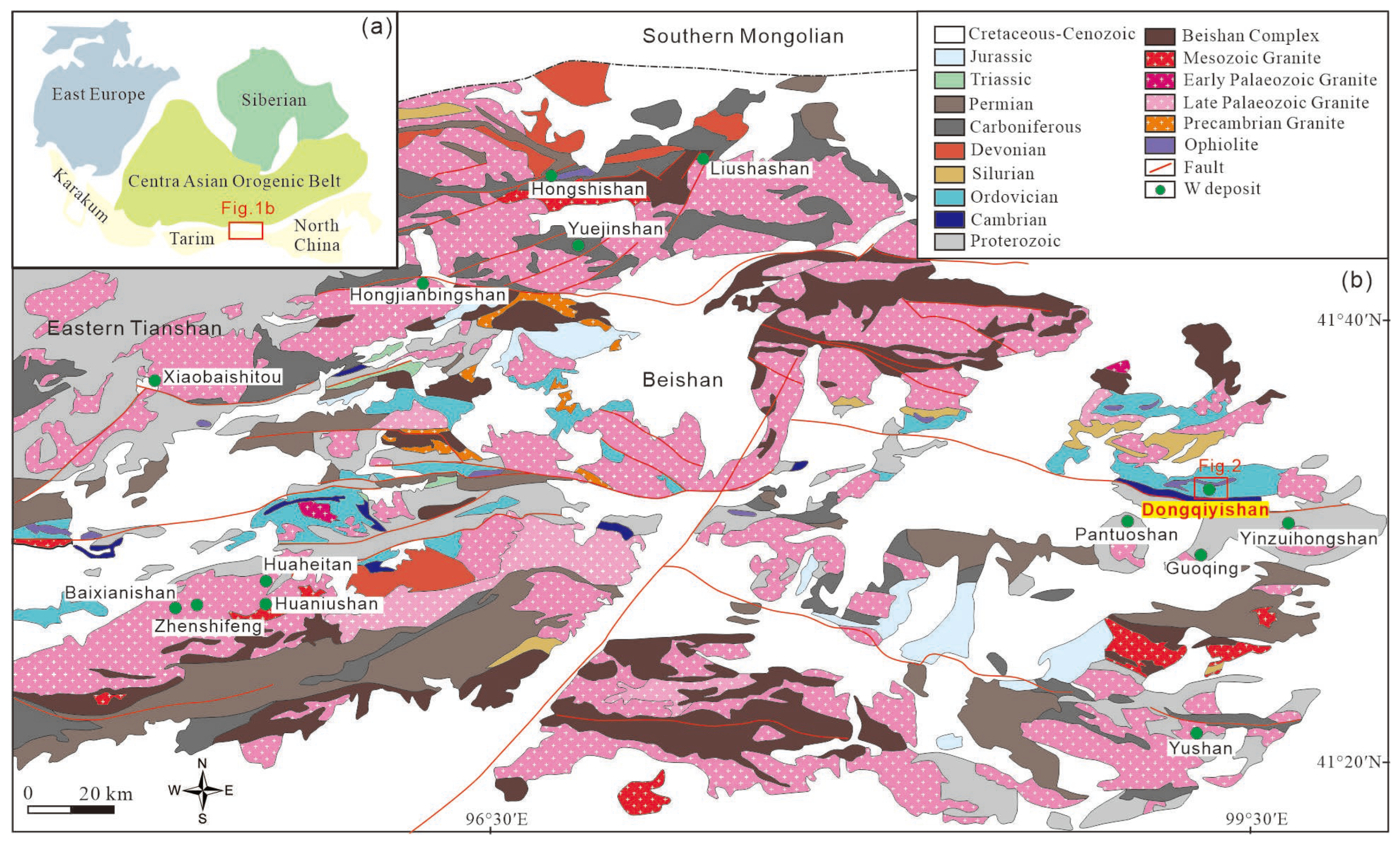
The Beishan orogenic belt is located on the southern margin of the Central Asian Orogenic Belt (Figure 1a), bounded by the Xingmeng orogenic belt to the east and the East Tianshan orogenic belt to the west, and sandwiched between the Dunhuang and South Mongolian blocks in the north–south direction (Figure 1b). It has undergone complex block assembly and fragmentation, with intense mineralization [22,32,33,34,35,36,37]. Regional structures are dominated by near east–west and northeast trends, with faults including Liuyuan–Daqishan, Hongliuhe–Niujuanzi–Xijianjing collision zone, Xingxingxia, Shaquanzi, and Hongshishan–Gongpoquan faults, which divide the Beishan orogenic belt into distinct tectonic units. From south to north, these units are the Daqishan–Zhangfangshan continental margin rift, Huan Niushan–Baishitang arc, Gongpoquan–Qilian block, Xingxingxia–Hanshan block, and Queershan arc [37,38]. Exposed strata are complete, ranging from the Neoproterozoic to Mesozoic (Figure 1b). Intrusive rocks are dominated by acidic magmatic rocks, widely distributed, including Early-Middle Paleozoic granite, Late Paleozoic granite, Paleozoic mafic and ultramafic intrusions, and some Triassic mafic dykes and granite [3,32,39,40]. Tungsten polymetallic mineralization can be divided into three stages: (1) Early Silurian (439–362 Ma) granite-related deposits, such as Guoqing and Yingzuihongshan; (2) Late Carboniferous (322–314 Ma) granite-related deposits, such as Hongjianbingshan; (3) Early Permian–Middle Triassic (286–226 Ma), including Yushan, Xiaobaishitou, and Huheitan deposits [13,15,33,36,41].
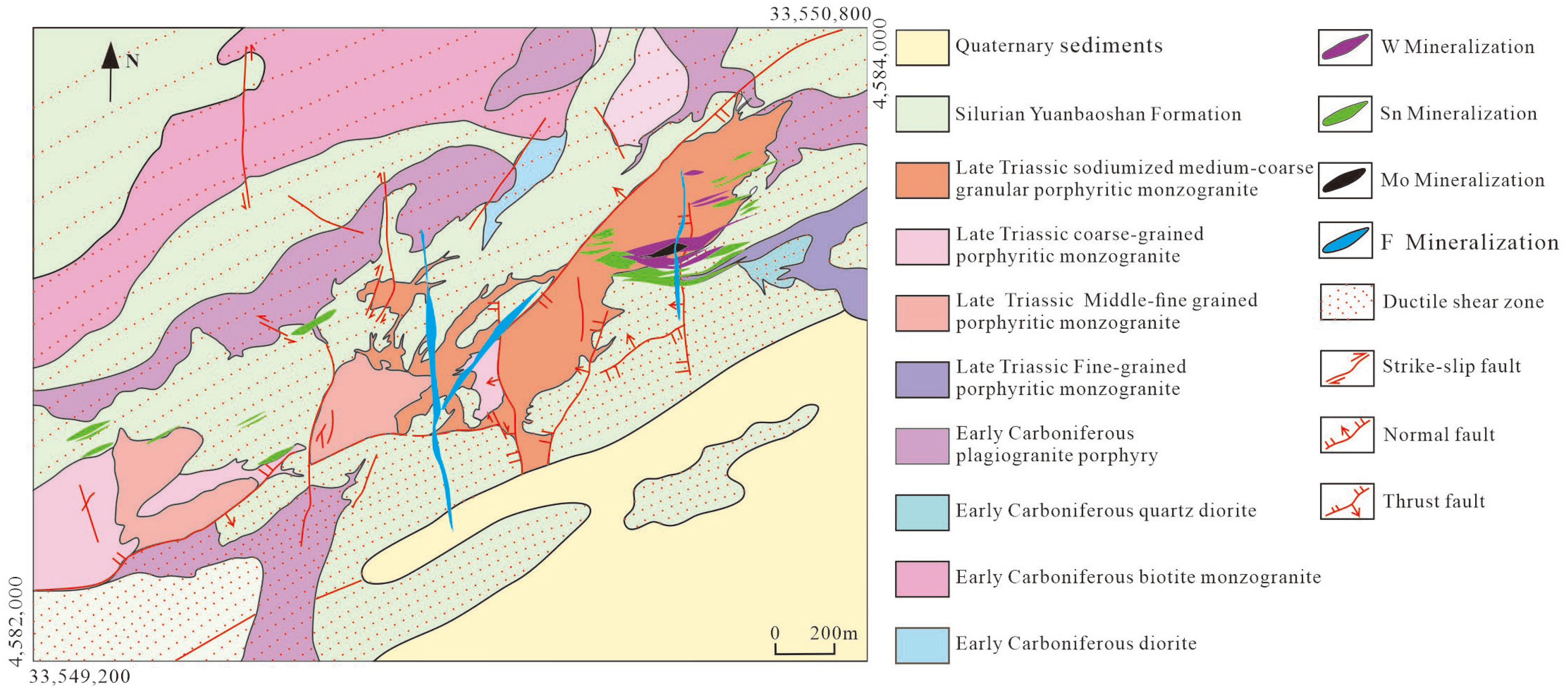
Figure 2. Geological map of the Dongqiyishan W-polymetallic deposit [43].
Minerals 16 00377 g002

3. Geology of Ore Deposit

3.1. Mining Area Geological Characteristics

The Dongqiyishan tungsten polymetallic deposit is located in the eastern segment of the Gongpoquan–Qiyishan arc, with exposed strata dominated by Silurian volcanic rock formations (Figure 2). These include the Lower Silurian Yuanbaoshan Formation metamorphosed andesitic tuff, siliceous rock intercalated with metamorphosed andesite, and the Middle–Upper Silurian Gongpoquan Formation light gray andesite, light grayish-green dacite, and gray calcite marble. Fault structures in the mining area are well developed, with main trends of E-W, NE-SW, NNE-SSW, and S-N. The EW-, NE- and NNE-trending faults form an NNE-trending fault zone, mostly forming fault contacts between complex rocks and wall rocks, controlling the occurrence of tungsten polymetallic orebodies. S-N trending faults cut through complex rocks and wall rocks, filled with fluorite veins. The mining area contains Early Carboniferous and Late Triassic intermediate–acidic magmatic rocks. Early Carboniferous rock types include diorite, quartz diorite, biotite monzogranite, and plagioclase granite porphyry. Late Triassic ore-forming intrusions are distributed along NNE-trending faults, with contact zones between intrusions and wall rocks developing assimilation–metasomatism zones of varying widths. Main lithologies include monzogranite, and albitized monzogranite [13,15,16,17,18,19]. The former two are enriched in W-Sn-Mo mineralization, while the latter is enriched in Rb-Be-Nb-Ta mineralization, with consistent crystallization ages of ~220 Ma [30].

3.2. Orebody Characteristics

The Dongqiyishan deposit contains 71 orebodies of tungsten, tin, molybdenum, rubidium, beryllium, iron, and copper, mainly distributed in the southern and eastern outer contact zones of the Dongqiyishan intrusion, occurring as residual rings in hornfelsed tuffaceous sandstone, andesite, and skarn. Rubidium, beryllium, and tin mineralization are primarily distributed within the eastern complex [30].
The No.27 W-(Sn-Mo) orebody is the largest, striking east–west, dipping north, with a dip angle of 50~65°, length of 700 m, extension of 300~500 m, and thickness of 80~150 m. Tungsten ores are dominated by wolframite–quartz veins, wolframite-potassic-quartz veins and scheelite–sericite–quartz ± wolframite assemblage; molybdenum ores are observed to take place as molybdenite–quartz veins; cassiterite generally occurs as cassiterite–quartz veins. Metal minerals include wolframite, scheelite, cassiterite, molybdenite, and rutile. WO3, Mo, and Sn contents range from 0.1%~2.07%, 0.03%~0.13%, and 0.1%~4.71%, respectively. The No.52 Rb-Be orebody occurs as a lens in albitized granite, striking NE-SE, dipping north, with length 100~400 m, extension 50~250 m, and thickness 1~30 m. Beryllium-bearing minerals are beryl; rubidium-bearing minerals are lepidolite and sericite. BeO and Rb contents range from 0.1%~0.43% and 0.1%~0.21%, respectively [30].
Wall rock alteration includes potassic, sericite, silicic, albitization, and fluorite alterations. The W-Sn-Mo mineralization usually relate with the potassic, sericite and silicic alterations, whereas Rb and fluorite mineralization are closely associated with albitization and fluoritization, respectively.
Rubidium (Rb), molybdenum (Mo), tungsten (W), tin (Sn), beryllium (Be) mineralization and fluorite (CaF2) mineralization exhibit distinct horizontal zoning from the center to the periphery of the mining area (Figure 2): albitized zones within intrusions host rubidium ore belts; 0~100 m from the intrusion margin outward hosts tungsten–molybdenum ore belts; 100~200 m outward hosts tin–iron–copper ore belts; and several hundred meters outward hosts fluorite ore belts. Vertical zoning is locally developed, roughly from top to bottom: 1180~1000 m: tin–iron–copper ore belt; 1100~900 m: tungsten ore belt; and 1000~800 m: molybdenum ore belt [30,44].

3.3. Stage of Mineralization

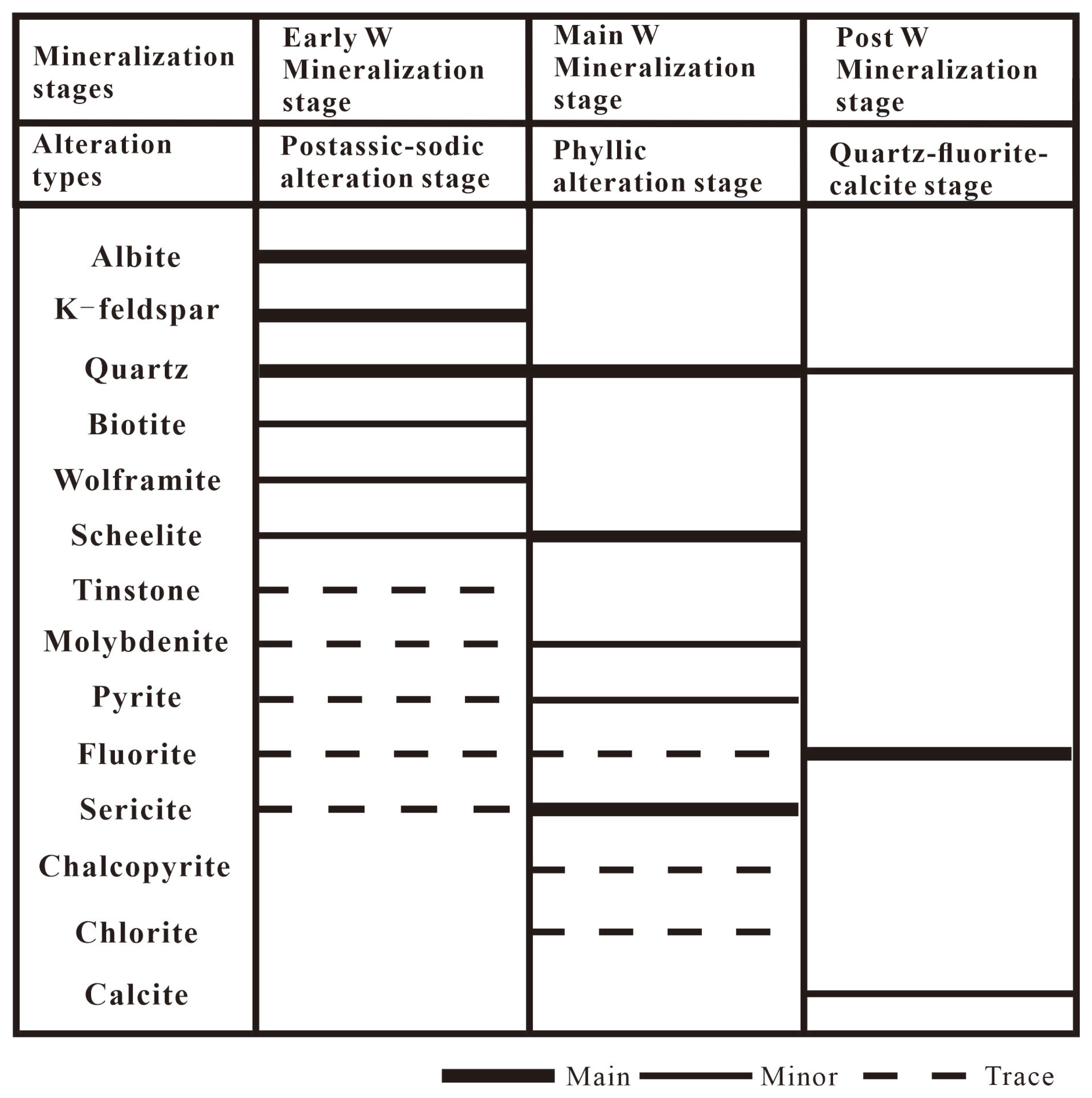
Based on detailed field and microscopic observations, cross-cutting relationships between veins and distinct mineral assemblages, this study divides the hydrothermal mineralization process of the Dongqiyishan W-polymetallic deposit into three stages (Figure 3):
(1)
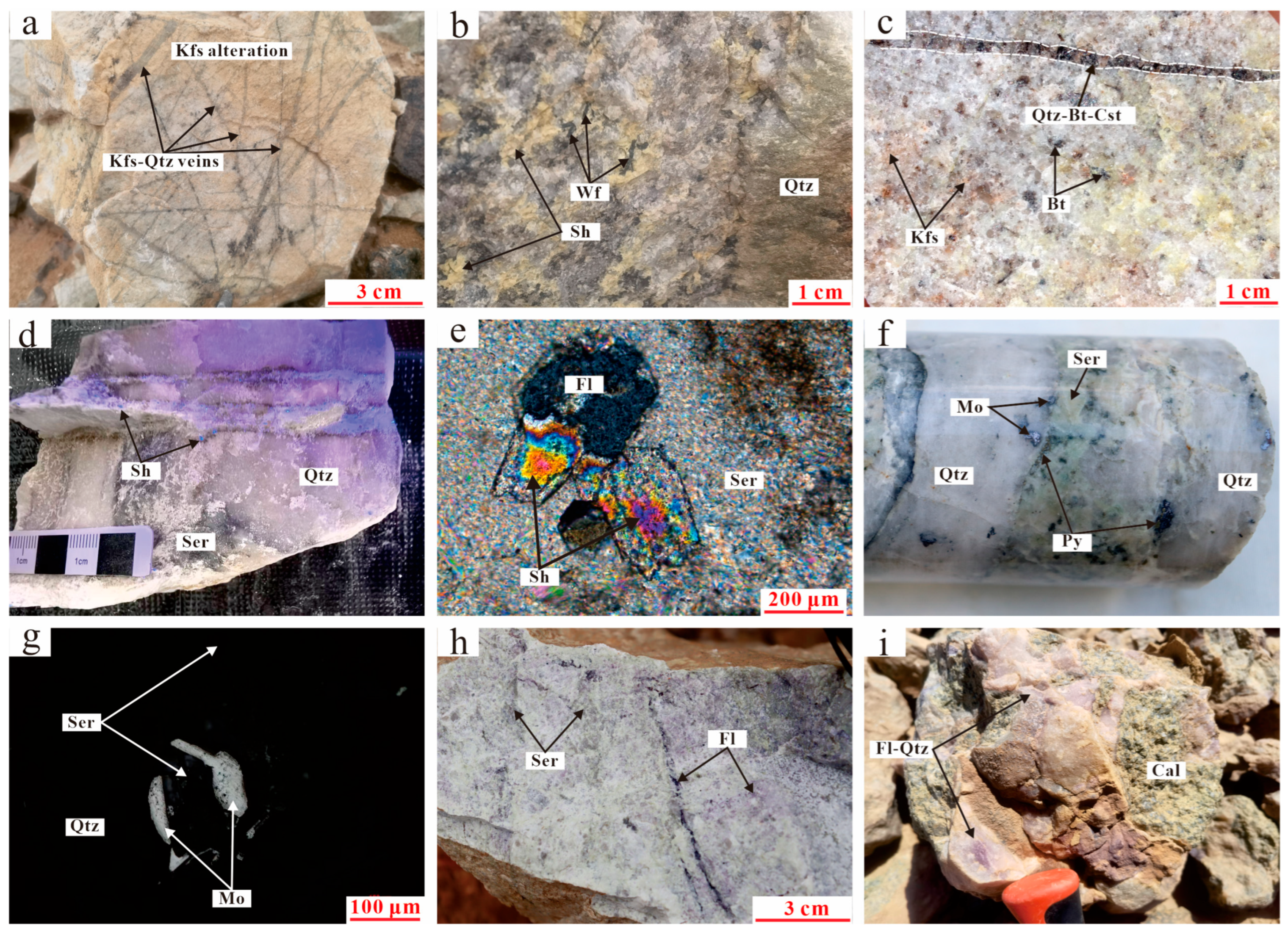
Potassic–sodic alteration stage (Stage I—early W mineralization stage): This stage is characterized by albite, K-feldspar, quartz, and biotite alteration, with minor scheelite and wolframite precipitation (Figure 3). Albite is predominantly disseminated in the core of the intrusions, with the albite-altered rock exhibiting a grayish white hue. Secondary albite grains, mostly 0.1–1 mm in size, are primarily hypidiomorphic–xenomorphic in texture. Similarly, K-feldspar is mainly distributed within the porphyritic monzogranite, where secondary K-feldspar exhibits a light red color, occurs as disseminations throughout the rock mass, and is typically hypidiomorphic to anhedral granular in texture with grain sizes mostly less than 0.5 mm. In the margin of the potassic alteration, porphyritic monzogranite is characterized by indistinct primary minerals and well-developed quartz–quartz-K-feldspar reticulated veins (0.5–5 mm wide). During this stage, minor wolframite typically occurs as euhedral prismatic and tabular crystals, with grain lengths ranging from approximately 3 to 20 mm; scheelite mostly appears as hypidiomorphic to anhedral granular aggregates, with grain sizes mostly between 0.5 and 5 mm. In this stage, no clear cross-cutting relationships are observed between scheelite–quartz ± K-feldspar veins and wolframite–quartz ± K-feldspar veins, also indicating their possible coexistence (Figure 4a,b). The secondary biotite in this stage is mainly hypidiomorphic to euhedral granular, disseminated within the K-feldspathized porphyritic monzogranite; spatially, biotitization is associated with K-feldspar alteration, and locally, quartz–biotite-cassiterite veins are observed within the porphyritic monzogranite (Figure 4c).
(2)
Phyllic alteration stage (Stage II—main W mineralization stage): This stage is characterized by extensive sericite, quartz and pyrite alteration, with the majority of economic W (wolframite and scheelite) and Mo (molybdenite) mineralization occurring in this stage (Figure 3). The alteration in this stage primarily occurs within the porphyritic monzogranite, forming at the expense of albite and K-feldspar from the potassic alteration stage. Sericite in this stage is mainly hypidiomorphic to euhedral flaky, with grain sizes mostly less than 1 mm. Quartz is predominantly anhedral granular and associated with sericite, with grain sizes mostly within 0.5 mm, and some quartz occurs in the form of quartz–sericite ± sulfide veins, with quartz grains ranging from 0.1 to 5 mm. Pyrite and scheelite mainly occur as disseminations in the phyllic-altered porphyritic monzogranite, with minor amounts occurring in quartz–sericite ± scheelite ± pyrite veins (Figure 4d,e). Tungsten and molybdenite mainly occurs in this stage, molybdenite presents in the quartz–sericite–molybdenite veins within the porphyritic monzogranite (Figure 4f,g), and wolframite occurs disseminated with quartz within the porphyritic monzogranite (Figure 4b). Furthermore, a minor amount of fluorite is present during this stage, predominantly occurring as disseminations in the porphyritic monzogranite, while some occurs as veinlets or veinlet-disseminated occurrences. (Figure 4h).
(3)
Quartz–fluorite–calcite stage (Stage III—post-W-mineralization hydrothermal stage): This stage is dominated by fluorite, quartz and calcite vein formation, with negligible W mineralization (Figure 3), which primarily occur as fluorite–quartz–calcite veins (Figure 4i). The veins are mainly distributed in the Yuanbaoshan Formation tuff and Carboniferous acidic intrusive rocks, outside the porphyritic monzogranite. The fluorite–quartz–calcite veins in this stage predominantly appear as large veins, with widths typically ranging from 0.1 to 5 m and lengths reaching up to 2 km, representing the main fluorite-producing stage in the mining district.

4. Analytical Methods

4.1. Fluid Inclusion Microthermometry

Microthermometric analysis of fluid inclusions was conducted at the School of Earth Sciences and Resources, China University of Geosciences (Beijing, China), using a Linkam MDS600 heating–freezing stage (manufactured by Linkam Scientific Instruments, Surrey, UK) with an operational temperature range of −196 to 600 °C. The instrumental accuracy is ±0.5 °C in the range of −196 to −100 °C, ±0.1 °C between −100 °C and 400 °C, and ±2 °C above 400 °C. During measurements, heating and cooling rates were generally maintained between 2 and 5 °C/min. However, the rate was reduced to 0.1 °C/min as the ice-melting temperature was approached and further adjusted to 0.2–0.5 °C/min near the homogenization temperature to ensure data reliability. Salinity calculations for H2O–NaCl fluid inclusions were performed following the method provided by Bodnar (1994), with salinities expressed in wt.% NaCl eqv. [45].

4.2. S Isotope Analysis

Sulfide samples used for sulfur isotope analysis were separated at Guizhou Chuangyuanweipu Technology Co., Ltd. (Guizhou, China) The sulfides were first processed by magnetic separation and then manually purified under a binocular microscope (manufactured by Leica Microsystems, Wetzlar, Germany) to achieve a purity of >99%. Sulfur isotope analysis was conducted at China University of Geosciences (Beijing, China). Sulfur isotope analysis followed the standard procedures described in Krouse and Grinenko (1991) and Coplen (1994) [46,47]. The analytical procedure involved converting sulfides to SO2 by reaction with copper oxide under vacuum and at high temperature. The resulting SO2 was then analyzed using a MAT 253 stable isotope ratio mass spectrometer (Thermo Fisher Scientific, Bremen, Germany) coupled with a Costech ECS 4010 elemental analyzer (Costech Analytical Technologies Inc., Valencia, CA, USA). The δ34S values were calculated based on the 34S/32S ratio and are reported relative to the VCDT standard, with an analytical precision better than ±0.2‰.

4.3. H-O Isotope Analysis

Quartz used for H-O isotope analysis are from quartz ± K-feldspar ± wolframite ± pyrite ± fluorite veins of Stage I to III, and were separated at Guizhou Chuangyuanweipu Technology Co., Ltd. Hydrogen and oxygen isotope analyses were performed using a MAT-253 mass spectrometer at the Stable Isotope Laboratory of the Institute of Mineral Resources, Chinese Academy of Geological Sciences. Oxygen isotope analysis of quartz samples used the conventional BrF5 method [48]. BrF5 reacts with oxygen-bearing minerals under vacuum and at high temperature to extract oxygen. The oxygen is then converted to CO2 gas by combustion over a heated graphite rod. The analytical precision is ±0.2‰, with V-SMOW as the reference. For hydrogen isotope analysis, pure quartz samples (40–60 mesh) were vacuum-degassed at 150 °C for over 4 h to remove adsorbed water and water from secondary fluid inclusions. The water was then released by thermal decrepitation at 400 °C and converted to H2 by reaction with metallic zinc. The analytical precision is ±0.2‰, with V-SMOW as the reference.

4.4. Molybdenite Re-Os Dating

The molybdenite samples used in this experiment were selected at Guizhou Chuangyuanweipu Technology Co., Ltd. The molybdenite samples were first subjected to flotation and then handpicked under a binocular microscope to ensure a purity of over 99%. The Re–Os isotopic analysis was conducted at the State Key Laboratory of Ore Deposit Geochemistry, Institute of Geochemistry, Chinese Academy of Sciences, using a Thermo Scientific X Series2 ICP–MS (manufactured by Thermo Fisher Scientific Inc., Waltham, MA, USA). The sample dissolution process, Re–Os extraction process, and testing methods are described in Sun et al. (2001, 2010) [49,50]. The molybdenite reference material used during the testing was JDC, and its analytical results were consistent with the recommended values within error, indicating that the test results are reliable. The molybdenite Re–Os model ages were calculated using the formula 187Os = 187Re(eλt−1), with a decay constant of λ = 1.666 × 10⁻¹¹ year−1 [51] and the Re–Os isochron ages were calculated using Isoplot.

5. Results

5.1. Fluid Inclusion

5.1.1. Fluid Inclusion Petrography

Detailed observation of fluid inclusions from various stages at room temperature reveals that fluid inclusions in the host mineral quartz are relatively well developed. They are mainly distributed in clusters and do not exhibit zonal distribution. Based on the phase characteristics and proportions of the inclusions, the fluid inclusions in the Dongqiyishan deposit are classified into four types: liquid–vapor two-phase inclusions (W-type), daughter mineral-bearing inclusions (S-type), pure liquid inclusions (PL-type), and pure vapor inclusions (PV-type). Among these, the W-type can be further divided into liquid-rich inclusions (WL-type) and vapor-rich inclusions (WV-type).
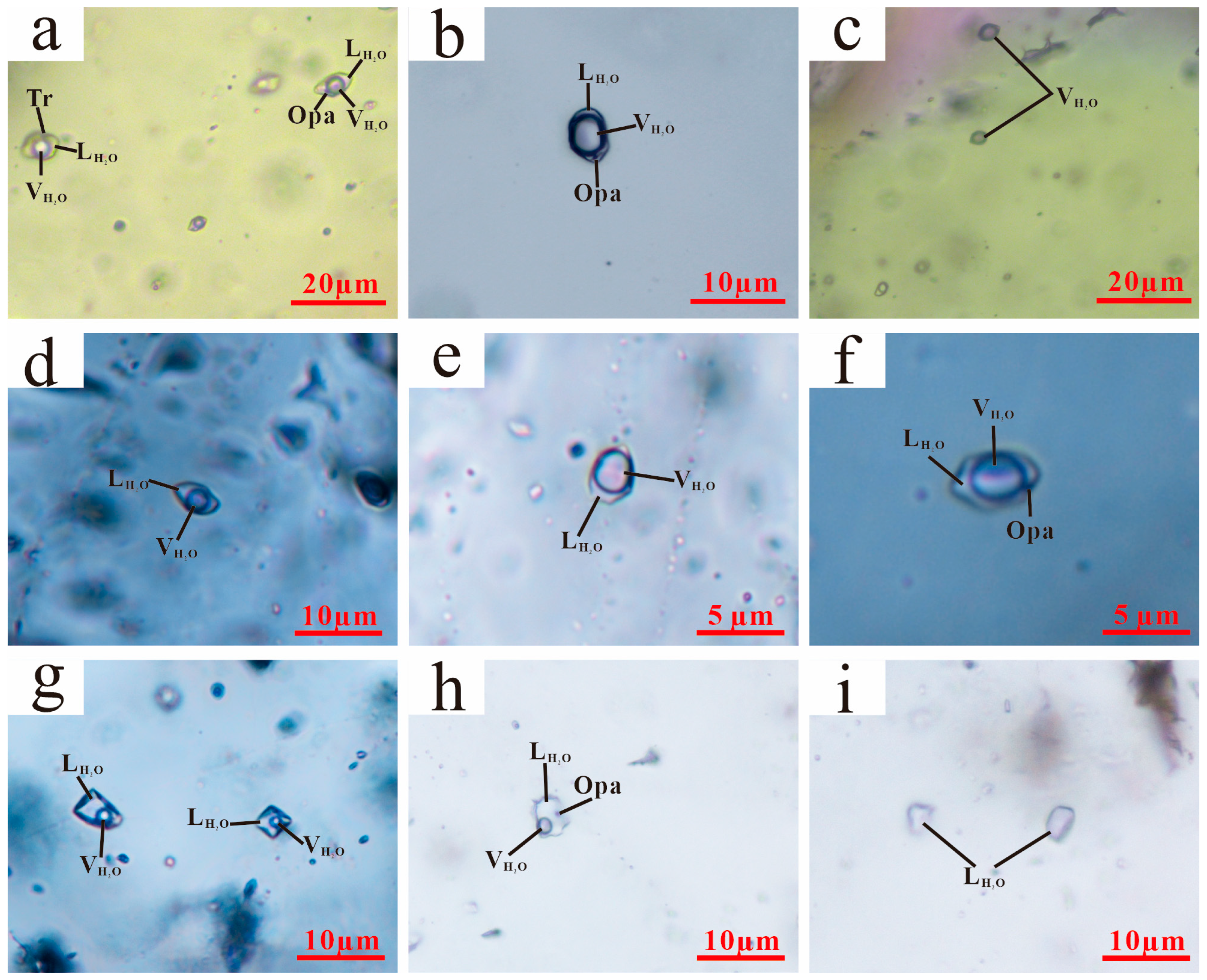
WL-type: This type of fluid inclusion consists of an aqueous liquid phase and a vapor bubble. The vapor phase proportion typically ranges from 10% to 30%. This type of fluid inclusion accounts for approximately 40% of the total inclusion population (Figure 5a,d,g). WL-type fluid inclusions are mostly 3–10 μm in size and exhibit oval, negative crystal, and irregular shapes. They commonly occur as isolated individuals, in clusters, or arranged linearly along fractures in minerals such as quartz. During heating, these inclusions homogenize to the liquid phase. WL-type inclusions are present in all stages.
WV-type: This type of fluid inclusion also consists of an aqueous liquid phase and a vapor bubble. The vapor phase proportion typically ranges from 50% to 90% (Figure 5b). WV-type inclusions are mostly 2–10 μm in size. They exhibit oval, negative crystal or irregular shapes. They primarily occur as isolated individuals or in clusters within quartz. This type accounts for approximately 50% of the total inclusion population. They are mainly distributed in Stage I and Stage II quartz.
S-type: This type of inclusion is composed of an aqueous liquid phase, a vapor phase, and typically one transparent or opaque daughter mineral. The daughter mineral is mostly anhedral, and its composition is difficult to infer. During heating, the daughter mineral does not dissolve (Figure 5a,f,h). These inclusions primarily occur in Stage I quartz and are occasionally observed in Stage II and Stage III inclusions. The vapor phase proportion typically ranges from 10% to 80%. The long axis of the inclusions is mostly between 3 and 10 μm.
PL-type: These inclusions are mostly 2–8 μm in size. They exhibit oval or negative crystal shapes. They commonly occur as isolated individuals. This type of inclusion is found in Stage III quartz (Figure 5i).
PV-type: This type of inclusion is typically dark-colored. They are 2–8 μm in size. They exhibit oval or negative crystal shapes. They are observed in Stage I quartz veins (Figure 5c).

5.1.2. Fluid Inclusion Microthermometry

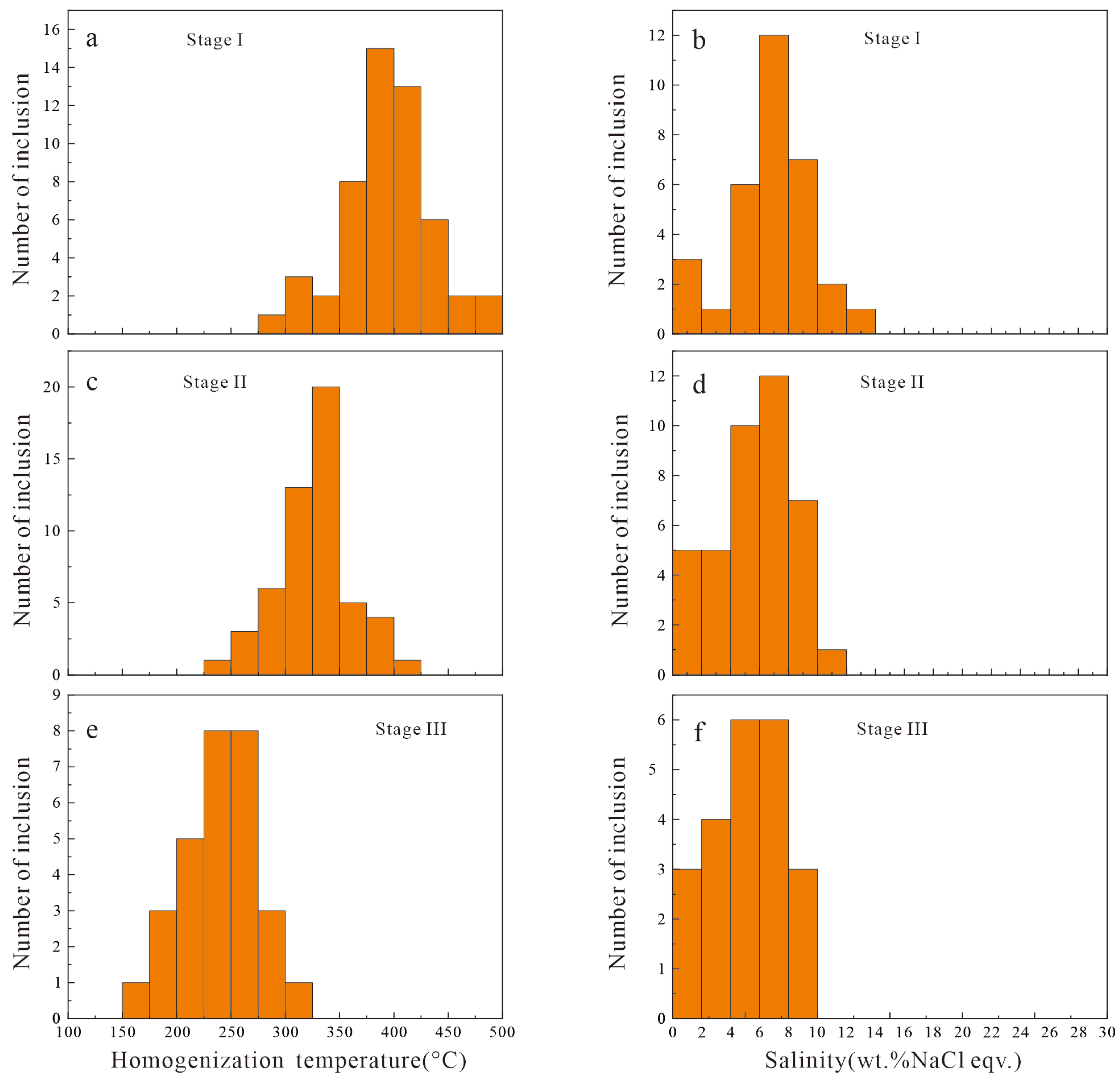
The salinities of NaCl-H2O vapor–liquid two-phase inclusions were calculated using the salinity-freezing point formula [52]. The microthermometric results of fluid inclusions from the Dongqiyishan deposit are presented in Table 1 and Figure 6.
Stage I quartz contains WL, WV, S, and PV-type fluid inclusions. Microthermometric analysis was conducted on WL and WV-type inclusions. The results indicate that all these inclusions homogenize to the liquid phase, with homogenization temperatures ranging from 296 to 481 °C, predominantly between 350 and 400 °C (Figure 6a). The ice-melting temperatures range from −0.5 to −8.8 °C, corresponding to salinities of 0.88 to 12.6 wt.% NaCl eqv., predominantly between 6.0 and 8.0 wt.% NaCl eqv. (Figure 6b). The calculated fluid densities range from 0.39 to 0.82 g/cm3.
Stage II quartz primarily contains WL, WV, and S-type fluid inclusions. WL and WV-type inclusions were selected for measurement, both of which predominantly homogenize to the liquid phase. The ice-melting temperatures of these fluid inclusions range from −0.5 to −8.0 °C, corresponding to total salinities of 0.9–11.7 wt.% NaCl eqv. (predominantly 4.0–8.0 wt.% NaCl eqv.), and fluid densities of 0.59–0.86 g/cm3 (Figure 6d). The homogenization temperatures range from 238 to 402 °C, predominantly between 300 and 350 °C (Figure 6c).
Stage III quartz primarily contains WL, PL, and S-type fluid inclusions. WL-type inclusions from this stage were selected for microthermometric analysis. The results show ice-melting temperatures range from −0.6 to −6.2 °C, corresponding to salinities of 1.1 to 9.5 wt.% NaCl eqv., predominantly between 4.0 and 8.0 wt.% NaCl eqv., and fluid densities range from 0.85 to 0.91 g/cm3 (Figure 6f). The homogenization temperatures range from 166 to 316 °C, predominantly between 225 and 275 °C (Figure 6e).

5.2. Results of H-O Isotope

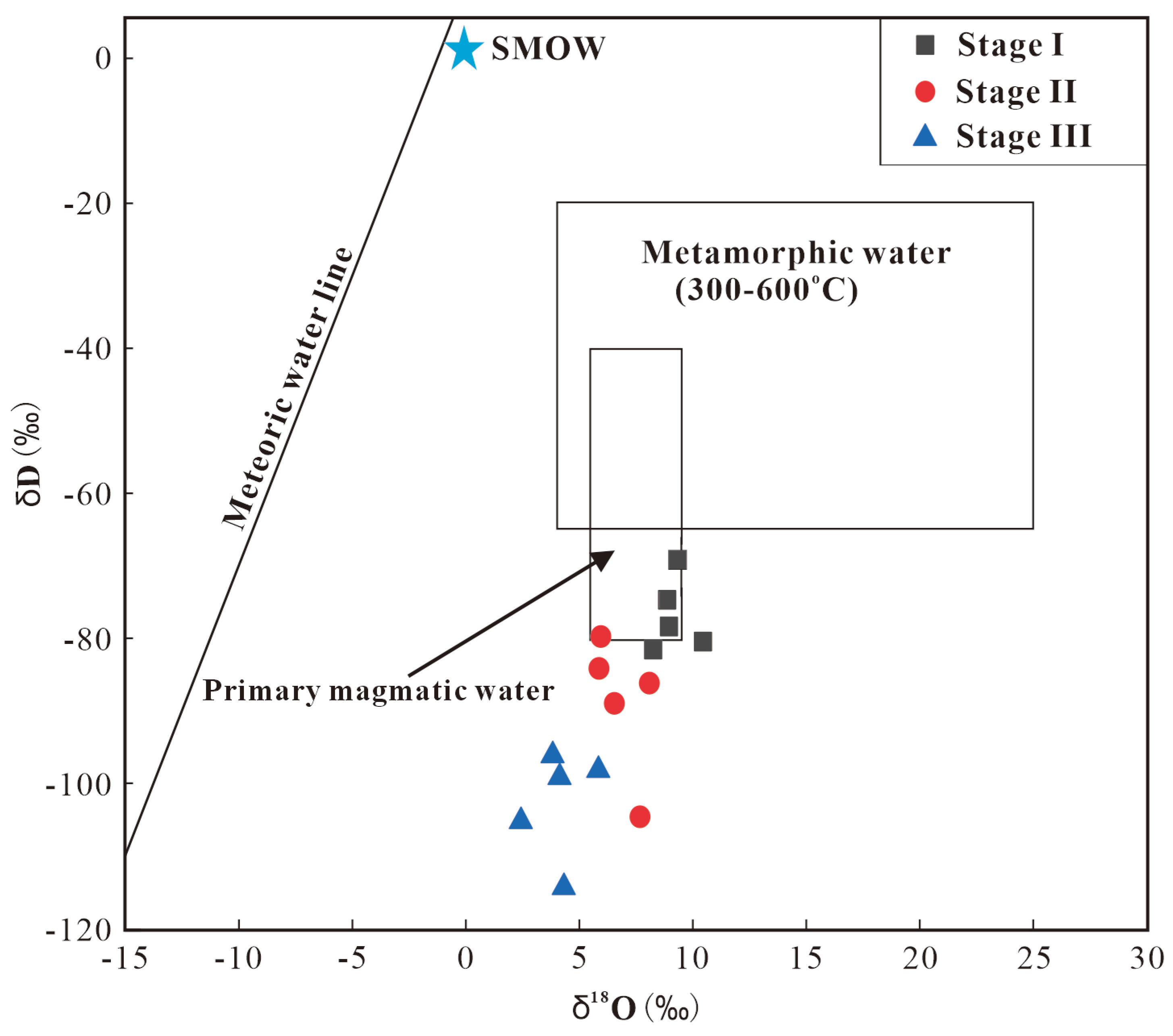
Five quartz samples from Stage I, II and III were respectively selected for H-O iso-tope test. The results are shown in Table 2. Among them, the δDV-SMOW of Stage I is −82 to −69‰, with an average of −77‰. The δ18OV-SMOW values range from 7.9 to 9.7‰, with an average of 8.8‰. The δ18OH2O-SMOW values range from 8.8‰ to 10.4‰, with an average of 9.5‰. The δDV-SMOW of Stage II is −104 to −80‰, with an average of −89‰. The δ18OV-SMOW values range from 6.0 to 7.9‰, with an average of 6.8‰. The δ18OH2O-SMOW is 5.8 to 8.0‰, with an average of 6.8‰. The δDV-SMOW of Stage III is −117‰ to −96‰, with an average of −103‰. The δ18OV-SMOW values range from 2.4 to 5.8‰, with an av-erage of 4.1‰. The δ18OH2O-SMOW is 1.9 to 5.2‰, with an average of 3.8‰.

5.3. Results of S Isotope Analysis

The five sulfide samples used to analyze the S isotope in the study are pyrite from Stage II, which are derived from the beresitization monzonitic granite and quartz-sulfide–sericite veins. The S isotope data are shown in Table 3. The δ34S value is −0.5~1.6‰, with an average of 0.93‰, and the variation range is narrow, indicating that the ore-forming materials of the Dongqiyishan deposit mainly come from the magmatic source area (−3~+7‰) [53].

5.4. Results of Molybdenite Re-Os Dating

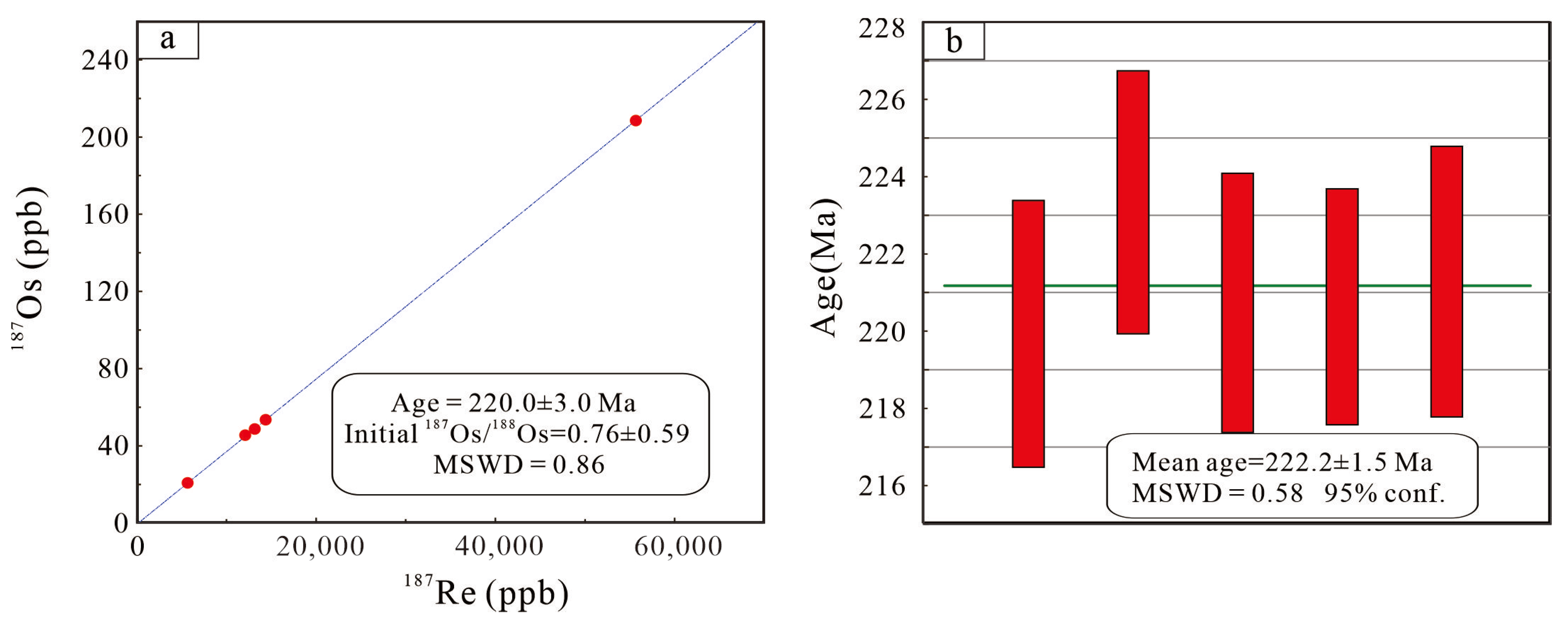
The five molybdenite samples used for dating are from the quartz–molybdenite ± pyrite ± sericite veins of Stage II, and the results are shown in Table 4. In the Dongqiyishan deposit, the content of molybdenite Re is low, which is 5.8–55.4 μg/g, and the content of 187Os is 22.3–205.1 ng/g. The model ages of the samples are 221.0 ± 3.5 Ma~224.4 ± 3.4 Ma, the isochron age is 220.0 ± 3.0 Ma (MSWD = 0.86), and the weighted average age is 222.2 ± 1.5 Ma (MSWD = 0.58) (Figure 7).

6. Discussion

6.1. Metallogenic Age

Previous studies have suggested that the porphyry–skarn-type W-Mo deposits in the Beishan area formed from the Early Permian to Triassic (286~226 Ma) [7,9,14,15,22]. In this study, the Re-Os weighted average age of molybdenite is 220.0 ± 3.0 Ma, and the isochron age is 222.2 ± 1.5 Ma. Zhang et al. (2023) [30] measured the ages of medium-fine grained monzogranite related to W-Sn-Mo mineralization in the mining area as 220.6 ± 1.6 Ma, granite porphyry as 220.0 ± 1.1 Ma, and albitized porphyritic monzogranite related to Rb-Be-Nb-Ta mineralization as 219.9 ± 1.9 Ma. These indicate that the metallogenic age of the Dongqiyishan W-polymetallic deposit is Middle–Late Triassic, consistent with the diagenetic age of the Qiyishan granites.
Previous studies have documented the metallogenic ages of several deposits in the Beishan region: the Huaheitan W-Mo deposit (~225 Ma [13,54]), the Xiaobaishitou W deposit (~240 Ma [9]), and the Hongjianbingshan W-Mo deposit, which exhibits two mineralization episodes (~320 Ma [13] and ~215 Ma [41]). These data collectively indicate that the Beishan region experienced multiple episodes of W-polymetallic mineralization, with the Middle–Late Triassic emerging as a key metallogenic epoch for tungsten mineralization.
The Triassic is an important magmatic–minerogenic period in the Beishan region, and scholars have proposed various views on its genesis: (1) the Beishan region was in a post-collisional extension stage of the Paleo-Asian Ocean during the Triassic [55]; (2) the Paleo-Asian Ocean closed during the Triassic [56]; (3) it was influenced by the post-collisional extension of the Mongol-Okhotsk Ocean [57]; (4) it was influenced by the subduction of the Paleo-Tethys Ocean during the Triassic [58]. Research indicates that the closure of the Paleo-Asian Ocean occurred in the Late Carboniferous to Early Permian (305–295 Ma) [58,59]. As a branch of the Paleo-Asian Ocean, the final closure time of the related ocean basin in the Beishan region is also in the Late Carboniferous to Early Permian [60,61]. The post-collisional extension stage is generally considered to last 30–40 Ma after ocean closure, whereas the Triassic magmatic activity in the Beishan region (approximately 250–195 Ma) far exceeds this time limit [62]. Furthermore, The ore-related granodiorite porphyry shows typical adakitic geochemical characteristics (Sr/Y = 45–62, La/Yb = 28–35, low Yb = 0.8–1.2 ppm) [28], which are consistent with the geochemical signatures of arc magmas formed by partial melting of subducted oceanic crust, rather than the post-collision A-type or highly fractionated I-type granites related to the PAO closure. The εHf(t) values of zircon from the ore-related porphyry range from +2.1 to +4.6, which are significantly lower than those of post-collision ore-related granites in the eastern CAOB (εHf(t) = +8 to +15) [63]. Therefore, the possibility that the Triassic magmatic activity in this region formed during the post-collisional extension stage of the Paleo-Asian Ocean is not very high. Furthermore, the subduction–closure zone of the Mongol-Okhotsk Ocean is thousands of kilometers away from the Beishan region, far beyond the traditional influence range of subduction (within 1000 km) [64]; thus, view (3) can be excluded. Therefore, it can be concluded that the Triassic magmatic–minerogenic events in the Beishan region were caused by the northward subduction of the Paleo-Tethys Ocean. In the adjacent Eastern Tianshan region, Triassic magmatic–minerogenic events are also observed, such as the Beishan molybdenum deposit (ca. 227 Ma) [65,66,67], the Donggobi molybdenum deposit (ca. 236 Ma) [55], and the Sanchakou copper deposit (ca. 237 Ma) [58].

6.2. Mineralization Pressure and Depth

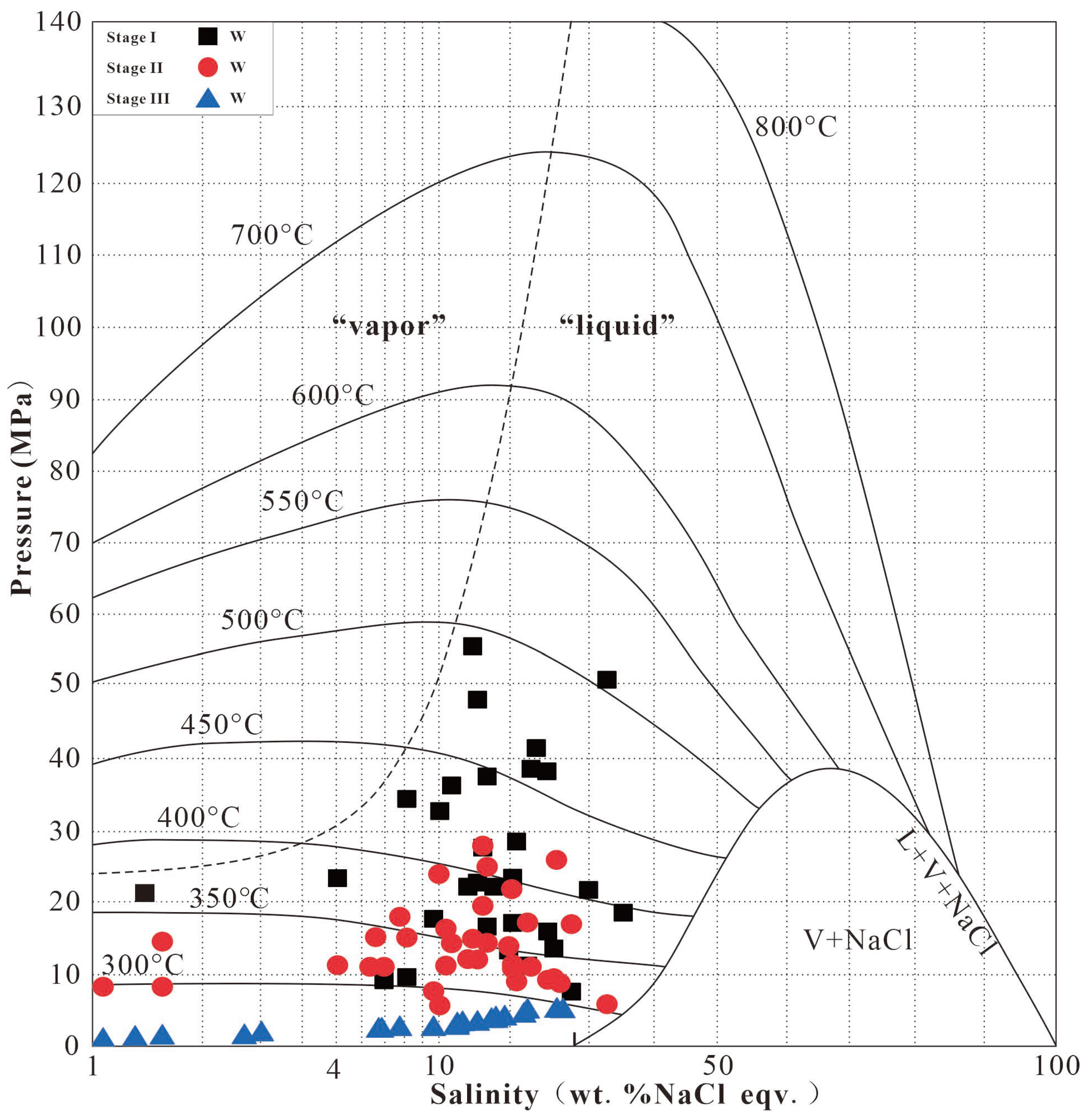
Based on the homogenization temperatures and salinities of fluid inclusions, the trapping pressures of W-type inclusions can be roughly estimated using the NaCl-H2O P-T-X diagram provided by Bouzari and Clark (2006) [68], whereas for non-boiling inclusions, this method only yields their minimum trapping pressure [69]. Consequently, the minimum trapping pressures for each stage are determined as follows: 7.6–55.6 MPa (predominantly 13–40 MPa; Stage I), 5.6–27.9 MPa (predominantly 7.0–18.0 MPa; Stage II), and 0.7–4.9 MPa (predominantly 1.0–4.9 MPa; Stage III) (Figure 8).
Assuming that the alteration and mineralization at the Dongqiyishan deposit formed in a closed system, the fluids at each stage were under lithostatic pressure conditions [70]. Using an average upper crustal rock density of 2.5 g/cm3, the formation depths for each stage of the Dongqiyishan deposit are calculated as: 0.30–2.22 km (0.52–1.60 km; Stage I), 0.22–1.12 km (0.28–0.72 km; Stage II), and 0.03–0.20 km (0.04–0.20 km; Stage III). If the fluid evolution at the Dongqiyishan deposit occurred in an open system, the mineralization system would have been under hydrostatic pressure, resulting in fluid pressure equivalents of 0.76–5.56 km (1.30–4.00 km; Stage I), 0.56–2.79 km (0.70–1.80 km; Stage II), and 0.07–0.49 km (0.10–0.49 km; Stage III).
In an extensional setting, magmatic rocks intrude rapidly into shallow crustal levels, bringing with them large volumes of 400–500 °C plastic rocks [71]. Under such conditions, the brittle–ductile transition may occur at depths of 1–2 km. Due to the influx of high-temperature fluids associated with magmatic emplacement, rocks below this transition undergo ductile deformation under lithostatic pressure (>400 °C), whereas above this transition, rocks experience brittle fracturing under hydrostatic pressure (<400 °C) [59,72]. Considering that fluid inclusion homogenization temperatures generally represent the minimum fluid temperatures, the Stage I fluids (predominantly 350–400 °C) likely formed under lithostatic pressure, suggesting trapping depths of 0.30–2.22 km (predominantly 0.52–1.60 km). Since the fluid temperatures in Stages II and III are predominantly 225–350 °C, and extensional settings are characterized by well-developed surface fractures, the fluid system during Stages II–III was likely under hydrostatic pressure. The minimum trapping depths for Stages II and III are thus 0.70–1.80 km and 0.10–0.49 km, respectively. In comparison, Stages I and II formed at similar depths, whereas Stage III formed at shallower depths.

6.3. Source of Metallogenic Fluids and Materials

Metallogenic fluids can be classified as meteoric water, seawater, magmatic water, metamorphic water, etc. [73]. The H-O isotopes are a widely used method for tracing the source of metallogenic fluids, as fluids from different sources possess unique H-O isotopic features [74]. The data from this study show that for Stage I of the Dongqiuyishan deposit, δDV-SMOW is −82 to −69‰ (with an average value of −77‰), and δ18OH2O-SMOW is 8.8 to 10.4‰ (with an average value of 9.5‰). In Figure 9, they mainly fall within the range of primary magmatic water, indicating that they mainly originated from magmatic fluids. The high homogenization temperatures of fluid inclusions (mainly 350 to 400 °C) and the presence of quartz–K-feldspar vein networks also suggest that they formed in magmatic fluids. The δDV-SMOW and δ18OH2O-SMOW values for Stage II were −104 to −80‰ (with an average of −89‰) and 5.8 to 8.0‰ (with an average of 6.8‰), respectively. These values are plotted near the primary magmatic water in Figure 9, indicating that the fluids in this stage mainly originated from magmatic water, with a small amount of meteoric water being added. The fluid δDV-SMOW value for Stage III was −117 to −96‰, with an average of −103‰, and the δ18OH2O-SMOW value was 1.9 to 5.2‰, with an average of 3.8‰. The sample data fall between the magmatic water and meteoric water, indicating that it was formed by the mixture of meteoric water and magmatic water. Previous researchers studied the trace element composition of fluorite and concluded that the fluorite in the Dongqiyishan area during Stage III was the result of the reaction between magmatic fluid and the water in the surrounding rocks [26,27]. During this process, as the temperature decreased, a large amount of groundwater was inevitably added. Additionally, the δ34S value of pyrite in the Dongqiyishan deposit during Stage II was −0.5 to 1.6‰, with an average of 0.93‰, which falls within the typical range of magmatic sulfur (0~5‰) and shows no obvious fractionation during hydrothermal evolution. This homogeneous sulfur isotope signature is highly consistent with the observation from the Mawchi Sn-W deposit [73], who demonstrated that S-type granite-related Sn-W deposits generally have restricted δ34S ranges (2~6‰) with limited crustal sulfur contamination, as the ore-forming fluids exsolved directly from the crystallizing magma without significant interaction with sedimentary country rocks during the main mineralization stage. The sulfur isotope characteristics are highly consistent with those of contemporaneous Triassic tungsten deposits in the Beishan region. For example, the δ34S values of pyrite from the Hongjianbingshan W-Mo deposit range from −1.2‰ to 2.1‰ (n = 6) [17], and those from the Huaheitan W-Mo deposit range from 0.3‰ to 1.8‰ (n = 5) [49], both indicating a typical magmatic sulfur source, which is consistent with our results. Combined with the whole-rock Sr-Nd and zircon Hf isotope data (εHf(t) = −5.3~−2.1, TDM2 = 1.32~1.11 Ga) [75], we confirm that the ore-forming materials (metals and sulfur) were dominantly derived from partial melting of Paleoproterozoic metasedimentary crustal materials, with minor mantle-derived magma input during the magmatic evolution process.
In summary, the early ore-forming fluids of the Dongqiyishan deposit originated from magma (Stages I and II). As the mineralization process progressed, meteoric water gradually entered the ore-forming fluids. By Stage III, the ore-forming fluids showed the characteristics of a mixture of meteoric water and magmatic water. The ore-forming materials of this deposit mainly originated from magmatic rocks.

6.4. Deposit Genesis

Wood and Samson (2000) demonstrated through thermodynamic simulation experiments that W exists in hydrothermal fluids mainly in the forms of simple tungstate (WO42−, H2WO4, HWO4, and KHWO4) and basic tungstate ions (KWO4, NaWO4, and NaHWO4) [77]. The precipitation of W is mainly caused by the following mechanisms: (1) natural cooling of the ore-forming fluid [78]; (2) water–rock reaction [42,43]; (3) fluid immiscibility/boiling [76]; and (4) fluid mixing [79,80].
In hydrothermal deposits, it is generally believed that the characteristics of fluid inclusions in the early-formed hydrothermal minerals can represent the true characteristics of the ore-forming fluid [81,82]. Therefore, it can be concluded that the initial ore-forming fluid of the Dongqiyanshan deposit has the characteristics of high temperature (mainly 350–400 °C) and low salinity (mainly 6–8 wt.% NaCl eqv.). It clearly has the characteristics of magmatic fluid. The formation depth of this fluid is 0.52–1.60 km, which is relatively consistent with the typical intrusion depth of porphyry deposits (<5 km) in the world [31,83,84,85]. Moreover, since fluorine in the ore of the mining area mainly comes from magmatic fluid [27], it can be inferred that the ore-forming fluid is a H2O-NaCl fluid rich in fluorine. Due to the quartz in Stage I containing WL-, WV-, and S-type fluid inclusions, and a wide range of salinity (0.9–12.6 wt.% NaCl eqv.), it suggests that this stage may have experienced a boiling phenomenon of the fluid, resulting in a significant difference in the ratio of gas–liquid phases. The H-O isotope characteristics also indicate that there was no obvious addition of extraneous fluid in this stage. Therefore, the early W mineralization (Stage I) may be primarily attributed to the combined effect of fluid boiling and water–rock interaction, as the temperature showed a negligible decrease and extensive potassic–sodic alteration was prevalent during this stage.
The fluid inclusions in Stage II are mainly WL-, WV-, and S-type, with a higher fluid temperature (mainly 300–350 °C) and a lower salinity (mainly 4.0–8.0 wt.% NaCl eqv.). From Stage I to Stage II, the alteration of the surrounding rocks changes from potassic–sodic to sericite (Stage II), indicating that the pH value of the ore-forming fluid changes from weakly alkaline (Stage I) to weakly acidic (Stage II), which may be caused by the alteration of the surrounding rocks. The H-O isotope values of quartz in this stage are still mainly magmatic water, with only a small amount of meteoric water added. Accordingly, for the main W mineralization stage (Stage II), water–rock interaction is proposed as the key driver for large-scale W precipitation, concurrent with a minor temperature decrease and limited meteoric water incursion.
Stage III is characterized by the production of a large amount of fluorite. The fluid temperature in this stage is significantly lower than that in Stages I and II (mainly 225–275 °C), and the H-O isotope indicates that a large amount of meteoric water was added in this stage.) [26] studied that the F in the fluorite of this stage mainly comes from magmatic fluid, and Ca mainly comes from the water–rock reaction between the fluid and the surrounding rocks [27]. Therefore, during the post-W-mineralization hydrothermal stage (Stage III), fluorite precipitation was likely the result of both water–rock interaction and significant fluid cooling, accompanied by large-scale mixing of meteoric water into the hydrothermal system.

7. Conclusions

(1)
The hydrothermal evolution of the Dongqiyishan W-polymetallic deposit can be divided into three stages: the potassic–sodic alteration stage (Stage I—early W mineralization), the phyllic alteration stage (Stage II—main W mineralization), and the quartz–fluorite–calcite stage (Stage III—post-W-mineralization). W mineralization mainly occurred in Stage I and Stage II, while late-stage hydrothermal activity (Stage III) was dominated by fluorite precipitation with negligible economic W mineralization.
(2)
Metallogenic of the Dongqiyishan W-polymetallic deposit formed at 222.2 ± 1.5 Ma (MSWD = 0.58), possibly as a result of the northward subduction of the Paleo-Tethys Ocean.
(3)
H-O-S isotope analyses reveal that Stage I ore-forming fluids were magmatic water-dominated, Stage II fluids were predominantly magmatic water with minor meteoric water addition, and Stage III fluids were mainly a meteoric–magmatic water mixture. The ore-forming materials were primarily derived from magma.
(4)
For Stage I, W precipitation was likely driven by the combined effect of fluid boiling and water–rock interaction; in contrast, W precipitation during Stage II is inferred to be attributed primarily to water–rock interaction. As for Stage III, fluorite precipitation probably resulted from water–rock interaction coupled with fluid cooling.

Author Contributions

Conceptualization, H.L. and L.W.; methodology, H.L.; software, H.L.; validation, H.L., F.Z. and X.Z.; formal analysis, H.L.; investigation, H.L. and S.G.; resources, S.G. and C.L.; data curation, H.L. and X.Z.; writing—original draft preparation, H.L.; writing—review and editing, L.W., C.L. and X.Z.; visualization, H.L. and F.Z.; supervision, L.W. and C.L.; project administration, L.W.; funding acquisition, L.W. All authors have read and agreed to the published version of the manuscript.

Funding

This research was funded by the Project of the Science and Technology Innovation Team for Deep Prospecting of Sulfur-Lead-Zinc Polymetallic Deposits, China Chemical Geology and Mine Bureau (ZHTD202402), and the APC was also funded by this project.

Data Availability Statement

This research data are available on request from the authors.

Acknowledgments

We are grateful to the Jianfei Wang and Zhiyou Xu of Ejin Banner Pengfei Mining Co., Ltd. for their field support.

Conflicts of Interest

Haijun Li, Lei Wu and Xiangxiang Zhang are employees of Inner Mongolia Geological Exploration Institute of Sinochem Geology and Mining Bureau. Shuqi Gao is an employee of The First Survey and Development Co., Ltd. of Geology and Mineral in Inner Mongolia. Feichao Zong is an employee of Northwest Institute of Nuclear Technology. The paper reflects the views of the scientists and not the company.

References

  1. Ao, S.J.; Xiao, W.J.; Han, C.M.; Mao, Q.G.; Zhang, J.E. Geochronology and geochemistry of Early Permian mafic–ultramafic complexes in the Beishan area, Xinjiang, NW China: Implications for late Paleozoic tectonic evolution of the southern Altaids. Gondwana Res. 2010, 18, 466–478. [Google Scholar] [CrossRef]
  2. Xiao, W.J.; Mao, Q.G.; Windley, B.F.; Han, C.M.; Qu, J.F.; Zhang, J.E.; Ao, S.J.; Guo, Q.Q.; Cleven, N.R.; Lin, S.F.; et al. Paleozoic multiple accretionary and collisional processes of the Beishan orogenic collage. Am. J. Sci. 2010, 310, 1553–1594. [Google Scholar] [CrossRef]
  3. Zong, K.; Klemd, R.; Yuan, Y.; He, Z.; Guo, J.; Shi, X.; Zhang, Z. The assembly of Rodinia: The correlation of early Neoproterozoic (ca. 900 Ma) high-grade metamorphism and continental arc formation in the southern Beishan Orogen, southern Central Asian Orogenic Belt (CAOB). Precambrian Res. 2017, 290, 32–48. [Google Scholar] [CrossRef]
  4. Mao, J.W.; Pirajno, F.; Zhang, Z.H.; Chai, F.M.; Wu, H.; Chen, S.P.; Zhang, C.Q. A review of the Cu–Ni sulphide deposits in the Chinese Tianshan and Altay orogens (Xinjiang Autonomous Region, NW China): Principal characteristics and ore-forming processes. J. Asian Earth Sci. 2008, 32, 184–203. [Google Scholar] [CrossRef]
  5. Zhang, Z.; Hou, T.; Santosh, M.; Li, H.; Li, J.; Zhang, Z.; Wang, M. Spatio-temporal distribution and tectonic settings of the major iron deposits in China: An overview. Ore Geol. Rev. 2014, 57, 247–263. [Google Scholar] [CrossRef]
  6. Han, C.; Xiao, W.; Zhao, G.; Ao, S.; Zhang, J.; Qu, W.; Du, A. In-situ U–Pb, Hf and Re–Os isotopic analyses of the Xiangshan Ni–Cu–Co deposit in Eastern Tianshan (Xinjiang), Central Asia Orogenic Belt: Constraints on the timing and genesis of the mineralization. Lithos 2010, 120, 547–562. [Google Scholar] [CrossRef]
  7. Li, N.; Yang, F.; Zhang, Z. Petrogenesis of Early Devonian granodiorite in the Xiaobaishitou W–(Mo) mining area of East Tianshan, Northwest China, and tectonic implications: U–Pb geochronological, geochemical, and Sr–Nd isotopic evidence. Geol. J. 2020, 55, 4302–4323. [Google Scholar] [CrossRef]
  8. Zhang, X.; Su, L.; Cui, X.; Ding, S.; Zhang, J.; Chen, L. Metallogenetic epoch and mechanism of the tungsten ore in Yushan, Beishan orogenic belt, Gansu. Chin. Sci. Bull. 2008, 53, 1222–1230. [Google Scholar] [CrossRef]
  9. Deng, X.H.; Chen, Y.J.; Santosh, M.; Wang, J.B.; Li, C.; Yue, S.W.; Zheng, Z.; Chen, H.J.; Tang, H.S.; Dong, L.H.; et al. U-Pb zircon, Re-Os molybdenite geochronology and Rb-Sr geochemistry from the Xiaobaishitou W (-Mo) deposit: Implications for Triassic tectonic setting in eastern Tianshan, NW China. Ore Geol. Rev. 2017, 80, 332–351. [Google Scholar] [CrossRef]
  10. Li, N.; Yang, F.Q.; Zhang, Z.X.; Li, C. Dating the Xiaobaishitou skarn W-(Mo) deposit, Eastern Tianshan, NW China: Constraints from zircon U-Pb, muscovite 40Ar-39Ar, and molybdenite Re-Os system. Ore Geol. Rev. 2020, 124, 103637. [Google Scholar] [CrossRef]
  11. Xue, D.; Deng, X.H.; Bagas, L.; Chen, X.A.; Wu, Y.S.; Jiang, X. Genesis of the Heiyanshan tungsten skarn deposit in the East Tianshan, NW China: Insights from geology, fluid inclusion, isotopic geochemistry and geochronology. Front. Earth Sci. 2021, 9, 664603. [Google Scholar] [CrossRef]
  12. Weng, K.; Chen, B.; Ma, Z.P.; Gao, Y.W.; Zhao, X.J.; Kang, W.B.; Cao, K. Early Permian granitic magmatism and mineralization in the Zhongbao W deposit, East Tianshan, NW China: Constraints from geochronology and whole-rock geochemistry. J. Geochem. Explor. 2025, 276, 107798. [Google Scholar] [CrossRef]
  13. Zhu, J.; Lü, X.; Cao, X.; Mo, Y.; Chen, C. U-Pb zircon geochronology, geochemistry and kinetics of the Huaniushan A-type granite in Northwest China. Chin. J. Geochem. 2012, 31, 85–94. [Google Scholar] [CrossRef]
  14. Ding, J.X.; Han, C.M.; Xiao, W.J.; Wang, Z.M.; Song, D.F. Geochronology, geochemistry and Sr-Nd isotopes of the granitic rocks associated with tungsten deposits in Beishan district, NW China, Central Asian orogenic belt: Petrogenesis, metallogenic and tectonic implications. Ore Geol. Rev. 2017, 89, 441–462. [Google Scholar] [CrossRef]
  15. Ding, J.X.; Chen, Y.J.; Han, C.M.; Xiao, W.J.; Deng, X.H.; Wang, Z.M. The tungsten deposits in Beishan, Gansu Province, NW China: Geochronological framework, spatial distribution and tectonic implication. Chin. J. Geol. 2019, 54, 1349–1369, (In Chinese with English Abstract). [Google Scholar]
  16. Cai, K.L.; Wang, J.X.; Fang, X.; Guo, D.B.; Huang, S.J. Geochronology, Petrogeochemistry, Sr-Nd-Pb-Hf Isotope Characteristics, and Geological Significance of a Beryllium-tungsten Deposit in Southern Miaomiaojing, Gansu Province. Acta Geosci. Sin. 2025, 46, 299–320, (In Chinese with English Abstract). [Google Scholar]
  17. Yin, Y.; Zhang, H.F.; Duan, Z.; Yu, B.F.; Luo, H.; Fu, Y.G.; Hu, H. The Hongjianbingshan W–Li–(Be) deposit in the Beishan orogenic belt is not related to carboniferous magmatic–hydrothermal events: Insights from multi-mineral UPb and Zinnwaldite RbSr Geochronology. J. Geochem. Explor. 2025, 280, 107916. [Google Scholar] [CrossRef]
  18. Song, S.W.; Liu, D.X.; Pan, S.L.; Liu, M.; Jian, W.; Li, Y.P.; Yao, L.F. Robust determination and significance of Late Triassic tungsten mineralization in the Baolaihuduge area, Beishan region, Gansu Province. Acta Petrogica Sin. 2025, 41, 1923–1940, (In Chinese with English Abstract). [Google Scholar] [CrossRef]
  19. Li, N.; Zhang, Z.X.; Yang, F.Q.; Yang, C.D.; Liu, D.N.; Xie, J.Q.; Hu, Y.T. Ore genesis and fluid evolution of the Xiaobaishitou skarn W–Mo deposit in East Tianshan, NW China: Insights from the geochemistry of garnet, scheelite, and apatite. Ore Geol. Rev. 2025, 186, 106911. [Google Scholar] [CrossRef]
  20. Chen, C.; Lv, X.B.; Wu, C.M.; Jiang, X.; Mao, C. Origin and geodynamic implications of concealed granite in Shadong tungsten deposit, Xinjiang, China: Zircon U-Pb chronology, geochemistry, and Sr-Nd-Hf isotope constraint. J. Earth Sci. 2018, 29, 114–129. [Google Scholar] [CrossRef]
  21. Yan, Q.J.; Chen, Z.L.; Zhou, Z.J.; Zhao, T.Y.; Han, Q.; Li, J.L.; Liu, B.; Zhang, W.G. Fluid evolution and ore genesis of the Juyuan tungsten deposit, Beishan, NW China. Minerals 2021, 11, 1309. [Google Scholar] [CrossRef]
  22. Nie, F.J. Metallogenic Regularity and Prospecting Direction of Metal Deposits in Beishan Area; Geological Publishing House: Beijing, China, 2002; pp. 1–408. (In Chinese) [Google Scholar]
  23. Li, P.; Lü, X.B.; Chen, C.; Cao, X.F.; Aishan, M.; Su, Y.Y. Chronology and geochemical characteristics of K-feldspar granite in the Guoqing tungsten deposit and their geological implications. Acta Petrol. Mineral. 2011, 30, 13–24, (In Chinese with English abstract). [Google Scholar]
  24. Zhao, G.B.; Li, W.M.; Yang, H.Q.; Tian, Y.T.; Gao, Y.W.; Du, T.; Feng, B. Geological and geochemical characteristics of the Pantuoshan tungsten-bearing granite mass in Inner Mongolia and its genesis. Geol. Explor. 2011, 47, 828–836, (In Chinese with English abstract). [Google Scholar]
  25. Wang, Y.C.; Li, H.; Liu, J.S.; Wang, T.G.; Zha, D.H.; Huang, C.W.; Zhang, C.G. Genesis of W–Mo mineralization in the Xiaoliugou and Ta’ergou ore fields, North Qilian Orogen (NW China): Constraints from fluid inclusions and S–PbHONd isotopes. Ore Geol. Rev. 2020, 124, 103649. [Google Scholar] [CrossRef]
  26. Liu, T.H.; Tang, W.D.; Gao, Y.B.; Wei, L.Y.; He, J.L.; Fan, B.C.; Zhang, Y.; Dong, M.J. Genesis of the Huashitoushan Fluorite Deposit, Beishan, Inner Mongolia: Constraints from Trace Elements, REE and H-O Isotope Geochemistry of Fluorite. Northwest. Geol. 2024, 57, 66–79, (In Chinese with English abstract). [Google Scholar]
  27. Wang, Z.F.; Li, J.B.; Chen, H.D.; Zhang, H.F.; Zhai, D.X.; He, S. Discovery of layered and sub-layered fluorite deposits (937 kt) in the Dongqiyishan mining area, Inner Mongolia. China Geol. 2025, 52, 2264–2265, (In Chinese with English abstract). [Google Scholar]
  28. Zhang, W.; Pease, V.; Wu, T.R.; Zheng, R.G.; Feng, J.C.; He, Y.K.; Xu, C. Discovery of an adakite-like pluton near Dongqiyishan (Beishan, NW China)-Its age and tectonic significance. Lithos 2012, 142–143, 148–160. [Google Scholar] [CrossRef]
  29. Yang, Y.Q.; Zhao, J.H.; Meng, G.X.; Yan, J.Y.; Lü, B.; Wang, S.G.; Jia, L.L.; Han, J.G. Rock-forming and ore-forming ages as well as formation environments of porphyry molybdenum deposits in Beishan area, Inner Mongolia. Acta Geosci. Sin. 2013, 34, 401–412, (In Chinese with English Abstract). [Google Scholar]
  30. Zhang, S.M.; Hu, Y.L.; Wang, G.H.; Hu, E.H.; Hu, H.B.; Zhou, Y.B.; He, Z.Y. Formation, evolution of the granitic complex and its contribution to mineralization in Dongqiyishan deposit, Inner Mongolia: Chronological and geochemical evidences. Acta Petrol. Sin. 2023, 39, 1791–1816, (In Chinese with English Abstract). [Google Scholar] [CrossRef]
  31. Liu, R.; Chen, C.; Lv, X.; Zhang, Z.; Ruan, B.; Zhang, S.; Hu, E. Petrogenesis and geological implications of the qiyishan triassic granitoids in east Beishan orogen, inner Mongolia, NW China: Evidence from geochronology, geochemistry and Nd-Hf isotopes. Front. Earth Sci. 2023, 11, 1260852. [Google Scholar] [CrossRef]
  32. Su, B.X.; Qin, K.Z.; Sakyi, P.A.; Li, X.H.; Yang, Y.H.; Sun, H.; Malaviarachchi, S.P. U–Pb ages and Hf–O isotopes of zircons from Late Paleozoic mafic–ultramafic units in the southern Central Asian Orogenic Belt: Tectonic implications and evidence for an Early-Permian mantle plume. Gondwana Res. 2011, 20, 516–531. [Google Scholar] [CrossRef]
  33. Song, D.; Xiao, W.; Han, C.; Li, J.; Qu, J.; Guo, Q.; Wang, Z. Progressive accretionary tectonics of the Beishan orogenic collage, southern Altaids: Insights from zircon U–Pb and Hf isotopic data of high-grade complexes. Precambrian Res. 2013, 227, 368–388. [Google Scholar] [CrossRef]
  34. Windley, B.F.; Alexeiev, D.; Xiao, W. Tectonic models for accretion of the Central Asian Orogenic Belt. J. Geol. Soc. 2007, 164, 31–47. [Google Scholar] [CrossRef]
  35. Xiao, W.J.; Windley, B.F.; Allen, M.B. Paleozoic multiple accretionary and collisional tectonics of the Chinese Tianshan orogenic collage. Gondwana Res. 2013, 23, 1316–1341. [Google Scholar] [CrossRef]
  36. He, Z.Y.; Klemd, R.; Yan, L.L.; Zhang, Z.M. The origin and crustal evolution of microcontinents in the Beishan orogen of the southern Central Asian Orogenic Belt. Earth-Sci. Rev. 2018, 185, 1–14. [Google Scholar] [CrossRef]
  37. Liu, Q.; Zhao, G.; Sun, M.; Eizenhöfer, P.R.; Han, Y.; Hou, W.; Xu, B. Ages and tectonic implications of Neoproterozoic ortho-and paragneisses in the Beishan Orogenic Belt, China. Precambrian Res. 2015, 266, 551–578. [Google Scholar] [CrossRef]
  38. Song, D.; Xiao, W.; Windley, B.F.; Han, C.; Tian, Z. A Paleozoic Japan-type subduction-accretion system in the Beishan orogenic collage, southern Central Asian Orogenic Belt. Lithos 2015, 224, 195–213. [Google Scholar] [CrossRef]
  39. Li, S.; Wang, T.; Wilde, S.A.; Tong, Y.; Hong, D.; Guo, Q. Geochronology, petrogenesis and tectonic implications of Triassic granitoids from Beishan, NW China. Lithos 2012, 134, 123–145. [Google Scholar] [CrossRef]
  40. Mao, Q.; Xiao, W.; Fang, T.; Wang, J.; Han, C.; Sun, M. Late ordovician to early devonian adakites and nbenriched basalts in the liuyuan area, beishan, NW China: Implications for early paleozoic slabmelting and crustal growth in the southern Altaids. Gondwana Res. 2011, 22, 534–553. [Google Scholar] [CrossRef]
  41. Mao, J.; Ouyang, H.; Song, S.; Santosh, M.; Yuan, S.; Zhou, Z.; Chen, M. Chapter 10 Geology and metallogeny of tungsten and tin deposits in China. In Mineral Deposits of China; Society of Economic Geologists: Littleton, CO, USA, 2019. [Google Scholar]
  42. Lecumberri-Sanchez, P.; Vieira, R.; Heinrich, C.A.; Pinto, F.; Wälle, M. Fluid-rock interaction is decisive for the formation of tungsten deposits. Geology 2017, 45, 579–582. [Google Scholar] [CrossRef]
  43. Korges, M.; Weis, P.; Volker, L.; Laurent, O. Depressurization and boiling of a single magmatic fluid as a mechanism for tin-tungsten deposit formation. Geology 2018, 46, 75–78. [Google Scholar] [CrossRef]
  44. Zhang, S.M.; Wang, T.Y.; Zhang, H.; Zhang, Z.G.; Yang, R.; Fan, L.X. Ore-controlling factors and geological features of the W-Sn polymetallic ore deposits in Dongqiyishan, Inner Mongolia. Geol. Explor. 2014, 50, 1038–1049, (In Chinese with English abstract). [Google Scholar]
  45. Bodnar, R.J. Synthetic fluid inclusions: XII. The system H2O–NaCl. Experimental determination of the halite liquidus and isochores for a 40 wt. % NaCl solution. Geochim. Cosmochim. Acta 1994, 58, 1053–1063. [Google Scholar] [CrossRef]
  46. Krouse, H.R.; Grinenko, V.A. (Eds.) Stable Isotopes: Natural and Anthropogenic Sulphur in the Environment; John Wiley & Sons: Chichester, UK, 1991; pp. 45–52. [Google Scholar]
  47. Coplen, T.B. Reporting of stable hydrogen, carbon, and oxygen isotopic abundances. Pure Appl. Chem. 1994, 66, 273–276. [Google Scholar] [CrossRef]
  48. Clayton, R.N.; O’Neil, J.R.; Mayeda, T.K. Oxygen isotope fractionation in quartz water. J. Geophys. Res. 1972, 77, 57–67. [Google Scholar]
  49. Sun, Y.L.; Zhou, M.F.; Sun, M. Routin Os analysis by isotope dilution-inductively coupled plasma mass spectrometry: OsO4 in water solution gives high sensitivity. J. Anal. At. Spectrom. 2001, 26, 345–349. [Google Scholar] [CrossRef]
  50. Sun, Y.L.; Xu, P.; Li, J.; He, K.; Chu, Z.Y.; Wang, C.Y. A practical method for determination of molybdenite Re–Os age by inductively coupled plasma-mass spectrometry combined with Carius tube-HNO3 digestion. Anal. Methods 2010, 2, 575–581. [Google Scholar] [CrossRef]
  51. Smoliar, M.L.; Walker, R.J.; Morgan, J.W. Re–Os ages of group IA, IIA, IVA and IVB iron meteorites. Science 1996, 271, 1099–1102. [Google Scholar] [CrossRef]
  52. Bodnar, R.J. A method of calculating fluid inclusion volumes based on vapor bubble diameters and PVTX properties of inclusion fluid. Econ. Geol. 1983, 78, 535–542. [Google Scholar] [CrossRef]
  53. Ohmoto, H. Systematics of sulfur and carbon isotopes in hydrothermal ore deposits. Econ. Geol. 1972, 67, 551–578. [Google Scholar] [CrossRef]
  54. Zhu, J.; Lü, X.B.; Peng, S.G. Ore genesis and hydrothermal evolution of the Huaheitan molybdenum deposit, NW China: Evidence from fluid inclusions and sulfur isotope analyses. Geochimica 2014, 43, 245–254, (In Chinese with English Abstract). [Google Scholar]
  55. Wu, Y.S.; Zhou, K.F.; Li, N.; Chen, Y.J. Zircon U–Pb dating and Sr–Nd–Pb–Hf isotopes of the ore-associated porphyry at the giant Donggebi Mo deposit, Eastern Tianshan, NW China. Ore Geol. Rev. 2017, 81, 794–807. [Google Scholar] [CrossRef]
  56. Chen, B.; Jahn, B.M.; Tian, W. Evolution of the Solonker suture zone: Constraints from zircon U-Pb ages, Hf isotopic ratios and whole-rock Nd-Sr isotope compositions of subduction- and collision-related magmas and forearc sediments. J. Asian Earth Sci. 2009, 34, 245–257. [Google Scholar] [CrossRef]
  57. Zhu, M.; Zhang, F.; Miao, L.; Baatar, M.; Anaad, C.; Yang, S.; Li, X. Geochronology and geochemistry of the Triassic bimodal volcanic rocks and coeval A-type granites of the Olzit area, Middle Mongolia: Implications for the tectonic evolution of Mongol–Okhotsk Ocean. J. Asian Earth Sci. 2016, 122, 41–57. [Google Scholar] [CrossRef]
  58. Wang, Y.F.; Chen, H.Y.; Falloon, J.T.; Han, J.S. The Paleozoic-Mesozoic magmatic evolution of the Eastern Tianshan, NW China: Constraints from geochronology and geochemistry of the Sanchakou intrusive complex. Gondwana Res. 2022, 102, 1–22. [Google Scholar] [CrossRef]
  59. Wang, Y.F.; Chen, H.Y.; Han, J.S.; Chen, S.B.; Huang, B.Q.; Li, C.; Tian, Q.L.; Wang, C.; Wu, J.X.; Chen, M.X. Paleozoic tectonic evolution of the Dananhu-Tousuquan island arc belt, Eastern Tianshan: Constraints from the magmatism of the Yuhai porphyry Cu deposit, Xinjiang, NW China. J. Asian Earth Sci. 2018, 153, 282–306. [Google Scholar] [CrossRef]
  60. Guo, Q.; Xiao, W.; Windley, B.F.; Mao, Q.; Han, C.; Qu, J.; Yong, Y. Provenance and tectonic settings of Permian turbidites from the Beishan Mountains, NW China: Implications for the Late Paleozoic accretionary tectonics of the southern Altaids. J. Asian Earth Sci. 2012, 49, 54–68. [Google Scholar] [CrossRef]
  61. Zhang, J.E.; Xiao, W.; Han, C.; Ao, S.; Yuan, C.; Sun, M.; Ma, C. Kinematics and age constraints of deformation in a Late Carboniferous accretionary complex in Western Junggar, NW China. Gondwana Res. 2011, 19, 958–974. [Google Scholar] [CrossRef]
  62. Li, Z.H. Flat Subduction Versus Big Mantle Wedge: Contrasting Modes for Deep Hydration Overriding Craton Modification. J. Geophys. Res. Solid Earth 2020, 125, e2020JB020018. [Google Scholar] [CrossRef]
  63. Bo, Z.; Shougang, Z.; Zongwei, S.; Xuezheng, G.; Zhaoyu, K.; Xiaolei, L.; Guodong, W. Zircon U-Pb dating and Hf isotopic compositions of intrusions in the Erdaohe silver-lead-zinc deposit, Inner Mongolia and the metallogenic process of the deposit. Acta Petrol. Sin. 2021, 37, 3849–3868. [Google Scholar] [CrossRef]
  64. Sun, W.D.; Huang, R.F.; Li, H.; Hu, Y.B.; Zhang, C.C.; Sun, S.J.; Zhang, L.P.; Ding, X.; Li, C.Y.; Zartman, R.E.; et al. Porphyry deposits and oxidized magmas. Ore Geol. Rev. 2015, 65, 97–131. [Google Scholar] [CrossRef]
  65. Zhang, F.F.; Wang, Y.H.; Liu, J.J. Fluid inclusions and H–O–S–Pb isotope systematics of the Baishan porphyry Mo deposit in Eastern Tianshan, China. Ore Geol. Rev. 2016, 78, 409–423. [Google Scholar] [CrossRef]
  66. Zhang, D.Y.; Zhou, T.F.; Yuan, F.; Xiao, W.J.; White, N.C.; Deng, Y.F.; Lu, W.W.; Deng, G. Petrogenesis and mineralization potential of a granite porphyry intrusion beneath and Baishan Mo deposit, Eastern Tianshan, NW China. J. Asian Earth Sci. 2015, 113, 254–265. [Google Scholar] [CrossRef]
  67. Wang, Y.H.; Xue, C.J.; Liu, J.J.; Zhang, F.F. Geological, geochronological, geochemical, and Sr-Nd-O-Hf isotopic constraints on origins of intrusions associated with the Baishan porphyry Mo deposit in eastern Tianshan, NW China. Miner. Depos. 2016, 51, 953–969. [Google Scholar] [CrossRef]
  68. Bouzari, F.; Clark, A.H. Prograde evolution and geothermal affinities of a major porphyry copper deposit: The Cerro Colorado hypogene protore, I Región, Northern Chile. Econ. Geol. 2006, 101, 95–134. [Google Scholar] [CrossRef]
  69. Rusk, B.G.; Reed, M.H. Fluid Inclusion Evidence for Magmatic-Hydrothermal Fluid Evolution in the Porphyry Copper-Molybdenum Deposit at Butte, Montana. Econ. Geol. 2008, 103, 307–328. [Google Scholar] [CrossRef]
  70. Shu, Q.; Chang, Z.; Mavrogenes, J. Fluid compositions reveal fluid nature, metal deposition mechanisms, and mineralization potential: An example at the Haobugao Zn-Pb skarn, China. Geology 2021, 49, 473–477. [Google Scholar] [CrossRef]
  71. Fournier, R.O. Hydrothermal processes related to movement of fluid from plastic into brittle rock in the magmatic-epithermal environment. Econ. Geol. 1999, 94, 1193–1211. [Google Scholar] [CrossRef]
  72. Shu, Q.; Lai, Y.; Sun, Y.; Wang, C.; Meng, S. Ore genesis and hydrothermal evolution of the Baiyinnuo’er zinc-lead skarn deposit, northeast China: Evidence from isotopes (S, Pb) and fluid inclusions. Econ. Geol. 2013, 108, 835–860. [Google Scholar] [CrossRef]
  73. Taylor, H.P. The application of oxygen and hydrogen isotope studies to problems of hydrothermal alteration and ore deposition. Econ. Geol. 1974, 69, 843–883. [Google Scholar] [CrossRef]
  74. Wang, Y.; Cao, D.; Fan, S.; Xu, B.; Song, M.; Li, J.; Li, S. Formation mechanism of the Yangchang Cu-Mo vein-type deposit, Inner Mongolia, NE China: Constraints from fluid inclusions and OHS-Pb isotopes. Ore Geol. Rev. 2025, 185, 106777. [Google Scholar] [CrossRef]
  75. Myint, A.Z.; Yonezu, K.; Boyce, A.; Selby, D.; Schersten, A.; Tindell, T.; Watanabe, K.; Swe, Y.M. Stable isotope and geochronological study of the Mawchi Sn-W deposit, Myanmar: Implications for timing of mineralization and ore genesis. Ore Geol. Rev. 2018, 95, 663–679. [Google Scholar] [CrossRef]
  76. Yang, J.H.; Zhang, Z.; Peng, J.T.; Liu, L.; Leng, C.B. Metal source and wolframite precipitation process at the Xihuashan tungsten deposit, South China: Insights from mineralogy, fluid inclusion and stable isotope. Ore Geol. Rev. 2019, 111, 102965. [Google Scholar] [CrossRef]
  77. Wood, S.A.; Samson, I.M. The hydrothermal geochemistry of tungsten in granitoid environments: I. relative solubilities of ferberite and scheelite as a function of T, P, pH, and mNaCl. Econ. Geol. 2000, 95, 143–182. [Google Scholar] [CrossRef]
  78. Ni, P.; Wang, X.D.; Wang, G.G.; Huang, J.B.; Pan, J.Y.; Wang, T.G. An infrared microthermometric study of fluid inclusions in coexisting quartz and wolframite from Late Mesozoic tungsten deposits in the Gannan metallogenic belt, South China. Ore Geol. Rev. 2015, 65, 1062–1077. [Google Scholar] [CrossRef]
  79. Wei, W.F.; Hu, R.Z.; Bi, X.W.; Peng, J.T.; Shi, S.H. Infrared microthermometric and stable isotopic study of fluid inclusions in wolframite at the Xihuashan tungsten deposit, Jiangxi province, China. Miner. Depos. 2012, 47, 589–605. [Google Scholar] [CrossRef]
  80. Pan, J.Y.; Ni, P.; Wang, R.C. Comparison of fluid processes in coexisting wolframite and quartz from a giant vein-type tungsten deposit, South China: Insights from detailed petrography and LA-ICP-MS analysis of fluid inclusions. Am. Mineral. 2019, 104, 1092–1116. [Google Scholar] [CrossRef]
  81. Mernagh, T.P.; Wygralak, A.S. Gold ore-forming fluids of the Tanami region, Northern Australia. Miner. Depos. 2007, 42, 145–173. [Google Scholar] [CrossRef]
  82. Han, J.S.; Yao, J.M.; Chen, H.Y.; Deng, X.H.; Ding, J.Y. Fluid inclusion and stable isotope study of the Shagou Ag–Pb–Zn deposit, Luoning, Henan province, China: Implications for the genesis of an orogenic lode Ag–Pb–Zn system. Ore Geol. Rev. 2014, 62, 199–210. [Google Scholar] [CrossRef]
  83. Shu, Q.; Deng, J. The composition of magmatic-hydrothermal fluids and their related metal mineralization. Sci. China Earth Sci. 2025, 68, 208–225. [Google Scholar] [CrossRef]
  84. Song, D.F.; Xiao, W.J.; Han, C.M.; Tian, Z.H.; Wang, Z.M. Provenance of metasedimentary rocks from the Beishan Orogenic Collage, Southern Altaids: Constraints from detrital zircon U-Pb and Hf isotopic data. Gondwana Res. 2013, 24, 1127–1151. [Google Scholar] [CrossRef]
  85. Hedenquist, A.J.W.; Lowenstern, J.B. The role of magmas in the formation of hydrothermal ore deposits. Nature 1994, 370, 519–527. [Google Scholar] [CrossRef]
Figure 1. (a) Tectonic position of the Beishan Orogenic Belt in the Central Asian Orogenic Belt. (b) Geological map of the Beishan orogen with major deposits [42].
Minerals 16 00377 g001
Figure 3. Alteration and mineralization paragenesis of the Dongqiyishan deposit.
Minerals 16 00377 g003
Figure 4. Representative hand specimen photographs and microphotographs of the Dongqiyishan deposit. (a) K-felspar-altered porphyritic monzogranite with K-felspar–quartz veins; (b) wolframite–scheelite–quartz vein of Stage I; (c) potassic-altered porphyritic monzogranite with quartz–biotite–cassiterite vein; (d) quartz–sericite–scheelite vein of Stage II; (e) sericite–scheelite–fluorite assemblage, under crossed polarized light; (f) quartz–molybdenite–pyrite vein in the phyllic porphyritic monzogranite; (g) quartz–molybdenite–sericite assemblage of Stage II, under reflected light; (h) sericite–quartz–fluorite assemblage from Stage II in the porphyritic monzogranite; (i) fluorite–quartz–calcite vein of Stage III. Abbreviations: Kfs—K-felspar; Qtz—quartz; Sh—scheelite; Wf—wolframite; Bt–biotite; Cst—cassiterite; Ser—sericite; Py—pyrite; Mo–molybdenite; Fl–fluorite; Cal—calcite.
Minerals 16 00377 g004
Figure 5. Representative photomicrographs of fluid inclusion from the Dongqiyishan deposit. (a,b) S-type fluid inclusions of Stage I with unidentified opaque mineral; (c) V-type fluid inclusions of Stage I; (d) W-type fluid inclusions of Stage I; (e) W-type fluid inclusions of Stage II; (f) S-type fluid inclusions of Stage II with unidentified opaque mineral; (g) W-type fluid inclusions of Stage III; (h) S-type fluid inclusions of Stage III with unidentified opaque mineral; (i) PW-type fluid inclusions of Stage III. Abbreviations: VH2O–H2O vapor; LH2O–H2O liquid; Opa–unidentified opaque mineral.
Minerals 16 00377 g005
Figure 6. Histograms of FI homogenization temperatures and salinities for different stages at Dongqiyishan. (a,c,e)—histograms of homogenization temperatures in stages I, II, and III, respectively; (b,d,f)—histograms of salinities in stages I, II, and III, respectively.
Minerals 16 00377 g006
Figure 7. Re-Os isochron (a) and weighted average age (b) diagrams of molybdenite in the Dongqiyishan porphyry W-polymetallic deposit.
Minerals 16 00377 g007
Figure 8. Pressure estimate for FIs of different stages at Dongqiyishan [66].
Minerals 16 00377 g008
Figure 9. δD–δ18OH2O diagram of the Dongqiyishan deposit [76].
Minerals 16 00377 g009
Table 1. Microthermometric data of fluid inclusions of the Dongqiyishan W-polymetallic deposit.
Sample No.StageMeasurement NumberHost MineralTypeTm (°C)Th (°C)Salt (wt.% NaCl eqv.)Density (g/cm3)
22S-3I18QuartzW−6.5~−0.8296–4171.4~9.90.39~0.82
23DY-122QuartzW−8.0~−0.5306~4810.9~11.70.39~0.76
23DY-1812QuartzW−8.8~−0.7368~4621.3~12.60.44~0.75
22S-9II11QuartzW−6.5~−0.8274~3911.4~9.90.61~0.81
22S-319QuartzW−8.0~−1.9279~3583.2~11.70.70~0.86
22S-4618QuartzW−4.7~−0.5289~3450.9~7.50.63~0.75
23DY-610QuartzW−6.1~−2.2306~4023.8~9.30.59~0.80
23DY-208QuartzW−6.0~−3.2239~3975.2~9.20.60~0.67
23DY-7III10QuartzW−5.1~−0.6166~2741.1~8.00.85~0.91
23DY-1411QuartzW−3.5~−0.7182~3161.2~5.70.87~0.90
23DY-168QuartzW−6.2~−0.8189~2871.4~9.50.86~0.89
Table 2. Oxygen and hydrogen isotopic data for quartz from the Dongqiyishan W-polymetallic deposit.
Sample NumberMineralStageδDV-SMOW/‰δ18OV-SMOW/‰δ18OH2O/‰
22S-2QuartzStage I−809.710.4
22S-3Quartz−758.79.4
22S-10Quartz−827.98.8
23DY-1Quartz−698.49.3
23DY-18Quartz−799.39.8
22S-9QuartzStage II−867.98.0
22S-11Quartz−896.36.5
22S-13Quartz−806.15.9
22S-31Quartz−1047.87.6
22S-46Quartz−846.05.8
22S-38QuartzStage III−1174.34.0
22S-39Quartz−994.13.8
23DY-7Quartz−963.83.8
23DY-14Quartz−1052.41.9
23DY-16Quartz−985.85.2
1000 lnα quartz-water = δ18Oquartz − δ18OH2O = 23.38 × 10⁶/T2 − 3.40. αquartz-wateris the oxygen isotope fractionation coefficient between quartz and water; δ18Oquartzis the measured δ18O value of quartz (relative to V-SMOW, analytical precision ±0.2‰); T is the mineralization temperature in Kelvin (K), derived from the homogenization temperature of primary fluid inclusions in the same quartz sample.
Table 3. S isotope of sulfide from the Dongqiyishan W-polymetallic deposit.
Sample NumberStageMineralδ34S (‰)
22S-11IIpyrite0.2
22S-12pyrite1.2
22S-15pyrite0.7
22S-16pyrite–0.5
22S-20pyrite1.6
Table 4. Molybdenite Re–Os isotope analyses for the Dongqiy ishan W-polymetallic deposit. Decay constant (λ) used for 187Re is 1.666 × 10⁻¹¹ year−1 [51].
SampleWeight (g)Re (μg/g)187Re (μg/g)187Os (ng/g)Age (Ma)
Re (μg/g)187Re (μg/g)187Os (ng/g)Model T
QYS-10.018619.60.212.30.145.60.4221.03.5
QYS-20.020522.90.214.40.153.80.5224.43.4
QYS-30.033188.20.755.40.2205.11.1221.83.4
QYS-40.02189.30.15.80.122.30.2221.73.1
QYS-50.015520.90.213.20.148.50.4222.33.5
Disclaimer/Publisher’s Note: The statements, opinions and data contained in all publications are solely those of the individual author(s) and contributor(s) and not of MDPI and/or the editor(s). MDPI and/or the editor(s) disclaim responsibility for any injury to people or property resulting from any ideas, methods, instructions or products referred to in the content.