


Abstract
The Dibaya Granitic and Migmatitic Complex (DGMC), located in the Kanyiki–Kapangu sector of the Kasaï Shield (Congo–Kasaï Craton, Democratic Republic of the Congo), represents a key exposure of Neoarchean continental crust in Central Africa. Despite its geological importance, information on its petrology, geochronology, geochemistry, and structural evolution remains dispersed across historical studies. This contribution presents a structured geological synthesis based exclusively on previously published cartographic, petrographic, structural, and isotopic data. No new analytical data are introduced; rather, existing datasets are systematically compiled, critically reassessed, and integrated into a coherent tectono-thermal framework. Published Rb–Sr and U–Pb ages indicate high-grade metamorphism and widespread migmatitization at ca. 2.72 Ga, followed by granitoid emplacement at ca. 2.65 Ga. Documented mineral assemblages (garnet–biotite–plagioclase–quartz ± K-feldspar ± amphibole) and the absence of reported high-pressure index minerals support high-temperature, moderate-pressure metamorphism consistent with intracrustal reworking. Reported regional geochemical characteristics suggest high-K calc-alkaline, weakly to moderately peraluminous granitoids derived predominantly from reworking of older TTG-type crust. Structural relationships, particularly along the Malafudi corridor, demonstrate strong coupling between deformation, anatexis, and magma emplacement. Collectively, this synthesis formalizes a Neoarchean intracrustal reworking model and provides a structured analytical basis for future high-resolution petrochronological and geochemical investigations. Although no new quantitative datasets are presented, this study provides the first systematic integration of dispersed geological and isotopic information for the Dibaya Complex, establishing a transparent analytical framework for future high-resolution investigations.
1. Introduction
The Archean Eon represents a fundamental stage in Earth’s history during which the earliest continental crust was generated, stabilized, and progressively reworked through complex magmatic, metamorphic, and tectonic processes. Understanding the origin, nature, and evolution of Archean crust is therefore essential for reconstructing early geodynamic regimes and the mechanisms that governed continental growth and stabilization. Archean terranes worldwide preserve evidence of high heat flow, intense deformation, and widespread partial melting, reflecting the unique thermal and mechanical conditions of the early Earth. These characteristics distinguish Archean crustal evolution from younger geological periods and continue to stimulate debate regarding the nature of early plate tectonics, crustal recycling, and intracrustal processes. In Africa, one of the largest and least disrupted remnants of Archean lithosphere is preserved within the Congo–Kasaï Craton, which constitutes a major Precambrian nucleus in Central Africa [1,2]. This craton forms part of the broader Congo Craton and hosts extensive granito-gneissic and migmatitic terrains that record multiple episodes of crust formation, reworking, and stabilization during the Archean [3,4]. Within this framework, the Kasaï Shield represents a particularly well-preserved Archean domain characterized by high-grade metamorphism, widespread migmatization, and late Archean granitoid magmatism [5,6]. These characteristics make the Kasaï Shield a key region for investigating Archean crustal evolution in Central Africa and for testing global models of early continental development. The Dibaya granitic and migmatitic complex, located in the Kanyiki–Kapangu region of central Kasaï in the Democratic Republic of the Congo (DRC), forms part of this Archean basement and represents a critical natural laboratory for investigating the interplay between magmatism, metamorphism, deformation, and crustal reworking. The region is dominated by heterogeneous assemblages of gneisses, migmatites, and granitoids, locally affected by ductile deformation and structural discontinuities such as the Malafudi structural corridor [7]. These lithological and structural features indicate a prolonged tectono-thermal evolution characteristic of deep continental crust subjected to high heat flow during the late Archean. The Dibaya complex thus provides valuable insights into the processes that shaped early continental crust within the Congo–Kasaï Craton.
Early geological investigations in the Dibaya area were primarily descriptive and cartographic, focusing on lithological associations and regional structural relationships [8]. These pioneering studies established the dominance of migmatitic gneisses intruded by granitoid bodies and recognized the importance of deformation and partial melting in shaping the present-day architecture of the basement. With the development of isotopic geochronology, more precise temporal constraints on the evolution of the Dibaya complex became available. The landmark study by Legrand, and Delhal [2,4] applied Rb–Sr whole-rock dating and U–Pb zircon methods, revealing Archean ages clustering around 2.7 Ga, with migmatitization occurring at approximately 2720 Ma and emplacement of granitic bodies slightly later, around 2650 Ma. These results firmly established Dibaya as part of the Neoarchean crustal evolution of the Kasaï Shield and provided the first robust chronological framework for interpreting its tectono-thermal history. From a broader perspective, Archean granito-migmatitic complexes such as Dibaya are commonly interpreted within the framework of Tonalite–Trondhjemite–Granodiorite (TTG) magmatism, which is widely regarded as the dominant mechanism of early continental crust formation [9,10,11]. TTG suites are thought to originate from partial melting of hydrated basaltic crust under high-pressure conditions, producing silica-rich magmas that subsequently differentiate and stabilize as continental nuclei [12]. The formation of TTG crust marks a crucial stage in the development of stable continental lithosphere and represents one of the defining characteristics of Archean crustal evolution [13]. In many cratons worldwide, TTG crust was later reworked by high-temperature metamorphism and partial melting, generating migmatites and more potassic granitoids during the late Archean [14,15,16]. This transition from TTG-dominated crust to potassic granitoid magmatism reflects progressive crustal differentiation and maturation.
In the Congo–Kasaï Craton, recent geochronological and isotopic studies from regions such as Luebo and adjacent domains have highlighted the importance of crustal recycling processes, whereby older TTG crust was partially remelted to produce late Archean high-K granitoids without significant juvenile mantle input [17,18,19]. These findings suggest that by ca. 2.7–2.6 Ga, the craton had already developed a thickened, thermally mature crust capable of undergoing widespread anatexis and intracrustal differentiation [20]. The migmatitic nature of the Dibaya complex therefore fits well within this regional model of Neoarchean crustal stabilization and differentiation, in which internal reworking of pre-existing continental crust played a dominant role in late Archean magmatism. Metamorphism plays a central role in deciphering the geodynamic significance of such complexes. Migmatites record the transition between solid-state deformation and partial melting, preserving valuable information on pressure–temperature conditions at depth and on the temporal relationships between deformation, metamorphism, and melt generation [21,22]. Migmatitic textures such as leucosome–melanosome segregation, stromatic layering, and nebulitic structures provide direct evidence for crustal anatexis and melt segregation in high-grade metamorphic environments [23]. Although detailed thermobarometric data for the Dibaya complex remain scarce in the published literature, the abundance of migmatitic textures implies metamorphic conditions at least within the upper amphibolite to granulite facies, consistent with high geothermal gradients typical of the Archean [24,25]. The association of migmatites with granitic intrusions further suggests that melt extraction and magma ascent were integral components of the tectono-thermal evolution of the region, reflecting a dynamic interaction between deformation and magmatism within a hot and mechanically weak crust. Beyond local observations, the Dibaya complex must be considered within the broader framework of Archean geodynamics. Two end-member models are commonly invoked to explain Archean crustal evolution: (i) subduction-related accretion involving juvenile mantle-derived magmatism, and (ii) intracrustal reworking within a hot, weak lithosphere dominated by vertical tectonics and crustal recycling [26,27,28]. The geological characteristics of the Dibaya complex particularly the dominance of migmatites, the scarcity of evidence for high-pressure metamorphism, and the close temporal relationship between metamorphism and granitoid emplacement are more consistent with the latter model [29]. This interpretation aligns with global perspectives that emphasize the role of intracrustal processes in late Archean crustal evolution and the progressive stabilization of continental lithosphere [30].
Despite its geological importance, the Dibaya complex has not yet benefited from a comprehensive synthesis integrating petrology, geochemistry, geochronology, and geodynamic interpretation within a unified analytical framework. Existing studies are scattered across historical publications, regional syntheses, and isolated geochronological contributions, often using different methodologies and interpretative approaches [31,32]. Moreover, modern analytical techniques such as LA-ICP-MS U–Pb zircon dating, Lu–Hf isotopic systematics, and whole-rock trace-element geochemistry have rarely been applied directly to Dibaya, limiting the resolution of current geodynamic models and hindering detailed comparison with other Archean terranes worldwide [33,34]. As a result, the geological evolution of the Dibaya complex remains less well-constrained than that of many other Archean domains.
In this context, a comprehensive synthesis of the magmatic and metamorphic evolution of the Dibaya granitic and migmatitic complex is both timely and necessary. By integrating available petrographic, structural, geochronological, and geochemical data and situating them within the broader framework of Archean crustal evolution in the Congo–Kasaï Craton [35,36], such a synthesis can clarify the timing, sources, and processes responsible for crust formation and reworking in central Africa. Furthermore, it provides a critical foundation for future field-based and analytical studies aimed at refining geodynamic models of Archean terrains and improving understanding of early continental evolution in poorly documented cratonic regions [37].
Accordingly, the objectives of this study are to: (i) compile and critically assess existing petrographic, geochemical, and geochronological data on the Dibaya complex; (ii) evaluate the nature and conditions of Archean magmatism and metamorphism recorded in the region; and (iii) propose an integrated geodynamic interpretation consistent with both local observations and regional cratonic evolution. By synthesizing site-specific studies with regional isotopic constraints and global Archean analogues, this contribution aims to formalize a coherent geological model for Neoarchean intracrustal reworking and craton stabilization in the central Congo–Kasaï Craton. It is important to emphasize that the present study does not introduce new field observations or analytical datasets. Instead, it constitutes a structured synthesis and reinterpretation of previously published geological, petrographic, structural, geochemical, and geochronological data. The novelty of this contribution lies not in the generation of new analytical data, but in the systematic compilation, critical reassessment, and integrative reinterpretation of previously published datasets within a unified tectono-thermal framework. By compiling dispersed information into an integrated analytical framework, this contribution aims to clarify the evidentiary basis for Neoarchean crustal evolution in the Dibaya region and to provide a foundation for future modern analytical investigations.
2. Geological Setting
2.1. Study Area
The study area is located in the Dibaya region, within the Kanyiki–Kapangu sector of central Kasaï Province, DRC. It lies in the interior of the Kasaï Shield, a major Archean domain of the Congo–Kasaï Craton, which represents one of the largest and least reworked Precambrian cratonic nuclei in Africa. The craton is bordered by Proterozoic mobile belts and locally overlain by Phanerozoic sedimentary successions; however, large portions of its Archean basement remain exceptionally well-preserved.
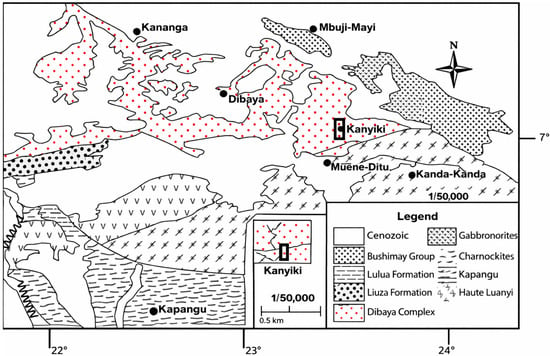
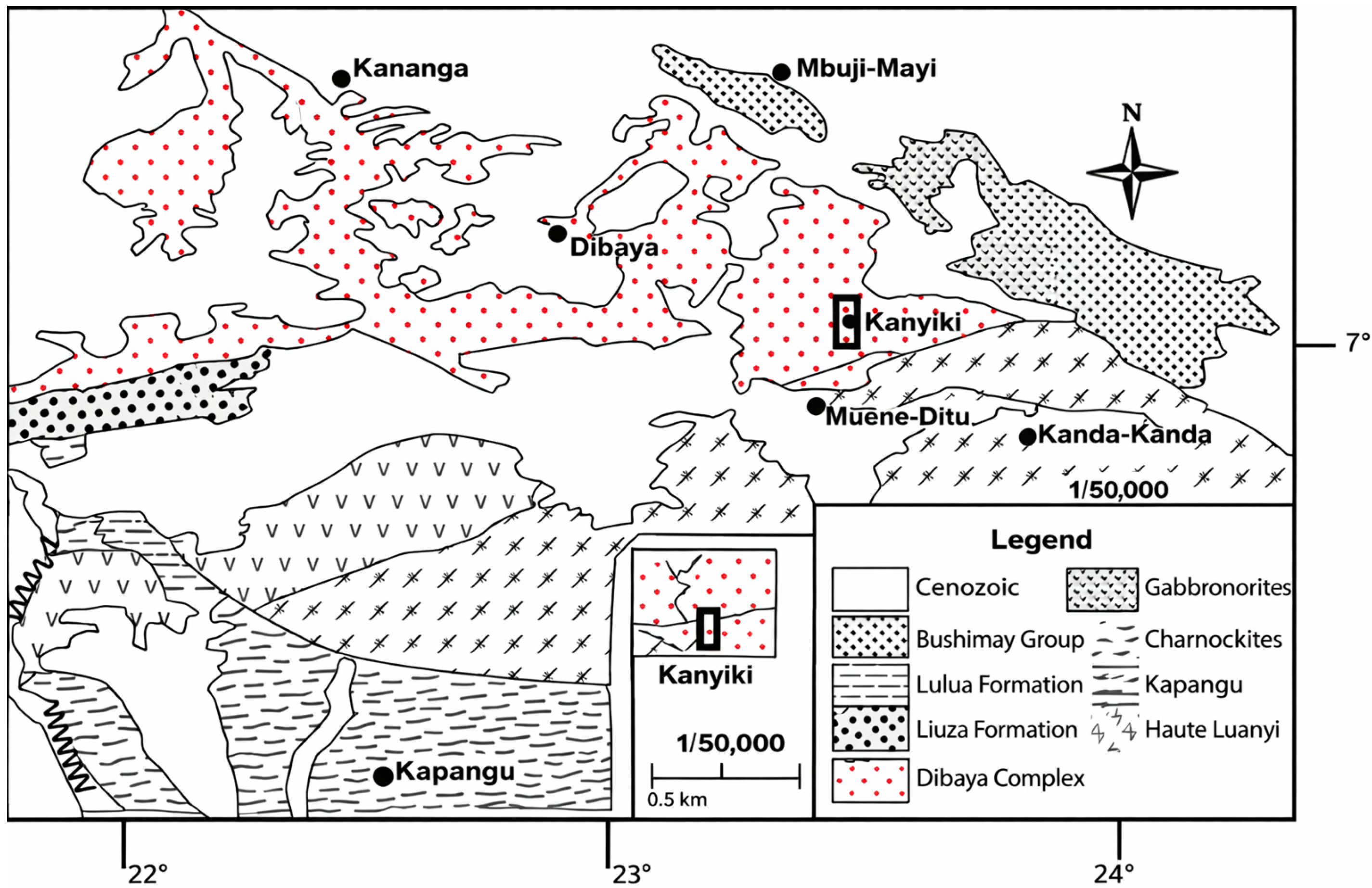
Figure 1 illustrates the map of the distribution of major Archean granito-gneissic domains of the Congo–Kasaï Craton and highlights the position of the Dibaya region, indicated by a black rectangle. The unit labeled “Lulua” corresponds to regional granito-gneissic basement of predominantly TTG affinity as defined in regional mapping studies. The Dibaya area forms part of geological sheet Dibaya (S7/22), which exposes extensive crystalline basement rocks and provides a well-preserved window into deep crustal processes. Owing to the quality and continuity of these exposures, the region is particularly suitable for investigating Archean crustal evolution, including high-grade metamorphism, partial melting, granitoid magmatism, and ductile deformation. Map data are modified after Legrand [3], Delhal et al. [4], and subsequent regional syntheses [1,21]. A scale bar and coordinate grid are included for spatial reference, the study area is dominated by a granitic–migmatitic complex composed of banded gneisses, stromatic to nebulitic migmatites, and intrusive granitoid bodies. The gneisses display well-developed compositional banding defined by alternating felsic (quartz–feldspar-rich) and mafic (biotite ± amphibole) layers, reflecting high-grade metamorphism of felsic continental protoliths followed by intense deformation. Migmatitic textures such as leucosomes, melanosomes, schlieren structures, and nebulitic domains are widespread and record in situ crustal anatexis under high-temperature conditions. Granitic intrusions, historically referred to as the Malafudi granites, crosscut the migmatitic basement and exhibit sharp to locally gradational contacts, consistent with syn- to late-tectonic emplacement. These granitoids are generally medium- to coarse-grained and range in composition from granodiorite to granite, indicating progressive crustal differentiation and melt extraction during the late Archean. Structurally, the area is characterized by pervasive ductile deformation expressed by penetrative foliations, folding, and shear zones. Several of these structures are spatially associated with the Malafudi structural corridor, a major zone of localized strain that likely played a key role in magma emplacement, melt migration, and crustal reworking. Available geochronological data indicate that the Dibaya complex formed during the Neoarchean, with major tectono-thermal events occurring between approximately 2.72 and 2.65 Ga, corresponding to a critical period of crustal stabilization within the Congo–Kasaï Craton.
Figure 1.
Simplified geological map showing the location and regional framework of the Dibaya study area within the Kanyiki–Kapangu sector, central Kasaï Province, DRC [4].
2.2. Local Geological Characteristics
The Congo–Kasaï Craton represents one of the largest and most stable Precambrian cratonic nuclei in Africa and constitutes a fundamental archive of Archean continental crustal evolution in Central Africa [1,2]. It is bounded by several Proterozoic mobile belts, including the West Congo Belt, the Lufilian Arc, and the Ubendian Belt, and is locally covered by Phanerozoic sedimentary basins [22,23]. The craton is dominated by Archean granito-gneissic basement rocks that record early crustal growth, high-temperature metamorphism, and subsequent stabilization [6,7]. Geochronological and isotopic studies indicate that the craton experienced major episodes of crust formation and reworking during the Archean, particularly between ca. 3.2 and 2.6 Ga [11,18]. These processes involved the generation of tonalite–trondhjemite–granodiorite (TTG) crust, followed by late Archean intracrustal reworking and granitoid magmatism [7,8,9]. Compared to many other African cratons, large portions of the Congo–Kasaï Craton have been only weakly affected by Proterozoic tectono-thermal events, allowing exceptional preservation of Archean structural, metamorphic, and magmatic features [2,22]. This makes the craton a key region for testing models of Archean crustal evolution and geodynamics [13,19].
2.3. Kasaï Shield
The Kasaï Shield constitutes the southern Archean domain of the Congo–Kasaï Craton and exposes extensive crystalline basement rocks dominated by granito-gneissic and migmatitic assemblages [22,23]. It represents one of the most tectonically stable segments of the craton and is characterized by widespread high-grade metamorphism, partial melting, and late Archean granitoid magmatism [11,12]. Regional geological mapping and geochronological studies indicate that the Kasaï Shield records a prolonged Archean evolution involving early crust formation, granulite- to amphibolite-facies metamorphism, migmatization, and late Archean granitoid emplacement [5,11]. Recent U–Pb zircon and Lu–Hf isotopic studies from adjacent areas suggest that late Archean magmatism was largely controlled by reworking of older continental crust, with limited juvenile mantle input [11,12,30]. These characteristics highlight the Kasaï Shield as a key region for investigating Archean intracrustal reworking, thermal maturation of continental crust, and craton stabilization processes [29,30]. Within this regional framework, the Dibaya complex represents one of the best-exposed high-grade domains and provides critical constraints on the tectono-thermal evolution of the shield.
2.4. Dibaya Granitic and Migmatitic Complex
The Dibaya granitic and migmatitic complex forms part of the Archean basement of the Kasaï Shield and corresponds to the Dibaya geological sheet (S7/22). It represents one of the most representative high-grade metamorphic domains in central Kasaï Province and provides important insights into Neoarchean crustal processes [4,5]. The complex is lithologically dominated by banded gneisses, stromatic to nebulitic migmatites, and intrusive granitoid bodies. The gneisses preserve well-developed compositional banding indicative of high-grade metamorphism of felsic continental protoliths, whereas the migmatites record widespread partial melting of the continental crust [14,15]. Granitic intrusions range in composition from granodiorite to granite and commonly display syn- to late-tectonic relationships with their host rocks, reflecting progressive melt generation and emplacement during crustal reworking [9,35]. Structurally, the complex is pervasively affected by ductile deformation expressed by penetrative foliations, folding, and shear zones. A major tectonic feature is the Malafudi structural corridor, which represents a zone of localized strain and is interpreted to have exerted a strong control on deformation patterns, melt migration, and granitoid emplacement within the complex [3,20]. Available geochronological data indicate high-grade metamorphism and migmatitization at approximately 2.72 Ga, followed by emplacement of granitoid bodies at around 2.65 Ga [5,11]. These ages place the evolution of the Dibaya complex firmly within the Neoarchean tectono-thermal history of the Kasaï Shield. The observed temporal relationships suggest that the Dibaya complex records a critical stage in the transition from early TTG-dominated crust formation to late Archean intracrustal reworking and progressive stabilization of the continental crust [7,29].
2.5. Geological Framework and Map of the Dibaya Region
The geological map of the Dibaya region provides the spatial framework necessary to interpret the lithological and structural organization of the granitic and migmatitic complex. The area is dominated by Archean crystalline basement rocks consisting of banded gneisses, migmatites, and granitoid intrusions [4,22]. Banded gneisses form the oldest recognized lithological unit and are interpreted as metamorphosed felsic continental protoliths. Migmatites occur extensively and display stromatic, schlieren, and nebulitic textures, indicating pervasive partial melting of the crust [14,15]. Granitoid bodies intrude the migmatitic basement and are spatially associated with major deformation zones, highlighting the close interplay between tectonics and magmatism [9,20]. Structural elements include penetrative foliations, folds, and ductile shear zones, with the Malafudi structural corridor representing a major tectonic feature that controlled deformation patterns and magma emplacement [3]. The spatial relationships between lithological units and structural features suggest that deformation, metamorphism, and magmatism were closely linked during the Neoarchean evolution of the Dibaya complex [29]. The geological map therefore provides essential constraints for reconstructing the tectono-thermal history of the region and highlights the Dibaya complex as a key segment of Archean crust within the Congo–Kasaï Craton. The spatial distribution of lithological units and major structural features of the Dibaya granitic and migmatitic complex.
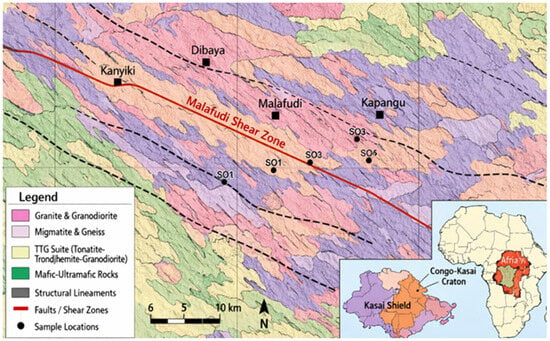
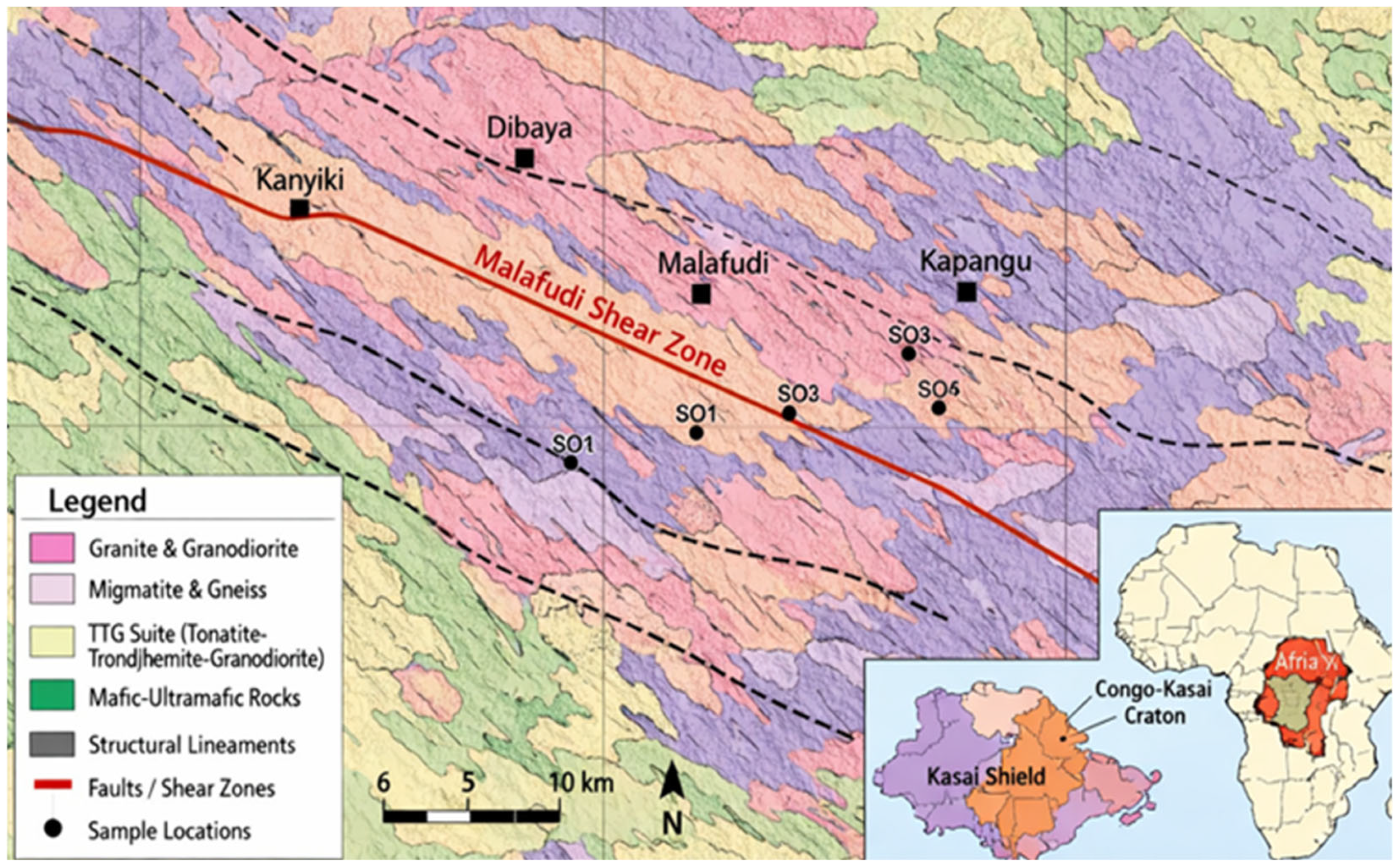
Table 1 summarizes the principal lithological units documented in the Dibaya Complex and clarifies their petrographic characteristics and structural relationships. The intimate spatial association of migmatites and granitoids with strongly foliated basement gneisses supports interpretation of widespread Neoarchean intracrustal reworking. This lithological and structural framework is spatially illustrated in Figure 2. The map highlights the dominance of migmatitic gneisses and granitoid bodies within the Kanyiki–Kapangu sector of the Kasaï Shield and emphasizes the structural control exerted by major shear zones, particularly the Malafudi structural corridor. The alignment of granitoid intrusions along deformation zones and their emplacement within migmatitic domains underscore the strong coupling between metamorphism, partial melting, deformation, and magma emplacement during Neoarchean crustal evolution of the region.
Table 1.
Compilation of principal lithological units reported in the Dibaya Granitic and Migmatitic Complex.
Figure 2.
Geological map of the Dibaya granitic and migmatitic complex (Kanyiki–Kapangu region, Kasaï Shield, Congo–Kasaï Craton) [4].
Figure 2 presents the geological map of the Dibaya granitic and migmatitic complex (Kanyiki–Kapangu area, Kasaï Shield, Congo–Kasaï Craton). The map illustrates the distribution of banded gneisses, stromatic to nebulitic migmatites, granitoid intrusions (including Malafudi-type granites), and associated TTG units. Major structural features, including foliations, ductile shear zones, and the Malafudi structural corridor, are indicated, together with key geological localities and sample sites. Geological data are compiled and modified after Legrand [3] and Delhal et al. [4]. The spatial relationships highlight the structural control on lithological distribution, melt migration, and granitoid emplacement during Neoarchean crustal reworking.
3. Materials and Methods
3.1. Geological Synthesis and Data Compilation Methodology
This study constitutes a structured geological synthesis based on previously published datasets. The objective is to reorganize dispersed geological and analytical information into an integrated and transparent framework that allows independent evaluation of the evidentiary basis for the proposed interpretations. The compiled dataset includes: (i) regional geological maps and lithological descriptions; (ii) petrographic observations and reported mineral assemblages; (iii) documented structural elements including foliations, shear zones, and deformation relationships; and (iv) available isotopic age determinations obtained through Rb–Sr whole-rock and U–Pb zircon methods. The data were extracted from published monographs, geological survey reports, and peer-reviewed studies and were reorganized into thematic compilation tables presented in Section 5 and Section 6. Each dataset is explicitly summarized in tabulated form, allowing direct assessment of lithological associations, metamorphic conditions, structural relationships, and chronological constraints. Interpretations presented in the discussion are derived strictly from these compiled datasets and from comparison with regional studies across the Congo–Kasaï Craton.
3.2. Analytical Framework
The compiled data were interpreted within established models of Archean crustal evolution, including TTG crust formation, high-temperature metamorphism, crustal thickening, and intracrustal recycling through partial melting [7,8,13]. Comparisons were made with other well-documented Archean domains of the Congo–Kasaï Craton and global Archean analogues to refine the geodynamic interpretation of the Dibaya complex [29,30].
3.3. Literature Compilation Protocol
To ensure transparency and reproducibility, the literature synthesis followed a PRISMA-inspired framework for systematic data compilation. Relevant studies were identified through bibliographic databases including Web of Science, Scopus, and Google Scholar using combinations of the keywords “Dibaya”, “Kasaï Shield”, “Congo Craton”, “Archean granitoids”, “migmatites”, and “TTG crust”.
Inclusion criteria:
- (i)
- They reported geological, petrographic, structural, geochemical, or geochronological data relevant to the Dibaya region or the Kasaï Shield;
- (ii)
- They presented primary analytical results or detailed geological descriptions;
- (iii)
- They were published in peer-reviewed journals, geological survey reports, or recognized scientific monographs.
Exclusion criteria:
- (i)
- They lacked primary geological data;
- (ii)
- They contained duplicated datasets already reported in other sources;
- (iii)
- They did not provide sufficient geological information relevant to the Dibaya region or the Kasaï Shield.
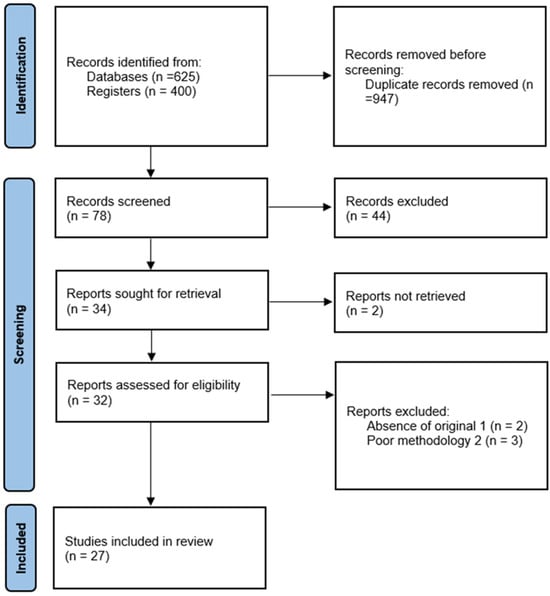
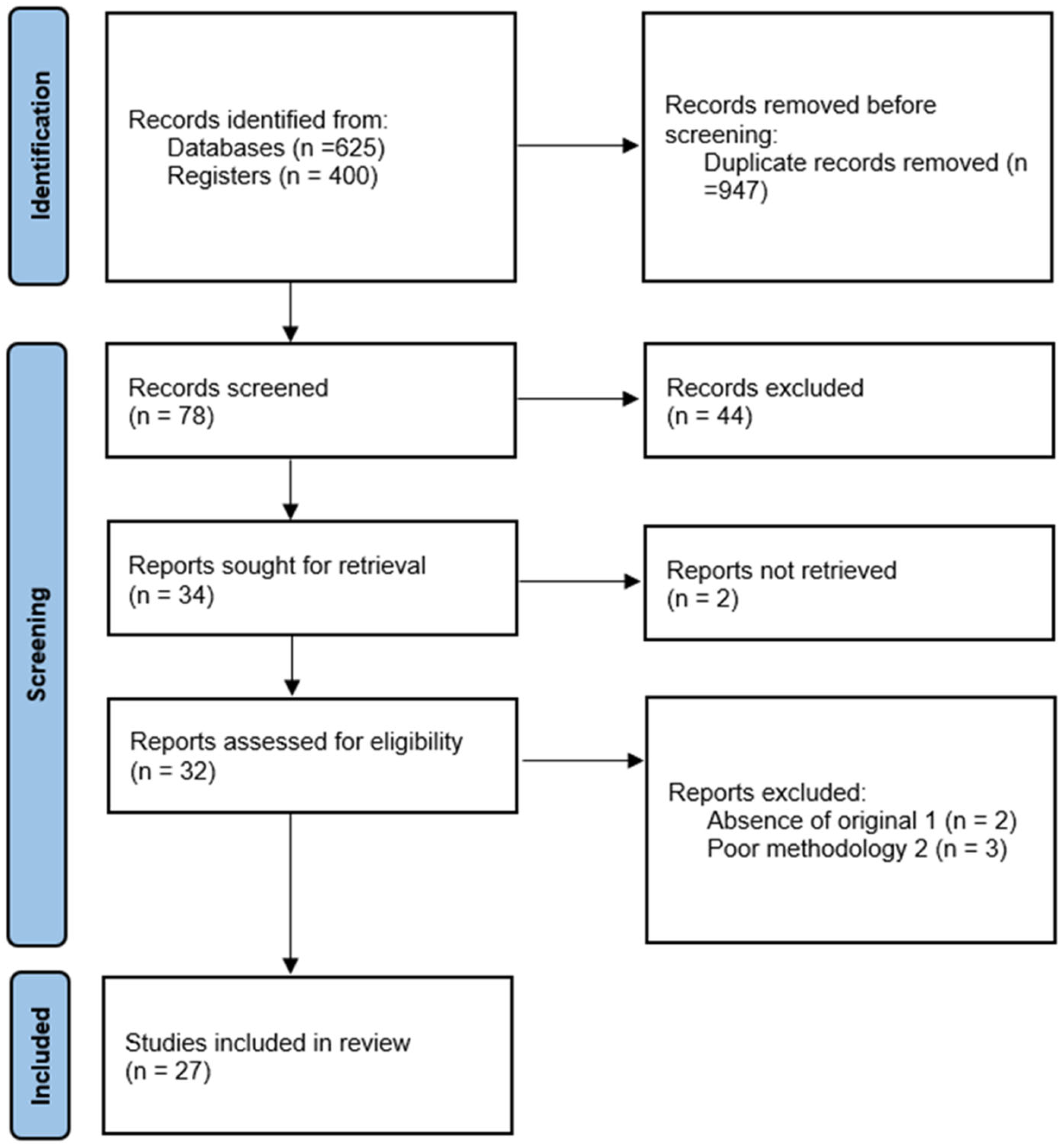
The selected studies were subsequently compiled and reorganized into thematic tables summarizing lithological units, structural features, metamorphic assemblages, geochemical characteristics, and isotopic age determinations. The literature selection workflow is summarized in the PRISMA-style flow diagram shown in Figure 3.
Figure 3.
PRISMA-style flow diagram illustrating the literature search, screening, and selection process used to compile geological datasets relevant to the Dibaya Granitic and Mig-matitic Complex.
The literature selection followed the PRISMA guidelines to ensure transparency and methodological rigor. Relevant studies on the Archean magmatic and metamorphic evolution of the Dibaya granitic and migmatitic complex were identified through searches of international scientific databases, academic repositories, and archival geological sources using French and English keywords related to the study area, geological age, lithology, and analytical methods. The initial search yielded 1025 records, including peer-reviewed articles, geological maps, monographs, and technical reports. After removing 947 duplicate entries, 78 unique records remained for screening. Title and abstract evaluation excluded 44 records that were unrelated to the study area, focused on Phanerozoic or sedimentary units, lacked scientific interpretation, or contained insufficient geological information. The remaining 34 studies underwent full-text assessment, leading to the exclusion of 7 studies due to lack of original data, insufficient methodological description, or redundancy with more comprehensive publications. Ultimately, 27 studies met all inclusion criteria and were incorporated into the qualitative synthesis. These studies include Dibaya-specific investigations [3,4,5], regional studies from the Kasaï Shield and Congo–Kasaï Craton [6,7,8,9,38], and broader Archean syntheses providing comparative frameworks [10,11,12,13,14,15,16,17,18,19,20,21,22,23].
4. Results
4.1. Geological Characteristics of the Dibaya Complex
The results presented in this section are derived directly from the structured compilation of previously published geological data. Lithological, petrographic, structural, and geochronological information is summarized in Table 1, Table 2, Table 3 and Table 4 to provide transparency and traceability of interpretations. These compiled datasets form the evidentiary basis for reconstructing the Neoarchean tectono-thermal evolution of the Dibaya complex.
Table 2.
Compilation of structural features reported in the Dibaya Complex.
Table 3.
Summary of reported whole-rock geochemical characteristics of Neoarchean granitoids from the Dibaya Complex and regional equivalents.
Table 4.
Compilation of Documented Metamorphic Assemblages.
4.2. Lithology and Structure of the Dibaya Complex
The Dibaya granitic and migmatitic complex is dominated by high-grade crystalline basement rocks that record intense Archean crustal reworking within the Kasaï Shield of the Congo–Kasaï Craton. The lithological assemblage is composed mainly of banded gneisses, stromatic to nebulitic migmatites, and intrusive granitoid bodies, reflecting the combined effects of high-temperature metamorphism, partial melting, ductile deformation, and magmatic intrusion during the Neoarchean [2,3,4]. Banded gneisses constitute a major component of the complex and typically display well-developed compositional layering defined by alternating felsic and mafic bands. The felsic layers are rich in quartz and feldspar, whereas the mafic bands are dominated by biotite ± amphibole, locally accompanied by accessory minerals such as zircon, apatite, and opaque phases [3]. This compositional banding is interpreted as the result of high-grade metamorphism of felsic continental protoliths, likely derived from earlier TTG type crust, subsequently modified by ductile deformation and partial melting [5,6]. Migmatites are widespread throughout the Dibaya complex and occur as stromatic, schlieren-rich, and locally nebulitic varieties. They are characterized by the segregation of light-colored leucosomes and darker melanosomes, indicating in situ partial melting of the gneissic host rocks [3,13]. Leucosomes are typically quartz–feldspar-rich and may form layers, lenses, or diffuse networks, whereas melanosomes are enriched in biotite and other ferromagnesian minerals. The abundance and diversity of migmatitic textures indicate that partial melting was pervasive and affected large volumes of the continental crust during peak metamorphic conditions, consistent with high geothermal gradients typical of the Archean [14,15]. Granitic intrusions are common within the Dibaya complex and range in composition from granodioritic to granitic. These granitoid bodies are generally medium- to coarse-grained and locally display weak foliation, suggesting syn- to late-tectonic emplacement [4]. Contacts between granitoids and migmatitic host rocks are commonly sharp but may also be gradational, supporting a genetic relationship between crustal anatexis and granitoid magmatism. Regional studies from the Congo–Kasaï Craton indicate that such late Archean granitoids are commonly derived from intracrustal melting and recycling of older TTG-like crust, with limited juvenile mantle input [10,11]. Structurally, the Dibaya complex is characterized by pervasive ductile deformation expressed by penetrative foliations, compositional banding, folding, and ductile shear zones. Foliations are generally parallel to gneissic banding and migmatitic layering, indicating synchronous development during high-temperature deformation [2]. Folding occurs at various scales, from centimeter-scale isoclinal folds within migmatitic layers to larger-scale folds affecting gneissic units. Ductile shear zones are locally well-developed and are commonly associated with enhanced migmatization and granitoid intrusion, suggesting that deformation facilitated melt segregation and magma ascent. major structural element of the region is the Malafudi structural corridor, which represents a zone of intensified deformation within the Dibaya complex [2].
Table 2 synthesizes structural observations reported in earlier studies and clarifies the deformation framework of the Malafudi corridor. The association of shear zones, migmatization, and granitoid emplacement suggests strong coupling between deformation and partial melting during Neoarchean crustal reworking. This structure appears to have exerted a strong control on strain localization, melt migration, and granitoid emplacement. The spatial association between shear zones, migmatitic domains, and granitoid bodies indicates a close coupling between deformation, partial melting, and magma transfer within a hot and mechanically weak Archean crust, a characteristic feature of late Archean high-grade terranes worldwide [18,19]. Overall, the lithological and structural characteristics of the Dibaya complex indicate a polyphase Neoarchean evolution dominated by high-grade metamorphism, widespread crustal anatexis, ductile deformation, and granitoid magmatism. These features are consistent with intracrustal reworking processes operating under elevated geothermal gradients, leading to progressive differentiation and stabilization of continental crust within the Congo–Kasaï Craton [16,17].
4.3. Malafudi Structural Corridor
The Malafudi structural corridor represents a major zone of strain localization within the Dibaya Complex and appears to have exerted significant control on deformation patterns, melt segregation, and granitoid emplacement [2,3]. Published geological descriptions emphasize penetrative foliations parallel to gneissic banding, localized mylonitic fabrics, and the spatial association of granitoid bodies with high-strain zones [2,3]. Migmatitic leucosomes are commonly concentrated along these deformation zones, suggesting that strain localization facilitated melt segregation and migration, consistent with deformation–anatexis coupling in high-temperature crustal environments [13,19]. Documented field relationships further indicate syn- to late-tectonic emplacement of granitoids relative to ductile deformation [3,4]. The spatial association between shear zones, migmatization, and granitoid intrusions supports interpretation of strong coupling between deformation, partial melting, and magma emplacement within a thermally weakened Archean crust [19,21]. However, systematic structural datasets for the Dibaya Complex remain limited. Published studies do not provide comprehensive orientation measurements (e.g., foliation strike and dip, lineation statistics, or shear-sense indicators), and therefore quantitative stereonet projections, rose diagrams, and statistical kinematic analyses cannot currently be constructed from the available literature. Consequently, the structural interpretation presented here is based primarily on documented field relationships and regional geological mapping rather than on newly compiled quantitative structural datasets [2,3,4]. Available geological maps and published descriptions indicate a dominant NE–SW structural grain across the Dibaya Complex. This trend is expressed by penetrative foliations, aligned granitoid bodies, and localized high-strain zones within the Malafudi corridor. Such patterns are consistent with ductile deformation in a thermally weakened crust and deformation anatexis coupling typical of Archean high-grade terranes [16,19]. However, systematic structural measurements and stereonet analysis are not yet available for the Dibaya region. Quantitative orientation statistics and stereonet-based structural synthesis are currently unavailable in the published datasets for the Dibaya Complex.
4.4. Magmatic and Metamorphic Evolution of the Dibaya Complex
The synthesis of the studies retained in this review indicates that the Dibaya granitic and migmatitic complex records a polyphase Neoarchean tectono-thermal evolution, dominated by high-grade metamorphism, partial melting, and granitoid emplacement over a relatively short geological interval. The most robust temporal constraints are provided by Rb–Sr whole-rock and U–Pb zircon data, which indicate a major migmatitization event at approximately 2.72 Ga, followed by emplacement of granitoid bodies at around 2.65 Ga [5]. Petrographic descriptions consistently document the dominance of banded gneisses and stromatic to nebulitic migmatites, characterized by leucosome melanosome segregation and diffuse melt structures [4]. These features are widely interpreted as evidence for in situ anatexis of felsic continental crust. Although quantitative pressure temperature estimates are not available for Dibaya, comparison with similar Archean migmatitic terranes suggests metamorphic conditions within the upper amphibolite to granulite facies, consistent with elevated geothermal gradients during the Archean [14,15].
Table 3 synthesizes available whole-rock and isotopic geochemical information relevant to the Dibaya granitoids. Although comprehensive modern geochemical datasets from the Dibaya region remain limited, published data and regional analogues consistently indicate high-K, peraluminous granitoids derived predominantly from reworking of older continental crust rather than significant juvenile mantle input.
4.5. Metamorphic Mineral Assemblages and Pressure–Temperature Constraints
Published petrographic descriptions of the Dibaya granitic and migmatitic complex document mineral assemblages dominated by quartz, plagioclase, K-feldspar, and biotite, locally accompanied by amphibole and garnet [3,4]. The most representative assemblage may be expressed as garnet–biotite–plagioclase–quartz ± K-feldspar ± hornblende [3,4]. Such parageneses are characteristic of amphibolite-facies metamorphism in felsic continental crust and indicate high-temperature conditions under moderate pressures [13,14,15]. The widespread development of stromatic and nebulitic migmatites, together with well-defined leucosome–melanosome segregation, indicates that peak temperatures exceeded the wet granite solidus, resulting in in situ partial melting of felsic protoliths [13,14]. No documented occurrences of high-pressure index minerals such as kyanite, omphacite, or other eclogite-facies assemblages have been reported in the available literature for the Dibaya region [3,4]. Orthopyroxene-bearing granulite-facies assemblages are likewise not systematically described [3]. Based on currently available petrographic evidence, metamorphism in the Dibaya complex is therefore interpreted as high-temperature and moderate-pressure rather than high-pressure [14,15]. This interpretation is constrained by published mineralogical observations and does not preclude refinement through future mineral chemistry and phase-equilibrium modeling.
Table 4 summarizes the mineral assemblages documented in the Dibaya complex and clarifies the basis for metamorphic interpretation. The predominance of quartz–feldspar–biotite ± garnet assemblages, coupled with the absence of reported high-pressure index minerals, supports interpretation of high-temperature intracrustal metamorphism rather than deep subduction-related processes. The spatial association between migmatitic domains and ductile deformation structures particularly along the Malafudi structural corridor indicates strong coupling between deformation, partial melting, and melt migration [3]. In such high-temperature settings, shear zones and penetrative foliations likely served as pathways for melt segregation and ascent, facilitating redistribution of crustally derived magmas. Comparable deformation–anatexis relationships are well-documented in other Archean cratons and are characteristic of hot, mechanically weakened continental crust [21]. Following peak metamorphism, granitoid magmatism at approximately 2.65 Ga marks a critical stage in the evolution of the Dibaya complex. The close temporal and spatial relationship between migmatitization and granitoid intrusion strongly suggests a genetic link, whereby granitic magmas were generated predominantly through partial melting of pre-existing continental crust rather than substantial juvenile mantle input [5,38]. Although Dibaya-specific whole-rock geochemical datasets remain limited, regional studies across the Congo–Kasaï Craton indicate that late Archean granitoids are commonly high-K, isotopically evolved, and derived from reworking of older TTG-like crust [9,38]. Available regional geochemical studies from the Kasaï Shield indicate that Neoarchean granitoids in adjacent domains are commonly high-K calc-alkaline in affinity. Although comprehensive modern whole-rock datasets specifically from the Dibaya Granitic and Migmatitic Complex remain limited, the reported characteristics from historically sampled granitoids and regional analogues suggest that the DGMC granitoids may belong to a comparable high-K calc-alkaline compositional group, although confirmation requires modern whole-rock geochemical analyses directly from Dibaya samples. Elevated K2O contents relative to Na2O at comparable SiO2 levels are consistent with high-K granite classification following Peccerillo and Taylor [36]. Reported aluminum saturation indices (A/CNK ≥ 1) from granitoids in the broader Congo–Kasaï Craton suggest weakly to moderately peraluminous compositions [11]. In the absence of a modern, systematically published Dibaya-specific geochemical dataset, the peraluminous character of the DGMC granitoids is therefore inferred primarily by comparison with regional equivalents and historical descriptions. Such compositions are compatible with partial melting of evolved continental crust and possible S-type affinity, as defined by Chappell and White [34] and further elaborated by Frost et al. [35]. Trace element characteristics described in regional studies particularly enrichment in large-ion lithophile elements (LILE) and relative depletion in high-field-strength elements (HFSE) are typical of intracrustal reworking and late Archean crustal differentiation Condie, [17]; Moyen and Martin [7]. Collectively, these regional geochemical characteristics are consistent with high-temperature intracrustal melting processes operating during Neoarchean crustal reworking. While direct Dibaya-specific whole-rock datasets remain sparse, available evidence suggests that the DGMC granitoids likely formed within a comparable intracrustal differentiation framework. It should be emphasized that the geochemical interpretation presented here is derived from previously published regional datasets and historical reports, and that acquisition of modern Dibaya-specific whole-rock analyses remains a priority for future work.
4.6. Regional Context and Crustal Recycling
Although Dibaya-specific Lu–Hf isotopic data are not yet available, regional isotopic and geochronological studies across the Kasaï Shield provide important constraints for interpreting the crustal evolution of the Dibaya complex. U–Pb zircon and Lu–Hf data from adjacent domains, including Luebo, indicate that Neoarchean magmatism in the region was dominated by intracrustal recycling of older Archean crust, with limited juvenile mantle input [6,7,38]. Detrital zircon datasets further confirm the persistence of Archean crustal sources and support interpretation of the Congo–Kasaï Craton as an early-established and long-lived continental nucleus [7]. Within this regional framework, the Dibaya complex is best interpreted as part of a craton-wide Neoarchean tectono-thermal episode rather than an isolated magmatic center. The temporal association between migmatitization (~2.72 Ga) and granitoid emplacement (~2.65 Ga) mirrors age patterns observed elsewhere in the Kasaï Shield, indicating participation in a large-scale phase of crustal thickening, elevated thermal gradients, and intracrustal differentiation during the late Archean. The transition from migmatitic gneisses to potassic granitoid intrusions reflects progressive melt generation, extraction, and crystallization within pre-existing TTG-dominated crust, consistent with regional isotopic evidence for dominant crustal recycling. When integrated with the pressure–temperature–deformation evolution outlined above, these relationships support a Neoarchean intracrustal reworking model in which early continental crust underwent thermal maturation, anatexis at ~2.72 Ga, granitoid crystallization at ~2.65 Ga, and subsequent stabilization. At the scale of the Congo–Kasaï Craton, this evolution aligns with global models of late Archean crustal development emphasizing elevated mantle heat flux, thermally weakened lithosphere, and vertical tectonic processes rather than sustained modern-style plate subduction [11,19,20,36]. The predominance of migmatitic gneisses, absence of high-pressure assemblages, and close temporal coupling of metamorphism and magmatism at Dibaya collectively favor intracrustal reworking over prolonged juvenile accretion. The Dibaya complex therefore represents a key example of Neoarchean cratonization through internal recycling and stabilization of early continental crust.
4.7. Implications for Archean Tectonic Regimes
The results of this geological synthesis support a geodynamic interpretation in which the Dibaya complex evolved within a hot Archean lithosphere, characterized by high mantle heat flux, weak crustal rheology, and dominance of vertical tectonic processes. The absence of documented high-pressure metamorphic assemblages and the prevalence of migmatites argue against sustained deep subduction as the primary driver of metamorphism. Instead, the data are more consistent with intracrustal reworking mechanisms operating in thermally mature continental crust [14,19,20]. Such conditions favor crustal thickening, partial melting, and dome and keel style deformation, as documented in other Archean terranes [21]. In this context, the Dibaya complex represents a well-preserved example of late Archean crustal reworking, where deformation, metamorphism, and magmatism were closely coupled and contributed to progressive craton stabilization. Based on the integration of geochronological, petrological, and structural data from the literature, the evolution of the study area can be subdivided into several major tectono-metamorphic stages. These stages reflect the progressive development of the Archean crust, from the presence of pre-existing basement to crustal stabilization. The main stages, their ages, dominant geological processes, and associated geological expressions are summarized in Table 5.
Table 5.
Summary of tectono-thermal events in the Dibaya complex.
Table 5 presents a synthesis of the main stages of Archean crustal evolution in the study area, highlighting their respective ages, dominant geological processes, and associated geological expressions. It illustrates the progressive transition from pre-existing crustal components to high-grade metamorphism and partial melting, followed by granitic magmatism and eventual cooling and stabilization of the cratonic basement.
4.8. Synthesis and Remaining Uncertainties
While the general Neoarchean framework of the Dibaya complex is reasonably well-established, this review highlights several critical uncertainties that limit robust geodynamic interpretation. The most significant gaps include the absence of modern in situ U–Pb zircon petrochronology, lack of Lu–Hf isotopic data directly from Dibaya rocks, scarcity of comprehensive whole-rock major, trace, and rare earth element geochemistry, and the absence of quantitative metamorphic pressure–temperature estimates. These limitations hinder the precise resolution of event timing, magma sources, and tectono-thermal conditions. Nevertheless, the convergence of local geochronological constraints [5], regional isotopic evidence [6,7,38], and global Archean models [10,11,12,13,14,15,16,17,18,19,20,21,22,23] supports a coherent interpretation in which the Dibaya granitic and migmatitic complex records Neoarchean intracrustal reworking and stabilization of early continental crust within the Congo–Kasaï Craton. The absence of documented high-pressure assemblages and the interpretation of limited juvenile mantle input reflect the currently available petrographic and isotopic dataset rather than definitive exclusion of alternative tectonic scenarios. Systematic mineral chemistry, quantitative thermobarometry, structural kinematic analysis, and modern zircon petrochronology are required to refine metamorphic conditions and crustal evolution pathways within the Dibaya complex.
4.9. Geochronological Constraints and Framework
Geochronological constraints on the evolution of the DGMC remain limited but provide a coherent first-order framework for its Neoarchean tectono-thermal history. The available chronological information is derived primarily from Rb–Sr whole-rock dating and early U–Pb zircon analyses, which constitute the only direct geochronological data currently reported from rocks of the Dibaya region [4]. The pioneering geochronological study by Delhal et al. [4] applied combined Rb–Sr whole-rock and U–Pb zircon methods to migmatitic gneisses and granitoid intrusions of the Dibaya complex. These analyses identified two principal Neoarchean age clusters. Migmatitic gneisses yield ages of approximately 2.72 Ga, interpreted as recording peak high-grade metamorphism and widespread crustal anatexis. Granitoid bodies, including the Malafudi-type granites, yield slightly younger ages of approximately 2.65 Ga, interpreted as the timing of pluton emplacement. This temporal relationship indicates a relatively short-lived but intense Neoarchean tectono-thermal episode involving high-temperature metamorphism, partial melting of continental crust, and subsequent crystallization of granitic magmas. The close temporal association between migmatitization and granitoid emplacement strongly suggests a genetic linkage between crustal anatexis and pluton formation.
Table 6 presents the compilation of published isotopic age determinations from the Dibaya Complex and establishes the temporal framework for Neoarchean tectono-thermal evolution in the region. Migmatitic gneisses yield ages of approximately 2.72 Ga, interpreted as recording a major high-temperature metamorphic and migmatitization event, whereas granitoid samples, including the Malafudi-type granites, yield slightly younger ages of approximately 2.65 Ga, interpreted as marking pluton emplacement [4]. Although these ages were obtained using analytical techniques that predate modern in situ zircon methods, they are internally consistent and define a relatively short-lived but intense Neoarchean tectono-thermal episode. Together, these ages define a coherent geochronological framework in which migmatitization at ~2.72 Ga was followed by granitoid emplacement at ~2.65 Ga, reflecting progressive melt generation, segregation, and crystallization during late Archean intracrustal reworking. Similar temporal relationships between high-grade metamorphism and granitoid magmatism have been documented in numerous Archean cratons and are widely interpreted as evidence for rapid crustal differentiation within thermally mature continental lithosphere [13,15].
Table 6.
Compilation of published isotopic age determinations from the Dibaya Complex.
Regional geochronological studies from other parts of the Kasaï Shield and the broader Congo–Kasaï Craton provide additional context for interpreting the Dibaya record. Modern U–Pb zircon dating from adjacent areas such as Luebo indicates that Archean crust formation and reworking occurred predominantly between ca. 2.9 and 2.6 Ga, with widespread Neoarchean metamorphism and granitoid magmatism [10,12]. Lu–Hf isotopic studies further indicate that late Archean magmatism in the region was dominated by recycling of older continental crust with only limited juvenile mantle input [10,11]. Despite providing a robust first-order temporal framework, the existing geochronological dataset for the Dibaya complex remains limited by the absence of modern in situ zircon petrochronology and isotopic analyses. High-resolution U–Pb zircon dating combined with Lu–Hf isotopic measurements would allow better resolution of zircon growth histories, magma sources, and the precise temporal relationships between deformation, metamorphism, and magmatism. Nevertheless, the currently available geochronological evidence indicates that the DGMC records a coherent Neoarchean evolution characterized by high-grade metamorphism and migmatitization at ~2.72 Ga, followed by granitoid emplacement at ~2.65 Ga, reflecting a major episode of intracrustal reworking and stabilization within the Congo–Kasaï Craton.
5. Discussion
5.1. Geodynamic Implications
The reconstructed magmatic and metamorphic evolution of the DGMC provides important constraints on Neoarchean geodynamic processes operating within the Congo–Kasaï Craton and contributes to broader discussions on the nature of Archean tectonics. The close temporal association between high-temperature metamorphism, crustal anatexis, and granitoid emplacement indicates that the Dibaya domain evolved within a hot, internally dynamic continental crust rather than in a tectonic regime dominated by continuous subduction-related accretion of juvenile material [19,20,21]. The widespread migmatitization recorded at approximately 2.72 Ga implies elevated geothermal gradients, consistent with models of a hot Archean lithosphere characterized by high mantle heat flux and weak rheology [19,20]. Under such conditions, vertical crustal movements, intracrustal deformation, and partial melting are favored over modern-style horizontal plate interactions. The abundance of migmatites and the absence of well-preserved high-pressure metamorphic assemblages in the Dibaya complex argue against deep subduction as the dominant geodynamic process and instead support intracrustal reworking mechanisms operating within a thermally mature crust [14,15,20]. Following this metamorphic climax, the emplacement of granitoids at approximately 2.65 Ga marks a stage of crustal differentiation and stabilization, during which melts generated during anatexis were extracted and crystallized as discrete plutonic bodies, including the Malafudi-type granites [5]. This evolutionary step is consistent with geodynamic models in which Archean TTG-dominated crust undergoes progressive internal reworking to generate more potassic granitoids, ultimately leading to the development of compositionally mature continental crust [11,12]. At the scale of the Congo–Kasaï Craton, the evolutionary trajectory inferred for Dibaya closely mirrors that documented in other central African Archean domains, suggesting that late Archean cratonization was largely achieved through intracrustal processes rather than by large-scale terrane accretion [6,7,38]. The limited evidence for significant juvenile mantle input during late Archean magmatism further implies that continental growth during this period was dominated by recycling and differentiation of existing crust [17,19].
5.2. Integrated Geological Evidence for Neoarchean Crustal Reworking
The interpretations developed in this study are grounded in the compiled datasets summarized in Table 1, Table 2, Table 3, Table 4, Table 5 and Table 6. Lithological architecture and mapped unit relationships (Table 1), deformation features (Table 2), whole-rock geochemical characteristics (Table 3), documented metamorphic mineral assemblages (Table 4), tectono-thermal staging (Table 5), and isotopic age determinations (Table 6) collectively define a coherent Neoarchean evolutionary framework for the DGMC. Available Rb–Sr and U–Pb age determinations indicate that the DGMC experienced a major tectono-thermal episode between ca. 2.72 and 2.65 Ga. Migmatitic gneisses yield ages around 2.72 Ga, interpreted as recording peak high-grade metamorphism and widespread anatexis, whereas granitoid intrusions yield slightly younger ages near 2.65 Ga, interpreted as the timing of pluton emplacement [1]. Although these analytical techniques predate modern in situ zircon petrochronology, their internal consistency defines a relatively short-lived but intense Neoarchean reworking episode. Petrographic evidence further constrains metamorphic conditions. Published descriptions emphasize migmatitic gneisses characterized by leucosome–melanosome segregation and stromatic to nebulitic textures [2,28]. Mineral assemblages dominated by quartz–plagioclase–biotite ± garnet ± amphibole indicate upper amphibolite-facies conditions. The absence of reported high-pressure index minerals such as kyanite or omphacite suggests metamorphism under high-temperature, moderate-pressure conditions rather than deep subduction-related metamorphism. Geochemical characteristics provide additional insight into magma sources and crustal evolution. Regional datasets indicate that Neoarchean granitoids throughout the Kasaï Shield are predominantly high-K calc-alkaline and weakly to moderately peraluminous. Reported enrichment in LILE and depletion in HFSE are consistent with intracrustal melting of evolved continental crust [6,8,31,32,33]. Regional Lu–Hf isotopic studies further indicate evolved isotopic signatures reflecting substantial crustal recycling during Neoarchean magmatism [6,7,38]. Structural relationships indicate that deformation was closely coupled with metamorphism and magmatism. Major ductile shear zones, particularly the Malafudi structural corridor [3], record high-temperature deformation synchronous with migmatitization and granitoid emplacement. In thermally weakened Archean crust, deformation commonly promotes melt segregation and facilitates magma ascent through strain localization [21,34,35]. Collectively, lithological, metamorphic, geochemical, structural, and geochronological evidence supports a Neoarchean intracrustal reworking model in which TTG-dominated continental crust underwent crustal thickening, thermal maturation, anatexis at ca. 2.72 Ga, and subsequent granitoid emplacement at ca. 2.65 Ga.
5.3. Comparison with Other Archean High-Grade Terranes
The Neoarchean tectono-thermal evolution inferred for the DGMC shows strong similarities with several well-studied Archean cratons worldwide. In the Kaapvaal Craton (southern Africa), widespread migmatitization and granitoid emplacement between ca. 2.75 and 2.65 Ga reflect extensive intracrustal melting of earlier TTG crust during late Archean crustal stabilization [17,18]. Comparable processes have been documented in the Yilgarn Craton (Western Australia), where late Archean high-K granitoids were generated through reworking of tonalitic crust under elevated geothermal gradients [17,18]. Similarly, the Dharwar Craton (India) records a transition from early TTG-dominated crust to potassic granitoid magmatism associated with high-temperature metamorphism and intracrustal differentiation [38]. These global analogues indicate that late Archean crustal maturation commonly involved widespread anatexis and internal recycling of early continental crust. The tectono-thermal evolution reconstructed for the Dibaya Complex is therefore consistent with global patterns of Neoarchean crustal differentiation and stabilization observed across many Archean cratonic terranes.
5.4. Alternative Geodynamic Scenarios and Diagnostic Criteria
Although the intracrustal reworking model proposed for the DGMC explains most of the available observations, alternative geodynamic interpretations should also be considered. The geodynamic evolution of Archean crust remains widely debated, particularly regarding the relative roles of vertical tectonics, sagduction, and early forms of plate tectonics [19,20,36]. One possible alternative involves subduction-related magmatism, in which granitoids are generated through melting of hydrated basaltic crust or mantle wedge material in convergent margin environments. Such settings typically produce calc-alkaline granitoids associated with volcanic arc sequences, pronounced Nb–Ta depletion, and isotopic signatures reflecting significant juvenile mantle input [11,12,31]. Subduction-related metamorphism may also generate high-pressure mineral assemblages such as garnet–kyanite or eclogite-facies assemblages. However, these diagnostic features have not been reported in the Dibaya region, where metamorphic assemblages are consistent with upper amphibolite-facies conditions and widespread migmatitization [14,15,29]. Another possible mechanism involves vertical tectonics or sagduction, in which dense supracrustal sequences sink into partially molten continental crust, promoting partial melting and granitoid generation under high geothermal gradients [19,20]. Such processes have been proposed for several Archean terranes characterized by thermally weakened lithosphere. Importantly, several observations could potentially challenge the intracrustal reworking model favored here. These include the discovery of unequivocal high-pressure metamorphic assemblages indicative of deep subduction, the identification of well-preserved arc-related volcanic sequences genetically linked to the granitoids, or isotopic evidence demonstrating substantial juvenile mantle contributions during Neoarchean magmatism. In the absence of such indicators, the currently available lithological, metamorphic, geochemical, and geochronological evidence remains most consistent with intracrustal melting and crustal recycling within a thermally weakened Archean lithosphere [11,19,20].
5.5. Limitations and Future Research Directions
Although the Neoarchean tectono-thermal framework of the DGMC is conceptually coherent, significant uncertainties persist due primarily to limitations in the available analytical dataset rather than inconsistencies in the interpretative model. Addressing these methodological gaps is essential for refining the geodynamic evolution of the complex and for placing the Dibaya domain more robustly within global Archean crustal evolution frameworks. Future investigations should prioritize the acquisition of high-resolution geochronological and isotopic data. In particular, in situ U–Pb zircon petrochronology using LA-ICP-MS or SIMS techniques would allow precise resolution of zircon growth domains, inheritance patterns, and the temporal relationships among metamorphism, deformation, and granitoid emplacement. Such analyses would clarify the duration and potential episodicity of the ca. 2.72–2.65 Ga tectono-thermal interval and test whether migmatitization and plutonism were continuous or occurred in discrete pulses. Lu–Hf isotopic analyses of the same zircon populations are equally critical for constraining crustal source evolution. Coupled U–Pb–Hf datasets would permit quantification of juvenile versus recycled crustal contributions and provide direct insight into the extent of mantle involvement during Neoarchean magmatism. This data is necessary to evaluate more rigorously the intracrustal reworking model proposed here and to determine whether limited but significant juvenile inputs may have contributed to crustal growth.
Comprehensive whole-rock geochemical datasets, including major, trace, and REE, should also be systematically generated from well-characterized field samples. High-quality geochemical data would allow robust classification of granitoid affinities, evaluation of melting conditions, assessment of source mineralogy, and testing of petrogenetic models through trace-element modeling and thermodynamic simulations. Equally important is the acquisition of quantitative metamorphic P–T constraints through mineral chemistry, phase-equilibrium modeling, and thermobarometry. These approaches would refine estimates of peak metamorphic conditions, geothermal gradients, and crustal thickness during the Neoarchean. Such constraints are essential for distinguishing between vertical tectonic regimes, crustal thickening models, or potential subduction-related scenarios. Finally, detailed structural mapping incorporating systematic orientation datasets, kinematic indicators, and microstructural analysis is required to better constrain deformation geometry and strain partitioning within the Malafudi structural corridor. Integration of structural data with petrochronological and thermodynamic results would enable direct testing of deformation anatexis coupling and melt migration pathways within a thermally weakened Archean crust. By combining modern petrochronology, isotopic systematics, geochemistry, thermodynamic modeling, and structural analysis, future research will allow quantitative evaluation of the intracrustal reworking hypothesis and significantly enhance understanding of late Archean crustal differentiation and craton stabilization processes in central Africa. Such work would not only refine the evolutionary history of the Dibaya complex but also contribute to broader debates concerning the onset of modern-style plate tectonics and the secular evolution of continental lithosphere.
6. Conclusions
This geological synthesis integrates existing petrographic, geochronological, structural, and regional geochemical studies to clarify the Archean magmatic and metamorphic evolution of the Dibaya granitic and migmatitic complex within the Kasaï Shield of the Congo–Kasaï Craton. The available evidence indicates that Dibaya records a coherent Neoarchean tectono-thermal evolution between ca. 2.72 and 2.65 Ga, marked by high-grade metamorphism, widespread migmatitization, and subsequent granitoid emplacement. Migmatitic textures and structural relationships point to partial melting of felsic continental crust under elevated geothermal gradients, consistent with a hot Archean lithosphere. Granitic intrusions are best interpreted as crustally derived melts extracted from migmatitic source regions, reflecting intracrustal differentiation rather than significant juvenile mantle input. At the craton scale, the Dibaya complex fits well within regional models of late Archean crustal reworking and stabilization through recycling of older TTG-dominated crust. Despite this robust first-order framework, significant data gaps remain, particularly the lack of modern geochronological, isotopic, geochemical, and quantitative metamorphic constraints. Addressing these gaps will be essential to refining geodynamic models of Archean crustal evolution in central Africa. The Dibaya Granitic and Migmatitic Complex therefore constitutes a key reference domain for understanding Neoarchean intracrustal reworking and craton stabilization processes within the Congo–Kasaï Craton and more broadly across late Archean continental nuclei worldwide.
Author Contributions
Conceptualization, T.M.B. and N.L.; methodology, T.M.B.; software, J.P.K.B.N.; validation, J.P.K.B.N. and A.T.K.; formal analysis, T.M.B.; investigation, T.M.B.; resources, A.T.K.; data curation, T.M.B.; writing—original draft preparation, T.M.B.; writing—review and editing, J.P.K.B.N., A.T.K. and N.L.; visualization, T.M.B.; supervision, A.T.K.; project administration, A.T.K.; funding acquisition, A.T.K. and J.P.K.B.N. All authors have read and agreed to the published version of the manuscript.
Funding
This research was funded by the Université Officielle de Mbuji-Mayi (UOM) under the institutional research support program (grant number UOM-RS-2024-01).
Data Availability Statement
This study is based exclusively on previously published geological data, including maps, petrographic descriptions, and geochronological results. No new analytical data were generated. All sources used in this geological synthesis are cited in the reference list.
Acknowledgments
The authors thank the Université Officielle de Mbuji-Mayi for institutional support. We acknowledge earlier geological investigations in the Kasaï Shield that provided the foundation for this study and thank colleagues and reviewers for constructive scientific discussions.
Conflicts of Interest
The authors declare no conflicts of interest.
Abbreviations
The following abbreviations are used in this manuscript:
| Abbreviation | Definition |
| A/CNK | Aluminum Saturation Index (molar Al2O3/(CaO + Na2O + K2O)) |
| Bt | Biotite |
| DGMC | Dibaya Granitic and Migmatitic Complex |
| DRC | Democratic Republic of the Congo |
| εHf | Epsilon Hafnium (Hf isotopic deviation parameter) |
| Ga | Billion years ago (giga-annum) |
| HFSE | High Field Strength Elements |
| Hbl | Hornblende |
| LA-ICP-MS | Laser Ablation–Inductively Coupled Plasma–Mass Spectrometry |
| LILE | Large-Ion Lithophile Elements |
| Lu–Hf | Lutetium–Hafnium isotopic system |
| Ma | Million years ago (mega-annum) |
| P–T | Pressure–Temperature |
| REE | Rare Earth Elements |
| Rb–Sr | Rubidium–Strontium isotopic system |
| SIMS | Secondary Ion Mass Spectrometry |
| TTG | Tonalite–Trondhjemite–Granodiorite |
| U–Pb | Uranium–Lead isotopic system |
References
- Fernandez-Alonso, M.; Tack, L.; Tahon, A.; De Waele, B. The Proterozoic history of the proto-Congo Craton of Central Africa. In Proceedings of the 23th Colloquium on Africa geology, Johannesburg, South Africa, 10–15 January 2011. [Google Scholar]
- Legrand, R.; Raucq, P. La faille de la Malafudi et son cadre géologique. Bull. Soc. Belg. Géol. 1957, 66, 137–156. [Google Scholar]
- Legrand, R. Étude pétrographique du socle cristallin du Kasaï central. In Annales du Musée Royal de l’Afrique Centrale, Sciences Géologiques; Royal Museum for Central Africa (RMCA): Tervuren, Belgium, 1965; Volume 48, pp. 1–126. [Google Scholar]
- Delhal, J.; Ledent, D.; Pasteels, P. Âge du complexe granitique et migmatitique de Dibaya (Kasaï central). Ann. Soc. Géol. Belg. 1975, 98, 141–154. [Google Scholar]
- Martin, H. The Archean grey gneisses and the genesis of continental crust. In Archean Crustal Evolution; Condie, K.C., Ed.; Elsevier: Amsterdam, The Netherlands, 1994; pp. 205–259. [Google Scholar]
- Martin, H.; Smithies, R.H.; Rapp, R.; Moyen, J.F.; Champion, D. An overview of adakite, tonalite–trondhjemite–granodiorite (TTG), and sanukitoid: Relationships and some implications for crustal evolution. Lithos 2005, 79, 1–24. [Google Scholar] [CrossRef] [Scilit]
- Moyen, J.F.; Martin, H. Forty years of TTG research. Lithos 2012, 148, 312–336. [Google Scholar] [CrossRef] [Scilit]
- Sylvester, P.J. Archean granite petrogenesis. In Archean Crustal Evolution; Condie, K.C., Ed.; Elsevier: Amsterdam, The Netherlands, 1994; pp. 263–298. [Google Scholar]
- Palin, R.M.; White, R.W.; Green, E.C.R. Partial melting of metabasalt and TTG generation. Lithos 2016, 240–243, 128–146. [Google Scholar] [CrossRef] [Scilit]
- Batumike, J.M.; Griffin, W.L.; O’Reilly, S.Y.; Belousova, E.A.; Pawlitschek, M. Crustal evolution in the central Congo-Kasai Craton, Luebo, D.R. Congo: Insights from zircon U–Pb ages, Hf-isotope and trace-element data. Precambrian Res. Precambrian Res. 2009, 170, 107–125. [Google Scholar] [CrossRef] [Scilit]
- Shang, C.K.; Liégeois, J.-P.; Satir, M.; Frisch, W.; Nsifa, E.N. Late Archaean high-K granite geochronology of the northern metacratonic margin of the Archaean Congo craton, Southern Cameroon: Evidence for Pb-loss due to non-metamorphic causes. Gondwana Res. 2010, 18, 337–355. [Google Scholar] [CrossRef] [Scilit]
- Debruyne, D.; Dewaele, S.; Tack, L.; Fernandez-Alonso, M.; Mees, F. Detrital zircon record of the Kasai Shield. Precambrian Res. 2019, 328, 1–18. [Google Scholar] [CrossRef] [Scilit]
- Sawyer, E.W.; Brown, M. Working with Migmatites; Mineralogical Association of Canada: Québec, QC, Canada, 2008. [Google Scholar]
- Sawyer, E.W.; Cesare, B.; Brown, M. When the continental crust melts. Elements 2011, 7, 229–234. [Google Scholar] [CrossRef] [Scilit]
- Brown, M. Metamorphism, plate tectonics, and the supercontinent cycle. Earth-Sci. Rev. 2007, 82, 1–18. [Google Scholar] [CrossRef] [Scilit]
- Brown, M.; Johnson, T.E. Secular change in metamorphism and the onset of global plate tectonics. Nat. Rev. Earth Environ. 2021, 2, 581–597. [Google Scholar] [CrossRef] [Scilit]
- Condie, K.C. Earth as an Evolving Planetary System; Elsevier: Amsterdam, The Netherlands, 2005. [Google Scholar]
- Van Kranendonk, M.J. Two types of Archean continental crust. Am. J. Sci. 2010, 310, 1187–1209. [Google Scholar] [CrossRef] [Scilit]
- Chardon, D.; Gapais, D.; Cagnard, F. Flow of ultra-hot orogens. Geol. Soc. Lond. Spec. Publ. 2009, 327, 129–145. [Google Scholar] [CrossRef] [Scilit]
- Ernst, W.G. Archean Geodynamics; Elsevier: Amsterdam, The Netherlands, 2014. [Google Scholar]
- Tack, L.; Fernandez-Alonso, M.; Tahon, A.; Wingate, M.T.D.; Barritt, S.D.; Baudet, D. Geological framework of Central Africa. J. Afr. Earth Sci. 2010, 58, 357–370. [Google Scholar] [CrossRef] [Scilit]
- Kampunzu, A.B.; Popoff, M. Distribution of Precambrian terranes in Africa. J. Afr. Earth Sci. 1991, 13, 287–296. [Google Scholar]
- Rollinson, H. Coupled evolution of Archean continental crust and subcontinental lithospheric mantle. Geology 2010, 38, 1083–1086. [Google Scholar] [CrossRef] [Scilit]
- Windley, B.F. The Evolving Continents, 3rd ed.; Wiley: Chichester, UK, 1995. [Google Scholar]
- Johnson, T.E.; Brown, M.; Gardiner, N.J.; Kirkland, C.L.; Smithies, R.H. Earth’s first stable continents did not form by subduction. Nature 2017, 543, 239–242. [Google Scholar] [CrossRef] [Scilit]
- Hawkesworth, C.J.; Cawood, P.A.; Kemp, A.I.S.; Storey, C.D.; Dhuime, B. A matter of preservation. Science 2009, 323, 49–50. [Google Scholar] [CrossRef] [Scilit]
- Foley, S.F.; Buhre, S.; Jacob, D.E. Evolution of the Archaean crust by delamination and shallow subduction. Nature 2003, 421, 249–252. [Google Scholar] [CrossRef] [Scilit]
- Cawood, P.A.; Hawkesworth, C.J.; Dhuime, B. The continental record. Geol. Soc. Am. Bull. 2013, 125, 14–32. [Google Scholar] [CrossRef] [Scilit]
- Palin, R.M.; Santosh, M. Crustal evolution and tectonic switching. Earth-Sci. Rev. 2021, 219, 103684. [Google Scholar] [CrossRef] [Scilit]
- Yakymchuk, C.; Brown, M. Behaviour of zircon during high-temperature metamorphism. J. Metamorph. Geol. 2014, 32, 779–801. [Google Scholar] [CrossRef] [Scilit]
- Percival, J.A. Archean crustal evolution. In Archean Crustal Evolution; Condie, K.C., Ed.; Elsevier: Amsterdam, The Netherlands, 1994; pp. 3–34. [Google Scholar]
- Kröner, A. Precambrian plate tectonics. In Precambrian Plate Tectonics; Elsevier: Amsterdam, The Netherlands, 1981; pp. 1–30. [Google Scholar]
- Smithies, R.H.; Champion, D.C.; Cassidy, K.F. Formation of Earth’s early Archaean continental crust. Precambrian Res. 2009, 127, 89–101. [Google Scholar] [CrossRef] [Scilit]
- Chappell, B.W.; White, A.J.R. Two contrasting granite types. Pac. Geol. 1974, 8, 173–174. [Google Scholar]
- Frost, B.R.; Barnes, C.G.; Collins, W.J.; Arculus, R.J.; Ellis, D.J.; Frost, C.D. A geochemical classification for granitic rocks. J. Petrol. 2001, 42, 2033–2048. [Google Scholar] [CrossRef] [Scilit]
- Peccerillo, A.; Taylor, S.R. Geochemistry of Eocene calc-alkaline volcanic rocks. Contrib. Mineral. Petrol. 1976, 58, 63–81. [Google Scholar] [CrossRef] [Scilit]
- Breaks, F.W.; Selway, J.B.; Tindle, A.G.; Kontak, D.J.; Miller, R.R.; Davidson, A. Anatomy of the Superior Province rare-element pegmatite–granite systems. Can. J. Earth Sci. 2019, 56, 1409–1436. [Google Scholar] [CrossRef] [Scilit]
- Laurent, O.; Martin, H.; Moyen, J.F.; Doucelance, R. The diversity of Archean granitoids: Geochemical constraints. Precambrian Res. 2014, 242, 117–141. [Google Scholar] [CrossRef] [Scilit]

Disclaimer/Publisher’s Note: The statements, opinions and data contained in all publications are solely those of the individual author(s) and contributor(s) and not of MDPI and/or the editor(s). MDPI and/or the editor(s) disclaim responsibility for any injury to people or property resulting from any ideas, methods, instructions or products referred to in the content. |
© 2026 by the authors. Licensee MDPI, Basel, Switzerland. This article is an open access article distributed under the terms and conditions of the Creative Commons Attribution (CC BY) license.