


Abstract
Microbe–mineral interactions in lacustrine environments play a critical role in controlling carbonate diagenesis and preserving organic matter, particularly under the influence of hydrothermal processes. To improve the understanding of such processes, this study focuses on the diagenesis of different types of carbonates from the upper section of the Bayingebi Formation in the Yin’e Basin, revealing the association between lacustrine sedimentation and hydrothermal activity. According to mineralogical and geochemical evidence, the carbonates in the studied interval can be broadly classified into hydrothermal, hydrothermal-biogenic, and sedimentary types on the basis of their dominant genetic signatures. Hydrothermal carbonates are dominated by crystalline dolomite, with associated hydrothermal minerals rich in Fe, Ba, and Mg, while 87Sr/86Sr values are close to mantle source values, indicating substantial mantle hydrothermal fluid contributions. Hydrothermal-biogenic carbonates are dominated by mud-crystalline and spherical dolomite enriched in Mg, Na, and P. The 87Sr/86Sr values fall between the typical mantle-derived and paleolake water ranges, indicating a mixed hydrothermal signal, with possible microbial involvement indicated by mineralogical and textural features. Sedimentary carbonates are predominantly crystalline calcite, with 87Sr/86Sr values close to crustal source values, indicating the influence of terrestrial inputs. Moreover, there are significant relationships between different types of diagenetic carbonates and organic matter. Intense hydrothermal activity is associated with low TOC values and relatively unfavorable conditions for organic matter preservation. In contrast, sections with mild hydrothermal activity have higher TOC contents, and the nutrient contents and water temperatures are more conducive to enrichment with organic matter. Although based on a single fully cored borehole from the upper section of the Bayingebi Formation, this study provides a framework for understanding the coupling between carbonate diagenesis and organic matter enrichment in hydrothermally influenced lacustrine systems, with implications for future studies involving multi-core investigations across the basin.
1. Introduction
The relationship between inorganic and organic processes in geological systems has been a consistent focus of geological research since the inception of the field [1,2]. This interactive relationship reflects the reciprocal, promotional effect of abiotic and biotic activities and their roles in geological processes and evolution [3,4]. As important geological units on Earth, lakes are widely distributed, have a high resolution, and contain a large amount of palaeoenvironmental information, which makes them ideal places for studying the relationship between inorganic and organic processes [5,6]. Notably, their smaller size makes them more sensitive to paleoclimate changes than oceans are [7,8]. Moreover, lakes tend to be characterized by diverse ecosystems and complex mineral combinations, which play important roles in the cycling of inorganic and organic matter during geological processes [9,10]. Carbonates, among the most common mineral types in lacustrine environments, are closely related to the depositional environment in terms of their diagenesis and storage conditions and are important factors for studying the mechanisms underlying the relationships between inorganic and organic processes in lacustrine environments.
Building on these perspectives, recent works have focused on the impact of hydrothermal activity on lacustrine systems [11,12,13], suggesting that hydrothermal fluids provide a direct link between carbonate mineralization and organic matter enrichment [14,15]. Intense hydrothermal activity can not only result in the transport of large quantities of carbonates, metal ions, and other minerals into lakes, providing the necessary resources for the formation of carbonate and hydrothermal minerals, but also dramatically change the conditions of the lake, which affects organic matter enrichment. Toxic inputs, changes in pH, and temperature increases associated with strong hydrothermal activity can have significant effects on biological communities. However, when the intensity of hydrothermal activity reaches moderate levels, the resulting eutrophic environment creates suitable conditions for the adaptation of biological communities [16,17,18]. Large amounts of metal ions and nutrient salts also provide abundant nutrients for biological growth; in addition, low paleosalinity and an anoxic environment are beneficial for the preservation of organic matter. Moreover, microorganisms and organic matter act as sediment nuclei and change the microenvironment of the water column, promoting the precipitation of some unique carbonates, such as spherical dolomite [13,14,15,16,17,18].
The Yin’e Basin, a Cretaceous lacustrine rift basin characterized by thick oil-shale intervals, has traditionally been studied for its organic-matter enrichment as well as for paleoenvironmental and paleoclimatic reconstruction [19,20,21]. However, the recent discovery of several spherical dolomites and radial pyrites in oil shale has drawn our attention. The study area contains a variety of carbonates, including scattered crystalline calcite, crystalline dolomite intergrown with metals, mud-crystalline dolomite, and fibrous calcite veins. The abundant morphological features imply that the lake underwent complex and diverse changes during the depositional period of the Bayingebi Formation. Therefore, the goal of this study was to focus on these carbonates by summarizing and classifying their diagenesis and combining hydrothermal activity and organic matter enrichment to demonstrate a clear coupled relationship among sedimentary, hydrothermal and biogenic processes in lacustrine systems, providing new insights for reconstructing past lake environments and hydrothermal activity.
2. Geological Setting
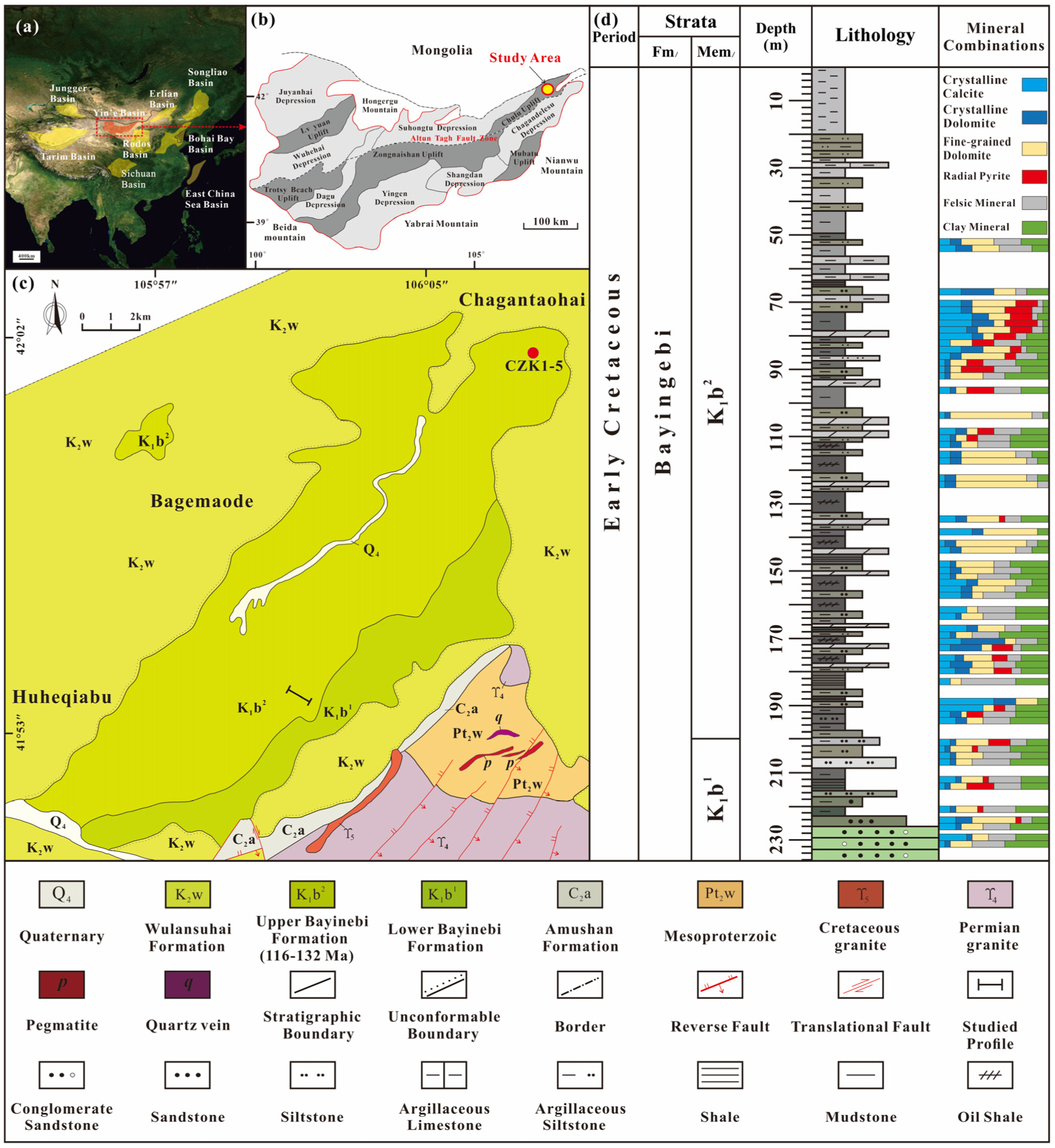
Located in the Inner Mongolia Autonomous Region of northwestern China (Figure 1a), the Yin’e Basin is a Mesozoic continental faulted basin developed on Precambrian crystalline landmasses and a Palaeozoic folded basement [22,23,24]. During the Early Cretaceous, it was located in the northeastern part of the Neotethyan Ocean, east of the Laura palaeocontinent. The east-west-trending Algin Fault Zone divides the Yin’e Basin into northern and southern parts (Figure 1b); the study area is located in the northern part of the Yin’e Basin.
The Yin’e Basin experienced five major tectonic stages [25,26] (Figure S1). The first was the Triassic extrusive orogenic stage, in which the basin was uplifted. Afterwards, during the Jurassic localized rifting stage, the basin was affected by both the subduction of the East Pacific Plate to the northwest and the southern migration of the Siberian Plate, resulting in regional tensional and torsional stress (Figure 1b). During the Early Cretaceous rift stage, the basin entered a rift basin period, with basal magma overflow forming a series of half-graben fault groups of extensional nature [25]. As rifting gradually ceased, the Yin’e Basin entered the Late Cretaceous depression stage, in which the depositional range significantly expanded and the old strata were covered with overlying unconformities at the basin margin [25]. Finally, the Palaeocene–Quaternary extrusion and uplift stage, influenced by movement of the Himalayas, caused the Indian plate to collide with the Eurasian plate, forming a tectonic background of extrusion and uplift (Figure S1).
The complex geologic structure of the Yin’e Basin, located at the confluence of the Palaeo-Asian and Tethys Oceans [27,28], led to the formation of diverse fracture systems. These fractures provided transport channels for the rise of deep hydrothermal fluids in the Yin’e Basin during the Early Cretaceous. Tensional fractures during the sedimentary period of the basin triggered the ejection of hydrothermal fluids and the formation of hot-water sedimentary rocks in the palaeolake [19,20,24]. These hydrothermal fluids were ultimately recorded within the lacustrine sedimentary succession of the Yin’e Basin, particularly the Lower Cretaceous Bayingebi Formation, which constitutes the principal oil shale–bearing unit and reaches a total thickness of approximately 250–500 m. Based on lithological characteristics, the Bayingebi Formation can be subdivided into two members, of which the upper member (K1b2; ~150–250 m thick) represents the peak lacustrine stage and preserves abundant dark mudstone, oil shale, and interbedded dolomite, providing an ideal archive for investigating hydrothermal-sedimentary interactions.
This study is based on data from well CZK1-5 in the second section (K1b2) of the Bayingebi Formation in the Yin’e Basin (Figure 1c), which is characterized by mudstones or oil shales with varying thicknesses (Figure 1d and Figure S2a,b). There are abundant and diverse carbonates in the core, as well as some thick oil shale layers (Figure S2c,d). Moreover, the occurrence of identifiable fossil remains (e.g., bivalve shells, fish remains, and plant debris), together with hydrothermal activity indicators in the core, suggests a complex evolution of the lacustrine environment. The relatively low thermal maturity indicates limited thermal overprinting, allowing primary sedimentary features to be largely retained. These properties provide a good foundation for studying the interrelationship between carbonates and organic matter in the Yin’e Basin.
Figure 1.
(a) Geographic location map of the Yin’e Basin. Map data from Maps International; (b) Tectonic map of the Yin’e Basin; (c) Chronology, lithostratigraphy and sedimentary facies of Bayingebi Formation of Lower Cretaceous in Yin’e Basin (modified from [24]). Age data are from [27,28]; (d) Lithological column of Bayingebi Formation in Yin’e Basin.
3. Samples and Methods
In this study, 50 carbonate samples were collected from fresh core surfaces of a single continuously cored well (CZK1-5) penetrating the upper section of the Bayingebi Formation (K1b2) in the Yin’e Basin, including 23 samples of mud-crystalline dolomite, 5 crystalline dolomite samples, 12 crystalline calcite samples, and 10 calcite vein samples (Figure 2). Some of the sample depths and detailed information are shown in Figure 2. Thin sections (30 μm), which were used for mineralogical and petrological observations, and probe sections (80 μm), which were used for in situ geochemical testing, including trace element and Sr isotope analyses, were prepared at the same sample locations. Samples of mud shale surrounding these carbonate samples were collected for total organic carbon (TOC) analysis.
Figure 2.
Sedimentology and petrography of the carbonates in Bayingebi Formation in the Yin’e Basin. (a) Radial pyrite and inky pyrite, sample number: 22-2-1 (depth: 72.98 m) and 22-1-1 (depth: 73.74 m); (b) Scattered crystalline calcite and coarse crystalline calcite in mudstone, sample number: 24-3-1 (depth: 82.89 m) and 25-3-1 (depth: 85.20 m); (c) Calcite veins and mud-crystalline dolomite, sample number: 27-4-1 (depth: 93.01 m) and 27-1-1 (depth: 95.17 m); (d) Mud-crystalline dolomite and laminated dolomite, sample number: 39-2-1 (depth: 148.85 m) and 40-5-1 (depth: 150.94 m); (e) Clumpy dolomite, sample number: 44-1-1 (depth: 171.96 m) and 45-11-1 (depth: 172.41 m).
3.1. Petrological and Mineralogical Analyses
Petrological and mineralogical observations were carried out at the Key Laboratory of Oil Shale and Coexistent Energy Minerals of Jilin Province. The samples were cut into 0.03 mm- and 0.08 mm-thick slices; the former were used for optical microscopic analysis, while the latter were used for in situ geochemical testing. In addition, some samples were made into light sheets for observation under reflected light. The samples were cut into small pieces of 1.5 cm3, and then the blocks were molded into cylinders with epoxy resin glue. In this study, a Zeiss transmission and reflection fluorescence microscope was used to identify and record mineralogical features through transmitted light, reflected white light and fluorescence. The micromorphology and composition of the samples were visualized with a JSM-IT500A instrument located at the Test Science Experiment Center (Electron Microscope Center) of Jilin University; the device has a resolution of 3.00 nm and an energy spectrum probe area of 20 mm2. In total, 115 carbonate samples from the upper section of the Bayingebi Formation (K1b2) were investigated petrographically. For each sample, one standard thin section (30 μm) was prepared and examined using transmitted and reflected light microscopy.
3.2. In Situ Element and Strontium Isotope Analysis
In situ element and strontium isotope analyses were conducted on 50 polished carbonate sections (80 μm) prepared from the same samples used for petrographic examination.
Trace mineral element analysis was conducted via laser ablation-inductively coupled plasma-mass spectrometry (LA-ICP-MS) at Wuhan SampleSolution Analytical Technology Co., Ltd., Wuhan, China. The detailed operating conditions for the laser ablation system, the ICP-MS instrument, and data reduction process are the same as those described by [29]. Laser sampling was performed using a GeoLasPro laser ablation system, which consists of a COMPexPro 102 ArF excimer laser (wavelength of 193 nm and maximum energy of 200 mJ) and a MicroLas optical system. An Agilent 7900 ICP-MS instrument was used to determine the ion signal intensities. Helium was used as the carrier gas, and argon was used as the make-up gas and was mixed with the carrier gas via a T-connector before entering the ICP instrument. The laser ablation system included a “wire” signal smoothing device. The spot size and frequency of the laser were set to 44 µm and 5 Hz, respectively. The mineral trace element compositions were calibrated against those of reference materials (MACS-3) without using an internal standard [30]. Each analysis included a background acquisition step of approximately 20–30 s followed by 50 s of data acquisition from the sample. The Excel-based software ICPMSDataCal V1.0 was used to perform offline selection and integration of background and analyzed signals, time-drift correction, and quantitative calibration for trace element analysis [30].
The Sr isotope ratios of the carbonates were measured by a Neptune Plus multiple collector MC-ICP-MS instrument (Thermo Fisher Scientific, Bremen, Germany) coupled with a GeoLas HD excimer ArF laser ablation system (Coherent, Göttingen, Germany). The Neptune Plus was equipped with nine Faraday cups fitted with 1011 Ω resistors. The Faraday collector of the mass system was composed of an array from L4 to H3 to monitor Kr, Rb, Er, Yb, and Sr through a combination of a high-sensitivity X-skimmer cone and a jet-sample cone. For single-spot laser ablation, the spot diameter ranged from 60 to 160 μm according to the Sr signal intensity. The pulse frequency ranged from 8 to 15 Hz, but the laser fluence was kept at a constant 10 J/cm2. A separate signal smoothing device [31] was used downstream from the sample cell to eliminate short-term variation in the signal. Two natural apatites, Durango and Madagascar [MAD] (compositions previously reported in [32]), were used as unknown samples for in situ Sr isotope analysis of the sample apatites. The analytical uncertainties for all the measurements were controlled within ±10% of the reported values.
3.3. TOC
Total organic carbon (TOC) measurements were obtained for mudstone (or oil shale) samples collected adjacent to each carbonate horizon (n = 50). Detailed sample allocation and analytical information are listed in Table S3. TOC was tested with a LECO CS-230 elemental analyser located at the Key Laboratory of Oil Shale and Coexistent Energy Minerals of Jilin Province. First, a 70 mg sample was weighed in a permeable crucible, dilute HCl (5%) was added via a dropper, and the crucible was placed in a wide-mouth beaker, which was then heated in a thermostatic water bath at 60 °C. After 6 h, the crucible was transferred to a tray, and distilled water was added to remove the dilute hydrochloric acid. Then, the crucible was placed in a drying oven at 60 °C for 48 h. Finally, the crucible was removed for online testing.
4. Results
4.1. Lithology and Mineralogy
To explore the hydrothermal activity responses during sedimentation, first, the lithology and mineralogy of the carbonates in the study area were characterized. Carbonates in the study area occur as mixed carbonate assemblages, which are composed mainly of mud-crystalline dolomite, crystalline dolomite, crystalline calcite, and calcite veins. They are heterogeneously distributed within the upper section of the Bayingebi Formation and occur as beds, nodules, and vein fillings. Their formation is controlled by the coupling of sedimentary processes, microbial activity, and hydrothermal fluids. The principal diagenetic elements involved are Ca, Mg, Fe, Ba, and Sr, reflecting carbonate precipitation and fluid-rock interactions.
4.1.1. Calcite
Calcite in the study area occurs mainly as crystalline calcite and calcite veins. Crystalline calcite is present as sparry to blocky crystals and occurs predominantly at depths of 74.67–84.84 m and 169.05–191.51 m (Figure 3a,b). Based on grain size, crystalline calcite can be subdivided into fine-crystalline and coarse-crystalline varieties. Fine-crystalline calcite is characterized by relatively small crystal sizes and commonly appears as thin, layered aggregates (Figure 3a). Coarse-crystalline calcite consists of larger crystals, reaching up to ~400 μm, and typically occurs as scattered crystal aggregates (Figure 3b; Figure 4a). Calcite veins are characterized by well-developed fibrous textures, showing sinusoidal crystal morphologies under crossed polarized light (Figure 3c,d). Vein widths vary considerably, ranging from approximately 20 μm to 3 cm. Two main types of fibrous calcite veins are recognized in the study area: syntaxial and antiaxial veins. Syntaxial fibrous veins are mainly developed within dolomite and commonly display a distinct medial line in the center of the veins. The central part is composed of dolomite enriched in Fe, Ba, and Mg, whereas fibrous crystals mainly occur toward the vein margins and are dominated by calcite (Figure 3c). Antiaxial fibrous veins are mainly observed within oil shale and are generally wider, showing symmetric fibrous growth relative to the vein walls (Figure 3d). In addition, calcium-rich layers occur locally within mud shale. These layers are darker in color than crystalline calcite and calcite veins, show poor lateral continuity, and are commonly associated with abundant feldspar grains (Figure 3a and Figure 4b).
Figure 3.
Microscopic characterization of different types of minerals in the study area. (a) Fine-crystalline calcite, sample number: 31-3-1 (depth: 112.29 m, PPL); (b) Coarse crystalline calcite, sample number: 49-6-1 (depth: 192.56 m, PPL); (c) Syntaxial fibrous calcite veins, sample number: 27-4-1 (depth: 93.01 m, PPL); (d) Antiaxial fibrous calcite veins, sample number: 47-7-1 (depth: 183.71 m, CPL); (e) Mud-crystalline dolomite, sample number: 38-3-1 (depth: 143.48 m, CPL); (f) Crystalline dolomite crossed with pyrite, sample number: 24-7-1 (depth: 81.38 m, PPL); (g) Pyrite veins intergrown with calcite and dolomite, sample number: 22-2-1 (depth: 72.98 m, CPL); (h) Spherical dolomite, sample number: 37-3-1 (depth: 137.93 m, RL); (i) Laminated dolomite under fluorescent light, sample number: 38-3-1 (depth: 143.48 m, FL). PPL: plane-polarized light; CPL: cross-polarized light; FL: fluorescence microscopy; RL: reflected-light microscopy.
Figure 4.
Scanning electron microscope photo of carbonates in the study area, EDS energy spectrum data is shown in the figure. (a) Coarse crystalline calcite, sample number: 49-6-1 (depth: 192.56 m); (b) Calcite intergrown with organic matter, sample number: 28-4-1 (depth: 97.68 m); (c) Mud-crystalline dolomite, sample number: 38-3-1 (depth: 143.48 m); (d–f) Spherical dolomite, sample number: 37-3-1 (depth: 137.93 m); (g,h) Radial pyrite and barite, sample number: 24-7-1 (depth: 81.38 m); (i) Ring-banded dolomite, sample number: 24-1-1 (depth: 83.75 m).
4.1.2. Dolomite
Dolomite in the study area occurs mainly as mud-crystalline dolomite, crystalline dolomite, laminar dolomite, and spherical dolomite. Mud-crystalline dolomite consists of very fine dolomite crystals with grain sizes ranging from micritic to microcrystalline. The crystal size is relatively uniform, and the dolomite commonly occurs as dense aggregates (Figure 3e and Figure 4c). Crystalline dolomite is composed of coarser dolomite crystals and typically shows clear crystal boundaries. Compared with crystalline calcite, crystalline dolomite is more frequently associated with pyrite, which occurs as disseminated or clustered crystals (Figure 3f,g). Laminar dolomite and spherical dolomite are mainly developed within oil shale intervals (Figure 3h,i). Laminar dolomite commonly exhibits strong fluorescence under ultraviolet light. Spherical dolomite is composed of densely packed submicron-scale particles, as revealed by SEM observations (Figure 4d–f). These dolomite types are locally associated with a variety of accessory minerals, including radial pyrite (Figure 4g), barite (Figure 4h), and ring-banded mineral assemblages (Figure 4i). The ring-banded minerals are characterized by a concentric structure consisting of an outer dolomite rim, an inner calcite core, and an intermediate ilmenite layer.
4.2. Major Element, Trace Element and REE Geochemistry
The in situ major and trace element compositions of the carbonates analyzed in this study are listed in Table S1. The mud-crystalline dolomite shows the highest MgCO3 contents, with an average value of 20.54%, followed by crystalline dolomite (10.74%). In contrast, crystalline calcite and calcite veins exhibit much lower MgCO3 contents, with average values of 2.01% and 2.45%, respectively. The concentrations of U, Fe, and Ba vary among different carbonate types, with higher average values observed in mud-crystalline dolomite (2.00 ppm U, 19,175.71 ppm Fe, and 228.56 ppm Ba) and crystalline dolomite (9.57 ppm U, 17,881.44 ppm Fe, and 256.16 ppm Ba). Crystalline calcite is characterized by average Mn, Fe, and Ba contents of 11.68 ppm, 4226.24 ppm, and 188.88 ppm, respectively, whereas calcite veins show lower Ba contents (123.55 ppm). The U/Th ratios also differ among carbonate types, with average values of 1.53 for crystalline calcite, 1.47 for crystalline dolomite, 1.06 for mud-crystalline dolomite, and 0.42 for calcite veins. In addition, Al, Si, and Ti contents are generally higher in crystalline dolomite and mud-crystalline dolomite than in calcite phases.
The rare earth element (REE) compositions of the carbonates are presented in Table S2. Crystalline calcite and calcite veins display relatively higher ∑REE contents, with mean values of 67.11 ppm (33.39–143.25 ppm) and 78.04 ppm (13.12–187.96 ppm), respectively. Lower ∑REE values are observed in mud-crystalline dolomite (43.40 ppm; 9.65–107.39 ppm) and crystalline dolomite (38.85 ppm; 18.49–64.19 ppm). The LREE/HREE ratios range from 1.26 to 2.88, with mean values of 2.51 for mud-crystalline dolomite, 2.88 for calcite veins, 1.97 for crystalline dolomite, and 1.26 for crystalline calcite. Chondrite-normalized REE patterns show slight LREE enrichment and HREE depletion in dolomite, whereas calcite exhibits relatively flatter patterns. Both dolomite and calcite display variable negative Ce and Eu anomalies, with mean δCe values of 0.974 (0.884–1.037) for dolomite and 0.913 (0.769–1.053) for calcite, and mean δEu values of 0.755 (0.622–1.059) and 0.740 (0.537–0.930), respectively.
4.3. Strontium Isotopes
The Sr isotope compositions of different carbonate types in this study are listed in Table S3. Crystalline dolomite exhibits the lowest average 87Sr/86Sr value of 0.710910, with a range of 0.710693–0.711150. Mud-crystalline dolomite and crystalline calcite show higher average 87Sr/86Sr values of 0.711396 (0.711007–0.711920) and 0.711465 (0.710747–0.713284), respectively. The 87Sr/86Sr values of crystalline calcite display a wider range than those of dolomite. Calcite veins also show internal variability in Sr isotope composition, with average 87Sr/86Sr values of 0.711736 for the fibrous exterior and 0.710851 for the interior portions of the veins.
4.4. Organic Geochemistry
The TOC of the mudstone surrounding the carbonates in this study is shown in Table S3. The mudstone surrounding the mud-crystalline dolomite has the highest average TOC value of approximately 4.52% (0.57–10.3%). The mudstone surrounding the crystalline calcite and crystalline dolomite has average TOC contents of 2.14% and 2.18, respectively. The average TOC content of the mudstone surrounding the calcite vein is lower, approximately 2.03%.
5. Discussion
5.1. Carbonate Diagenesis and Supporting Evidence
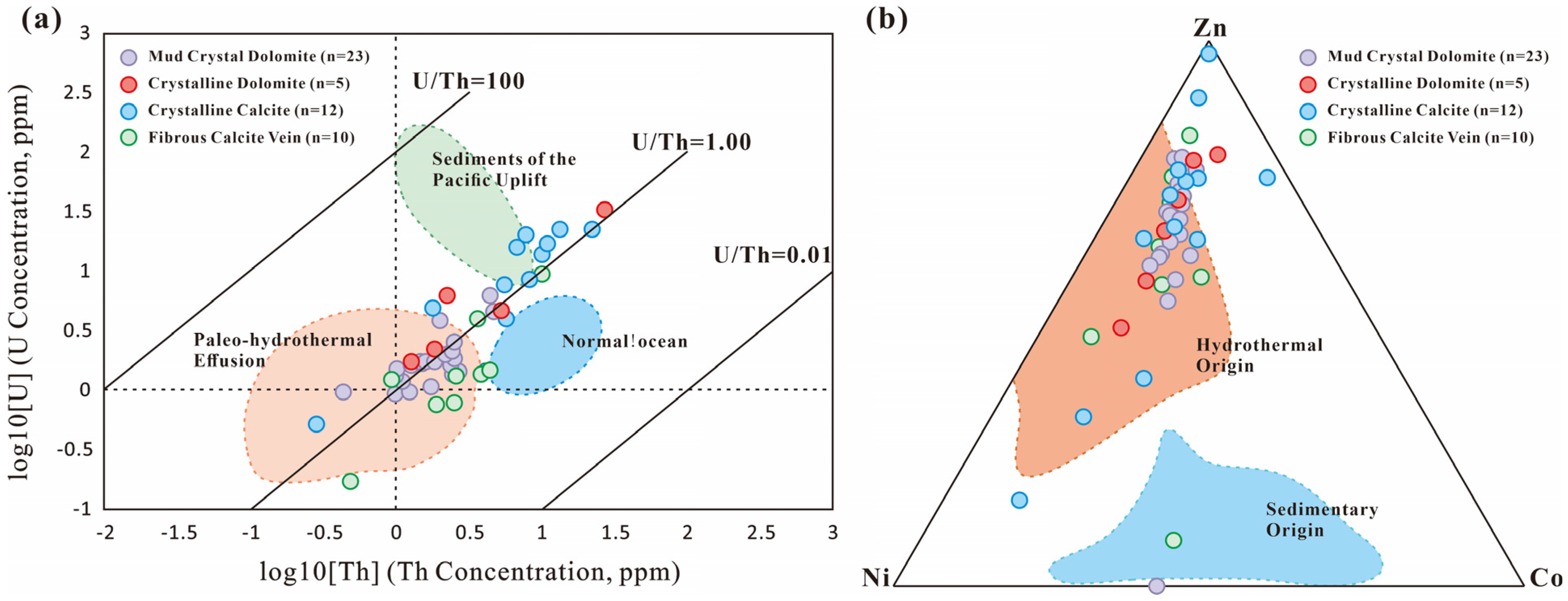
The LgTh–LgU and Zn–Ni–Co ternary diagrams indicate that most carbonate samples in the study area show geochemical signatures influenced by hydrothermal activity [33,34], although the degree of influence varies among samples (Figure 5a,b). Based on the mineralogical and in–situ geochemical characterization, the carbonates in the study area are classified as hydrothermal, hydrothermal–biogenic, and sedimentary origin.
Figure 5.
(a) log10[U]-log10[Th] relationship diagram (modified from [33]); (b) Zn-Ni-Co ternary diagram (modified from [34]).
5.1.1. Hydrothermal Carbonates
Hydrothermal carbonates are often formed by diagenetic fluids at least 5 °C above the ambient temperature and are common in carbonate chimney environments [35,36]. Intense hydrothermal activity often leaves an obvious record in sediments, such as conglomerate structure, saddle dolomite, and diverse hydrothermal-associated minerals [37,38]. In terms of elemental geochemistry, hydrothermal carbonates tend to be enriched in hydrothermal indicator elements [39,40], where the 87Sr/86Sr ratios are closer to mantle source values [41].
Crystalline dolomites in the study area commonly exhibit recrystallized crystal textures and associated mineral assemblages (Figure 3f,g), indicating characteristics of intense hydrothermal activity [42,43]. Some crystalline dolomites are also characterized by fog-centered bright-rim structures and ring bands (Figure 4i), indicating the occurrence of multiple periods of hydrothermal activity in the Yin’e Basin. In terms of elemental geochemistry, the hydrothermal carbonates of the Bayingebi Formation are enriched in hydrothermal indicator elements such as Fe, Ba, and Mg and generally have high U/Th ratios (above 1.5), which are typical of hydrothermal diagenesis [33]. In addition, the 87Sr/86Sr ratios of the crystalline dolomite are the lowest, with mean values of 0.71090, indicating significant hydrothermal activity contribution.
5.1.2. Hydrothermal–Biogenic Carbonates
Numerous studies have demonstrated that mild hydrothermal intensity not only conveys large amounts of carbonate ions into palaeolakes, promoting carbonate deposition, but also provides abundant nutrients that accelerate microbial reproduction, which promotes the production of biogenic carbonates [44,45]. The biogenic dolomitization model was formally proposed by Vasconcelos and McKenzie in 1997 in their study of modern microbial dolomites in the Lagoa Vermelha Lagoon, Brazil [46,47,48]. Since then, many scholars have identified a link between microbial activity and dolomitization [44,49]. Microorganisms not only improve the chemical conditions of the water column, creating a microenvironment conducive to dolomite deposition, but also provide nucleation sites for dolomite sedimentation consistent with a microbially influenced contribution to dolomite formation [50].
The hydrothermal–biogenic carbonates in the study area are mainly composed of mud-crystalline dolomite and dolomitic grains, which are fine-grained, relatively homogeneous, and commonly show strong fluorescence (Figure 3e and Figure 4c). Spherical dolomite is also abundant in these layers (Figure 3h,i and Figure 4d–f). Previous studies have suggested that such spherical morphologies may be associated with microbial processes [51,52], and published organic geochemical and biomarker evidence from the Yin’e Basin further supports a close association between spherical dolomite and organic-rich layers [53]. In this context, the occurrence of spherical dolomite together with strong fluorescence and organic enrichment suggests that microbial activity likely participated in its formation, in combination with hydrothermal and geochemical controls. Radial pyrite is locally developed adjacent to these carbonates, a feature that has been widely linked to the coupled influence of hydrothermal fluids and biological processes [13]. SEM observations show that these pyrites consist of superimposed thin layers (Figure 4d–f), a morphology commonly reported from hydrothermal-influenced environments. Geochemically, these dolomites are enriched in Mg, Na, and P (Table S1), and their REE patterns display Ce and Eu anomalies comparable to those of hydrothermal dolomite, indicating elevated diagenetic temperatures and reducing conditions. The mean 87Sr/86Sr ratio of the hydrothermal–biogenic carbonates (0.711396; Table S3) falls between mantle-derived and surface water values, reflecting mixed fluid contributions.
5.1.3. Sedimentary Carbonates
When the intensity of hydrothermal activity in a lake begins to decrease, terrestrial weathering tends to dominate [54,55,56]. Changes in the physicochemical conditions of lake water, such as lake temperature, lake volume and lake salinity, can lead to the precipitation of sedimentary carbonates [57]. In addition, factors such as palaeoclimate, palaeotectonics, and palaeomorphology also influence the deposition of such carbonates [58].
The sedimentary carbonates in the study area mainly include crystalline calcite, calcium-rich grains, and antiaxial fibrous veins (Figure 3a,b,d). Crystalline calcite typically shows coarse crystal sizes with well-defined crystal boundaries (Figure 3b) and commonly occurs as cemented or fracture-related carbonate phases (Figure 4a). Calcium-rich grains are frequently associated with terrestrial clastic components, such as quartz and feldspar, and display features indicative of variable depositional conditions, possibly influenced by seasonal inputs [59]. Antiaxial fibrous veins are predominantly developed within oil shale intervals and are characterized by relatively large widths and clear fibrous symmetry (Figure 3d). Geochemically, crystalline calcite is enriched in terrestrial-related elements (e.g., Si, Na, Th) and exhibits relatively high 87Sr/86Sr ratios (mean value of 0.71146), close to crustal source values (Tables S1 and S3), reflecting a strong contribution from terrestrial materials during carbonate formation.
5.2. Sources of Diagenetic Fluids in Carbonates
5.2.1. Sr Sources
Since 87Sr/86Sr is not significantly fractionated by chemical or microbial processes, this ratio is widely used to evaluate the sources and evolution of carbonate diagenetic fluids [60,61]. In general, higher 87Sr/86Sr values are commonly associated with crustal materials, whereas lower values are typically linked to deeper or mantle-related reservoirs, although their absolute ranges may vary depending on regional geological settings [62]. The 87Sr/86Sr composition of seawater also changes through geological time; for example, Aptian palaeo-oceanic values are reported to be approximately 0.7073–0.7074, while modern global riverine waters show an average value of about 0.711900 [13,63,64]. Therefore, these values are used as broad reference ranges rather than strict endmembers in this study. Owing to its relative stability and inheritance during carbonate formation, 87Sr/86Sr is therefore applied here to provide qualitative constraints on fluid sources, including the possible influence of deep-sourced fluids and continental weathering [65].
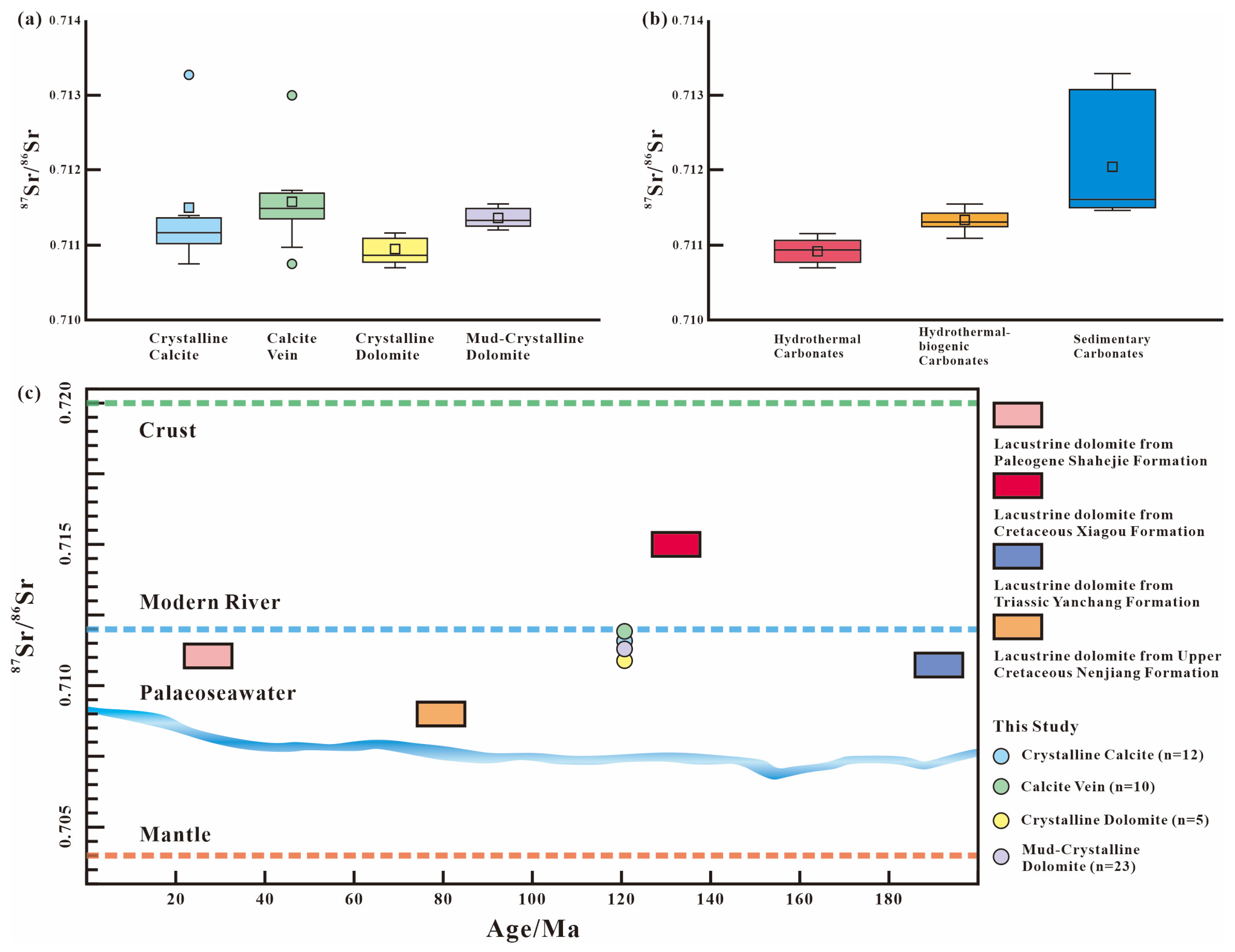
The 87Sr/86Sr ratios of different carbonate types in the upper section of the Bayingebi Formation exhibit clear but systematic variability (Figure 6). Crystalline calcite and fibrous calcite veins show relatively wide ranges of 87Sr/86Sr values (Figure 6a), indicating heterogeneous Sr sources and variable fluid compositions during their formation [66]. Crystalline calcite generally displays higher 87Sr/86Sr ratios (average 0.711465; range 0.710747–0.713284), consistent with a stronger influence of basin-derived and detrital Sr components. Fibrous calcite veins also exhibit internal variability in 87Sr/86Sr ratios, with measurable differences between vein interiors and exteriors, reflecting temporal changes in fluid composition during vein growth [38], similar to fibrous calcite veins reported from the Chang 7 Member of the Yanchang Formation in the Ordos Basin [67]. In contrast, crystalline dolomite and mud-crystalline dolomite are characterized by comparatively lower 87Sr/86Sr ratios, with mean values of 0.710910 (0.710693–0.711150) and 0.711396 (0.711007–0.711920), respectively. Although these values still fall within the range of radiogenic continental Sr, their relative depletion compared to calcite suggests a greater contribution from lower-radiogenic Sr components, potentially associated with deep-circulating hydrothermal fluids mixed with crustal and lacustrine sources. When grouped by carbonate type, hydrothermal carbonates show the lowest average 87Sr/86Sr ratios, sedimentary carbonates show the highest values, and hydrothermal-biogenic carbonates fall between these end members (Figure 6b,c), suggesting systematic differences in Sr sources among carbonate categories.
Figure 6.
Strontium isotopic compositions of carbonates of Bayingebi Formation and samples from other areas. Palaeoseawater are from [68], crust are from [69], modern river are from [63], and mantle are from [62]. Paleogene dolomite is referred from [70]; Cretaceous dolomite is referred from [71]; Triassic dolomite is referred from [72]; Upper Cretaceous dolomite is referred from [73]. (a) 87Sr/86Sr characterization of carbonates with different morphological features; (b) 87Sr/86Sr characterization of carbonates with different diagenetic types; (c) 87Sr/86Sr characteristics of samples in the study area.
5.2.2. Mg Sources
As Mg is an important component of carbonates, determining the source of Mg can effectively reveal the contribution of diagenetic fluids [74,75]. For example, dolomitization processes usually occur in solutions with high Mg/Ca ratios [11,46]. Lakes rarely reach such high Mg/Ca ratios, so the formation of lacustrine dolomites often depends on a certain amount of external Mg. This external Mg can come from a wide range of sources, including inputs from terrestrial sources, ion exchange with clay minerals, and deep underground hydrothermal activities [45,75,76].
Based on the full dataset of 50 carbonate samples analyzed in this study, Si, Al, and Ti—commonly used proxies for terrestrial input [77,78]—show relatively strong internal correlations in carbonates from the upper section of the Bayingebi Formation (Figure S3a,b). In dolomite, positive correlations are observed between Al and Si (R2 = 0.95) and between Ti and Al (R2 = 0.92), while similar relationships occur in calcite, with R2 values of 0.96 (Al–Si) and 0.94 (Ti–Al) (Figure S3a,b). These relationships indicate that Al, Si, and Ti provide a reasonable qualitative proxy for terrestrial input in the study area [52,79]. In contrast, Mg shows only a weak positive correlation with Al in calcite (R2 = 0.39), suggesting that terrestrial input may have contributed to Mg in calcite-forming fluids, although this relationship alone does not uniquely constrain the Mg source. For dolomite, Mg and Al exhibit a moderate negative correlation (R2 = 0.46; Figure S3c), implying a limited direct association with terrestrial input. In addition, Mg in dolomite displays a positive correlation with hydrothermal-related elements such as Mn (R2 = 0.67; Figure S3d), suggesting that hydrothermal activity likely contributed to the Mg budget of dolomite-forming fluids.
5.3. Intensity of Hydrothermal Activity and Palaeolake Environments
5.3.1. Intensity of Hydrothermal Activity
In lacustrine systems, different intensities of hydrothermal activity tend to leave different records [80,81]. During intense hydrothermal activity, hydrothermal fluids enter lakes via periodic transient eruptions [14]. The sediments tend to show more heterogeneous, high-energy features, such as the development of structures such as plaques, breccias, strips, or web veins [82]. In terms of geochemical characteristics, these sediments tend to be more enriched in Ba, Fe, and Mn, with U/Th > 1.5, as well as lower 87Sr/86Sr values. When the intensity of hydrothermal activity decreases, hydrothermal fluids tend to form discontinuous episodic overflows at fractures, and the temperature, pressure and fluid composition of the sedimentary environment are more stable [83,84]. The Ba, Fe, Mn, and U/Th levels in the sediments are lower than those during intense hydrothermal activity, while the 87Sr/86Sr values are closer to the crustal source values [82].
In this study, relatively intense hydrothermal influence is defined by the combined occurrence of elevated Ba (>300 ppm), Fe (>20,000 ppm), and U/Th ratios (>1.5), together with comparatively low 87Sr/86Sr values; based on these criteria, three depth intervals (75–90 m, 115–125 m, and 165–175 m) were recognized (Figure 7). In the cores, these layers generally feature thick dolomite, with significant lithological mutations. Microscope observation revealed the development of large amounts of crystalline dolomite and low-Mg calcite, often surrounded by hydrothermal minerals such as pyrite, barite, and ilmenite. Among these three intense hydrothermal events, that at a depth of 75–85 m had the highest intensity, and the U/Th ratio is generally greater than 1.5.
Figure 7.
Changes in the hydrothermal intensity in the upper section of the Bayingebi Formation; Red areas represent intense hydrothermal stages; Blue dots represent calcite; Purple dots represent dolomite.
Besides these three intense hydrothermal events, there were several mild hydrothermal events, with lower U/Th, Ba and Fe contents than the intense hydrothermal events. This mild hydrothermal activity is characterized by the alternation of dolomite and oil shale and obvious traces of microbial activity, indicating higher productivity in the Yin’e Basin during this period. In addition, micron-sized spherical dolomite and radial pyrite, which are indicative of biogenesis, are abundant in these layers (Figure 7).
Evidence of hydrothermal activity is weak at depths of 50 and 200 m. These layers are characterized by numerous fine sandstones and siltstones, with average U/Th values lower than 1.0 and 87Sr/86Sr values close to the crustal source values. A large amount of scattered crystalline calcite was observed under the microscope, which may be indirectly related to changed in lake water chemistry.
5.3.2. Palaeolake Environments
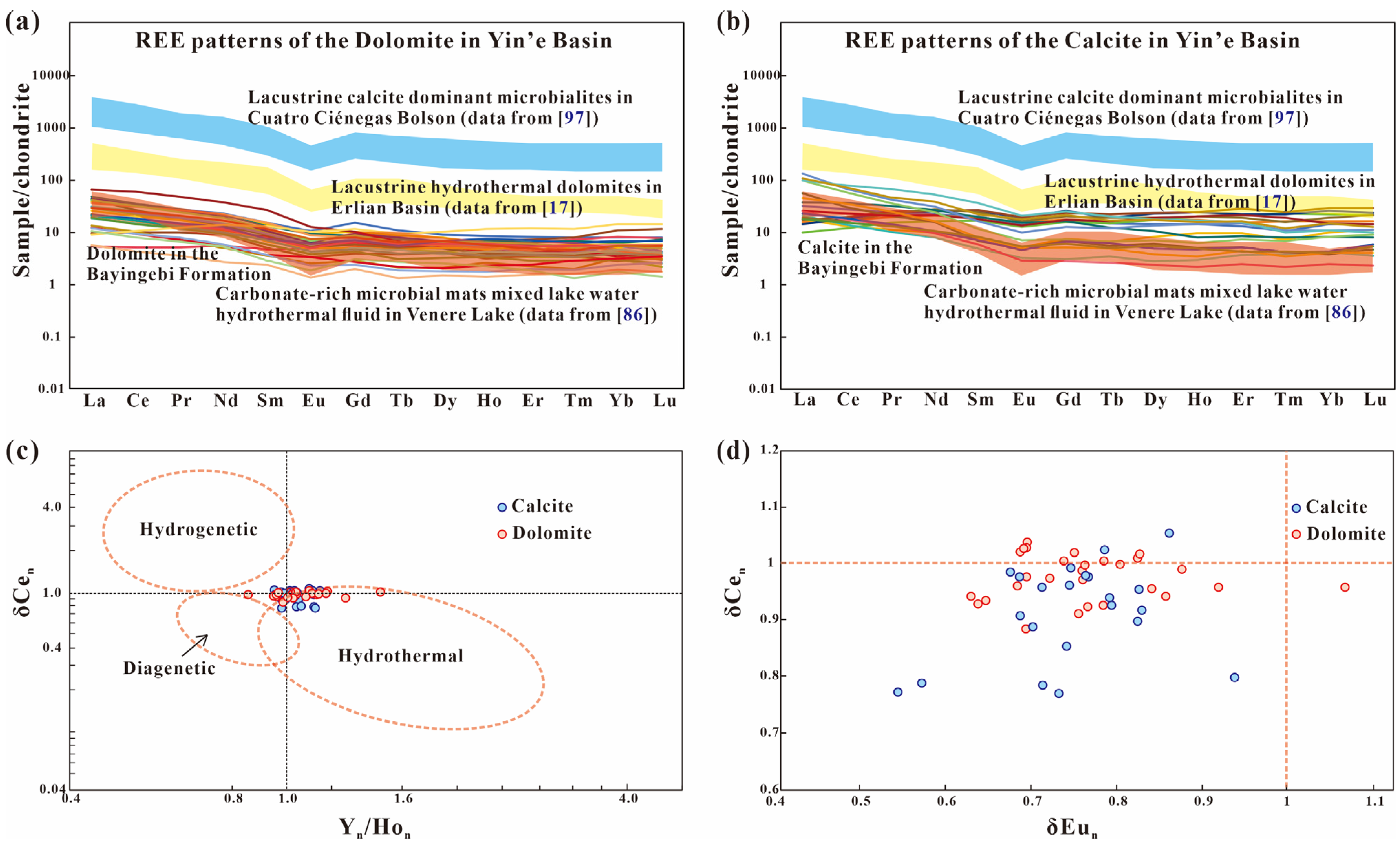
REEs provide sensitive records of the fluid chemistry, redox conditions, and temperature properties of lacustrine diagenetic fluids [60,85]. In hydrothermal environments, REE distribution patterns are usually characterized by LREE enrichment, weak negative Ce anomalies, and strong positive Eu anomalies. However, in lacustrine environments, the situation is often more complex. At Abhé Lake, for example, the significant HREE enrichment in the hydrothermal carbonate chimney was attributed to the rapid precipitation of carbonates during hydrothermal mixing with lake water [16]. The REE distribution pattern in the Yin’e Basin is characterized by LREE enrichment (Figure 8a,b), HREE depletion, and low ΣREE (<200 ppm), accompanied by a slight Eu deficiency. Moreover, Al and Ti were not systematically positively correlated with the REE content, indicating that clay contamination is unlikely to be the primary factor controlling the REE distribution. These characteristics are similar to those of lacustrine microbial calcite from the Cuatro Ciénegas Basin region in Coahuila, Mexico; microbial mats formed by the mixing of lake water, seawater, and hydrothermal fluids in Pantelleria Island, Lake Venere; and Lower Cretaceous lacustrine hydrothermal dolomite from the Erlian Basin, China [17,86], suggesting that the carbonate from the Bayingebi Formation in the Yin’e Basin was affected by the coaction of hydrothermal fluids and microbes at the bottom of the lake (Figure 8a,b).
Under the oxic, alkaline conditions of modern seawater, Ce3+ is oxidized to insoluble Ce4+, ultimately leading to a Ce3+ deficit in seawater and sediments [87,88]. In contrast, near modern hydrothermal vents, sediments may be characterized by Ce-negative anomalies because of the oxidation-based removal of Ce by suspended δ-MnO2 grains [89,90]. In the study area, a slightly negative Ce anomaly is observed in dolomite from the upper section of the Bayingebi Formation, with an average δCe value of 0.97, which is comparable to that reported for hydrothermal carbonate deposits from Lake Tanganyika, East Africa [91]. In contrast, calcite from the same interval shows a more pronounced negative Ce anomaly, with an average δCe value of 0.91, which may reflect differences in redox conditions during carbonate formation (Figure 8d). In addition, the Yn/Hon-δCen diagram shows that most carbonate samples cluster near the hydrothermal diagenetic field, while also exhibiting a considerable degree of overlap with adjacent fields [92]. This distribution suggests that the sedimentary environment of the studied interval was affected by hydrothermal processes, but within a mixed and transitional lacustrine system rather than a single end-member setting. Collectively, these geochemical features indicate that bottom-water redox conditions during carbonate precipitation likely evolved toward suboxic, and locally more reducing, conditions (Figure 8c).
Negative Eu anomalies occur mostly in relatively reducing and alkaline environments. However, there are many influencing factors; for example, in lacustrine hydrothermal environments, the input of exogenous fluids can modify and decrease existing Eu anomalies [12,93,94]. In addition, the temperature affects the redox potential of Eu. When the temperature is high (>250 °C), the Eu3+/Eu2+ potential moves in a more reducing direction, producing a positive Eu anomaly in sediments [95]. In contrast, in environments with relatively low temperatures (<250 °C), Eu is mainly in the form of Eu3+ [13]. In the study area, most of the carbonates from the upper section of the Bayingebi Formation show negative Eu anomalies (Figure 8d), with average δEu values of 0.75 in dolomite and 0.74 in calcite (Figure 8d), which suggests that the sedimentary environments were low-temperature hydrothermal environments.
Figure 8.
REE patterns of the carbonates in Yin’e Basin. (a,b) Chondrite-normalized (data from [96]) REE patterns of dolomite and calcite in Yin’e Basin, lacustrine calcite dominant microbialites data from [97], lacustrine hydrothermal dolomites data from [17], carbonate-rich microbial mats data from [86]; (c) Cross-plot of Yn/Hon versus δCen (modified from [92]); (d) Ce and Eu anomalies of the dolomite and calcite. Blue dots represent calcite; Purple dots represent dolomite.
5.4. Relationship Between Carbonates and Organic Matter
The coupling between inorganic and organic matter in lakes has been a focus of research in recent years, and evidence suggests that hydrothermal activity connects these types of matter [98]. Mild hydrothermal activity inputs large quantities of nutrients into lakes and promotes the reproduction of organisms, while increased salinity causes significant stratification of the water column, creating an anoxic environment at the lake bottom and thus preserving organic matter [99,100,101]. However, when hydrothermal activity becomes excessively intense, the input of hydrothermal fluids and associated fine-grained suspended materials can reduce water transparency, thereby limiting light penetration and suppressing the productivity of algae, phytoplankton, and other primary producers. In addition, rapid physicochemical changes and the introduction of hydrothermally derived toxic components may exceed the tolerance of many lacustrine organisms, ultimately inhibiting organic matter enrichment [102,103]. As hydrothermal influence diminishes, terrestrial weathering–derived inputs become increasingly prominent in the sedimentary system, reflecting a relative shift in dominant material sources during diagenesis [104].
This study suggests that mud-crystalline dolomite and spherical dolomite in the Bayingebi Formation of the Yin’e Basin are commonly associated with intervals interpreted to have experienced mild hydrothermal activity, occurring at burial depths of approximately 86.80–172.41 m. These intervals are also characterized by the widespread development of oil shale and relatively high TOC values (Figure 9a,c), indicating a close stratigraphic and environmental correspondence between carbonate diagenetic features and organic-rich sedimentation. Mild and relatively stable hydrothermal activity likely contributed additional Mg2+ to the lake system, increasing the Mg/Ca ratio of lake water and thereby favoring dolomitization. At the same time, hydrothermal inputs may have supplied nutrients to the palaeolake, potentially enhancing primary productivity. Together, these processes may have created environmental conditions conducive to both carbonate transformation and organic matter accumulation, which can be supported by the organic geochemical and biomarker evidence in the Yin’e Basin [53]. In addition, the introduction of hydrothermal fluids likely supplied reducing gases (e.g., SO2, H2S) and dissolved ionic species, which could have intensified water-column stratification and promoted suboxic to anoxic conditions in the palaeolake [105,106]. Such redox conditions would have been favorable for the preservation of organic matter, contributing to the development of organic-rich oil shale within these stratigraphic intervals.
Figure 9.
(a) TOC of mudstones surrounding carbonate samples; Blue dots represent calcite; Purple dots represent dolomite; Red areas represent intense hydrothermal activity; Yellow areas represent moderate hydrothermal activity; Blue areas represent weak hydrothermal activity. (b) TOC classified according to different carbonate mineral types; (c) TOC classified according to different diagenetic processes.
Three intense hydrothermal events identified in this study (85 m, 120 m and 158 m) were equally correlated with the TOC (Figure 9a). The carbonates in these sections are mostly crystalline calcite and crystalline dolomite, and the average TOC values of their surrounding mud shales are low and fluctuate widely (Figure 9c). Intense hydrothermal activity implies the release of more fluids, which would further contribute to the increase in lake water salinity and the formation of an anoxic environment [37,99]. Such hydrochemical instability could have constrained sustained microbial productivity, potentially favoring only a limited range of salt-tolerant organisms. The intermittent development of dark mud shale within these intervals may reflect short-lived episodes of enhanced organic matter preservation under reducing conditions, rather than persistently high primary productivity, and may also contribute to the locally elevated mean TOC values observed during periods of intense hydrothermal activity.
Hydrothermal activity is weak at depths of approximately 200 m and 50 m, where carbonate occurrences are mainly represented by scattered coarse crystalline calcite and antiaxial fibrous calcite veins. These intervals are characterized by relatively low TOC values (average TOC = 2.81 for crystalline calcite and 3.21 for antiaxial fibrous calcite veins; Figure 9c), which are associated with increased input of terrestrial detrital minerals. Enhanced weathering of the host rocks likely supplied sufficient Ca2+ to the lake, and together with available carbonate ions, promoted supersaturation and the precipitation of coarse crystalline calcite at the lake bottom [107,108]. At the same time, intensified detrital input and relatively stronger hydrodynamic conditions may have contributed to dilution and reduced preservation efficiency of organic matter in these weak hydrothermal intervals.
6. Conclusions
The carbonate studied from the upper section (K1b2) of the Bayingebi Formation in well CZK1-5 provides a basis for exploring the links between carbonate diagenesis and organic matter enrichment in a hydrothermally influenced lacustrine setting within this specific interval.
Carbonates that form diagenetically in the interval can be grouped into three broad types: hydrothermal, hydrothermal–biogenic, and sedimentary. Hydrothermal carbonates are typically coarse crystalline dolomite and syntaxial fibrous calcite veins associated with hydrothermal minerals and enriched in Fe, Ba and Mg. Their relatively low 87Sr/86Sr signatures suggest a notable contribution from deep-sourced hydrothermal fluids. Hydrothermal–biogenic carbonates are dominated by mud-crystalline and spherical dolomite; these carbonates present intermediate geochemical signatures and textural features that are consistent with a combined hydrothermal influence and biogenic modulation. Sedimentary carbonates are largely coarse crystalline calcite and antiaxial fibrous calcite veins; their higher 87Sr/86Sr and stronger terrestrial geochemical signals are consistent with extensive lacustrine and detrital influences during precipitation.
Variations in hydrothermal intensity broadly correspond to differences in carbonate types and TOC levels. Intervals with mild hydrothermal influence commonly coincide with elevated TOC levels in the enclosing mudstones, whereas intervals interpreted as having intense or weak hydrothermal influence have lower or more variable TOC level. These patterns indicate that hydrothermal inputs are important factors controlling carbonate diagenesis and organic matter preservation in the studied interval.
Overall, based on observations from a single fully cored borehole in the upper section of the Bayingebi Formation within a specific interval, this study highlights the complex interplay among hydrothermal fluids, carbonate precipitation, and organic matter enrichment in a lacustrine rift setting. Although additional cores from other intervals are needed to fully characterize the spatial variability of hydrothermally influenced lacustrine systems, these results provide a robust framework for understanding the coupling between inorganic mineral diagenesis and organic matter preservation in paleolake environments, with implications for future multi-core studies.
Supplementary Materials
The following supporting information can be downloaded at: https://www.mdpi.com/article/10.3390/min16020165/s1, Table S1. Contents of Trace elements in carbonate samples of the Bayingebi Formation; Table S2. Contents of rare earth elements (REE) in carbonate samples of the Bayingebi Formation; Table S3. Ce and Eu anomalies and Sr isotopes in carbonate samples and TOC values around carbonate samples of the Bayingebi Formation; Figure S1. Model Diagram of Basin Formation and Tectonic Evolution in the Yin’e Basin and Adjacent Basins (modified from [109,110]); Figure S2. (a) Black mudstone in the Yin’e Basin; (b) Oil shale in the Yin’e Basin; (c) Carbonate minerals in the Yin’e Basin; (d) Thick carbonate and oil shale interbeds in the Yin’e Basin; Figure S3. (a) Cross-plot of Al versus Si; (b) Cross-plot of Ti versus Al; (c) Cross-plot of Al versus Mg; (d) Cross-plot of Mn versus Mg. Blue dots represent calcite; Purple dots represent dolomite.
Author Contributions
F.M.: The conception and design; Funding acquisition. T.H.: Writing—Original Draft; Methodology; Validation. B.C.: Software. R.L.: Writing—Review and Editing; Supervision; Funding acquisition. Q.L.: Formal analysis; Investigation. H.Z.: Resources; Data Curation. All listed authors meet the criteria for authorship as per the ICMJE guidelines. All authors have read and agreed to the published version of the manuscript.
Funding
This study was financially supported by the National Natural Science Foundation of China (NSFC) (Grant No. 42072122) and PetroChina Company Limited Science and Technology Project, Research on New Theories of Overseas Oil and Gas Geology, New Resource Evaluation Technologies, and Advanced Region Selection (Project Number: 2023ZZ07).
Data Availability Statement
The data are contained within the article.
Acknowledgments
We are grateful to all researchers who participated in this study for their indispensable efforts and contributions throughout the research process. Special thanks go to Feng Ma and Rong Liu, who provided crucial financial support for the research and offered valuable insights during the manuscript review, significantly improving the work’s quality. I also appreciate Bintao Chen, Qianghao Liu, and Haoran Zhang for their important contributions to experimental testing and result analysis, which laid a solid foundation for this study. Additionally, we sincerely thank the editor and reviewers for their valuable feedback and guidance, which greatly enhanced the quality and clarity of this manuscript.
Conflicts of Interest
Feng Ma and Bintao Chen are employees of PetroChina. The paper reflects the views of the scientists and not the company.
References
- Jin, Z.; Nie, H.; Liu, Q.; Zhao, J.; Wang, R.; Sun, C.; Wang, G. Coevolutionary Dynamics of Organic-Inorganic Interactions, Hydrocarbon Generation, and Shale Gas Reservoir Preservation: A Case Study from the Upper Ordovician Wufeng and Lower Silurian Longmaxi Formations, Fuling Shale Gas Field, Eastern Sichuan Basin. Geofluids 2020, 6672386. [Google Scholar] [CrossRef] [Scilit]
- Szymczycha, B.; Böttcher, M.E.; Diak, M.; Koziorowska-Makuch, K.; Kuliński, K.; Makuch, P.; von Ahn, C.M.E.; Winogradow, A. The benthic-pelagic coupling affects the surface water carbonate system above groundwater-charged coastal sediments. Front. Mar. Sci. 2023, 10, 1218245. [Google Scholar] [CrossRef] [Scilit]
- Tian, H.; Ren, W.; Yang, J.; Tao, B.; Cai, W.-J.; Lohrenz, S.E.; Hopkinson, C.S.; Liu, M.; Yang, Q.; Lu, C.; et al. Climate extremes dominating seasonal and interannual variations in carbon export from the Mississippi River Basin. Glob. Biogeochem. Cycles 2015, 29, 1333–1347. [Google Scholar] [CrossRef] [Scilit]
- Chen, L.; Xiong, M.; Tan, X.; Chen, X.; Zheng, J.; Yang, Y.; Jing, C.; Wang, G. Coupling mechanism between sea level changes and pore heterogeneity of marine shale reservoirs driven by astronomical orbital cycles: Lower Silurian Longmaxi shale in the Upper Yangtze area, South China. Mar. Pet. Geol. 2024, 160, 106590. [Google Scholar] [CrossRef] [Scilit]
- Huang, C.; Zhang, L.; Li, Y.; Lin, C.; Huang, T.; Zhang, M.; Zhu, A.; Yang, H.; Wang, X. Carbon and nitrogen burial in a plateau lake during eutrophication and phytoplankton blooms. Sci. Total Environ. 2018, 616–617, 296–304. [Google Scholar] [CrossRef] [Scilit] [PubMed]
- Zheng, Y.; Fu, D.; Qin, J.; Liu, X.; Tian, B.; Sun, L. Exploring the coupling relationship between hydrocarbon generation of continental shale and nanopore structure evolution—A case study of Shahejie formation in Bohai Bay Basin. J. Pet. Explor. Prod. Technol. 2021, 11, 4215–4225. [Google Scholar] [CrossRef] [Scilit]
- Merkel, A.; Fink, R.; Littke, R. High pressure methane sorption characteristics of lacustrine shales from the Midland Valley Basin, Scotland. Fuel 2016, 182, 361–372. [Google Scholar] [CrossRef] [Scilit]
- Vosoughi Moradi, A.; Sarı, A.; Akkaya, P. Paleoredox reconstruction of bituminous shales from the Miocene Hançili Formation, Çankırı-Çorum Basin, Turkey: Evaluating the role of anoxia in accumulation of organic-rich shales. Mar. Pet. Geol. 2016, 78, 136–150. [Google Scholar] [CrossRef] [Scilit]
- Yue, H.; Horsfield, B.; Schulz, H.-M.; Yang, S.; Vieth-Hillebrand, A.; Poetz, S. Preservation of biotic and palaeoenvironmental signatures in organosulfur compounds of immature fine-grained sedimentary rocks. Int. J. Coal Geol. 2023, 265, 104168. [Google Scholar] [CrossRef] [Scilit]
- Zeng, W.; Zhang, Z.; Wang, B.; Chen, X.; Zheng, R.; Fu, G.; Jin, Y. Formation mechanism of organic-rich mixed sedimentary rocks in saline lacustrine basin, Permian Lucaogou Formation, Jimsar Sag, Junggar Basin, Northwest China. Mar. Pet. Geol. 2023, 156, 106452. [Google Scholar] [CrossRef] [Scilit]
- Warren, J. Dolomite: Occurrence, evolution and economically important associations. Earth-Sci. Rev. 2000, 52, 1–81. [Google Scholar] [CrossRef] [Scilit]
- Rieger, P.; Magnall, J.M.; Gleeson, S.A.; Oelze, M.; Wilke, F.D.H.; Lilly, R. Differentiating between hydrothermal and diagenetic carbonate using rare earth element and yttrium (REE plus Y) geochemistry: A case study from the Paleoproterozoic George Fisher massive sulfide Zn deposit, Mount Isa, Australia. Miner. Depos. 2022, 57, 187–206. [Google Scholar] [CrossRef] [Scilit]
- Wu, A.; Cao, J.; Zhang, J.; Wu, T.; Wang, Y. Origin of microbial-hydrothermal bedded dolomites in the Permian Lucaogou Formation lacustrine shales, Junggar Basin, NW China. Sediment. Geol. 2022, 440, 106260. [Google Scholar] [CrossRef] [Scilit]
- Duddy, I.R.; Green, P.F.; Bray, R.J.; Hegarty, K.A. Recognition of the thermal effects of fluid flow in sedimentary basins. Geol. Soc. Lond. Spec. Publ. 1994, 78, 325–345. [Google Scholar] [CrossRef] [Scilit]
- Hao, F.; Zou, H.Y.; Fang, Y.; Zeng, Z.P. Overpressure-fault controlled fluid flow and episodic hydrocarbon accumulation. Acta Petrolei Sin. 2004, 25, 38–43,47. [Google Scholar]
- Dekov, V.M.; Egueh, N.M.; Kamenov, G.D.; Bayon, G.; Lalonde, S.V.; Schmidt, M.; Liebetrau, V.; Munnik, F.; Fouquet, Y.; Tanimizu, M.; et al. Hydrothermal carbonate chimneys from a continental rift (Afar Rift): Mineralogy, geochemistry, and mode of formation. Chem. Geol. 2014, 387, 87–100. [Google Scholar] [CrossRef] [Scilit]
- Yang, Z.; Zhong, D.; Whitaker, F.; Lu, Z.; Zhang, S.; Tang, Z.; Liu, R.; Li, Z. Syn-sedimentary hydrothermal dolomites in a lacustrine rift basin: Petrographic and geochemical evidence from the lower Cretaceous Erlian Basin, Northern China. Sedimentology 2020, 67, 305–329. [Google Scholar] [CrossRef] [Scilit]
- Li, H.; Liu, Y.Q.; Yang, K.; Liu, Y.J.; Niu, Y. Hydrothermal mineral assemblages of calcite and dolomite-analcime-pyrite in Permian lacustrine Lucaogou mudstones, eastern Junggar Basin, Northwest China. Mineral. Petrol. 2021, 115, 63–85. [Google Scholar] [CrossRef] [Scilit]
- Zhang, K.; Liu, R.; Liu, Z.; Li, L.; Wu, X.; Zhao, K. Influence of palaeoclimate and hydrothermal activity on organic matter accumulation in lacustrine black shales from the Lower Cretaceous Bayingebi Formation of the Yin’e Basin, China. Palaeogeogr. Palaeoclimatol. Palaeoecol. 2020, 560, 110007. [Google Scholar] [CrossRef] [Scilit]
- Zhang, K.; Liu, R.; Liu, Z.; Li, B.; Liu, G.; Yan, X.; Li, L. Terrestrial records of Early Cretaceous paleoclimate fluctuations in the Yin’e Basin, northern China: Evidence from sedimentology and palynomorphs in lacustrine sediments. Sediment. Geol. 2022, 432, 106110. [Google Scholar] [CrossRef] [Scilit]
- Zhang, K.; Liu, R.; Bai, E.; Zhao, Z.; Peyrotty, G.; Fathy, D.; Chang, Q.; Liu, Z.P.; Yang, K.; Xu, C.; et al. Biome responses to a hydroclimatic crisis in an Early Cretaceous (Barremian-Aptian) subtropical inland lake ecosystem, Northwest China. Palaeogeogr. Palaeoclimatol. Palaeoecol. 2023, 622, 111596. [Google Scholar] [CrossRef] [Scilit]
- Dobretsov, N.L.; Berzin, N.A.; Buslov, M.M. Opening and Tectonic Evolution of the Paleo-Asian Ocean. Int. Geol. Rev. 1995, 37, 335–360. [Google Scholar] [CrossRef] [Scilit]
- Scotese, C.R. Map Folio 27: Early Cretaceous (Early Aptian, 121.8 Ma). In PALEOMAP PaleoAtlas for ArcGIS; PALEOMAP Project: Evanston, IL, USA, 2013. [Google Scholar]
- Zuo, Y.; Qiu, N.; Hao, Q.; Pang, X.; Gao, X.; Wang, X.; Luo, X.; Zhao, Z. Geothermal regime and source rock thermal evolution in the Chagan sag, Inner Mongolia, northern China. Mar. Pet. Geol. 2015, 59, 245–267. [Google Scholar] [CrossRef] [Scilit]
- Meng, Q.; Hu, J.; Jin, J.; Zhang, Y.; Xu, D. Tectonics of the late Mesozoic wide extensional basin system in the China-Mongolia border region. Basin Res. 2003, 15, 397–415. [Google Scholar] [CrossRef] [Scilit]
- Hou, Y.; Wang, H.; Fan, T.; Zhang, H.; Yang, R.; Li, Y.; Long, S. Rift-related sedimentary evolution and its response to tectonics and climate changes: A case study of the Guaizihu sag, Yingen-Ejinaqi Basin, China. J. Asian Earth Sci. 2020, 195, 104370. [Google Scholar] [CrossRef] [Scilit]
- Chen, Z.; Ren, Z.; Yu, C.; Qi, K.; Ren, W.; Yang, Y.; Ma, Q. Characteristics and Genetic Analysis of Hydrothermal Sediment of Lower Cretaceous in Hari Depression, Yin’e Basin. Earth Sci.—J. China Univ. Geosci. 2018, 43, 1941. [Google Scholar] [CrossRef] [Scilit]
- Tong, Q.; Ye, F.; Qin, M. U-Pb Chronology of Detrital Zircons from Lower Cretaceous in Xinniwusu Sag, Bayingobi Basin and Its Geological Significance. Earth Sci.—J. China Univ. Geosci. 2023, 48, 3613–3630. [Google Scholar] [CrossRef]
- Zong, K.; Klemd, R.; Yuan, Y.; He, Z.; Guo, J.; Shi, X.; Liu, Y.; Hu, Z.; Zhang, Z. The assembly of Rodinia: The correlation of early Neoproterozoic (ca. 900 Ma) high-grade metamorphism and continental arc formation in the southern Beishan Orogen, southern Central Asian Orogenic Belt (CAOB). Precambrian Res. 2017, 290, 32–48. [Google Scholar] [CrossRef] [Scilit]
- Liu, Y.; Hu, Z.; Gao, S.; Günther, D.; Xu, J.; Gao, C.; Chen, H. In situ analysis of major and trace elements of anhydrous minerals by LA-ICP-MS without applying an internal standard. Chem. Geol. 2008, 257, 34–43. [Google Scholar] [CrossRef] [Scilit]
- Hu, Z.; Zhang, W.; Liu, Y.; Gao, S.; Li, M.; Zong, K.; Chen, H.; Hu, S. “wave” signal-smoothing and Mercury-removing device for laser ablation quadrupole and multiple collector ICPMS analysis: Application to lead isotope analysis. Anal. Chem. 2015, 87, 1152–1157. [Google Scholar] [CrossRef] [Scilit]
- Yang, Y.; Wu, F.; Yang, J.; Chew, D.M.; Xie, L.; Chu, Z.; Zhang, Y.; Huang, C. Sr and Nd isotopic compositions of apatite reference materials used in U–Th–Pb geochronology. Chem. Geol. 2014, 385, 35–55. [Google Scholar] [CrossRef] [Scilit]
- Boström, K. Genesis of Ferromanganese Deposits-Diagnostic Criteria for Recent and Old Deposits. In Hydrothermal Processes at Seafloor Spreading Centers; Springer: Boston, MA, USA, 1983; pp. 473–489. [Google Scholar] [CrossRef] [Scilit]
- Choi, J.H.; Hariya, Y. Geochemistry and depositional environment of Mn oxide deposits in the Tokoro Belt, northeastern Hokkaido, Japan. Econ. Geol. 1992, 87, 1265–1274. [Google Scholar] [CrossRef] [Scilit]
- Machel, H.G.; Lonnee, J. Hydrothermal dolomite—A product of poor definition and imagination. Sediment. Geol. 2002, 152, 163–171. [Google Scholar] [CrossRef] [Scilit]
- Machel, H.G. Concepts and models of dolomitization: A critical reappraisal. Geol. Soc. Lond. Spec. Publ. 2004, 235, 7–63. [Google Scholar] [CrossRef] [Scilit]
- Hackley, P.C.; Fishman, N.; Wu, T.; Baugher, G. Organic petrology and geochemistry of mudrocks from the lacustrine Lucaogou Formation, Santanghu Basin, northwest China: Application to lake basin evolution. Int. J. Coal Geol. 2016, 168, 20–34. [Google Scholar] [CrossRef] [Scilit]
- Jiao, X.; Liu, Y.; Yang, W.; Zhou, D.; Li, H.; Nan, Y.; Jin, M. A magmatic-hydrothermal lacustrine exhalite from the Permian Lucaogou Formation, Santanghu Basin, NW China-The volcanogenic origin of fine-grained clastic sedimentary rocks. J. Asian Earth Sci. 2018, 156, 11–25. [Google Scholar] [CrossRef] [Scilit]
- Korte, C.; Jasper, T.; Kozur, H.W.; Veizer, J. 87Sr/86Sr record of Permian seawater. In Evolution of the System Earth in the Late Palaeozoic: Clues from Sedimentary Geochemistry. Palaeogeogr. Palaeoclimatol. Palaeoecol. 2006, 240, 89–107. [Google Scholar] [CrossRef] [Scilit]
- Niu, Y.; O’Hara, M.J. MORB mantle hosts the missing Eu (Sr, Nb, Ta and Ti) in the continental crust: New perspectives on crustal growth, crust-mantle differentiation and chemical structure of oceanic upper mantle. In Recent developments on seafloor petrology and tectonics. Lithos 2009, 112, 1–17. [Google Scholar] [CrossRef] [Scilit]
- Ingram, B.L.; Coccioni, R.; Montanari, A.; Richter, F.M. Strontium isotopic composition of mid-cretaceous seawater. Science 1994, 264, 546–550. [Google Scholar] [CrossRef] [Scilit]
- Ma, P.; Lin, C.; Jahren, J.; Dong, C.; Ren, L.; Hellevang, H. Cyclic zoning in authigenic saddle dolomite-ankerite: Indications of a complex interplay between fault-rupturing and diagenetic alteration. Chem. Geol. 2021, 559, 119831. [Google Scholar] [CrossRef] [Scilit]
- Mansurbeg, H.; Alsuwaidi, M.; Salih, N.; Shahrokhi, S.; Morad, S. Integration of stable isotopes, radiometric dating and microthermometry of saddle dolomite and host dolostones (Cretaceous carbonates, Kurdistan, Iraq): New insights into hydrothermal dolomitization. Mar. Pet. Geol. 2021, 127, 104989. [Google Scholar] [CrossRef] [Scilit]
- Roberts, J.A.; Bennett, P.C.; González, L.A.; Macpherson, G.L.; Milliken, K.L. Microbial precipitation of dolomite in methanogenic groundwater. Geology 2004, 32, 277–280. [Google Scholar] [CrossRef] [Scilit]
- Kenward, P.A.; Goldstein, R.H.; González, L.A.; Roberts, J.A. Precipitation of low-temperature dolomite from an anaerobic microbial consortium: The role of methanogenic Archaea. Geobiology 2009, 7, 556–565. [Google Scholar] [CrossRef] [Scilit] [PubMed]
- Vasconcelos, C.; McKenzie, J.A. Microbial mediation of modern dolomite precipitation and diagenesis under anoxic conditions (Lagoa Vermelha, Rio de Janeiro, Brazil). J. Sediment. Res. 1997, 67, 378–390. [Google Scholar] [CrossRef] [Scilit]
- Land, L.S. Failure to Precipitate Dolomite at 25 °C from Dilute Solution Despite 1000-Fold Oversaturation after 32 Years. Aquat. Geochem. 1998, 4, 361–368. [Google Scholar] [CrossRef] [Scilit]
- Burns, S.J.; McKenzie, J.A.; Vasconcelos, C. Dolomite formation and biogeochemical cycles in the Phanerozoic. Sedimentology 2000, 47, 49–61. [Google Scholar] [CrossRef] [Scilit]
- Sanchez-Roman, M.; Vasconcelos, C.; Schmid, T.; Dittrich, M.; McKenzie, J.A.; Zenobi, R.; Rivadeneyra, M.A. Aerobic microbial dolomite at the nanometer scale: Implications for the geologic record. Geology 2008, 36, 879–882. [Google Scholar] [CrossRef] [Scilit]
- Sun, F.; Hu, W.; Wang, X.; Cao, J.; Fu, B.; Wu, H.; Yang, S. Methanogen microfossils and methanogenesis in Permian lake deposits. Geology 2021, 49, 13–18. [Google Scholar] [CrossRef] [Scilit]
- Dare, S.A.S.; Barnes, S.-J.; Beaudoin, G.; Meric, J.; Boutroy, E.; Potvin-Doucet, C. Trace elements in magnetite as petrogenetic indicators. Miner. Depos. 2014, 49, 785–796. [Google Scholar] [CrossRef] [Scilit]
- Petrash, D.A.; Bialik, O.M.; Bontognali, T.R.R.; Vasconcelos, C.; Roberts, J.A.; McKenzie, J.A.; Konhauser, K.O. Microbially catalyzed dolomite formation: From near-surface to burial. Earth-Sci. Rev. 2017, 171, 558–582. [Google Scholar] [CrossRef] [Scilit]
- Zhang, K.; Liu, R.; Ding, W.; Li, L.; Liu, Z. The influence of Early Cretaceous paleoclimate warming event on sedimentary environment evolution and organic matter sources in Yin’e Basin: Evidence from petrology and molecular geochemistry. Int. J. Coal Geol. 2022, 254, 103972. [Google Scholar] [CrossRef] [Scilit]
- Jones, B. The preferential association of dolomite with microbes in stalactites from Cayman Brac, British West Indies. Sediment. Geol. 2010, 226, 94–109. [Google Scholar] [CrossRef] [Scilit]
- Langmann, B.; Zaksek, K.; Hort, M.; Duggen, S. Volcanic ash as fertiliser for the surface ocean. Atmos. Chem. Phys. 2010, 10, 3891–3899. [Google Scholar] [CrossRef] [Scilit]
- Wei, W.; Algeo, T.J.; Lu, Y.B.; Lu, Y.C.; Liu, H.; Zhang, S.; Peng, L.; Zhang, J.; Chen, L. Identifying marine incursions into the Paleogene Bohai Bay Basin lake system in northeastern China. Int. J. Coal Geol. 2018, 200, 1–17. [Google Scholar] [CrossRef] [Scilit]
- Guo, P.; Liu, C.; Gibert, L.; Huang, L.; Zhang, D.; Dai, J. How to find high-quality petroleum source rocks in saline lacustrine basins: A case study from the Cenozoic Qaidam Basin, NW China. Mar. Pet. Geol. 2020, 111, 603–623. [Google Scholar] [CrossRef] [Scilit]
- Doner, Z.; Kumral, M.; Demirel, I.H.; Hu, Q. Geochemical characteristics of the Silurian shales from the central Taurides, southern Turkey: Organic matter accumulation, preservation and depositional environment modeling. Mar. Pet. Geol. 2019, 102, 155–175. [Google Scholar] [CrossRef] [Scilit]
- Zhao, K.; Du, X.; Lu, Y.; Xiong, S.; Wang, Y. Are light-dark coupled laminae in lacustrine shale seasonally controlled? A case study using astronomical tuning from 42.2 to 45.4 Ma in the Dongying Depression, Bohai Bay Basin, eastern China. Palaeogeogr. Palaeoclimatol. Palaeoecol. 2019, 528, 35–49. [Google Scholar] [CrossRef] [Scilit]
- Peucker-Ehrenbrink, B.; Fiske, G.J. A continental perspective of the seawater 87Sr/86Sr record: A review. Chem. Geol. 2019, 510, 140–165. [Google Scholar] [CrossRef] [Scilit]
- Bataille, C.P.; Bowen, G.J. Mapping 87Sr/86Sr variations in bedrock and water for large-scale provenance studies. Chem. Geol. 2012, 304–305, 39–52. [Google Scholar] [CrossRef] [Scilit]
- Palmer, M.R.; Elderfield, H. Sr isotope composition of sea water over the past 75 Myr. Nature 1985, 314, 526–528. [Google Scholar] [CrossRef] [Scilit]
- Palmer, M.R.; Edmond, J.M. The strontium isotope budget of the modern ocean. Earth Planet. Sci. Lett. 1989, 92, 11–26. [Google Scholar] [CrossRef] [Scilit]
- Bralower, T.J.; Fullagar, P.D. Mid-Cretaceous strontium-isotope stratigraphy of deep-sea sections. Geol. Soc. Am. Bull. 1997, 109, 1421. [Google Scholar] [CrossRef]
- Faure, G.; Powell, J.L. Strontium Isotope Geol; Springer Science & Business Media: Berlin/Heidelberg, Germany, 2012. [Google Scholar]
- He, T.; Liu, R.; Liu, Q.; Ning, T. The Formation Mechanism of the Fibrous Calcite Veins in the Lower Cretaceous Bayingebi Formation of the Yin’e Basin: Evidence from Hot Water Deposition and Isotopies. J. Jilin Univ. Earth Sci. Ed. 2025, 1–15. [Google Scholar] [CrossRef]
- Liu, G.; Liu, X.; Ma, X.; Ma, S.; Wang, X.; Li, S.; Shi, Z.; Wang, Y. Genesis of Fibrous Calcite in the Chang 7 Member of the Yanchang Formation, Ordos Basin, China. Acta Geol. Sin.—Engl. Ed. 2023, 97, 1490–1502. [Google Scholar] [CrossRef] [Scilit]
- McArthur, J.M.; Howarth, R.J.; Shields, G.A.; Zhou, Y. Strontium isotope stratigraphy. In Geologic Time Scale 2020; Elsevier: Amsterdam, The Netherlands, 2020; pp. 211–238. [Google Scholar] [CrossRef] [Scilit]
- Faure, G. Principles of Isotope Geology; Wiley: New York, NY, USA, 1977. [Google Scholar]
- Zhao, Z.; Dong, C.; Ma, P.; Lin, C.; Li, G.; Du, X.; Luan, G.; He, Y.; Liu, W. Origin of Dolomite in Lacustrine Organic-Rich Shale: A Case Study in the Shahejie Formation of the Dongying Sag, Bohai Bay Basin. Front. Earth Sci. 2022, 10, 909107. [Google Scholar] [CrossRef] [Scilit]
- Wen, H.; Zheng, R.; Qing, H.; Fan, M.; Li, Y.; Gong, B. Primary dolostone related to the Cretaceous lacustrine hydrothermal sedimentation in Qingxi sag, Jiuquan Basin on the northern Tibetan Plateau. Sci. China Earth Sci. 2013, 56, 2080–2093. [Google Scholar] [CrossRef] [Scilit]
- Zhu, R.; Cui, J.; Luo, Z.; Li, S.; Mao, Z.; Xi, K.; Su, L. A discussion on the genesis of carbonate concretions in the Chang 7 Member of the Middle-Upper Triassic Yanchang Formation of Ordos basin. Acta Geol. Sin. 2020, 95, 3442–3454. [Google Scholar] [CrossRef]
- Liu, W.; Wang, P. Genesis and Environmental Significance of the Dolomite Concretions from the 690 Nenjiang Formation in the Songliao Basin, Northeastern China. Sediment. Geol. Tethyan Geol. 1997, 17, 22–26. [Google Scholar]
- Yang, Y.; Qiu, L.; Gregg, J.; Shi, Z.; Yu, K. Formation of fine crystalline dolomites in lacustrine carbonates of the Eocene Sikou Depression, Bohai Bay Basin, East China. Pet. Sci. 2016, 13, 642–656. [Google Scholar] [CrossRef] [Scilit]
- Robertson, A.H.F.; Necdet, M.; Raffi, I.; Chen, G. Early Messinian manganese deposition in NE Cyprus related to cyclical redox changes in a silled hemipelagic basin prior to the Mediterranean salinity crisis. Sediment. Geol. 2019, 385, 126–148. [Google Scholar] [CrossRef] [Scilit]
- Drief, A.; Martinez-Ruiz, F.; Nieto, F.; Sanchez, N.V. Transmission electron microscopy evidence for experimental illitization of smectite in K-enriched seawater solution at 50 °C and basic pH. Clays Clay Miner. 2002, 50, 746–756. [Google Scholar] [CrossRef] [Scilit]
- Deckker, P.D.; Last, W.M. Modern dolomite deposition in continental, saline lakes, western Victoria, Australia. Geology 1988, 16, 29–32. [Google Scholar] [CrossRef] [Scilit]
- Böning, P.; Brumsack, H.J.; Böttcher, M.E.; Schnetger, B.; Kriete, C.; Kallmeyer, J.; Borchers, S.L. Geochemistry of Peruvian near-surface sediments. Geochim. Cosmochim. Acta 2004, 68, 4429–4451. [Google Scholar] [CrossRef] [Scilit]
- Piper, D.Z.; Perkins, R.B. A modern vs. Permian black shale-the hydrography, primary productivity, and water-column chemistry of deposition. Chem. Geol. 2004, 206, 177–197. [Google Scholar] [CrossRef] [Scilit]
- Dekov, V.M.; Petersen, S.; Garbe-Schönberg, C.-D.; Kamenov, G.D.; Perner, M.; Kuzmann, E.; Schmidt, M. Fe-Si-oxyhydroxide deposits at a slow-spreading centre with thickened oceanic crust: The Lilliput hydrothermal field (9°33′S, Mid-Atlantic Ridge). Chem. Geol. 2010, 278, 186–200. [Google Scholar] [CrossRef] [Scilit]
- Boetius, A.; Wenzhoefer, F. Seafloor oxygen consumption fuelled by methane from cold seeps. Nat. Geosci. 2013, 6, 725–734. [Google Scholar] [CrossRef] [Scilit]
- Hao, F.; Zou, H.Y.; Yang, X.S.; Wang, M.F. Episodic petroleum accumulation, its driving mechanisms and distinguishing markers. Chin. J. Geol. 2003, 38, 403–412. [Google Scholar]
- Lesniewski, R.A.; Jain, S.; Anantharaman, K.; Schloss, P.D.; Dick, G.J. The metatranscriptome of a deep-sea hydrothermal plume is dominated by water column methanotrophs and lithotrophs. ISME J. 2012, 6, 2257–2268. [Google Scholar] [CrossRef] [Scilit]
- Anantharaman, K.; Breier, J.A.; Dick, G.J. Metagenomic resolution of microbial functions in deep-sea hydrothermal plumes across the Eastern Lau Spreading Center. ISME J. 2016, 10, 225–239. [Google Scholar] [CrossRef] [Scilit]
- Murray, R.W. Chemical criteria to identify the depositional environment of chert: General principles and applications. Sediment. Geol. 1994, 90, 213–232. [Google Scholar] [CrossRef] [Scilit]
- Censi, P.; Cangemi, M.; Brusca, L.; Madonia, P.; Saiano, F.; Zuddas, P. The behavior of rare-earth elements, Zr and Hf during biologically-mediated deposition of silica-stromatolites and carbonate-rich microbial mats. Gondwana Res. 2015, 27, 209–215. [Google Scholar] [CrossRef] [Scilit]
- Bau, M.; Möller, P. Rare earth element fractionation in metamorphogenic hydrothermal calcite, magnesite and siderite. Mineral. Petrol. 1992, 45, 231–246. [Google Scholar] [CrossRef] [Scilit]
- Gruau, G.; Dia, A.; Olivié-Lauquet, G.; Davranche, M.; Pinay, G. Controls on the distribution of rare earth elements in shallow groundwaters. Water Res. 2004, 38, 3576–3586. [Google Scholar] [CrossRef] [Scilit] [PubMed]
- Patino, L.C.; Velbel, M.A.; Price, J.R.; Wade, J.A. Trace element mobility during spheroidal weathering of basalts and andesites in Hawaii and Guatemala. In Controls on Chemical Weathering. Chem. Geol. 2003, 202, 343–364. [Google Scholar] [CrossRef] [Scilit]
- Lawrence, M.G.; Greig, A.; Collerson, K.D.; Kamber, B.S. Rare Earth Element and Yttrium Variability in South East Queensland Waterways. Aquat. Geochem. 2006, 12, 39–72. [Google Scholar] [CrossRef] [Scilit]
- Barrat, J.A.; Boulègue, J.; Tiercelin, J.J.; Lesourd, M. Strontium isotopes and rare-earth element geochemistry of hydrothermal carbonate deposits from Lake Tanganyika, East Africa. Geochim. Cosmochim. Actacta 2000, 64, 287–298. [Google Scholar] [CrossRef] [Scilit]
- Bau, M.; Schmidt, K.; Koschinsky, A.; Hein, J.; Kuhn, T.; Usui, A. Discriminating between different genetic types of marine ferro-manganese crusts and nodules based on rare earth elements and yttrium. Chem. Geol. 2014, 381, 1–9. [Google Scholar] [CrossRef] [Scilit]
- Hecht, L.; Freiberger, R.; Gilg, H.A.; Grundmann, G.; Kostitsyn, Y.A. Rare earth element and isotope (C, O, Sr) characteristics of hydrothermal carbonates: Genetic implications for dolomite-hosted talc mineralization at Göpfersgrün (Fichtelgebirge, Germany). Chem. Geol. 1999, 155, 115–130. [Google Scholar] [CrossRef] [Scilit]
- Jiang, Y.; Tan, X.; Zhang, C.; Jiang, W.; Wang, J.; Luo, L.; Tan, D.; Wang, W.; Xiong, Z. Genesis of Dolomite in Middle Permian Maokou Formation in Eastern Sichuan: Constraints from In Situ Geochemistry, Sr-Mg Isotopes, and Fluid Inclusions. Geofluids 2021, 2021, 6611140. [Google Scholar] [CrossRef] [Scilit]
- Morad, S.; Felitsyn, S. Identification of primary Ce-anomaly signatures in fossil biogenic apatite: Implication for the Cambrian oceanic anoxia and phosphogenesis. Sediment. Geol. 2001, 143, 259–264. [Google Scholar] [CrossRef] [Scilit]
- Sun, S.S.; McDonough, W.F. Chemical and Isotopic Systematics of Oceanic Basalts: Implications for Mantle Composition and Processes. Geol. Soc. Lond. Spec. Publ. 1989, 42, 313–345. [Google Scholar] [CrossRef] [Scilit]
- Johannesson, K.H.; Telfeyan, K.; Chevis, D.A.; Rosenheim, B.E.; Leybourne, M.I. Rare Earth Elements in Stromatolites—1. Evidence that Modern Terrestrial Stromatolites Fractionate Rare Earth Elements During Incorporation from Ambient Waters. In Evolution of Archean Crust and Early Life; Dilek, Y., Furnes, H., Eds.; Springer: Dordrecht, The Netherlands, 2014; pp. 385–411. [Google Scholar] [CrossRef] [Scilit]
- Wang, M.; Wilkins, R.W.T.; Song, G.; Zhang, L.; Xu, X.; Li, Z.; Chen, G. Geochemical and geological characteristics of the Es3L lacustrine shale in the Bonan sag, Bohai Bay Basin, China. Int. J. Coal Geol. 2015, 138, 16–29. [Google Scholar] [CrossRef] [Scilit]
- Qiu, Z.; Tao, H.; Zou, C.; Wang, H.; Ji, H.; Zhou, S. Lithofacies and organic geochemistry of the Middle Permian Lucaogou Formation in the Jimusar Sag of the Junggar Basin, NW China. J. Pet. Sci. Eng. 2016, 140, 97–107. [Google Scholar] [CrossRef] [Scilit]
- Chen, G.; Gang, W.; Liu, Y.; Wang, N.; Guo, Y.; Zhu, C.; Cao, Q. High-resolution sediment accumulation rate determined by cyclostratigraphy and its impact on the organic matter abundance of the hydrocarbon source rock in the Yanchang Formation, Ordos Basin, China. Mar. Pet. Geol. 2019, 103, 1–11. [Google Scholar] [CrossRef] [Scilit]
- Payne, R.J.; Egan, J. Using palaeoecological techniques to understand the impacts of past volcanic eruptions. Quat. Int. 2019, 499, 278–289. [Google Scholar] [CrossRef] [Scilit]
- Madonia, P.; Cangemi, M.; Bellomo, S.; D’Alessandro, W. Influence of volcanic activity on the quality of water collected in roof water catchment systems at Stromboli Island (Italy). J. Geochem. Explor. 2013, 131, 28–36. [Google Scholar] [CrossRef] [Scilit]
- Memoli, V.; Eymar, E.; García-Delgado, C.; Esposito, F.; Panico, S.C.; De Marco, A.; Barile, R.; Maisto, G. Soil element fractions affect phytotoxicity, microbial biomass and activity in volcanic areas. Sci. Total Environ. 2018, 636, 1099–1108. [Google Scholar] [CrossRef] [Scilit]
- Vasconcelos, C.; Warthmann, R.; McKenzie, J.A.; Visscher, P.T.; Bittermann, A.G.; van Lith, Y. Lithifying microbial mats in Lagoa Vermelha, Brazil: Modern Precambrian relics? Sediment. Geol. 2006, 185, 175–183. [Google Scholar] [CrossRef] [Scilit]
- Katz, B.J. Lacustrine basin hydrocarbon exploration-current thoughts. J. Paleolimnol. 2001, 26, 161–179. [Google Scholar] [CrossRef] [Scilit]
- Kong, X.; Jiang, Z.; Zheng, Y.; Xiao, M.; Chen, C.; Yuan, H.; Chen, F.; Wu, S.; Zhang, J.; Han, C.; et al. Organic geochemical characteristics and organic matter enrichment of mudstones in an Eocene saline lake, Qianjiang Depression, Hubei Province, China. Mar. Pet. Geol. 2020, 114, 104194. [Google Scholar] [CrossRef] [Scilit]
- Lee, C.-T.A.; Jiang, H.; Ronay, E.; Minisini, D.; Stiles, J.; Neal, M. Volcanic ash as a driver of enhanced organic carbon burial in the Cretaceous. Sci. Rep. 2018, 8, 4197. [Google Scholar] [CrossRef] [Scilit]
- Xiao, D.; Cao, J.; Luo, B.; Tan, X.; Xiao, W.; He, Y.; Li, K. Neoproterozoic postglacial paleoenvironment and hydrocarbon potential: A review and new insights from the Doushantuo Formation Sichuan Basin, China. Earth-Sci. Rev. 2021, 212, 103453. [Google Scholar] [CrossRef] [Scilit]
- Huang, H. Tectonic Framework and Regional Evolution Characteristics of the Upper Palaeozoic in Yin-E Basin—A Case Study in Juyanhai Depression; Yangtze University: Jingzhou, China, 2013. [Google Scholar]
- Lu, J.C.; Shi, J.Z.; Niu, Y.Z.; Song, B.; Zhang, Y.X. The Carboniferous-Permian sequence stratigraphy and sedimentary evolution of Beishan-Yin’e region, western Inner Mongolia. Acta Petrol. Sin. 2018, 34, 3101–3115. [Google Scholar]
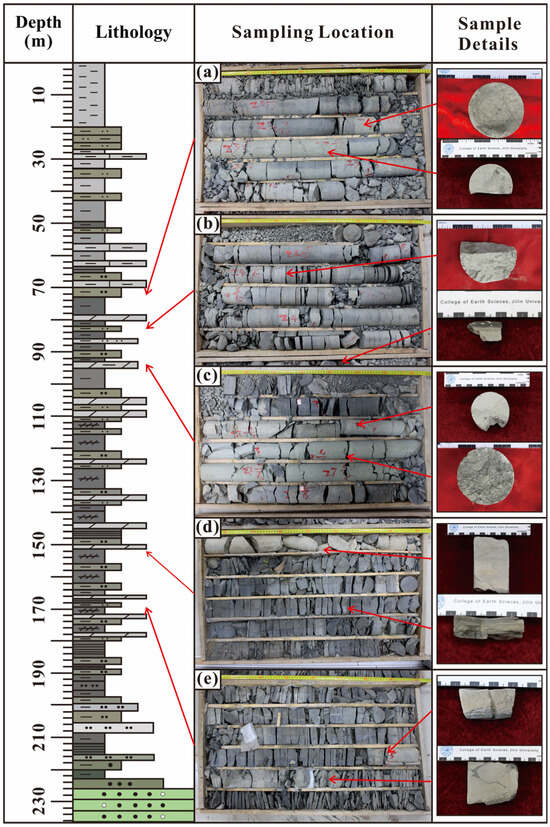
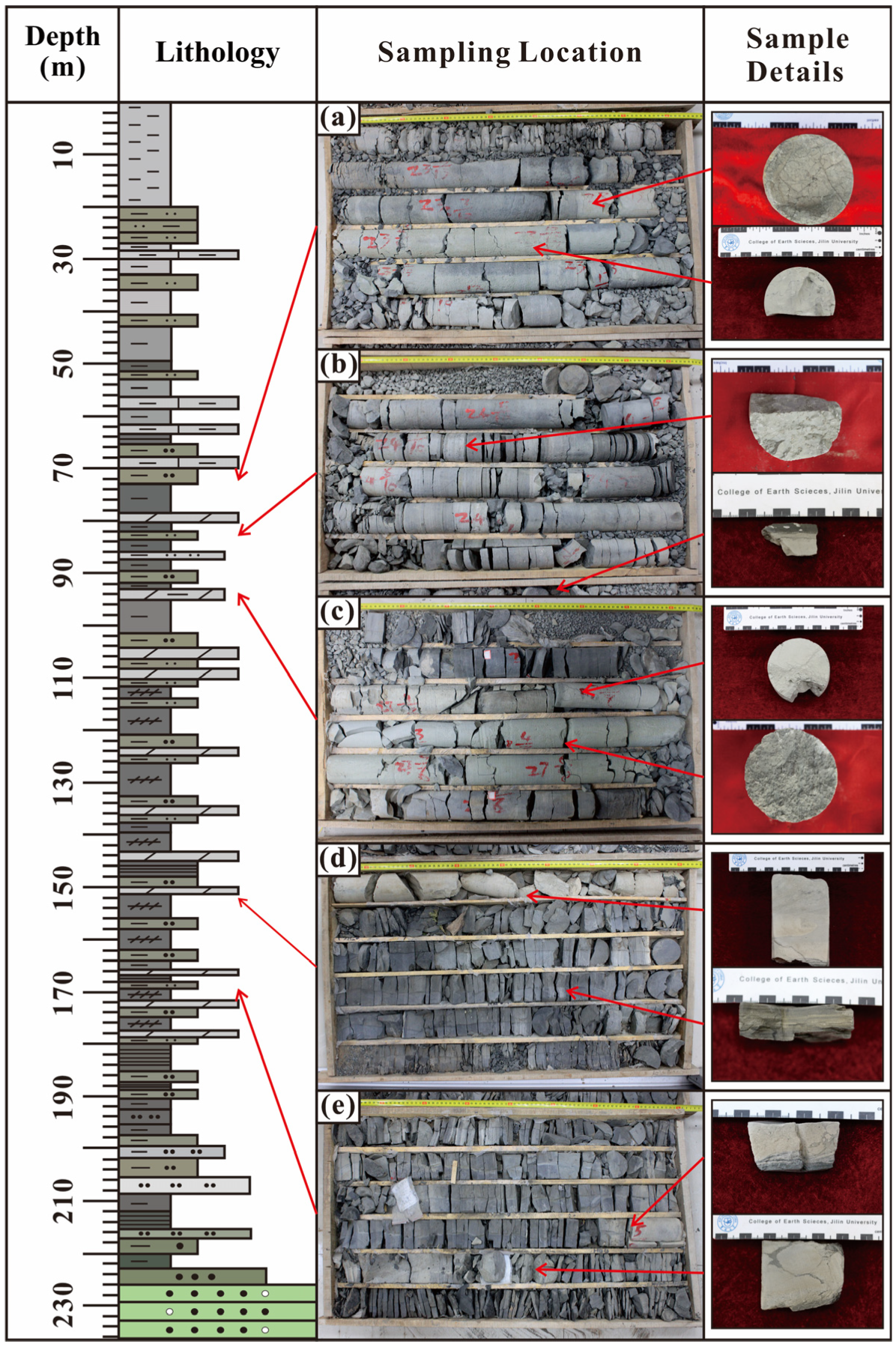
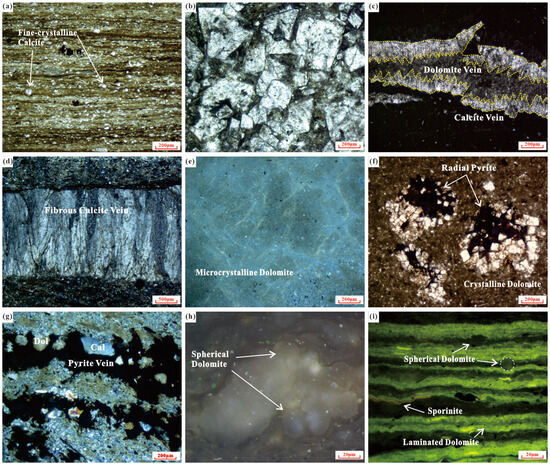
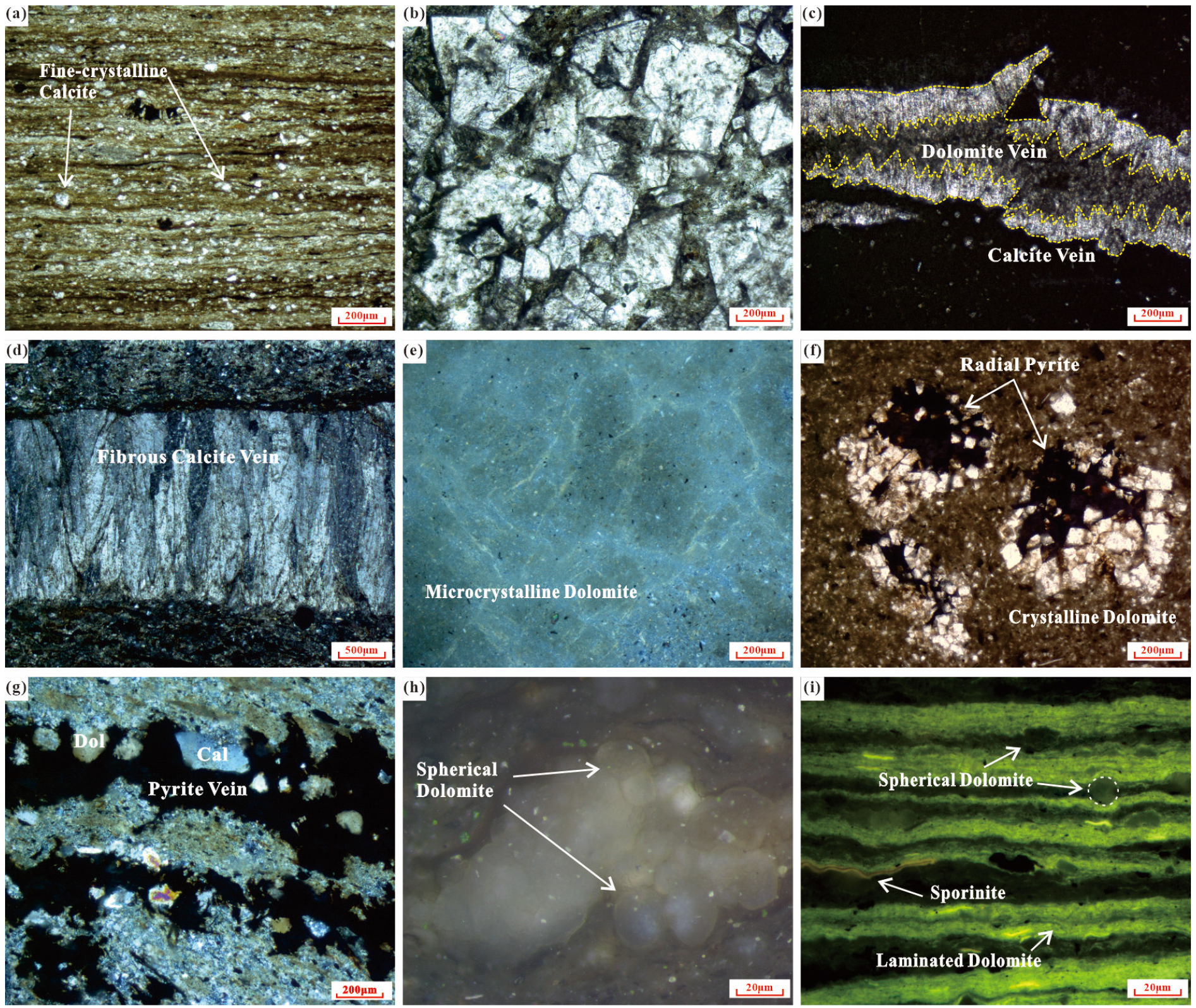
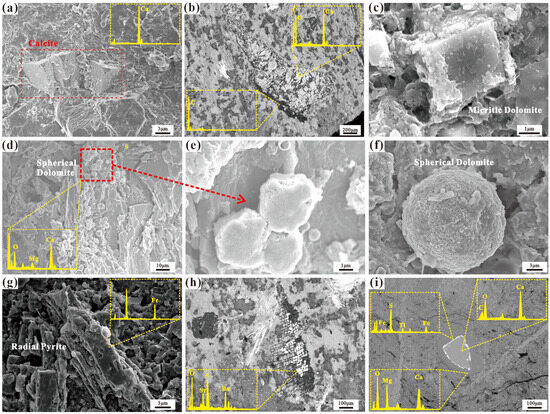
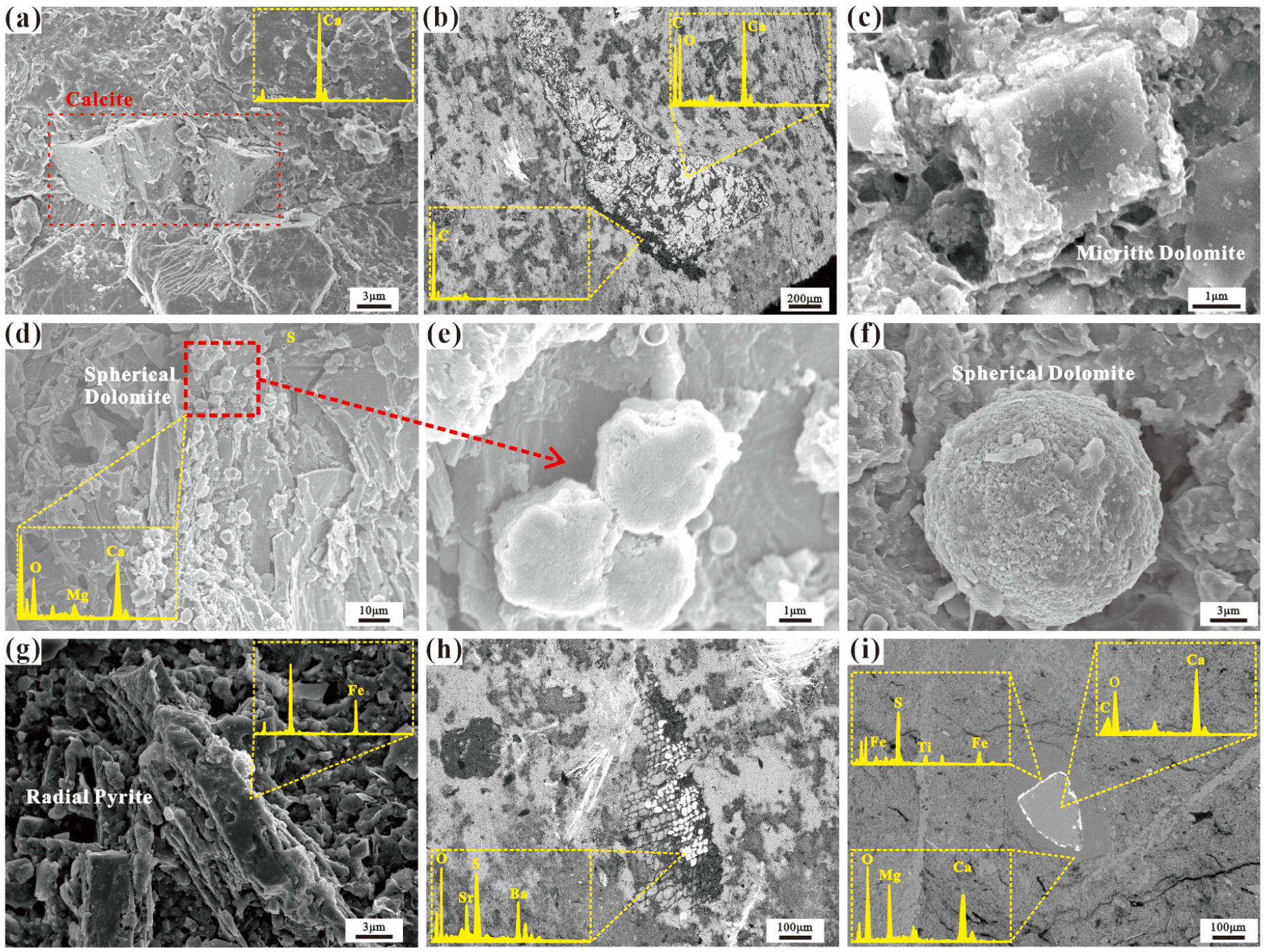
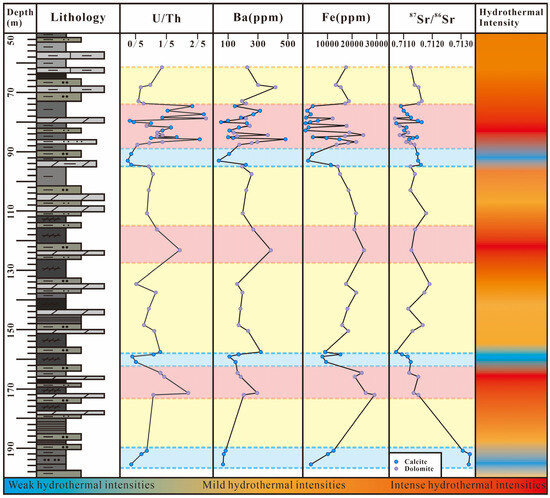
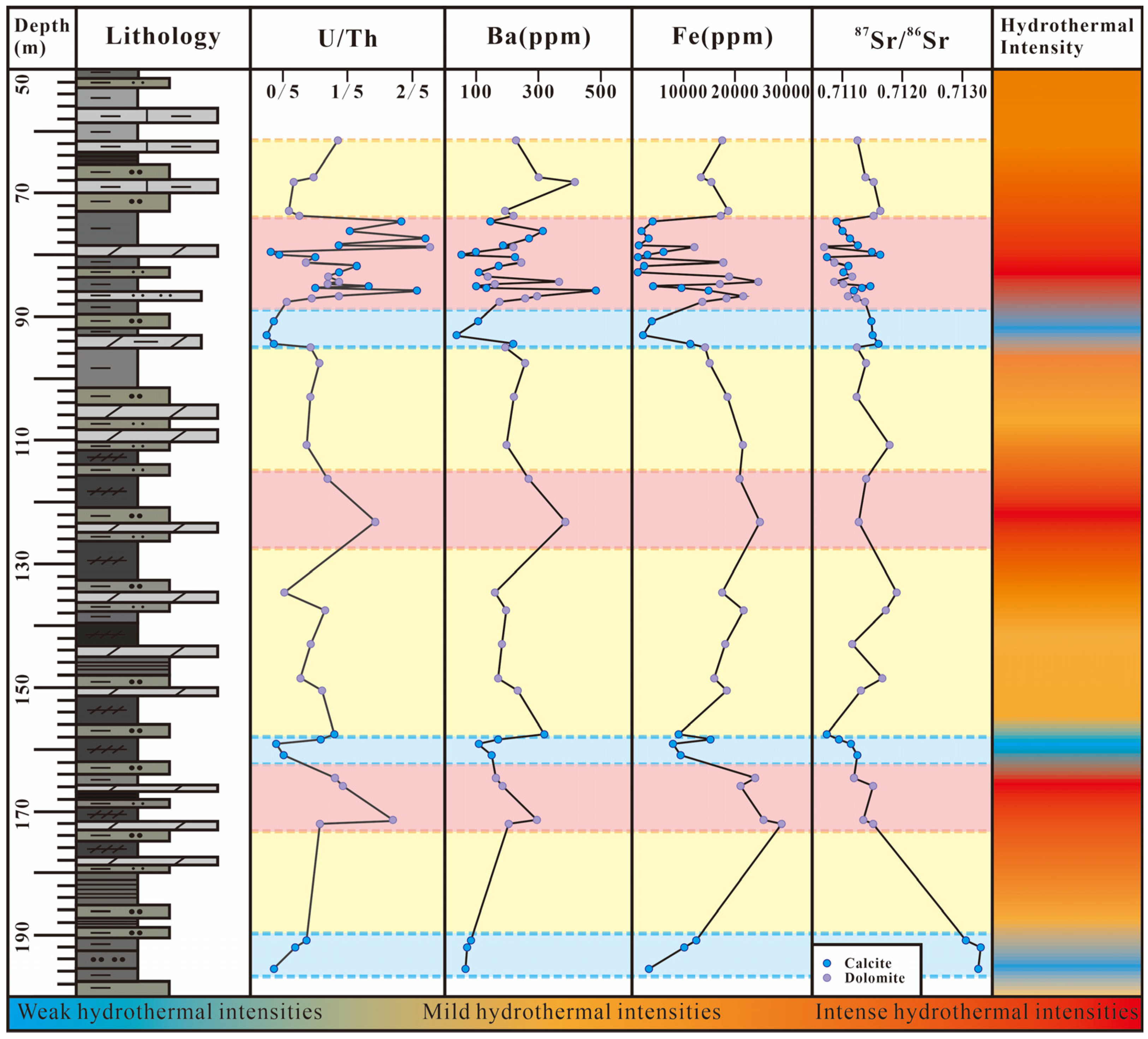
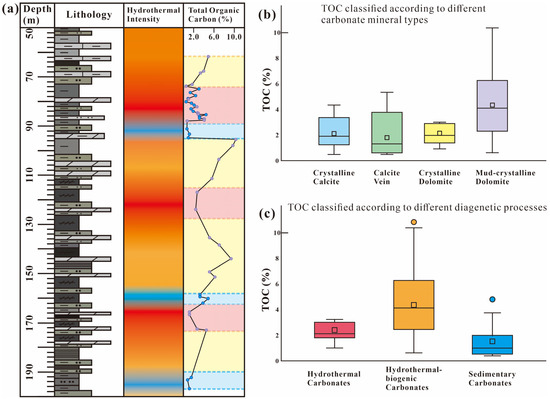
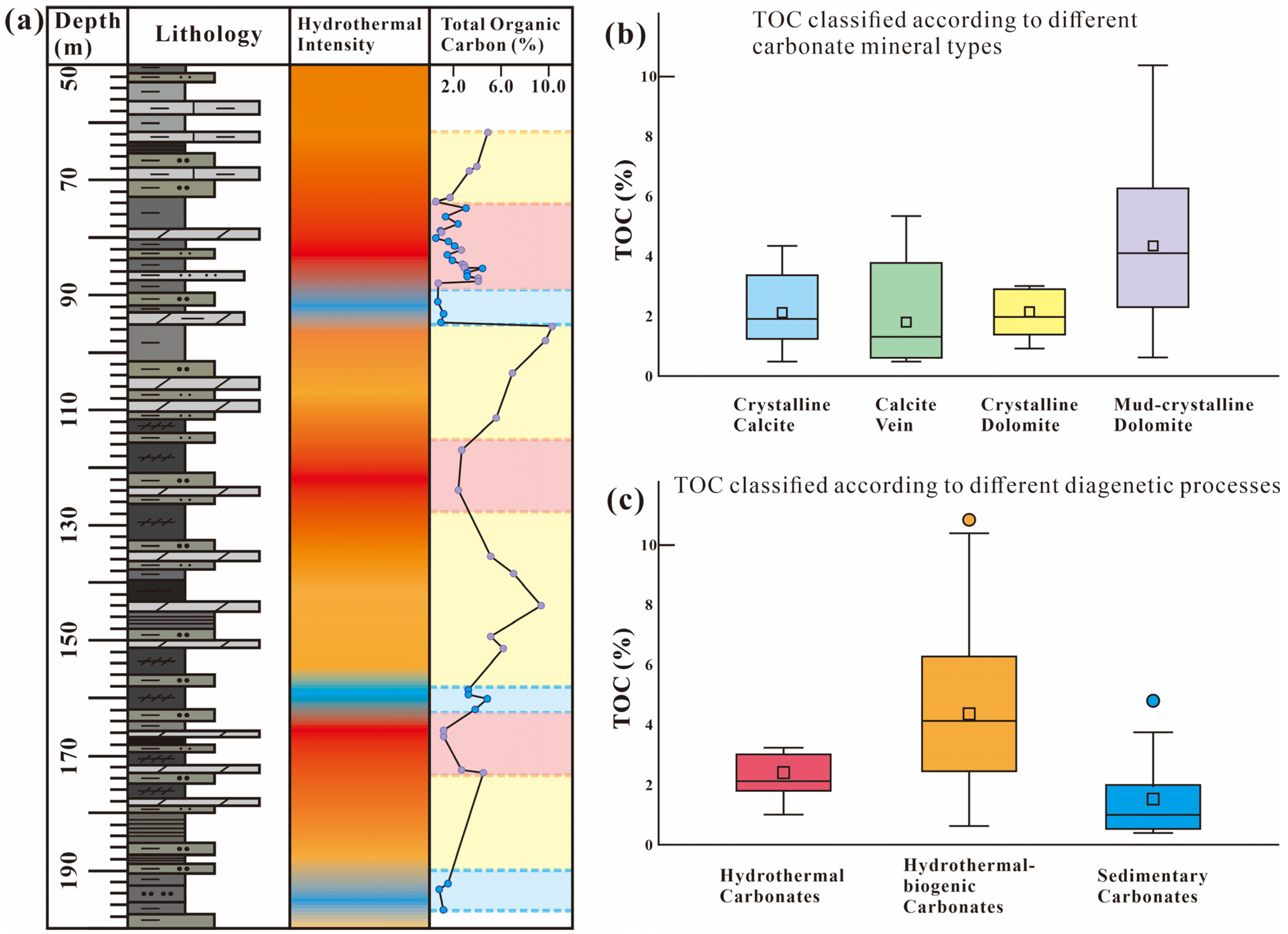
Disclaimer/Publisher’s Note: The statements, opinions and data contained in all publications are solely those of the individual author(s) and contributor(s) and not of MDPI and/or the editor(s). MDPI and/or the editor(s) disclaim responsibility for any injury to people or property resulting from any ideas, methods, instructions or products referred to in the content. |
© 2026 by the authors. Licensee MDPI, Basel, Switzerland. This article is an open access article distributed under the terms and conditions of the Creative Commons Attribution (CC BY) license.