Geochronology, Geochemistry, and Geological Implications of the Baiyingaolao Formation Volcanic Rocks in the Tulihe Area, Northern Great Xing’an Range, NE China

 , ,
, ,
Abstract
1. Introduction
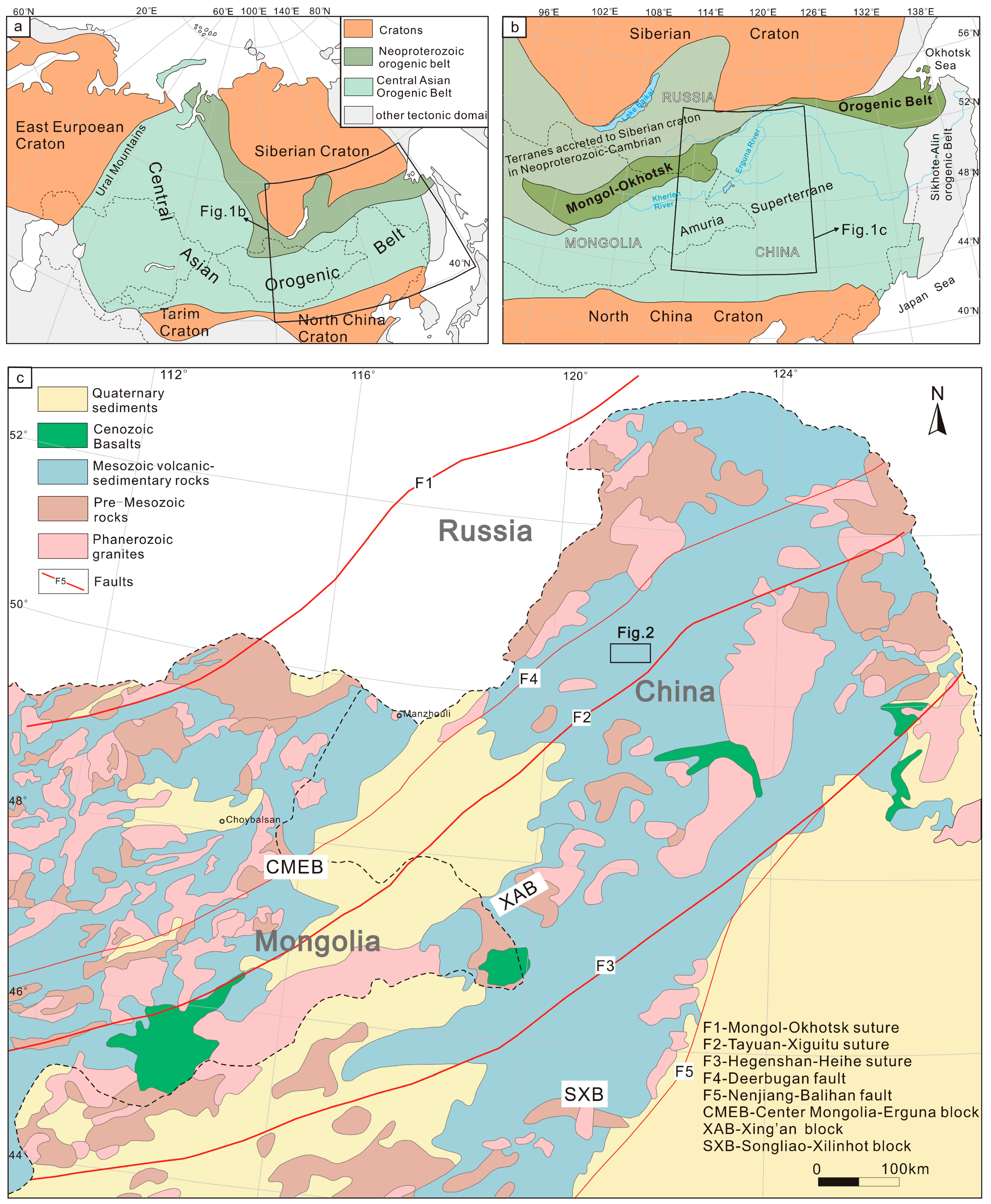
2. Geological Setting and Petrographic Characteristics of Volcanic Rocks
3. Analytical Methods
3.1. Petrographic Observations
3.2. LA-ICP-MS Zircon U–Pb Dating
3.3. Major, Trace, and Rare Earth Element (REE) Analyses
4. Results
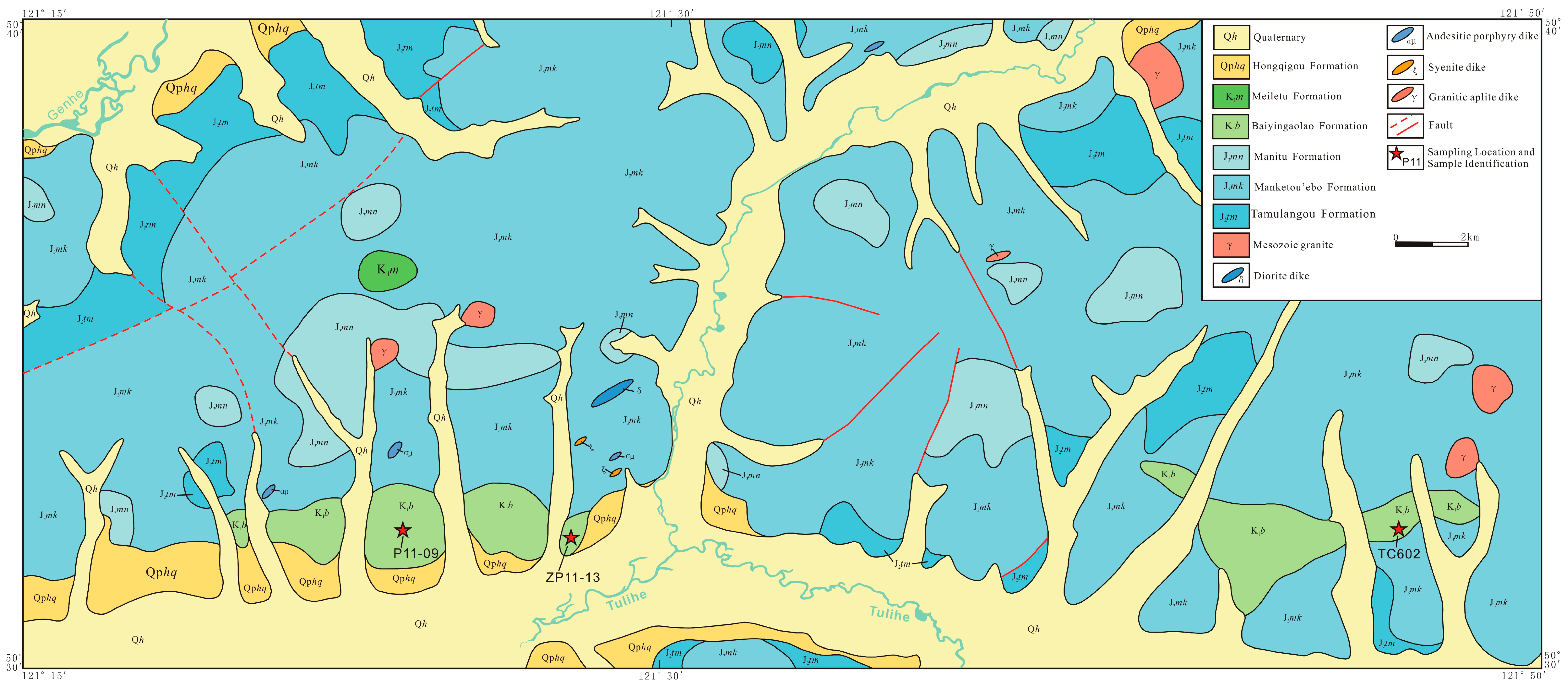
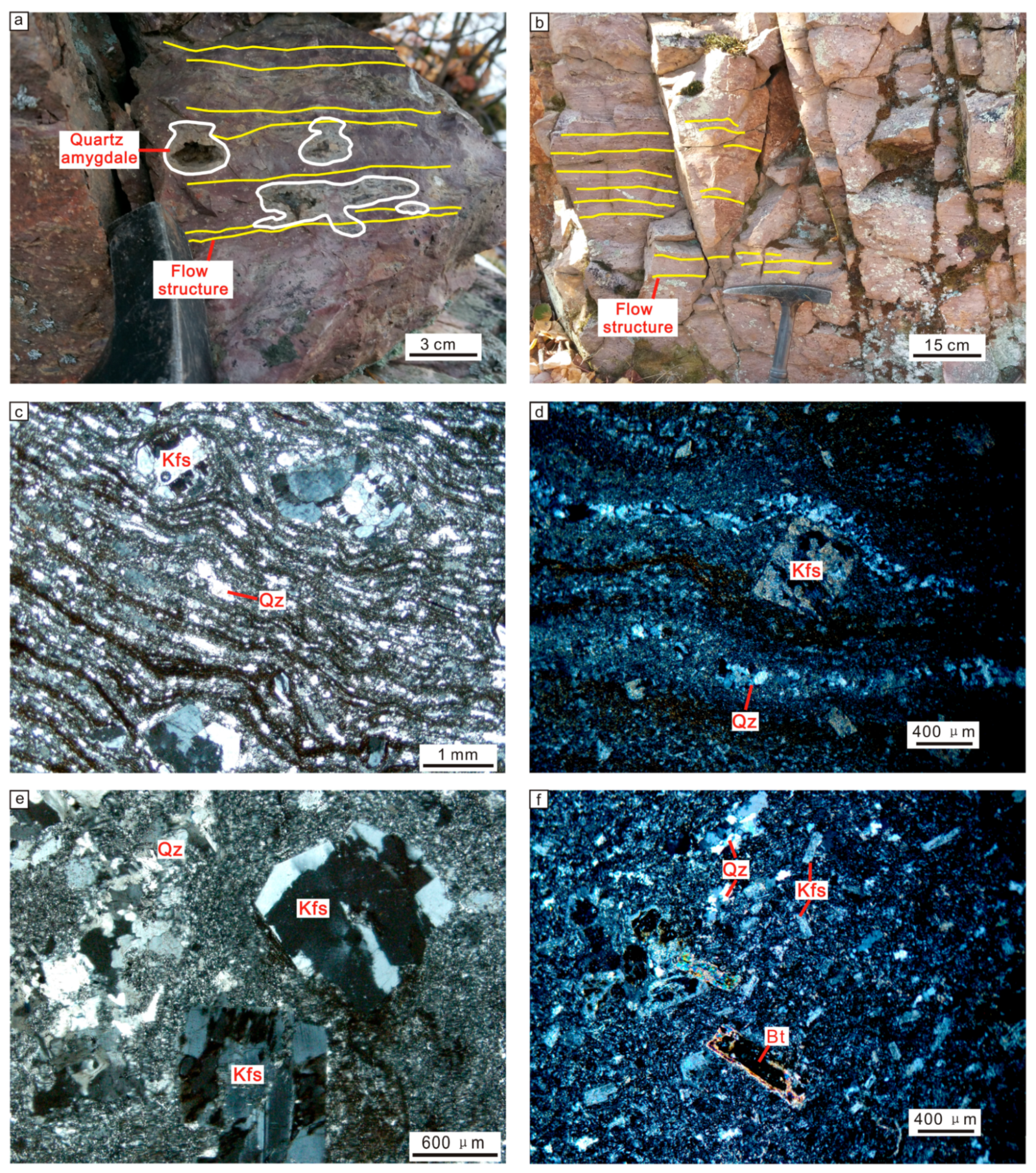
4.1. E–W-Trending Rhyolite Belt and Petrographic Characteristics in the Tulihe Area
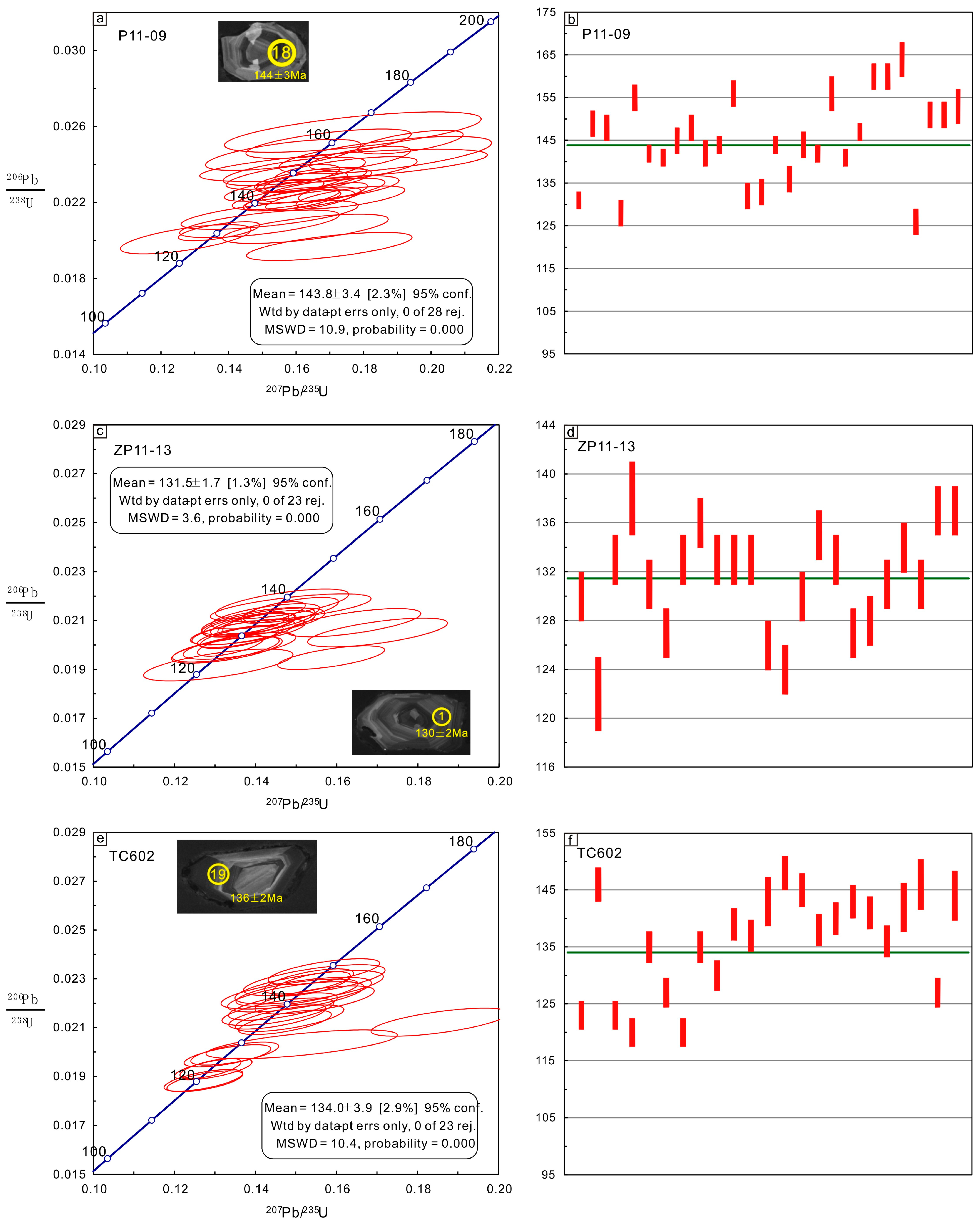
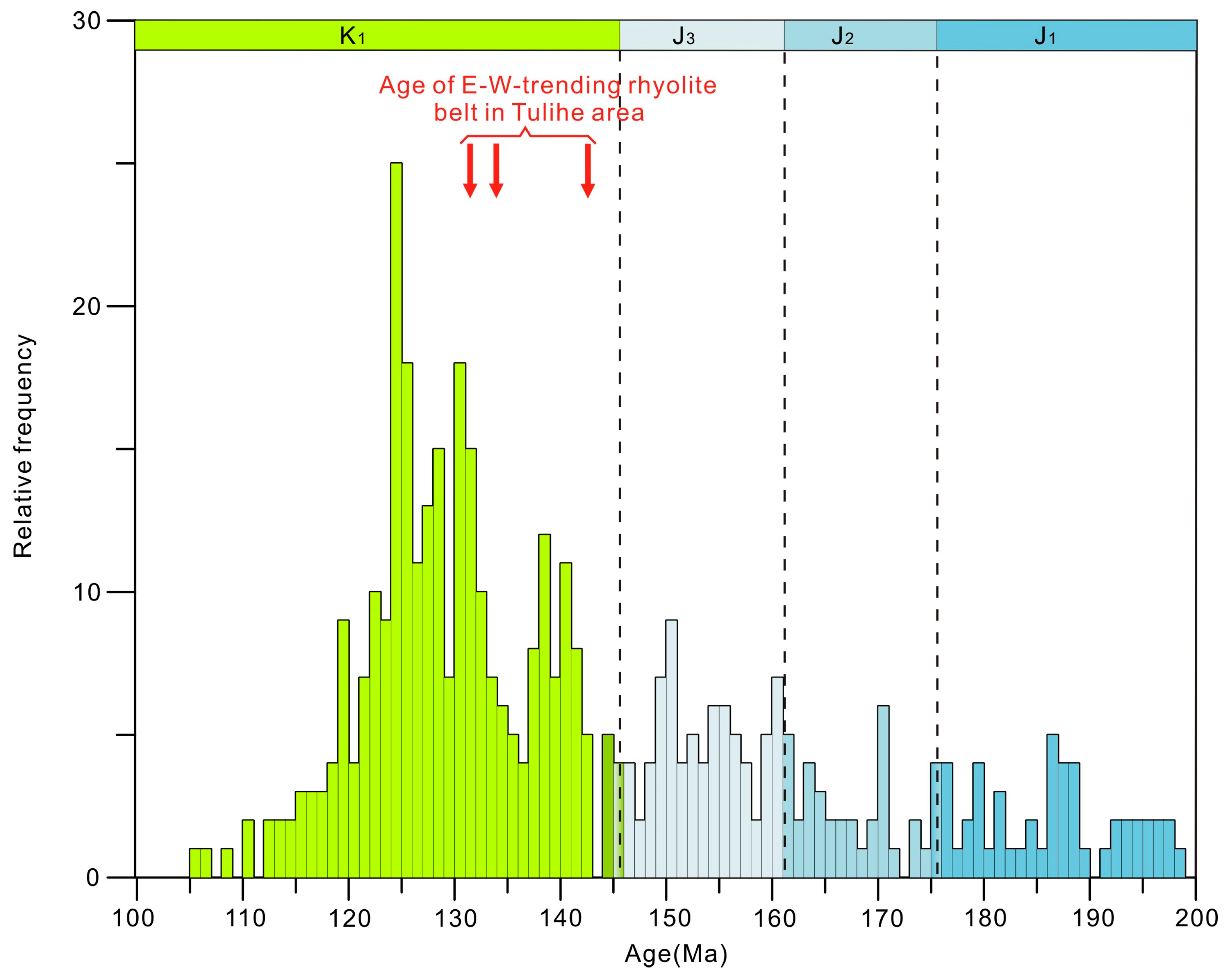
4.2. Zircon U–Pb Ages
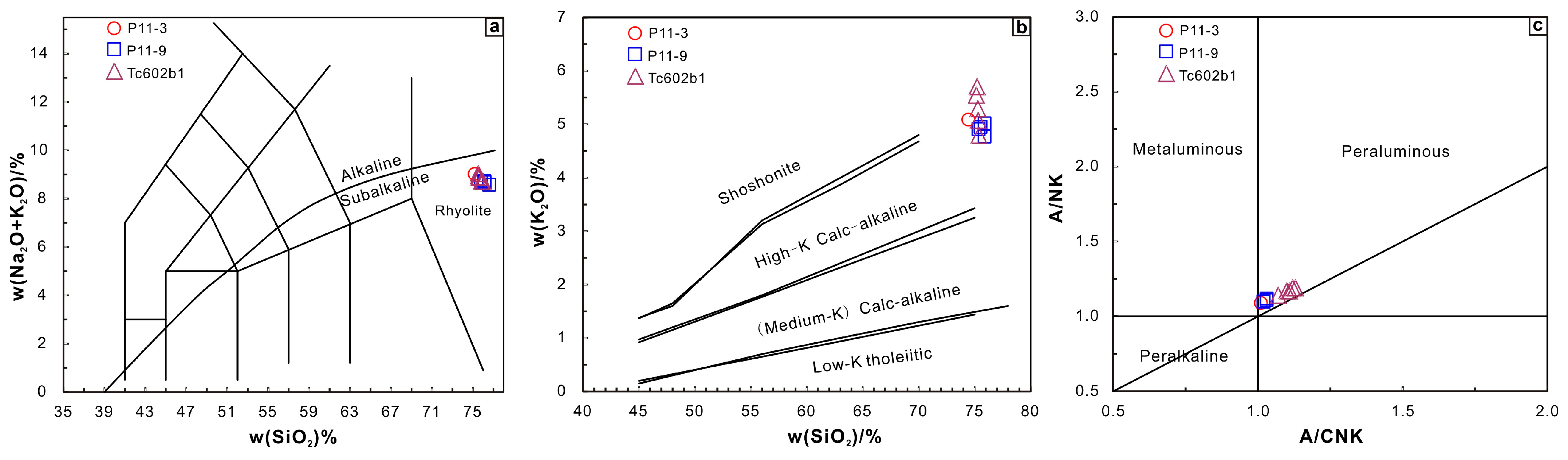
4.3. Major, Trace, and Rare Earth Element Analyses
4.3.1. Major Elemental Analyses
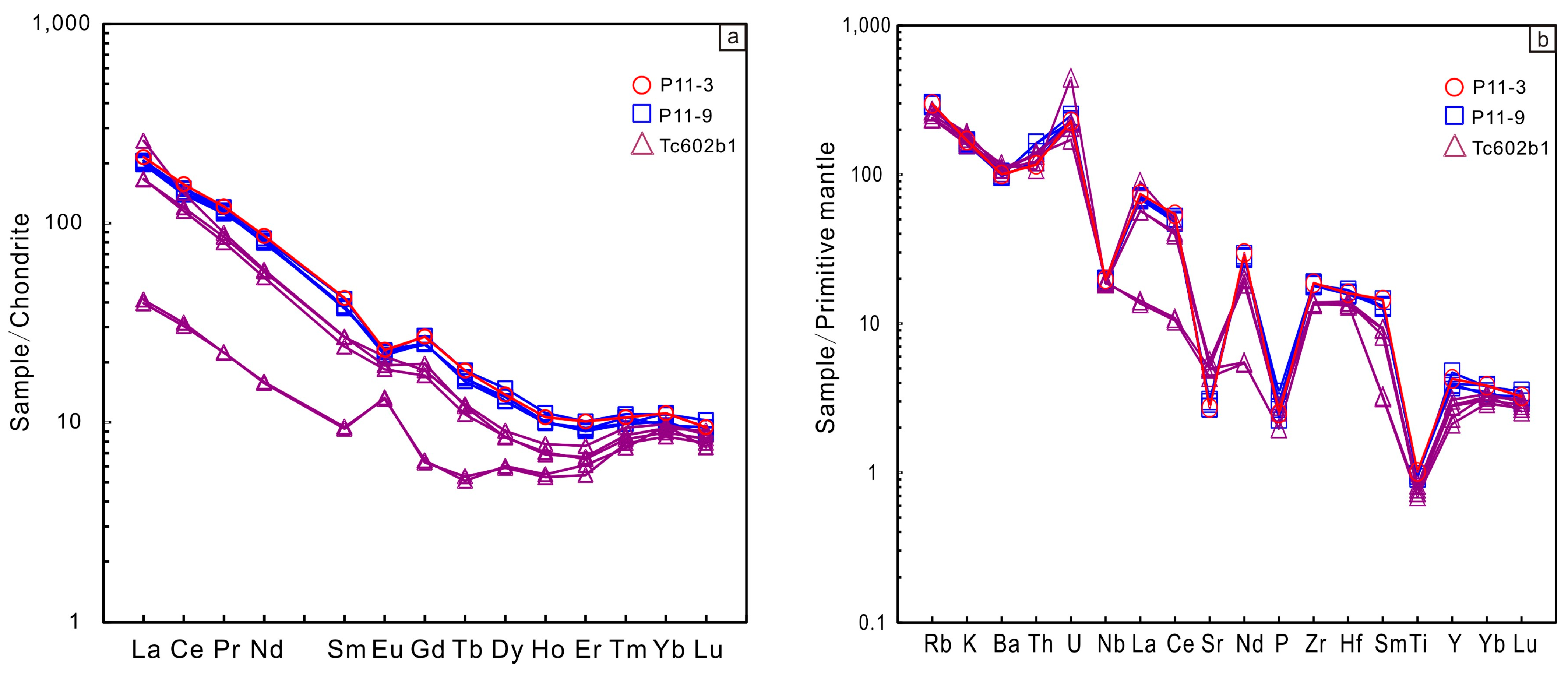
4.3.2. Trace and Rare Earth Elemental Analyses
5. Discussion
5.1. Formation Age and Stratigraphic Affiliation
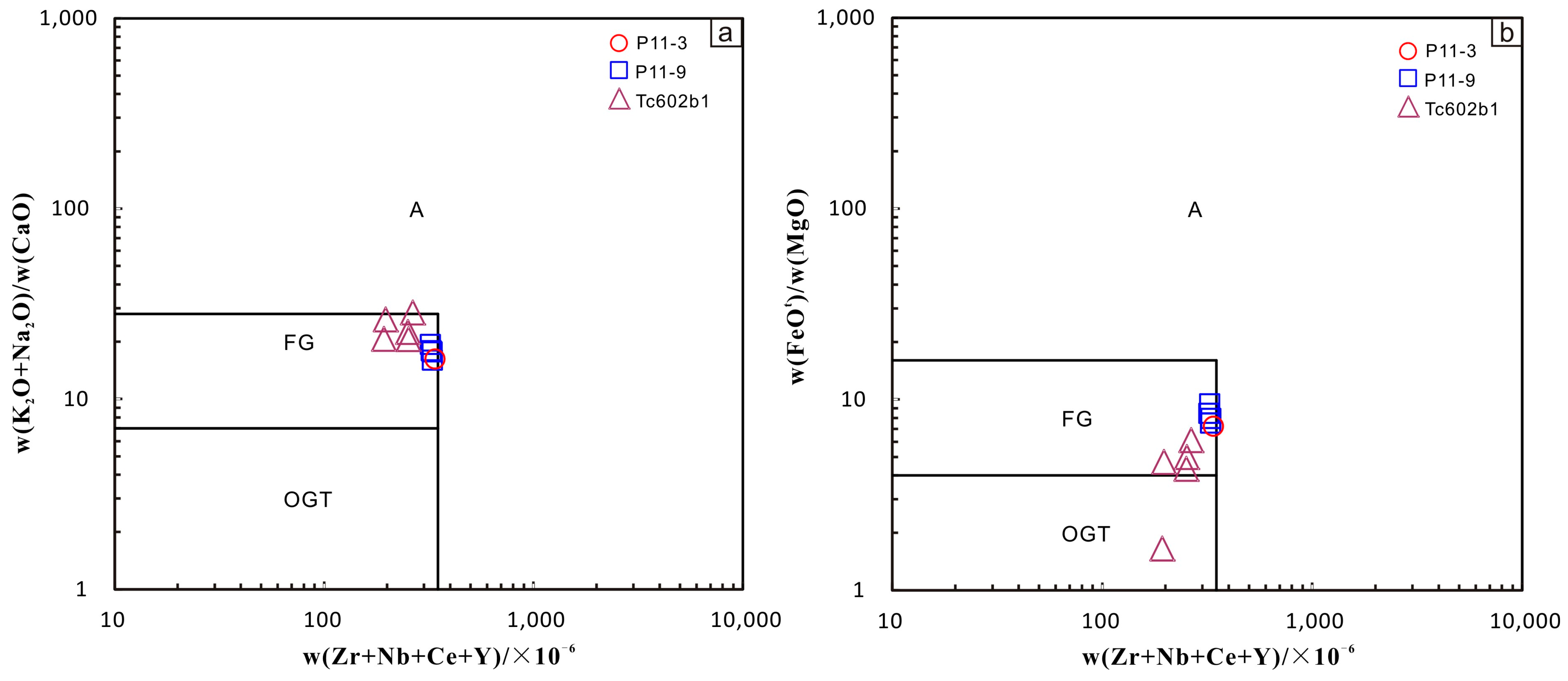
5.2. Petrogenesis
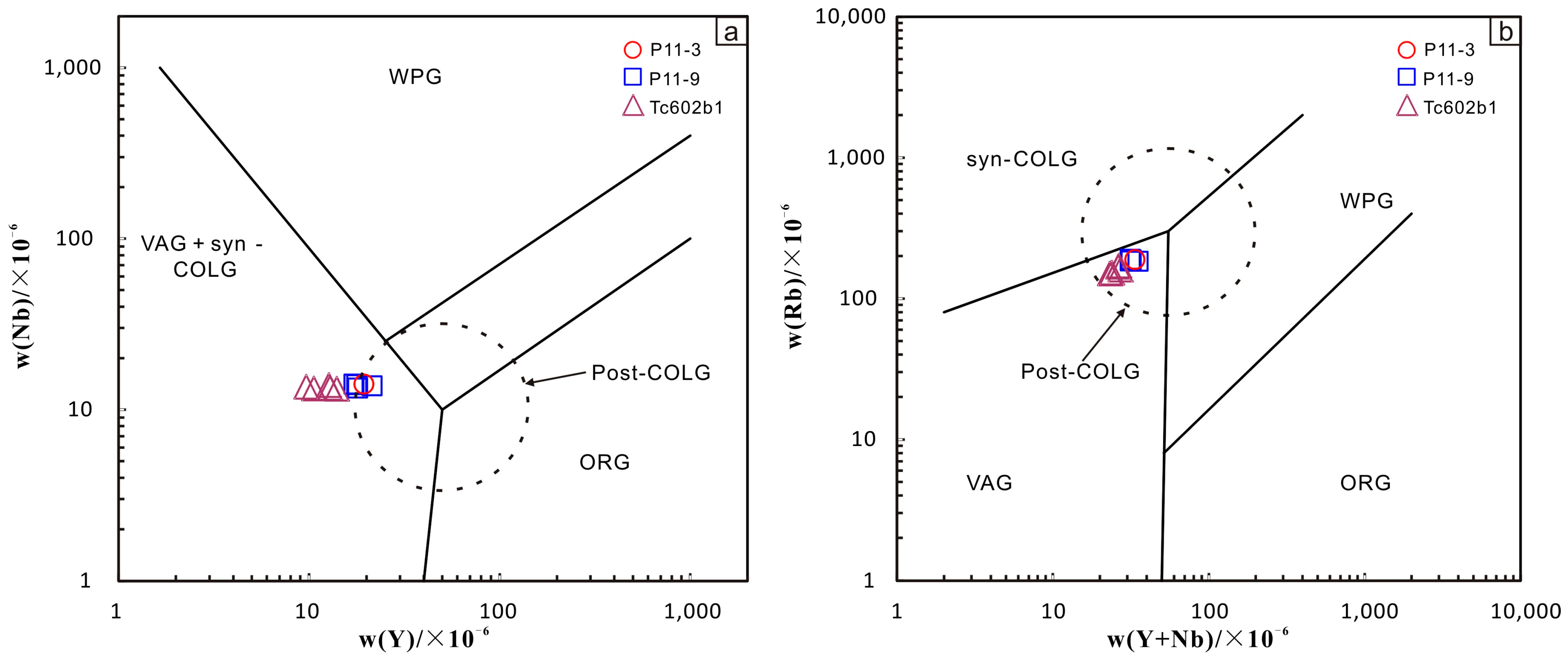
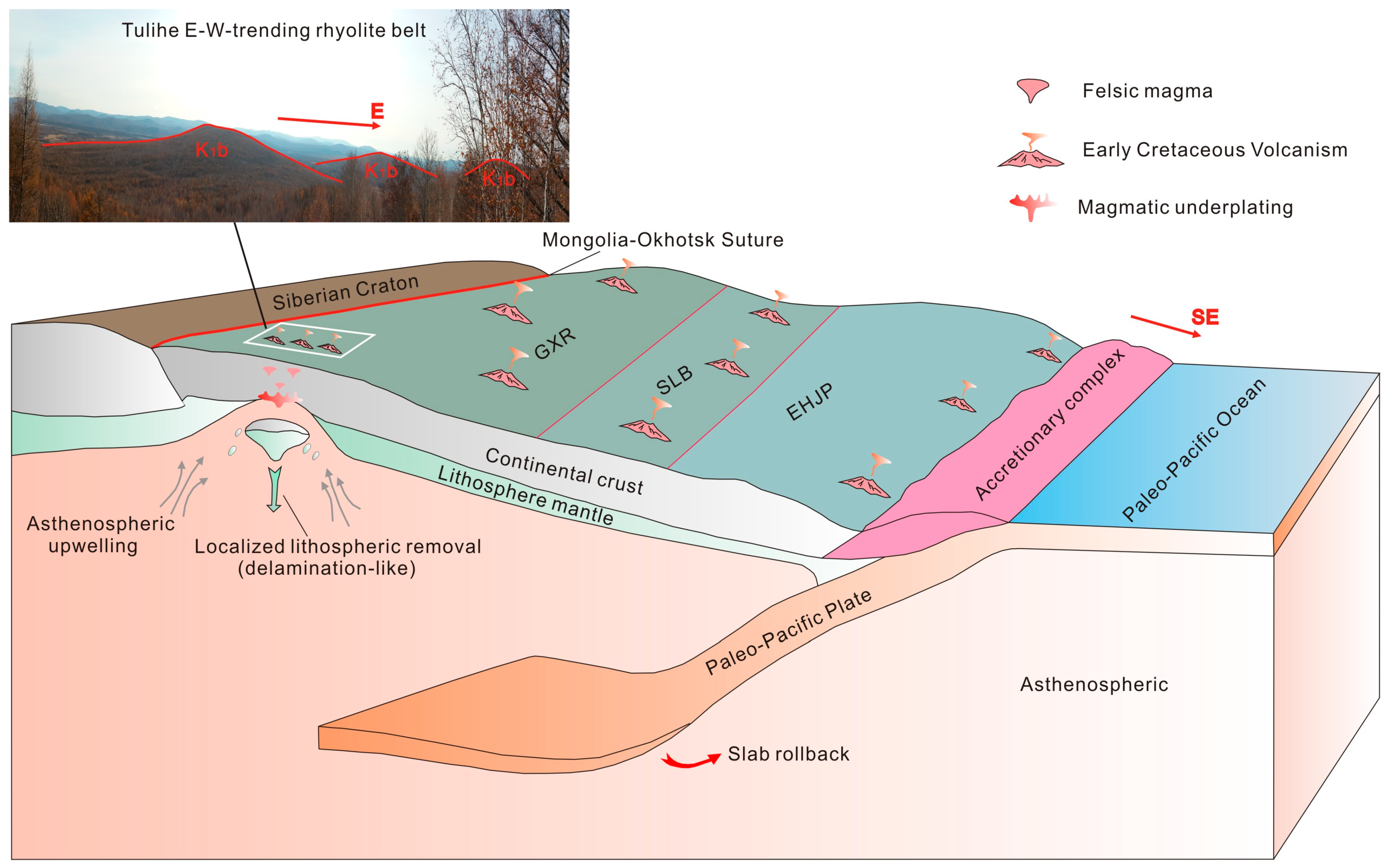
5.3. Tectonic Setting
6. Conclusions
- The newly identified E–W-trending rhyolite belt in the Tulihe area represents a previously unrecognized structural feature and was formed during the Early Cretaceous (131.5–143.8 Ma). The geochemical data indicate that these rhyolites are highly evolved, fractionated I-type volcanic rocks, providing new constraints on the petrogenesis of Mesozoic volcanism in the northern Great Xing’an Range.
- The rhyolites were predominantly generated by the partial melting of juvenile, medium- to high-K lower crust, accompanied by minor assimilation of older crustal materials and subordinate lithospheric mantle input, consistent with geochemical signatures observed in major, trace, and rare earth elements.
- Early Cretaceous magmatism in the northern Great Xing’an Range was mainly controlled by flat subduction of the Paleo-Pacific (Izanagi) plate and subsequent slab rollback. The formation of the E–W-trending rhyolite belt was localized by pre-existing fault systems, representing a secondary tectono-magmatic response within the regional extensional regime, which is compatible with the dominant NE-trending volcanic belts at a broader scale.
Author Contributions
Funding
Data Availability Statement
Acknowledgments
Conflicts of Interest
References
- Zheng, J.P.; Sun, M.; Zhao, G.C.; Robinson, P.T.; Wang, F.Z. Elemental and Sr–Nd–Pb isotopic geochemistry of Late Paleozoic volcanic rocks beneath the Junggar Basin, NW China: Implications for the formation and evolution of the basin basement. J. Asian Earth Sci. 2007, 29, 778–794. [Google Scholar] [CrossRef]
- Wang, Y.J.; Yuan, C.; Long, X.P.; Sun, M.; Xiao, W.J.; Zhao, G.C.; Cai, K.D.; Jiang, Y.D. Geochemistry, zircon U–Pb ages and Hf isotopes of the Paleozoic volcanic rocks in the northwestern Chinese Altai: Petrogenesis and tectonic implications. J. Asian Earth Sci. 2011, 42, 969–985. [Google Scholar] [CrossRef]
- Wang, F.; Zhou, X.H.; Zhang, L.C.; Ying, J.F.; Zhang, Y.T.; Wu, F.Y.; Zhu, R.X. Late Mesozoic volcanism in the Great Xing’an Range (NE China): Timing and implications for the dynamic setting of NE Asia. Earth Planet. Sci. Lett. 2006, 251, 179–198. [Google Scholar] [CrossRef]
- Zhang, J.H.; Ge, W.C.; Wu, F.Y.; Wilde, S.A.; Yang, J.H.; Liu, X.M. Large—Scale Early Cretaceous volcanic events in the northern Great Xing’an Range, Northeastern China. Lithos 2008, 102, 138–157. [Google Scholar] [CrossRef]
- Zhang, J.H.; Gao, S.; Ge, W.C.; Wu, F.Y.; Yan, J.H.; Wilde, S.A.; Li, M. Geochronology of the Mesozoic volcanic rocks in the Great Xing’an Range, Northeastern China: Implications for subduction—Induced delamination. Chem. Geol. 2010, 276, 144–165. [Google Scholar] [CrossRef]
- Wu, F.Y.; Sun, D.Y.; Ge, W.C.; Zhang, Y.B.; Grant, M.L.; Wilde, S.A.; Jahn, B.M. Geochronology of the Phanerozoic granitoids in Northeastern China. J. Asian Earth Sci. 2011, 41, 1–30. [Google Scholar] [CrossRef]
- Meng, E.; Xu, W.L.; Yang, D.B.; Qiu, K.F.; Li, C.H.; Zhu, H.T. Zircon U–Pb chronology and geochemistry of Mesozoic volcanic rocks from the Lingquan Basin in Manzhouli area, and its tectonic implications. Acta Petrol. Sin. 2011, 27, 1209–1226, (In Chinese with English Abstract). [Google Scholar]
- Xu, W.L.; Wang, F.; Pei, F.P.; Meng, E.; Tang, J.; Xu, M.J.; Wang, W. Mesozoic tectonic regimes and regional ore—Forming background in NE China: Constraints from spatial and temporal variations of Mesozoic volcanic rock associations. Acta Petrol. Sin. 2013, 29, 339–353, (In Chinese with English Abstract). [Google Scholar]
- Han, S.J.; Wang, X.; Wang, X.; Zhang, Y.; Yang, H.; Zhao, G.C.; Dong, Y.; Zhang, Y.L. Geochronology and geochemistry of late Jurassic–Early Cretaceous volcanic rocks in the southern Great Xing’an Range, NE China: Constraints for late Mesozoic tectono—Magmatic evolution. Int. Geol. Rev. 2021, 63, 1366–1388. [Google Scholar] [CrossRef]
- Pan, B.B.; Huang, H.; Zhang, Z.C. The incomplete crystal–melt separation of volcanic–plutonic complex in the southern Great Xing’an Range, NE China. Chem. Geol. 2025, 696, 123096. [Google Scholar] [CrossRef]
- Jahn, B.M.; Wu, F.Y.; Chen, B. Granitoids of the Central Asian Orogenic Belt and continental growth in the Phanerozoic. Earth Environ. Sci. Trans. R. Soc. 2000, 91, 181–193. [Google Scholar] [CrossRef]
- Bussien, D.; Gombojav, N.; Winkler, W.; Quadt, A. The Mongol—Okhotsk Belt in Mongolia—An appraisal of the geodynamic development by the study of sandstone provenance and detrital zircons. Tectonophysics 2011, 510, 132–150. [Google Scholar] [CrossRef]
- Wu, T.T.; Xue, C.J.; Zhou, Y.H.; Chai, L.; Wang, Q.S.; Bao, Q.Z. Genesis of the Ulaan silver–lead–zinc deposit in Northeast Mongolia: Constraints from S and Pb isotopes, together with U–Pb and Rb–Sr geochronology. Ore Geol. Rev. 2024, 173, 106262. [Google Scholar] [CrossRef]
- Jahn, B.M.; Wu, F.Y.; Chen, B. Massive granitoid generation in Central Asia: Nd isotope evidence and implication for continental growth in the Phanerozoic. Episodes 2000, 23, 82–92. [Google Scholar] [CrossRef]
- Li, J.Y. Permian geodynamic setting of Northeast China and adjacent regions: Closure of the Paleo—Asian Ocean and subduction of the Paleo—Pacific Plate. J. Asian Earth Sci. 2006, 26, 207–224. [Google Scholar] [CrossRef]
- Sengör, A.M.C.; Natal’in, B.A.; Burtman, V.S. Evolution of the Altaid tectonic collage and Paleozoic crustal growth in Eurasia. Nature 1993, 364, 299–307. [Google Scholar] [CrossRef]
- Xiao, W.J.; Windley, B.F.; Hao, J.; Zhai, M.G. Accretion leading to collision and the Permian Solonker suture, Inner Mongolia, China: Termination of the Central Asian Orogenic Belt. Tectonics 2003, 22, 1069. [Google Scholar] [CrossRef]
- Zhao, P.; Jia, Z.H.; Xu, B.; Xu, Y.; Sukhbaatar, T.; Appel, E.; Chen, Y. Late Triassic initial closure of the Mongol—Okhotsk Ocean in the western segment: Constraints from sedimentological, detrital zircon ages and paleomagnetic evidence. Gondwana Res. 2024, 125, 110–129. [Google Scholar] [CrossRef]
- Zhao, X.X.; Coe, R.S.; Zhou, Y.X.; Wu, H.R.; Wang, J. New paleomagnetic results from northern China: Collision and suturing with Siberia and Kazakhstan. Tectonophysics 1990, 181, 43–81. [Google Scholar] [CrossRef]
- Wu, F.Y.; Ye, M.; Zhang, S.H. The geodynamic model of the Manzhouli–Suifenhe geoscience transect. J. Earth Sci. 1995, 20, 535–539, (In Chinese with English Abstract). [Google Scholar]
- Wu, F.Y.; Sun, D.Y.; Li, H.M. Zircon U–Pb ages for the basement rocks of the Songliao Basin. Chin. Sci. Bull. 2000, 45, 656–660, (In Chinese with English Abstract). [Google Scholar]
- Wu, F.Y.; Sun, D.Y.; Li, H.M.; Wang, X.L. The nature of basement beneath the Songliao Basin in NE China: Geochemical and isotopic constraints. Phys. Chem. Earth A 2001, 26, 793–803. [Google Scholar] [CrossRef]
- Wu, F.Y.; Lin, J.Q.; Wilde, S.A.; Zhang, X.O.; Yang, J.H. Nature and significance of the Early Cretaceous giant igneous event in Eastern China. Earth Planet. Sci. Lett. 2005, 233, 103–119. [Google Scholar] [CrossRef]
- Zhou, J.B.; Wilde, S.A.; Zhang, X.Z.; Zhao, G.C.; Zheng, C.Q.; Wang, Y.J.; Zhang, X.H. The onset of Pacific margin accretion in NE China: Evidence from the Heilongjiang high-pressure metamorphic belt. Tectonophysics 2009, 478, 230–246. [Google Scholar] [CrossRef]
- Zhou, J.B.; Wilde, S.A.; Zhao, G.C.; Zhang, X.Z.; Zheng, C.Q.; Wang, H. Pan-African metamorphic and magmatic rocks of the Khanka Massif, NE China: Further evidence regarding their affinity. Geol. Mag. 2010, 147, 737–749. [Google Scholar] [CrossRef]
- Zhou, J.B.; Wilde, S.A.; Zhao, G.C.; Zhang, X.Z.; Zheng, C.Q.; Wang, H.; Zeng, W.S. An intriguing dilemma: Was the easternmost segment of the Central Asian orogenic belt derived from Gondwana? J. Geodyn. 2010, 50, 300–317. [Google Scholar] [CrossRef]
- Zhou, J.B.; Wilde, S.A.; Zhao, G.C.; Zhang, X.Z.; Zheng, C.Q.; Wang, H. New SHRIMP U–Pb zircon ages from the Heilongjiang high-pressure belt: Constraints on the Mesozoic evolution of NE China. Am. J. Sci. 2010, 310, 1024–1053. [Google Scholar] [CrossRef]
- Zhou, J.B.; Wilde, S.A.; Zhang, X.Z.; Zhao, G.C.; Liu, F.L.; Qiao, D.W.; Ren, S.M.; Liu, J.H. A N1300 km late Pan-African metamorphic belt in NE China: New evidence from the Xing’an block and its tectonic implications. Tectonophysics 2011, 509, 280–292. [Google Scholar] [CrossRef]
- Yang, H.; Ge, W.C.; Zhao, G.C.; Yu, J.J.; Zhang, Y.L. Petrogenesis and tectonic implications of Early Permian–Late Triassic granitic magmatism in the Jiamusi–Khanka Massif, eastern segment of the Central Asian Orogenic Belt (CAOB): Geochronological, geochemical and Hf isotopic evidence. Gondwana Res. 2014, 27, 1509–1533. [Google Scholar] [CrossRef]
- IMBGMR (Inner Mongolian Bureau of Geology and Mineral Resources). Regional Geology of Inner Mongolian Autonomous Region; Geological Publishing House: Beijing, China, 1991; pp. 1–726. (In Chinese) [Google Scholar]
- HBGMR (Heilongjiang Bureau of Geology and Mineral Resources). Regional Geology of Heilongjiang Province; Geological Publishing House: Beijing, China, 1993; pp. 347–418. (In Chinese) [Google Scholar]
- Badarch, G.; Cunningham, W.D.; Windley, B.F. A new terrane subdivision for Mongolia: Implications for the Phanerozoic crustal growth of Central Asia. J. Asian Earth Sci. 2002, 21, 87–110. [Google Scholar] [CrossRef]
- Li, J.J.; Tang, W.L.; Fu, C.; Chen, Z.; Orolmaa, D.; Oyuntuya, N.; Delgersaikhan, A.; Enkhbat, T.; Dang, Z.C.; Zhao, Z.L.; et al. The division of metallogenic belts in Sino-Mongolian border area. Geol. Bull. China 2016, 35, 461–487, (In Chinese with English Abstract). [Google Scholar]
- Gou, J.; Sun, D.Y.; Ren, Y.S.; Liu, Y.J.; Zhang, S.Y.; Fu, C.L.; Wang, T.H.; Wu, P.F.; Liu, X.M. Petrogenesis and geodynamic setting of Neoproterozoic and Late Paleozoic magmatism in the Manzhouli–Erguna area of Inner Mongolia, China: Geochronological, geochemical and Hf isotopic evidence. J. Asian Earth Sci. 2013, 67–68, 114–137. [Google Scholar] [CrossRef]
- Tang, J. Geochronology and Geochemistry of the Mesozoic Igneous Rocks in the Erguna Massif, NE China: Constraints on the Tectonic Evolution of the Mongol-Okhotsk Suture Zone. Ph.D. Thesis, Jilin University, Changchun, China, 2016; pp. 1–189, (In Chinese with English Abstract). [Google Scholar]
- Liu, K.; Wu, T.T.; Liu, J.L.; Bao, Q.Z.; Du, S.Y. Geochronology and geochemistry of volcanic rocks in Manketou’ebo Formation of Tulihe area, northern Da Hinggan Mountains. Geol. China 2018, 45, 367–376, (In Chinese with English Abstract). [Google Scholar] [CrossRef]
- Wu, T.T.; Zhou, Y.H.; Chen, C.; Liu, K.; Bao, Q.Z.; Wu, D.T.; Chai, L. Geochronology and geochemistry of the Early Cretaceous basalt in the Genhe area, northern Great Xing’an Range and geological implications. Geol. Explor. 2018, 54, 1270–1281, (In Chinese with English Abstract). [Google Scholar]
- Sláma, J.; Košler, J.; Condon, D.J.; Crowley, J.L.; Gerdes, A.; Hanchar, J.M.; Horstwood, M.S.A.; Morris, G.A.; Nasdala, L.; Norberg, N.; et al. Plesovice zircon—A new natural reference material for U–Pb and Hf isotopic microanalysis. Chem. Geol. 2008, 249, 1–35. [Google Scholar] [CrossRef]
- Black, L.P.; Kamo, S.L.; Allen, C.M.; Aleinikoff, J.N.; Davis, D.W.; Korsch, R.J.; Foudoulis, C. TEMORA 1: A new zircon standard for Phanerozoic U–Pb geochronology. Chem. Geol. 2003, 200, 155–170. [Google Scholar] [CrossRef]
- van Achterbergh, E.; Ryan, C.G.; Griffin, W.L. GLITTER: On-line Interactive Data Reduction for the Laser Ablation ICP-MS Microprobe. In Proceedings of the 9th Annual V. M. Goldschmidt Conference, Cambridge, MA, USA, 22–27 August 1999; p. 305. [Google Scholar]
- Andersen, T. Correction of common lead in U–Pb analyses that do not report 204 Pb. Chem. Geol. 2002, 192, 59–79. [Google Scholar] [CrossRef]
- Ludwig, K.R. User’s Manual for Isoplot 3.00: A Geochronological Toolkit for Microsoft Excel; No. 4; Berkeley Geochronology Center Special Publication: Berkeley, CA, USA, 2003; 70p. [Google Scholar]
- Belousova, E.A.; Griffin, W.L.; O’Reilly, S.Y.; Fisher, N.I. Igneous zircon: Trace element composition as an indicator of source rock type. Contrib. Mineral. Petrol. 2002, 143, 602–622. [Google Scholar] [CrossRef]
- Le Maitre, R.W. (Ed.) A Classification of Igneous Rocks and Glossary of Terms; Blackwell: Oxford, UK, 1989; 193p. [Google Scholar]
- Peccerillo, A.; Taylor, D.R. Geochemistry of Eocene calc-alkaline volcanic rocks from the Kastamonu Area, Northern Turkey. Contrib. Mineral. Petrol. 1976, 58, 63–81. [Google Scholar] [CrossRef]
- Maniar, P.D.; Piccoli, P.M. Tectonic discrimination of granitoids. Geol. Soc. Am. Bull. 1989, 101, 635–643. [Google Scholar] [CrossRef]
- Taylor, S.R.; McLennan, S.M. The Continental Crust: Its Composition and Evolution; Blackwell: Oxford, UK, 1985; 312p. [Google Scholar]
- Boynton, W.V. Geochemistry of the rare earth elements: Meteorite studies. In Rare Earth Element Geochemistry; Henderson, P., Ed.; Elsevier: Amsterdam, The Netherlands, 1984; pp. 63–114. [Google Scholar]
- Zhang, J.H. Chronological Framework of Mesozoic Volcanic Rocks in the Great Xing’an Range. Master’s Thesis, Jilin University, Changchun, China, 2006. (In Chinese with English Abstract). [Google Scholar]
- Zhang, J.H. Geochronology and Geochemistry of Mesozoic Volcanic Rocks in the Great Xing’an Range. Ph.D. Thesis, China University of Geosciences, Beijing, China, 2009. (In Chinese with English Abstract). [Google Scholar]
- IMBGMR (Inner Mongolian Bureau of Geology and Mineral Resources). Stratigraphy of Rocks in Inner Mongolia Autonomous Region; China University of Geosciences Press: Beijing, China, 1996. (In Chinese) [Google Scholar]
- Shao, J.D.; Tan, Q.; Wang, H.; Zhang, M.; He, H.Y. Mesozoic stratigraphic characteristics and discussion on the Jurassic–Cretaceous boundary in the Great Xing’an Range. Geol. Resour. 2011, 20, 4–11, (In Chinese with English Abstract). [Google Scholar]
- Gou, J.; Sun, D.Y.; Zhao, Z.H.; Ren, Y.S.; Zhang, X.Y.; Fu, C.L.; Wang, X.; Wei, H.Y. Zircon LA–ICPMS U–Pb dating and petrogenesis of rhyolite in Baiyingaolao Formation from the southern Manzhouli, Inner Mongolia. Acta Petrol. Sin. 2010, 26, 333–344, (In Chinese with English Abstract). [Google Scholar]
- Ying, J.F.; Zhou, X.H.; Zhang, L.C.; Wang, F.; Zhang, Y.T.; Wu, F.Y. Geochronological framework of Mesozoic volcanic rocks in the Great Xing’an Range, NE China, and their geodynamic implications. J. Asian Earth Sci. 2010, 39, 786–793. [Google Scholar] [CrossRef]
- Fang, H.W. Characteristics and Tectonic Setting of the Volcanic Rocks from Mesozoic Baiyingaolao Formation in Wuchagou area, Middle of Daxing’anling. Master’s Thesis, China University of Geosciences, Wuhan, China, 2010; pp. 1–62. [Google Scholar]
- Dong, Y.; Ge, W.C.; Yang, H.; Zhao, G.C.; Wang, Q.H.; Zhang, Y.L.; Su, L. Geochronology and geochemistry of Early Cretaceous volcanic rocks from the Baiyingaolao Formation in the central Great Xing’an Range, NE China, and its tectonic implications. Lithos 2014, 205, 168–184. [Google Scholar] [CrossRef]
- Si, Q.L.; Cui, T.R.; Wang, E.D.; Ding, S. Zircon U-Pb dating and petrogenesis of the Baiyingaolao Formation rhyolites in Chaihe area, Great Xing’an Range. J. NE Univ. Nat. Sci. 2016, 37, 412–415, (In Chinese with English Abstract). [Google Scholar]
- Tan, H.Y.; He, Z.H.; Chen, F.; Du, Y.D.; Ren, Z.H. Zircon U-Pb ages and geochemical characteristics of volcanic rocks in Baiyingaolao Formation of Suolun area within central Da Hinggan Mountains and their tectonic implications. Geol. Bull. China 2017, 36, 893–908, (In Chinese with English Abstract). [Google Scholar]
- Gou, J.; Sun, D.Y.; Liu, Y.J.; Ren, Y.S.; Zhao, Z.H.; Liu, X.M. Geochronology, petrogenesis, and tectonic setting of Mesozoic volcanic rocks, southern Manzhouli area, Inner Mongolia. Int. Geol. Rev. 2013, 55, 1029–1048. [Google Scholar] [CrossRef]
- Jing, J.H.; Yang, H.; Ge, W.C.; Dong, Y.; Ji, Z.; Yan, J.; Bi, J.H.; Zhou, H.Y. Early Cretaceous crust-mantle interaction linked to rollback of the Palaeo-Pacific flat-subducting slab: Constraints from the intermediate-felsic volcanic rocks of the northern Great Xing’an Range, NE China. Geol. Mag. 2021, 158, 1617–1638. [Google Scholar] [CrossRef]
- Deng, C.Z.; Sun, D.Y.; Li, G.H.; Lu, S.; Tang, Z.Y.; Gou, J.; Yang, Y.J. Early Cretaceous volcanic rocks in the Great Xing’an Range: Late effect of a flat-slab subduction. J. Geodyn. 2019, 124, 38–51. [Google Scholar] [CrossRef]
- Zhou, X.H.; Ying, J.F.; Zhang, L.C.; Wang, F.; Guo, F. Geochemical records of post-collisional extension in the East Asian Orogenic Belt: Age and source characteristics of late Mesozoic volcanic rocks. Bull. Miner. Petrol. Geochem. 2007, 26, 45, (In Chinese with English Abstract). [Google Scholar]
- Yang, Y.J.; Yang, X.P.; Jiang, B.; Wang, Y.; Pang, X.J. Spatio-temporal distribution of Mesozoic volcanic strata in the Great Xing’an Range: Response to the subduction of the Mongol-Okhotsk Ocean and Paleo-Pacific Ocean. Earth Sci. Front. 2022, 29, 115–131. [Google Scholar] [CrossRef]
- Lu, S.; Wang, K.Y.; Zhao, H.L.; Deng, C.Z. Geochronology and geochemistry of late Mesozoic volcanic rocks in the Wenkutu area, Great Xing’an Range, China. Geol. J. 2018, 54, 1343–1360. [Google Scholar] [CrossRef]
- Sun, J.G.; Zhang, Y.; Xing, S.W.; Zhang, Z.J.; Bai, L.A.; Ma, Y.B.; Liu, Y.S. Genetic types, metallogenic ages, and geodynamic background of endogenic molybdenum deposits along the eastern margin of the Xing’an–Mongolia Orogenic Belt. Acta Petrol. Sin. 2012, 28, 1317–1332, (In Chinese with English Abstract). [Google Scholar]
- Li, B.; Wang, T.; Tong, Y.; Zhang, L.; Yang, Q.D.; Zhang, J.J. Spatial & temporal distribution and tectonic settings of magmatic-hydrothermal ore deposits in the eastern Central Asia Orogenic Belt. J. Jilin Univ. Earth Sci. Ed. 2017, 47, 305–343, (In Chinese with English Abstract). [Google Scholar] [CrossRef]
- Jiang, S.H.; Zhang, L.L.; Liu, Y.F.; Liu, C.H.; Kang, H.; Wang, F.X. Metallogeny of the Xing-Meng Orogenic Belt and some related problems. Miner. Depos. 2018, 37, 671–711, (In Chinese with English Abstract). [Google Scholar] [CrossRef]
- Lee, C.T.A.; Bachmann, O. How important is the role of crystal fractionation in making intermediate magmas? Insights from Zr and P systematic. Earth Planet. Sci. Lett. 2014, 393, 266–274. [Google Scholar] [CrossRef]
- Soesoo, A. Fractional crystallization of mantle-derived melts as a mechanism for some I-type granite petrogenesis: An example from Lachlan Fold Belt, Australia. J. Geol. Soc. 2000, 157, 135–149. [Google Scholar] [CrossRef]
- Rapp, R.P.; Watson, E.B. Dehydration melting of metabasalt at 8–32 kbar: Implications for continental growth and crust-mantle recycling. J. Petrol. 1995, 36, 891–931. [Google Scholar] [CrossRef]
- Gao, S.; Rudnick, R.L.; Yuan, H.L.; Liu, X.M.; Liu, Y.S.; Xu, W.L.; Ling, W.L.; Ayers, J.; Wang, X.C.; Wang, Q.H. Recycling lower continental crust in the North China craton. Nature 2004, 432, 892–897. [Google Scholar] [CrossRef]
- Kemp, A.I.S.; Wormald, R.J.; Whitehouse, M.J.; Price, R.C. Hf isotopes in zircon reveal contrasting sources and crystallization histories for alkaline to peralkaline granites of Temora, Southeastern Australia. Geology 2005, 33, 797–800. [Google Scholar] [CrossRef]
- Konopelko, D.; Biske, G.; Seltmann, R.; Eklund, O.; Belyatsky, B. Hercynian post-collisional A-type granites of the Kokshaal Range, Southern Tien Shan, Kyrgyzstan. Lithos 2007, 97, 140–160. [Google Scholar] [CrossRef]
- Pankhurst, M.J.; Schaefer, B.F.; Turner, S.P.; Argles, T.; Wade, C.E. The source of A-type magmas in two contrasting settings: U-Pb, Lu-Hf and Re-Os isotopic constraints. Chem. Geol. 2013, 351, 175–194. [Google Scholar] [CrossRef]
- Ge, W.C.; Lin, Q.; Sun, D.Y.; Wu, F.Y.; Yuan, Z.K.; Li, W.Y.; Chen, M.Z.; Yin, C.X. Geochemical study on the genesis of two types of Mesozoic rhyolites in the Great Xing’an Range. Earth Sci.–J. China Univ. Geosci. 2000, 25, 172–178, (In Chinese with English Abstract). [Google Scholar]
- Patiño Douce, A.E.; Beard, J.S. Dehydration–melting of biotite gneiss and quartz amphibolite from 3 to 15 kbar. J. Petrol. 1995, 36, 707–738. [Google Scholar] [CrossRef]
- Whalen, J.B. Geochemistry of an island-arc plutonic suite: The Uasilau-YauYau intrusive complex, New Britain, P.N.G. J. Petrol. 1985, 26, 603–632. [Google Scholar] [CrossRef]
- Whalen, I.B.; Currie, K.L.; Chappell, B.W. A-type granites: Geochemical characteristics, discrimination and petrogenesis. Contrib. Miner. Petrol. 1987, 95, 407–419. [Google Scholar] [CrossRef]
- Chappell, B.W.; White, A.J.R. I- and S-type granites in the Lachlan Fold Belt. Earth Planet. Sci. Trans. R. Soc. Edinb. 1992, 83, 1–26. [Google Scholar] [CrossRef]
- Eby, G.N. The A-type granitoids: A review of their occurrence and chemical characteristics and speculations on their petrogenesis. Lithos 1990, 26, 115–134. [Google Scholar] [CrossRef]
- Meng, Q.R.; Hu, J.M.; Jin, J.Q.; Zhang, Y.; Xu, D.F. Tectonics of the late Mesozoic wide extensional basin system in the China–Mongolia border region. Basin Res. 2003, 15, 397–415. [Google Scholar] [CrossRef]
- Wu, F.Y.; Sun, D.Y.; Li, H.M.; Jahn, B.M.; Wilde, S.A. A-type granites in northeastern China: Age and geochemical constraints on their petrogenesis. Chem. Geol. 2002, 187, 143–173. [Google Scholar] [CrossRef]
- Liu, W.; Siebel, W.; Li, X.J.; Büchl, A.; Hoernes, S. Petrogenesis of the Linxi granitoids, northern Inner Mongolia of China: Constraints on basaltic underplating. Chem. Geol. 2005, 219, 5–35. [Google Scholar] [CrossRef]
- Wang, T.; Guo, L.; Zheng, Y.D.; Donskaya, T.; Gladkochub, D.; Zeng, L.S.; Li, J.B.; Wang, Y.B.; Mazukabzov, A. Timing and processes of late Mesozoic mid-lower-crustal extension in continental NE Asia and implications for the tectonic setting of the destruction of the North China Craton: Mainly constrained by zircon U–Pb ages from metamorphic core complexes. Lithos 2012, 154, 315–345. [Google Scholar] [CrossRef]
- Ji, Z.; Ge, W.C.; Meng, Q.A.; Wan, C.B.; Yang, H.; Zhang, Y.L.; Dong, Y.; Jin, X. Early Cretaceous adakitic lavas and A-type rhyolites in the Songliao Basin, NE China: Implications for the mechanism of lithospheric extension. Gondwana Res. 2019, 71, 28–48. [Google Scholar] [CrossRef]
- Ji, Z.; Meng, Q.A.; Wan, C.B.; Zhu, D.F.; Ge, W.C.; Zhang, Y.L.; Yang, H.; Dong, Y.; Jing, Y. Generation of late Mesozoic felsic volcanic rocks in the Hailar Basin, northeastern China in response to overprinting of multiple tectonic regimes. Sci. Rep. 2019, 9, 15854. [Google Scholar] [CrossRef] [PubMed]
- Zhou, X.M.; Li, W.X. Origin of Late Mesozoic igneous rocks of southeastern China: Implications for lithosphere subduction and underplating of mafic magmas. Tectonophysics 2000, 326, 269–287. [Google Scholar] [CrossRef]
- Qian, S.P.; Ren, Z.Y.; Richard, W.; Zhang, L.; Zhang, Y.H.; Hong, L.B.; Ding, X.L.; Wu, Y.D. Petrogenesis of Early Cretaceous basaltic lavas from the North China Craton: Implications for cratonic destruction. J. Geophys. Res. Solid Earth 2017, 122, 1900–1918. [Google Scholar] [CrossRef]
- Wu, F.Y.; Yang, J.H.; Xu, Y.G.; Wilde, S.A.; Walker, R.J. Destruction of the North China Craton in the Mesozoic. Annu. Rev. Earth Planet. Sci. 2019, 47, 173–195. [Google Scholar] [CrossRef]
- Pearce, J.A. Sources and settings of granitic rocks. Episodes 1996, 19, 120–125. [Google Scholar] [CrossRef]
- Fan, W.M.; Guo, F.; Wang, Y.J.; Lin, G. Late Mesozoic calc-alkaline volcanism of post-orogenic extension in the northern Da Hinggan Mountains, northeastern China. J. Volcanol. Geotherm. Res. 2003, 121, 115–135. [Google Scholar] [CrossRef]
- Parfenov, L.M.; Berzin, N.A.; Khanchuk, A.I.; Badarch, G.; Belichenko, V.G.; Bulgatov, A.N.; Dril, S.I.; Kirillova, G.L.; Kuz’min, M.I.; Nokleberg, W.J.; et al. A model for the formation of orogenic belts in Central and Northeast Asia. Tikhookeanskaya Geol. 2003, 22, 7–41. (In Russian) [Google Scholar]
- Tomurtogoo, O.; Windley, B.F.; Kröner, A.; Badarch, G.; Liu, D.Y. Zircon age and occurrence of the Adaatsag ophiolite and Muron shear zone, central Mongolia: Constraints on the evolution of the Mongol-Okhotsk ocean, suture and orogen. J. Geol. Soc. 2005, 162, 125–134. [Google Scholar] [CrossRef]
- Sui, Z.M.; Ge, W.C.; Wu, F.Y.; Yuan, Z.K.; Li, W.Y.; Chen, M.Z. Zircon U–Pb ages, geochemical characteristics, and petrogenesis of Jurassic granitoid rocks in the northeastern Great Xing’an Range. Acta Petrol. Sin. 2007, 23, 461–480, (In Chinese with English Abstract). [Google Scholar]
- Miao, L.C.; Zhang, F.Q.; Zhu, M.S.; Liu, D.Y.; Fan, W.M.; Shi, Y.R.; Xie, H.Q. Zircon SHRIMP U–Pb dating of metamorphic complexes in the conjunction of the Greater and Lesser Xing’an Ranges, NE China: Timing of formation and metamorphism and tectonic implications. J. Asian Earth Sci. 2014, 114, 634–648. [Google Scholar] [CrossRef]
- Li, Y.; Ding, L.L.; Xu, W.L.; Wang, F.; Tang, J.; Zhao, S.; Wang, Z.J. Geochronology and geochemistry of middle Jurassic muscovite granite in the Sunwu area: Constraints on the closure timing of the Mongol–Okhotsk Ocean. Acta Petrol. Sin. 2015, 31, 56–66, (In Chinese with English Abstract). [Google Scholar]
- Li, Y. Geochronology and Geochemistry of Mesozoic igneous Rocks in the Xing’an Block: Constraints on the Evolution of the Mongol–Okhotsk Tectonic System. Ph.D. Thesis, Jilin University, Changchun, China, 2018. (In Chinese with English Abstract). [Google Scholar]
- Yu, J.J.; Wang, F.; Xu, W.L.; Gao, F.H.; Pei, F.P.; Yang, D.B.; Zhao, Q.G. Early Jurassic mafic magmatism in the Lesser Xing’an–Zhangguangcai Range, NE China, and its tectonic implications: Constraints from zircon U–Pb chronology and geochemistry. Lithos 2012, 142–143, 256–266. [Google Scholar] [CrossRef]
- Guo, F.; Li, H.X.; Fan, W.M.; Li, J.Y.; Zhao, L.; Huang, M.W.; Xu, W.L. Early Jurassic subduction of the Paleo-Pacific Ocean in NE China: Petrologic and geochemical evidence from the Tumen mafic intrusive complex. Lithos 2015, 224–225, 46–60. [Google Scholar] [CrossRef]
- Martin, H.; Smithies, R.H.; Rapp, R.; Moyen, J.-F.; Champion, D. An overview of adakite, tonalite–trondhjemite–granodiorite (TTG), and sanukitoid: Relationships and some implications for crustal evolution. Lithos 2005, 79, 1–24. [Google Scholar] [CrossRef]
- Ji, Z. Geochronology and Geochemistry of Mesozoic Volcanic Rocks in the Hailar–Tamtsag Basin. Ph.D. Thesis, Jilin University, Changchun, China, 2019. (In Chinese with English Abstract). [Google Scholar]



| Sample No. | 232Th | 238U | 232Th/238U | 207Pb/206Pb | ±1σ | 207Pb/235U | ±1σ | 206Pb/238U | ±1σ | 208Pb/232Th | ±1σ | 206Pb/238U | ±1σ |
|---|---|---|---|---|---|---|---|---|---|---|---|---|---|
| (×10−6) | (×10−6) | Age (Ma) | |||||||||||
| P11-09-01 | 331.97 | 261.06 | 1.271623 | 0.0486 | 0.00284 | 0.13721 | 0.00795 | 0.02048 | 0.00033 | 0.00652 | 0.00013 | 131 | 2 |
| P11-09-03 | 333.05 | 278.05 | 1.197806 | 0.04853 | 0.0035 | 0.15613 | 0.01112 | 0.02334 | 0.00043 | 0.00729 | 0.00019 | 149 | 3 |
| P11-09-04 | 302.28 | 266.69 | 1.133451 | 0.05135 | 0.00347 | 0.16433 | 0.01096 | 0.02321 | 0.00042 | 0.00743 | 0.00019 | 148 | 3 |
| P11-09-05 | 162.88 | 174.07 | 0.935716 | 0.07872 | 0.00854 | 0.22699 | 0.02395 | 0.02092 | 0.00062 | 0.00876 | 0.00044 | 128 | 3 |
| P11-09-06 | 753.43 | 551.85 | 1.36528 | 0.05336 | 0.00299 | 0.17896 | 0.00992 | 0.02433 | 0.00041 | 0.00826 | 0.00015 | 155 | 3 |
| P11-09-07 | 304.86 | 262.95 | 1.159384 | 0.0513 | 0.00348 | 0.15704 | 0.01052 | 0.02221 | 0.00039 | 0.0074 | 0.00018 | 142 | 2 |
| P11-09-08 | 703.27 | 401.25 | 1.752698 | 0.05211 | 0.00317 | 0.15881 | 0.00956 | 0.02211 | 0.00037 | 0.00746 | 0.00014 | 141 | 2 |
| P11-09-09 | 166.84 | 175.15 | 0.952555 | 0.05349 | 0.005 | 0.16718 | 0.01542 | 0.02268 | 0.00048 | 0.00784 | 0.00027 | 145 | 3 |
| P11-09-10 | 409.05 | 298.6 | 1.369893 | 0.05215 | 0.00334 | 0.16647 | 0.01055 | 0.02316 | 0.0004 | 0.00716 | 0.00016 | 148 | 3 |
| P11-09-11 | 543.78 | 241.41 | 2.252516 | 0.05301 | 0.00374 | 0.16221 | 0.01132 | 0.0222 | 0.0004 | 0.00755 | 0.00014 | 142 | 3 |
| P11-09-12 | 634.3 | 532.46 | 1.191263 | 0.05502 | 0.00218 | 0.17091 | 0.00676 | 0.02254 | 0.00033 | 0.00796 | 0.00013 | 144 | 2 |
| P11-09-13 | 582.59 | 394.5 | 1.476781 | 0.04625 | 0.00456 | 0.15621 | 0.0152 | 0.0245 | 0.00054 | 0.00727 | 0.00024 | 156 | 3 |
| P11-09-14 | 321.34 | 231.92 | 1.385564 | 0.05732 | 0.00582 | 0.16282 | 0.01622 | 0.02061 | 0.00051 | 0.00752 | 0.00025 | 132 | 3 |
| P11-09-15 | 246.35 | 174.75 | 1.409728 | 0.05186 | 0.0055 | 0.1492 | 0.01561 | 0.02087 | 0.00048 | 0.007 | 0.00023 | 133 | 3 |
| P11-09-16 | 406.9 | 267.95 | 1.518567 | 0.0492 | 0.00315 | 0.15355 | 0.00974 | 0.02264 | 0.00038 | 0.00719 | 0.00015 | 144 | 2 |
| P11-09-17 | 223.62 | 165.8 | 1.348733 | 0.05176 | 0.00597 | 0.1522 | 0.01733 | 0.02134 | 0.0005 | 0.00671 | 0.00024 | 136 | 3 |
| P11-09-18 | 318.64 | 255.83 | 1.245515 | 0.05388 | 0.00391 | 0.16811 | 0.01205 | 0.02264 | 0.00042 | 0.0078 | 0.0002 | 144 | 3 |
| P11-09-19 | 408.98 | 301.54 | 1.356304 | 0.05738 | 0.00351 | 0.17613 | 0.01063 | 0.02227 | 0.00039 | 0.00818 | 0.00018 | 142 | 2 |
| P11-09-20 | 782.18 | 339.87 | 2.301409 | 0.05526 | 0.00628 | 0.18647 | 0.02081 | 0.02449 | 0.00065 | 0.00829 | 0.00026 | 156 | 4 |
| P11-09-21 | 636.66 | 372.77 | 1.707916 | 0.05387 | 0.00288 | 0.16417 | 0.0087 | 0.02211 | 0.00036 | 0.00773 | 0.00014 | 141 | 2 |
| P11-09-22 | 608.9 | 374.25 | 1.626987 | 0.05087 | 0.00283 | 0.16171 | 0.00891 | 0.02307 | 0.00037 | 0.00756 | 0.00014 | 147 | 2 |
| P11-09-23 | 211.22 | 207.9 | 1.015969 | 0.04907 | 0.00473 | 0.16966 | 0.01617 | 0.02509 | 0.00051 | 0.0079 | 0.00026 | 160 | 3 |
| P11-09-24 | 561.03 | 400.07 | 1.40233 | 0.05592 | 0.00299 | 0.19396 | 0.01028 | 0.02517 | 0.00041 | 0.00894 | 0.00016 | 160 | 3 |
| P11-09-25 | 259.09 | 216.38 | 1.197384 | 0.04993 | 0.00718 | 0.17686 | 0.02512 | 0.0257 | 0.0007 | 0.00826 | 0.00033 | 164 | 4 |
| P11-09-26 | 330.87 | 264.33 | 1.251731 | 0.06262 | 0.0061 | 0.16988 | 0.01619 | 0.01968 | 0.00049 | 0.0078 | 0.00028 | 126 | 3 |
| P11-09-27 | 226.53 | 196.89 | 1.150541 | 0.05347 | 0.0043 | 0.17482 | 0.01391 | 0.02372 | 0.00045 | 0.00811 | 0.00022 | 151 | 3 |
| P11-09-29 | 605.23 | 303.49 | 1.994234 | 0.04898 | 0.00433 | 0.15951 | 0.01392 | 0.02363 | 0.00049 | 0.00743 | 0.00019 | 151 | 3 |
| P11-09-30 | 284.75 | 160.03 | 1.779354 | 0.11781 | 0.00679 | 0.42413 | 0.02366 | 0.02612 | 0.00054 | 0.01003 | 0.00024 | 153 | 4 |
| ZP11-13-01 | 444.98 | 337.47 | 1.318576 | 0.04859 | 0.00229 | 0.13603 | 0.00637 | 0.02031 | 0.0003 | 0.00692 | 0.00012 | 130 | 2 |
| ZP11-13-02 | 362.82 | 288.3 | 1.258481 | 0.04947 | 0.00468 | 0.13082 | 0.01216 | 0.01918 | 0.00043 | 0.00734 | 0.00023 | 122 | 3 |
| ZP11-13-03 | 606.23 | 392.89 | 1.543002 | 0.0486 | 0.00186 | 0.14005 | 0.00537 | 0.0209 | 0.00029 | 0.00673 | 0.00009 | 133 | 2 |
| ZP11-13-04 | 263.26 | 216.73 | 1.214691 | 0.04903 | 0.00367 | 0.14657 | 0.01084 | 0.02168 | 0.0004 | 0.00756 | 0.00019 | 138 | 3 |
| ZP11-13-05 | 241.12 | 245.22 | 0.98328 | 0.04845 | 0.003 | 0.13704 | 0.00841 | 0.02052 | 0.00034 | 0.00732 | 0.00017 | 131 | 2 |
| ZP11-13-06 | 394.47 | 346.98 | 1.136867 | 0.04855 | 0.00322 | 0.1327 | 0.00868 | 0.01983 | 0.00035 | 0.00721 | 0.00017 | 127 | 2 |
| ZP11-13-07 | 267.28 | 250.37 | 1.06754 | 0.049 | 0.0032 | 0.14094 | 0.00909 | 0.02086 | 0.00036 | 0.00705 | 0.00017 | 133 | 2 |
| ZP11-13-09 | 629.2 | 376.99 | 1.66901 | 0.04909 | 0.00178 | 0.14431 | 0.00524 | 0.02133 | 0.00029 | 0.00684 | 0.00009 | 136 | 2 |
| ZP11-13-10 | 479.86 | 333.14 | 1.440415 | 0.0492 | 0.00353 | 0.14189 | 0.01004 | 0.02092 | 0.00039 | 0.0062 | 0.00015 | 133 | 2 |
| ZP11-13-11 | 292.53 | 250.37 | 1.168391 | 0.057 | 0.00383 | 0.16424 | 0.01089 | 0.02091 | 0.00038 | 0.00651 | 0.00017 | 133 | 2 |
| ZP11-13-12 | 446.48 | 306.43 | 1.457037 | 0.04878 | 0.00219 | 0.14018 | 0.00626 | 0.02085 | 0.0003 | 0.00679 | 0.00011 | 133 | 2 |
| ZP11-13-13 | 674.8 | 418.02 | 1.614277 | 0.0487 | 0.00336 | 0.13293 | 0.00903 | 0.0198 | 0.00036 | 0.00634 | 0.00014 | 126 | 2 |
| ZP11-13-14 | 694.98 | 347.28 | 2.001209 | 0.05908 | 0.00328 | 0.15863 | 0.00871 | 0.01948 | 0.00032 | 0.00502 | 0.0001 | 124 | 2 |
| ZP11-13-15 | 317.37 | 248.92 | 1.274988 | 0.04857 | 0.00251 | 0.13624 | 0.00702 | 0.02035 | 0.0003 | 0.00668 | 0.00011 | 130 | 2 |
| ZP11-13-16 | 236.23 | 204.87 | 1.153073 | 0.04882 | 0.00305 | 0.14243 | 0.00884 | 0.02117 | 0.00034 | 0.0073 | 0.00015 | 135 | 2 |
| ZP11-13-17 | 299.65 | 260.49 | 1.150332 | 0.04857 | 0.00244 | 0.13946 | 0.00697 | 0.02083 | 0.00031 | 0.00689 | 0.00012 | 133 | 2 |
| ZP11-13-18 | 349.14 | 293.83 | 1.188238 | 0.04944 | 0.00338 | 0.13605 | 0.00918 | 0.01996 | 0.00036 | 0.0065 | 0.00016 | 127 | 2 |
| ZP11-13-19 | 746.15 | 492.12 | 1.516195 | 0.04859 | 0.00196 | 0.13385 | 0.00539 | 0.01998 | 0.00029 | 0.00654 | 0.0001 | 128 | 2 |
| ZP11-13-20 | 373.75 | 247.63 | 1.509308 | 0.06015 | 0.0041 | 0.17007 | 0.0114 | 0.02051 | 0.00039 | 0.00748 | 0.00017 | 131 | 2 |
| ZP11-13-22 | 676.27 | 400.53 | 1.688438 | 0.04864 | 0.00323 | 0.14064 | 0.00923 | 0.02097 | 0.00037 | 0.00679 | 0.00014 | 134 | 2 |
| ZP11-13-23 | 239.8 | 221.75 | 1.081398 | 0.04876 | 0.00333 | 0.13807 | 0.00934 | 0.02054 | 0.00035 | 0.00689 | 0.00016 | 131 | 2 |
| ZP11-13-24 | 468.73 | 347.8 | 1.3477 | 0.05034 | 0.00265 | 0.14871 | 0.00777 | 0.02143 | 0.00034 | 0.0074 | 0.00014 | 137 | 2 |
| ZP11-13-25 | 243.39 | 198.99 | 1.223127 | 0.05727 | 0.00312 | 0.17152 | 0.00929 | 0.02173 | 0.00035 | 0.00713 | 0.00015 | 137 | 2 |
| TC602-01 | 417.14 | 416.7 | 1.001056 | 0.04874 | 0.0024 | 0.12963 | 0.00632 | 0.0193 | 0.00029 | 0.00679 | 0.00014 | 123 | 2 |
| TC602-02 | 246.79 | 311.85 | 0.791374 | 0.04856 | 0.00234 | 0.15321 | 0.0073 | 0.02289 | 0.00034 | 0.00762 | 0.00018 | 146 | 2 |
| TC602-03 | 1074.62 | 862.05 | 1.246587 | 0.04842 | 0.00188 | 0.12893 | 0.00498 | 0.01932 | 0.00027 | 0.00674 | 0.00011 | 123 | 2 |
| TC602-04 | 513.02 | 542.06 | 0.946427 | 0.04897 | 0.0025 | 0.12719 | 0.00643 | 0.01884 | 0.00029 | 0.00702 | 0.00015 | 120 | 2 |
| TC602-05 | 756.85 | 575.47 | 1.315186 | 0.0504 | 0.00263 | 0.14732 | 0.00758 | 0.02121 | 0.00033 | 0.00766 | 0.00014 | 135 | 2 |
| TC602-06 | 364.19 | 422.15 | 0.862703 | 0.04869 | 0.00261 | 0.13312 | 0.00707 | 0.01984 | 0.0003 | 0.007 | 0.00016 | 127 | 2 |
| TC602-07 | 624.48 | 591.53 | 1.055703 | 0.04922 | 0.00241 | 0.12753 | 0.00618 | 0.0188 | 0.00028 | 0.00682 | 0.00014 | 120 | 2 |
| TC602-08 | 422.24 | 390.34 | 1.081724 | 0.06346 | 0.0039 | 0.18557 | 0.01122 | 0.02122 | 0.00038 | 0.00597 | 0.00017 | 135 | 2 |
| TC602-09 | 862.03 | 589.58 | 1.462109 | 0.06676 | 0.0034 | 0.18988 | 0.00949 | 0.02064 | 0.00035 | 0.00682 | 0.00014 | 130 | 2 |
| TC602-10 | 533.08 | 553.75 | 0.962673 | 0.04873 | 0.00299 | 0.14681 | 0.00888 | 0.02186 | 0.00037 | 0.00814 | 0.00019 | 139 | 2 |
| TC602-11 | 1373.5 | 929.43 | 1.477787 | 0.0492 | 0.00271 | 0.14543 | 0.00791 | 0.02145 | 0.00034 | 0.0068 | 0.00013 | 137 | 2 |
| TC602-12 | 922.8 | 491.38 | 1.877976 | 0.0486 | 0.00403 | 0.15012 | 0.01227 | 0.02241 | 0.00043 | 0.00701 | 0.00017 | 143 | 3 |
| TC602-13 | 760.64 | 438.87 | 1.733178 | 0.04888 | 0.00285 | 0.15693 | 0.0091 | 0.02329 | 0.00035 | 0.00806 | 0.00013 | 148 | 2 |
| TC602-14 | 1643.76 | 917.6 | 1.791369 | 0.04896 | 0.00205 | 0.15382 | 0.00639 | 0.02279 | 0.00033 | 0.00831 | 0.00012 | 145 | 2 |
| TC602-15 | 857.03 | 641.12 | 1.33677 | 0.04879 | 0.0031 | 0.14557 | 0.00912 | 0.02165 | 0.00037 | 0.00683 | 0.00016 | 138 | 2 |
| TC602-16 | 1016.99 | 542.52 | 1.874567 | 0.08255 | 0.00278 | 0.25025 | 0.00835 | 0.022 | 0.00032 | 0.0082 | 0.00012 | 140 | 2 |
| TC602-17 | 377.05 | 365.75 | 1.030895 | 0.04862 | 0.00325 | 0.15031 | 0.00996 | 0.02243 | 0.00037 | 0.00755 | 0.00018 | 143 | 2 |
| TC602-18 | 830.96 | 681.43 | 1.219436 | 0.0507 | 0.00323 | 0.15464 | 0.00973 | 0.02213 | 0.00038 | 0.00561 | 0.00014 | 141 | 2 |
| TC602-19 | 1513.08 | 723.52 | 2.091276 | 0.05038 | 0.00305 | 0.14845 | 0.00886 | 0.02138 | 0.00036 | 0.00693 | 0.00013 | 136 | 2 |
| TC602-20 | 319.33 | 396.76 | 0.804844 | 0.04889 | 0.00368 | 0.15 | 0.01115 | 0.02226 | 0.00041 | 0.00775 | 0.00024 | 142 | 3 |
| TC602-21 | 290.61 | 397.3 | 0.731462 | 0.04888 | 0.0037 | 0.15455 | 0.01156 | 0.02294 | 0.00042 | 0.00844 | 0.00027 | 146 | 3 |
| TC602-24 | 1216.79 | 681.13 | 1.786428 | 0.0491 | 0.00264 | 0.13491 | 0.00717 | 0.01993 | 0.00031 | 0.00771 | 0.00013 | 127 | 2 |
| TC602-25 | 642.49 | 535.78 | 1.199168 | 0.0491 | 0.00394 | 0.1533 | 0.01211 | 0.02265 | 0.00045 | 0.00728 | 0.00023 | 144 | 3 |
| Samples | P11-3 | P11-9-1 | P11-9-2 | P11-9-3 | P11-9-4 | TC602b1-1 | TC602b1-2 | TC602b1-3 | TC602b1-4 | TC602b1-5 |
|---|---|---|---|---|---|---|---|---|---|---|
| SiO2 | 74.44 | 75.35 | 75.52 | 75.88 | 75.88 | 75.29 | 75.16 | 75.23 | 75.40 | 75.33 |
| Na2O | 3.84 | 3.73 | 3.66 | 3.73 | 3.69 | 3.36 | 3.28 | 3.29 | 3.85 | 3.81 |
| MgO | 0.21 | 0.19 | 0.16 | 0.17 | 0.16 | 0.19 | 0.17 | 0.20 | 0.20 | 0.55 |
| Al2O3 | 12.94 | 12.78 | 12.47 | 12.39 | 12.74 | 13.43 | 13.56 | 13.57 | 13.43 | 13.36 |
| P2O5 | 0.05 | 0.08 | 0.06 | 0.05 | 0.06 | 0.06 | 0.06 | 0.06 | 0.04 | 0.04 |
| K2O | 5.09 | 4.91 | 4.95 | 4.77 | 5.02 | 5.29 | 5.54 | 5.70 | 4.79 | 5.07 |
| CaO | 0.55 | 0.54 | 0.48 | 0.48 | 0.45 | 0.42 | 0.31 | 0.40 | 0.33 | 0.43 |
| TiO2 | 0.22 | 0.21 | 0.21 | 0.20 | 0.21 | 0.18 | 0.16 | 0.17 | 0.15 | 0.16 |
| MnO | 0.03 | 0.03 | 0.03 | 0.03 | 0.03 | 0.01 | 0.01 | 0.01 | 0.03 | 0.02 |
| Fe2O3 | 1.19 | 1.08 | 1.09 | 1.02 | 1.06 | 0.71 | 0.91 | 0.76 | 0.80 | 0.71 |
| FeO | 0.45 | 0.54 | 0.54 | 0.36 | 0.40 | 0.31 | 0.22 | 0.18 | 0.22 | 0.27 |
| LOI | 0.43 | 0.61 | 0.56 | 0.37 | 0.51 | 0.44 | 0.58 | 0.44 | 0.39 | 0.35 |
| Total | 100.04 | 100.03 | 100.04 | 100.03 | 100.03 | 100.03 | 100.04 | 100.02 | 100.03 | 100.05 |
| FeOt | 1.52 | 1.51 | 1.52 | 1.28 | 1.35 | 0.95 | 1.04 | 0.86 | 0.94 | 0.91 |
| Mg# | 12.13 | 11.16 | 9.52 | 11.74 | 10.57 | 16.68 | 14.06 | 18.80 | 17.55 | 37.70 |
| K2O + Na2O | 8.93 | 8.64 | 8.61 | 8.50 | 8.71 | 8.65 | 8.82 | 8.99 | 8.64 | 8.88 |
| K2O/Na2O | 1.33 | 1.32 | 1.35 | 1.28 | 1.36 | 1.57 | 1.69 | 1.73 | 1.24 | 1.33 |
| DI | 94.63 | 94.56 | 95.02 | 95.28 | 95.22 | 94.77 | 95.08 | 95.13 | 95.27 | 94.47 |
| A/NK | 1.09 | 1.12 | 1.10 | 1.10 | 1.11 | 1.19 | 1.19 | 1.17 | 1.17 | 1.14 |
| A/CNK | 1.01 | 1.03 | 1.02 | 1.02 | 1.03 | 1.12 | 1.13 | 1.10 | 1.11 | 1.07 |
| SI | 1.95 | 1.82 | 1.54 | 1.70 | 1.55 | 1.93 | 1.68 | 1.98 | 2.03 | 5.29 |
| AR | 3.64 | 3.55 | 3.60 | 3.76 | 3.54 | 2.88 | 2.79 | 2.78 | 3.54 | 3.47 |
| σ43 | 2.53 | 2.30 | 2.27 | 2.19 | 2.31 | 2.31 | 2.41 | 2.50 | 2.30 | 2.44 |
| Hf | 4.94 | 4.83 | 4.92 | 4.86 | 5.17 | 4.06 | 4.35 | 4.32 | 4.16 | 4.17 |
| Ta | 0.74 | 0.90 | 0.64 | 0.80 | 1.19 | 0.92 | 0.84 | 0.86 | 0.85 | 0.68 |
| Li | 37.20 | 39.40 | 45.70 | 47.50 | 41.70 | 5.87 | 6.61 | 6.20 | 6.58 | 5.59 |
| Be | 5.19 | 5.33 | 5.37 | 5.47 | 5.22 | 2.60 | 2.86 | 2.71 | 2.38 | 2.73 |
| Sc | 16.20 | 15.30 | 15.50 | 16.10 | 17.50 | 17.90 | 20.70 | 19.20 | 20.60 | 21.20 |
| Co | 1.20 | 1.31 | 1.43 | 1.60 | 1.63 | 2.35 | 1.12 | 1.16 | 1.04 | 1.14 |
| Ni | 0.11 | 0.02 | 0.28 | 0.07 | 0.03 | 0.40 | 0.45 | 0.23 | 0.26 | 0.12 |
| Mo | 1.70 | 2.08 | 2.17 | 1.81 | 2.02 | 3.31 | 2.61 | 2.32 | 2.45 | 1.87 |
| Cs | 8.11 | 8.85 | 9.24 | 8.76 | 8.52 | 5.01 | 5.37 | 5.60 | 4.44 | 4.94 |
| Th | 9.87 | 11.90 | 10.40 | 13.70 | 13.80 | 9.18 | 11.50 | 11.50 | 12.00 | 10.40 |
| U | 4.78 | 4.87 | 4.76 | 5.22 | 4.71 | 9.32 | 3.58 | 4.67 | 4.35 | 4.39 |
| Ba | 697.00 | 721.00 | 680.00 | 695.00 | 690.00 | 821.00 | 768.00 | 755.00 | 718.00 | 760.00 |
| Cr | 5.92 | 6.32 | 10.20 | 12.20 | 7.89 | 8.22 | 12.70 | 7.94 | 6.67 | 9.55 |
| Cu | 2.09 | 0.81 | 2.20 | 2.47 | 4.03 | 1.84 | 2.45 | 2.07 | 3.32 | 2.14 |
| Ga | 19.00 | 19.10 | 18.50 | 19.00 | 19.10 | 16.70 | 17.90 | 17.70 | 18.00 | 17.10 |
| Nb | 14.10 | 14.00 | 13.40 | 13.80 | 14.10 | 13.20 | 13.90 | 13.40 | 13.60 | 13.30 |
| Pb | 28.40 | 30.50 | 30.60 | 31.90 | 31.80 | 17.30 | 39.80 | 20.00 | 14.80 | 16.40 |
| Rb | 189.00 | 188.00 | 185.00 | 184.00 | 190.00 | 160.00 | 171.00 | 168.00 | 150.00 | 152.00 |
| Sr | 57.30 | 64.30 | 57.40 | 57.80 | 61.90 | 119.00 | 107.00 | 110.00 | 92.10 | 105.00 |
| V | 10.90 | 12.30 | 10.70 | 10.50 | 14.70 | 12.90 | 12.50 | 10.80 | 9.65 | 12.30 |
| Zn | 42.10 | 39.10 | 40.00 | 40.90 | 40.70 | 11.20 | 13.10 | 11.00 | 9.90 | 10.40 |
| Zr | 209.00 | 209.00 | 202.00 | 201.00 | 205.00 | 153.00 | 152.00 | 155.00 | 155.00 | 150.00 |
| Y | 19.40 | 17.80 | 18.00 | 21.40 | 17.20 | 14.00 | 12.70 | 12.90 | 9.68 | 10.60 |
| La | 50.80 | 47.60 | 48.70 | 48.70 | 46.70 | 39.20 | 61.30 | 39.40 | 9.37 | 9.76 |
| Ce | 95.80 | 87.50 | 90.90 | 91.30 | 85.10 | 73.20 | 86.60 | 70.30 | 18.60 | 19.30 |
| Pr | 11.50 | 10.80 | 11.00 | 11.40 | 10.60 | 8.10 | 8.47 | 7.61 | 2.13 | 2.12 |
| Nd | 40.30 | 37.10 | 37.70 | 39.10 | 38.10 | 26.70 | 27.20 | 24.90 | 7.35 | 7.44 |
| Sm | 6.44 | 5.85 | 5.70 | 6.37 | 5.82 | 4.08 | 4.11 | 3.67 | 1.42 | 1.45 |
| Eu | 1.34 | 1.30 | 1.33 | 1.31 | 1.26 | 1.24 | 1.12 | 1.07 | 0.77 | 0.76 |
| Gd | 5.53 | 5.05 | 5.12 | 5.58 | 5.10 | 3.74 | 4.04 | 3.53 | 1.29 | 1.32 |
| Tb | 0.68 | 0.63 | 0.60 | 0.68 | 0.62 | 0.46 | 0.45 | 0.41 | 0.20 | 0.19 |
| Dy | 3.50 | 3.25 | 3.23 | 3.76 | 3.41 | 2.30 | 2.13 | 2.15 | 1.50 | 1.53 |
| Ho | 0.60 | 0.56 | 0.56 | 0.63 | 0.57 | 0.44 | 0.40 | 0.39 | 0.30 | 0.31 |
| Er | 1.67 | 1.52 | 1.55 | 1.67 | 1.49 | 1.26 | 1.08 | 1.11 | 0.90 | 1.01 |
| Tm | 0.27 | 0.27 | 0.25 | 0.28 | 0.25 | 0.24 | 0.21 | 0.22 | 0.20 | 0.19 |
| Yb | 1.89 | 1.64 | 1.89 | 1.86 | 1.71 | 1.66 | 1.51 | 1.59 | 1.44 | 1.63 |
| Lu | 0.24 | 0.24 | 0.24 | 0.26 | 0.22 | 0.22 | 0.21 | 0.23 | 0.20 | 0.19 |
| ∑REE | 220.56 | 203.31 | 208.77 | 212.90 | 200.95 | 162.84 | 198.83 | 156.58 | 45.67 | 47.20 |
| ∑LREE | 206.18 | 190.15 | 195.33 | 198.18 | 187.58 | 152.52 | 188.80 | 146.95 | 39.64 | 40.83 |
| ∑HREE | 14.38 | 13.16 | 13.44 | 14.72 | 13.37 | 10.32 | 10.03 | 9.63 | 6.03 | 6.37 |
| LREE/HREE | 14.34 | 14.45 | 14.53 | 13.46 | 14.03 | 14.78 | 18.82 | 15.26 | 6.57 | 6.41 |
| LaN/YbN | 18.12 | 19.57 | 17.37 | 17.65 | 18.41 | 15.92 | 27.37 | 16.71 | 4.39 | 4.04 |
| δEu | 0.67 | 0.71 | 0.74 | 0.66 | 0.69 | 0.95 | 0.83 | 0.90 | 1.71 | 1.65 |
| δCe | 0.92 | 0.89 | 0.91 | 0.90 | 0.89 | 0.94 | 0.80 | 0.92 | 0.97 | 0.98 |
| Sm/Nd | 0.16 | 0.16 | 0.15 | 0.16 | 0.15 | 0.15 | 0.15 | 0.15 | 0.19 | 0.19 |
| Rb/Sr | 3.30 | 2.92 | 3.22 | 3.18 | 3.07 | 1.34 | 1.60 | 1.53 | 1.63 | 1.45 |
| Ti/Y | 67.97 | 70.71 | 69.92 | 56.01 | 73.18 | 77.06 | 75.51 | 78.98 | 92.87 | 90.47 |
| Ti/Zr | 6.31 | 6.02 | 6.23 | 5.96 | 6.14 | 7.05 | 6.31 | 6.57 | 5.80 | 6.39 |
| Nb/Ta | 19.05 | 15.56 | 20.94 | 17.25 | 11.85 | 14.35 | 16.55 | 15.58 | 16.00 | 19.56 |
| Zr/Hf | 42.31 | 43.27 | 41.06 | 41.36 | 39.65 | 37.68 | 34.94 | 35.88 | 37.26 | 35.97 |
| La/Sm | 7.89 | 8.14 | 8.54 | 7.65 | 8.02 | 9.61 | 14.91 | 10.74 | 6.60 | 6.73 |
| Cr/Ni | 53.82 | 300.95 | 36.43 | 184.85 | 246.56 | 20.55 | 28.22 | 34.52 | 25.65 | 79.58 |
| Ba/Sr | 12.16 | 11.21 | 11.85 | 12.02 | 11.15 | 6.90 | 7.18 | 6.86 | 7.80 | 7.24 |
Disclaimer/Publisher’s Note: The statements, opinions and data contained in all publications are solely those of the individual author(s) and contributor(s) and not of MDPI and/or the editor(s). MDPI and/or the editor(s) disclaim responsibility for any injury to people or property resulting from any ideas, methods, instructions or products referred to in the content. |
© 2026 by the authors. Licensee MDPI, Basel, Switzerland. This article is an open access article distributed under the terms and conditions of the Creative Commons Attribution (CC BY) license.
Share and Cite
Wu, T.; Chen, C.; Fan, Y.; Meng, X.; Chen, L.; Wang, Q.; Zhou, Y. Geochronology, Geochemistry, and Geological Implications of the Baiyingaolao Formation Volcanic Rocks in the Tulihe Area, Northern Great Xing’an Range, NE China. Minerals 2026, 16, 166. https://doi.org/10.3390/min16020166
Wu T, Chen C, Fan Y, Meng X, Chen L, Wang Q, Zhou Y. Geochronology, Geochemistry, and Geological Implications of the Baiyingaolao Formation Volcanic Rocks in the Tulihe Area, Northern Great Xing’an Range, NE China. Minerals. 2026; 16(2):166. https://doi.org/10.3390/min16020166
Chicago/Turabian StyleWu, Taotao, Cong Chen, Yu Fan, Xiangxi Meng, Liangxi Chen, Qingshuang Wang, and Yongheng Zhou. 2026. "Geochronology, Geochemistry, and Geological Implications of the Baiyingaolao Formation Volcanic Rocks in the Tulihe Area, Northern Great Xing’an Range, NE China" Minerals 16, no. 2: 166. https://doi.org/10.3390/min16020166
APA StyleWu, T., Chen, C., Fan, Y., Meng, X., Chen, L., Wang, Q., & Zhou, Y. (2026). Geochronology, Geochemistry, and Geological Implications of the Baiyingaolao Formation Volcanic Rocks in the Tulihe Area, Northern Great Xing’an Range, NE China. Minerals, 16(2), 166. https://doi.org/10.3390/min16020166