


Abstract
Forest Action Plans (FAPs) are strategic documents guiding forest management across the United States (U.S.), yet agroforestry terminology is used inconsistently within these plans. This study analyzed 50 state FAPs to assess how agroforestry practices are communicated. Using a predetermined list of 29 terms, including the five main agroforestry practices in the U.S. (alley cropping, forest farming, riparian forest buffers, silvopasture, and windbreaks), a descriptive content analysis was conducted, examining the frequency of agroforestry terms and their associated terms across all states. Results revealed wide variation in FAP document page length and regional differences in terminology usage. FAPs ranged from about 15–681 pages and the Midwestern (Great Plains) states demonstrated the highest frequency of agroforestry term mentions. Among the five main agroforestry practices, riparian forest buffers were mentioned most frequently (437 times across 44 states), while alley cropping and forest farming appeared in only two states. Notably, some states with established agroforestry traditions and practices showed minimal explicit agroforestry term usage in their FAPs. These findings highlight the need for clearer guidance within FAPs to improve the consistency and visibility of agroforestry terminology in the U.S. This analysis establishes a benchmark for understanding how agroforestry is communicated in FAPs and offers guidance for future research and FAP writing cycles beyond the current 2025–2026 updates.
1. Introduction
Agroforestry integrates trees and shrubs into agricultural and land management systems to create multifunctional landscapes that produce economic and protective benefits [1,2]. Indigenous populations have practiced these integrated systems for thousands of years, simulating local forest conditions to cultivate crops and raise livestock. Modern science increasingly recognizes these land management systems as models for sustainable agriculture and land restoration [3,4,5,6].
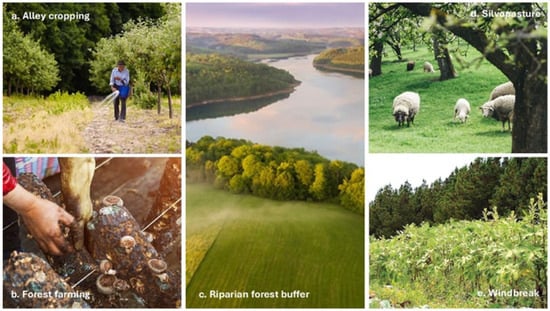
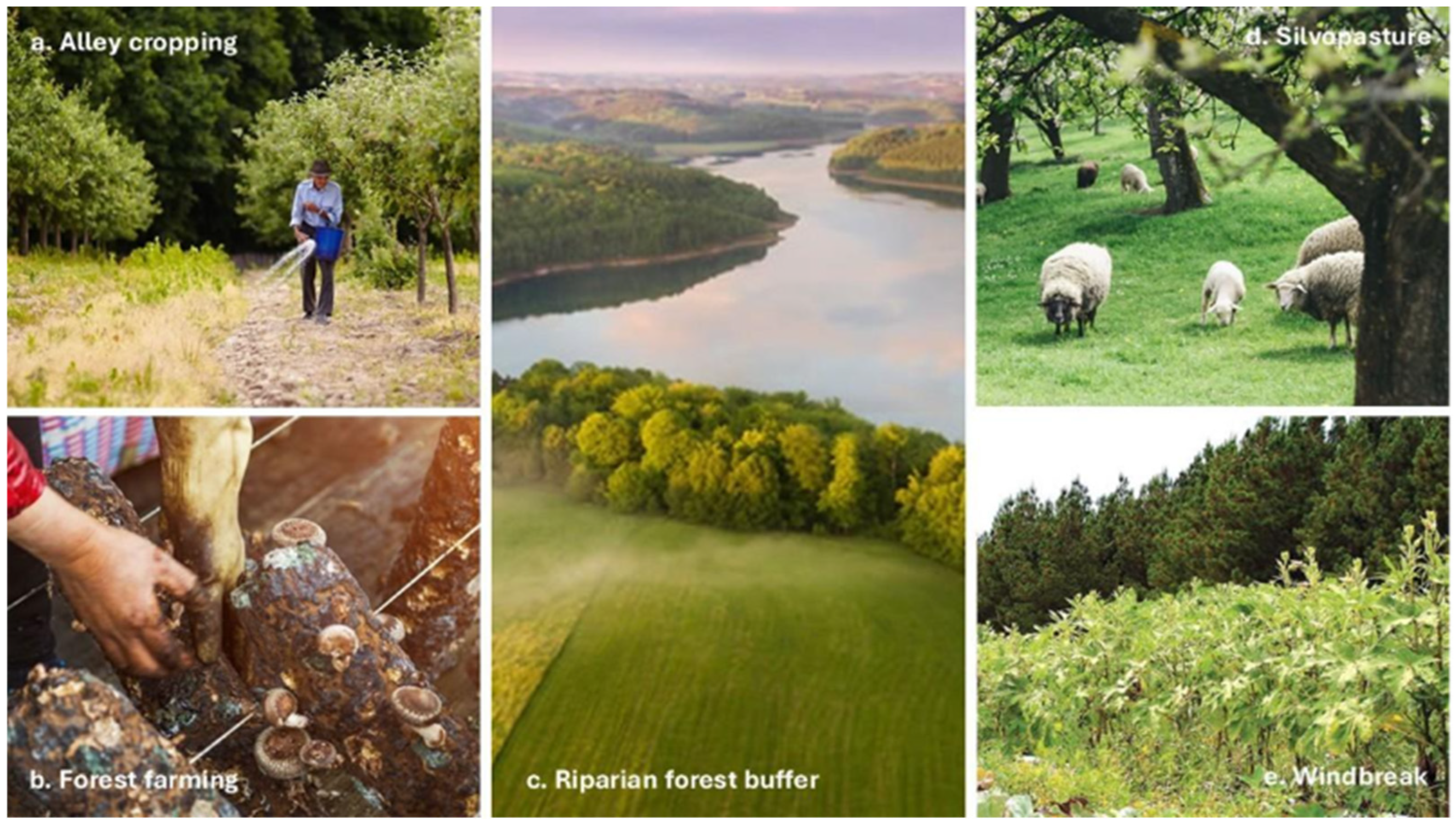
In the United States (U.S.), the U.S. Department of Agriculture (USDA) National Agroforestry Center (NAC) promotes the implementation of five main agroforestry practices: alley cropping, forest farming, riparian forest buffers, silvopasture, and windbreaks [7]. These practices combine trees, crops, and livestock in ways that enhance productivity and environmental quality. Figure 1 illustrates the diversity of these systems across the landscape.
Figure 1.
The five main agroforestry practices. (a) Alley cropping: trees or shrubs grown with alleyways (open rows) for crops in-between. (b) Forest farming: specialty crops cultivated under a managed forest canopy. (c) Riparian forest buffers: trees and shrubs planted along waterways for conservation benefits. (d) Silvopasture: trees integrated with livestock grazing systems. (e) Windbreaks: linear tree plantings that reduce wind speed and protect crops. Source: National Agroforestry Center. Available at https://www.fs.usda.gov/nac/practices/ (accessed on 27 August 2022).
Forest Action Plans (FAPs) are strategic documents that serve as roadmaps for forest resource management in every state. Although agroforestry is supported through several USDA programs and various agricultural initiatives, its clear adoption across states has been uneven. Previous research has identified inconsistent terminology as a significant barrier to implementation and coordination among agencies [8]. Regionality and context-specific vocabulary compound this challenge, as seen in synonymous but regionally distinct terms such as “shelterbelt” and “windbreaks” [8,9].
Inconsistent terminology can affect how programs are understood, funded, and implemented. When language varies across documents or agencies, communication barriers can emerge, reducing stakeholder understanding and complicating technical assistance or policy alignment. This inconsistency in agroforestry terminology has not yet been systematically analyzed in state-level forest planning, leaving a gap in understanding how agroforestry is described state-by-state.
This study provides the first national analysis of how agroforestry terminology is described across all 50 state FAPs. By systematically examining terminology patterns, this research establishes a baseline for identifying gaps, regional differences, and opportunities for further contextualization in agroforestry communication.
Agroforestry terminology usage in FAPs was hypothesized to vary based on regional differences (history, level of communication, description) and document length. States located in the Great Plains region (Midwest) were anticipated to demonstrate stronger agroforestry representation due to their long-standing windbreak initiatives in response to historical events and conservation traditions. The results aim to inform efforts to clarify and standardize agroforestry communication across the U.S., improving connectivity between forestry and agricultural planning frameworks.
This study had three main objectives: to examine how agroforestry practices are described across U.S. FAPs, to assess the frequency of agroforestry terms, and to identify terminology gaps and recommend improvements for future FAP cycles and broader policy coherence.
2. Background and Literature Review
2.1. The Evolution of Agroforestry Definitions
The formalization of agroforestry began over 50 years ago, with systematic definitions emerging around the late 1970s [3,10,11]. Between 1977 and 1979, researchers at what is now the International Center for Research in Agroforestry (ICRAF) published the first formal attempts to define these systems [12,13,14]. These initial efforts produced lists of attributes rather than coherent definitions, signifying the complexity of integrating trees, crops, and livestock into unified, defined management systems [3,10].
By the 1980s, more explicit definitional frameworks for agroforestry emerged. Lundgren and Raintree introduced the term “woody perennials” to replace “tree”, broadening the scope of what ‘defining agroforestry’ could be [15]. Nair later defined agroforestry as land-use systems and technologies where woody perennials are deliberately used on the same land management unit as agricultural crops and/or animals, either in spatial mixture or temporal sequence [16]. This definition emphasized the intentional nature of these systems, distinguishing planted trees from accidental tree presence in agricultural landscapes [16].
The 1990s saw a transition from structural to functional definitions. In 1996, Leakey introduced a definition that characterized agroforestry as a dynamic, ecologically based, natural resource management system that, through the integration of trees in farm and rangeland, diversifies and sustains production for increased social, economic, and environmental benefits [17,18].
Contemporary frameworks refined the broader concepts of agroforestry in the 1990s by considering biological interactions between plant species and the management of forage and crop production [3,17]. Today, agroforestry is communicated as an initiative that parallels agricultural production with biodiversity conservation [1,2,19].
2.2. The Regionality of Agroforestry in the United States
The implementation of agroforestry in the U.S. began gaining recognition around 100 years ago, though Indigenous communities have long practiced integrated land management systems for millennia [4,20]. First Nation tribes across North America developed sophisticated agroforestry systems that managed trees, plants, animals, and fungi at layered, multifunctional scales. The Karuk Tribe in Northern California, for instance, used fire, pruning, and coppicing to manage hundreds of species in an integrated system that included forests with tanoak and black oak, fruit-bearing vegetation, and wildlife [21]. In Hawaiʻi, Indigenous communities developed the pākukui swidden system in the Hāmākua region of Hawaiʻi Island, a rotational agroforestry practice combining kukui (Aleurites moluccanus) with understory crops. This system, along with other place-adapted methods, supported complex agricultural, social, and land management systems still present in Hawaiʻi today [22].
Environmental crises like the 1930s Dust Bowl catalyzed widespread agroforestry adoption in the U.S., particularly with windbreak (shelterbelt) establishment across the Great Plains states (Midwest). Initiatives like the Prairie States Forestry Project planted over 200 million trees between 1935 and 1942 [11,23]. This crisis response evolved into systematic approaches when the 1990 Farm Bill authorized the creation of NAC through partnership between the United States Forest Service (USFS) and Natural Resources Conservation Service (NRCS) [24,25]. Now, agroforestry practices are widely used by landowners to protect resources (windbreaks reducing wind erosion), improve crop yields, enhance local biodiversity through soil nutrient cycling, and as supplementary income from producing specialty and secondary crops [26,27,28].
Regional agroforestry patterns reflect diverse agricultural systems and environmental challenges. A region’s topography, climate, culture, and vegetation shape these patterns [29]. Great Plains states developed extensive windbreak programs that continue today, with Nebraska alone maintaining over 40,000 km of field windbreaks [9,23,30]. Iowa State University’s Bear Creek demonstration watershed showcases multi-species riparian buffer systems that combine native prairie grasses, shrubs, and trees to reduce pollution. These buffers can remove up to 80 percent of nitrate from agricultural runoff [19,31].
Southeastern states emphasize silvopasture, building on forest grazing traditions while demonstrating that properly managed systems enhance both timber quality and livestock productivity [32,33]. Pacific Northwest states have implemented riparian forest buffers for salmon habitat protection and water quality improvement [34].
Crop cultivation and livestock farming dominate land use in the Midwestern region [35]. However, the Midwest’s open, flat landscapes are particularly vulnerable to weather extremes like high winds from severe thunderstorms [36]. The prevalence of large-scale, single-crop agriculture reduces biodiversity and heightens economic vulnerability, leaving producers more exposed to losses during environmental or market disruptions [8,26,37].
2.3. Forest Action Plans
FAPs evolved from earlier forest planning requirements under the Food, Conservation, and Energy Act of 2008. The bill mandated comprehensive statewide assessments addressing a broad range of forest resource concerns, including wildfire risk, forest health, water quality, biodiversity, and climate resilience. FAPs are subject to USFS review and approval, with a required mid-cycle update at five years to incorporate new data and shifting priorities. Full plan revisions occur every 10 years, with the first plans released in 2010 and mid-cycle updates completed in 2015. 2020 was the most recent full plan update [38].
Legislation from 2008 broadened the scope of forest planning beyond traditional forestry to include coordination with agricultural programs and recognition of trees outside forests. This created opportunities for agroforestry integration while lime-lighting institutional challenges in bridging sectors [38,39].
There is little literature on the existence of FAPs, and there are no official guidelines for how these documents are written or designed. State flexibility in FAP development supports regional adaptation in forestry systems, but variation in language, terminology, and emphasis can lead to discrepancies at the agency and stakeholder levels due to unequivocal communication [40]. The Southern Group of State Foresters [39] conducted a comparative review of southern state FAPs to identify detail and regional plan cohesiveness. They assessed how frequently specific themes and strategies appeared across plans, the consistency of terminology used, and the degree of alignment with sustainable forest management goals. The Southern Group found commonalities, but trends in agroforestry terms were not specifically noted [39].
The length and design of FAP document structures vary considerably. These differences likely reflect variations in stages of development, agency size and output, stakeholder engagement, and forest policy. Previous analyses have focused primarily on traditional forest management, with limited attention to agroforestry integration [5]. It has been noted that agroforestry often falls between institutional boundaries, receiving inadequate attention from both forestry and agricultural agencies [8].
2.4. Communication in U.S. Land Management
Communication gaps have been created within U.S. land management agencies through decades of miscommunication and stakeholder resource availability [41,42,43,44]. At the agency level, broken channels of communication trickle from the top down, affecting how information is described to landowning stakeholders [41,44]. Organizational sensemaking theory provides a useful lens for understanding how agroforestry terminology inconsistencies emerge when standardized communication frameworks are limited or absent [40,45]. Sensemaking emphasizes that different organizational units develop their own interpretations of identical concepts through equivocal communication processes, creating fragmented understanding. Successful communication requires well-specified messages delivered to well-defined audiences, with stakeholder groups needing different approaches based on their localized concerns [40,44,45]. In the context of FAPs, how content is described functions as a part of that message design. Inconsistencies in how agroforestry practices are described could lead to a reduction in the ability of stakeholders to identify relevant agroforestry practices, programs, and policies.
At the Lake Tahoe Basin Management Unit in California and Nevada, forest managers held multiple forums to engage different stakeholder groups. Learning their interests created more effective engagement that could later help overcome forestry planning challenges [41]. In relation to agroforestry terms in FAPs, using a sensemaking theory approach could help agencies clarify how agroforestry practices are described locally and identify where local terms diverge from NAC’s outlined practices. This way, intentional stakeholder engagement can support more consistent and legible agroforestry terminology in future FAP cycles while also upholding regional language and stakeholder framing.
2.5. Problem Statement and Research Gaps
Agroforestry provides a suite of production, conservation, and climate benefits and has received growing attention in federal programs and datasets in the U.S. [8], yet its visibility and treatment in FAPs remain uneven. In many cases, agroforestry is described only briefly, conceptually, or omitted entirely, even where state agencies actively support related practices through initiatives like cost-share programs. This is important to know because terminology in planning documents does more than describe practices. It shapes what becomes clear to agencies, partners, and landowners for future policymaking and land management strategies. Although inconsistencies associated with agroforestry terminology (nomenclature) has been noted [8], no research has systematically analyzed how these agroforestry practices are described across all U.S. FAPs. The absence of such a baseline assessment limits our understanding of how language affects policy coherence, stakeholder engagement, and cross-agency coordination. This study addresses this gap by providing the first nationwide assessment of agroforestry terminology in FAPs, establishing a foundation for understanding contextualization and improving communication in future planning cycles.
3. Materials and Methods
This study used a structured content analysis combining quantitative frequency counts and qualitative contextual interpretation to conduct a preliminary assessment of agroforestry term usage across all 50 U.S. FAPs [25,46,47,48,49,50,51,52,53,54,55,56,57,58,59,60,61,62,63,64,65,66,67,68,69,70,71,72,73,74,75,76,77,78,79,80,81,82,83,84,85,86,87,88,89,90,91,92,93,94,95,96]. The methodology consisted of four main stages: document compilation, terminology selection, data collection with contextual verification, and descriptive data analysis, and synthesis. Each stage was designed to ensure transparency, replicability, and consistency with the research objectives.
3.1. FAP Compilation and Criteria
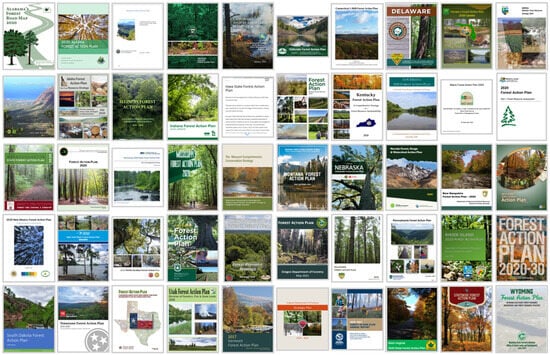
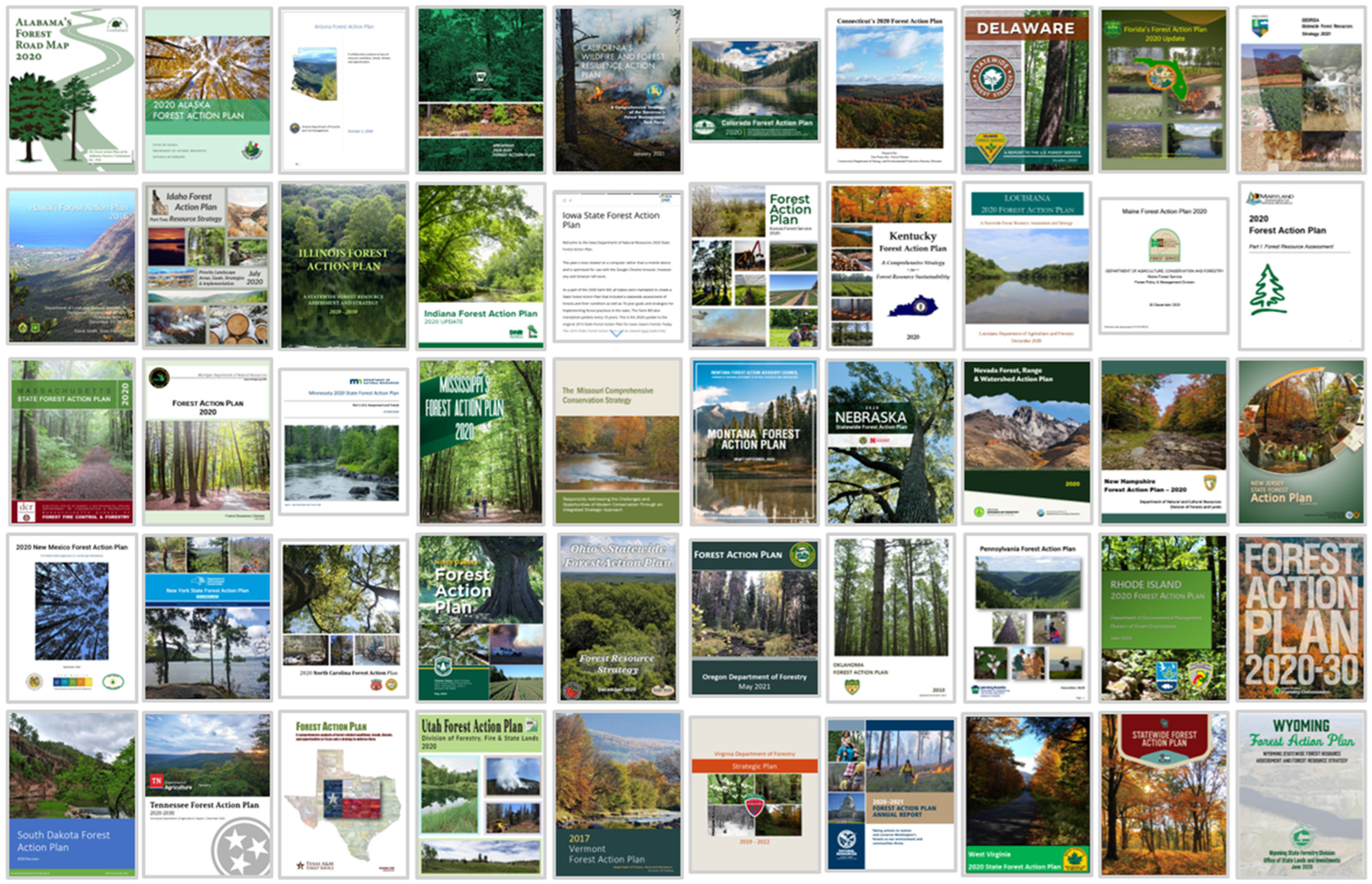
FAPs were analyzed based on the most current versions publicly available on state Department of Natural Resources (DNR), USFS, National Association of State Foresters or other forest agency websites. In total, 50 FAPs were collected (Figure 2).
Figure 2.
Cover pages of the 50 most current state Forest Action Plans (FAP) as of 2020. FAPs are arranged alphabetically by state. This figure illustrates substantial variation in document design and structure across states, which can influence how practices are presented and how readily terminology can be located in the text. See references to access the FAPs analyzed within this study.
FAPs were compiled alphabetically through PDFs and online links. Most FAPs were published in 2020, apart from a few released in 2021. The most current FAPs from three states (Hawaiʻi [61], Oklahoma [82], and Vermont [91]) were older (2015–2017). Nine FAPs from U.S. territories were excluded from this study.
FAPs will be updated at the end of 2025 into the beginning of 2026 [97]. The descriptive analyses conducted in this study will establish a preliminary baseline for other analyses that could further contextualize agroforestry implementation and term usage in current and upcoming FAP cycles.
3.2. FAP Terminology Selection
A list of 29 agroforestry-associated terms was adopted from Smith et al. [8]. That study derived the terminology set using a practice-based crosswalk that links the five main U.S. agroforestry practices with commonly used synonyms and phrases reflected in U.S. agency usage and the broader agroforestry literature. We used this list because it also provides U.S. specific vocabulary that reflects commonly used agency and practitioner language. Using a predetermined list reduces the likelihood of ad hoc keyword selection and provides a reproducible basis for work beyond this study. Each term was associated with one or more of the five main agroforestry practices: alley cropping, forest farming, riparian forest buffers, silvopasture, and windbreaks. Categorizing terms under these broader practices allowed for an assessment of both linguistic variety (use of synonyms and related phrases) and alignment with established definitions. Table 1 summarizes this study’s key terms and their associated terms, spellings, or phrases.
Table 1.
A table listing the common agroforestry terms and their associated phrases. The table lists a range of agroforestry-related terms and identifies which of the five main agroforestry practices (alley cropping, forest farming, riparian forest buffers, silvopasture, and windbreaks) each term is contextually associated with.
Context associated with each agroforestry term was determined during manual text analysis. For example, silvo-pasture or silvopasturing would be counted under silvopasture. An assessment of term contextualization was conducted by analyzing the frequency of the five main agroforestry practices and associated terms in all 50 FAPs. We only formalized a new textual variant as an “associated term” when it appeared in two or more FAPs, and contextual review confirmed that it referred to the same agroforestry concept. This was conducted to confirm agroforestry-relevant usage and reduce false counts. This approach also minimizes undercounts in cases like ours where formal pilot testing was not undertaken. Further analyses are needed to establish deeper contextualization of how agroforestry is communicated not only through individual terms, but also through nuance within sentences and sections in FAP documents.
3.3. Data Collection
Data collection involved the systematic searching of each FAP for predetermined agroforestry terms using text search functions. Each document underwent manual individual analysis. We only formalized a new textual variant as an “associated term” when it appeared in two or more FAPs, and contextual review confirmed that it referred to the same agroforestry concept. We evaluated case by case in scenarios where we had only single-occurrence variants and excluded if ambiguous or could not be verified. Terms were counted when appearing using text search functions, or in contexts generally associated with agroforestry applications, including variations in spelling or hyphenation.
Data were organized alphabetically and followed a matrix format with states as columns and terms as rows in Microsoft Excel. The process involved 1450 individual searches (29 terms × 50 states) conducted over a three-month period in 2022. Quality control measures included duplicate searches for term context (changes in spelling, phrasing, or hyphenation) and cross-verification of high-frequency terms.
The total number of pages in FAP documents (FAPtp) were also recorded using a Microsoft Excel spreadsheet in a matrix format. Individual pages were defined by the PDF document’s rendered structure (i.e., the page count as displayed by the PDF viewer), as printed page numbers within documents were often inconsistent with actual page totals. Pages listing cited references (LR) did not count toward FAPtp to maintain consistency with agency-developed content (number of pages in document—LR = FAPtp).
Lists of references were determined by the first page number listed in the Table of Contents or from where sections noted as “references cited”, “literature cited”, “data sources”, etc. began in a document to the last individual reference cited. Partial or short lists of references (less than half a page as per a document’s dimensions) within the main body of a document were not counted toward LR. If lists of references were unidentifiable, documents were manually reviewed to ensure consistency.
Appendices in PDFs, as well as appendices referencing cited figures for state forest agency programs, were included in the FAPtp. Individual formatting, dimensions, footnotes, and design of FAP documents did not affect data collection. In the unique case of Iowa’s 2020 FAP, available only in a website format, the FAPtp was denoted by individually tabbed sections. One tab counted as one page. The sections ‘Goals & Strategies’ and ‘Appendices’ were not included as they were single webpages of downloadable resources and online links [64].
3.4. Data Analysis
Quantitative analyses focused on descriptive statistics, including total counts, frequency distributions, and practice-level summaries of terminology occurrence. Patterns were examined both across states, all agroforestry terms, and among the five main agroforestry practices. From the list of 29 terms, terms with a low frequency of usage were omitted from more in-depth descriptive analyses examining regional contexts in the agroforestry communication. Correlation coefficients were calculated to assess the relationship between FAP document page length and agroforestry term frequency. A simulation analysis using 1000 random samples at varying sample sizes (10–16% of states) was conducted to evaluate parameter stability and justify the full census approach.
Qualitative analysis complemented this by recording contextual notes about how terms were used, potential misapplications, and thematic nuances suggesting local or institutional preferences. This dual approach enabled interpretation beyond mere term frequency. Findings from both analyses were then synthesized to identify major trends, regional patterns, and terminology gaps relevant to gaining a deeper comprehension of how agroforestry is contextualized and communicated in FAPs in the future. As with most document-based content analyses, this study’s findings depend on the accuracy of keyword searches and the content of available documents. Some terms may have been overlooked where different phrasings described similar concepts. Repeated manual verification minimized possible omissions, and the results are a step toward understanding how agroforestry is described in FAPs.
Throughout this study, terminology frequencies are interpreted as indicators of visibility and framing within FAP text, not as direct measures of agroforestry adoption or implementation.
3.5. Limitations
One limitation of this study is the limited contextualization in data collection and analysis. We recorded the frequency of individual agroforestry terms and a subset of associated spellings and phrases, but we did not systematically code how terms were framed within sentences, sections, or program descriptions. Across the U.S., agroforestry implementation can vary by state due to climate, history, professional jargon, regional initiatives, and policy context. Likewise, regional recognition of agroforestry may be influenced by whether and how practices are communicated in FAPs, even when related activities occur on the ground. In addition, there are no official guidelines establishing FAP length, structure, or reporting style, which may affect how consistently practices, initiatives, and impacts are described. A deeper region-focused review could help contextualize these patterns. Another limitation is descriptive scope. Because this research is preliminary, we set boundaries on contextual interpretation and did not fully assess “conceptual agroforestry”, where agroforestry may be communicated without explicit or standard terminology. Future work should apply a more robust framework to evaluate agroforestry communication beyond isolated terms.
4. Results
Analysis of agroforestry terminology across the 50 state FAPs revealed substantial variation in both frequency and diversity of term usage, with clear regional patterns and practice-specific trends emerging from the data.
4.1. Agroforestry Term Frequency in FAPs
Term frequency varied substantially among states, from no mentions in several FAPs to over 400 cumulative terms mentioned (Table 2). Most terms in the total list of 29 appeared at least once nationally. A small number were absent or nearly absent, indicating potential gaps in how agroforestry is communicated. States with the highest overall agroforestry term diversity were concentrated in the Great Plains and Midwest, which is consistent with historical tree-based conservation traditions in agricultural landscapes.
Table 2.
Number of times the five main agroforestry practices were mentioned in the 50 state Forest Action Plans (FAP).
4.2. Patterns in Terminology Use Across the Five Main Agroforestry Practices
Agroforestry terminology usage was more frequently used in terms associated with the five main agroforestry practices. Terminology patterns strictly with these terms showed clear asymmetries in representation across states (Table 2).
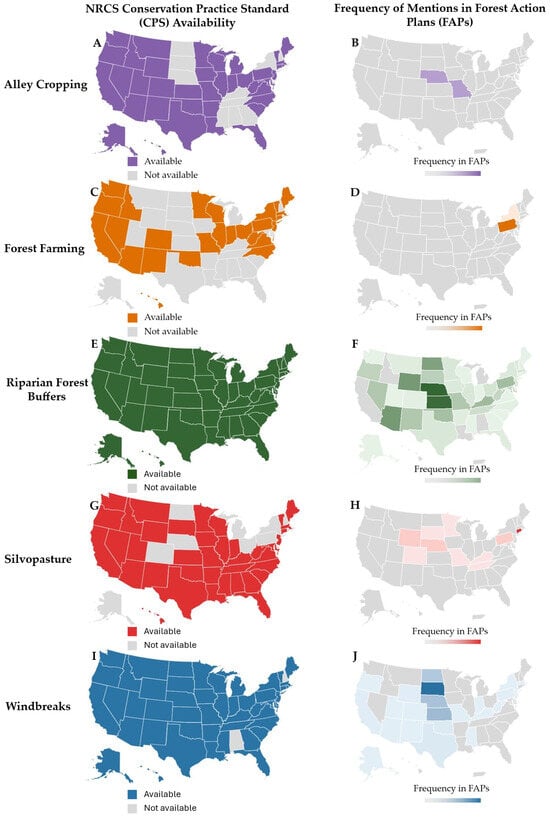
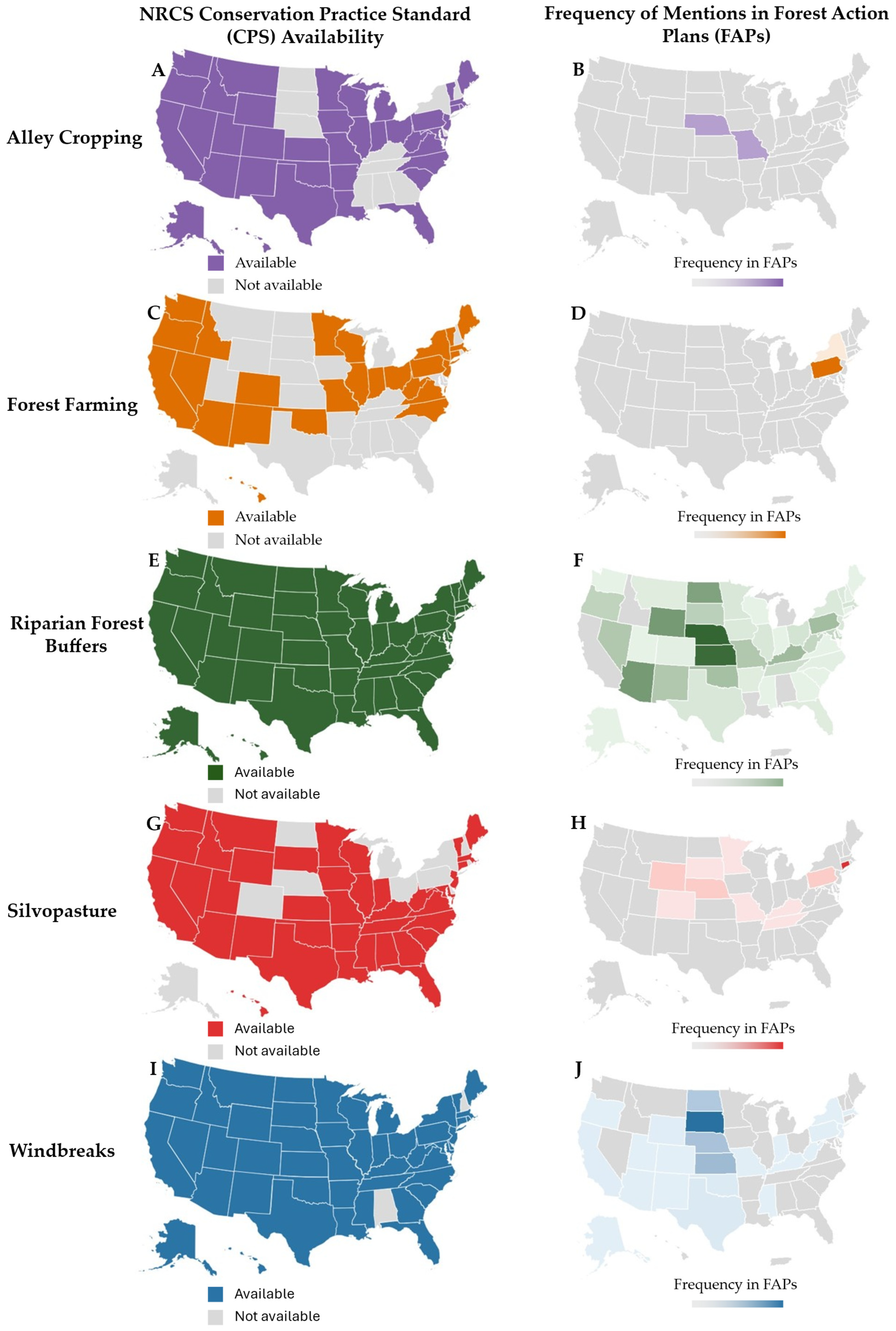
Regional differences in use of terminology were evident across the 5MAFP. The Great Plains states accounted for 88 percent of windbreak references, with South Dakota contributing 149 mentions, Kansas 60, Nebraska 51, and North Dakota 44. This concentration contextually parallels historical responses to wind erosion during the 1930s and the continued extension of windbreak programs in the Midwest [30,46,47,48,49] (Figure 3).
Figure 3.
Side-by-side comparison of federal agroforestry program availability and terminology visibility in State Forest Action Plans (FAPs) for the five main U.S. agroforestry practices. Left panels (A,C,E,G,I) show state-level availability of USDA Natural Resources Conservation Service (NRCS) Conservation Practice Standards (CPS) specific to agroforestry, as reported by the USDA National Agroforestry Center (NAC). These CPS support technical assistance and financial incentives delivered through programs such as the Environmental Quality Incentives Program (EQIP), the Conservation Stewardship Program (CSP), and related USDA and state conservation programs. Right panels (B,D,F,H,J) show the frequency of practice-specific terminology mentions within the 50 most current state FAPs (darker shading indicates higher mention frequency; gray indicates zero mentions). In the CPS panels, colored states indicate that the CPS is available/offered and gray indicates it is not offered. Practices shown are: alley cropping (A,B), forest farming (C,D), riparian forest buffers (E,F), silvopasture (G,H), and windbreaks (I,J).
Riparian forest buffers appeared multiple times in over 40 FAPs. The U.S. has roughly 3.5 million miles of rivers and tributaries [53,98]. The broad distribution in riparian forest buffers suggests widespread recognition of the importance of water quality and riparian biodiversity nationwide, though riparian terminology varied considerably.
Riparian forest buffers also related to 16 other terms on the agroforestry terms list, accounting for around 50 percent of total contextual references. Clarifying relationships between core terms and localized terminology could help structure future term lists and improve consistency across FAPs.
Among the five main agroforestry practices, alley cropping and forest farming were directly used the least. Alley cropping appeared in only Missouri and Nebraska FAPs while forest farming was mentioned a few times in the New York [79] and Pennsylvania [84] FAPs despite there being forest farming operations across Appalachia (Southeastern U.S.) and other forested regions in the U.S. [33,49,51,77].
4.3. Document Length and Agroforestry Term Frequency
Document length varied substantially across all FAPs, ranging from 15–681 pages. Most FAPs (84%) were under 300 pages (Table 3).
Table 3.
Distribution of Forest Action Plan (FAP) document page lengths (FAPtp) and agroforestry term frequency across 50 FAPs (n = 50). Page ranges represent categories used for distribution analysis; Actual range shows the observed minimum and maximum page counts within each category. Mean and median agroforestry term values indicate the total terminology mentions per state within each page range category.
Document length showed a weak correlation with total agroforestry term usage (r = 0.27). Examining the five main agroforestry practices, document length and usage had a weaker correlation (r = 0.14). ‘Windbreak’ terminology showed virtually no relationship with document length (r = 0.01) while ‘riparian forest buffer’ terminology demonstrated the strongest correlation with page count (r = 0.32).
Simulation analysis using 1000 random samples at 10–16% of states (n = 5–8) demonstrated that while the mean values for page count and agroforestry term frequency recovered population parameters adequately, correlation coefficients were highly unstable. At 14% sampling (n = 7), correlations between page count and total terms ranged from r = −0.73 to r = 0.99 across iterations (SD = 0.38), reflecting the skewed distribution of term mentions driven by Great Plains states.
States with widely adopted traditional practices inconsistently mentioned agroforestry terms within their FAPs. Hawaiʻi’s FAP (316 pages) contained only 14 agroforestry term mentions despite centuries-long agroforestry traditions, potentially underrepresenting these practices to outside audiences [22,61]. Similarly, states in the Southeastern U.S. showed limited agroforestry terms despite research documenting successful forest farming and silvopasture operations in these regions [31,32,33]. A more complex descriptive analysis could reveal the terms, phrases, or sentences functionally describing agroforestry practices that could have been missed through text search functions and correlative analysis. This is a research gap that should be explored in the future and could reveal themes also highlighted by a framework developed through organizational sensemaking.
5. Discussion
Analysis revealed significant gaps in how agroforestry is conceptualized within state FAPs. These gaps reflect broader institutional challenges where agroforestry falls between traditional forestry and agricultural boundaries. Results also reflect how agroforestry is sorted, owned, and made clear within institutions that are historically organized around separate forestry and agricultural mandates. This increases the likelihood of agroforestry (especially) being treated as someone else’s domain or described using language familiar to that specific sector, causing obscurity in agroforestry identity [8]. These observations are consistent with organizational sensemaking where planning documents often rely on familiar terms and metrics to establish order. However, this reliance creates gaps between official plans and the innovative, cross-sector work actually happening on the ground. Organizational sensemaking could help to identify regionality in agroforestry terminology, contextualizing how agroforestry is understood and described across the U.S. [45].
The inconsistent use of agroforestry terms is more than just a lack of knowledge. It is a breakdown in how we communicate and categorize work. Traditionally, forestry has relied on top-down information sharing. This often creates bottlenecks and prevents agencies from agreeing on a common language [40,45]. As a result, agroforestry practices might exist in the field but disappear in policy documents because planners and farmers use different words for the same thing. When FAPs use consistent names, it becomes much easier for partners to notice programs, justify funding, and prioritize actions in future cycles [40,42,44].
Our results parallel this gap through correlations in five main agroforestry terminology usage and regionality. Midwestern states had high frequencies in terminology usage, mirroring current and past agroforestry initiatives to preserve wildlife habitats, combat soil erosion, and ameliorate the negative impacts of climate change [7,20,30]. FAPs often focus on practices that feel familiar to local institutions. Windbreaks/shelterbelts are highly visible in the Great Plains because they are tied to regional history and the legacy of the Dust Bowl. The side-by-side comparison of conservation practices, especially in the case of windbreaks, also confirms this. In other regions where agroforestry might not have a historical tie to the place, terms such as watershed protection and agroecology may be used in place of recognized agroforestry labels. This creates a disconnect and makes it harder for other partners to find, provide funding for, or collaborate on these programs [23,40,42,44]. The notion that agroforestry terminology varies by location is further supported, demonstrating that it does not have a strong foothold in nationwide management documentation.
Another example of this disconnect is in Hawaiʻi’s FAP and FAPs from several Southeastern states. These areas have deep agroforestry histories and active tree-based land use, yet their FAPs tend to describe these practices in localized or more detailed, context-specific language rather than standardized agroforestry terminology. This suggests a gap between formal planning language and the actual practices happening on the ground. From a sensemaking perspective, this is more than just an oversight. It likely reflects how agencies note these activities in their records. Historical tree systems in Hawaiʻi, which have been implemented for thousands of years, might be categorized as culturally grounded stewardship, invasive species control for preserving biodiversity, or watershed protection rather than being labeled as agroforestry [22,61]. Similarly, in parts of the Southeast, practices like forest farming are often described as non-timber forest products (NTFPs), and alley cropping might be called working-lands integration without using the specific labels that external readers expect from the standard five-practice NAC framework [32,60,99]. As a result, formal plans may fail to show how much agroforestry is actually happening, making it harder for agencies in different states to learn from each other or coordinate their efforts.
Agroforestry term usage with terms such as alley cropping and forest farming were minimal in comparison to other agroforestry practices. In both contexts, implementation is common and successful in many states [11,20,32,33] but not recognized in some FAPs. This gap may reflect a perception that these practices belong primarily in other forms of planning rather than documents like FAPs.
The near absence of alley cropping and forest farming terminology (Table 2; Figure 3) warrants an in-depth investigation. This could be due to two mechanisms or an interplay of both. First, these practices often fall between institutional mandates and planning. Alley cropping is commonly viewed as an agricultural production system whereas forest farming is viewed as an NTFP or specialty-crop system that needs to be promoted via agricultural land use plans and extension programs rather than forestry-led strategies [20,32,33,99]. Secondly, technical expertise and program ownership shape what becomes nameable and reportable. Where state forestry agencies do not see themselves as primary technical routes for a practice, or where implementation support is perceived to flow primarily through ‘other’ partners (e.g., NRCS), FAP writers may reference related land use strategies indirectly without naming them explicitly. In the end, activities can be widespread while the terminology remains sparse in FAPs and produces an apparent absence that is better explained as a matter of visibility or categorization.
A practical communication framework for FAPs could combine a short glossary of the five main agroforestry practices with a synonym crosswalk that translates common regional terms into standardized labels. Adding a brief cross-agency terminology review (e.g., with NAC) would maintain local flexibility while improving discoverability, coordination, and evaluation across jurisdictions. These suggestions could help balance flexibility and standardization without aiming to replace any culturally/regionally effective terminology. The goal is to potentially pair local language with a shared set of reference terms to improve visibility/discoverability, coordination, and evaluation across jurisdictions and partners interested in overall land stewardship.
Additionally, the forest sector’s historical emphasis on one-way communication [40] suggests that agroforestry terminology standardization efforts should prioritize stakeholder engagement and collaborative definition development rather than top-down frameworks only. Incorporating lessons from successful regional implementation and addressing the communication barriers that limit current adoption could improve both agroforestry term consistency and actual agroforestry implementation outcomes.
Future research should examine relationships between agroforestry term usage and agroforestry implementation and explore whether consistent term usage correlates with successful programs and stakeholder engagement in local regions. Comparative analysis with agricultural planning documents could also reveal whether gaps reflect institutional boundaries requiring targeted integration. Context-driven agroforestry terminology research could help establish a more robust baseline for developing a communication framework to guide future FAP cycles, and therefore, communication, outreach, and education.
Author Contributions
Conceptualization, K.B.D. and L.A.; methodology, K.B.D. and L.A.; software, K.B.D. and L.A.; validation, K.B.D. and L.A.; formal analysis, K.B.D.; investigation, K.B.D.; resources, K.B.D. and L.A.; data curation, K.B.D.; writing—original draft preparation, K.B.D.; writing—review and editing, K.B.D. and L.A.; visualization, K.B.D.; supervision, L.A.; project administration, L.A.; funding acquisition, L.A. All authors have read and agreed to the published version of the manuscript.
Funding
This research received no external funding. Internal support was provided by start-up funds from the School of Natural Resources, University of Nebraska–Lincoln, which were used as graduate research assistant support.
Data Availability Statement
All data and contributions to this study are freely available upon request.
Acknowledgments
A special note of appreciation to Matthew Smith of the National Agroforestry Center (U.S. Forest Service) for his initial thoughts and guidance on the topic.
Conflicts of Interest
The authors declare no conflicts of interest.
References
- Gold, M.A.; Garrett, H.E. Agroforestry nomenclature, concepts and practices. In North American Agroforestry, 3rd ed.; Garrett, H.E., Jose, S., Gold, M.A., Eds.; American Society of Agronomy: Madison, WI, USA, 2022; pp. 27–41. [Google Scholar]
- Mosquera-Losada, M.R.; Santiago-Freijanes, J.J.; Rigueiro-Rodriguez, A.; Rodríguez-Rigueiro, F.J.; Martínez, D.A.; Pantera, A.; Ferreiro-Domínguez, N. The importance of agroforestry systems in supporting biodiversity conservation and agricultural production: A European perspective. In Reconciling Agricultural Production with Biodiversity Conservation; Burleigh Dodds Science Publishing Limited: Cambridge, UK, 2020. [Google Scholar]
- Somarriba, E. Revisiting the past: An essay on agroforestry definition. Agrofor. Syst. 1992, 19, 233–240. [Google Scholar] [CrossRef] [Scilit]
- Raj, A.J.; Lal, S.B. Agroforestry: Theory and Practices; Scientific Publishers: Rajasthan, India, 2014. [Google Scholar]
- Ollinaho, O.I.; Kröger, M. Agroforestry transitions: The good, the bad and the ugly. J. Rural Stud. 2021, 82, 210–221. [Google Scholar] [CrossRef] [Scilit]
- Tiwari, V. Agroforestry and biodiversity: Integrating trees into farming for environmental benefits. Glob. Agron. Res. J. 2025, 2, 12–14. [Google Scholar]
- Schoeneberger, M.; Bentrup, G.; de Gooijer, H.; Soolanayakanahally, R.; Sauer, T.; Brandle, J.; Zhou, X.; Current, D. Branching out: Agroforestry as a climate change mitigation and adaptation tool for agriculture. J. Soil Water Conserv. 2012, 67, 128A–136A. [Google Scholar] [CrossRef] [Scilit]
- Smith, M.M.; Bentrup, G.; Kellerman, T.; MacFarland, K.; Straight, R.; Ameyaw, L. Agroforestry extent in the United States: A review of national datasets and inventory efforts. Agriculture 2022, 12, 726. [Google Scholar] [CrossRef] [Scilit]
- Brandle, J.; Finch, S. How Windbreaks Work; EC91-1763-B; Historical Materials from University of Nebraska-Lincoln Extension; University of Nebraska-Lincoln Extension: Lincoln, NE, USA, 1991. [Google Scholar]
- Wiersum, K.F. Viewpoints on Agroforestry; Agricultural University of Wageningen: Wageningen, The Netherlands, 1981. [Google Scholar]
- Smith, J. The History of Temperate Agroforestry; The Organic Research Centre: Cheshire, UK, 2010. [Google Scholar]
- Bene, J.G.; Beall, H.W.; Côté, A. Trees, Food and People: Land Management in the Tropics; International Development Research Centre: Ottawa, ON, Canada, 1977. [Google Scholar]
- Combe, J.; Budowski, G. Classification of traditional agroforestry techniques. In Workshop on Traditional Agroforestry Systems in Latin America; De Las Salas, G., Ed.; CATIE: Cartago, Costa Rica, 1979; pp. 17–47. [Google Scholar]
- ICRAF. Agroforestry defined. ICRAF Newsl. 1979, 1, 4. [Google Scholar]
- Lundgren, B.; Raintree, J.B. Sustained agroforestry. In Agricultural Research for Development: Potentials and Challenges in Asia; Nestel, B., Ed.; ISNAR: The Hague, The Netherlands, 1982; pp. 37–49. [Google Scholar]
- Nair, P.K.R. (Ed.) Agroforestry Systems in the Tropics; Kluwer Academic Publishers, in cooperation with ICRAF: Dordrecht, The Netherlands, 1989. [Google Scholar]
- Leakey, R. Definition of Agroforestry Revisited. Agrofor. Today 1996, 8, 5–7. [Google Scholar] [CrossRef] [Scilit]
- Atangana, A.; Khasa, D.; Chang, S.; Degrande, A. Definitions and classification of agroforestry systems. In Tropical Agroforestry; Springer: Berlin/Heidelberg, Germany, 2014; pp. 35–47. [Google Scholar]
- Schultz, R.C.; Colletti, J.P.; Faltonson, R.R. Agroforestry opportunities for the United States of America. Agrofor. Syst. 1995, 31, 117–132. [Google Scholar] [CrossRef] [Scilit]
- MacFarland, K.; Schoeneberger, M.; Bentrup, G.; Straight, R. Agroforestry: Enhancing resiliency in U.S. agricultural landscapes under changing conditions. In USDA Forest Service Gen. Tech. Report WO-96; US Department of Agriculture, Forest Service: Washington, DC, USA, 2017. [Google Scholar]
- Vinyeta, K.; Lake, F.; Norgaard, K. Vulnerabilities of traditional foods and cultural use species. In Climate Change Vulnerability Assessment; Karuk Tribe: Happy Camp, CA, USA, 2016; pp. 68–138. [Google Scholar]
- Lincoln, N.K. Agroforestry form and ecological adaptation in ancient Hawai’i: Extent of the pākukui swidden system of Hāmākua, Hawai’i Island. Agric. Syst. 2020, 181, 102808. [Google Scholar] [CrossRef] [Scilit]
- Li, T. Protecting the Breadbasket with Trees? The Effect of the Great Plains Shelterbelt Project on Agriculture. Land Econ. 2021, 97, 321–344. [Google Scholar] [CrossRef]
- Garrett, G.; Buck, L. Agroforestry practice and policy in the United States of America. For. Ecol. Manag. 1997, 91, 5–15. [Google Scholar] [CrossRef] [Scilit]
- Illinois Department of Natural Resources. Illinois Forest Action Plan; Illinois Department of Natural Resources: Springfield, IL, USA, 2020. Available online: http://ifdc.nres.illinois.edu/2020-2023-illinois-forest-action-plan (accessed on 1 September 2022).
- Colletti, J.P.; Schultz, R.C.; Mize, C.W.; Hall, R.B.; Twarok, C.J. An Iowa demonstration of agroforestry: Short-rotation woody crops. For. Chron. 1991, 67, 258–262. [Google Scholar] [CrossRef] [Scilit]
- United States Congress. Food, Conservation, and Energy Act of 2008; Pub. L. No. 110-246, H.R. 2419, 122 Stat. 923; U.S. Government Publishing Office: Washington, DC, USA, 2008.
- National Association of State Foresters. (n.d.). Forest Action Plans. Available online: https://www.stateforesters.org/forest-action-plans (accessed on 17 July 2025).
- Jiang, S.; Xiong, K.; Xiao, J. Structure and stability of agroforestry ecosystems: Insights into the improvement of service supply capacity of agroforestry ecosystems under the Karst rocky desertification control. Forests 2022, 13, 878. [Google Scholar] [CrossRef] [Scilit]
- Smith, M.M.; Bentrup, G.; Kellerman, T.; MacFarland, K.; Straight, R.; Ameyaw, L. Windbreaks in the United States: A systematic review of producer-reported benefits, challenges, management activities and drivers of adoption. Agric. Syst. 2021, 187, 103032. [Google Scholar] [CrossRef] [Scilit]
- Schultz, R.C.; Colletti, J.P.; Simpkins, W.W.; Mize, C.W.; Thompson, M.L. Developing a multispecies riparian buffer strip agroforestry system. In Proceedings of the Riparian Ecosystems in the Humid US—Functions, Values and Management, Atlanta, GA, USA, 15–18 March 1993; USDA Forest Service: Washington, DC, USA, 1993; pp. 203–225. [Google Scholar]
- Baker, E.; Saha, S. Forest farming in Georgia, United States: Three potential crops. Ann. Agrar. Sci. 2018, 16, 304–308. [Google Scholar] [CrossRef] [Scilit]
- Frey, G.E.; Durmus, T.; Sills, E.O.; Isik, F.; Comer, M.M. Potential alternative tree species as substrates for forest farming of log-grown shiitake mushrooms in the southeastern United States. HortTechnology 2020, 30, 741–744. [Google Scholar] [CrossRef] [Scilit]
- Larsen-Grey, A.; Loehle, C. Relationship between riparian buffers and terrestrial wildlife in the eastern United States. J. For. 2021, 120, 336–357. [Google Scholar] [CrossRef] [Scilit]
- Lu, C.; Yu, Z.; Zhang, J.; Cao, P.; Tian, H.; Nevison, C. Century-long changes and drivers of soil nitrous oxide (N2O) emissions across the contiguous United States. Glob. Change Biol. 2022, 28, 2505–2524. [Google Scholar] [CrossRef] [Scilit] [PubMed]
- Udawatta, R.P.; Jose, S. Agroforestry strategies to sequester carbon in temperate North America. Agrofor. Syst. 2012, 86, 225–242. [Google Scholar] [CrossRef] [Scilit]
- Garrett, H.E.; Jose, S.; Gold, M.A. (Eds.) North American Agroforestry, 3rd ed.; American Society of Agronomy: Madison, WI, USA, 2022. [Google Scholar]
- Baldwin, E.; McLaughlin, D.M.; Jasso, V.; Woods, D.; Breshears, D.D.; López-Hoffman, L.; Soto, J.R.; Swann, A.; Lien, A. Diverse stakeholders and their interests matter to the U.S. Forest Service: A network of action situations analysis of how stakeholders affect forest plan outcomes. Sustain. Sci. 2023, 18, 27–42. [Google Scholar] [CrossRef] [Scilit]
- Southern Group of State Foresters. A Vision for Southern Forests: 2020 State Forest Action Plan Assessments, Southern Region. 2020. Available online: https://southernforests.org/resources/publications/ (accessed on 17 July 2025).
- McCauley, J.; Maggard, A.; Barlow, R.; Kush, J. Open conversations: Finding ways to improve communication between family forest landowners and consulting foresters. Trees For. People 2024, 18, 100681. [Google Scholar] [CrossRef] [Scilit]
- Butler, B.J.; Hewes, J.H.; Dickinson, B.J.; Andrejczyk, K.; Butler, S.M.; Markowski-Lindsay, M. Extension forestry programming challenges in the United States: Results from a national survey. J. For. 2014, 112, 1–8. [Google Scholar]
- Rubino, E.C.; Tian, N.; Pelkki, M.H. Improving communications to increase nonindustrial private forest landowner (NIPF) participation in forest certification programs: A case study in Arkansas, USA. Forests 2022, 13, 86. [Google Scholar] [CrossRef] [Scilit]
- Laatsch, J.; Ma, Z. Climate-change communication within public natural resource agencies: Lessons learned from the U.S. Forest Service. Soc. Nat. Resour. 2016, 29, 1169–1185. [Google Scholar] [CrossRef] [Scilit]
- Lähtinen, K.; Toppinen, A.; Suojanen, H.; Stern, T.; Ranacher, L.; Burnard, M.; Kitek Kuzman, M. Forest sector communication culture and the targets of communication: A survey study covering seven countries. Curr. For. Rep. 2018, 4, 72–88. [Google Scholar]
- Weick, K.E. The Social Psychology of Organizing, 2nd ed.; McGraw-Hill: New York, NY, USA, 1979. [Google Scholar]
- Kansas Forest Service. Forest Action Plan: Kansas Forest Service 2020; Kansas Forest Service: Manhattan, KS, USA, 2020; Available online: https://www.kansasforests.org/about/actionplan.html (accessed on 1 September 2022).
- Nebraska Forest Service. 2020 Nebraska Statewide Forest Action Plan; Nebraska Forest Service: Lincoln, NE, USA, 2020; Available online: https://nfs.unl.edu/sites/unl.edu.ianr.nebraska-forest-service/files/media/file/2020-NFS-Action-Plan%20Revised.pdf (accessed on 1 September 2022).
- South Dakota Department of Agriculture. South Dakota Forest Action Plan: 2020 Revision; South Dakota Department of Agriculture: Pierre, SD, USA, 2020. Available online: https://danr.sd.gov/Conservation/Forestry/ForestActionPlan/default.aspx (accessed on 1 September 2022).
- North Dakota Forest Service. North Dakota Forest Action Plan; North Dakota Forest Service: Bismarck, ND, USA, 2020; Available online: https://www.stateforesters.org/wp-content/uploads/2021/02/2020-North-Dakota-Forest-Action-Plan.pdf (accessed on 1 September 2022).
- Alabama Forestry Commission. Alabama’s Forest Road Map 2020: The Forest Action Plan of the Alabama Forestry Commission; Alabama Forestry Commission: Montgomery, AL, USA, 2020. Available online: https://www.forestry.alabama.gov/Pages/Management/Forest_Action_Plan.aspx (accessed on 1 September 2022).
- Alaska Department of Natural Resources. 2020 Alaska Forest Action Plan; Alaska Department of Natural Resources: Juneau, AK, USA, 2020. Available online: https://forestry.alaska.gov/Assets/pdfs/forestactionplan/FINAL2020AlaskaForestActionPlan.pdf (accessed on 1 September 2022).
- Arizona Department of Forestry and Fire Management. Arizona Forest Action Plan; Arizona Department of Forestry and Fire Management: Phoenix, AZ, USA, 2020. Available online: https://dffm.az.gov/sections/forestry (accessed on 1 September 2022).
- Arkansas Department of Agriculture. Arkansas 2020–2029 Forest Action Plan; Arkansas Department of Agriculture: Little Rock, AR, USA, 2020. Available online: https://agriculture.arkansas.gov/forests/forest-management/forest-action-plan/ (accessed on 1 September 2022).
- California Department of Forestry and Fire Protection. California’s Wildfire and Forest Resilience Action Plan; California Department of Forestry and Fire Protection: Sacramento, CA, USA, 2021. Available online: https://wildfiretaskforce.org/wp-content/uploads/2022/04/californiawildfireandforestresilienceactionplan.pdf (accessed on 1 September 2022).
- Colorado State Forest Service. Colorado Forest Action Plan 2020; Colorado State Forest Service: Fort Collins, CO, USA, 2020; Available online: https://csfs.colostate.edu/forest-action-plan/ (accessed on 1 September 2022).
- Connecticut Department of Energy and Environmental Protection. Connecticut’s 2020 Forest Action Plan; Connecticut Department of Energy and Environmental Protection: Hartford, CT, USA, 2020. Available online: https://portal.ct.gov/-/media/deep/forestry/2020-approved-ct-forest-action-plan.pdf?rev=a1234fca39924796bb8e4e6311518f4d&hash=C301A0DCB580EA49854B9FA97882DE05 (accessed on 1 September 2022).
- Delaware Forest Service. Delaware Statewide Forest Strategy; Delaware Forest Service: Dover, DE, USA, 2020. Available online: https://agriculture.delaware.gov/forest-service/forest-management/delaware-forest-action-plan/ (accessed on 1 September 2022).
- Florida Forest Service. Florida’s Forest Action Plan: 2020 Update; Florida Forest Service: Tallahassee, FL, USA, 2020. Available online: https://ccmedia.fdacs.gov/content/download/96038/file/Florida-Forest-Action-Plan-2020-Update.pdf (accessed on 1 September 2022).
- Pollack, S.L.; Lynch, L. Food, Agriculture, Conservation, and Trade Act of 1990; S. 2830, 101st Cong. Public Law No. 101-624; U.S. Government Publishing Office: Washington, DC, USA, 1990. Available online: https://www.congress.gov/bill/101st-congress/senate-bill/2830 (accessed on 1 August 2025).
- Georgia Forestry Commission. Georgia Statewide Forest Resources Strategy 2020; Georgia Forestry Commission: Dry Branch, GA, USA, 2020; Available online: https://gatrees.org/forest-management-conservation/forest-action-plan/ (accessed on 1 September 2022).
- Hawai’i Department of Land and Natural Resources. Hawaiʻi Forest Action Plan 2016; Hawai’i Department of Land and Natural Resources: Honolulu, HI, USA, 2016. Available online: https://dlnr.hawaii.gov/forestry/info/fap/ (accessed on 1 September 2022).
- Idaho Department of Lands. Idaho Forest Action Plan; Idaho Department of Lands: Boise, ID, USA, 2020. Available online: https://www.idl.idaho.gov/forestry/forest-action-plan/ (accessed on 1 September 2022).
- Indiana Department of Natural Resources. Indiana Forest Action Plan: 2020 Update; Indiana Department of Natural Resources: Indianapolis, IN, USA, 2020. Available online: https://www.in.gov/dnr/forestry/files/fo-Forest-Action-Plan2020.pdf (accessed on 1 September 2022).
- Iowa Department of Natural Resources. Iowa State Forest Action Plan; Iowa Department of Natural Resources: Des Moines, IA, USA, 2020. Available online: https://www.iowadnr.gov/programs-services/forestry-resources (accessed on 1 September 2022).
- Kentucky Division of Forestry. Kentucky Forest Action Plan; Kentucky Division of Forestry: Frankfort, KY, USA, 2020. Available online: https://eec.ky.gov/Natural-Resources/Forestry/Pages/Kentucky's-Forest-Action-Plan.aspx (accessed on 1 September 2022).
- Louisiana Department of Agriculture and Forestry. Louisiana 2020 Forest Action Plan; Louisiana Department of Agriculture and Forestry: Baton Rouge, LA, USA, 2020. Available online: https://assets.ctfassets.net/pc5e1rlgfrov/6E5xPFDEL5XbuIKoMXUDyr/02b5e248c91d8982d6d0e9b545d3018f/LA_FAP_2020_Final.pdf (accessed on 1 September 2022).
- Maine Forest Service. Maine Forest Action Plan 2020; Maine Forest Service: Augusta, ME, USA, 2020. Available online: https://www.maine.gov/dacf/mfs/about/action_plans/Maine%20Forest%20Action%20Plan%202020.pdf (accessed on 1 September 2022).
- Maryland Department of Natural Resources. 2020 Forest Action Plan; Maryland Department of Natural Resources: Annapolis, MD, USA, 2020. Available online: https://dnr.maryland.gov/forests/Documents/Maryland-State-Assessment-2020FINALpages.pdf (accessed on 1 September 2022).
- Massachusetts Department of Conservation and Recreation. Massachusetts State Forest Action Plan 2020; Massachusetts Department of Conservation and Recreation: Boston, MA, USA, 2020. Available online: https://www.mass.gov/doc/massachusetts-forest-action-plan/download (accessed on 1 September 2022).
- Michigan Department of Natural Resources. Forest Action Plan 2020; Michigan Department of Natural Resources: Lansing, MI, USA, 2020. Available online: https://www.michigan.gov/dnr/-/media/Project/Websites/dnr/Documents/FRD/Mgt/ForestActionPlan_Forestry_2020.pdf?rev=7753bf4ccceb4b6da4adf2badaa8e5b0&hash=728A034DEEB65830CCB322707B39F202 (accessed on 1 September 2022).
- Minnesota Department of Natural Resources. Minnesota 2020 State Forest Action Plan; Minnesota Department of Natural Resources: St. Paul, MN, USA, 2020. Available online: https://www.dnr.state.mn.us/forestry/forest-action-plan.html (accessed on 1 September 2022).
- Mississippi Forestry Commission. Mississippi’s Forest Action Plan 2020; Mississippi Forestry Commission: Jackson, MS, USA, 2020. Available online: https://www.mfc.ms.gov/wp-content/uploads/2021/01/Mississippi-Forest-Action-Plan-January-2021-compressed.pdf (accessed on 1 September 2022).
- Missouri Department of Conservation. The Missouri Comprehensive Conservation Strategy; Missouri Department of Conservation: Jefferson City, MO, USA, 2020. Available online: https://mdc.mo.gov/sites/default/files/2024-03/CCS.pdf (accessed on 1 September 2022).
- Montana Department of Natural Resources and Conservation. Montana Forest Action Plan; Montana Department of Natural Resources and Conservation: Helena, MT, USA, 2020. Available online: https://dnrc.mt.gov/_docs/forestry/Montana_Forest_Action_Plan_12.22.2020.pdf (accessed on 1 September 2022).
- Nevada Division of Forestry. Nevada Forest, Range & Watershed Action Plan 2020; Nevada Division of Forestry: Carson City, NV, USA, 2020. Available online: https://drive.google.com/file/d/1juVIM_Edw4wsKODNmPryxo2da7aPTMXF/view (accessed on 1 September 2022).
- New Hampshire Department of Natural and Cultural Resources. New Hampshire Forest Action Plan; New Hampshire Department of Natural and Cultural Resources: Concord, NH, USA, 2020. Available online: https://www.nhdfl.dncr.nh.gov/forest-action-plan (accessed on 1 September 2022).
- New Jersey Forest Service. New Jersey State Forest Action Plan; New Jersey Forest Service: Trenton, NJ, USA, 2020. Available online: https://dep.nj.gov/parksandforests/conservation/forest-action-plan/ (accessed on 1 September 2022).
- New Mexico Energy, Minerals and Natural Resources Department. 2020 New Mexico Forest Action Plan; New Mexico Energy, Minerals and Natural Resources Department: Santa Fe, NM, USA, 2020. Available online: https://www.emnrd.nm.gov/sfd/wp-content/uploads/sites/4/NMFAP_2020_v1-1_2021_03_12b_web.pdf (accessed on 1 September 2022).
- New York State Department of Environmental Conservation. New York State Forest Action Plan; New York State Department of Environmental Conservation: Albany, NY, USA, 2020. Available online: https://dec.ny.gov/nature/forests-trees/forest-action-plan (accessed on 1 September 2022).
- North Carolina Forest Service. 2020 North Carolina Forest Action Plan; North Carolina Forest Service: Raleigh, NC, USA, 2020. Available online: https://www.ncforestservice.gov/publications/WO0027.pdf (accessed on 1 September 2022).
- Ohio Department of Natural Resources. Ohio’s Statewide Forest Action Plan; Ohio Department of Natural Resources: Columbus, OH, USA, 2020. Available online: https://dam.assets.ohio.gov/image/upload/ohiodnr.gov/documents/forestry/plans/OhioForestActionPlan-Forest-Resource-Strategy-2020.pdf (accessed on 1 September 2022).
- Oklahoma Forestry Services. Oklahoma Forest Action Plan; Oklahoma Forestry Services: Oklahoma City, OK, USA, 2015. Available online: https://ag.ok.gov/wp-content/uploads/2025/02/Forest-Action-Plan-2020.pdf (accessed on 1 September 2022).
- Oregon Department of Forestry. Forest Action Plan; Oregon Department of Forestry: Salem, OR, USA, 2021. Available online: https://www.oregon.gov/odf/aboutodf/pages/stateforestsfmp.aspx (accessed on 1 September 2022).
- Pennsylvania Department of Conservation and Natural Resources. Pennsylvania Forest Action Plan; Pennsylvania Department of Conservation and Natural Resources: Harrisburg, PA, USA, 2020. Available online: https://elibrary.dcnr.pa.gov/GetDocument?docId=3861659&DocName=PA%20Forest%20Action%20Plan%202020.pdf (accessed on 1 September 2022).
- Rhode Island Department of Environmental Management. Rhode Island 2020 Forest Action Plan; Rhode Island Department of Environmental Management: Providence, RI, USA, 2020. Available online: https://dem.ri.gov/natural-resources-bureau/agriculture-and-forest-environment/forest-environment/forestry-info-0 (accessed on 1 September 2022).
- South Carolina Forestry Commission. Forest Action Plan 2020–30; South Carolina Forestry Commission: Columbia, SC, USA, 2020. Available online: https://dc.statelibrary.sc.gov/server/api/core/bitstreams/2917e18d-0aa4-47d6-ad8c-11f4d07403b9/content (accessed on 1 September 2022).
- Tennessee Department of Agriculture. Tennessee Forest Action Plan 2020–2030; Tennessee Department of Agriculture: Nashville, TN, USA, 2020. Available online: https://www.tn.gov/content/dam/tn/agriculture/archive/archive-can't-be-altered-after-placed/documents/forestry/2020-TN-FAP.pdf (accessed on 1 September 2022).
- Texas A&M Forest Service. Forest Action Plan; Texas A&M Forest Service: College Station, TX, USA, 2020; Available online: https://tfsweb.tamu.edu/ForestActionPlan/ (accessed on 1 September 2022).
- USDA. USDA Agroforestry Strategic Framework, Fiscal Year 2011–2016; United States Department of Agriculture: Washington, DC, USA, 2011.
- Utah Division of Forestry, Fire & State Lands. Utah Forest Action Plan; Utah Division of Forestry, Fire & State Lands: Salt Lake City, UT, USA, 2020. Available online: https://ffsl.utah.gov/forestry/about-forestry/forest-action-plan/ (accessed on 1 September 2022).
- Vermont Department of Forests, Parks and Recreation. 2017 Vermont Forest Action Plan; Vermont Department of Forests, Parks and Recreation: Montpelier, VT, USA, 2017. Available online: https://fpr.vermont.gov/sites/fpr/files/Forest_and_Forestry/Vermont_Forests/Library/2017_VT_ForestActionPlan.pdf (accessed on 1 September 2022).
- Virginia Department of Forestry. Virginia Department of Forestry Strategic Plan 2019–2022; Virginia Department of Forestry: Charlottesville, VA, USA, 2020. Available online: https://www.stateforesters.org/districts/virginia/ (accessed on 1 September 2022).
- Washington State Department of Natural Resources. 2025 Forest Action Plan Update [Video]; YouTube; Washington State Department of Natural Resources: Olympia, WA, USA, 2025.
- West Virginia Division of Forestry. West Virginia 2020 State Forest Action Plan; West Virginia Division of Forestry: Charleston, WV, USA, 2020. Available online: https://wvforestry.com/wv-2020-state-forest-action-plan/ (accessed on 1 September 2022).
- Wisconsin Department of Natural Resources. 2020 Statewide Forest Action Plan; Wisconsin Department of Natural Resources: Madison, WI, USA, 2020. Available online: https://dnr.wisconsin.gov/topic/forestplanning/actionplan2020 (accessed on 1 September 2022).
- Wyoming State Forestry Division. Wyoming Forest Action Plan; Wyoming State Forestry Division: Cheyenne, WY, USA, 2020. Available online: https://wsfd.wyo.gov/forest-management/Forest-Action-Plan (accessed on 1 September 2022).
- Washington State Department of Natural Resources. 2020–2021 Forest Action Plan Annual Report; Washington State Department of Natural Resources: Olympia, WA, USA, 2021. Available online: https://dnr.wa.gov/sites/default/files/2025-03/rp_2020_forest_action_plan.pdf (accessed on 1 September 2022).
- NOAA Fisheries. River Habitat. Office of Habitat Conservation. 2024. Available online: https://www.fisheries.noaa.gov/national/habitat-conservation/river-habitat (accessed on 28 July 2025).
- USDA NAC. (n.d.). Agroforestry Practices. Available online: https://www.fs.usda.gov/nac/practices/index.shtml (accessed on 27 August 2023).

Disclaimer/Publisher’s Note: The statements, opinions and data contained in all publications are solely those of the individual author(s) and contributor(s) and not of MDPI and/or the editor(s). MDPI and/or the editor(s) disclaim responsibility for any injury to people or property resulting from any ideas, methods, instructions or products referred to in the content. |
© 2026 by the authors. Licensee MDPI, Basel, Switzerland. This article is an open access article distributed under the terms and conditions of the Creative Commons Attribution (CC BY) license.