Opportunities and Barriers to Integrating Urban Grasslands into Green Infrastructure: A Socio-Institutional Assessment of Latvian Cities


Abstract
1. Introduction
1.1. From Natural Grassland Loss to Urban Biodiversity Enhancement: Socio-Institutional Challenges of Urban Grassland Implementation
1.2. Aim and Scope of the Study
2. Theoretical Background and Previous Research
2.1. Terminological Framework
2.2. Ecological Dimensions of Urban Grasslands
2.3. Socio-Economic Aspects of Urban Grasslands
2.4. Policy and Institutional Context for Urban Grasslands
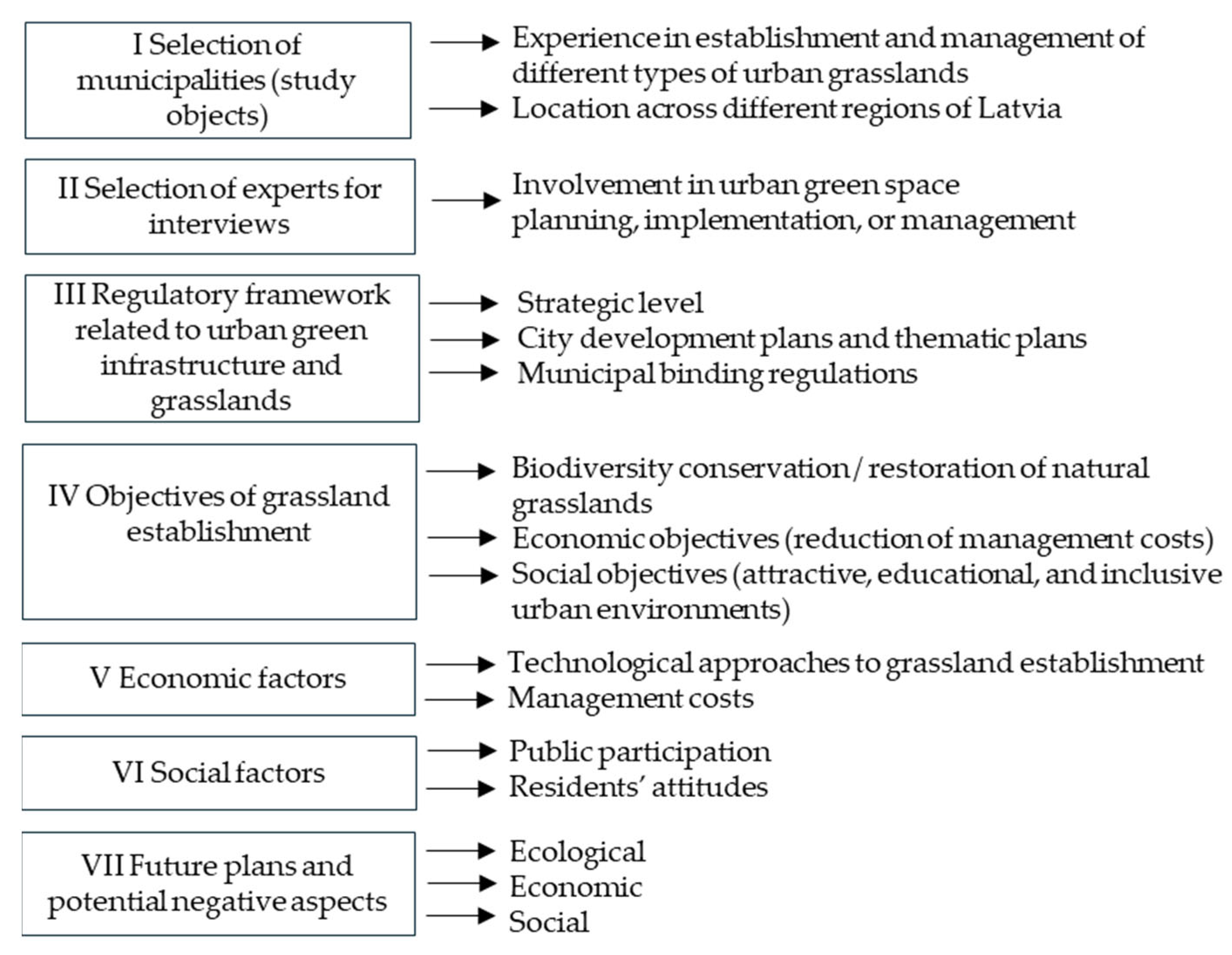
3. Materials and Methods
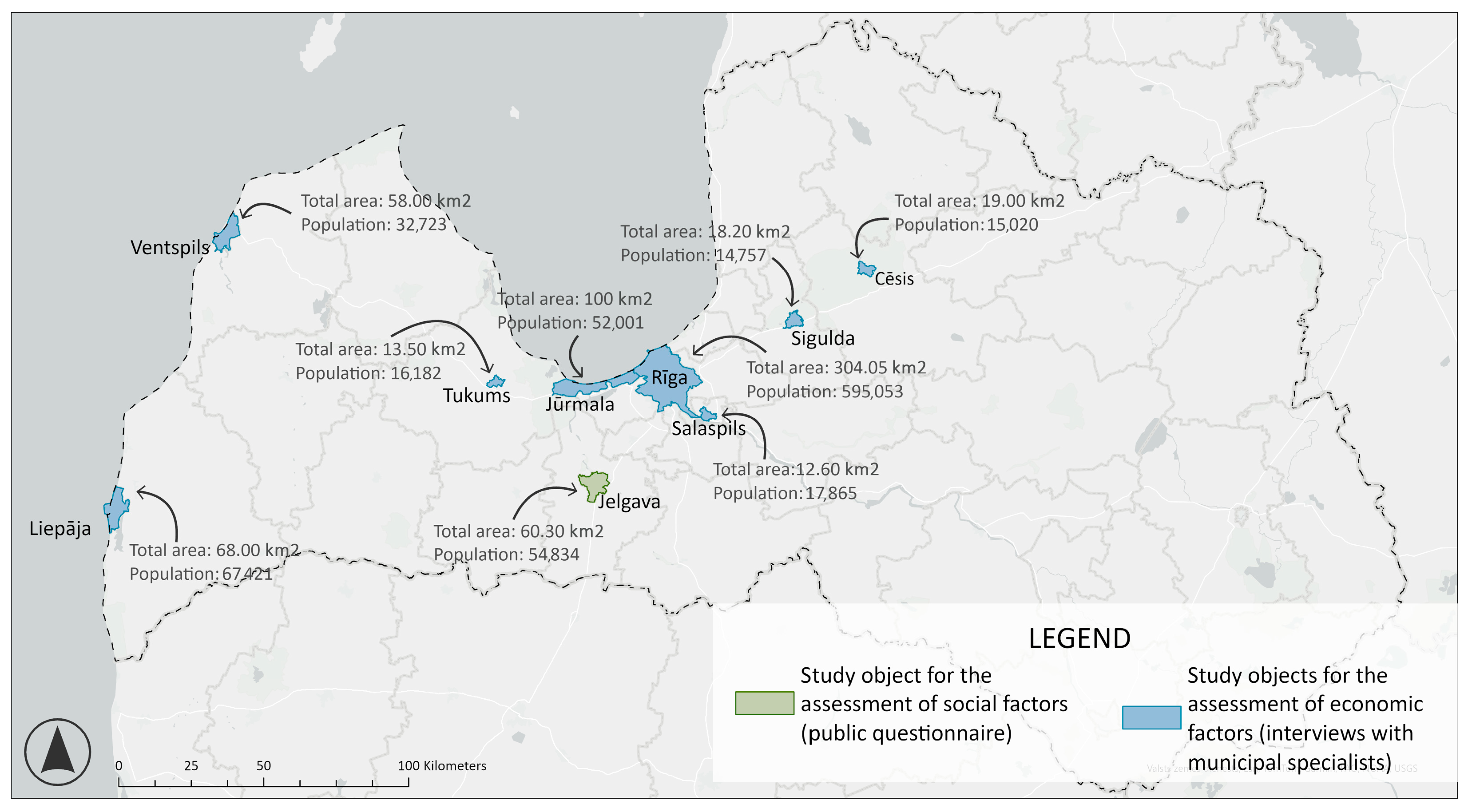
3.1. Study Areas
- The establishment of grasslands through modifications of existing grassland management practices (e.g., reduced mowing frequency and removal of cut biomass);
- The enhancement of plant species diversity in existing grasslands through the overseeding of native perennial and grass species;
- The creation of new urban meadows using either locally sourced plant seeds or mixed seed mixtures of diverse origins to form visually attractive meadow landscapes;
- The establishment of meadow-like plantings composed of perennials and grasses;
- The management and promotion of existing protected grassland habitats.
3.2. Methods
3.2.1. Expert (Municipal Specialist) Interviews for the Identification of Institutional Factors
3.2.2. Public Survey for the Identification of Social Factors
4. Results
4.1. Socio-Institutional Factors Influencing Grassland Implementation from the Perspective of Municipal Authorities
4.1.1. Regulatory Framework and Terminology
4.1.2. Objectives of Grassland Establishment
4.1.3. Grassland Management Approaches and Maintenance Costs
4.1.4. Public Attitude and Participation
4.1.5. Future Potential and Possible Risks
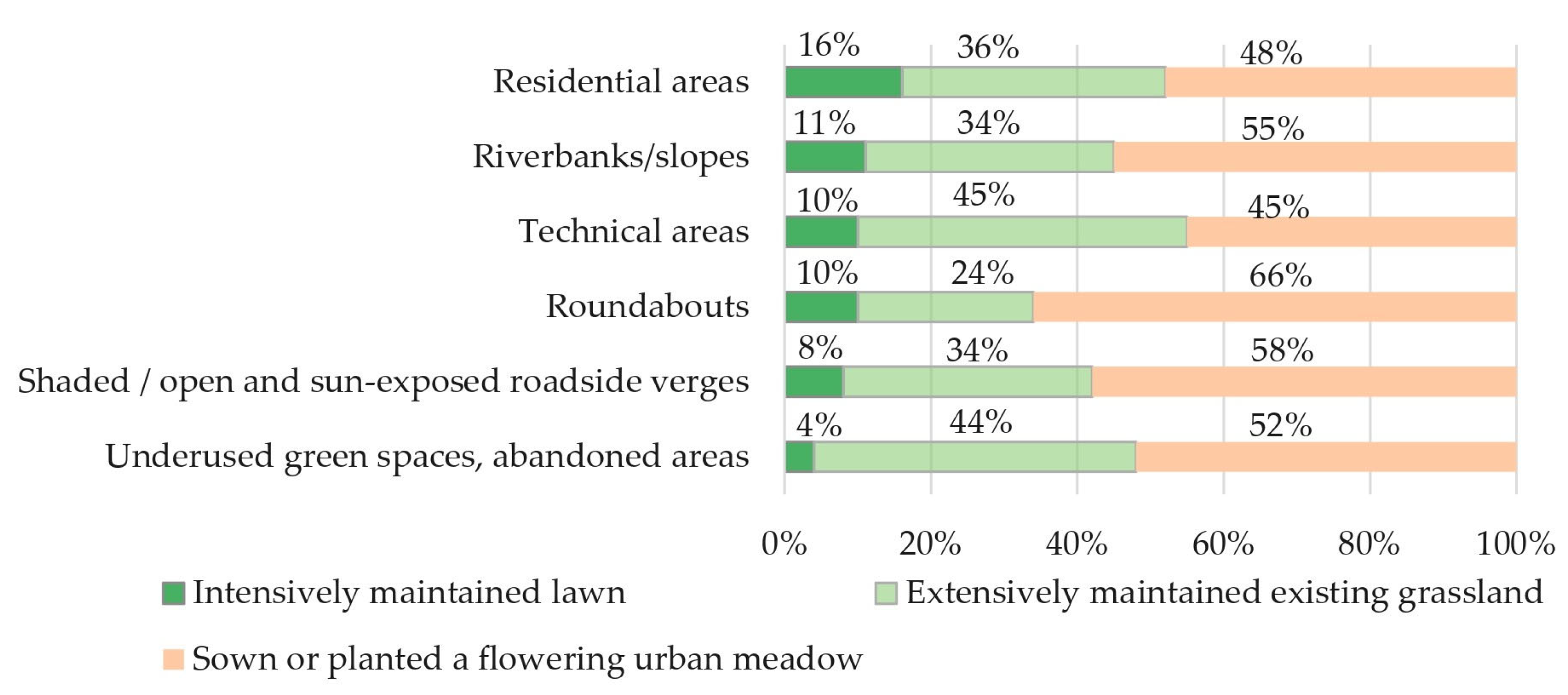
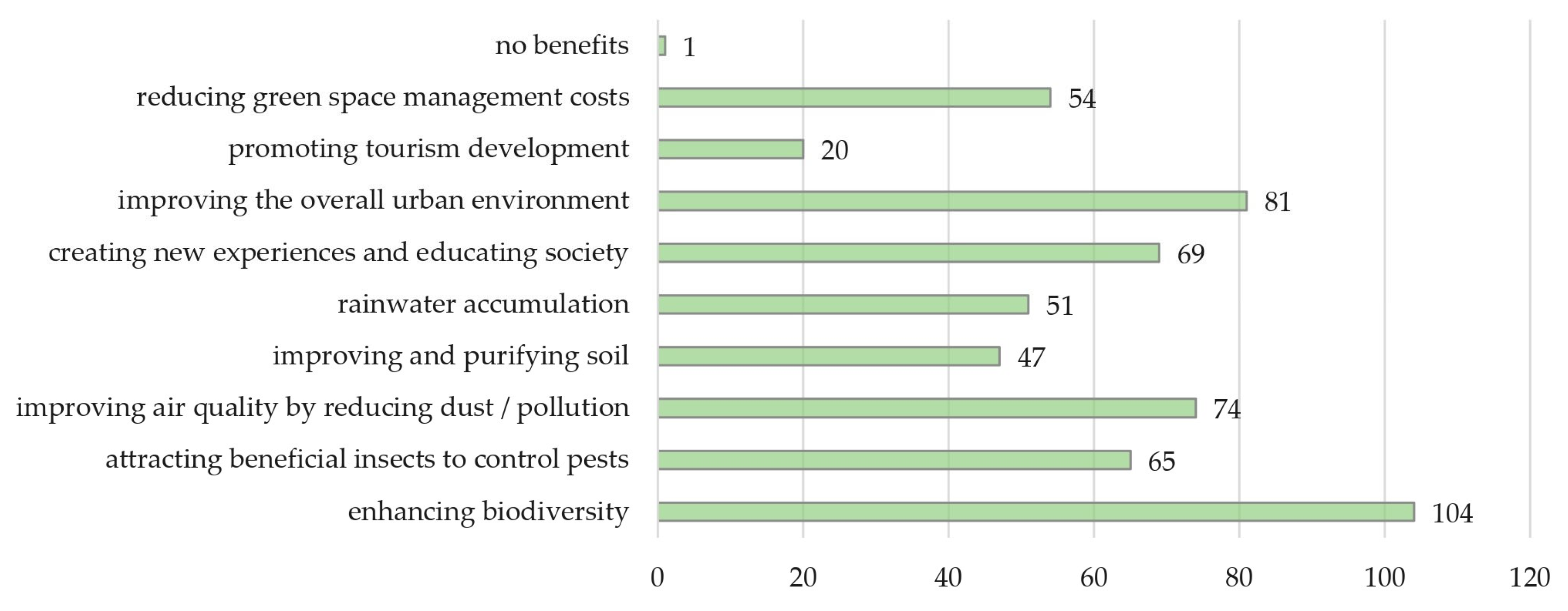
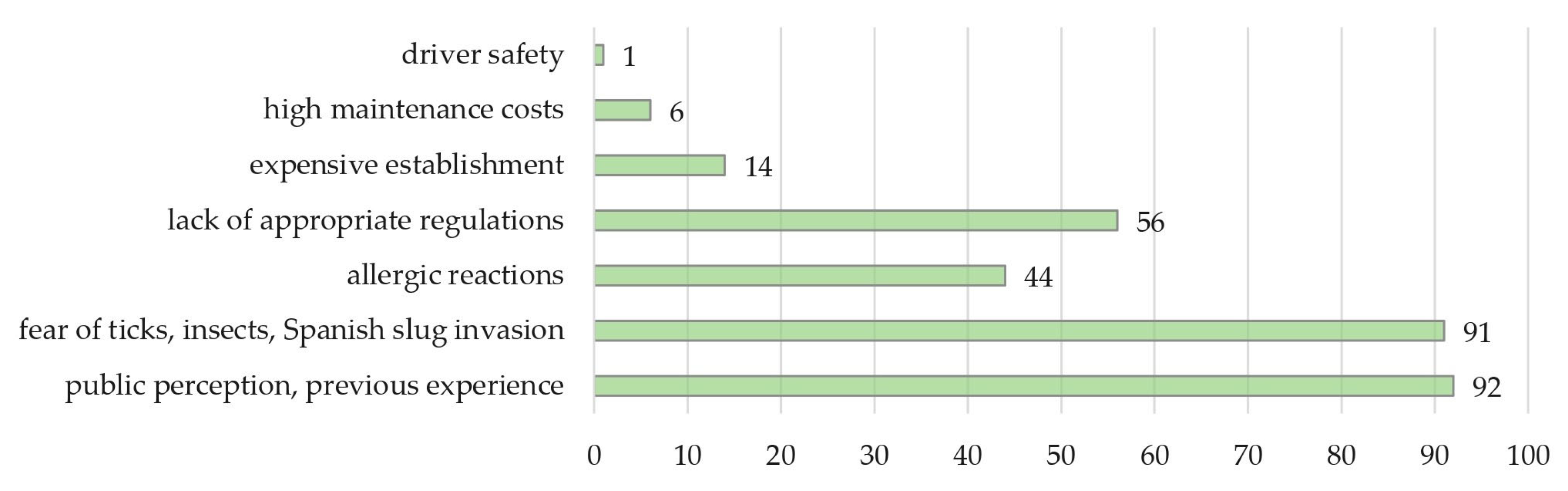
4.2. Public Perception of Grassland Implementation in Urban Areas
5. Discussion
5.1. Institutional Perspective for Integration of Urban Grasslands into City Green Infrastructure
5.2. Social Challenges for Urban Grasslands
6. Conclusions
Author Contributions
Funding
Institutional Review Board Statement
Informed Consent Statement
Data Availability Statement
Conflicts of Interest
Correction Statement
References
- Rūsina, S. (Ed.) Outstanding Semi-Natural Grassland Sites in Latvia: Biodiversity, Management, Restoration; University of Latvia: Riga, Latvia, 2017. [Google Scholar]
- European Commission. EU Biodiversity Strategy for 2030. Available online: https://environment.ec.europa.eu/strategy/biodiversity-strategy-2030_en (accessed on 16 January 2026).
- Mollashahi, H.; Szymura, M.; Szymura, T.H. Connectivity assessment and prioritization of urban grasslands as a helpful tool for effective management of urban ecosystem services. PLoS ONE 2020, 15, e0244452. [Google Scholar] [CrossRef] [PubMed]
- Dushkova, D.; Ignatieva, M. Rethinking Urban Lawns: Rewilding and other Nature-Based Alternatives. Diversity 2025, 17, 830. [Google Scholar] [CrossRef]
- Lhomme-Duchadeuil, A. Urban Naturalistic Meadows to Promote Cultural and Regulating Ecosystem Services. Doctoral Dissertation, The University of Sheffield, Sheffield, UK, 2018. [Google Scholar]
- Hedblom, M.; Lindberg, F.; Vogel, E.; Wissman, J.; Ahrné, K. Estimating urban lawn cover in space and time: Case studies in three Swedish cities. Urban Ecosyst. 2017, 20, 109–1119. [Google Scholar] [CrossRef]
- Ignatieva, M. Lawn Alternatives in Sweden: From Theory to Practice; Swedish University of Agricultural Sciences: Uppsala, Sweden, 2017. [Google Scholar]
- Paudel, S.; States, S.L. Urban green spaces and sustainability: Exploring the ecosystem services and disservices of grassy lawns versus floral meadows. Urban For. Urban Green. 2023, 84, 127932. [Google Scholar] [CrossRef]
- Hoyle, H.; Jorgensen, A.; Warren, P.; Dunnett, N.; Evans, K. “Not in their front yard” The opportunities and challenges of introducing perennial urban meadows: A local authority stakeholder perspective. Urban For. Urban Green. 2017, 25, 139–149. [Google Scholar] [CrossRef]
- Filibeck, G.; Petrella, P.; Cornelini, P. All ecosystems look messy, but some more so than others: A case-study on the management and acceptance of Mediterranean urban grasslands. Urban For. Urban Green. 2015, 15, 32–39. [Google Scholar] [CrossRef]
- Latvijas Dabas Fonds. ULC Urban Meadows. Available online: https://ldf.lv/en/project-tab/ulc-urban-meadows/ (accessed on 2 December 2024).
- Latvijas Dabas fonds. UrbanLIFEcircles. Available online: https://ldf.lv/en/projects/urbanlifecircles/ (accessed on 2 December 2024).
- GrassLife. Available online: https://www.grasslife.lv/ (accessed on 16 January 2026).
- Ignatieva, M.; Eriksson, F.; Eriksson, T.; Berg, P.; Hedblom, M. The lawn as a social and cultural phenomenon in Sweden. Urban For. Urban Green. 2017, 21, 213–223. [Google Scholar] [CrossRef]
- Southon, G.E.; Jorgensen, A.; Dunnett, N.; Hoyle, H.; Evans, K.L. Biodiverse perennial meadows have aesthetic value and increase residents’ perceptions of site quality in urban green-space. Landsc. Urban Plan. 2016, 158, 105–118. [Google Scholar] [CrossRef]
- Swacha, G.; Raduła, M.W.; Jewticz, S.; Kusak, B.; Świerszcz, S. Varying patterns of taxonomic and functional plant composition and diversity across different types of urban and rural grasslands. Land Degrad. Dev. 2024, 35, 4997–5010. [Google Scholar] [CrossRef]
- McFrederick, Q.S.; LeBuhn, G. Are urban parks refuges for bumble bees Bombus spp. (Hymenoptera: Apidae)? Biol. Conserv. 2005, 129, 372–382. [Google Scholar] [CrossRef]
- Bauer, T.; Höfer, H.; Schirmel, J. Dry grasslands in urban areas can harbour arthropod species of local conservation concern and should be prioritised for biodiversity-friendly mowing regimes. Insect Conserv. Divers. 2024, 17, 811–825. [Google Scholar] [CrossRef]
- Nawrocki, A.; Popek, R.; Sikorski, P.; Wińska-Krysiak, M.; Zhu, C.-Y.; Przybysz, A. Air phyto-cleaning by an urban meadow: Filling the winter gap. Ecol. Indic. 2023, 151, 110259. [Google Scholar] [CrossRef]
- Baruch, Z.; Liddicoat, C.; Cando-Dumancela, C.; Laws, M.; Morelli, H.; Weinstein, P.; Young, J.M.; Breed, M.F. Increased plant species richness associates with greater soil bacterial diversity in urban green spaces. Environ. Res. 2020, 196, 110425. [Google Scholar] [CrossRef]
- Petrova, S.; Velcheva, I.; Nikolov, B.; Angelov, N.; Hristozova, G.; Zaprjanova, P.; Valcheva, E.; Golubinova, I.; Marinov-Serafimov, P.; Petrov, P.; et al. Nature-Based solutions for the sustainable management of urban soils and quality of life improvements. Land 2022, 11, 569. [Google Scholar] [CrossRef]
- Przybysz, A.; Popek, R.; Stankiewicz-Kosyl, M.; Zhu, C.; Małecka-Przybysz, M.; Maulidyawati, T.; Mikowska, K.; Deluga, D.; Griżuk, K.; Sokalski-Wieczorek, J.; et al. Where trees cannot grow—Particulate matter accumulation by urban meadows. Sci. Total Environ. 2021, 785, 147310. [Google Scholar] [CrossRef] [PubMed]
- Watson, C.J.; Carignan-Guillemette, L.; Turcotte, C.; Maire, V.; Proulx, R. Ecological and economic benefits of low-intensity urban lawn management. J. Appl. Ecol. 2019, 57, 436–446. [Google Scholar] [CrossRef]
- European Commission. EU Green Infrastructure Strategy. Available online: https://environment.ec.europa.eu/topics/nature-and-biodiversity/green-infrastructure_en (accessed on 19 January 2026).
- European Commission. The European Green Deal. European Commission. Available online: https://commission.europa.eu/strategy-and-policy/priorities-2019-2024/european-green-deal_en (accessed on 19 January 2026).
- New European Bauhaus: Beautiful, Sustainable, Together. New European Bauhaus. Available online: https://new-european-bauhaus.europa.eu/index_en (accessed on 19 January 2026).
- Official Statistics Portal of Latvia. Population of State cities, towns. Available online: https://stat.gov.lv/en/statistics-themes/population/population/247-population-and-population-change (accessed on 10 January 2026).
- Official Statistics Portal of Latvia. Total and land area of cities, towns. Available online: https://stat.gov.lv/en/statistics-themes/environment/nature-resources/tables/drt011-total-and-land-area-regions-cities (accessed on 10 January 2026).
- Rīgas Valstspilsētas Pašvaldība. Available online: https://www.riga.lv/en (accessed on 20 December 2025).
- Jūrmalas Valstspilsētas Pašvaldība. Available online: https://www.jurmala.lv/ (accessed on 20 December 2025).
- Jūrmalas Valstspilsētas Pašvaldība. Dabas Liegums “Lielupes Grīvas Pļavas”. Available online: https://www.jurmala.lv/lv/dabas-liegums-lielupes-grivas-plavas (accessed on 20 December 2025).
- Liepāja. Available online: https://www.liepaja.lv/ (accessed on 20 December 2025).
- Liepajniekiem.lv. Foto: Pļavas Ienāk Pilsētā. Available online: https://www.liepajniekiem.lv/zinas/sabiedriba/foto-plavas-ienak-pilseta/ (accessed on 20 December 2025).
- Ventspils Pilsētas Pašvaldība. Ventspils. Available online: https://www.ventspils.lv/ (accessed on 28 January 2026).
- Cēsu Novada Pašvaldība. Cēsis Town. Available online: https://www.cesis.lv/lv (accessed on 10 January 2026).
- Cēsu Novada Pašvaldība. Cēsu Novada Pašvaldība Īstenos Projektu Zālāju Biotopu Atjaunošanai un Uzturēšanai. Available online: https://www.cesis.lv/lv/novads/aktualitates/zinas/vide/cesu-novada-pasvaldiba-istenos-projektu-zalaju-biotopu-atjaunosanai-un-uzturesanai/ (accessed on 10 January 2026).
- Siguldas Novada Pašvaldība. Siguldas Pilsēta. Sākums. Available online: https://sigulda.lv/ (accessed on 16 April 2024).
- Siguldas Novada Pašvaldība. Siguldas Pilsētā Veido Dabiski Skaistas Pļavas; Aicinām Tās Izmantot Svētkos. Available online: https://sigulda.lv/siguldas-pilseta-veido-dabiski-skaistas-plavas-aicinam-tas-izmantot-svetkos/ (accessed on 19 September 2024).
- Tukuma Novada Dome. About the City. Available online: https://www.tukums.lv/en/about-city (accessed on 10 January 2026).
- Tukuma Novada Dome. Dabīgās Pļavas—Daļa no Topošās “Ziedoņa dārza Mālkalnā” Dārzu Skolas. Available online: https://www.tukums.lv/lv/jaunums/dabigas-plavas-dala-no-toposas-ziedona-darza-malkalna-darzu-skolas (accessed on 10 January 2026).
- Salaspils Novada Pašvaldība. Salaspils Pilsēta. Available online: https://www.salaspils.lv/ (accessed on 16 January 2026).
- Salaspils Novada Pašvaldība. Top Oāze Pilsētas Centrā. Salaspils. Available online: https://salaspils.lv/lv/node/935 (accessed on 16 January 2026).
- Jelgavas Valstspilsētas Pašvaldība. Sākumlapa—Jelgava. Jelgava. Available online: https://www.jelgava.lv/ (accessed on 16 January 2026).
- Jelgavas Valstspilsētas Pašvaldība. Jelgavas Pilsētvidē Eksperimentāli Mēģinās Atjaunot Dabiskas Puķu Pļavas. Jelgava. Available online: https://www.jelgava.lv/jaunumi/pilseta/jelgavas-pilsetvide-eksperimentali-meginas-atjaunot-dabiskas-puku-plavas/ (accessed on 16 January 2026).
- Eiter, S.; Vik, M.L. Public participation in landscape planning: Effective methods for implementing the European Landscape Convention in Norway. Land Use Policy 2014, 44, 44–53. [Google Scholar] [CrossRef]
- Roth, M. Validating the use of Internet survey techniques in visual landscape assessment—An empirical study from Germany. Landsc. Urban Plan. 2005, 78, 179–192. [Google Scholar] [CrossRef]
- Taherdoost, H. Sampling Methods in Research Methodology. How to Choose a Sampling Technique for Research. Int. J. Acad. Res. Manag. 2016, 5, 18–27. [Google Scholar] [CrossRef]
- Memon, M.A.; Ting, H.; Cheah, J.-H.; Thurasamy, R.; Chuah, F.; Cham, T.H. Sample Size for Survey Research: Review and Recommendations. J. Appl. Struct. Equ. Model. 2020, 4, i-xx. [Google Scholar] [CrossRef]
- Lindemann-Matthies, P.; Bose, E. Species richness, structural diversity and species composition in meadows created by visitors of a botanical garden in Switzerland. Landsc. Urban Plan. 2007, 79, 298–307. [Google Scholar] [CrossRef]
- Bar-Hillel, M. The Role of Sample Size in Sample Evaluation. Organ. Behav. Hum. Perform. 1979, 24, 245–-257. [Google Scholar] [CrossRef]
- Personal Data Regulation—2016/679—EN—Gdpr—EUR-Lex. Available online: https://eur-lex.europa.eu/eli/reg/2016/679/oj (accessed on 19 January 2026).
- Apstādījumu Uzturēšanas un Aizsardzības Noteikumi Cēsu Novada Pašvaldības Teritorijā. LIKUMI.LV. Available online: https://likumi.lv/ta/id/349588-apstadijumu-uzturesanas-un-aizsardzibas-noteikumi-cesu-novada-pasvaldibas-teritorija (accessed on 20 December 2025).
- Rīgas Dome. Rīgas Domes Saistošie Noteikumi Nr. RD-24-270-sn “Rīgas Valstspilsētas Pašvaldības Teritorijas Kopšanas un Būvju Uzturēšanas Saistošie Noteikumi”. 2024. Available online: https://likumi.lv/ta/id/353198-rigas-valstspilsetas-pasvaldibas-teritorijas-kopsanas-un-buvju-uzturesanas-saistosie-noteikumi (accessed on 20 December 2025).
- Pilsētvidē Atgriežas Daba—Cēsis Uzsākušas Veidot Dabiskās Pļavas—Jaunie Vides Reportieri. Available online: https://jvr.lv/jvrblogs/pilsetvide-atgriezas-daba-cesis-uzsakusas-veidot-dabiskas-plavas/ (accessed on 19 January 2026).
- ReTV. Valmierā Sāk Veidot Dabisko Pļavu. ReTV. Available online: https://retv.lv/raksts/valmiera-sak-veidot-dabisko-plavu/ (accessed on 15 December 2025).
- Latvijas Ornitoloģijas Biedrība. Lielupes Palienes Pļavas. Available online: https://www.lob.lv/projekti/latvijas-palienu-plavu-atjaunosana-es-prioritaro-sugu-un-biotopu-aizsardzibai/lielupes-palienes-plavas/ (accessed on 20 January 2026).
- Dabisko Pļavu Krāšņums Ienāk Pilsētvidē. Available online: https://sigulda.lv/dabisko-plavu-krasnums-ienak-pilsetvide/ (accessed on 19 September 2024).
- Dabisko Pļavu Produkts. Available online: https://dabiskoplavuprodukts.lv/ (accessed on 21 January 2026).





| Study Areas Area/Population (1 January 2025) [27,28] | City Landscape Characteristics | Implemented Projects or Activities Related to Urban Grasslands | Aspects Considered in the Implementation of Urban Grasslands in Current Projects or Activities | ||
|---|---|---|---|---|---|
| Ecological | Economic | Social | |||
| Rīga * Area: 304.05 km2 Population: 595,053 |
|
| The grasslands are established by sowing locally sourced native perennial and grass species. | Reduced mowing (compared to conventional lawns) is part of the management approach. | Residents join seed-collection and sowing workshops, propose meadow sites, monitor them, and report to LDF. Informational boards are placed next to urban meadows. |
| Jūrmala * Area: 100.00 km2 Population: 52,001 |
|
| The reserve protects coastal and Lielupe River floodplain grasslands, encompassing multiple biotopes and species. | No information on economic aspects is provided. | Visitor infrastructure (trails and recreation areas) is integrated into the nature protection plan to support public awareness and education. |
| Liepāja * Area: 68.00 km2 Population: 67,421 |
|
| Meadow-like plantings are designed to naturalise and self-propagate. | More cost- and labour-efficient meadow-style plantings compared to traditional flowerbeds. | No targeted or specific activities are described. |
| Ventspils * Area: 58.00 km2 Population: 32,723 |
|
| Protection of natural coastal grasslands. | No information on economic aspects is provided. | No information on social aspects is provided. |
| Cēsis * Area: 19.00 km2 Population: 15,020 |
|
| Landscape/natural grasslands managed to support biodiversity. | Reduced mowing (once per season) compared to conventional lawn maintenance. | No targeted or specific activities are described. |
| Sigulda * Area: 18.20 km2 Population: 14,757 |
|
| Natural-looking meadows (using mixed seed sources). | No information on economic aspects is provided. | Positive attitude from residents and visitors. |
| Tukums * Area: 13.50 km2 Population: 16,182 |
|
| Developing grassland areas through targeted management of existing grasslands. | No information on economic aspects is provided. | No information on social aspects is provided. |
| Salaspils * Area: 12.60 km2 Population: 17,865 |
|
| Seeded/established natural grassland (seed mixture). | No information on economic aspects is provided. | Involvement of children and youth from an art studio in creating seed-mix species illustrations for an on-site educational display. |
| Jelgava ** Area: 60.30 km2 Population: 54,834 |
|
| Enhanced biodiversity through the overseeding of native perennials and grasses and the modification of existing grassland management practices. | Reduced management intensity, allowing grasslands to develop naturally. | No information on social aspects is provided. |
| No | Survey Question | Question Type | Predefined Response Options |
|---|---|---|---|
| I Respondent Profile and Connection to the City of Jelgava | |||
| 1. | Age | Demographic/multiple-choice question | (a) <18; (b) 18–25; (c) 26–45; (d) 46–60; (e) >60 |
| 2. | Occupation | Demographic/multiple-response question | (a) environmental protection, biology, forestry, ecology; (b) spatial planning, architecture, landscape architecture, urban planning; (c) horticulture, territory management; (d) education, science; (e) culture, art; (f) state or municipal institution; (g) private sector; (h) pupil, student; (i) retiree |
| 3. | Frequency of presence in Jelgava | Multiple-choice question | (a) every day, I live in Jelgava; (b) almost every day, I work in Jelgava; (c) I visit for leisure or as a tourist less than once a month; (d) I have not been to Jelgava |
| II Respondents’ understanding and general attitude towards urban grasslands | |||
| 4. | Indicate how much attention you pay to urban greenery in your daily life | Likert scale responses | point scale—0 (do not pay attention at all) to 5 (pay very close attention) |
| 5. | Understanding of the concept “urban grasslands” | Multiple-response/open-ended question | (a) extensively maintained (mown) existing grassland; (b) established (sown) flowering urban grassland; (c) planted perennial and grass species; (d) other |
| 6. | Would you like urban grasslands to be established in Jelgava city? | Multiple-choice/open-ended question | (a) yes; (b) yes, but only in certain locations; (c) no; (d) other |
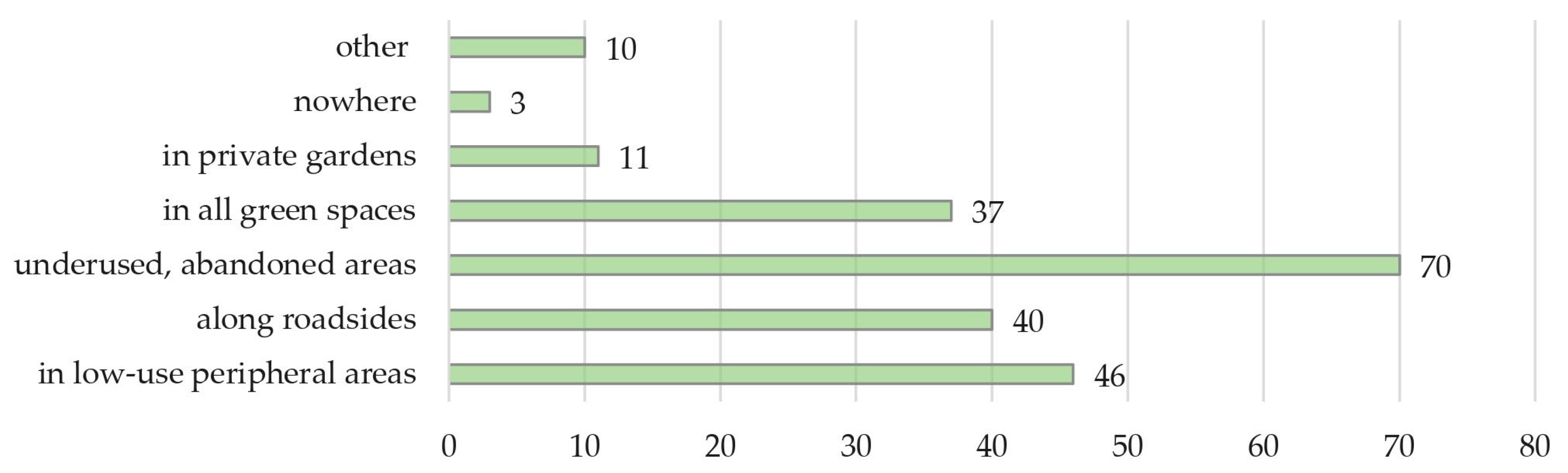
| 7. | In which parts of Jelgava city do you think the establishment of urban grasslands would be most appropriate? | Multiple-response/open-ended question | (a) in low-use peripheral areas of the city with lower pedestrian traffic; (b) along roadsides; (c) in underused and abandoned areas; (d) in all urban green spaces; (e) in private gardens; (f) in no areas; (g) other |
| III Selection of urban grassland scenarios and their suitability for different urban areas | |||
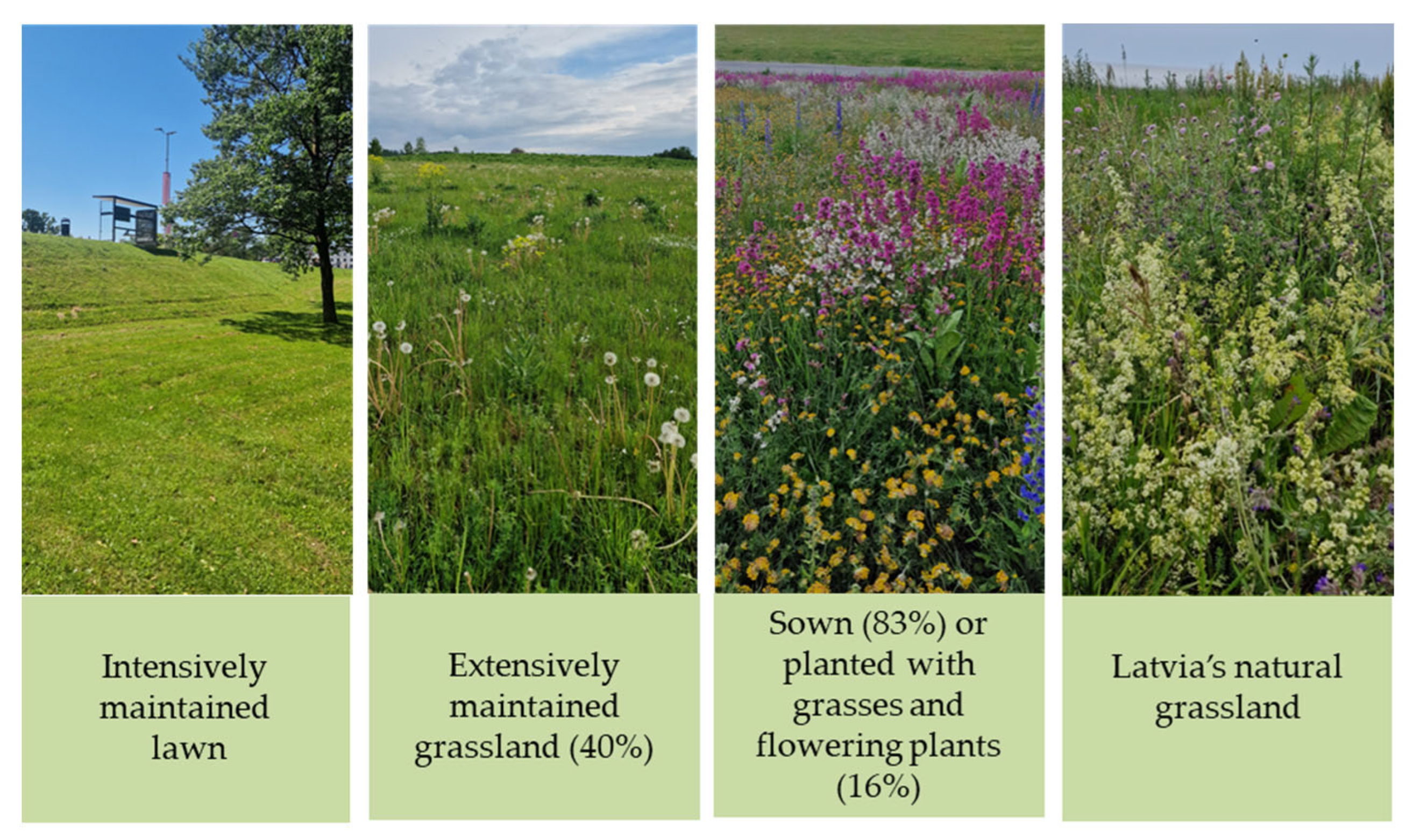
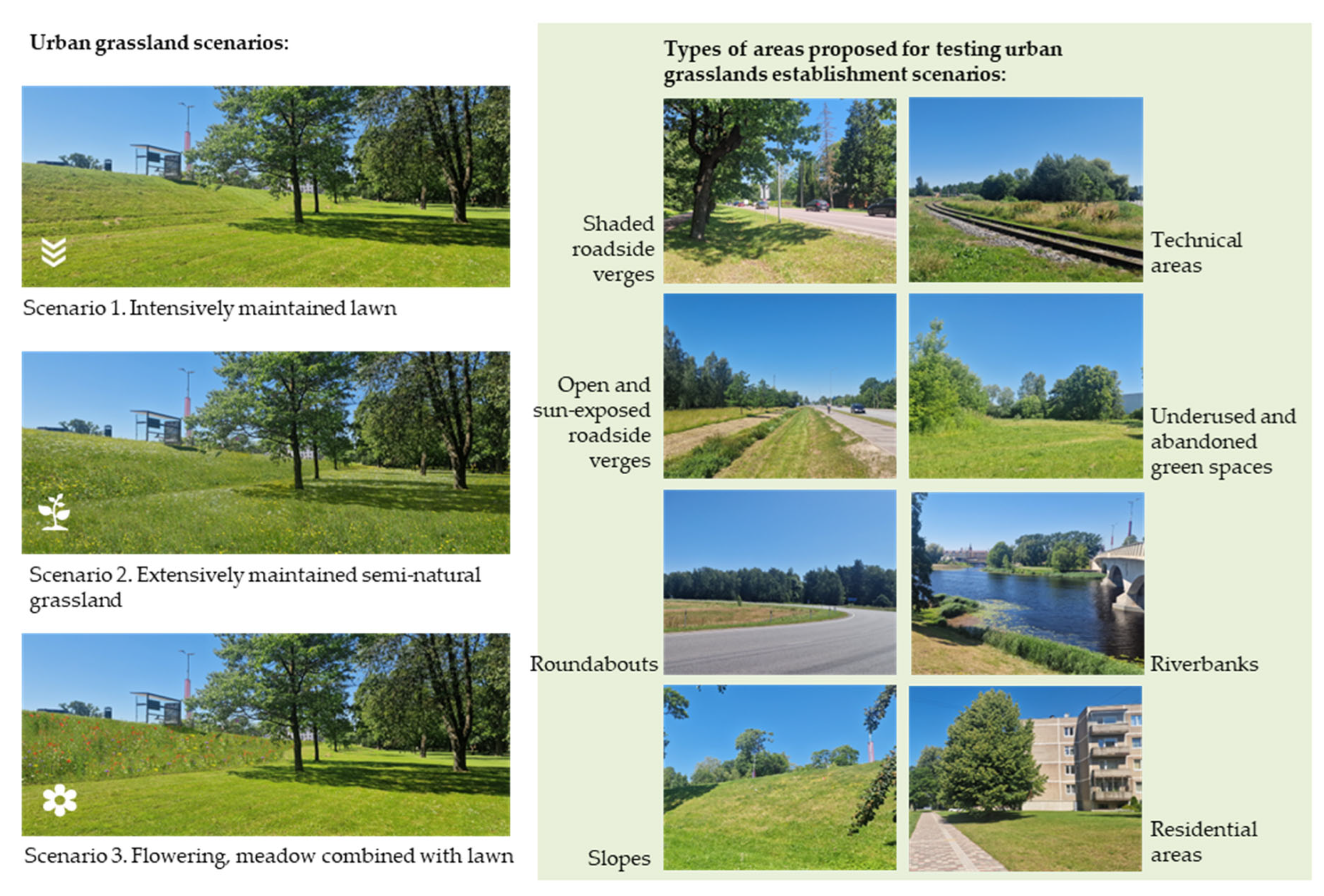
| 8. | Types of urban areas: residential areas | Multiple-response question | Scenarios/Photoshop models for each type of urban areas based on photographs of the existing situation: (a) intensively maintained lawn; (b) extensively maintained existing grassland *; (c) sown or planted a flowering urban meadow * |
| 9. | riverbanks/slopes | ||
| 10. | technical areas | ||
| 11. | roundabouts | ||
| 12. | shaded roadsides | ||
| 13. | open, sun-exposed roadsides | ||
| 14. | underused green spaces, abandoned areas | ||
| IV Benefits and constraints | |||
| 15. | Main benefits of establishing urban grasslands | Multiple-response question | (a) enhancing biodiversity and attracting pollinators; (b) attracting (beneficial insects to control pests; (c) improving air quality by reducing dust and pollution; (d) improving soil quality and helps remediate contamination; (e) rainwater accumulation; (f) creating new, engaging experiences and educating the public about nature; (g) improving the overall urban environment; (h) promoting tourism development; (i) reducing green space management costs; (j) no benefits |
| 16. | Limitations of establishing urban meadows | Multiple-response question | (a) existing public perceptions and previous experience, associating urban meadows with “weed fields,” overgrown lawns, or neglected areas; b) fear of the presence of insects and ticks, or the risk of Spanish slug (Arion vulgaris) invasion; (c) allergic reactions to plant species found in grasslands; (d) urban regulations not adapted to grassland management, for example restrictions on permissible grass height; (e) high establishment costs; (f) high maintenance costs |
| 17. | Are you aware of any other examples of urban meadow development? If yes, please specify the cities | Open-ended question | |
Disclaimer/Publisher’s Note: The statements, opinions and data contained in all publications are solely those of the individual author(s) and contributor(s) and not of MDPI and/or the editor(s). MDPI and/or the editor(s) disclaim responsibility for any injury to people or property resulting from any ideas, methods, instructions or products referred to in the content. |
© 2026 by the authors. Licensee MDPI, Basel, Switzerland. This article is an open access article distributed under the terms and conditions of the Creative Commons Attribution (CC BY) license.
Share and Cite
Skujane, D.; Nitavska, N.; Markova, M.; Lagzdina, A.; Cavare, A. Opportunities and Barriers to Integrating Urban Grasslands into Green Infrastructure: A Socio-Institutional Assessment of Latvian Cities. Land 2026, 15, 505. https://doi.org/10.3390/land15030505
Skujane D, Nitavska N, Markova M, Lagzdina A, Cavare A. Opportunities and Barriers to Integrating Urban Grasslands into Green Infrastructure: A Socio-Institutional Assessment of Latvian Cities. Land. 2026; 15(3):505. https://doi.org/10.3390/land15030505
Chicago/Turabian StyleSkujane, Daiga, Natalija Nitavska, Madara Markova, Anete Lagzdina, and Alise Cavare. 2026. "Opportunities and Barriers to Integrating Urban Grasslands into Green Infrastructure: A Socio-Institutional Assessment of Latvian Cities" Land 15, no. 3: 505. https://doi.org/10.3390/land15030505
APA StyleSkujane, D., Nitavska, N., Markova, M., Lagzdina, A., & Cavare, A. (2026). Opportunities and Barriers to Integrating Urban Grasslands into Green Infrastructure: A Socio-Institutional Assessment of Latvian Cities. Land, 15(3), 505. https://doi.org/10.3390/land15030505