Article

Composition of Dinoflagellate Resting Cyst Assemblages and Its Monthly Variability in a Shallow Mediterranean Lagoon (Santa Giusta Lagoon, Sardinia, Italy)
by
Cecilia Teodora Satta
1,*,
Bachisio Mario Padedda
2,
Silvia Pulina
2,
Nicola Fois
1 and
Antonella Lugliè
2
1
Agenzia Regionale per la Ricerca in Agricoltura (AGRIS), Loc. Bonassai, 07100 Sassari, Sardinia, Italy
2
Dipartimento di Architettura, Design e Urbanistica, University of Sassari, 07100 Sassari, Sardinia, Italy
*
Author to whom correspondence should be addressed.
Water 2025, 17(17), 2635; https://doi.org/10.3390/w17172635
Submission received: 4 July 2025 / Revised: 27 August 2025 / Accepted: 4 September 2025 / Published: 6 September 2025
(This article belongs to the Section Biodiversity and Functionality of Aquatic Ecosystems)

Abstract

The present study identifies and quantifies the dinoflagellate resting cysts along an annual cycle from a shallow Mediterranean lagoon. Sediment samples were collected and analyzed for the determination of the dinoflagellate cyst density and composition at four sampling stations in Santa Giusta Lagoon (Oristano Gulf) from March 2015 to February 2016. At the same time, selected physicochemical variables and the cell densities of the dinoflagellate species in the water column were measured and determined. The group of Peridiniales dominated the cyst assemblages at spatial and temporal scales, with an almost total prevalence of the autotrophic–mixotrophic taxa. Heterotrophic Peridiniales showed occasional importance, especially in the stations closest to the sea connections, as well as the group of Gonyaulacales and Gymnodiniales. The composition in morphotypes revealed the dominance of Ensiculifera tyrrhenica and Scrippsiella kirschiae in correspondence with the maximum cyst densities in the inner sampling stations. Cysts of Margalefidinium cf polykrikoides reached high density values following an intense summer bloom. Salinity, ammonia, and total nitrogen were the environmental variables more strongly correlated with the multivariate cyst assemblage structure. The monthly time-scale offered a more accurate focus on cyst assemblages changes in respect to the usual single seasonal sampling in Santa Giusta Lagoon. The obtained data provided further knowledge on the relation among cyst assemblage variability, environmental conditions, and dinoflagellate motile stages in the water column relevant for comparisons with similar ecosystems in the Mediterranean and worldwide.

1. Introduction

Dinoflagellates are eukaryotic organisms representing one of the most important phytoplankton groups. They contribute significantly to aquatic primary production, especially in marine coastal ecosystems [1]. At present, 123 species of dinoflagellate causing toxic Harmful algal blooms (HABs) are included in the IOC-UNESCO Taxonomic Reference List [2]. Consequently, the biology and ecology of many of these species have been intensively investigated, focusing on their complex life cycle [3,4].
At least 200 dinoflagellate species produce cysts as part of their life cycle [5,6]. These benthic phases have a crucial role in the ecology of cyst-producing species, as they can ensure survival, favor dispersion, provide a source of genetic diversity, and promote bloom initiation and its recurrence [7,8]. Cysts are non-motile and, once formed, generally sink and accumulate in the bottom sediments [8], remaining viable for a long time [9]. Hence, cysts represent a proxy of plankton populations, retaining useful information on dinoflagellate diversity and distribution, also contributing to overcome the discontinuity and/or ephemerality of species in the water column as vegetative stages [8,10,11]. In addition, cyst assemblage composition and distribution are recognized to be related to environmental factors such as temperature, salinity, nutrients, currents, and water stratification [12]. Consequently, the reconstruction of cyst assemblages can incorporate additional information on planktonic population dynamics in relation to environmental changes [12]. Moreover, dinoflagellate cysts have been considered as environmental indicators of past changes in temperature, salinity, turbulence, and sedimentary conditions [13]. In addition, some other studies connect certain cyst assemblage shifts to pollution, especially derived from cultural eutrophication and industrial discharges [14,15,16,17,18,19,20,21]. Among studies on dinoflagellate cysts, the seasonal dynamics of assemblages have been intensively investigated, while shorter-time-scale changes (e.g., monthly variability) have been less examined. Cyst studies at weekly or monthly time-scales have been primarily conducted using sediment traps [22] also in the Mediterranean area [23,24]. No cyst data at weekly or monthly time-scales are available from shallow transitional ecosystems, such as Mediterranean lagoons, probably because the use of traps is difficult in areas with such shallow waters.
Studies on cyst assemblages from shallow lagoon ecosystems are very sparse worldwide [25,26,27,28], although they have increased in recent years, especially in the Mediterranean, with a large contribution from the North African coasts [29,30,31,32,33,34]. Available Mediterranean data mainly examine the assemblage composition, morphotype identification, and the correlation to environmental conditions based on one or two sampling campaigns [29,30,32,33,34], whereas some others are mainly focused on harmful dinoflagellate species [35,36,37,38,39]. Just one study reports seasonal data on cyst assemblage composition [31].
The role of coastal lagoons as connection/transition between terrestrial and marine systems attributes great importance to these areas in ecological terms. In fact, lagoons support fundamental ecological services such as flood control, the prevention of seawater intrusion, groundwater recharge, shoreline stabilization, storm protection, the retention and export of sediment and nutrients, the mitigation of climate change, and water purification [40,41]. In addition, these ecosystems ensure habitats for bivalves, crustaceans, fish, and birds, supporting important biodiversity; they also represent fundamental nursery and feeding areas for some endangered species [42]. Lastly, coastal lagoon ecosystems support a wide range of human activities, including economic sectors such as fisheries and aquaculture, as well as leisure and tourism [40]. Increasing knowledge about poorly studied cyst assemblages can enhance our understanding of these peculiar and important ecosystems, also contributing to the general knowledge regarding dinoflagellate resting cyst dynamics. Consequently, this study reports, for the first time, dinoflagellate cyst data collected on a monthly scale over an annual period from a shallow coastal Mediterranean lagoon (Santa Giusta Lagoon, Sardinia, Italy). The objectives of the present study are (1) to investigate compositional changes in the cyst assemblages at a monthly scale and at a relatively small-spatial scale in a Mediterranean shallow lagoon, and (2) to investigate the relation between cyst assemblage variability, environmental conditions, and dinoflagellate motile stages in the water column.

2. Materials and Methods

2.1. Study Area

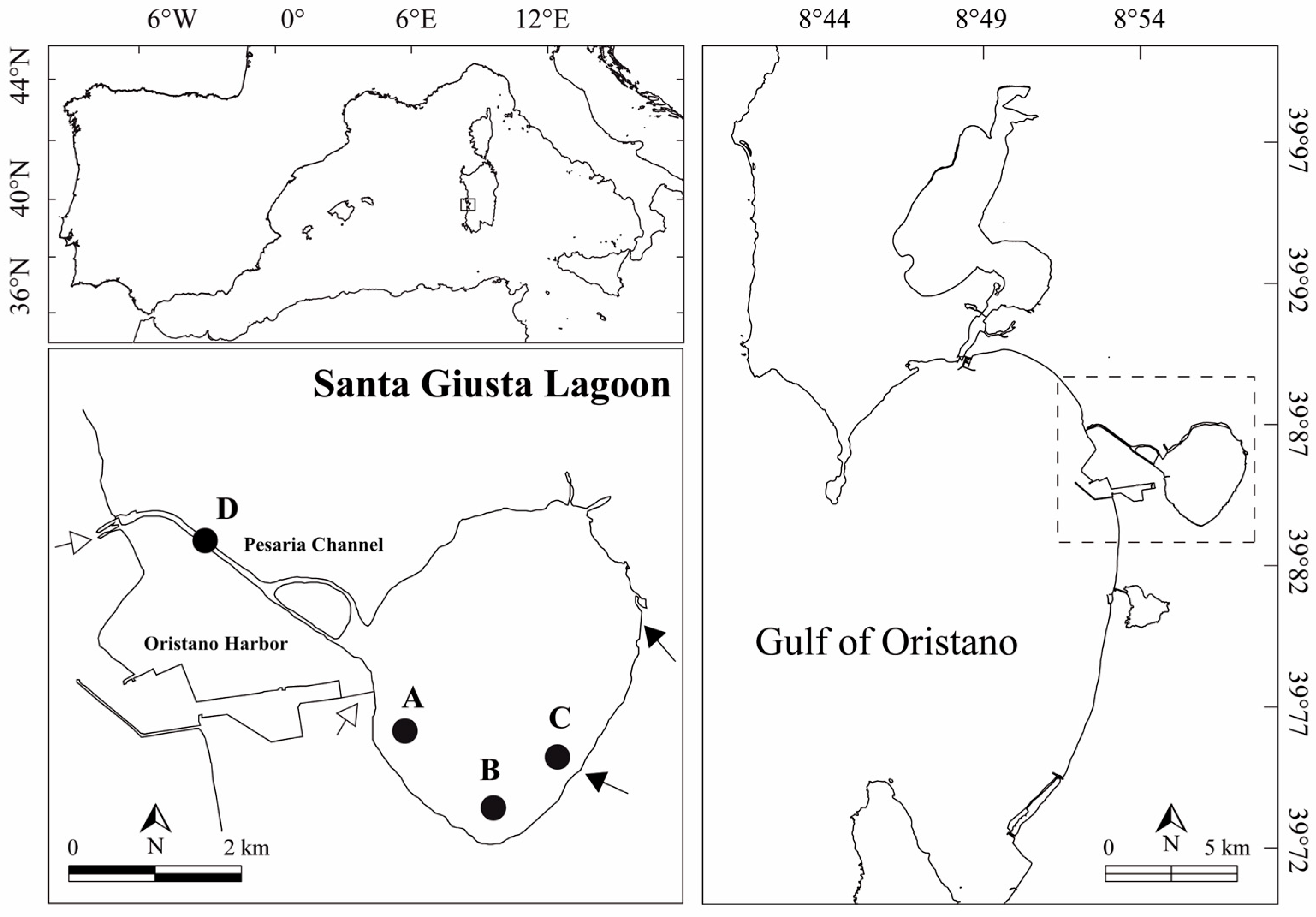
Santa Giusta Lagoon (SG) is located on the western coast of Sardinia (Mediterranean Sea, Italy; Figure 1). The lagoon is circular in shape. Its surface area is about 8 km2, and the mean water depth is about 1 m. The lagoon is connected to the Mediterranean Sea through the 3 km long Pesaria channel. Another canal connects the lagoon to the industrial harbor of Oristano. This canal is controlled by floodgates that are opened periodically at low tide to prevent the inflow of harbor water, but allow for the lagoon water to flow out. The estimated residence time of SG is 7 days. Freshwater inputs derive from Rio Pauli Maiori and Rio Pauli Figu, located along the east side of the lagoon. The present configuration of the lagoon, especially the connection with the sea and the internal hydrodynamic, results from substantial modifications due to human actions [30]. Macrobenthic algae and phytoplankton are the most important primary producers in SG. The lagoon belongs to the “Marine Ecosystems of Sardinia” within the Italian Long-Term Ecological Research network (IT14-004-M; www.lteritalia.it; [43]). In addition, SG is a Site of Community Interest for European Union (SCI ITB030037), and it is a protected area for animals (Sardinian Government, INFS code: OR0211).
The lagoon is exploited for fishing by a cooperative of fishermen (Pescatori Santa Giusta Soc. Coop., Santa Giusta, Italy). Some articles report further information about SG [30,44,45].

2.2. Sampling and Analyses

2.2.1. Sediments

Sampling surveys were conducted monthly from March 2015 to February 2016 (except May 2015), covering the four seasons of the Mediterranean area (Mar–May: spring; Jun–Aug: summer; Sep–Nov: autumn; Dec–Feb: winter). Sediment cores were collected from 4 sampling stations (Figure 1). The sampling stations were chosen following the sediment grain size distribution and the previous information on dinoflagellate cyst patterns [30]. The four sampling stations showed some differences in position and the influence of sea water and depth (Table 1). Samples were collected using a hand-core sampler connected to cylindrical plastic tubes (40 cm long, 5 cm in diameter) [30]. Samples were stored in the dark at 4 °C and processed within 3 months from collection. The low depth of the water column (1 m on average) impeded the use of sediment traps. In any case, similar sampling strategies were adopted in other studies reporting seasonal variations in dinoflagellate cyst assemblages and of other benthic resting stages from plankton [46,47,48], as well as in comparable ecosystems [31].
The top 1 cm of each core sample from each station was sectioned. Subsamples (2–3 cm3) of each section were suspended into filtered seawater (FSW) and sonicated for 2 min using a Bandelin Sonoplus ultrasonic homogenizer (Bandelin electronic GmbH & Co. KG, Berlin, Germany). An additional subsample (2–3 cm3) from the same section was weighed and then dried at 105 °C for 24 h to obtain dry weight. Following sonication, samples were filtered through a 100 µm mesh and collected on a 10 µm mesh. The fraction obtained was washed with FSW and collected in a 50 mL tube (volume of about 20 mL). Subsamples (5–7 mL) of the slurry were processed for cyst concentration and separation from inorganic particles using the sodium polytungstate (SPT) method [49], adding the SPT solution (density of 2.1 g cm−3) at the second centrifugation step [50]. The resulting sample was rinsed in a 10 µm mesh and collected in 5–15 mL of FSW. Final cyst sample aliquots were counted in 3 mL sedimentation chambers with a Zeiss Axiovert 10 (Carl Zeiss AG, Obekochen, Germany) inverted microscope at ×400 magnification. At least 200–300 cysts were counted for each sample. All cysts found in the sample were counted in case of a smaller number of cysts. Empty cysts were not considered. The pellet excluded from the density gradient was checked to avoid the possible loss of resting cysts due to the presence of cyst clusters [51].
Cyst identification, nomenclature, and terminology were based on the literature reported in Satta et al. [52]. The Scrippsiella trochoidea (=S. acuminata) complex was established for all morphotypes referring to this species [52]. The designation “round brown” (RB) was established to include spherical/oval peridinioid cysts that could not be identified due to an absence of information on the archeopyle and/or on vegetative stages, including cyst morphotypes referable to Protoperidinium, Diplopsalis, Echinidinium, Islandinium, Qia, Nia, and related genera. RB cysts were split into smooth (RBsm) and spiny (RBsp) types. Margalefidinium polykrikoides (Margalef) Gómez, Richlen et Anderson cyst identification was based on the published literature [53,54,55] and are reported as M. cf polykrikoides. Cysts with unknown affinity were classified as “others”. Cyst abundances are expressed as relative abundances (per cent) of the entire cyst assemblage and as the number of cysts per gram dry weight sediment.

2.2.2. Environmental Parameters, Phytoplankton, and Chlorophyll a

Samples for nutrient and phytoplankton analyses were collected at about 30 cm depth from the water’s surface in correspondence with sediment sampling stations from March 2015 to February 2016 (except for May 2015).
Salinity (S) and water temperature (T) were measured in situ using multiparameter probes (YSI 6600 v2, Yellow Springs, OH, USA). Reactive phosphorus (P-PO4), total organic phosphorous (TOP), ammonium (N-NH3), nitrate (N-NO3), nitrite (N-NO2), and total organic nitrogen (TON) concentrations were determined [56].
Phytoplankton samples were immediately fixed during samplings using a Lugol’s iodine solution. Dinoflagellate cell density was determined on the fixed sample under an Axiovert 25 inverted microscope (Carl Zeiss, Oberkochen, Germany) within 2 weeks after sampling [57]. At least 400–500 cells were counted in order to obtain statistically reliable results [58]. When this was not possible, all of the cells on the entire bottom of the sedimentation chamber were counted. Further information on phytoplankton taxonomic determination is reported in Pulina et al. [59].
Dinoflagellate taxa recorded in at least the 10% of samples were considered in the visualization of the results.
About 1 L of water, taken together with the previously mentioned samples, was filtered using Whatman GF/C filters for the determination of Chlorophyll a (Chla) using the spectrophotometric method after extraction in acetone [60].

2.3. Statistical Analyses

One-way analysis of variance (ANOVA) was applied to the monthly data of environmental parameters, exploring any significant difference among sampling stations. Tukey’s pairwise post hoc test was used to determine which sampling station significantly differed from each other. Data were square root-transformed before analyses to meet distributional assumptions of linear models (normality and homoscedasticity of residuals).
Non-metric Multi Dimensional Scaling ordination (NMDS) was applied to the environmental set of data and to the cyst assemblages. Euclidean and Bray–Curtis distances were, respectively, used for the environmental data (T, S, and nutrients) and the morphotype assemblages to obtain the dissimilarity matrices. An analysis of similarity test (ANOSIM) was applied to the matrices in order to identify any significant difference among sampling stations (morphotype assemblages and environmental data) and months/seasons (morphotype assemblages). The BIOENV procedure [61] was used for calculating a rank correlation between the dissimilarity matrices of cyst morphotype and environmental data in order to identify single and/or groups of environmental variables that have a strong correlation with multivariate cyst assemblage structure.
Indicator species analysis [62] was used to identify the cyst morphotypes significantly characterizing the assemblages of sampling stations.
Cyst morphotypes recorded in at least the 10% of samples were considered in the statistical analysis. Selected morphotypes are reported in Table 2. Related cyst morphotypes were grouped to be included in the analysis; the rarely observed Scrippsiella species were included in the ‘otherScr’ group.
Analyses were performed using the statistical software R (version 3.3.3) and Primer (version 6).

3. Results

3.1. Environmental Characterization and Dinoflagellate in the Water Column

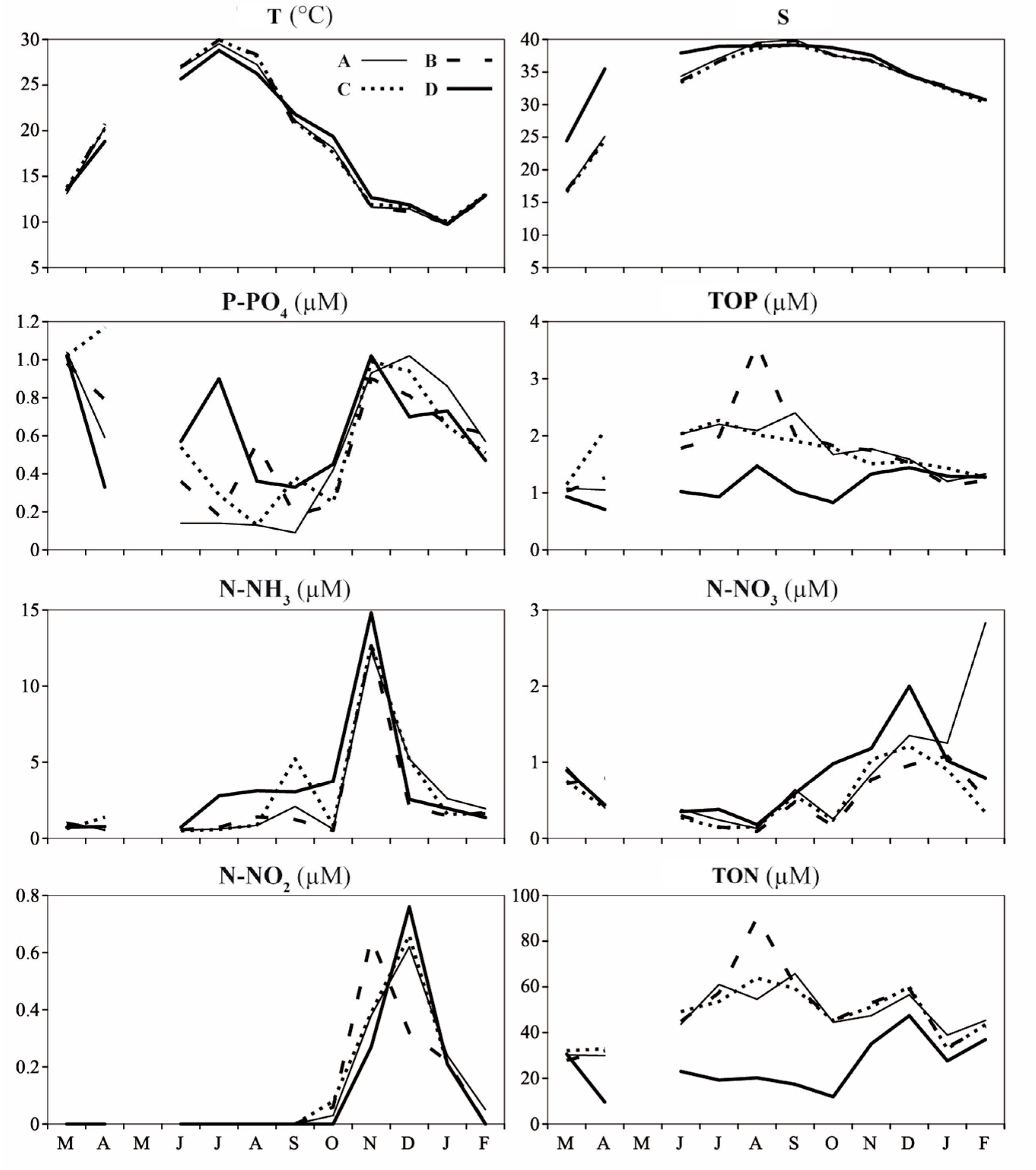
The monthly dynamics of T show a defined seasonality, with the lowest values observed in January and the maxima in July at each sampling station (Figure 2, Table S1). Mean T over the study period varied from 18.32 °C at station D to 18.59 °C at station C (Table S1). Monthly dynamics of S also had a definite seasonality, showing the lowest values in March and the maxima in September at each sampling station (Figure 2, Table S1). Mean S over the study period ranged from 32.76 at station C to 35.37 at station D (Table S1). No significant differences among sampling stations were detected for T and S.
Regarding nutrients, P-PO4 and TOP monthly dynamics showed quite specific trends for each sampling station (Figure 2, Table S1). P-PO4 showed maximum values in spring and late autumn. The minimum values were recorded in summer at each sampling station, although mild peaks were observed at station B, C, and D (Figure 2). TOP showed common trends at each sampling station, i.e., spring minima and summer maxima (Figure 2, Table S1). Mean P-PO4 and TOP over the study period ranged from 0.54 µM at station A to 0.62 µM at station C and D, and from 1.11 µM at station D to 1.74 µM at station B, respectively (Table 2). No significant differences among sampling stations were detected for P-PO4, whereas TOP in sampling station D resulted significantly different from the others (Tukey test, A–D: p = 0.02; B–D: p = 0.01; C–D: p = 0.008).
N-NH3 was the most relevant inorganic nitrogen form in terms of concentration along the study period (Table S1). N-NH3 dynamics were quite specific for each sampling station, although the peaks were recorded in November at all of them (Figure 2, Table S1). Mean N-NH3 over the study period ranged from 2.17 µM at station B to 3.24 µM at station D (Table S1). N-NO3 monthly dynamic showed summer minima and winter maxima at each sampling station (Figure 2, Table S1). Mean N-NO3 over the study period ranged from 0.54 µm at station B to 0.84 µM at station A (Table S1). N-NO2 monthly values were under the detection threshold of the method (btm) between spring and summer, and they reached the highest value between November and December (Figure 2, Table S1). Mean N-NO2 over the study period were similar among sampling stations (Table S1). TON monthly dynamics showed summer maxima (except sampling station D) and minima at all sampling stations in spring (Figure 2, Table S1). Mean TON over the study period ranged from 25.36 µM at station D to 49.71 µM at station B (Table S1). No significant differences among sampling stations were detected for the inorganic nitrogen forms, whereas TON in sampling station D resulted significantly different from the others (Tukey test, A–D: p < 0.001; B–D: p < 0.001; C–D: p < 0.001).
Chla monthly dynamics showed maxima in August (except sampling station A), while minimum values had variable timings at the different sampling stations (Table S1). Mean Chla over the entire study period ranged from 1.56 mg m−3 at station D to 5.19 mg m−3 at station B (Table S1). No significant differences among sampling stations were detected for Chla.
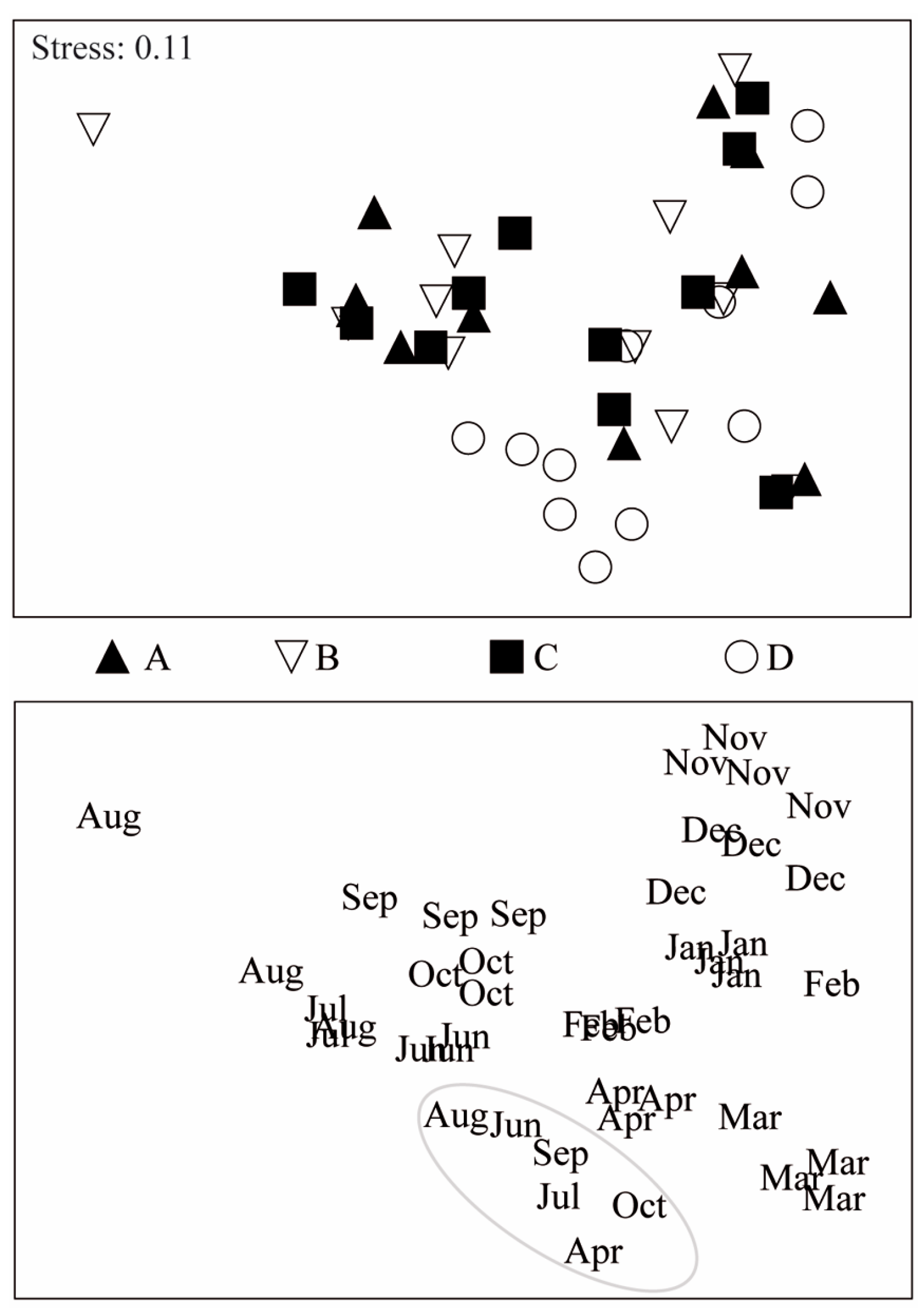
The nMDS ordination based on the environmental variables showed a slight separation between station D and the other three, especially for the period from April to October. In addition, sampling station A and B slightly diverged in some specific months, i.e., station A in February and station B in August (Figure 3). The ANOSIM test revealed significant differences between sampling station D and the other three (Global R: 0.159; A–D: p = 1.7%; B–D: p = 0.1%; C–D: p = 0.1%).
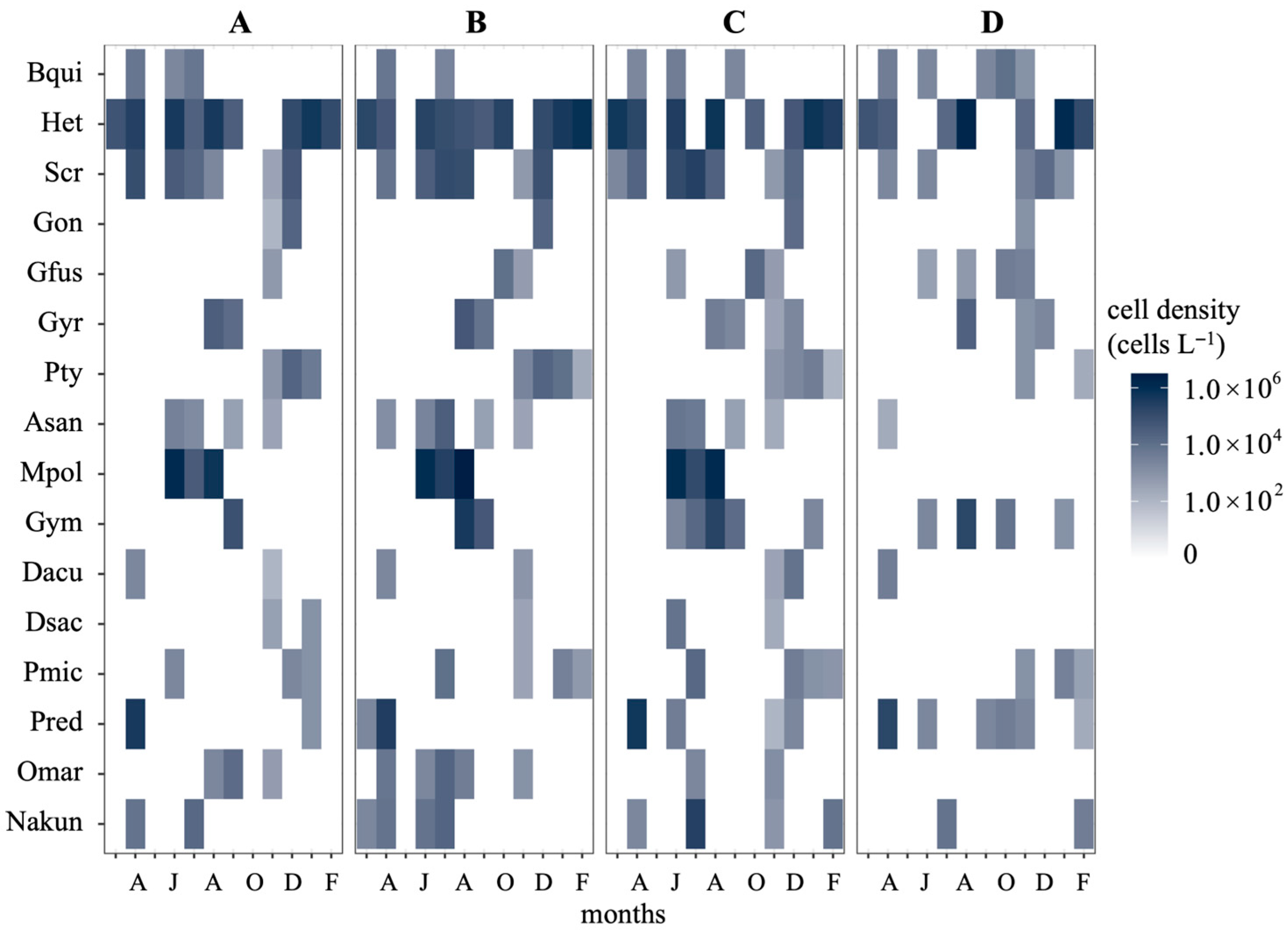
The total dinoflagellate cell density showed a similar dynamic at station A, B, and C, revealing peaks in June, August, and October and between December and January. Station D showed two peaks in April and January (Table S1).
The more frequently recorded dinoflagellates in the water column in SG were attributed to 16 taxa/groups, with a prevalence in terms of cell density and frequency of observations for the mixotrophic taxa (Figure 4, Table 3). The three internal stations (A, B, and C) showed the presence of a greater number of taxa and, in general, higher densities for each over the study period (Figure 4). Heterocapsa spp. (Hetcp) and Scrippsiella spp. (Scr) were the more frequently recorded, reaching maximum densities among the highest (Figure 4, Table 3). Margalefidinium cf polykrikoides (Mpol) showed the highest cell density values, especially in summer months (Figure 4, Table 3). Prorocentrum redfieldii (Pred) and Gymnodinium spp. (Gym) also sporadically reached high maximum density values (Figure 4, Table 3). The remaining taxa were less important in terms of density and number of observations (Figure 4, Table 3).

3.2. Total Resting Cyst Distribution and Order/Family Composition

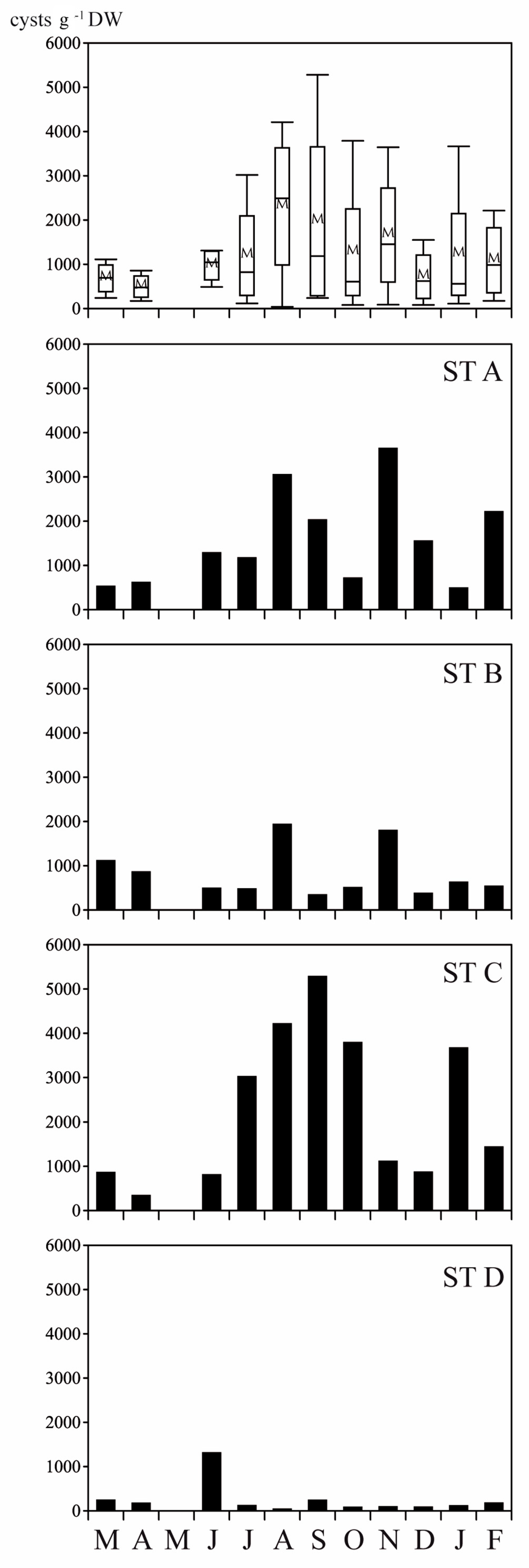
The highest mean values of total resting cyst abundance in SG were observed between July and November (maximum of 2.3 ± 1.8 × 10³ cysts g−1 DW in August), whereas the lowest were between March and April (minimum of 0.5 ± 0.3 × 10³ cysts g−1 DW in March) (Figure 5). Considering data from each sampling station, the total resting cyst abundances showed different monthly dynamics among sampling stations, with the resting cyst maxima detected in August and November at sampling stations A and B, in August–September at sampling station C, and in June at sampling station D (Figure 5).
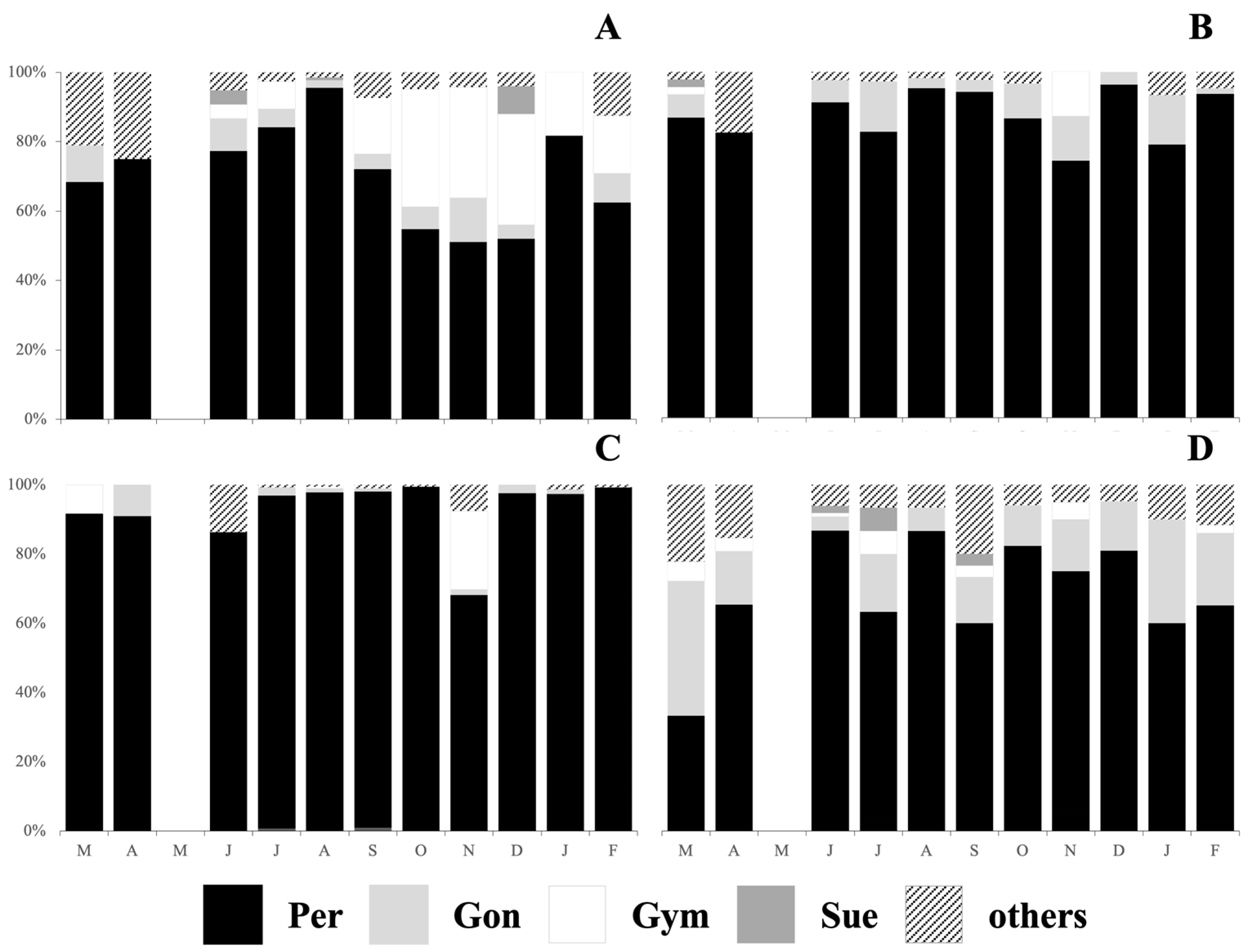
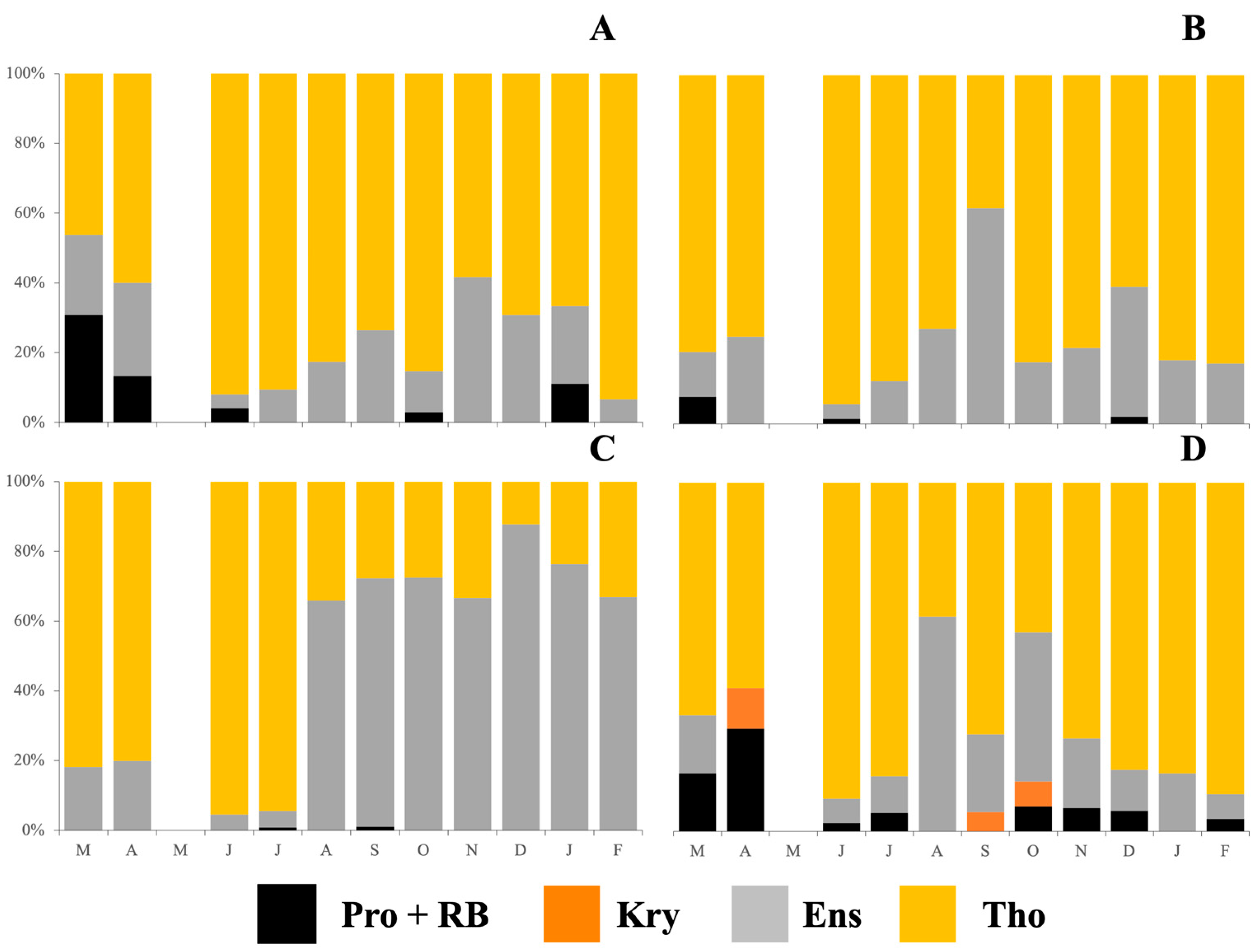
The percentage composition of resting cysts at order level showed a predominance of Peridiniales (Per) at each sampling station (Figure 6). Gonyaulacales (Gon) were frequently observed at each sampling station with low percentages (<15%). This group was especially important at sampling station D, with percentages ranging from 4% to 39% (Figure 6). Gymnodiniales (Gym) showed greater importance at sampling station A, reaching 34% in October. Gym was detected less frequently at the other sampling stations, although this group reached the 23% at sampling station C in November (Figure 6). Suessiales (Sue) was sporadically detected at sampling stations A, B, and D, reaching the 8% at sampling station A in December (Figure 6). The unidentified morphotypes (others) were especially important at sampling station A and D, reaching the maximum percentage at sampling station A in April (25%). Considering the families of the order Peridiniales, the Thoracosphaeraceae (Tho) reached the highest percentages in all stations (Figure 7). The Ensiculiferaceae (Ens) reached the maxima at station C (Figure 7). The Protoperidiniaceae (including the undetermined Round Brown morphotypes, Pro + RB) showed minor importance; however, they contributed to characterizing stations A and D (Figure 7). The Kryptoperidiniaceae (Kry) were less important, and they were observed only at station D (Figure 7).

3.3. Characterization of Resting Cyst Morphotype Assemblages

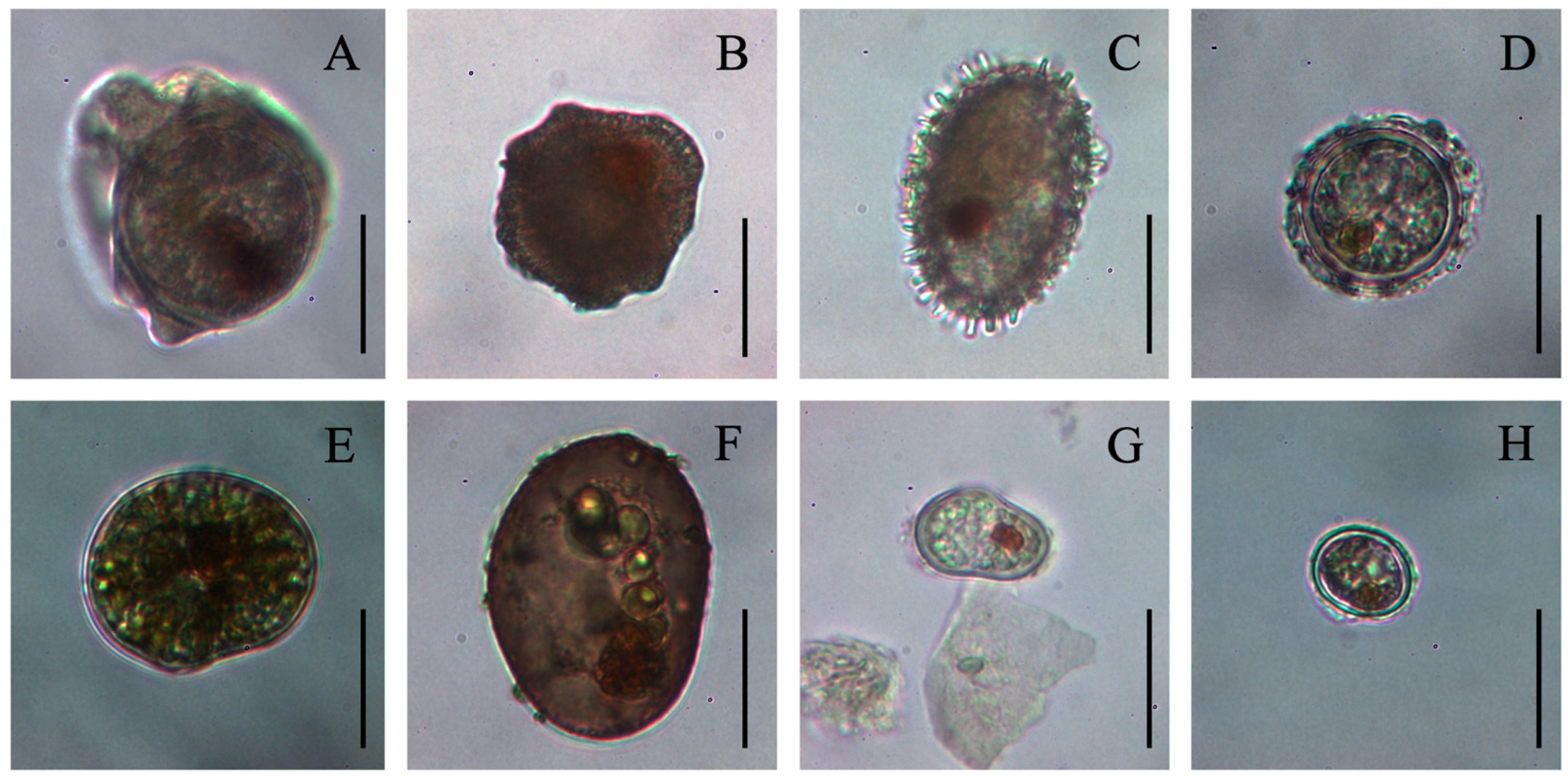
Thirty-six resting cyst morphotypes were recognized during the study period in SG, including six Gonyaulax morphotypes reported as Gonyaulax spp. (Table 2). In addition, groups of RBsm (15 morphotypes) and RBsp (6 morphotypes) and the “others” group were detected (Table 2). The highest number of recognized morphotypes belonged to the Scrippsiella genus (Table 2). Eight cyst morphotypes of potentially harmful species were detected (Table 2). Some of the morphotypes are shown in Figure 8.
Cyst morphotypes attributable to mixotrophic taxa were prevalent both in terms of the density and frequency of observation in SG (Table 2).
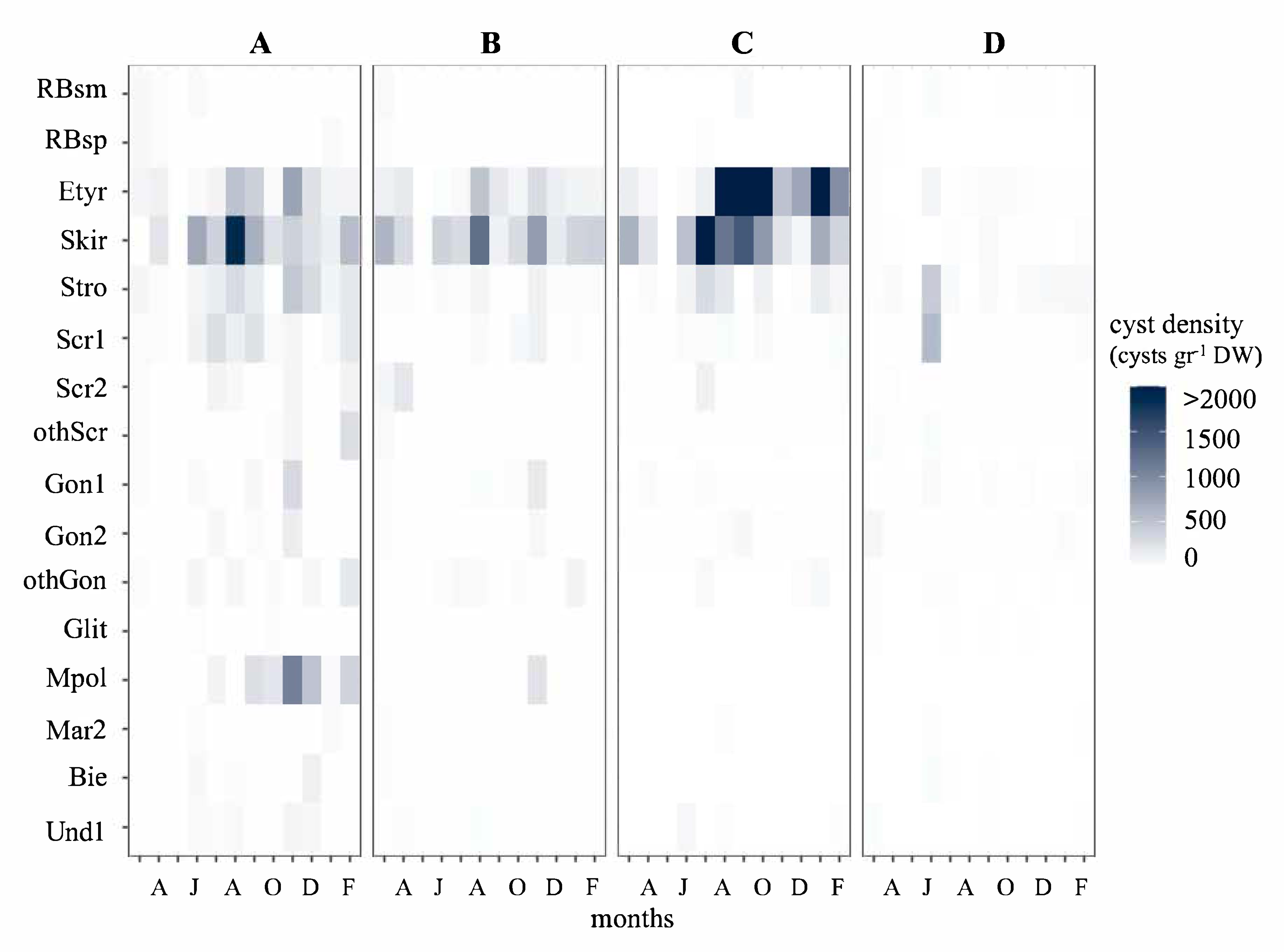
The indicator species analysis revealed the most important resting cyst morphotypes or a combination of them, characterizing each assemblage (Table 4). Skir (Figure 8) characterized the three internal stations (A, B, and C), reaching maximum abundance values at stations A and B in August (1926 cysts g−1 DW and 1216 cysts g−1 DW, respectively) and at station C in July (2322 cysts g−1 DW) (Figure 9, Table 2). Etyr (Figure 8) was also observed mainly at internal stations, but showed particular importance at station C, reaching maximum abundance values 3691 cysts g−1 DW in September (Figure 9, Table 2). Stro and Mpol (Figure 8) significantly characterized the cyst assemblage at station A (Table 4). Stro was commonly detected at each sampling station, but it reached the highest abundance value at sampling station A, although it was also quite important at station D (Figure 9, Table 2). Mpol was detected only at stations A and B, but it was especially important at station A, reaching a maximum abundance value of 1086 cysts g−1 DW in November (Figure 9, Table 2). The nMDS ordination, based on the assemblage composition of the most important cyst morphotypes, showed a clear separation between the samples from station D and the other three. The pattern that emerged from the nMDS ordination was confirmed using ANOSIM (Global R: 0.331), showing that station A significantly differed from stations B, C, and D (P = 0.5%, P = 0.1%, and P = 0.1%, respectively) and that sampling station D significantly differed from stations B and C (P = 0.1% and P = 0.1%, respectively). The ANOSIM analysis applied at seasonal level did not show significant differences in the assemblage composition, neither by month nor by season.
Applying the BIOENV procedure, the best model selected three explanatory variables (S, N-NH3, and TON, correlation coefficient: 0.163) correlating the environmental conditions and the cyst assemblage distribution.

4. Discussion

Coastal lagoons are peculiar ecosystems, characterized by great environmental heterogeneity, which often contributes to site-specific assemblages of living organisms, even when comparing lagoons of the same geographical region. Heterogeneity, both in terms of environmental conditions and biotic components, gives rise to ecological structures, processes, and functions that are characteristic to each system [41]. The data obtained in this work contribute to increasing knowledge on cyst-producing dinoflagellates, expanding information in terms of diversity, assemblage structure, and the role of environmental conditions on cyst dynamics in Mediterranean shallow lagoons.

4.1. Composition and Diversity of Dinoflagellate Cyst Assemblages

The composition of dinoflagellate cyst assemblages in SG sediments at family level revealed a certain homogeneity in the dominance of the cysts produced by the calcareous Peridiniales (Thoracosphaeraceae and Ensiculiferaceae) both on the temporal and spatial scales. This result came as no surprise because similar observations were made in numerous coastal ecosystems in the Mediterranean and around the world [11,23,47,52]. However, SG seems to be a special case, comparing these results with others similar ecosystems, i.e., shallow coastal lagoons. In fact, none of the works published so far (which did not use acid treatment in sample preparation) recorded a similar dominance of the calcareous Peridiniales [29,31,32,33,34] in the same geographical area (Cabras and Corru S’Ittiri lagoons [30]). The family of Protoperidiniaceae and the order Gonyaulacales, which are largely dominant in these ecosystems [29,31,32,33,34], were instead found to be less relevant in SG, except at sampling station A and D in specific months (i.e., March and June). SG appears to be a special case compared to similar ecosystems, also considering trophic affinity, with the dominance of mixotrophic taxa compared to heterotrophs.
The greater detail obtained with the monthly samplings highlighted significant variations in the dominant morphotypes, underlining a notable heterogeneity at a small spatial scale in SG. The most interesting evidence concerned Ensiculifera tyrrhenica (=Pentapharsodinium tyrrhenicum) and Scrippsiella kirschiae, which were present, but not as important in terms of cyst density in the 2011 sampling campaign [30]. In the present study, these morphotypes contributed significantly to the total densities at specific sampling stations, concurring to the density maxima. These two calcareous peridiniales produce cysts with very peculiar morphology that clearly distinguishes them from the others [63,64]. Both species have been described in the Mediterranean, and if E. tyrrhenica has been frequently observed in cyst studies [11,23,24,30,34,52,65,66,67,68], S. kirschiae appears to have a limited distribution [11,30,52,64]. The data obtained in this study, particularly for these two cyst morphotypes, highlight and confirm another important aspect: the study of cysts represents an invaluable tool for improving taxonomic determination for at least some dinoflagellate groups (e.g., calcareous Peridiniales [52]). In fact, the results of this study add detail to the information deriving from the planktonic compartment, where the set of small peridiniod dinoflagellates were reported at genus/order level, given the difficulty in determining them without the use of specific techniques, often molecular [69,70].
The remaining morphotypes reached minor importance in terms of cyst density, but some of them contributed to characterize the sampling stations, i.e., S. trochoidea, confirming the observations made in previous studies [30].
Other useful information obtained in this study concerns the group of harmful gymnodinioids. Morphotypes attributable to Gymnodinium impudicum, G. litoralis, Margalefidinium cf polykrikoides, and Margalefidium sp. were detected in SG sediments during the study period. The cysts belonging to G. impudicum had already been observed in previous studies, and their identity confirmed after germination and molecular analyses [30]. Conversely, no cysts attributable to G. litoralis and the Margalefidium genus were observed from SG in the same study [30]. M. polykrikoides blooms had been observed in the water column between 1998 and 2002 in the lagoon (source: phytoplankton data from long-term ecological network databases available since the early 1990s; Satta C.T. pers. comm.), and a long-lasting bloom (June–August) was observed during the samplings of this study. Consequently, the observation of a consistent number of cysts attributable to Margalefidium could be directly connected to this latter event. Interestingly, the bloom occurred at the three internal stations of the lagoon and predominantly during the three summer months, while the cysts were observed primarily at a single station in November. These observations suggest the particular sedimentation behavior of these cysts, which appear to be produced at the end of the bloom. Blooms of this species have never been reported in the Mediterranean (the only one reported was confirmed as a misidentification [71]), and its presence is considered rare for this region [72]. Therefore, the data obtained from SG represent an important starting point for further investigations of this species. M. polykrikoides is, in fact, a species of ecological interest for various reasons: the first is linked to its ichthyotoxicity, and the second to the presence of different ribotypes, which often alternate in the blooms [73,74]. Some M. polykrikoides cells isolated from the summer 2015 bloom in SG were molecularly identified as the newly described Mediterranean ribotype (Reñe A. pers. comm.), but, since the presence of the Philippine ribotype is also known in the Mediterranean area [72], further investigation would be important to determine the possible presence of other ribotypes that are also in SG. Descriptions and illustrations of the morphology of Margalefidinium field cysts have a long history ([53] and references therein): the molecular identity of germinated cells from isolated cysts have been univocally determined at least for the East Asian ribotype [54]. In the Mediterranean, two morphotypes with slightly different morphologies have been attributed to M. cf polykrikoides [52,67], showing information on the morphology of the germinated cells, but no molecular data. Recent laboratory [53] and field evidence [54,55] has, moreover, highlighted differences in the morphology of the cysts, and also the cysts found in SG and attributed to M. cf polykrikoides showed intermediate characters between the different descriptions reported in the literature, i.e., round-to-slightly oval shape, granulations, deep red accumulation bodies, and lack of spines/processes. Instead, the second Margalefidium morphotype (called Margalefidinium sp. in this study) resembled several cyst morphotypes already described from the field in the Mediterranean area [52,67]. Intra-specific differences in cyst morphologies have been explained in a few ways., i.e., the role of environmental conditions in determining the morphology of processes, production of cysts in the laboratory different from the field, and the morphology of cysts genetically determined and linked to the different ribotypes [55]. A further concurrent explanation could derive from changes in cyst morphology with the maturation in the sediments, as already observed for other dinoflagellates [3,50]; therefore, observations of cysts produced at different times may show different morphologies.
The other new observation for gymnodinioid dinoflagellates in SG was G. litoralis. This species has been described in the Mediterranean area, with material deriving from Catalan coastal sites and from a lagoon near SG (i.e., Corru S’Ittiri Lagoon) [75]. G. litoralis is a peculiar dinoflagellate, able to give rise to high-biomass summer blooms in coastal ecosystems. Very recent studies have highlighted how the vegetative cells of G. litoralis can be misidentified with M. polykrikoides, but especially with G. impudicum [71]. In the case of SG, G. litoralis showed a limited presence compared to M. polykrikoides in the water column during the study period, and this is also supported by the low cyst densities observed in the sediments.
Regarding the other harmful species, the list coincided with that reported in other studies [30], with the addition of Lingulaulax polyedra representing a new report in SG. Cyst densities of L. polyedra, Kryptoperidinium sp., and of the morphotypes attributed to the genus Alexandrium were not particularly high, and are consistent with those registered in similar ecosystems [29,30,31,32,33,34,52].
Furthermore, studies focused on the more precise determination of morphotypes in the Protoperidiniaceae family and Gonyaulax genus will be necessary to advance the knowledge of the diversity of SG cyst-producing dinoflagellates.

4.2. Total Cyst Density and Assemblage Composition Changes vs. Environmental Context and Motile Stages at the Temporal and Spatial Scales

Environmental conditions have great relevance as drivers of dinoflagellate total cell densities and especially of community composition in the water column [76], but, when analyzing dinoflagellate cyst assemblages in surface sediments, other aspects should be considered [47]. First, there is always a certain temporal gap between the production of the cysts and the accumulation in the sediments, and, in parallel, the cysts can be transported laterally away from the point of production [22,77]. Second, the cyst assemblages in the sediment surface represent an integration in space and time over a few months or years, so a certain uniformity among monthly assemblages is expected with the sharing of common species [23,47]. The possible cyst/environmental variable relationships are further complicated by the specific characteristics of each morphotype, e.g., mandatory dormancy period and temperature window for germination, but also by the multiple pathways that characterize the life cycles of many species [3]. The use of cyst sediment traps is a way to overcome at least a part of these complications [22,77], but a certain amount of information can also be obtained from direct studies on the sediments [46,47,48].
At spatial scale, a significant differentiation emerges between the internal and external stations, both in terms of environmental conditions and cyst assemblages in SG, similar to other comparable ecosystems [29,33]. The three variables more strongly correlated to the cyst assemblage structure (S, N-NH3 and TON) seem to derive from these spatial differences. In fact, the outermost station D showed higher salinities (at least for the spring months), higher N-NH3 concentrations (from July to November), and significantly lower concentrations of organic nutrients (especially TON). These environmental conditions corresponded to lower total cyst densities and a greater relative importance of the heterotrophic family Protoperidiniaceae (including the round brown undetermined morphotypes).
The cyst assemblages showed no significant differences regarding seasonality in SG, as already observed in similar studies [47], probably a result of the abovementioned space-time integration of the cyst assemblages in the sediments. A pattern of seasonality emerges, however, when observing the dynamics of the total cyst density. This pattern reflects that of the most important morphotypes in SG. Peaks in total cyst density, although variable among sampling stations, are prevalently recorded in summer months and in fall, implying a possible role of temperature and day length as a trigger for encystment, as demonstrated in laboratory studies [78]. Comparing the total densities of cysts with the densities of the dinoflagellates in the water column, a certain concordance in the peaks is also observed.
The coincidence of higher encystment rates with the highest temperatures has been already reported, also, in seasonal studies from coastal sites [22,24,79]. Moreover, cyst trap data obtained in the Gulf of Naples reported fall encystment peaks, presumably linked to some influence of day length reduction, especially on calcareous Peridiniales [23]. The role of nutrients seems to be more difficult to disentangle. In general, peaks in total cyst density were observed under low (summer) and high (fall) nutrient concentrations in SG. These observations are consistent with other seasonal field studies that revealed that encystment rates and nutrient depletion or enrichment are not always concordant [23,24,79,80]. Indeed, although a role for nutrient depletion in the production of cysts in culture has been demonstrated [3], this is not the only condition in which encystment occurs both in laboratory experiments [78,81,82] and in the field [83,84].
These findings do not fully explain the heterogeneity observed in SG, especially the specific patterns of E. tyrrhenica and S. kirschiae in the inner stations, suggesting, once again, the complexity of factors that can influence encystment and, therefore, cyst assemblage structure in the field. Certainly, calcareous Peridiniales species present specific characteristics, such as high vegetative growth rates, fast cyst–motile stage turnover rates, continuous encystment, and excystment during blooms, which can represent an advantage in exploring resources [23]. In this sense, nutrient pulses can be the trigger for the development of calcareous Peridiniales, resulting in cyst assemblage changes, especially in the inner sampling stations in SG. In fact, inorganic nutrient (including P-PO4 and N-NH3) concentrations are similar among sampling stations, but they also show site-specific peaks in summer. In addition, the reduced depth of the two inner stations B and C (about 1 m) can be a facilitating factor for the turnover between the cyst and motile stage for species that have a particular affinity with the sediment. This additional aspect concurs to explain the difference with station D, which is also characterized by different current conditions being more influenced by their connection with the sea.

5. Conclusions

Detailed studies of cyst assemblages in sediments in short time-scales (i.e., monthly samplings) added further and deeper knowledge useful for interpretation of the dinoflagellate temporal dynamics in shallow coastal lagoons. Investigations on the relation among cyst assemblage variability, environmental conditions, and dinoflagellate motile stages in the water column revealed a remarkable spatial heterogeneity that appears to be mainly explained by the influence of the sea and other factors yet to be investigated.

Supplementary Materials

The following supporting information can be downloaded at: https://www.mdpi.com/article/10.3390/w17172635/s1, Table S1: Monthly values and means ± standard deviation (SD) of surface temperature (T), salinity (S), reactive phosphorous (P-PO4), total organic phosphorous (TOP), ammonium (N-NH3), nitrate (N-NO3), nitrite (N-NO2), total organic nitrogen (TON), chlorophyll a (Chla) and total dinoflagellate cell density (Tot Din) in Santa Giusta Lagoon (SG) at each sampling station (A, B, C, D) from March 2015 to February 2016. Btm: below the detection threshold of the method (<0.01 µM for N-NO2). ns: not sampled.

Author Contributions

Conceptualization, C.T.S., B.M.P. and A.L.; methodology, C.T.S., B.M.P., S.P. and A.L.; validation, C.T.S., B.M.P., S.P., N.F. and A.L.; formal analysis, C.T.S. and B.M.P.; investigation, C.T.S., B.M.P. and S.P.; resources, B.M.P. and A.L.; data curation, C.T.S. and B.M.P.; writing—original draft preparation, all authors; writing—review and editing, C.T.S.; visualization, C.T.S.; supervision, N.F. and A.L.; project administration, C.T.S. and B.M.P.; funding acquisition, N.F. and A.L. All authors have read and agreed to the published version of the manuscript.

Funding

This research received no external funding.

Data Availability Statement

The original contributions presented in this study are included in the article. Further inquiries can be directed to the corresponding author.

Acknowledgments

The authors thank B. Manca for all laboratory analyses and the Sassari University Aquatic Ecology group for their support.

Conflicts of Interest

The authors declare no conflicts of interest.

References

  1. Falkowski, P.G.; Knoll, A.H. Evolution of Primary Producers in the Sea, 1st ed.; Elsevier: Amsterdam, The Netherlands, 2007; pp. 1–456. [Google Scholar]
  2. Lundholm, N.; Bernard, C.; Churro, C.; Escalera, L.; Hoppenrath, M.; Iwataki, M.; Larsen, J.; Mertens, K.; Moestrup, Ø.; Murray, S.; et al. (Eds.) (2009 Onwards). IOC-UNESCO Taxonomic Reference List of Harmful Micro Algae. Available online: https://www.marinespecies.org/hab (accessed on 12 August 2025).
  3. Bravo, I.; Figueroa, R.I. Towards an ecological understanding of dinoflagellate cyst functions. Microorganisms 2014, 2, 11–32. [Google Scholar] [CrossRef]
  4. Figueroa, R.; Estrada, M.; Garcés, E. Life histories of microalgal species causing harmful blooms: Haploids, diploids and the relevance of benthic stages. Harmful Algae 2018, 73, 44–57. [Google Scholar] [CrossRef]
  5. Head, M.J. Modern dinoflagellate cysts and their biological affinities. In Palynology: Principles and Applications 3, 1st ed.; Jansonius, J., McGregor, D.C., Eds.; AASP Foundation: Salt Lake City, UT, USA, 1996; Volume 3, pp. 1197–1248. [Google Scholar]
  6. Matsuoka, K.; Head, M.J. Clarifying cyst–motile stage relationships dinoflagellates. In Biological and Geological Perspectives of Dinoflagellates, 1st ed.; Lewis, J.M., Marret, F., Bradley, L., Eds.; The Micropalaeontological Society: London, UK, 2013; pp. 325–350. [Google Scholar]
  7. Anderson, D.M.; Wall, D. Potential importance of benthic cysts of Gonyaulax tamarensis and G. excavata in initiating toxic dinoflagellate blooms. J. Phycol. 1978, 14, 224–234. [Google Scholar] [CrossRef]
  8. Dale, B. Dinoflagellate Resting Cysts. In Survival Strategies of the Algae, 1st ed.; Frixell, G.A., Ed.; Cambridge University Press: New York, NY, USA, 1983; pp. 67–136. [Google Scholar]
  9. Lundholm, N.; Ribeiro, S.; Andersen, T.J.; Koch, T.; Godhe, A.; Ekelund, F.; Ellengaard, M. Buried alive–germination of up to 100 years-old marine dinoflagellate resting stages. Phycologia 2011, 50, 629–640. [Google Scholar] [CrossRef]
  10. Godhe, A.; McQuoid, M.R. Influence of benthic and pelagic environmental factors on the distribution of dinoflagellate cysts in surface sediments along the Swedish west coast. Aquat. Microb. Ecol. 2003, 32, 185–201. [Google Scholar] [CrossRef]
  11. Satta, C.T.; Anglès, S.; Garcés, E.; Lugliè, A.; Padedda, B.M.; Sechi, N. Dinoflagellate cysts in recent sediments from two semi-enclosed areas of the Western Mediterranean Sea subject to high human impact. Deep-Sea Res. II 2010, 57, 256–267. [Google Scholar]
  12. Dale, B. Dinoflagellate cyst ecology: Modeling and geological applications. In Palynology: Principles and Applications 3, 1st ed.; Jansonius, J., McGregor, D.C., Eds.; AASP Foundation: Salt Lake City, UT, USA, 1996; Volume 3, pp. 1249–1275. [Google Scholar]
  13. Marret, F.; De Vernal, A. Dinoflagellate cysts as proxies of environmental, ocean and climate changes in the Atlantic realm during the quaternary. Front. Ecol. Evol. 2024, 12, 1378931. [Google Scholar] [CrossRef]
  14. Sætre, M.M.; Dale, B.; Abdullah, M.I.; Sætre, G.P. Dinoflagellate cysts as potential indicators of industrial pollution in a Norwegian Fjord. Mar. Environ. Res. 1997, 44, 167–189. [Google Scholar] [CrossRef]
  15. Dale, B.; Thorsen, T.A.; Fjellså, A. Dinoflagellate cysts as indicators of cultural eutrophication in the Oslofjord, Norway. Estuar. Coast. Shelf Sci. 1999, 49, 371–382. [Google Scholar] [CrossRef]
  16. Matsuoka, K. Eutrophication process recorded in dinoflagellate cyst assemblages—A case of Yokohama Port, Tokyo Bay, Japan. Sci. Total Environ. 1999, 231, 17–35. [Google Scholar] [CrossRef] [PubMed]
  17. Pospelova, V.; Chmura, G.L.; Boothman, W.S.; Latimer, J.S. Dinoflagellate cyst records and human disturbance in two neighboring estuaries, New Bedford Harbor and Apponagansett Bay, Massachusetts (USA). Sci. Total Environ. 2002, 298, 81–102. [Google Scholar] [CrossRef]
  18. Pospelova, V.; Chmura, G.L.; Boothman, W.S.; Latimer, J.S. Spatial distribution of modern dinoflagellate cysts in polluted estuarine sediments from Buzzards Bay (Massachusetts, USA) embayments. Mar. Ecol. Prog. Ser. 2005, 292, 23–40. [Google Scholar] [CrossRef]
  19. Matsuoka, K.; Joyce, L.B.; Kotani, Y.; Matsuyama, Y. Modern dinoflagellate cysts in hypertrophic coastal waters of Tokyo Bay, Japan. J. Plank. Res. 2003, 25, 1461–1470. [Google Scholar]
  20. Dale, B. Eutrophication signals in the sedimentary record of dinoflagellate cysts in coastal waters. J. Sea Res. 2009, 61, 103–113. [Google Scholar] [CrossRef]
  21. Shin, H.H.; Yoon, Y.H.; Kim, Y.O.; Matsuoka, K. Dinoflagellate cysts in surface sediments from southern coast of Korea. Estuar. Coast 2011, 34, 712–725. [Google Scholar] [CrossRef]
  22. Shin, H.H.; Li, Z.; Lim, D.; Lee, K.W.; Seo, M.H.; Lim, W.A. Seasonal production of dinoflagellate cysts in relation to environmental characteristics in Jinhae-Masan Bay, Korea: One-year sediment trap observation. Est. Coast. Shelf Sci. 2018, 215, 83–93. [Google Scholar] [CrossRef]
  23. Montresor, M.; Zingone, A.; Sarno, D. Dinoflagellate cyst production at a coastal Mediterranean site. J. Plank. Res. 1998, 20, 2291–2312. [Google Scholar] [CrossRef]
  24. Bastianini, M.; Totti, C.; Penna, A.; De Lazzari, A.; Montresor, M. Dinoflagellate cyst production in the north-western Adriatic Sea. Mediterr. Mar. Sci. 2016, 17, 751–765. [Google Scholar] [CrossRef]
  25. Bradford, M.R.; Wall, D.A. The distribution of Recent organic-walled dinoflagellate cysts in the Persian Gulf, Gulf of Oman, and northwestern Arabian Sea. Paleontogr. Abt. B 1984, 192, 16–84. [Google Scholar]
  26. Pospelova, V.; Chmura, G.L.; Walker, H.A. Environmental factors influencing the spatial distribution of dinoflagellate cyst assemblages in shallow lagoons of Southern New England (USA). Rev. Palaeobot. Palynol. 2004, 128, 7–34. [Google Scholar] [CrossRef]
  27. Aydin, H.; Yürür, E.E.; Uzar, S. Dinoflagellate cyst assemblages in surface sediments from Homa Lagoon (Izmir Bay, Eastern Aegean Sea, The Mediterranean). Fresenius Environ. Bull. 2014, 23, 1795–1801. [Google Scholar]
  28. Limoges, A.; de Vernal, A.; Ruiz-Fernandez, A.C. Investigating the impact of land use and the potential for harmful algal blooms in a tropical lagoon of the Gulf of Mexico. Est. Coast. Shelf Sci. 2015, 167, 549–559. [Google Scholar] [CrossRef]
  29. Fertouna-Bellakhal, M.; Dhib, A.; Béjaoui, B.; Turki, S.; Aleya, L. Driving factors behind the distribution of dinocyst composition and abundance in surface sediments in a western Mediterranean coastal lagoon: Report from a high resolution mapping study. Mar. Pollut. Bull. 2014, 84, 347–362. [Google Scholar] [CrossRef] [PubMed]
  30. Satta, C.T.; Angles, S.; Garces, E.; Sechi, N.; Pulina, S.; Padedda, B.M.; Stacca, D.; Luglie, A. Dinoflagellate cyst assemblages in surface sediments from three shallow mediterranean lagoons (Sardinia, North Western Mediterranean Sea). Estuar. Coast 2014, 37, 646–663. [Google Scholar] [CrossRef]
  31. Dhib, A.; Fertouna-Bellakhal, M.; Turki, S.; Aleya, L. Driving factors of dinoflagellate cyst distribution in surface sediments of a Mediterranean lagoon with limited access to the sea. Mar. Pollut. Bull. 2016, 112, 303–312. [Google Scholar] [CrossRef] [PubMed]
  32. Zmerli-Triki, H.; Laabir, M.; Lafabrie, C.; Malouche, D.; Bancon-Montigny, C.; Gonzalez, C.; Deidun, A.; Pringault, O.; Daly-Yahi, K.O. Do the levels of industrial pollutants influence the distribution and abundance of dinoflagellate cysts in the recently-deposited sediment of a Mediterranean coastal ecosystem? Sci. Total Environ. 2017, 595, 380–392. [Google Scholar] [CrossRef]
  33. Keskes, F.A.; Ayadi, N.; Atoui, A.; Mahfoudi, M.; Abdennadher, M.; Dammak Walha, L.; Ben Ismail, S.; Ben Abdallah, O.; Khammeri, Y.; Pagano, M.; et al. Dinoflagellates encystment with emphasis on blooms in Boughrara Lagoon (South-Western Mediterranean): Combined effects of trace metal concentration and environmental context. Est. Coast. Shelf Sci. 2020, 237, 106648. [Google Scholar] [CrossRef]
  34. Draredja, M.A.; Frihi, H.; Boualleg, C.; Abadie, E.; Laabir, M. Distribution of dinoflagellate cyst assemblages in recent sediments from a southern Mediterranean lagoon (Mellah, Algeria) with emphasis on toxic species. Environ. Sci. Poll. Res. Int. 2020, 27, 25173–25185. [Google Scholar] [CrossRef]
  35. Genovesi, B.; Mouillot, D.; Vaquer, A.; Laabir, M.; Pastoureaud, A. Towards an optimal sampling strategy for Alexandrium catenella (Dinophyceae) benthic resting cysts. Harmful Algae 2007, 6, 837–848. [Google Scholar] [CrossRef]
  36. Genovesi, B.; Laabir, M.; Masseret, E.; Collos, Y.; Vaquer, A.; Grzebyk, D. Dormancy and germination features in resting cysts of Alexandrium tamarense species complex (Dinophyceae) can facilitate bloom formation in a shallow lagoon (Thau, southern France). J. Plank. Res. 2009, 31, 1209–1224. [Google Scholar] [CrossRef]
  37. Genovesi, B.; Mouillot, D.; Laugier, T.; Fiandrino, A.; Laabir, M.; Vaquer, A.; Grzebyk, D. Influences of sedimentation and hydrodynamics on the spatial distribution of Alexandrium catenella/tamarense resting cysts in a shellfish farming lagoon impacted by toxic blooms. Harmful Algae 2013, 25, 15–25. [Google Scholar] [CrossRef]
  38. Zmerli Triki, H.; Daly-Yahia, O.K.; Malouche, D.; Komiha, Y.; Deidun, A.; Brahim, M.; Laabir, M. Distribution of resting cysts of the potentially toxic dinoflagellate Alexandrium pseudogonyaulax in recently deposited sediment within Bizerte lagoon (Mediterranean coast, Tunisia). Mar. Pollut. Bull. 2014, 84, 172–181. [Google Scholar] [CrossRef]
  39. Fertouna-Bellakhal, M.; Dhib, A.; Fathalli, A.; Bellakhal, M.; Chom, N.; Masseret, E.; Laabir, M.; Turki, S.; Aleya, L. Alexandrium pacificum Litaker sp. nov (group IV): Resting cyst distribution and toxin profile of vegetative cells in Bizerte Lagoon (Tunisia, Southern Mediterranean Sea). Harmful Algae 2015, 48, 69–82. [Google Scholar] [CrossRef] [PubMed]
  40. Newton, A.; Brito, A.C.; Icely, J.D.; Derolez, V.; Clara, I.; Angus, S.; Schernewski, G.; Inácio, M.; Lillebø, A.I.; Sousa, A.I.; et al. Assessing, quantifying and valuing the ecosystem services of coastal lagoons. J. Nat. Conserv. 2018, 44, 50–65. [Google Scholar] [CrossRef]
  41. Pérez-Ruzafa, A.; Campillo, S.; Fernández-Palacios, J.M.; Garcia-Lacunza, A.; Garcia-Oliva, M.; Ibanez, H.; Navarro-Martínez, P.C.; Pérez-Marcos, M.; Pérez-Ruzafa, I.M.; Quispe-Becerra, J.I.; et al. Long-term dynamic in nutrients, chlorophyll a, and water quality parameters in a coastal lagoon during a process of eutrophication for decades, a sudden break and a relatively rapid recovery. Front. Mar. Sci. 2019, 6, 26. [Google Scholar] [CrossRef]
  42. Pérez-Ruzafa, A.; Perez-Marcos, M.; Marcos, C. Coastal lagoons in focus: Their environmental and socioeconomic importance. J. Nat. Conserv. 2020, 57, 125886. [Google Scholar] [CrossRef]
  43. DEIMS IDR. Available online: https://deims.org/6f7581f0-e663-4681-bf9d-4668d6c3f2ba (accessed on 2 March 2025).
  44. Satta, C.T.; Padedda, B.M.; Sechi, N.; Pulina, S.; Loria, A.; Lugliè, A. Multiannual Chattonella subsalsa Biecheler (Raphidophyceae) blooms in a Mediterranean lagoon (Santa Giusta Lagoon, Sardinia Island, Italy). Harmful Algae 2017, 67, 61–73. [Google Scholar] [CrossRef]
  45. Floris, R.; Sanna, G.; Satta, C.T.; Piga, C.; Sanna, F.; Lugliè, A.; Fois, N. Intestinal Microbial Ecology and Fillet Metal Chemistry of Wild Grey Mullets Reflect the Variability of the Aquatic Environment in a Western Mediterranean Coastal Lagoon (Santa Giusta, Sardinia, Italy). Water 2021, 13, 879. [Google Scholar] [CrossRef]
  46. Harland, R.; Nordberg, K.; Filipsson, H. The seasonal occurrence of dinoflagellate cysts in surface sediments from Koljö Fjord, west coast of Sweden—a note. Rev. Palaeobot. Palynol. 2004, 128, 107–117. [Google Scholar] [CrossRef]
  47. Ribeiro, S.; Amorim, A. Environmental drivers of temporal succession in recent dinoflagellate cyst assemblages from a coastal site in the North-East Atlantic (Lisbon Bay, Portugal). Mar. Micropaleontol. 2008, 68, 156–178. [Google Scholar] [CrossRef]
  48. Montresor, M.; Di Prisco, C.; Sarno, D.; Margiotta, F.; Zingone, A. Diversity and germination patterns of diatom resting stages at a coastal Mediterranean site. Mar. Ecol. Progr. Ser. 2013, 484, 79–95. [Google Scholar] [CrossRef]
  49. Bolch, C.J.S. The use of sodium polytungstate for the separation and concentration of living dinoflagellate cysts from marine sediments. Phycologia 1997, 36, 472–478. [Google Scholar] [CrossRef]
  50. Bravo, I.; Garces, E.; Diogene, J.; Fraga, S.; Sampedro, N.; Figueroa, R.I. Resting cysts of the toxigenic dinoflagellate genus Alexandrium in recent sediments from the Western Mediterranean Coast, including the first description of cysts of A. kutnerae and A. peruvianum. Eur. J. Phycol. 2006, 41, 293–302. [Google Scholar] [CrossRef]
  51. Zonneveld, K.A.F.; Susek, E.; Fischer, G. Seasonal variability of the organic-walled dinoflagellate cyst production in the coastal upwelling region off Cape Blanc (Mauritania): A five-year survey. J. Phycol. 2010, 46, 202–215. [Google Scholar] [CrossRef]
  52. Satta, C.T.; Anglès, S.; Lugliè, A.; Guillén, J.; Sechi, N.; Camp, J.; Garcés, E. Studies on dinoflagellate cyst assemblages in two estuarine Mediterranean bays: A useful tool for the discovery and mapping of harmful algal species. Harmful Algae 2013, 24, 65–79. [Google Scholar] [CrossRef]
  53. Tang, Y.Z.; Gobler, C.J. The toxic dinoflagellate Cochlodinium polykrikoides (Dinophyceae) produces resting cysts. Harmful Algae 2012, 20, 71–80. [Google Scholar] [CrossRef]
  54. Li, Z.; Han, M.-S.; Matsuoka, K.; Kim, S.-Y.; Shin, H.H. Identification of the resting cyst of Cochlodinium polykrikoides Margalef (Dinophyceae, Gymnodiniales) in Korean coastal sediments. J. Phycol. 2015, 51, 204–210. [Google Scholar] [CrossRef]
  55. Thoha, H.; Muawanah; Bayu Intan, M.D.; Rachman, A.; Sianturi, O.R.; Sidabutar, T.; Iwataki, M.; Takahashi, K.; Avarre, J.C.; Masseret, E. Resting cyst distribution and molecular identification of the harmful dinoflagellate Margalefidinium polykrikoides (Gymnodiniales, Dinophyceae) in Lampung Bay, Sumatra, Indonesia. Front. Microbiol. 2019, 10, 306. [Google Scholar] [CrossRef]
  56. Strickland, J.D.H.; Parsons, T.R. A Practical Handbook of Seawater Analysis, 1st ed.; Fisheries Research Board of Canada: Ottawa, ON, Canada, 1972; pp. 1–167. [Google Scholar]
  57. Uthermöhl, H. Zur Vervollkomnung der quantitativen Phytoplankton-Methodik. Mitt. Int. Ver. Limnol. 1958, 9, 1–38. [Google Scholar]
  58. Edler, L.; Elbrachter, M. The Utermohl Method for Quantitative Phytoplankton Analysis. In Microscopic and Molecular Methods for Quantitative Phytoplankton Analysis, 1st ed.; Karlson, B., Cusack, C., Bresnan, E., Eds.; Intergovernmental Oceanographic Commission of UNESCO: Paris, France, 2010; IOC Manuals and Guides 55; pp. 13–20. [Google Scholar]
  59. Pulina, S.; Padedda, B.M.; Satta, C.T.; Sechi, N.; Lugliè, A. Long-term phytoplankton dynamics in a Mediterranean eutrophic lagoon (Cabras Lagoon, Italy). Plant Biosyst. 2012, 146, 259–272. [Google Scholar] [CrossRef]
  60. SCOR-UNESCO. Determination of Photosynthetic Pigments in Sea Water, 1st ed.; UNESCO Monographs on Oceanographic Methodology: Paris, France, 1997; pp. 1–66. [Google Scholar]
  61. Clarke, K.R.; Ainsworth, M. A method of linking multivariate community structure to environmental variables. Mar. Ecol. Prog. Ser. 1993, 92, 205–219. [Google Scholar] [CrossRef]
  62. De Caceres, M.; Legendre, P. Associations between species and groups of sites: Indices and statistical inference. Ecology 2009, 90, 3566–3574. [Google Scholar] [CrossRef]
  63. Montresor, M.; Zingone, A.; Marino, D. The calcareous resting cyst of Pentapharsodinium tyrrhenicum comb. nov. (Dinophyceae). J. Phycol. 1993, 29, 223–230. [Google Scholar] [CrossRef]
  64. Zinssmeister, C.; Soehner, S.; Kirsch, M.; Facher, E.; Meier, K.J.S.; Keupp, H.; Gottschling, M. Same but different: Two novel bicarinate species of extant calcareous Dinophytes (Thoracosphaeraceae, Peridiniales) from the Mediterranean Sea. J. Phycol. 2012, 48, 1107–1118. [Google Scholar] [CrossRef]
  65. Moscatello, S.; Rubino, F.; Saracino, O.D.; Fanelli, G.; Belmonte, G.; Boero, F. Plankton biodiversity around the Salento Peninsula (South East Italy): An integrated water/sediments approach. Sci. Mar. 2004, 68, 85–102. [Google Scholar] [CrossRef]
  66. Orlova, T.Y.; Morozova, T.V.; Gribble, K.E.; Kulis, D.M.; Anderson, D.M. Dinoflagellate cysts in recent marine sediments from the east coast of Russia. Bot. Mar. 2004, 47, 184–201. [Google Scholar] [CrossRef]
  67. Rubino, F.; Belmonte, M.; Caroppo, C.; Giacobbe, M. Dinoflagellate cysts from surface sediments of Syracuse Bay (Western Ionian Sea, Mediterranean). Deep-Sea Res. II 2010, 57, 243–247. [Google Scholar] [CrossRef]
  68. Rogelja, M.; Cibic, T.; Rubino, F.; Belmonte, M.; Del Negro, P. Active and resting microbenthos in differently contaminated marine coastal areas: Insights from the Gulf of Trieste (northern Adriatic, Mediterranean Sea). Hydrobiologia 2018, 806, 283–301. [Google Scholar] [CrossRef]
  69. D’Onofrio, G.; Marino, D.; Bianco, L.; Busico, E.; Montresor, M. Toward an assessment on the taxonomy of dinoflagellates that produce calcareous cysts (Calciodinelloidae, Dinophyceae): A morphological and molecular approach. J. Phycol. 1999, 35, 1063–1078. [Google Scholar] [CrossRef]
  70. Montresor, M.; Sgrosso, S.; Procaccini, G.; Kooistra, W.H.C.F. Intraspecific diversity in Scrippsiella trochoidea (Dinophyceae): Evidence for cryptic species. Phycologia 2003, 42, 56–70. [Google Scholar] [CrossRef]
  71. Gómez, F.; Roselli, L.; Zhang, H.; Lin, S. Misidentifications of the bloom-forming dinoflagellates Gymnodinium litorale and Margalefidinium polykrikoides in the Mediterranean Sea. Reg. Stud. Mar. Sci. 2024, 70, 103376. [Google Scholar] [CrossRef]
  72. Reñé, A.; Garcés, E.; Camp, J. Phylogenetic relationships of Cochlodinium polykrikoides Margalef (Gymnodiniales, Dinophyceae) from the Mediterranean Sea and the implications of its global biogeography. Harmful Algae 2013, 25, 39–46. [Google Scholar] [CrossRef]
  73. Kudela, R.M.; Gobler, C.J. Harmful dinoflagellate blooms caused by Cochlodinium sp.: Global expansion and ecological strategies facilitating bloom formation. Harmful Algae 2012, 14, 71–86. [Google Scholar] [CrossRef]
  74. Park, B.S.; Wang, P.; Kim, J.H.; Kim, J.H.; Gobler, C.J.; Han, M.S. Resolving the intra-specific succession within Cochlodinium polykrikoides populations in southern Korean coastal waters via use of quantitative PCR assays. Harmful Algae 2014, 37, 133–141. [Google Scholar] [CrossRef]
  75. Reñé, A.; Satta, C.T.; Garcés, E.; Massana, R.; Zapata, M.; Anglès, S.; Camp, J. Gymnodinium litoralis sp. nov. (Dinophyceae), a newly identified bloom-forming dinoflagellate from the NW Mediterranean Sea. Harmful Algae 2011, 12, 11–25. [Google Scholar] [CrossRef]
  76. Smayda, T.J.; Reynolds, C.S. Strategies of marine dinoflagellate survival and some rules of assembly. J. Sea Res. 2003, 49, 95–106. [Google Scholar] [CrossRef]
  77. Zonneveld, K.A.F.; Grotheer, H.; Versteegh, G.J.M. Dinoflagellate cysts production, excystment and transport in the upwelling off Cape Blanc (NW Africa). Front. Mar. Sci. 2022, 9, 915755. [Google Scholar] [CrossRef]
  78. Sgrosso, S.; Esposito, F.; Montresor, M. Temperature and daylength regulate encystment in calcareous cyst-forming dinoflagellates. Mar. Ecol. Progr. Ser. 2001, 211, 77–87. [Google Scholar] [CrossRef]
  79. Shin, H.H.; Park, J.S.; Kim, Y.O.; Baek, S.H.; Lim, D.I.; Yoon, Y.H. Dinoflagellate cyst production and flux in Gamak Bay, Korea: A sediment trap study. Mar. Micropaleontol. 2012, 94, 72–79. [Google Scholar] [CrossRef]
  80. Godhe, A.; Norén, F.; Kuylenstierna, M.; Ekberg, C.; Karlson, B. Relationship between planktonic dinoflagellate abundance, cyst recovered in sediment traps and environmental factors in the Gullmar Fjord, Sweden. J. Plankton Res. 2001, 23, 923–938. [Google Scholar] [CrossRef]
  81. Olli, K.; Anderson, D.M. High encystment success of the dinoflagellate Scrippsiella cf. lachrymosa in culture experiments. J. Phycol. 2002, 18, 145–156. [Google Scholar] [CrossRef]
  82. Kremp, A.; Rengefors, K.; Montresor, M. Species-specific encystment patterns in three Baltic cold-water dinoflagellates: The role of multiple cues in resting cyst formation. Limnol. Oceanogr. 2009, 54, 1125–1138. [Google Scholar] [CrossRef]
  83. Probert, I. The induction of sexual reproduction in dinoflagellates: Culture studies and field surveys. In LIFEHAB: Life Histories of Microalgal Species Causing Harmful Algal Blooms, 1st ed.; Garcés, E., Zingone, A., Montresor, M., Reguera, B., Dale, B., Eds.; European Commission: Maiorca, Spain, 2002; pp. 57–59. [Google Scholar]
  84. Angles, S.; Garcés, E.; Reñé, A.; Sampedro, N. Life-cycle alternations in Alexandrium minutum natural populations from the NW Mediterranean Sea. Harmful Algae 2012, 16, 1–11. [Google Scholar] [CrossRef]
Figure 1. Geographical localization of Santa Giusta Lagoon (Mediterranean Sea, Sardinia, Italy) and sampling station placement. Black arrows = freshwater inputs; white arrows = sea inlets.
Water 17 02635 g001
Figure 2. Monthly dynamics (from March 2015 to February 2016) of temperature (T), salinity (S), and nutrient (reactive phosphorus: P-PO4; total organic phosphorous: TOP; ammonium: N-NH3; nitrate: N-NO3; nitrite: N-NO2; and total organic nitrogen: TON) values at each sampling station in Santa Giusta Lagoon (Mediterranean Sea, Sardinia, Italy).
Water 17 02635 g002
Figure 3. Non-metric Multi Dimensional Scaling ordination (NMDS) based on the set of environmental data collected along the studied period (March 2015–February 2016) in Santa Giusta Lagoon (Mediterranean Sea, Sardinia, Italy) showing the sampling stations (upper panel) and the months (below panel) as factors. Inside the gray circle are the months in which station D particularly differs from the others.
Water 17 02635 g003
Figure 4. Heatmap showing the monthly dynamics of cell densities in the water column for the more frequently observed dinoflagellate taxa/group along the study period (March 2015–February 2016) in Santa Giusta Lagoon (Mediterranean Sea, Sardinia, Italy) at the four sampling stations (A–D). Abbreviations are reported in Table 3.
Water 17 02635 g004
Figure 5. Monthly dynamics of total resting cyst abundance variation (upper panel) and total resting cyst abundances at each sampling station (panels below) in Santa Giusta Lagoon (Mediterranean Sea, Sardinia, Italy). Box plots (upper panel) were constructed using the total resting cyst abundances of all sampling stations: lines represent medians, M represent means. The bottom of the box is the first quartile (Q1); the upper part is the third quartile (Q3). Whiskers represent the 90th and 10th percentiles.
Water 17 02635 g005
Figure 6. Monthly dynamics of the percentage abundance composition of resting cyst at order level at each sampling station (A, B, C and D) in Santa Giusta Lagoon (Mediterranean Sea, Sardinia, Italy). Per: Peridiniales; Gon: Gonyaulacales; Gym: Gymnodiniales; Sue: Suessiales; others: unidentified morphotypes.
Water 17 02635 g006
Figure 7. Monthly dynamics of the percentage abundance composition of Peridiniales resting cyst at family level at each sampling station (A, B, C and D) in Santa Giusta Lagoon (Mediterranean Sea, Sardinia, Italy). Pro + RB: Protoperidiniaceae + round brown undetermined morphotypes; Kry: Kryptoperidiniaceae; Ens: Ensiculiferaceae; Tho: Thoracosphaeraceae.
Water 17 02635 g007
Figure 8. Photomicrographs of some dinoflagellate cysts in surface sediments from Santa Giusta Lagoon: (A) Ensiculifera tyrrhenica, (B) Scrippsiella kirschiae, (C) Scrippsiella trochoidea complex, (D) Scrippsiella sp.1, (E) Margalefidinium cf polykrikoides, (F) Margalefidinium sp., (G) Cyst type 1, (H) other unidentified cyst. Scale bars: 20 µm.
Water 17 02635 g008
Figure 9. Heatmap showing the monthly dynamics of cyst densities in the sediments for the more frequently observed dinoflagellate taxa/group along the study period (March 2015–February 2016) in Santa Giusta Lagoon (Mediterranean Sea, Sardinia, Italy) at the four sampling stations (A–D). Abbreviations are reported in Table 2.
Water 17 02635 g009
Table 1. Main characteristics of the sampling stations considered along the study period in Santa Giusta Lagoon.
ABCD
Position in the lagooninternalinternalinternalexternal
Depth (m)1.20.70.72.0
Influence of sea waterssporadicmarginalmarginalconsistent
Sediment grain sizesilt-claysilt-claysilt-claysilt-clay
Table 2. Species or taxa names, minimum abundances (min) and maximum abundances (max) as cysts g−1 of dry weight, number of records (n) and trophic affinity (Tr. Aff.: Het = heterotrophy, Mix = mixotrophy, ? = to be assumed, but data not available for the species) of dinoflagellate cyst morphotypes identified in Santa Giusta Lagoon (SG) from March 2015 to February 2016 at each sampling station (A–D). Abbreviations (abbr.) were reported for selected cyst morphotypes included in the analysis of data. Cyst morphotypes attributable to potentially harmful species are reported in bold.
ABCD
Tr. Affabbr.minmaxnminmaxnminmaxnminmaxn
Peridiniales
Protoperidinium sp.Het 000071000071
Round Brown smoothHetRBsm0554049205110277
Round Brown spinyHetRBsp0553025102310132
Kryptoperidinium sp.Mix 0000000000133
Ensiculifera tyrrhenica (=Pentapharsodinium tyrrhenicum)
(Balech) Li, Mertens, Gottschling, Gu et Shin.
Mix?Etyr407751119500113236911108010
Scrippsiella kirschiae
Zinssmeister, Soehner, Meier et Gottschling
Mix?Skir0192610111121611832322110489
Scrippsiella lachrymosa
Lewis ex Head
Mix?othScr0922000000000
Scrippsiella precaria
Montresor et Zingone
Mix?othScr000000000082
Scrippsiella rotunda
Lewis ex Head
Mix?othScr0281049201710272
Scrippsiella trochoidea (=S. acuminata) complexMixStro114651191161103028042810
Scrippsiella sp. 1Mix?Scr102771001168041505756
Scrippsiella sp.2Mix?Scr2092502023011620132
Scrippsiella sp.3Mix?othScr018420000161000
Scrippsiella sp.4Mix?othScr01110000000131
Scrippsiella sp.5Mix?othScr0000000000131
Scrippsiella sp.6Mix?othScr000000000041
Scrippsiella sp.7Mix?othScr000000000041
Scrippsiella sp.8Mix?othScr000071000000
Gonyaulacales
Alexandrium minutum
Halim
Mix 0000000000134
Alexandrium tamarense complexMix 00002520231041
Gonyaulax sp.1Mix?Gon1031040174703120407
Gonyaulax sp.2Mix?Gon201554058305130674
Other Gonyaulax spp.Mix?othGon01846090705030156
Lingulaulax sp.Mix 000000000071
Gymnodiniales
Gymnodinium impudicum
(Fraga et Bravo) Hansen et Moestrup
Mix 013100002532000
Gymnodinium litoralis
Reñé
Mix?Glit02320000000134
Margalefidinium cf polykrikoidesMixMpol01086702321000000
Margalefidinium sp.MixMar20443025102310132
Polykrikos spp.Het 0781000000000
Gymnodiniales type 1Mix? 000000000071
Gymnodiniales type 2Mix? 0601000000000
Suessiales
Biecheleria sp.MixBie0124302510000273
Other cysts
Cyst type 1-Und10785025506330273
others- 0276701268084638011
Table 3. Species or taxa names, minimum abundances (min) and maximum abundances (max) as cells × 103 L−1, number of records (n) and trophic affinity (Tr. Aff.: Het = heterotrophy, Mix = mixotrophy, ? = to be assumed, but data not available for the species), and name abbreviations of dinoflagellate vegetative cells identified in Santa Giusta Lagoon (SG) from March 2015 to February 2016 at each sampling station (A, B, C, and D) in at least the 10% of samples. * = species or genus known to produce resting cysts.
ABCD
Tr. Affabbr.minmaxnminmaxnminmaxnminmaxn
Peridiniales
Blixaea quinquecornis
(Abé) Gottschling
MixBqui0630620430115
Heterocapsa spp. *Mix?Het0514908881006648016017
Scrippsiella spp. * Mix?Scr0109601156022670135
Gonyaulacales
Gonyaulax spp. *Mix?Gon018202210131011
Gymnodiniales
Gyrodinium fusiforme
Kofoid et Swezy
HetGfus01101120153044
Gyrodinium spp.HetGyr033204620440263
Proterythropsis sp.HetPty01830184044012
Akashiwo sanguinea *
(Hirasaka) Hansen et Moestrup
MixAsan034029506400.21
Margalefidinium cf polykrikoides *MixMpol013113032573013683000
Gymnodinium spp.*Mix?Gym0891042620184501494
Dinophisiales
Dinophysis acuminata
Claparède et Lachmann
MixDacu022022092041
Dinophysis sacculusMixDsac01200.31082000
Stein
Prorocentrales
Prorocentrum micans complexMixPmic0230940164033
Prorocentrum redfieldii
Bursa
MixPred04152031620515401516
Other taxa
Oxyrrhis marina
Dujardin
HetOmar01330185022000
Naked Unidentified?Nakun0152018402684082
Table 4. Results of the indicator species analysis showing the resting cyst morphotypes significantly characterizing the sampling station A (group A), sampling station C (group C), and sampling stations A, B, and C (group A + B + C) in Santa Giusta Lagoon. Stro: Scrippsiella trochoidea complex; Mpol: Margalefidinium cf polykrikoides; Etyr: Ensiculifera tyrrhenica; Skir: S. kirschiae. Asterisks indicate the level of significance (* < 0.05, ** < 0.01, *** < 0.001).
Statp-Value
Group A
Stro0.4100.0359 *
Mpol0.5190.0005 ***
Group C
Etyr0.606<0.0001 ***
Group A + B + C
Skir0.4790.0058 **
Disclaimer/Publisher’s Note: The statements, opinions and data contained in all publications are solely those of the individual author(s) and contributor(s) and not of MDPI and/or the editor(s). MDPI and/or the editor(s) disclaim responsibility for any injury to people or property resulting from any ideas, methods, instructions or products referred to in the content.