


Abstract
Whether particulate matter (PM) exposure modifies the brain-related benefits of exercise remains unresolved. This focused narrative review examined exercise-related neurotrophic responses, centred on brain-derived neurotrophic factor (BDNF), alongside cognitive and brain outcomes under particulate or traffic-related pollution. PubMed and Web of Science Core Collection were searched, and 37 reports, comprising 33 main and four indirect reports, were synthesised by biological outcome level and response pattern. Circulating BDNF responses were heterogeneous; vascular endothelial growth factor (VEGF) and insulin-like growth factor 1 (IGF-1) provided complementary peripheral evidence. Human experiments and population studies reported attenuation in selected cognitive, dementia and imaging contrasts, alongside retained favourable activity associations, uncertain modification and potential activity-related buffering. Central molecular evidence from inhalation experiments was limited; selected animal improvements arose after intravenous particle administration or in an airway-instillation model with cerebral ischaemia/reperfusion, constraining translation to exercise during ambient inhalation. Differences in comparators, interaction scales and exposure measurement, together with potentially overlapping cohorts, limited inference. Neurotrophic and functional findings should be interpreted in relation to the measured outcome and study comparison: a change in peripheral BDNF alone does not establish brain benefit under PM exposure. The evidence supports neither a uniform loss of exercise benefit nor a general concentration threshold for reversal to harm. Studies measuring neurotrophic markers and central or functional outcomes together, with activity-specific exposure and exercise-intensity assessment and appropriate exposure-by-exercise comparisons, are needed to test how these responses relate.
1. Introduction
1.1. Particulate Matter and Brain Health
Particulate matter (PM) is a heterogeneous mixture characterised by particle size, chemical composition, source and concentration, with regional and seasonal variation in composition limiting comparisons of exposure based on particle mass alone [1]. Its relationship with brain health must also be considered in the context of exposure route and timing. Earlier reviews brought physical activity and air pollution into a common brain-health framework and assessed acute health responses to exercising in polluted air [2,3].
Inhalation experiments without exercise have identified changes in memory, brain inflammation and blood–brain barrier (BBB) function after particulate or vehicle-exhaust exposure [4,5]. Reviews of epidemiological evidence have linked air pollution with poorer cognitive performance and cognitive decline [6], and PM2.5 with a broader range of neurological outcomes, including stroke and dementia [7]. A more recent meta-analysis reported associations of long-term PM2.5 and black carbon/PM2.5 absorbance exposure with incident dementia, although between-study heterogeneity was substantial [8].
In the 1946 British Birth Cohort, higher midlife exposure to selected pollutants was associated with poorer later-life cognition and differences in hippocampal or ventricular volume [9]. Air pollution and physical inactivity were both identified as potentially modifiable dementia risk factors in the 2020 Lancet Commission report [10]. These findings motivate examining their joint associations, but do not determine whether exercise-related brain responses are attenuated, retained or otherwise modified under exposure.
1.2. Exercise, Neurotrophic Signalling, and Peripheral BDNF
Experimental evidence supports a role for brain-derived neurotrophic factor (BDNF) in exercise-related synaptic plasticity and learning [11]. In healthy participants, a meta-analysis of randomised controlled trials reported average increases in circulating BDNF after acute exercise and longer-term training, although responses varied across studies [12]. These findings support examining whether pollution modifies exercise-related neurotrophic responses, without assuming that an increase must occur in every protocol. This review centres on BDNF, with vascular endothelial growth factor (VEGF) and insulin-like growth factor 1 (IGF-1) as secondary markers. Their biological relevance does not make circulating concentrations interchangeable with central molecular or functional outcomes. Platelet release and sample processing further require serum and plasma BDNF to be distinguished [13,14].
1.3. Rationale and Aims of the Review
Acute exercise experiments, longer training interventions, population studies and animal models address different questions and measure outcomes ranging from circulating growth factors to hippocampal gene expression, cognition, brain imaging and barrier-associated markers. Their comparison requires attention to both the biological outcome and the contrast supported by the design.
This focused narrative review has four aims. First, it synthesises exercise-related BDNF responses under particulate or traffic-related pollution, with VEGF and IGF-1 as complementary growth-factor outcomes. Second, it distinguishes peripheral, central and functional outcomes and organises their reported patterns as attenuation, retention, potential amplification or uncertain modification. Third, it examines the evidence linking neurotrophic responses to central and functional outcomes, distinguishing within-study comparisons from cross-study contrasts. Fourth, it evaluates how study design, exposure timing and route, particle composition, activity measurement and population context constrain interpretation and identify priorities for further research.
2. Review Scope and Evidence Identification
2.1. Review Design and Objective
This focused narrative review examines how particulate and traffic-related pollution may modify exercise- or physical activity-related neurotrophic and brain outcomes. Its purpose is to identify response patterns and the conditions under which they can be interpreted across heterogeneous human and animal studies. Reporting was guided by the Scale for the Assessment of Narrative Review Articles (SANRA) [15]. Evidence was synthesised narratively, with biological outcome level, exposure characteristics and study design providing the organising framework.
2.2. Literature Search and Selection
PubMed and Web of Science Core Collection were searched, with the final searches conducted on 13 October 2026. The search strategy combined three concept blocks using AND, with related terms within each block linked by OR: (1) particulate or traffic-related pollution, including particulate matter, ultrafine particles, diesel exhaust and black carbon; (2) exercise, physical activity and training; and (3) neurotrophic, cognitive, brain and cerebrovascular outcomes. PubMed expressions combined Medical Subject Headings with title/abstract terms; Web of Science searches used the Topic field. Database-specific expressions are provided in Supplementary Methods S1. No publication-year, language or document-type filters were applied.
The database searches yielded 1798 records, comprising 1386 from Web of Science and 412 from PubMed; 265 duplicates were removed. From the remaining 1533 records, 53 publications that jointly addressed exercise or physical activity and particulate or traffic-related air pollution and reported neurotrophic or brain-related outcomes were selected as candidates. One author assessed all 53 candidate publications against the eligibility criteria, and a second author verified the selection decisions. Ultimately, 33 reports were included in the main evidence synthesis and four as indirect evidence. Of the remaining candidates, nine were retained as contextual literature and seven were excluded because their publication type or exposure scope did not meet the eligibility criteria, or their relevance to the core review question was limited.
2.3. Eligibility and Evidence Organisation
For the main synthesis, eligible primary reports were peer-reviewed human experimental or observational studies or animal experiments that jointly examined exercise or physical activity and particulate or traffic-related pollution and reported a relevant neurotrophic, cognitive, neurodevelopmental, brain, cerebrovascular, blood–brain barrier or neural-injury outcome. No age or health-status restrictions were imposed. BDNF was the principal neurotrophic marker; VEGF and IGF-1 were secondary growth-factor outcomes. Selection was independent of result direction, statistical significance and authorship. Reviews, protocols and conference abstracts were not counted as primary reports.
Eligible comparisons included exercise across exposure conditions, pollution associations stratified by activity, joint exposure–activity categories, and formal interaction analyses. An interaction test was not required for inclusion; the comparison structure determined the inference supported. The main synthesis comprised human exercise comparisons, human observational or panel analyses, and animal experiments. Four reports were considered separately as indirect evidence: two compared exercise in complex natural and built environments without isolating a particle-specific cognitive contrast, and two used outdoor time as an activity proxy in developmental analyses with differing exposure and activity assessment periods.
Studies limited to pulmonary or systemic inflammatory and oxidative outcomes, studies using exercise only to increase ventilation or physical activity only as a covariate, and non-exercise mechanistic studies contributed contextual evidence where relevant. Exposures limited to gaseous pollutants or tobacco smoke were outside the core particulate/traffic-related scope. These contextual sources were not added to the 37 synthesis reports.
2.4. Data Extraction and Narrative Synthesis
Study-level records captured design and sample characteristics; pollution source, metric, route and timing; activity type, intensity or volume and assessment method; outcome and sampling compartment; comparator structure; reported estimates and uncertainty; and potential cohort overlap. Qualitative appraisal considered design suitability, measurement directness, confounding and precision, together with study-specific limitations such as multiplicity, missing data or reporting inconsistencies. These considerations informed interpretation of individual findings rather than a single numerical quality score. Exposure metrics and administration routes are summarised in Table 1. Table 2 provides a concise overview of outcome level, reported pattern and comparison basis. Supplementary Table S1 retains detailed exposure/activity conditions, samples, estimates and qualifications for each included report.
Findings were synthesised along two axes: biological outcome level (peripheral biomarkers, central molecular or structural outcomes, and cognitive or functional outcomes) and response pattern (attenuated, retained, potentially amplified, or uncertain exercise-related responses). A retained response denotes an exercise-related response observed under pollution exposure, without implying equivalence to a lower-exposure condition. Patterns were interpreted within the available comparison, considering effect magnitude and precision where reported; they were not used to tally statistically significant findings. A non-significant result did not establish equivalence or absence of an effect. Differences between subgroup p values did not establish effect modification [16]; formal interaction estimates, joint-category associations and within-stratum results were distinguished, as were additive and multiplicative interaction scales.
Interpretation retained distinctions between measured or modelled pollution and exposure proxies, and between inhalation, airway instillation and intravenous administration. Intravenous experiments informed responses to direct systemic administration, not protection during ambient inhalation. Designs lacking the comparisons needed to assess effect modification were not treated as direct tests of a pollution-by-exercise interaction. Peripheral biomarkers were not equated with central neuroplasticity or blood–brain barrier permeability, and group-level agreement between biomarkers and cognition was not taken as evidence of mediation or surrogate validity. Reports sharing a cohort were treated as related analyses rather than independent replications; their sample sizes were not summed. The same eligibility and appraisal principles were applied to studies co-authored by the review authors.
Table 1.
Exposure metrics, administration routes and limits of dose comparison.
Table 2.
Study-level overview of exercise and brain outcomes under particle exposure.
3. Biological Framework
3.1. Neurotrophic Markers and Biological Outcome Level
BDNF provides a mechanistic anchor because hippocampal BDNF blockade prevented exercise-related gains in spatial learning and associated synaptic-plasticity signalling in rodents [11]. Experiments blocking peripheral VEGF or brain entry of circulating IGF-1 likewise support their involvement in exercise-induced hippocampal neurogenesis [55,56]. These findings establish biological plausibility, but do not validate blood concentrations as surrogates for neural or cognitive responses to exercise under PM exposure.
Peripheral BDNF has potential biological relevance, but its interpretation depends on species, sample matrix and study design. Positive associations with hippocampal BDNF have been reported for whole blood in rats and plasma in pigs [57]. These cross-sectional animal findings do not establish that exercise-induced changes in human serum or plasma track central responses under PM exposure. Human platelets store and release BDNF [13]; clotting duration and temperature affect serum measurements [58], while centrifugation strategy influences plasma concentrations [14]. Thus, serum and plasma should remain distinct, and neither an increase nor a non-significant change alone establishes enhanced or suppressed central plasticity. Peripheral growth factors, central molecular measures, brain structure or haemodynamics, and cognitive performance are consequently treated as separate outcome levels.
3.2. Exposure Route and Inhaled Versus Deposited Dose
Exposure route determines the biological processes modelled. Inhalation involves respiratory deposition; intratracheal instillation delivers an airway bolus, whereas intravenous injection bypasses airway deposition and the exercise-related increase in inhaled dose [21,24,25,26]. Responses to these routes cannot be treated as equivalent evidence for exercising in ambient pollution.
Exercise increases ventilation and can alter particle deposition. In a controlled study of ultrafine carbon particles, deposition fraction increased during moderate exercise [27]; this does not establish a universal fraction for other particles or breathing conditions. Where concentration and ventilation are approximated as constant, their product with exposure duration estimates inhaled particle mass. Heart-rate-based ventilation estimates also depend on the calibration used, with substantial differences between individual and population-average predictions [59]. These estimates do not measure deposited or brain dose, or establish exact dose matching across studies. Table 1 distinguishes exposure metrics and administration routes and explains why reported concentrations or reconstructed inhaled masses cannot establish equivalent deposited or brain doses across studies.
3.3. Mechanistic Links and Analytical Framework
Several pathways may connect inhaled pollution with brain outcomes. Mechanistic reviews identify systemic inflammatory signalling, microglial responses and oxidative stress as plausible contributors to neural injury [60], alongside changes in neurotransmission and synaptic plasticity that may differ by exposure and cognitive domain [61]. In rats, inhaled isotope-labelled ultrafine carbon particles produced persistent enrichment in the olfactory bulb, consistent with olfactory translocation. This finding supports a possible route of entry but does not quantify its contribution to human brain exposure [62].
In male mice, prolonged PM2.5 inhalation impaired spatial learning and memory alongside increased hippocampal inflammatory gene expression and reduced dendritic spine density or branching [63]. Other inhalation experiments demonstrated oxidative and inflammatory changes after traffic-related PM1 exposure [4] and increased tracer-measured BBB permeability with altered tight-junction proteins in vehicle-exhaust-exposed ApoE-deficient mice [5]. These findings provide mechanistic context, but neither establish a common pathway across models nor demonstrate that exercise modifies these processes.
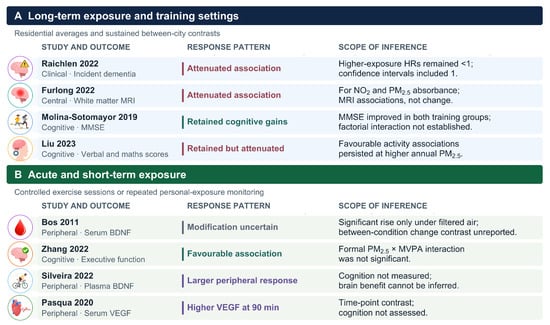
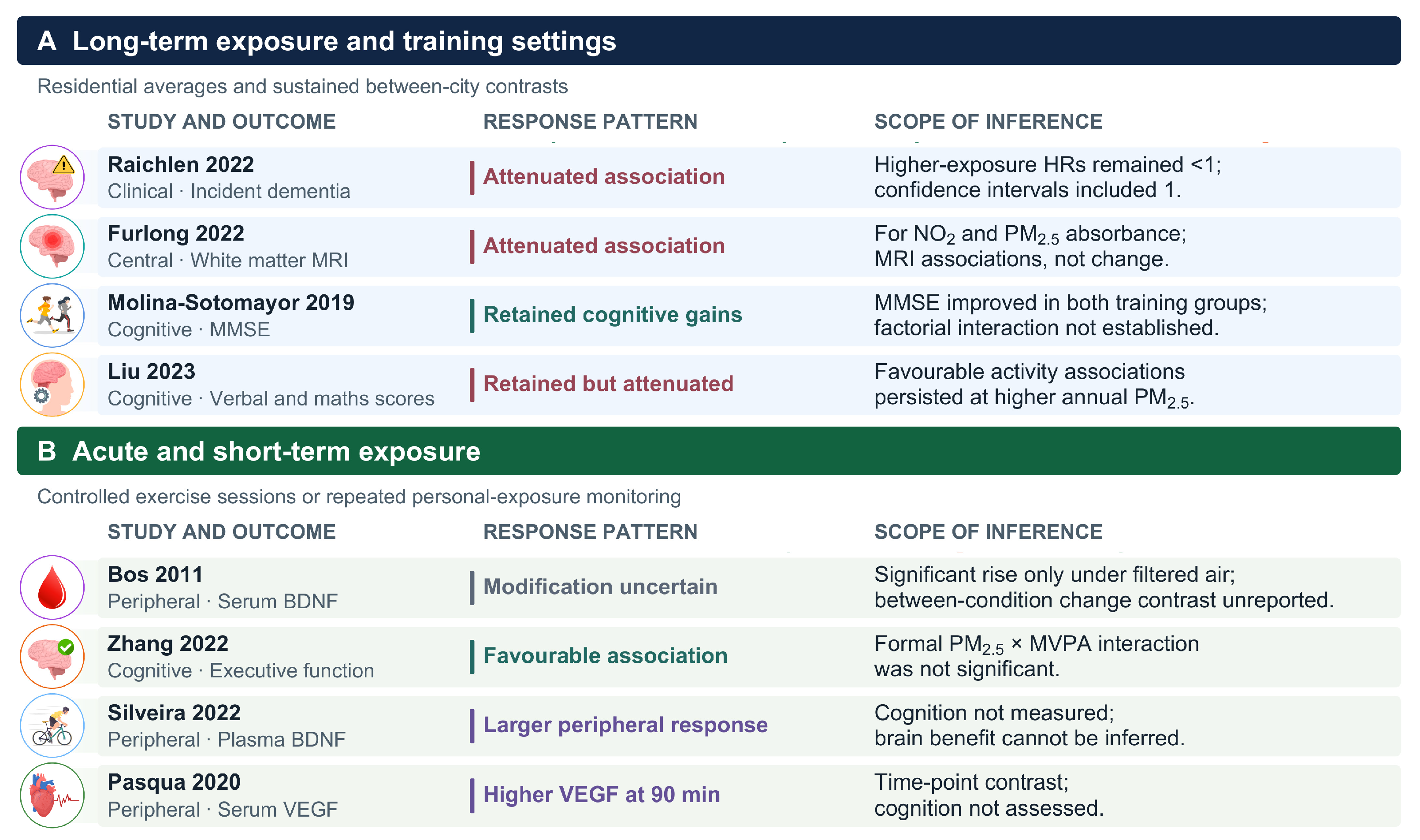
The synthesis therefore relates response patterns to the endpoint measured and the comparison supported by each design. Concordant group changes in biomarkers and cognition do not demonstrate mediation. Likewise, circulating S100B and neuron-specific enolase (NSE), or brain tight-junction-protein expression, are distinguished from direct BBB permeability measurements [24,25,26]. This framework permits evaluation of retained, attenuated or potentially amplified responses without assuming a common mechanism across outcome levels. Table 3 maps the outcome domains and provides mechanistic examples of why a circulating response cannot automatically be interpreted as a change in brain plasticity, BBB permeability or cognition. Figure 1 illustrates how outcome level, response pattern and study design shape interpretation in selected human studies across long-term and acute or short-term exposure contexts.
Table 3.
Outcome domains and boundaries of inference.
Figure 1.
Exposure context, biological outcome level and interpretation in selected human studies. (A) Long-term exposure and training settings: Raichlen et al. (2022) [45], Furlong et al. (2022) [22], Molina-Sotomayor et al. (2019) [28], and Liu et al. (2023) [23]. (B) Acute or short-term exposure: Bos et al. (2011) [17], Zhang et al. (2022) [32], Silveira et al. (2022) [18], and Pasqua et al. (2020) [19]. Response patterns should be interpreted together with the biological outcome level and the contrast supported by each study; no common concentration scale, dose–response relationship or safety threshold is implied. Retained responses do not establish equivalence with cleaner air, and larger peripheral responses do not establish greater brain benefit. BDNF, brain-derived neurotrophic factor; HR, hazard ratio; MMSE, Mini-Mental State Examination; MRI, magnetic resonance imaging; MVPA, moderate-to-vigorous physical activity; VEGF, vascular endothelial growth factor. Study summaries are provided in Table 2; full details are in Supplementary Table S1.
4. Evidence Synthesis
4.1. Peripheral Responses in Human Studies
Acute exercise studies show heterogeneous peripheral responses to polluted air. Serum BDNF increased significantly only after filtered-air cycling in the roadside comparison by Bos et al.; however, neither a condition × time test nor a between-condition change contrast was reported, so this pattern does not establish suppression of the exercise response [17]. Conversely, Silveira et al. observed a larger plasma BDNF post/pre-exercise ratio during a 50-km cycling trial under traffic-related pollution than filtered air (3.3 versus 1.3; p = 0.048). Cognition was not assessed [18]. Serum VEGF was also higher under polluted air at 90 min of moderate cycling, alongside inflammatory and blood-pressure responses; this peripheral vascular signal cannot be interpreted as evidence of enhanced central neuroplasticity [19].
Longer interventions do not show uniformly concordant biomarker and cognitive responses. In the 12-week urban/rural study, the Stroop time × site interaction was significant, whereas serum BDNF changes were non-significant in both groups [20]. In contrast, the four-group indoor/outdoor trial reported exercise × site interactions favouring indoor exercise for both serum BDNF and cognitive outcomes. These concordant group differences do not establish BDNF-mediated improvement, particularly because site and exercise modality co-varied [31]. In the two-city resistance-training study, IGF-1 increased within both active groups, although the post-training omnibus comparison across groups was non-significant (p = 0.322). These analyses address different contrasts and should not be reduced to either a uniform benefit or a null effect [30]. These findings support interpreting circulating growth factors and cognitive responses as distinct outcomes.
A small repeated panel of retirees added a peripheral neural-injury signal: the PM2.5–serum neurofilament light-chain association was stronger at lower activity, whereas no statistically significant activity-group difference was reported for BDNF. Unequal activity strata and an unclear between-group test method limit this potential buffering interpretation [44].
4.2. Central and Peripheral Outcomes in Animal Models
Direct central molecular evidence remains limited. After 90-min soot-UFP inhalation or ambient-air exposure with running or rest, hippocampal BDNF mRNA was higher in the ambient-air exercise group than the ambient-air rest group at 24 h; the UFP-plus-exercise group did not differ significantly from ambient-air rest. This pattern suggests attenuation, but no factorial interaction was reported. It therefore does not establish that UFP exposure abolished an exercise effect, and gene expression alone cannot determine the corresponding protein or cognitive response [21].
Behavioural and brain-tissue improvements were reported in mice receiving wheel exercise before intratracheal particle instillation and cerebral ischaemia/reperfusion, with the strongest pattern after six weeks of exercise. This supports benefit within the combined exposure–disease model, rather than protection during ambient inhalation in healthy animals. The absence of a PM-free exercised ischaemia/reperfusion group precludes a full PM × exercise interaction estimate. Moreover, brain tight-junction proteins and injury measures provide barrier-associated evidence, not a direct tracer measurement of BBB permeability [24].
Intravenous models further separate circulating growth-factor responses from injury-marker responses. Treadmill training with PM increased serum IGF-1, BDNF and VEGF relative to PM alone, while S100B and NSE remained elevated relative to control [25]. Under high-fat-diet and PM exposure, resistance training increased BDNF and VEGF and reduced S100B, whereas the NSE contrast was non-significant [26]. These findings support selected peripheral biomarker improvements, not directly measured BBB restoration. The treadmill study reported one-way group comparisons; the resistance-training design lacked a PM-free exercise group. Consequently, neither establishes a full factorial interaction, and systemic particle administration cannot reproduce ventilation-dependent inhalation exposure [25,26].
4.3. Cognitive Responses in Exercise Interventions
A randomised trial of 93 participants provided acute evidence of exposure-related attenuation. PM2.5 × high-intensity interval training (HIIT) coefficients for congruent and incongruent Stroop reaction time were 2.231 and 3.305 ms per μg/m3, respectively, with both confidence intervals excluding zero. These estimates support attenuation of the HIIT contrast with stretching as exposure increased. The corresponding moderate-intensity continuous training (MICT) confidence intervals included zero, but this does not establish that HIIT and MICT interaction coefficients differed. Prefrontal haemodynamic findings were channel- and task-specific and do not independently establish the mechanism of the cognitive response [29].
Training studies indicate that cognitive improvement can persist in more polluted settings, with variable magnitude across outcomes. Mini-Mental State Examination (MMSE) scores improved in both active groups after progressive walking; resistance training likewise produced gains in both cities, with greater improvement in the lower-pollution setting. Neither study established a factorial pollution × exercise interaction [28,30]. The urban/rural Stroop interaction and the indoor/outdoor trial’s cognitive interactions provide more direct statistical evidence of differing responses across settings. However, age imbalance and attrition in the former, and co-variation of site and exercise modality in the latter, limit attribution specifically to particles [20,31].
4.4. Population Evidence
Observational studies provide evidence that particulate exposure can weaken activity-related associations with cognition or dementia, although this pattern is not uniform. UK Biobank analyses using accelerometry reported attenuation of inverse activity–dementia associations at higher PM2.5 or PM2.5 absorbance; the activity estimates in the highest exposure categories did not demonstrate a reversal to harm [45]. A subsequent subtype analysis identified attenuation for a selected Alzheimer’s disease contrast, but most interactions were non-significant and multiple comparisons were unadjusted [33]. Across 108,099 repeated observations in three China Family Panel Studies waves, favourable associations of activity with combined verbal and mathematics scores also weakened as PM2.5 increased, while remaining evident at higher exposure [23].
Retained favourable associations and uncertain modification qualify an attenuation-centred interpretation. In older Hong Kong adults, greater activity was associated with lower dementia risk without clear additive or multiplicative interaction with PM2.5 [42]. In the young-adult panel, activity was associated with faster Stroop responses, but the formally tested linear interaction was non-significant; numerically stronger associations under higher pollution did not establish amplification [32]. A childhood study likewise reported no significant modification by activity, while both additive and multiplicative interaction intervals in the Northern Ireland cohort included their null values [35,43]. The Fuyang analysis suggested attenuation using an exploratory p < 0.20 criterion, with all three PM interaction p-values exceeding 0.05 [36]. These findings preserve uncertainty; non-significance does not establish equivalent effects.
Activity-related buffering was also reported, with its interpretation tied to the outcome and model. Pollution associations were weaker at higher activity levels for incident dementia in Danish nurses and for cross-sectional cognitive scores in KoGES [40,46]. Among kidney-transplant candidates, low activity strengthened the association of PM2.5 with baseline cognitive scores; effect modification for dementia was not tested, and only 29 dementia events occurred [37]. Household biomass use showed a similar activity-related difference for cognitive decline, but the interaction for incident cognitive impairment remained uncertain [50]. CHARLS findings require additional qualification: the cross-sectional buffering signal arose from an instrumental-variable model, with association directions differing across models, whereas the longitudinal analysis supported interaction for the mental-status component but not overall cognition or episodic memory [38,39]. Disagreement between the abstract and supplementary results limits confidence in the reported buffering effect [39].
The interaction scale and comparison also affect the synthesis. In UK Biobank, PM2.5 and low activity showed additive interaction for Alzheimer’s disease, while multiplicative interaction remained uncertain and neither scale supported modification for all-cause or vascular dementia [41]. In LASI, a significant activity × household-pollution × sex term indicated sex variation in the joint association, despite a non-significant overall two-way interaction [34]. Conversely, pollution associations were stronger among active participants for prevalent dementia in Chinese veterans and incident Alzheimer’s disease in the Zhejiang cohort [47,49]. Such contrasts concern the association with pollution within activity strata and do not by themselves establish harm from exercise. Finally, lower cognitive-impairment odds in selected exercise–road-distance categories did not establish an exercise-by-distance interaction, because the reported comparisons used a common reference group [48].
Structural imaging provides a distinct outcome level. In UK Biobank, vigorous activity interacted with residential NO2 and PM2.5 absorbance on white matter hyperintensity volume after correction for multiple testing. The favourable activity association was attenuated at higher exposure [22]. This finding concerns a cross-sectional MRI phenotype rather than measured cognitive decline or a training-induced change. It also cannot be transferred directly to PM2.5 mass, because absorbance represents a different exposure metric. The analysis therefore adds structural evidence to a literature otherwise dominated by cognitive scores and diagnoses.
4.5. Indirect Evidence
The indirect reports broaden the developmental and environmental context while addressing different questions from concurrent exercise under measured particulate exposure. The Shanghai–Minhang cohort examined prenatal PM2.5 in relation to intelligence at six years, with outdoor activity assessed in childhood. PM2.5-specific interaction tests were non-significant, although selected constituent interactions were reported for verbal comprehension [52]. The Shenzhen cohort likewise found no significant outdoor-time interaction across five developmental domains for prenatal or postnatal PM2.5 and its components [53]. Outdoor time does not quantify exercise intensity or dose, and prenatal exposure precedes the activity assessment. Environmental walking or jogging comparisons also varied multiple route characteristics alongside pollution [51,54]. Neither comparison established a particle-specific cognitive effect; the older-adult pilot’s PM-by-environment analysis concerned heart-rate variability rather than cognition [54]. They therefore contribute contextual and null findings without isolating particle-specific protection from physical activity.
5. Sources of Heterogeneity
5.1. Exposure Composition and Timing
Particle mass, component concentrations, PM2.5 absorbance and composite pollution scores describe different exposure contrasts. Black carbon can provide an additional indicator of combustion-related particles beyond total PM mass [64]. Component analyses and studies of combustion-related markers support reporting exposure composition, but coefficients with different measurement scales and correlated co-pollutants cannot be interpreted as universal toxicity ratios [23,39]. Likewise, a household-fuel category or distance from a major road cannot identify a particle-specific effect [48,50].
Exposure timing also changes the question being answered. Session-level concentrations address responses during or after a defined bout, whereas residential annual averages describe longer-term exposure contexts. Indoor–outdoor and city comparisons additionally combine air quality with environmental differences. Traffic noise is another relevant co-exposure: the Danish Nurse Cohort incorporated it in the analysis, whereas its separation from particle effects was not uniform across the evidence base. These differences limit attribution of cross-study contrasts to a single pollutant or exposure duration [28,29,31,40].
5.2. Activity Measurement and Population Context
Prescribed exercise, accelerometer-derived activity, self-reported activity volume and a yes/no exercise category are not interchangeable doses. Frequency or duration cannot resolve intensity when intensity was unmeasured [23,33]. Fitness, exercise protocols and exposure conditions differed across the small chamber studies, so the larger BDNF response in recreationally trained cyclists does not demonstrate physiological adaptation to pollution [18,19]. Age, sex and metabolic health remain plausible modifiers, but differences between studies or populations require direct interaction tests before they can be attributed to these characteristics. The sex-related result in LASI and the high-fat-diet mouse experiment illustrate the importance of the exact comparison available [26,34].
5.3. Comparator Structure and Statistical Interpretation
A larger pollution association among active participants and a weaker activity association at higher pollution are related forms of effect modification, but neither alone establishes that activity becomes harmful [49]. Joint categories compared with a common reference answer a different question from a within-exposure exercise contrast [48]. Interpretation therefore depends on the specified comparator, outcome scale and uncertainty interval. Additive interaction can be present without statistically supported multiplicative interaction, and different within-stratum p values do not establish either [16,41,65]. Preserving these distinctions explains part of the apparent disagreement between studies without assigning every difference to biological heterogeneity.
6. Implications for Brain Health
6.1. Linking Biological Outcome Levels
The central interpretive finding is that a change in peripheral BDNF alone cannot establish a brain-health benefit under PM exposure. Increased circulating BDNF can coexist across the literature with attenuated cognitive associations, but the studies differ in population, exposure, exercise and timing. These contrasts generate a hypothesis about cross-level discordance; they do not demonstrate that biological outcome level determines the direction of an interaction. Within-study concordance in BDNF and cognitive group contrasts is more informative, although concordant group means still do not establish mediation or validate an individual-level surrogate. Paired measurements should therefore be interpreted as distinct outcomes until their temporal and statistical relationships have been tested [18,20,23,31].
6.2. Limits of Quantitative Translation
The evidence does not identify a general PM2.5 concentration at which exercise-related brain benefit reverses to harm. The approximately 33 μg/m3 division in the acute cognitive trial was a sample-mean split, not an estimated change point [29]. Loss of statistical significance within an exposure stratum likewise does not establish loss of benefit or a safety boundary [36,45]. Activity–pollution trade-offs derived from observational coefficients cannot specify an exercise dose that compensates for exposure [23,39]. These estimates can describe study-specific contrasts and inform hypotheses; their use as concentration limits or exercise prescriptions would require direct validation. Table 4 distinguishes quantitative evidence for study-specific contrasts from the additional evidence needed to define an exposure threshold or compensatory activity dose.
Table 4.
Quantitative findings and limits of translation.
7. Limitations and Research Priorities
7.1. Limits of the Assembled Evidence
This focused narrative review searched two databases and documented literature selection decisions, but some relevant publications may not have been included because of the search scope and eligibility criteria. Verification of selection decisions did not constitute independent duplicate screening. Measurement limitations and reporting inconsistencies constrained some finding-specific appraisals, while diverse exposure metrics, comparator structures and biological outcomes limited direct quantitative comparison across studies [35,39].
Small controlled-exposure samples and attrition constrain precision, while differences in training protocols and settings complicate comparisons. In observational analyses, residential exposure estimates and reported activity may not capture exposure during exercise. Cross-sectional associations cannot resolve temporal ordering, and prospective designs remain susceptible to residual confounding. These design limitations restrict causal interpretation even when an interaction estimate is statistically significant [18,20,22,23].
Reports are not necessarily independent samples. Analyses from UK Biobank, CHARLS and CLHLS may include overlapping participants; participant-level overlap was not quantified. Supplementary Table S1 records the cohort sources, and sample sizes were not summed across reports.
Two of the four animal reports were co-authored by the present authors and used intravenous exposure with peripheral outcomes. Their findings were subject to the same selection and interpretive criteria and cannot establish central protection during ambient inhalation. The remaining animal reports provide hippocampal gene-expression comparisons after acute inhalation exposure and a preventive-exercise instillation model with cerebral ischaemia/reperfusion, leaving chronic central protection under environmentally relevant inhalation unresolved [21,24,25,26].
7.2. Priorities for Discriminating Between Explanations
The next experiments should measure BDNF and complementary growth factors alongside central or cognitive outcomes within the same protocol, retain appropriate exposed and unexposed exercise comparators, and measure exposure during activity [18,31]. Measured ventilation and clearly distinguished inhaled and deposited doses would strengthen dose interpretation. Repeated sampling can test whether apparent disagreement reflects sampling time; randomising exercise intensity while controlling exposure and accounting for baseline fitness would better isolate intensity effects. Inhalation experiments are needed to test the exposure-route generalisability of intravenous findings, while paired peripheral and central measurements can test whether biomarker changes correspond to brain outcomes. Including both sexes would broaden the populations represented in these experiments [21,24,25,26]. Component-resolved human studies should address correlated co-pollutants and relevant environmental factors, including noise.
Analyses should prespecify the primary endpoint, comparator, interaction scale and multiplicity strategy, and report effect estimates with uncertainty rather than relying on subgroup significance [16,65]. Candidate modifiers such as age, sex, metabolic status and training history require adequately powered direct tests. A proposed concentration change point or compensatory activity dose should be estimated with uncertainty and validated in independent data before quantitative guidance is considered. Table 5 translates these interpretive issues into proposed reporting priorities for future studies.
Table 5.
Proposed reporting priorities.
8. Conclusions
Neurotrophic responses and functional brain outcomes associated with exercise under PM exposure show heterogeneous patterns across studies. Circulating BDNF responses vary, with VEGF and IGF-1 providing complementary growth-factor evidence; selected cognitive, dementia and imaging comparisons show attenuation alongside retained favourable activity associations and potential buffering. These findings support interpreting neurotrophic responses in relation to the biological outcome level, exposure context and comparison supported by each study. A change in peripheral BDNF alone cannot establish brain benefit, and cognitive or imaging findings do not by themselves demonstrate a BDNF-mediated mechanism.
Animal experiments provide mechanistic leads whose relevance depends on the exposure route and model. The evidence does not identify a general PM concentration at which exercise-related brain benefit reverses to harm or an activity dose that compensates for pollution exposure. A priority is to measure BDNF, complementary growth factors and central or functional outcomes together while assessing actual exposure during exercise and exercise intensity, with appropriate exposure-by-exercise comparisons. This approach can test whether neurotrophic changes accompany functional benefit and under which exposure and exercise conditions those relationships hold.
Supplementary Materials
The following supporting information can be downloaded at: https://www.mdpi.com/article/10.3390/atmos17111077/s1, Supplementary Methods S1: Database search strategies; Supplementary Table S1: Detailed study characteristics and findings.
Author Contributions
Conceptualization, H.-T.R.; methodology, S.-Y.C. and H.-T.R.; writing—original draft preparation, S.-Y.C. and H.-T.R.; writing—review and editing, S.-Y.C. and H.-T.R.; project administration, H.-T.R.; funding acquisition, H.-T.R. All authors have read and agreed to the published version of the manuscript.
Funding
This work was supported by the Ministry of Education of the Republic of Korea and the National Research Foundation of Korea (NRF-2025S1A5A2A01009403).
Institutional Review Board Statement
Not applicable.
Informed Consent Statement
Not applicable.
Data Availability Statement
No new data were created or analysed in this study. Data sharing is not applicable to this article.
Conflicts of Interest
The authors declare no financial conflicts of interest. Both authors were co-authors of two primary reports included in the main synthesis [25,26]. The potential implications of this authorship overlap are addressed in Section 7.1.
Abbreviations
The following abbreviations are used in this manuscript:
| BBB | blood–brain barrier |
| BDNF | brain-derived neurotrophic factor |
| CHARLS | China Health and Retirement Longitudinal Study |
| CLHLS | Chinese Longitudinal Healthy Longevity Survey |
| HIIT | high-intensity interval training |
| IGF-1 | insulin-like growth factor-1 |
| KoGES | Korean Genome and Epidemiology Study |
| LASI | Longitudinal Ageing Study in India |
| MICT | moderate-intensity continuous training |
| MMSE | Mini-Mental State Examination |
| mRNA | messenger RNA |
| MRI | magnetic resonance imaging |
| NO2 | nitrogen dioxide |
| NSE | neuron-specific enolase |
| PM | particulate matter |
| PM2.5 | particulate matter with an aerodynamic diameter ≤ 2.5 μm |
| S100B | S100 calcium-binding protein B |
| SANRA | Scale for the Assessment of Narrative Review Articles |
| UFP | ultrafine particles |
| VEGF | vascular endothelial growth factor |
References
- Bell, M.L.; Dominici, F.; Ebisu, K.; Zeger, S.L.; Samet, J.M. Spatial and temporal variation in PM2.5 chemical composition in the United States for health effects studies. Environ. Health Perspect. 2007, 115, 989–995. [Google Scholar] [CrossRef] [Scilit] [PubMed]
- Bos, I.; De Boever, P.; Int Panis, L.; Meeusen, R. Physical activity, air pollution and the brain. Sports Med. 2014, 44, 1505–1518. [Google Scholar] [CrossRef] [Scilit] [PubMed]
- Hung, A.; Nelson, H.; Koehle, M.S. The acute effects of exercising in air pollution: A systematic review of randomized controlled trials. Sports Med. 2022, 52, 139–164. [Google Scholar] [CrossRef] [Scilit] [PubMed]
- Shih, C.-H.; Chen, J.-K.; Kuo, L.-W.; Cho, K.-H.; Hsiao, T.-C.; Lin, Z.-W.; Lin, Y.-S.; Kang, J.-H.; Lo, Y.-C.; Chuang, K.-J.; et al. Chronic pulmonary exposure to traffic-related fine particulate matter causes brain impairment in adult rats. Part. Fibre Toxicol. 2018, 15, 44. [Google Scholar] [CrossRef] [Scilit] [PubMed]
- Oppenheim, H.A.; Lucero, J.; Guyot, A.-C.; Herbert, L.M.; McDonald, J.D.; Mabondzo, A.; Lund, A.K. Exposure to vehicle emissions results in altered blood brain barrier permeability and expression of matrix metalloproteinases and tight junction proteins in mice. Part. Fibre Toxicol. 2013, 10, 62. [Google Scholar] [CrossRef] [Scilit] [PubMed]
- Delgado-Saborit, J.M.; Guercio, V.; Gowers, A.M.; Shaddick, G.; Fox, N.C.; Love, S. A critical review of the epidemiological evidence of effects of air pollution on dementia, cognitive function and cognitive decline in adult population. Sci. Total Environ. 2021, 757, 143734. [Google Scholar] [CrossRef] [Scilit] [PubMed]
- Fu, P.; Guo, X.; Cheung, F.M.H.; Yung, K.K.L. The association between PM2.5 exposure and neurological disorders: A systematic review and meta-analysis. Sci. Total Environ. 2019, 655, 1240–1248. [Google Scholar] [CrossRef] [Scilit] [PubMed]
- Best Rogowski, C.B.; Bredell, C.; Shi, Y.; Tien-Smith, A.; Szybka, M.; Fung, K.W.; Hong, L.; Phillips, V.; Jovanovic Andersen, Z.; Sharp, S.J.; et al. Long-term air pollution exposure and incident dementia: A systematic review and meta-analysis. Lancet Planet. Health 2025, 9, 101266. [Google Scholar] [CrossRef] [Scilit] [PubMed]
- Canning, T.; Arias-de la Torre, J.; Fisher, H.L.; Gulliver, J.; Hansell, A.L.; Hardy, R.; Hatch, S.L.; Mudway, I.S.; Ronaldson, A.; Cartlidge, M.; et al. Associations between life course exposure to ambient air pollution with cognition and later-life brain structure: A population-based study of the 1946 British Birth Cohort. Lancet Healthy Longev. 2025, 6, 100724. [Google Scholar] [CrossRef] [Scilit] [PubMed]
- Livingston, G.; Huntley, J.; Sommerlad, A.; Ames, D.; Ballard, C.; Banerjee, S.; Brayne, C.; Burns, A.; Cohen-Mansfield, J.; Cooper, C.; et al. Dementia prevention, intervention, and care: 2020 report of the Lancet Commission. Lancet 2020, 396, 413–446, (Erratum in 2023, Lancet, 402, 1132). [Google Scholar] [CrossRef] [Scilit] [PubMed]
- Vaynman, S.; Ying, Z.; Gomez-Pinilla, F. Hippocampal BDNF mediates the efficacy of exercise on synaptic plasticity and cognition. Eur. J. Neurosci. 2004, 20, 2580–2590. [Google Scholar] [CrossRef] [Scilit] [PubMed]
- Wang, Y.-H.; Zhou, H.-H.; Luo, Q.; Cui, S. The effect of physical exercise on circulating brain-derived neurotrophic factor in healthy subjects: A meta-analysis of randomized controlled trials. Brain Behav. 2022, 12, e2544. [Google Scholar] [CrossRef] [Scilit] [PubMed]
- Fujimura, H.; Altar, C.A.; Chen, R.; Nakamura, T.; Nakahashi, T.; Kambayashi, J.; Sun, B.; Tandon, N.N. Brain-derived neurotrophic factor is stored in human platelets and released by agonist stimulation. Thromb. Haemost. 2002, 87, 728–734. [Google Scholar] [CrossRef] [Scilit]
- Gejl, A.K.; Enevold, C.; Bugge, A.; Andersen, M.S.; Nielsen, C.H.; Andersen, L.B. Associations between serum and plasma brain-derived neurotrophic factor and influence of storage time and centrifugation strategy. Sci. Rep. 2019, 9, 9655. [Google Scholar] [CrossRef] [Scilit] [PubMed]
- Baethge, C.; Goldbeck-Wood, S.; Mertens, S. SANRA—A scale for the quality assessment of narrative review articles. Res. Integr. Peer Rev. 2019, 4, 5. [Google Scholar] [CrossRef] [Scilit] [PubMed]
- Gelman, A.; Stern, H. The Difference Between “Significant” and “Not Significant” is not Itself Statistically Significant. Am. Stat. 2006, 60, 328–331. [Google Scholar] [CrossRef] [Scilit]
- Bos, I.; Jacobs, L.; Nawrot, T.S.; de Geus, B.; Torfs, R.; Int Panis, L.; Degraeuwe, B.; Meeusen, R. No exercise-induced increase in serum BDNF after cycling near a major traffic road. Neurosci. Lett. 2011, 500, 129–132. [Google Scholar] [CrossRef] [Scilit] [PubMed]
- Silveira, A.C.; Hasegawa, J.S.; Cruz, R.; Matsuda, M.; Marquezini, M.V.; Lima-Silva, A.E.; Giles, L.V.; Saldiva, P.; Koehle, M.S.; Bertuzzi, R. Effects of air pollution exposure on inflammatory and endurance performance in recreationally trained cyclists adapted to traffic-related air pollution. Am. J. Physiol. Regul. Integr. Comp. Physiol. 2022, 322, R562–R570. [Google Scholar] [CrossRef] [Scilit] [PubMed]
- Pasqua, L.A.; Damasceno, M.V.; Cruz, R.; Matsuda, M.; Martins, M.A.G.; Marquezini, M.V.; Lima-Silva, A.E.; Saldiva, P.H.N.; Bertuzzi, R. Exercising in the urban center: Inflammatory and cardiovascular effects of prolonged exercise under air pollution. Chemosphere 2020, 254, 126817. [Google Scholar] [CrossRef] [Scilit] [PubMed]
- Bos, I.; De Boever, P.; Vanparijs, J.; Pattyn, N.; Int Panis, L.; Meeusen, R. Subclinical effects of aerobic training in urban environment. Med. Sci. Sports Exerc. 2013, 45, 439–447. [Google Scholar] [CrossRef] [Scilit] [PubMed]
- Bos, I.; De Boever, P.; Int Panis, L.; Sarre, S.; Meeusen, R. Negative effects of ultrafine particle exposure during forced exercise on the expression of Brain-Derived Neurotrophic Factor in the hippocampus of rats. Neuroscience 2012, 223, 131–139. [Google Scholar] [CrossRef] [Scilit] [PubMed]
- Furlong, M.A.; Alexander, G.E.; Klimentidis, Y.C.; Raichlen, D.A. Association of Air Pollution and Physical Activity with Brain Volumes. Neurology 2022, 98, e416–e426. [Google Scholar] [CrossRef] [Scilit] [PubMed]
- Liu, J.; Liu, R.; Zhang, Y.; Lao, X.; Mandeville, K.L.; Ma, X.; Di, Q. Leisure-time physical activity mitigated the cognitive effect of PM2.5 and PM2.5 components exposure: Evidence from a nationwide longitudinal study. Environ. Int. 2023, 179, 108143. [Google Scholar] [CrossRef] [Scilit] [PubMed]
- Sun, S.; Qin, M.; Cao, Q.; Zhang, Q.; Guo, X.; Wang, H.; Gao, Y.; Wu, Y.; Li, R.; Jia, X.; et al. Exercise protects against PM2.5 exacerbated cerebral ischemia/reperfusion injury via the gut-brain axis in mice. Ecotoxicol. Environ. Saf. 2025, 305, 119202. [Google Scholar] [CrossRef] [Scilit] [PubMed]
- Cho, S.-Y.; Roh, H.-T. Combined Effects of Particulate Matter Exposure and Exercise Training on Neuroplasticity-Related Growth Factors and Blood–Brain Barrier Integrity. Atmosphere 2025, 16, 220. [Google Scholar] [CrossRef] [Scilit]
- Cho, S.-Y.; Roh, H.-T. Resistance Exercise Training Attenuates Metabolic and Neurovascular Dysfunction Induced by a High-Fat Diet, With or Without Particulate Matter Exposure. Atmosphere 2026, 17, 203. [Google Scholar] [CrossRef] [Scilit]
- Daigle, C.C.; Chalupa, D.C.; Gibb, F.R.; Morrow, P.E.; Oberdörster, G.; Utell, M.J.; Frampton, M.W. Ultrafine particle deposition in humans during rest and exercise. Inhal. Toxicol. 2003, 15, 539–552. [Google Scholar] [CrossRef] [Scilit] [PubMed]
- Molina-Sotomayor, E.; González Orb, M.; Pradas de la Fuente, F.; Carozzi Figueroa, G.; Sánchez-Oliver, A.J.; González-Jurado, J.A. Effects of Cardiorespiratory Exercise on Cognition in Older Women Exposed to Air Pollution. Int. J. Environ. Res. Public Health 2019, 16, 245. [Google Scholar] [CrossRef] [Scilit] [PubMed]
- Liu, J.; You, Y.; Liu, R.; Shen, L.; Wang, D.; Li, X.; Min, L.; Yin, J.; Zhang, D.; Ma, X.; et al. The joint effect and hemodynamic mechanism of PA and PM2.5 exposure on cognitive function: A randomized controlled trial study. J. Hazard. Mater. 2023, 460, 132415. [Google Scholar] [CrossRef] [Scilit] [PubMed]
- Molina-Sotomayor, E.; Castillo-Quezada, H.; Martínez-Salazar, C.; González-Orb, M.; Espinoza-Salinas, A.; Gonzalez-Jurado, J.A. Effects of Progressive Resistance Training on Cognition and IGF-1 Levels in Elder Women Who Live in Areas with High Air Pollution. Int. J. Environ. Res. Public Health 2020, 17, 6203. [Google Scholar] [CrossRef] [Scilit] [PubMed]
- Cassilhas, R.C.; De Sousa, R.A.L.; Caxa, L.; Viana, V.; Meeusen, R.; Gonçalves, F.L.; Diniz e Magalhães, C.O.; Tufik, S.; Dias Peixoto, M.F.; Monteiro Junior, R.S.; et al. Indoor aerobic exercise reduces exposure to pollution, improves cognitive function, and enhances BDNF levels in the elderly. Air Qual. Atmos. Health 2022, 15, 35–45. [Google Scholar] [CrossRef] [Scilit]
- Zhang, Y.; Ke, L.; Fu, Y.; Di, Q.; Ma, X. Physical activity attenuates negative effects of short-term exposure to ambient air pollution on cognitive function. Environ. Int. 2022, 160, 107070. [Google Scholar] [CrossRef] [Scilit] [PubMed]
- Zhang, Y.; Xu, W. Accelerometer-based physical activity, air pollution and risk of dementia subtypes: A prospective study using UK biobank. Front. Public Health 2026, 13, 1695462. [Google Scholar] [CrossRef] [Scilit] [PubMed]
- Das, S.; Ayalon, L. Physical activity, indoor air pollution, and cognitive function among older-adults in India: Evidence of gendered environmental disadvantage. Soc. Sci. Med. 2026, 404, 119520. [Google Scholar] [CrossRef] [Scilit] [PubMed]
- Gui, Z.; Cai, L.; Zhang, J.; Zeng, X.; Lai, L.; Lv, Y.; Huang, C.; Chen, Y. Exposure to ambient air pollution and executive function among Chinese primary schoolchildren. Int. J. Hyg. Environ. Health 2020, 229, 113583. [Google Scholar] [CrossRef] [Scilit] [PubMed]
- Li, J.; Liu, Q.; Tian, Z.; Wang, J.; Zhang, Y.; Cheng, X.; Wang, Y.; Wang, H.; Guo, X.; Li, H.; et al. The interaction between physical activity and ambient particulate matters on cognitive function among Chinese community-dwelling older adults. J. Affect. Disord. 2024, 363, 391–400. [Google Scholar] [CrossRef] [Scilit] [PubMed]
- Hong, J.; Wilson, M.; Long, J.J.; Li, Y.; Ghildayal, N.; Kim, B.; Ali, N.M.; Mathur, A.; Gordon, T.; Thurston, G.D.; et al. Ambient Air Pollution, Cognitive Impairment, and Dementia Among Older Patients Being Evaluated for Kidney Transplantation. Clin. Transplant. 2025, 39, e70376. [Google Scholar] [CrossRef] [Scilit] [PubMed]
- Zhu, L.; Zou, M. Air pollution and cognitive function: The potential protective effect of physical activity. Sci. Rep. 2025, 15, 45167. [Google Scholar] [CrossRef] [Scilit] [PubMed]
- Yu, Z.; Jiang, Z.; Feng, Y.; Ni, P.; He, J.; Bao, Z.; Cui, J.; Li, F. Physical activity offsets air pollution-related cognitive decline: A retrospective cohort study based on China Health and Retirement Longitudinal Study. J. Gerontol. A Biol. Sci. Med. Sci. 2026, 81, glaf291. [Google Scholar] [CrossRef] [Scilit] [PubMed]
- Tuffier, S.; Zhang, J.; Bergmann, M.; So, R.; Napolitano, G.M.; Cole-Hunter, T.; Maric, M.; Antic, S.; Brandt, J.; Ketzel, M.; et al. Long-term exposure to air pollution and road traffic noise and incidence of dementia in the Danish Nurse Cohort. Alzheimer’s Dement. 2024, 20, 4080–4091. [Google Scholar] [CrossRef] [Scilit] [PubMed]
- Zhang, Y.; Fu, Y.; Guan, X.; Wang, C.; Fu, M.; Xiao, Y.; Hong, S.; Zhou, Y.; Liu, C.; Zhong, G.; et al. Associations of ambient air pollution exposure and lifestyle factors with incident dementia in the elderly: A prospective study in the UK Biobank. Environ. Int. 2024, 190, 108870. [Google Scholar] [CrossRef] [Scilit] [PubMed]
- Ran, J.; Zhang, Y.; Han, L.; Sun, S.; Zhao, S.; Shen, C.; Zhang, X.; Chan, K.P.; Lee, R.S.; Qiu, Y.; et al. The joint association of physical activity and fine particulate matter exposure with incident dementia in elderly Hong Kong residents. Environ. Int. 2021, 156, 106645. [Google Scholar] [CrossRef] [Scilit] [PubMed]
- Küçükali, H.; Garcia, L.; Avila-Palencia, I.; Wang, R.; Mullineaux, S.; Kee, F.; McGuinness, B.; Hunter, R.F. Investigating Syndemic Effects of Air Pollution and Physical Inactivity on Cognitive Decline in Older Adults. J. Phys. Act. Health 2025, 22, 1153–1159. [Google Scholar] [CrossRef] [Scilit] [PubMed]
- Song, J.; Qu, R.; Sun, B.; Chen, R.; Kan, H.; An, Z.; Jiang, J.; Li, J.; Zhang, Y.; Wu, W. Associations of Short-Term Exposure to Fine Particulate Matter with Neural Damage Biomarkers: A Panel Study of Healthy Retired Adults. Environ. Sci. Technol. 2022, 56, 7203–7213. [Google Scholar] [CrossRef] [Scilit] [PubMed]
- Raichlen, D.A.; Furlong, M.; Klimentidis, Y.C.; Sayre, M.K.; Parra, K.L.; Bharadwaj, P.K.; Wilcox, R.R.; Alexander, G.E. Association of Physical Activity with Incidence of Dementia Is Attenuated by Air Pollution. Med. Sci. Sports Exerc. 2022, 54, 1131–1138. [Google Scholar] [CrossRef] [Scilit] [PubMed]
- Lee, J.J.; Kim, J.H.; Song, D.S.; Lee, K. Effect of Short- to Long-Term Exposure to Ambient Particulate Matter on Cognitive Function in a Cohort of Middle-Aged and Older Adults: KoGES. Int. J. Environ. Res. Public Health 2022, 19, 9913. [Google Scholar] [CrossRef] [Scilit] [PubMed]
- Tan, J.; Li, N.; Wang, X.; Chen, G.; Yan, L.; Wang, L.; Zhao, Y.; Li, S.; Guo, Y. Associations of particulate matter with dementia and mild cognitive impairment in China: A multicenter cross-sectional study. Innovation 2021, 2, 100147. [Google Scholar] [CrossRef] [Scilit] [PubMed]
- Zhang, H.; Chen, Y.; Ni, R.; Cao, Y.; Fang, W.; Hu, W.; Pan, G. Traffic-related air pollution, adherence to healthy lifestyles, and risk of cognitive impairment: A nationwide population-based study. Ecotoxicol. Environ. Saf. 2023, 262, 115349. [Google Scholar] [CrossRef] [Scilit] [PubMed]
- Fu, H.; Zhang, T.; Gu, X.; Li, F.; Jin, M.; He, F.; Fei, F. Association between long-term exposure to air pollutant mixture and the risk of Alzheimer’s disease among older people: A prospective cohort study in China. BMC Public Health 2025, 25, 3562. [Google Scholar] [CrossRef] [Scilit] [PubMed]
- Deng, Y.; Yang, T.; Gao, Q.; Yang, D.; Liu, R.; Wu, B.; Hu, L.; Liu, Y.; He, M. Cooking with biomass fuels increased the risk for cognitive impairment and cognitive decline among the oldest-old Chinese adults (2011-2018): A prospective cohort study. Environ. Int. 2021, 155, 106593. [Google Scholar] [CrossRef] [Scilit] [PubMed]
- Han, K.-T. The effect of environmental factors and physical activity on emotions and attention while walking and jogging. J. Leis. Res. 2021, 52, 619–641. [Google Scholar] [CrossRef] [Scilit]
- Sun, X.; Liu, C.; Ji, H.; Li, W.; Miao, M.; Yuan, W.; Yuan, Z.; Liang, H.; Kan, H. Prenatal exposure to ambient PM2.5 and its chemical constituents and child intelligence quotient at 6 years of age. Ecotoxicol. Environ. Saf. 2023, 255, 114813. [Google Scholar] [CrossRef] [Scilit] [PubMed]
- Deng, Y.; Li, X.; Li, X.; Liu, X.; Lin, L.; Cai, L.; Zhang, M. Association of early life exposure to PM2.5 and its components with offspring neurodevelopment: A prospective birth cohort study. Environ. Res. 2025, 266, 120552. [Google Scholar] [CrossRef] [Scilit] [PubMed]
- Roe, J.; Mondschein, A.; Neale, C.; Barnes, L.; Boukhechba, M.; Lopez, S. The Urban Built Environment, Walking and Mental Health Outcomes Among Older Adults: A Pilot Study. Front. Public Health 2020, 8, 575946. [Google Scholar] [CrossRef] [Scilit] [PubMed]
- Fabel, K.; Fabel, K.; Tam, B.; Kaufer, D.; Baiker, A.; Simmons, N.; Kuo, C.J.; Palmer, T.D. VEGF is necessary for exercise-induced adult hippocampal neurogenesis. Eur. J. Neurosci. 2003, 18, 2803–2812. [Google Scholar] [CrossRef] [Scilit] [PubMed]
- Trejo, J.L.; Carro, E.; Torres-Alemán, I. Circulating insulin-like growth factor I mediates exercise-induced increases in the number of new neurons in the adult hippocampus. J. Neurosci. 2001, 21, 1628–1634. [Google Scholar] [CrossRef] [Scilit] [PubMed]
- Klein, A.B.; Williamson, R.; Santini, M.A.; Clemmensen, C.; Ettrup, A.; Rios, M.; Knudsen, G.M.; Aznar, S. Blood BDNF concentrations reflect brain-tissue BDNF levels across species. Int. J. Neuropsychopharmacol. 2011, 14, 347–353. [Google Scholar] [CrossRef] [Scilit] [PubMed]
- Amadio, P.; Sandrini, L.; Ieraci, A.; Tremoli, E.; Barbieri, S.S. Effect of clotting duration and temperature on BDNF measurement in human serum. Int. J. Mol. Sci. 2017, 18, 1987. [Google Scholar] [CrossRef] [Scilit] [PubMed]
- Zuurbier, M.; Hoek, G.; van den Hazel, P.; Brunekreef, B. Minute ventilation of cyclists, car and bus passengers: An experimental study. Environ. Health 2009, 8, 48. [Google Scholar] [CrossRef] [Scilit] [PubMed]
- Block, M.L.; Calderón-Garcidueñas, L. Air pollution: Mechanisms of neuroinflammation and CNS disease. Trends Neurosci. 2009, 32, 506–516. [Google Scholar] [CrossRef] [Scilit] [PubMed]
- Allen, J.L.; Klocke, C.; Morris-Schaffer, K.; Conrad, K.; Sobolewski, M.; Cory-Slechta, D.A. Cognitive effects of air pollution exposures and potential mechanistic underpinnings. Curr. Environ. Health Rep. 2017, 4, 180–191. [Google Scholar] [CrossRef] [Scilit] [PubMed]
- Oberdörster, G.; Sharp, Z.; Atudorei, V.; Elder, A.; Gelein, R.; Kreyling, W.; Cox, C. Translocation of inhaled ultrafine particles to the brain. Inhal. Toxicol. 2004, 16, 437–445. [Google Scholar] [CrossRef] [Scilit] [PubMed]
- Fonken, L.K.; Xu, X.; Weil, Z.M.; Chen, G.; Sun, Q.; Rajagopalan, S.; Nelson, R.J. Air pollution impairs cognition, provokes depressive-like behaviors and alters hippocampal cytokine expression and morphology. Mol. Psychiatry 2011, 16, 987–995. [Google Scholar] [CrossRef] [Scilit] [PubMed]
- Janssen, N.A.H.; Hoek, G.; Simic-Lawson, M.; Fischer, P.; van Bree, L.; ten Brink, H.; Keuken, M.; Atkinson, R.W.; Anderson, H.R.; Brunekreef, B.; et al. Black carbon as an additional indicator of the adverse health effects of airborne particles compared with PM10 and PM2.5. Environ. Health Perspect. 2011, 119, 1691–1699. [Google Scholar] [CrossRef] [Scilit] [PubMed]
- VanderWeele, T.J.; Knol, M.J. A Tutorial on Interaction. Epidemiol. Methods 2014, 3, 33–72. [Google Scholar] [CrossRef] [Scilit]

Disclaimer/Publisher’s Note: The statements, opinions and data contained in all publications are solely those of the individual author(s) and contributor(s) and not of MDPI and/or the editor(s). MDPI and/or the editor(s) disclaim responsibility for any injury to people or property resulting from any ideas, methods, instructions or products referred to in the content. |
© 2026 by the authors. Licensee MDPI, Basel, Switzerland. This article is an open access article distributed under the terms and conditions of the Creative Commons Attribution (CC BY) license.