

Skip to Content

Genes, Volume 10, Issue 4

2019 April - 71 articles

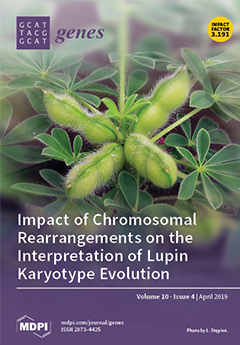
Cover Story: Lupins are legumes that are diverse and geographically widespread mainly around Mediterranean basin and both Americas. European lupins also exhibit great variability in chromosome number (2n=32-52), the basic chromosome number (x=5-9, 13) and genome size (0.97 pg/2C to 2.44 pg/2C). Comparative BAC-FISH analyses highlighted chromosomes variations and its multiple rearrangements. We proposed along with phylogeny data, the model of lupin chromosome evolution through three round of whole genome duplication, with assistance to aneuploidy. We assume the basic chromosome number as x=6, that is considered also for American lupins. The outstanding complex genome evolution makes lupin fascinating model for evolutionary studies. Polyploidy may provide an privilege in domestication, thus development of fundamental (cyto)genetic is a crucial to utilisate lupins in modern plant improvement. View this paper.
  • Issues are regarded as officially published after their release is announced to the table of contents alert mailing list .
  • You may sign up for email alerts to receive table of contents of newly released issues.
  • PDF is the official format for papers published in both, html and pdf forms. To view the papers in pdf format, click on the "PDF Full-text" link, and use the free Adobe Reader to open them.

Articles (71)

  • Article
  • Open Access
15 Citations
6,053 Views
11 Pages

Novel Y Chromosome Retrocopies in Canids Revealed through a Genome-Wide Association Study for Sex

  • Kate L. Tsai,
  • Jacquelyn M. Evans,
  • Rooksana E. Noorai,
  • Alison N. Starr-Moss and
  • Leigh Anne Clark

25 April 2019

The lack of an annotated reference sequence for the canine Y chromosome has limited evolutionary studies, as well as our understanding of the role of Y-linked sequences in phenotypes with a sex bias. In genome-wide association studies (GWASs), we obs...

  • Review
  • Open Access
36 Citations
6,215 Views
10 Pages

25 April 2019

microRNAs regulate gene expression by blocking the translation of mRNAs and/or promoting their degradation. They, therefore, play important roles in gene regulatory networks (GRNs) by modulating the expression levels of specific genes and can tune GR...

  • Review
  • Open Access
64 Citations
16,203 Views
17 Pages

24 April 2019

Telomeric repeats, coated by the shelterin complex, prevent inappropriate activation of the DNA damage response at the ends of linear chromosomes. Shelterin has evolved distinct solutions to protect telomeres from different aspects of the DNA damage...

  • Article
  • Open Access
8 Citations
5,135 Views
12 Pages

MicroRNAs Mediated Regulation of Expression of Nucleoside Analog Pathway Genes in Acute Myeloid Leukemia

  • Neha S. Bhise,
  • Abdelrahman H. Elsayed,
  • Xueyuan Cao,
  • Stanley Pounds and
  • Jatinder K. Lamba

24 April 2019

Nucleoside analog, cytarabine (ara-C) is the mainstay of acute myeloid leukemia (AML) chemotherapy. Cytarabine and other nucleoside analogs require activation to the triphosphate form (ara-CTP). Intracellular ara-CTP levels demonstrate significant in...

  • Article
  • Open Access
37 Citations
5,769 Views
11 Pages

The Biochemical Role of the Human NEIL1 and NEIL3 DNA Glycosylases on Model DNA Replication Forks

  • Mustafa S. Albelazi,
  • Peter R. Martin,
  • Soran Mohammed,
  • Luciano Mutti,
  • Jason L. Parsons and
  • Rhoderick H. Elder

23 April 2019

Endonuclease VIII-like (NEIL) 1 and 3 proteins eliminate oxidative DNA base damage and psoralen DNA interstrand crosslinks through initiation of base excision repair. Current evidence points to a DNA replication associated repair function of NEIL1 an...

  • Article
  • Open Access
15 Citations
5,827 Views
25 Pages

Mitochondrial Introgression, Color Pattern Variation, and Severe Demographic Bottlenecks in Three Species of Malagasy Poison Frogs, Genus Mantella

  • Angelica Crottini,
  • Pablo Orozco-terWengel,
  • Falitiana C. E. Rabemananjara,
  • J. Susanne Hauswaldt and
  • Miguel Vences

23 April 2019

Madagascar is a biodiversity hotspot particularly rich in amphibian diversity and only a few charismatic Malagasy amphibians have been investigated for their population-level differentiation. The Mantella madagascariensis group is composed of two rai...

  • Article
  • Open Access
18 Citations
4,750 Views
17 Pages

23 April 2019

In maize, pyramiding of o2 and o16 alleles can greatly improve the nutritional quality of grains. To dissect its molecular mechanism, we created a double recessive mutant line, o2o2o16o16, by introgression of the o2 and o16 alleles into the wild-type...

  • Article
  • Open Access
13 Citations
5,653 Views
18 Pages

Systematic Identification and Evolution Analysis of Sox Genes in Coturnix japonica Based on Comparative Genomics

  • Lan Jiang,
  • De Bi,
  • Hengwu Ding,
  • Xuan Wu,
  • Ran Zhu,
  • Juhua Zeng,
  • Xiaojun Yang and
  • Xianzhao Kan

22 April 2019

Coturnix japonica (Japanese quail) has been extensively used as a model animal for biological studies. The Sox gene family, which was systematically characterized by a high-mobility group (HMG-box) in many animal species, encodes transcription factor...

  • Review
  • Open Access
16 Citations
6,271 Views
13 Pages

21 April 2019

Plants are exposed to diverse abiotic and biotic stimuli. These require fast and specific integrated responses. Such responses are coordinated at the protein and transcript levels and are incorporated into larger regulatory networks. Here, we focus o...

  • Article
  • Open Access
5 Citations
3,481 Views
14 Pages

A Novel Aquaporin 12-like Protein from Chilo suppressalis: Characterization and Functional Analysis

  • Ming-Xing Lu,
  • Jie Song,
  • Jing Xu,
  • Guirong Wang,
  • Yang Liu and
  • Yu-Zhou Du

21 April 2019

Aquaporins (AQPs), which are members of the major intrinsic protein (MIP) family, play an important role in the transport of water and other small, uncharged solutes across membranes. In this study, we identified gene encoding two aquaporin 12-like (...

  • Article
  • Open Access
11 Citations
5,100 Views
21 Pages

21 April 2019

Members of the PIP4K/PIP5K family of proteins, which generate the highly important secondary messenger phosphatidylinositol-4,5-bisphosphate, play central roles in regulating diverse signaling pathways. In eukaryotic organisms, multiple isozymes and...

  • Article
  • Open Access
19 Citations
3,887 Views
14 Pages

21 April 2019

This article explores the mechanism of miR-194 on the proliferation and apoptosis of Aβ1–42-transduced hippocampal neurons. Aβ1–42-transduced hippocampal neuron model was established by inducing hippocampal neurons with Aβ1...

  • Article
  • Open Access
14 Citations
4,605 Views
16 Pages

20 April 2019

Bacteria belonging to the genus Chryseobacterium are ubiquitously distributed in natural environments, plants, and animals. Except C. indologenes and C. gleum, other Chryseobacterium species rarely cause human diseases. This study reported the whole-...

  • Article
  • Open Access
20 Citations
5,177 Views
13 Pages

18 April 2019

Temperature is one of the most important environmental factors affecting flowering in plants. Adonis amurensis, a perennial herbaceous flower that blooms in early spring in northeast China where the temperature can drop to −15 °C, is an ide...

  • Article
  • Open Access
9 Citations
5,865 Views
16 Pages

Shedding Light on a Secretive Tertiary Urodelean Relict: Hynobiid Salamanders (Paradactylodon persicus s.l.) from Iran, Illuminated by Phylogeographic, Developmental, and Transcriptomic Data

  • Matthias Stöck,
  • Fatemeh Fakharzadeh,
  • Heiner Kuhl,
  • Beata Rozenblut-Kościsty,
  • Sophie Leinweber,
  • Riddhi Patel,
  • Mehregan Ebrahimi,
  • Sebastian Voitel,
  • Josef Friedrich Schmidtler and
  • Daniel W. Förster
  • + 2 authors

18 April 2019

The Hyrcanian Forests present a unique Tertiary relict ecosystem, covering the northern Elburz and Talysh Ranges (Iran, Azerbaijan), a poorly investigated, unique biodiversity hotspot with many cryptic species. Since the 1970s, two nominal species of...

  • Opinion
  • Open Access
53 Citations
14,324 Views
13 Pages

18 April 2019

Measuring the magnitude of differentiation between populations based on genetic markers is commonplace in ecology, evolution, and conservation biology. The predominant differentiation metric used for this purpose is FST. Based on a qualitative survey...

  • Article
  • Open Access
18 Citations
4,374 Views
13 Pages

EcoTILLING Reveals Natural Allelic Variations in Starch Synthesis Key Gene TaSSIV and Its Haplotypes Associated with Higher Thousand Grain Weight

  • Ahsan Irshad,
  • Huijun Guo,
  • Shunlin Zhang,
  • Jiayu Gu,
  • Linshu Zhao,
  • Yongdun Xie,
  • Hongchun Xiong,
  • Shirong Zhao,
  • Yuping Ding and
  • Luxiang Liu
  • + 1 author

18 April 2019

Wheat is a staple food commodity grown worldwide, and wheat starch is a valuable source of energy and carbon that constitutes 80% of the grain weight. Manipulation of genes involved in starch synthesis significantly affects wheat grain weight and yie...

  • Article
  • Open Access
34 Citations
9,197 Views
15 Pages

DNA Barcode Reveals the Bycatch of Endangered Batoids Species in the Southwest Atlantic: Implications for Sustainable Fisheries Management and Conservation Efforts

  • Bruno Lopes da Silva Ferrette,
  • Rodrigo Rodrigues Domingues,
  • Matheus Marcos Rotundo,
  • Marina Provetti Miranda,
  • Ingrid Vasconcellos Bunholi,
  • Juliana Beltramin De Biasi,
  • Claudio Oliveira,
  • Fausto Foresti and
  • Fernando Fernandes Mendonça

18 April 2019

Today, elasmobranchs are one the most threatened vertebrate groups worldwide. In fact, at least 90% of elasmobranch species are listed in the International Union for Conservation of Nature (IUCN) Red List, while more than 40% are data-deficient. Alth...

  • Article
  • Open Access
34 Citations
4,277 Views
20 Pages

Identification and Characterization of Salt-Responsive MicroRNAs in Vicia faba by High-Throughput Sequencing

  • Saud M. Alzahrani,
  • Ibrahim A. Alaraidh,
  • Muhammad A. Khan,
  • Hussein M. Migdadi,
  • Salem S. Alghamdi and
  • Abdluaziz A. Alsahli

17 April 2019

Salt stress has detrimental effects on plant growth and development. MicroRNAs (miRNAs) are a class of noncoding RNAs that are involved in post-transcriptional gene expression regulation. In this study, small RNA sequencing was employed to identify t...

  • Technical Note
  • Open Access
24 Citations
5,983 Views
11 Pages

15 April 2019

The sex of an animal influences its economic traits, especially in species displaying sexual dimorphism. The Chinese soft-shelled turtle, Pelodiscus sinensis, is an economically important aquatic species that shows significant male sexual dimorphism,...

  • Article
  • Open Access
23 Citations
7,972 Views
17 Pages

The Genome of Blue-Capped Cordon-Bleu Uncovers Hidden Diversity of LTR Retrotransposons in Zebra Finch

  • Jesper Boman,
  • Carolina Frankl-Vilches,
  • Michelly da Silva dos Santos,
  • Edivaldo H. C. de Oliveira,
  • Manfred Gahr and
  • Alexander Suh

13 April 2019

Avian genomes have perplexed researchers by being conservative in both size and rearrangements, while simultaneously holding the blueprints for a massive species radiation during the last 65 million years (My). Transposable elements (TEs) in bird gen...

  • Article
  • Open Access
2 Citations
4,743 Views
7 Pages

Tracking Biodistribution of Myeloid-Derived Cells in Murine Models of Breast Cancer

  • Jun Li,
  • Junhua Mai,
  • Louis Hinkle,
  • Daniel Lin,
  • Jingxin Zhang,
  • Xiaoling Liu,
  • Maricela R. Ramirez,
  • Youli Zu,
  • Ganesh L. Lokesh and
  • Haifa Shen
  • + 1 author

12 April 2019

A growing tumor is constantly secreting inflammatory chemokines and cytokines that induce release of immature myeloid cells, including myeloid-derived suppressor cells (MDSCs) and macrophages, from the bone marrow. These cells not only promote tumor...

  • Article
  • Open Access
3 Citations
3,366 Views
16 Pages

Computational Methods for Detection of Differentially Methylated Regions Using Kernel Distance and Scan Statistics

  • Faith Dunbar,
  • Hongyan Xu,
  • Duchwan Ryu,
  • Santu Ghosh,
  • Huidong Shi and
  • Varghese George

12 April 2019

Motivation: Researchers in genomics are increasingly interested in epigenetic factors such as DNA methylation because they play an important role in regulating gene expression without changes in the sequence of DNA. Abnormal DNA methylation is associ...

  • Article
  • Open Access
12 Citations
5,040 Views
15 Pages

Commensal and Pathogenic Members of the Dental Calculus Microbiome of Badia Pozzeveri Individuals from the 11th to 19th Centuries

  • Tasha M. Santiago-Rodriguez,
  • Antonio Fornaciari,
  • Gino Fornaciari,
  • Stefania Luciani,
  • Isolina Marota,
  • Giuseppe Vercellotti,
  • Gary A. Toranzos,
  • Valentina Giuffra and
  • Raul J. Cano

12 April 2019

The concept of the human oral microbiome was applied to understand health and disease, lifestyles, and dietary habits throughout part of human history. In the present study, we augment the understanding of ancient oral microbiomes by characterizing h...

  • Article
  • Open Access
6 Citations
4,778 Views
14 Pages

Molecular Characterization of a Dirofilaria immitis Cysteine Protease Inhibitor (Cystatin) and Its Possible Role in Filarial Immune Evasion

  • Xiaowei Dong,
  • Jing Xu,
  • Hongyu Song,
  • Yuchen Liu,
  • Maodi Wu,
  • Haojie Zhang,
  • Bo Jing,
  • Weimin Lai,
  • Xiaobin Gu and
  • Guangyou Yang
  • + 2 authors

12 April 2019

Infection with canine heartworm (Dirofilaria immitis), spread via mosquito vectors, causes coughing, asthma, pneumonia, and bronchitis in humans and other animals. The disease is especially severe and often fatal in dogs and represents a serious thre...

  • Review
  • Open Access
5 Citations
4,575 Views
13 Pages

11 April 2019

Background: Exercise is one of the best nonpharmacologic therapies to treat hypertension. The blood pressure (BP) response to exercise is heritable. Yet, the genetic basis for the antihypertensive effects of exercise remains elusive. Methods: To asse...

  • Article
  • Open Access
12 Citations
5,383 Views
15 Pages

The Alternative Splicing Landscape of Brassica napus Infected with Leptosphaeria maculans

  • Jin-Qi Ma,
  • Li-Juan Wei,
  • Ai Lin,
  • Chao Zhang,
  • Wei Sun,
  • Bo Yang,
  • Kun Lu and
  • Jia-Na Li

11 April 2019

Alternative splicing (AS) is a post-transcriptional regulatory process that enhances transcriptome diversity, thereby affecting plant growth, development, and stress responses. To identify the new transcripts and changes in the isoform-level AS lands...

  • Article
  • Open Access
19 Citations
5,412 Views
15 Pages

Pacbio Sequencing Reveals Identical Organelle Genomes between American Cranberry (Vaccinium macrocarpon Ait.) and a Wild Relative

  • Luis Diaz-Garcia,
  • Lorraine Rodriguez-Bonilla,
  • Jessica Rohde,
  • Tyler Smith and
  • Juan Zalapa

10 April 2019

Breeding efforts in the American cranberry (Vaccinium macrocarpon Ait.), a North American perennial fruit crop of great importance, have been hampered by the limited genetic and phenotypic variability observed among cultivars and experimental materia...

  • Article
  • Open Access
7 Citations
7,058 Views
25 Pages

Going Deeper into High and Low Phylogenetic Relationships of Protura

  • Antonio Carapelli,
  • Yun Bu,
  • Wan-Jun Chen,
  • Francesco Nardi,
  • Chiara Leo,
  • Francesco Frati and
  • Yun-Xia Luan

10 April 2019

Proturans are small, wingless, soil-dwelling arthropods, generally associated with the early diversification of Hexapoda. Their bizarre morphology, together with conflicting results of molecular studies, has nevertheless made their classification amb...

  • Article
  • Open Access
11 Citations
4,492 Views
14 Pages

10 April 2019

Early stage prediction of economic trait performance is important and directly linked to profitability of farm pig production. Genome-wide association study (GWAS) has been applied to find causative genomic regions of traits. This study established a...

  • Article
  • Open Access
16 Citations
4,929 Views
9 Pages

10 April 2019

Tunicates or urochordates—comprising ascidians, larvaceans, and salps—are the only metazoans that can synthesize cellulose, a biological function usually associated with bacteria and plants but not animals. Tunicate cellulose or tunicine...

  • Article
  • Open Access
14 Citations
3,659 Views
15 Pages

9 April 2019

The evolutionary dynamics of long terminal repeat (LTR) retrotransposons in tree genomes has remained largely unknown. The availability of the complete genome sequences of the mulberry tree (Morus notabilis) has offered an unprecedented opportunity f...

  • Article
  • Open Access
18 Citations
5,286 Views
20 Pages

DNA Authentication of St John’s Wort (Hypericum perforatum L.) Commercial Products Targeting the ITS Region

  • Caroline Howard,
  • Eleanor Hill,
  • Marco Kreuzer,
  • Purvi Mali,
  • Eva Masiero,
  • Adrian Slater and
  • Tiziana Sgamma

9 April 2019

There is considerable potential for the use of DNA barcoding methods to authenticate raw medicinal plant materials, but their application to testing commercial products has been controversial. A simple PCR test targeting species-specific sequences wi...

  • Article
  • Open Access
59 Citations
10,655 Views
12 Pages

9 April 2019

Gene therapy using adeno-associated viral (AAV) vectors currently represents the most promising approach for the treatment of many inherited retinal diseases (IRDs), given AAV’s ability to efficiently deliver therapeutic genes to both photorece...

  • Article
  • Open Access
21 Citations
6,619 Views
16 Pages

Evolutionary Insights of the ZW Sex Chromosomes in Snakes: A New Chapter Added by the Amazonian Puffing Snakes of the Genus Spilotes

  • Patrik F. Viana,
  • Tariq Ezaz,
  • Marcelo de Bello Cioffi,
  • Breno Jackson Almeida and
  • Eliana Feldberg

9 April 2019

Amazonian puffing snakes (Spilotes; Colubridae) are snakes widely distributed in the Neotropical region. However, chromosomal data are scarce in this group and, when available, are only limited to karyotype description using conventional staining. In...

  • Article
  • Open Access
43 Citations
6,439 Views
12 Pages

In Vitro Gene Delivery in Retinal Pigment Epithelium Cells by Plasmid DNA-Wrapped Gold Nanoparticles

  • Sònia Trigueros,
  • Elena B. Domènech,
  • Vasileios Toulis and
  • Gemma Marfany

9 April 2019

Many rare diseases course with affectation of neurosensory organs. Among them, the neuroepithelial retina is very vulnerable due to constant light/oxidative stress, but it is also the most accessible and amenable to gene manipulation. Currently, gene...

  • Article
  • Open Access
43 Citations
5,999 Views
18 Pages

Overexpression of Nitrate Transporter OsNRT2.1 Enhances Nitrate-Dependent Root Elongation

  • Misbah Naz,
  • Bingbing Luo,
  • Xueya Guo,
  • Bin Li,
  • Jingguang Chen and
  • Xiaorong Fan

9 April 2019

Root morphology is essential for plant survival. NO3 is not only a nutrient, but also a signal substance affecting root growth in plants. However, the mechanism of NO3-mediated root growth in rice remains unclear. In this study, we inve...

  • Article
  • Open Access
14 Citations
5,239 Views
18 Pages

8 April 2019

Quorum sensing (QS) is a cell-to-cell communication system that uses autoinducers as signaling molecules to enable inter-species and intra-species interactions in response to external stimuli according to the population density. QS allows bacteria su...

  • Article
  • Open Access
1 Citations
3,194 Views
10 Pages

8 April 2019

To escape from local fitness peaks, a population must navigate across valleys of low fitness. How these transitions occur, and what role they play in adaptation, have been subjects of active interest in evolutionary genetics for almost a century. How...

  • Article
  • Open Access
11 Citations
5,757 Views
14 Pages

Microhomology Selection for Microhomology Mediated End Joining in Saccharomyces cerevisiae

  • Kihoon Lee,
  • Jae-Hoon Ji,
  • Kihoon Yoon,
  • Jun Che,
  • Ja-Hwan Seol,
  • Sang Eun Lee and
  • Eun Yong Shim

8 April 2019

Microhomology-mediated end joining (MMEJ) anneals short, imperfect microhomologies flanking DNA breaks, producing repair products with deletions in a Ku- and RAD52-independent fashion. Puzzlingly, MMEJ preferentially selects certain microhomologies o...

  • Article
  • Open Access
45 Citations
6,073 Views
15 Pages

6 April 2019

Dalbergia odorifera T. Chen (Fabaceae) is a woody tree species indigenous to Hainan Island in China. Due to its high medicinal and commercial value, this tree species has been planted over 3500 ha2 in southern China. There is an urgent need for impro...

  • Article
  • Open Access
33 Citations
6,222 Views
13 Pages

Correction of NR2E3 Associated Enhanced S-cone Syndrome Patient-specific iPSCs using CRISPR-Cas9

  • Laura R. Bohrer,
  • Luke A. Wiley,
  • Erin R. Burnight,
  • Jessica A. Cooke,
  • Joseph C. Giacalone,
  • Kristin R. Anfinson,
  • Jeaneen L. Andorf,
  • Robert F. Mullins,
  • Edwin M. Stone and
  • Budd A. Tucker

5 April 2019

Enhanced S-cone syndrome (ESCS) is caused by recessive mutations in the photoreceptor cell transcription factor NR2E3. Loss of NR2E3 is characterized by repression of rod photoreceptor cell gene expression, over-expansion of the S-cone photoreceptor...

  • Article
  • Open Access
4 Citations
3,906 Views
10 Pages

Clinical and Molecular Differences between 4-Year-Old Monozygous Male Twins Mosaic for Normal, Premutation and Fragile X Full Mutation Alleles

  • Alison Pandelache,
  • Emma K Baker,
  • Solange M. Aliaga,
  • Marta Arpone,
  • Robin Forbes,
  • Zornitza Stark,
  • David Francis and
  • David E. Godler

5 April 2019

This study describes monozygotic (MZ) male twins with fragile X syndrome (FXS), mosaic for normal size (NS: <44 CGGs), premutation (PM: 55–199 CGG) and full mutation (FM alleles ≥ 200) alleles, with autism. At 4 years of age chromosomal m...

  • Article
  • Open Access
11 Citations
5,226 Views
17 Pages

The Primary Antisense Transcriptome of Halobacterium salinarum NRC-1

  • João Paulo Pereira de Almeida,
  • Ricardo Z. N. Vêncio,
  • Alan P. R. Lorenzetti,
  • Felipe ten-Caten,
  • José Vicente Gomes-Filho and
  • Tie Koide

5 April 2019

Antisense RNAs (asRNAs) are present in diverse organisms and play important roles in gene regulation. In this work, we mapped the primary antisense transcriptome in the halophilic archaeon Halobacterium salinarum NRC-1. By reanalyzing publicly availa...

  • Article
  • Open Access
40 Citations
4,795 Views
15 Pages

Perinatal Lead (Pb) Exposure and Cortical Neuron-Specific DNA Methylation in Male Mice

  • John F. Dou,
  • Zishaan Farooqui,
  • Christopher D. Faulk,
  • Amanda K. Barks,
  • Tamara Jones,
  • Dana C. Dolinoy and
  • Kelly M. Bakulski

4 April 2019

Lead (Pb) exposure is associated with a wide range of neurological deficits. Environmental exposures may impact epigenetic changes, such as DNA methylation, and can affect neurodevelopmental outcomes over the life-course. Mating mice were obtained fr...

  • Article
  • Open Access
20 Citations
6,016 Views
13 Pages

FARMAPRICE: A Pharmacogenetic Clinical Decision Support System for Precise and Cost-Effective Therapy

  • Rossana Roncato,
  • Lisa Dal Cin,
  • Silvia Mezzalira,
  • Francesco Comello,
  • Elena De Mattia,
  • Alessia Bignucolo,
  • Lorenzo Giollo,
  • Simone D’Errico,
  • Antonio Gulotta and
  • Erika Cecchin
  • + 5 authors

4 April 2019

Pharmacogenetic (PGx) guidelines for the precise dosing and selection of drugs remain poorly implemented in current clinical practice. Among the barriers to the implementation process is the lack of clinical decision support system (CDSS) tools to ai...

  • Article
  • Open Access
17 Citations
4,646 Views
12 Pages

Azathioprine Biotransformation in Young Patients with Inflammatory Bowel Disease: Contribution of Glutathione-S Transferase M1 and A1 Variants

  • Marianna Lucafò,
  • Gabriele Stocco,
  • Stefano Martelossi,
  • Diego Favretto,
  • Raffaella Franca,
  • Noelia Malusà,
  • Angela Lora,
  • Matteo Bramuzzo,
  • Samuele Naviglio and
  • Giuliana Decorti
  • + 3 authors

4 April 2019

The contribution of candidate genetic variants involved in azathioprine biotransformation on azathioprine efficacy and pharmacokinetics in 111 young patients with inflammatory bowel disease was evaluated. Azathioprine doses, metabolites thioguanine-n...

  • Article
  • Open Access
7 Citations
13,932 Views
25 Pages

Fluorescent Light Incites a Conserved Immune and Inflammatory Genetic Response within Vertebrate Organs (Danio rerio, Oryzias latipes and Mus musculus)

  • Mikki Boswell,
  • Yuan Lu,
  • William Boswell,
  • Markita Savage,
  • Kim Hildreth,
  • Raquel Salinas,
  • Christi A. Walter and
  • Ronald B. Walter

3 April 2019

Fluorescent light (FL) has been utilized for ≈60 years and has become a common artificial light source under which animals, including humans, spend increasing amounts of time. Although the solar spectrum is quite dissimilar in both wavelengths...

  • Article
  • Open Access
16 Citations
3,745 Views
15 Pages

3 April 2019

Hepatic fatty acid oxidation of yolk lipoproteins provides the main energy source for chick embryos. Post-hatching these yolk lipids are rapidly exhausted and metabolism switches to a carbohydrate-based energy source. We recently demonstrated that ma...

of 2

XFacebookLinkedIn
Genes - ISSN 2073-4425