You are currently viewing a new version of our website. To view the old version click .

Cells, Volume 12, Issue 8

April-2 2023 - 111 articles

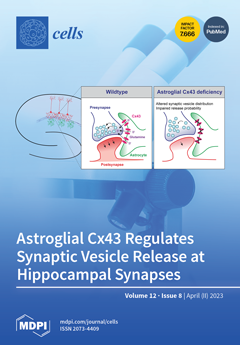
Cover Story: Connexin 43 (Cx43), an astroglial perisynaptic protein, is important for synaptic transmission and cognition via presynaptic regulation. However, whether it acts by modulating synaptic vesicle release is unknown. Using ultrastructural studies and live imaging of synaptic vesicle recycling, we found that a deficiency of astroglial Cx43 impairs synaptic vesicle distribution and release dynamics, despite the normal development of hippocampal neurons and synapses. Electrophysiological recordings further showed that synaptic vesicle release probability is also reduced and dependent on glutamine supply via the Cx43 hemichannel function. Taken together, we have uncovered a role for astroglial Cx43 in presynaptic function by controlling the rate and probability of synaptic vesicle release, further highlighting its significance in synaptic transmission and efficacy. View this paper
  • Issues are regarded as officially published after their release is announced to the table of contents alert mailing list .
  • You may sign up for email alerts to receive table of contents of newly released issues.
  • PDF is the official format for papers published in both, html and pdf forms. To view the papers in pdf format, click on the "PDF Full-text" link, and use the free Adobe Reader to open them.

Articles (111)

  • Review
  • Open Access
21 Citations
5,726 Views
23 Pages

Essential Protein PHB2 and Its Regulatory Mechanisms in Cancer

  • Amanda Qi,
  • Lillie Lamont,
  • Evelyn Liu,
  • Sarina D. Murray,
  • Xiangbing Meng and
  • Shujie Yang

21 April 2023

Prohibitins (PHBs) are a highly conserved class of proteins and have an essential role in transcription, epigenetic regulation, nuclear signaling, mitochondrial structural integrity, cell division, and cellular membrane metabolism. Prohibitins form a...

  • Feature Paper
  • Review
  • Open Access
11 Citations
5,502 Views
17 Pages

21 April 2023

Brain channelopathies are a group of neurological disorders that result from genetic mutations affecting ion channels in the brain. Ion channels are specialized proteins that play a crucial role in the electrical activity of nerve cells by controllin...

  • Article
  • Open Access
17 Citations
3,391 Views
19 Pages

Residual Foci of DNA Damage Response Proteins in Relation to Cellular Senescence and Autophagy in X-Ray Irradiated Fibroblasts

  • Andrey Osipov,
  • Anna Chigasova,
  • Elizaveta Yashkina,
  • Maxim Ignatov,
  • Yuriy Fedotov,
  • Daria Molodtsova,
  • Natalia Vorobyeva and
  • Andreyan N. Osipov

21 April 2023

DNA repair (DNA damage) foci observed 24 h and later after irradiation are called “residual” in the literature. They are believed to be the repair sites for complex, potentially lethal DNA double strand breaks. However, the features of th...

  • Systematic Review
  • Open Access
31 Citations
5,607 Views
16 Pages

21 April 2023

Betel quid and areca nut are complex mixture carcinogens, but little is known about whether their derived single-agent arecoline or arecoline N-oxide (ANO) is carcinogenic, and the underlying mechanisms remain unclear. In this systematic review, we a...

  • Review
  • Open Access
26 Citations
9,008 Views
17 Pages

21 April 2023

Alzheimer’s disease (AD) is the most prevalent neurodegenerative disease worldwide, but therapeutic strategies to slow down AD pathology and symptoms have not yet been successful. While attention has been focused on neurodegeneration in AD path...

  • Article
  • Open Access
8 Citations
5,980 Views
13 Pages

Progesterone: A Neuroprotective Steroid of the Intestine

  • Lennart Norman Stegemann,
  • Paula Maria Neufeld,
  • Ines Hecking,
  • Matthias Vorgerd,
  • Veronika Matschke,
  • Sarah Stahlke and
  • Carsten Theiss

21 April 2023

The enteric nervous system (ENS) is an intrinsic network of neuronal ganglia in the intestinal tube with about 100 million neurons located in the myenteric plexus and submucosal plexus. These neurons being affected in neurodegenerative diseases, such...

  • Review
  • Open Access
13 Citations
4,686 Views
19 Pages

21 April 2023

Peroxisome proliferator-activated receptor-γ (PPARγ) belongs to the superfamily of nuclear receptors that control the transcription of multiple genes. Although it is found in many cells and tissues, PPARγ is mostly expressed in the...

  • Feature Paper
  • Review
  • Open Access
27 Citations
4,727 Views
26 Pages

21 April 2023

The evolutionary conserved WNT signaling pathway orchestrates numerous complex biological processes during development and is critical to the maintenance of tissue integrity and homeostasis in the adult. As it relates to the central nervous system, W...

  • Article
  • Open Access
4 Citations
3,576 Views
17 Pages

21 April 2023

Ischemic heart disease is the leading cause of mortality in the United States. Progenitor cell therapy can restore myocardial structure and function. However, its efficacy is severely limited by cell aging and senescence. Gremlin-1 (GREM1), a member...

  • Feature Paper
  • Article
  • Open Access
10 Citations
2,958 Views
16 Pages

Steatosis and Metabolic Disorders Associated with Synergistic Activation of the CAR/RXR Heterodimer by Pesticides

  • Yannick Dauwe,
  • Lucile Mary,
  • Fabiana Oliviero,
  • Marina Grimaldi,
  • Patrick Balaguer,
  • Véronique Gayrard and
  • Laïla Mselli-Lakhal

21 April 2023

The nuclear receptor, constitutive androstane receptor (CAR), which forms a heterodimer with the retinoid X receptor (RXR), was initially reported as a transcription factor that regulates hepatic genes involved in detoxication and energy metabolism....

of 12

Get Alerted

Add your email address to receive forthcoming issues of this journal.

XFacebookLinkedIn
Cells - ISSN 2073-4409