You are currently viewing a new version of our website. To view the old version click .

Cells, Volume 12, Issue 2

January-2 2023 - 137 articles

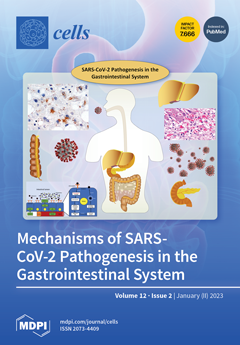
Cover Story: The novel coronavirus SARS-CoV-2 rapidly spread worldwide, causing a global pandemic. Although the respiratory system is the primary site of infection, growing evidence indicates the involvement of the gastrointestinal tract. ACE2 receptors are particularly abundant throughout the GI tract, making intestinal epithelial cells, liver, and pancreas extrapulmonary sites of infection and reservoir sites. Once inside these cells, the mechanisms of pathogenesis involve cytotoxic effects due to viral invasion and replication, tissue necrosis, and cell damage secondary to cytokine storm, dysregulation of autophagy, transport via extracellular vesicles/exosomes, increase in myeloid-derived suppressor cells, which inhibit the normal function of T-lymphocytes, dysbiosis, and ischemia secondary to thrombosis. View this paper
  • Issues are regarded as officially published after their release is announced to the table of contents alert mailing list .
  • You may sign up for email alerts to receive table of contents of newly released issues.
  • PDF is the official format for papers published in both, html and pdf forms. To view the papers in pdf format, click on the "PDF Full-text" link, and use the free Adobe Reader to open them.

Articles (137)

  • Review
  • Open Access
24 Citations
5,172 Views
16 Pages

Implications of Crosstalk between Exosome-Mediated Ferroptosis and Diseases for Pathogenesis and Treatment

  • Zixuan Zhou,
  • Benshuai You,
  • Cheng Ji,
  • Leilei Zhang,
  • Feng Wu and
  • Hui Qian

13 January 2023

Ferroptosis is a type of iron-dependent cell death caused by ferrous iron overload, reactive oxygen species generation through the Fenton reaction, and lipid peroxidation, leading to antioxidative system dysfunction and, ultimately, cell membrane dam...

  • Article
  • Open Access
6 Citations
4,859 Views
14 Pages

An Inhibitory Role for Human CD96 Endodomain in T Cell Anti-Tumor Responses

  • Chelsia Qiuxia Wang,
  • Fong Chan Choy,
  • Arleen Sanny,
  • Takashi Murakami,
  • Andy Hee-Meng Tan and
  • Kong-Peng Lam

13 January 2023

Immune checkpoint blockade (ICB) therapy involves the inhibition of immune checkpoint regulators which reverses their limitation of T cell anti-tumor responses and results in long-lasting tumor regression. However, poor clinical response or tumor rel...

  • Article
  • Open Access
2 Citations
4,329 Views
19 Pages

Panobinostat Induced Spatial In Situ Biomarkers Predictive of Anti-PD-1 Efficacy in Mouse Mammary Carcinoma

  • Zuzana Tatarova,
  • Dylan C. Blumberg,
  • AeSoon Bensen,
  • Gordon B. Mills and
  • Oliver Jonas

13 January 2023

Immunotherapies, including anti-PD-1 immune checkpoint blocking (ICB) antibodies, have revolutionized the treatment of many solid malignancies. However, their efficacy in breast cancer has been limited to a subset of patients with triple-negative bre...

  • Feature Paper
  • Review
  • Open Access
23 Citations
8,193 Views
24 Pages

The Landscape of HNF1B Deficiency: A Syndrome Not Yet Fully Explored

  • Alessandro Gambella,
  • Silvia Kalantari,
  • Massimiliano Cadamuro,
  • Marco Quaglia,
  • Maurizio Delvecchio,
  • Luca Fabris and
  • Michele Pinon

13 January 2023

The hepatocyte nuclear factor 1β (HNF1B) gene is involved in the development of specialized epithelia of several organs during the early and late phases of embryogenesis, performing its function mainly by regulating the cell cycle and apoptosis...

  • Review
  • Open Access
78 Citations
10,112 Views
13 Pages

Network Regulation of microRNA Biogenesis and Target Interaction

  • Shintaro Komatsu,
  • Hiroki Kitai and
  • Hiroshi I. Suzuki

13 January 2023

MicroRNAs (miRNAs) are versatile, post-transcriptional regulators of gene expression. Canonical miRNAs are generated through the two-step DROSHA- and DICER-mediated processing of primary miRNA (pri-miRNA) transcripts with optimal or suboptimal featur...

  • Article
  • Open Access
3 Citations
2,646 Views
17 Pages

13 January 2023

The electrical characteristic of cancer cells is neglected among tumor biomarkers. The development of nanoprobes with opposing charges for monitoring the unique electrophysiological characteristics of cancer cells. Micro-nano size adsorption binding...

  • Article
  • Open Access
4 Citations
3,228 Views
20 Pages

Essential Role of Adhesion GPCR, GPR123, for Human Pluripotent Stem Cells and Reprogramming towards Pluripotency

  • Olga A. Krasnova,
  • Karina A. Kulakova,
  • Julia V. Sopova,
  • Evgenyi Y. Smirnov,
  • Sergey A. Silonov,
  • Ekaterina V. Lomert,
  • Olga A. Bystrova,
  • Marina G. Martynova and
  • Irina E. Neganova

13 January 2023

G-protein-coupled receptors (GPCRs) are the largest family of cell surface receptors. They modulate key physiological functions and are required in diverse developmental processes including embryogenesis, but their role in pluripotency maintenance an...

  • Article
  • Open Access
24 Citations
5,341 Views
18 Pages

The Role of CTGF in Liver Fibrosis Induced in 3D Human Liver Spheroids

  • Sara Redenšek Trampuž,
  • Sander van Riet,
  • Åsa Nordling and
  • Magnus Ingelman-Sundberg

13 January 2023

Connective tissue growth factor (CTGF) is involved in the regulation of extracellular matrix (ECM) production. Elevated levels of CTGF can be found in plasma from patients with liver fibrosis and in experimental animal models of liver fibrosis, but t...

  • Review
  • Open Access
19 Citations
5,019 Views
24 Pages

13 January 2023

Liver transplantation is currently the only curative therapy for patients with acute or chronic liver failure. However, a dramatic gap between the number of available liver grafts and the number of patients on the transplantation waiting list emphasi...

of 14

Get Alerted

Add your email address to receive forthcoming issues of this journal.

XFacebookLinkedIn
Cells - ISSN 2073-4409