


You are currently viewing a new version of our website. To view the old version click .

Cells, Volume 11, Issue 4

February-2 2022 - 167 articles

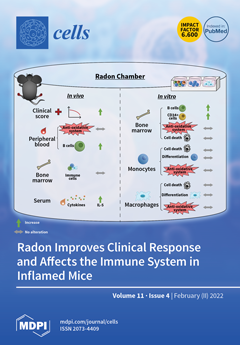
Cover Story: A therapy with the noble gas radon can be used in the treatment of painful, chronic inflammatory diseases as patients report long-lasting analgesic effects. So far, there is a lack in understanding the underlying molecular mechanisms and involved cell types. Next to the modulation of the immune system, an involvement of the antioxidative system is assumed. We utilized the controlled environment of a radon chamber in an in vivo as well as an ex vivo approach. We revealed that radon exposure significantly improves clinical disease progression and significantly increases B cell numbers and IL-5 levels, while no alterations in the antioxidative system were found in K/BxN serum-induced arthritic mice. We thus conclude that radon is able to modulate the immune system and, alongside with other, yet to be identified, parameters, improves painful inflammatory diseases. View this paper
  • Issues are regarded as officially published after their release is announced to the table of contents alert mailing list .
  • You may sign up for email alerts to receive table of contents of newly released issues.
  • PDF is the official format for papers published in both, html and pdf forms. To view the papers in pdf format, click on the "PDF Full-text" link, and use the free Adobe Reader to open them.

Articles (167)

  • Review
  • Open Access
17 Citations
5,491 Views
48 Pages

21 February 2022

Among the first discovered and most prominent cellular oncogenes is MYC, which encodes a bHLH-ZIP transcription factor (Myc) that both activates and suppresses numerous genes involved in proliferation, energy production, metabolism and translation. M...

  • Article
  • Open Access
9 Citations
4,212 Views
21 Pages

Enhanced Autophagic Flux, Suppressed Apoptosis and Reduced Macrophage Infiltration by Dasatinib in Kidneys of Obese Mice

  • Hassan Reda Hassan Elsayed,
  • Randa El-Gamal,
  • Mohammed R. Rabei,
  • Mona G. Elhadidy,
  • Shereen Hamed,
  • Basma H. Othman,
  • Mohamed Mahmoud Abdelraheem Elshaer,
  • Mostafa Khaled Sedky,
  • Ahmed Tarek Abd Elbaset Hassan and
  • Mohammad El-Nablaway

21 February 2022

Obesity causes renal changes (ORC), characterized by defective renal autophagy, lipogenesis, enhanced macrophage infiltration and apoptosis. We hypothesize that Dasatinib, a tyrosine kinase inhibitor, may ameliorate changes associated with obesity. W...

  • Article
  • Open Access
5 Citations
3,394 Views
20 Pages

Protective Effects of Chaya against Mitochondrial and Synaptic Toxicities in the Type 2 Diabetes Mouse Model TallyHO

  • Bhagavathi Ramasubramanian,
  • Cameron Griffith,
  • Madison Hanson,
  • Lloyd E. Bunquin,
  • Arubala P. Reddy,
  • Vijay Hegde and
  • P. Hemachandra Reddy

21 February 2022

The purpose of our study is to determine the protective effects of the chaya leaf against mitochondrial abnormalities and synaptic damage in the Type 2 diabetes (T2D) mouse model, TallyHO (TH). The TH mouse is a naturally occurring polygenic mouse mo...

  • Review
  • Open Access
34 Citations
7,424 Views
19 Pages

A Focused Review on Primary Graft Dysfunction after Clinical Lung Transplantation: A Multilevel Syndrome

  • Jan Van Slambrouck,
  • Dirk Van Raemdonck,
  • Robin Vos,
  • Cedric Vanluyten,
  • Arno Vanstapel,
  • Elena Prisciandaro,
  • Lynn Willems,
  • Michaela Orlitová,
  • Janne Kaes and
  • Xin Jin
  • + 5 authors

21 February 2022

Primary graft dysfunction (PGD) is the clinical syndrome of acute lung injury after lung transplantation (LTx). However, PGD is an umbrella term that encompasses the ongoing pathophysiological and -biological mechanisms occurring in the lung grafts....

  • Article
  • Open Access
3 Citations
3,593 Views
14 Pages

21 February 2022

Mediators of cardiac injury in preeclampsia are not well understood. Preeclamptic women have decreased cardiac global longitudinal strain (GLS), a sensitive measure of systolic function that indicates fibrosis and tissue injury. GLS is worse in preec...

  • Review
  • Open Access
98 Citations
13,798 Views
23 Pages

21 February 2022

With 296 million cases estimated worldwide, chronic hepatitis B virus (HBV) infection is the most common risk factor for hepatocellular carcinoma (HCC). HBV-encoded oncogene X protein (HBx), a key multifunctional regulatory protein, drives viral repl...

  • Article
  • Open Access
15 Citations
4,423 Views
14 Pages

20 February 2022

Myasthenia gravis (MG) is an autoimmune neuromuscular disease characterized by fatigable skeletal muscle weakness with a fluctuating unpredictable course. One main concern in MG is the lack of objective biomarkers to guide individualized treatment de...

  • Review
  • Open Access
54 Citations
15,979 Views
19 Pages

20 February 2022

Nucleotides are synthesized through two distinct pathways: de novo synthesis and nucleoside salvage. Whereas the de novo pathway synthesizes nucleotides from amino acids and glucose, the salvage pathway recovers nucleosides or bases formed during DNA...

  • Article
  • Open Access
12 Citations
7,170 Views
26 Pages

20 February 2022

Mast cells (MCs) are the major effector cells of allergic responses and reside throughout the body, including in the brain and meninges. Previously, we showed in a mouse model of subclinical cow’s milk allergy that brain MC numbers were elevate...

  • Article
  • Open Access
11 Citations
4,439 Views
32 Pages

Aryl Hydrocarbon Receptor Activation by Benzo[a]pyrene Prevents Development of Septic Shock and Fatal Outcome in a Mouse Model of Systemic Salmonella enterica Infection

  • Christiane Fueldner,
  • Sina Riemschneider,
  • Janine Haupt,
  • Harald Jungnickel,
  • Felix Schulze,
  • Katharina Zoldan,
  • Charlotte Esser,
  • Sunna Hauschildt,
  • Jens Knauer and
  • Andreas Luch
  • + 2 authors

20 February 2022

This study focused on immunomodulatory effects of aryl hydrocarbon receptor (AhR) activation through benzo[a]pyrene (BaP) during systemic bacterial infection. Using a well-established mouse model of systemic Salmonella enterica (S.E.) infection, we s...

of 17

Get Alerted

Add your email address to receive forthcoming issues of this journal.

XFacebookLinkedIn
Cells - ISSN 2073-4409