


Abstract
Summer cover crops can improve soil fertility and contribute to nitrogen (N) supply in temperate cropping systems, yet the effects of mixture composition and sowing timing remain insufficiently documented. This study evaluated biomass production and N accumulation of five multispecies cover crop mixtures grown in Estonia during 2024–2025 under two sowing dates per year. Aboveground biomass, botanical composition, and carbon (C) and nitrogen concentrations were measured to assess productivity, species contributions, and residue quality. Earlier sowing was generally associated with higher biomass and N accumulation, with first-sown mixtures producing, on average, 38.7% more biomass than later-sown mixtures. Mixture performance was strongly shaped by species composition and competitive hierarchies. Total N accumulation of the cover crop mixtures ranged from 42 to 275 kg N ha−1 depending on mixture composition and sowing time, with mixtures dominated by common vetch (Vicia sativa L.) achieving the highest values. Oat (Avena sativa) dominated and contributed substantially to biomass in mixtures lacking competitive legumes, whereas sunflower (Helianthus annuus) and maize (Zea mays) performed less well under delayed sowing. Low-growing species such as Persian clover (Trifolium resupinatum) produced little biomass when grown with highly competitive species. Legumes exhibited lower C:N ratios than non-legumes, while mixture-level values remained moderate, suggesting residue quality with potential for favourable decomposition and nutrient release in summer cover crop systems under temperate conditions.
1. Introduction
The cultivation of cover crops is an important component of environmentally sustainable agriculture, contributing to improved soil quality and reduced reliance on synthetic fertilisers and pesticides [1,2]. Traditionally, cover crops have been used to protect soil during the winter, with their primary role being the reduction of nitrate leaching [3,4,5]. In Northern Europe, where short growing seasons and cool temperatures constrain biomass production, spring-sown cover crops cultivated during summer present a promising strategy for integrating green manure into crop rotations. This is increasingly relevant as the area devoted to winter crops expands within agricultural systems, highlighting the importance of summer cover crops for enhancing soil fertility and nutrient availability for subsequent crops. Spring-sown cover crops can accumulate substantial biomass and nitrogen (N) over a relatively short growing period, and their incorporation into the soil contributes organic matter and nutrients to the following crop [6,7]. Earlier sowing generally favours biomass accumulation, whereas for summer cover crops, slightly later sowing may be preferable for frost-sensitive species; however, excessively early sowing in some species may accelerate development and increase the risk of premature flowering or seed maturation [8,9]. Beyond sowing time, the composition of cover crop mixtures also plays a crucial role in determining their effectiveness. Multi-species cover crop mixtures have received increasing attention as a strategy to enhance agroecosystem multifunctionality. By combining species with contrasting functional traits, such mixtures can improve nutrient retention, suppress weeds, enhance soil structure, and support biodiversity compared with single-species cover crops [10,11]. Legumes are widely used in cover crop mixtures because biological nitrogen fixation can increase N availability for subsequent crops and reduce the need for external N inputs [12,13,14,15]. Non-leguminous species, particularly grasses, are effective at accumulating residual soil N and preventing nitrate leaching while providing soil cover [16,17]. This functional complementarity among plant types is a key rationale for multi-species mixtures under temperate agroecological conditions. The carbon-to-nitrogen (C:N) ratio of cover crop biomass is a key factor influencing decomposition rates and subsequent nutrient release to cash crops [18], indicating that both species selection and biomass composition are pivotal for the effectiveness of cover crops as green manure. While increased species diversity may enhance multifunctionality, the performance of mixtures depends not only on the number of species but also on the compatibility of growth strategies and the relative dominance of species within the stand [19]. Notably, the interactions between species composition and sowing time are important but remain insufficiently studied, particularly for summer annual cover crops. Recent research emphasises the need to address these knowledge gaps to optimise the multifunctionality of cover crop mixtures under temperate conditions.
Most research in Northern temperate environments has concentrated on winter cover crops sown post-harvest, while spring-sown summer cover crops intended as green manure have received considerably less attention. Although several studies have investigated spring-sown cover crops across diverse climatic conditions, including semiarid regions [20,21,22], there is a notable lack of data on their performance in cool temperate climates, particularly regarding the interactive effects of species composition and sowing time.
The objective of this study was to assess how cover crop mixture composition and sowing time affect biomass production and nitrogen accumulation in spring-sown cover crops under temperate conditions. To address this objective, five cover crop mixtures differing in species diversity and functional group composition were established during two consecutive growing seasons in Estonia. Aboveground biomass, botanical composition, and carbon (C) and nitrogen (N) accumulation were quantified to compare mixture performance and to evaluate the effects of sowing time on biomass yield and nitrogen accumulation. These results provide new insights for optimising the design and management of cover crop mixtures in temperate agricultural systems.
2. Materials and Methods
2.1. Study Site and Soil Characterization
The experiment was conducted in 2024 and 2025 on a farmer-managed commercial field owned by Sadala Agro OÜ (Jõgevamaa, Estonia; 58°52′19.9″ N, 26°34′32.8″ E), with spring wheat (Triticum aestivum L.) as the preceding crop. The study area is characterised by a cool temperate climate, with a long-term (1991–2020) mean annual temperature of 5.8 °C and mean annual precipitation of 672 mm [23].
The soil at the experimental site is classified as Stagnic Luvisol [24]. The average soil characteristics were as follows: pHKCl 5.74, P 37.87 mg kg−1, K 108.50 mg kg−1, Corg 1.58%. Soil pH was determined in 1 M KCl (1:2.5). Soil organic carbon (Corg) and total nitrogen (N) were determined by dry combustion (Dumas method) using a Primacs SNC-100 elemental analyzer (Skalar, Breda, The Netherlands). Plant-available P and K were extracted using the ammonium lactate (AL) method [25].
2.2. Experimental Design and Cover Crop Mixtures
Two sowing dates were used each year: ST1 (earlier) and ST2 (later). In 2024, cover crops were sown on 15 May and 31 May; in 2025, sowing took place on 26 May and 10 June, with sowing occurring later in the second year due to lower early-season temperatures. The same cover crop mixtures were used in both years. Five mixtures (M1–M5) were tested, consisting of the following species (Table 1):
Table 1.
Species composition and seeding rates (kg ha−1) of the cover crop mixtures (M1–M5) used in the experiment in 2024 and 2025.
M1: forage pea (Pisum sativum), phacelia (Phacelia tanacetifolia), buckwheat (Fagopyrum esculentum)
M2: sunflower (Helianthus annuus), maize (Zea mays), phacelia, common vetch (Vicia sativa)
M3: oat (Avena sativa), common vetch
M4: Persian clover (Trifolium resupinatum), common vetch, phacelia
M5: forage pea, oat, buckwheat.
Seeding rates for the component species were derived from recommended monoculture rates and adjusted to achieve a balanced mixture composition. The botanical composition and seeding rates (kg ha−1) for each mixture are presented in Table 1. Cover crops were established in adjacent, non-randomised strips measuring 108 × 9 m, corresponding to the 9 m working width of the seed drill (Pronto SW).
2.3. Biomass Sampling and Laboratory Analyses
Cover crop aboveground biomass was collected on 2 August 2024 and 18 August 2025 from four randomly positioned quadrats (50 × 50 cm) within each strip, representing four replicates (n = 4).
Plant material was separated by species, oven-dried at 45 °C to constant weight, and ground prior to chemical analysis. Total C and N concentrations in plant biomass were determined by dry combustion (Dumas method) using the Primacs SNC-100 elemental analyzer (Skalar, Breda, The Netherlands) at the Laboratory of the Chair of Soil Science, Estonian University of Life Sciences. Accumulated carbon (t C ha−1) and nitrogen (kg N ha−1) were calculated by multiplying dry matter biomass yield (kg ha−1) by the respective element concentration (%) and dividing by 100.
2.4. Meteorological Conditions During the 2024 and 2025 Growing Seasons
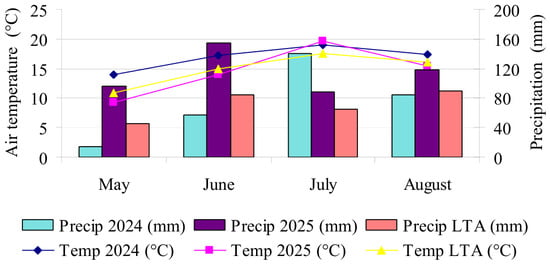
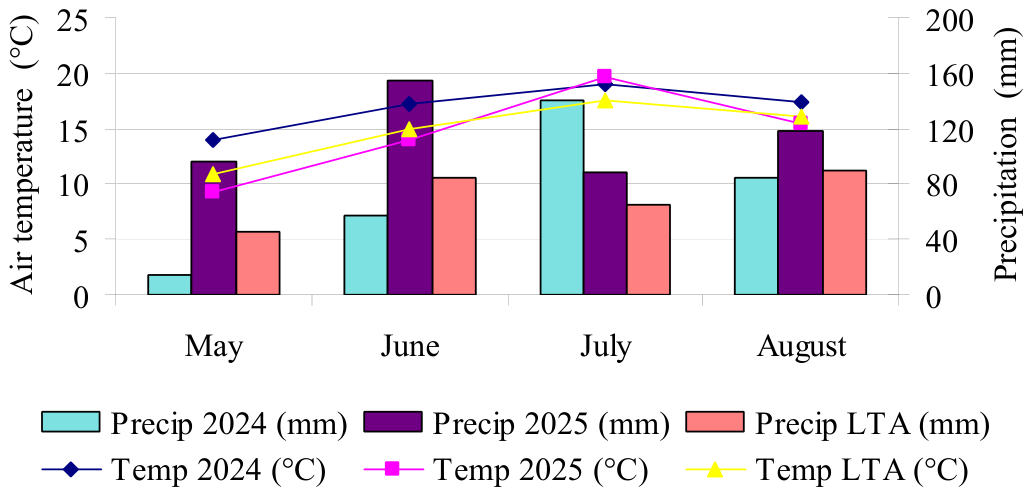
Meteorological conditions during May–August differed between the two study years and from the long-term average (LTA, 1991–2020) (Figure 1). In 2024, mean monthly air temperatures were above the LTA throughout the growing period, ranging from 14.0 °C in May to 19.0 °C in July. In 2025, May and June were cooler than the LTA, whereas July was warmer and August slightly cooler than average.
Figure 1.
Monthly mean air temperature and cumulative monthly precipitation during the cover crop growing period (May–August) in 2024 and 2025 compared with the long-term average (LTA, 1991–2020) at the experimental site.
Monthly precipitation also differed markedly between years. In 2024, May was dry (14.8 mm, 32.7% of the LTA), June was moderately dry, July was wetter than average (140.2 mm), and August was close to the LTA. In 2025, precipitation exceeded the LTA in all months, with particularly high totals in May (96.0 mm) and June (154.8 mm).
2.5. Statistical Analysis
Statistical analysis was performed using Statistica 13 software (TIBCO Software Inc., Palo Alto, CA, USA). The experiment was conducted as a production-scale strip trial with adjacent non-randomised strips. The four quadrat samples collected within each strip were treated as within-strip sampling replicates.
Data were analysed using one-way analysis of variance (ANOVA) within the predefined comparison groups presented in the tables. When ANOVA indicated significant differences, means were separated using Tukey’s HSD test at p < 0.05.
Because the strip layout did not provide independent randomised replication for all year × sowing date × mixture combinations, a full factorial model including interaction terms was not statistically appropriate. Accordingly, statistical inference should be interpreted as describing observed differences under the present strip-trial conditions rather than fully randomised factorial treatment effects. Cover crop biomass is presented on a dry matter basis (t ha−1 DM).
3. Results and Discussion
Total aboveground biomass production and N accumulation varied with year, sowing date, and species composition under the present strip-trial conditions (Figure 2 and Figure 3; Table 2 and Table 3). In general, biomass production was higher in 2024 than in 2025, coinciding with warmer-than-average temperatures and a more favourable precipitation regime. Weather conditions in 2024 supported continuous crop growth throughout the growing season, while cooler temperatures and persistently wet conditions in 2025 likely constrained plant development. Such variability in cover crop productivity has been widely reported, primarily driven by interactions between temperature, moisture availability, and their timing during the growing season [6,26,27,28].
Figure 2.
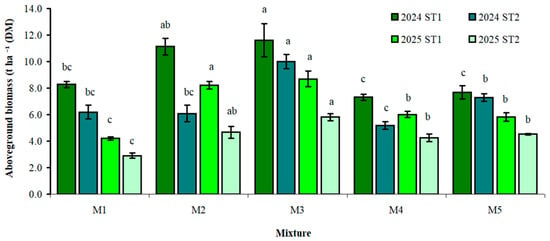
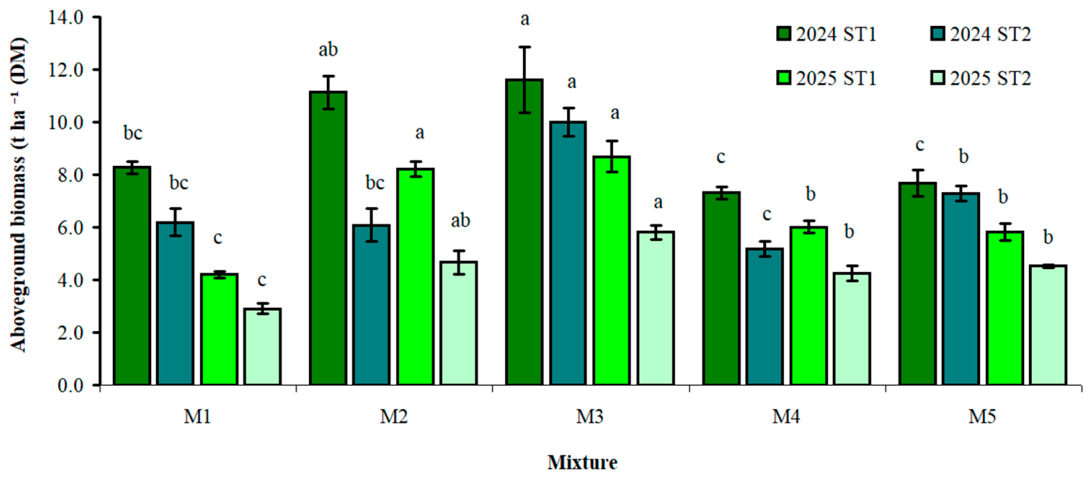
Aboveground biomass (t ha−1 DM) of five cover crop mixtures (M1–M5) under two sowing dates (ST1, ST2) in 2024 and 2025. Bars represent means ± SE (n = 4). Different letters indicate significant differences among mixtures within each year × sowing date combination (one-way ANOVA followed by Tukey’s HSD, p < 0.05).
Figure 3.
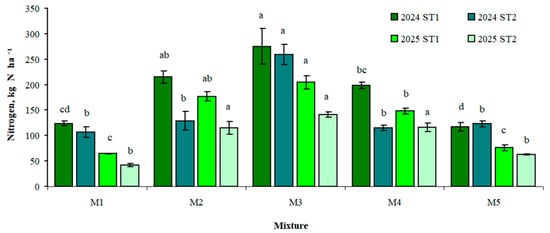
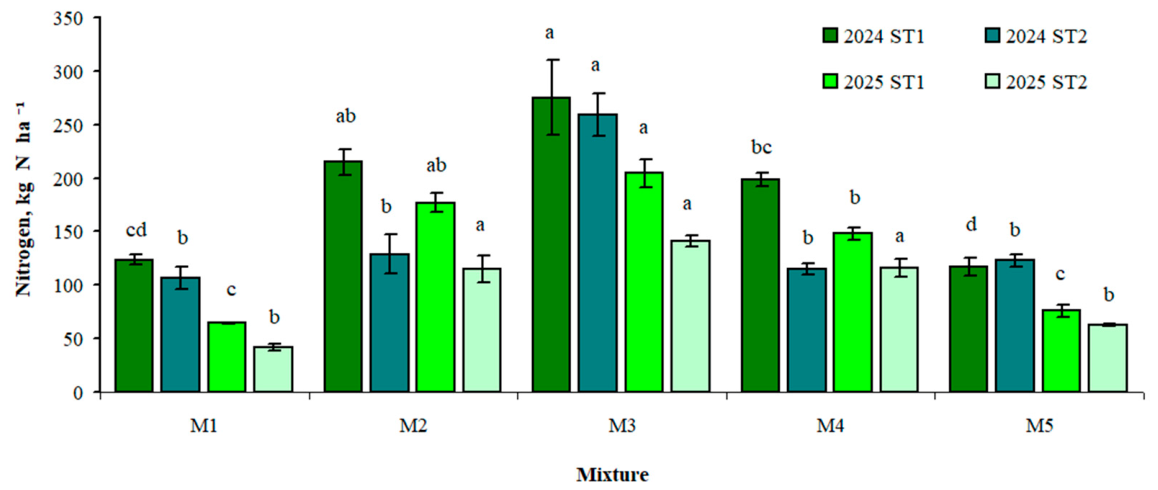
Accumulated nitrogen (kg N ha−1) of five cover crop mixtures (M1–M5) under two sowing dates (ST1, ST2) in 2024 and 2025. Bars represent means ± SE (n = 4). Different letters indicate significant differences among mixtures within each year × sowing date combination (one-way ANOVA followed by Tukey’s HSD, p < 0.05).
Table 2.
Aboveground biomass (t ha−1 DM, mean ± SE, n = 4) of component species and total biomass in five cover crop mixtures under two sowing dates (ST1, ST2) in 2024–2025.
Table 3.
Accumulated nitrogen (kg N ha−1, mean ± SE, n = 4) of component species and total nitrogen in five cover crop mixtures under two sowing dates (ST1, ST2) in 2024–2025.
Across both years, earlier sowing was generally associated with higher biomass production and N accumulation. Mixtures sown at the first sowing date (15 May 2024 and 26 May 2025) accumulated substantially more biomass (on average 38.7%) than those sown later (31 May 2024 and 10 June 2025). Earlier sowing may extend the effective growing period and contribute to greater biomass compared with later sowing dates [29].
The magnitude of the sowing date effect differed markedly among mixtures. At the first sowing date, M2 (sunflower, maize, phacelia, common vetch) and M3 (oat and common vetch) achieved the highest biomass and N accumulation in both years (p < 0.05). In 2024, these mixtures produced 11.13 and 11.60 t ha−1 DM and accumulated 215 and 275 kg N ha−1, respectively; in 2025, they still reached 8.23 and 8.69 t ha−1 DM and accumulated 177 and 204 kg N ha−1 (Table 2 and Table 3).
In contrast, at the later sowing date, only M3 maintained relatively high biomass and nitrogen accumulation in 2024. Although the absolute biomass of common vetch decreased under delayed sowing, it remained the dominant component, accounting for 67.8% of total biomass in 2024 and 64.7% in 2025. Consequently, vetch was also the main contributor to nitrogen accumulation, providing 211 and 112 kg N ha−1 in 2024 and 2025, respectively.
Across mixtures and years, common vetch consistently emerged as the most productive component, driving overall biomass production and N accumulation. This is consistent with previous findings highlighting common vetch as a productive cover crop with high biomass production and substantial N contribution under a range of conditions [30,31], further confirming its value in enhancing nitrogen availability to subsequent crops [2]. High biomass production by common vetch has also been reported under Mediterranean conditions, where sole-cropped vetch reached 7.01 t ha−1 and demonstrated strong weed suppression potential due to rapid canopy development [30]. However, the dominance of common vetch may vary depending on companion species. For example, in mixtures with oilseed radish (Raphanus sativus), vetch has shown a lower contribution to total biomass, suggesting that more competitive species can limit its relative importance [32].
Oat is widely recognised as a productive cover crop species with high biomass potential [17,22]. Its strong performance is also demonstrated under semiarid conditions, producing the highest biomass and exceeding other species by more than 60% [22]. In the present study, its role depended strongly on mixture composition. In M3, where oat was grown with common vetch, it remained consistently subordinate, contributing less biomass and nitrogen than the legume component. This likely reflects the vigorous growth and climbing habit of vetch, effectively constraining oat dominance. In contrast, in M5, which did not include vetch, oat dominated biomass production at both sowing dates and contributed substantially to total biomass, particularly under the cooler and wetter conditions of 2025. These results indicate that oat can function as either a subordinate or a dominant species depending on the competitive context, consistent with previous findings for bristle oat (Avena strigosa), whose contribution varies among years and companion species [32].
Forage pea was particularly sensitive to delayed sowing and unfavourable conditions in 2025, contributing only a small proportion of total biomass. This aligns with previous studies reporting pronounced species-specific differences in biomass and biological N fixation among legume cover crops [14].
In M2, although vetch was also the dominant species and contributed most of the N, overall mixture performance was more sensitive to delayed sowing. This may be attributed to the inclusion of species with contrasting growth strategies.
On average across the two years, vetch and sunflower accounted for most of the mixture’s total biomass in the first sowing, with shares of about 51.9% and 26.6%, respectively. At the later sowing, vetch and sunflower biomass decreased by approximately 38.7% and 66.8%, respectively, resulting in a sharp decline in total biomass of the mixture and the amount of N accumulation.
Sunflower has been reported as a summer cover crop with high biomass potential and tolerance to environmental stress, particularly under high temperatures and limited fertility [33]. However, the results of the present study suggest that this potential may not be fully realised in competitive multispecies mixtures under delayed sowing. Despite its general productivity, sunflower did not compensate for reductions in mixture biomass, indicating that its performance may be constrained when establishment conditions are suboptimal or when co-occurring species with strong early growth dominate resource capture.
Maize contributed little biomass and nitrogen across sowing dates. This species is known to be highly sensitive to early-season competition, with growth reductions caused by neighbouring plants competing for resources and altering light quality even before substantial biomass accumulation occurs [34]. Under delayed sowing and a shortened growing period, these constraints likely further limited maize establishment and growth, reducing its contribution to mixture productivity. In addition to its sensitivity to competition, maize has high nutrient requirements, particularly for N [35]. Without direct fertilization, early plant development remains weak, as reflected by the pale green leaf colour observed in this experiment, indicating possible N limitation. These results suggest that maize may be less suitable for inclusion in unfertilised green manure mixtures under the conditions of this study.
Phacelia and buckwheat showed context-dependent contributions within the cover crop mixtures. Phacelia exhibited variable responses to sowing time depending on mixture composition and year. In M4, phacelia biomass increased with later sowing time in 2024, indicating that under certain competitive and environmental conditions, it can benefit from delayed establishment. However, this response was inconsistent across years, and vetch remained the dominant species in the mixture, except for later sowing in 2024. Buckwheat displayed a contrasting pattern. Its absolute biomass contribution was consistently higher in M1 across years and sowing times, whereas in M5 it contributed a smaller but stable share of total biomass, likely constrained by strong competition from oat. Both species provide important functional benefits: buckwheat has been reported to mobilise sparingly available soil phosphorus [36,37], and under favourable conditions both species can contribute substantially to mixture biomass [11], supporting their role as complementary components enhancing mixture productivity and nutrient cycling.
M4 further illustrates the importance of competitive hierarchies in multispecies cover crop mixtures. Persian clover contributed very little biomass when grown with the highly competitive vetch and moderately competitive phacelia, remaining in the understory and highlighting its limited competitive ability. Such suppression of low-growing annual clovers is common in mixtures dominated by fast-growing or climbing species, particularly when establishment is rapid and canopy closure occurs early [19]. In contrast, Persian clover can produce substantial biomass in monoculture systems, with dry matter yields exceeding 8 t ha−1 under Mediterranean conditions depending on harvest timing [38].
While composition and competitive hierarchy of cover crop mixtures strongly shape biomass and N accumulation, the timing of sowing also influences plant development, residue quality, and potential N release. In some summer cover crop species, early sowing may accelerate development toward reproductive stages, increasing the likelihood of seed production and entry into the soil seed bank. If termination is delayed, these seeds may germinate in the subsequent cash crops as volunteer plants thereby increasing weediness risk [9]. Additionally, some species are sensitive to early sowing because late spring frosts may occur and kill frost-sensitive species such as buckwheat. Early sowing can also influence biomass quality, as more mature growth stages are associated with higher structural biomass and wider C:N ratios, which may slow decomposition and temporarily reduce N availability [18]. In the present study, legumes generally exhibited narrow C:N ratios (12–24), reflecting high tissue nitrogen concentrations and suggesting greater potential for rapid decomposition, whereas non-leguminous species had wider C:N ratios (23–55), with phacelia showing comparatively lower values than oat, sunflower, buckwheat, and maize (Table 4).
Table 4.
C:N ratio (mean ± SE, n = 4) of component species and total mixture biomass in five cover crop mixtures under two sowing dates (ST1, ST2) in 2024–2025.
Despite the presence of species with contrasting residue characteristics, mixture-level C:N ratios generally remained moderate (15–32), indicating that the functional composition of mixtures may have buffered extremes in residue quality [7]. This highlights the importance of aligning sowing date, species selection, and management timing when designing cover crop rotations.
Due to the high proportion of common vetch and the low C:N ratio of legume species, the C:N ratios of mixtures M2, M3 and M4 remained substantially narrower than those of the mixture without legumes (M1) and the mixture containing only forage pea as the legume component (M5).
When comparing sowing times and growing years, the C:N ratios of leguminous species were generally more stable than those of several non-leguminous species. Maize and buckwheat, in particular, exhibited pronounced interannual variability. In 2024, maize had notably wide C:N ratios (55 at the first sowing time and 53 at the second), whereas in 2025 these ratios were considerably narrower (36 and 35, respectively). This variability may reflect year-to-year differences in maize developmental stage at biomass sampling, as more advanced development is typically associated with higher structural carbon relative to nitrogen and thus wider C:N ratios. This aligns with findings from China, where most nitrogen in maize accumulates before flowering (pre-anthesis), while most carbon accumulates after flowering (post-anthesis), leading to a significant post-flowering increase in the C:N ratio [39]. Buckwheat displayed the opposite pattern, with substantially lower C:N ratios in 2025.
Differences in the C:N ratio of species mixtures between sowing times were relatively small, indicating that the complementary traits of the component species effectively balanced the overall C:N ratio within the mixtures.
4. Conclusions
Aboveground biomass production and nitrogen accumulation of summer cover crop mixtures varied with year, sowing date, and species composition. Earlier sowing was generally associated with higher biomass and nitrogen accumulation, while more favourable weather conditions in 2024 coincided with higher yields than in 2025. Species composition was a key factor in shaping mixture performance. Mixtures dominated by common vetch achieved the highest biomass and nitrogen accumulation, while low-growing Persian clover contributed little biomass under competitive conditions. Among non-legumes, oat played a dominant role in mixtures without common vetch and contributed substantially to total biomass. Despite differences among species, mixture C:N ratios remained moderate, indicating that combining legumes and non-legumes can balance residue quality. These findings highlight the importance of optimising species composition and sowing time to enhance productivity and nitrogen accumulation in cover crop systems.
Author Contributions
Conceptualization, L.T., K.S., V.E. and M.T.; methodology, K.T., L.T., K.S., V.E. and M.T.; investigation, K.T., K.S., L.E. and M.T.; formal analysis, K.T., K.S. and V.E.; resources, M.T. and L.T.; data curation, K.T. and K.S.; writing—original draft preparation, K.T., L.T., K.S., V.E. and M.T.; writing—review and editing, all authors; visualization, K.T.; supervision, M.T., L.T., K.K. and V.E.; project administration, M.T.; funding acquisition, L.T., K.S. and M.T. All authors have read and agreed to the published version of the manuscript.
Funding
This research was funded by the Centre for Estonian Rural Research and Knowledge, project PA1-PR-HALJASSADALA.
Data Availability Statement
The data presented in this study are available upon request from the corresponding author.
Acknowledgments
The authors would like to thank Sadala Agro OÜ for their collaboration and for providing technical support in the establishment and maintenance of the field experiments.
Conflicts of Interest
The authors declare no conflicts of interest.
References
- Schipanski, M.E.; Barbercheck, M.; Douglas, M.R.; Finney, D.M.; Haider, K.; Kaye, J.P.; Kemanian, A.R.; Mortensen, D.A.; Ryan, M.R.; Tooker, J.; et al. A framework for evaluating ecosystem services provided by cover crops in agroecosystems. Agric. Syst. 2014, 125, 12–22. [Google Scholar] [CrossRef] [Scilit]
- Pál, V.; Zsombik, L. Effect of common vetch (Vicia sativa L.) green manure on the yield of corn in crop rotation system. Agronomy 2024, 14, 19. [Google Scholar] [CrossRef] [Scilit]
- Constantin, J.; Bas, C.L.; Justes, E. Large-scale assessment of optimal emergence and destruction dates for cover crops to reduce nitrate leaching in temperate conditions using the STICS soil–crop model. Eur. J. Agron. 2015, 69, 75–87. [Google Scholar] [CrossRef] [Scilit]
- De Notaris, C.; Rasmussen, J.; Sørensen, P.; Olesen, J.E. Nitrogen leaching: A crop rotation perspective on the effect of N surplus, field management and use of catch crops. Agric. Ecosyst. Environ. 2018, 255, 1–11. [Google Scholar] [CrossRef] [Scilit]
- Nouri, A.; Lukas, S.; Singh, S.; Singh, S.; Machado, S. When do cover crops reduce nitrate leaching? A global meta-analysis. Glob. Change Biol. 2022, 28, 4736–4749. [Google Scholar] [CrossRef] [Scilit]
- Wilczewski, E.; Jug, I.; Szpunar-Krok, E.; Staniak, M.; Jug, D. Shaping soil properties and yield of cereals using cover crops under conservation soil tillage. Agronomy 2024, 14, 2104. [Google Scholar] [CrossRef] [Scilit]
- Wang, J.; Sainju, U.M.; Zhang, S. A mixture of summer legume and nonlegume cover crops enhances winter wheat yield, nitrogen uptake, and nitrogen balance. Nitrogen 2024, 5, 871–890. [Google Scholar] [CrossRef] [Scilit]
- Clark, A. (Ed.) Managing Cover Crops Profitably, 3rd ed.; Sustainable Agriculture Research and Education (SARE): College Park, MD, USA, 2012. [Google Scholar]
- Nosratti, I.; Korres, N.E.; Cordeau, S. Knowledge of cover crop seed traits and treatments to enhance weed suppression: A narrative review. Agronomy 2023, 13, 1683. [Google Scholar] [CrossRef] [Scilit]
- Finney, D.M.; White, C.M.; Kaye, J.P. Biomass production and carbon/nitrogen ratio influence ecosystem services from cover crop mixtures. Agron. J. 2016, 108, 39–52. [Google Scholar] [CrossRef] [Scilit]
- Raniro, H.R.; Staudinger, C.; Hage-Ahmed, K.; Müller-Stöver, D.S.; Santner, J. Tailored cover crop mixtures enhance soil phosphorus cycling but not wheat yield in a short-term column experiment. Plant Soil 2025, 514, 1783–1809. [Google Scholar] [CrossRef] [Scilit]
- Gselman, A.; Kramberger, B. Benefits of winter legume cover crops require early sowing. Aust. J. Agric. Res. 2008, 59, 1156–1163. [Google Scholar] [CrossRef] [Scilit]
- Dabney, S.M.; Delgado, J.A.; Reeves, D.W. Using winter cover crops to improve soil and water quality. Commun. Soil Sci. Plant Anal. 2001, 32, 1221–1250. [Google Scholar] [CrossRef] [Scilit]
- Büchi, L.; Gebhard, C.A.; Liebisch, F.; Sinaj, S.; Ramseier, H.; Charles, R. Accumulation of biologically fixed nitrogen by legumes cultivated as cover crops in Switzerland. Plant Soil 2015, 393, 163–175. [Google Scholar] [CrossRef] [Scilit]
- Yang, X.; Drury, C.F.; Reynolds, W.D.; Reeb, M.-A.D. Legume cover crop as a primary nitrogen source in an organic crop rotation in Ontario, Canada: Impacts on corn, soybean and winter wheat yields. Org. Agric. 2024, 14, 19–31. [Google Scholar] [CrossRef] [Scilit]
- Tosti, G.; Benincasa, P.; Farneselli, M.; Pace, R.; Tei, F.; Guiducci, M.; Thorup-Kristensen, K. Green manuring effect of pure and mixed barley–hairy vetch winter cover crops on maize and processing tomato N nutrition. Eur. J. Agron. 2012, 43, 136–146. [Google Scholar] [CrossRef] [Scilit]
- Hashemi, M.; Farsad, A.; Sadeghpour, A.; Weis, S.A.; Herbert, S.J. Cover-crop seeding-date influence on fall nitrogen recovery. J. Plant Nutr. Soil Sci. 2013, 176, 69–75. [Google Scholar] [CrossRef] [Scilit]
- Sainju, U.M.; Singh, B.P. Winter cover crops for sustainable agricultural systems: Influence on soil properties, water quality, and crop yields. HortScience 1997, 32, 21–28. [Google Scholar] [CrossRef] [Scilit]
- Groß, J.; Kümmerer, R.; Heuermann, D.; Gentsch, N.; Schweneker, D.; Feuerstein, U.; Guggenberger, G.; von Wirén, N.; Bauer, B. Improving dual cover crop mixtures to increase shoot biomass production and weed suppression potential. Front. Agron. 2024, 6, 1416379. [Google Scholar] [CrossRef] [Scilit]
- Rose, T.J.; Parvin, S.; Han, E.; Condon, J.; Flohr, B.M.; Schefe, C.; Rose, M.T.; Kirkegaard, J.A. Prospects for summer cover crops in southern Australian semi-arid cropping systems. Agric. Syst. 2022, 200, 103415. [Google Scholar] [CrossRef] [Scilit]
- Rose, T.J.; Parvin, S.; McInnes, J.; van Zwieten, L.; Gibson, A.J.; Kearney, L.J.; Rose, M.T. Summer cover crop and temporary legume–cereal intercrop effects on soil microbial indicators, soil water and cash crop yields in a semi-arid environment. Field Crops Res. 2024, 304, 109384. [Google Scholar] [CrossRef] [Scilit]
- Thapa, V.R.; Koehler-Cole, K.; Easterly, A.; Cafaro La Menza, N.; Pacheco, G.E.; McKinley, B.; Basche, A. Biomass and forage nutritive value of spring-planted cover crops in a semiarid region. Agron. J. 2025, 117, e70154. [Google Scholar] [CrossRef] [Scilit]
- Estonian Environment Agency. Climate Normals (1991–2020). Available online: https://www.ilmateenistus.ee/kliima/kliimanormid/ (accessed on 21 April 2026).
- IUSS Working Group WRB. World Reference Base for Soil Resources 2022: International Soil Classification System for Naming Soils and Creating Legends for Soil Maps, 4th ed.; World Soil Resources Reports No. 106; FAO: Rome, Italy, 2022. [Google Scholar]
- Egnér, H.; Riehm, H.; Domingo, W.R. Untersuchungen über die chemische Bodenanalyse als Grundlage für die Beurteilung des Nährstoffzustandes der Böden. II. Chemische Extraktionsmethoden zur Phosphor- und Kaliumbestimmung. K. Lantbrukshögskolans Ann. 1960, 26, 199–215. (In German) [Google Scholar]
- Constantin, J.; Dürr, C.; Tribouillois, H.; Justes, E. Catch crop emergence success depends on weather and soil seedbed conditions in interaction with sowing date: A simulation study using the SIMPLE emergence model. Field Crops Res. 2015, 176, 22–33. [Google Scholar] [CrossRef] [Scilit]
- Tribouillois, H.; Dürr, C.; Demilly, D.; Wagner, M.-H.; Justes, E. Determination of germination response to temperature and water potential for a wide range of cover crop species and related functional groups. PLoS ONE 2016, 11, e0161185. [Google Scholar] [CrossRef] [Scilit]
- Wilczewski, E.; Sokół, B.; Nowicki, R.; Jug, I.; Pietrzykowski, K.; Gałęzewski, L. Response of field pea and common vetch, grown as a catch crop, on the sowing method. Agriculture 2023, 13, 3. [Google Scholar] [CrossRef] [Scilit]
- Corti, M.; Bechini, L.; Cavalli, D.; Ben Hassine, M.; Michelon, L.; Cabassi, G.; Pricca, N.; Perego, A.; Marino Gallina, P. Early sowing dates and pre-plant nitrogen affect autumn weed control and nitrogen content of winter cover crops in rotation with spring crops. Eur. J. Agron. 2024, 155, 127140. [Google Scholar] [CrossRef] [Scilit]
- Bilalis, D.; Karkanis, A.; Efthimiadou, A. Effects of two legume crops, for organic green manure, on weed flora, under Mediterranean conditions: Competitive ability of five winter season weed species. Afr. J. Agric. Res. 2009, 4, 1431–1441. [Google Scholar]
- Wittwer, R.A.; Dorn, B.; Jossi, W.; van der Heijden, M.G.A. Cover crops support ecological intensification of arable cropping systems. Sci. Rep. 2017, 7, 41911. [Google Scholar] [CrossRef] [Scilit]
- Elhakeem, A.; van der Werf, W.; Ajal, J.; Lucà, D.; Claus, S.; Alonso Vico, R.; Bastiaans, L. Cover crop mixtures result in a positive net biodiversity effect irrespective of seeding configuration. Agric. Ecosyst. Environ. 2019, 286, 106627. [Google Scholar] [CrossRef] [Scilit]
- Alapati, D.K.; Ancona, V.; Sétamou, M.; Donato, C.; Nelson, S.D.; Reyes-Cabrera, J. Sunflower and sunn hemp potential as summer cover crops in southern Texas. Agronomy 2025, 15, 986. [Google Scholar] [CrossRef] [Scilit]
- Rajcan, I.; Swanton, C.J. Understanding maize–weed competition: Resource competition, light quality, and the whole plant. Field Crops Res. 2001, 71, 139–150. [Google Scholar] [CrossRef] [Scilit]
- Hou, P.; Gao, Q.; Xie, R.; Li, S.; Meng, Q.; Kirkby, E.A.; Römheld, V.; Müller, T.; Zhang, F.; Cui, Z.; et al. Grain yields in relation to N requirement: Optimizing nitrogen management for spring maize grown in China. Field Crops Res. 2012, 129, 1–6. [Google Scholar] [CrossRef] [Scilit]
- Zhu, Y.-G.; He, Y.-Q.; Smith, S.E.; Smith, F.A. Buckwheat (Fagopyrum esculentum Moench) has high capacity to take up phosphorus (P) from a calcium (Ca)-bound source. Plant Soil 2002, 239, 1–8. [Google Scholar] [CrossRef] [Scilit]
- Teboh, J.M.; Franzen, D.W. Buckwheat (Fagopyrum esculentum Moench) potential to contribute solubilized soil phosphorus to subsequent crops. Commun. Soil Sci. Plant Anal. 2011, 42, 1544–1550. [Google Scholar] [CrossRef] [Scilit]
- Kavut, Y.T.; Geren, H. Effects of seeding pattern and harvest date of Persian clover (Trifolium resupinatum) and annual ryegrass (Lolium multiflorum) on hay yield and quality in a Mediterranean environment. Turk. J. Field Crops 2019, 24, 245–251. [Google Scholar] [CrossRef] [Scilit]
- Li, Q.; Ren, Y.; Fu, H.; Li, Z.; Kong, F.; Yuan, J. Cultivar differences in carbon and nitrogen accumulation, balance, and grain yield in maize. Front. Plant Sci. 2022, 13, 992041. [Google Scholar] [CrossRef] [Scilit]

Disclaimer/Publisher’s Note: The statements, opinions and data contained in all publications are solely those of the individual author(s) and contributor(s) and not of MDPI and/or the editor(s). MDPI and/or the editor(s) disclaim responsibility for any injury to people or property resulting from any ideas, methods, instructions or products referred to in the content. |
© 2026 by the authors. Licensee MDPI, Basel, Switzerland. This article is an open access article distributed under the terms and conditions of the Creative Commons Attribution (CC BY) license.