


Abstract
Understanding the short-term availability of legacy phosphorus (P) in soils is important for improving fertilizer management and reducing unnecessary P inputs. This study evaluated whether soil legacy P could temporarily support rice growth under continuous cultivation and assessed the short-term potential for reducing P fertilizer applications. Field experiments were conducted over two consecutive rice cropping seasons in paddy soils located in Taoyuan (TY) and Changhua (CH), Taiwan. Rice grain yield, grain P concentration, and soil P dynamics were compared between plots receiving chemical fertilizers (CF) and those without chemical P fertilization (NCF). Results showed no significant differences in grain yield or grain P concentration between CF and NCF treatments over the two cropping seasons. Sequential P extraction and P K-edge X-ray absorption near-edge structure (XANES) analyses of soils collected before planting and after harvest revealed a redistribution of soil P from moderately and slowly labile pools to more labile fractions during rice cultivation. These changes suggest that legacy P contributed to maintaining plant-available P during the short experimental period. Overall, this study provides short-term (two-season) field evidence that, in P-enriched paddy soils, legacy P can partially supply rice P demand without additional P fertilization. However, the long-term sustainability of this strategy and its applicability under different soil and management conditions require further investigation.
1. Introduction
Phosphorus (P) is a pivotal limiting nutrient in agroecosystems, profoundly influencing crop growth [1]. To address low P availability in farmland soils, chemical P fertilizers have been applied to the soils to maintain or enhance crop production. Over time, this practice has led to the accumulation of P in soils, known as “legacy P” [2,3]. This P accumulation in farmland soils poses a dual challenge: on the one hand, continued agricultural P consumption could deplete global P reserves, while recent assessments highlight that global phosphorus supply has become a critical issue for future food security and agricultural sustainability [4,5,6,7]. On the other hand, the release of P from farmland soils into the environment has caused detrimental impacts on water quality, such as eutrophication and dead zones in surface waters. If crops can efficiently access a portion of soil legacy P, it could be used to sustain crop production [8]. It is estimated that soil legacy P, if made available, could support global crop yields on the order of a century [9,10]. Therefore, there is an urgent need to develop methods to reduce the dependence on chemical P fertilizers and harness the potential of legacy P for crop production. Considerable effort has therefore been devoted to identifying strategies to access and mobilize legacy P in soils, including chemical, biological, and management-based approaches [2]. Recent studies using advanced spectroscopic and long-term field approaches have further demonstrated that legacy P in agricultural soils is not chemically inert, but can remain dynamically redistributed among soil P pools and contribute to crop P supply over agronomic timescales [11,12].
Current practices of P fertilization are inefficient, with only 10–20% of applied P taken up by crops, leaving the rest as residual P in soils [13]. Recent field studies also show that soil P forms and fertilizer use efficiency are strongly influenced by long-term management practices, such as tillage and liming, which affect both P availability and crop uptake patterns across decades [14]. A recent multi-region assessment further highlights sustainable P management indicators that combine P use efficiency with crop productivity, reinforcing the need to bridge efficiency gaps in current fertilization strategies [15]. Assessing soil P availability often involves long-term field experiments with a test crop [16,17]. Studies have examined the impacts of organic and inorganic P fertilization on soil P availability [18]. The availability of P fertilizers applied to soils depends on various factors, such as pH, texture, organic matter content, and mineral composition of the soils [19]. Only a fraction of P is dissolved at any given time, governed by soil P speciation [20]. To understand the intricate nature of soil P speciation, various extraction methods have been developed using a set of chemical solutions [21,22], fractionating soil P into labile to recalcitrant fractions [22,23,24,25]. Soil P fractions are categorized as: (a) dissolved P, which is readily available to plant uptake, (b) sorbed P, which is available when dissolved P is depleted, and (c) fixed P, which is strongly associated with soil solids [26]. However, limited information is available concerning the actual P species that determine soil P availability assessed by these methods, along with considerations regarding the nature and quality of residual P in soils [8]. Thus, soil P speciation was further determined using P K-edge X-ray absorption near-edge structure (XANES) spectroscopy, which is an element-specific and non-invasive method [27,28]. The complementary application of these methods enables a comprehensive determination of chemical speciation of legacy P in farmland soils [11,25].
Legacy P in agricultural soils holds the potential to sustain crop productivity, yet its short-term contribution to rice production under reduced P inputs in paddy systems remains insufficiently quantified. Here, we evaluated the short-term role of legacy P in supporting rice growth in P-enriched paddy soils by integrating sequential P fractionation with P K-edge XANES analysis over two consecutive cropping seasons. We hypothesized that (i) in paddy soils with high P levels, omitting P fertilizer would not significantly reduce rice grain yield or grain P concentration over a short-term cultivation period; (ii) soil legacy P could temporarily buffer plant-available P supply by redistributing P from moderately and slowly labile pools to more labile fractions during rice cultivation; and (iii) Fe- and Al-associated P pools would be important contributors to this buffering under paddy field conditions, where redox cycling is expected to influence P dynamics. Accordingly, the objectives were to (i) assess the short-term effects of omitting P fertilization on rice yield and grain P concentration over two consecutive cropping seasons in paddy soils with contrasting physicochemical properties and (ii) quantify short-term changes in soil P pools under chemical P fertilization (CF) and no chemical P fertilization (NCF) treatments using sequential P fractionation and P K-edge XANES analyses to elucidate the short-term P redistribution and its contribution to plant-available P under paddy field conditions.
2. Materials and Methods
2.1. Field Experiment of Rice Cultivation
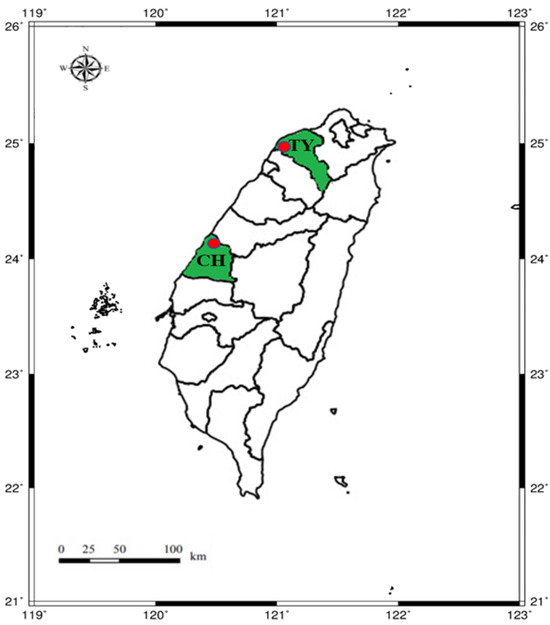
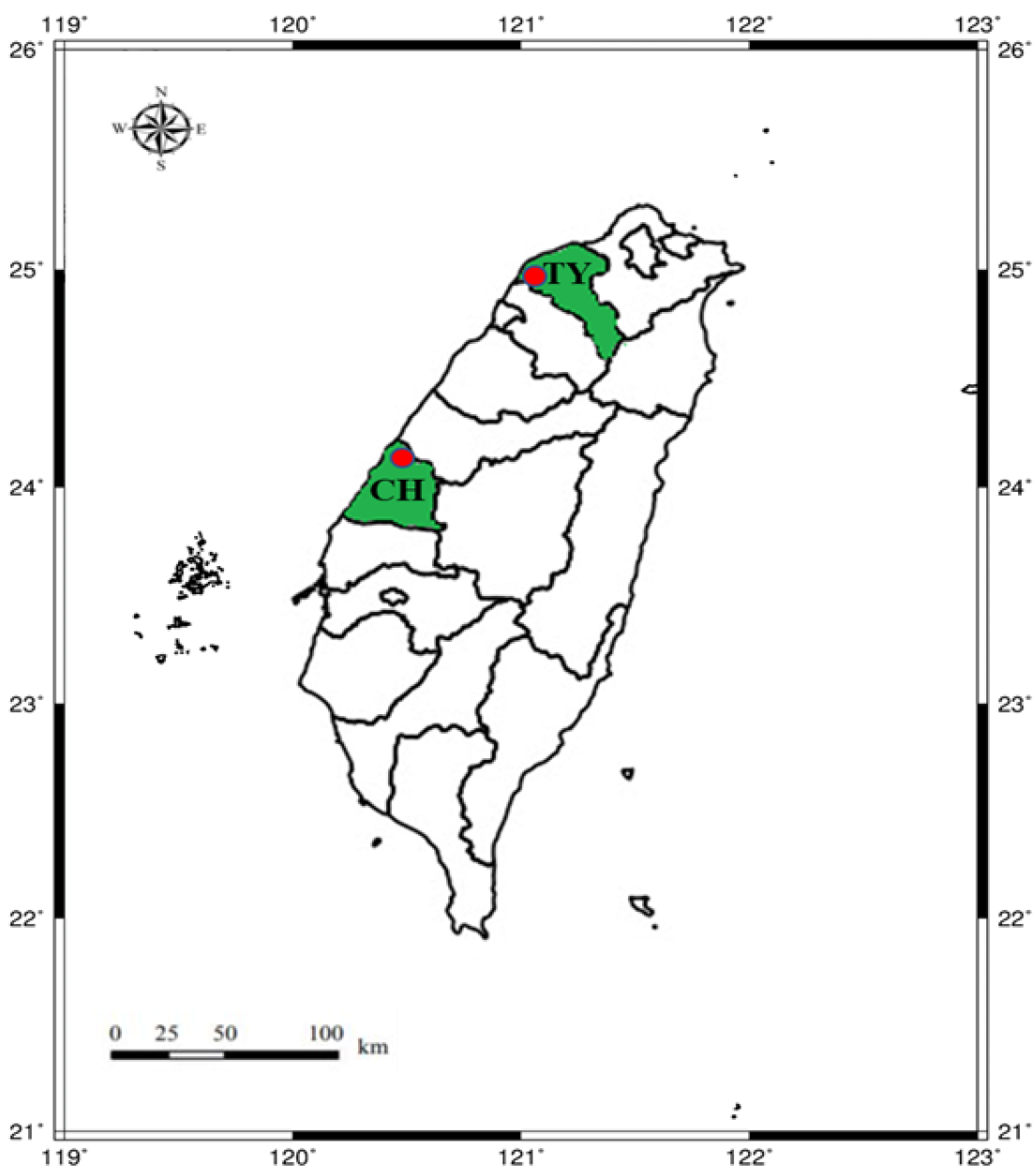
Field experiments were carried out to cultivate rice (Oryza sativa L., Taiwanese japonica varieties, Tainang 11) over two cultivation periods and one intermittent period spanning one year from July 2016 to August 2017. The experimental fields were located in Taoyuan City in northern Taiwan (TY; 121°02′30.1″ E, 24°56′57.8″ N) and Changhua County in central Taiwan (CH; 120°31′36.8″ E, 24°06′00.0″ N) (Figure 1). The same rice cultivar was used across the two consecutive cropping seasons at each site to ensure varietal consistency. The experiments were conducted within the same experimental fields and under typical regional paddy management practices. Although seasonal climatic conditions, particularly temperature, differed between the two cropping seasons, no extreme weather events were recorded, and treatment comparisons were conducted within each season, thereby minimizing potential confounding effects of inter-seasonal climatic variation. Each field was subjected to two treatments, including chemical fertilization (CF) with N, P2O5, and K2O rates of 120, 60, and 120 kg ha−1, respectively. In NCF plots, P fertilizer was omitted while N and K were applied at the same rates as CF to isolate the effect of P omission. Each treatment was implemented in four plots, each measuring 5 m × 5 m, using the completely randomized design (CRD). Approximately 300 rice seedlings were planted in each plot. Plots were maintained under flooded conditions, with mid-season drainage, and were drained before harvest.
Figure 1.
The locations of the experimental fields in Taiwan. CH and TY denote Changhua County and Taoyuan City, respectively.
After a growth period of 100–130 days (d), rice plants were collected randomly from each plot of the CF and NCF treatments in both TY and CH experimental fields. Edge effects were mitigated by harvesting solely from the central area of the plots (3 m × 3 m). The harvested plants underwent thorough cleaning with tap water and then deionized water (>18 MΩ cm−1). The plants were separated into roots, shoots, and grains, dried in an oven at 65 °C for 72 h, and then weighed.
Before (Pb) and after (Ph) each rice cultivation period, four surface soil samples (i.e., 0–15 cm depth) were collected from different locations within the inner area in each plot, and mixed well to form one representative sample for the plot. The collected soil samples were air-dried, ground through a 2-mm sieve, and stored in plastic bottles for further analysis.
2.2. Total P Concentration of Plant Tissues
Plant tissues weighing 0.5 g of the sample were digested with 5 mL HNO3 and 1 mL H2O2 using a microwave digestion system (Microwave Go Plus, Anton Paar GmbH, Graz, Austria). The digests were analyzed for P concentration using inductively coupled plasma atomic emission spectrometry (ICP-AES; Optima 8000, PerkinElmer, Inc., Waltham, MA, USA). All the procedures were carried out in triplicate.
2.3. Phosphorus-Use Efficiency
Percent P recovery efficiency (PRB) was calculated as the plant-accumulated P in biomass (PUF) (kg P ha−1) divided by the amount of P in soil (kg P ha–1) [29].
where PUF is biomass P of harvested rice plants (kg P ha–1) and PF is the amount of P in soil (kg P ha–1).
PRB = (PUF/PF) × 100
Agronomic utilization efficiency (AUE) was defined as the crop biomass (kg DM ha–1) produced per unit of P uptake (kg P ha–1):
AUE = BY/PUF
2.4. Soil Properties
Soil pH was measured with a soil–water ratio of 1:1 using a Thermo Orion pH meter with a combined pH electrode (Thermo Fisher Scientific Inc., Waltham, MA, USA) [30]. Cation-exchange capacity (CEC) was determined using the ammonium acetate method buffered at pH 7 [31]. Soil organic matter was analyzed using the wet oxidation method [32]. Soil texture was determined using the pipette method after the removal of soil organic matter and oxides [33]. Total P, K, Ca, Mg, Al, Fe, and Mn contents were analyzed using ICP-AES after microwave digestion (Multiwave GO, Anton Paar, Graz, Austria) with aqua regia. Total C and N contents were analyzed using a PerkinElmer 2400 II CHNS/O Analyzer (PerkinElmer, Inc., Waltham, MA, USA). Soil-available nitrogen was assessed using the KCl extraction method [34]. Soil-available K was evaluated using the Mehlich-3 method [35].
2.4.1. Soil-Available P
Available P content in soils was assessed using the Bray-1 method [36]. Two grams of soil was extracted with a 20 mL extraction solution, composed of 0.3 M NH4F and 0.025 M HCl, for 5 min. The resulting suspensions were filtered to collect the filtrates, and the P concentration in the filtrates was subsequently analyzed using the molybdenum-blue method [37].
2.4.2. Sequential Extraction of Soil P
Soil P fractionation was conducted using Hedley’s sequential extraction procedures [22], as modified by [23,24,25]. For each soil sample (0.2 g), four replicates were placed into 30 mL polypropylene tubes and underwent consecutive extractions with 30 mL of deionized water, 0.5 M NaHCO3, 0.1 M NaOH, and 1.0 M HCl solutions (Table S1 [22,23,24,25]) on a reciprocal shaker. After each extraction for 16 h, the samples were centrifuged at 9000 rpm for 20 min, and the supernatants were carefully withdrawn from each of the centrifuge tubes using a pipette to avoid the disturbance of soil sediment at the bottom of the tube. The supernatants were then filtered using a 0.2 μm membrane filter. The concentrations of total P (Pt) and inorganic P (Pi) in each fraction were determined using ICP-AES and the molybdenum-blue method, respectively. The concentration of organic P (Po) was calculated as the difference between Pt and Pi for each fraction. However, the Po fractions in the H2O and HCl extracts were below the detection limit and were therefore not reported. Accordingly, the HCl-extractable P fraction is expressed as total HCl-P, which predominantly represented inorganic P in this study.
2.4.3. Phosphorus K-Edge X-Ray Absorption Spectroscopy
For the analysis of soil P speciation, P K-edge XANES spectra of soil samples were collected at Beamline 16A in the National Synchrotron Radiation Research Center (NSRRC) in Hsinchu, Taiwan. The soil samples were ground and homogenized using a mortar and pestle and then pressed into Al sample holders. Data were collected for samples and reference materials in a helium environment in the fluorescence mode using a four-element silicon drift detector (Vortex-ME4; Hitachi High-Tech Analytical Science, Northbrook, IL, USA).
The XANES spectrum of each sample was processed with energy calibration, background removal, and normalization using the Athena software (Demeter version 0.9.26) [38]. Linear combination fitting (LCF) was performed for the XANES spectra of the soil samples over the energy range from 2130 to 2182 eV, with energy floating not allowed. The selection of the reference materials for LCF was based on principal component analysis [27]. The P reference materials included (1) Al–P (variscite), (2) Fe–P (PO4 adsorbed on ferrihydrite), (3) Ca–P (hydroxyapatite), and (4) organic-P (phytate). The goodness-of-fit was assessed by the R factor determined by the Athena software.
2.5. Statistical Analysis
A one-way analysis of variance (ANOVA) was performed to identify variations in data from soil and plant samples subjected to different treatments. Prior to statistical analysis, data were examined for normality and homogeneity of variance using the Shapiro–Wilk test and Levene’s test, respectively. The significant differences among the treatments were determined by the least significant difference (LSD) test (p < 0.05), denoting statistical significance. For plant growth and yield parameters, treatment effects (CF vs. NCF) were evaluated separately for each site, with cropping season considered as a repeated factor. When appropriate, site and treatment effects were further examined using two-way ANOVA. Principal component analysis (PCA) was used to summarize multivariate patterns among standardized (z-score) soil P fractions (see Figure S2). All statistical analyses were completed in the SAS system (version 9.4; SAS Institute Inc., Cary, NC, USA).
3. Results
3.1. Basic Properties of TY and CH Soils
Key physicochemical properties of TY and CH soils are summarized in Table 1. Both soils were acidic. TY soil was more acidic and had a lower CEC than CH soil, while both soils had high P levels and were classified as P-enriched paddy soils. The concentrations of soil-available P of TY and CH soils were 35.3 and 33.7 mg kg−1, respectively (Table 1), and both were classified as ‘extremely high’ (>30 mg kg−1) according to the Crop Fertilization Manual published by the Taiwan Agriculture and Food Agency. Notably, the ratio of available P to total P in TY soil (i.e., 4.5%) was lower than that of CH soil (i.e., 6.4%).
Table 1.
Physicochemical properties of TY and CH soils.
3.2. Rice Growth Performances in TY and CH Soils with CF and NCF Treatments
Across two consecutive cropping seasons, rice growth and yield were comparable between CF and NCF treatments at both sites (Table 2). This section presents direct agronomic evidence evaluating whether short-term omission of P fertilization affects rice growth performance, grain yield, and grain P concentration. In TY soil, for example, grain yields were similar between CF and NCF across the two seasons, and shoot height showed only small variation between the treatments. In CH soil, yields were likewise stable with no consistent differences between CF and NCF. Statistical analysis indicated that neither P fertilization treatment nor cropping season significantly affected shoot height, grain dry weight, or grain yield (p > 0.05), and no consistent treatment × season interaction was detected at either site. Grain P concentration followed the same pattern: values were comparable between CF and NCF within each season, and seasonal differences were small (Table 2). Overall, these results indicate that short-term omission of P fertilizer did not adversely affect rice growth, grain yield, or grain P concentration in either P-rich paddy soil evaluated in this study.
Table 2.
Plant growth performance, including rice shoot height, grain dry weight, grain yield, and grain P concentration, at the first (Ph1) and second (Ph2) harvests in TY and CH soils under CF and NCF treatments.
3.3. Total and Available P Concentrations in Soils
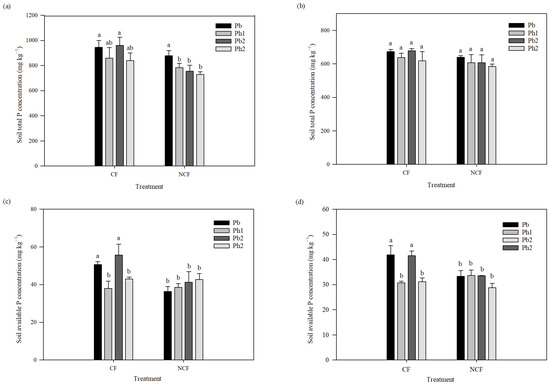
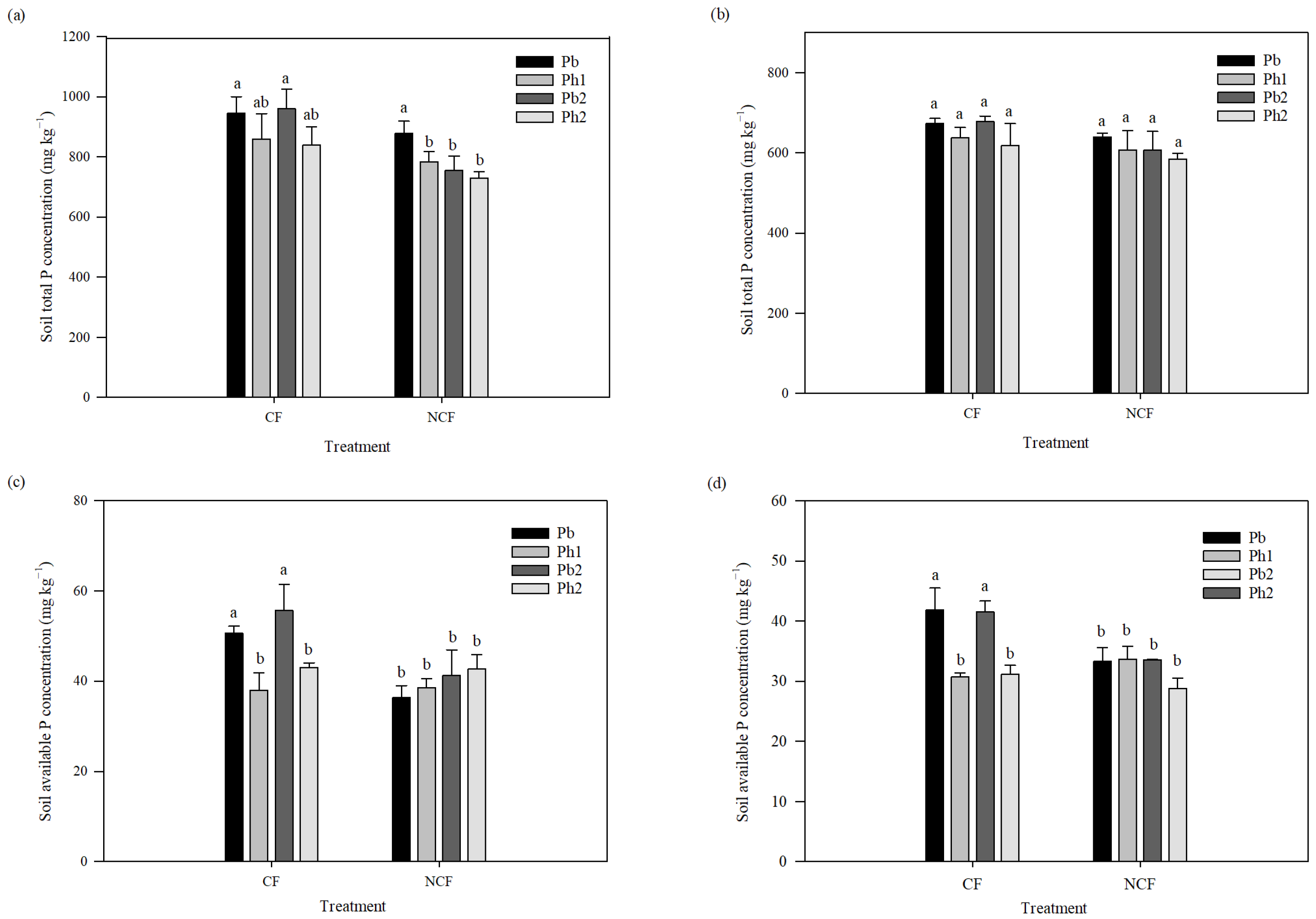
To examine whether soil P availability was maintained under P omission, temporal changes in total and available P were assessed across two consecutive cropping seasons under CF and NCF treatments (Figure 2). In TY soil, total P decreased after each cropping season (Ph1 and Ph2) relative to pre-planting values (Pb and Pb2), but temporarily increased at the beginning of the second season (Pb2) due to P fertilization. In contrast, under the NCF treatment, total P concentrations in TY soil exhibited a continuous declining trend throughout the two cropping seasons without recovery between seasons (Figure 2a). In CH soil, total P showed a similar but smaller downward tendency under CF and a gradual decline under NCF; however, differences among sampling times were not statistically significant (Figure 2b).
Figure 2.
Soil total and available P concentrations in TY (a,c) and CH soils (b,d) under CF and NCF treatments at four sampling times: before the first cropping season (Pb), after the first cropping season (Ph1), before the second cropping season (Pb2), and after the second cropping season (Ph2). Data are presented as means ± SD (n = 4). Mean comparisons were performed using the LSD test (p < 0.05). Different lowercase letters indicate significant differences among treatments within the same soil and sampling time.
In TY soil under CF treatment, available P declined after each cropping season (Ph1 and Ph2) and increased at the start of the second season (Pb2) following P fertilization (Figure 2c). Under NCF treatment, available P in TY soil remained relatively stable across sampling times, with a slight increasing tendency over the two cropping seasons. In CH soil, available P under CF treatment also decreased after each cropping season (Ph1 and Ph2) relative to the pre-planting values (Pb and Pb2), whereas under NCF treatment, it showed only minor fluctuations with no clear temporal trend over the two cropping seasons (Figure 2d).
3.4. Sequential Fractionation of Soil Phosphorus
To identify which soil P pools responded during rice cultivation and potentially contributed to maintaining plant-available P, sequential P fractionation was performed before the first planting (Pb) and after each cropping season (Ph1 and Ph2) (Table 3; Figure 3). Statistical comparisons were performed within each soil and treatment to assess temporal changes across cropping seasons, rather than direct comparisons between CF and NCF at given sampling time (Table 3).
Table 3.
Soil P fractions in TY and CH soils under CF and NCF treatments, measured before the first planting (Pb) and after the first (Ph1) and second (Ph2) cropping seasons.
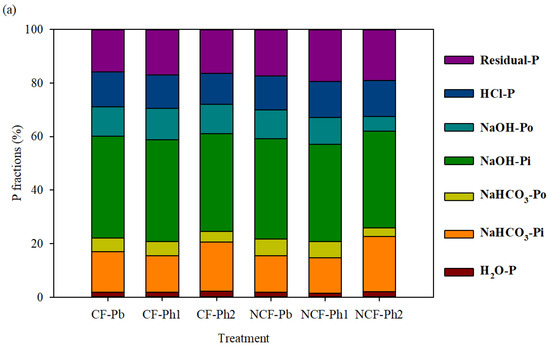
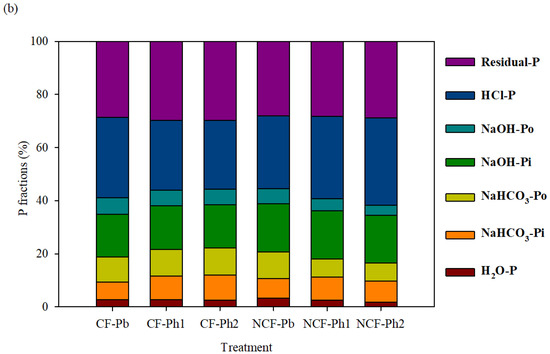
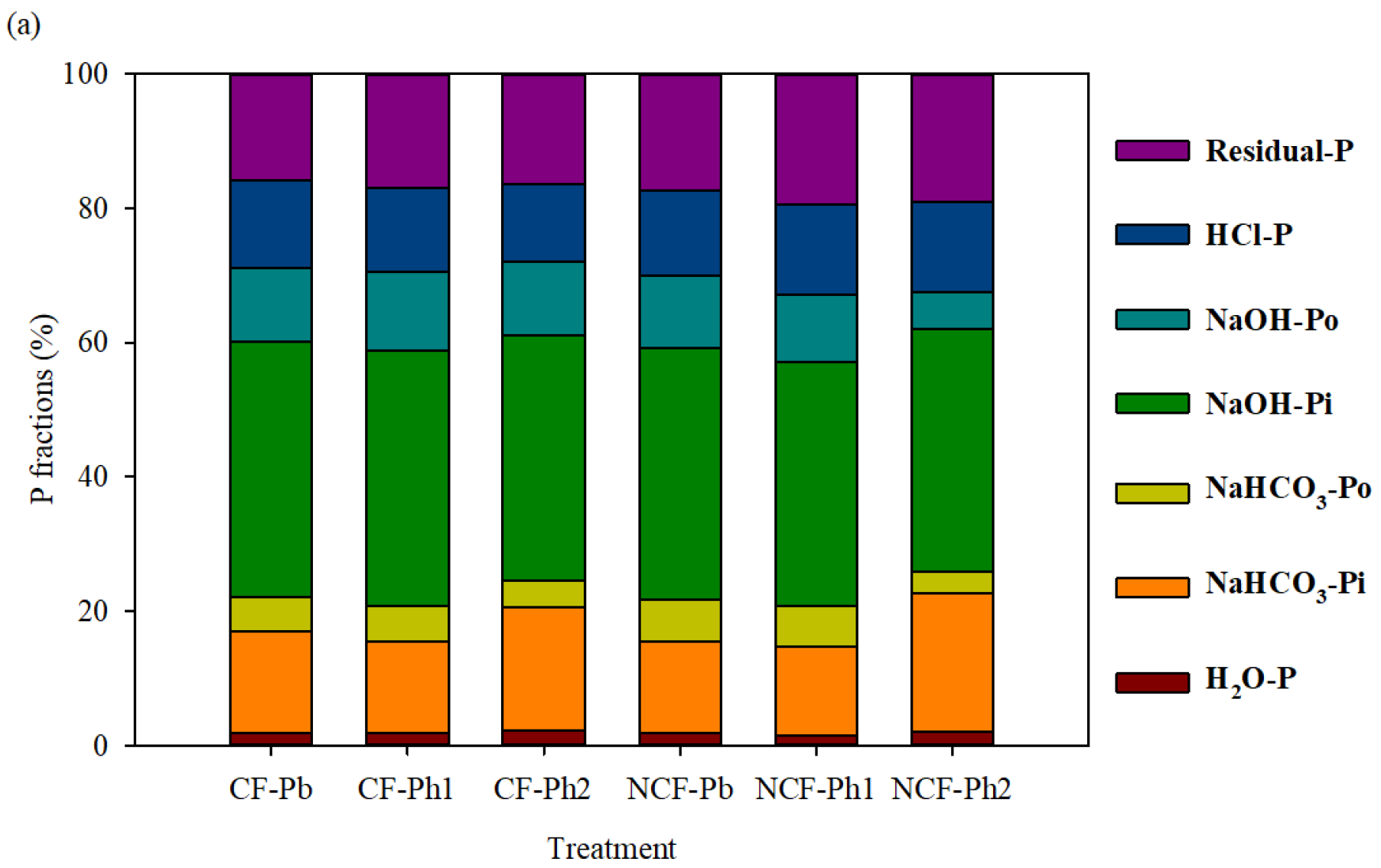
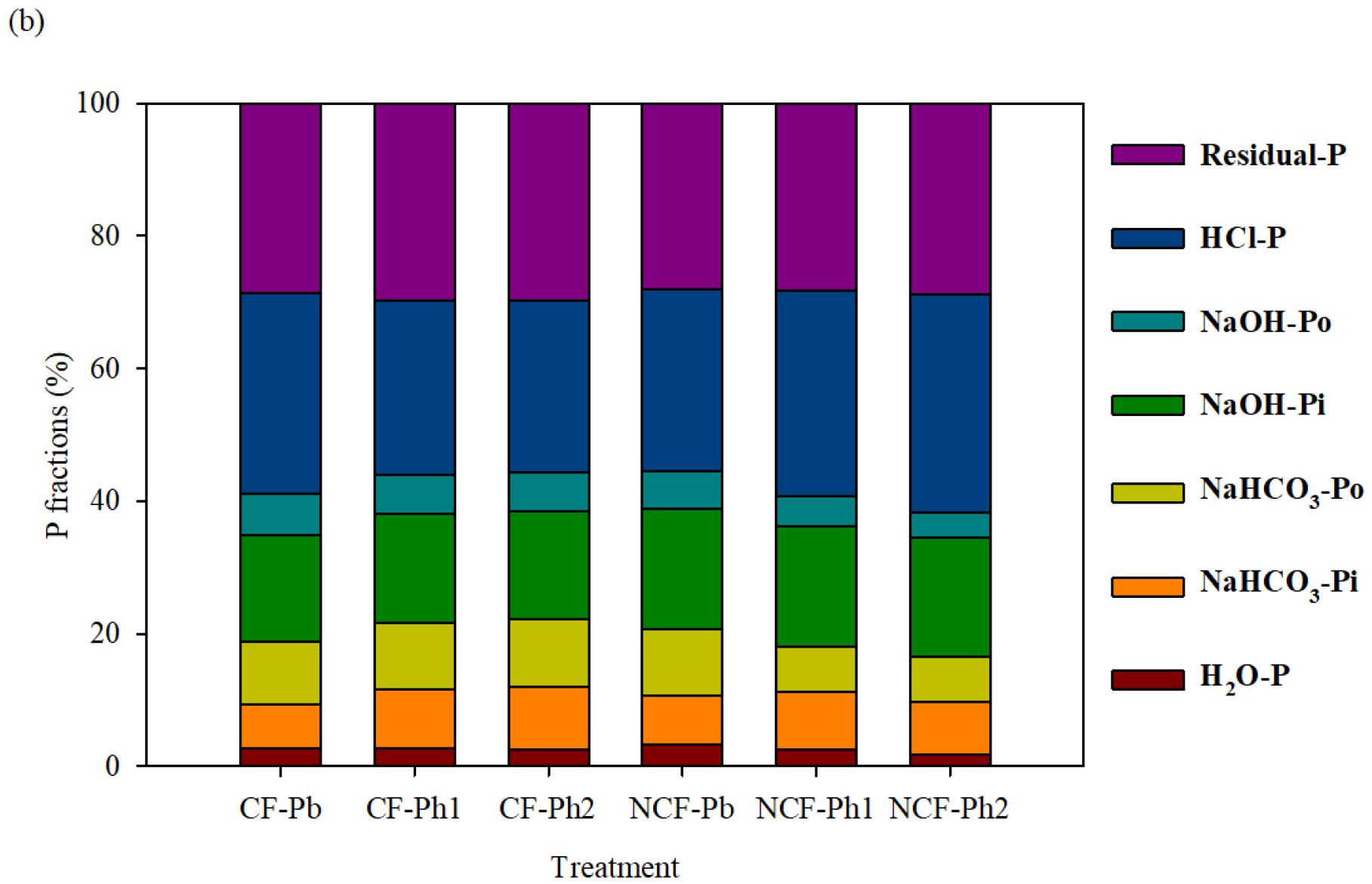
Figure 3.
P fractionation in (a) TY and (b) CH soils under CF and NCF treatments measured before the first planting (Pb) and after the first (Ph1) and second (Ph2) cropping seasons. Values are expressed as percentages of total Hedley-extractable P.
Across both soils, the H2O-P fraction accounted for only a small proportion of total P (<3%; Figure 3), representing dissolved inorganic P in soil solution and the most readily available P pool for plant uptake. The NaHCO3-extractable P fractions (NaHCO3-Pi and NaHCO3-Po), which represent labile inorganic and organic P, contributed a moderate proportion of total P (Figure 3) and were consistently larger in TY soil than in CH soil (Table 3).
The two soils differed markedly in dominant P pools. In TY soil, NaOH-Pi was the largest fraction, indicating that a substantial proportion of soil P was associated with Fe/Al phases (Figure 3). In CH soil, NaOH-Pi contributed less, whereas the HCl-P fraction (Ca-associated P) represented a substantially larger portion of total P than in TY soil (Figure 3), suggesting stronger Ca-related P stabilization in CH soil. Residual-P comprised a considerable proportion of total P in both soils, with a relatively higher contribution in CH soil (Figure 3).
Temporal patterns differed between soils and treatments. In TY soil, the residual-P fraction showed no significant change after two cropping seasons (Table 3). In CH soil under NCF, NaHCO3− and NaOH-extractable organic P fractions showed a decreasing trend over time (Table 3). Unlike TY soil, NaOH-Pi in CH soil remained relatively stable, while residual-P under NCF declined significantly after the first and second cropping seasons (Table 3), indicating that less-labile pools contributed to short-term P dynamics under P omission.
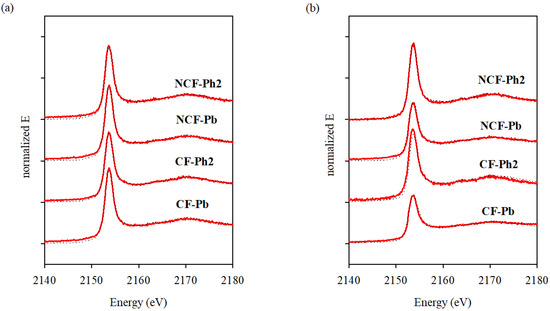
3.5. Chemical Speciation of Soil Phosphorus by XANES-LCF
The results of P K-edge XANES-LCF indicated that soil P was dominated by inorganic species associated with Al, Fe, and Ca (Table 4; Figure 4). Although an organic-P reference (phytate) was included in the LCF reference set, it was not selected in the best-fit models, suggesting that organic P was not resolved as a dominant spectral component under the current reference set and fitting constraints. Because soil spectra represent mixtures of overlapping P species, Ca-associated contributions identified by XANES-LCF may not produce a visually distinct shoulder feature in every sample. Across both soils, Al-P generally decreased under NCF relative to CF, whereas Fe-P remained a major contributor across treatments (Table 4). Changes in Ca-P were soil- and treatment-dependent (Table 4). Overall, the XANES-LCF patterns were broadly consistent with the sequential fractionation results, in which NaOH-extractable pools (Fe/Al-associated forms) exhibited short-term responsiveness during cultivation.
Table 4.
Chemical P speciation in TY and CH soils under CF and NCF treatments measured before planting (Pb) and after the second cropping season (Ph2), determined by P K-edge XANES-LCF.
Figure 4.
P K-edge XANES spectra and linear combination fits of (a) TY and (b) CH soils under CF and NCF treatments measured before planting (Pb) and after the second cropping season (Ph2).
3.6. Multivariate Relationships Among Fertilizer Inputs, Soil P Indicators, and Crop Outcomes
To provide an integrated overview of patterns across plant performance, soil properties, and sequentially fractionated P pools, we generated heatmaps of standardized (z-score) values (Figure S1). Because all variables were placed on a common scale, Figure S1 is presented as an exploratory visualization to highlight broad similarities and contrasts among treatments and sampling times rather than to infer causality. Consistent with the univariate results, plant performance metrics varied within a relatively narrow range between CF and NCF.
We also applied principal component analysis (PCA) to the soil P fraction dataset to summarize multivariate variation in P pool composition (Figure S2). The PCA biplots show sample clustering and the P fractions most strongly associated with the major axes. Overall, PCA primarily separated the two soils and provided a compact representation of seasonal and treatment-related shifts in fraction composition. Because PCA was used for exploratory purposes, interpretation of PCA gradients in relation to crop outcomes (e.g., yield and grain P) is qualitative and should be considered together with the fractionation and XANES results. Accordingly, statistical inference regarding treatment effects was based primarily on the univariate analyses described above.
4. Discussion
4.1. Short-Term Rice Performance Under P Omission
Across two consecutive cropping seasons, rice grain yield and grain P concentration did not differ significantly between CF and NCF (P-omission) treatments, indicating that short-term rice performance was maintained without additional P input over the short-term study period in these P-rich paddy soils. The lack of significant treatment effects does not imply that soil P was static; rather, it suggests that any changes in soil P pools and availability were buffered sufficiently to sustain crop growth and grain production within the variability observed over the two seasons.
4.2. Soil P Buffering and Redistribution During Rice Cultivation
Consistent with the crop responses, soil-available P under NCF remained broadly stable across the two cropping seasons, whereas available P under CF showed clearer before–after seasonal fluctuations associated with fertilizer application (Figure 2c,d). Importantly, available P at the end of each season was similar between CF and NCF treatments in both soils, suggesting that the soils were able to buffer plant-available P during cultivation despite the absence of P fertilization. Meanwhile, total soil P declined over time, particularly under NCF, where no P was added between seasons (Figure 2a,b). Together, the decline in total P alongside relatively stable available P under NCF suggests that part of the accumulated legacy P pool contributed to replenishing plant-available P during rice growth. This interpretation aligns with the general concept that as labile pools are depleted, more strongly retained pools can contribute to plant supply—often slowly—through dissolution and desorption processes [39,40].
Soil P buffering capacity (i.e., resistance of solution/labile P to change as P is removed) may better reflect seasonal plant-available P than a single instantaneous measure of labile P [39,40]. Buffer capacity is commonly quantified through sorption isotherms or quantity/intensity (Q/I) relationships [41]. Integrated field analyses suggest that in soils with high legacy-P and labile-P contents, buffering behavior may shift with changes in sorption capacity and fertilizer history, influencing the resilience of plant-available P under changing management and environmental conditions [39,42]. Although such measurements were not performed here, the observed seasonal patterns, i.e., stable available P under NCF despite declining total P, are consistent with meaningful buffering by legacy P pools over the two-season timeframe.
As a conceptual interpretation, if seasonal changes in total P are assumed to be driven predominantly by plant removal, the change in total P can be treated as a “quantity” change (ΔQ), whereas changes in available P can be treated as an “intensity” change (ΔI). Under this interpretation, TY soil exhibited a larger ΔQ while maintaining ΔI compared with CH soil, suggesting a potentially greater effective buffering behavior during the study period. This remains inferential rather than a direct quantification, and targeted experiments (e.g., sorption isotherms, Q/I curves, and longer-term depletion trials) would be required to confirm these buffering differences. Mechanistically, differences in buffering among soils can arise from mineral controls and organic matter interactions: Fe- and Al-(hydr)oxides are key sorbents that retain P strongly and can release P as chemical equilibria shift; Ca-P precipitation may occur depending on pH and Ca activity; and soil organic matter may influence P retention through complexation and competitive sorption [42,43]. The higher Fe and Al contents and lower pH of TY relative to CH (Table 1) plausibly contributed to a larger legacy-P reservoir associated with Fe/Al phases (Table 4), and thus greater buffering during short-term P omission, whereas the comparatively higher organic matter in CH may influence retention and release pathways differently.
Sequential P fractionation further clarified which operational pools were most responsive during cultivation (Table 3; Figure 3). The relatively low concentrations of H2O-P and NaHCO3–Pi observed here suggest limited storage in the readily soluble pools over the season, emphasizing the importance of moderately labile pools in sustaining supply (Table 3). The NaOH-Pi and NaOH-Po fractions represent moderately labile inorganic and organic P pools, respectively, commonly associated with Fe and Al oxides and organic matter. The dominant pools differed between soils: in TY soil, NaOH-Pi comprised the largest fraction, consistent with the strong association of P with Fe/Al phases; in CH soil, HCl-P and residual-P constituted relatively larger proportions, indicating a greater contribution of Ca-associated and stable pools (Figure 3). These contrasts suggest that the mechanisms governing P retention and release differed between soils, which is consistent with their contrasting physicochemical properties.
Temporal changes in soil P fractions also differed between soils and treatments. In TY soil, NaOH-Pi declined during cultivation under both CF and NCF treatments, supporting the interpretation that crops likely drew on moderately labile Fe/Al-associated pools beyond the operationally defined “available” fraction [44,45]. In CH soil, NaOH-Pi was comparatively stable across seasons, whereas the NaHCO3- and NaOH-extractable organic fractions showed a decreasing tendency, and residual-P declined after the first and second seasons under NCF treatment (Table 3). Together, these results suggest that under P omission, the specific pools contributing to short-term buffering may differ between soils: TY soil showed clearer responsiveness of Fe/Al-associated pools, while CH soil exhibited detectable changes in organic and more stable pools under NCF treatment. In paddy soils under reduced fertilizer inputs, NaOH-extractable Pi and Po have also been recognized as important potential P sources during crop growth [46,47]. From a management perspective, these findings are relevant because excessive P fertilization in paddy systems can elevate risks of P loss to surrounding waters, often dominated by inorganic forms [48,49]. The responsiveness of soil pools under NCF implies that short-term reductions in P input may draw on legacy reserves in P-rich fields, while acknowledging that the present study cannot address long-term sustainability.
Where short-term shifts among labile, moderately labile, and more stable pools were observed, these changes may reflect combined mineral-solution equilibria, biological uptake, and paddy-specific chemical dynamics. Because redox indicators (e.g., Eh and porewater Fe(III)/Fe(II)) were not measured, redox-driven interpretations should be treated as plausible rather than demonstrated mechanisms. Recent work in flooded paddy soils indicates that microbial Fe(III) reduction can mobilize Fe-bound P and partially compensate for plant P demand, highlighting the potential role of redox-driven release of Fe-associated legacy P during rice growth [50,51]. In addition, drying–wetting cycles in paddy systems can modify Fe chemistry and thereby influence P binding and release, which may contribute to the observed redistribution among operationally defined P pools [52,53]. At the mineralogical scale, recent spectroscopic evidence further demonstrated that redox-induced transformations among iron oxyhydroxide phases in flooded rice paddy soils can substantially alter phosphate retention and release behavior, ultimately affecting the accessibility of Fe-associated P pools [52]. Multivariate summaries (e.g., PCA) can provide an integrated view of how treatments and soils differ in P pool composition; however, the mechanistic interpretation remains grounded in the information of soil P fractionation and speciation discussed below. The redistribution of P among labile, moderately labile, and more stable pools highlights the potential importance of Fe- and Al-associated P as short-term “intermediate reservoirs” for rice in paddy soils. Under paddy field conditions, shifts in sorption equilibria and (potentially) redox-driven transformations can alter the stability and accessibility of Fe/Al-associated P, enabling partial replenishment of labile pools during cultivation [43]. Prior work has also shown that P in runoff is not exclusively water-soluble Pi, but can include P associated with NaHCO3- and NaOH-extractable pools, including organic fractions [43], reinforcing the environmental relevance of these pools in fertilized paddy landscapes. From a statistical perspective, while these processes were sufficiently consistent across seasons to sustain crop growth, inherent field heterogeneity and seasonal variability may have limited the detection of subtle treatment effects on yield.
Comparisons with upland/arable systems further emphasize that the soil redox regime can modulate the direction of legacy P transformations. For example, cessation of P inputs in non-flooded systems has been associated with contrasting shifts among NaHCO3-Pi and NaOH-Pi pools relative to paddy systems [9,44,54], suggesting that paddy-specific conditions may alter the balance between labile replenishment and stabilization into less labile forms. Residual-P was stable in CH under CF treatment, but under NCF, it decreased significantly after the first season and remained lower after the second season (Table 3), indicating that less-labile pools contributed to short-term P dynamics under P omission. Meanwhile, variation in labile pools across seasons likely reflects the combined effects of plant uptake and replenishment from moderately labile pools, rather than a monotonic trend driven solely by fertilization regime.
At the molecular scale, P K-edge XANES-LCF provides complementary evidence by identifying dominant inorganic P associations (Table 4). Because sequential fractionation pools are operationally defined and XANES fits reflect molecular-scale spectral contributors, direct correspondence is not expected. Broadly, the Fe-/Al-associated species can correspond to NaOH-extractable behavior, while the Ca-associated species can align with HCl-extractable behavior (Table 4). In both soils, Fe-P remained a major component, whereas Al-P was lower under NCF by Ph2 in both soils, suggesting that Al-associated legacy P may be relatively more responsive to short-term depletion during P omission [11,12,14,55]. Because XANES-LCF outcomes depend on the reference set and spectral similarity among species, these results should be interpreted as dominant-trend patterns rather than exact pool sizes.
Finally, we note an important design limitation related to nutrient interactions: a true unfertilized control (without N, P, and K) was not included. Nitrogen and potassium were applied at the same rates in CF and NCF, while only P was omitted to isolate the short-term effect of P omission under field conditions. Therefore, the observed maintenance of rice yield and grain P under NCF should be interpreted in the context of adequate N and K supply, and future studies that incorporate broader nutrient gradients would further clarify interactive controls on productivity.
4.3. Limitations and Implications for P Management
Two limitations are important for interpreting these findings. First, root-exuded organic acids, rhizosphere chemistry, and direct redox indicators were not quantified; therefore, biological and redox-driven mechanisms remain hypotheses that require direct measurement to confirm. Second, this study provides short-term evidence (two cropping seasons) and cannot establish long-term sustainability of P omission, especially under different climatic years, management regimes, or progressive depletion of legacy pools. Despite these limitations, the results have a clear management implication: in P-rich paddy soils with a long history of fertilization, short-term reductions in P fertilizer inputs may be feasible without immediate yield penalties, because legacy P pools can buffer plant-available P during cultivation. This approach may reduce unnecessary P application and associated environmental risk in the near term. However, continued crop P removal without replenishment is expected to progressively deplete labile and moderately labile pools [44,54], which may weaken buffering capacity over time. Depletion may be nonlinear, with threshold responses once key pools are exhausted; thus, longer-duration field experiments are needed to quantify depletion trajectories and identify when supplemental P becomes necessary to sustain productivity.
Finally, the applicability of these findings should be interpreted within the experimental context. The buffering effects observed here are most relevant to P-enriched paddy soils with long fertilization histories and reflect system responses over two cropping seasons. Extrapolation to P-deficient soils, other cropping systems, or longer timescales should be made with caution, as soil P availability, buffering behavior, and crop responses may differ substantially. Future research combining long-term field trials with process-based indicators (e.g., changes in soil P fractions, buffering capacity, and crop P uptake efficiency) would be particularly valuable for developing practical guidance on safe P-reduction thresholds.
5. Conclusions
This study provides short-term (two-season) field evidence that, in paddy soils with high background P, omitting P fertilizer did not significantly reduce rice grain yield or grain P concentration compared with chemical P fertilization. Under P omission (NCF), soil-available P was maintained despite a decline in total soil P, indicating that accumulated legacy P buffered plant-available P during rice cultivation. Sequential fractionation and P K-edge XANES consistently suggested that Fe- and Al-associated pools contributed to the replenishment of labile P fractions during the study period. Because root exudation and redox indicators were not directly measured, the proposed roles of biological processes and paddy redox dynamics should be regarded as plausible mechanisms rather than demonstrated pathways. Overall, these results imply that short-term reductions in P inputs may be feasible in P-rich paddy soils, potentially reducing unnecessary fertilization and associated P-loss risk. However, this study cannot determine the long-term sustainability of continuous P omission, including progressive depletion of legacy P pools and changes in soil P buffering capacity. Longer-duration, multi-site field experiments that incorporate mechanistic measurements (e.g., rhizosphere chemistry and redox dynamics) are therefore required before recommending sustained P-omission strategies for regional P management.
Supplementary Materials
The following supporting information can be downloaded at: https://www.mdpi.com/article/10.3390/agronomy16040456/s1, Figure S1: Heatmaps of standardized (z-score) plant performance, soil properties, and soil P fractions under different fertilization treatments in the TY and CH soils; Figure S2: PCA biplots of soil P fractions under CF and NCF treatments in TY and CH soils; Table S1: Hedley P extraction procedure and significance of the different P fractions [22,23,24,25].
Author Contributions
Conceptualization, C.-H.Y. and S.-L.W.; methodology, C.-H.Y.; investigation, C.-H.Y.; validation, P.-T.K.; resources, P.-T.K. and S.-L.W.; writing—original draft preparation, C.-H.Y.; writing—review and editing, C.-H.Y., P.-T.K. and S.-L.W.; supervision, S.-L.W.; funding acquisition, S.-L.W. All authors have read and agreed to the published version of the manuscript.
Funding
This research was funded by the National Science and Technology Council of Taiwan (Grant No. 112-2313-B-002-030-MY3) and the Ministry of Agriculture, Taiwan (Grant No. 105-ARDP-2.4.3-PB-U1 and 106-ARDP-2.4.3-PB-U1).
Institutional Review Board Statement
Not applicable.
Informed Consent Statement
Not applicable.
Data Availability Statement
The original contributions presented in this study are included in the article/Supplementary Material. Further inquiries can be directed to the corresponding author.
Acknowledgments
The authors gratefully acknowledge the National Synchrotron Radiation Research Center (NSRRC), Hsinchu, Taiwan, for providing beamtime and technical support during the XANES measurements. ChatGPT and Grammarly were used to assist with English-language editing and improving clarity of the manuscript text.
Conflicts of Interest
The authors declare no conflicts of interest.
References
- Simpson, R.J.; Oberson, A.; Culvenor, R.A.; Ryan, M.H.; Veneklaas, E.J.; Lambers, H.; Lynch, J.P.; Ryan, P.R.; Delhaize, E.; Smith, F.A.; et al. Strategies and agronomic interventions to improve the phosphorus-use efficiency of farming systems. Plant Soil 2011, 349, 89–120. [Google Scholar] [CrossRef] [Scilit]
- Doydora, S.; Gatiboni, L.; Grieger, K.; Hesterberg, D.; Jones, J.L.; McLamore, E.S.; Peters, R.; Sozzani, R.; Van den Broeck, L.; Duckworth, O.W. Accessing legacy phosphorus in soils. Soil Syst. 2020, 4, 74. [Google Scholar] [CrossRef] [Scilit]
- Turner, B.L.; Kim, P.J. Terminology for residual and legacy phosphorus. Plant Soil 2024, 501, 237–239. [Google Scholar] [CrossRef] [Scilit]
- Abelson, P.H. A potential phosphate crisis. Science 1999, 283, 2015. [Google Scholar] [CrossRef] [Scilit] [PubMed]
- Sattari, S.Z.; Bouwman, A.F.; Giller, K.E.; van Ittersum, M.K. Residual soil phosphorus as the missing piece in the global phosphorus crisis puzzle. Proc. Natl. Acad. Sci. USA 2012, 109, 6348–6353. [Google Scholar] [CrossRef] [Scilit]
- Brownlie, W.J.; Alexander, P.; Cordell, D.; Maslin, M.; Metson, G.S.; Sutton, M.A.; Spears, B.M. National phosphorus planning for food and environmental security. Curr. Opin. Biotechnol. 2024, 90, 103226. [Google Scholar] [CrossRef] [Scilit]
- Scholz, R.W.; Wellmer, F.; Mew, M.; Steiner, G. The dynamics of increasing mineral resources and improving resource efficiency: Prospects for mid- and long-term security of phosphorus supply. Resour. Conserv. Recycl. 2025, 213, 107993. [Google Scholar] [CrossRef] [Scilit]
- Condron, L.M.; Spears, B.M.; Haygarth, P.M.; Turner, B.L.; Richardson, A.E. Role of legacy phosphorus in improving global phosphorus-use efficiency. Environ. Dev. 2013, 8, 147–148. [Google Scholar] [CrossRef] [Scilit]
- McDowell, R.W.; Simpson, Z.P.; Doscher, C.; Steinfurth, K.; Mott, J.D.; Margenot, A.J.; Appelhans, S.C.; Elledge, A.E.; Thornton, C.M.; Moore, P.A.; et al. Managing the reduction of soil phosphorus can prolong global reserves of fertilizer phosphorus and improve water quality. One Earth 2025, 8, 101448. [Google Scholar] [CrossRef] [Scilit]
- Solangi, F.; Zhu, X.; Khan, S.; Rais, N.; Majeed, A.; Sabir, M.A.; Iqbal, R.; Ali, S.; Hafeez, A.; Ali, B.; et al. The Global Dilemma of Soil Legacy Phosphorus and Its Improvement Strategies under Recent Changes in Agro-Ecosystem Sustainability. ACS Omega 2023, 8, 23271–23282. [Google Scholar] [CrossRef] [Scilit]
- Lucas, E.; Mosesso, L.; Roswall, T.; Yang, Y.Y.; Scheckel, K.; Shober, A.; Toor, G.S. X-ray absorption near edge structure spectroscopy reveals phosphate minerals at surface and agronomic sampling depths in agricultural Ultisols saturated with legacy phosphorus. Chemosphere 2022, 308, 136288. [Google Scholar] [CrossRef] [Scilit]
- Biassoni, M.M.; Vivas, H.; Gutiérrez-Boem, F.H.; Salvagiotti, F. Changes in soil phosphorus (P) fractions and P bioavailability after 10 years of continuous P fertilization. Soil Tillage Res. 2023, 232, 105777. [Google Scholar] [CrossRef] [Scilit]
- López-Arredondo, D.L.; Leyva-González, M.A.; González-Morales, S.L.; López-Bucio, J.; Herrera-Estrella, L. Phosphate Nutrition: Improving Low-Phosphate Tolerance in Crops. Annu. Rev. Plant Biol. 2014, 65, 95–123. [Google Scholar] [CrossRef] [Scilit] [PubMed]
- Tiecher, T.; Fontoura, S.M.V.; Ambrosini, V.G.; Araújo, E.A.; Alves, L.A.; Bayer, C.; Gatiboni, L.C. Soil phosphorus forms and fertilizer use efficiency are affected by tillage and soil acidity management. Geoderma 2023, 435, 116495. [Google Scholar] [CrossRef] [Scilit]
- Szymańska, M.; Sulewski, P.; Wąs, A.; Sosulski, T. In the way to more sustainable phosphorus management in European agriculture: Changes in fertilization efficiency in the context of the sustainable intensification concept. Environ. Sci. Eur. 2025, 37, 235. [Google Scholar] [CrossRef] [Scilit]
- Cavigelli, M.A.; Thien, S.J. Phosphorus bioavailability following incorporation of green manure crops. Soil Sci. Soc. Am. J. 2003, 67, 1186–1194. [Google Scholar] [CrossRef] [Scilit]
- Eichler-Löbermann, B.; Köhne, S.; Kowalski, B.; Schnug, E. Effect of catch cropping on phosphorus bioavailability in comparison to organic and inorganic fertilization. J. Plant Nutr. 2008, 31, 659–676. [Google Scholar] [CrossRef] [Scilit]
- Fuentes, B.; de la Luz Mora, M.; Bolan, N.S.; Naidu, R. Assessment of phosphorus bioavailability from organic wastes in soil. In Developments in Soil Science; Naidu, R., Ed.; Elsevier: Amsterdam, The Netherlands, 2008; Volume 32, pp. 363–411. [Google Scholar]
- Rowe, H.; Withers, P.J.A.; Baas, P.; Chan, N.I.; Doody, D.; Holiman, J.; Jacobs, B.; Li, H.G.; MacDonald, G.K.; McDowell, R.; et al. Integrating legacy soil phosphorus into sustainable nutrient management strategies for future food, bioenergy and water security. Nutr. Cycl. Agroecosyst. 2016, 104, 393–412. [Google Scholar] [CrossRef] [Scilit]
- Bünemann, E.K. Assessment of gross and net mineralization rates of soil organic phosphorus: A review. Soil Biol. Biochem. 2015, 89, 82–98. [Google Scholar] [CrossRef] [Scilit]
- Chang, S.C.; Jackson, M.L. Fractionation of soil phosphorus. Soil Sci. 1957, 84, 133–144. [Google Scholar] [CrossRef] [Scilit]
- Hedley, M.J.; Stewart, J.W.B.; Chauhan, B.S. Changes in Inorganic and Organic Soil-Phosphorus Fractions Induced by Cultivation Practices and by Laboratory Incubations. Soil Sci. Soc. Am. J. 1982, 46, 970–976. [Google Scholar] [CrossRef] [Scilit]
- Tiessen, H.; Moir, J. Characterization of available phosphorus by sequential fractionation. In Soil Sampling and Methods of Analysis; Carter, M.R., Ed.; Lewis Publishers: Boca Raton, FL, USA, 1993; pp. 75–86. [Google Scholar]
- Negassa, W.; Leinweber, P. How does the Hedley sequential phosphorus fractionation reflect impacts of land use and management on soil phosphorus? A review. J. Plant Nutr. Soil Sci. 2009, 172, 305–325. [Google Scholar] [CrossRef] [Scilit]
- Li, L.; Liang, X.Q.; Ye, Y.S.; Zhao, Y.; Zhang, Y.X.; Jin, Y.; Yuan, J.L.; Chen, Y.X. Effects of repeated swine manure applications on legacy phosphorus and phosphomonoesterase activities in a paddy soil. Biol. Fertil. Soils 2015, 51, 167–181. [Google Scholar] [CrossRef] [Scilit]
- Teng, Z.; Zhu, J.; Shao, W.; Zhang, K.; Li, M.; Whelan, M.J. Increasing plant availability of legacy phosphorus in calcareous soils using some phosphorus activators. J. Environ. Manag. 2020, 256, 109952. [Google Scholar] [CrossRef] [Scilit]
- Kizewski, F.; Liu, Y.T.; Morris, A.; Hesterberg, D. Spectroscopic approaches for phosphorus speciation in soils and other environmental systems. J. Environ. Qual. 2011, 40, 751–766. [Google Scholar] [CrossRef] [Scilit]
- Toor, G.S.; Hunger, S.; Peak, J.D.; Sims, J.T.; Sparks, D.L. Advances in the characterization of phosphorus in organic wastes: Environmental and agronomic applications. Adv. Agron. 2006, 89, 1–72. [Google Scholar] [CrossRef] [Scilit]
- Syers, J.K.; Johnston, A.E.; Curtin, D. Efficiency of Soil and Fertiliser Phosphorus Use. In FAO Fertilizer and Plant Nutrition Bulletin; FAO: Rome, Italy, 2008. [Google Scholar]
- Thomas, G.W. Soil pH and soil acidity. In Methods of Soil Analysis. Part 3—Chemical Methods; Sparks, D.L., Ed.; Soil Science Society of America: Madison, WI, USA, 1996; pp. 475–490. [Google Scholar]
- Rhoades, J.D. Cation-exchange capacity. In Methods of Soil Analysis; Soil Science Society of America: Madison, WI, USA, 1982; pp. 149–157. [Google Scholar]
- Nelson, D.W.; Sommers, L.E. Total carbon, organic carbon, and organic matter. In Methods of Soil Analysis; Soil Science Society of America: Madison, WI, USA, 1982; pp. 539–579. [Google Scholar]
- Gee, G.W.; Bauder, J.W. Particle-size analysis. In Methods of Soil Analysis; Soil Science Society of America: Madison, WI, USA, 1986; pp. 383–412. [Google Scholar]
- Øien, A.; Selmer-Olsen, A.R. A laboratory method for evaluation of available nitrogen in soil. Acta Agric. Scand. 1980, 30, 149–156. [Google Scholar] [CrossRef] [Scilit]
- Mehlich, A. Mehlich-3 Soil Test Extractant—A Modification of Mehlich-2 Extractant. Commun. Soil Sci. Plant Anal. 1984, 15, 1409–1416. [Google Scholar] [CrossRef] [Scilit]
- Bray, R.H.; Kurtz, L.T. Determination of total, organic, and available forms of phosphorus in soils. Soil Sci. 1945, 59, 39–46. [Google Scholar] [CrossRef] [Scilit]
- Murphy, J.; Riley, J.P. A modified single solution method for the determination of phosphate in natural waters. Anal. Chim. Acta 1962, 27, 31–36. [Google Scholar] [CrossRef] [Scilit]
- Ravel, B.; Newville, M. ATHENA, ARTEMIS, HEPHAESTUS: Data analysis for X-ray absorption spectroscopy using IFEFFIT. J. Synchrotron Radiat. 2005, 12, 537–541. [Google Scholar] [CrossRef] [Scilit] [PubMed]
- Yang, S.; White, B.; Regan, F.; Kent, N.; Hall, R.L.; Daly, K. Integrating soil phosphorus sorption capacity with agronomic indices to improve sustainable P use in agriculture. J. Soils Sediments 2024, 24, 3396–3406. [Google Scholar] [CrossRef] [Scilit]
- Zhang, J.; Wen, J.; Zhang, T.; Zhang, Y.; Peng, Z.; Tang, C.; Wang, Y.; Su, S.; Zhang, N.; Zeng, X. Effects of Five–Year Inorganic and Organic Fertilization on Soil Phosphorus Availability and Phosphorus Resupply for Plant P Uptake during Maize Growth. Agriculture 2023, 13, 858. [Google Scholar] [CrossRef] [Scilit]
- Hafiz, N.; Adity, S.M.; Mitu, S.F.; Rahman, A. Effect of manure types on phosphorus sorption characteristics of an agricultural soil in Bangladesh. Cogent Food Agric. 2016, 2, 1270160. [Google Scholar] [CrossRef] [Scilit]
- Zhang, L.; Chen, J.; Chu, G. Legacy phosphorus in calcareous soil under 33 years of P fertilizer application: Implications for efficient P management in agriculture. Soil Use Manag. 2022, 38, 1380–1393. [Google Scholar] [CrossRef] [Scilit]
- Yu, W.J.; Li, G.H.; Hartmann, T.E.; Xu, M.G.; Yang, X.Y.; Li, H.G.; Zhang, J.L.; Shen, J.B. Development of a novel model of soil legacy phosphorus assessment for calcareous and acidic soils. Front. Environ. Sci. 2021, 8, 621833. [Google Scholar] [CrossRef] [Scilit]
- Louhisuo, A.; Yli-Halla, M.; Termonen, M.; Kykkänen, S.; Järvenranta, K.; Virkajärvi, P. Long-term changes in soil phosphorus in response to fertilizer application and negative phosphorus balance under grass rotation in mineral soils in Nordic conditions. Soil Use Manag. 2024, 40, e13013. [Google Scholar] [CrossRef] [Scilit]
- Hu, Y.; Jarosch, K.A.; Kavka, M.; Eichler-Löbermann, B. Fate of P from organic and inorganic fertilizers assessed by complementary approaches. Nutr. Cycl. Agroecosyst. 2022, 124, 189–209. [Google Scholar] [CrossRef] [Scilit]
- Ahmed, W.; Jing, H.; Kaillou, L.; Qaswar, M.; Khan, M.N.; Jin, C.; Geng, S.; Qinghai, H.; Yiren, L.; Guangrong, L.; et al. Changes in phosphorus fractions associated with soil chemical properties under long-term organic and inorganic fertilization in paddy soils of southern China. PLoS ONE 2019, 14, e0216881. [Google Scholar] [CrossRef] [Scilit]
- Yan, S.; Liu, C.; Li, J.; Li, J.; Cui, C.; Fan, J.; Gong, Z.; Zhang, Z.; Yan, C. Changes in the Soil Phosphorus Supply with Rice Straw Return in Cold Region. Agronomy 2023, 13, 2214. [Google Scholar] [CrossRef] [Scilit]
- Zhao, L.; Fu, D.; Liu, C.; Wu, X.; Yuan, X.; Yuan, M.; Gao, Y.; Duan, C. Effect of fertilization on farmland phosphorus loss via surface runoff in China: A meta-analysis. Soil Tillage Res. 2023, 230, 105700. [Google Scholar] [CrossRef] [Scilit]
- Guan, R.; Wu, L.; Li, Y.; Ma, B.; Liu, Y.; Zhao, C.; Wang, Z.; Zhao, Y. Evaluating the Impacts of Fertilization and Rainfall on Multi-Form Phosphorus Losses from Agricultural Fields: A Case Study on the North China Plain. Agronomy 2024, 14, 1922. [Google Scholar] [CrossRef] [Scilit]
- Wang, C.; Thielemann, L.; Dippold, M.A.; Guggenberger, G.; Kuzyakov, Y.; Banfield, C.C.; Ge, T.; Guenther, S.; Bork, P.; Horn, M.A.; et al. Microbial iron reduction compensates for phosphorus limitation in paddy soils. Sci. Total Environ. 2022, 837, 155810. [Google Scholar] [CrossRef] [Scilit]
- Khan, I.; Fahad, S.; Wu, L.; Zhou, W.; Xu, P.; Sun, Z.; Salam, A.; Imran, M.; Jiang, M.; Kuzyakov, Y.; et al. Labile organic matter intensifies phosphorous mobilization in paddy soils by microbial iron (III) reduction. Geoderma 2019, 352, 185–196. [Google Scholar] [CrossRef] [Scilit]
- Schulz, K.; Wisawapipat, W.; Barmettler, K.; Grigg, A.R.C.; Kubeneck, L.J.; Notini, L.; ThomasArrigo, L.K.; Kretzschmar, R. Iron Oxyhydroxide Transformation in a Flooded Rice Paddy Field: The Role of Direct Soil Contact and Adsorbed Phosphate. Environ. Sci. Technol. 2024, 58, 10601–10610. [Google Scholar] [CrossRef] [Scilit]
- Wang, Z.; Eltohamy, K.M.; Liu, B.; Jin, J.; Liang, X. Effects of drying-rewetting cycles on colloidal phosphorus composition in paddy and vegetable soils. Sci. Total Environ. 2024, 907, 168016. [Google Scholar] [CrossRef] [Scilit]
- Zhang, T.Q.; MacKenzie, A.F.; Liang, B.C.; Drury, C.F. Soil test phosphorus and phosphorus fractions with long-term phosphorus addition and depletion. Soil Sci. Soc. Am. J. 2004, 68, 519–528. [Google Scholar] [CrossRef] [Scilit]
- Singh, P.; Dheri, G.S.; Nazir, G.; Singh, S. Impact of long-term use of fertilizers on soil phosphorus fractions and its uptake. Geoderma Reg. 2025, 43, e01021. [Google Scholar] [CrossRef] [Scilit]

Disclaimer/Publisher’s Note: The statements, opinions and data contained in all publications are solely those of the individual author(s) and contributor(s) and not of MDPI and/or the editor(s). MDPI and/or the editor(s) disclaim responsibility for any injury to people or property resulting from any ideas, methods, instructions or products referred to in the content. |
© 2026 by the authors. Licensee MDPI, Basel, Switzerland. This article is an open access article distributed under the terms and conditions of the Creative Commons Attribution (CC BY) license.