Article

Screening Stripe Rust Resistance Wheat Germplasm Using Molecular Markers and Phenotypic Evaluation

Wheat Research Institute, College of Life Sciences and Agri-Forestry, Southwest University of Science and Technology, Mianyang 621010, China
*
Author to whom correspondence should be addressed.
These authors contributed equally to this work.
Agronomy 2026, 16(4), 457; https://doi.org/10.3390/agronomy16040457
Submission received: 9 January 2026 / Revised: 8 February 2026 / Accepted: 12 February 2026 / Published: 14 February 2026
(This article belongs to the Section Pest and Disease Management)

Abstract

Wheat stripe rust, caused by Puccinia striiformis f. sp. tritici (Pst), is an important disease in wheat production. Breeding disease-resistant breeds is the most effective measure for preventing and controlling this disease. In this study, hybrid combinations were developed using wheat varieties Mianmai367 and Zhoumai22; 40059, 40047, and Zhoumai8425B. Mixed seed harvesting and artificial selection were conducted from the F1 to F4 generations, followed by manual screening of superior disease-resistant single plants in the F5 generation to obtain 271 F6 families. These F6 families underwent molecular marker detection, disease resistance identification, and agronomic trait evaluation. The molecular markers included markers linked to YrZH84 (Xcfa2040, Xbarc32), YrZH22 (WGGB119, WGGB124), Yr30 (Xgwm533, We173), and Yr26 (Xbarc181). Through a comprehensive selection, wheat families with either single or multiple pyramided genes that exhibited both disease resistance and excellent agronomic traits were identified. Ultimately, 63 wheat families with excellent agronomic traits and disease resistance were selected. Among 63 pedigrees, there are three pedigrees containing four genes YrZH84, Yr30, YrZH22, and Yr26, four pedigrees containing three genes, 13 families containing two genes, 22 families containing one gene, and 21 families containing none of the genes. These families exhibit strong stripe rust resistance and superior agronomic characteristics, making them suitable for developing new wheat lines with durable resistance and high-yield potential. They thus provide effective materials for wheat breeding.

1. Introduction

Wheat is an important global food crop and one of the three major food crops in China (with output second only to rice and corn). As a crucial food crop in China, a high and stable wheat yield is essential to ensure national food security. Wheat stripe rust, a major disease that poses a serious threat to global wheat production and food security, is characterized by its rapid spread speed, wide damage range, and prolonged epidemic cycle. China is the world’s largest epidemic region for wheat stripe rust, with an annual occurrence area ranging from 3.333 million to 10 million hectares and an average annual occurrence area of 6.167 million hectares. Even with control measures in place, it still causes a wheat yield reduction of approximately 14 billion kilograms, primarily distributed in the northwest, southwest, north, and Huang-Huai-Hai wheat regions. In epidemic areas, wheat yields typically decrease by 10% to 20%, while in severely affected areas the yield reduction exceeds 30%, posing a significant threat to wheat production security [1,2]. At the international level, there have been historical reports of stripe rust epidemics in various parts of the world, including major wheat-growing areas such as the United States, Western Europe, East Asia, South Asia, the Arabian Peninsula, and Oceania. It causes a yield loss of 5% to 25% every year, and in severe cases, even complete crop failure [3,4].
The most effective strategy to control wheat stripe rust is the breeding of disease-resistant varieties. However, the virulence structure of Puccinia striiformis f. sp. tritici is complex and highly variable, with new physiological races or pathogenic types continuously emerging, often leading to the “loss” of resistance in major cultivated wheat varieties [5]. For example, at the end of the 20th century, the appearance and spread of CYR32 and CYR33 resulted in the loss of resistance in sources such as Fan 6 and Shuiyuan 11 [6]. In recent years, the continued evolution of races CYR32, CYR33, and CYR34, as well as the emergence of novel virulent races, has gradually overcome the resistance conferred by Yr10 and Yr26, and wide varieties with otherwise excellent agronomic traits also have their resistance [7]. Notably, CYR34 is currently the physiological race with the broadest virulence spectrum. When used to assess the disease resistance of 197 wheat core germplasm resources and 60 differential varieties used for stripe rust from China, Australia, the United States, and Europe at the seedling stage, only Yr5 and Yr15 were found to be resistant to CYR34 [8]. Other resistance genes, such as Yr10, Yr26, and Yr32, have also become ineffective.
Although numerous resistance genes have been identified to date, only a limited number have been applied in wheat breeding programs. Currently, 87 stripe rust resistance genes (Yr1Yr87) have been officially named. Based on differences in resistance expression across growth stages, these genes can be broadly categorized into two types: all-stage resistance (ASR) genes and adult-plant resistance (APR) genes, with 58 ASR genes and 29 APR genes, respectively [9]. Additionally, over 300 tentative names for stripe rust resistance genes or QTL genetic loci have been reported, yet only a few major resistance genes or QTLs have been practically applied in wheat disease-resistant breeding programs [10,11]. Zhou Jingwei et al. evaluated the stripe rust resistance of 153 domestic and international wheat accessions, finding that domestic varieties primarily carry Yr9, Yr10, and Yr26, whereas CIMMYT varieties mainly contain Yr8, Yr17, and Yr29. Pyramiding 1–2 seedling resistance genes with 2–3 adult-plant resistance genes can significantly enhance wheat’s overall resistance to stripe rust at the adult-plant stage, effectively extend the duration of resistance, and reduce the risk of resistance breakdown caused by pathogen virulence mutations [12]. Alma et al. [13] partially detected wheat varieties carrying Yr genes in Kazakhstan. Among these, varieties with the gene combinations Yr5 + Yr17 + Yr18 and Yr5 + Yr10 + Yr18 exhibited high to moderate resistance levels.
Traditional breeding relies on phenotypic selection of plants. Due to the influence of factors such as the environment and gene interactions, there are problems with developing excellent varieties, low efficiency, and accuracy. Therefore, improving selection efficiency and accuracy has become a critical focus in plant breeding. Marker-assisted selection (MAS) identifies target genes by detecting DNA molecular markers closely linked to genes controlling target traits and combines with conventional breeding to efficiently screen excellent new varieties. MAS breeding can be carried out at any growth stage of crops, featuring a fast speed and short cycle. It can directly select genes without being affected by the environment, greatly shortening the breeding years and providing high-quality parental materials for new variety breeding. Therefore, as an efficient breeding method, MAS breeding has been well applied in crops such as wheat [14], rice [14], and corn [15]. Huang et al. aimed to improve rice quality and used marker-assisted selection (MAS) to backcross and introgress the Wxmp gene into Ning 84, thereby developing a new soft rice japonica rice line, Ning 84 (Wxmp) improved line, with low amylose content [16]; Zhang Hong et al. pyramided the genes YrSM139-1B and YrSM139-2D into Shaanmai139 through MAS, which improved the stripe rust resistance of the breed [17]; using MAS, Fang Taohong [18] introduced the rust resistance gene Yr52 into Lunxuan987, Bainong Aikang58 and Han 6172, and screened out five wheat materials by comprehensively evaluating the disease resistance and agronomic traits of each population, indicating that Yr52 has adult-plant resistance to the currently epidemic races.
Zhou 8425B is a backbone parent of dwarf and large-spike wheat with a wide application range in the Huang-Huai-Hai wheat region, which has both disease resistance and stress resistance characteristics, and carries stripe rust resistance genes such as YrZH84, YrZH22, and Yr30 [19]. As a backbone parent, it carries multiple stripe rust resistance genes that can be stably transmitted to derived varieties, and also has the characteristics of powdery mildew resistance and leaf rust resistance [20,21,22]. Its disease resistance and excellent yield traits will continue to play an important role in wheat breeding and production in the Huang-Huai-Hai wheat region. Zhoumai22 is a new semi-winter wheat variety with super-high yield, multiple resistances, wide adaptability, and high-quality medium gluten, developed by Zhoukou Academy of Agricultural Sciences in Henan Province [23]. Its adult plant resistance to stripe rust is controlled by a single gene, and this gene is named YrZH22 [24]. Zhou 8425B carries the dominant resistance gene YrZH84, which is closely linked to SSR markers Xcfa2040-7B and Xbarc32-7B at genetic distances of 1.4 cm and 4.8 cm, respectively [21]. Wang Yong et al. used SNP mapping to show that YrZH22 is located between markers WGGB105 and WGGB112 on chromosome arm 4BL, delimited by a genetic interval of 5.92 cm [24]. Hayden et al. [25] used the microsatellite marker method to find the SSR molecular marker WMS533 closely linked to the Sr2/Yr30 gene, with a genetic distance of 2.0 cm between them. Mianmai367 contains Yr26 and Yr10; the linkage distance between SSR marker Xgwm18 and Yr26 is within 5.5 cm, and the dominant STS marker WE173 is located on the long arm of chromosome 1B with a genetic distance of 1.4 cm from Yr26 [26].
This study intends to use wheat varieties Zhoumai22 and Zhou8425B as male parents, and Mianmai367, 40059, and 40047 as female parents to prepare hybrid combinations. By applying molecular marker-assisted selection technology, combined with multi-year consecutive field phenotypic identification and agronomic trait evaluation, wheat lines carrying single resistance genes or pyramided resistance genes that simultaneously exhibit disease resistance and excellent agronomic traits will be comprehensively screened. This research aims to promote the application of resistance genes in wheat production, create lines with outstanding disease resistance and superior agronomic traits, and enrich the diversity of resistance genes in China’s wheat germplasm resources.

2. Materials and Methods

2.1. Plant Materials

Zhou8425B (Z8425B, carrying YrZH84, YrZH22, and Yr30) is a key parent of dwarf, large-spike, disease-resistant, and stress-tolerant wheat, developed through distant hybridization between hexaploid triticale and common wheat [27]. Zhoumai22 (ZM22, carrying YrZH84, YrZH22, Yr30) is a new high-yield, stable-yield, high-quality, and multi-resistant wheat breed developed by Zhoukou Academy of Agricultural Sciences through a multi-parent composite cross of Zhoumai12/Wenmai6//Zhoumai13 [28]. These two male parents carry stripe rust resistance genes YrZH84, YrZH22, and Yr30 [27], and these three genes are closely linked with molecular markers Xcfa2040, Xbarc32 [24], WGGB119, WGGB124 [24], and Xgwm533 [29]. The female parent Mianmai367 (MM367, carrying Yr10 and Yr26) is an excellent dwarf and large-spike wheat line developed by the Mianyang Institute of Agricultural Sciences. It was derived from the cross combination 1275-1(37)/99-1522 (Chuanmai43) [30]. MM367 contains stripe rust resistance genes Yr10 and Yr26 [17], among which Yr10 is closely linked with the molecular marker Yr10; Yr26 is closely linked with We173 and Xbarc181 [26]. The maternal parents 40059 and 40047 are F4—generation disease-resistant single—plant materials. This study selected SSR markers that are mature in operation, reasonable in cost, stable in results, and have advantages such as high polymorphism, good stability, and codominance. SSR markers are widely used in wheat research on stripe rust resistance genes and are linked to a large number of named stripe rust resistance genes, enabling efficient and accurate primary screening of germplasm resources.

2.2. Population Construction and Field Planting

During the wheat heading to flowering stage in March 2019, from three hybrid combinations (MM367/ZM22, 40059/Z8425B, 40047/Z8425B), robustly growing wheat spikes of MM 367, 40059, and 40047 were selected. The anthers were removed with tweezers, followed by bagging, and relevant information was recorded. When the stigmas after emasculation showed feathery bifurcate and were glossy, mature pollens of ZM22 and Z8425B were collected and pollinated onto the stigmas of MM367, 40059, and 40047. Bagging was done again, and F2 seeds were harvested in mid-May. F2 to F5 were continuously planted in the field for selfing over multiple years. For the F2 to F5 seeds derived from the three hybrid combinations, each row was sown with a length of 2 m, 30 rows were planted with approximately 80 seeds per row, and the row spacing was 30 cm. During seed selection, plants that were susceptible to disease or had a plant height greater than 110 cm were discarded. This approach ensured the retention of individuals with both disease resistance and desirable plant stature for further breeding.
During the 2023–2024 growing season, a total of 271 F6 Families were selected based on the criteria of infection type (IT) ≤ 6, plant height (PH) ≤ 100 cm, number of tillers (NT) ≥ 3, and spike length (SL) ≥ 10 cm. Among them, 118 were from MM367/ZM22, 74 from 40059/Z8425B, and 79 from 40047/Z8425B.
In the 2024–2025 planting season, a randomized block design with 3 replications was used to plant the F6 families. Each family was planted in 2 rows, with each row being 120 cm in length, having a row spacing of 30 cm, and approximately 30 seeds per row. Mianyang, Sichuan Province, serves as a winter breeding area for Puccinia striiformis f. sp. tritici (Pst), providing inoculum sources for the spring epidemic, and allowing natural disease occurrence to be achieved in experimental fields. To ensure sufficient disease development, Jinmai 47 should be sown as a trap crop around the experimental fields. Field management must strictly follow effective and efficient local management methods.

2.3. Molecular Marker Detection

The DNA of parents and F6 families was extracted using the modified cetyltrimethylammonium bromide (CTAB) extraction method [31]. The DNA concentration was measured using a UV-visible spectrophotometer. The original DNA solution was then diluted with double distilled water (ddH2O) to a final concentration of 80 ng·μL−1 and stored at −4 °C for later use. Then, Yr genetic testing was performed, and the molecular marker primers used to detect the Yr gene were. All primers were synthesized by Sangon Biological Engineering (Shanghai) Co., Ltd. (Shanghai, China) (https://www.sangon.com/) (Table 1).
The total polymerase chain reaction (PCR) system is 10 µL, and the specific component composition is shown in (Table 2). The PCR amplification procedure included pre-denaturing at 94 °C for 5 min, followed by 35 cycles of denaturation at 94 °C for 25 s, annealing at 52.2–60.5 °C for 25 s (annealing temperatures of different primers are shown in (Table 1) and extension at 72 °C for 25 s. After the cycles, a final extension was performed at 72 °C for 5 min, then the samples were kept at 10 °C for later detection. The products were separated by band analysis using 6% polyacrylamide gel electrophoresis, then stained with silver nitrate solution in the dark for 30 min. After washing with distilled water, they were placed in a NaOH solution containing formaldehyde and shaken for development until bands appeared. Subsequently, they were washed with distilled water, air-dried, scanned, photographed for observation, and the band results were recorded.

2.4. Disease Resistance Identification

In April 2025, the disease resistance identification of parents and F6 families was conducted in Qinglian Town, Mianyang City, Sichuan Province (31°33′ N, 104°55′ E). Mianyang is a winter reproduction area for Puccinia striiformis f. sp. tritici, providing a pathogen source for the spring epidemic, and the experimental field can be naturally infected. When the susceptible control Jinmai47 was completely diseased (DS ≥ 80%), the disease resistance of parents and families was investigated. The infection type (IT) of parents and each family was recorded according to the 0–9 grade [33], among which IT = 0 was immune, 1–3 was high resistance, 4–6 was moderate resistance, and 7–9 was susceptible. disease severity (DS) was divided into (%) 0, 5, 10, 20, 30, 40, 50, 60, 70, 80, 90, 100 [34] according to the onset area of the whole leaf. Infection type and disease severity were investigated three times for each replicate, and the average value was taken as the final investigation result.

2.5. Evaluation of Agronomic Traits

Plant height (PH), spikelet number (SN), spike length (SL), number of tillers (NT), and thousand-grain weight (TGW) at the harvest stage in May 2025 were evaluated and subjected to statistical analysis [35]. Each family and parent was evaluated in three independent replicates, and the mean value was calculated. For thousand-grain weight, 100 wheat grains were randomly weighed with a balance and then multiplied by 10, and the average value was taken after three repeated weights.

2.6. Statistical Analysis

Data on disease resistance identification and agronomic traits of the family lines were processed using Excel 2010 for raw data, plotted using Origin 2021, and analyzed using SPSS 28.0 software for one-way analysis of variance (ANOVA). The measurement results were expressed as mean values.

3. Results and Analysis

3.1. Molecular Marker Detection

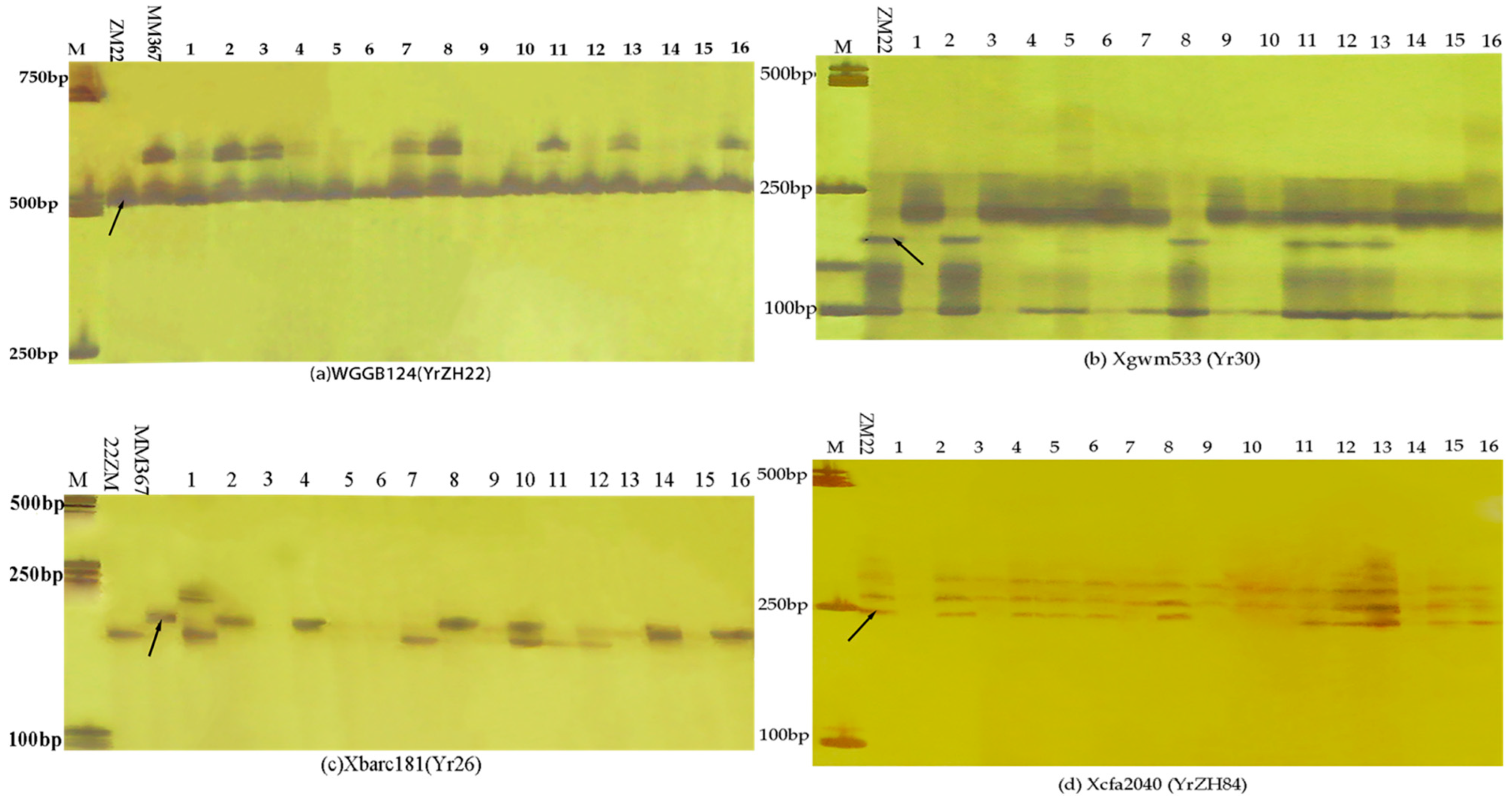
Molecular marker detection was performed on 271 families from three hybrid combinations using molecular markers Xcfa2040 and Xbarc32 closely linked to YrZH84, markers WGGB119 and WGGB124 closely linked to YrZH22, marker Xgwm533 linked to Yr30, and markers We173 and Xbarc181 linked to Yr26 (Figure 1) A total of five families containing all four stripe rust resistance genes YrZH84, Yr30, YrZH22, and Yr26 were screened out. Thirteen families contained three of the resistance genes YrZH84, Yr30, YrZH22, and Yr26. Among them, the MM367/ZM22 combination had the largest number of such families, totaling 10; 40059/Z8425B was next with two; and the 40047/Z8425B combination had the least, with only one. A total of 46 family materials containing two of the target genes YrZH84, Yr30, YrZH22, and Yr26 were screened out. In terms of distribution among hybrid combinations, the MM367/ZM22 combination had the largest number of such families, totaling 29; the 40047/Z8425B combination was next with nine; and the 40059/Z8425B combination had eight.
Among the 271 families tested: the number of families containing the YrZH84 gene was the largest, with a total of 43, and the detection rate was 15.87%; the number of families containing the YrZH22 gene was the second, with a total of 29, and the detection rate was 10.7%; there were 17 families containing the Yr30 gene, with a detection rate of 6.27%; the number of families containing the Yr26 gene was the smallest, with a total of 10, and the detection rate was 3.7%. Only one out of the 271 family lines was identified as containing Yr10 using the Yr10 molecular marker. Among the tested families, 107 did not carry any of the aforementioned disease resistance genes. Notably, the 40047/Z8425B hybrid combination accounted for the largest proportion, with 41 such families.

3.2. Identification of Stripe Rust Disease

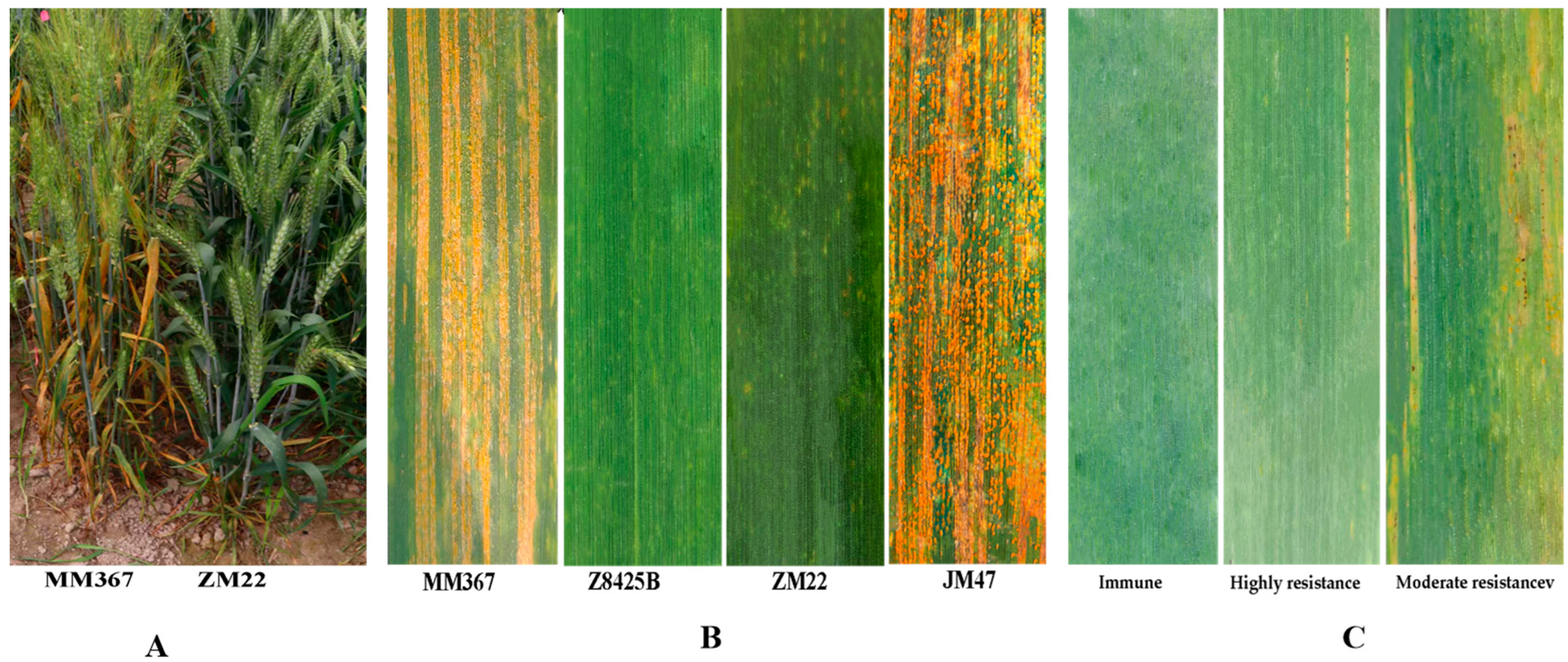
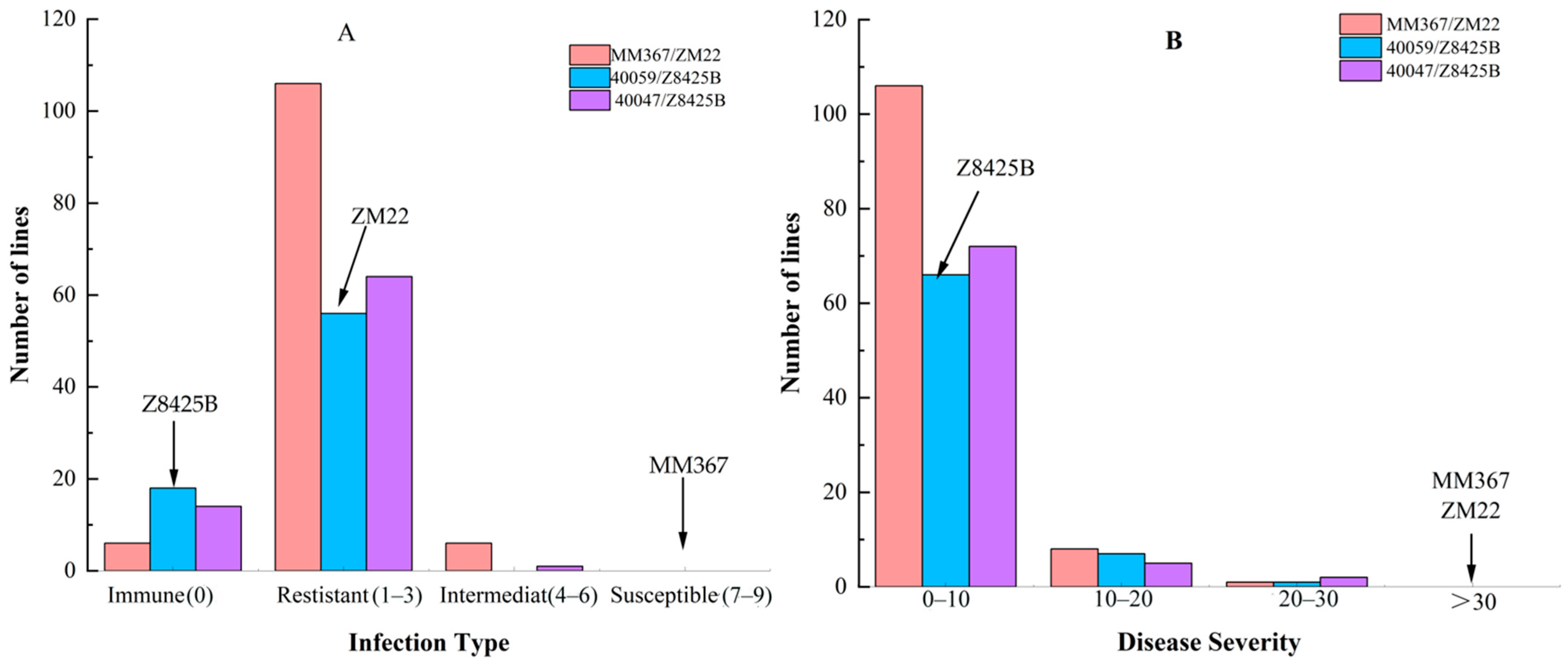
In April 2025, during the high-incidence period of wheat stripe rust in the Mianyang area, Sichuan Province, field identification of adult-plant resistance to stripe rust was carried out on 271 F6 family materials from three hybrid combinations: MM367/ZM22, 40059/Z 8425B, and 40047/Z 8425B. MM367 was susceptible (IT = 7–8, DS > 30%), while Z 8425B was immune (IT = 0, DS = 0–10%) (Figure 2). The IT values of the 271 families from the three hybrid combinations were mainly concentrated at scores of one, two, and three (Figure 3) among them, the resistance phenotype IT values of 192 F6 families from the two hybrid combinations MM367/ZM22 and 40047/Z8425B ranged from zero to six, while those of 79 families from the 40059/Z 8425B hybrid combination ranged from zero to three. In terms of disease severity (DS), the distribution range was 0–30%, and the core was concentrated in the 0–10% interval, further indicating that the overall disease occurrence degree of the families of these two combinations was mild, and the disease resistance performance was stable, which showed a certain association with the high carrying rate of stripe rust resistance genes in the previous molecular marker detection. Regarding the disease resistance performance of the families from the three hybrid combinations, the number and proportion of immune, high resistance, moderate susceptibility, and high susceptibility grades (Table 3) are as follows: 38 immune families, accounting for 14.02%; 226 high resistance families, accounting for 83.39%; seven moderate susceptibility families, accounting for 2.58%; none of the families showed high susceptibility characteristics.

3.3. Agronomic Traits Performance

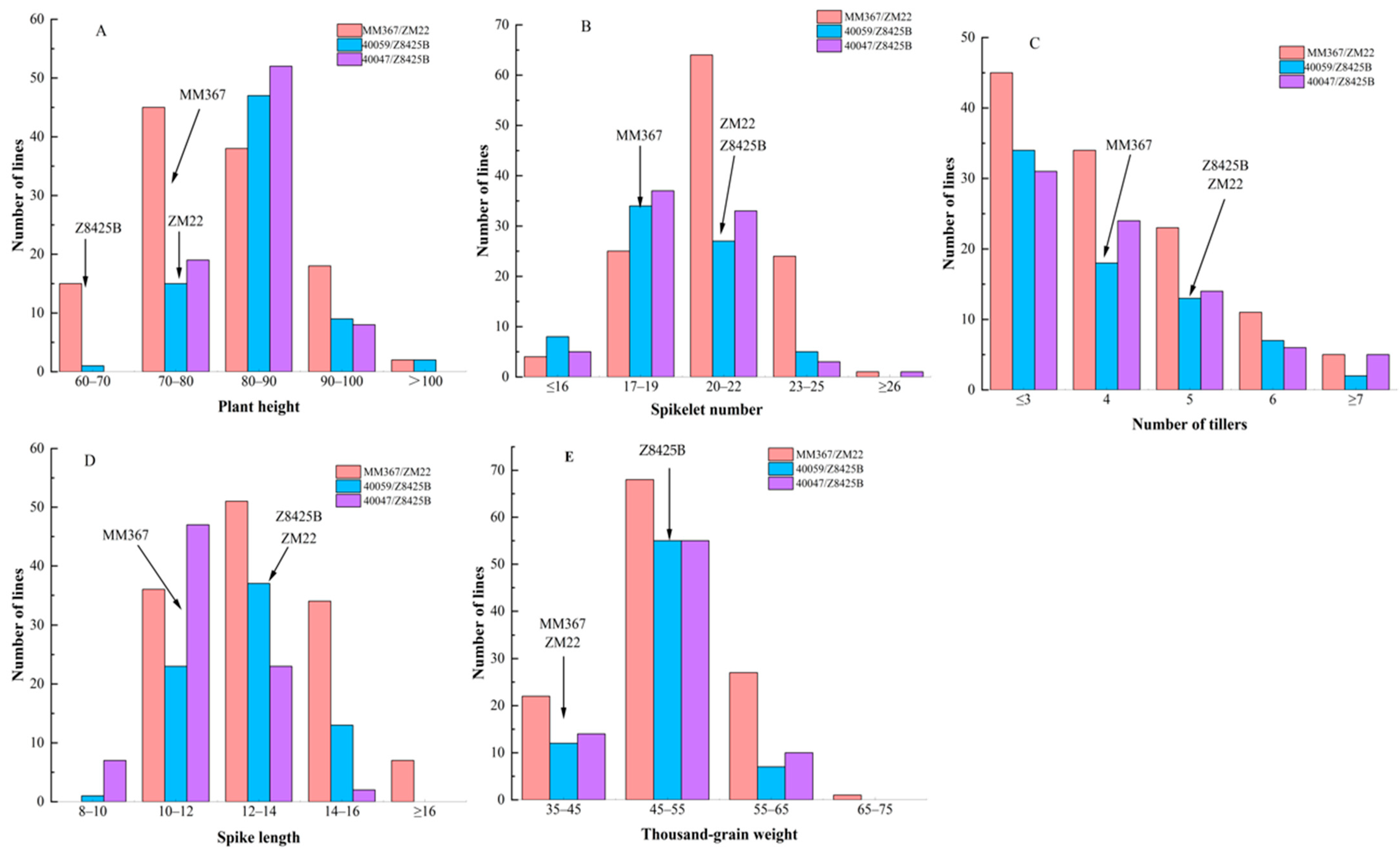
During the harvest period in May 2025 in Mianyang, Sichuan, agronomic traits, including PH, SN, NT, SL, and TGW of the parents and 271 families, were evaluated and compared. The results are as follows (Figure 4A–E): mean of plant height (PH), the parental lines MM367, Z8425B, and ZM22 measured 77.67 cm, 68 cm, and 74.67 cm, respectively. The plant height (PH) of the 271 families was concentrated in the range of 70 cm to 100 cm, among which the MM367/ZM22 families were most abundant in the 70–80 cm range, with 45 families. Both the 40059/Z 8425B and 40047/Z 8425B families were most numerous in the 80–90 cm interval, with 45 and 52 families, respectively. There were zero families in the 60–70 cm and >100 cm ranges. For the number of effective spikelets (SN), the parents MM367, Z8425B, and ZM22 had 18 grains, 22 grains, and 21 grains, respectively. The number of effective spikelets (SN) in the families ranges from 16 grains to 26 grains. Among them, the families with 20–22 grains of spikelets were highest in the MN 367/ZM22 family, and the families with 17–19 grains of spikelets were the highest in the 40059/Z8425B and 40047/Z8425B combinations. The tiller number (NT) is as follows: the parents MM367, Z8425B, and ZM22 have four, five, and five tillers, respectively. The tiller number of most families is in the range of three to seven, and the families with three tillers have the highest proportion. The spike length (SL) is as follows: the parents MM367, Z8425B, and ZM22 are 11.5 cm, 13.5 cm, and 12.2 cm, respectively. The spike length (SL) of the families is generally distributed from 10 cm to 16 cm. The MM367/ZM22 family has the most (28 copies) from 12 cm to 14 cm. The 40059/Z 8425B family has the most (19 copies) from 12 cm to 14 cm. The 40047/Z8425B family has the most (18 copies) from 10 cm to 12 cm. In terms of thousand-grain weight (TGW), the parents MM 367, Z8425B, and ZM22 measured 39.53 g, 55.03 g, and 43.45 g, respectively. The families of all three hybrid combinations had the highest proportion in the 45–55 g thousand-grain weight range, with 68, 55, and 55 families, respectively.

3.4. Effect of Genome Combination Types on Agronomic Traits

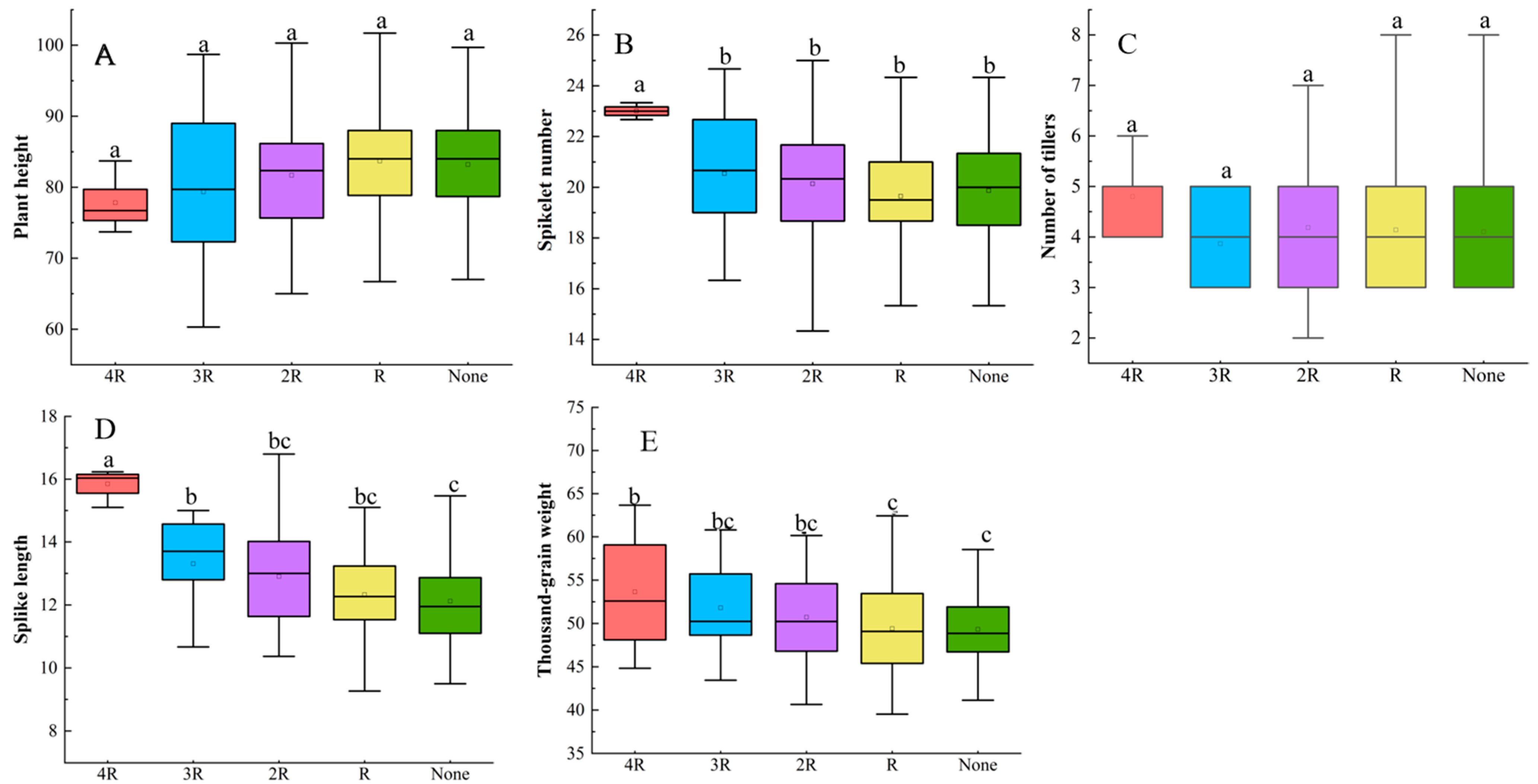
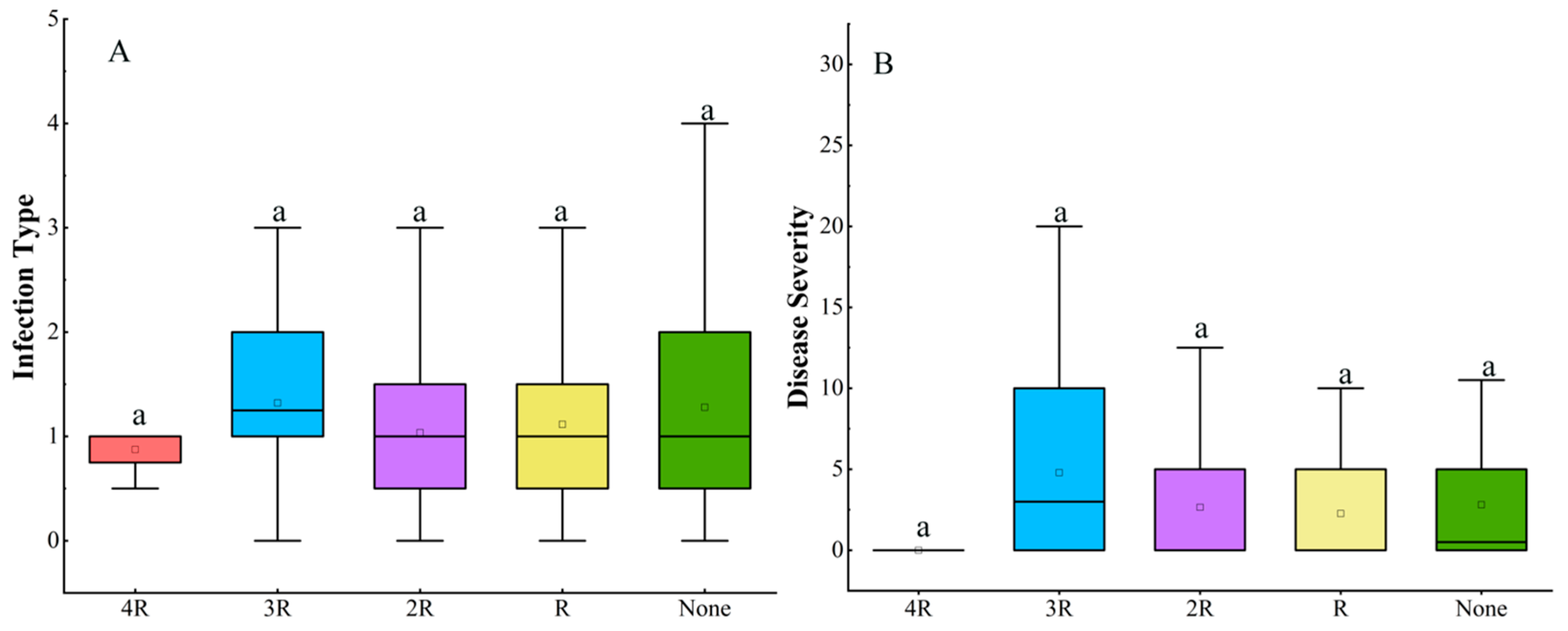
To clarify the impact of gene pyramiding on wheat agronomic traits, 271 experimental materials obtained from three hybrid combinations were divided into different gene combinations (Figure 5A–E), shows that different gene-combination forms do not affect plant height, tiller number, or thousand-grain weight. For the number of effective spikelets, the families pyramiding YrZH84 + YrZH22 + Yr30 + Yr26 genes showed significant differences compared with families with other gene combinations. For spike length, the pyramiding of four genes resulted in significant differences compared to other gene combinations, and the data for each combination were relatively consistent. Pyramiding disease resistance genes not only enhances the resistance level of crops but also impacts yield potential by influencing key agronomic traits such as spikelet number and spike length. This has an important role in selecting gene combinations for wheat breeding aimed at achieving both disease resistance and high yield. For spike length, the pyramiding of four genes resulted in significant differences compared to other gene combinations, and the data for each combination were relatively consistent. Pyramiding disease resistance genes not only enhances the resistance level of crops but also impacts yield potential by influencing key agronomic traits such as spikelet number and spike length. This has an important role in selecting gene combinations for wheat breeding aimed at achieving both disease resistance and high yield; (Figure 6) shows that different gene combination forms did not result in significant differences in infection type and severity.

3.5. Comprehensive Selection of Breeding Materials

In order to screen wheat strains with excellent disease resistance and agronomic traits 63 families were selected from 271 families with the criteria of IT value ≤ 3 and DS value ≤ 20%, 75 cm ≤ PH ≤ 95 cm, NT value ≥ 4, SL value ≥ 12 cm, TGW value ≥ 45 g, and SN value ≥ 18 (Table S1). Among the 63 selected families, 31 originated from the MM367/ZM22 hybrid combination, 24 from 40059/Z8425B, and eight from 40047/Z8425B. Among the 63 pedigrees, three contain all four genes (YrZH84, Yr30, YrZH22, and Yr26), four contain three genes, 13 contain two genes, 22 contain one gene, and 21 do not contain any of these genes. These families with production potential can be further evaluated in wheat-producing regions and also serve as valuable germplasm resources for developing new wheat varieties with disease resistance, high yield, and desirable agronomic traits.

4. Discussion

4.1. Wheat Stripe Rust Resistance

Wheat stripe rust, a globally significant disease, is characterized by a large number of inoculum sources, rapid variation in physiological races, and fast spread. The continuous emergence of new races leads to the rapid loss of resistance in resistant varieties, posing a severe threat to wheat production. The predominant races of Puccinia striiformis f. sp. tritici in China are CYR32, CYR33, and CYR34. The emergence of the new virulent race CYR34 has caused a large number of wheat varieties carrying Yr10 and Yr24/Yr26/YrCH42 to lose their resistance to stripe rust [7,36]. Genes such as Yr10, Yr15, and Yr26 are major resistance genes that confer resistance to CYR32 and CYR33, the main prevalent physiological races of Puccinia striiformis f. sp. tritici in China, and thus hold potential for utilization [37,38]. The female parent MM376 used in this study carries the Yr10 and Yr24/Yr26 genes, which have lost resistance to currently prevalent races such as CYR34, but still hold important value in wheat breeding. For example, Li Mengkai pyramided three stripe rust resistance genes—Yr10, Yr18, and Yr36—into wheat cultivars adapted to the Huang-Huai-Hai wheat region. This approach not only enhanced the wheat plants’ resistance to stripe rust but also mitigated thousand-grain weight losses caused by the disease [39]. Liu Lijuan [40] et al. employed markers Xgwm11 and Xgwm18, which are tightly linked to Yr26, in combination with field resistance evaluations to screen 239 wheat cultivars (lines) from the Huang-Huai-Hai wheat region. Their objective was to clarify the distribution of the Yr26 gene within wheat germplasm resources in this region, thereby laying a foundation for its application in marker-assisted breeding. In the present study, we aim to pyramid the Yr10 and Yr26 resistance genes, which have gradually lost effectiveness against newly emerged physiological races of stripe rust. By doing so, we seek to improve the utilization of known resistance genes and develop elite wheat materials with broad and durable resistance spectra (as detailed in Table S1).

4.2. Breeding Materials Used in This Study

The resistance genes YrZH8, YrZH22, and Yr30 used in this study were derived from the wheat backbone parent Z8425B. Previous studies have identified that Z8425B also carries the rust resistance genes YrZH84.2 and Yr9 [19]. Due to its excellent disease resistance and agronomic traits, Z8425B has been widely utilized in China in recent years, particularly in the Huang-Huai-Hai wheat region [27]. More than 80 derived varieties (lines) have been developed, including BainongAK58 and Zhoumai16 [20,41] ZM22, which pyramids multiple favorable genes such as YrZH22, YrZH84, and Yr30, and have been extensively employed by breeders for their superior comprehensive traits, high yield potential, and outstanding disease and stress resistance. As a parental line, it has generated over 100 derived varieties [24,42]. MM367, characterized by large spike inflorescences and high yield, is a key wheat variety used in liquor-making starter production [43]. In this study, ZM22 and Z 8425B, both with strong disease resistance, were used as male parents to develop hybrid combinations, and the adult-plant disease resistance of the parents and their families was evaluated. The parental materials 40047 and 40059 were derived from the cross of Xikekemai5/Xikemai1. Xikemai5 was widely cultivated in the southwest wheat region in the early 21st century, showing broad adaptability and good yield stability, but it is currently highly susceptible to stripe rust and has lost direct application value. In contrast, Xikemai1 exhibits moderate resistance to stripe rust (with unknown resistance genes) and high yield potential. To utilize the complementary traits of the two parents, the elite individual plants 40047 and 40059, which showed outstanding disease resistance, were selected from the F4 generation of this cross and crossed with Z8425B to form hybrid combinations. Z8425B exhibited high resistance with an infection type (IT) of 1–3 and a disease severity (DS) of 0–10%, while ZM22 showed high resistance with an IT of 1–3 and a DS greater than 30% (Figure 3). The thousand-kernel weights of Z8425B and ZM22 were 55.03 g and 43.45 g, respectively, and the thousand-kernel weights of the families were mainly distributed between 35 g and 65 g (Figure 4).

4.3. Molecular Markers and Marker-Assisted Breeding

An ideal molecular marker should not only exhibit high polymorphism but also have the shortest possible linkage distance to the target gene. Since there is inevitably a certain physical distance between the linked marker and the target gene, genetic recombination may occur between the marker and the gene, leading to some false positives in the detection results. To ensure the accuracy of molecular marker detection and minimize false positives as much as possible, it is necessary to select molecular markers that are tightly linked to the target gene (≤5 cm and have high polymorphism for use in marker-assisted selection breeding [44]. Li et al. [45] reported that the novel stripe rust resistance gene YrZH84 is located between the RGAP marker Xrga-1 and the SSR marker Xcfa2040-7B, with genetic distances of 0.8 cm and 1.4 cm from these two markers, respectively. This represents a relative reduction of 4.0 cm compared to the genetic distance (4.8 cm) of the previously identified ipsilateral SSR marker Xbarc32.YrZH22 [24] is a stripe rust resistance gene identified in ZM22. Located on chromosome 4BL, it is tightly linked to the STS markers WGGB119 and WGGB124 with genetic distances of 4.61 cm and 5.92 cm, respectively, and it functions as an adult-plant resistance gene. Among the 63 family lines screened in this study, 21 lines exhibited high disease resistance despite lacking the target gene (Table S1). This phenomenon may occur because, while the markers used in this study are closely linked to the target gene, such linkage could be disrupted during multi-generational breeding processes involving hybridization and recombination, leading to the separation of markers from functional genes. Alternatively, the target gene might be present but undetected in the parental or population materials, or other unknown resistance genes could be carried by these lines. Further investigation is required to clarify the specific reasons. Although the resistance of Yr10, Yr17, and Yr26 has been overcome by CYR34 [46], Yr30, a typical race-nonspecific adult-plant resistance (APR) gene, usually only confers moderate levels of slow rusting resistance [47,48]. In the MM367/ZM22 population of this study, the above genes were detected, but high stripe rust resistance was still observed. It is speculated that this may be because these families contain other undetected or unknown resistance genes.

4.4. Gene Aggregation Breeding

Employing molecular marker-assisted breeding techniques, pyramiding multiple resistance genes, and developing wheat varieties with durable and comprehensive disease resistance represents the optimal strategy for wheat breeding. Li et al. [45] demonstrated that Zhou 8425B carries three full-growth-stage resistance genes—YrZH22, YrZH84, and the YrZH3BS locus—that significantly reduce stripe rust damage and enhance yield, with the triple combination (YrZH22 + YrZH84 + YrZH3BS) yielding the best results. Zhang et al. [49] introgressed the high-temperature adult-plant resistance gene Yr59 into Chuanmai42 and Jimai22, generating two lines containing Yr59 + Yr26 and two lines containing Yr59 + YrJ22, all of which exhibited strong resistance and excellent agronomic traits. In this study, the families pyramided with the YrZH84 + YrZH22 + Yr30 + Yr26 genes showed significant differences in spikelet number and spike length (Figure 5). Gene pyramiding can significantly enhance crop disease resistance, reducing the frequency of disease occurrence and associated losses. In their study on the current utilization status and strategies of stripe rust resistance genes in winter wheat breeding in the source regions of stripe rust pathogens in northwestern China, Bai et al. [50] noted that varieties pyramiding one or more genes from YrZH84, YrZH22, and Yr17, combined with other stripe rust resistance genes, exhibited notably higher stripe rust resistance than those with other gene combinations. Additionally, Han and Kang [11] found that pyramiding the ineffective stripe rust resistance gene Yr9 with other Yr genes can improve stripe rust resistance, as seen in combinations such as Yr9 + Yr17 and Yr9 + Yr18. Ma [51] successfully pyramided the stripe rust resistance genes Yr29, Yr30, and YrZH84, developing two new winter wheat varieties, Lantian133 and Lantian134. These varieties showed immunity to the highly virulent physiological race CYR33 at the seedling stage, susceptibility to CYR34, and high resistance to mixed pathogens at the adult-plant stage. In this study, four family lines with excellent disease resistance and agronomic traits, pyramiding YrZH84, Yr30, and YrZH22, were obtained from three hybrid combinations: MM 367/ZM 22, 40059/Z8425B, and 40047/Z 8425B. There are three pedigrees containing four genes: YrZH84, Yr30, YrZH22, and Yr26, four families containing three genes, 13 families containing two genes, 22 families containing one gene, and 21 families containing none of the genes (Table S1).

5. Conclusions

In this study, we employed molecular marker-assisted selection (MAS) to generate three hybrid combinations by crossing ZM22 and Z8425B, which carry the resistance genes YrZH84, YrZH22, and Yr30, with MM367, 40047, and 40059. Following multiple generations of selection, we successfully obtained 63 F6 lines that exhibit both strong stripe rust resistance and excellent agronomic traits. These wheat lines not only enrich the breeding resources for disease-resistant wheat varieties but also hold broad application prospects, which may have significant value for food production in China and globally.

Supplementary Materials

The following supporting information can be downloaded at: https://www.mdpi.com/article/10.3390/agronomy16040457/s1, Table S1: Selected families, Yr–resistance gene, stripe rust resistance, and agronomic traits.

Author Contributions

C.C. detected the markers, analyzed data, and wrote the first draft of the manuscript. H.G., B.Y., X.Y. and P.H. collected samples and phenotype data. S.Y., Y.Z. and K.H. contributed to the crosses, selection of target lines, and evaluation of the populations. S.Y. revised the draft. C.C. and S.Y. conceived the project and generated the final version of the manuscript. All authors have read and agreed to the published version of the manuscript.

Funding

This study was financially supported by the Major Program of National Agricultural Science and Technology of China (NK20220607) and the Breakthrough in Wheat Breeding Material and Method Innovation and New Variety Breeding (Breeding Research Project, 2021YFYZ0002).

Data Availability Statement

Data are contained within the article.

Acknowledgments

We thank the anonymous reviewers for their valuable review and comments on the manuscript.

Conflicts of Interest

The authors declare no conflicts of interest.

References

  1. Han, D.J.; Wang, Q.L.; Zhang, L.; Wei, G.R.; Zeng, Q.D.; Zhao, J.; Wang, X.J.; Huang, L.L.; Kang, Z.S. Evaluation of resistance of current wheat cultivars to stripe rust in northwest china, north china and the middle and lower reaches of changjiang river epidemic area. Sci. Agric. Sin. 2010, 43, 2889–2896. [Google Scholar] [CrossRef]
  2. Liu, W.C.; Wang, B.T.; Zhao, Z.H.; Li, Y.; Kang, Z.H. Historical review and countermeasures of wheat stripe rust epidemics in China. China Plant Prot. 2022, 42, 21–41. [Google Scholar] [CrossRef]
  3. Wellings, C.R. Global status of stripe rust: A review of historical and current threats. Euphytica 2011, 179, 129–141. [Google Scholar] [CrossRef]
  4. Chen, X.M. Pathogens which threaten food security: Puccinia striiformis, the wheat stripe rust pathogen. Food Secur. 2020, 12, 239–251. [Google Scholar] [CrossRef]
  5. Lin, R.M.; Qie, Y.M.; Feng, J.; Xu, S.C. Identification of the yellow rust resistance gene carrying wheat landraces in China. J. Shenyang Agric. Univ. 2010, 21, 535–539. [Google Scholar] [CrossRef]
  6. Liu, B.; Liu, T.G.; Zhang, Z.Y.; Jia, Q.Z.; Wang, B.T.; Gao, L.; Peng, Y.L.; Jin, S.L.; Chen, W.Q. Discovery and pathogenicity of CYR34, a new race of Puccinia striiformis f. sp. tritici in China. Acta Phytopathol. Sin. 2017, 47, 681–687. [Google Scholar] [CrossRef]
  7. McIntosha, R.; Mu, J.M.; Han, D.J.; Kang, Z.S. Wheat stripe rust resistance gene Yr24/Yr2: A retrospective review. Crop J. 2018, 6, 321–329. [Google Scholar] [CrossRef]
  8. Huang, L.T.G.; Liu, B.; Gao, L.; Luo, P.G.; Chen, W.Q. Resistance evaluation of 197 Chinese wheat core germplasms to a new stripe rust race, CYR34. Plant Prot. 2019, 45, 148–149. [Google Scholar]
  9. Sharma, D.; Avni, R.; Gutierrez-Gonzalez, J.; Kumar, R.; Sela, H.; Prusty, M.R.; Shatil-Cohen, A.; Molnár, I.; Holušová, K.; Said, M.; et al. A single NLR gene confers resistance to leaf and stripe rust in wheat. Nat. Commun. 2024, 15, 9925. [Google Scholar] [CrossRef] [PubMed]
  10. Li, J.B.; Dundas, I.; Dong, C.M.; Li, G.R.; Trethowan, R.; Yang, Z.; Hoxha, S.; Zhang, P. Identification and characterization of a new stripe rust resistance gene Yr83 on rye chromosome 6R in wheat. Theor. Appl. Genet. 2020, 133, 1095–1107. [Google Scholar] [CrossRef] [PubMed]
  11. Han, D.J.; Kang, Z.S. Current status and future stategy in breeding wheat for resistance to stripe rust in China. Plant Prot. 2018, 44, 1–12. [Google Scholar] [CrossRef]
  12. Zhou, J.W.; Ye, B.W.; Zhang, P.F.; Zhang, Y.Q.; Hao, M.; Yin, Y.O.; Yuan, C.; Li, Z.K.; Li, S.D.; Xia, X.C.; et al. Identification and evaluation of stripe rust resistance in 153 wheatcollections. Sci. Agric. Sin. 2024, 57, 18–33. [Google Scholar] [CrossRef]
  13. Alma, K.A.R.; Angelina, M.; Makpal, A.; Madina, K.; Zhenis, K. Identification of Stripe Rust Resistance Genes in Common Wheat Cultivars and Breeding Lines from Kazakhstan. Plants 2021, 10, 2303. [Google Scholar] [CrossRef] [PubMed]
  14. Wang, W.R.; He, H.G.; Gao, H.M.; Xu, H.G.; Song, W.Y.; Zhang, X.; Zhang, L.P.; Song, J.C.; Liu, C.; Liu, K.C.; et al. Characterization of the powdery mildew resistance gene in wheat breeding line KN0816 and its evaluation in marker-assisted selection. Plant Dis. 2021, 105, 4042–4050. [Google Scholar] [CrossRef]
  15. Yang, R.F.; Piao, Z.Z.; Wan, C.Z.; Lee, G.S.; Ruan, X.M.; Bai, J.J. Breeding for three-line japonica hybrid rice combinations with high resistant starch content using molecular marker-assisted selection. Breed. sci 2020, 70, 409–414. [Google Scholar] [CrossRef] [PubMed]
  16. Huang, X.; Ye, C.H.; Yan, C.Q. Molecular Marker-Assisted selection of Wxmp Gene for Improving Rice Quality of Late Japonica Rice Ning84. Crop Res. 2024, 38, 308–313. [Google Scholar]
  17. Zhang, H.; Zhang, L.; Wang, C.Y.; Wang, Y.J.; Zhou, X.L.; Lv, S.H.; Liu, X.L.; Kang, Z.S.; Ji, W.Q. Molecular mapping and marker development for the Triticum dicoccoides-derived stripe rust resistance gene YrSM139-1B in bread wheat cv. Shaanmai 139. Theor. Appl. Genet. 2016, 129, 369–376. [Google Scholar] [CrossRef]
  18. Fang, T.H.; Zhang, M.; Ma, C.H.; Zheng, X.C.; Tan, W.J.; Tian, R.; Yan, Q.; Zhou, X.L.; Li, X.; Yang, S.Z.; et al. Application of Yr52 Gene in wheat improvement for stripe rust resistance. Sci. Agric. Sin. 2022, 55, 2077–2091. [Google Scholar] [CrossRef]
  19. Liu, Z.Y.; Zhang, Z.H.; Bai, B.; Li, J.; Huan, L.; Xu, Z.B.; Chen, Y.X.; Liu, X.; Cao, T.J.; Li, M.M.; et al. Current status and strategies for utilization of stripe rust resistance genes in wheat breeding program of china. Sci. Agric. Sin. 2024, 57, 34–51. [Google Scholar] [CrossRef]
  20. Yin, G.H.; Wang, J.W.; Wen, W.; He, Z.H.; Li, Z.F.; Wang, H.; Xia, X.C. Mapping of wheat stripe rust resistance gene YrZH84 with RGAP markers and its application. Acta Agron. Sin. 2009, 35, 1274–1281. [Google Scholar] [CrossRef]
  21. Li, Z.F.; Zheng, T.C.; He, Z.H.; Li, G.Q.; Xu, S.C.; Li, X.P.; Yang, G.Y.; Singh, R.P.; Xia, X.C. Molecular tagging of stripe rust resistance gene YrZH84 in Chinese wheat line Zhou 8425B. Theor. Appl. Genet. 2006, 112, 1098–1103. [Google Scholar] [CrossRef] [PubMed]
  22. Zhao, X.L.; Zheng, T.C.; Xia, X.C.; He, Z.H.; Liu, D.Q.; Yang, W.X.; Yin, G.H.; Li, Z.F. Molecular mapping of leaf rust resistance gene LrZH84 in Chinese wheat line Zhou 8425B. Appl. Genet. 2008, 117, 1069–1075. [Google Scholar] [CrossRef]
  23. Li, G.C.; Li, Q.Z.; Zhang, B.L.; Yu, H.F.; Yang, Y.Z. Characteristics and promotion effects of wheat variety Zhoumai 22. Agric. Sci. Technol. 2013, 22, 148–243. [Google Scholar]
  24. Wang, Y.; Xie, J.; Zhang, H.; Guo, B.; Ning, S.; Chen, Y.; Lu, P.; Wu, Q.; Li, M.; Zhang, D.; et al. Mapping stripe rust resistance gene YrZH22 in Chinese wheat cultivar Zhoumai 22 by bulked segregant RNA-Seq (BSR-Seq) and comparative genomics analyses. Theor. Appl. Genet. 2017, 130, 2191–2201. [Google Scholar] [CrossRef] [PubMed]
  25. Hayden, M.J.; Kuchel, H.; Chalmers, K.J. Sequence tagged microsatellites for the Xgwm533 locus provide new diagnostic markers to select for the presence of stem rust resistance gene Sr2 in bread wheat (Triticum aestivum L.). Appl. Genet. 2004, 109, 1641–1647. [Google Scholar] [CrossRef] [PubMed]
  26. Wang, C.M.; Zhang, Y.P.; Han, D.J.; Kang, Z.S.; Li, G.P.; Cao, A.Z.; Chen, P.D. SSR and STS markers for wheat stripe rust resistance gene Yr26. Euphytica 2008, 159, 359–366. [Google Scholar] [CrossRef]
  27. Li, W.J.; Xu, H.; Yu, S.; Tang, J.W.; Li, Q.Y.; Gao, Y.; Zheng, J.Z.; Dong, C.H.; Yuan, Y.H.; Zheng, T.C.; et al. Genetic analysis of elite stripe rust resistance genes of founder parent Zhou8425B in its derived varieties. Acta Agron. Sin. 2024, 50, 16–31. [Google Scholar] [CrossRef]
  28. Zou, S.K.; Yin, G.H.; Tang, J.W.; Han, Y.L.; Li, S.C.; Lin, A.N.; Huang, F.; Wang, L.N.; Zhang, Q.; Gao, Y. Molecular and genetic basis of wheat variety zhoumai22 and specific primers screening. J. Triticeae Crops 2017, 37, 472–482. [Google Scholar] [CrossRef]
  29. Yang, X.; Jian, J.T.; Zhu, C.J.; Zhang, Z.P.; Sun, D.J.; Zhang, L. Genetic characteristic of wheat rust resistance genes Lr68 and Sr2/Yr3. J. Triticeae Crops 2014, 34, 151–156. [Google Scholar] [CrossRef]
  30. Li, R.S.; Du, X.Y.; Ren, Y.; Zhou, Q.; Lei, J.R.; He, Y.J. Characteristics and cultivation points of large-spike wheat new varieties Mianmai 367 and Mianmai 51. Sichuan Agric. Sci. Technol. 2015, 3, 11–12. [Google Scholar]
  31. Mace, E.S.; Buhariwalla, K.K.; Buhariwalla, H.K.; Crouch, J.H. A High-Throughput DNA Extraction Protocol for Tropical Molecular Breeding Programs. Plant Mol. Biol. Reporter 2003, 21, 459–460. [Google Scholar] [CrossRef]
  32. Liu, W.; Frick, M.; Huel, R.; Nykiforuk, C.L.; Wang, X.M.; Gaudet, D.A.; Eudes, F.; Conner, R.L.; Kuzyk, A.; Chen, Q.; et al. The stripe rust resistance gene Yr10 encodes an evolutionary-conserved and unique CC–NBS–LRR sequence in wheat. Mol. Plant 2014, 7, 1740–1755. [Google Scholar] [CrossRef]
  33. Akin, B.H.; Chen, X.M.; Morgunov, A.; Zencirci, N.; Wan, A.M.; Wang, M.N. High-temperature adult-plant resistance to stripe rust in facultative winter wheat. Crop Pasture Sci. 2016, 67, 1064–1074. [Google Scholar] [CrossRef]
  34. Peterson, R.F.; Campbell, A.B.; Hannah, A.E. A diagrammatis scale for estimating rust inensity on leaves and stems of cereals. Can. J. Res. 1948, 26, 496–500. [Google Scholar] [CrossRef]
  35. Niu, J.Q.; Li, C.G.; Xin, H.B.; Zhang, S.F.; Xu, H.Q.; Yu, X.G.; Xu, J.J.; Liu, Y.G.; Liu, L.J.; Zhang, F.; et al. Analysis of the current registration status and production applicability of pesticides for wheat rust prevention and control. Agric. Sci. Technol. 2021, 9, 10–12. [Google Scholar]
  36. Cao, S.Q.; Jia, Q.Z.; Song, J.R.; Zhang, Y.H.; Wang, W.J.; Yue, W.Y.; Sun, Z.Y.; Huang, J.; Zhang, B.; Wang, X.M. Strategies on breeding for winter wheat resistance to Puccinia striiformis f. sp tritici CYR34 in Gansu province. J. Plant Genet. Resour. 2019, 20, 1129–1133. [Google Scholar] [CrossRef]
  37. Li, B.; Xu, Q.; Yang, Y.H.; Wang, Q.L.; Zeng, Q.D.; Wu, J.H.; Mu, J.M.; Huang, L.L.; Kang, Z.S.; Han, D.J. Stripe Rust Resistance and Genes in Chongqing Wheat Cultivars and Lines. Sci. Agric. Sin. 2017, 50, 413–425. [Google Scholar] [CrossRef]
  38. Yao, Q.; Wang, J.; Meng, Y.; Zhan, G.M.; Huang, L.L.; Kang, Z.S. Virulence and genotypic diversity of wheat stripe rust races CYR32 and CYR33 in China. J. Plant Prot. 2018, 45, 46–52. [Google Scholar] [CrossRef]
  39. Li, M.K. Application of Yr10, Yr18 and Yr36 Genes in Wheat Improvement for Stripe Rust Resistance. Master’s Thesis, Shandong Agricultural University, Taian, China, 2017. [Google Scholar]
  40. Liu, L.J.; Wang, Z.L.; Xi, Y.J.; Liu, S.D. Detection of Stripe Rust Resistant Gene Yr26 with SSR Markers in Wheat Cultivars of Huanghuai Region. Acta Agron. Sin. 2008, 20, 1308–1312. [Google Scholar]
  41. Tang, J.W.; Yin, G.H.; Gao, Y.; Wang, L.; Han, Y.L.; Huang, F.; Yu, H.F.; Yang, G.Y.; Li, X.P.; Xiao, Y.G.; et al. Comprehensive analysis on agronomic traits and processing quality of core parent zhou8425B and its derivative. J. Triticeae Crops 2015, 35, 777–784. [Google Scholar]
  42. Gao, Y.; Tang, J.W.; Zou, S.K.; Hu, R.Y.; Zhang, G.Y.; Sun, Y.X.; Wang, L.; Yin, G.H. Genetic diversity assessment on derivatives from wheat cultivar Zhoumai 22. Plant Genet. Resour. 2021, 22, 38–49. [Google Scholar] [CrossRef]
  43. Zou, F.L.; He, Y.J.; Zhang, S.H.; Zhu, Z.H.; Li, C.; Zhon, H.; Wu, G.; Zhang, H.; Ren, Y. Research Progress on Wheat for Chinese Baijiu. J. Triticeae Crops 2023, 43, 1351–1360. [Google Scholar]
  44. Hospital, F. Challenges for effective marker-assisted selection in plants. Genes 2009, 136, 303–310. [Google Scholar] [CrossRef]
  45. Li, G.; Ren, Y.; Yang, Y.; Chen, S.L.; Zheng, J.Z.; Zhang, X.Q.; Li, J.L.; Chen, M.E.; Sun, X.N.; Lv, C.L.; et al. Genomic analysis of Zhou8425B, a key founder parent, reveals its genetic contributions to elite agronomic traits in wheat breeding. Plant Commun. 2024, 6, 101222. [Google Scholar] [CrossRef]
  46. Hu, C.Y.; Wang, F.T.; Lang, X.W.; Feng, J.; Li, J.K.; Liu, R.M.; Yao, X.B. Resistance Analyses on Wheat Stripe Rust Resistance Genes to the Predominant Races of Puccinia striiformis f. sp. tritici in China. Sci. Agric. Sin. 2022, 55, 491–502. [Google Scholar] [CrossRef]
  47. Wang, X.; Xiang, M.; Li, H.; Li, X.; Mu, K.; Huang, S.; Zhang, Y.; Cheng, X.; Yang, S.; Yuan, X.; et al. High density mapping of durable and broadspectrum stripe rust resistance gene Yr30 in wheat. Crop J. 2024, 12, 1463–1473. [Google Scholar] [CrossRef]
  48. Singh, R.P.; Nelson, J.C.; Sorrells, M.E. Mapping Yr28 and Other Genes for Resistance to Stripe Rust in Wheat. Crop Sci. 2014, 40, 1148–1155. [Google Scholar] [CrossRef]
  49. Zhang, M.; Fang, T.H.; Zhou, X.L.; Chen, X.M.; Li, X.; Feng, J.Y.; Yang, S.H.; Kang, Z.S. Combination of marker-assisted backcross selection of Yr59 and phenotypic selection to improve stripe rust resistance and agronomic performance in four elite wheat cultivars. Agronomy 2022, 12, 497. [Google Scholar] [CrossRef]
  50. Bai, B.; Zhang, H.Z.; Du, J.Y.; Zhang, X.Y.; He, R.; Wu, L.; Zhang, Z.; Zhang, Y.H.; Cao, S.Q.; Liu, Z.Y. Current situation and strategy of stripe rust resistance genes untilization in winter wheat cultivars of northwestern oversummering region for puccinia striiformis f. sp. tritici in China. Sci. Agric. Sin. 2024, 57, 4–17. [Google Scholar] [CrossRef]
  51. Ma, R.; He, R.; Guo, Y.; Zhan, Z.B.; Zhang, W.T.; Du, J.Y.; Bai, B. Pyramiding of stripe rust-resistant genes and development of resistant wheat (Triticum aestivum) cultivars for stripe rust. J. Agric. Bio 2025, 33, 1417–1426. [Google Scholar] [CrossRef]
Figure 1. Molecular marker detection results of partial F6 families of three hybridization combinations. (a): WGGB124 (YrZH22), (b): Xgwm533 (Yr30), (c): Xbarc181 (Yr26), (d): Xcfa2040 (YrZH84); M: marker, lanes 1–16 represent the molecular marker detection results of partial F6 families of three hybridization combinations, and arrows indicate target bands.
Agronomy 16 00457 g001
Figure 2. Hybrid combination MM367/ZM22 (A); three parents and the susceptible control (Jinmai 47) (B); and some F6 families (C).
Agronomy 16 00457 g002
Figure 3. Frequency distribution maps of the resistance infection type (IT) (A) and disease severities (DS) (B) of 271 F6 families of three hybrid combinations at the adult-plant stage.
Agronomy 16 00457 g003
Figure 4. Frequency distribution diagrams of (A) plant height (PH); (B) number of spikelets (SN); (C) number of tillers (NT); (D) spike length (SL) and (E) thousand-grain weight (TGW) of 271 F6 family materials from three hybridization combinations.
Agronomy 16 00457 g004
Figure 5. Effect of gene combination types of 271 pedigrees on agronomic traits. The term 4R means containing four genes YrZH84, YrZH22, Yr30, and Yr26; 3R means containing three of them; 2R means containing two of them; R means containing one of them; None means containing none of them. (A) Plant height (PH); (B) number of spikelets (SN); (C) number of tillers (NT); (D) spike length (SL), and (E) thousand-grain weight (TGW) of 271 F6 family materials from three hybridization combinations. Lowercase letters indicate significance at p < 0.05, and the same letters indicate no significant difference in pairwise comparisons.
Agronomy 16 00457 g005
Figure 6. Comparison of infection type and disease severity of Yr genes pyramiding families in the F6 population. (A) Infection type (IT); (B) Disease severity (DS). One-way analysis of variance was used to test the significance between each group. Lowercase letters indicate significance at p < 0.05, and the same letters indicate no significant difference in pairwise comparisons.
Agronomy 16 00457 g006
Table 1. Sequence and amplification information for markers linked to the YrZH84, YrZH22, Yr30, Yr26, Yr10.
GeneTypeMarkerPrimer Sequence(Tm °C)References
YrZH84SSR
SSR
Xcfa2040
Xbarc32
F: TCAAATGATTTCAGGTAACCACTA
R: TTCCTGATCCCACCAAACAT
F: GCGTGAATCCGGAAACCCAATCTGTG
R: TGGAGAACCTTCGCATTGTGTCATTA
52.2
60.5
[22]
YrZH22STS
STS
WGGB119
WGGB124
F: CGGCCAAATATGAGACTGCC
R: AATGCGGTGAATGGAAGACG
F: TGGCACCACTTCATCCATCT
R: ATGTTCAGTTTACGCCGCTG
52[24]
Yr30SSRXgwm533F: GTTGCTTTAGGGGAAAAGCC
R: AAGGCGAATCAAACGGAATA
60[29]
Yr26STS
SSR
We173
Xbarc181
F: GGGACAAGGGGAGTTGAAGC
R: GAGAGTTCCAAGCAGAACAC
F: CGCTGGAGGGGGTAAGTCATCAC
R: CGCAAATCAAGAACACGGGAGAAAGAA
56
60.5
[26]
Yr10SCARYr10Yr10-F: TCAAAGACATCAAGAGCCGC
Yr10-R: TGGCCTACATGAACTCTGGAT
60[32]
Table 2. The polymerase chain reaction (PCR) was performed in a 10 µL volume.
Reaction ComponentsVolume
2 × M5 PAGE Taq PCR Mix5 µL
forward primers0.25 μL
reverse primers0.25 μL
DNA template0.5 µL
ddH2O4 µL
Table 3. Distribution of stripe rust resistance in 271 families of three hybrid combinations at the adult-plant stage.
Resistance EvaluationMM367/ZM2240059/Z8425B40047/Z8425BTotal
QuantityProportion%QuantityProportion%QuantityProportion%
Immune65.081824.321417.7238
Resistant10689.835675.686481.01226
Intermediate65.0800.0011.277
Susceptible00.0000.0000.000
Disclaimer/Publisher’s Note: The statements, opinions and data contained in all publications are solely those of the individual author(s) and contributor(s) and not of MDPI and/or the editor(s). MDPI and/or the editor(s) disclaim responsibility for any injury to people or property resulting from any ideas, methods, instructions or products referred to in the content.