Greenhouse Gas Emissions in Maize/Peanut Intercropping Under Water-Limited Semi-Arid Growing Conditions

 ,
, 
Abstract
1. Introduction
2. Materials and Methods
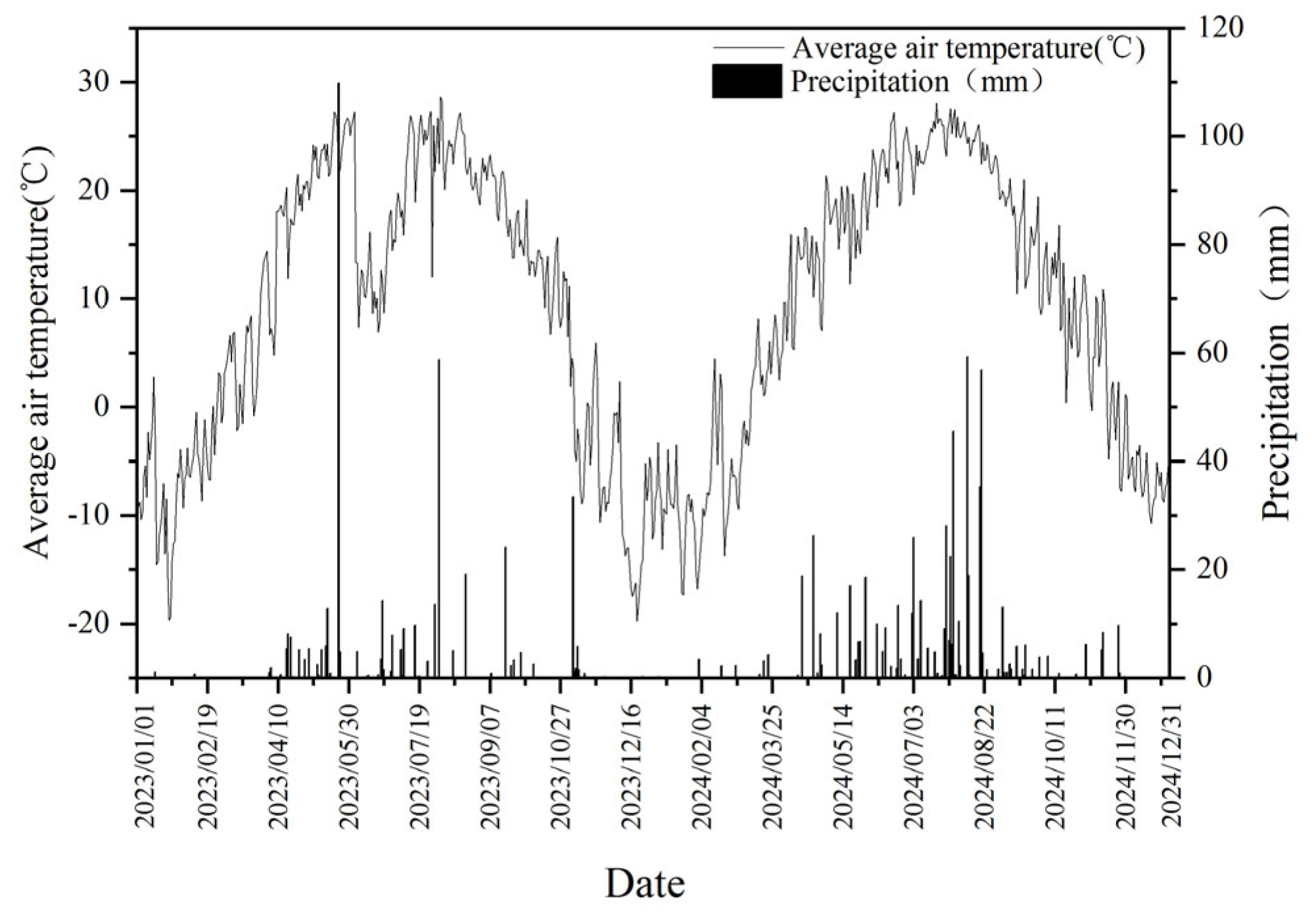
2.1. Site Description
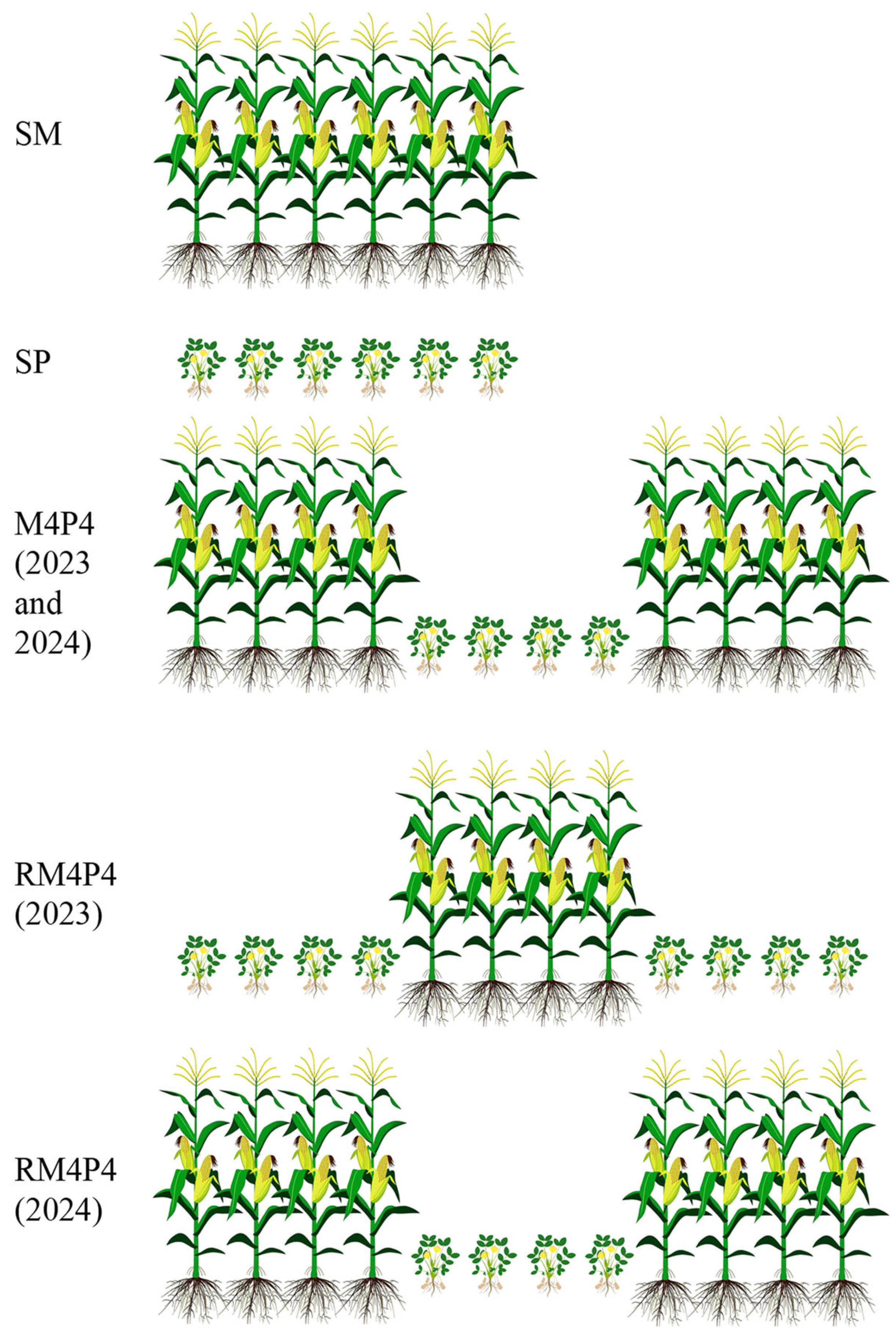
2.2. Experimental Design and Field Management
2.3. Field Measurement
2.3.1. Greenhouse Gas Flux Measurement
2.3.2. Temperature and Soil Properties
2.3.3. Crop Yield
2.4. Data Analysis
2.4.1. Analysis of Greenhouse Effects on the Agroecosystem
- (1)
- The fluxes of GHGs emissions in intercropping
- (2)
- Cumulative CO2, CH4 and N2O emissions
- (3)
- GWP
- (4)
- Since there are two different crops in the intercropping system, peanut yields were converted to a unified standard based on market prices.
- (5)
- GHGI
2.4.2. LER
2.4.3. Soil Aggregate
2.5. Statistical Analysis
3. Results
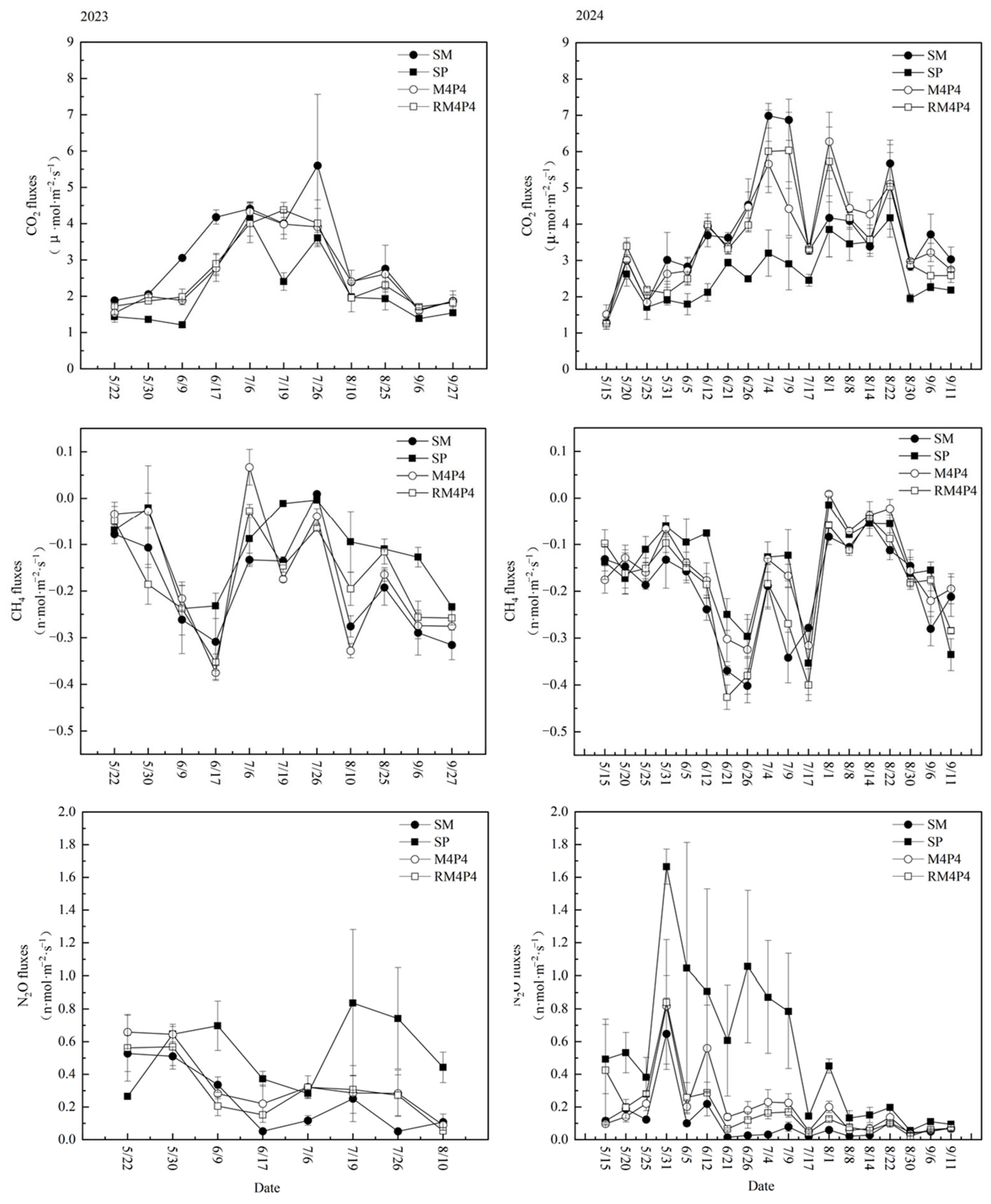
3.1. Dynamics of Greenhouse Gas Emissions
3.2. Cumulative GHGs Emissions
3.3. Yield, Global Warming Potential (GWP) and Greenhouse Gas Emission Intensity (GHGI)
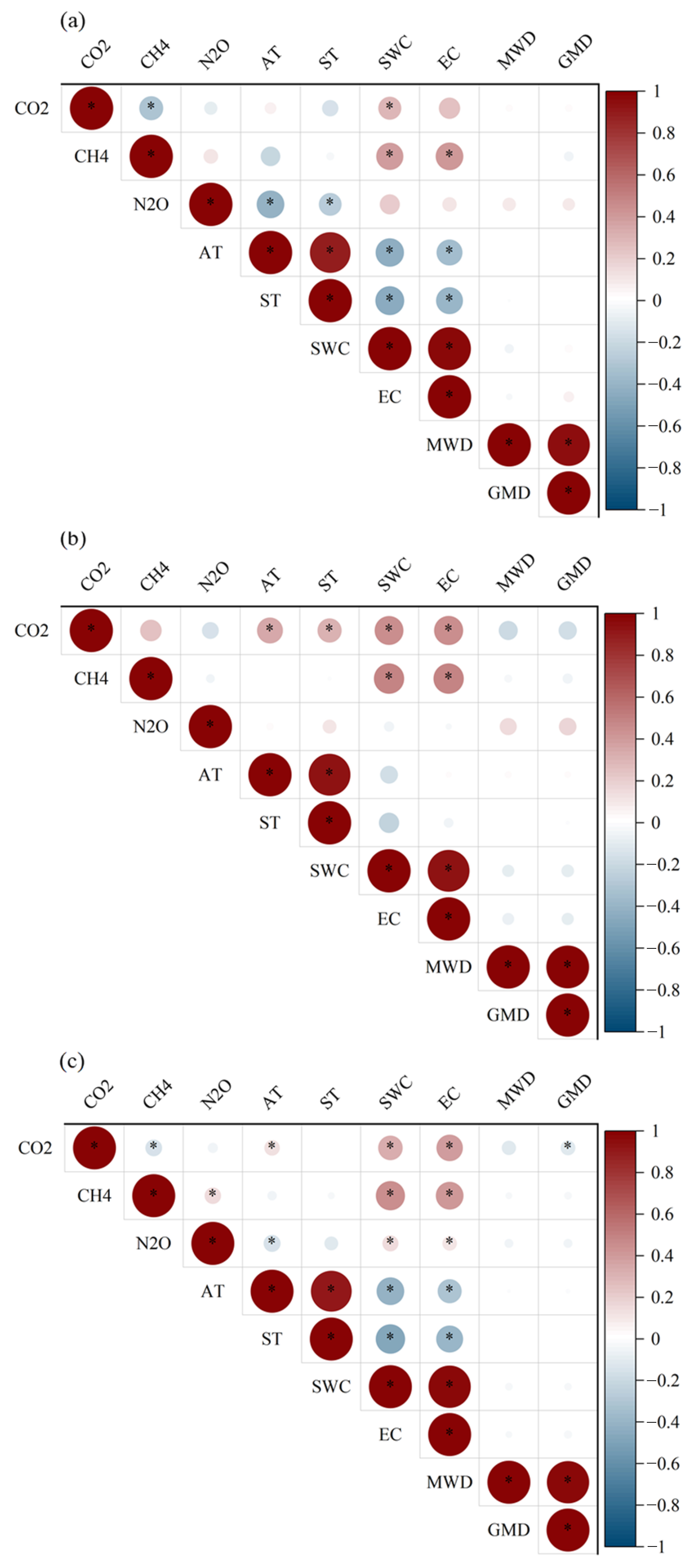
3.4. The Relationships Between Emissions and Soil Environment Factors
4. Discussion
4.1. Species-Specific Carbon–Nitrogen Processes Underpin Divergent GHG Emission Patterns
4.2. Yield-Scaled Climate Benefits of Intercropping Despite Limited Land-Use Advantage
4.3. The Microclimate and Soil Structure Jointly Determine Greenhouse Gas Emissions in the Intercropping System
4.4. Limitations and Future Directions
5. Conclusions
Author Contributions
Funding
Data Availability Statement
Conflicts of Interest
References
- Robertson, G.P.; Paul, E.A.; Harwood, R.R. Greenhouse gases in intensive agriculture: Contributions of individual gases to the radiative forcing of the atmosphere. Science 2020, 289, 1922–1925. [Google Scholar] [CrossRef]
- Kopittke, P.M.; Dalal, R.C.; McKenna, B.A.; Smith, P.; Wang, P.; Weng, Z.; van der Bom, F.J.T.; Menzies, N.W. Soil is a major contributor to global greenhouse gas emissions and climate change. SOIL 2024, 10, 873–885. [Google Scholar] [CrossRef]
- Richardson, A.D.; Hollinger, D.Y.; Shoemaker, J.K.; Hughes, H.; Savage, K.; Davidson, E.A. Six years of ecosystem-atmosphere greenhouse gas fluxes measured in a sub-boreal forest. Sci. Data 2019, 6, 117. [Google Scholar] [CrossRef]
- Lipper, L.; Thornton, P.; Campbell, B.M.; Baedeker, T.; Braimoh, A.; Bwalya, M.; Caron, P.; Cattaneo, A.; Garrity, D.; Henry, K.; et al. Climate-smart agriculture for food security. Nat. Clim. Change 2014, 4, 1068–1072. [Google Scholar] [CrossRef]
- Zheng, H.; Ma, W.; He, Q. Climate-smart agricultural practices for enhanced farm productivity, income, resilience, and greenhouse gas mitigation: A comprehensive review. Mitig. Adapt. Strateg. Glob. Change 2024, 29, 28. [Google Scholar] [CrossRef]
- Chamkhi, I.; Cheto, S.; Geistlinger, J.; Zeroual, Y.; Kouisni, L.; Bargaz, A.; Ghoulam, C. Legume-based intercropping systems promote beneficial rhizobacterial community and crop yield under stressing conditions. Ind. Crops Prod. 2022, 183, 114958. [Google Scholar] [CrossRef]
- Feng, C.; Sun, Z.; Zhang, L.; Feng, L.; Zheng, J.; Bai, W.; Gu, C.; Wang, Q.; Xu, Z.; Van Der Werf, W. Maize/peanut intercropping increases land productivity: A meta-analysis. Field Crops Res. 2021, 270, 108208. [Google Scholar] [CrossRef]
- Xu, Z.; Li, C.; Zhang, C.; Yu, Y.; Van Der Werf, W.; Zhang, F. Intercropping maize and soybean increases efficiency of land and fertilizer nitrogen use; a meta-analysis. Field Crops Res. 2020, 246, 107661. [Google Scholar] [CrossRef]
- Brooker, R.W.; Bennett, A.E.; Cong, W.F.; Daniell, T.J.; George, T.S.; Hallett, P.D.; Hawes, C.; Iannetta, P.P.M.; Jones, H.G.; Karley, A.J.; et al. Improving intercropping: A synthesis of research in agronomy, plant physiology and ecology. New Phytol. 2015, 206, 107–117. [Google Scholar] [CrossRef] [PubMed]
- Gao, Y.; Duan, A.; Qiu, X.; Liu, Z.; Sun, J.; Zhang, J.; Wang, H. Distribution of roots and root length density in a maize/soybean strip intercropping system. Agric. Water Manag. 2010, 98, 199–212. [Google Scholar] [CrossRef]
- Wang, R.; Sun, Z.; Bai, W.; Wang, E.; Wang, Q.; Zhang, D.; Zhang, Y.; Yang, N.; Liu, Y.; Nie, J.; et al. Canopy heterogeneity with border-row proportion affects light interception and use efficiency in maize/peanut strip intercropping. Field Crops Res. 2021, 271, 108239. [Google Scholar] [CrossRef]
- Dong, Q.; Zhao, X.; Zhou, D.; Liu, Z.; Shi, X.; Yuan, Y.; Jia, P.; Liu, Y.; Song, P.; Wang, X.; et al. Maize and peanut intercropping improves the nitrogen accumulation and yield per plant of maize by promoting the secretion of flavonoids and abundance of bradyrhizobium in rhizosphere. Front. Plant Sci. 2022, 13, 957336. [Google Scholar] [CrossRef]
- Shen, Y.; Sui, P.; Huang, J.; Wang, D.; Whalen, J.K.; Chen, Y. Greenhouse gas emissions from soil under maize–soybean intercrop in the north China plain. Nutr. Cycl. Agroecosystems 2018, 110, 451–465. [Google Scholar] [CrossRef]
- Gui, D.; Zhang, Y.; Lv, J.; Guo, J.; Sha, Z. Effects of intercropping on soil greenhouse gas emissions—A global meta-analysis. Sci. Total Environ. 2024, 918, 170632. [Google Scholar] [CrossRef]
- Yin, Y.; Ma, D.; Wu, S. Enlargement of the semi-arid region in China from 1961 to 2010. Clim. Dyn. 2019, 52, 509–521. [Google Scholar] [CrossRef]
- Begizew, G. Agricultural production system in arid and semi-arid regions. Int. J. Agric. Sci. Food Technol. 2021, 7, 234–244. [Google Scholar] [CrossRef]
- Luo, D.; Xu, G.; Luo, J.; Cui, X.; Shang, S.; Qian, H. Integrated carbon footprint and economic performance of five types of dominant cropping systems in China’s semiarid zone. Sustainability 2022, 14, 5844. [Google Scholar] [CrossRef]
- Gu, J.; Sun, H.; Zhou, X.; Liu, Y.; Zhou, M.; Ma, N.; Yin, G.; Sun, S. Subsoiling-induced shifts in nitrogen dynamics and microbial community structure in semi-arid rainfed maize agroecosystems. Microorganisms 2025, 13, 1897. [Google Scholar] [CrossRef] [PubMed]
- Norton, U.; Mosier, A.R.; Morgan, J.A.; Derner, J.D.; Ingram, L.J.; Stahl, P.D. Moisture pulses, trace gas emissions and soil C and N in cheatgrass and native grass-dominated sagebrush-steppe in Wyoming, USA. Soil Biol. Biochem. 2008, 40, 1421–1431. [Google Scholar] [CrossRef]
- Kim, D.-G.; Vargas, R.; Bond-Lamberty, B.; Turetsky, M.R. Effects of soil rewetting and thawing on soil gas fluxes: A review of current literature and suggestions for future research. Biogeosciences 2012, 9, 2459–2483. [Google Scholar] [CrossRef]
- Amos, B.; Walters, D.T. Maize root biomass and net rhizodeposited carbon: An analysis of the literature. Soil Sci. Soc. Am. J. 2006, 70, 1489–1503. [Google Scholar] [CrossRef]
- Raji, S.G.; Dörsch, P. Effect of legume intercropping on N2O emissions and CH4 uptake during maize production in the great rift valley, Ethiopia. Biogeosciences 2020, 17, 345–359. [Google Scholar] [CrossRef]
- Van Den Bergh, S.G.; Chardon, I.; Leite, M.F.A.; Korthals, G.W.; Mayer, J.; Cougnon, M.; Reheul, D.; De Boer, W.; Bodelier, P.L.E. Soil aggregate stability governs field greenhouse gas fluxes in agricultural soils. Soil Biol. Biochem. 2024, 191, 109354. [Google Scholar] [CrossRef]
- Zhang, Y.; Sun, Z.; Feng, C.; Du, G.; Feng, L.; Bai, W.; Zhang, Z.; Zhang, D.; Yang, J.; Li, C.; et al. Intercropping maize and peanut under semi-arid conditions is a zero-sum game. Field Crops Res. 2025, 326, 109833. [Google Scholar] [CrossRef]
- Li, S.; Wang, B.; Zhang, X.; Wang, H.; Yi, Y.; Huang, X.; Gao, X.; Zhu, P.; Han, W. Soil Particle Aggregation and Aggregate Stability Associated with Ion Specificity and Organic Matter Content. Geoderma 2023, 429, 116285. [Google Scholar] [CrossRef]
- Yu, W.; Zhao, P.; Li, C.; Wang, D.; Ming, C.; Chen, L.; Zhou, L.; Zhu, Q.; Tang, L.; Zhou, Y.; et al. Intercropping achieves long-term dual goals of yield gains and soil N2O emission mitigation. Resour. Environ. Sustain. 2025, 20, 100210. [Google Scholar] [CrossRef]
- Yan, Z.; Wang, J.; Liu, Y.; You, Z.; Zhang, J.; Guo, F.; Gao, H.; Li, L.; Wan, S. Maize/peanut intercropping reduces carbon footprint size and improves net ecosystem economic benefits in the huang-huai-hai region: A four-year study. Agronomy 2023, 13, 1343. [Google Scholar] [CrossRef]
- IPCC. Climate Change 2021: The Physical Science Basis. Contribution of Working Group I to the Sixth Assessment Report of the Intergovernmental Panel on Climate Change; Cambridge University Press: Cambridge, UK, 2021. [Google Scholar]
- Liu, K.; Johnson, E.N.; Blackshaw, R.E.; Hossain, Z.; Gan, Y. Improving the productivity and stability of oilseed cropping systems through crop diversification. Field Crops Res. 2019, 237, 65–73. [Google Scholar] [CrossRef]
- Wang, W.; Zhang, H.; Mo, F.; Liao, Y.; Wen, X. Reducing Greenhouse Gas Emissions and Improving Net Ecosystem Economic Benefit through Long-Term Conservation Tillage in a Wheat-Maize Multiple Cropping System in the Loess Plateau, China. Eur. J. Agron. 2022, 141, 126619. [Google Scholar] [CrossRef]
- Karami, A.; Homaee, M.; Afzalinia, S.; Ruhipour, H.; Basirat, S. Organic resource management: Impacts on soil aggregate stability and other soil physico-chemical properties. Agric. Ecosyst. Environ. 2012, 148, 22–28. [Google Scholar] [CrossRef]
- Pausch, J.; Kuzyakov, Y. Carbon input by roots into the soil: Quantification of rhizodeposition from root to ecosystem scale. Glob. Change Biol. 2018, 24, 1–12. [Google Scholar] [CrossRef]
- Feldman, L. The maize root. In The Maize Handbook; Springer: New York, NY, USA, 1994; pp. 29–37. [Google Scholar]
- Hostetler, A.N.; Morais de Sousa Tinoco, S.; Sparks, E.E. Root Responses to Abiotic Stress: A Comparative Look at Root System Architecture in Maize and Sorghum. J. Exp. Bot. 2024, 75, 553–562. [Google Scholar] [CrossRef] [PubMed]
- Widjaja, H.; Suward; Suryaningtyas, D.T.; Oktariani, P.; Kuswandora, D.V. Carbon flux and net primary production in mineral soil-based tropical agricultural land: A study case corn and peanut crops. Aust. J. Crop Sci. 2025, 19, 449–457. [Google Scholar] [CrossRef]
- Rochette, P.; Janzen, H.H. Towards a revised coefficient for estimating N2O emissions from legumes. Nutr. Cycl. Agroecosystems 2005, 73, 171–179. [Google Scholar] [CrossRef]
- Huang, T.; Gao, B.; Hu, X.K.; Lu, X.; Well, R.; Christie, P.; Bakken, L.R.; Ju, X.T. Ammonia-oxidation as an engine to generate nitrous oxide in an intensively managed calcareous Fluvo-aquic soil. Sci. Rep. 2014, 4, 3950. [Google Scholar] [CrossRef]
- Guo, X.; Drury, C.F.; Yang, X.; Daniel Reynolds, W.; Fan, R. The extent of soil drying and rewetting affects nitrous oxide emissions, denitrification, and nitrogen mineralization. Soil Sci. Soc. Am. J. 2014, 78, 194–204. [Google Scholar] [CrossRef]
- Bodelier, P.L.E.; Laanbroek, H.J. Nitrogen as a regulatory factor of methane oxidation in soils and sediments. FEMS Microbiol. Ecol. 2004, 47, 265–277. [Google Scholar] [CrossRef]
- Yang, L.; Luo, Y.; Lu, B.; Zhou, G.; Chang, D.; Gao, S.; Zhang, J.; Che, Z.; Cao, W. Long-Term Maize and Pea Intercropping Improved Subsoil Carbon Storage While Reduced Greenhouse Gas Emissions. Agric. Ecosyst. Environ. 2023, 349, 108444. [Google Scholar] [CrossRef]
- Zhang, W.; Lu, J.; Bai, J.; Khan, A.; Liu, S.; Zhao, L.; Wang, W.; Zhu, S.; Li, X.; Tian, X.; et al. Introduction of soybean into maize field reduces N2O emission intensity via optimizing nitrogen source utilization. J. Clean. Prod. 2024, 442, 141052. [Google Scholar] [CrossRef]
- Raseduzzaman, M.; Ali, M.R.; Dong, W.; Aluoch, S.O.; Li, X.; Gaudel, G.; Zhang, Y.; Hu, C. Soil Greenhouse Gas Emissions, Yield, and Water-Use Efficiency Affected by Maize-Soybean Intercropping under Long-Term Nitrogen Fertilization. Field Crops Res. 2025, 326, 109861. [Google Scholar] [CrossRef]
- Bedoussac, L.; Justes, E. The efficiency of a durum wheat-winter pea intercrop to improve yield and wheat grain protein concentration depends on N availability during early growth. Plant Soil 2010, 330, 19–35. [Google Scholar] [CrossRef]
- Jensen, E.S.; Carlsson, G.; Hauggaard-Nielsen, H. Intercropping of grain legumes and cereals improves the use of soil N resources and reduces the requirement for synthetic fertilizer N: A global-scale analysis. Agron. Sustain. Dev. 2020, 40, 5–14. [Google Scholar] [CrossRef]
- Fu, Z.; Chen, P.; Zhang, X.; Du, Q.; Zheng, B.; Yang, H.; Luo, K.; Lin, P.; Li, Y.; Pu, T.; et al. Maize-legume intercropping achieves yield advantages by improving leaf functions and dry matter partition. BMC Plant Biol. 2023, 23, 438. [Google Scholar] [CrossRef] [PubMed]
- Wu, X.; Wang, W.; Xie, X.; Yin, C.; Hou, H.; Yan, W.; Wang, G. Net global warming potential and greenhouse gas intensity as affected by different water management strategies in Chinese double rice-cropping systems. Sci. Rep. 2018, 8, 779. [Google Scholar] [CrossRef]
- Wang, J.; Han, Y.; Zhou, C.; Xu, T.; Qu, Z.; Ma, B.; Yuan, M.; Wang, L.; Liu, Y.; Li, Q.; et al. Effects of Depth of Straw Returning on Maize Yield Potential and Greenhouse Gas Emissions. Front. Plant Sci. 2024, 15, 1344647. [Google Scholar] [CrossRef] [PubMed]
- Smith, P.; Nkem, J.; Calvin, K.; Campbell, D.; Cherubini, F.; Grassi, G.; Korotkov, V.; Hoang, A.L.; Lwasa, S.; McElwee, P.; et al. Interlinkages Between Desertification, Land Degradation, Food Security and Greenhouse Gas Fluxes: Synergies, Trade-offs and Integrated Response Options. In Climate Change and Land: An IPCC Special Report on Climate Change, Desertification, Land Degradation, Sustainable Land Management, Food Security, And Greenhouse Gas Fluxes in Terrestrial Ecosystems; Cambridge University Press: Cambridge, UK, 2019. [Google Scholar] [CrossRef]
- Wang, X.; Chen, Y.; Yang, K.; Duan, F.; Liu, P.; Wang, Z.; Wang, J. Effects of Legume Intercropping and Nitrogen Input on Net Greenhouse Gas Balances, Intensity, Carbon Footprint and Crop Productivity in Sweet Maize Cropland in South China. J. Clean. Prod. 2021, 314, 127997. [Google Scholar] [CrossRef]
- Jia, H.Y.; Fei, X.H.; Zhu, J.Y.; Chen, W.D.; Chen, R.; Liao, Z.Z.; Zhou, B.H.; Huang, Y.Q.; Du, H.Q.; Xu, P.; et al. Soil respiration and its response to climate change and anthropogenic factors in a karst plateau wetland, southwest China. Sci. Rep. 2024, 14, 8653. [Google Scholar] [CrossRef] [PubMed]
- Li, X.F.; Wang, Z.G.; Bao, X.G.; Sun, J.H.; Yang, S.C.; Wang, P.; Wang, C.B.; Wu, J.P.; Liu, X.R.; Tian, X.L.; et al. Long-Term Increased Grain Yield and Soil Fertility from Intercropping. Nat. Sustain. 2021, 4, 943–950. [Google Scholar] [CrossRef]
- Zhang, Y.; Zhao, F.; Sun, Z.; Bai, W.; Feng, C.; Risch, A.C.; Feng, L.S.; Frey, B. Maize–peanut intercropping and N fertilization changed the potential nitrification rate by regulating the ratio of AOB to AOA in soils. Clim. Smart Agric. 2024, 1, 100023. [Google Scholar] [CrossRef]
- Krichels, A.H.; Yang, W.H. Dynamic controls on field-scale soil nitrous oxide hot spots and hot moments across a microtopographic gradient. J. Geophys. Res. Biogeosciences 2019, 124, 3618–3634. [Google Scholar] [CrossRef]
- Luo, G.J.; Kiese, R.; Wolf, B.; Butterbach-Bahl, K. Effects of soil temperature and moisture on methane uptake and nitrous oxide emissions across three different ecosystem types. Biogeosciences 2013, 10, 3205–3219. [Google Scholar] [CrossRef]
- Harris, E.; Diaz-Pines, E.; Stoll, E.; Schloter, M.; Schulz, S.; Duffner, C.; Li, K.; Moore, K.L.; Ingrisch, J.; Reinthaler, D.; et al. Denitrifying pathways dominate nitrous oxide emissions from managed grassland during drought and rewetting. Sci. Adv. 2021, 7, eabb7118. [Google Scholar] [CrossRef]
- Gou, Q.; Zhu, Q. Response of deep soil moisture to different vegetation types in the loess plateau of northern Shannxi, China. Sci. Rep. 2021, 11, 15098. [Google Scholar] [CrossRef] [PubMed]



| Total Nitrogen (TN) (%) | Total Phosphorus (TP) (%) | Total Potassium (TK) (%) | Soil Organic Matter (SOM) (g/kg) | Available Phosphorus (AP) (mg/kg) | Available Potassium (AK) (mg/kg) | Cation Exchange Capacity (CEC) (cmol/kg) | pH | Sand Content (%) | Silt Content (%) | Clay Content (%) |
|---|---|---|---|---|---|---|---|---|---|---|
| 0.10 | 0.03 | 1.31 | 12.20 | 54.20 | 80.13 | 32.36 | 5.81 | 57.50 | 29.63 | 12.88 |
| Year | Treatment | Cumulative CO2 Emissions (t CO2–C ha−1) | Cumulative CH4 Uptake (kg CH4–C ha−1) | Cumulative N2O Emissions (kg N2O–N ha−1) |
|---|---|---|---|---|
| 2023 | SM | 15.12 ± 1.60 a | −4.63 ± 0.16 b | 7.56 ± 0.09 b |
| SP | 10.92 ± 0.03 b | −2.62 ± 0.08 a | 26.84 ± 5.39 a | |
| M4P4 | 13.10 ± 0.71 ab | −4.12 ± 0.40 b | 13.09 ± 1.90 b | |
| RM4P4 | 12.80 ± 1.10 ab | −4.07 ± 0.35 b | 11.58 ± 3.44 b | |
| 2024 | SM | 17.74 ± 0.24 a | −4.25 ± 0.29 ab | 4.37 ± 0.52 b |
| SP | 12.35 ± 0.72 b | −3.09 ± 0.28 a | 23.80 ± 3.89 a | |
| M4P4 | 17.69 ± 1.34 a | −3.26 ± 0.31 ab | 8.68 ± 2.33 b | |
| RM4P4 | 17.28 ± 1.32 a | −4.19 ± 0.32 b | 7.44 ± 0.52 b | |
| Mean | SM | 16.43 ± 0.80 a | −4.44 ± 0.20 c | 5.96 ± 0.29 b |
| SP | 11.63 ± 0.35 b | −2.86 ± 0.16 a | 25.32 ± 2.67 a | |
| M4P4 | 15.39 ± 0.95 a | −3.69 ± 0.25 b | 10.88 ± 1.95 b | |
| RM4P4 | 15.04 ± 1.16 a | −4.13 ± 0.16 bc | 9.51 ± 1.77 b | |
| Two-way ANOVA results | ||||
| F | Year | 20.47 ** | 0.61 n.s. | 3.32 n.s. |
| Treatment | 8.21 ** | 11.15 ** | 17.71 ** | |
| Year × Treat | 1.11 n.s. | 1.97 n.s. | 0.03 n.s. | |
| Year | Treatment | Yield (t ha−1) | LERm | LERp | LER | |
|---|---|---|---|---|---|---|
| Maize | Peanut | |||||
| 2023 | Sole | 12.80 ± 1.56 n.s. | 5.63 ± 1.06 n.s. | |||
| M4P4 | 13.53 ± 1.93 n.s. | 3.16 ± 0.10 n.s. | 0.55 ± 0.13 n.s. | 0.30 ± 0.06 n.s. | 0.86 ± 0.11 n.s. | |
| RM4P4 | 14.96 ± 1.59 n.s. | 3.18 ± 0.74 n.s. | 0.60 ± 0.09 n.s. | 0.34 ± 0.15 n.s. | 0.94 ± 0.12 n.s. | |
| 2024 | Sole | 9.91 ± 0.92 b | 6.73 ± 0.45 a | |||
| M4P4 | 11.98 ± 1.67 ab | 3.09 ± 0.32 b | 0.60 ± 0.07 n.s. | 0.23 ± 0.02 n.s. | 0.83 ± 0.07 n.s. | |
| RM4P4 | 14.51 ± 0.37 a | 3.33 ± 0.56 b | 0.74 ± 0.07 n.s. | 0.24 ± 0.03 n.s. | 0.99 ± 0.08 n.s. | |
| Mean | Sole | 11.35 ± 1.12 n.s. | 6.18 ± 0.41 a | |||
| M4P4 | 12.75 ± 1.80 n.s. | 3.13 ± 0.16 b | 0.58 ± 0.10 n.s. | 0.27 ± 0.03 n.s. | 0.85 ± 0.10 n.s. | |
| RM4P4 | 14.73 ± 0.77 n.s. | 3.26 ± 0.50 b | 0.67 ± 0.04 n.s. | 0.29 ± 0.08 n.s. | 0.96 ± 0.09 n.s. | |
| Two-way ANOVA results | ||||||
| F | Year | 1.92 n.s. | 0.61 n.s. | 1.15 n.s. | 1.00 n.s. | 0.02 n.s. |
| Treatment | 2.78 n.s. | 15.51 ** | 1.02 n.s. | 0.09 n.s. | 1.47 n.s. | |
| Year × Treatment | 0.36 n.s. | 0.51 n.s. | 0.26 n.s. | 0.02 n.s. | 0.13 n.s. | |
| Year | Treatment | GWP (t CO2-eq ha−1) | Grain Yield (t ha−1) | GHGI (CO2-eq kg−1) |
|---|---|---|---|---|
| 2023 | SM | 17.04 ± 1.59 a | 12.80 ± 1.56 b | 1.35 ± 0.10 a |
| SP | 18.17 ± 1.48 a | 24.55 ± 4.63 a | 0.79 ± 0.12 b | |
| M4P4 | 16.55 ± 1.22 a | 13.66 ± 1.18 b | 1.22 ± 0.04 a | |
| RM4P4 | 15.84 ± 2.02 a | 14.41 ± 0.83 b | 1.10 ± 0.15 ab | |
| 2024 | SM | 18.81 ± 0.38 a | 9.91 ± 0.92 c | 1.93 ± 0.20 a |
| SP | 18.75 ± 0.34 a | 30.66 ± 2.04 a | 0.62 ± 0.04 b | |
| M4P4 | 19.96 ± 1.97 a | 13.02 ± 1.12 bc | 1.57 ± 0.23 a | |
| RM4P4 | 19.18 ± 1.44 a | 14.85 ± 1.46 b | 1.34 ± 0.24 a | |
| Mean | SM | 17.92 ± 0.83 a | 12.08 ± 1.11 b | 1.64 ± 0.09 a |
| SP | 18.46 ± 0.69 a | 27.60 ± 1.79 a | 0.70 ± 0.05 b | |
| M4P4 | 18.25 ± 1.46 a | 13.34 ± 1.07 b | 1.39 ± 0.13 a | |
| RM4P4 | 17.51 ± 1.61 a | 14.63 ± 0.91 b | 1.22 ± 0.20 a | |
| Two-way ANOVA results | ||||
| F | Year | 5.05 * | 0.27 n.s. | 0.27 * |
| Treatment | 0.17 n.s. | 25.34 ** | 25.34 ** | |
| Year × Treatment | 0.45 n.s. | 1.71 n.s. | 1.71 | |
| Treatment | X ≥ 2 mm | 0.25 mm ≤ X < 2 mm | 0.106 mm ≤ X < 0.25 mm | X < 0.106 mm | >0.25 mm |
|---|---|---|---|---|---|
| SM | 9.00 ± 1.12 n.s. | 33.74 ± 3.63 n.s. | 15.66 ± 4.82 n.s. | 41.60 ± 1.03 n.s. | 42.74 ± 4.46 n.s. |
| SP | 13.78 ± 1.40 n.s. | 40.77 ± 7.02 n.s. | 7.41 ± 3.43 n.s. | 38.04 ± 4.41 n.s. | 54.55 ± 7.52 n.s. |
| M4P4 | 14.98 ± 1.53 n.s. | 34.74 ± 5.07 n.s. | 13.56 ± 1.56 n.s. | 36.71 ± 6.13 n.s. | 49.72 ± 6.57 n.s. |
| RM4P4 | 13.16 ± 3.28 n.s. | 36.38 ± 4.78 n.s. | 13.26 ± 0.25 n.s. | 37.20 ± 7.34 n.s. | 49.54 ± 7.32 n.s. |
| Treatment | MWD (mm) | GMD (mm) | EC (ds/m) |
|---|---|---|---|
| SM | 0.74 ± 0.06 n.s. | 0.26 ± 0.02 n.s. | 0.14 ± 0.01 n.s. |
| SP | 0.97 ± 0.10 n.s. | 0.37 ± 0.07 n.s. | 0.14 ± 0.01 n.s. |
| M4P4 | 0.96 ± 0.11 n.s. | 0.35 ± 0.08 n.s. | 0.13 ± 0.01 n.s. |
| RM4P4 | 0.91 ± 0.15 n.s. | 0.35 ± 0.09 n.s. | 0.13 ± 0.00 n.s. |
Disclaimer/Publisher’s Note: The statements, opinions and data contained in all publications are solely those of the individual author(s) and contributor(s) and not of MDPI and/or the editor(s). MDPI and/or the editor(s) disclaim responsibility for any injury to people or property resulting from any ideas, methods, instructions or products referred to in the content. |
© 2026 by the authors. Licensee MDPI, Basel, Switzerland. This article is an open access article distributed under the terms and conditions of the Creative Commons Attribution (CC BY) license.
Share and Cite
Xiang, W.; Feng, C.; Feng, L.; Bai, W.; Zhang, Y.; Song, W.; Wang, L.; Wang, J.; Sun, Z. Greenhouse Gas Emissions in Maize/Peanut Intercropping Under Water-Limited Semi-Arid Growing Conditions. Agronomy 2026, 16, 455. https://doi.org/10.3390/agronomy16040455
Xiang W, Feng C, Feng L, Bai W, Zhang Y, Song W, Wang L, Wang J, Sun Z. Greenhouse Gas Emissions in Maize/Peanut Intercropping Under Water-Limited Semi-Arid Growing Conditions. Agronomy. 2026; 16(4):455. https://doi.org/10.3390/agronomy16040455
Chicago/Turabian StyleXiang, Wuyan, Chen Feng, Liangshan Feng, Wei Bai, Yue Zhang, Wenbo Song, Liwei Wang, Juanling Wang, and Zhanxiang Sun. 2026. "Greenhouse Gas Emissions in Maize/Peanut Intercropping Under Water-Limited Semi-Arid Growing Conditions" Agronomy 16, no. 4: 455. https://doi.org/10.3390/agronomy16040455
APA StyleXiang, W., Feng, C., Feng, L., Bai, W., Zhang, Y., Song, W., Wang, L., Wang, J., & Sun, Z. (2026). Greenhouse Gas Emissions in Maize/Peanut Intercropping Under Water-Limited Semi-Arid Growing Conditions. Agronomy, 16(4), 455. https://doi.org/10.3390/agronomy16040455