


Abstract
Biopriming cowpea (Vigna unguiculata) seeds with beneficial fungi and biopolymer matrices offer a sustainable strategy to enhance crop establishment in smallholder agriculture. This study evaluated four biopolymers—sodium alginate (SA), guar gum (GG), arabic gum (AG), and maltodextrin (MAL)—as film-coating delivery systems for Trichoderma virens. We assessed biopolymer-bioagent compatibility, optimal imbibition kinetics, conidium loading efficiency via scanning electron microscopy (SEM), early seedling growth promotion, and inoculant survival over 30 days of cold storage. Results indicated that while all matrices preserved seed viability, their efficacy varied significantly. SA demonstrated the highest initial conidia entrapment capacity and provided superior protection of the conidia throughout storage, maintaining peak fungal viability and 100% seed germination. Conversely, AG exhibited a stimulatory effect on seedling development, resulting in the highest total plant and radicle elongation compared to unformulated T. virens and the untreated control. Microstructural analysis confirmed that matrix architecture directly dictates conidia binding and distribution. In conclusion, biopolymer-based seed coatings significantly modulate the biopriming efficacy of T. virens. Selecting an optimal carrier requires balancing physical loading efficiency and shelf-life viability with plant growth-promoting activity (AG) for sustainable crop management.
1. Introduction
Among the legumes of global economic importance, cowpea (Vigna unguiculata (L.) Walp.) remains a high-value crop due to its substantial nutritional value and a broad industrial applicability of by-products [1,2,3]. Cowpea grows in a wide range of environmental conditions across the globe, is mostly cultivated in tropical and subtropical regions, and is adapted to marginal lands under high temperatures and drought [4,5]. It is traditionally adopted within the smallholder family sector in the northeast of Argentina (NEA) for several reasons besides grain consumption, including its use as a cover crop and green manure, owing to its high nitrogen-fixing capacity as well as its value as animal feed [6,7]. However, achieving uniform seedling establishment in these low-input systems often remains a bottleneck due to limited access to tailored seed-enhancement technologies. Consequently, developing accessible, bio-based seed treatments represents a promising pathway to support sustainable cowpea cultivation. In this regard, seed priming is one of the most promising pre-sowing techniques to enhance seed germination speed, uniformity, and seedling establishment [8]. During priming, seeds are partially hydrated, inducing early-stage metabolic processes and deploying efficient defense mechanisms in response to stress [9,10,11]. This priming phase can be induced through numerous strategies, among which biopriming stands out by combining controlled hydration with the application of beneficial microorganisms that function as growth-promoting or biocontrol agents [12]. Their inclusion accelerates the imbibition period, thereby shortening germination time and fostering both below- and above-ground growth to achieve optimal seedling vigor [13]. Moreover, the adoption of native soil-borne or seed-associated microbes, which have developed specific adaptive traits as a result of evolving under these site-specific conditions, not only exerts a strong protective effect on plant external defense, but also contributes to lasting soil legacy effects, ensuring their long-term persistence on the farm [14,15,16]. Building on this ecological advantage, seed inoculation with beneficial fungi or bacteria has been widely explored to improve crop performance. A growing body of evidence in recent years has demonstrated that leveraging these biological allies is effective in enhancing plant tolerance to adverse environmental conditions, including drought [17,18,19,20], salinity [21,22,23], heat stress [24,25], flooding [26,27], and heavy metal toxicity [28,29,30]. Notably, Trichoderma spp. have gained increasing relevance within the agricultural biological sector, owing to their well-established role as biocontrol agents with a range of complementary mechanisms that collectively contribute to robust disease-suppressive activity [31,32]. In addition, these fungi synthesize phytohormones (particularly auxins and gibberellins) and produce ACC (1-aminocyclopropane-1-carboxylate) deaminase, an enzyme involved in the regulation of ethylene biosynthesis. Together, these traits underlie their plant growth-promoting performance, positioning them as attractive candidates for biopriming applications [33].
Beyond bioagent selection, the efficacy of seed biopriming largely depends on the delivery matrix. These are typically plant- and algae-derived polysaccharides, which act as carriers for microbial inoculum units, adhering to the seed surface and gradually releasing them during imbibition [34]. Specifically, film coating involves creating a thin, conformal layer around the seed, providing a physical barrier that protects the embryo from mechanical damage and environmental stress [35]. Biopolymers represent a green alternative towards sustainable agriculture, as they are non-toxic compounds that are readily biodegraded by the soil microflora [36,37]. Of utmost importance in the combined bioagent-carrier approach is ensuring compatibility between the biopolymer and the bioagent, which depends on factors such as biopolymer concentration, imbibition time, and conidia viability, in order to obtain an optimal formulation [38]. However, despite the recognized potential of Trichoderma spp. and biodegradable polymers, the specific interactions between Trichoderma virens and different biopolymer matrices on cowpea seeds remain scarcely explored. In particular, comparative studies evaluating how distinct biopolymer coatings simultaneously influence seed hydration dynamics, conidial attachment, shelf-life stability, and early seedling performance in cowpea are still lacking.
To address this knowledge gap, the main aim of this study was to evaluate selected biopolymer matrices (sodium alginate, guar gum, gum arabic, and maltodextrin) as film-coating delivery systems for Trichoderma virens on cowpea seeds, assessing their compatibility, imbibition kinetics, conidia loading efficiency, and subsequent plant growth-promoting activity. Furthermore, the survival and persistence of the bioagent were monitored during refrigerated storage (4 °C for 30 days) to establish effective formulation strategies capable of preserving microbial viability and promoting early seedling vigor.
2. Materials and Methods
2.1. Plant Material, Biopolymers and Bioagent
Cowpea (Vigna unguiculata [L.] Walp.) seeds were provided by El Sombrero Agricultural Experiment Station (EEA Corrientes) of the National Institute of Agricultural Technology (INTA), Corrientes, Argentina. The cowpea variety is registered under number 1981-01-13 with the National Register of Cultivars (RNC, by its Spanish acronym) of the National Seed Institute of Argentina.
Four biopolymers were used as carrier matrices: sodium alginate (Cargill S.A., Buenos Aires, Argentina), with a molecular weight (Mw) of 1.97 × 10⁵ g mol−1 and a mannuronate/guluronate (M/G) ratio of 0.6; arabic gum (Biopack, Buenos Aires, Argentina), with a Mw of 250,000 g mol−1 and 99% purity; guar gum (Cordis S.A., Buenos Aires, Argentina), with a Mw of 220,000 g mol−1 and a mannose/galactose ratio of 1.8, and maltodextrin (Química Córdoba, Córdoba, Argentina). Before use, the biopolymers were sterilized by exposure to UV-light for 30 min. Sterile distilled water was used for dissolution. As a control, an aliquot of each biopolymer was plated on nutrient agar (Merck, Darmstadt, Germany) to ensure the absence of microbial contamination.
The bioagent used in the experiment, T. virens, belongs to the collection of fungi of the Chair of Phytopathology of the Faculty of Agricultural Sciences of the National University of the Northeast (FCA-UNNE), Corrientes, Argentina [39].
2.2. Biopolymer-T. virens Compatibility
To evaluate biopolymer compatibility with T. virens, the fungal isolate was grown on potato dextrose agar (PDA; Merck, Darmstadt, Germany) at 25 °C for 7 days. The conidia were harvested by surface-washing plates with sterile distilled water and gently scraping the mycelium using a glass rod. The conidial suspension was adjusted through several dilutions and mixed into the respective biopolymer matrices (Table 1) to reach a final standardized concentration of 1 × 10⁶ conidia mL−1 [40]. Treatments were assayed in triplicate and incubated under controlled conditions at 25 °C for 48 h. Conidia viability was quantified using a hemocytometer (Neubauer improved, Brand, Wertheim, Germany) after 48 h based on germination counts [38]. Based on this preliminary experiment, the optimal concentration of each biopolymer was selected for the following tests.
Table 1.
Types and concentrations of biopolymers evaluated in seed coating treatments.
2.3. Optimal Seed-Biopolymer Imbibition Periods
Cowpea seeds, previously disinfected in 1.5% (v/v) sodium hypochlorite for 5 min, were immersed in 200 mL of each biopolymer at the optimal concentration, based on the results obtained in Section 2.2, along with a distilled water control. Imbibition periods for each treatment were 15, 30, 60, and 90 min. The seeds were allowed to dry for 2 h under laminar flow (Class II A2 Biosafety Cabinet, mod. BSC-1300IIA2-X, Biobase, Jinan, China) and placed on sterile filter paper. Following drying, three replicates of 15 seeds per treatment were arranged in plastic trays using the between-paper method (BP), according to ISTA guidelines [41].
Germination percentage (GP) and germination rate index (GRI) were assessed at 24 h intervals for 8 days under sterile conditions. Successful germination was strictly identified by the geotropic protrusion of the radicle through the testa. GRI was calculated using raw seed counts per replicate (15 seeds per replicate, n = 3) and that daily evaluations began at 24 h after sowing (Y1 = 1). Specifically, in Equation (2), Xn represents the cumulative number of germinated seeds on day n, and the count from the previous evaluation (Xn−1) is subtracted at each consecutive time point (Xn − Xn−1) so that only newly germinated seeds are weighted by the corresponding day (Yn). Calculation of GP and GRI followed the mathematical framework (Equations (1) and (2), respectively) [42].
X1: Number of seeds germinated on day 1; X2: Number of seeds germinated on day 2; Xn: Number of seeds germinated on day n; Y1: Number of days from sowing to first count; Y2: Number of days from sowing to second count; Yn: Number of days from sowing to n count.
The radicle length (RL) and hypocotyl length (HL) were measured to evaluate seed vigor index (SVI) as follows [43]:
SVI = GP × (RL + HL)
SVI is primarily used to determine whether the coating improves early seed performance by comparing seedling length and emergence rate, as well as germination percentage. It also helps to detect whether a formulation is beneficial or detrimental, as the effect depends heavily on the polymer, its concentration, the thickness of the coating, hydration, and the active ingredient load [43].
2.4. Conidia Loading Percentage on Seeds Using Selected Biopolymers
Based on the preliminary experiments of the bioagent viability (Section 2.2) and seed-biopolymer imbibition periods (Section 2.3), the conidia loading percentage on seeds was determined. To evaluate the binding efficiency of the biopolymer matrices, three cowpea seeds per treatment were processed individually in 1.5 mL microcentrifuge tubes (three replications). In each tube, one seed was submerged in 1 mL of sterile distilled water and vortexed intensively to detach the bound biomass. Subsequently, the conidia concentration (initial viable conidia) was counted using a hemocytometer (Equation (4)). After 24 h, the bioprimed seeds, which were stored at 4 °C, were submitted to the same procedure using the hemocytometer to detect the final viable conidia. The conidia loading capacity in each biopolymer was determined as follows:
In addition, the viability of the inoculum recovered from 20 µL of the vortexed solution was spread onto PDA plates and incubated at 25 °C for 24 h. Subsequently, colony-forming units (N in Equation (5)) were counted and converted to log10CFU + 1/seed. Additionally, to evaluate the persistence and survival of the encapsulated fungus over time, bioprimed seeds were stored at 4 °C, and fungal viability was determined following the same procedure of log10CFU + 1/seed, at 15 and 30 days post-biopriming with three repetitions per treatment. In cases where no colony formation was observed, a raw count of 0 CFU was recorded across all three replicates. Prior to statistical analysis and plotting, a standard log10(x + 1) transformation was applied so that raw counts of 0 CFU yielded a defined value of 0 on the logarithmic scale. The theoretical limit of detection (LOD) was defined as the occurrence of at least one colony on the plate.
2.5. Microstructural Characterization by Scanning Electron Microscopy (SEM)
To perform the microstructural analysis of the biopolymer coatings on the seed surface, bioprimed seeds were examined via SEM. For this procedure, three bioprimed seeds (coated with the biopolymer matrix and fungal conidia) were randomly selected and desiccated overnight. Seed surface morphology and microbial distribution were then evaluated using a scanning electron microscope (ZEISS EVO 15, Carl Zeiss AG, Oberkochen, Germany) operating at an accelerating voltage of 10 kV. Prior to analysis, the samples were metallized and subsequently examined under vacuum at magnifications of 1000×, 2000×, and 3400× [44].
2.6. Effect of Biopriming on Cowpea Seed Germination Capacity After Storage
To evaluate the effect of biopriming formulations on seed viability during storage, cowpea seeds treated with the optimized biopolymer–T. virens combinations (selected from Section 3.2 and Section 3.3) were stored at 4 °C. Germination performance was assessed at 1, 15, and 30 days post-treatment. The assay followed a completely randomized design with three replicates per treatment, using 15 seeds per replicate arranged between damp sterile filter paper sheets (between-paper method, BP) according to ISTA guidelines [41]. At each storage checkpoint (1, 15, and 30 days), seeds were incubated at 25 °C under sterile laboratory conditions, and GP was determined over an 8-day evaluation period. Germination was recorded every 48 h and strictly defined by the geotropic protrusion of the radicle through the seed coat. Non-bioprimed seeds (lacking both the biopolymer carrier and the fungal inoculant) were maintained as a control for comparative analysis.
2.7. Seedling Growth and Morphological Assays
Cowpea seeds coated with the optimized biopolymer–T. virens combinations (selected from Section 2.2 and Section 2.3) were assayed to determine their plant growth-promoting activity, alongside two reference treatments: unformulated T. virens (TV) and an uninoculated, uncoated control (C). A completely randomized design was used with three independent replicates per treatment. Each replicate consisted of a plastic germination tray (16 × 12 × 5 cm) containing five seeds arranged between moistened sterile filter paper sheets (between-paper method, BP), following ISTA guidelines. The uninoculated control (C, sterile distilled water without polymer) and the unformulated fungal treatment (TV, T. virens suspended in sterile water without polymer) were both hydrated using the optimal control imbibition time derived from Table 2 and dried under identical conditions. Seedlings were incubated under controlled laboratory conditions at 25 °C. At 8 days post-sowing, all seedlings from each replicate were measured for morphological evaluation. The measured variables included hypocotyl length (HL, cm) and radicle length (RL, cm), measured from the root-hypocotyl transition zone to the hypocotyl apex and root tip, respectively, using a digital caliper. Plant length (PL, cm) was determined as the sum of hypocotyl and radicle lengths (PL = HL + RL) [45]. Additionally, to assess shoot-to-root developmental balance, the hypocotyl-to-radicle ratio (H/R ratio) was calculated as follows [46]:
Table 2.
Mean values of germination rate index (GRI), seed vigor index (SVI), and germination percentage (GP) of cowpea seeds as affected by the biopolymer type, imbibition period, and their interaction.
2.8. Statistical Analysis
Statistical analyses were conducted by using InfoStatversion 2020 [47], and additional analyses were performed in R using software version 4.6.0 [48]. Before analyzing the ANOVA outcomes, model residuals were examined for normality and homogeneity of variance using the Shapiro–Wilk and Levene’s tests, respectively. For the optimal seed–biopolymer imbibition periods (Section 2.3) and fungal load dynamics on stored bioprimed seeds (Section 2.4), a two-way ANOVA was performed to assess the main effects of each factor and their interaction. Appropriate data transformations (e.g., square root) were applied when required to satisfy these statistical prerequisites. Whenever significant differences were identified in the aforementioned analyses, mean comparisons were conducted using Duncan’s Multiple Range Test (p < 0.05). Data are reported as the mean ± standard error of the mean.
3. Results
3.1. Biopolymer-Bioagent Compatibility Assay
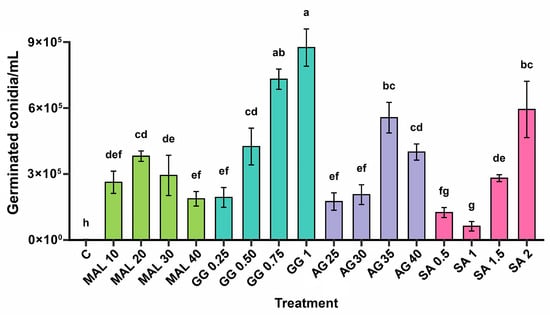
Conidia germination was significantly influenced by both the biopolymer matrix identity and its concentration, with all biopolymer treatments achieving significantly higher conidia viability compared to the untreated control, which had zero germination (Figure 1). GG demonstrated the highest overall biocompatibility and a clear concentration-dependent stimulation of conidia germination, reaching the absolute highest viability at 1% GG (8.7 × 10⁵ conidia mL−1) and remaining high at 0.75% GG (7.3 × 10⁵ conidia mL−1), whereas lower GG concentrations (0.25 and 0.50%) resulted in significantly lower conidia counts. Among the other matrices, optimal germination was achieved at specific intermediate or higher concentrations: AG reached its peak at 35% AG (5.6 × 10⁵ conidia mL−1), resulting in significantly higher germination than the 25 and 30% concentrations; SA showed maximum viability at 2%, reaching 5.9 × 10⁵ conidia mL−1, whereas its lowest concentrations (0.5 and 1%) showed poor compatibility; and MAL peaked at 20% (3.8 × 10⁵ conidia mL−1) before declining at 40%. Based on these conidia germination responses, the optimal concentration selected for each biopolymer was 20% for MAL, 1% for GG, 35% for AG, and 2% for SA.
Figure 1.
Viability of T. virens conidia following 48 h of incubation with different biopolymers. Treatments used were: control (C), maltodextrin (MAL), guar gum (GG), arabic gum (AG), and sodium alginate (SA), in various concentrations (numerical values attached to the biopolymer abbreviation). Values represent the mean of three replicates. Means within columns with the same letter are not significantly different (Duncan’s test, p < 0.05). Bars indicate the standard error of the mean.
3.2. Biopolymer-Seed Compatibility Assay
A two-way ANOVA (Table 3) was conducted to evaluate the main effects of biopolymer type (B) and imbibition period (IP), as well as their interaction (B × IP), on GP, GRI, and SVI. Only the B effect was significant; while IP and the interaction did not significantly affect GP. In contrast, GRI and SVI were significantly influenced by the experimental factors, exhibiting significant B × IP interactions (F = 4.62, p < 0.0001 for GRI; F = 2.41, p = 0.0186 for SVI). Based on these p-values (p < 0.05), the imbibition period was identified as a critical factor influencing seed physiological performance, particularly for GRI and SVI. It was therefore selected (GRI and SVI) as a key parameter for determining optimal seed treatment conditions.
Table 3.
Influence of biopolymer type, imbibition time, and their interaction on germination percentage (GP), germination rate index (GRI), and seed vigor index (SVI) of seeds. The F-values, p-values, and degrees of freedom (df) tabulated were determined from a Two-way ANOVA analysis.
In Table 2, for the main effect of biopolymers, significant differences were observed across all parameters (p < 0.05). GG achieved the highest overall germination rate index (GRI = 12.79), while MAL, AG, and SA showed the highest SVI ranging from 441.83 to 465.28, all significantly higher than the untreated control (C; SVI = 221.44). Analyzing the main effect of the imbibition period, exposure times of 60 and 90 min yielded the highest GRI values (9.80 and 9.89, respectively). In comparison, an imbibition period of 60 min resulted in the highest SVI (432.71). The interaction between biopolymers and imbibition period further detailed seed performance, establishing specific optimal imbibition times for each coating matrix. For MAL, an imbibition time of 15 min was selected because it achieved the absolute highest SVI (546.67)— separating from the lower C values—while maintaining an intermediate GRI (7.06). For AG, the shorter exposure time of 15 min was chosen as its GRI (6.11) did not decrease relative to C, while sustaining a high SVI (491.56). Also, C of 30 min was superior to AG at 30 min (5.61). In the case of GG, 30 min was selected because SVI values at 30 min (413.33) and 60 min (408.22) were statistically equivalent; thus, the shorter time was preferred, consistently outperforming C. For SA, 60 min was chosen due to its significantly higher GRI (11.61) compared to C, whereas its SVI values showed no statistical differences across all imbibition times (432.89 to 460.00), all being higher than C. Finally, within C, 60 min was identified as optimal due to its higher GRI (9.00) relative to shorter times, with no significant differences observed in SVI across imbibition periods.
3.3. Conidia Loading Percentage and Distribution on Seeds Using Selected Biopolymers
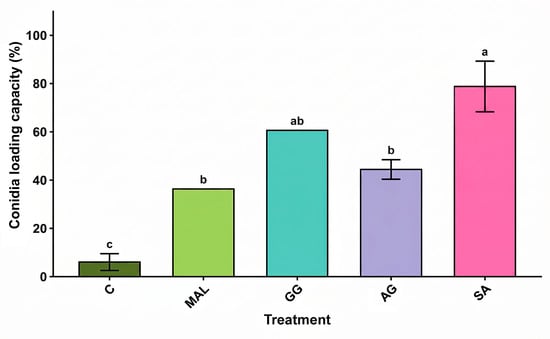
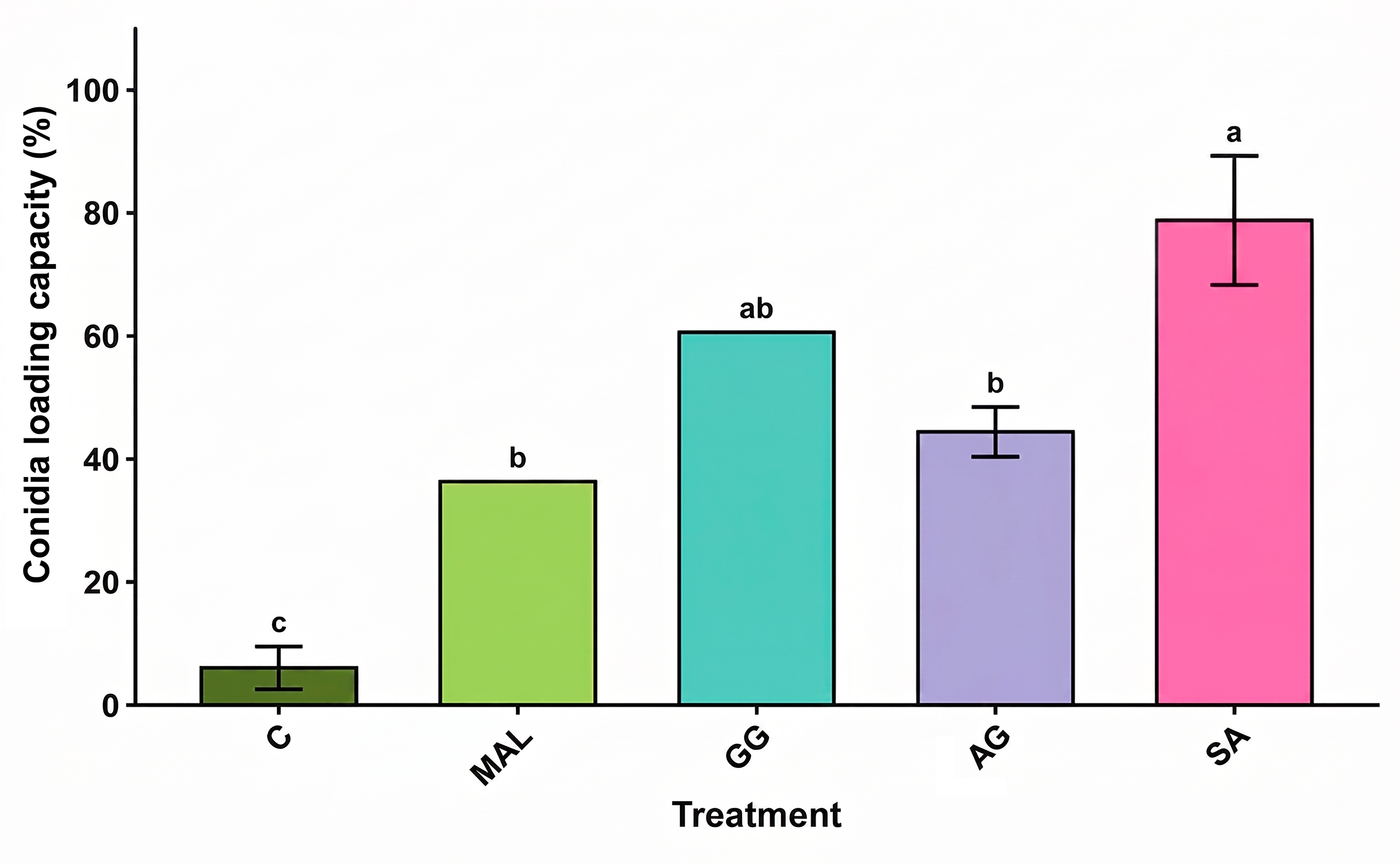
The conidia loading capacity (Figure 2) on cowpea seeds varied significantly depending on the biopolymer matrix applied (p < 0.05). All biopolymer treatments achieved significantly higher conidia retention compared to the untreated control, which retained less than 10% of T. virens conidia. SA achieved the highest binding efficiency, showing no significant difference compared to GG. Meanwhile, AG and MAL exhibited moderate loading efficiencies (44% and 36%, respectively), which were significantly lower than that of SA—though statistically comparable to GG—while remaining markedly superior to the control (C).
Figure 2.
Conidia loading capacity (%) of T. virens conidia coated with different biopolymer formulations at 24 h post-coating. Treatments used were control (C), maltodextrin (MAL), guar gum (GG), arabic gum (AG), and sodium alginate (SA). Values represent the mean of three replicates. Means with the same letter are not significantly different (Duncan’s test, p < 0.05). Bars indicate the standard error of the mean.
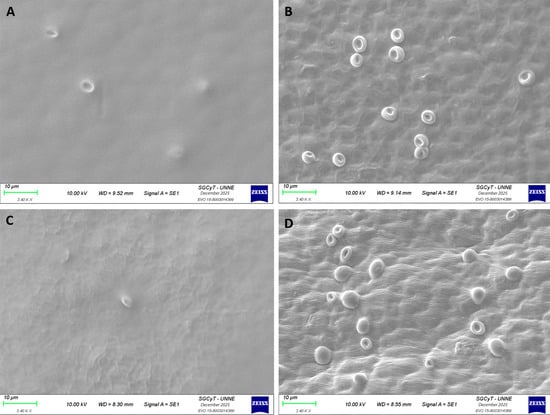
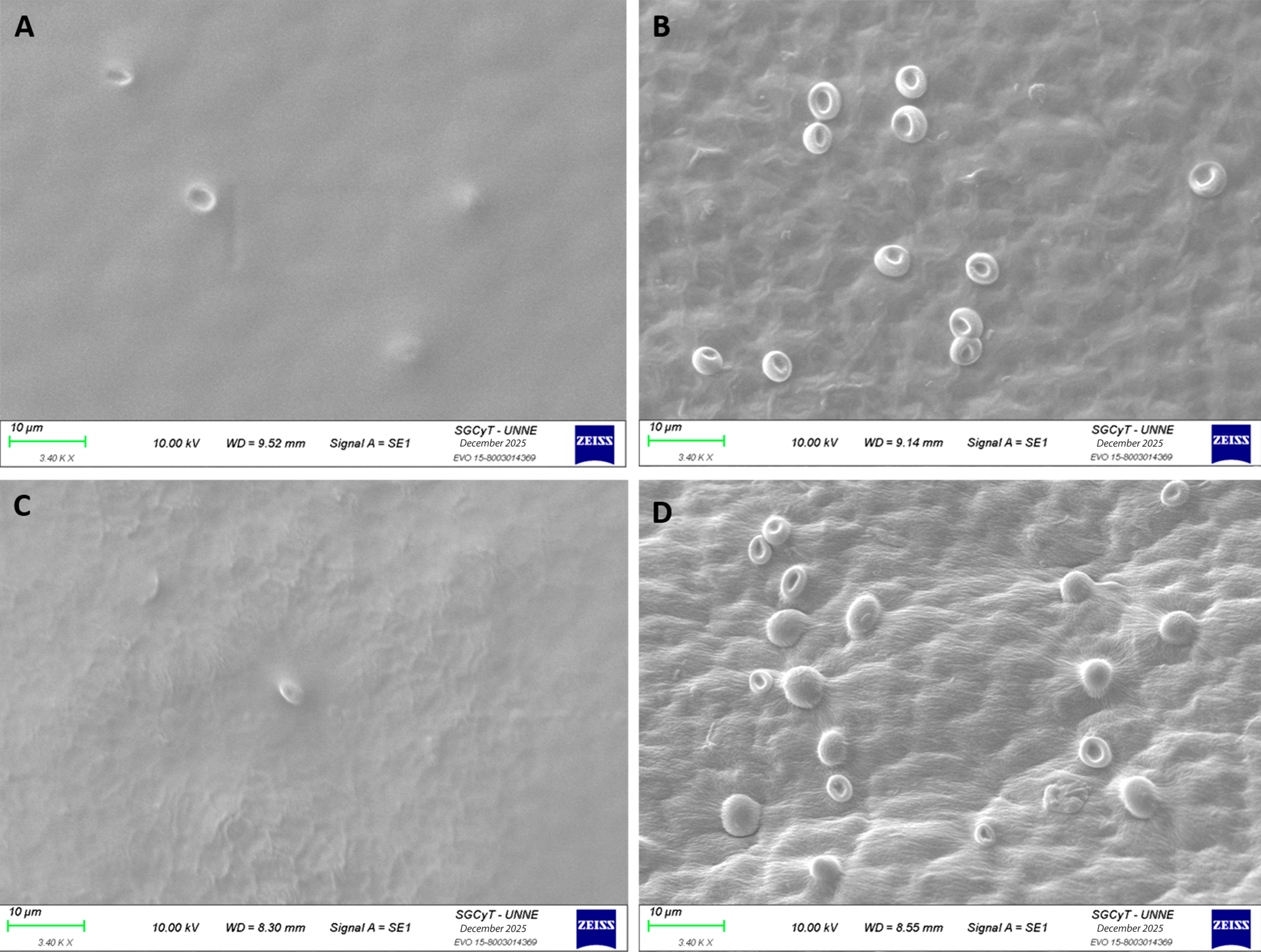
Scanning electron microscopy analysis revealed distinct surface topographies and conidium distribution patterns across the evaluated biopolymer coatings. In seeds treated with MAL (Figure 3A), the biopolymer produced a remarkably smooth, and featureless surface under which only a very low density of conidia remained visible or partially embedded within the matrix. The GG coating formed a uniform layer displaying globose-to-subglobose fungal conidia arranged in scattered clusters, with no evidence of structural collapse (Figure 3B). Seeds coated with AG (Figure 3C) exhibited a continuous film with a slightly textured microtopography, displaying isolated conidia entrapped within the biopolymer network.
Figure 3.
Scanning electron micrographs depicting conidia of T. virens bioprimed onto cowpea seed surfaces using maltodextrin (A), guar gum (B), arabic gum (C), and sodium alginate (D) at high magnification (3.40 k×). Seed surface morphology and microbial distribution were then evaluated using a scanning electron microscope operating at an accelerating voltage of 10 kV. The working distance (WD) ranged from 8.30 to 9.52 mm. The green scale bar in the bottom-left corner of each panel represents 10 µm. Images were captured using a ZEISS EVO 15 scanning electron microscope.
Finally, the SA treatment (Figure 3D) conformed to the natural irregularities of the seed coat, supporting a dense and well-distributed cluster of T. virens conidia firmly anchored to the surface. Overall, according to the scanning electron micrographs, SA and GG matrices provided superior conidia loading capacity and surface attachment compared to MAL and AG.
3.4. Growth Parameters Response of Cowpea to Biopriming with Trichoderma virens and Selected Biopolymers
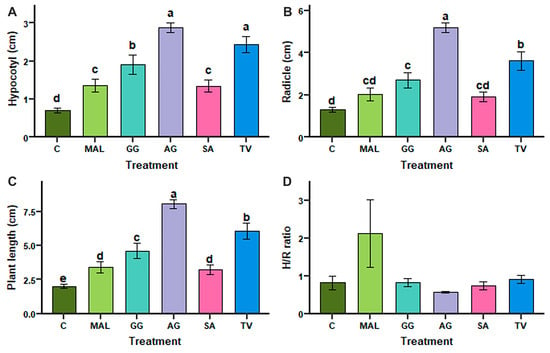
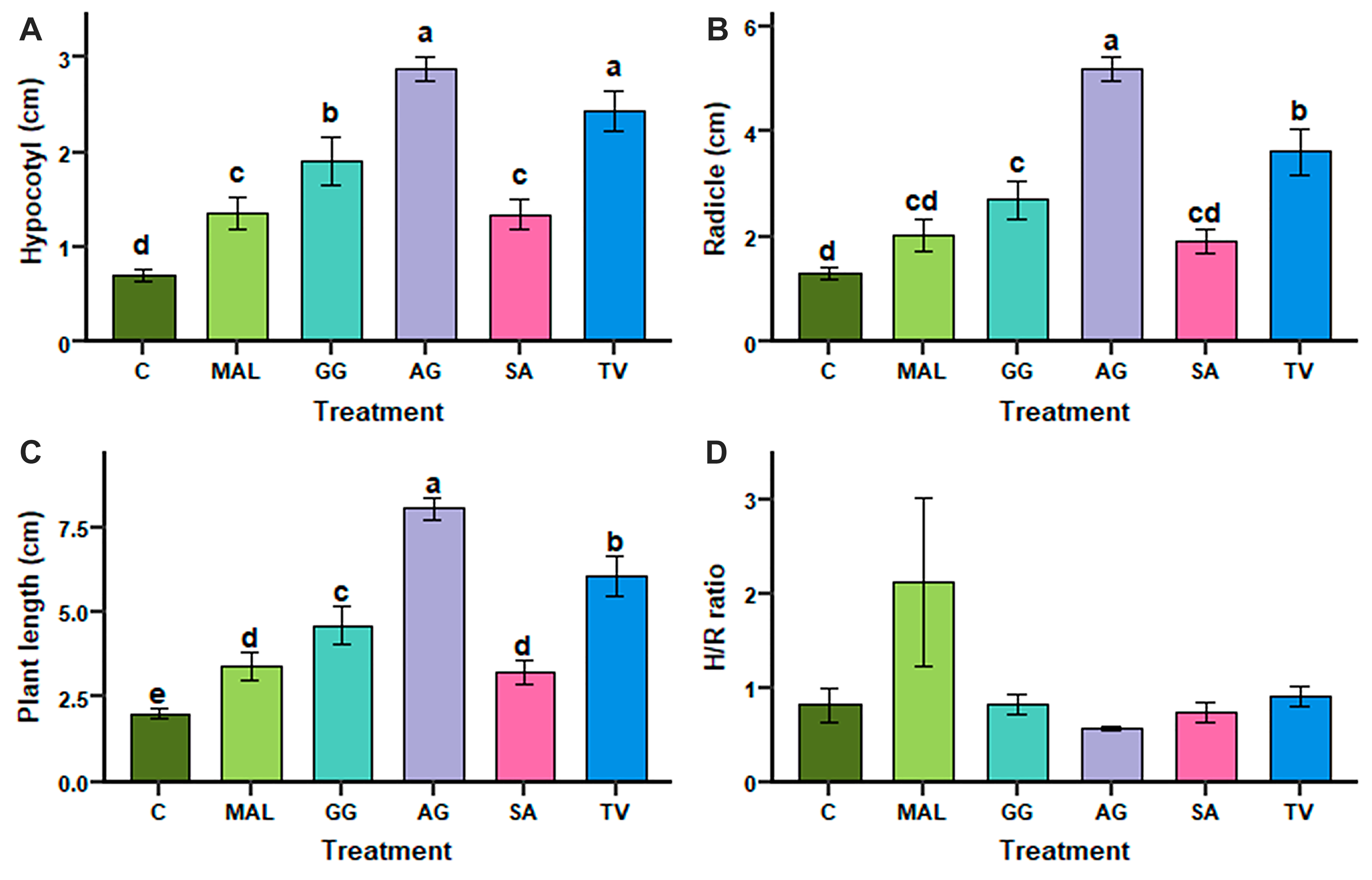
The application of T. virens, both alone and formulated with various biopolymers, significantly enhanced early cowpea seedling growth compared to C (Figure 4 and Figure S1). AG exhibited the most prominent growth-promoting effect, resulting in the highest values for total plant length (8.05 ± 0.39 cm) and radicle length (5.17 ± 0.23 cm), which were significantly superior to all other treatments, including T. virens alone (6.05 ± 0.59 cm and 3.61 ± 0.44 cm, respectively). Regarding hypocotyl length, both AG (2.88 ± 0.12 cm) and T. virens (2.44 ± 0.21 cm) achieved the highest values, with no significant differences between them. Other biopolymers showed intermediate effects: GG significantly outperformed MAL and SA in total plant length (4.61 ± 0.57 cm vs. 3.38 ± 0.41 cm and 3.24 ± 0.33 cm, respectively) and radicle development (2.70 ± 0.36 cm vs. 2.02 ± 0.31 cm and 1.90 ± 0.22 cm). Although MAL and SA were the least effective among the formulated treatments, both still significantly increased total plant length relative to C (2.00 ± 0.14 cm). The hypocotyl-to-radicle (H/R) ratio showed no statistically significant differences among treatments, with most values ranging from 0.57 ± 0.02 to 0.90 ± 0.10; however, MAL displayed a trend toward a higher ratio (2.13 ± 0.89), accompanied by high variability.
Figure 4.
Effects of biopriming treatments on cowpea seedling growth: (A) hypocotyl length (cm), (B) radicle length (cm), (C) total plant length (cm), and (D) hypocotyl-to-radicle (H/R) ratio. Treatments used were: uninoculated control (C), maltodextrin (MAL), guar gum (GG), arabic gum (AG), sodium alginate (SA), and unformulated T. virens (TV). Values represent the mean of three replicates. Different letters indicate statistically significant differences (Duncan’s test, p < 0.05). Bars indicate the standard error of the mean.
3.5. Evaluation of Cowpea Seed Viability After 30 Days of Cold Storage
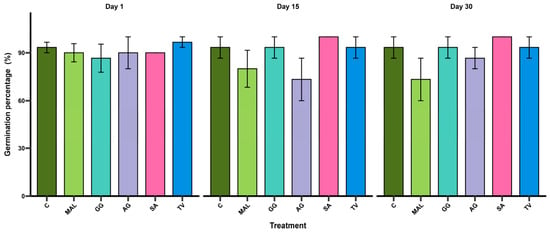
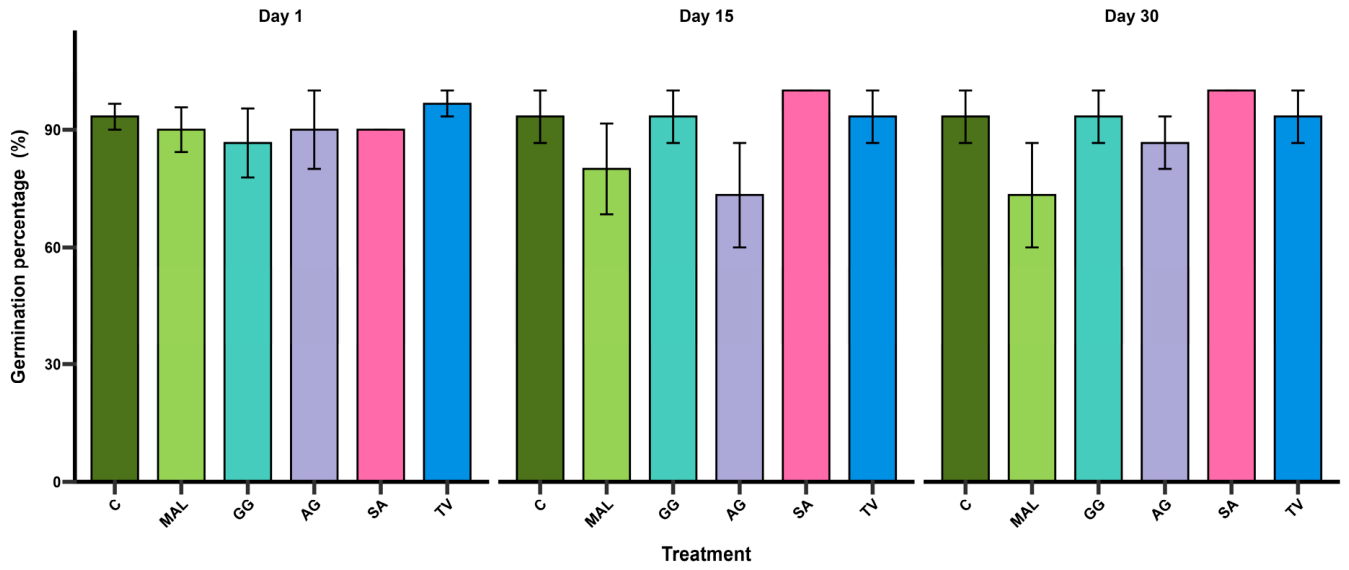
The GP of cowpea seeds (Figure 5) was evaluated across different biopriming formulations after 1, 15, and 30 days of refrigerated storage (4 °C). Overall, seed germination remained high and stable throughout the 30-day storage period across most treatments, generally ranging between 70 and 100%. On day 1, all treatments, including the T. virens and coated seeds (AG, GG, MAL, SA), exhibited high germination capacity (87–96%), showing performance comparable to the untreated control (C; 93%). As cold storage progressed to 15 and 30 days, SA consistently maintained the highest germination percentage, followed closely by C, GG, and T. virens, all sustaining germination rates above 90%. In contrast, seeds coated with AG and MAL showed slight fluctuations and lower mean germination values at days 15 and 30 (70–85%). Nonetheless, no statistically significant difference was detected under the tested conditions for GP.
Figure 5.
Germination percentage (%) of bioprimed cowpea seeds stored at 4 °C for 1, 15, and 30 days. Control (C), maltodextrin (MAL), guar gum (GG), arabic gum (AG), sodium alginate (SA), and unformulated T. virens (TV). Values represent the mean of three replicates. Bars indicate the standard error of the mean.
3.6. Inoculum Viability and Fungal Load Dynamics on Stored Bioprimed Seeds
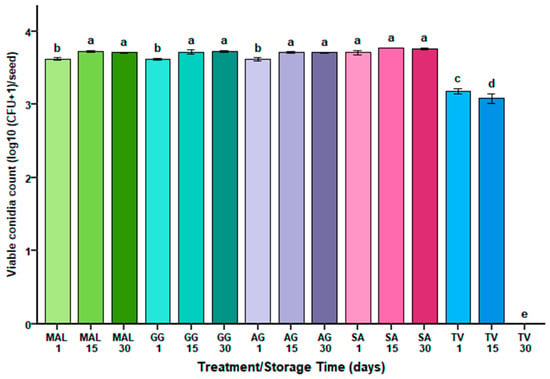
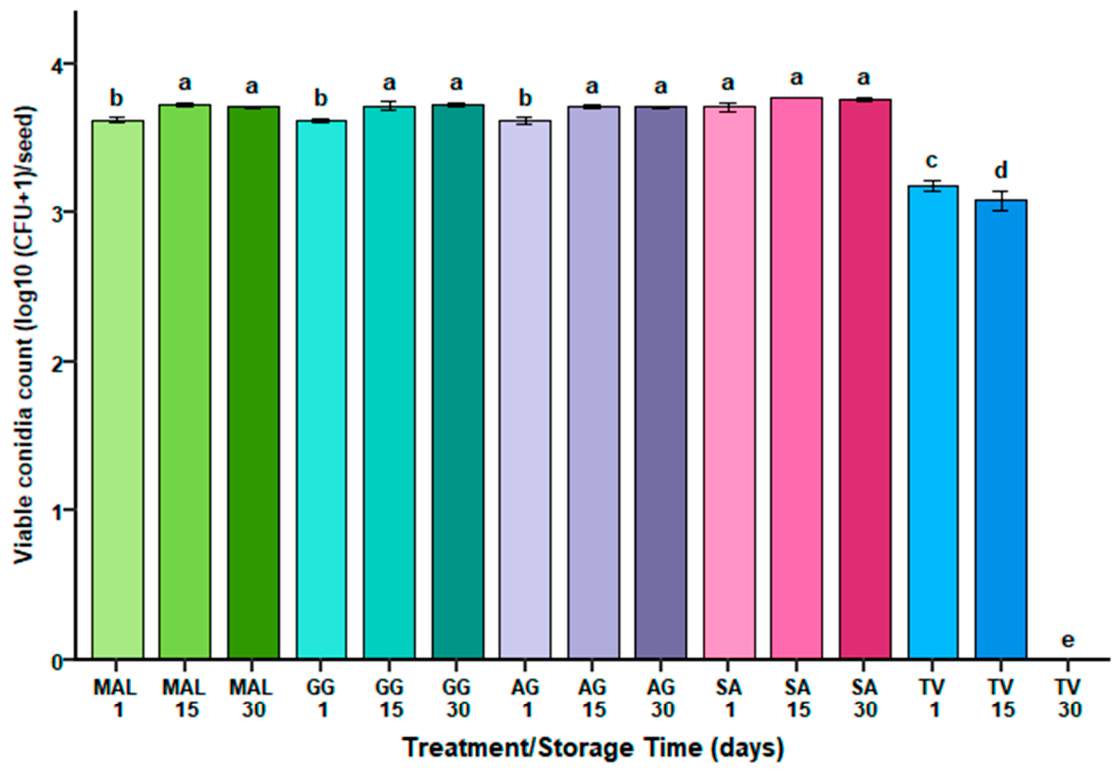
The two-way ANOVA revealed a highly significant interaction between treatment and cold storage time (Table 4, Figure 6), as well as significant main effects for both treatment and storage time. Regarding the main effect of biopolymers, SA overall supported the highest mean viable conidia count (3.75 log10 CFU + 1/seed), followed by GG, MAL, and AG (3.68 log10 CFU + 1/seed), all of which significantly outperformed unformulated T. virens (TV; 2.08 log10 CFU + 1/seed). For the storage factor, mean overall fungal viability peaked at day 15 (3.60 log10 CFU + 1/seed), followed by day 1 (3.55 log10 CFU + 1/seed) and day 30 (2.98 log10 CFU + 1/seed).
Table 4.
Viable conidia (Log10 (CFU + 1)/seed) as affected by coating treatment (uncoated control and biopolymer formulations), storage time (1, 15, and 30 days), and their interaction. F-values, p-values, and degrees of freedom (df) were determined by two-way ANOVA.
Figure 6.
Viable conidia count (log10 CFU + 1/seed) of T. virens on bioprimed cowpea seeds stored at 4 °C for 1, 15, and 30 days. Maltodextrin (MAL), guar gum (GG), arabic gum (AG), sodium alginate (SA), and TV (unformulated T. virens). Different letters indicate statistically significant differences according to Duncan’s test (p < 0.05) following a two-way ANOVA. Bars indicate the standard error of the mean.
The interaction analysis demonstrated distinct survival profiles between biopolymer-encapsulated formulations and unformulated conidia (Figure 6). All biopolymer treatments (SA, GG, MAL, and AG) maintained high viability across the 30-day storage period at 4 °C. At days 15 and 30, all four biopolymers reached the highest statistical significance group (3.71 log10 CFU + 1/seed), along with SA at day 1 (3.71 log10 CFU + 1/seed). The initial counts at day 1 for GG, MAL, and AG formed a slightly lower statistical group (3.61–3.62 log10 CFU + 1/seed). In contrast, TV suffered a progressive and significant decline, starting at 3.18 log10 CFU + 1/seed on day 1, dropping to 3.08 log10 CFU + 1/seed on day 15, and collapsing completely to non-detectable viability by day 30.
4. Discussion
As agriculture transitions toward more sustainable practices, integrating biopolymer-based seed coatings with biological control agents provides a viable alternative to conventional agrochemical inputs. Across the evaluated biopolymers, T. virens conidia germination was generally enhanced at high concentrations. MAL, however, proved to be an exception, achieving optimal germination at its second-lowest concentration. This behavior is likely linked to its simple chemical structure, consisting of D-glucose units linked primarily by α-(1,4) glycosidic bonds with α-(1,6) branching, which makes it highly susceptible to rapid enzymatic degradation by the bioagent [49,50]. Conversely, GG emerged as the most suitable substrate for T. virens conidia, fully preserving their viability while offering favorable growth conditions and effective protection against dehydration. Overall, all biopolymer–concentration combinations differed significantly from the control after 48 h, contrasting with shorter (24 h) evaluations in previous reports [29] where no viability differences were detected. Because Trichoderma species modulate their enzyme synthesis depending on available carbon sources, matrix–fungus interactions are highly specific [51,52]. Consequently, biopolymer performance in seed biopriming is strongly context-dependent—with polymer identity, concentration, and hydration time jointly governing coating efficacy and spore viability [38]—as polymer architecture and water content dictate hydrogel physicochemical behavior [53].
While final GP was significantly influenced solely by biopolymer type, the lack of significant imbibition period and interaction effects suggests that varying the soaking duration within the applied biopolymer matrices did not impair basic seed viability, but instead modulated germination and seedling establishment kinetics. This stability across imbibition times aligns with previous seed-coating literature across various legume and cereal crops, demonstrating that polymer coatings preserve total germination capacity while regulating germination speed, uniformity, and early vigor [54,55,56,57]. Specifically, unlike GP, GRI and SVI responded significantly to biopolymer type, imbibition period, and their interaction. These findings reinforce the premise that evaluating GRI and SVI alongside GP provides a more nuanced understanding of treatment efficacy by capturing temporal dynamics and early-growth variations that standard endpoint germination assessments fail to detect [38,55,58,59,60,61]. Furthermore, the significant interaction highlights that no single imbibition period is universally optimal across all matrices, reflecting how coating efficacy depends on formulation properties and species-specific seed traits [58,62]. From a physiological perspective, seed imbibition reactivates basal metabolism, yet poorly regulated or excessive water uptake can hinder germination [63]. Polymer coatings modulate this micro-hydration environment through two primary mechanisms: (i) hydration regulation, where coatings either accelerate water uptake under adequate moisture [54,64,65,66] or delay imbibition when coating thickness increases [66,67,68]; and (ii) gas exchange and mechanical resistance, whereby water-retentive hydrogel matrices delay germination by limiting oxygen diffusion or imposing physical resistance around the seed coat [54,69]. These combined mechanisms explain why extended imbibition periods did not consistently improve cowpea performance in this study, directly aligning with findings in Brassica rapa, where short imbibition times proved optimal and prolonged exposure reduced seedling vigor [38].
The significant differences in conidia loading across biopolymers underscore the vital role of the coating matrix in establishing successful seed biopriming [38,70]. All biopolymer formulations substantially improved spore entrapment compared to the uncoated control, with SA and GG achieving the highest binding efficiencies, followed by moderate retention in AG and MAL. This hierarchy aligns with prior studies employing alginate and guar gum matrices to immobilize Trichoderma spp. on vegetable seeds [29,38,70,71], whereas the lower retention of AG reflects its tendency to perform best when blended with secondary polymers rather than applied alone [72]. SEM analysis provided physical insight into how matrix architecture directly dictates this surface conidia entrapment as a qualitative feature. Specifically, SA formed a coating characterized by fine porous microstructures that likely favored conidia entrapment, mirroring findings in Brassica seeds [29,38] that linked high microbial recovery to a fine porous matrix. Similarly, GG created a uniform, structurally stable layer over the seed coat, consistent with the role of gellan and guar matrices as protective adhesive films that shield sensitive biological structures [72]. In contrast, MAL produced a dense, featureless coating layer that trapped fewer conidia—corroborating that layer density and spatial incorporation govern viable CFU counts [72]—whereas the AG coating formed a film containing only isolated, entrapped conidia, acting primarily as a surface film-former rather than a high-density carrier matrix [43]. Maximizing initial conidia load and uniform surface distribution has direct implications for biological efficacy, which typically requires a threshold population of 3–4 × 10⁴ CFU seed−1 to suppress soilborne pathogens [70]. By anchoring conidia securely within a conforming matrix, SA and GG coatings can reduce the need for high-volume liquid inoculants (106 CFU mL−1) while facilitating sustained release into the spermosphere and long-term viability [70,71].
The application of T. virens, whether unformulated or combined with biopolymers, consistently promoted early cowpea seedling growth compared to the uninoculated control. This baseline stimulation aligns with previous reports in cowpea and other legumes (such as Vigna radiata and Cicer arietinum), where Trichoderma inoculation enhanced radicle elongation, emergence, and seedling vigor [73,74,75,76], largely driven by fungal synthesis of phytohormones such as indole-3-acetic acid (IAA) [77,78]. Crucially, however, our results reveal a functional trade-off between physical conidial loading and early plant growth promotion: although SA and GG maximized spore entrapment on the seed coat, the AG formulation yielded the greatest total seedling and radicle elongation, significantly outperforming both unformulated T. virens and the remaining matrices, while GG showed intermediate effects and MAL and SA exhibited lower stimulation. Rather than representing a contradiction, this divergence from studies in Brassica rapa and Capsicum annuum—where SA was optimal [29,38]—demonstrates that biopriming efficacy is strictly crop- and matrix-dependent [38,79]. In this cowpea–T. virens system study, AG functioned as an active efficacy-enhancing carrier [79], consistent with its superior performance in chickpea and Vigna mungo [80,81]. Because AG formed a less restrictive film than the cross-linked or dense networks of SA and MAL, it likely permitted faster hydration, uninhibited oxygen diffusion, and rapid conidial release into the spermosphere, thereby amplifying localized IAA-mediated root elongation without altering shoot-to-root allometry (H/R ratio) [38,73,77,79,80].
Maintaining both seed vigor and fungal viability during storage is a critical prerequisite for practical biopriming adoption. Cowpea germination remained high across all treatments after 30 days at 4 °C, confirming that neither T. virens nor the biopolymer coatings impaired seed physiological quality during short-term cold storage [38,82,83,84,85,86,87,88,89,90]. Even more pronounced was the effect of encapsulation on fungal shelf-life: the non-detectable in unformulated conidia by day 30 contrasted sharply with the sustained survival of T. virens across all biopolymer matrices. While refrigeration at 4 °C slows metabolic depletion, unencapsulated spores remain vulnerable to desiccation and physiological decline ; in addition, biopolymer encapsulation provides a protective microenvironment that buffers moisture fluctuations and oxidative stress, maintaining conidial dormancy without triggering premature germination [70,87,91,92,93,94,95,96,97,98,99]. Among the tested carriers, SA yielded the highest initial loading and maintained superior CFU in the first day—corroborating its robust protective capacity [29,38,91,100]—although the narrowing gap among SA, GG, MAL, and AG by day 30 indicates that all four matrices effectively preserved threshold inoculant populations capable of subsequent spermosphere release [70,97,101]. Despite these promising findings, there are limitations of the present study that should be acknowledged. Storage stability was evaluated solely at 4 °C for 30 days; because smallholder farmers in tropical and subtropical regions often lack cold-chain infrastructure, further studies must evaluate longer storage durations under fluctuating ambient temperatures. The observed trade-off between physical protection and early growth stimulation; where SA maximized conidial loading, whereas AG promoted superior early root elongation. Future research should therefore explore composite or blended biopolymer formulations (e.g., combining the structural protection of SA or GG with the rapid bioavailability of AG) and validate their performance under multi-environment field trials.
5. Conclusions
This study demonstrates that biopolymer-based seed coatings significantly modulate the biopriming efficacy of Trichoderma virens in cowpea (Vigna unguiculata). While unformulated T. virens enhanced early seedling growth compared to the uninoculated control, formulation with AG exhibited the most stimulating effect, achieving the highest total plant length and radicle elongation. Conversely, SA provided the highest initial conidia entrapment capacity. The matrix microstructure determines conidia binding efficiency and surface distribution. Rather than altering basic seed viability, biopolymer matrices modulated germination kinetics and early seedling vigor, with AG emerging as the most effective delivery matrix for promoting early root-directed growth in cowpea. These findings highlight that selecting an optimal biopolymer carrier must balance physical loading efficiency, storage viability, and initial plant growth-promoting activity, offering a viable tool for sustainable agricultural practices.
Supplementary Materials
The following supporting information can be downloaded at https://www.mdpi.com/article/10.3390/agronomy16212208/s1, Figure S1: Cowpea seedlings at the end of the growth experiment. Control (C), maltodextrin (MAL), guar gum (GG), arabic gum (AG), sodium alginate (SA), and unformulated T. virens (TV).
Author Contributions
Conceptualization, M.D.G.-H., M.V.A. and M.V.T.-S.; methodology, M.D.G.-H., A.L.E., A.J.O., S.G., M.V.A. and M.V.T.-S.; software, M.D.G.-H.; validation, M.D.G.-H. and A.J.O.; formal analysis, M.D.G.-H., A.J.O., S.G. and M.V.T.-S.; investigation, M.D.G.-H., A.J.O., S.G., M.V.A. and M.V.T.-S.; resources, M.D.G.-H., S.G., M.V.A. and M.V.T.-S.; data curation, M.D.G.-H. and A.J.O.; writing—original draft preparation, M.D.G.-H., A.J.O., S.G., A.L.E., M.V.A. and M.V.T.-S.; writing—review and editing, M.D.G.-H., A.J.O., S.G., M.V.A. and M.V.T.-S.; visualization, M.D.G.-H., M.V.A. and M.V.T.-S.; supervision, M.V.A. and M.V.T.-S.; project administration, M.D.G.-H., S.G., M.V.A. and M.V.T.-S.; funding acquisition, M.D.G.-H., S.G., M.V.A. and M.V.T.-S. All authors have read and agreed to the published version of the manuscript.
Funding
This research was funded by Universidad Nacional del Nordeste (PI 24F008, PINOV 24AN02).
Data Availability Statement
Data is contained within the article.
Acknowledgments
During the preparation of this manuscript, the authors used Gemini (v 3.6) to improve grammar, language clarity, and text fluency. After using this tool, the authors reviewed and edited the content as necessary and took full responsibility for the content of the publication.
Conflicts of Interest
The authors declare no conflicts of interest.
Abbreviations
The following abbreviations are used in this manuscript:
| TV | Trichoderma virens |
| MAL | Maltodextrin |
| AG | Arabic gum |
| GG | Guar gum |
| SA | Sodium Alginate |
| GRI | Germination rate index |
| SVI | Seed vigor index |
References
- Traffano-Schiffo, M.V.; Vallejos, M.M.; Gómez, A.G.; Avalos, B.I.; Acevedo, B.A.; Avanza, M.V. Bioactive Profiling of Cowpea Pods via Optimized Extraction and Experimental–Computational Approaches. Agronomy 2025, 15, 1681. [Google Scholar] [CrossRef] [Scilit]
- Peyrano, F.; Speroni, F.; Avanza, M.V. Physicochemical and functional properties of cowpea protein isolates treated with temperature or high hydrostatic pressure. Innov. Food Sci. Emerg. Technol. 2016, 33, 38–46. [Google Scholar] [CrossRef] [Scilit]
- Traffano-Schiffo, M.V.; Aguirre-Calvo, T.R.; Navajas-Porras, B.; Avanza, M.V.; Rufián-Henares, J.Á.; Santagapita, P.R. In vitro digestion and fermentation of cowpea pod extracts and proteins loaded in Ca (II)-alginate hydrogels. Foods 2024, 13, 3071. [Google Scholar] [CrossRef] [Scilit] [PubMed]
- Boukar, O.; Belko, N.; Chamarthi, S.; Togola, A.; Batieno, J.; Owusu, E.; Fatokun, C. Cowpea (Vigna unguiculata): Genetics, genomics and breeding. Plant Breed. 2019, 138, 415–424. [Google Scholar] [CrossRef] [Scilit]
- Abebe, B.K.; Alemayehu, M.T. A review of the nutritional use of cowpea (Vigna unguiculata L. Walp) for human and animal diets. J. Agric. Food Res. 2022, 10, 100383. [Google Scholar] [CrossRef] [Scilit]
- Avanza, M.V.; Chaves, M.G.; Acevedo, B.A.; Añón, M.C. Functional properties and microstructure of cowpea cultivated in north-east Argentina. LWT 2012, 49, 123–130. [Google Scholar] [CrossRef] [Scilit]
- Binacchi, F.; Rusinamhodzi, L.; Cadisch, G. The potential of conservation agriculture to improve nitrogen fixation in cowpea under the semi-arid conditions of Kenya. Front. Agron. 2022, 4, 988090. [Google Scholar] [CrossRef] [Scilit]
- Dueñas, C., Jr.; Pagano, A.; Calvio, C.; Kharga, N.; Macovei, A.; Milanese, C.; Balestrazzi, A. Novel approaches for understanding and improving the effectiveness of seed biopriming. Sci. Rep. 2026, 16, 10965. [Google Scholar] [CrossRef] [Scilit] [PubMed]
- Cañizares, E.; Giovannini, L.; Gumus, B.O.; Fotopoulos, V.; Balestrini, R.; González-Guzmán, M.; Arbona, V. Seeds of Change: Exploring the transformative effects of seed priming in sustainable agriculture. Physiol. Plant. 2025, 177, e70226. [Google Scholar] [CrossRef] [Scilit] [PubMed]
- Balmer, A.; Pastor, V.; Gamir, J.; Flors, V.; Mauch-Mani, B. The ‘prime-ome’: Towards a holistic approach to priming. Trends Plant Sci. 2015, 20, 443–452. [Google Scholar] [CrossRef] [Scilit] [PubMed]
- Gamir, J.; Sánchez-Bel, P.; Flors, V. Molecular and physiological stages of priming: How plants prepare for environmental challenges. Plant Cell Rep. 2014, 33, 1935–1949. [Google Scholar] [CrossRef] [Scilit] [PubMed]
- Junges, E.; Brião Muniz, M.F.; Bastos, B.D.O.; Oruoski, P. Biopriming in bean seeds. Acta Agric. Scand. Sect. B Soil Plant Sci. 2016, 66, 207–214. [Google Scholar] [CrossRef] [Scilit]
- Fiodor, A.; Ajijah, N.; Dziewit, L.; Pranaw, K. Biopriming of seed with plant growth-promoting bacteria for improved germination and seedling growth. Front. Microbiol. 2023, 14, 1142966. [Google Scholar] [CrossRef] [Scilit] [PubMed]
- Singh, P.; Vaishnav, A.; Liu, H.; Xiong, C.; Singh, H.B.; Singh, B.K. Seed biopriming for sustainable agriculture and ecosystem restoration. Microb. Biotechnol. 2023, 16, 2212–2222. [Google Scholar] [CrossRef] [Scilit] [PubMed]
- Vigneshwaran, K.; Lakshmi, S.; Vanitha, C.; Anand, T.; Babu, V.P.R.; Kavitha, S.; Nelson, K.N. Seed biopriming: A promising strategy to tackle abiotic stress in plants. Plant Sci. Today 2025, 12, 9581. [Google Scholar] [CrossRef] [Scilit]
- Sun, Z.; Adeleke, B.S.; Shi, Y.; Li, C. The seed microbiomes of staple food crops. Microb. Biotechnol. 2023, 16, 2236–2249. [Google Scholar] [CrossRef] [Scilit] [PubMed]
- Shaffique, S.; Khan, M.A.; Wani, S.H.; Imran, M.; Kang, S.M.; Pande, A.; Lee, I.J. Biopriming of maize seeds with a novel bacterial strain SH-6 to enhance drought tolerance in South Korea. Plants 2022, 11, 1674. [Google Scholar] [CrossRef] [Scilit] [PubMed]
- Mohamed, N.G.; Mokhtar, A.; Khaled, Y.; Mohamed, N.; Mahmoud, A. Seed biopriming with Bacillus nematocida enhances drought tolerance in maize via regulation of stress-responsive genes. Sci. Rep. 2025, 15, 43227. [Google Scholar] [CrossRef] [Scilit] [PubMed]
- Chávez, D.; Rivas, G.; Machuca, Á.; Santos, C.; Deramond, C.; Aroca, R.; Cornejo, P. Contribution of arbuscular mycorrhizal and endophytic fungi to drought tolerance in Araucaria araucana seedlings. Plants 2023, 12, 2116. [Google Scholar] [CrossRef] [Scilit] [PubMed]
- Chen, X.; Sun, R.; Hu, D.; Yang, Y.; Cheng, Z.; Hu, P.; Fei, Y. Serendipita indica enhances drought tolerance in Phoebe sheareri Seedlings by improving photosynthetic efficiency, stimulating the antioxidant defense system, and modulating hormone synthesis. J. Fungi 2025, 11, 717. [Google Scholar] [CrossRef] [Scilit] [PubMed]
- Aizaz, M.; Ahmad, W.; Asaf, S.; Khan, I.; Saad Jan, S.; Salim Alamri, S.; Al-Harrasi, A. Characterization of the seed biopriming, plant growth-promoting and salinity-ameliorating potential of halophilic fungi isolated from hypersaline habitats. Int. J. Mol. Sci. 2023, 24, 4904. [Google Scholar] [CrossRef] [Scilit] [PubMed]
- Tisarum, R.; Theerawitaya, C.; Samphumphuang, T.; Polispitak, K.; Thongpoem, P.; Singh, H.P.; Cha-Um, S. Alleviation of salt stress in upland rice (Oryza sativa L. ssp. indica cv. Leum Pua) using arbuscular mycorrhizal fungi inoculation. Front. Plant Sci. 2020, 11, 348. [Google Scholar] [CrossRef] [Scilit] [PubMed]
- Hadj Brahim, A.; Ben Ali, M.; Daoud, L.; Jlidi, M.; Akremi, I.; Hmani, H.; Ben Ali, M. Biopriming of durum wheat seeds with endophytic diazotrophic bacteria enhances tolerance to Fusarium head blight and salinity. Microorganisms 2022, 10, 970. [Google Scholar] [CrossRef] [Scilit] [PubMed]
- Ji, H.; Zhang, M.; Huang, C.; Lin, W.; Lu, Y.; Wang, P.; Guo, L. The Impact of Piriformospora indica on plant heat and drought tolerance. Front. Plant Sci. 2024, 15, 1479561. [Google Scholar] [CrossRef] [Scilit] [PubMed]
- Ali, S.Z.; Sandhya, V.; Grover, M.; Linga, V.R.; Bandi, V. Effect of inoculation with a thermotolerant plant growth promoting Pseudomonas putida strain AKMP7 on growth of wheat (Triticum spp.) under heat stress. J. Plant Interact. 2011, 6, 239–246. [Google Scholar]
- Liang, S.M.; Hashem, A.; Fathi Abd_Allah, E.; Wu, Q.S. Transcriptomic analysis reveals potential roles of polyamine and proline metabolism in waterlogged peach roots inoculated with Funneliformis mosseae and Serendipita indica. Tree Physiol. 2025, 45, tpaf013. [Google Scholar] [CrossRef] [Scilit] [PubMed]
- Ahumada, G.D.; Gómez-Álvarez, E.M.; Dell’Acqua, M.; Bertani, I.; Venturi, V.; Perata, P.; Pucciariello, C. Bacterial endophytes contribute to rice seedling establishment under submergence. Front. Plant Sci. 2022, 13, 908349. [Google Scholar] [CrossRef] [Scilit] [PubMed]
- Subašić, M.; Selović, A.; Dahija, S.; Demir, A.; Samardžić, J.; Bonomo, A.; Karalija, E. Biopriming-Induced Transcriptomic Memory Enhances Cadmium Tolerance in the Cd Hyperaccumulator Silene sendtneri. Plants 2026, 15, 257. [Google Scholar] [CrossRef] [Scilit] [PubMed]
- Chin, J.M.; Lim, Y.Y.; Ting, A.S.Y. Biopriming vegetable seeds with metal-tolerant biocontrol agents to enhance tolerance to biotic and abiotic stress. Biol. Control 2022, 174, 105035. [Google Scholar] [CrossRef] [Scilit]
- Dabral, S.; Varma, A.; Choudhary, D.K.; Bahuguna, R.N.; Nath, M. Biopriming with Piriformospora indica ameliorates cadmium stress in rice by lowering oxidative stress and cell death in root cells. Ecotoxicol. Environ. Saf. 2019, 186, 109741. [Google Scholar] [CrossRef] [Scilit] [PubMed]
- Guzmán-Guzmán, P.; Kumar, A.; de Los Santos-Villalobos, S.; Parra-Cota, F.I.; Orozco-Mosqueda, M.D.C.; Fadiji, A.E.; Santoyo, G. Trichoderma species: Our best fungal allies in the biocontrol of plant diseases—A review. Plants 2023, 12, 432. [Google Scholar] [CrossRef] [Scilit] [PubMed]
- Otithi, S.M.B.A.; Rana, M.S.; Islam, M.S.; Zaki, R.M.; Ali, S.; Rabbee, M.F.; Baek, K.H. Harnessing Trichoderma Species for Sustainable Biocontrol: Mechanisms, Formulation Strategies, Commercialization, and Field Applications. Plants 2026, 15, 2260. [Google Scholar] [CrossRef] [Scilit] [PubMed]
- Tyśkiewicz, R.; Nowak, A.; Ozimek, E.; Jaroszuk-Ściseł, J. Trichoderma: The current status of its application in agriculture for the biocontrol of fungal phytopathogens and stimulation of plant growth. Int. J. Mol. Sci. 2022, 23, 2329. [Google Scholar] [CrossRef] [Scilit] [PubMed]
- Gohari, G.; Spanos, A.; Ioannou, A.; Efstathiou, I.; Panahirad, S.; Kolbert, Z.; Fotopoulos, V. Seed priming approaches for climate-resilient agriculture. J. Exp. Bot. 2026, 77, 2013–2026. [Google Scholar] [CrossRef] [Scilit] [PubMed]
- Paravar, A.; Piri, R.; Balouchi, H.; Ma, Y. Microbial seed coating: An attractive tool for sustainable agriculture. Biotechnol. Rep. 2023, 37, e00781. [Google Scholar] [CrossRef] [Scilit] [PubMed]
- Usmanova, A.; Brazhnikova, Y.; Omirbekova, A.; Kistaubayeva, A.; Savitskaya, I.; Ignatova, L. Biopolymers as seed-coating agent to enhance microbially induced tolerance of barley to phytopathogens. Polymers 2024, 16, 376. [Google Scholar] [CrossRef] [Scilit] [PubMed]
- Skrzypczak, D.; Jarzembowski, Ł.; Izydorczyk, G.; Mikula, K.; Hoppe, V.; Mielko, K.A.; Witek-Krowiak, A. Hydrogel alginate seed coating as an innovative method for delivering nutrients at the early stages of plant growth. Polymers 2021, 13, 4233. [Google Scholar] [CrossRef] [Scilit] [PubMed]
- Chin, J.M.; Lim, Y.Y.; Ting, A.S.Y. Biopolymers for biopriming of Brassica rapa seeds: A study on coating efficacy, bioagent viability and seed germination. J. Saudi Soc. Agric. Sci. 2021, 20, 198–207. [Google Scholar] [CrossRef] [Scilit]
- Prado, G.; Gutiérrez, S.; Domínguez, M.; Carbajal, L.; Lovato, A.; Solís, V.; Arriola, D.; Pascarella, A.; Cardozo, W. Efecto bioestimulante de Trichoderma virens y Bacillus subtilis en el cultivo de arroz. In Proceedings of the 6° Congreso Argentino de Fitopatología, Cipolletti, Argentina, 18–20 September 2024. [Google Scholar]
- do Amaral, A.C.T.; de Holanda Cavalcanti Maciel, M.; Machado, A.R.; Gonçalves de Oliveira, L.; Souza Lima, C.; Félix da Costa, A.; Tinti de Oliveira, N. Trichoderma as a biological agent of Fusarium oxysporum species complex and Vigna unguiculata growth promoter. Eur. J. Plant Pathol. 2022, 163, 875–890. [Google Scholar] [CrossRef] [Scilit]
- International Seed Testing Association (ISTA). International Rules for Seed Testing 2016; ISTA: Bassersdorf, Switzerland, 2016. [Google Scholar]
- Bhatt, R.M.; Selvakumar, G.; Upreti, K.K.; Boregowda, P.C. Effect of biopriming with Enterobacter strains on seed germination and seedling growth of tomato (Solanum lycopersicum L.) under osmotic stress. Proc. Natl. Acad. Sci. India Sect. B Biol. Sci. 2015, 85, 63–69. [Google Scholar] [CrossRef] [Scilit]
- Chandrika, K.P.; Singh, A.; Prasad, R.D.; Yadav, P.; Dhara, M.; Kavya, M.; Gopalan, B. Porous crosslinked CMC-PVA biopolymer films: Synthesis, standardization, and application in seed coating for improved germination. Carbohydr. Polym. Technol. Appl. 2025, 11, 100900. [Google Scholar] [CrossRef] [Scilit]
- Dietz, R.M.; Traffano-Schiffo, M.V.; Maiocchi, M.G.; Leon, A.E.; Avanza, M.V. Effect of high-intensity ultrasound on cowpea flours optimized by response surface methodology and the impact on their techno-functional properties. Food Biosci. 2025, 68, 106469. [Google Scholar] [CrossRef] [Scilit]
- Maamallan, S.; Prakash, M.; Sathiyanarayanan, G.; Rameshkumar, S. Effect of seed hardening and pelleting on germination and seedling attributes of cowpea under saline condition. Legume Res. 2021, 44, 723–729. [Google Scholar] [CrossRef] [Scilit]
- Pimentel, M.L.; Castro, H.V.M.; Munduruku, M.K.; Cunha Ponte, L.C.; Alves, D.M.R.; Pinto, R.B.; Silva, L.S. Application of Trichoderma harzianum on the physiological quality of cowpea seeds. Aust. J. Crop Sci. 2021, 15, 643–648. [Google Scholar] [CrossRef] [Scilit]
- Di Rienzo, J.A.; Casanoves, F.; Balzarini, M.G.; González, L.; Tablada, M.; Robledo, Y.C. InfoStat Versión 2011. Grupo InfoStat, FCA, Universidad Nacional de Córdoba, Argentina. Available online: http://www.infostat.com.ar (accessed on 23 September 2026).
- R Core Team. R: A Language and Environment for Statistical Computing; R Foundation for Statistical Computing: Vienna, Austria, 2026; Available online: https://www.R-project.org/ (accessed on 20 September 2026).
- Kawano, A.; Yamamoto, T.; Shinagawa, Y.; Hanashiro, I.; Yoshida, H. Enzymatic synthesis of a novel short linear maltodextrin from starch. J. Appl. Glycosci. 2025, 72, 7201101. [Google Scholar] [CrossRef] [Scilit] [PubMed]
- Saavedra-Leos, Z.; Leyva-Porras, C.; Araujo-Díaz, S.B.; Toxqui-Terán, A.; Borrás-Enríquez, A.J. Technological application of maltodextrins according to the degree of polymerization. Molecules 2015, 20, 21067–21081. [Google Scholar] [CrossRef] [Scilit] [PubMed]
- Sharahi, M.; Bahrami, S.H.; Karimi, A. A comprehensive review on guar gum and its modified biopolymers: Their potential applications in tissue engineering. Carbohydr. Polym. 2025, 347, 122739. [Google Scholar] [CrossRef] [Scilit] [PubMed]
- Cripps-Guazzone, N.; Ridgway, H.J.; Condron, L.M.; McLean, K.L.; Stewart, A.; Jones, E.E. Isolate and plant host specificity of rhizosphere competence in Trichoderma species. Fungal Biol. 2025, 129, 101554. [Google Scholar] [CrossRef] [Scilit] [PubMed]
- Kumar, R.; Parashar, A. Effect of the degree of polymerization and water content on the thermal transport phenomena in PEGDA hydrogel: A molecular-dynamics-based study. Phys. Chem. Chem. Phys. 2023, 25, 18960–18972. [Google Scholar] [CrossRef] [Scilit] [PubMed]
- Gorim, L.; Asch, F. Seed Coating Increases Seed Moisture Uptake and Restricts Embryonic Oxygen Availability in Germinating Cereal Seeds. Biology 2017, 6, 31. [Google Scholar] [CrossRef] [Scilit] [PubMed]
- Qiu, Y.; Amirkhani, M.; Mayton, H.; Chen, Z.; Taylor, A. Biostimulant Seed Coating Treatments to Improve Cover Crop Germination and Seedling Growth. Agronomy 2020, 10, 154. [Google Scholar] [CrossRef] [Scilit]
- Godínez-Garrido, N.A.; Ramírez-Pimentel, J.; Covarrubias-Prieto, J.; Cervantes-Ortiz, F.; Pérez-López, A.; Aguirre-Mancilla, C.L. Chitosan coating on bean and maize seeds: Release of agrochemical fungicide and post-storage condition. J. Seed Sci. 2021, 43, e202143036. [Google Scholar] [CrossRef] [Scilit]
- Trică, B.; Tritean, N.; Constantinescu-Aruxandei, D.; Oancea, F. Optimization of the Mung Bean Seed Coating with Alginate in a Bottom-Sprayed Wurster Fluidized Bed Coater. Coatings 2023, 13, 562. [Google Scholar] [CrossRef] [Scilit]
- Godínez-Garrido, N.A.; Torres-Castillo, J.A.; Ramírez-Pimentel, J.; Covarrubias-Prieto, J.; Cervantes-Ortiz, F.; Aguirre-Mancilla, C.L. Effects on Germination and Plantlet Development of Sesame (Sesamum indicum L.) and Bean (Phaseolus vulgaris L.) Seeds with Chitosan Coatings. Agronomy 2022, 12, 666. [Google Scholar] [CrossRef] [Scilit]
- Vijaykumar, S.; Sowmya, V.; Chandrika, K.S.V.P.; Prasad, R.D.; Kavya, M.; Yadav, P.; Suresh, M.; Mathur, R.K.; Rajeswari, B. Deciphering physiological mechanisms of biopolymeric seed coatings in oilseed crops. Sci. Rep. 2026, 16, 25575. [Google Scholar] [CrossRef] [Scilit] [PubMed]
- Hilli, J.S.; Malik, R.; Vijayakumar, A.; Hunje, R. Effect of seed coating polymers on performance in soybean (Glycine max L.) Var. JS335. Int. J. Plant Sci. 2021, 16, 120–125. [Google Scholar] [CrossRef] [Scilit]
- Pravina, K.; Renganayaki, P.R. Unveiling the Impact of Plant Growth Regulator Infused Tamarind Seed Polysaccharide (TSP) Polymer Coating on Seed Quality Behaviour of Cowpea var. VBN 3. Int. J. Plant Soil Sci. 2025, 37, 220–227. [Google Scholar] [CrossRef] [Scilit]
- Larson, A.J.S.; Cartwright, M.M.; Jones, W.D.; Luce, K.; Chen, M.-Y.; Petersen, K.; Nelson, S.V.; Michaelis, D.J.; Madsen, M.D. Slow Release of GA3 Hormone from Polymer Coating Overcomes Seed Dormancy and Improves Germination. Plants 2023, 12, 4139. [Google Scholar] [CrossRef] [Scilit] [PubMed]
- Pompelli, M.F.; Jarma-Orozco, A.; Rodriguez-Páez, L.A. Imbibition and germination of seeds with economic and ecological interest: Physical and biochemical factors involved. Sustainability 2023, 15, 5394. [Google Scholar] [CrossRef] [Scilit]
- Baxter, L.; Waters, L. Effect of a Hydrophilic Polymer Seed Coating on the Field Performance of Sweet Corn and Cowpea. J. Am. Soc. Hortic. Sci. 1986, 111, 31–34. [Google Scholar] [CrossRef] [Scilit]
- Scarsi, M.; Possenti, J.C.; Brandelero, R.P.H.; Deuner, C. Desempenho germinativo de sementes de soja revestidas com polímeros hidrofílicos. Colloq. Agrar. 2020, 16, 48–59. [Google Scholar] [CrossRef] [Scilit]
- Vijayalakshmi, V.; Sathish, S.; Sivasubramaniam, K.; Malarkodi, K.; Sujatha, K.; Sundaralingam, K.; Jeyasrinivas, R.; Navamaniraj, K.N. Role of Hydrophilic Biopolymers Concoction Seed Coating on Seed Germination and Field Performance of Blackgram (Vigna mungo L.). Legume Res. 2023, 46, 1292–1298. [Google Scholar]
- Schneider, A.; Renault, P. Effects of Coating on Seed Imbibition: I. Model Estimates of Water Transport Coefficient. Crop Sci. 1997, 37, 1841–1849. [Google Scholar] [CrossRef] [Scilit]
- Wang, Y.; Yu, X.; He, H.; Zhu, W.; Yuan, X.; Wang, H. Engineering high-performance and multifunctional seed coating agents from lignocellulosic components. Ind. Crops Prod. 2024, 222, 119768. [Google Scholar] [CrossRef] [Scilit]
- Phillips, T.M.; Green, J.; Sanz-Saez, A.; Louf, J. Physical effects of hydrogel coatings on seed germination. Soft Matter 2026, 22, 645–656. [Google Scholar] [CrossRef] [Scilit] [PubMed]
- Malavathu, K.; Godbole, V.Y.; Singh, A.; Chandrika, K.S.V.P.; Prasad, R.D. Porous Biopolymer Matrices: Advanced Seed Delivery Platforms for Beneficial Microbes to Combat Soilborne Diseases. ACS Omega 2025, 10, 20723–20731. [Google Scholar] [CrossRef] [Scilit] [PubMed]
- Sangeetha, B.M.; Chandrika, K.; Prasad, R.D.; Bhat, B.N.; Dinesh Kumar, V. Copper doped chitosan-guar gum nanocomposite: A multifunctional carrier for Trichoderma with potent antifungal properties. Int. J. Biol. Macromol. 2025, 311, 143919. [Google Scholar] [CrossRef] [Scilit] [PubMed]
- Uthoff, J.; Jakobs-Schönwandt, D.; Dietz, K.-J.; Patel, A.V. Development of a Seed Treatment with Pochonia chlamydosporia for Biocontrol Application. Agriculture 2024, 14, 138. [Google Scholar] [CrossRef] [Scilit]
- Barboza, H.B.; Rodrigues, A.C.; Chagas Júnior, A.F.; Bonifácio, A.; Santos, G.D. Efficiency of application of Trichoderma on the physiological quality and health of cowpea seeds. Comun. Sci. 2019, 10, 301–307. [Google Scholar] [CrossRef] [Scilit]
- Linné, J.A.; Silva, L.D.R.; Nascimento, L.C. Microbiolization of cowpea seeds with commercial strains of Trichoderma asperellum and T. harzianum. Rev. Ceres 2022, 69, 613–618. [Google Scholar] [CrossRef] [Scilit]
- Inayati, A.; Setyowati, L.; Aini, L.Q.; Yusnawan, E. Plant growth promoter produced by Trichoderma virens and its effect on mungbean (Vigna radiata (L.) Wilczek) seedling. IOP Conf. Ser. Earth Environ. Sci. 2021, 803, 012013. [Google Scholar] [CrossRef] [Scilit]
- Mukherjee, P.K.; Mehetre, S.T.; Sherkhane, P.D.; Muthukathan, G.; Ghosh, A.; Kotasthane, A.S.; Khare, N.; Rathod, P.; Sharma, K.K.; Nath, R.; et al. A Novel Seed-Dressing Formulation Based on an Improved Mutant Strain of Trichoderma virens, and Its Field Evaluation. Front. Microbiol. 2019, 10, 1910. [Google Scholar] [CrossRef] [Scilit] [PubMed]
- Contreras-Cornejo, H.A.; Macías-Rodríguez, L.; Cortés-Penagos, C.; López-Bucio, J. Trichoderma virens, a Plant Beneficial Fungus, Enhances Biomass Production and Promotes Lateral Root Growth through an Auxin-Dependent Mechanism in Arabidopsis. Plant Physiol. 2009, 149, 1579–1592. [Google Scholar] [CrossRef] [Scilit] [PubMed]
- Mendes, J.B.S.; Da Costa, V.P.; De Sousa, C.D.A.; De Carvalho, M.R.; Rodrigues, A.C.; Bonifácio, A. Trichoderma and bradyrhizobia act synergistically and enhance the growth rate, biomass and photosynthetic pigments of cowpea (Vigna unguiculata) grown in controlled conditions. Symbiosis 2020, 81, 313–323. [Google Scholar] [CrossRef] [Scilit]
- Rocha, I.; Ma, Y.; Souza-Alonso, P.; Vosátka, M.; Freitas, H.; Oliveira, R.S. Seed Coating: A Tool for Delivering Beneficial Microbes to Agricultural Crops. Front. Plant Sci. 2019, 10, 1357. [Google Scholar] [CrossRef] [Scilit] [PubMed]
- Morcuende, J.; Martín-García, J.; Velasco, P.; Sánchez-Gómez, T.; Santamaría, Ó.; Rodríguez, V.M.; Poveda, J. Effective biological control of chickpea rabies (Ascochyta rabiei) through systemic phytochemical defenses activation by Trichoderma roots colonization: From strain characterization to seed coating. Biol. Control 2024, 193, 105530. [Google Scholar] [CrossRef] [Scilit]
- Monisha, S.; Renganayaki, P.R.; Sundareswaran, S.; Nakkeeran, S.; Varanavasiappan, S. Seed Coating with Biodegradable Stickers for Enhancement of Inoculant Viability and Their Beneficial Properties on Seed Germination of Blackgram [Vigna mungo (L.) Hepper]. Agric. Sci. Dig. 2023, 43, 618–623. [Google Scholar]
- De Sousa, W.N.; Brito, N.F.; Felsemburgh, C.A.; Vieira, T.A.; Lustosa, D.C. Evaluation of Trichoderma spp. Isolates in Cocoa Seed Treatment and Seedling Production. Plants 2021, 10, 1964. [Google Scholar] [CrossRef] [Scilit] [PubMed]
- Chandrika, K.S.V.P.; Prasad, R.D.; Prasanna, S.L.; Shrey, B.; Kavya, M. Impact of biopolymer-based Trichoderma harzianum seed coating on disease incidence and yield in oilseed crops. Heliyon 2024, 10, e38816. [Google Scholar] [CrossRef] [Scilit] [PubMed]
- Bashan, Y.; De-Bashan, L.E.; Prabhu, S.R.; Hernández, J.P. Advances in plant growth-promoting bacterial inoculant technology: Formulations and practical perspectives (1998–2013). Plant Soil 2014, 378, 1–33. [Google Scholar] [CrossRef] [Scilit]
- Barboza, J.T.P.P.; Trostdorf, M.; Benatti, J.M.V.; Ortiz, T.A. Biopriming of corn seeds based on Bacillus subtilis under different storage periods. Bioagro 2024, 36, 287–296. [Google Scholar] [CrossRef] [Scilit]
- Mitchener, B.; King, J.; Peters, C.; Peereboom, A.; Dobrowolska-Haywood, M.; Steinbrecher, T.; Leubner-Metzger, G. Seed biopriming and long-term air-dry storage effects on Pseudomonas fluorescens viability and Brassica napus germination. Seed Sci. Res. 2025, 35, 60–77. [Google Scholar] [CrossRef] [Scilit]
- Martínez, Y.; Ribera, J.; Schwarze, F.W.M.R.; De France, K.J. Biotechnological development of Trichoderma-based formulations for biological control. Appl. Microbiol. Biotechnol. 2023, 107, 5595–5612. [Google Scholar] [CrossRef] [Scilit] [PubMed]
- Silva, L.G.; Camargo, R.C.; Mascarin, G.M.; Favaro, C.B.; Nunes, P.S.O.; Farinas, C.S.; Ribeiro, C.; Bettiol, W. Innovative sustainable bioreactor-in-a-granule formulation of Trichoderma asperelloides. Appl. Microbiol. Biotechnol. 2024, 108, 262. [Google Scholar] [CrossRef] [Scilit] [PubMed]
- Kumari, A.; Vimal, S.C.; Mishra, S.; Gupta, S.; Yadav, H.K. Quantify the Storage Span of Bio Primed Seed using Biocontrol Agents and Liquid Biofertilizers in Moong Bean (Vigna radiata L.). Indian J. Agric. Res. 2025, 59, 1619–1626. [Google Scholar] [CrossRef] [Scilit]
- Liaqat, M.; Riaz, S.; Yahya, I.; Pervez, M. Synthesis and application of biodegradable seed coatings to assess the infestation of chickpea (Cicer arietinum L.) seeds by pests. J. Saudi Soc. Agric. Sci. 2026, 25, 100288. [Google Scholar] [CrossRef] [Scilit]
- Arias-Chavarría, L.D.; Batista-Menezes, D.; Orozco-Cayasso, S.; Vargas-Martínez, A.; Vega-Baudrit, J.R.; Montes De Oca-Vásquez, G. Evaluation of the viability of microencapsulated Trichoderma longibrachiatum conidia as a strategy to prolong the shelf life of the fungus as a biological control agent. Front. Chem. 2025, 12, 1488107. [Google Scholar] [CrossRef] [Scilit] [PubMed]
- Sprey, L.; Fernandes, T.A.; Kirillov, A.M.; Sousa, A.C. Biopolymers in Seed Coating for Sustainable Agriculture. ACS Agric. Sci. Technol. 2025, 5, 12–29. [Google Scholar] [CrossRef] [Scilit]
- Przyklenk, M.; Vemmer, M.; Hanitzsch, M.; Patel, A.V. A bioencapsulation and drying method increases shelf life and efficacy of Metarhizium brunneum conidia. J. Microencapsul. 2017, 34, 498–512. [Google Scholar] [CrossRef] [Scilit] [PubMed]
- Locatelli, G.O.; Santos, G.F.; Botelho, P.S.; Finkler, C.L.L.; Bueno, L.A. Development of Trichoderma sp. formulations in encapsulated granules (CG) and evaluation of conidia shelf-life. Biol. Control 2018, 117, 21–29. [Google Scholar] [CrossRef] [Scilit]
- Braga, A.B.; Costa, C.J.; Ribeiro, E.J.; Zotarelli, M.F.; Santos, L.D. Evaluation of the microencapsulation process of conidia of Trichoderma asperellum by spray drying. Braz. J. Microbiol. 2022, 53, 1871–1880. [Google Scholar] [CrossRef] [Scilit] [PubMed]
- Muñoz-Celaya, A.L.; Ortiz-García, M.; Vernon-Carter, E.J.; Jáuregui-Rincón, J.; Galindo, E.; Serrano-Carreón, L. Spray-drying microencapsulation of Trichoderma harzianum conidias in carbohydrate polymers matrices. Carbohydr. Polym. 2012, 88, 1141–1148. [Google Scholar] [CrossRef] [Scilit]
- Adzmi, F.; Suhaimi, N.S.; Rosli, M.A.; Othman, R. Development of Alginate-Montmorillonite-Starch with Encapsulated Trichoderma harzianum and Evaluation of Conidia Shelf Life. Int. J. Agric. Biol. 2021, 26, 531–538. [Google Scholar] [CrossRef] [Scilit]
- Sowmya, V.; Maruthi, P.P.; Devi, G.U.; Rajanikant, P.; Kannan, C. Encapsulation of Native Strains of Bioagents Trichoderma asperellum and Pseudomonas putida Using Different Biopolymers. Int. J. Plant Soil Sci. 2023, 35, 1904–1911. [Google Scholar] [CrossRef] [Scilit]
- Pinotti, T.I.; De Paula Taffarel, V.; De Araújo Silva Cipriano, G.; Xavier, I.D.; Gaspar, Y.M.D.S.; Ramos, L.V.L.C.; De Oliveira, A.M.; De Lima, M.D.; De Campos-Takaki, G.M.; De Oliveira Sousa, T.; et al. Formulation of Trichoderma spp. encapsulated in alginate: Potential for biofungicide with controlled conidial release. World J. Microbiol. Biotechnol. 2026, 42, 198. [Google Scholar] [CrossRef] [Scilit] [PubMed]
- Vipul, K.; Ankit, K.; Adesh, K.; Dipika, M.; Snigdha, R. Enhancing the viability of Trichoderma harzianum MF87546.1 through alginate-bentonite clay encapsulation: A physicochemical and biological study. Plant Sci. Today 2026, 13, 124–132. [Google Scholar] [CrossRef] [Scilit]
- Santos-Díaz, A.; Uribe-Gutiérrez, L.; Cruz-Barrera, M. High-Throughput Assessments for Storage Stability, In Vitro Release, and Particle Size of Encapsulated Biocontrol Fungi in Hydrogel Beads. Curr. Protoc. 2022, 2, e515. [Google Scholar] [CrossRef] [Scilit] [PubMed]

Disclaimer/Publisher’s Note: The statements, opinions and data contained in all publications are solely those of the individual author(s) and contributor(s) and not of MDPI and/or the editor(s). MDPI and/or the editor(s) disclaim responsibility for any injury to people or property resulting from any ideas, methods, instructions or products referred to in the content. |
© 2026 by the authors. Licensee MDPI, Basel, Switzerland. This article is an open access article distributed under the terms and conditions of the Creative Commons Attribution (CC BY) license.