


Abstract
Biodegradable film is a potential alternative to polyethylene film, but its performance under sub-soil film mulching in saline–alkali soil remains unclear. A two-season winter wheat field experiment on the Bohai Coastal Plain compared a control without film mulching with polyethylene and biodegradable films on the soil surface or covered with approximately 1 cm of soil. Soil cover over film raised soil temperature before jointing and lowered it thereafter, while generally reducing electrical conductivity of the 1:5 soil–water extract (EC) and soluble Na+ in the 0–20 cm soil layer. Across materials and seasons, soil cover increased grain yield, maturity dry matter, and grain yield water use efficiency (WUEy) by 17.3%, 14.0%, and 22.4%, respectively, while estimated seasonal evapotranspiration was 4.8% lower. Piecewise structural equation modeling showed associations of soil cover with greater early-stage soil water storage and grain-filling dry matter. Greater grain-filling dry matter was associated with higher grain yield, whereas early-stage soil water storage did not significantly predict grain yield in the fitted model. Soil cover was associated with lower early-stage sodium adsorption ratio (SAR), whereas higher early-stage EC and SAR showed observational associations with lower grain-filling dry matter. The effect of soil cover on grain yield and WUEy did not differ significantly by film material, while the relative performance of the two film materials varied between growing seasons.
1. Introduction
Coastal saline–alkali soils represent important land resources for sustaining grain production, but high soil salinity constrains their agricultural productivity [1,2,3]. This salinity problem is particularly severe in rainfed saline–alkali cropland, where limited rainfall restricts salt leaching, while strong evaporation promotes upward water movement and salt accumulation in the cultivated layer [4]. Changes in the composition of soluble cations can increase sodicity risk, weaken soil structure, and restrict soil water movement [5,6]. Winter wheat is particularly sensitive to salinity, which can suppress seedling establishment and subsequent growth and ultimately reduce grain yield [7]. Therefore, improving rainfed winter wheat production in coastal saline–alkali soils requires management that reduces soil water loss while limiting salt accumulation in the cultivated layer [8].
Plastic film mulching can reduce soil evaporation, regulate soil temperature, and suppress evaporation-driven salt accumulation at the soil surface [9,10]. In rainfed winter wheat, whole-ground film mulching with soil cover has increased grain yield and water productivity across different field environments [11]. In saline winter wheat fields, sub-soil polyethylene film mulching increased upper soil moisture, reduced soil salinity, and improved water utilization across different initial salinity levels [12]. In coastal saline–alkali winter wheat, sub-soil polyethylene film mulching reduced EC in surface soil more than surface polyethylene film mulching and increased dry matter accumulation and grain yield [13].
Polyethylene film is widely used for agricultural mulching, but incomplete recovery after use can cause residual film to accumulate in the soil, impairing soil properties and root growth and reducing crop yield and water use efficiency [14]. Biodegradable films have therefore been evaluated as alternatives to polyethylene film, with field studies showing that they can maintain crop production while leaving much less persistent residue after use [15]. The agronomic performance of biodegradable film relative to polyethylene film varies with crop, climate, film properties, and degradation [16,17]. In coastal saline–alkali winter wheat, sub-soil biodegradable film mulching increased grain yield relative to surface biodegradable film mulching and was accompanied by greater bacterial diversity [18]. It remains unclear how soil cover over film interacts with film material and growing season to affect rainfed wheat performance in coastal saline–alkali soil.
Accordingly, we conducted a field experiment over two growing seasons with rainfed winter wheat in coastal saline–alkali soil, comparing polyethylene and biodegradable films laid on the soil surface or covered with approximately 1 cm of soil. We hypothesized that soil-covered treatments would better conserve soil water, moderate soil temperature, and reduce surface soil salinity and sodicity, thereby increasing grain yield. We further hypothesized that soil cover over film would have more consistent effects on grain yield and water use efficiency across growing seasons than film material. To test this hypothesis, the objectives were to (1) evaluate the effects of film material and soil cover over film on soil water, temperature, salinity and sodicity, crop growth, yield, and water use efficiency; and (2) use factorial analysis to quantify the main effects and interactions of film material, soil cover over film, and growing season, and piecewise structural equation modeling to examine the pathways linking overall mulching and soil cover over film with soil conditions, dry matter accumulation, and grain yield.
2. Materials and Methods
2.1. Site Description
The field experiment was conducted during the 2023–2024 and 2024–2025 winter wheat growing seasons in Beishangzhuang Village, Huanghua, Cangzhou, Hebei Province, China (117°21′ E, 38°29′ N). The site is located at an elevation of 6.6 m and has a semi-humid monsoon climate. The long-term mean air temperature and precipitation during the winter wheat growing season were 9.1 °C and 118.9 mm, respectively. The slightly salinized fluvo-aquic soil had a heavy loam texture and initial 0–20 cm EC, pH, and bulk density of 0.305 dS m−1, 8.19, and 1.38 g cm−3, respectively. Groundwater depth ranged from 3.4 to 4.9 m over the year.
2.2. Experimental Design and Crop Management
The experiment was arranged in a randomized complete block design with five treatments and three replicates. The same 15 plots retained their original treatments in the second growing season. The treatments included a control without film mulching (CK), surface polyethylene film mulching (PM), surface biodegradable film mulching (BM), sub-soil polyethylene film mulching (PMF), and sub-soil biodegradable film mulching (BMF) (Table 1). Each plot measured 3.2 m × 60 m. Walkways separated adjacent plots, and border rows were included in the experimental layout. No irrigation was applied in either growing season.
Table 1.
Experimental treatments and factorial structure used in the field experiment.
Both polyethylene and biodegradable films (Shandong Qingtian Sugong Co., Ltd., Zibo, China) were colorless and transparent, 1.6 m wide and 0.01 mm thick. The biodegradable film contained PBAT and PLA, with a combined content exceeding 90%. The polyethylene and biodegradable films complied with Chinese standards GB 13735-2017 [19] and GB/T 35795-2017 [20], respectively. The films in all four mulched treatments were laid using the 2MBM-1 rotary-filming-soil covering seeder (Taohe Tractor Factory, Dingxi, China). PM and BM had no soil cover over the film, whereas PMF and BMF received approximately 1 cm of soil applied mechanically during installation. Circular planting holes were 2.5 cm in diameter. Film degradation was not measured during either growing season. The seeding rate of winter wheat was 300 kg ha−1, and the cultivar was Jiemai 19. The row spacing was 25 cm, and the hole spacing was 15 cm. A compound fertilizer (Qingdao Zhongtian Chemical Technology Co., Ltd., Qingdao, China) was used. All fertilizers were applied once before sowing at rates of 230 kg N ha−1, 300 kg P2O5 ha−1, and 75 kg K2O ha−1, with no topdressing during the growing season. Fertilization followed the standard management scheme used at the experimental site. Wheat was sown on 23 November 2023 and harvested on 6 June 2024 in the first season, and sown on 3 November 2024 and harvested on 6 June 2025 in the second season. Other field management practices were identical across treatments and followed local farming practices. Between growing seasons, polyethylene film was recovered, whereas the existing biodegradable film was not recovered. New films were installed in the second growing season.
2.3. Measurements and Calculations
Initial soil water samples were collected before fertilization and film installation. At the seedling, regreening, jointing, grain-filling, and maturity stages, soil samples were collected from each replicate plot with a soil auger at 10 cm intervals to a depth of 100 cm. Gravimetric soil water content was determined by the oven-drying method, and soil water storage (SWS) in the 0–100 cm soil profile was calculated as follows:
where Ws is gravimetric soil water content (%), ρ is the soil bulk density (g cm−3), d is the soil layer thickness (mm), and i is the soil layer number.
Soil temperature at 15 cm depth was continuously recorded in each replicate plot using an ENVIdata (version 1.12). automatic temperature data logger (Beijing Aozuo Ecology Instrumentation Ltd., Beijing, China). Data were retrieved using ENVIdata Client (version 1.12).
Soil samples in the 0–20 cm and 20–40 cm soil profile were passed through a 2 mm sieve, and extracted with deionized water at a 1:5 soil to water mass ratio. Electrical conductivity of the 1:5 soil–water extract (EC1:5, hereafter EC) was measured using a conductivity meter (DDSJ-308F, Shanghai Leici Instrument Factory, Ltd., Shanghai, China) [21,22]. Soluble Na+, Ca2+, and Mg2+ concentrations were determined using an inductively coupled plasma optical emission spectrometer (Optima 5300DV, PerkinElmer, Waltham, MA, USA) [23]. The sodium adsorption ratio (SAR) was calculated as follows:
where Na+, Ca2+, and Mg2+ are the soluble cation concentrations (mmolc L−1). SAR is reported in (mmolc L−1)1/2.
At the regreening, jointing, and grain-filling stages, 30 representative wheat stems were selected from each replicate plot to measure leaf length and maximum leaf width. Leaf area index (LAI) was calculated as follows:
where Lij and Bij are the leaf length and maximum leaf width (cm), respectively, n is the number of leaves per stem, m is the number of sampled stems, ρ is the stem density (stems m−2), 0.78 is the leaf area correction coefficient [24], and 10,000 is the unit conversion factor.
Tiller number was recorded in a 1 m section of two adjacent rows in each replicate plot at the seedling, regreening, jointing, grain-filling, and maturity stages. Stem density was calculated by dividing the recorded stem number by the sampled ground area of 0.5 m2.
Aboveground dry matter accumulation (DMA) was determined at the regreening, jointing, grain-filling, and maturity stages using 10 representative plants from each replicate plot. After root removal, the samples were heated at 105 °C for 30 min and then dried at 85 °C to constant weight.
At maturity, three 0.5 m2 quadrats (two adjacent 1 m rows each) were harvested from each replicate plot to determine grain yield and yield components. Border rows and plot ends were excluded. Spike number was recorded in the harvested section, and 30 spikes were selected from each replicate plot to determine grains per spike. After threshing, grains were air-dried and weighed. Grain yield was calculated from the harvested area, corrected to a standard moisture content of 11%, and expressed as kg ha−1. The 1000-grain weight was determined from cleaned grains.
Seasonal evapotranspiration (ET) of winter wheat was estimated using a simplified soil water balance as follows [25,26]:
where ET is seasonal evapotranspiration (mm), P is precipitation (mm), I is irrigation (mm), C is upward groundwater contribution (mm), D is deep percolation (mm), R is surface runoff (mm), and ΔSWS is initial minus final soil water storage within the 0–100 cm profile (mm). I was zero because no irrigation was applied. R was assumed negligible because the field was level, and D because growing-season rainfall was low. C was also assumed negligible, although its omission could lead to underestimation of ET.
Seasonal ET was estimated for the entire sowing-to-maturity period using cumulative precipitation and initial minus final SWS in the 0–100 cm profile. ET and corresponding WUEy were therefore treated as balance-based estimates.
Grain yield water use efficiency (WUEy) was calculated as follows [27,28]:
where GY is grain yield (kg ha−1) and ET is estimated seasonal evapotranspiration (mm). WUEy was calculated separately for each replicate plot before treatment means were obtained.
2.4. Statistical Analysis
For each growing season, treatment effects were evaluated by analysis of variance according to a randomized complete block design, with separate analyses for each sampling stage and soil depth, where applicable. When the treatment effect was significant at p < 0.05, treatment means were compared using Duncan’s multiple range test. Across the two growing seasons, the four mulched treatments were analyzed using linear mixed-effects models with block, film material, soil cover over film, growing season, and all interactions among the latter three as fixed effects, and plot as a random intercept [29,30]. Plots were nested within blocks and identified by unique plot IDs. A plot-specific random intercept accounted for repeated observations across seasons. Conditional residuals were assumed to be independent with constant variance. Models were fitted by restricted maximum likelihood, and planned contrasts were derived from estimated marginal means with 95% confidence intervals.
Piecewise structural equation modeling (pSEM) was used to examine hypothesized pathways linking overall mulching and soil cover over film with early-stage SWS, EC, and SAR, grain-filling dry matter, and grain yield [31,32]. Early-stage SWS, EC, and SAR were calculated as the mean values at the regreening and jointing stages in the 0–20 cm soil layer. Overall mulching contrasted the four mulched treatments with CK, whereas soil cover over film contrasted covered with uncovered film treatments, with CK assigned zero for the latter contrast. The two contrasts were standardized before model fitting, with continuous variables standardized within each growing season. Component models included block as a fixed effect and plot as a random intercept. Model fit was assessed using Fisher’s C, and standardized path coefficients and marginal R2 were reported [33]. Statistical analyses were conducted using IBM SPSS Statistics 26.0 (IBM Corp., Armonk, NY, USA) and R 4.5.2 (R Foundation for Statistical Computing, Vienna, Austria). Figures were prepared using Origin 2024 (OriginLab Corporation, Northampton, MA, USA) and R. Model formulas, contrast coding, and denominator degrees-of-freedom methods are provided in the Supplementary Materials.
3. Results
3.1. Meteorological Conditions During the Two Growing Seasons
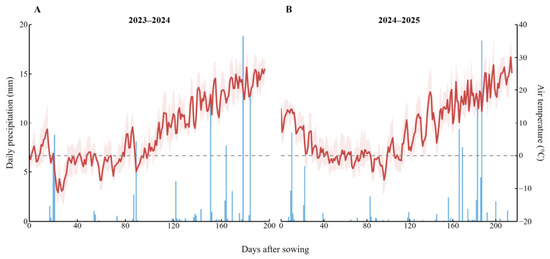
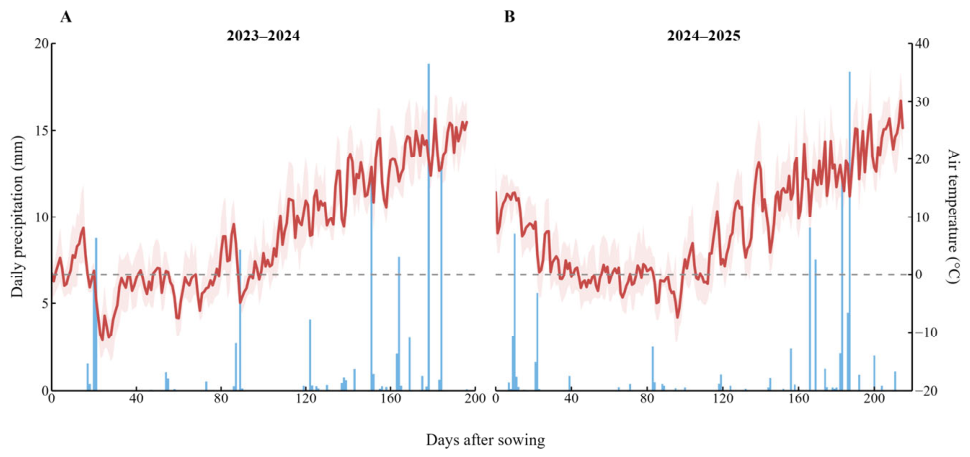
The two growing seasons differed in duration and mean air temperature, while cumulative precipitation was similar (Figure 1A,B). The 2023–2024 growing season lasted 197 d, from 23 November 2023 to 6 June 2024, with a mean air temperature of 7.23 °C and cumulative precipitation of 100.19 mm. In 2024–2025, sowing occurred 20 d earlier and the growing season extended to 216 d. Mean air temperature was 1.2 °C higher, reaching 8.43 °C, whereas cumulative precipitation was 7.48 mm lower, at 92.71 mm.
Figure 1.
Air temperature and precipitation during the 2023–2024 (A) and 2024–2025 (B) winter wheat growing seasons. Lines show daily mean air temperature, shaded areas show the daily minimum–maximum air temperature range, and bars show daily precipitation. The horizontal dashed line indicates 0 °C.
3.2. Soil Water Content, Soil Water Storage, and Soil Temperature
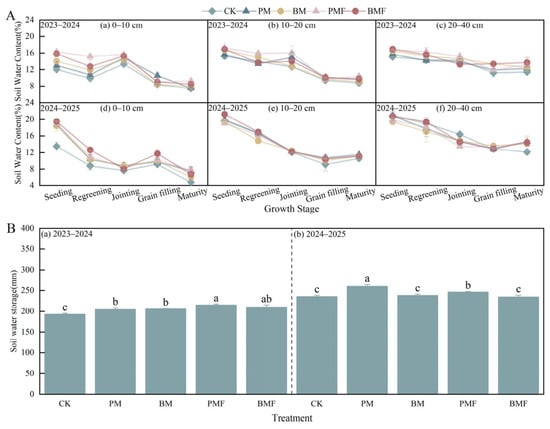
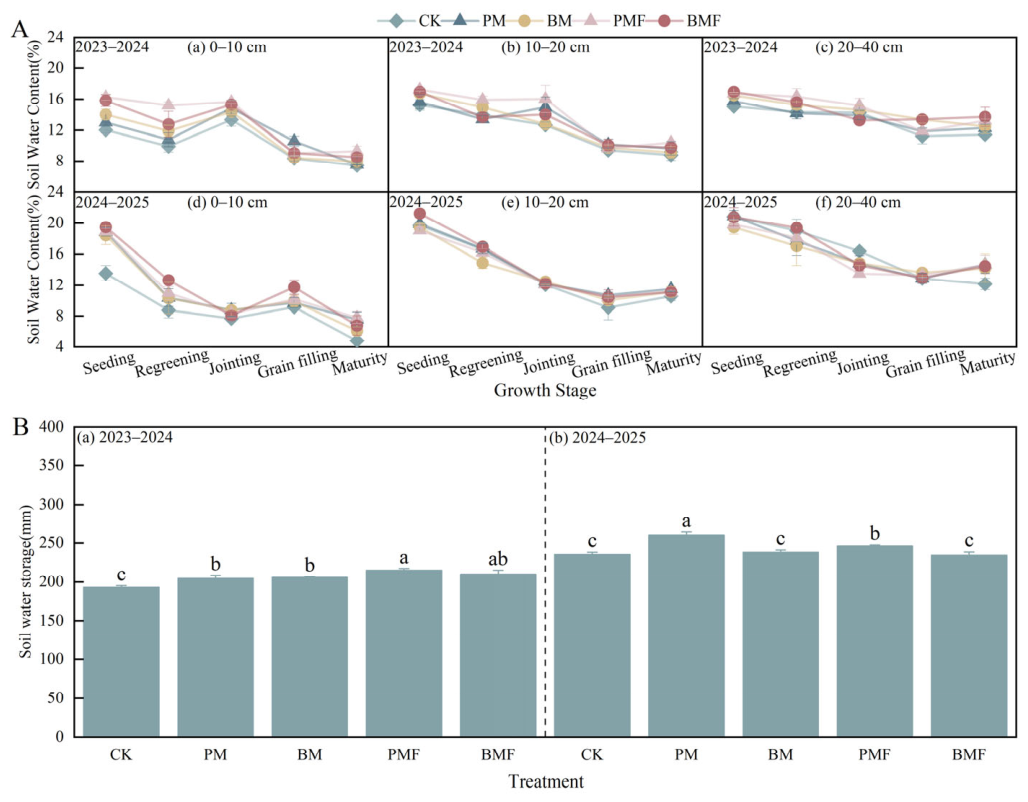
Soil water content varied with growth stage, depth, and growing season (Figure 2A). In 2023–2024, PMF had the highest mean gravimetric water contents in the 0–10, 10–20, and 20–40 cm layers, at 12.98%, 13.86%, and 14.67%, respectively. PMF also had significantly greater 0–100 cm soil water storage than CK and PM (Figure 2B). In 2024–2025, BMF had the highest corresponding water contents, at 11.75%, 14.40%, and 16.43%. However, 0–100 cm soil water storage was greatest under PM, followed by PMF, whereas BM and BMF did not differ significantly from CK.
Figure 2.
Soil water content (A) and soil water storage at maturity (B) under different mulching treatments during the two growing seasons. Different lowercase letters in panel (B) indicate significant differences among treatments within the same growing season at p < 0.05. CK, control without film mulching; PM, surface polyethylene film mulching; BM, surface biodegradable film mulching; PMF, sub-soil polyethylene film mulching; BMF, sub-soil biodegradable film mulching.
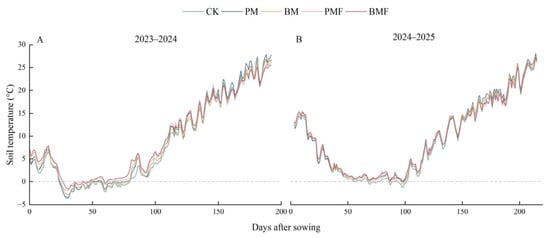
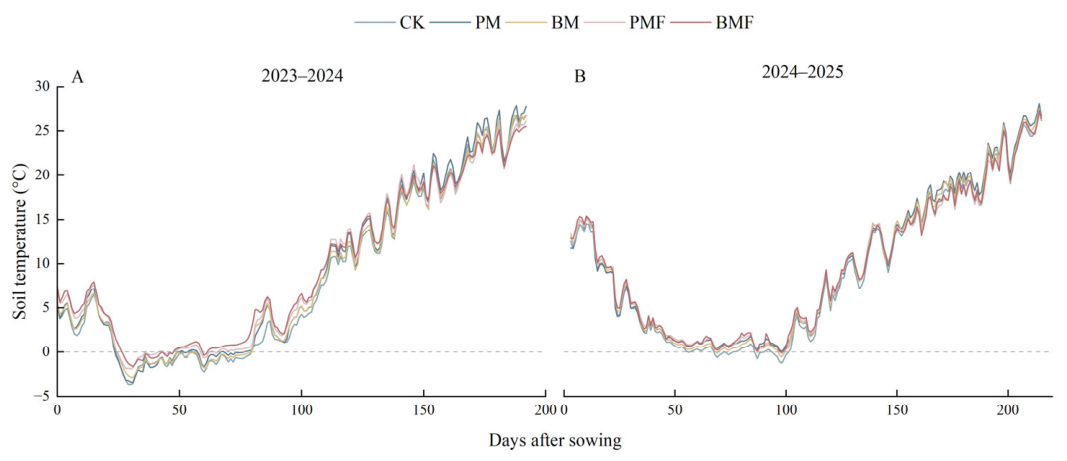
Treatment differences in mean soil temperature at 15 cm were stage dependent, with rankings changing after jointing (Figure 3A,B). From sowing to jointing, all four mulching treatments were warmer than CK by 0.43–1.56 °C in 2023–2024 and 0.52–0.80 °C in 2024–2025. Within each material, soil-covered treatments were warmer than the corresponding treatments without soil cover before jointing. PMF was 0.74 and 0.15 °C warmer than PM, and BMF was 1.13 and 0.28 °C warmer than BM, in 2023–2024 and 2024–2025, respectively. This pattern reversed after jointing. From jointing to grain filling, PMF was 0.85 and 1.41 °C cooler than PM, and BMF was 0.19 and 0.80 °C cooler than BM in 2023–2024 and 2024–2025, respectively. From grain filling to maturity, PMF was 0.91 and 1.15 °C cooler than PM, and BMF was 0.77 and 0.49 °C cooler than BM in the two seasons, respectively. PM remained warmer than CK across all three periods, by 0.64–1.47 °C in 2023–2024 and 0.58–0.98 °C in 2024–2025. Film material differences were smaller and less consistent. Across growth periods, BM was 0.06–0.99 °C cooler than PM, whereas BMF ranged from 0.84 °C cooler to 0.19 °C warmer than PMF.
Figure 3.
Daily soil temperature at 15 cm depth under different mulching treatments during the 2023–2024 (A) and 2024–2025 (B) winter wheat growing seasons. CK, control without film mulching; PM, surface polyethylene film mulching; BM, surface biodegradable film mulching; PMF, sub-soil polyethylene film mulching; BMF, sub-soil biodegradable film mulching.
3.3. Soil EC, Soluble Na+ Concentration, and SAR
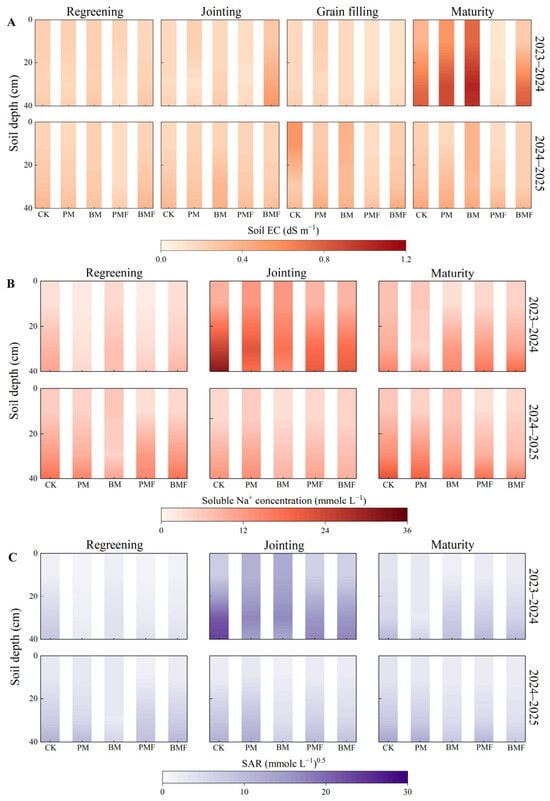
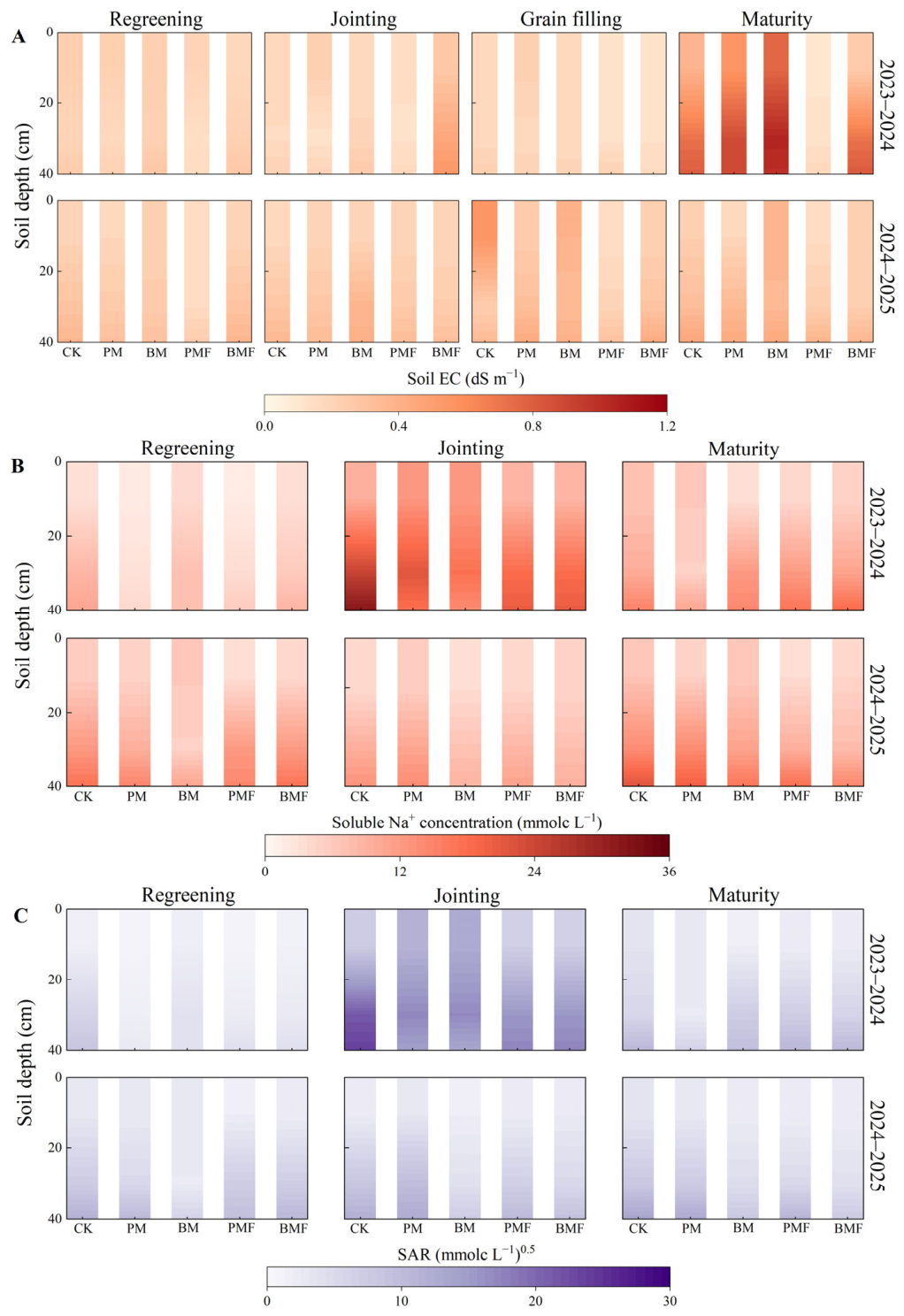
The salinity results presented here focus on the 0–40 cm soil layers (Figure 4). Treatment differences in EC were most evident in the 0–20 cm layer, whereas treatment rankings at 20–40 cm varied more across growth stages (Figure 4A). In the 0–20 cm layer, EC under PMF was 10.4–79.2% lower than under PM across all four growth stages in 2023–2024 and 2.5–38.4% lower in 2024–2025 (Figure 4A). EC under BMF was 20.3–66.6% lower than under BM at all stages except jointing in 2023–2024 and 4.0–43.7% lower at all four stages in 2024–2025. Relative to CK, EC under PMF was 12.9–70.5% lower at all four stages in 2023–2024 and 26.6–72.4% lower at all stages except jointing in 2024–2025. Across both growing seasons, EC under BMF was 3.1–60.7% lower than under CK at all stages except jointing.
Figure 4.
Electrical conductivity of the 1:5 soil–water extract (EC) (A), soluble Na+ concentration (B), and sodium adsorption ratio (SAR) (C) in the 0–40 cm soil layers at different growth stages under different mulching treatments during the two growing seasons. EC was measured at regreening, jointing, grain filling, and maturity, whereas soluble Na+ concentration and SAR were measured at regreening, jointing, and maturity.
In the 0–20 cm layer, PMF had lower Na+ and SAR than PM at all three sampling stages in both growing seasons (Figure 4B,C). Relative to PM, Na+ under PMF was 8.6–35.1% lower in 2023–2024 and 23.1–32.3% lower in 2024–2025, while SAR was lower by 7.7–42.1% and 25.3–30.3%, respectively. The direction of the BMF–BM difference changed with growth stage and soil depth. In 2023–2024, Na+ under BMF in the 0–20 cm layer was 45.9% higher than under BM at regreening, 29.4% lower at jointing, and higher again at maturity; SAR showed the same directional pattern, being higher under BMF at regreening and maturity and lower at jointing. In 2024–2025, Na+ and SAR under BMF in the 0–20 cm layer were lower than under BM at regreening and maturity, whereas this pattern was not observed at jointing. At 20–40 cm, treatment rankings for Na+ and SAR varied more among growth stages and between growing seasons than in the 0–20 cm layer. At maturity, Na+ and SAR in the 0–20 cm layer were lower under all four mulching treatments than under CK in both growing seasons, with Na+ reductions of 9.0–52.0% and 9.0–45.7% and SAR reductions of 14.2–50.8% and 18.0–41.1% in 2023–2024 and 2024–2025, respectively.
3.4. Canopy Development and Aboveground Dry Matter Accumulation
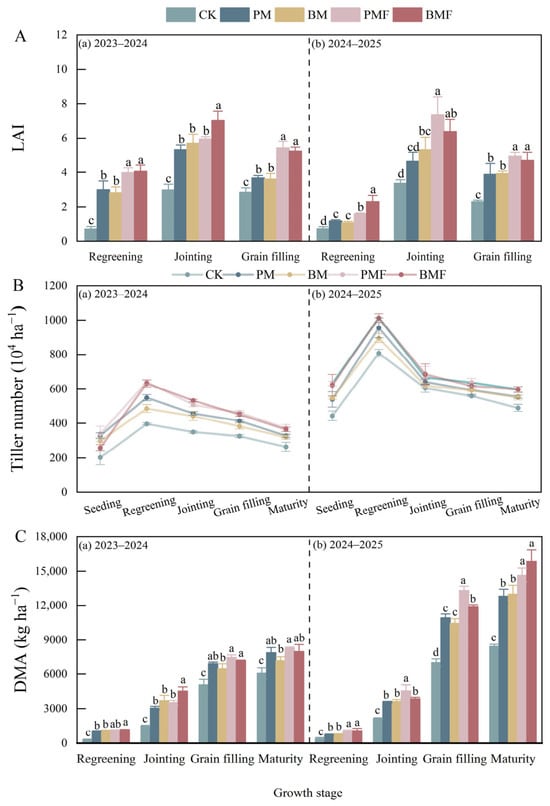
At regreening, jointing, and grain filling, LAI was generally higher under all four mulching treatments than under CK in both growing seasons (Figure 5A). Across both seasons and the three stages, LAI under PMF exceeded that under PM by 12.1–57.5%, whereas BMF exceeded BM by 20.0–113.9%. Tiller number peaked at regreening and then declined under all treatments; relative to CK, values under mulching were 17.3–61.6% higher across stages in 2023–2024 and 2.3–38.6% higher in 2024–2025 (Figure 5B).
Figure 5.
Leaf area index (LAI) (A), tiller number (B), and aboveground dry matter accumulation (DMA) (C) of winter wheat under different mulching treatments during the two growing seasons. Different lowercase letters indicate significant differences among treatments within the same growing season at p < 0.05.
The largest increase in aboveground dry matter occurred between jointing and grain filling (Figure 5C). From jointing to maturity, dry matter was significantly greater under all four mulching treatments than under CK. Before maturity, the maximum PMF–PM and BMF–BM differences reached 43.0% and 42.1%, respectively; at maturity, the corresponding differences were 5.0–14.6% and 10.8–21.8% across the two seasons. Film material rankings at maturity differed between years: PM and PMF were numerically higher than BM and BMF, respectively, in 2023–2024, whereas both rankings reversed in 2024–2025.
3.5. Grain Yield, Yield Components, and Water Use Efficiency
Spike number and grains per spike were significantly higher under all four mulching treatments than under CK in both growing seasons (Table 2). Across the two seasons, PMF exceeded PM in spike number by 7.8–13.5% and in grains per spike by 12.7–17.0%, whereas BMF exceeded BM by 8.5–13.9% and 3.1–7.4%, respectively. PMF and BMF had significantly more spikes than PM and BM, respectively, whereas a significant increase in grains per spike was observed only for PMF relative to PM. Treatment differences in 1000-grain weight were detected only in 2023–2024, when BM had the highest value and differed significantly from CK, PMF, and BMF, but not from PM; no significant differences were detected in 2024–2025.
Table 2.
Grain yield, yield components, seasonal evapotranspiration, and grain yield water use efficiency of winter wheat under different treatments.
Grain yield under all four mulching treatments was significantly higher than under CK, by 21.0–42.6% in 2023–2024 and 37.5–80.8% in 2024–2025. PMF significantly exceeded PM by 9.0% and 26.3%, whereas BMF significantly exceeded BM by 13.7% and 19.7% in the two growing seasons, respectively. PMF had the highest grain yield in 2023–2024 and BMF in 2024–2025, although PMF and BMF did not differ significantly in either season.
In 2023–2024, estimated seasonal ET under all four mulching treatments was 8.4–16.2% lower than under CK, whereas in 2024–2025 only PM differed significantly from CK, with a 10.2% higher value (Table 2). WUEy was significantly higher under all four mulching treatments than under CK in both growing seasons. PMF exceeded PM in WUEy by 19.1% and 33.4% in 2023–2024 and 2024–2025, respectively, whereas the corresponding BMF–BM increases were 17.8% and 22.6%.
3.6. Factorial Effects of Film Material, Soil Cover over Film, and Growing Season
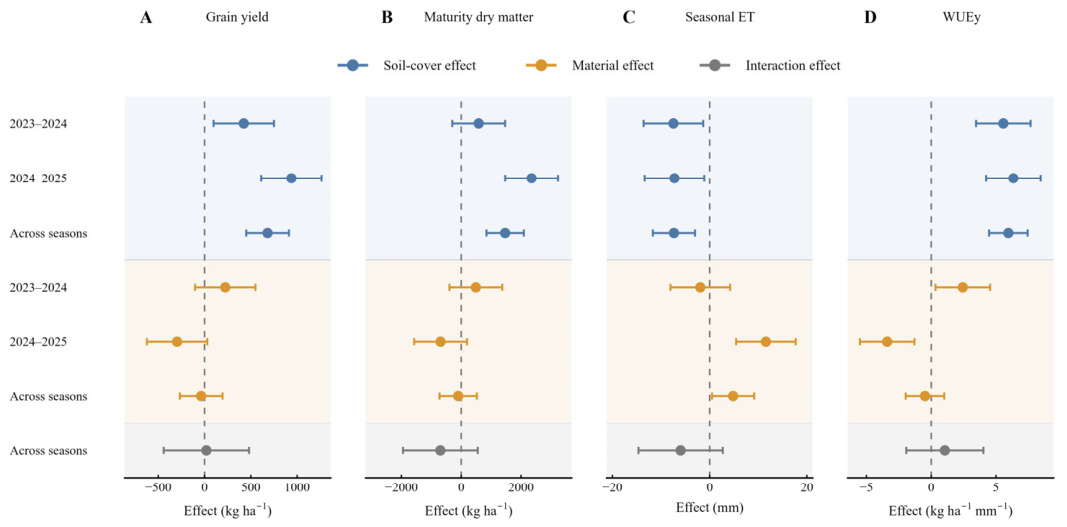
Growing season significantly affected all seven evaluated variables, whereas soil cover over film affected all variables except 1000-grain weight (Table 3). Averaged across growing seasons and film materials, soil cover over film increased grain yield, maturity dry matter, and WUEy by 17.3%, 14.0%, and 22.4%, respectively, while estimated seasonal ET was 4.8% lower (Figure 6A–D). The effect of soil cover over film varied between growing seasons for grain yield, maturity dry matter, and 1000-grain weight, but not for estimated seasonal ET or WUEy. The increases in grain yield and maturity dry matter associated with soil cover rose from 11.3% and 7.8% in 2023–2024 to 22.8% and 18.2% in 2024–2025, respectively (Figure 6A,B). Film material significantly affected only estimated seasonal ET, which was 3.3% higher under polyethylene film when averaged across growing seasons (Figure 6C). Material effects on grain yield, grains per spike, maturity dry matter, estimated seasonal ET, and WUEy varied between growing seasons (Table 3). Grain yield, maturity dry matter, and WUEy under polyethylene film were 5.8–7.7% higher than under biodegradable film in 2023–2024 but 4.7–12.2% lower in 2024–2025 (Figure 6A,B,D). Grains per spike showed the same reversal, changing from 2.9% higher under polyethylene film in 2023–2024 to 10.8% lower in 2024–2025 (Table 3). Seasonal ET showed the opposite pattern, changing from 1.6% lower under polyethylene film in 2023–2024 to 6.8% higher in 2024–2025 (Figure 6C). The effect of soil cover over film did not differ significantly between film materials for any of the seven variables, and no significant three-way interaction was detected.
Table 3.
p values from linear mixed-effects models testing the effects of film material, soil cover over film, growing season, and their interactions.
Figure 6.
Estimated effects of soil cover over film and film material on grain yield (A), maturity dry matter (B), seasonal evapotranspiration (ET) (C), and grain yield water use efficiency (WUEy) (D). The soil cover contrast represents treatments with soil cover relative to those without soil cover, the material contrast represents polyethylene film (PE) relative to biodegradable film (BIO), and the interaction contrast represents the difference in the soil cover effect between PE and BIO. Points and horizontal bars show estimated effects and 95% confidence intervals, respectively. The dashed vertical line indicates zero effect.
3.7. Pathways Linking Overall Mulching and Soil Cover over Film to Grain Yield
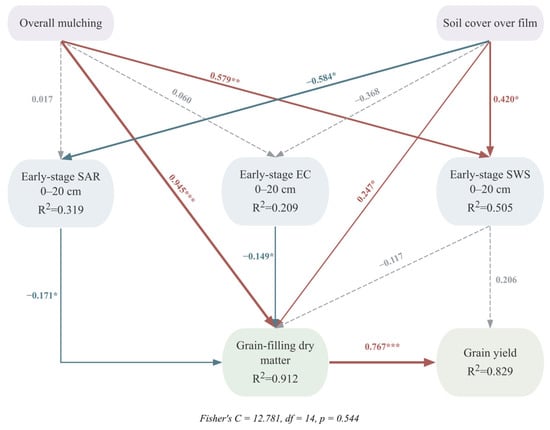
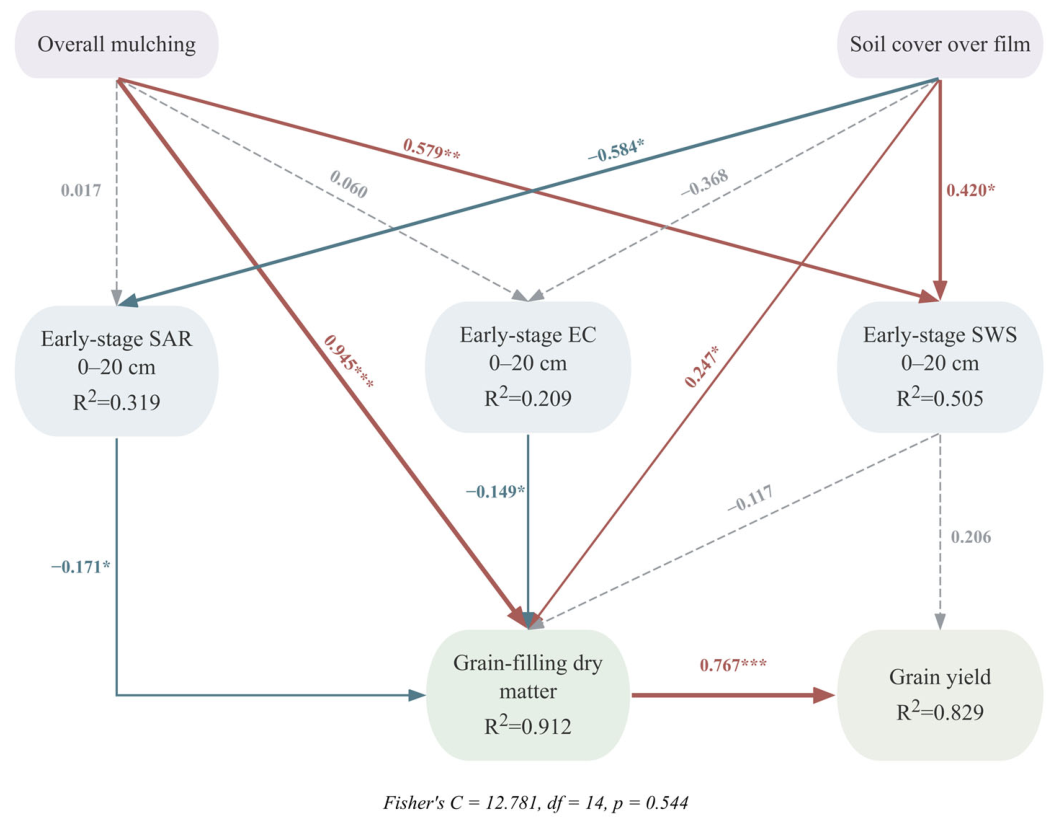
The pSEM showed no evidence of lack of fit (Fisher’s C = 12.781, df = 14, p = 0.544; Figure 7). Overall mulching (0.945, p < 0.001) and soil cover over film (0.247, p = 0.015) were positively associated with grain-filling dry matter, which was positively associated with grain yield (0.767, p < 0.001). Early-stage SWS was positively associated with overall mulching (0.579, p = 0.001) and soil cover over film (0.420, p = 0.010), whereas its associations with grain-filling dry matter (−0.117, p = 0.099) and grain yield (0.206, p = 0.072) were not significant. Soil cover over film was negatively associated with early-stage SAR (−0.584, p = 0.017), whereas overall mulching was not significantly associated with SAR. Neither overall mulching nor soil cover over film was significantly associated with early-stage EC, while both early-stage EC (−0.149, p = 0.021) and SAR (−0.171, p = 0.026) were negatively associated with grain-filling dry matter.
Figure 7.
Piecewise structural equation model linking overall mulching and soil cover over film with soil conditions, grain-filling dry matter, and grain yield. Early-stage soil water storage (SWS), electrical conductivity of the 1:5 soil–water extract (EC), and sodium adsorption ratio (SAR) represent the mean values at the regreening and jointing stages in the 0–20 cm soil layer. R2 denotes marginal R2, representing the variance explained by fixed effects. Numbers beside arrows are standardized path coefficients, with EC and SAR paths representing observational associations. Red and blue solid arrows indicate significant positive and negative paths, respectively, whereas gray dashed arrows indicate nonsignificant paths. * p < 0.05, ** p < 0.01, *** p < 0.001.
4. Discussion
4.1. Effects of Sub-Soil Film Mulching on Soil Water, Temperature, Salinity, and Sodicity
Soil cover over film did not affect soil water uniformly through the profile, and the response also differed between growing seasons. In 2023–2024, PMF maintained higher water content in the upper soil together with greater 0–100 cm SWS. In 2024–2025, BMF showed higher water content in the upper soil, but this was not accompanied by greater SWS across the 0–100 cm profile. Sub-soil film mulching can reduce soil evaporation and retain more water near the soil surface, while part of the conserved water may subsequently be used through crop transpiration and root uptake rather than remain in the soil until maturity [9,12]. SWS across the 0–100 cm profile therefore reflects the balance among rainfall input, infiltration, water redistribution, evaporation, and crop water uptake rather than simply the amount of water conserved by film placement [25,26]. The weaker correspondence between upper soil moisture and profile SWS in 2024–2025 may reflect greater crop water use during the longer and warmer growing season. These results suggest that soil cover over film affected the distribution and subsequent use of soil water during the growing season rather than simply increasing the amount remaining in the 0–100 cm profile at maturity.
The effect of soil cover over film on soil temperature was more consistent than that on soil water. PMF and BMF were warmer than PM and BM, respectively, before jointing, but cooler afterwards. Similar responses across growth stages have been reported in mulched winter wheat, with soil warming before jointing followed by lower temperatures later in the season [9,34]. Before jointing, the sparse canopy leaves the soil surface more exposed, and the film can reduce heat loss and maintain a warmer soil environment. As the canopy developed, greater shading reduced the radiation reaching the soil surface, while higher soil water content could further moderate temperature fluctuations [34]. The thin soil layer above the film may also have slowed heat exchange with the atmosphere [11,34]. Soil cover over film therefore moderated soil temperature across the growing season rather than maintaining a persistent warming effect.
The effect of soil cover over film on soil salinity was most evident in the 0–20 cm layer, whereas treatment patterns at 20–40 cm were more variable across growth stages. The 0–40 cm presentation focuses on upper-soil responses to film placement, consistent with the shallow-soil effects reported in previous winter wheat studies [12,13]. In both growing seasons, EC in the 0–20 cm layer was generally lower under PMF and BMF than under PM and BM, respectively, with the differences particularly evident from grain filling to maturity. Sub-soil film mulching has also been shown to reduce salinity in the upper soil of saline winter wheat fields [12,13,18]. By reducing soil evaporation, sub-soil film mulching can weaken the upward transport of water and dissolved salts, thereby limiting salt accumulation near the soil surface [10,35]. The stronger response in the 0–20 cm layer likely reflects the greater influence of surface evaporation, while salt distribution at 20–40 cm is also shaped by infiltration, water redistribution, and root uptake [12,35]. The magnitude of salinity reduction under mulching can also vary with climate, soil conditions, and management practices [36]. Higher water content in the upper soil and more moderate soil temperatures after jointing may also have limited salt accumulation in the 0–20 cm layer. These differences in the upper soil do not demonstrate net salt removal from the soil profile, as salt redistribution may also contribute to the observed patterns.
Na+ and SAR did not always follow the same treatment pattern as EC, showing that overall salinity and relative Na+ enrichment did not necessarily change in parallel. PMF generally maintained lower Na+ and SAR than PM, while differences between BMF and BM changed with growth stage and growing season. This divergence was particularly clear at jointing in 2023–2024, when BMF had higher EC but lower Na+ and SAR than BM in the 0–20 cm layer. This pattern reflects the different information represented by these indicators. EC represents salinity in the extract, whereas SAR expresses Na+ relative to Ca2+ and Mg2+ rather than directly measuring exchangeable sodium percentage or soil structural change [5,22]. Lower SAR therefore indicates weaker relative Na+ enrichment and a lower sodicity risk, although the consequences for soil structure also depend on salinity and soil properties [5,6]. Although the response of BMF varied with growth stage and growing season, the SAR results show that EC alone did not fully capture changes in sodium balance.
4.2. Effects of Sub-Soil Film Mulching on Crop Growth, Grain Yield, and Water Use Efficiency
Mulching promoted early crop growth, which was later reflected in canopy development and dry matter accumulation. Relative to CK, all mulching treatments maintained more tillers at regreening. Although tiller number declined with crop development, PMF and BMF maintained greater LAI than the corresponding surface film treatments. After jointing, this difference was increasingly reflected in aboveground dry matter accumulation and remained evident at maturity. Similar responses have been reported in winter wheat, where improved soil water and temperature under mulching favored tiller establishment and canopy development and were followed by greater biomass accumulation [9,37]. In coastal saline–alkali winter wheat, sub-soil film mulching has likewise increased effective tillering and dry matter accumulation [13]. Improved soil water, temperature, and salinity conditions may have favored early tiller and canopy development. Greater dry matter around anthesis can provide a larger biomass base for subsequent yield formation, while dry matter accumulation after anthesis contributes to grain filling [37,38]. The greater dry matter under soil cover over film likely developed from earlier advantages in tillering and canopy growth.
The greater dry matter at maturity was accompanied by higher grain yield. Under both film materials, soil-covered treatments significantly increased grain yield in each growing season. Relative to PM and BM, respectively, grain yield was 9.0–26.3% higher under PMF and 13.7–19.7% higher under BMF. Spike number also increased under both PMF and BMF, whereas a significant increase in grains per spike was observed only under PMF relative to PM. PMF and BMF had more spikes than PM and BM, respectively, in both growing seasons, whereas 1000-grain weight changed little. Previous studies have similarly identified spike number as a major determinant of wheat yield under film mulching [39,40]. Higher grain yield under soil-covered treatments was accompanied by higher WUEy and lower estimated seasonal ET in both growing seasons. Similar responses have been reported in rainfed winter wheat, where film mulching increased grain yield and WUE without consistently reducing seasonal water use [11,41]. Higher WUEy in the present study therefore reflected greater grain yield together with lower estimated seasonal ET under soil cover.
4.3. Agronomic Performance of Sub-Soil Biodegradable Film Mulching
Factorial analysis showed that soil cover over film produced more consistent agronomic responses across the two growing seasons than film material. Averaged across film materials and growing seasons, soil cover over film increased grain yield and WUEy by 17.3% and 22.4%, respectively, while reducing estimated seasonal ET by 4.8%. The WUEy response was consistent between growing seasons, whereas the increases in grain yield and maturity dry matter were greater in 2024–2025. Film material had no significant main effect on grain yield, maturity dry matter, or WUEy, although estimated seasonal ET was higher under polyethylene film. The relative performance of polyethylene and biodegradable films reversed between seasons for grain yield, maturity dry matter, and WUEy. Previous field studies have shown that biodegradable film performance varies with climatic conditions and film characteristics [42,43]. The timing of film degradation is important because premature loss of film integrity can reduce the water conservation effect of mulching during crop growth [17,44,45]. Differences in film degradation may have contributed to the reversal between polyethylene and biodegradable films, but this explanation remains speculative.
The factorial analysis showed how agronomic responses varied with management factors and between growing seasons, while the pSEM related these responses to soil conditions, grain-filling dry matter, and grain yield. Overall mulching and soil cover over film were positively associated with grain-filling dry matter, which was positively associated with grain yield. This relationship is consistent with the importance of biomass accumulation around anthesis for wheat yield formation [38,46,47]. The greater grain-filling dry matter under mulching was also consistent with the earlier improvements in soil temperature and canopy development observed in this study [9,13,37]. Overall mulching and soil cover over film were also positively associated with early-stage SWS, but SWS was not significantly related to grain-filling dry matter or grain yield. This suggests that greater early-stage water storage did not necessarily translate into greater biomass accumulation or grain yield later in the season. The contribution of stored soil water to winter wheat depends on its redistribution and use during later growth, particularly from deeper soil layers and after anthesis [41,48]. Soil cover over film was also associated with lower early-stage SAR, while higher SAR and EC were each associated with lower grain-filling dry matter. Long-term saline irrigation studies have similarly linked higher SAR with poorer soil physical conditions and lower crop productivity [49]. This pattern suggests that lower early-stage SAR was associated with greater grain-filling dry matter under soil cover. Although soil-covered treatments reduced EC at several sampling stages, soil cover over film was not significantly associated with early-stage EC in the pSEM. This difference may reflect the timing of the EC response, as soil salinity changes during crop growth with evaporation, infiltration, and water redistribution [10,12,35]. In this study, treatment differences in EC were clearer later in the season, whereas the pSEM used the mean of regreening and jointing to represent early-stage EC. The negative relationship between early-stage EC and grain-filling dry matter is consistent with reduced wheat growth under saline conditions [50]. However, with only 15 plots, sampling uncertainty should be considered when interpreting these associations, and the proposed pathways require further testing before causal mediation can be established.
The effects of soil cover over film on grain yield, maturity dry matter, and WUEy did not differ significantly between biodegradable and polyethylene films. However, the absence of a significant interaction should not be interpreted as agronomic equivalence between BMF and PMF. Biodegradable film degradation depends on field conditions and exposure time, and its timing affects how long the film can maintain its water conservation and temperature regulation functions during crop growth [51,52]. Its agronomic performance relative to polyethylene film also varies with rainfall and soil conditions [53]. Across the two growing seasons, BMF showed agronomic potential for rainfed winter wheat in coastal saline–alkali soil. However, these single-site findings should be interpreted with possible carryover effects in mind. Studies conducted over more years and locations are needed to determine whether this performance remains stable under different field conditions.
5. Conclusions
Across two growing seasons, soil cover over film improved the agronomic performance of rainfed winter wheat in coastal saline–alkali soil. Compared with treatments without soil cover, treatments with soil cover maintained higher soil temperatures before jointing and lower temperatures thereafter and generally reduced EC and Na+ concentration in the 0–20 cm soil layer. Averaged across both growing seasons and film materials, soil cover over film increased grain yield and WUEy by 17.3% and 22.4%, respectively, while estimated seasonal ET was 4.8% lower. The pSEM associated soil cover over film with early-stage SWS and grain-filling dry matter, and greater grain-filling dry matter was associated with higher grain yield. Soil cover over film was associated with early-stage SAR, while higher early-stage EC and SAR were associated with lower grain-filling dry matter. The effects of soil cover over film on grain yield and WUEy did not differ significantly between film materials. Across the two growing seasons, BMF showed agronomic potential for rainfed winter wheat in coastal saline–alkali soil, although its performance relative to PMF remains to be evaluated across different years and locations.
Supplementary Materials
The following supporting information can be downloaded at: https://www.mdpi.com/article/10.3390/agronomy16212207/s1, Supplementary Materials S1. Statistical model specifications.
Author Contributions
Conceptualization, Y.W., Q.L. and M.Z.; methodology, Y.W., B.J. and M.Z.; validation, Y.W., C.S., Q.M. and M.Z.; formal analysis, Y.W., C.S., Q.M., Q.Z. and M.Z.; investigation, Y.W., B.J., D.X., Z.B. and T.J.; resources, B.J.; data curation, Y.W., B.J., D.X., Z.B. and T.J.; writing—original draft preparation, Y.W. and B.J.; writing—review and editing, D.X., Z.B., T.J., Q.L., C.S., Q.Z., Q.M. and M.Z.; funding acquisition, M.Z. All authors have read and agreed to the published version of the manuscript.
Funding
This study was supported by the National Key Research and Development Program of China (2023YFD1701901; 2023YFD1902605), the National Natural Science Foundation of China (32001473), the Earmarked Fund for the Key Research and Development Program of Shandong Province (2023TZXD009) and the Youth Innovation Team of Shandong Province (2023KJ162).
Data Availability Statement
The original contributions presented in this study are included in the article/Supplementary Materials. Further inquiries can be directed to the corresponding author.
Conflicts of Interest
The authors declare no conflicts of interest.
References
- Meng, Q.; Zhang, C.; Zhao, J.; Zhang, J.; Lu, Y.; Liu, F. Saline-alkali soil amelioration in China: A systematic review and evidence synthesis. Agric. Water Manag. 2026, 327, 110296. [Google Scholar] [CrossRef] [Scilit]
- Xie, H.; Li, J.; Zhang, Y.; Xu, X.; Wang, L.; Ouyang, Z. Evaluation of coastal farming under salinization and optimized fertilization strategies in China. Sci. Total Environ. 2021, 797, 149038. [Google Scholar] [CrossRef] [Scilit] [PubMed]
- Zhu, K.; Song, F.; Duan, F.; Zhuge, Y.; Chen, W.; Yang, Q.; Guo, X.; Hong, P.; Wan, L.; Lin, Q. Fertilizer 15N Fates of the Coastal Saline Soil-Wheat Systems with Different Salinization Degrees in the Yellow River Delta. Water 2022, 14, 3748. [Google Scholar] [CrossRef] [Scilit]
- Guo, S.; Li, X.; Šimůnek, J.; Wang, J.; Zhang, Y.; Wang, Y.n.; Zhen, Z.; He, R. Experimental and numerical evaluation of soil water and salt dynamics in a corn field with shallow saline groundwater and crop-season drip and autumn post-harvest irrigations. Agric. Water Manag. 2024, 305, 109119. [Google Scholar] [CrossRef] [Scilit]
- Adeyemo, T.; Kramer, I.; Levy, G.J.; Mau, Y. Salinity and sodicity can cause hysteresis in soil hydraulic conductivity. Geoderma 2022, 413, 115765. [Google Scholar] [CrossRef] [Scilit]
- Fei, Y.; She, D.; Tang, S.; Wang, H.; Sun, X.; Han, X.; Liu, D. Assessing Roles of Aggregate Structure on Hydraulic Properties of Saline/Sodic Soils in Coastal Reclaimed Areas. Agronomy 2024, 14, 2877. [Google Scholar] [CrossRef] [Scilit]
- Desoky, E.-S.M.; Abdel-Hamed, E.M.W.; Abd El-Mageed, T.A.; Majrashi, A.; Ahmed, A.F.; Abou-Elsebaa, H.M.; Mosa, W.F.A.; Saad, A.M.; El-Saadony, M.T.; AbuQamar, S.F.; et al. Integrative use of maize grain embryo extract and bioactive compounds to enhance salinity tolerance in bread wheat (Triticum aestivum L.). Field Crops Res. 2025, 333, 110072. [Google Scholar] [CrossRef] [Scilit]
- Lei, S.; Jia, X.; Zhao, C.; Shao, M. A review of saline-alkali soil improvements in China: Efforts and their impacts on soil properties. Agric. Water Manag. 2025, 317, 109617. [Google Scholar] [CrossRef] [Scilit]
- Yang, Y.; Ding, J.; Zhang, Y.; Wu, J.; Zhang, J.; Pan, X.; Gao, C.; Wang, Y.; He, F. Effects of tillage and mulching measures on soil moisture and temperature, photosynthetic characteristics and yield of winter wheat. Agric. Water Manag. 2018, 201, 299–308. [Google Scholar] [CrossRef] [Scilit]
- Chen, N.; Li, X.; Šimůnek, J.; Zhang, Y.; Shi, H.; Hu, Q.; Xin, M. Evaluating soil salts dynamics under biodegradable film mulching with different disintegration rates in an arid region with shallow and saline groundwater: Experimental and modeling study. Geoderma 2022, 423, 115969. [Google Scholar] [CrossRef] [Scilit]
- Chai, Y.; Chai, Q.; Yang, C.; Chen, Y.; Li, R.; Li, Y.; Chang, L.; Lan, X.; Cheng, H.; Chai, S. Plastic film mulching increases yield, water productivity, and net income of rain-fed winter wheat compared with no mulching in semiarid Northwest China. Agric. Water Manag. 2022, 262, 107420. [Google Scholar] [CrossRef] [Scilit]
- Zhang, M.; Dong, B.; Qiao, Y.; Yang, H.; Wang, Y.; Liu, M. Effects of sub-soil plastic film mulch on soil water and salt content and water utilization by winter wheat under different soil salinities. Field Crops Res. 2018, 225, 130–140. [Google Scholar] [CrossRef] [Scilit]
- Wang, C.; Qiao, Y.; Zong, R.; Sun, C.; Li, Q.; Zhang, M. Sub-soil plastic film mulch promotes the growth and yield improvement of winter wheat in coastal saline–alkali soil. Crop Sci. 2024, 64, 442–454. [Google Scholar] [CrossRef] [Scilit]
- Gu, X.; Yin, R.; Cai, W.; Chen, P.; Cui, K.; Du, Y.; Li, Y.; Cai, H. Residual plastic film decreases crop yield and water use efficiency through direct negative effects on soil physicochemical properties and root growth. Sci. Total Environ. 2024, 946, 174204. [Google Scholar] [CrossRef] [Scilit] [PubMed]
- Gao, X.; Xie, D.; Yang, C. Effects of a PLA/PBAT biodegradable film mulch as a replacement of polyethylene film and their residues on crop and soil environment. Agric. Water Manag. 2021, 255, 107053, Corrigendum in Agric. Water Manag. 2021, 258, 107176. https://doi.org/10.1016/j.agwat.2021.107176. [Google Scholar] [CrossRef] [Scilit]
- Gu, X.; Cai, H.; Fang, H.; Li, Y.; Chen, P.; Li, Y. Effects of degradable film mulching on crop yield and water use efficiency in China: A meta-analysis. Soil Tillage Res. 2020, 202, 104676. [Google Scholar] [CrossRef] [Scilit]
- Yin, T.; Yao, Z.; Yan, C.; Liu, Q.; Ding, X.; He, W. Maize yield reduction is more strongly related to soil moisture fluctuation than soil temperature change under biodegradable film vs plastic film mulching in a semi-arid region of northern China. Agric. Water Manag. 2023, 287, 108351. [Google Scholar] [CrossRef] [Scilit]
- Wang, C.; Dong, J.; Ji, B.; Lv, Y.; Song, Y.; Li, Q.; Sun, C.; Zong, R.; Zhang, M. Sub-soil biodegradable film mulching: A sustainable solution for enhancing winter wheat yield and shaping soil microbial communities in saline-alkali soils. J. Hazard. Mater. 2025, 495, 139020. [Google Scholar] [CrossRef] [Scilit] [PubMed]
- GB 13735-2017; Polyethylene Blown Mulch Film for Agricultural Uses. General Administration of Quality Supervision, Inspection and Quarantine of the PRC: Beijing, China, 2017.
- GB/T 35795-2017; Biodegradable Mulching Film for Agricultural Uses. General Administration of Quality Supervision, Inspection and Quarantine of the PRC. Beijing, China, 2017.
- He, Y.; DeSutter, T.; Prunty, L.; Hopkins, D.; Jia, X.; Wysocki, D.A. Evaluation of 1:5 soil to water extract electrical conductivity methods. Geoderma 2012, 185–186, 12–17. [Google Scholar] [CrossRef] [Scilit]
- Gharaibeh, M.A.; Albalasmeh, A.A.; Pratt, C.; El Hanandeh, A. Estimation of exchangeable sodium percentage from sodium adsorption ratio of salt-affected soils using traditional and dilution extracts, saturation percentage, electrical conductivity, and generalized regression neural networks. CATENA 2021, 205, 105466. [Google Scholar] [CrossRef] [Scilit]
- Yuan, H.; Zhang, A.; Zhu, C.; Dang, H.; Zheng, C.; Zhang, J.; Cao, C. Saline Water Irrigation Changed the Stability of Soil Aggregates and Crop Yields in a Winter Wheat–Summer Maize Rotation System. Agronomy 2024, 14, 2564. [Google Scholar] [CrossRef] [Scilit]
- Apolo-Apolo, O.E.; Pérez-Ruiz, M.; Martínez-Guanter, J.; Egea, G. A Mixed Data-Based Deep Neural Network to Estimate Leaf Area Index in Wheat Breeding Trials. Agronomy 2020, 10, 175. [Google Scholar] [CrossRef] [Scilit]
- He, G.; Wang, Z.; Li, F.; Dai, J.; Li, Q.; Xue, C.; Cao, H.; Wang, S.; Malhi, S.S. Soil water storage and winter wheat productivity affected by soil surface management and precipitation in dryland of the Loess Plateau, China. Agric. Water Manag. 2016, 171, 1–9. [Google Scholar] [CrossRef] [Scilit]
- Ding, D.; Zhao, Y.; Feng, H.; Hill, R.L.; Chu, X.; Zhang, T.; He, J. Soil water utilization with plastic mulching for a winter wheat-summer maize rotation system on the Loess Plateau of China. Agric. Water Manag. 2018, 201, 246–257. [Google Scholar] [CrossRef] [Scilit]
- Belkher, S.; Latrech, B.; Bekri, W.; Markwordt, F.; Rahim, M.A.; Dupont, C.; Ben Abdallah, M.A.; Daghari, H.; Rezig, M. Deficit Irrigation and an IoT-Based System for Improving Yield and Water Use Efficiency of Winter Wheat Grown Under Semi-Arid Conditions. Agronomy 2025, 15, 157. [Google Scholar] [CrossRef] [Scilit]
- Ru, C.; Hu, X.; Wang, W.; Yan, H. Impact of nitrogen on photosynthesis, remobilization, yield, and efficiency in winter wheat under heat and drought stress. Agric. Water Manag. 2024, 302, 109013. [Google Scholar] [CrossRef] [Scilit]
- Piepho, H.P.; Edmondson, R.N. A tutorial on the statistical analysis of factorial experiments with qualitative and quantitative treatment factor levels. J. Agron. Crop Sci. 2018, 204, 429–455. [Google Scholar] [CrossRef] [Scilit]
- Pagliari, P.; Galindo, F.S.; Strock, J.; Rosen, C. Use of Repeated Measures Data Analysis for Field Trials with Annual and Perennial Crops. Plants 2022, 11, 1783. [Google Scholar] [CrossRef] [Scilit] [PubMed]
- Liu, H.; Ma, Y.; Wei, Y.; Wu, C.; Zhang, Y. Biochar and Nitrogen Fertilizer Synergies: Enhancing Soil Properties and Jujube Fruit Quality in Saline–Alkali Orchards of Southern Xinjiang. Agronomy 2025, 15, 2205. [Google Scholar] [CrossRef] [Scilit]
- Lefcheck, J.S. piecewiseSEM: Piecewise structural equation modelling in r for ecology, evolution, and systematics. Methods Ecol. Evol. 2016, 7, 573–579. [Google Scholar] [CrossRef] [Scilit]
- Shipley, B. Confirmatory path analysis in a generalized multilevel context. Ecology 2009, 90, 363–368. [Google Scholar] [CrossRef] [Scilit] [PubMed]
- Li, Y.; Chai, S.; Chai, Y.; Li, R.; Lan, X.; Ma, J.; Cheng, H.; Chang, L. Effects of mulching on soil temperature and yield of winter wheat in the semiarid rainfed area. Field Crops Res. 2021, 271, 108244. [Google Scholar] [CrossRef] [Scilit]
- Zhu, W.; Yang, J.; Yao, R.; Xie, W.; Wang, X.; Liu, Y. Soil water-salt control and yield improvement under the effect of compound control in saline soil of the Yellow River Delta, China. Agric. Water Manag. 2022, 263, 107455. [Google Scholar] [CrossRef] [Scilit]
- Song, Y.; Sun, J.; Cai, M.; Li, J.; Bi, M.; Gao, M. Effects of management of plastic and straw mulching management on crop yield and soil salinity in saline-alkaline soils of China: A meta-analysis. Agric. Water Manag. 2025, 308, 109309. [Google Scholar] [CrossRef] [Scilit]
- Fang, H.; Liu, F.; Gu, X.; Chen, P.; Li, Y.; Li, Y. The effect of source–sink on yield and water use of winter wheat under ridge-furrow with film mulching and nitrogen fertilization. Agric. Water Manag. 2022, 267, 107616. [Google Scholar] [CrossRef] [Scilit]
- Zhang, R.; Zhang, C.; Lei, T.; Xu, J.; Zhang, P.; Hu, C.; Sadras, V.; Yang, X.; Zhang, S. Dynamics of Structural Dry Matter, Water Soluble Carbohydrates and Leaf Senescence Mediate the Response of Winter Wheat Yield to Soil Cover and Water Availability. Agronomy 2023, 13, 336. [Google Scholar] [CrossRef] [Scilit]
- Dou, Y.; Zhao, H.; Yang, H.; Wang, T.; Liu, G.; Wang, Z.; Malhi, S. The first factor affecting dryland winter wheat grain yield under various mulching measures: Spike number. J. Integr. Agric. 2024, 23, 836–848. [Google Scholar] [CrossRef] [Scilit]
- Chai, Y.; Li, Y.; Li, R.; Chang, L.; Cheng, H.; Ma, J.; Qin, Y.; Han, F.; Yang, C.; Chen, Y.; et al. Increased spike density and enhanced vegetative growth as primary contributors to improvement of dryland wheat yield via surface mulching. Field Crops Res. 2025, 326, 109853. [Google Scholar] [CrossRef] [Scilit]
- Zhang, R.; Lei, T.; Wang, Y.; Xu, J.; Zhang, P.; Han, Y.; Hu, C.; Yang, X.; Sadras, V.; Zhang, S. Responses of yield and water use efficiency to the interaction between water supply and plastic film mulch in winter wheat-summer fallow system. Agric. Water Manag. 2022, 266, 107545, Corrigendum in Agric. Water Manag. 2022, 273, 107914. https://doi.org/10.1016/j.agwat.2022.107914. [Google Scholar] [CrossRef] [Scilit]
- Huang, F.; Liu, Z.; Li, Z.; Wang, B.; Zhang, P.; Jia, Z. Is biodegradable film an alternative to polyethylene plastic film for improving maize productivity in rainfed agricultural areas?—Evidence from field experiments. Agric. Water Manag. 2022, 272, 107868. [Google Scholar] [CrossRef] [Scilit]
- Lin, N.; Luo, X.; Wen, J.; Fu, J.; Zhang, H.; Siddique, K.H.M.; Feng, H.; Zhao, Y. Black biodegradable mulching increases grain yield and net return while decreasing carbon footprint in rain-fed conditions of the Loess Plateau. Field Crops Res. 2024, 318, 109590. [Google Scholar] [CrossRef] [Scilit]
- Yin, M.; Li, Y.; Fang, H.; Chen, P. Biodegradable mulching film with an optimum degradation rate improves soil environment and enhances maize growth. Agric. Water Manag. 2019, 216, 127–137. [Google Scholar] [CrossRef] [Scilit]
- Yang, W.; Yan, N.; Zhang, J.; Yan, J.; Ma, D.; Wang, S.; Yin, L. The applicability of water-permeable plastic film and biodegradable film as alternatives to polyethylene film in crops on the Loess Plateau. Agric. Water Manag. 2022, 274, 107952. [Google Scholar] [CrossRef] [Scilit]
- Han, S.; Wang, C.; Zheng, Y.; Lu, Z.; Dang, Y.P.; Si, J.; Li, H.; Zhao, X.; Zhang, H. The yield and nitrogen use efficiency of winter wheat in the North China Plain could be improved through enhanced tiller formation and biomass transport. Field Crops Res. 2024, 318, 109570. [Google Scholar] [CrossRef] [Scilit]
- Yan, S.; Wu, Y.; Fan, J.; Zhang, F.; Guo, J.; Zheng, J.; Wu, L. Optimization of drip irrigation and fertilization regimes to enhance winter wheat grain yield by improving post-anthesis dry matter accumulation and translocation in northwest China. Agric. Water Manag. 2022, 271, 107782. [Google Scholar] [CrossRef] [Scilit]
- Huang, C.; Zhang, Y.; Liu, X.; Gao, Y.; Ma, S.; Qin, A.; Li, Y.; Zhang, Q.; Gao, Z.; Wu, G.; et al. Post-anthesis water use and biomass accumulation in winter wheat under subsoiling and microsprinkler irrigation. Soil Tillage Res. 2025, 246, 106343. [Google Scholar] [CrossRef] [Scilit]
- Wang, H.; Zheng, C.; Ning, S.; Cao, C.; Li, K.; Dang, H.; Wu, Y.; Zhang, J. Impacts of long-term saline water irrigation on soil properties and crop yields under maize-wheat crop rotation. Agric. Water Manag. 2023, 286, 108383. [Google Scholar] [CrossRef]
- Zhu, C.; Zheng, C.; Cao, C.; Liu, D.; Dang, H.; Yuan, H.; Zhang, A.; Zhang, J.; Sun, C. Organic fertilizer application improved the growth characteristics and enhanced sustainable production of wheat-maize crops under saline water irrigation. Field Crops Res. 2026, 339, 110350. [Google Scholar] [CrossRef] [Scilit]
- Graf, M.; Choiselat, E.; Reay, M.K.; Bargiela, R.; Dimitriou, A.; Liu, Q.; Elias, R.M.; Golyshin, P.N.; Griffiths, R.; Chadwick, D.R.; et al. Biodegradable mulch films exhibit slower-than-expected degradation with negligible effects on soil microbial communities. J. Hazard. Mater. 2025, 498, 139871. [Google Scholar] [CrossRef] [Scilit] [PubMed]
- Zhang, W.; Wang, W.; Zhang, Y.; Wang, F.; Sun, S. Determining the optimal degradation rate of biodegradable films in a maize farmland based on the EWM-TOPSIS model. Agric. Water Manag. 2025, 309, 109359. [Google Scholar] [CrossRef] [Scilit]
- Chen, N.; Li, X.; Liu, T.; Zhang, Y.; Yan, J.; Hu, Q.; Ren, W.; Mei, Z.; Cai, X. Evaluating the effects of biodegradable film and plastic film mulching on soil water and nitrogen cycles and maize yield in different regions of rainfall and soil texture: An experimental and modeling study. Field Crops Res. 2026, 335, 110190. [Google Scholar] [CrossRef] [Scilit]

Disclaimer/Publisher’s Note: The statements, opinions and data contained in all publications are solely those of the individual author(s) and contributor(s) and not of MDPI and/or the editor(s). MDPI and/or the editor(s) disclaim responsibility for any injury to people or property resulting from any ideas, methods, instructions or products referred to in the content. |
© 2026 by the authors. Licensee MDPI, Basel, Switzerland. This article is an open access article distributed under the terms and conditions of the Creative Commons Attribution (CC BY) license.