


Abstract
To support producers in selecting cultivars, this study aimed to investigate whether the strawberry yield and fruit quality differ according to cultivars and growing cycles. The treatments consisted of three cultivars (‘Albion’, ‘Monterey’, and ‘San Andreas’) over four cycles (2021/2022, 2022/2023, 2023/2024, and 2024/2025). The experiments were arranged in a randomized block design, with four replications. Attributes related to yield and fruit quality were evaluated. The interaction between cultivars and cycles influenced the horticultural potential of strawberry plants in a soilless system. The best productive performance of the three cultivars was observed in 2024/2025. In this growing cycle, ‘San Andreas’ exhibited the highest yield, ‘Monterey’ produced the highest number of fruits, and both cultivars produced fruits of superior quality. In 2022/2023, ‘Albion’ produced the sweetest and most flavorful fruits. Principal component analysis formed four groups in relation to cultivars and cycles, one of which included only cultivars from the 2024/2025 cycle. The other three groupings did not show a clear pattern of separation by cultivar and/or harvest. In conclusion, the association between cultivars and production cycles interferes with the horticultural potential of strawberry under soilless cultivation systems.
1. Introduction
Climate change creates a vulnerable scenario for agricultural production systems. In this context, biotic and abiotic stresses can compromise crop quality and plant productivity [1,2]. Cultivar diversification is a key component in dealing with these inconveniences, as it increases the adaptability of cultivated plants to specific environmental conditions [3,4]. In the pursuit of more resilient crops, guided by the strategic use of cultivar diversification, horticultural species stand out, particularly the cultivated strawberry (Fragaria × ananassa Duch.), which represents an important source of employment and income [5]. Strawberry is highly valued for its flavor, aroma, and color, in addition to its health-promoting properties [6].
In the Brazilian subtropical region, as a strategy to improve yield, growers have increasingly adopted soilless cultivation systems under protected environments, typically using a single cultivar, either ‘Albion’ or ‘San Andreas’ [7]. The internal microclimate dynamics of greenhouses, driven by natural forces, exhibit considerable temporal variability in meteorological parameters [8]. Air temperatures inside greenhouses may exceed outdoor temperatures, particularly during the summer, due to insufficient ventilation or the physical properties of the plastic covering materials [9]. In this context, if the cultivar used is not well adapted to the micrometeorological conditions of the greenhouse, yield performance may be compromised [10], especially because elevated temperatures reduce leaf growth [11], yield [12], and fruit quality [13].
Through plant breeding programs, numerous strawberry cultivars have been developed worldwide to obtain genotypes adapted to the agroclimatic conditions of specific regions [14]. However, variation in environmental factors such as incident radiation, air temperature, and relative humidity [15] may affect fruit yield and quality depending on the cultivar selected for crop establishment [7] and, consequently, its acceptance in the consumer market [16]. For instance, the number of marketable fruits is a key criterion in genotype selection aimed at achieving higher productivity, while also influencing commercialization potential and consumer preference [5]. Furthermore, beyond the microclimatic conditions within the greenhouse, nutrient concentrations and bioactive compound contents vary according to cultivar-specific traits, particularly genetic background [17]. In addition, there are gaps in knowledge about the performance of strawberry cultivars across multiple consecutive growing cycles in soilless greenhouse systems. We still need to understand the adaptability, uniformity, yield and quality stability of cultivars in relation to microclimatic variations among cycles.
Thus, the study of the genotype × environment (cycles) interaction aims to identify the variation in performance exhibited by cultivars when exposed to different environmental conditions [18], as well as to determine cultivars that are adapted and stable across production cycles. In many crops, including strawberry, stable yield or product quality is as important as high mean productivity or superior fruit quality [19]. Therefore, adaptability and stability analyses provide guidance to growers regarding cultivar selection for cultivation in a given environment [4]. In this context, cultivar diversification within the production system seeks to meet multiple market niches and to ensure production uniformity both within each growing cycle and across successive cycles. This can reduce production risks and optimize crop planning, in order to increase the economic sustainability of the production system.
Therefore, based on the hypothesis that the horticultural performance of strawberry varies across multiple growing cycles in a greenhouse soilless system, the objective of this study was to investigate whether yield, soluble solids and acidity content, and phytochemical composition of fruits differ according to cultivar choice over four cycles. Furthermore, to better understand the multiple relationships among cultivars, cycles, yield, and fruit quality attributes, the data were analyzed using a multivariate approach. Our findings will assist growers in cultivar selection for crop establishment by providing information on yield performance, fruit sugar and acidity levels, and the phytochemical quality of strawberries.
2. Materials and Methods
2.1. Experimental Site, Plant Material, and Management Practices
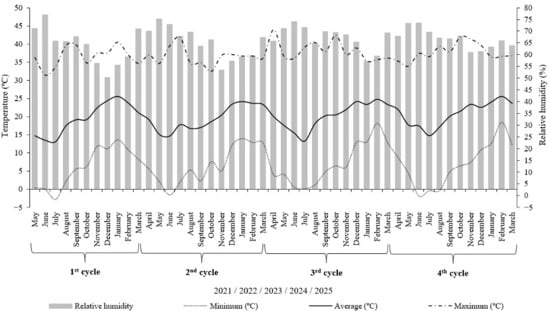
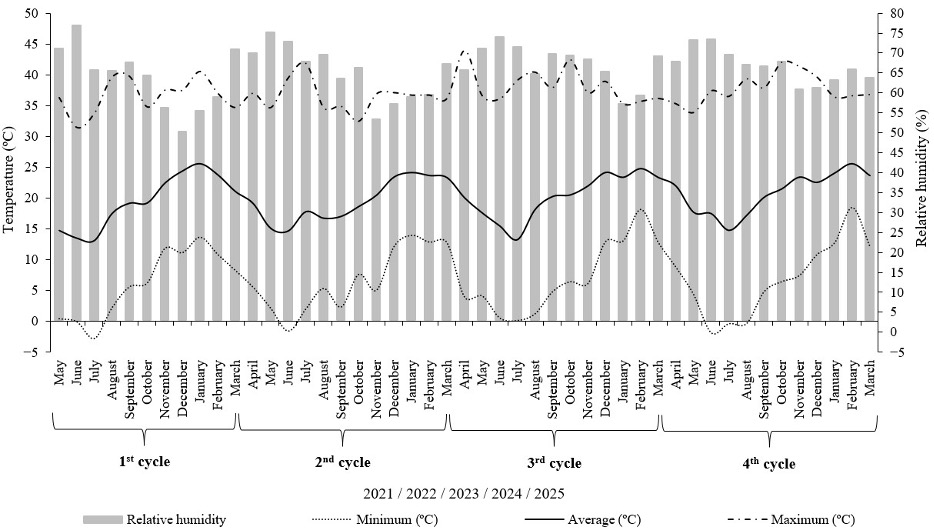
A greenhouse experiment was conducted over four consecutive growing seasons (2021/2022, 2022/2023, 2023/2024, and 2024/2025) at the experimental farm of the University of Passo Fundo (Rio Grande do Sul, Brazil: 28°15′41″ S, 52°24′45″ W, 672 m a.s.l.). The greenhouse had an area of 430 m2, with a semicircular roof covered by a low-density polyethylene film (150 µm thick) and an anti-ultraviolet additive. During the experiment, the micrometeorological conditions inside the greenhouse (Figure 1) were recorded every 30 min using sensors connected to a data logger (WatchDog® 2475, Spectrum® Technologies, Inc., Chicago, IL, USA). Three neutral-day (ND) strawberry cultivars, namely ‘Albion’, ‘Monterey’, and ‘San Andreas’, were obtained from a certified nursery in Chile (33°84′17″ S, 70°66′71″ W) and selected for this study based on their increasing commercial relevance in the target region.
Figure 1.
Relative humidity and minimum, average, and maximum monthly temperatures inside the greenhouse during the cycles.
In May of each year (2021 to 2024), bare-roots were transplanted into an open-soilless cultivation system consisting of containers (1 m × 0.3 m), with one row of plants per container filled with Dallemole® substrate (Vacaria, Rio Grande do Sul, Brazil), with an inter-plant spacing of 0.17 m and an inter-row spacing of 0.40 m, resulting in a planting density of ~15 plants.m−2. Dallemole® substrate was a mixture of pine bark, rice husks, and rice ash, presentign the following characteristics: pH = 5.6; nitrogen = 0.82% (m.m−1); phosphorus pentoxide = 0.58% (m.m−1); potassium oxide = <0.25% (m.m−1); organic carbon = 26.10% (m.m−1); and electric conductivity = 1.05 mS.cm−1. Irrigation was done using an automated dripper system (flow rate of 1.4 L.h−1 per dripper). The irrigation regime was activated five times a day, with a total wetting time of 10 min. Nutrient solutions were applied weekly [20]. The nutrient solutions were composed of calcium nitrate, potassium monobasic phosphate, potassium nitrate, magnesium sulfate, urea, and micronutrients (boron, copper, iron, manganese, molybdenum, and zinc). The experimental trial was arranged as a randomized block design with four replicates and six plants per plot. Each growth cycle extended from the onset of vegetative development to the end of the fruiting season, when ND cultivars showed a temperature-driven reduction in yield potential. Four cycles were assessed (2021/2022 through 2024/2025), each spanning from May to March.
2.2. Strawberry Yield and Fruit Quality
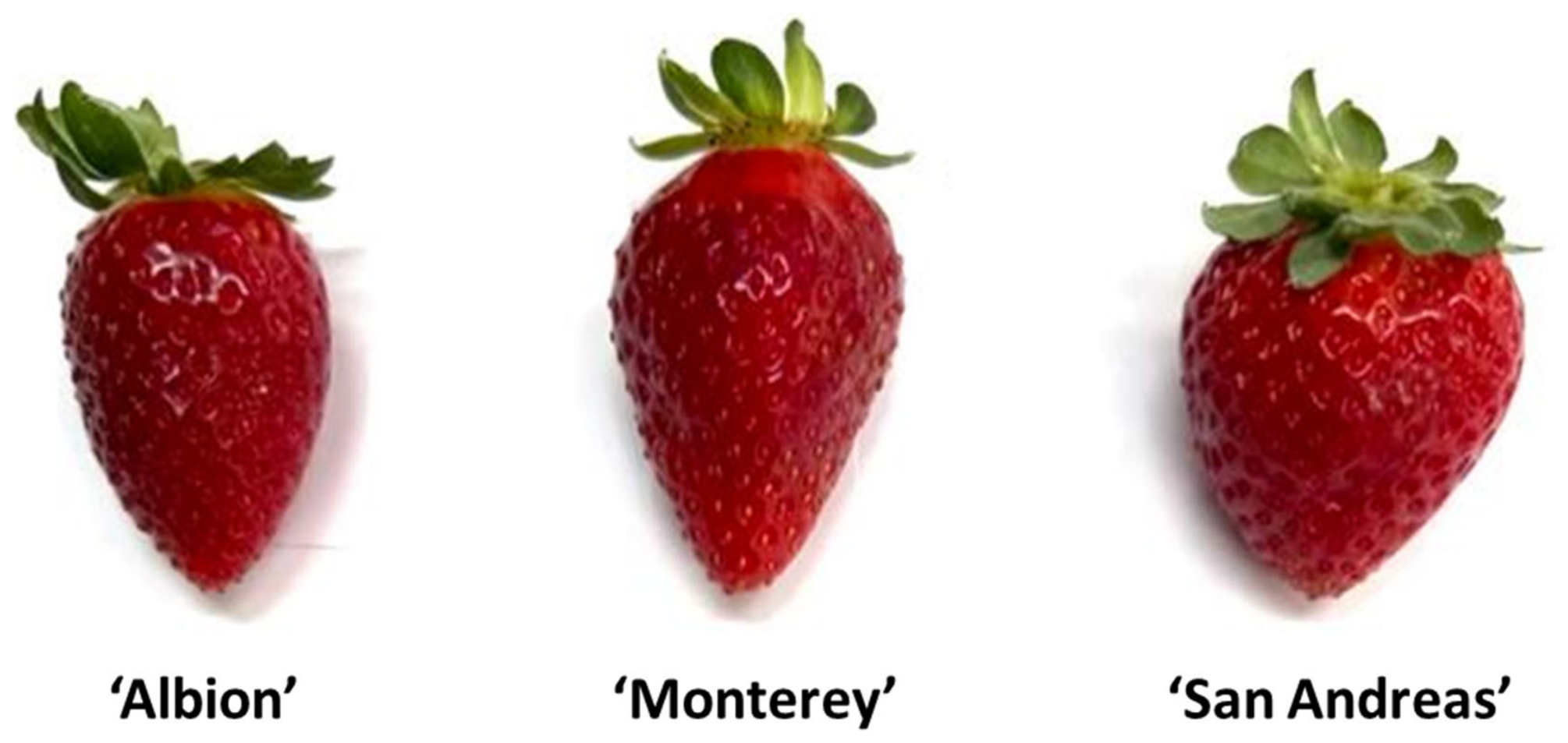
From the beginning of the fruiting period, the total number of fruits per plant (TNF) and total fruit production per plant (TP, g) were recorded. Harvesting was carried out from August to March in each cycle, with approximately seven harvest events per month. Fruits were collected at full ripeness (Figure 2) and weighed on a digital scale [21].
Figure 2.
Indicative ripening point for harvesting strawberry cultivars.
At peak production, in November of each cycle, 20 fruits per cultivar from each replicate were sampled for an internal quality assessment. To this end, for each replicate, in each plot consisting of six plants, at harvest time the fruits were placed in paper bags and, considering full ripeness (Figure 2), the 20 fruits were selected. Thus, 80 fruits per cultivar were analyzed in each growing cycle. Total soluble solids (TSS, %) were measured using a refractometer, and total titratable acidity (TTA), expressed as percentage of citric acid, was determined according to the standards of the Adolfo Lutz Institute [22]. Additionally, 100 g of fruit per replicate were used to determine total anthocyanins (TA), total flavonoids (TF), and total polyphenols (TPO). All analyses were performed on fresh fruit mass, consistent with the usual form of consumption.
TA content was determined by the pH differential method [23]. Briefly, 500 μL of each sample was diluted with 2.0 mL aqueous pH 1.0 and 4.5 buffers, and absorbance measurements were taken at 510 nm and 700 nm using a spectrophotometer (PerkinElmer Lambda 20, PerkinElmer®, Springfield, IL, USA). Results were expressed as mg pelargonidin-3-O-glucoside equivalents per 100 g of fresh fruit (mg PE/100 g FF−1).
TF content was determined according to Basílio et al. (2022) [24]. Extracted aliquots of 10 mL were diluted with 1.0 mL of aluminum chloride and the volume was adjusted to 25 mL with ethanol 70% pH 1.0. Absorbance was measured at 425 nm by spectrophotometry, and the results were calculated using a standard curve with rutin and expressed in mg of rutin equivalent per 100 g of fresh fruit (mg RE/100 g FF−1).
TPO was determined using Folin–Ciocalteu reagent [25]. Diluted extracts (125 μL) were mixed with 500 μL of distilled water and 125 μL of Folin–Ciocalteu reagent. After incubation for 6 min, sodium carbonate (7%) was added, and the volume was adjusted to 3.0 mL with distilled water. The mixture was incubated for 90 min at room temperature in the dark before absorption was measured at 760 nm by spectrophotometry. The results were calculated using a standard curve with gallic acid and expressed in mg of gallic acid equivalent per 100 g of fresh fruit (mg GAE/100 g FF−1).
2.3. Statistical Analysis
The experiment was analyzed as a two-factor randomized complete block design, considering cultivars and growing cycles as fixed effects. The interaction between cultivars and growing cycles was included in the model. Each growing cycle was established independently using new bare-root transplants and a new production season. Therefore, the data were not treated as repeated measures over time. The data normality was assessed using the Shapiro–Wilk test, and homogeneity of variances was evaluated through residual analysis. Subsequently, the data were subjected to analysis of variance (ANOVA), and treatment means were compared using Tukey’s test (p ≤ 0.05). Principal component analysis (PCA) was performed using standardized data, with eigenvalues <1 excluded [26]. PCA was used to explore multivariate patterns of association among cultivars, growing cycles, yield, and fruit quality traits [27]. The importance of the characters [28], estimated from the components of Mahalanobis generalized distance, was used to quantify the relative contribution of each attribute to the divergence among experimental units [29]. All analyses were performed using R software, version 4.5.2 [30].
3. Results
3.1. Strawberry Yield
The association between cycles and cultivars highlighted the higher production of ‘San Andreas’ in 2024/2025, the same cultivar that had the lowest productive potential in 2021/2022. These contrasts in ‘San Andreas’ indicated the sensitivity of this cultivar to environmental variations, especially to thermal conditions, throughout the growing cycles (Figure 1). For the number of fruits, the best combination was ‘Monterey’ in 2024/2025 (Table 1), which showed a greater capacity for converting photoassimilates into reproductive structures under greenhouse conditions.
Table 1.
Association between cycles and strawberry cultivars in relation to yield.
‘Monterey’ had the best yield in 2021/2022, and ‘San Andreas’ stood out in 2022/2023 with the highest values of TNF and TP (Table 1). In general, the best productive performance of the three cultivars occurred in 2024/2025, with higher TP and TNF (on average), respectively, by 44% and 46% (‘Albion’), 53% and 54% (‘Monterey’), and 55% and 51% (‘San Andreas’), compared to the other three cycles (Table 1).
3.2. Fruit Quality
In 2024/2025, ‘Monterey’ produced higher quality fruit, with the lowest TTA content and the highest TA, TF, and TPO levels. ‘San Andreas’ also stood out in 2024/2025 by producing fruit with higher TPO levels. In 2022/2023, ‘Albion’ produced the sweetest and most flavorful fruit (Table 2). Furthermore, in 2021/2022, ‘San Andreas’ fruit had the lowest quality because it presented the highest TTA content and the lowest TSS, TSS/TTA, TA, and TF levels (Table 2).
Table 2.
Association between cycles and strawberry cultivars in relation to fruit quality.
The bioactive compounds revealed a somewhat different pattern from the taste variables. For TA, ‘Monterey’ generally occupied the leading position from 2022/2023 onwards, while ‘Albion’ and especially ‘San Andreas’ were lower in the first cycle and then increased over time. TF also distinguishes ‘Monterey’, which rose sharply across seasons and reached a particularly high value in 2024/2025. ‘Albion’ showed a progressive increase in flavonoids across the four cycles, but less sharply, while ‘San Andreas’ remained lower or intermediate throughout. A similar picture was visible for TPO: ‘Monterey’ was repeatedly among the highest cultivars and attained the greatest concentration in the final cycle, whereas ‘San Andreas’ improved markedly in the last two seasons, and ‘Albion’ declined in 2024/2025.
3.3. Multivariate Analysis
PCA indicated that the first three principal components (PC) explained 91.14% of the variance. The first two PCs accounted for 81.25% of the total variance (Table 3). PC1, responsible for 51.12% of the total variance, showed high positive factor loadings for TA (0.951), TF (0.915), TP (0.798), and TNF (0.759) (Table 3). PC2 explained 30.13% of the variance and was influenced by TSS (0.921) and TSS/TTA (0.873), while showing negative loadings for TTA (−0.550), TP (−0.443), and TNF (−0.505) (Table 3). The traits most responsible for distinguishing cultivar behavior over time were TA, TSS and, to a lesser extent, TPO.
Table 3.
Principal components (PC), eigenvalues (λj), variance explained (VaE), and cumulative variance (CuV), and variance contributions to genetic divergence by Singh’s methods (Sj) based on mean values of strawberry cultivars over four cycles.
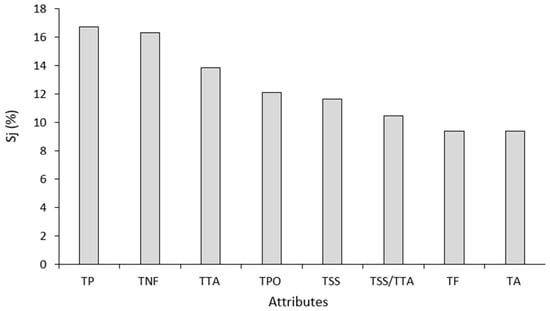
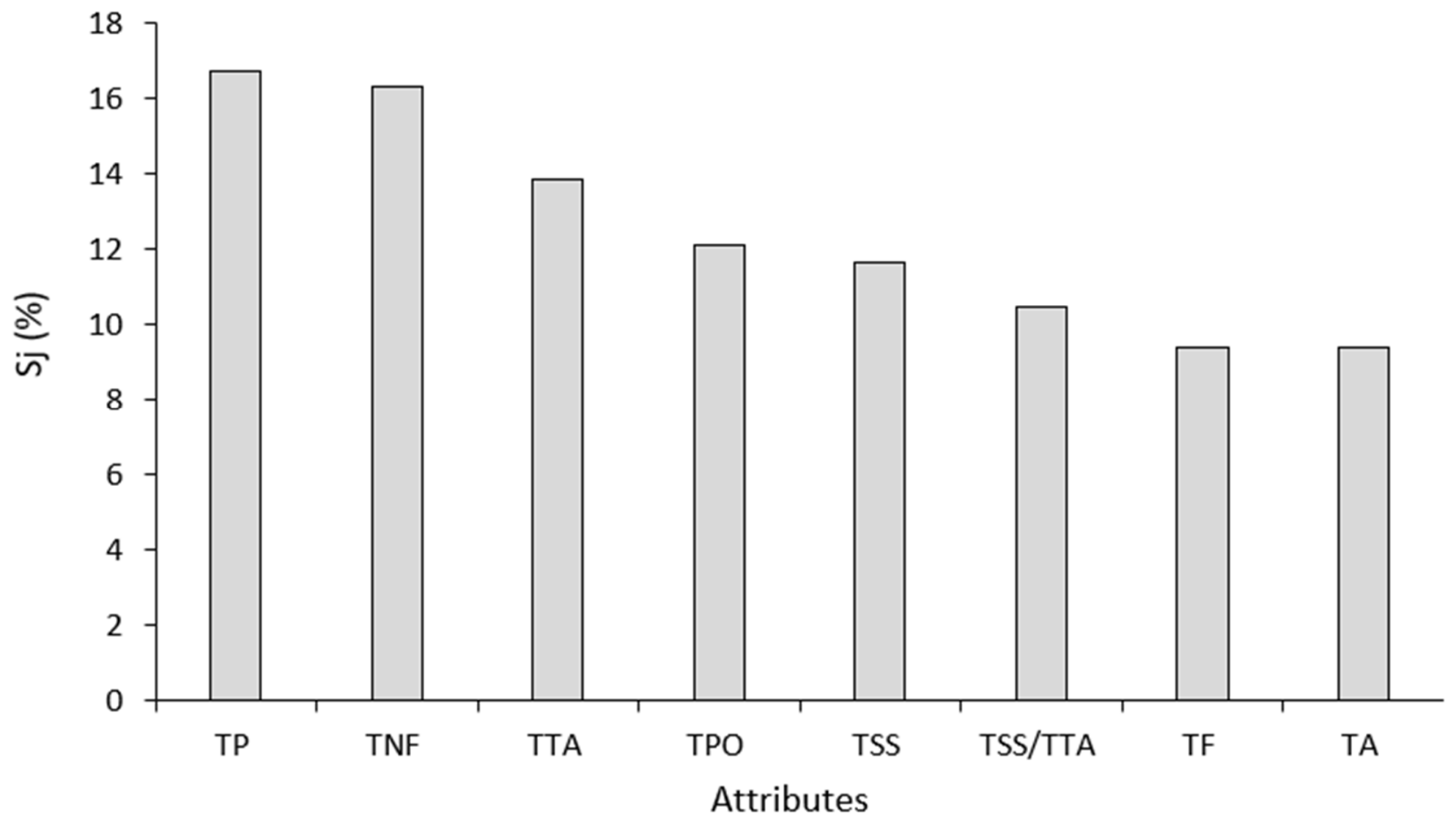
The yield attributes (TP and TNF) were those that contributed most to differentiating the treatments (Figure 3). This general pattern was consistent with Table 1, where marked seasonal shifts were evident for both production per plant and fruit number, particularly in the highly productive 2024/2025 cycle. The TSS/TTA ratio, TF, and TA contributed less to divergence than the traits discussed above (Figure 3).
Figure 3.
Variance contributions to genetic divergence by Singh’s methods (Sj) based on mean values of strawberry cultivars over four cycles. TP: total production; TNF: total number of fruits; TSS: total soluble solids; TTA: total titratable acidity; TSS/TTA: flavor; TA: total anthocyanin; TF: total flavonoid; TPO: total polyphenol.
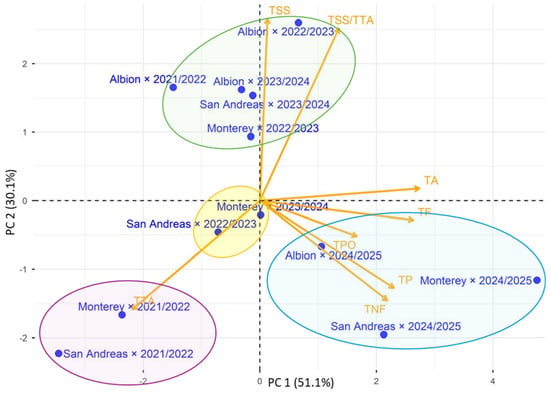
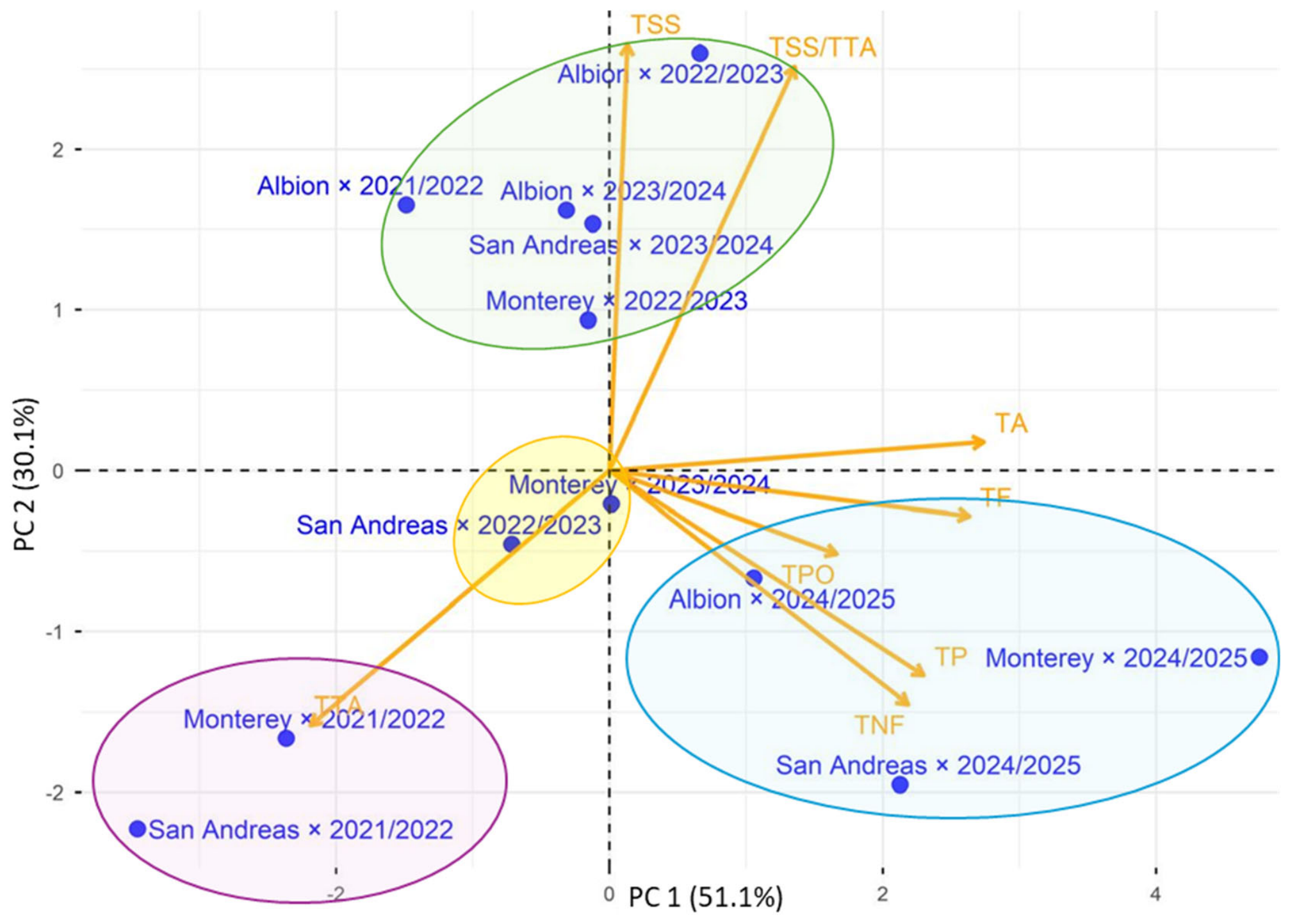
In general, the organization of treatments in the quadrants of the biplot indicated that the temporal variation among cycles exerted a greater influence on the multivariate structure of the data than the identity of the cultivars (Figure 4). The distribution of treatments in the PC1 × PC2 plan, based on PC scores, revealed the formation of four groups, one of which (blue color) included only cultivars established in 2024/2025 (Figure 4), especially for traits associated with yield, such as TP and TNF. This reinforced the results of the univariate analysis, which showed that the best productive performance was observed in 2024/2025 (Table 1). In 2024/2025, the three cultivars presented the highest positive scores in PC1, with ‘Monterey’ × 2024/2025, ‘San Andreas’ × 2024/2025, and ‘Albion’ × 2024/2025 standing out (Figure 4). The other three groupings did not follow a pattern of separation by cultivar and/or cycle (Figure 4). In 2021/2022, the cultivars presented high negative scores in PC1, especially ‘San Andreas’ × 2021/2022 and ‘Monterey’ × 2021/2022, reflecting lower productive performance. Regarding PC2, the highest positive scores were observed mainly in the cultivars associated with 2022/2023 and 2023/2024, such as ‘Albion’ × 2022/2023 and ‘San Andreas’ × 2023/2024, indicating an association with sensory quality attributes (Figure 4).
Figure 4.
Principal component analysis with the contribution percentage of the production attributes and fruit quality analyzed in the study. TP: total production; TNF: total number of fruits; TSS: total soluble solids; TTA: total titratable acidity; TSS/TTA: flavor; TA: total anthocyanin; TF: total flavonoid; TPO: total polyphenol.
3.4. Thermal Relationships with the Horticultural Performance of Strawberry Plants
There was variation between the start and end of the harvest in all cycles, with the longest harvest season in 2024/2025, followed by 2022/2023, 2023/2024, and 2021/2022. In general, ‘Albion’ always had a longer harvest period, except for 2024/2025, when it coincided with ‘San Andreas’ (Table 4). Daytime and nighttime temperatures during the harvest season also fluctuated among cycles, with the smallest thermal amplitude in 2024/2025 (Table 4).
Table 4.
Details of experiments and temperatures recorded during the harvest period of three strawberry cultivars over four cycles.
The thermal conditions during November, when fruit quality was evaluated, differed among cycles, particularly in nighttime temperature and day–night amplitude. The warmest November occurred in 2024/2025, which combined the highest daytime and nighttime temperatures, while 2022/2023 was the coolest cycle overall, especially at night. By contrast, 2023/2024 was characterized by the narrowest thermal amplitude, whereas 2022/2023 showed the widest difference between day and night temperatures (Table 5).
Table 5.
Temperatures recorded during the evaluation month (November) of fruit quality for three strawberry cultivars over four cycles.
4. Discussion
Here, we demonstrate that yield and fruit quality of the strawberry plants were modulated by the association between cultivars and cycles, reinforcing the role of genotype × environment interaction in soilless cultivation systems. Although the three cultivars evaluated are classified as ND with respect to flowering, their horticultural performance varied across cycles. This finding indicates the sensitivity of these genotypes to seasonal microclimatic conditions inside the greenhouse. In strawberry cultivation, environmental variability often exerts a greater influence on yield performance and fruit quality than cultivar identity per se [14,31]. This reinforces that interannual climatic variability is a determining factor in strawberry performance under protected cultivation systems [15], even when external conditions are partially moderated by the greenhouse structure [32].
The three strawberry cultivars responded to temperature fluctuations inside the greenhouse (Figure 1), exhibiting greater yield potential in 2024/2025 (Table 1). This response was likely associated with a longer developmental cycle (Table 4), as well as a more favorable thermal regime during the harvest period in 2024/2025, particularly the lower difference between daytime temperature and night temperature (DIF) of 6.30 °C (Table 4), suggesting that thermal stability plays a decisive role in strawberry yield under greenhouse conditions. In addition, the greater thermal availability during the 2024/2025 growing cycle may be related to increased solar radiation availability, which likely enhanced photosynthesis.
Photosynthetic capacity, which is closely related to plant growth and development, is influenced by DIF [33]. For example, a DIF of 5 °C improved the net photosynthetic rate [34], potentially enhancing photomorphogenesis and, consequently, yield performance. In strawberry, Wang and Camp (2000) [35] demonstrated that the optimal day–night temperature for fruit growth and development was 18/12 °C, corresponding to a DIF of 6 °C, similar to that reported in our study (Table 4). Night temperature assumes particular relevance in this context.
On the other hand, the highest TSS content and the most favorable TSS/TTA ratio were detected in 2022/2023 (Table 2), a period in which the highest DIF (8.17 °C) was recorded (Table 5). In November 2022, when fruits were harvested for quality assessment, the lowest mean nighttime temperature (16.21 °C) was observed compared with the other cycles, resulting in the greatest DIF (Table 5). The literature indicates that the greater the DIF, the higher the soluble sugar content in fruits, generally due to lower temperatures, reduced respiratory rates, and decreased biomass consumption during the night [36]. This contrasts with the thermal dynamics required for maximizing yield, in which a lower DIF is considered more favorable [35].
In summary, the superior fruit quality observed in the 2022/2023 growing cycle is attributed to the higher DIF and lower nighttime temperature. As nighttime temperature increases, enzymatic activity associated with respiration and overall respiratory rates in plants also increase [37]. In contrast, the enhanced productive performance observed in 2024/2025 appears to be associated with a lower DIF and higher nighttime temperature. Although respiration is intensified during the night, photosynthetic rates also increase as a function of greater thermal availability, particularly due to increased solar radiation during the day. Consequently, net photosynthetic rate and the accumulation of photosynthates are higher, thereby promoting biomass accumulation [36]. However, studies addressing the effects of DIF on strawberry growth and development under soilless cultivation and greenhouse conditions remain limited. This represents a knowledge gap in strawberry ecophysiology that warrants further investigation. An appropriate DIF may also provide a scientific basis for optimizing protected strawberry cultivation across growing cycles.
Overall, fruit quality attributes responded differently to environmental variation when compared with yield components, as evidenced by the multivariate analysis. The separation of treatments along PC2, influenced by TSS, TTA, and TSS/TTA, indicated that sensory attributes are more genotype-dependent and less synchronized with yield performance. Furthermore, the average TSS/TA ratio detected of 8.87 (Table 2) was within the commercially relevant thresholds for strawberry quality. A TSS/TTA ratio of 8.5 to 14 is considered appropriate for a good balance between sweetness and acidity for human palatability [7]. In contrast, phytochemical content—represented by TA, TF, and TPO—was associated with PC1, together with yield-related traits (Figure 4). This finding indicated that, under favorable thermal conditions, strawberry plants may simultaneously enhance yield and fruit phytochemical quality [38], particularly when environmental conditions reduce physiological stress without suppressing secondary metabolism [39]. In 2024/2025, the superior performance of ‘Monterey’ and ‘San Andreas’, especially regarding TPO content, suggests that these cultivars benefit from environments with lower thermal variability, which promote the biosynthesis of bioactive compounds without compromising yield [40].
The higher sugar contents observed in 2022/2023, under greater thermal amplitude, reinforced the role of nighttime temperature in modulating respiratory carbon loss and sugar accumulation, as lower nighttime temperatures reduce respiration and favor the retention of soluble sugars in strawberry fruits [36]. These findings demonstrate that fruit quality traits are under partially independent genetic control and are differentially modulated by environmental factors, further emphasizing the importance of genotype × environment interaction in strawberry production systems [14].
The univariate analyses of yield (Table 1) and quality (Table 2) and the multivariate analysis (Figure 4) revealed the absence of a consistent pattern regarding the horticultural potential of each cultivar across cycles, highlighting the importance of cultivar diversification within production systems. In this context, despite the superior productive performance observed in 2024/2025, cultivar-specific responses were evident. ‘Monterey’ exhibited greater yield stability across cycles in addition to producing fruits rich in bioactive components, corroborating a study that had emphasized its environmental adaptability [7]. This suggests that ‘Monterey’ has greater responsiveness to environmental conditions that modulate the balance between primary and secondary metabolism. Under conditions of lower thermal variability and greater energy availability, as observed in 2024/2025, the increase in photosynthetic efficiency and carbon assimilation may have simultaneously favored the production of photoassimilates and the biosynthesis of secondary metabolites, without compromising yield. Furthermore, microclimatic factors, such as incident solar radiation, photoperiod, and vapor pressure deficit, may also have influenced the activation of photoprotective and antioxidant mechanisms, which are related to the production of secondary metabolites. However, we suggest future research on microclimatic monitoring and physiological analyses to confirm these hypotheses. In contrast, ‘San Andreas’ showed high productive plasticity, with low performance in 2021/2022 and maximum yield in 2024/2025. These results demonstrate the agronomic risk associated with relying on a single cultivar for crop establishment, particularly in environments subject to interannual variability, which is characteristic of subtropical regions [12,18].
Thus, our findings support the recommendation that strawberry growers should establish their crops using more than one cultivar. Cultivar diversification enhances the resilience of the production system by reducing the risk of yield and quality losses associated with adverse environmental conditions in specific cycles [41]. Moreover, such variability enables producers to target contrasting market niches, reconciling yield stability, sensory quality, and nutritional value both within and across cycles [42,43]. Under scenarios of climatic uncertainty, cultivar diversification represents an efficient, low-cost, and adaptively relevant biostrategy.
Finally, although the results demonstrate the influence of the interaction between cultivars and growing cycles on strawberry plant performance in a greenhouse soilless system, some limitations should be considered. The study did not include measurements of solar radiation, vapor pressure deficit, ventilation conditions, and light availability inside the greenhouse, which may limit the understanding of the environmental mechanisms associated with the variations observed among cycles. In addition, the absence of physiological assessments, including gas exchange, chlorophyll fluorescence, photosynthetic efficiency, and osmotic responses, restricts a more in-depth interpretation of the processes involved in plant adaptation, yield, and fruit quality. Furthermore, the study was limited to the evaluation of only three cultivars, which does not encompass the wide range of genetic materials available for strawberry cultivation. Thus, future research should integrate microclimatic and physiological monitoring and expand the number of evaluated cultivars to improve the understanding of strawberry ecophysiology in a greenhouse soilless system.
5. Conclusions
The association between cultivars and production cycles interferes with the horticultural potential of strawberry under soilless cultivation systems. Overall, our study provides evidence that cultivar recommendation in strawberry should be aligned with the production objective. Under the environmental and management conditions evaluated in this study, ‘Monterey’ appears to be the most suitable option when high fruit number is sought together with strong flavonoid and polyphenol accumulation, ‘Albion’ when soluble solids and flavor balance are prioritized, and ‘San Andreas’ when emphasis is placed on maximizing total production under favorable conditions. Therefore, to optimize the strawberry production chain, it is essential to focus on production systems capable of responding flexibly to environmental changes and market demands.
Author Contributions
Conceptualization, J.L.T.C., F.W.R.J., P.P. and D.C.S.; methodology, J.L.T.C., N.A.M., H.D., M.A.L.d.O. and B.J.; software, J.L.T.C., F.W.R.J., J.K., M.P.B., P.P. and D.C.S.; validation, J.L.T.C., N.A.M., H.D., M.A.L.d.O., B.J., J.L.C., F.W.R.J., J.K., M.P.B., P.P. and D.C.S.; formal analysis, J.L.T.C., J.L.C., F.W.R.J., J.K., M.P.B., P.P. and D.C.S.; investigation, J.L.T.C., N.A.M., H.D., M.A.L.d.O., B.J., J.L.C., F.W.R.J., J.K., M.P.B., P.P. and D.C.S.; resources, J.L.T.C., P.P. and D.C.S.; data curation, J.L.T.C., N.A.M., H.D., M.A.L.d.O. and B.J.; writing—original draft preparation, J.L.T.C., N.A.M., H.D., M.A.L.d.O., B.J., J.L.C., F.W.R.J., J.K., M.P.B., P.P. and D.C.S.; writing—review and editing, J.L.T.C., J.L.C., F.W.R.J., J.K., M.P.B., P.P. and D.C.S.; visualization, J.L.T.C., N.A.M., H.D., M.A.L.d.O., B.J., J.L.C., F.W.R.J., J.K., M.P.B., P.P. and D.C.S.; supervision, J.L.T.C., P.P. and D.C.S.; project administration, J.L.T.C., P.P. and D.C.S.; funding acquisition, J.L.T.C., P.P. and D.C.S. All authors have read and agreed to the published version of the manuscript.
Funding
This study was financed by the Coordination for the Improvement of Higher Education Personnel (CAPES) (finance code 001).
Data Availability Statement
The raw data supporting the conclusions of this article will be made available by the authors on request.
Acknowledgments
To University of Passo Fundo, Federal University of Rio Grande do Sul, Fundação de Amparo à Pesquisa do Estado do Rio Grande do Sul (FAPERGS), Conselho Nacional de Desenvolvimento Científico e Tecnológico (CNPq), and CAPES for granting scientific initiation (H. Didó, M. A. L. Oliveira, and B. Jirkowski) or doctoral (J. L. Cassel) scholarships. To the company Bioagro Comercial Agropecuária Ltda (Araucária, Paraná, Brazil) for the supply of bare-root transplants used in this work.
Conflicts of Interest
The authors declare no conflicts of interest.
References
- Singh, B.K.; Delgado-Baquerizo, M.; Egidi, E.; Guirado, E.; Leach, J.E.; Liu, H.; Trivedi, P. Climate change impacts on plant pathogens, food security and paths forward. Nat. Rev. Microbiol. 2023, 21, 640–656. [Google Scholar] [CrossRef] [Scilit] [PubMed]
- Mba, P.C.; Njoku, J.N.; Uyeh, D.D. Enhancing resilience in specialty crop production in a changing climate through smart systems adoption. Smart Agric. Technol. 2025, 11, 100897. [Google Scholar] [CrossRef] [Scilit]
- Pagnotta, M.A. Molecular breeding for abiotic stress tolerance in crops: Recent developments and future prospectives. Int. J. Mol. Sci. 2025, 26, 9164. [Google Scholar] [CrossRef] [Scilit] [PubMed]
- Mainem, C.A.T.; Agustin, R.Q.; Duza, G.M. Growth and yield adaptability of selected varieties of strawberry (Fragaria x ananassa) under BPSU abucay bataan condition, Philippines. J. Bio. Environ. Sci. 2021, 18, 23–30. [Google Scholar]
- Costa, B.M.; Lima, J.M.; Souza, H.R.C.; Santos, M.F.S.; Nerbass, F.R.; Kretzschmar, A.A.; Rufato, L. New strawberry genotypes adapted for the Southern Plateau of Santa Catarina: A study of yield and fruits quality. Discov. Plants 2025, 2, 192. [Google Scholar] [CrossRef] [Scilit]
- Almutairi, K.F.; Alharbi, A.R.; Abdelaziz, M.E.; Mosa, W.F.A. Salicylic acid and chitosan effects on fruit quality when applied to fresh strawberry or during different periods of cold storage. BioResources 2024, 19, 6057–6075. [Google Scholar] [CrossRef] [Scilit]
- Chiomento, J.L.T.; De Nardi, F.S.; Kujawa, S.C.; Deggerone, Y.S.; Fante, R.; Kaspary, I.J.; Dornelles, A.G.; Huzar-Novakowiski, J.; Trentin, T.S. Multivariate contrasts of seven strawberry cultivars in soilless cultivation and greenhouse in southern Brazil. Adv. Chem. Res. 2023, 2, 62–76. [Google Scholar]
- Liu, R.; Bournet, P.E.; Guzmán, J.L.; Tingting, W.; Li, M.; Yang, X. Variation analysis of natural ventilation and air temperature within a greenhouse cluster using a large-scale 3D CFD modelling. Comput. Electron. Agric. 2026, 240, 111220. [Google Scholar]
- Kumsong, N.; Thepsilvisut, O.; Imorachorn, P.; Chutimanukul, P.; Pimpha, N.; Toojinda, T.; Trithaveesak, O.; Ratanaudomphisut, E.; Poyai, A.; Hruanun, C.; et al. Comparison of different temperature control systems in tropical-adapted greenhouses for green romaine lettuce production. Horticulturae 2023, 9, 1255. [Google Scholar] [CrossRef] [Scilit]
- Ahn, M.G.; Kim, D.S.; Ahn, S.R.; Sim, H.S.; Kim, S.; Kim, S.K. Characteristics and trends of strawberry cultivars throughout the cultivation season in a greenhouse. Horticulturae 2021, 7, 30. [Google Scholar] [CrossRef] [Scilit]
- Menzel, C.M. Temperatures above 30 °C decrease leaf growth in strawberry under global warming. J. Hortic. Sci. Biotechnol. 2024, 99, 507–530. [Google Scholar] [CrossRef] [Scilit]
- Menzel, C. Higher temperatures decrease fruit size in strawberry growing in the subtropics. Horticulturae 2021, 7, 34. [Google Scholar] [CrossRef] [Scilit]
- Ullah, I.; Toor, M.D.; Yerlikaya, B.A.; Mohamed, H.I.; Yerlikaya, S.; Basit, A.; Rehman, A.U. High-temperature stress in strawberry: Understanding physiological, biochemical and molecular responses. Planta 2024, 260, 118. [Google Scholar] [CrossRef] [Scilit] [PubMed]
- Cervantes, L.; Ariza, M.T.; Miranda, L.; Lozano, D.; Medina, J.J.; Soria, C.; Martínez-Ferri, E. Stability of fruit quality traits of different strawberry varieties under variable environmental conditions. Agronomy 2020, 10, 1242. [Google Scholar] [CrossRef] [Scilit]
- Khammayom, N.; Maruyama, N.; Chaichana, C. The effect of climatic parameters on strawberry production in a small walk-in greenhouse. AgriEngineering 2022, 4, 104–121. [Google Scholar] [CrossRef] [Scilit]
- Barth, E.; Resende, J.T.V.; Mariguele, K.H.; Resende, M.D.V.; Silva, A.L.B.R.; Ru, S. Multivariate analysis methods improve the selection of strawberry genotypes with low cold requirement. Sci. Rep. 2022, 12, 11458. [Google Scholar] [CrossRef] [Scilit] [PubMed]
- Zhou, Z.P.; Zhao, L.Y.; Sun, J.Y.; Li, Q.Y.; Cai, B.B.; Wang, X.X. Cultivar-driven variations in physicochemical properties and volatile organic compound profiles of strawberry (Fragaria × ananassa Duch.). Food Chem. Mol. Sci. 2026, 12, 100346. [Google Scholar]
- Nascimento, D.A.; Gomes, G.C.; Oliveira, L.V.B.; Paula Gomes, G.F.; Ivamoto-Suzuki, S.T.; Ziest, A.R.; Mariguele, K.H.; Roberto, S.R.; Resende, J.T.V. Adaptability and stability analyses of improved strawberry genotypes for tropical climate. Horticulturae 2023, 9, 643. [Google Scholar] [CrossRef] [Scilit]
- Menzel, C.M. The stability of important fruit traits in strawberry in Queensland. Horticulturae 2023, 9, 296. [Google Scholar] [CrossRef] [Scilit]
- De Nardi, F.S.; Trentin, T.S.; Trentin, N.S.; Costa, R.C.; Calvete, E.O.; Palencia, P.; Chiomento, J.L.T. Mycorrhizal biotechnology reduce phosphorus in the nutrient solution of strawberry soilless cultivation systems. Agronomy 2024, 14, 355. [Google Scholar] [CrossRef] [Scilit]
- Chiomento, J.L.T.; Mandelli, N.A.; Ely, A.J.S.; Welter, M.; Didó, H.; Oliveira, M.A.L.; Jirkowski, B.; Reichert Junior, F.W.; Bortoluzzi, M.P.; Rieder, R.; et al. Microbial biostimulants and their combinations alter phytochemical quality of strawberry fruits in a soilless cultivation system. Horticulturae 2026, 12, 56. [Google Scholar] [CrossRef] [Scilit]
- Zenebon, O.; Pascuet, N.S.; Tiglea, P. Métodos Físico-Químicos para Análise de Alimentos, 4th ed.; Instituto Adolfo Lutz: São Paulo, Brasil, 2008; p. 1020. [Google Scholar]
- Giusti, M.M.; Wrolstad, R.E. Anthocyanins: Characterization and measurement with UV-visible spectroscopy. In Current Protocols in Food Analytical Chemistry; Wrolstad, R.E., Ed.; John Wiley & Sons: New York, NY, USA, 2001; pp. 1–13. [Google Scholar]
- Basílio, L.S.P.; Borges, C.V.; Minatel, I.O.; Vargas, P.F.; Tecchio, M.A.; Vianello, F.; Lima, G.P.P. New beverage based on grapes and purple-fleshed sweet potatoes: Use of non-standard tubers. Food Biosci. 2022, 47, 101626. [Google Scholar]
- Singleton, V.L.; Rossi, J.A. Colorimetry of total phenolics with phosphomolybidic-phosphotungstic acid reagent. Am. J. Enol. Vitic. 1965, 16, 144–158. [Google Scholar]
- Kaiser, H.F. The varimax criterion for analytic rotation in factor analysis. Psychometrika 1958, 23, 187–200. [Google Scholar] [CrossRef] [Scilit]
- Jolliffe, I.T. Discarding variables in a principal component analysis. I: Artificial data. Appl. Stat. 1972, 21, 160–173. [Google Scholar] [CrossRef] [Scilit]
- Singh, D. The relative importance of characters affecting genetic divergence. Indian J. Genet. Plant Breed. 1981, 41, 237–245. [Google Scholar]
- Silveira, D.C.; Mills, A.; Cruz, C.D.; Antoniolli, J.; Bonotto, C.Z.; De Ávila, V.S.; Weiler, R.L.; Brunes, A.P.; Simioni, C.; Dall’Agnol, M. Repeatability, genetic variability and importance of forage traits in ecotypes of brunswickgrass (Paspalum nicorae Parodi) via BLUP. Plant Breed. 2026, 145, 561–574. [Google Scholar] [CrossRef] [Scilit]
- R Core Team. R: A Language and Environment for Statistical Computing; R Foundation for Statistical Computing: Vienna, Austria, 2025. [Google Scholar]
- Altieri, G.; Curcio, D.; Lepore, A.; Grobler, E.; Maffia, A.; Gargano, N.; Tedesco, A.; Graziano, M.L.; Mazzei, P.; Capocasa, F.; et al. Yield and quality of new strawberry advanced breeding selections and commercial cultivars, grown under warm-temperate climatic conditions. Agriculture 2025, 15, 1406. [Google Scholar] [CrossRef] [Scilit]
- Lee, T.Y.; Moon, Y.H.; Sim, H.S.; Jung, S.B.; Woo, U.J.; Shin, H.R.; Kim, Y.J.; Kim, N.K.; Jo, J.S.; Kim, S.K. Prediction and application on the first flowering date of June-bearing strawberry cultivars using ensemble-based machine learning with primary temperature values. Comput. Electron. Agric. 2026, 240, 111208. [Google Scholar]
- Ihsan, M.Z.; Khaliq, A.; Siddiqui, M.H.; Ali, L.; Kumar, R.; Ali, H.M.; Matloob, A.; Fahad, S. The response of Triticum aestivum treated with plant growth regulators to acute day/night temperature rise. J. Plant Growth Regul. 2022, 41, 2020–2033. [Google Scholar] [CrossRef] [Scilit]
- Tan, X.; Li, H.; Zhang, Z.; Yang, Y.; Jin, Z.; Chen, W.; Tang, D.; Wei, C.; Tang, Q. Characterization of the difference between day and night temperatures on the growth, photosynthesis, and metabolite accumulation of tea seedlings. Int. J. Mol. Sci. 2023, 24, 6718. [Google Scholar] [CrossRef] [Scilit] [PubMed]
- Wang, S.Y.; Camp, M.J. Temperatures after bloom affect plant growth and fruit quality of strawberry. Sci. Hortic. 2000, 85, 183–199. [Google Scholar] [CrossRef] [Scilit]
- Wu, X.Y.; Han, W.; Yang, Z.Q.; Zhang, Y.X.; Zheng, Y.J. The difference in temperature between day and night affects the strawberry soluble sugar content by influencing the photosynthesis, respiration and sucrose phosphatase synthase. Hortic. Sci. 2021, 48, 174–182. [Google Scholar] [CrossRef] [Scilit]
- Nei, D.; Uchino, T.; Sakai, N.; Tanaka, S.I. Effect of high temperature on the apparent activation energy of respiration of fresh produce. Postharvest Biol. Technol. 2005, 37, 277–285. [Google Scholar] [CrossRef] [Scilit]
- Sobari, E.; Wicaksana, N.; Suwali, N.; Nakayama, M.; Endo, K.; Matsumoto, Y.; Yoshida, S.; Iwasaki, Y.; Hindersah, R.; Mubarok, S. Supplemental white LED lighting enhances strawberry fruit quality and physicochemical properties under tropical climate conditions. Int. J. Food Prop. 2026, 29, 2647495. [Google Scholar] [CrossRef] [Scilit]
- Gaude, A.A.; Jalmi, S.K. Environmental stress induced biosynthesis of plant secondary metabolites- transcriptional regulation as a key. Crop Des. 2025, 4, 100100. [Google Scholar] [CrossRef] [Scilit]
- Sorkhoeih, M.K.; Moghaddam, A.H.; Seyedi, A. Salicylic acid induces cultivar specific compromises in yield, fruit quality and defense metabolism of heat stressed strawberry. Sci. Rep. 2026, 16, 4874. [Google Scholar] [CrossRef] [Scilit] [PubMed]
- Sridhar, R.; Longkumer, L.T.; Pilla, A.; Bharteey, P.K.; Jatav, H.S.; Hareesh, D.; Vilakar, K.; Singh, A.P.; Srikar, K.; Aruna, K.; et al. Diverse fields for stronger yields: Crop diversification strategies for sustainable agriculture and climate-resilient ecosystems. Front. Agron. 2026, 7, 1746895. [Google Scholar] [CrossRef] [Scilit]
- Antunes, L.E.C.; Mueller, F.C.S.; Schiavon, A.V.; Barreto, C.F.; Bonow, S. Agronomic performance from new Brazilian strawberry cultivars in low altitude. Fruit. Crop. Sci. J. 2026, 1, 038. [Google Scholar]
- Bernard, M.F.; Schiavon, A.V.; Alves, A.S.; Bonow, S.; Herter, F.G.; Cantillano, R.F.F.; Antunes, L.E.C. Effect of planting date on the yield and quality of Brazilian strawberry cultivars. Semin. Ciênc. Agrár. 2025, 46, 1695–1714. [Google Scholar] [CrossRef] [Scilit]

Disclaimer/Publisher’s Note: The statements, opinions and data contained in all publications are solely those of the individual author(s) and contributor(s) and not of MDPI and/or the editor(s). MDPI and/or the editor(s) disclaim responsibility for any injury to people or property resulting from any ideas, methods, instructions or products referred to in the content. |
© 2026 by the authors. Licensee MDPI, Basel, Switzerland. This article is an open access article distributed under the terms and conditions of the Creative Commons Attribution (CC BY) license.