Evaluation of the Predatory Efficacy of Arma chinensis Against Larvae of Helicoverpa armigera and Spodoptera exigua
 ,
,
Abstract
1. Introduction
2. Materials and Methods
2.1. Insect Sources
2.2. Experimental Methods
2.2.1. Predation Tests of A. chinensis on H. armigera and S. exigua Larvae
2.2.2. Functional Response of A. chinensis to H. armigera and S. exigua Larvae
2.2.3. Searching Efficiency of A. chinensis on H. armigera and S. exigua Larvae
2.2.4. Prey Preference of A. chinensis Toward Third-Instar Larvae of H. armigera and S. exigua
2.2.5. Field Control Trials of A. chinensis Against H. armigera and S. exigua Larvae
2.3. Data Analysis
3. Results and Analysis
3.1. Evaluation of the Predatory Efficacy of Arma chinensis Against Helicoverpa armigera Larvae
3.1.1. The Predatory Capacity of Arma chinensis Towards Helicoverpa armigera Larvae
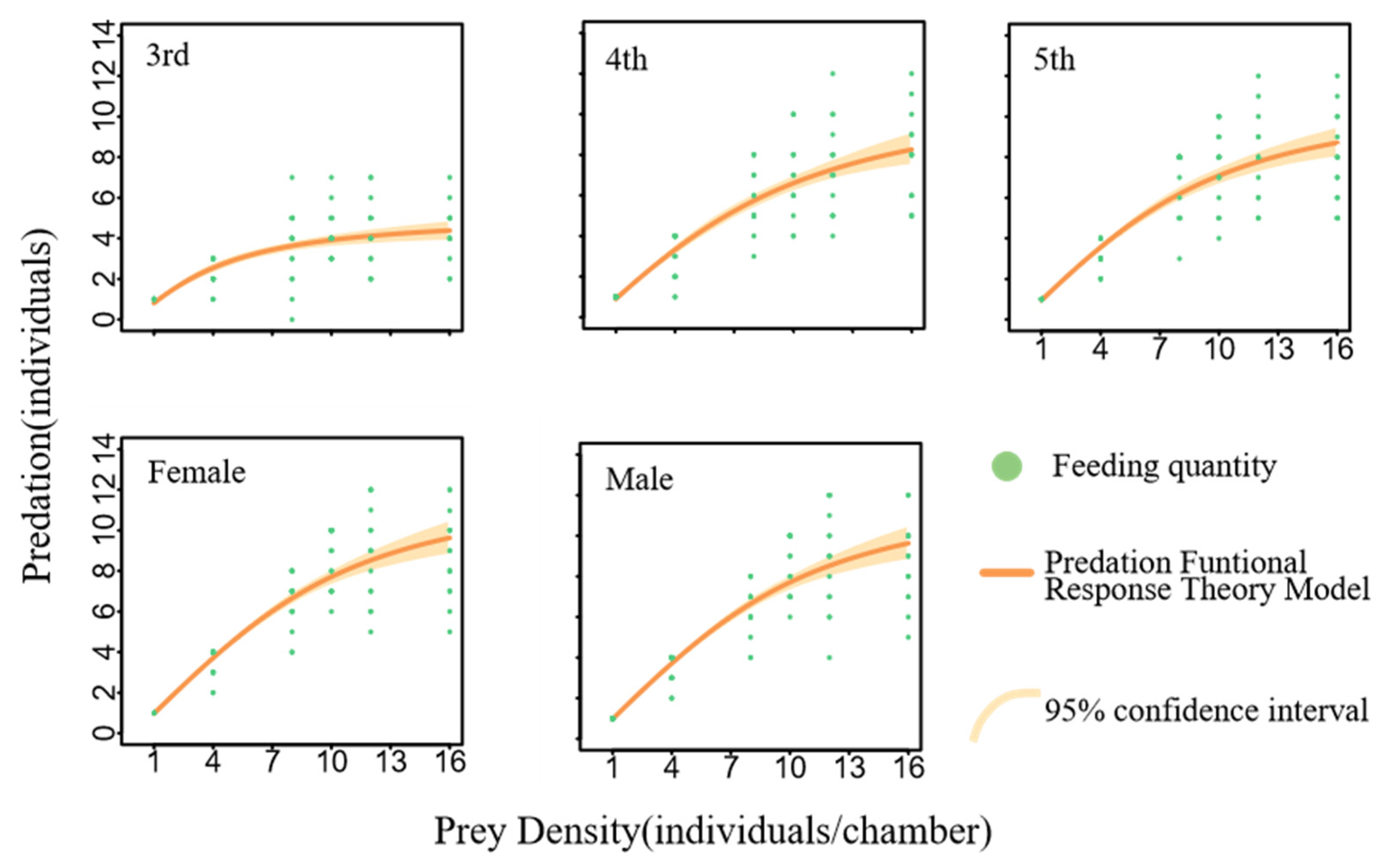
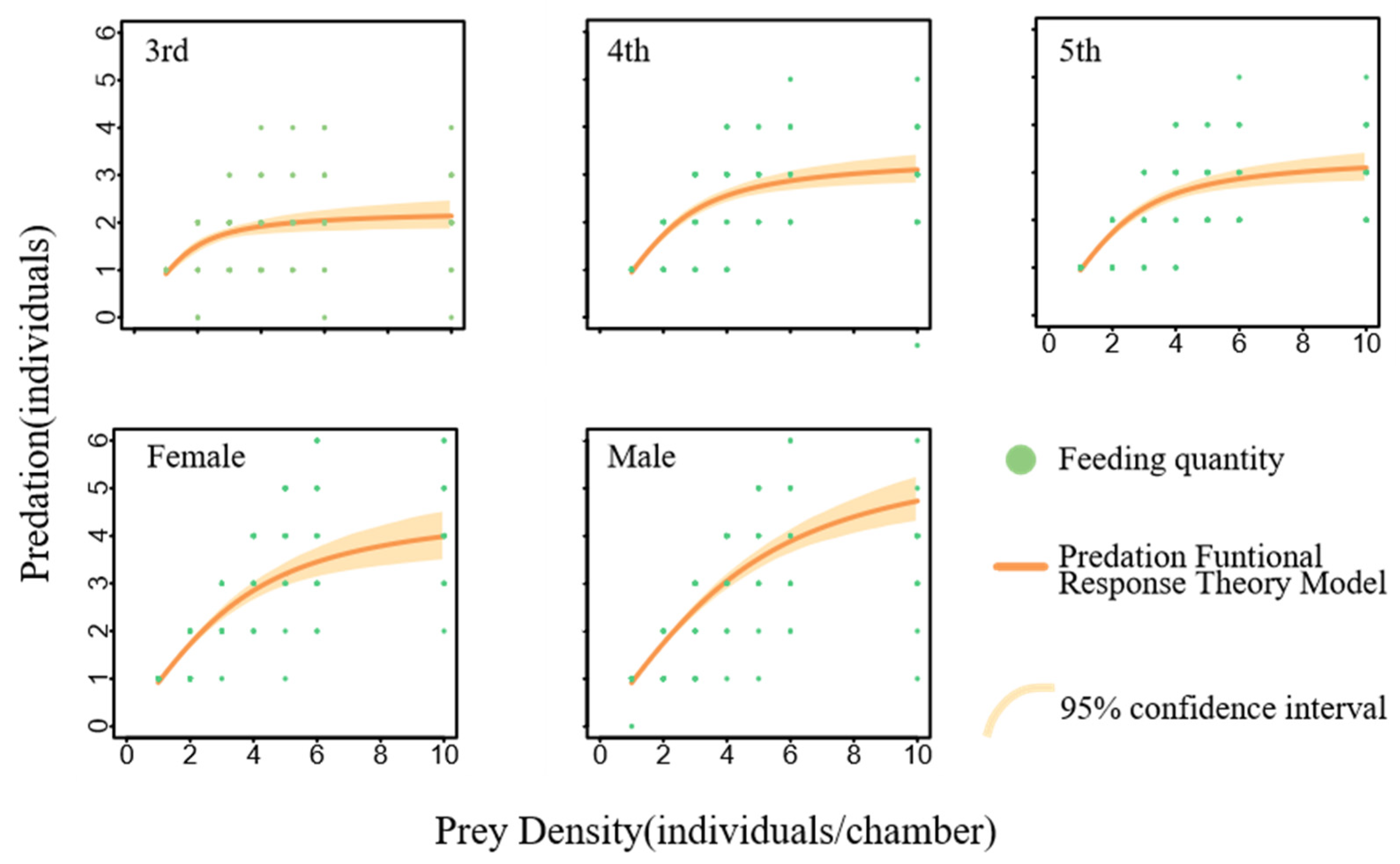
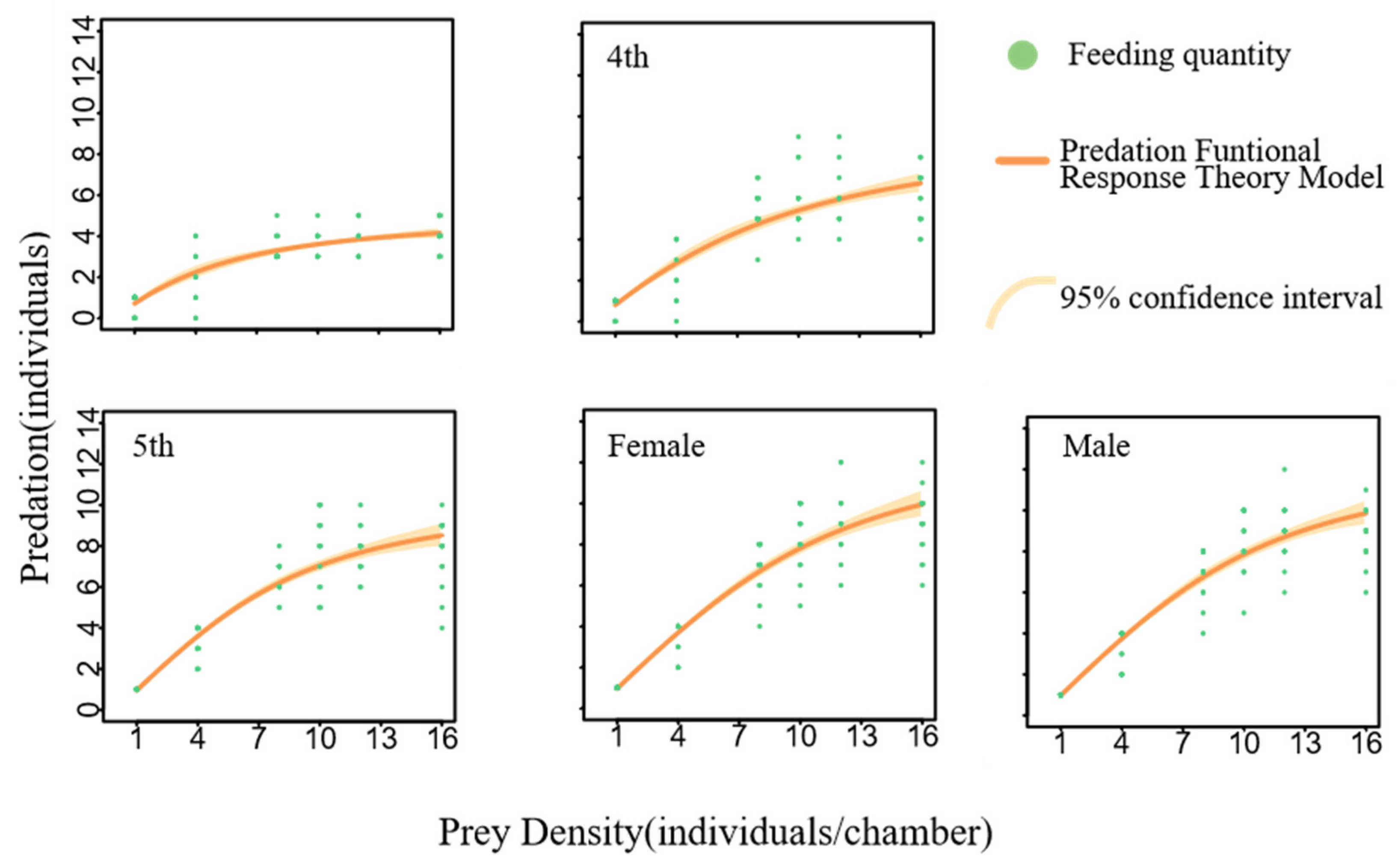
3.1.2. The Predatory Function Response of Arma chinensis to the Larvae of Helicoverpa armigera
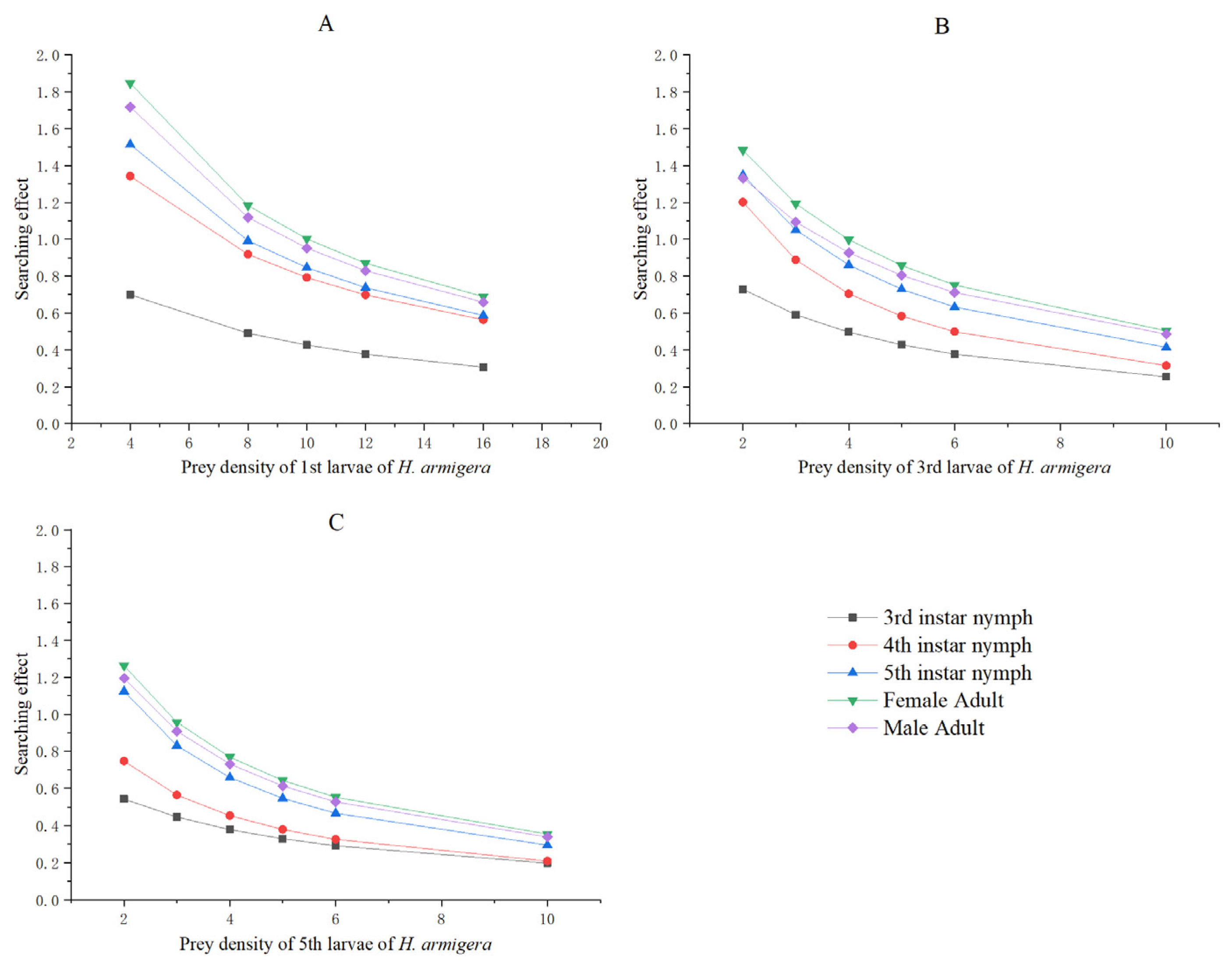
3.1.3. The Searching Efficiency of Arma chinensis on Helicoverpa armigera Larvae
3.2. Evaluation of the Predatory Effect of Arma chinensis Against Spodoptera exigua Larvae
3.2.1. The Predatory Capacity of Arma chinensis Towards Spodoptera exigua Larvae
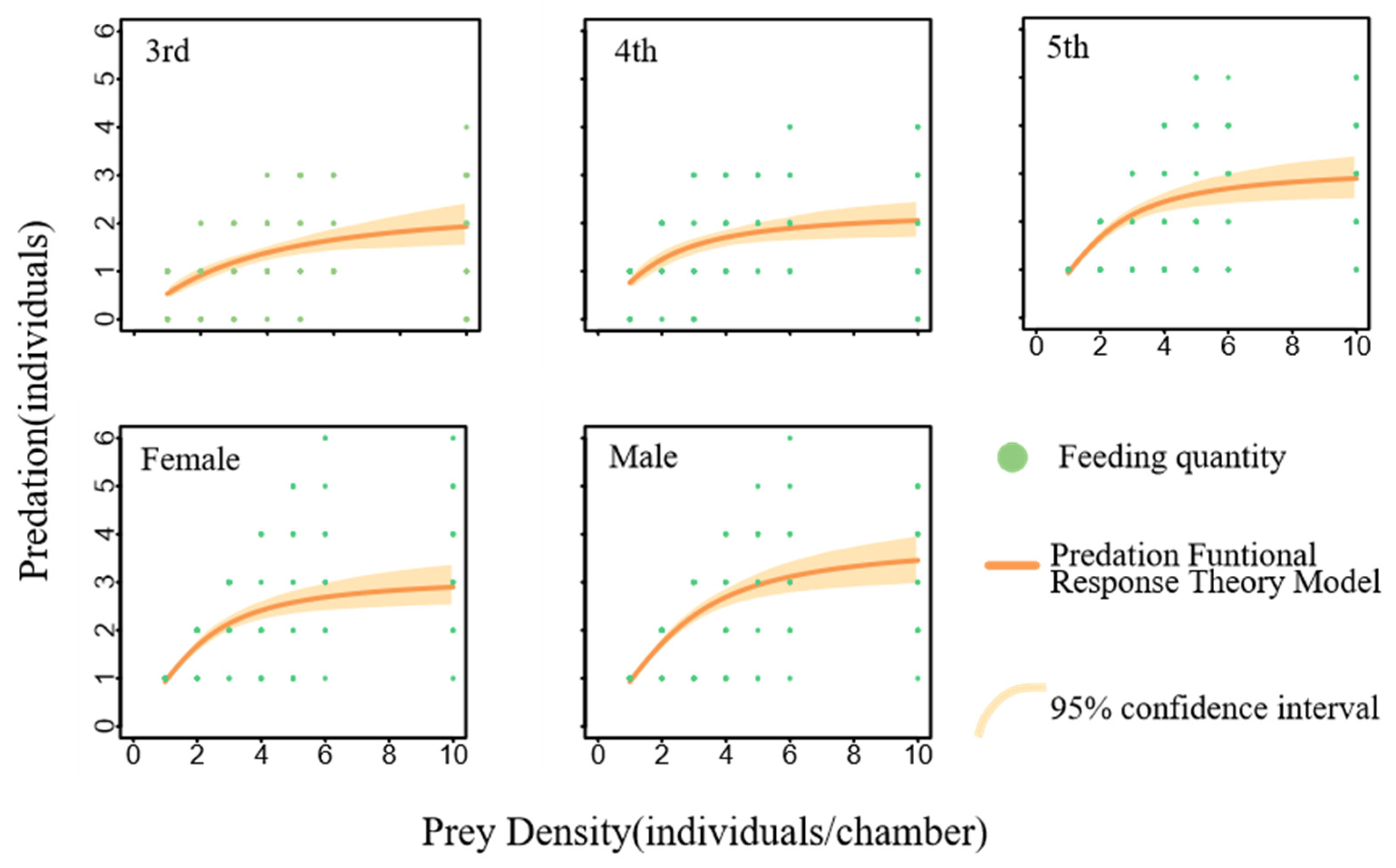
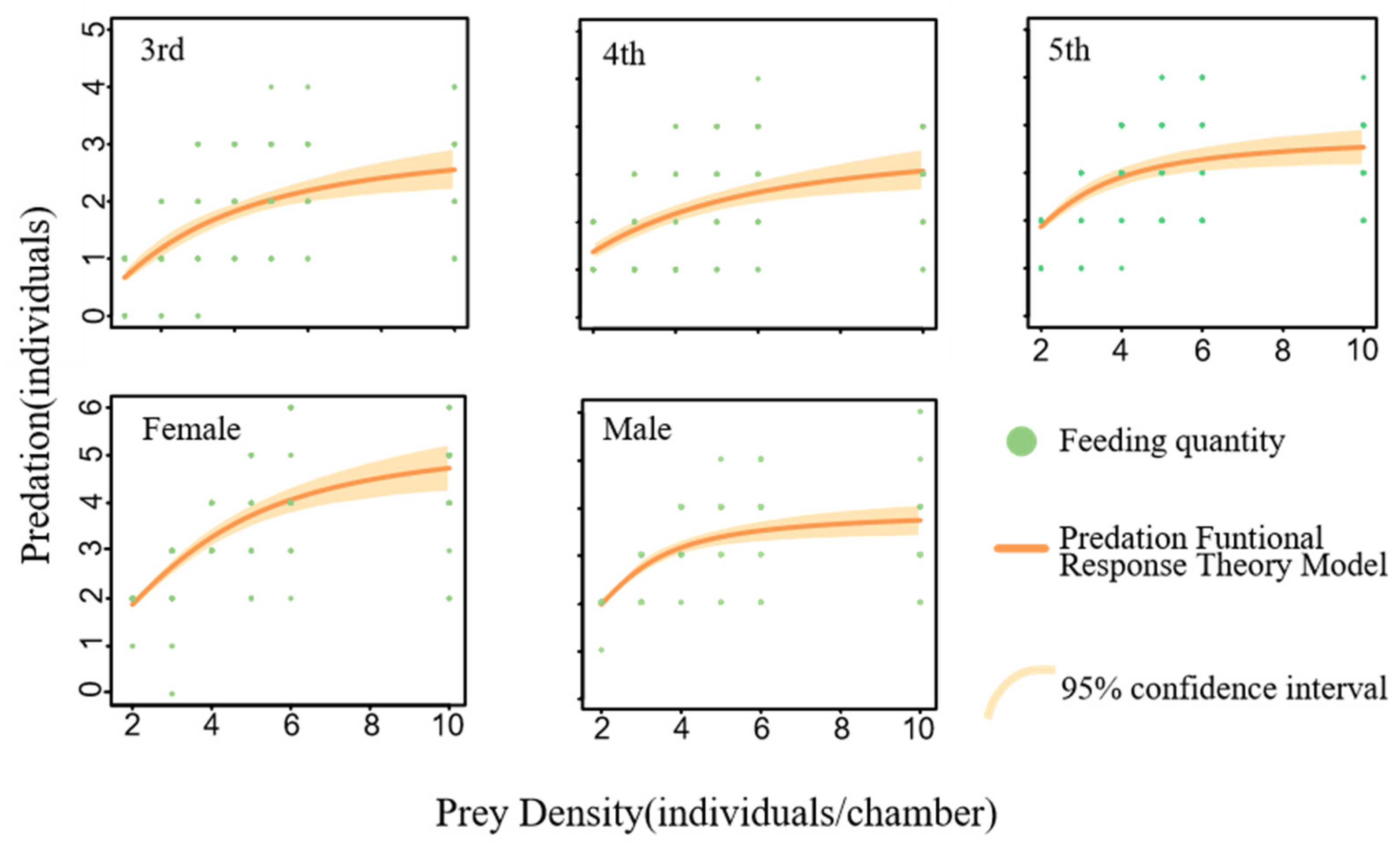
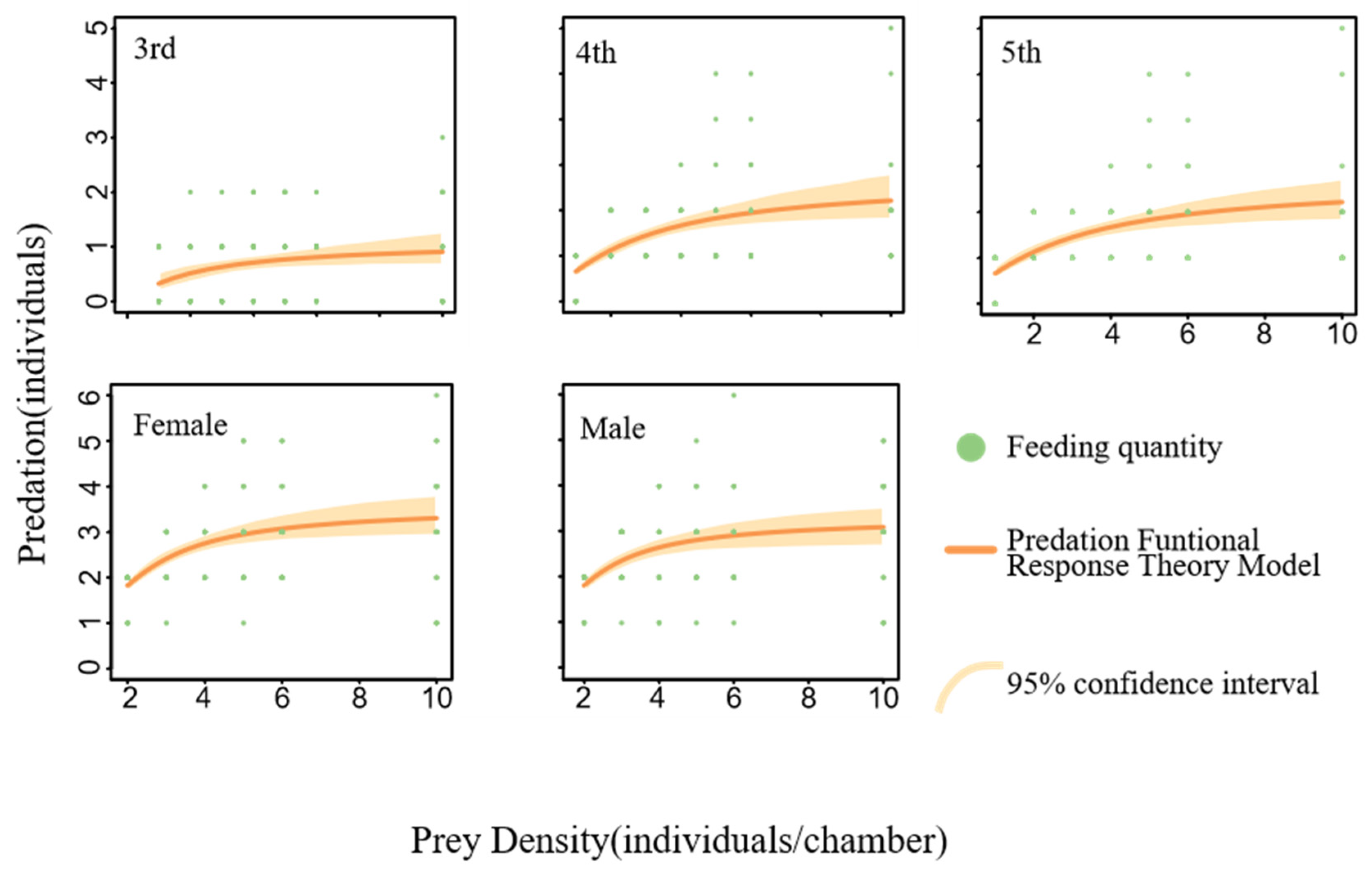
3.2.2. The Predatory Function Response of Arma chinensis to the Larvae of Spodoptera exigua
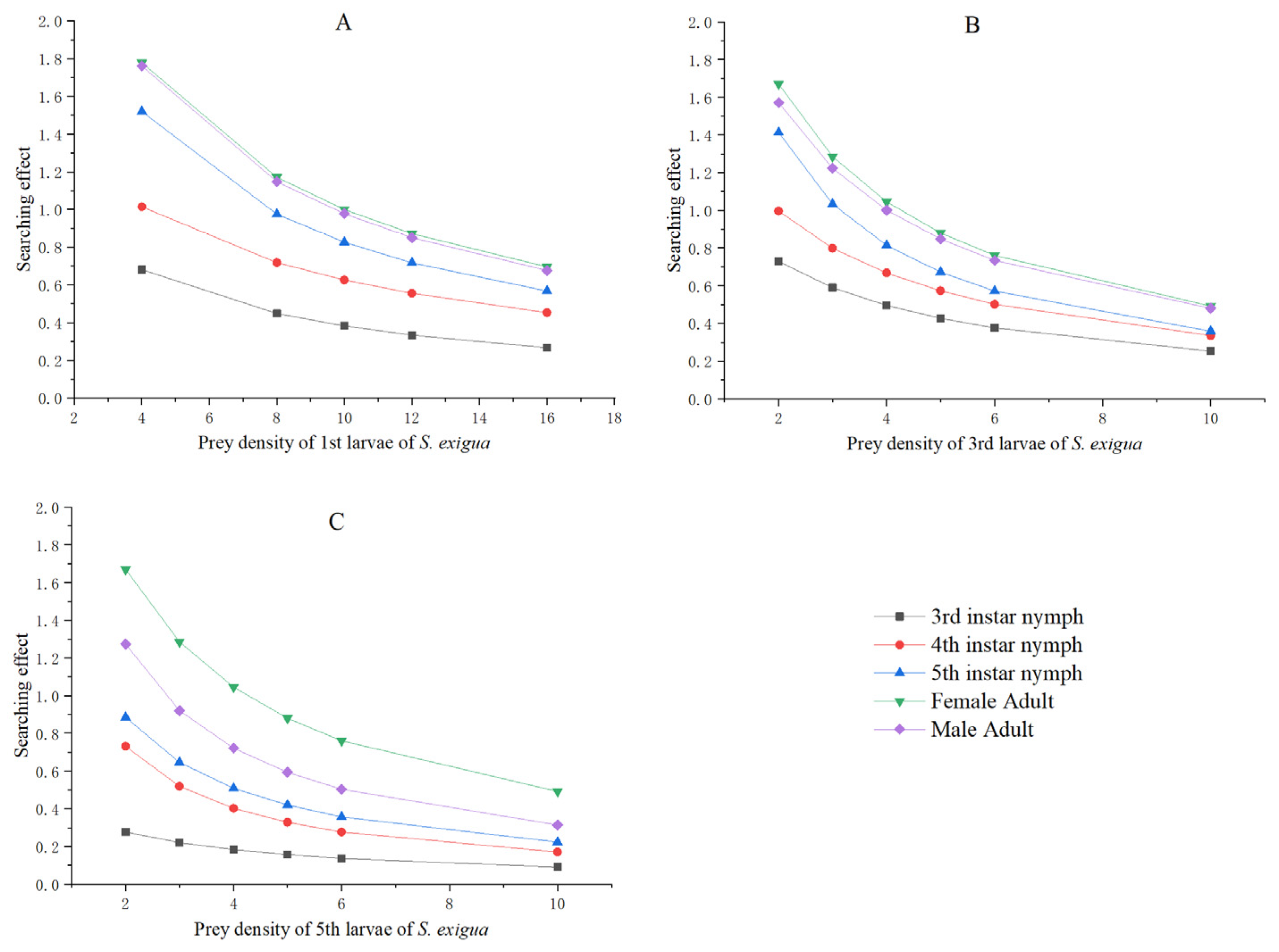
3.2.3. The Searching Efficiency of Arma chinensis on Spodoptera exigua Larvae
3.3. Prey Preference of Arma chinensis Towards Larvae of Helicoverpa armigera and Spodoptera exigua
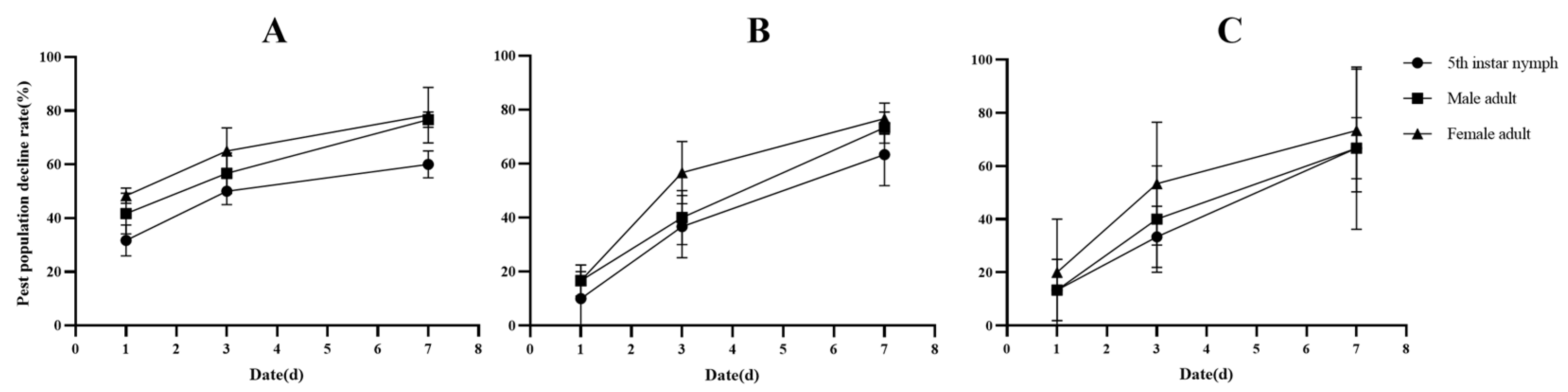
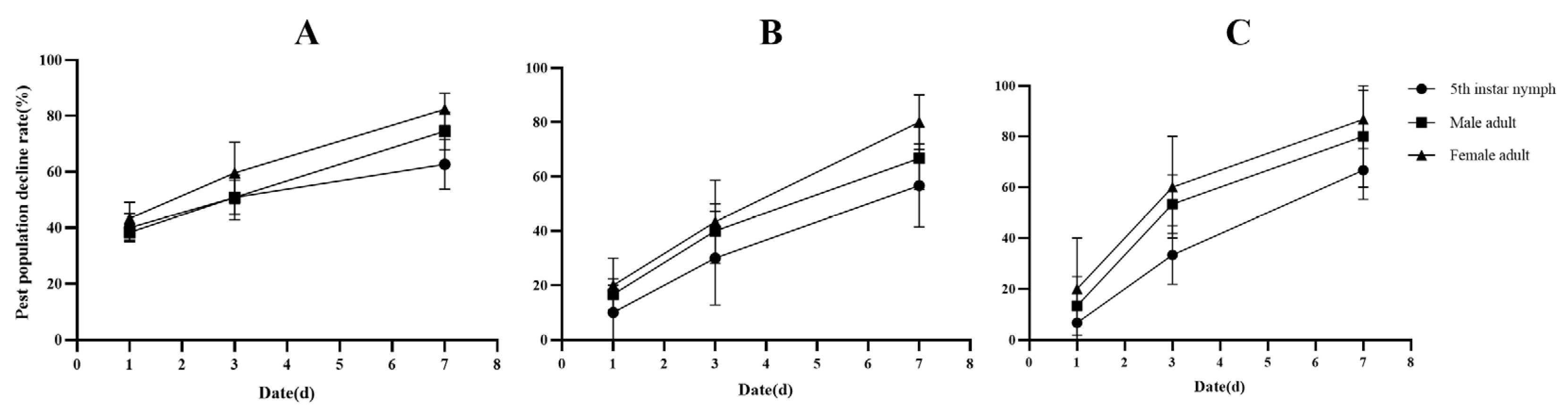
3.4. Field Efficacy of Arma chinensis Against Larvae of Helicoverpa armigera and Spodoptera exigua
4. Discussion
Author Contributions
Funding
Data Availability Statement
Acknowledgments
Conflicts of Interest
References
- Valencia-Montoya, W.A.; Elfekih, S.; North, H.L.; José Maurício, S.B. Adaptive introgression across semipermeable species boundaries between local Helicoverpa zea and invasive Helicoverpa armigera Moths. Mol. Biol. Evol. 2020, 37, 2568–2583. [Google Scholar] [CrossRef] [Scilit] [PubMed]
- Yadav, S.P.S.; Lahutiya, V.; Paudel, P. A review on the biology, ecology, and management tactics of Helicoverpa armigera (Lepidoptera: Noctuidae). Turk. J. Agric.-Food Sci. Technol. 2022, 10, 2467–2476. [Google Scholar] [CrossRef] [Scilit]
- Jin, M.; North, H.L.; Peng, Y.; Liu, H.; Liu, B.; Pan, R.; Zhou, Y.; Zheng, W.; Liu, K.; Yang, B.; et al. Adaptive evolution to the natural and anthropogenic environment in a global invasive crop pest, the cotton bollworm. Innovation 2023, 4, 100454. [Google Scholar] [CrossRef] [Scilit] [PubMed]
- Lu, y.; Wang, K.; Jiang, Y.; Xia, B.; Li, P.; Feng, H.; Wyckhuys, K.A.; Guo, Y. Mirid bug outbreaks in multiple crops correlated with wide-scale adoption of Bt cotton in China. Science 2010, 328, 1151–1154. [Google Scholar] [CrossRef] [Scilit] [PubMed]
- Zheng, X.; Cong, X.; Wang, X.; Lei, C. A Review of Geographic Distribution, Overwintering and Migration in Spodoptera exigua Hübner (Lepidoptera: Noctuidae). J. Entomol. Res. Soc. 2011, 13, 39–48. [Google Scholar]
- Rajesh Chowdary, L.; Suneel Kumar, G.V.; Bharathi, S.; Sarada, O.; Nagaraju, Y.; Manikyanahalli Chandrashekara, K.; Naga Harish, G. Off-season survival and life history of beet armyworm, Spodoptera exigua (Hubner) on various host plants. Sci. Rep. 2024, 14, 13721. [Google Scholar] [CrossRef] [Scilit] [PubMed]
- Azidah, A.; Sofian-azirun, M. Life history of Spodoptera exigua (Lepidoptera: Noctuidae) on various host plants. Bull. Entomol. Res. 2006, 96, 613–618. [Google Scholar] [CrossRef] [Scilit]
- Saeed, S.; Sayyed, A.H.; Ahmad, I. Effect of host plants on life-history traits of Spodoptera exigua (Lepidoptera: Noctuidae). J. Pest Sci. 2010, 83, 165–172. [Google Scholar] [CrossRef] [Scilit]
- Hafeez, M.; Ullah, F.; Khan, M.M.; Li, X.; Zhang, Z.; Shah, S.; Imran, M.; Assiri, M.A.; Fernández-grandon, G.M.; Desneux, N.; et al. Metabolic-based insecticide resistance mechanism and ecofriendly approaches for controlling of beet armyworm Spodoptera exigua: A review. Environ. Sci. Pollut. Res. 2022, 29, 1746–1762. [Google Scholar] [CrossRef] [Scilit]
- Zhou, W.; Arcot, Y.; Medina, R.F.; Bernal, J.; Cisneros-Zevallos, L.; Akbulut, M.E.S. Integrated Pest Management: An Update on the Sustainability Approach to Crop Protection. ACS Omega 2024, 9, 41130–41147. [Google Scholar] [CrossRef] [Scilit] [PubMed]
- Gao, Z.; Wang, X.; Zhang, L.; Sun, Y.; Fan, J.; Wang, G. Study on the biological characteristics of Arma chinensis. J. Eng. Heilongjiang Univ. 2011, 2, 72–77. [Google Scholar] [CrossRef]
- Gao, Z.; Wang, X.; Zhang, L.; Sun, Y.; Fan, J.; Fu, X.; Jing, N.; Wang, G. Study on artificial breeding technology and releasing in field of Arma chinensis Fallou. J. Eng. Heilongjiang Univ. 2012, 3, 65–73. [Google Scholar] [CrossRef]
- Pan, S.; Yang, X.; Yuan, R.; Yang, Y. Determination of the number of enemies of Arma chinensis feeding on Leucoma salicis. J. Jilin For. Sci. Technol. 1993, 1, 25–26. [Google Scholar] [CrossRef]
- Chen, J.; Zhang, J.; Zhang, J.; Tian, Y.; Xu, Z.; Li, G. Study on functional response of Arma chinensis to the adults of Monolepta hieroglyphica. J. Environ. Entomol. 2007, 4, 149–154. [Google Scholar] [CrossRef]
- Zou, D.; Wang, M.; Zhang, L.; Zhang, Y.; Zhang, X.; Chen, H. Taxonomic and bionomic notes on Arma chinensis (Fallou). Zootaxa 2012, 3382, 41–52. [Google Scholar] [CrossRef] [Scilit]
- Wang, Y.; Zhang, H.; Yin, Y.; Li, X.; Zhao, X.; Tang, Y.; Wang, M.; Chen, A.; Chen, F.; Zhang, L. Predation of adult of Arma chinensis to larvae of Spodoptera frugiperda. Plant Prot. 2019, 45, 42–46. [Google Scholar] [CrossRef]
- Gao, Q.; Wang, D.; Zhang, W.; Liu, Y.; Meng, F.; Wu, B.; Wang, Z.; Liu, L.; Zong, H.; Tan, X. Study on Predatory Function of Arma chinensis on Spodoptera litura (Fabricius). Tob. Sci. China 2019, 40, 55–59. [Google Scholar] [CrossRef]
- Wang, M.; Su, X.J.; Zhou, X.X.; Yue, H.F.; Chen, Y.X.; Yan, X.J.; Yuan, H.Z. Study on the predation ability of Arma chinensis and Picromerus lewisi on the older larvae of Spodoptera frugiperda. In Proceedings of the 2019 Annual Academic Conference of the Chinese Society for Plant Protection, Xi’an, China, 23 October 2018; Available online: https://kns.cnki.net/kcms2/article/abstract?v=iwDheDcO5w5xP1cIh53Yl4uXcI9kHmCfXp1b0I-Oi8xIEtfmhN08SxG1tNTrvjoxokKhM5OkNaMvk_ddT7WYNSPXWhwOZEZND0HFbwzWhUEs3YF7tZc8HLh7-NKNkxQMbeen__bUDRqarr32V9KJEkFYMYV3ffFVWRlQiiFaRcDeEhl7Y8MeXQ0MNlVVPfNH&uniplatform=NZKPT&language=CHS (accessed on 5 May 2026).
- Tang, Y.; Wang, M.; Li, Y.; Liu, C.; Mao, J.; Chen, H.; Zhang, L. Predation of Arma chinensis on Spodoptera litura Larvae. Tob. Sci. China. 2020, 41, 62–66. [Google Scholar] [CrossRef]
- Luo, Z.; Gong, X.; Yuxiang, D.; Wang, X.; Shen, S.; Long, Y. Evaluation of predation effectiveness of Arma chinensis to Agriophara rhombata larvae. For. Pest Dis. 2023, 42, 19–25. [Google Scholar] [CrossRef]
- Wang, W.; Liu, Q.; Yanjia, R.; Kang, Z.; Lin, Z.; Zhang, X.; Yang, Q.; Wang, J.; Ma, J.; Sun, Y. Preliminary Observation of Preyed Ability of Arma chinensis (Fallou), a New Natural Enemy of Hyphantria cunea (Drury). J. Shandong For. Sci. Technol. 2012, 42, 11–14. [Google Scholar] [CrossRef]
- Sun, J.; Wang, M.; Tang, Y.; Li, X.; Zhang, L.; Li, H. Predatory functional response of Arma custos (Hemiptera: Pentatomidae) to the larvae of Helicoverpa armigera (Lepidoptera: Noctuidae). J. Plant Prot. 2021, 48, 1081–1087. [Google Scholar] [CrossRef]
- Chen, J.; Li, F.; Du, Y.; Xie, J.; Zhang, Q.; Wang, C.; Guo, S. Predation Ability and Preference of Arma chinensis against Helicoverpa armigera Larvae. Henan Agric. Sci. 2025, 54, 109–118. [Google Scholar] [CrossRef]
- Wang, J.; Ge, Y.; Jiang, J.; Liu, Y.; Ji, X. Functional response of Arma chinensis adults to different larval instars of Spodoptera exigua. J. Appl. Entomol. 2025, 62, 1828–1835. [Google Scholar] [CrossRef]
- Ganjisaffar, F.; Perring, T.M. Prey stage preference and functional response of the predatory mite Galendromus flumenis to Oligonychus pratensis. Biol. Control 2015, 82, 40–45. [Google Scholar] [CrossRef] [Scilit]
- Patel, P.; Kumar, B.; Kumar, D. Does body size of coccinellid predators (Coleoptera: Coccinellidae) influence their preference to eat well-defended prey? Acta Entomol. Sin. 2018, 61, 704–711. [Google Scholar] [CrossRef]
- Rendon, D.; Taylor, P.W.; Wilder, S.M.; Whitehouse, M.E.A. Does prey encounter and nutrient content affect prey selection in wolf spiders inhabiting Bt cotton fields? PLoS ONE 2019, 14, e0210296. [Google Scholar] [CrossRef] [Scilit] [PubMed]
- Řezáč, M.; Gloríková, N.; Líznarová, E.; Wilder, S.M.; Heneberg, P. The nutritional status of Heliophanus spiders shifts their food preferences for aphid prey over intraguild spider prey. Environ. Entomol. 2025, 55, nvaf135. [Google Scholar] [CrossRef] [Scilit] [PubMed]
- Pintar, M.R.; Resetarits, W.J. Match and mismatch: Integrating consumptive effects of predators, prey traits, and habitat selection in colonizing aquatic insects. Ecol. Evol. 2021, 11, 1902–1917. [Google Scholar] [CrossRef] [Scilit] [PubMed]
- Beretta, G.M.; Zandbergen, L.; Deere, J.A.; Messelink, G.J.; Muñoz Cárdenas, K.; Janssen, A. Predator-prey interactions: How thrips avoid predation. Biol. Control 2024, 188, 105437. [Google Scholar] [CrossRef] [Scilit]
- Deng, H.; Wang, Z.; Chen, Y.; Wu, W. Predation of Harpactor fuscipes on Helicoverpa assulta and Spodoptera litura. Guangdong Agric. Sci. 2012, 39, 107–109. [Google Scholar] [CrossRef]
- Song, B.; Yang, Q.; Li, Q.; Jiang, C.; Wang, X.; Wang, H. Prey preferences of Orius munutus. Chin. J. Appl. Entomol. 2018, 55, 112–116. [Google Scholar] [CrossRef]
- Ouyang, J.; Wu, S.; Zhou, Z. Effects of Mixed Prey on the Development, Reproduction, and Predation of Arma chinensis. Chin. J. Biol. Control 2021, 37, 1090–1094. [Google Scholar] [CrossRef]
- Yang, C. Predation, Prey Preference, and Life Table of Arma chinensis (Fallou) on Spodoptera litura (Fabricius) and Helicoverpa assulta (Guenée). Master’s Thesis, Guizhou University, Guizhou, China, 2021. [Google Scholar] [CrossRef]
- Liu, Q.; Wang, L.; Zhu, X.; Lin, C.; Huang, H.; Kuang, Y.; Jing, R.; Zhou, Z.; Chen, L. Evaluation of the growth and development of predatory stink bug Arma custos(Fabricius) fed on Chinese tussar moth Antheraea pernyi (Guérin-Méneville) pupaeand geometer Ectropis grisescens Warren pupae based on two-sex life table. J. Plant Prot. 2025, 52, 60–69. [Google Scholar] [CrossRef]
- Wang, J.; Mu, Y.; Yang, C.; Yang, L.; Zhang, C.; Yu, H.; Chang, Z.; Long, J.; Chen, X. Population Growth Performance of Arma custos (Faricius) (Hemiptera: Pentatomidae) at Different Temperatures. J. Insect Sci. 2022, 22, 12. [Google Scholar] [CrossRef] [Scilit] [PubMed]
- Liao, P.; Yin, J.; Yin, Y.; Zhu, Y.; Li, Y.; Mi, J.; Wang, M.; Chen, H.; Zhang, L.; Liu, C. Influence of Leguminous Host Plants on Growth, Development and Fecundity of Arma chinensis. Chin. J. Biol. Control 2020, 36, 539–544. [Google Scholar] [CrossRef]
- Van Baaren, J.; Le Lann, C.; van Alphen, J. Aphid Biodiversity Under Environmental Change; Springer: Berlin/Heidelberg, Germany, 2010; pp. 55–68. [Google Scholar]
- Rafiei, B. Climate change impacts on pest and beneficial insects: Challenges and management strategies for adaptation. Arthropods 2025, 14, 82–93. [Google Scholar]
- Inbar, M.; Gerling, D. Plant-Mediated Interactions Between Whiteflies, Herbivores, and Natural Enemies. Annu. Rev. Entomol. 2008, 53, 431–448. [Google Scholar] [CrossRef] [Scilit] [PubMed]
- Lemay, J.; Zheng, Y.; Scott-dupree, C. Factors Influencing the Efficacy of Biological Control Agents Used to Manage Insect Pests in Indoor Cannabis (Cannabis sativa) Cultivation. Front. Agron. 2022, 4, 795989. [Google Scholar] [CrossRef] [Scilit]
- Carter, M.C.; Sutherland, D.; Dixon, A.F.G. Plant structure and the searching efficiency of coccinellid larvae. Oecologia 1984, 63, 394–397. [Google Scholar] [CrossRef] [Scilit] [PubMed]
- Holling, C.S. Some Characteristics of Simple Types of Predation and Parasitism. Can. Entomol. 1959, 91, 385–398. [Google Scholar] [CrossRef] [Scilit]
- Cuthbert, R.N.; Dalu, T.; Wasserman, R.J.; Sentis, A.; Weyl, O.L.F.; Froneman, P.W.; Callaghan, A.; Dick, J.T.A. Prey and predator density-dependent interactions under different water volumes. Ecol. Evol. 2021, 11, 6504–6512. [Google Scholar] [CrossRef] [Scilit] [PubMed]
- Arim, M.; Marquet, P.A. Intraguild predation: A widespread interaction related to species biology. Ecol. Lett. 2004, 7, 557–564. [Google Scholar] [CrossRef] [Scilit]
- Provost, C.; Coderre, D.; Lucas, É.; Chouinard, G.; Bostanian, N.J.; Provost, C. Impact of intraguild predation and lambda-cyhalothrin on predation efficacy of three acarophagous predators. Pest Manag. Sci. 2005, 61, 532–538. [Google Scholar] [CrossRef] [Scilit] [PubMed]
- de Pedro, L.; Beitia, F.; Tormos, J. Two Better Than One? Potential Effects of Intraguild Predation on the Biological Control of Ceratitis capitata (Diptera: Tephritidae) by the Parasitoid Aganaspis daci (Hymenoptera: Figitidae) and the Predator Pseudoophonus rufipes (Coleoptera: Carabidae). Agronomy 2022, 13, 87. [Google Scholar] [CrossRef] [Scilit]
- Schmidt-jeffris, R.A. Nontarget pesticide impacts on pest natural enemies: Progress and gaps in current knowledge. Curr. Opin. Insect Sci. 2023, 58, 101056. [Google Scholar] [CrossRef] [Scilit] [PubMed]
- Zhang, Z.; Wu, H.; Zhang, A.; Tan, M.; Yan, S.; Jiang, D. Transfer of heavy metals along the food chain: A review on the pest control performance of insect natural enemies under heavy metal stress. J. Hazard. Mater. 2024, 478, 135587. [Google Scholar] [CrossRef] [Scilit] [PubMed]
- Spence, S.K.; Alharbi, S.A.M.; Ejomah, A.; Maleki, F.A.; Wolfin, M.S.; Kersch-Becker, M.F. Sublethal Effects of Neonicotinoids: How Physiological and Behavioral Disruptions in Non-Target Insects Threaten Biodiversity and Ecosystem Services. Insects 2025, 17, 26. [Google Scholar] [CrossRef] [Scilit] [PubMed]
- Qu, H.; Duan, J.; Ma, S.; Wang, S. Effect of different artificial diet preservatives on the growth and reproduction of the cotton bollworm, Helicoverpa armigera. Chin. J. Appl. Entomol. 2024, 61, 1048–1056. [Google Scholar] [CrossRef]
- Zhou, J.Z.; Chen, C.M. Quantitative measurement of selectivity of predator for prey. Acta Ecol. Sin. 1987, 7, 50–56. [Google Scholar]
- Xie, Q.; Yang, J.; Ma, J.; Yi, X. Forest Predation Behavior and Control of Arma chinensis on Alphaea phasm. For. Sci. Technol. Commun. 2022, 9, 71–74. [Google Scholar] [CrossRef]
- Chen, B. Effectiveness of the Natural Enemy Arma chinensis and Telenomus remus on the Prevention and Control of Major Pest, Spodoptera frugiperda. Master’s Thesis, Shenyang Agricultural University, Shenyang, China, 2024. [Google Scholar]
- Zhuang, L.; Li, W.; Yang, L.; Li, H.; Fan, Y.; Yuan, G. Influencing factors of ladybirds on aphid functional response. Res. Insects Cent. China 2012, 8, 30–35. [Google Scholar]
- Ali, S. Fitness and Predating Potential of orius strigicollis poppius (heteroptera:anthocoridae) on Pectinophora gossypiella and Spodoptera exigua. Master’s Thesis, Huazhong Agricultural University, Wuhan, China, 2020. [Google Scholar] [CrossRef] [Scilit] [PubMed]
- Hou, Z.; Sun, B.; Liu, X.; Yin, Z.; Guo, X. Predatory functional response of assassin bug Sycanus falleni to the larvae of fall armyworm Spodoptera frugiperda. J. Plant Prot. 2020, 47, 852–858. [Google Scholar] [CrossRef]
- Wang, Y.; Zhang, H.; Li, X.; Yin, Y.; Zhao, X.; Chen, F.; Zhang, L. Predation of Picromerus lewisi Nymph on Larvae of Spodoptera frugiperda. Chin. J. Biol. Control. 2020, 36, 520–524. [Google Scholar] [CrossRef]
- Gong, X.; Luo, Z.; Yu, X.; Qu, H.; Wang, X.; Long, L.; Zhang, D.; Liang, X.; Chen, L.; Long, Y. Functional response of Eocanthecona furcellate(Hemiptera: Pentatomidae) to different instars of Agriophara rhombata Meyr. Chin. J. Biol. Control. 2023, 39, 1066–1075. [Google Scholar] [CrossRef]
- Azevedo, K.E.X.; Magalhães, D.M.; De Andrade Moral, R.; José Maurício, S.B. Weathering the hunt: The role of barometric pressure in predator insects’ foraging behaviour. Ecol. Evol. 2023, 13, e10416. [Google Scholar] [CrossRef] [Scilit] [PubMed]
- Pan, M.; Zhang, H.; Zhang, L.; Chen, H. Effects of Starvation and Prey Availability on Predation and Dispersal of an Omnivorous Predator Arma chinensis Fallou. J. Insect Behav. 2019, 32, 134–144. [Google Scholar] [CrossRef] [Scilit]
- Pervez, A.; Sharma, R. Influence of intraspecific competition for food on the bodyweight of the adult aphidophagous ladybird, Coccinella transversalis. Eur. J. Environ. Sci. 2021, 11, 5–11. [Google Scholar] [CrossRef] [Scilit]
- Qu, Y.; Walker, A.A.; Meng, L.; Herzig, V.; Li, B. The Predatory Stink Bug Arma custos (Hemiptera:Pentatomidae) Produces a Complex Proteinaceous Venom to Overcome Caterpillar Prey. Biology 2023, 12, 691. [Google Scholar] [CrossRef] [Scilit] [PubMed]
- Zeng, R.; Wu, J.; Bai, T.; Cai, Y.; Peng, R.; Ma, C.; Zhang, R.; Yang, Q.; Ren, W. Predation Characteristics of Arma chinensis to Larvae of Argyrogramma agnata. Chin. Agric. Sci. Bull. 2025, 41, 143–147. [Google Scholar] [CrossRef]
- Fu, C.; Liu, J.; Huang, M.; Zhang, S.; Chen, B.; Zhang, L. Study on indoor predation characteristics of Arma chinensis on Spodoptera frugiperda. In Proceedings of the 2019 Green Control Conference on Spodoptera litura in Yunnan; Editorial Department of Yunnan Agricultural Sciences and Technology: Kunming, China, 2019; pp. 31–35. [Google Scholar] [CrossRef]
- Yang, W. Screening of Pesticides and Evaluation of the Predation Function of Arma chinensis on Tuta absoluta Control in Inner Mongolia. Master’s Thesis, Inner Mongolia Agricultural University, Inner Mongolia, China, 2024. [Google Scholar] [CrossRef]
- Han, S.; Yu, W.; Li, Q.; Xu, B.; Zhang, M.; Shen, Z.; Li, Y.; Zhang, L. Evaluation of the predatory ability of Arma chinensis adults on larvae of Gynaephora menyuanensis. Plant Prot. 2025, 51, 111–117. [Google Scholar] [CrossRef]
- Tang, Y.; Zhang, X.; Zhao, Y.; Zhang, K.; Cao, K.; Wang, M.; Chen, C. Predatory functional response and predation preference of ladybeetle Harmonia axyridis to Spodoptera frugiperda and Spodoptera exigua. Plant Health Med. 2025, 4, 45–50. [Google Scholar] [CrossRef]
- Chen, C.; Song, L.; Zuo, T.; Wang, Y.; Li, S.; Sun, S. Observation of predation behavior and evaluation of the predation capacity of Arma chinensis against Hyphantria cunea. J. Beijing For. Univ. 2022, 44, 94–102. [Google Scholar]
- Guo, S.; Chen, J.; Zhang, L.; Li, F.; Liu, H.; Shi, H. The Predatory Ability and Intraspecific Interference Response of Arma chinensis to the Larvae of Ectropis grisescens. Tea Sci. 2024, 44, 609–617. [Google Scholar] [CrossRef]
- Pan, M.-Z.; Fu, Z.-X.; Li, Y.-Y.; Chen, H.-Y.; Zhang, L.-S.; Liu, T.-X. Role of host plants in the suitability and dispersal of an omnivorous predator Arma chinensis Fallou (Hemiptera: Pentatomidae: Asopinae) in a biological control context. J. Plant Dis. Prot. 2022, 129, 861–868. [Google Scholar] [CrossRef] [Scilit]
- Du, Q.; Cai, H.; Li, J.; Wu, S.; Zeng, W.; Zhai, Z.; Yang, Z. Effects of Field Rejuvenation on Biological Characteristics of Arma chinensis and Its Progeny. Chin. J. Biol. Control 2022, 38, 1619–1624. [Google Scholar] [CrossRef]
- Chi, H.; You, M.; Atlıhan, R.; Smith, C.L.; Kavousi, A.; Özgökçe, M.S.; Güncan, A.; Tuan, S.-J.; Fu, J.-W.; Xu, Y.-Y.; et al. Age-Stage, two-sex life table: An introduction to theory, data analysis, and application. Entomol. Gen. 2020, 40, 103–124. [Google Scholar] [CrossRef] [Scilit]
- Wu, S.; Zeng, W.; Deng, W.; Li, J.; Li, M.; Tan, L.; Cai, H.; Li, X.; Li, Y.; Zhou, Z. Parental Sex and Not Kinship Determines Egg Cannibalism in Arma custos Fallou (Hemiptera: Pentatomidae: Asopinae). Front. Ecol. Evol. 2022, 10, 758587. [Google Scholar] [CrossRef] [Scilit]






| A. chinensis Stage | Prey Stage of H. armigera | ||
|---|---|---|---|
| The First Instar | The Third Instar | The Fifth Instar | |
| The third-instar | 42.0 ± 12.1 a | 21.3 ± 9.9 b | 17.3 ± 12.8 c |
| The fourth-instar | 70.7 ± 19.8 a | 30.7 ± 9.6 b | 20.0 ± 14.1 c |
| The fifth-instar | 76.0 ± 19.2 a | 34.7 ± 12.5 b | 29.3 ± 12.8 c |
| Female adult | 87.3 ± 16.2 a | 41.3 ± 11.3 b | 34.0 ± 13.5 c |
| Male adult | 85.3 ± 14.6 a | 39.3 ± 16.2 b | 32.0 ± 13.2 c |
| A. chinensis Stage | H. armigera Stage | Estimate | SE | z Value |
|---|---|---|---|---|
| third instar | first instar | −0.107 | 0.020 | −5.371 |
| third instar | −0.255 | 0.037 | −6.821 | |
| fifth instar | −0.164 | 0.037 | −4.379 | |
| fourth instar | first instar | −0.13 | 0.021 | −6.141 |
| third instar | −0.273 | 0.036 | −7.591 | |
| fifth instar | −0.224 | 0.037 | −6.016 | |
| fifth instar | first instar | −0.172 | 0.023 | −7.475 |
| third instar | −0.281 | 0.036 | −7.734 | |
| fifth instar | −0.252 | 0.036 | −7.105 | |
| Female adult | first instar | −0.206 | 0.027 | −7.687 |
| third instar | −0.265 | 0.037 | −7.221 | |
| fifth instar | −0.256 | 0.035 | −7.228 | |
| Male adult | first instar | −0.184 | 0.025 | −7.355 |
| third instar | −0.231 | 0.035 | −6.547 | |
| fifth instar | −0.249 | 0.035 | −7.067 |
| A. chinensis Stage | H. armigera Stage | Functional Response Equation | Attack Rate | Handling Time | Predation Efficiency | Maximum Daily Consumption |
|---|---|---|---|---|---|---|
| third instar | first instar | Na = 1.223N0/(1 + 0.187N0) | 1.223 ± 0.357 a | 0.153 ± 0.026 a | 7.993 | 6.536 |
| third instar | Na = 1.369N0/(1 + 0.439N0) | 1.369 ± 0.373 a | 0.321 ± 0.061 a | 4.265 | 3.115 | |
| fifth instar | Na = 0.963N0/(1 + 0.387N0) | 0.963 ± 0.290 b | 0.402 ± 0.089 b | 2.396 | 2.488 | |
| fourth instar | first instar | Na = 2.490N0/(1 + 0.214N0) | 2.490 ± 0.398 a | 0.086 ± 0.010 a | 28.953 | 11.628 |
| third instar | Na = 4.079N0/(1 + 1.199N0) | 4.079 ± 1.088 a | 0.294 ± 0.03 b | 13.874 | 3.401 | |
| fifth instar | Na = 2.125N0/(1 + 0.922N0) | 2.125 ± 0.713 a | 0.434 ± 0.061 c | 4.896 | 2.304 | |
| fifth instar | first instar | Na = 3.201N0/(1 + 0.278N0) | 3.201 ± 0.476 a | 0.087 ± 0.008 a | 36.793 | 11.494 |
| third instar | Na = 3.106N0/(1 + 0.652N0) | 3.106 ± 0.573 a | 0.210 ± 0.023 b | 14.790 | 4.762 | |
| fifth instar | Na = 3.818N0/(1 + 0.199N0) | 3.818 ± 1.154 a | 0.314 ± 0.036 c | 12.159 | 3.185 | |
| Female adult | first instar | Na = 4.208N0/(1 + 0.320N0) | 4.208 ± 0.608 a | 0.076 ± 0.006 a | 55.368 | 13.158 |
| third instar | Na = 2.887N0/(1 + 0.473N0) | 2.887 ± 0.458 b | 0.164 ± 0.019 b | 17.604 | 6.098 | |
| fifth instar | Na = 3.550N0/(1 + 0.905N0) | 3.550 ± 0.870 b | 0.255 ± 0.029 c | 13.922 | 3.922 | |
| Male adult | first instar | Na = 3.695N0/(1 + 0.288N0) | 3.695 ± 0.543 a | 0.078 ± 0.007 a | 47.372 | 12.821 |
| third instar | Na = 2.364N0/(1 + 0.388N0) | 2.364 ± 0.379 b | 0.164 ± 0.022 b | 14.415 | 6.098 | |
| fifth instar | Na = 3.257N0/(1 + 0.863N0) | 3.257 ± 0.841 b | 0.265 ± 0.032 c | 12.291 | 3.774 |
| A. chinensis Stage | Prey Stage of S. exigua | ||
|---|---|---|---|
| First Instar | Third Instar | Fifth Instar | |
| third instar nymphs | 36.0 ± 06.3 a | 23.3 ± 9.8 b | 8.7 ± 9.9 c |
| fourth-instar nymphs | 59.3 ± 13.9 a | 28.0 ± 10.1 b | 16.7 ± 7.2 c |
| fifth-instar nymphs | 76.7 ± 18.8 a | 32.7 ± 8.8 b | 19.3 ± 7.0 c |
| Female adult | 84.0 ± 15.9 a | 43.3 ± 12.3 b | 31.3 ± 15.5 c |
| male adult | 86.7 ± 15.0 a | 34.7 ± 10.6 b | 30.0 ± 13.6 c |
| A. chinensis Stage | H. armigera Stage | Estimate | SE | z Value |
|---|---|---|---|---|
| third instar | first instar | −0.107 | 0.020 | −5.371 |
| third instar | −0.173 | 0.035 | −4.925 | |
| fifth instar | −0.159 | 0.048 | −3.280 | |
| fourth instar | first instar | −0.115 | 0.020 | −5.817 |
| third instar | −0.214 | 0.036 | −5.903 | |
| fifth instar | −0.235 | 0.041 | −5.690 | |
| fifth instar | first instar | −0.177 | 0.023 | −7.669 |
| third instar | −0.326 | 0.039 | −8.368 | |
| fifth instar | −0.237 | 0.040 | −5.962 | |
| Female adult | first instar | −0.190 | 0.026 | −7.340 |
| third instar | −0.308 | 0.004 | −7.719 | |
| fifth instar | −0.295 | 0.038 | −7.719 | |
| Male adult | first instar | −0.191 | 0.026 | −7.418 |
| third instar | −0.354 | 0.040 | −8.840 | |
| fifth instar | −0.291 | 0.038 | −7.669 |
| A. chinensis Stage | S. exigua Stage | Function Response Equation | Attack Rate | Handling Time | Predation Efficiency | Maximum Daily Consumption |
|---|---|---|---|---|---|---|
| third instar | first instar | Na = 1.420N0/(1 + 0.271N0) | 1.420 ± 0.357 a | 0.191 ± 0.026 a | 7.435 | 5.236 |
| third instar | Na = 1.369N0/(1 + 0.439N0) | 1.369 ± 0.373 b | 0.321 ± 0.061 b | 4.265 | 3.115 | |
| fifth instar | Na = 0.562N0/(1 + 0.515N0) | 0.562 ± 0.295 c | 0.917 ± 0.268 c | 0.613 | 1.091 | |
| fourth instar | first instar | Na = 1.731N0/(1 + 0.177N0) | 1.731 ± 0.290 a | 0.102 ± 0.014 a | 16.971 | 9.804 |
| third instar | Na = 2.002N0/(1 + 0.517N0) | 2.002 ± 0.511 a | 0.258 ± 0.041 b | 7.760 | 3.876 | |
| fifth instar | Na = 4.019N0/(1 + 2.247N0) | 4.019 ± 3.355 b | 0.559 ± 0.083 c | 7.190 | 1.789 | |
| fifth instar | first instar | Na = 3.448N0/(1 + 0.317N0) | 3.448 ± 0.540 a | 0.092 ± 0.008 a | 37.478 | 10.870 |
| third instar | Na = 5.339N0/(1 + 1.388N0) | 5.339 ± 0.371 a | 0.260 ± 0.022 b | 20.535 | 3.846 | |
| fifth instar | Na = 3.388N0/(1 + 0.413N0) | 3.388 ± 1.909 a | 0.417 ± 0.065 c | 8.125 | 2.398 | |
| Female adult | first instar | Na = 3.701N0/(1 + 0.270N0) | 3.701 ± 0.512 a | 0.073 ± 0.007 a | 50.699 | 13.699 |
| third instar | Na = 4.151N0/(1 + 0.743N0) | 4.151 ± 0.809 a | 0.179 ± 0.019 b | 23.190 | 5.587 | |
| fifth instar | Na = 4.962N0/(1 + 1.379N0) | 4.962 ± 1.460 a | 0.278 ± 0.027 c | 17.849 | 3.597 | |
| Male adult | first instar | Na = 3.790N0/(1 + 0.288N0) | 3.790 ± 0.528 a | 0.076 ± 0.007 a | 49.868 | 13.158 |
| third instar | Na = 3.645N0/(1 + 0.660N0) | 3.645 ± 0.662 b | 0.181 ± 0.019 b | 20.138 | 5.525 | |
| fifth instar | Na = 5.392N0/(1 + 1.618N0) | 5.392 ± 1.741 b | 0.300 ± 0.027 b | 17.973 | 3.333 |
| Initial Prey | Initial Prey Quantity | Predation Amount | Predation Prefeference (Ci) |
|---|---|---|---|
| third-instar larvae of H. armigera | 2 | 1.200 ± 0.447 | 0.233 ± 0.224 |
| 4 | 2.000 ± 0.707 | 0.113 ± 0.137 | |
| 6 | 2.400 ± 0.458 | 0.084 ± 0.179 | |
| third-instar larvae of S. exigua | 2 | 0.600 ± 0.548 | −0.333 ± 0.624 |
| 4 | 1.200 ± 0.837 | −0.262 ± 0.421 | |
| 6 | 1.600 ± 1.140 | −0.248 ± 0.450 |
Disclaimer/Publisher’s Note: The statements, opinions and data contained in all publications are solely those of the individual author(s) and contributor(s) and not of MDPI and/or the editor(s). MDPI and/or the editor(s) disclaim responsibility for any injury to people or property resulting from any ideas, methods, instructions or products referred to in the content. |
© 2026 by the authors. Licensee MDPI, Basel, Switzerland. This article is an open access article distributed under the terms and conditions of the Creative Commons Attribution (CC BY) license.
Share and Cite
Cao, J.; Hua, R.; Wang, H.; Zheng, L.; Hu, J.; Zhang, J.; Chen, J. Evaluation of the Predatory Efficacy of Arma chinensis Against Larvae of Helicoverpa armigera and Spodoptera exigua. Agronomy 2026, 16, 1216. https://doi.org/10.3390/agronomy16131216
Cao J, Hua R, Wang H, Zheng L, Hu J, Zhang J, Chen J. Evaluation of the Predatory Efficacy of Arma chinensis Against Larvae of Helicoverpa armigera and Spodoptera exigua. Agronomy. 2026; 16(13):1216. https://doi.org/10.3390/agronomy16131216
Chicago/Turabian StyleCao, Jiyu, Rongrong Hua, Huiqing Wang, Lixuan Zheng, Jiayun Hu, Jianping Zhang, and Jing Chen. 2026. "Evaluation of the Predatory Efficacy of Arma chinensis Against Larvae of Helicoverpa armigera and Spodoptera exigua" Agronomy 16, no. 13: 1216. https://doi.org/10.3390/agronomy16131216
APA StyleCao, J., Hua, R., Wang, H., Zheng, L., Hu, J., Zhang, J., & Chen, J. (2026). Evaluation of the Predatory Efficacy of Arma chinensis Against Larvae of Helicoverpa armigera and Spodoptera exigua. Agronomy, 16(13), 1216. https://doi.org/10.3390/agronomy16131216