


Abstract
Two novel polybenzoxazines are designed to reveal, through comparison with formerly studied umbelliferone-furfurylamine-based benzoxazine (U-fa), how the position of an α,β-unsaturated carbonyl group and its participation in a cyclic substituent influence flammability and thermal stability. Synthesized from naturally derived furfurylamine and each of two bio-based phenols—7-hydroxy-4-chromone and methyl trans-p-coumarate—the novel benzoxazine structures (abbreviated as 7H4C-fa and mtpC-fa, respectively) are confirmed by Fourier transform infrared (FTIR) and 1H nuclear magnetic resonance (1H NMR) spectroscopy. The polymerization behavior of each resin is determined by differential scanning calorimetry (DSC). Thermal degradation and flammability are assessed using thermogravimetric analysis (TGA) and microscale combustion calorimetry (MCC), respectively. Char yields above 55% suggest the thermosets to be thermally stable. An unexpectedly low heat release capacity of 14 J·g−1·K−1 is observed for 7H4C-fa, suggestive of non-ignitable behavior and outperforming the previously studied umbelliferone-based polybenzoxazine. Fire growth capacities as low as 19 J·g−1·K−1 make the polybenzoxazines competitive with high-performance polymers. The results obtained in this work demonstrate that, compared to its open-chain counterpart mtpC-fa, the closed-chain α,β-unsaturated carbonyl-containing moiety of U-fa reduces late-stage thermal decomposition and improves flame retardancy of the resulting thermoset, without necessarily benefitting early-stage thermal stability. Additionally, the position of the α,β-unsaturated carbonyl within the ring is shown to impact both thermal stability and flammability, which may be explained by differences in the electrophilicity of the β-position and the ability of U-fa to participate in transesterification.
1. Introduction
In 1977, the United States Consumer Product Safety Commission banned the production of tris(2,3-dibromopropyl) phosphate, or “brominated Tris”, a flame-retardant additive used in children’s sleepwear. The ban came months after Prival et al. reported that the compound could induce mutations in bacterial strains, placing flame-retardant additives under intense scrutiny [1]. One year after the regulation was passed, Blum et al. confirmed that mutagenic metabolites of Tris were present in children’s urine [2,3]. Thus began an ongoing search for safe yet effective flame-retardant additives. The first replacement, tris-(1,3-dichloro-2-propyl)phosphate—or “chlorinated Tris” for short—was found to have similar effects as its predecessor, leading to short-lived production [4]. Polybrominated diphenyl ethers (PBDEs) had a three-decade-long streak beginning in the late 1970s, lasting until they were reported as bioaccumulative and linked to neurological, endocrine, and reproductive harm [5,6,7,8,9]. Organophosphate flame retardants (OPFRs) have since taken the place of halogenated flame retardants like Tris and PBDEs, despite mounting evidence of their toxicity, carcinogenicity, and high accumulation in indoor spaces [10]. It is probable that organophosphates will face a similar fate as their brominated predecessors (the state of New York has already banned their use in mattresses and upholstered furniture).
Part of what makes these additives so problematic is how easily they can be released into their surroundings. PBDEs, for example, are not covalently bound to their host material and can diffuse out of polymer matrices over time to become airborne. Polymeric flame retardants (PFRs) have been developed under the assumption that their larger size would make them less likely to escape host polymer matrices, with the added benefit that they would be hindered from entering human cells [11]. Publicly available information on PFRs centers around PolyFR, launched by Dow Chemical in 2011 [11]. Koch et al. reported 75 degradation products of PolyFR via UV irradiation and heat, which—unlike the polymer they came from—could leach beyond their host material and accumulate in indoor spaces [12,13]. The health effects of these degradation products are not yet studied. Byproducts of a different, tetrabromobisphenol-A-based PFR was shown to adversely affect mitochondrial function in zebrafish embryos [14].
Given the regulatory track record of flame-retardant additives, it would be advantageous to—whenever possible—employ intrinsically flame-retardant materials, avoiding additives altogether. Polybenzoxazines, halogen-free thermoset polymers obtained through the cationic ring-opening polymerization of 1,3-benzoxazine monomers [15] are promising in this regard. Their monomers can be synthesized via one-pot Mannich condensation involving the combination of a phenolic derivative, an aldehyde, and a primary amine. Alterations to any of the three starting materials (commonly the phenol or amine) provide a straightforward route for manipulating the properties of the resulting polymer [15]. Over the past decade, this design flexibility has been leveraged toward developing intrinsically flame-retardant polybenzoxazines from naturally sourced phenolic derivatives, beginning with an umbelliferone-aniline-based polybenzoxazine (abbreviated as U-a) reported by Arza et al. in 2015 [16]. U-a came after a long line of bio-based polybenzoxazines—which incorporated cinnamate [17], cardanol [18,19], guaiacol [20,21], eugenol [22], vanillin [23], catechol [24,25], and others as their phenolic component—but it was the first to be highlighted for its unexpected thermal properties, outperforming even petroleum-based polybenzoxazines. In 2016, Froimowicz et al. replaced the aminic component with furfurylamine—an electron-rich, bio-derived intermediate—improving upon the already-favorable char yield and polymerization temperature of its aniline-based counterpart [26]. Recently, a systematic study on the amine group in umbelliferone-based polybenzoxazines substantiated their flame retardancy using microscale combustion calorimetry and revealed that the activating effect of the umbelliferone moiety is preserved regardless of amine group [27].
The working explanation for the favorable thermal properties of umbelliferone-based benzoxazines is that the conjugated ester group of the umbelliferone moiety behaves as an activated electrophilic olefin (otherwise known as a Michael acceptor), lowering the activation energy of polymerization and enhancing crosslinking [27,28]. Consideration of comparable phenolic derivatives would greatly supplement this rationale by revealing how the placement and surrounding structure of an α,β-unsaturated carbonyl influences the properties of polybenzoxazines. The present work addresses this gap by synthesizing two new polybenzoxazines from 7-hydroxy-4-chromone and methyl trans-p-coumarate. Like umbelliferone, these phenols contain an α,β-unsaturated carbonyl group. However, they differ from umbelliferone in a manner that allows us to evaluate separately (1) the position of the unsaturated carbonyl group and (2) its participation in a cyclic vs. acyclic substituent on the benzoxazine nucleus. To make for more direct comparisons, all three compounds will be synthesized using furfurylamine, which has historically contributed to favorable results in umbelliferone-benzoxazine systems [26,27]. It is worth emphasizing that all phenolic derivatives studied in this work are natural products isolated from plants. While furfurylamine itself is not bio-based, it can be derived from biomass (furfural).
2. Materials and Methods
2.1. Materials
Umbelliferone (C9H6O3) (>98%) and methyl trans-p-coumarate (C10H10O3) (>98%) were purchased from TCI Chemicals, Portland, OR, USA. 7-Hydroxy-4-chromone (C9H6O3) (97%) was purchased from BLD Pharmatech Co., Cincinnati, OH, USA. Furfurylamine (C5H7NO) (>99%) was purchased from Sigma-Aldrich, St. Louis, MO, USA. Paraformaldehyde (96%) was purchased from Acros Organics, Waltham, MA, USA. Toluene (>99.5%) was purchased from Fisher Chemical, Waltham, MA, USA, as were sodium hydroxide pellets (98.8%). All chemicals were used as received.
2.2. Synthesis
Added to a 100 mL round-bottom flask equipped with a magnetic stirrer was 6 mmol of one of three selected phenols: umbelliferone (0.97 g), 7-hydroxy-4-chromone (0.97 g), or methyl trans-p-coumarate (1.07 g). In each case, paraformaldehyde (13.2 mmol, 0.40 g), furfurylamine (6 mmol, 0.58 g), and toluene (25 mL) were added to the flask. The dispersion containing umbelliferone was heated at 90 °C to afford a brown-yellow reaction mixture after 24 h. The mixture was passed through basic alumina powder under vacuum and left under air to evaporate the solvent, leaving yellow crystals that were recrystallized one time in toluene at low temperatures. The dispersion containing 7-hydroxy-4-chromone was heated at 90 °C to produce a pink reaction mixture after 24 h. Gravity filtration through medium-porosity filter paper yielded pink-white crystals, which were isolated from the remaining solvent via vacuum filtration. The dispersion containing methyl trans-p-coumarate was heated at 90 °C for 15 h. Toluene (25 mL) was added to the reaction mixture, which was washed three times with 1 M NaOH aqueous solution (15 mL) and three times with water (15 mL) in a 125 mL separatory funnel. After drying over MgSO4 powder and allowing the solvent to evaporate, a light brown powder was obtained. For more details regarding the synthesis of U-fa or other umbelliferone-based benzoxazines, we direct readers to past papers on the subject from which we based our synthetic procedures [26,28].
U-fa was obtained with a yield of 48%. 1H NMR (500 MHz, DMSO-d6, 20 °C): δ 7.97 (d, J = 9.5 Hz, 1H), 7.63 (d, J = 1.8 Hz, 1H), 7.50 (d, J = 8.6 Hz, 1H), 6.82 (d, J = 8.5 Hz, 1H), 4.96 (s, 2H), 4.06 (s, 2H), 3.88 (s, 2H). 13C NMR (126 MHz, DMSO-d6): δ 160.07, 157.08, 152.07, 151.46, 144.81, 142.87, 127.17, 113.30, 112.07, 112.02, 110.49, 108.96, 107.31, 82.19, 47.70, 43.42, 40.11, 40.02, 39.95, 39.85, 39.78, 39.69, 39.61, 39.52, 39.44, 39.35, 39.19, 39.02. FTIR (KBr, cm−1): v 1714 (C=O str.), 1495 (furan ring C=C str.), 1354 (C-N-C sym. str.), 1234 (aliphatic C-N str.), 1063 (aliphatic C-O str.), 920 (C-H out-of-plane benzoxazine bend.).
7. H4C-fa was obtained with a yield of 39%. 1H NMR (500 MHz, DMSO-d6, 20 °C): δ 8.22 (d, J = 6.0 Hz, 1H), 7.81 (d, J = 8.8 Hz, 1H), 7.62 (dd, J = 1.8, 0.9 Hz, 1H), 6.93 (d, J = 8.8 Hz, 1H), 6.45–6.33 (m, 2H), 5.00 (s, 2H), 4.11 (s, 2H), 3.89 (s, 2H). 13C NMR (126 MHz, DMSO-d6): δ 175.78, 158.22, 156.17, 154.50, 151.41, 142.89, 123.85, 117.79, 115.03, 112.24, 110.48, 109.02, 108.03, 82.34, 47.75, 43.49. FTIR (KBr, cm−1): v 1650 (C=O str.), 1500 (furan ring C=C str.), 1325 (C-N-C asym. str.), 1242 (aliphatic C-N str.), 1059 (aliphatic C-O str.), 918 (C-H out-of-plane benzoxazine bend.), 746 (furan ring C-H out-of-plane in-phase wag.).
mtpC-fa was obtained with a yield of 66%. 1H NMR (500 MHz, DMSO-d6, 20 °C): δ 7.61 (s, 1H), 7.55 (d, J = 16.0 Hz, 1H), 7.49 (dd, J = 8.5, 2.2 Hz, 1H), 7.43 (d, J = 2.2 Hz, 1H), 6.79 (d, J = 8.5 Hz, 1H), 6.45 (d, 16.0 Hz, 1H), 6.42 (dd, J = 3.2, 1.9 Hz, 1H), 6.33 (d, J = 3.2 Hz, 1H), 4.89 (s, 2H), 3.94 (s, 2H), 3.84 (s, 2H), 3.70 (s, 3H). 13C NMR (126 MHz, DMSO-d6): δ 166.96, 155.97, 151.59, 144.48, 142.77, 128.38, 128.24, 126.47, 120.33, 116.55, 115.01, 110.47, 108.81, 82.09, 51.34, 48.38, 47.47. FTIR (KBr, cm−1): v 1716 (C=O str.), 1496 (furan ring C=C str.), 1315 (C-N-C sym. str.), 1277 (aromatic C-O str.), 1232 (aliphatic C-N str.), 912 (C-H out-of-plane benzoxazine bend), 727 (furan ring C-H out-of-plane in-phase wag.).
2.3. Polymerization
A Being BON-30T 30L (Novatech International Inc., Kingwood, TX, USA) natural convection oven was used to heat samples under standard atmospheric composition and pressure. Each of the three monomer samples underwent isothermal heating for 1 h at their respective melting endset to ensure complete melting, followed by 3 h of isothermal heating at the polymerization onset temperature, 1 h at the polymerization peak, and 2 h at the polymerization endset to encourage complete polymerization. Following this scheme, U-fa was heated at 180, 187, 197, and 206 °C; 7H4C-fa was heated at 163, 195, 202, and 209 °C; and mtpC-fa was heated at 93, 205, 218, and 276 °C. DSC of the resulting thermosets showed no visible polymerization exotherm.
2.4. Characterization
Proton nuclear magnetic resonance (1H NMR) spectra were obtained using a Bruker Avance spectrometer at a proton frequency of 500 MHz and a relaxation time of 10 s (Bruker Corp., Billerica, MA, USA). Carbon-13 nuclear magnetic resonance (13C NMR) spectroscopy was conducted using the same spectrometer at a carbon frequency of 125.8 MHz, with a relaxation delay of 2 s and acquisition time of 1.1 s. Fourier transform infrared spectra were recorded with a Bruker Invenio X equipped with a deuterated triglycine sulfate detector, using KBr pellets and 64 scans at a resolution of 4 cm−1 in the frequency range of 4000–400 cm−1. The spectrometer was constantly purged with dry air free of CO2 gas. For U-fa and mtpC-fa, a concave rubber-band correction was applied using 5 iterations and 64 baseline points. Differential scanning calorimetry (DSC) was performed using TA Instruments (New Castle, DE, USA) model DSC 250. DSC thermograms were obtained by running one time for each monomer, using a heating rate of 10 °C·min−1 under a nitrogen flow rate of 50 mL·min−1. Samples with a mass of 0.5–1 mg were held in aluminum pans. Thermogravimetric analysis (TGA) data was acquired using TA Instruments model TGA 500, and one run was performed for each polymer. Samples, weighing between 3 and 5 mg, were heated in platinum pans at a rate of 10 °C·min−1 from 30 to 820 °C with a nitrogen flow rate of 60 mL·min−1. Data was collected up to 800 °C. Microscale combustion calorimetry (MCC) was performed using a Deatak (Chicago, IL, USA) model MCC-4, its mode set to heat release capacity measurement. Polymer samples weighing 2 ± 0.5 mg were pyrolyzed with a heating rate of 1 °C·s−1 from 75 to 750 °C under an oxygen flow rate of 20 mL·min−1 and a nitrogen flow rate of 80 mL·min−1. Combustor temperature was held at 900 °C. Heat release capacity, total heat release, and fire growth capacity values are provided as the average of three runs in MCC, corrected for baseline using Deatak MCC curve fit software version 4.2.2.5.
3. Results and Discussion
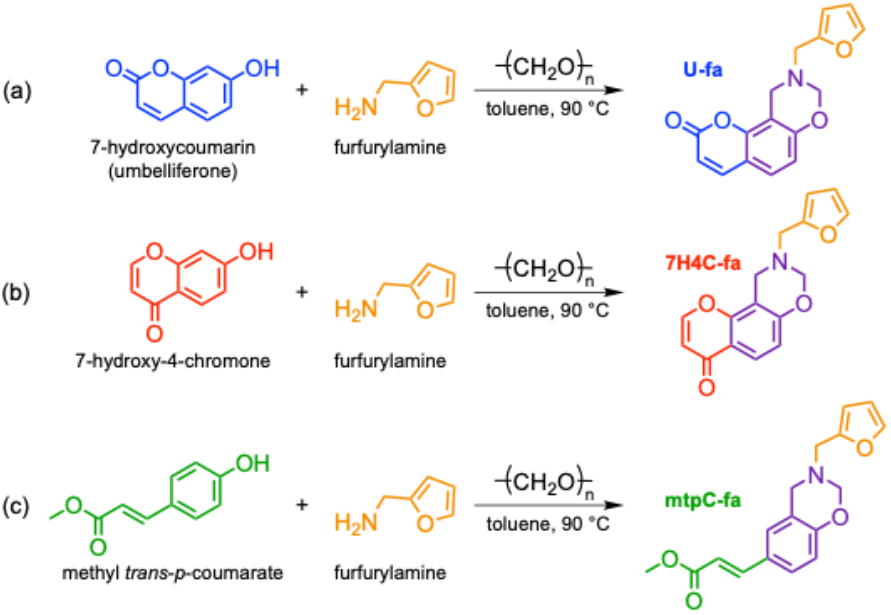
A previous study involving umbelliferone-based benzoxazines revealed that a methyl-substitution in the umbelliferone moiety increased the polymerization temperature and triggered earlier degradation but did not reduce the glass transition temperature [28]. In the present study we are not interested in the effect that various substitutions could have on the umbelliferone-benzoxazine system—we instead narrow our focus to the α,β-unsaturated carbonyl group. Hence, we have sourced the first novel benzoxazine of this study from 7-hydroxy-4-chromone, a structural isomer of umbelliferone in which the carbonyl and C=C double bond are the only groups whose positions are altered, as seen in Scheme 1. Our second novel benzoxazine, synthesized using methyl trans-p-coumarate as the phenolic component, will allow us to compare an open-chain structure—containing the same conjugated ester as that of umbelliferone—to the closed-chain structure seen in the other two compounds.
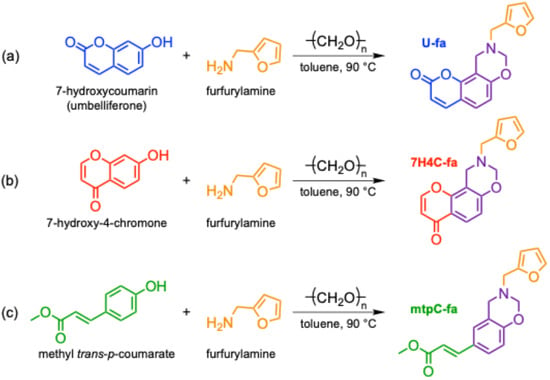
Scheme 1.
Reaction scheme for the synthesis of benzoxazine monomers (a) U-fa (b) 7H4C-fa and (c) mtpC-fa.
While cyclic vs. acyclic structures (in the context of umbelliferone-based benzoxazines) have been previously deliberated, considerations were limited to thermogravimetric analysis across various studies [16]. Here, in one study, we can observe the thermal and flammability behavior of a closed-chain α,β-unsaturated carbonyl moiety with reference to an open-chain counterpart, making way for more robust analysis. Note that methyl trans-p-coumarate is not exactly the open structure of umbelliferone due to its terminal methyl group on the oxygen heteroatom. We chose this structure to avoid the formation of a second oxazine ring during Mannich condensation. For the purposes of this study, we will treat methyl trans-p-coumarate as the acyclic counterpart to umbelliferone, bearing in mind that the additional methyl group could have implications on resulting thermal and flammability properties.
3.1. Fourier Transform Infrared and Nuclear Magnetic Resonance Spectroscopic Analyses of the Monomers
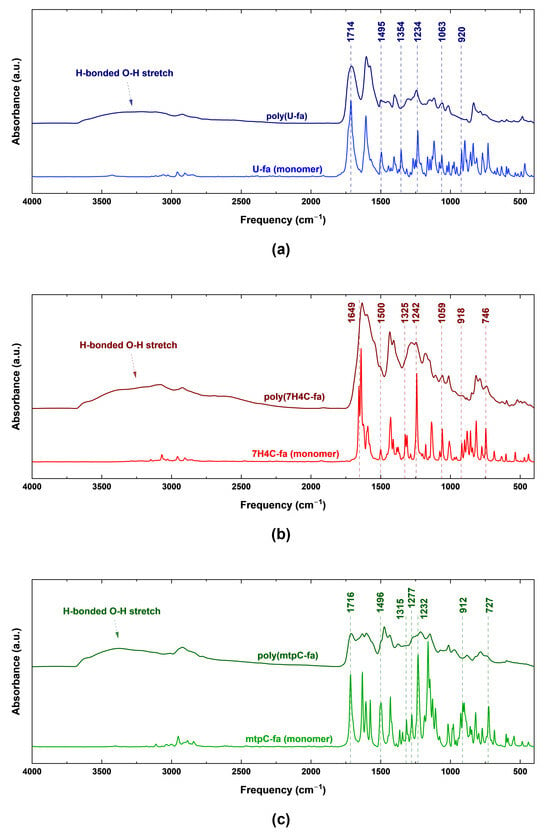
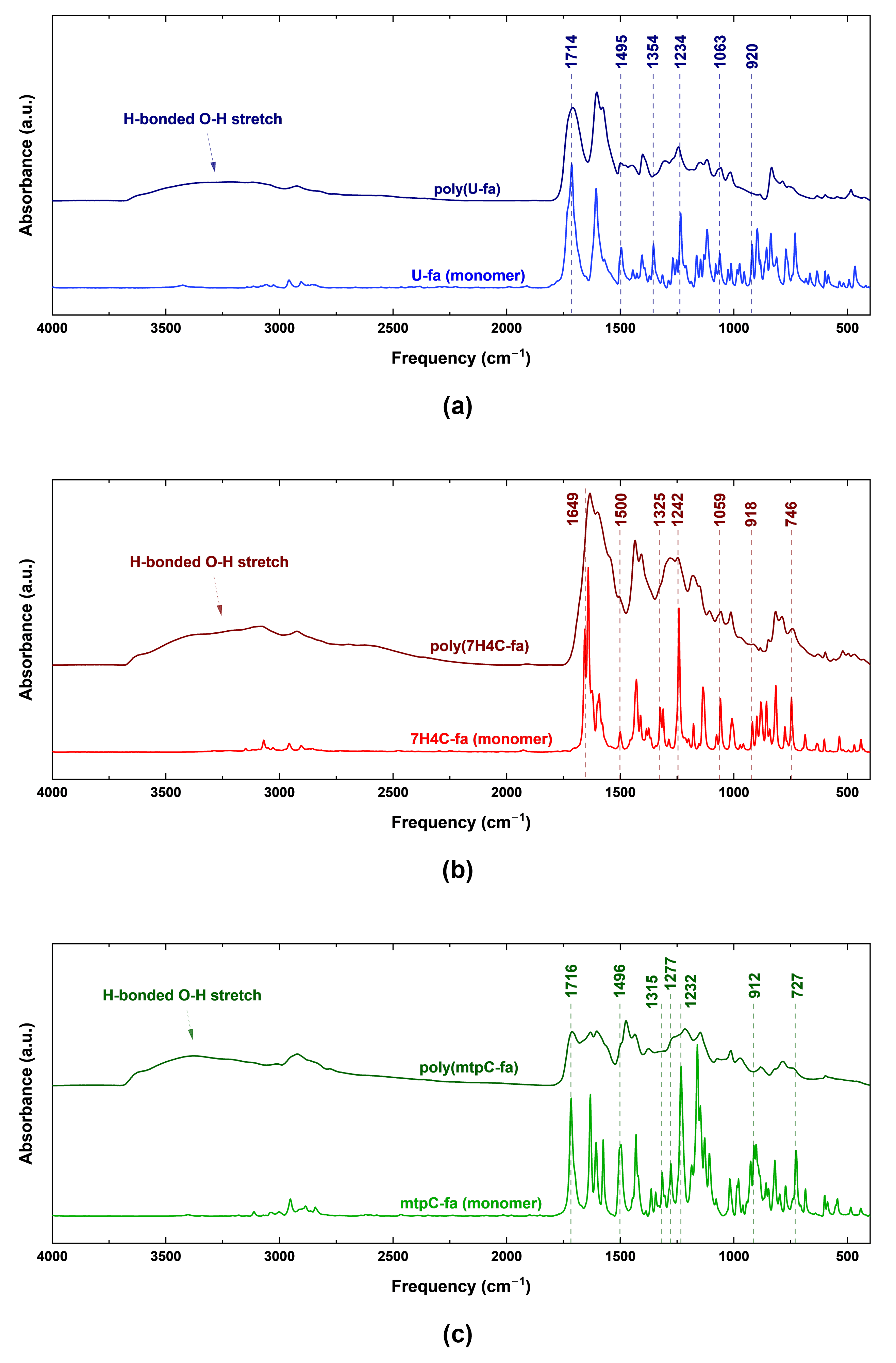
The FTIR spectra of the three monomers, provided in Figure 1, were obtained to verify the formation of the oxazine ring and incorporation of the starting materials. The spectroscopic data for U-fa closely matches that which has been previously reported, namely a strong band around 1714 cm−1 belonging to C=O stretching within the umbelliferone moiety; characteristic benzoxazine bands at 1354, 1234, 1063, and 920 cm−1, corresponding to C-N-C symmetric stretching, aliphatic C-N stretching, aliphatic C-O stretching, and oxazine ring mode, respectively; and a band at 1495 cm−1 corresponding to C=C stretching of the furfurylamine moiety. This spectrum is comparable to that which was previously reported for U-fa [26].
Figure 1.
Stacked monomer/polymer FTIR spectra of (a) U-fa and poly(U-fa) (b) 7H4C-fa and poly(7H4C-fa) and (c) mtpC-fa and poly(mtpC-fa).
The C=O stretching band from the phenolic moiety of 7H4C-fa appears as a doublet centered around 1649 cm−1, while that of mtpC-fa occurs as a singlet at 1716 cm−1. The characteristic benzoxazine bands for 7H4C-fa can be seen at 1325 (C-N-C asymmetric stretching), 1242 (aliphatic C-N stretching), 1059 (aliphatic C-O stretching) and 918 cm−1 (oxazine ring mode); for mtpC-fa, 1315 (C-N-C symmetric stretching), 1277 (aromatic C-O stretching), 1232 (aliphatic C-N stretching), and 912 cm−1 (oxazine ring mode). C=C stretching at 1500 cm−1 and C-H out-of-plane in-phase wagging at 746 cm−1 are the most apparent indicators of furfurylamine incorporation in 7H4C-fa; these bands appear at 1496 and 727 cm−1, respectively, for mtpC-fa.
Shifting focus to the polymer spectra, the disappearance of C-N-C symmetric stretching bands in poly(U-fa) and poly(mtpC-fa), as well oxazine ring mode bands in all three polymers provides evidence for the opening of the oxazine ring during polymerization. Appearance of broad H-bonded O-H stretching bands centered between 3000 and 3300 cm−1 provide further support. Bands generated by the furfurylamine and phenolic moieties, for example C=O stretching and furfurylamine C=C stretching or C-H out-of-plane in-phase wagging, are retained.
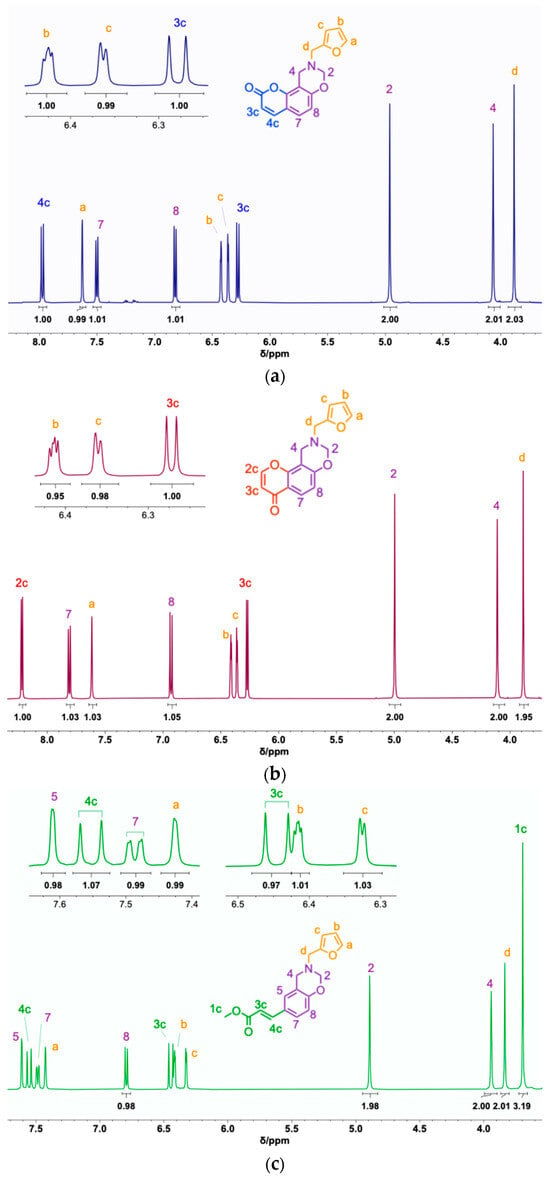
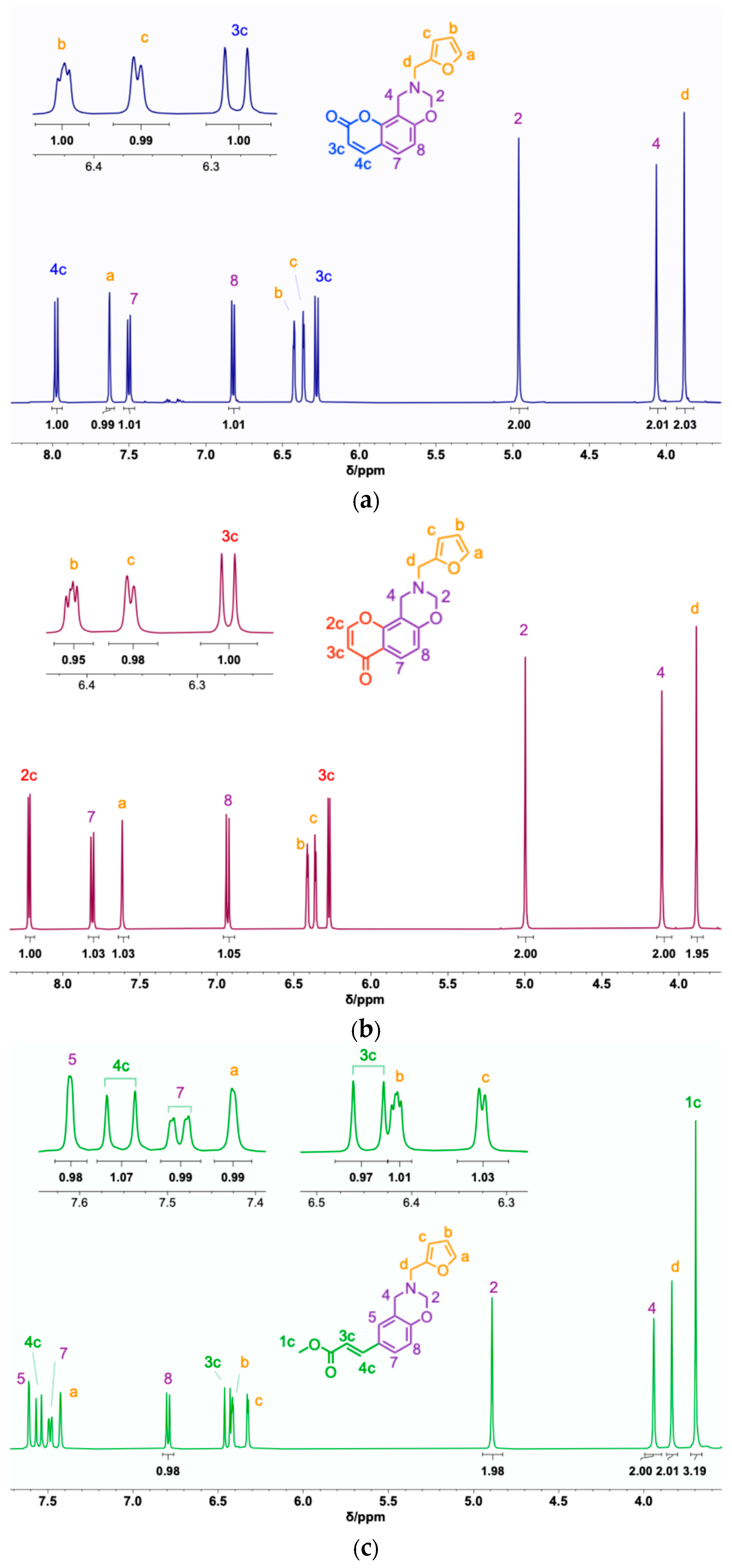
While the FTIR spectroscopic data confirms the incorporation of the starting materials and substantiates the ensuing ring-opening polymerization, it does not elucidate the positions of various functional groups in the monomers, nor does it rule out the formation of different structural isomers. To verify that we obtained the exact structures shown in Scheme 1, we turn to the 1H NMR spectra presented in Figure 2. In all cases, two singlets at roughly 4 and 5 ppm, with integration values corresponding to two protons, arise from the oxazine methylene groups at positions 2 and 4. These singlets are characteristic to all benzoxazines—typically occurring between 3 and 5 ppm with a frequency separation of 0.7–0.9 ppm—and they confirm formation of the oxazine ring during Mannich condensation [15]. A third methylene group attached to the nitrogen heteroatom (position d) is present in all three monomers; it would complicate the assignment of H4 if not for existing NOESY experiments on umbelliferone-based benzoxazines affirming that the methylene peak with a lower chemical shift belongs to Hd [26,27]. In the case of 7H4C-fa and mtpC-fa, because the protons in positions 4 and d are relatively separated from the structural differences compared to U-fa, we can expect the pattern to persist and assign Hd to the lowest shifted methylene peak. One additional peak in this upfield region for mtpC-fa integrates to three protons, lending itself toward the methyl group in position 1c.
Figure 2.
1H NMR of (a) U-fa (b) 7H4C-fa and (c) mtpC-fa.
In the downfield region, single neighboring protons in positions 7 and 8 generate two doublets, each with integration values corresponding to one proton, confirming that the oxazine ring formed in the manner shown in Scheme 1. Matching coupling constants verify that these signals are indeed coupled. For U-fa, this J value is 8.6 Hz; for 7H4C-fa, 8.8 Hz; and for mtpC-fa, 8.5 Hz. The peak for H7, conjugated with the carbonyl group in all cases, is shifted higher than that of H8. The open structure of mtpC-fa means position 5 on its benzoxazine nucleus ring is unsubstituted, giving rise to a single-proton singlet around 7.6 ppm. The remaining aminic protons Ha, Hb, and Hc, can also be found in this region, their chemical shifts decreasing with greater proximity from the oxygen atom of the furan ring.
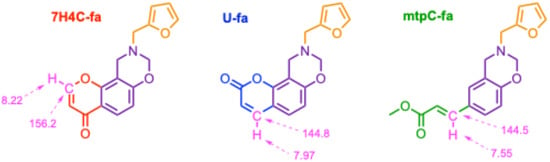
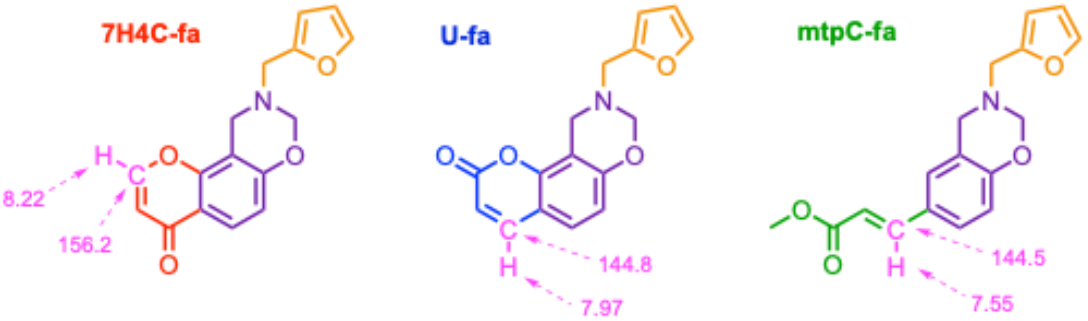
This leaves us with the α- and β-protons of the phenolic moiety. In U-fa and mtpC-fa, these are labeled as positions 3c and 4c, respectively. 7H4C-fa instead has the carbonyl group in position 4c, placing the β-position in position 2c. In all three compounds, the single protons on the α- and β-positions split one another to give two doublets, with the proton in the β-position shifted to a greater extent due to a mesomeric effect with the carbonyl group.
We can use these β-position shifts as facile (admittedly incomplete) indicators of the α,β-unsaturated carbonyl group’s reactivity in each monomer, since a more electrophilic β-position—generally associated with higher chemical shift—would be more conducive toward Michael addition. Considering the 1H and 13C shifts shown in Figure 3 and compiled in Table 1, 7H4C-fa appears to have the most electrophilic β-position, likely due to an inductive effect by the adjacent oxygen atom acting in conjunction with the mesomeric effect described previously. U-fa lacks this additional electron-withdrawing effect, contributing to a less electrophilic β-position. Comparing U-fa and mtpC-fa, where the position of the α,β-unsaturated carbonyl group is the same and cyclization is the defining difference, the 13C chemical shifts overlap; electrophilicity of the β-position may not be a suitable basis for thermal differences between the two.
Figure 3.
1H and 13C chemical shifts of the carbon and hydrogen atom at the β-position (highlighted in pink). Chemical shifts are shown in ppm.
Table 1.
1H and 13C chemical shifts at the β-position for each monomer.
3.2. Differential Scanning Calorimetry of the Monomers
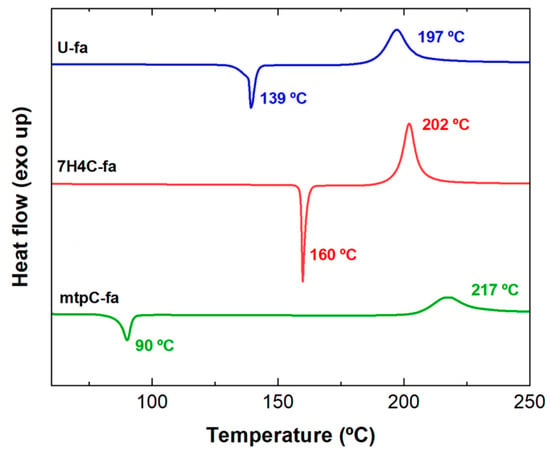
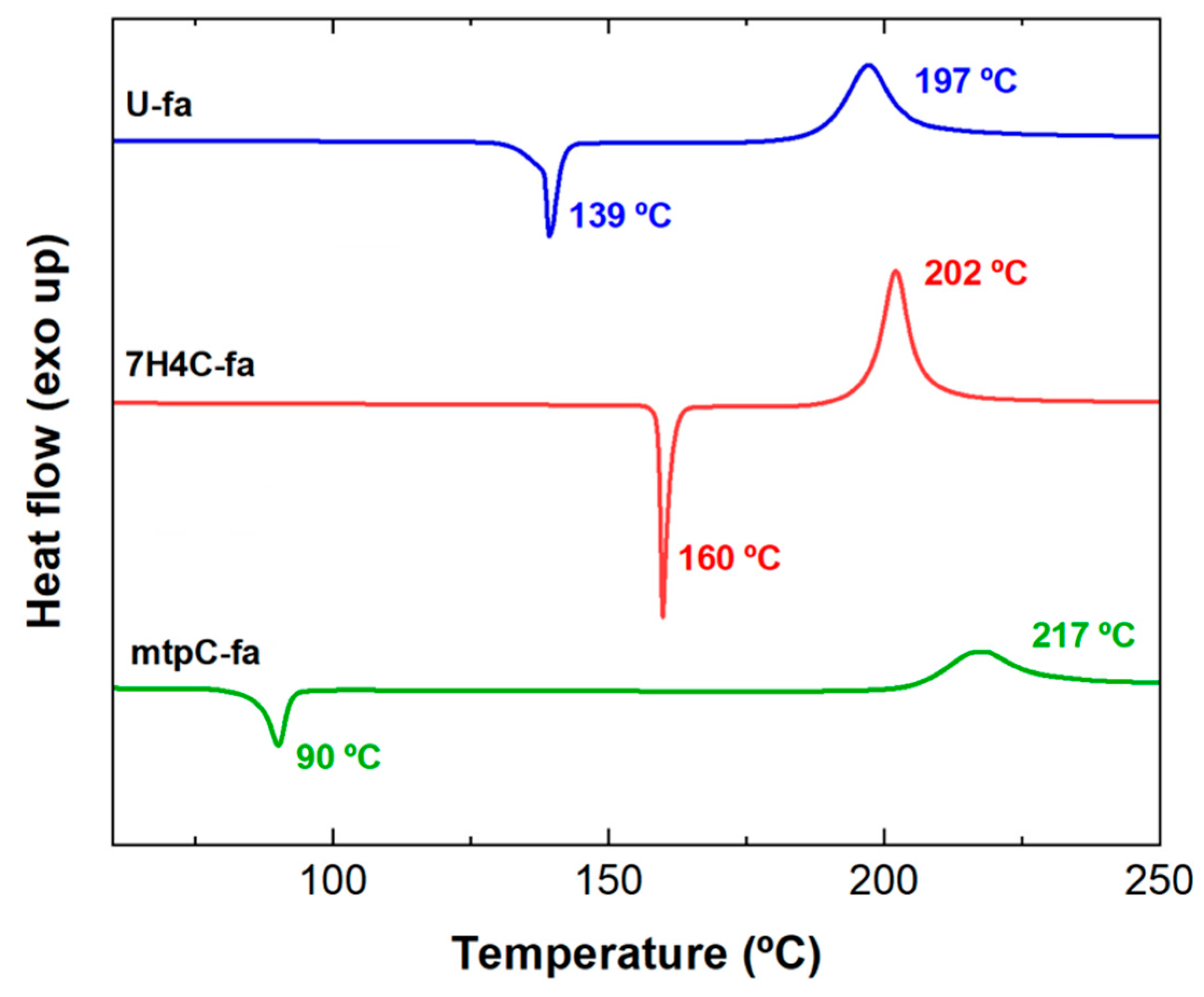
Figure 4 shows the DSC thermograms of the three monomers at a heating rate of 10 °C·min−1. A sharp 160 °C melting endotherm for 7H4C-fa suggests high purity, consistent with the needle-like crystals obtained after recrystallization. U-fa’s endotherm can be seen at 139 °C, and mtpC-fa’s at 90 °C. U-fa and 7H4C-fa showed exceptionally low polymerization temperatures for benzoxazine resins, with U-fa’s peak polymerization temperature of 197 °C being slightly lower than 7H4C-fa’s 202 °C. Although mtpC-fa has the highest polymerization temperature (217 °C) of the three monomers presented here, it is still low compared to many petroleum-based benzoxazines, suggesting that the activating effect of the phenolic moiety is preserved even in its open form. It can also be said that mtpC-fa, possessing the lowest melting temperature and highest polymerization temperature, has the widest processing window among not only the three monomers studied in this work, but also two previously reported umbelliferone-based benzoxazines synthesized using aniline and benzylamine [27]. In the case that lower polymerization temperature is desired, it has been demonstrated that the addition of elemental sulfur to benzoxazines lowers their polymerization temperature via radical species, providing a facile method for achieving these ends without redesigning the monomer structure itself [29,30].
Figure 4.
DSC thermograms of the three monomers, including their peak melting and peak polymerization temperatures.
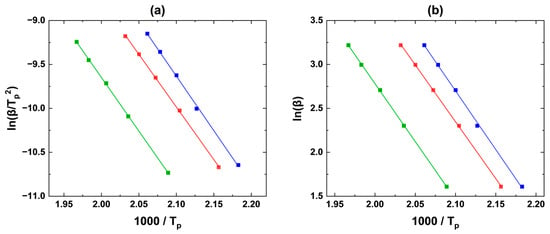
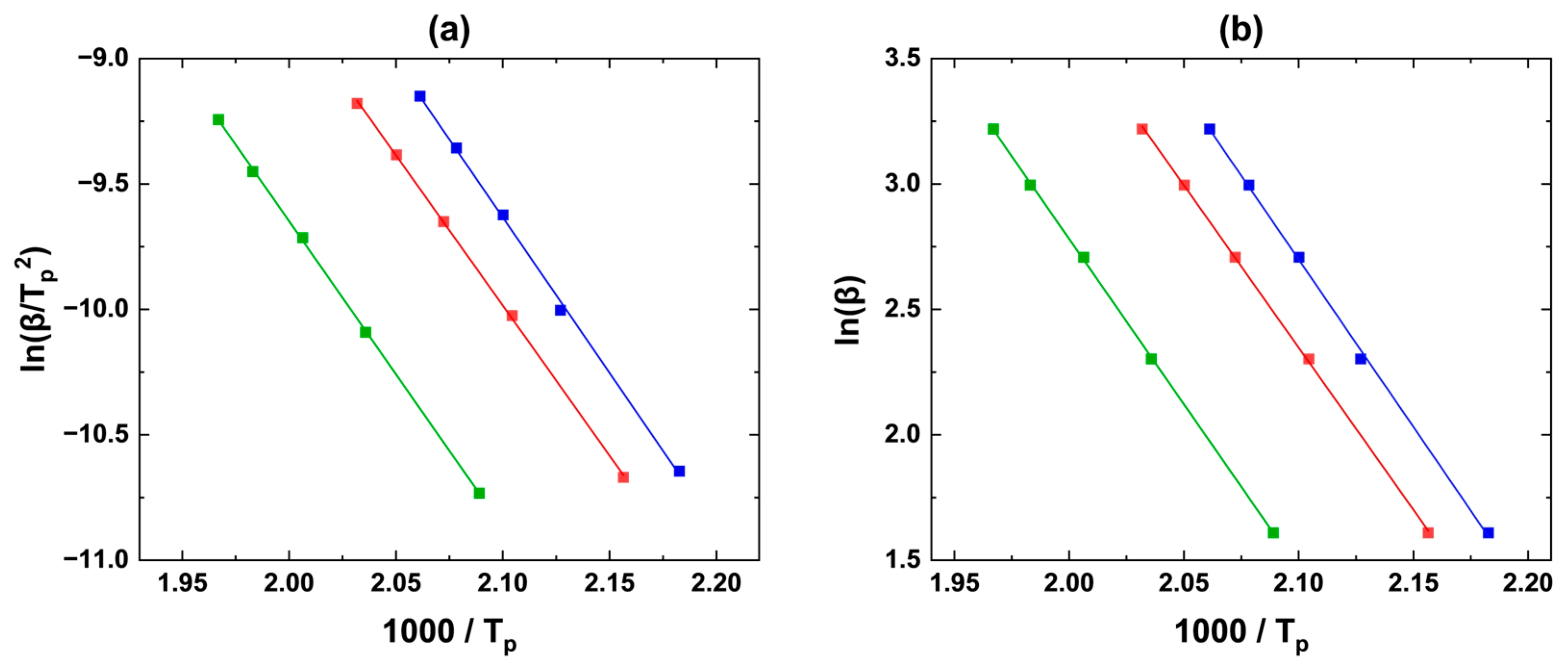
Polymerization temperatures can vary based on purity, crystal structure, solvent, and other factors. So, for a more complete look at the polymerization behavior of the three monomers, DSC was run for each monomer at a heating rate of 5, 10, 15, 20, and 25 °C·min−1 to create the plots shown in Figure 5. The slopes of these plots were used to find the activation energy of polymerization according to the Kissinger (Equation (1)) and modified Ozawa (Equation (2)) equations:
where β is the constant heating rate, Tp is the peak polymerization temperature, Ea is the activation energy for polymerization, R is the gas constant, and A is the frequency factor. Compiled in Table 2 are the activation energies determined using the Kissinger and modified Ozawa methods. These values are in the lower range of what is typically reported for benzoxazines, but not especially low for benzoxazines that are intrinsically “activated” toward polymerization. For example, bisphenol-A-aniline-based benzoxazine—a widely studied petroleum-based benzoxazine—was reported to have an activation energy of 117 kJ·mol−1 according to the Kissinger method [31], whereas many functionalized benzoxazines have shown values between 80 and 100 kJ·mol−1 [32,33]. Straight-line fits (R2 > 0.98) suggest one predominant mechanism of polymerization for the three compounds.
Figure 5.
Kissinger (a) and modified Ozawa (b) plots used to find the activation energy of polymerization of U-fa (blue), 7H4C-fa (red), and mtpC-fa (green).
Table 2.
Activation energy towards polymerization of each monomer, calculated using the Kissinger and modified Ozawa methods.
3.3. Thermogravimetric Analysis of the Polymers
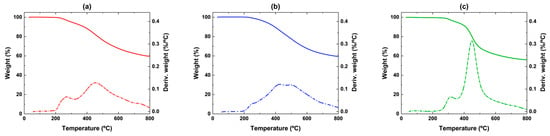
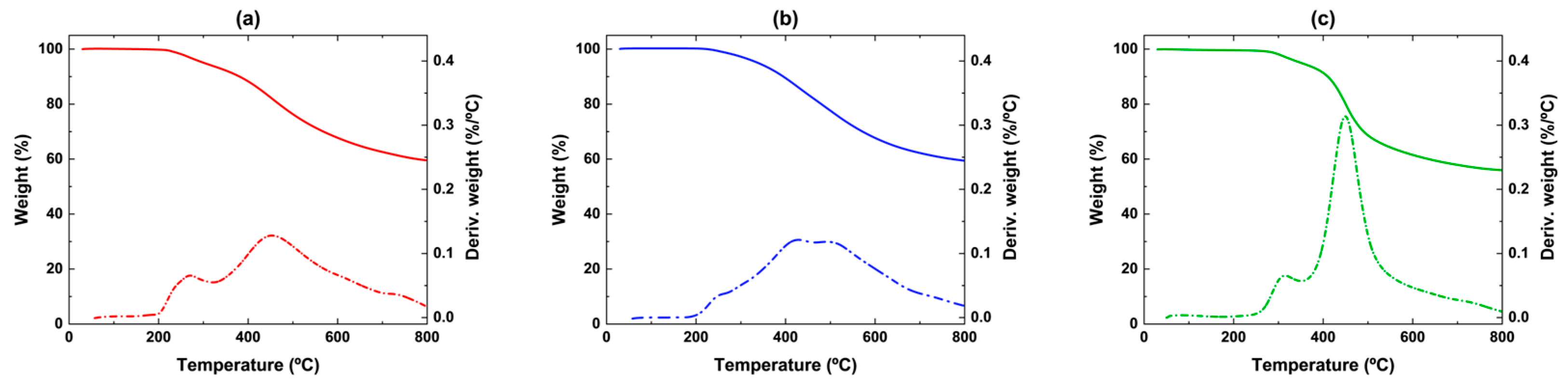
Weight percent and derivative weight, taken from TGA measurements of the three polymers, are plotted as a function of temperature in Figure 6. Poly(U-fa) degrades rapidly between 400 and 600 °C, with two shoulders on either side: one just above 200 °C and another less pronounced between 700 and 800 °C. The intermediate degradation peak appears to consist of two overlapping peaks, suggesting coincident but separate thermal decomposition events. Poly(7H4C-fa) shows a similar pattern to poly(U-fa), but with only one apparent intermediate peak and a more pronounced shoulder ahead. Poly(mtpC-fa) has the sharpest intermediate degradation, responsible for a drop of about 35 weight percent between 400 and 550 °C. Polybenzoxazines typically undergo thermal decomposition in three steps: (1) degradation of terminal amine groups (2) degradation of amine groups from the main chain and (3) breakage of the phenolic linkage, along with degradation of the Mannich base [34,35]. While it is not readily apparent from the thermograms where these steps lie, it is helpful to consider that the structural differences of the monomers are isolated to the phenolic moiety; thus, the most variable derivative weight peaks likely correlate to this portion as well. Out of this framework, the sharp peak for poly(mtpC-fa) corresponds to evaporation of the open-chain phenolic moiety, which—for now ignoring its incorporation into a crosslinked network—can be volatilized by the breakage of just one bond. The closed-chain structures of poly(7H4C-fa) and poly(U-fa) instead require the breakage of two bonds (without considering crosslinking) to release an equivalent fraction, contributing to milder intermediate peaks. It should be noted that different polymerization temperatures—despite being normalized according to monomer behavior—may influence polymer behavior in a negligible manner.
Figure 6.
TGA thermograms of (a) poly(U-fa) (b) poly(7H4C-fa) and (c) poly(mtpC-fa). Weight percent (—) and derivative weight (---) are shown.
Char yield, defined as the residual weight at 800 °C under inert atmosphere, is shown in Table 3. Poly(7H4C-fa) saw the greatest char yield of 60%, followed by poly(U-fa) at 59% and poly(mtpC-fa) at 56%. These values outperform many petroleum-based polybenzoxazines, including phenol-aniline-based (40%) and bisphenol-A-aniline-based (30%) benzoxazines [36,37].
Table 3.
Char yield, 5 and 10% degradation temperatures (Td5 and Td10), and limiting oxygen index (LOI) of the three polymers, as determined by TGA.
When compared to poly(U-fa), the low char yield of poly(mtpC-fa) may be rationalized by a combination of influences. First is the reduced number of bonds that must be broken for full mass loss of the acyclic substituent on the benzene ring—a consequence of the monomer structure itself, persisting even if both polymers were to have the same degree of crosslinking. Loss of this open aliphatic chain is reflected in the sharp decline in weight just above 400 °C. Second, we saw that the beta position in mtpC-fa was the least electrophilic among the three compounds, theoretically making it less susceptible to nucleophilic attack during polymerization and thus less likely to become a part of the crosslinked network. It is also worth noting that, due to the additional methyl group in mtpC-fa’s open aliphatic chain, the percent weight loss may be skewed slightly higher than what is purely due to a cyclic vs. acyclic substituent on the benzene ring.
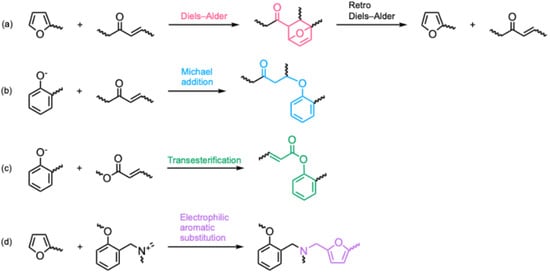
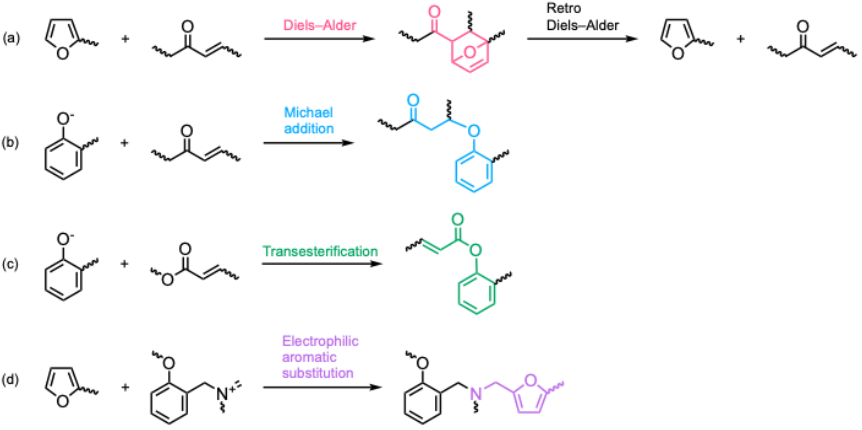
Shifting our focus to poly(U-fa) and poly(7H4C-fa), the difference in char yield is far less marked and could very well be within experimental error. We had initially hypothesized that 7H4C-fa, given a sufficient nucleophile (such as phenoxide ions generated during ring opening), might undergo Michael addition (Figure 7b) more readily to promote crosslinking at its more electrophilic β-carbon [28,38,39,40]. U-fa also contains an ester group which, if it were to undergo transesterification during polymerization, would open the ring to generate a far more labile crosslink than one produced by Michael addition (which leaves the ring intact) [17,26,41,42,43,44,45].
Figure 7.
Proposed crosslinking reactions between different reactive groups of the monomers presented in this work. Reaction C will not proceed during the polymerization of 7H4C-fa.
Using char yield (defined above), we can calculate the limiting oxygen index (LOI)—the lowest oxygen content required to sustain burning—via the van Krevalen equation (Equation (3)), which holds for non-halogenated polymers:
where Yc is char yield. We obtain an LOI of 41.1 for poly(U-fa), 41.5 for poly(7H4C-fa), and 39.9 for poly(mtpC-fa). For polymers, an LOI above 28 is linked to non-ignitable behavior [45], giving the first indication of exceptional flame retardancy for poly(7H4C-fa) and poly(mtpC-fa) and validating previous results for poly(U-fa) [27]. LOI values obtained in this manner provide for a facile initial understanding of flammability behavior; however, the empirical LOI equation is approximate, and its applicability is limited. Such a cursory assessment would benefit from quantitative flammability measurements, explored in Section 3.4.
LOI = 17.5 + 0.4Yc
While char yield is the culmination of all stages of degradation, Td5 and Td10—defined as the temperatures at which 5 and 10% of the polymer has degraded—can provide insight into early decomposition behavior. Compiled in Table 3, these values display the reverse trend of char yield, with poly(mtpC-fa) demonstrating the slowest early thermal decomposition, followed by poly(U-fa) then poly(7H4C-fa). While it may seem counterintuitive, degradation beginning at lower temperatures does not necessarily mean that the polymer degrades more overall by the time it reaches 800 °C. It is possible that a more reactive α,β-unsaturated carbonyl interferes with the formation of stable crosslinks between furan groups and iminium ions generated during ring opening (Figure 7d) [15,21,46,47,48,49,50], while at the same time promoting crosslinking between the β-carbon and phenoxide ions via Michael addition (Figure 7b) [28,38,39,40]. This interference, if occurring, would lead to greater decomposition at lower temperatures where degradation of the amine is expected, without necessarily facilitating late-stage degradation.
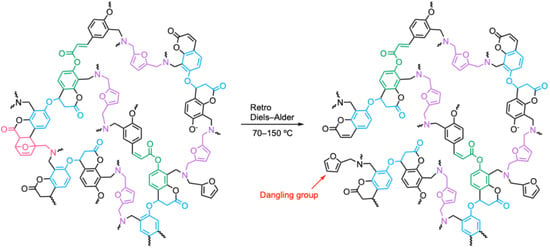
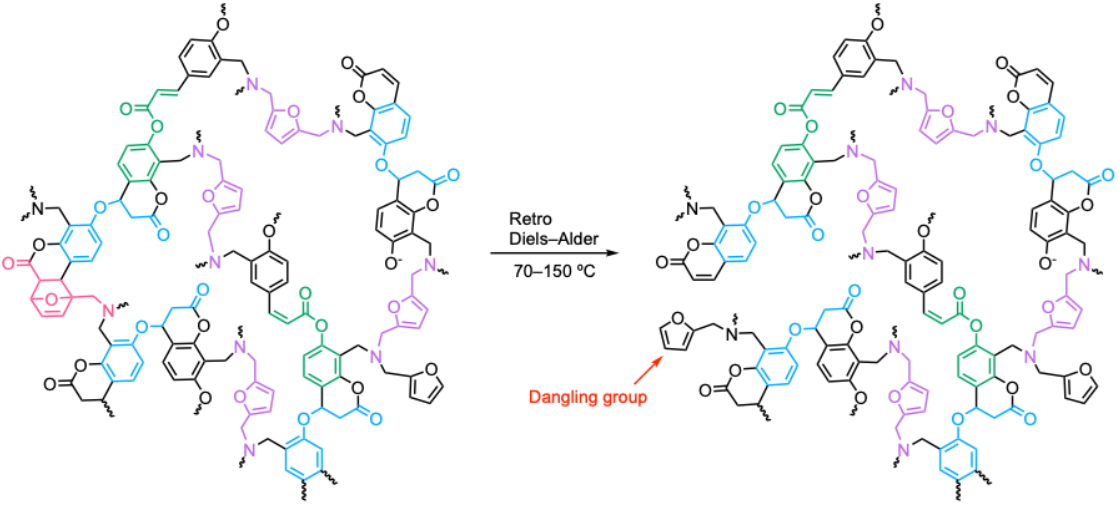
We can link the reactivity of the α,β-unsaturated carbonyl group to the above phenomenon by considering a Diels–Alder reaction between the furan group (an s-cis diene) and the double bond of the unsaturated carbonyl (behaving as a dienophile) (Figure 7a). In this hypothesized pathway, the low thermodynamic stability of a resulting furan [4 + 2] adduct can open the way for a retro Diels–Alder reaction to occur at lower temperatures than the cleavage of crosslinks formed via electrophilic aromatic substitution (Figure 7d), leaving the furfurylamine moiety susceptible to evaporation [51,52]. This case is illustrated using an idealized crosslinked structure of poly(U-fa) in Figure 8. Recalling the chemical shifts in Figure 3, we saw that 7H4C-fa’s β-position was most electrophilic, which could certainly make its unsaturated carbonyl more susceptible to a Diels–Alder reaction given a sufficient diene [53,54]. In fact, Diels–Alder and retro Diels–Alder reactions have been widely reported in benzoxazine chemistry, frequently using furan as a dienophile [55,56,57,58,59]. As discussed at the end of Section 3.2, electrophilicity of the β-position is less useful when comparing U-fa and mtpC-fa. However, the fact that the unsaturated carbonyl in mtpC-fa belongs to a freely rotating open aliphatic chain with trans geometry, while that of U-fa is locked in a cis configuration within a closed-chain, means this Diels–Alder reaction—owing to entropic and steric effects—would more readily occur for U-fa [60,61]. This rationale lends itself to the pronounced derivative weight loss observed for poly(U-fa), and even more so for poly(7H4C-fa), between 200 and 300 °C, where degradation of the amine at chain-ends is expected. At higher temperatures, where retention of the phenolic moiety is more influential, open vs. closed structures and crosslinking at the β-position are likely to take precedence.
Figure 8.
Idealized structure of a crosslinked poly(U-fa) network that may result from the reactions proposed in Figure 7, before and after undergoing a retro Diels–Alder reaction. These illustrations do not reflect the relative occurrence of each type of crosslink in the entire network.
3.4. Microscale Combustion Calorimetry of the Polymers
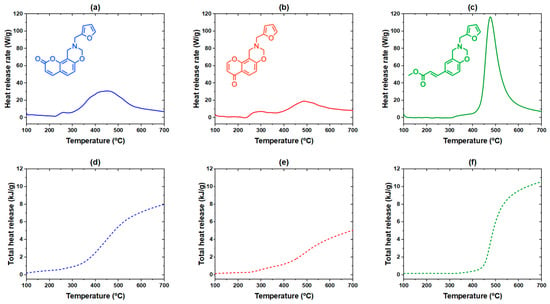
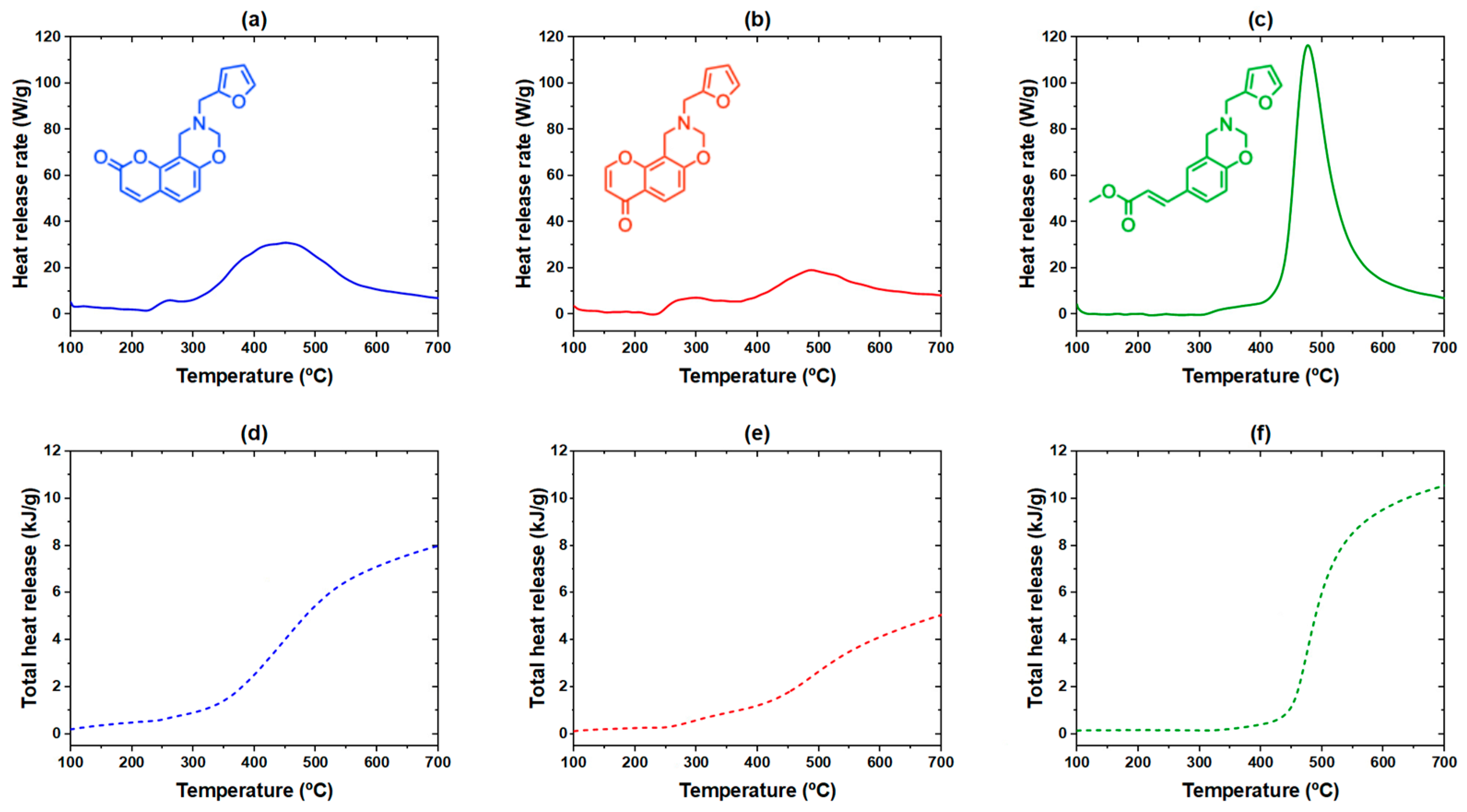
Microscale combustion calorimetry allows for precise, quantitative assessment of flammability behavior by pyrolyzing just milligrams of sample at a constant heating rate. The volatiles are combusted in a high-temperature chamber from which the released energy is recorded as the heat release rate (HRR), plotted in Figure 9 for our three thermosets as a function of temperature. The peak HRR, corrected for baseline and divided by the heating rate, is referred to as the heat release capacity (HRC) and is included in Table 4. When correlated with direct fire testing, as done by Lyon et al., an HRC below 300 J·g−1·K−1 may be associated with self-extinguishing behavior, while an HRC below 100 J·g−1·K−1 may be associated with non-ignitable behavior [45].
Figure 9.
Microscale combustion calorimetry thermograms of (a) poly(U-fa) (b) poly(7H4C-fa) and (c) poly(mtpC-fa), and cumulative total heat release of (d) poly(U-fa) (e) poly(7H4C-fa) and (f) poly(mtpC-fa). The monomer structure for each polymer is shown for easier comparison.
Table 4.
Average heat release capacity (HRC), total heat release (THR), and fire growth capacity (FGC), as determined by microscale combustion calorimetry. Standard deviation is provided for each measurement, obtained as the average of three runs.
Since HRC has been established to exhibit direct correlations with traditional cone calorimetric and other flammability-related measurements (provided the small amount of sample can be of representative of the whole), MCC measurement can be used advantageously to study the flammability of polymers using little sample without the influence of the sample thickness, unlike cone calorimetric analysis. A direct relationship has been established between HRC (obtained from MCC analysis) and peak heat release rate obtained from cone calorimetry [45]; HRC (from MCC) and average flaming heat release rate (from cone calorimetry) [62]; HRC (from MCC) and LOI [62]; fire growth capacity (from MCC) and LOI [63]; fire growth capacity (from MCC) and fire growth potential (from cone calorimetry) [64]; and HRC (from MCC) and fire growth capacity (from MCC) [65]. Total heat release (THR), or the area under the entire heat release rate curve, is included in Table 4. THR is also plotted cumulatively with respect to temperature in Figure 9.
Poly(7H4C-fa) had the lowest HRC of 14 J·g−1·K−1 followed by poly(U-fa) with an HRC of 26 J·g−1·K−1, suggesting our two closed-chain thermosets to be non-ignitable according to the empirical correlations set forth by Lyon et al. [45]. Using these same grounds, we may expect self-extinguishing behavior from poly(mtpC-fa), which produced an HRC of 117 J·g−1·K−1. We stress that these thermosets have no additives and can be deemed intrinsically flame-retardant materials based on MCC analysis.
HRC is loosely associated with char yield on the basis that a thicker char layer insulates the underlying polymer from heat and hinders the escape of volatilized fuels [66,67,68]. While it would be convenient to explain the observed HRC trend by the charring behavior of the three polymers, the difference in char yield between the three polymers is not enough to solely justify the marked disparities in HRC. An important distinction between the two measures is that char yield deals with the mass of degraded components under inert atmosphere, while HRC can be influenced by what those volatiles are, more specifically by their heat of combustion. Additionally, HRC is more closely linked to the rate, rather than the total amount, of polymer evaporation.
Cross referencing the HRR thermograms from Figure 9 with the TGA thermograms in Figure 6 intimates that the most significant HRC peaks—centered around 450 °C for poly(U-fa), 500 °C for poly(7H4C-fa), and 500 °C for mtpC-fa—correspond to mass loss of the phenolic moiety. It is possible that, due to the different arrangement of atoms in 7H4C-fa and U-fa, the volatiles released by cleavage of the poly(7H4C-fa) phenolic moiety have a slightly lower heat of combustion than those of poly(U-fa). At the same time, U-fa may undergo transesterification (Figure 7c) during polymerization [41,42,43,44], which opens the cyclic structure of the umbelliferone moiety and allows for more rapid volatilization. The notably sharp HRR peak for poly(mtpC-fa) likely coincides with rapid degradation of its open-chained phenolic moiety, consistent with TGA results. The additional methyl group (not part of the experimental design) may also artificially elevate the HRC of poly(mtpC-fa) when compared to poly(U-fa) by raising the total heat of combustion of the volatilized aliphatic chain, though possession of the open aliphatic chain itself is likely the more influential factor.
Fire growth capacity (FGC) is a metric closely related to THR which accounts for ignitability, physical changes during burning, heat and mass transfer in the solid, and reaction kinetics in the flame, allowing one to effectively predict qualitative pass/fail tests of flame spread using quantitative data from MCC [69]. FGC can be calculated from MCC data using Equation (4) given below:
where is the total heat release, and T5% and T95% are the temperatures at which 5 and 95% of the total heat release is reached, respectively. The standard ambient temperature, T0, is fixed at 298 K (25 °C) regardless of the actual starting temperature.
The FGC values of the three thermosets are presented in Table 4. An FGC below 40 J·g−1·K−1 places poly(U-fa) and poly(7H4C-fa) among high-performance polymers like polybenzimidazole and polyimide, and comfortably ahead of standard phenol-formaldehyde thermosets, which are reported to have an FGC of 46 J·g−1·K−1 [69]. Poly(mtpC-fa), though not as high-performing as the pertinent closed-chain polybenzoxazines, has a respectable FGC that would place it in the upper-third of most commercial polymers [69].
4. Conclusions
Two novel benzoxazines, abbreviated as 7H4C-fa and mtpC-fa, were successfully synthesized using naturally sourced, α,β-unsaturated phenolic derivatives and furfurylamine, an electron-rich, bio-derived amine. The resulting thermosets demonstrated good thermal stability with char yields between 56 and 60%. Flammability of the polybenzoxazines was correlated to direct fire testing through MCC analysis. Poly(7H4C-fa) exhibited an HRC of 14 J·g−1·K−1, suggestive of non-ignitable behavior, and outperformed poly(U-fa), a previously studied α,β-unsaturated carbonyl-containing polybenzoxazine notable for its intrinsic flame retardancy. The FGC values of poly(U-fa) and the two novel polymers were reported for the first time; both poly(U-fa) and poly(7H4C-fa) exhibited FGCs below 40 J·g−1·K−1, placing them ahead of many high-performance polymers.
Occupation of the α,β-unsaturated carbonyl group within 7H4C-fa’s cyclic substituent improved the char yield and all measures of flammability as compared to mtpC-fa’s open aliphatic chain. Interestingly, this trend reversed for early thermal degradation—poly(mtpC-fa) exhibited delayed early thermal degradation compared to its cyclic counterparts. This behavior can be tentatively explained by the open chain’s lower reactivity towards side reactions with the electron-rich furan moiety that may interfere with the amine group’s anchoring to the crosslinked network. Concerning the α,β-unsaturated carbonyl’s position within the cyclic substituent, poly(7H4C-fa) largely matched poly(U-fa) in terms of thermal stability but excelled in flammability. Proposed drivers for this behavior include the more electrophilic β-position of 7H4C-fa and the ability of U-fa to form more labile crosslinks via a ring-opening transesterification reaction.
While the properties of these polybenzoxazines are highly promising and competitive with even petroleum-based high-performance polymers, access to high volumes of the phenolic starting materials (at a reasonable price) are limited, presenting a significant barrier to scale-up. Additionally, thorough mechanical, processing, aging, and direct fire testing would be necessary steps for the application of these materials. Nevertheless, the straightforward synthesis and exceptional properties presented herein makes a strong case for naturally occurring materials in demanding applications. Expanding the repertoire of naturally based flame-retardant polybenzoxazines paves the way for smarter, more streamlined chemical design.
Author Contributions
Conceptualization, H.I. and P.F.; methodology, M.L.S. and T.C.; investigation, T.C.; resources, H.I. and C.S.; data curation, M.L.S.; writing—original draft preparation, T.C.; writing—review and editing, H.I. and C.S., P.F., and M.L.S.; supervision, M.L.S., P.F. and H.I.; project administration, H.I. and C.S.; funding acquisition, H.I. and C.S. All authors have read and agreed to the published version of the manuscript.
Funding
The authors gratefully acknowledge the financial support from National Aeronautics and Space Administration (NASA) SBIR Phase II under the contract number 80NSSC27C0010.
Institutional Review Board Statement
Not applicable.
Data Availability Statement
Data available upon request.
Conflicts of Interest
Author Chris Scott was employed by the company Material Answers LLC. The remaining authors declare that the research was conducted in the absence of any commercial or financial relationships that could be construed as potential conflicts of interest.
Abbreviations
| FTIR | Fourier transform infrared |
| NMR | nuclear magnetic resonance |
| DSC | differential scanning calorimetry |
| TGA | thermogravimetric analysis |
| LOI | limiting oxygen index |
| HRR | heat release rate |
| HRC | heat release capacity |
| THR | total heat release |
| FGC | fire growth capacity |
| U-fa | umbelliferone-furfurylamine benzoxazine |
| 7H4C-fa | 7-hydroxy-4-chromone-furfurylamine benzoxazine |
| mtpC-fa | methyl trans-p-coumarate-furfurylamine benzoxazine |
References
- Prival, M.J.; McCoy, E.C.; Gutter, B.; Rosendranz, H.S. Tris(2,3-Dibromopropyl) Phosphate: Mutagenicity of a Widely Used Flame Retardant. Science 1977, 195, 76–78. [Google Scholar] [CrossRef] [Scilit] [PubMed]
- Blum, A.; Gold, M.D.; Ames, B.N.; Jones, F.R.; Hett, E.A.; Dougherty, R.C.; Horning, E.C.; Dzidic, I.; Carroll, D.I.; Stillwell, R.N.; et al. Children absorb tris-BP flame retardant from sleepwear: Urine contains the mutagenic metabolite, 2,3-dibromopropanol. Science 1978, 201, 1020–1023. [Google Scholar] [CrossRef] [Scilit] [PubMed]
- Blum, A.; Ames, B.N. Flame-retardant additives as possible cancer hazards. Science 1977, 195, 17–23. [Google Scholar] [CrossRef] [Scilit] [PubMed]
- Gold, M.D.; Blum, A.; Ames, B.N. Another Flame Retardant, Tris-(1,3-dichloro-2-propyl)-phosphate, and its expected metabolites are mutagens. Science 1978, 200, 785–787. [Google Scholar] [CrossRef] [Scilit] [PubMed]
- Harrad, S.; de Wit, C.A.; Abdallah, M.A.E.; Bergh, C.; Björklund, J.A.; Covaci, A.; Darnerud, P.O.; de Boer, J.; Diamond, M.; Huber, S.; et al. Indoor contamination with hexabromocyclododecanes, polybrominated diphenyl ethers, and perfluoroalkyl compounds: An important exposure pathway for people? Environ. Sci. Technol. 2010, 44, 3221–3231. [Google Scholar] [CrossRef] [Scilit] [PubMed]
- Environment Canada. Ecological Screening Assessment Report on Polybrominated Diphenyl Ethers (PBDEs). 2006. Available online: https://www.canada.ca/en/environment-climate-change/services/canadian-environmental-protection-act-registry/publications/ecological-screening-assessment-report-polybrominated.html (accessed on 7 November 2026).
- Vonderheide, A.P.; Mueller, K.E.; Meija, J.; Welsh, G.L. Polybrominated diphenyl ethers: Causes for concern and knowledge gaps regarding environmental distribution, fate and toxicity. Sci. Total Environ. 2008, 400, 425–436. [Google Scholar] [CrossRef] [Scilit] [PubMed]
- Donohue, J.; Galal-Gorchev, H.; Zhao, Q.; Gadagbui, B.; Maier, A. Toxicological Review of Decabromodiphenyl Ether; EPA/635/R-07/008F; United States Environmental Protection Agency: Washington, DC, USA, 2008. [Google Scholar]
- U.S EPA. Polybrominated Diphenyl Ethers (PBDEs) Action Plan. 2009. Available online: https://www.epa.gov/assessing-and-managing-chemicals-under-tsca/polybrominated-diphenyl-ethers-pbdes-action-plan (accessed on 7 November 2026).
- Solan, M.E.; Goetzinger, E.G.; Sampath, V.; Park, J. Breathing hazards: Perspective on the adverse health effects of organophosphate flame retardants. J. Hazard. Mater. Adv. 2025, 18, 100744. [Google Scholar] [CrossRef] [Scilit] [PubMed]
- Minet, L.; Blum, A.; Fernandez, S.R.; Rodgers, K.M.; Singla, V.; Soehl, A.; Diamond, M.L. High production, low information: We need to know more about polymeric flame retardants. Environ. Sci. Technol. 2021, 55, 3467–3469. [Google Scholar] [CrossRef] [Scilit] [PubMed]
- Koch, C.; Nachev, M.; Klein, J.; Köster, D.; Schmitz, O.J.; Schmidt, T.C.; Sures, B. Degradation of the polymeric brominated flame retardant “polymeric fr” by heat and UV exposure. Environ. Sci. Technol. 2019, 53, 1453–1462. [Google Scholar] [CrossRef] [Scilit] [PubMed]
- Koch, C.; Dundua, A.; Aragon-Gomez, J.; Nachev, M.; Stephan, S.; Willach, S.; Ulbricht, M.; Schmitz, O.J.; Schmidt, T.C.; Sures, B. Degradation of polymeric brominated flame retardants: Development of an analytical approach using polyFR and UV irradiation. Environ. Sci. Technol. 2016, 50, 12912–12920. [Google Scholar] [CrossRef] [Scilit] [PubMed]
- Liu, X.; Xiong, Y.; Gou, X.; Zhao, L.; Wang, S.; Wei, Y.; Fan, X.; Yu, Y.; Blum, A.; Jahl, L.; et al. Environmental impacts of polymeric flame retardant breakdown. Nat. Sustain. 2025, 8, 432–445. [Google Scholar] [CrossRef] [Scilit]
- Ishida, H. Overview and historical background of polybenzoxazine research. In Handbook of Benzoxazine Resins; Ishida, H., Agag, T., Eds.; Elsevier: Amsterdam, The Netherlands, 2011; pp. 3–81. [Google Scholar]
- Arza, C.R.; Froimowicz, P.; Ishida, H. Smart chemical design incorporating umbelliferone as natural renewable resource toward the preparation of thermally stable thermosets materials based on benzoxazine chemistry. RSC Adv. 2015, 5, 97855–97861. [Google Scholar] [CrossRef] [Scilit]
- Comi, M.; Lligadas, G.; Ronda, J.C.; Galia, M.; Cadiz, V.J. Renewable benzoxazine monomers from “lignin-like” naturally occurring phenolic derivatives. Polym. Sci. Part A Polym. Chem. 2013, 51, 4894–4903. [Google Scholar] [CrossRef] [Scilit]
- Calo, E.; Maffezzoli, A.; Mele, G.; Martina, F.; Mazzeto, S.E.; Tarzia, A.; Stifani, C. Synthesis of a novel cardanol-based benzoxazine monomer and environmentally sustainable production of polymers and bio-composites. Green Chem. 2007, 9, 754–759. [Google Scholar] [CrossRef] [Scilit]
- Monisha, M.; Amarnath, N.; Mukherjee, S.; Lochab, B. Cardanol benzoxazines: A versatile monomer with advancing applications. Macromol. Chem. Phys. 2019, 220, 1800470. [Google Scholar] [CrossRef] [Scilit]
- Yang, R.; Han, M.; Hao, B.; Zhang, K. Biobased high-performance tri-furan functional bis-benzoxazine resin derived from renewable guaiacol, furfural and furfurylamine. Eur. Polym. J. 2020, 131, 109706. [Google Scholar] [CrossRef] [Scilit]
- Wang, C.; Sun, J.; Liu, X.; Sudo, A.; Endo, T. Synthesis and copolymerization of fully bio-based benzoxazines from guaiacol, furfurylamine and stearylamine. Green Chem. 2012, 14, 2799–2806. [Google Scholar] [CrossRef] [Scilit]
- Thirukumaran, P.; Skakila, P.A.; Muthusamy, S. Synthesis and characterization of novel bio-based benzoxazines from eugenol. RSC Adv. 2014, 4, 7959–7966. [Google Scholar] [CrossRef] [Scilit]
- Sini, N.; Bijwe, J.; Varma, I.K. Renewable benzoxazine monomer from vanillin: Synthesis, characterization, and studies on curing behavior. J. Polym. Sci. Part A Polym. Chem. 2014, 52, 7–11. [Google Scholar] [CrossRef] [Scilit]
- He, Y.J.; Gao, S.; Lu, Z.J. A mussel-inspired polybenzoxazine containing catechol groups. Polymer 2018, 158, 53–58. [Google Scholar] [CrossRef] [Scilit]
- Machado, I.; Rachita, E.; Fuller, E.; Calado, V.M.A.; Ishida, H. Very high char-yielding elastomers based on the copolymers of a catechol/furfurylamine benzoxazine and polydimethylsiloxane oligomers. ACS Sustain. Chem. Eng. 2021, 9, 16637–16650. [Google Scholar] [CrossRef] [Scilit]
- Froimowicz, P.; Arza, C.R.; Han, L.; Ishida, H. Smart, sustainable, and ecofriendly chemical design of fully bio-based thermally stable thermosets based on benzoxazine chemistry. Chem. Sus. Chem. 2016, 9, 1921–1928. [Google Scholar] [CrossRef] [Scilit] [PubMed]
- Coughlin, T.; Weng, K.; Salum, M.L.; Froimowicz, P.; Scott, C.; Ishida, H. Synthesis of umbelliferone-based, thermally stable and intrinsically flame-retardant benzoxazines: Understanding the aminic moiety’s influence on thermal properties. Polymers 2025, 17, 3340. [Google Scholar] [CrossRef] [Scilit] [PubMed]
- Froimowicz, P.; Arza, C.R.; Ohashi, S.; Ishida, H. Tailor-made and chemically designed synthesis of coumarin-containing benzoxazines and their reactivity study toward their thermosets. J. Polym. Sci. Part Polym. Chem. 2016, 54, 1428–1435. [Google Scholar] [CrossRef] [Scilit]
- Arza, C.R.; Froimowicz, P.; Ishida, H. Triggering effect caused by elemental sulfur as a mean to reduce the polymerization temperature of benzoxazine monomers. RSC Adv. 2016, 6, 35144–35151. [Google Scholar] [CrossRef] [Scilit]
- Salnikov, D.; Gorodisher, I.; Webb, R.J. Polybenzoxazine Composition. US2015218429-A1, 16 August 2015. [Google Scholar]
- Ishida, H.; Rodriguez, Y. Curing kinetics of a new benzoxazine-based phenolic resin by differential scanning calorimetry. Polymer 1995, 36, 3151–3158. [Google Scholar] [CrossRef] [Scilit]
- Zhang, K.; Han, L.; Froimowicz, P.; Ishida, H. Synthesis, polymerization kinetics and thermal properties of para-methylol functional benzoxazine. React. Funct. Polym. 2018, 129, 23–28. [Google Scholar] [CrossRef] [Scilit]
- Ohashi, S.; Kilbane, J.; Heyl, T.; Ishida, H. Synthesis and characterization of cyanate ester functional benzoxazine and its polymer. Macromolecules 2015, 48, 8412–8417. [Google Scholar] [CrossRef] [Scilit]
- Hemvichian, K.; Ishida, H. Thermal decomposition processes in aromatic amine-based polybenzoxazines investigated by TGA and GC–MS. Polymer 2002, 43, 4391–4402. [Google Scholar] [CrossRef] [Scilit]
- Chernykh, A.; Agag, T.; Ishida, H. Effect of polymerizing diacetylene groups on the lowering of polymerization temperature of benzoxazine groups in the highly thermally stable, main-chain-type polybenzoxazines. Macromolecules 2009, 42, 5121–5127. [Google Scholar] [CrossRef] [Scilit]
- Ishida, H.; Sanders, D.P. Improved thermal and mechanical properties of polybenzoxazines based on alkyl-substituted aromatic amines. J. Polym. Sci. B Polym. Phys. 2000, 38, 3289–3301. [Google Scholar] [CrossRef] [Scilit]
- Wang, J.; Fang, X.; Wu, M.; He, X.; Liu, W.; Shen, X. Synthesis, curing kinetics and thermal properties of bisphenol-AP-based benzoxazine. Eur. Polym. J. 2011, 47, 2158–2168. [Google Scholar] [CrossRef] [Scilit]
- Mather, B.D.; Viswanathan, K.; Miller, K.M.; Long, T.E. Michael addition reactions in macromolecular design for emerging technologies. Prog. Polym. Sci. 2006, 31, 487–531. [Google Scholar] [CrossRef] [Scilit]
- Kumar, A.; Tarannum, N.; Singh, M.S. Surface Photografting of Novel Sulfobetaine Copolymers on Silica. Mater. Sci. Appl. 2012, 3, 467–477. [Google Scholar]
- Pavlinec, J.; Moszner, N. Photocured polymer networks based on multifunctional β-ketoesters and acrylates. J. Appl. Polym. Sci. 1997, 65, 165–178. [Google Scholar] [CrossRef] [Scilit]
- Zúñiga, C.; Larrechi, M.S.; Lligadas, G.; Ronda, J.C.; Galià, M.; Cádiz, V. Polybenzoxazines from renewable diphenolic acid. J. Polym. Sci. A Polym. Chem. 2011, 49, 1219–1227. [Google Scholar] [CrossRef] [Scilit]
- Adjaoud, A.; Trejo-Machin, A.; Puchot, L.; Verge, P. Polybenzoxazines: A sustainable platform for the design of fast responsive and catalyst-free vitrimers based on trans-esterification exchanges. Polym. Chem. 2021, 12, 3276–3289. [Google Scholar] [CrossRef] [Scilit]
- Adjaoud, A.; Marcolini, B.; Dieden, R.; Puchot, L.; Verge, P. Deciphering the Self-Catalytic Mechanisms of Polymerization and Transesterification in Polybenzoxazine Vitrimers. J. Am. Chem. Soc. 2024, 15, 13367–13376. [Google Scholar] [CrossRef] [Scilit] [PubMed]
- Fu, F.; Huang, M.; Zhang, W.; Zhao, Y.; Liu, X. Thermally assisted self-healing behavior of anhydride modified polybenzoxazines based on transesterification. Sci. Rep. 2018, 8, 10325. [Google Scholar] [CrossRef] [Scilit] [PubMed]
- Lyon, R.E.; Walters, R.N.; Stoliarov, S.I. Thermal analysis of flammability. J. Therm. Anal. Calorim. 2007, 89, 441–448. [Google Scholar] [CrossRef] [Scilit]
- Dunkers, J.; Ishida, H. Reaction of benzoxazine-based phenolic resins with strong and weak carboxylic acids and phenols as catalysts. J. Polym. Sci. A Polym. Chem. 1999, 37, 1913–1921. [Google Scholar] [CrossRef] [Scilit]
- Wang, M.W.; Jeng, R.U.; Lin, C.H. Study on the Ring-Opening Polymerization of Benzoxazine through Multisubstituted Polybenzoxazine Precursors. Macromolecules 2015, 48, 530–535. [Google Scholar] [CrossRef] [Scilit]
- Rajasekar, S.; Hari, N. Synthesis and polymerization of benzoxazine molecules with electron-withdrawing group substitution and ring-opening polymerization. High Perform. Polym. 2017, 29, 349–361. [Google Scholar] [CrossRef] [Scilit]
- Davis, C.; Hollcraft, A.; Wiggins, J. Structure-Property Relationships of Aryl Ether Diamine-Based Benzoxazines: Role of Aromatic Substitution and Molecular Weight Between Crosslinks. Polymers 2026, 18, 440. [Google Scholar] [CrossRef] [Scilit] [PubMed]
- Martos, A.; Sebastián, R.M.; Marquet, J. Studies on the ring-opening polymerization of benzoxazines: Understanding the effect of the substituents. Eur. Polym. J. 2018, 108, 20–27. [Google Scholar] [CrossRef] [Scilit]
- Rulíšek, L.; Šebek, P.; Havlas, Z.; Hrabal, R.; Čapek, P.; Svatoš, A. An Experimental and Theoretical Study of Stereoselectivity of Furan−Maleic Anhydride and Furan−Maleimide Diels−Alder Reactions. J. Org. Chem. 2005, 70, 6295–6302. [Google Scholar] [CrossRef] [Scilit] [PubMed]
- Ehrhardt, D.; Mangialetto, J.; Bergouille, J.; van Durme, K.; van Mele, B.; van den Brande, N. Self-Healing in Mobility-Restricted Conditions Maintaining Mechanical Robustness: Furan–Maleimide Diels–Alder Cycloadditions in Polymer Networks for Ambient Applications. Polymers 2020, 12, 2543. [Google Scholar] [CrossRef] [Scilit] [PubMed]
- Avalos, M.; Babiano, R.; Bravo, J.; Cintas, P.; Jimenez, J.; Placios, J.C. Clay-catalyzed solventless addition reactions of furan with α,β-unsaturated carbonyl compounds. Tetrahedron. Lett. 1998, 39, 9301–9304. [Google Scholar] [CrossRef] [Scilit]
- Girotti, R.; Marrocchi, A.; Minuti, L.; Piermatti, O.; Pizzo, F.; Vaccaro, L. Diels−Alder Reactions of 3-Substituted Coumarins in Water and under High-Pressure Condition. An Uncatalyzed Route to Tetrahydro-6H-benzo[c]chromen-6-ones. J. Org. Chem. 2006, 71, 70–74. [Google Scholar] [CrossRef] [Scilit] [PubMed]
- Xie, L.; Yang, R.; Li, N.; Froimowicz, P.; Zhang, K. Competitive Study of Novel Triptycene-Containing Benzoxazine Monomers and a Thermoresponsive Linear Main Chain-Type Benzoxazine Copolymer: Synthesis, Polymerization, and Thermal Properties of Their Thermosets. Macromolecules 2022, 55, 6973–6981. [Google Scholar] [CrossRef] [Scilit]
- Chou, C.I.; Liu, Y.L. High performance thermosets from a curable Diels–Alder polymer possessing benzoxazine groups in the main chain. J. Polym. Sci. A Polym. Chem. 2008, 46, 6509–6517. [Google Scholar] [CrossRef] [Scilit]
- Karlinskii, B.Y. Synthesis of Renewable Furan-Based Benzoxazines and Polybenzoxazines: Recent Advances. Chem. Sus. Chem. 2015, 18, e202402200. [Google Scholar]
- Štirn, Ž.; Rucigaj, A.; Krajnc, M. Characterization and kinetic study of Diels-Alder reaction: Detailed study on N-phenylmaleimide and furan based benzoxazine with potential self-healing application. Express Polym. Lett. 2016, 10, 537–547. [Google Scholar] [CrossRef] [Scilit]
- Zhang, K.; Liu, Y.; Ishida, H. Polymerization of an AB-Type Benzoxazine Monomer toward Different Polybenzoxazine Networks: When Diels–Alder Reaction Meets Benzoxazine Chemistry in a Single-Component Resin. Macromolecules 2019, 52, 7386–7395. [Google Scholar] [CrossRef] [Scilit]
- Sauer, J.; Weist, H.; Mielert, A. Eine Studie der DIELS-ALDER-Reaktion, I. Die Reaktivität von Dienophilen gegenüber Cyclopentadien und 9.10-Dimethyl-anthracen. Chem. Berichte 1964, 97, 3183–3207. [Google Scholar] [CrossRef] [Scilit]
- Levandowski, B.J.; Raines, R.T. Click Chemistry with Cyclopentadiene. Chem. Rev. 2021, 121, 6777–6801. [Google Scholar] [CrossRef] [Scilit] [PubMed]
- Walters, R.N.; Lyon, R.E. Molar group contribution to polymer flammability. J. Appl. Polym. Sci. 2003, 87, 548–563. [Google Scholar] [CrossRef] [Scilit]
- Safronava, N.; Lyon, R.E.; Walters, R.N. Microscale Fire Test for Component Substitutions in Aircraft Cabin Materials; DOT/FAA/TC-20/30; Southwest Research Institute, Fire Technology Department: San Antonio, TX, USA, 2020. [Google Scholar]
- Lyon, R.E. Micro- and bench-scale fire growth parameters. In FAA Technical Report; October 2023; William J. Hughes Technical Center: Egg Harbor Township, NJ, USA, 2023. [Google Scholar]
- Faiza; Froimowicz, P.; Ishida, H. Intrinsically non-combustible, high performance, thermally stable and fully-biobased benzoxazine from caffeic acid and furfuryl amine. Polym. Degrad. Stabil. 2026, 249, 112073. [Google Scholar] [CrossRef] [Scilit]
- Kashiwagi, T.; Danyus, R.; Liu, M.; Zammarano, M.; Shields, J.R. Enhancement of char formation of polymer nanocomposites using a catalyst. Polym. Degrad. Stabil. 2009, 94, 2028–2035. [Google Scholar] [CrossRef] [Scilit]
- Kim, Y.; Lee, S.; Yoon, H. Fire-Safe Polymer Composites: Flame-Retardant Effect of Nanofillers. Polymers 2021, 13, 540. [Google Scholar] [CrossRef] [Scilit] [PubMed]
- Camino, G.; Costa, L. Performance and mechanisms of fire retardants in polymers. Polym. Degrad. Stabil. 1988, 20, 271–294. [Google Scholar] [CrossRef] [Scilit]
- Lyon, R.E.; Safronava, N.; Crowley, S.; Walters, R.N. A molecular-level fire growth parameter. Polym. Degrad. Stab. 2021, 186, 109478. [Google Scholar] [CrossRef] [Scilit]

Disclaimer/Publisher’s Note: The statements, opinions and data contained in all publications are solely those of the individual author(s) and contributor(s) and not of MDPI and/or the editor(s). MDPI and/or the editor(s) disclaim responsibility for any injury to people or property resulting from any ideas, methods, instructions or products referred to in the content. |
© 2026 by the authors. Licensee MDPI, Basel, Switzerland. This article is an open access article distributed under the terms and conditions of the Creative Commons Attribution (CC BY) license.