

You are currently viewing a new version of our website. To view the old version click .

Polymers, Volume 14, Issue 15

August-1 2022 - 260 articles

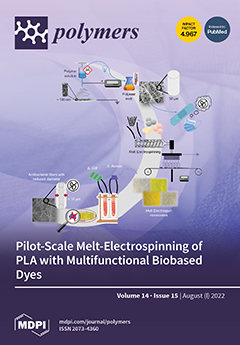
Cover Story: Fibers with diameters in the lower micrometer range for textile and biomedical applications are produced by solution electrospinning, but this process is environmentally harmful because toxic solvents are used. Melt electrospinning is a sustainable alternative but the high viscosity and low electrical conductivity of molten polymers produces thicker fibers. Here, we used multifunctional potentially bio-based dyes as additives to produce antibacterial fibers in the lower micrometer range using pilot-scale melt electrospinning for interesting applications in the biomedical field. View this paper
  • Issues are regarded as officially published after their release is announced to the table of contents alert mailing list .
  • You may sign up for email alerts to receive table of contents of newly released issues.
  • PDF is the official format for papers published in both, html and pdf forms. To view the papers in pdf format, click on the "PDF Full-text" link, and use the free Adobe Reader to open them.

Articles (260)

  • Article
  • Open Access
18 Citations
5,180 Views
14 Pages

8 August 2022

Experimental and numerical investigations are presented for a theory-guided machine learning (ML) model that combines the Hashin failure theory (HFT) and the classical lamination theory (CLT) to optimize and accelerate the design of composite laminat...

  • Article
  • Open Access
3 Citations
3,450 Views
13 Pages

On-the-Fly Formation of Polymer Film at Water Surface

  • Veronica Vespini,
  • Sara Coppola and
  • Pietro Ferraro

8 August 2022

The self-propulsion of bodies floating in water is of great interest for developing new robotic and intelligent systems at different scales, and whenever possible, Marangoni propulsion is an attractive candidate for the locomotion of untethered micro...

  • Review
  • Open Access
91 Citations
14,528 Views
18 Pages

Fabrication, Property and Application of Calcium Alginate Fiber: A Review

  • Xiaolin Zhang,
  • Xinran Wang,
  • Wei Fan,
  • Yi Liu,
  • Qi Wang and
  • Lin Weng

8 August 2022

As a natural linear polysaccharide, alginate can be gelled into calcium alginate fiber and exploited for functional material applications. Owing to its high hygroscopicity, biocompatibility, nontoxicity and non-flammability, calcium alginate fiber ha...

  • Article
  • Open Access
4 Citations
4,909 Views
16 Pages

8 August 2022

Based on pilot-scale twin-screw reactive extrusion, the structural and rheological properties of controlled-rheology polypropylenes (CR-PPs) are investigated, where the effects of peroxide content and extrusion conditions such as screw configuration,...

  • Article
  • Open Access
2,864 Views
15 Pages

8 August 2022

In order to investigate the yield surface evolution of polypropylene (PP) under dynamic impact and the relationship between yield surface parameters and the strain rate, five shear-compression specimens (SCSs) with different inclination angles are de...

  • Article
  • Open Access
26 Citations
4,478 Views
15 Pages

Advanced “Green” Prebiotic Composite of Bacterial Cellulose/Pullulan Based on Synthetic Biology-Powered Microbial Coculture Strategy

  • Sirina Zhantlessova,
  • Irina Savitskaya,
  • Aida Kistaubayeva,
  • Ludmila Ignatova,
  • Aizhan Talipova,
  • Alexander Pogrebnjak and
  • Ilya Digel

8 August 2022

Bacterial cellulose (BC) is a biopolymer produced by different microorganisms, but in biotechnological practice, Komagataeibacter xylinus is used. The micro- and nanofibrillar structure of BC, which forms many different-sized pores, creates prerequis...

  • Article
  • Open Access
17 Citations
2,529 Views
12 Pages

Novel Immobilized Biocatalysts Based on Cysteine Proteases Bound to 2-(4-Acetamido-2-sulfanilamide) Chitosan and Research on Their Structural Features

  • Svetlana S. Olshannikova,
  • Nataliya V. Malykhina,
  • Maria S. Lavlinskaya,
  • Andrey V. Sorokin,
  • Nikolay E. Yudin,
  • Yulia M. Vyshkvorkina,
  • Anatoliy N. Lukin,
  • Marina G. Holyavka and
  • Valeriy G. Artyukhov

8 August 2022

Briefly, 2-(4-Acetamido-2-sulfanilamide) chitosan, which is a chitosan water-soluble derivative, with molecular weights of 200, 350, and 600 kDa, was successfully synthesized. The immobilization of ficin, papain, and bromelain was carried out by comp...

  • Review
  • Open Access
56 Citations
7,588 Views
29 Pages

In Vivo Bone Tissue Engineering Strategies: Advances and Prospects

  • Ilya L. Tsiklin,
  • Aleksey V. Shabunin,
  • Alexandr V. Kolsanov and
  • Larisa T. Volova

8 August 2022

Reconstruction of critical-sized bone defects remains a tremendous challenge for surgeons worldwide. Despite the variety of surgical techniques, current clinical strategies for bone defect repair demonstrate significant limitations and drawbacks, inc...

  • Article
  • Open Access
24 Citations
3,610 Views
24 Pages

A QbD Approach to Design and to Optimize the Self-Emulsifying Resveratrol–Phospholipid Complex to Enhance Drug Bioavailability through Lymphatic Transport

  • Syed Abul Layes Gausuzzaman,
  • Mithun Saha,
  • Shahid Jaman Dip,
  • Shaiful Alam,
  • Arup Kumar,
  • Harinarayan Das,
  • Shazid Md. Sharker,
  • Md Abdur Rashid,
  • Mohsin Kazi and
  • Hasan Mahmud Reza

8 August 2022

Objectives: Despite having profound therapeutic value, the clinical application of resveratrol is restrained due to its <1% bioavailability, arising from the extensive fast-pass effect along with enterohepatic recirculation. This study aimed to de...

  • Article
  • Open Access
4 Citations
3,301 Views
13 Pages

The Separation of Chlorobenzene Compounds from Environmental Water Using a Magnetic Molecularly Imprinted Chitosan Membrane

  • Guizhen Li,
  • Jinyao Wang,
  • Peng Zhu,
  • Ying Han,
  • Anqi Yu,
  • Junhong Li,
  • Zhaomei Sun and
  • Kyung Ho Row

8 August 2022

In this work, a magnetic molecularly imprinted chitosan membrane (MMICM) was synthesized for the extraction of chlorobenzene compounds in environmental water using the membrane separation method. The optimal extraction amount for chlorobenzene (9.64...

of 26

Get Alerted

Add your email address to receive forthcoming issues of this journal.

XFacebookLinkedIn
Polymers - ISSN 2073-4360