


Abstract
Nickel salts with different counter-anions were used as a model system to examine how precursor chemistry affects aerosol conversion and alkaline hydrogen evolution. Acetate, nitrate, chloride, and sulfate precursors were processed under the same spray-pyrolysis and reduction conditions. Thermogravimetric analysis showed separated dehydration and decomposition steps for acetate and distinct thermal responses for the inorganic salts. Ni_acetate showed the highest geometric HER activity among the tested electrodes, requiring overpotentials of 280.0 and 346.1 mV at 5 and 10 mA cm−2, respectively, with a Tafel slope of 136.8 mV dec−1. The comparison links precursor-dependent thermal and structural evolution with electrode performance and indicates that physical surface area alone does not account for the activity differences.
1. Introduction
Hydrogen production through electrochemical water splitting is an important technology for the development of future sustainable energy systems, offering a viable route for the conversion of renewable electricity into a storable, carbon-free energy carrier [1,2]. In alkaline water electrolysis, the hydrogen evolution reaction (HER) at the cathode is catalyzed by inexpensive transition-metal-based materials, providing a significant advantage over systems that rely heavily on noble metals [1,3]. While platinum and related platinum-group metals remain the reference electrocatalysts for HER because of their favorable hydrogen adsorption characteristics and rapid reaction kinetics, their limited availability and high cost restrict their widespread use in large-scale electrolyzers [3,4]. These limitations have stimulated extensive efforts to develop catalysts based on various non-platinum-group metals. In particular, Ni-based materials have received intense attention as catalysts for alkaline HER because nickel combines relatively high electronic conductivity with low material cost and good electrochemical stability under alkaline operating conditions [3,5].
Hydrogen adsorption on Ni in alkaline solution involves water activation through the Volmer reaction, H2O + e− + * → H* + OH−, making water dissociation an important kinetic consideration [6,7]. Both surface chemistry and particle structure influence this process. Porous Ni architectures, including spray-pyrolyzed particles with interconnected nanoscale pores, provide accessible reaction sites and transport pathways [7,8,9]. Ultrasonic spray pyrolysis (USP) offers a continuous route from precursor solutions to particulate materials [8,10,11]. Droplet generation, solvent removal, solute precipitation, and decomposition collectively determine the resulting particle morphology and internal structure [8,10,11].
Precursor counter-anions influence thermochemical conversion and product structure, making salt selection an important variable in spray-based synthesis [12,13,14]. Nickel chloride, nitrate, and sulfate follow different dehydration and conversion pathways [12]. For chloride-derived aerosols, the formation of NiO or Ni depends on temperature, atmosphere, and residence time [13]. Nickel sulfate is comparatively resistant to decomposition, with conversion temperatures approaching 890 °C under some thermal-analysis conditions [15]. Nickel nitrate converts at lower temperatures, although the associated gas evolution can produce hollow or fragile particles. Gas-to-particle conversion at higher temperatures can also generate ultrafine particles [16,17]. The subsequent reduction of NiO introduces another structural change: oxygen removal gives a theoretical solid-volume contraction of approximately 40–41% [18]. Depending on the reduction conditions, this transformation can involve pore formation, coarsening, and densification [18]. Evaluating both the oxide-forming and reduction stages is therefore necessary to distinguish the effects of precursor chemistry.
This study uses four nickel salts as a comparative model system for precursor-dependent spray pyrolysis. The synthesis and reduction conditions were held constant while the counter-anion was varied. Thermal analysis, SEM, XRD, XPS, BET measurements, and double-layer capacitance were combined to relate precursor conversion to particle structure and the initial HER response of catalyst-coated Ni foam electrodes. The emphasis is on differences induced by precursor selection under a common preparation protocol.
2. Results and Discussion
2.1. Thermal Decomposition Behaviors and Physicochemical Characteristics of Nickel Precursors
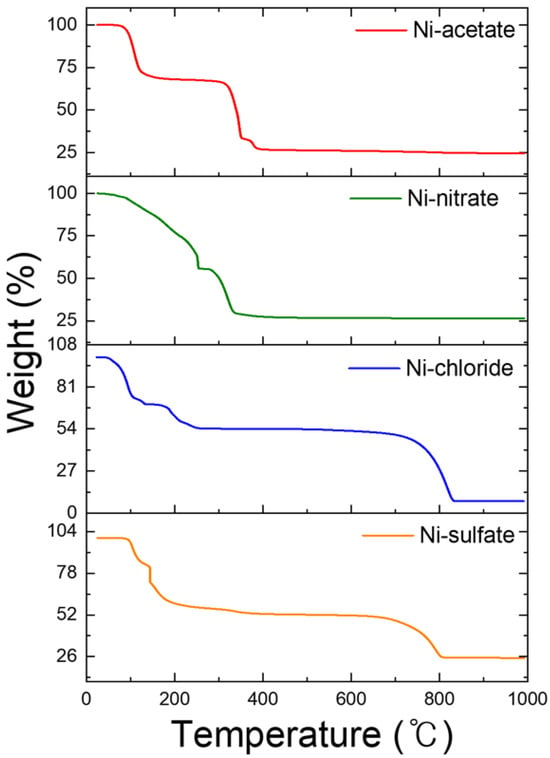
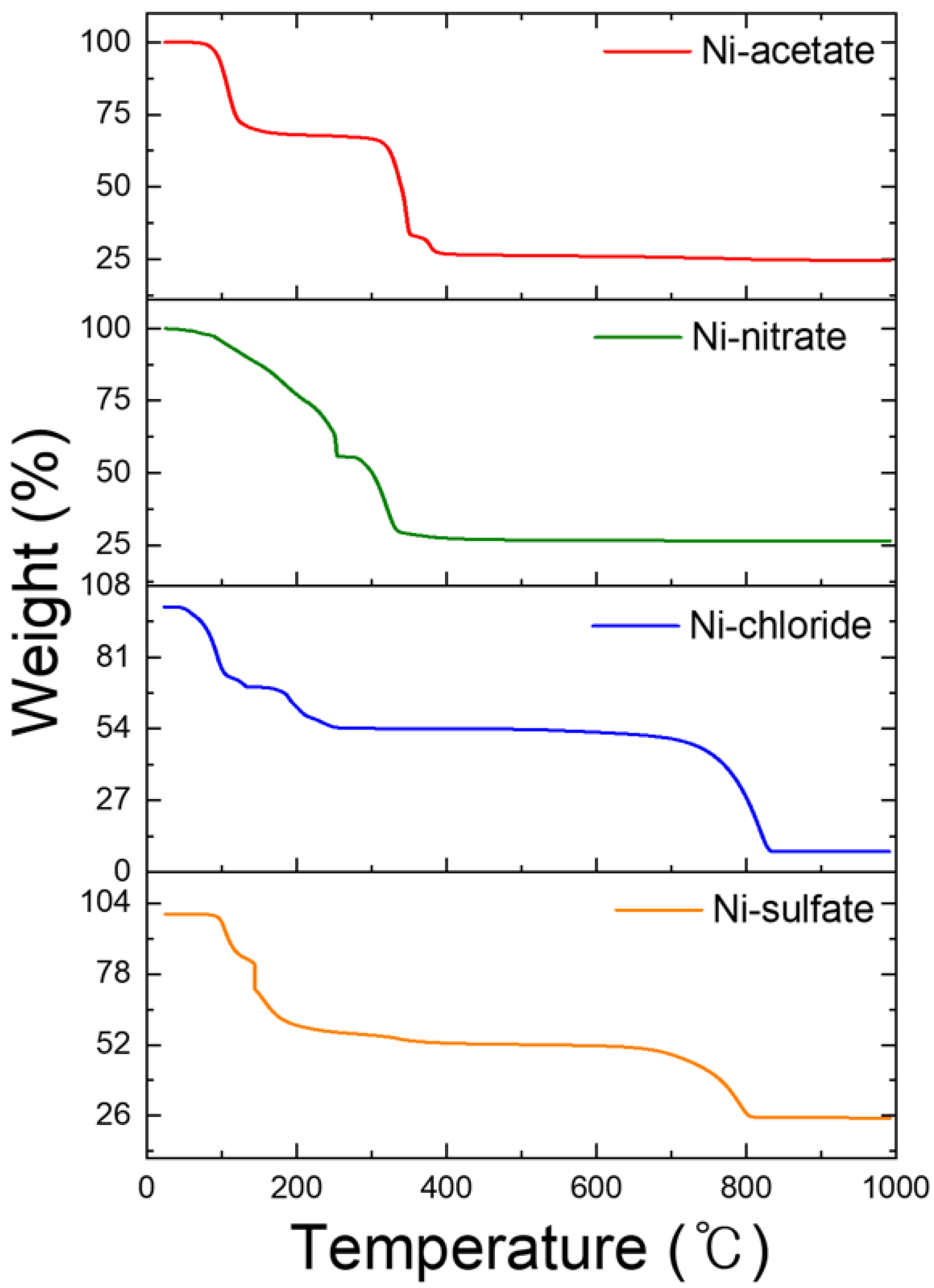
The four hydrated nickel salts showed different mass-loss profiles during heating in air (Figure 1). Table 1 lists their compositions, molar masses, observed thermal intervals, and theoretical NiO residues. Dehydration and decomposition steps were assessed by comparing measured mass fractions with stoichiometric expectations and precursor decomposition pathways [12,19,20,21,22].
Figure 1.
Thermogravimetric analysis (TGA) profiles of Ni(CH3COO)2·4H2O (Ni-acetate), Ni(NO3)2·6H2O (Ni-nitrate), NiCl2·6H2O (Ni-chloride), and NiSO4·7H2O (Ni-sulfate), recorded in air from room temperature to 1000 °C at a heating rate of 10 °C min−1.
Table 1.
Precursor characteristics and thermal parameters relevant to the interpretation of the TGA profiles.
The acetate precursor showed two principal mass-loss regions. The first, near 110 °C, was attributed mainly to dehydration and is represented by:
Ni(CH3COO)2·4H2O → Ni(CH3COO)2 + 4H2O.
The mass remaining after this step was approximately 70.0%, close to the calculated 71.0% for water removal. The second decrease occurred at approximately 300–380 °C and is consistent with acetate decomposition under oxidizing conditions [19]. The final residue was 25.5–26.0%, below the theoretical NiO yield of 30.0%. The separation of these events distinguishes the acetate profile from the more strongly overlapping nitrate response.
The nitrate precursor lost mass continuously between approximately 50 and 250 °C. These changes are consistent with overlapping dehydration, hydrolysis, and nitrate decomposition. The sharper decrease at approximately 260–350 °C corresponds to further decomposition and the evolution of water and nitrogen-containing gases [20]. The net conversion can be written as:
Ni(NO3)2·6H2O → NiO + 2NO2 + 0.5O2 + 6H2O
The final residue of approximately 26.5% was close to the calculated NiO yield of 25.7%. Gas evolution during nitrate conversion can alter the morphology of spray-pyrolyzed particles [16,17].
The chloride precursor underwent stepwise dehydration below approximately 300 °C. Residual masses near 70% and 54% are consistent with the calculated values for NiCl2·2H2O and anhydrous NiCl2, respectively [21]. A further decrease at approximately 650–830 °C left less than 10% residue, compared with a theoretical NiO yield of 31.4%. This mass deficit suggests the loss of Ni-containing material in addition to anion removal. Volatilization is a possible contributor under these conditions [13].
The sulfate precursor retained an anhydrous intermediate over the widest temperature interval. Dehydration began near 100 °C, with residual masses consistent with NiSO4·H2O and anhydrous NiSO4 [22]. The major high-temperature decrease occurred at approximately 700–820 °C. The overall reactions are:
NiSO4 → NiO + SO3,
SO3 → SO2 + 0.5O2
The final residual mass was approximately 26.0%, close to the theoretical NiO yield of 26.6%.
The acetate and nitrate precursors completed their major low-temperature mass-loss events below approximately 400 °C, whereas chloride and sulfate showed additional changes at higher temperatures. In the spray reactor, droplets instead undergo rapid heating under N2, with simultaneous solvent removal and precursor conversion. N2 is the carrier gas, while water and oxygen-bearing anions provide possible oxygen sources within the droplets. NiO reflections in the sulfate-derived powder confirm oxide formation at 600 °C under the reactor conditions; the bulk air-TGA interval is therefore not a direct conversion threshold for spray pyrolysis. Additional reflections in the spray-pyrolyzed powders are discussed below.
2.2. Morphology and Crystal Structure of Spray-Pyrolyzed NiO Particles
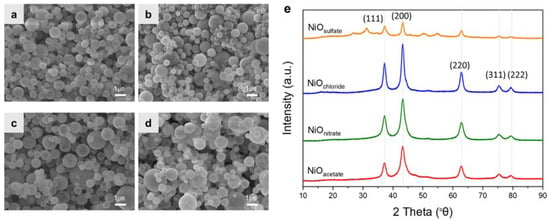
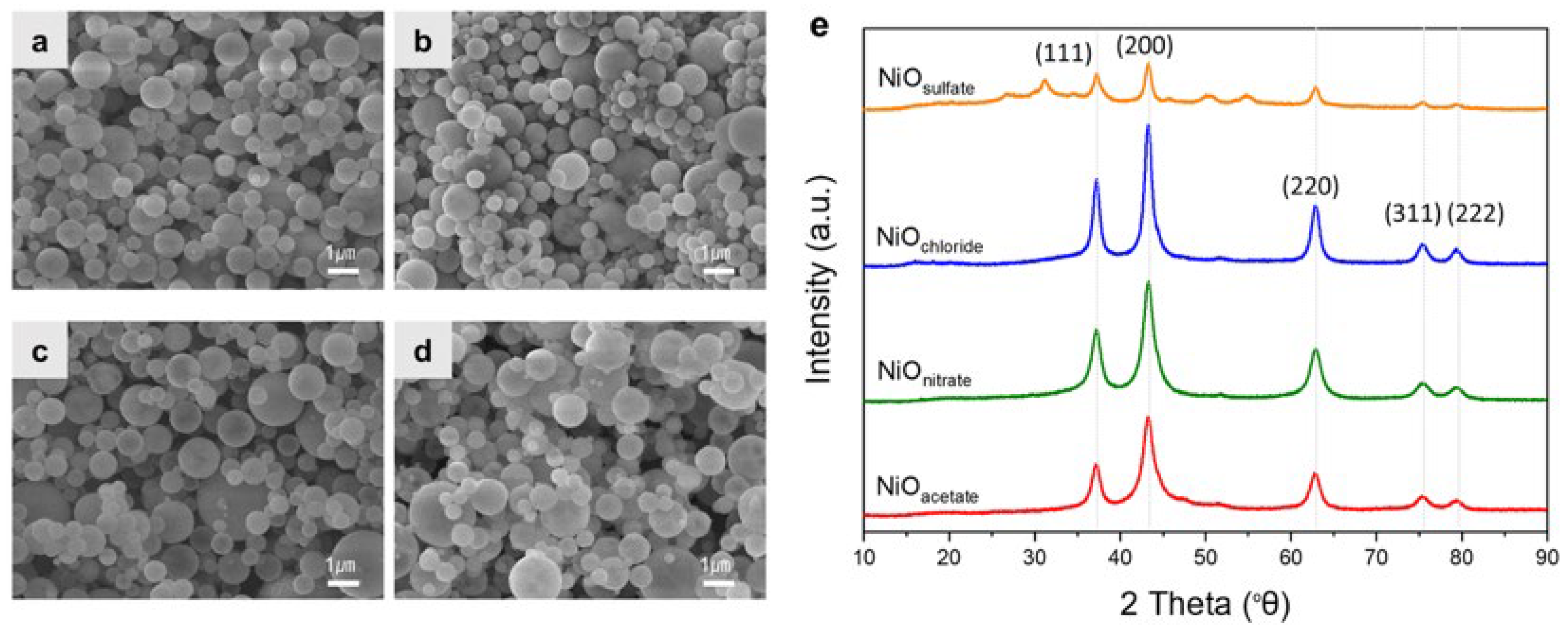
Figure 2 compares the morphology and XRD patterns of the spray-pyrolyzed powders. All four samples contained predominantly spherical secondary particles, consistent with droplet-to-particle conversion [11,23]. NiO_acetate consisted mainly of intact spheres with relatively smooth surfaces (Figure 2a). The preserved morphology is consistent with the separated dehydration and decomposition events observed by TGA. Acetate-containing feeds can promote smoother Ni particles and reduce ultrafine-particle formation relative to nitrate-only systems [17]. NiO_nitrate showed partially collapsed spheres, shell fragments, and smaller particles (Figure 2b). Rapid thermal conversion and gas evolution offer a plausible explanation for the fragmentation of nitrate-derived particles [16,17]. NiO_chloride retained comparatively intact spherical outlines (Figure 2c), consistent with droplet conversion under suitable temperature and residence-time conditions [13,23]. NiO_sulfate also retained a generally spherical form but had a rougher, granular surface (Figure 2d). Its distinct texture may reflect a slower conversion of sulfate-containing species during the short reactor residence time [12,22].
Figure 2.
Morphological and structural characterization of NiO particles prepared by spray pyrolysis using different nickel precursors: SEM images of (a) NiO_acetate, (b) NiO_nitrate, (c) NiO_chloride, and (d) NiO_sulfate, and (e) corresponding XRD patterns. The major reflections of cubic rock-salt NiO are indexed according to JCPDS No. 47-1049 (Fm-3m). Additional peak annotations and crystallite-size parameters are provided in Figure S1 and Table S1.
The principal reflections in Figure 2e can be seen at approximately 37.2°, 43.3°, 62.9°, 75.4°, and 79.4° and indicate the (111), (200), (220), (311), and (222) planes of cubic rock-salt NiO (Fm-3m; JCPDS No. 47-1049). NiO was the dominant crystalline phase in all four powders. Additional features in the nitrate-, chloride-, and sulfate-derived patterns are marked as unassigned reflections in Figure S1.
The mean apparent NiO crystallite sizes were 7.43 ± 0.26, 9.73 ± 0.96, 6.94 ± 0.20, and 8.85 ± 0.20 nm for NiO_acetate, NiO_nitrate, NiO_chloride, and NiO_sulfate, respectively (Table S1). The oxide powders contained nanoscale coherent domains within a narrow size range despite differences in secondary-particle morphology.
2.3. Phase Transformation and Morphological Evolution into Metallic Ni Catalysts
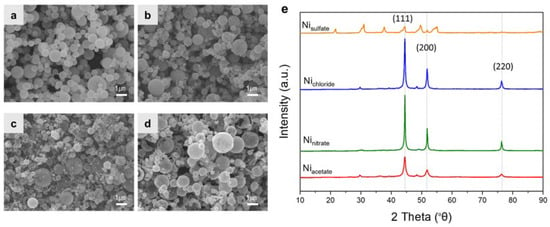
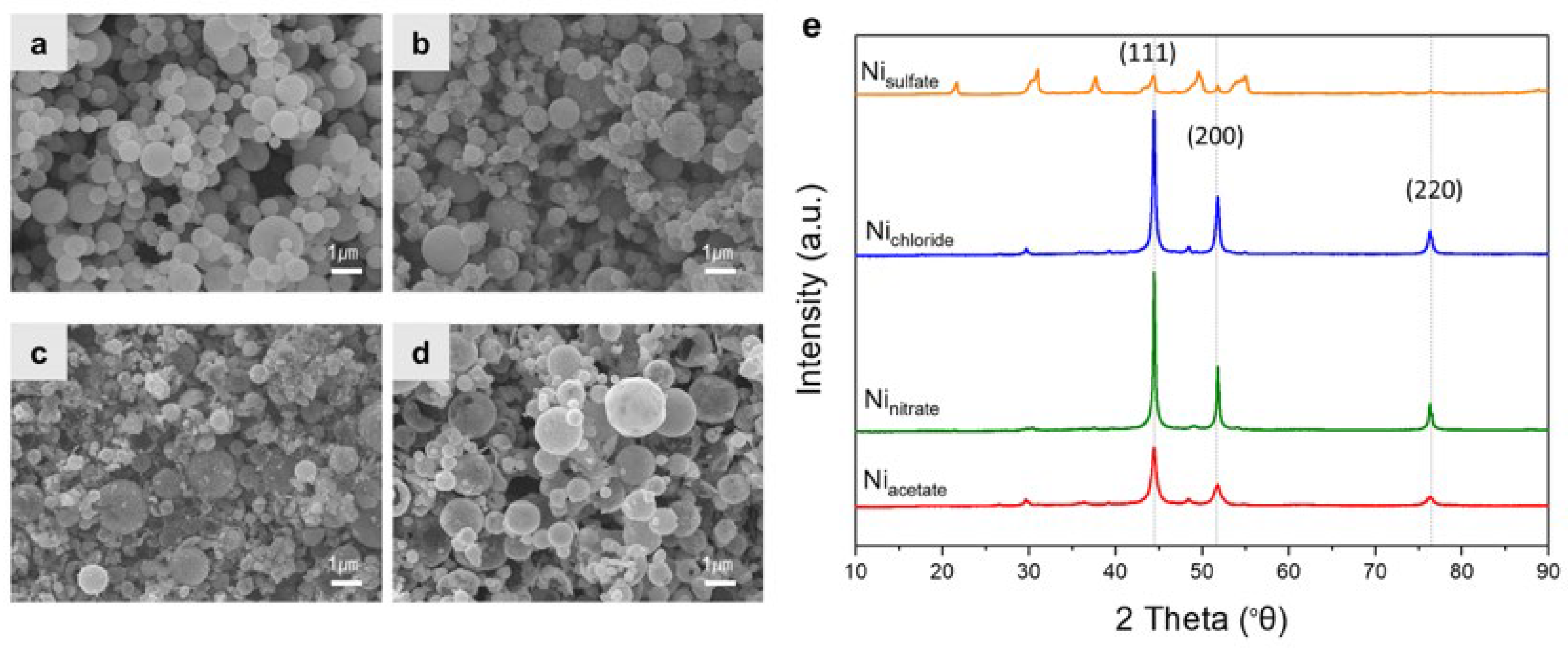
Figure 3 presents the morphology and crystalline phases after hydrogen treatment. NiO reduction involves the formation and growth of metallic Ni domains together with rearrangement of the oxide framework [18,24,25]. Comparison with Figure 2 shows how precursor-dependent structures evolve during the second thermal step.
Figure 3.
Morphological and crystallographic evolution of metallic Ni particles obtained by the reduction of spray-pyrolyzed NiO particles: SEM images of (a) Ni_acetate, (b) Ni_nitrate, (c) Ni_chloride, and (d) Ni_sulfate, and (e) corresponding XRD patterns. The major reflections of face-centered cubic metallic Ni are indexed according to JCPDS No. 04-0850 (Fm-3m). Additional peak annotations and crystallite-size parameters are provided in Figure S2 and Table S2.
Ni_acetate, Ni_nitrate, and Ni_chloride displayed the principal fcc-Ni reflections at approximately 44.5°, 51.8°, and 76.4°, indexed as (111), (200), and (220), respectively (Fm-3m; JCPDS No. 04-0850). The major NiO peaks present before reduction were no longer discernible. The loss of the major NiO reflections and the appearance of Ni peaks are consistent with hydrogen-driven NiO-to-Ni conversion [24].
The average apparent Ni crystallite sizes after reduction were 12.53 ± 1.11, 25.32 ± 3.05, and 19.25 ± 1.34 nm for Ni_acetate, Ni_nitrate, and Ni_chloride, respectively (Table S2). Ni_acetate retained smaller coherent Ni domains than the other two predominantly metallic samples. Ni_sulfate exhibited additional reflections at approximately 21.7°, 31.0°, 37.7°, 44.4°, 49.6°, and 54.5–55.0°, consistent with a Ni3S2-containing multiphase pattern (Figure S2) [26]. For this sample, Table S2 shows a representative apparent Ni-domain size from the comparatively isolated Ni (200) reflection.
SEM showed that Ni_acetate retained the spherical secondary-particle outlines after reduction (Figure 3a). The retained morphology coexists with comparatively small coherent Ni domains. NiO reduction entails a theoretical solid-volume contraction of 40–41% [18], while SEM shows that the external particle shape is retained.
Ni_nitrate exhibited particle fragmentation and increased particle-to-particle contact, while Ni_chloride showed surface coarsening and aggregation (Figure 3b,c). These morphologies are consistent with the larger Ni domains measured by XRD. Ni_sulfate showed fragmented and partly collapsed particles together with a multiphase diffraction pattern (Figure 3d).
Precursor selection affected Ni-domain growth during reduction and the final phase composition, particularly for the sulfate-derived sample. These differences are evaluated together with the surface and electrochemical measurements. The corresponding XPS spectra are presented in Figure S3.
2.4. Electrocatalytic Hydrogen Evolution Reaction (HER) Performance
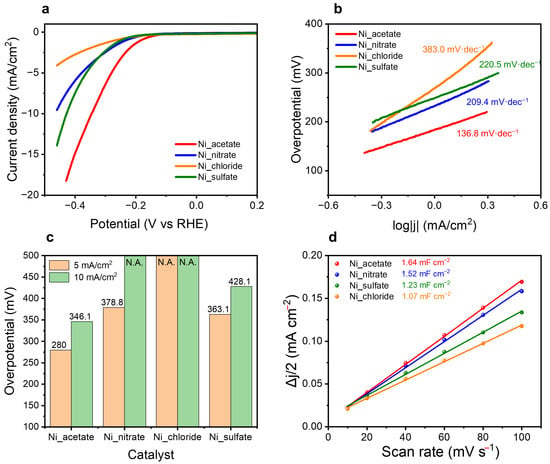
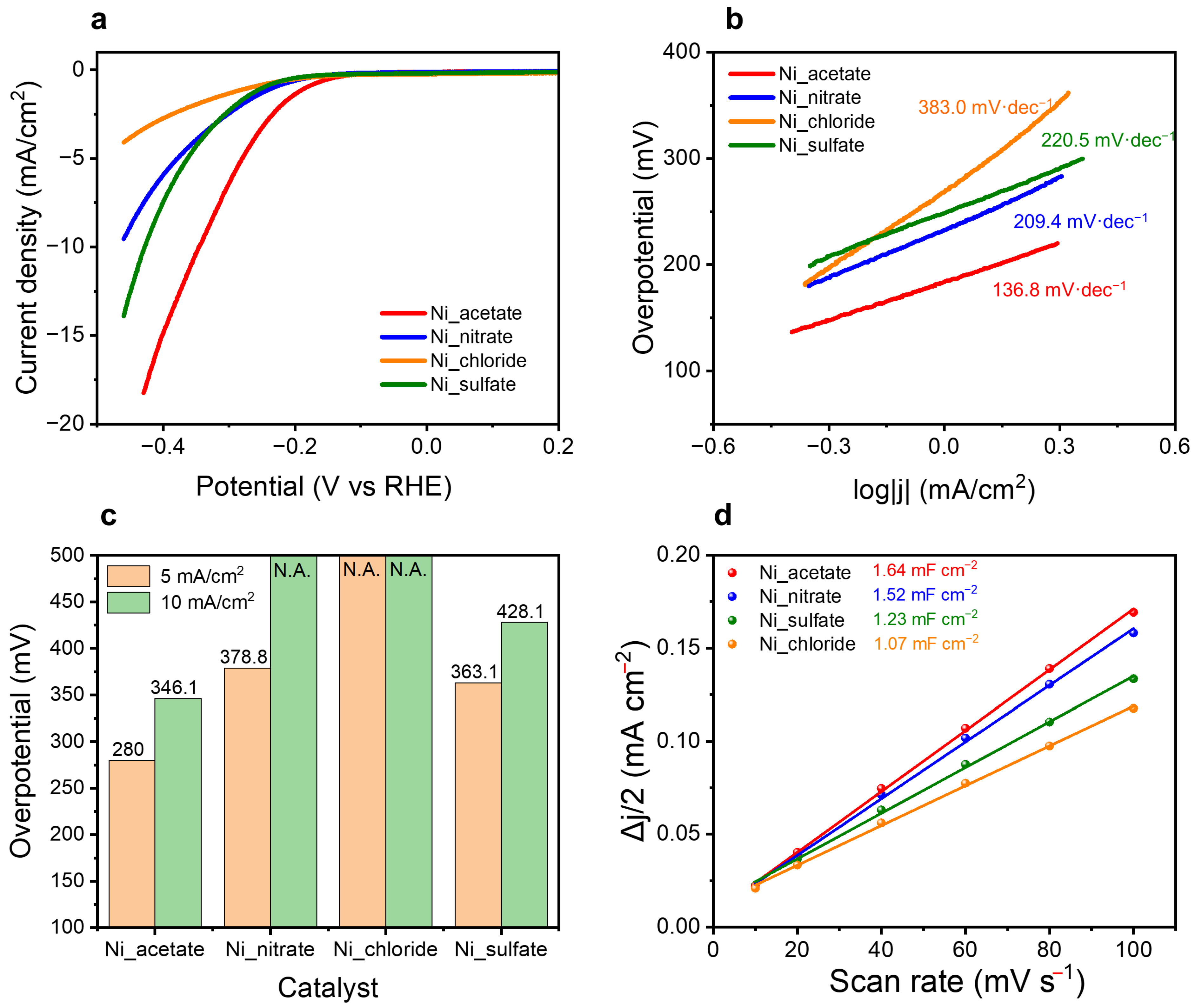
LSV, Tafel analysis, and capacitance measurements were used to compare the initial alkaline HER response of the four catalyst-coated Ni foam electrodes (Figure 4). The electrochemical results are compared with the precursor-dependent morphology, phase composition, and surface chemical states.
Figure 4.
Electrochemical characterization in 1 M KOH: (a) LSV polarization curves; (b) Tafel plots; (c) overpotentials at geometric current densities of 5 and 10 mA cm−2; and (d) Δj/2 plotted against the scan rate for Cdl determination. Δj denotes the difference between anodic and cathodic current densities at the selected potential. In panel (c), N.A. indicates that the target current density was not reached within the measured potential range.
Ni_acetate reached 5 and 10 mA cm−2 at overpotentials of 280.0 and 346.1 mV, respectively (Figure 4a,c). Ni_sulfate required 363.1 and 428.1 mV at the same current densities. Ni_nitrate reached 5 mA cm−2 at 378.8 mV but did not reach 10 mA cm−2 within the measured interval. Ni_chloride did not reach 5 mA cm−2. These values compare electrode activity on a geometric-area basis, following common HER benchmarking practice [3,4].
At −0.40 V vs. RHE, the cathodic current-density magnitudes were 14.91, 7.48, 5.94, and 2.74 mA cm−2 for Ni_acetate, Ni_sulfate, Ni_nitrate, and Ni_chloride, respectively (Figure S4b). At this potential, the first three catalyst-coated electrodes also exceeded the current magnitude of bare Ni foam, whereas Ni_chloride did not (Figure S4a). The comparison shows increased electrode currents after coating with acetate-, sulfate-, and nitrate-derived powders under the measured conditions.
The apparent Tafel slopes were 136.8, 209.4, 220.5, and 383.0 mV dec−1 for Ni_acetate, Ni_nitrate, Ni_sulfate, and Ni_chloride, respectively (Figure 4b). Ni_acetate thus showed the smallest increase in overpotential per decade of current within the fitted interval.
For an ideal HER mechanism, Tafel slopes are commonly associated with limiting Volmer, Heyrovsky, and Tafel steps, respectively [5,27]. The alkaline Volmer reaction is given in the Introduction.
Water dissociation in this step is important for alkaline Ni-based HER [5,7,27]. The larger experimental slopes also reflect the selected fitting interval and electrode-specific effects, so the present comparison is used to describe apparent kinetics [27].
The Cdl values obtained from Figure 4d were 1.64, 1.52, 1.23, and 1.07 mF cm−2 for Ni_acetate, Ni_nitrate, Ni_sulfate, and Ni_chloride, respectively; the corresponding cyclic voltammograms are shown in Figure S5. Ni_acetate had the largest capacitance and the highest geometric HER current. However, Ni_sulfate was more active than Ni_nitrate despite its lower Cdl.
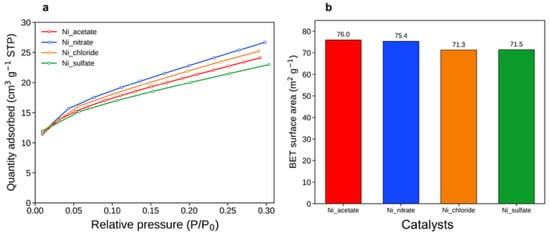
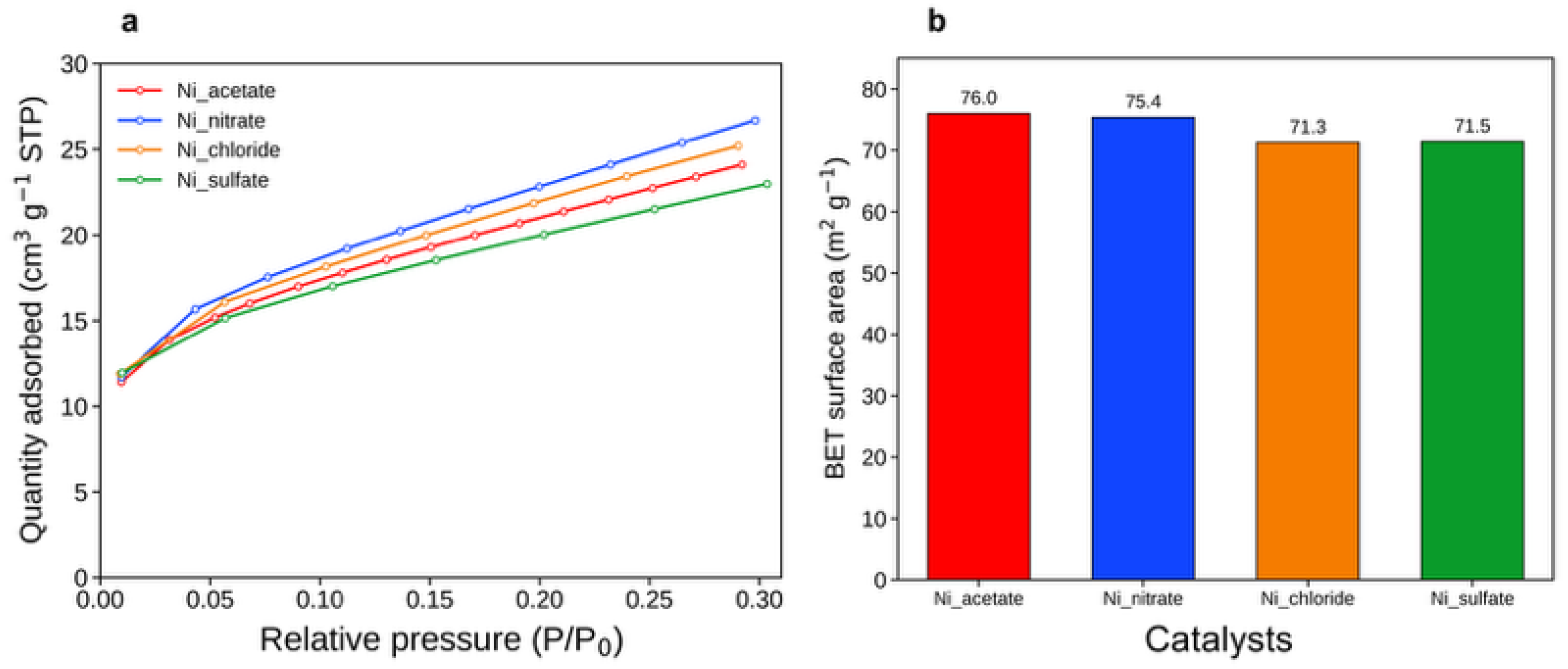
Figure 5a presents the adsorption branches used for BET analysis, and Figure 5b compares the resulting specific surface areas. The values were 76.0, 75.4, 71.3, and 71.5 m2 g−1 for Ni_acetate, Ni_nitrate, Ni_chloride, and Ni_sulfate, respectively. The approximately 7% span in reported BET areas is small compared with the more than fivefold difference in geometric current at −0.40 V vs. RHE.
Figure 5.
Gas-adsorption characterization of the reduced powders: (a) adsorption branches used for BET analysis and (b) BET specific surface areas.
At −0.40 V vs. RHE, jBET was 196.2, 78.8, 38.4, and 104.7 mA m−2 of BET area for Ni_acetate, Ni_nitrate, Ni_chloride, and Ni_sulfate, respectively (Figure S6a). The corresponding jCdl values were 9.09, 3.91, 2.56, and 6.08 mA mF−1 (Figure S6b). The activity order, Ni_acetate > Ni_sulfate > Ni_nitrate > Ni_chloride, was retained after both BET-area and Cdl normalization (Figure S6). The substantial differences remaining after normalization suggest that surface-area variations are not the main origin of the observed activity trend. Together with the XRD and XPS results (Figures S2 and S3), this supports contributions from precursor-dependent phase composition and surface chemical states. In particular, Ni_sulfate contains Ni3S2 and exhibits higher HER activity than Ni_nitrate despite its lower Cdl and fragmented morphology. These results indicate that precursor chemistry influences HER performance beyond changes in particle morphology and surface area. Because capacitance depends on surface state and measurement potential, jCdl is interpreted as current per measured capacitance rather than absolute ECSA-specific activity [28,29].
Figure S3 shows the C 1s, O 1s, and Ni 2p3/2 spectra after reduction. The C–C/C–H component is located at 284.8 eV. The O 1s components near 530 and 531 eV are assigned to Ni–O and surface hydroxyls, respectively [30,31]. Ni_acetate, Ni_nitrate, and Ni_chloride exhibit metallic Ni contributions at 852.5–852.9 eV, together with Ni2+ oxide/hydroxide envelopes and satellite/loss features [30,31]. The 853.3 eV component of Ni_sulfate is interpreted as a Ni–S contribution in conjunction with its Ni3S2 XRD pattern (Figure S2) [26]. Ni_sulfate exhibits higher HER current than Ni_nitrate despite its lower Cdl and fragmented morphology [26]. Surface chemical state is therefore considered alongside morphology and phase composition in interpreting catalytic response [5,30,32].
3. Materials and Methods
3.1. Synthesis of NiO Particles by Spray Pyrolysis
Nickel(II) acetate tetrahydrate (Ni(CH3COO)2·4H2O, 99.995% trace metals basis, Sigma-Aldrich, St. Louis, MO, USA, product no. 379883), nickel(II) nitrate hexahydrate (Ni(NO3)2·6H2O, 99.999% trace metals basis, Sigma-Aldrich, St. Louis, MO, USA, product no. 203874), nickel(II) chloride hexahydrate (NiCl2·6H2O, 99.999% trace metals basis, Sigma-Aldrich, St. Louis, MO, USA, product no. 203866), and nickel(II) sulfate heptahydrate (NiSO4·7H2O, 99.999% trace metals basis, Sigma-Aldrich, St. Louis, MO, USA, product no. 203890) were used as nickel precursors. Each precursor was separately dissolved in deionized water (500 mL) to prepare a 0.1 M solution, corresponding to the same nominal Ni concentration for all precursor systems. The solutions were stirred at room temperature for 1 h prior to aerosol generation. Aerosol droplets were generated using an ultrasonic nebulizer operated at 1.7 MHz and transported into the tubular reactor by N2 gas at a flow rate of 10 L min−1. Spray pyrolysis was carried out at 600 °C using a reactor composed of six heating zones with a unit heating length of 60 cm. During passage through the heated region, solvent evaporation, precursor precipitation, and thermal conversion proceeded sequentially to form Ni-containing oxide particles. The resulting powder was collected at the reactor outlet using a bag filter system. To allow direct evaluation of the effects of precursor chemistry, the atomization conditions, gas flow rate, reactor temperature, and particle collection conditions were kept identical for all four precursor systems. The spray-pyrolyzed products are denoted as NiO_acetate, NiO_nitrate, NiO_chloride, and NiO_sulfate, respectively, according to the corresponding precursor.
3.2. Conversion of NiO Particles to Metallic Ni
The spray-pyrolyzed powders were reduced at 600 °C for 1 h under 10 vol% H2/90 vol% N2. A heating rate of 5 °C min−1 and a total gas flow rate of 2 L min−1 were used. The powders were cooled to room temperature under the same gas mixture. The reduced samples were designated Ni_acetate, Ni_nitrate, Ni_chloride, and Ni_sulfate according to the precursor.
3.3. Characterization and Electrochemical Measurements
Thermogravimetric analysis (TGA, SDT-650, TA Instruments, New Castle, DE, USA) was conducted in air from room temperature to 1000 °C at 10 °C min−1 to compare precursor dehydration and decomposition. Particle morphology was examined by field-emission scanning electron microscopy (FE-SEM, MIRA3 LM, TESCAN, Brno, Czech Republic). X-ray diffraction patterns (XRD, Ultima IV, Rigaku, Akishima, Tokyo, Japan) were recorded using Cu K-alpha radiation (λ = 1.5418 Å) over 2θ = 10–90°. Cubic NiO (JCPDS No. 47-1049) and fcc Ni (JCPDS No. 04-0850) were used as reference phases. Apparent crystallite sizes were calculated as D = Kλ/(β cos θ), with K = 0.9 and β representing the measured FWHM in radians [33]. Interplanar spacings were calculated as d = λ/(2 sin θ). Gas-adsorption data were analyzed by the BET method [34]. High-resolution C 1s, O 1s, and Ni 2p XPS spectra were analyzed after reduction. Binding energies were referenced to the C–C/C–H component at 284.8 eV. Ni 2p3/2 assignments were based on the fitted envelopes, O 1s spectra, and XRD results [30,31]. Electrochemical measurements were performed with a WaveDriver 100 workstation (Pine Research Instrumentation, Durham, NC, USA) in 1 M KOH using catalyst-coated Ni foam, Pt mesh, and Hg/HgO (1.0 M NaOH) as the working, counter, and reference electrodes, respectively. The catalyst ink contained 25 mg of powder dispersed in 425 µL of ethanol and 75 µL of 20% Nafion solution. A 20 µL aliquot of the 500 µL ink was deposited on 1 cm2 of Ni foam, giving a catalyst loading of 1.0 mg cm−2. Potentials were converted to the RHE scale using:
E(RHE) = E(Hg/HgO) + 0.0592 × pH + 0.098.
Backward linear sweep voltammetry (LSV) was performed at 1 mV s−1 with ohmic-resistance correction. Geometric activity was compared using the overpotentials at 5 and 10 mA cm−2 and the current density at −0.40 V vs. RHE. Tafel slopes were obtained from linear regions of the overpotential versus log|j| plots. Double-layer capacitance (Cdl) was determined from cyclic voltammograms recorded at 10–100 mV s−1 in the potential windows shown in Figure S5. The slope of Δj/2 versus scan rate gives Cdl, where Δj is the difference between anodic and cathodic current densities at the selected potential [28]. Cdl is reported per geometric electrode area as a comparative measure of the capacitive response. Bare Ni foam was measured in the same electrolyte and electrode configuration for comparison with the catalyst-coated electrodes (Figure S4).
The current-density magnitude at −0.40 V vs. RHE was normalized as jBET = |jgeo|/(L × SBET) and jCdl = |jgeo|/Cdl, where jgeo is the geometric current density, L = 0.001 g cm−2 is the deposited catalyst loading, and SBET is the specific BET area. The resulting units are mA m−2 of BET area and mA mF−1, respectively (Figure S6). These calculations use the measured catalyst-coated electrode currents without subtracting the bare Ni foam response. Cdl normalization provides a capacitance-based comparison at the measured potential windows [28,29].
4. Conclusions
This study demonstrates that the precursor counter-anion chemistry plays a critical role in governing the thermal conversion, structural evolution, and alkaline HER performance of spray-pyrolyzed Ni catalysts. Among the four precursors examined, nickel acetate exhibited the most favorable thermal behavior with dehydration and decomposition steps adequately separated to enable low-temperature NiO formation and preservation of the spherical secondary-particle framework. After reduction, the acetate-derived sample retained relatively fine metallic Ni domains with limited structural coarsening, whereas the nitrate-, chloride-, and sulfate-derived samples exhibited greater particle fragmentation, crystallite growth, and incomplete phase conversion. Ni_acetate exhibited the highest HER activity among the investigated catalysts, requiring overpotentials of 280.0 and 346.1 mV to reach 5 and 10 mA cm−2, respectively, while exhibiting the lowest Tafel slope of 136.8 mV dec−1 among the investigated catalysts. These findings identify precursor selection as a key synthetic parameter for controlling the structure and electrocatalytic performance of spray-pyrolyzed Ni and provide a practical basis for the design of transition-metal catalysts for efficient alkaline water electrolysis.
Supplementary Materials
The following supporting information can be downloaded at: https://www.mdpi.com/article/10.3390/catal16110996/s1, Figure S1: XRD patterns of the spray-pyrolyzed powders, ordered from top to bottom as acetate-, nitrate-, chloride-, and sulfate-derived samples. Dotted lines indicate reference positions for cubic NiO (JCPDS No. 47-1049). Asterisks mark unassigned additional reflections; Figure S2: XRD patterns after reduction, ordered from top to bottom as Ni_acetate, Ni_nitrate, Ni_chloride, and Ni_sulfate. Dotted lines indicate reference positions for fcc Ni (JCPDS No. 04-0850). Diamonds denote reflections assigned to Ni3S2 in the sulfate-derived pattern; asterisks mark unassigned additional reflections; Figure S3: High-resolution XPS spectra of (a) C 1s, (b) O 1s, and (c) Ni 2p3/2 after reduction. From top to bottom: Ni_acetate, Ni_nitrate, Ni_chloride, and Ni_sulfate. Open circles represent measured spectra, black lines the total fits, colored lines fitted components on their backgrounds, and dashed lines the backgrounds. Spectra are normalized and vertically offset for clarity. Binding energies are referenced to C–C/C–H at 284.8 eV; Figure S4: (a) LSV polarization curves of the four catalyst-coated Ni foam electrodes and bare Ni foam in 1 M KOH. (b) Cathodic current-density magnitudes at −0.40 V vs. RHE for Ni_acetate, Ni_nitrate, Ni_chloride, and Ni_sulfate, normalized by geometric electrode area; Figure S5: Cyclic voltammograms used for capacitance analysis at scan rates of 10–100 mV s−1: (a) Ni_acetate, (b) Ni_nitrate, (c) Ni_sulfate, and (d) Ni_chloride. The corresponding plots of Δj/2 against scan rate are shown in Figure 4d; Figure S6: Current-density magnitudes at −0.40 V vs. RHE normalized by (a) total BET catalyst area, jBET = |jgeo|/(L × SBET), and (b) measured double-layer capacitance, jCdl = |jgeo|/Cdl. The catalyst loading L is 0.001 g cm−2. The plotted quantities are in mA m−2 of BET area and mA mF-1, respectively. Sample order is Ni_acetate, Ni_nitrate, Ni_chloride, and Ni_sulfate. jBET = |jgeo|/(L × SBET); jCdl = |jgeo|/Cdl; L = 0.001 g cm−2. The inputs and calculated values are listed in Table S3; Table S1: Peak parameters and apparent crystallite sizes of NiO particles after spray pyrolysis; Table S2: Peak parameters and apparent crystallite sizes of metallic Ni after reduction; Table S3: Input values and calculated quantities used in Figure S6.
Author Contributions
Conceptualization, methodology, formal analysis, visualization, writing of the original draft: O.Y.K.; Methodology, formal analysis: Y.-A.C.; Conceptualization, funding acquisition: H.Y.K.; Conceptualization, writing of the original draft, review & editing, supervision: D.P. All authors have read and agreed to the published version of the manuscript.
Funding
This research was funded by the Ministry of Trade, Industry & Energy (MOTIE) of the Republic of Korea, grant number 20019175.
Data Availability Statement
The datasets are available on reasonable request.
Conflicts of Interest
The authors declare no conflicts of interest.
References
- Tüysüz, H. Alkaline water electrolysis for green hydrogen production. Acc. Chem. Res. 2024, 57, 558–567. [Google Scholar] [CrossRef] [Scilit]
- Buttler, A.; Spliethoff, H. Current status of water electrolysis for energy storage, grid balancing and sector coupling via Power-to-Gas and Power-to-Liquids: A review. Renew. Sustain. Energy Rev. 2018, 82, 2440–2454. [Google Scholar] [CrossRef] [Scilit]
- Feidenhans’l, A.A.; Regmi, Y.N.; Wei, C.; Xia, D.; Kibsgaard, J.; King, L.A. Precious metal free hydrogen evolution catalyst design and application. Chem. Rev. 2024, 124, 5617–5667. [Google Scholar] [CrossRef] [Scilit]
- McCrory, C.C.L.; Jung, S.; Ferrer, I.M.; Chatman, S.M.; Peters, J.C.; Jaramillo, T.F. Benchmarking hydrogen evolving reaction and oxygen evolving reaction electrocatalysts for solar water splitting devices. J. Am. Chem. Soc. 2015, 137, 4347–4357. [Google Scholar] [CrossRef] [Scilit]
- Gong, M.; Wang, D.-Y.; Chen, C.-C.; Hwang, B.-J.; Dai, H. A mini review on nickel-based electrocatalysts for alkaline hydrogen evolution reaction. Nano Res. 2016, 9, 28–46. [Google Scholar] [CrossRef] [Scilit]
- Zhu, Y.; Li, L.; Cheng, H.; Ma, J. Alkaline hydrogen evolution reaction electrocatalysts for anion exchange membrane water electrolyzers: Progress and perspective. JACS Au 2024, 4, 4639–4654. [Google Scholar] [CrossRef] [Scilit]
- Hu, Q.; Chen, Z.; Wang, J.; Zheng, X.; Han, X.; Deng, Y.; Hu, W. Nanoporous nickel with rich adsorbed oxygen for efficient alkaline hydrogen evolution electrocatalysis. Sci. China Mater. 2022, 65, 1825–1832. [Google Scholar] [CrossRef] [Scilit]
- Park, D.; Yun, J.-Y.; Hong, S.; Yang, S.; Koo, H.-Y.; Park, J.Y.; Kim, K.T. Enhanced hydrogenation conversion efficiency of porous nickel particles with homogeneously distributed unimodal nanopores. Scr. Mater. 2022, 216, 114761. [Google Scholar] [CrossRef] [Scilit]
- Siwek, K.I.; Eugénio, S.; Santos, D.M.F.; Silva, M.T.; Montemor, M.F. 3D nickel foams with controlled morphologies for hydrogen evolution reaction in highly alkaline media. Int. J. Hydrogen Energy 2019, 44, 1701–1709. [Google Scholar] [CrossRef] [Scilit]
- Rahemi Ardekani, S.; Sabour Rouh Aghdam, A.; Nazari, M.; Bayat, A.; Yazdani, E.; Saievar-Iranizad, E. A comprehensive review on ultrasonic spray pyrolysis technique: Mechanism, main parameters and applications in condensed matter. J. Anal. Appl. Pyrolysis 2019, 141, 104631. [Google Scholar] [CrossRef] [Scilit]
- Leng, J.; Wang, Z.; Wang, J.; Wu, H.-H.; Yan, G.; Li, X.; Guo, H.; Liu, Y.; Zhang, Q.; Guo, Z. Advances in nanostructures fabricated via spray pyrolysis and their applications in energy storage and conversion. Chem. Soc. Rev. 2019, 48, 3015–3072. [Google Scholar]
- Cattin, L.; Reguig, B.A.; Khelil, A.; Morsli, M.; Benchouk, K.; Bernède, J.C. Properties of NiO thin films deposited by chemical spray pyrolysis using different precursor solutions. Appl. Surf. Sci. 2008, 254, 5814–5821. [Google Scholar] [CrossRef] [Scilit]
- Stopić, S.; Ilić, I.; Uskoković, D. Structural and morphological transformations during NiO and Ni particles generation from chloride precursor by ultrasonic spray pyrolysis. Mater. Lett. 1995, 24, 369–376. [Google Scholar] [CrossRef] [Scilit]
- Zhong, M.; Zhao, Y.; Zhai, J.-R.; Jin, L.-J.; Hu, H.-Q.; Bai, Z.-Q.; Li, W. Effects of nickel additives with different anions on the structure and pyrolysis behavior of Hefeng coal. Fuel Process. Technol. 2019, 193, 273–281. [Google Scholar] [CrossRef] [Scilit]
- Kobertz, D.; Müller, M. Experimental studies on NiSO4 by thermal analysis and calorimetry. Calphad 2014, 45, 55–61. [Google Scholar] [CrossRef] [Scilit]
- Kim, K.N.; Kim, S.-G. Nickel particles prepared from nickel nitrate with and without urea by spray pyrolysis. Powder Technol. 2004, 145, 155–162. [Google Scholar] [CrossRef] [Scilit]
- Jung, K.Y.; Lee, J.H.; Koo, H.Y.; Kang, Y.C.; Park, S.B. Preparation of solid nickel nanoparticles by large-scale spray pyrolysis of Ni(NO3)2·6H2O precursor: Effect of temperature and nickel acetate on the particle morphology. Mater. Sci. Eng. B 2007, 137, 10–19. [Google Scholar] [CrossRef] [Scilit]
- Simonsen, S.B.; Agersted, K.; Hansen, K.V.; Jacobsen, T.; Wagner, J.B.; Hansen, T.W.; Kuhn, L.T. Environmental TEM study of the dynamic nanoscaled morphology of NiO/YSZ during reduction. Appl. Catal. A Gen. 2015, 489, 147–154. [Google Scholar] [CrossRef] [Scilit]
- De Jesus, J.C.; Gonzalez, I.; Quevedo, A.; Puerta, T. Thermal decomposition of nickel acetate tetrahydrate: An integrated study by TGA, QMS and XPS techniques. J. Mol. Catal. A Chem. 2005, 228, 283–291. [Google Scholar] [CrossRef] [Scilit]
- Brockner, W.; Ehrhardt, C.; Gjikaj, M. Thermal decomposition of nickel nitrate hexahydrate, Ni(NO3)2·6H2O, in comparison to Co(NO3)2·6H2O and Ca(NO3)2·4H2O. Thermochim. Acta 2007, 456, 64–68. [Google Scholar] [CrossRef] [Scilit]
- Charles, J.N.; Deshpande, N.D.; Deshpande, D.A. Dehydration of NiCl2·6H2O. Thermochim. Acta 2001, 375, 169–176. [Google Scholar] [CrossRef] [Scilit]
- Onuki, K.; Shimizu, S.; Nakajima, H.; Ikezoe, Y.; Sato, S. Kinetics of the thermal decomposition of nickel sulfate. Bull. Chem. Soc. Jpn. 1983, 56, 3294–3296. [Google Scholar] [CrossRef] [Scilit]
- Lenggoro, I.W.; Itoh, Y.; Iida, N.; Okuyama, K. Control of size and morphology in NiO particles prepared by a low-pressure spray pyrolysis. Mater. Res. Bull. 2003, 38, 1819–1827. [Google Scholar] [CrossRef] [Scilit]
- Richardson, J.T.; Scates, R.; Twigg, M.V. X-ray diffraction study of nickel oxide reduction by hydrogen. Appl. Catal. A Gen. 2003, 246, 137–150. [Google Scholar] [CrossRef] [Scilit]
- Rhamdhani, M.A.; Jak, E.; Hayes, P.C. Basic nickel carbonate: Part I. Microstructure and phase changes during oxidation and reduction processes. Metall. Mater. Trans. B 2008, 39, 218–233. [Google Scholar] [CrossRef] [Scilit]
- Zhou, W.; Zhao, J.; Guan, J.; Wu, M.; Li, G.-R. Ni3S2 in situ grown on Ni foam coupled with nitrogen-doped carbon nanotubes as an efficient electrocatalyst for the hydrogen evolution reaction in alkaline solution. ACS Omega 2019, 4, 20244–20251. [Google Scholar] [CrossRef] [Scilit]
- Shinagawa, T.; Garcia-Esparza, A.T.; Takanabe, K. Insight on Tafel slopes from a microkinetic analysis of aqueous electrocatalysis for energy conversion. Sci. Rep. 2015, 5, 13801, Correction in Sci. Rep. 2020, 10, 6899. [Google Scholar] [CrossRef] [Scilit]
- Morales, D.M.; Risch, M. Seven steps to reliable cyclic voltammetry measurements for the determination of double layer capacitance. J. Phys. Energy 2021, 3, 034013. [Google Scholar] [CrossRef] [Scilit]
- Schalenbach, M.; Tempel, H.; Eichel, R.-A. Capacitance measurements for evaluating electrochemical double-layer models and potentials of zero charge: A reassessment. ChemPhysChem 2025, 26, e202401088. [Google Scholar] [CrossRef] [Scilit]
- Biesinger, M.C.; Payne, B.P.; Grosvenor, A.P.; Lau, L.W.M.; Gerson, A.R.; Smart, R.S.C. Resolving surface chemical states in XPS analysis of first row transition metals, oxides and hydroxides: Cr, Mn, Fe, Co and Ni. Appl. Surf. Sci. 2011, 257, 2717–2730. [Google Scholar] [CrossRef] [Scilit]
- Biesinger, M.C.; Payne, B.P.; Lau, L.W.M.; Gerson, A.; Smart, R.S.C. X-ray photoelectron spectroscopic chemical state quantification of mixed nickel metal, oxide and hydroxide systems. Surf. Interface Anal. 2009, 41, 324–332. [Google Scholar] [CrossRef] [Scilit]
- Yang, C.; Zhang, Z.; Zhao, S.; Gai, X.; Cai, T.; Gao, F.; Wang, B. Dynamic charge redistribution in Fe/AC catalysts drives efficient and stable TCE dehydrochlorination: Mechanistic superiority over Ni/AC. Inorg. Chem. Commun. 2025, 181, 115317. [Google Scholar] [CrossRef] [Scilit]
- Langford, J.I.; Wilson, A.J.C. Scherrer after sixty years: A survey and some new results in the determination of crystallite size. J. Appl. Crystallogr. 1978, 11, 102–113. [Google Scholar] [CrossRef] [Scilit]
- Thommes, M.; Kaneko, K.; Neimark, A.V.; Olivier, J.P.; Rodriguez-Reinoso, F.; Rouquerol, J.; Sing, K.S.W. Physisorption of gases, with special reference to the evaluation of surface area and pore size distribution (IUPAC Technical Report). Pure Appl. Chem. 2015, 87, 1051–1069. [Google Scholar] [CrossRef] [Scilit]

Disclaimer/Publisher’s Note: The statements, opinions and data contained in all publications are solely those of the individual author(s) and contributor(s) and not of MDPI and/or the editor(s). MDPI and/or the editor(s) disclaim responsibility for any injury to people or property resulting from any ideas, methods, instructions or products referred to in the content. |
© 2026 by the authors. Licensee MDPI, Basel, Switzerland. This article is an open access article distributed under the terms and conditions of the Creative Commons Attribution (CC BY) license.