


Abstract
This scoping review critically synthesizes 34 studies (2015–2026) examining the metaverse’s role in fostering six core STEM competencies, moving beyond descriptive reporting to interrogate whether these technologies constitute genuine pedagogical transformation, whose learners are served or excluded, and how isolated interventions connect into lifelong learning pathways. Following PRISMA-ScR guidelines, our analysis reveals that while technology literacy and collaboration appear in 91.2% of our selected studies, mathematical application is addressed in fewer than half (44.1%), raising unanswered questions about whether this pattern reflects an equitable distribution of mathematical learning opportunities across diverse learner populations—a question the current evidence base cannot answer but one that warrants urgent investigation. The evidence demonstrates substantial immediate learning gains through embodied presence and risk-free experimentation, yet a deeper reading suggests this often represents technological optimization of traditional goals rather than epistemological transformation. More troublingly, the concentration of inclusivity evidence on select populations—while rendering students with physical disabilities, Indigenous learners, and refugee students entirely invisible—reveals an equity paradox where immersive technologies may inadvertently amplify existing disparities. The absence of any longitudinal data linking short-term engagement to sustained STEM participation leaves the field’s claim to transformative impact unsubstantiated. This review argues for moving beyond fragmented interventions toward designing coherent, equitable learning pathways that fulfill the metaverse’s potential for all learners.
Keywords:
metaverse; STEM education; virtual reality; pedagogical shift; inclusivity; scoping review 1. Introduction
The landscape of education is undergoing a profound transformation, driven by the rapid integration of advanced computational technologies. From the ubiquity of personal mobile devices to the emergence of generative artificial intelligence, machine learning, and mixed reality, the boundaries of the classroom are dissolving. These technologies are no longer peripheral tools for information storage or automated assessment; they are becoming central to the creation of intelligent, responsive, and personalized learning ecosystems [1,2]. Within this technological renaissance, the metaverse—a persistent, interconnected network of immersive virtual environments—has emerged as a particularly compelling frontier for computer-assisted learning, promising to fundamentally reconfigure where, how, and with whom learning occurs [3,4].
This promise is especially resonant in STEM education, a field long challenged by the need to cultivate both deep disciplinary competencies and a diverse, robust workforce [5]. Traditional science education environments, despite their strengths, often fail to engage learners who do not already possess familiarity or expertise with scientific disciplines [6]. Students from historically marginalized groups—including women, learners with disabilities, first-generation college students, and those from under-resourced communities—frequently struggle to develop science identities or feel excluded from the cultures of science education [7]. The metaverse, with its affordances for embodied presence, risk-free experimentation, and real-time global collaboration, offers a potential antidote to these persistent inequities [8]. It promises to make abstract concepts tangible, to simulate scientific phenomena inaccessible in physical laboratories, and to foster a sense of belonging through avatar-mediated interaction [9].
However, as the field of computer-assisted learning matures, it is crucial to move beyond the allure of technological novelty and subject these emerging tools to rigorous, critical scrutiny. The rapid proliferation of studies on the metaverse in education risks producing a fragmented evidence base, one that celebrates isolated successes without interrogating underlying assumptions, systemic gaps, or long-term implications. To what extent does the metaverse represent a genuine pedagogical shift, as opposed to a technologically sophisticated delivery mechanism for traditional curricula? Whose learners are being served by these innovations, and whose are being silently excluded? And how can we move from designing discrete, short-term interventions to creating coherent, lifelong learning pathways that leverage the full potential of these technologies?
This scoping review is situated at the intersection of these critical questions, recognizing that the metaverse is not an isolated phenomenon but part of a broader ecosystem of emerging tools—including AI, adaptive systems, and collaborative platforms—that are collectively reshaping education. Our goal is to synthesize evidence from 34 studies (2015–2026) not merely to catalog what has been done, but to critically evaluate the metaverse’s contribution to the core goals of computer-assisted learning: personalization, engagement, inclusivity, and lasting educational impact. To guide this scoping review, we propose the following overarching questions, which move beyond descriptive reporting to interrogate the deeper implications of this research for the field:
- RQ1 (The Nature of the Shift): To what extent does the integration of metaverse technologies into STEM education constitute a fundamental pedagogical transformation, as opposed to a technological enhancement of existing instructional models? What is gained, and what might be lost, in this transition?
- RQ2 (The Equity Paradox): Whose knowledge, competencies, and ways of learning are being prioritized in the design and implementation of metaverse-based STEM interventions, and whose are being marginalized or ignored? How does the current research landscape reflect or challenge existing patterns of educational inequity?
- RQ3 (The Learner’s Journey): How do metaverse-based learning experiences across K-12, university, and professional contexts connect—or fail to connect—into coherent, lifelong learning pathways? What evidence exists that these short-term interventions translate into sustained STEM engagement and participation?
- RQ4 (Designing for the Future): What critical design principles and research imperatives must guide the next generation of metaverse-based computer-assisted learning to ensure it fulfills its promise of being intelligent, responsive, equitable, and transformative for all learners?
By addressing these questions, this scoping review aims to provide a critical, forward-looking synthesis that informs both research and practice. We seek to move the conversation beyond the “what” of metaverse applications to the “so what” and “for whom”, analyzing the pedagogical, ethical, and technological challenges and opportunities posed by emerging developments such as the metaverse. Ultimately, we aim to understand not just whether the metaverse can support learning, but whether it can help us reimagine a more equitable and effective future for STEM education.
2. Related Work
A growing corpus of literature reviews has sought to map the intersection of emerging technologies and education, yet few have examined the metaverse’s specific role in fostering defined STEM competencies across diverse learner populations. To contextualize our contribution and justify the need for this scoping review, we critically analyze recent, high-impact reviews published between 2023 and 2026. Table 1 summarizes these works, highlighting their primary goals, key findings, and—most importantly—their critical differences from our study. This comparative analysis reveals that while existing reviews offer valuable insights into general trends, technological architectures, or specific platforms, they consistently lack a targeted focus on the pedagogical mechanisms and competency-specific outcomes that are central to our investigation.
Table 1.
Summary of recent literature reviews on metaverse applications in education, highlighting scope, focus, and differences with the present review.
The landscape of recent literature reviews reveals a growing but fragmented interest in the role of immersive technologies within education. For instance, Tijani and Adeduyigbe [1] provide a broad overview of instructional strategies for 21st-century skills, while Phonrawatjaradwat et al. [2] and Chamola et al. [3] offer extensive bibliometric and technological mappings of the metaverse’s educational potential. Similarly, Han et al. [4] and Chen et al. [5] explore specific platforms like Roblox and identify cross-disciplinary research themes. However, these works are characterized by their expansive scope, often treating STEM education as one application area among many. They successfully map the terrain but do not delve deeply into the specific pedagogical mechanisms that foster defined STEM competencies. In contrast, our review narrows the analytical lens, moving beyond general engagement metrics to examine how metaverse environments cultivate six core competencies. While prior reviews acknowledge that skills like critical thinking are enhanced, our scoping review critically dissects which competencies are prioritized (or neglected) and how they are developed across different learner populations, exposing patterns that broader surveys tend to flatten.
Despite their valuable contributions, the existing literature suffers from critical gaps that our scoping review directly addresses, particularly concerning inclusivity and mathematical reasoning. Reviews like those by Ariza and Hernández Hernández [6] and Yazdi [9] focus on specialized niches—students with disabilities and mathematics education, respectively—highlighting the potential of immersive tools for specific groups or subjects. However, these works remain siloed. Our synthesis bridges these divides by evaluating how metaverse interventions serve diverse populations (including gifted students, professionals, and learners with difficulties) within the same analytical framework, revealing a troubling concentration of evidence. Furthermore, while Feng et al. [8] and Mohammadi and Ebrahimi [7] discuss engagement and family–school interactions, they do not critically interrogate the systematic neglect of mathematical application—a finding our scoping review identifies as a pattern whose equity implications remain unexplored and demand critical investigation. By explicitly coding for the presence or absence of mathematical reasoning across 34 studies, our scoping review moves beyond describing what the metaverse can do to critically evaluate what it is currently failing to do, offering a more pointed and actionable critique for researchers and practitioners aiming for holistic STEM education.
3. Methodology
This scoping review was conducted following the PRISMA-ScR (Preferred Reporting Items for Systematic reviews and Meta-Analyses extension for Scoping Reviews) guidelines [10]. The protocol was pre-registered in the Open Science Framework (OSF) portal (available at https://osf.io/m3wbr/overview?view_only=e58dd79f510f4a7ca988a994b41a3aa4 on 23 February 2026).
3.1. Databases and Search Strategy
A comprehensive literature search was conducted across Scopus and IEEE Xplore to identify peer-reviewed journal articles and conference proceedings published between January 2015 and March 2026. Google Scholar was used as a complementary source to capture grey literature and conference proceedings not indexed in Scopus or IEEE Xplore. All database searches were executed on 24 March 2026 to ensure temporal consistency across sources. The search strategy employed the Boolean combinations detailed in Table 2.
Table 2.
Number of studies retrieved per database using the systematic search strategy.
Given the large volume of results retrieved from Google Scholar (n = 23,300), a structured screening procedure was applied. Results were sorted by relevance, and the first 300 records were screened based on title and abstract, as recommended in prior evidence synthesis studies using Google Scholar [11,12,13]. This pragmatic threshold was selected following established precedent in the literature and reflects the diminishing marginal returns observed in Google Scholar searches beyond the first several hundred results, where relevance declines substantially [12]. Records beyond the first 300 were not examined.
In addition, although the search strategy included broad terms such as “virtual reality”, “augmented reality”, and “immersive”, these were intentionally combined with the term “metaverse” to ensure sensitivity in capturing emerging literature where terminology is not yet standardized.
During the screening process, studies were only retained if they explicitly situated their contribution within a metaverse context or demonstrated key characteristics of metaverse environments, such as persistent virtual worlds, social interaction, avatar-based embodiment, or interconnected immersive spaces. This approach allowed the review to balance comprehensiveness with conceptual specificity, minimizing the inclusion of generic VR/AR studies that do not align with the metaverse paradigm.
Finally, it is important to mention that, while specialized education databases such as ERIC were not included, this decision was based on the interdisciplinary nature of the topic, which spans computer science, engineering, and educational technology. Scopus and IEEE Xplore were selected to ensure coverage of both educational and technical contributions, particularly given that many metaverse-related studies are published in technology-oriented venues. Additionally, Google Scholar was used to broaden coverage and mitigate potential database bias by capturing educational studies indexed outside traditional disciplinary boundaries.
3.2. Inclusion and Exclusion Criteria
- Studies were included if they met the following criteria:
- Focused on STEM education at any level;
- Implemented, evaluated, or proposed metaverse-based learning approaches (including VR, AR, or immersive virtual environments);
- Conceptual and design-oriented studies that provided detailed descriptions of metaverse-based learning environments, pedagogical frameworks, or proposed interventions relevant to STEM competencies;
- Peer-reviewed journal articles or conference proceedings;
- Published in English or Spanish.
- Exclusion criteria were:
- Studies focusing exclusively on non-STEM disciplines;
- Purely speculative works lacking sufficient methodological or design detail;
- Duplicate publications;
- Full-text unavailable.
3.3. Study Selection and Quality Appraisal
The screening process was conducted by two independent reviewers (F.P.-B. and R.T.-B.) to ensure methodological rigor and minimize selection bias. Titles and abstracts of all retrieved records were initially screened against the pre-established inclusion and exclusion criteria. Subsequently, full-text articles deemed potentially relevant were retrieved and independently assessed for eligibility. Any disagreements between the two reviewers at either stage were resolved through discussion and consensus; in instances where consensus could not be reached, a third reviewer (J.J.-G.) was consulted to arbitrate the final decision. This process was designed to enhance the reliability and reproducibility of the study selection decisions.
Figure 1 presents the PRISMA flowchart documenting the study selection process. From 27,237 initial records identified through database searching (Scopus: 3187; IEEE Xplore: 750; Google Scholar: 23,300), 3268 duplicate records were removed, yielding 23,969 unique records.
Figure 1.
PRISMA flowchart of study selection.
Regarding record management and deduplication, all records retrieved from Scopus (n = 3187) and IEEE Xplore (n = 750) were exported in BibTeX format and imported into Zotero (version 6.0.27) for management. The 300 records screened from Google Scholar were manually entered into the same Zotero library, with bibliographic information recorded for each potentially relevant record. Automated deduplication was performed using Zotero’s “Find Duplicates” function, which compares records across title, author, year, and DOI fields. Following automated deduplication, two reviewers (F.P.-B. and R.T.-B.) independently performed manual duplicate checks to identify remaining duplicates not captured algorithmically, such as records with minor title variations or identical content published in both journal and conference formats. Discrepancies in duplicate identification were resolved through consensus. A total of 3268 duplicate records were removed across all databases.
Given the large volume of results retrieved from Google Scholar (n = 23,300), a structured screening procedure was applied, consistent with the approach outlined in Section 3.1. Results from Google Scholar were sorted by relevance, and the first 300 records were screened based on title and abstract. This method aligns with recommendations in prior evidence synthesis studies that utilize Google Scholar as a complementary source to capture grey literature and conference proceedings not indexed in traditional databases [11,12,13].
Following the initial screening, a total of 330 full-text articles were assessed for eligibility. This total includes records identified from Scopus and IEEE Xplore, as well as the 300 records screened from Google Scholar. Full-text review led to the exclusion of 296 articles for the following reasons: irrelevant population (n = 56), irrelevant intervention (n = 70), conceptual only without empirical data (n = 84), language other than English or Spanish (n = 23), and full-text unavailable (n = 14). Additionally, 49 articles were excluded as they focused on non-STEM disciplines or represented duplicate publications not identified in the initial automated deduplication. This rigorous selection process resulted in 34 studies that met all inclusion criteria and were included in the final synthesis.
To further enhance the robustness of our scoping review, a formal quality appraisal of the 27 empirical studies was conducted using an adapted version of the Mixed Methods Appraisal Tool (MMAT). Two independent reviewers (F.P.-B. and R.T.-B.) assessed each study against five criteria: (1) clarity of research objectives, (2) appropriateness of study design, (3) adequacy of participant sampling, (4) validity of measurement instruments, and (5) robustness of analysis. Discrepancies were resolved through consensus. Studies were rated as having “high”, “moderate”, or “low” methodological quality. No studies were excluded based on quality; however, this appraisal informed the interpretative weight assigned to findings, with claims from low-quality studies being treated as preliminary and framed tentatively.
3.4. Data Extraction
Data extraction was performed by one reviewer (F.P.-B.) using a structured coding framework developed a priori to ensure consistency across studies. The extraction form was piloted on three randomly selected studies and refined to capture all relevant variables. The following information was systematically extracted from each included study:
- Authors and year of publication
- Study type (empirical vs. conceptual/design-oriented)
- Educational level and participant characteristics
- Metaverse platform or technology used
- Pedagogical approach (e.g., game-based, inquiry-based, collaborative learning)
- Targeted STEM competencies
- Reported outcomes (e.g., achievement, engagement, motivation, identity development)
- Key findings and contributions
To ensure accuracy and consistency, the extracted data were independently verified by a second reviewer (R.T.-B.). Any discrepancies between the two reviewers were discussed and resolved through consensus, with a third reviewer consulted when necessary.
Inter-rater reliability was formally assessed for both the study selection process and the data-extraction phase. For study selection, agreement between the two independent reviewers on full-text eligibility was calculated using Cohen’s kappa coefficient, yielding a value of = 0.87, indicating a high level of agreement. For the data-extraction phase, reliability was assessed on a randomly selected subset of 30% of the included studies (n = 10). Agreement on extracted variables, particularly on the coding of targeted STEM competencies and study characteristics, was calculated, resulting in a pooled agreement rate of 94.2%. These reliability checks confirm the robustness of the screening and extraction processes and minimize the risk of individual bias influencing the synthesis.
To address heterogeneity in the evidence base, studies were explicitly classified into two categories:
- Empirical studies: involving implementation and/or evaluation with reported data;
- Conceptual/design-oriented studies: proposing or describing systems, frameworks, or interventions without empirical validation.
This distinction was used in subsequent analysis to differentiate between validated evidence and emerging design insights.
3.5. Analytical Framework
The synthesis was guided by a STEM competency framework consisting of six core competencies: problem-solving, critical thinking, inquiry and curiosity, mathematical application, technology literacy, and collaboration. Table 3 presents the six core STEM competencies guiding our analysis, adapted from foundational STEM education literature.
Table 3.
Fundamental skills developed in STEM education.
3.6. Explicit Coding Rules for STEM Competencies
The following explicit coding rules were applied to classify each study in Table A1 according to the six core competencies defined in Table 3 of the manuscript. These rules were applied independently by two reviewers (F.P.-B. and R.T.-B.), with discrepancies resolved through consensus with a third reviewer (J.J.-G.).
3.6.1. Problem-Solving
- Core indicator: Learners tackle complex, ill-defined problems through iterative processes.
- Coding present if: Study describes activities involving prototyping, testing, failing, learning, and improving; OR systems thinking where changing one variable affects the whole system; OR diagnosis of malfunctions with solution generation; OR application of knowledge to novel, real-world scenarios.
- Coding absent if: Learning is passive (e.g., lecture, content consumption) without active problem-solving tasks; OR problem-solving is implied but not described, operationalized, or assessed.
3.6.2. Critical Thinking
- Core indicator: Learners analyze data and situations logically rather than at face value.
- Coding present if: Study describes activities involving data interpretation (statistics, charts, visualizations); OR evidence-based reasoning (defending conclusions with facts); OR questioning assumptions; OR systematic evaluation of complex concepts; OR comparative analysis of multiple solutions or perspectives.
- Coding absent if: Learning focuses solely on factual recall or procedural execution without analytical reasoning; OR critical thinking is mentioned as a goal but not operationalized in activities or assessment.
3.6.3. Inquiry and Curiosity
- Core indicator: Learners engage in the scientific method as an engine of discovery.
- Coding present if: Study describes activities involving asking testable questions; OR formulating hypotheses; OR designing fair experiments; OR open-ended exploration where learners discover relationships through investigation; OR guided inquiry cycles with student-driven questioning.
- Coding absent if: Learning follows prescribed step-by-step instructions without opportunities for questioning or exploration; OR curiosity is measured only as self-reported engagement without observable inquiry behaviors.
3.6.4. Mathematical Application
- Core indicator: Learners use mathematics as a language to describe the world.
- Coding present if: Study describes activities involving mathematical modeling (using equations to represent real-world phenomena); OR quantitative reasoning (working with numbers, scale, ratios, proportions); OR logical structuring (creating algorithms, formal proofs); OR explicit calculations (formulas, stoichiometry, geometry proofs, statistical analysis) that are central to learning objectives or assessment.
- Coding absent if: Mathematics is incidental (e.g., basic counting, programming logic without mathematical framing); OR quantitative reasoning is involved but not assessed as a competency; OR mathematics appears only in conceptual design without implementation; OR mathematics is used passively without active application.
3.6.5. Technology Literacy
- Core indicator: Learners use technology as a tool to execute solutions.
- Coding present if: Study describes activities involving decomposition (breaking large problems into smaller steps); OR creating algorithms; OR proficiency development with specific tools, software, sensors, or lab equipment; OR navigation and manipulation of metaverse platforms (VR/AR, 3D environments, avatars, virtual objects); OR computational thinking practices.
- Coding absent if: Technology is used passively (e.g., watching videos, reading digital content) without active manipulation or tool development; OR technology literacy is assumed but not developed, practiced, or assessed.
3.6.6. Collaboration
- Core indicator: Learners work in interdisciplinary teams to achieve complex goals.
- Coding present if: Study describes activities involving teamwork in groups of two or more; OR task distribution across different specialties or roles; OR technical communication (explaining complex ideas to non-experts); OR peer teaching, mentoring, or feedback; OR shared workspaces, real-time co-creation, or collaborative problem-solving.
- Coding absent if: Learning is individual with no structured peer interaction; OR collaboration is limited to simple discussion without shared task completion or interdependence; OR only instructor-student interaction is present without peer collaboration.
3.6.7. Coding Reliability
- Inter-rater reliability for study selection: Cohen’s (high agreement).
- Pooled agreement rate for competency coding: .
- Discrepancies resolved through consensus with third reviewer.
Each selected study was coded according to the competencies it addressed, enabling both quantitative mapping (frequency analysis) and qualitative interpretation of patterns across the literature.
3.7. Operational Definitions for Population Coding
Table 4 presents the following operational definitions were applied during data extraction to ensure systematic and transparent classification of study populations for the inclusivity analysis. These definitions were developed to distinguish between studies that explicitly target a given population versus those that merely include members of that population without disaggregated analysis or intentional design.
Table 4.
Operational definitions used to classify study populations for inclusivity analysis, distinguishing between targeted inclusion and incidental presence across the reviewed empirical corpus.
These operational definitions were applied independently by two reviewers (F.P.-B. and R.T.-B.) during data extraction, with discrepancies resolved through consensus.
4. Results
The 34 included studies are presented in Table A1. They span diverse educational contexts, populations, and metaverse platforms. Studies were conducted across 16 countries, with concentrations in South Korea (n = 5), Thailand (n = 5), the United States (n = 4), Taiwan (n = 3), and Turkey (n = 2). Populations ranged from primary school students (age 8) to industrial professionals, with university students most frequently represented (n = 20). Metaverse platforms included Gather.town (n = 5), Spatial.io (n = 4), Frame VR (n = 4), CoSpaces (n = 3), ZEPETO (n = 3), Roblox (n = 2), and custom-built environments (n = 13). Pedagogical approaches included game-based learning (n = 12), inquiry-based learning (n = 11), collaborative learning (n = 15), authentic simulation (n = 9), and AI-integrated personalization (n = 6).
4.1. Frequency of STEM Competency Addressing
Table 5 presents the frequency with which each of the six core competencies is addressed across the 34 studies. Technology Literacy and Collaboration are nearly universal, each appearing in 31 studies (91.2%). Problem-Solving appears in 28 studies (82.4%), Critical Thinking in 26 (76.5%), and Inquiry and Curiosity in 25 (73.5%). Mathematical Application appears in only 15 studies (44.1%).
Table 5.
Frequency of STEM competency addressing across included studies (N = 34).
4.2. Classification of Studies by Evidence Type
The included studies were classified into two categories: (1) empirical studies, involving implementation and/or evaluation with reported data, and (2) conceptual or design-oriented studies, which propose or describe metaverse-based learning environments without empirical validation.
Out of the 34 studies, 27 were empirical, while 7 were conceptual/design-oriented. Empirical studies primarily contributed evidence on learning outcomes, engagement, and competency development, whereas conceptual studies provided insights into emerging design principles, pedagogical frameworks, and potential applications of metaverse technologies in STEM education.
The appraisal revealed that while 14 studies (51.9%) demonstrated high methodological quality with rigorous designs and validated instruments, 9 studies (33.3%) were rated as moderate, primarily due to small sample sizes ( 30 per group) or reliance on non-validated ad-hoc surveys. Four studies (14.8%) were rated as low quality, characterized by unclear participant selection, absence of control groups, or insufficient statistical reporting. For instance, the large effect sizes reported by Rahman et al. [14] () and Al-Muqbil [15] () were derived from studies with moderate quality ratings, where the absence of pre-registered protocols and the potential for publication bias warrant caution in interpreting these as definitive evidence. A detailed summary of the quality appraisal for each study is provided in Appendix B (Table A2).
5. Discussion
This scoping review synthesizes evidence from 34 studies examining metaverse-based STEM education, revealing both transformative potential and critical limitations that warrant careful consideration. In the discussion that follows, we interpret key findings across four interconnected themes: pedagogical transformation versus technological optimization (examining whether metaverse integration represents a genuine epistemological shift or merely an enhancement of traditional instruction), the equity paradox (critically analyzing whose learners are studied and served—and whose are systematically excluded or rendered invisible), the learner’s journey across time (interrogating the absence of longitudinal evidence and the fragmentation of learning pathways across K-12, university, and professional contexts), and designing for complementarity and inclusion (synthesizing implications for creating coherent, epistemologically pluralistic, and intersectionally equitable immersive learning environments). We conclude by outlining implications for research, practice, and the equitable design of immersive learning environments.
5.1. Pedagogical Transformation or Technological Upgrade? Unpacking the Nature of the Shift (RQ1)
The framing of this section as a binary—transformation versus optimization, gain versus loss—is a simplification that requires interrogation from the outset. The relationship between traditional and immersive pedagogies is not zero-sum, and the most valuable insights may emerge from understanding how they can be integrated rather than opposed. The metaverse is frequently heralded as a catalyst for fundamental change in education, yet a critical examination of the empirical evidence reveals a more nuanced and, at times, troubling picture. The question is not whether metaverse environments can support learning—the studies in this review demonstrate conclusively that they can—but rather what kind of learning they are supporting, and whether this constitutes a genuine epistemological reconfiguration or merely a technologically sophisticated optimization of traditional educational models.
5.1.1. The Allure of Optimization: When the Medium Obscures the Message
A substantial proportion of the reviewed studies, despite their immersive trappings, betray a fundamental allegiance to conventional learning goals measured through conventional means. Rahman et al. [14] provide a particularly instructive example. As an empirical study with a randomized controlled design (see Table A1), their Virtual Chemistry Classroom for Chemical Bonding (VC3B) reported significantly higher learning outcomes than textbook or online lecture conditions, with a large effect size ( = 0.47) in their moderate-quality RCT. While this suggests a promising association, the absence of a pre-registered protocol and reliance on a researcher-developed outcome measure warrant caution in interpreting this as definitive evidence of epistemological change. In their study, students constructed molecules and completed chemical formulas in an immersive VR environment, receiving immediate feedback and progressing through gamified levels. Yet the outcome measure was a nine-question quiz assessing the same factual recall targeted by the control conditions. The metaverse did not transform what students learned about chemical bonding; it made the acquisition of that predetermined knowledge more efficient and engaging. The medium changed, but the message—that chemistry is about correctly recalling formulas and molecular structures—remained intact.
This pattern of optimizing traditional learning objectives recurs across the corpus. Payonpak et al. [16] developed “Factory Runner” on Roblox to teach fatigue testing processes to production engineers. This empirical study (see Table A1) reported learning gains from pre-test to post-test; however, its low quality rating (Appendix B) and very small sample (n = 10) without a control group mean these findings should be interpreted as exploratory rather than conclusive. The game-based approach yielded impressive learning gains from pre-test to post-test, and the integration of Lean principles with game mechanics represents a creative instructional design. However, the learning objectives—understanding fatigue testing procedures and standardized work principles—were precisely those that would be taught in a conventional corporate training session. The metaverse compressed the learning into 50–60 min and made it more enjoyable, but it did not fundamentally alter the relationship between the learner and the knowledge. The engineers learned the same procedures they would have learned in a classroom, just faster and with more entertainment value.
Even studies that explicitly invoke transformative pedagogies often revert to conventional assessment paradigms. Canfarotta and Pipitone [17] describe an ambitious international collaboration where Italian and French students used CoSpaces to create virtual museums, including Non-Euclidean Geometries museums that would be impossible to construct physically. This empirical qualitative study (see Table A1) was rated low quality in our appraisal (Appendix B) due to its small convenience sample and lack of systematic data analysis; findings should therefore be considered illustrative rather than generalizable. This project ostensibly embodies the kind of epistemological expansion that the metaverse promises—students engaging with mathematical concepts beyond the standard curriculum and representing them in immersive, interactive forms. Yet the evidence for learning outcomes relies heavily on self-reported improvements in the “4 Cs” (critical thinking, communication, collaboration, creativity) rather than on demonstrations of transformed understanding of geometry itself. The students may have felt more creative and collaborative, and they almost certainly enjoyed the process, but whether they developed a qualitatively different relationship with mathematical knowledge remains unsubstantiated.
The prevalence of self-report measures and engagement metrics as proxies for learning outcomes across the corpus—evident in studies ranging from Kovalenko et al. [18] to Mehboob et al. [19]—reveals a deeper methodological and conceptual problem. When researchers measure what is easiest to measure (engagement, satisfaction, self-perceived skill gains) rather than what matters most (transformed understanding, epistemological development, transfer to novel contexts), they risk conflating the appearance of learning with learning itself. The metaverse is exceptionally good at generating engagement; its immersive qualities, gamified elements, and social features reliably produce high satisfaction ratings and positive affective responses. But engagement is not transformation, and satisfaction is not understanding. The field’s enthusiasm for documenting these immediate affective outcomes may be obscuring a more fundamental question: Are students actually learning differently, or are they simply enjoying the same kind of learning more?
5.1.2. Glimpses of Transformation: When the Metaverse Reconfigures Knowing
Yet amid the studies that optimize traditional learning, there are glimpses of genuine transformation—moments when the metaverse enables forms of knowing and relating to knowledge that would be difficult or impossible to achieve through conventional instruction. These exceptional cases reveal what a fundamental reconfiguration of learning might look like when it is fully realized.
Sim et al. [20] provide perhaps the most compelling example through their NTUniverse project, developed on the NVIDIA Omniverse platform. This empirical study (see Table A1) implemented the platform with university students and reported high scores for creativity, student cohesiveness, and perceived usefulness on the TROFLEI inventory, though the sample was small (n = 8). The application of vector geometry visualization—Vector Cross Product, Skewline Distance, Left-hand Rule—represents more than a three-dimensional illustration of concepts typically taught through two-dimensional diagrams and equations. By enabling students to manipulate vectors interactively, to see the relationships between mathematical operations and spatial outcomes in real-time, the environment transforms the learner’s relationship to abstract mathematical knowledge. The vector cross product ceases to be a formula to be memorized and becomes a phenomenon to be explored, a relationship to be experienced. This is not optimization; it is reconfiguration.
Similarly, Avcu and Yaman [21] designed a differentiated science activity for gifted students that leveraged the metaverse to explore forest ecosystem changes through three immersive scenes. This empirical study (see Table A1) was rated low quality in our appraisal (Appendix B) due to its very small sample (n = 8) and reliance on teacher observations without systematic outcome measurement; the findings therefore suggest feasibility rather than demonstrated effectiveness. The pedagogical power of this intervention lay not in its efficient delivery of ecological content but in its invitation to students to wander, to observe, to question. Students were asked to imagine being a rabbit in a wildlife before entering the virtual forest, a personal analogy task that primed them for embodied engagement with the ecosystem. The learning emerged not from the transmission of information but from the experience of exploration, the cultivation of curiosity, and the development of questions. The metaverse here functioned not as a delivery mechanism but as a space for inquiry, a context for developing scientific habits of mind rather than accumulating scientific facts.
Al-Nawaiseh [22] offers another glimpse of transformation, albeit in a very different context. This empirical study (see Table A1) used an experimental design with moderate quality rating (Appendix B) and a small sample (n = 20 per group); its findings should be interpreted as promising preliminary evidence requiring replication. The study targeted fifth-grade students with learning difficulties, using augmented reality to teach geometry. The large effect size is notable, but more significant is what the technology made possible: students who struggled with abstract geometric concepts could manipulate three-dimensional representations, could see relationships that remained invisible in two-dimensional diagrams, could experience success in a domain where they had previously encountered only failure. For these students, the metaverse did not simply make learning more efficient; it made learning accessible in ways that traditional instruction could not. It transformed their relationship to mathematics from one of frustration and exclusion to one of engagement and possibility.
What distinguishes these exemplary cases from the merely optimizing ones? Three characteristics appear salient. First, the learning goals themselves are reconceived: students are asked to explore, to question, to experience, rather than simply to acquire and reproduce information. Second, the assessment aligns with these reconceived goals: Sim et al. [20] focus on students’ ability to manipulate and understand vector relationships, not on their performance on a multiple-choice test about vector formulas. Third, the technology is deployed not as a more efficient delivery mechanism but as a space for new kinds of epistemic engagement—for experiencing abstraction, for failing safely, for developing questions rather than memorizing answers.
5.1.3. The Silences of Translation: What Is Lost in Immersive Environments
If the previous sections have examined what is gained through metaverse-based learning, this section addresses a question that is almost entirely absent from the reviewed literature: What is lost? The translation of learning experiences from physical to virtual environments involves trade-offs that remain largely unexamined, yet they may be as consequential for student development as the affordances that immersive technologies provide.
The studies in this corpus do not examine what might be lost in virtual environments. For example, Avcu and Yaman [21] had gifted students explore virtual forest ecosystems, but they did not investigate whether the absence of physical sensory experience—smell, sound, tactile sensation [23]—affects ecological understanding or environmental identity. Whether these dimensions of physical experience matter for learning is a question the field has not yet addressed in their study. Yet a virtual forest, however immersive, cannot replicate the experience of being in an actual forest—the smell of damp soil after rain, the sound of wind moving through different species of trees, the tactile sensation of moss or bark, the awareness of one’s own body moving through three-dimensional space in real-time [24,25].
The problem of risk-free experimentation raises similar concerns. Chang et al. [26] structured clinical cycles for nursing students that included observation, imitation, action error, system feedback, behavior correction, completion, and reflection. This empirical study (see Table A1) received a high quality rating (Appendix B) and demonstrated significant learning achievement gains with large effect sizes, though the sample was small (n = 28 per group) and the study lacked pre-registration. The capacity to make errors without harming real patients is rightly celebrated as an affordance of virtual environments. Yet what are the unintended consequences of learning in contexts where errors carry no consequences? Clinical practice in actual healthcare settings involves not only technical competence but also the emotional and ethical weight of responsibility for another human being [27]. The anxiety of performing a procedure correctly the first time, the vigilance that comes from knowing that mistakes matter, the ethical deliberation that precedes action when consequences are real—these dimensions of professional practice may be difficult or impossible to develop in environments where errors are always correctable and never consequential [28]. Students who learn only in risk-free environments may develop technical proficiency without developing the ethical sensitivity and emotional resilience that characterize expert practitioners [29].
Real-time collaboration across geographical boundaries, celebrated by Li et al. [30] and others for inducing higher engagement and sense of community than traditional video conferencing, also involves trade-offs that remain unexamined. The spontaneous interactions that occur in physical spaces—the conversation that continues after a meeting ends [31], the serendipitous encounter in a hallway that leads to an unexpected collaboration [32], the trust that develops through shared physical experiences like meals or walks [33]—these dimensions of human relationship are difficult to replicate in virtual environments. Students in Gather.town or Spatial.io may feel connected to their peers, but do they develop the same depth of relationship? Do they learn to read subtle nonverbal cues, to navigate the complexities of physical copresence, to build trust through shared embodied experience? The metaverse may produce efficient collaboration, but efficiency is not the same as richness, and task completion is not the same as relationship development [34].
Perhaps most concerning is what is lost in the translation of scientific practice itself. Authentic science involves messiness, uncertainty, and material resistance that virtual simulations necessarily filter out. Amirbekova et al. [35] demonstrated learning gains through VR/AR-based chemical experiments. However, the reviewed studies do not address whether virtual environments develop the same competencies in managing experimental uncertainty [36], unexpected outcomes, or material resistance that characterize authentic scientific practice [37]. Research on the epistemology of laboratory learning suggests that material resistance—the way the physical world resists human efforts to capture data—plays a critical role in developing scientific reasoning and epistemic agency [37,38]. Scholars have documented that encountering unexpected results and engaging in “troubleshooting” modes of inquiry can generate productive disciplinary practices [39], while physical laboratories may cultivate material epistemic practices that virtual environments do not necessarily emphasize [37].
The absence of any systematic investigation of these trade-offs in the reviewed literature represents a significant gap in the field’s understanding of metaverse-based learning. Researchers have been so focused on documenting what immersive technologies make possible that they have neglected to ask what they make impossible, or at least more difficult. This asymmetry in attention—celebrating affordances while ignoring limitations—produces an incomplete and potentially misleading picture of the metaverse’s pedagogical value [40,41]. A more balanced research agenda would investigate not only whether students learn more in virtual environments but what they learn differently, and what they fail to learn at all.
5.1.4. Beyond the Binary: Designing for Complementarity
The relationship between traditional and immersive pedagogies is not zero-sum, and the most valuable insights may emerge from understanding how they can be integrated rather than opposed. Several studies in the corpus suggest productive directions for such integration.
Zhang et al. [42] implemented collaborative science experiments in a Unity3D-based virtual platform while maintaining connections to physical experimentation and classroom discussion. Students explored abstract concepts in circuits and optics through virtual manipulation, then applied their understanding to physical materials. This empirical study (see Table A1) received a high quality rating (Appendix B) and used PLS-SEM analysis with a sample of 88 sixth-grade students, providing robust evidence for the mediating role of belongingness in creative thinking outcomes. The metaverse did not replace physical experimentation; it supplemented it, providing opportunities for visualization and manipulation that complemented rather than substituted for hands-on engagement with materials. This integrative approach acknowledges that virtual and physical learning have different affordances and that both may be necessary for robust understanding.
Chang [43] similarly combined metaverse-enabled collaborative learning with conventional instruction in nursing education. Students engaged with immersive scenarios for pediatric first aid training, then participated in debriefing sessions and skill practice in physical settings. The metaverse provided opportunities for repeated practice and exposure to varied scenarios; the physical environment provided opportunities for embodied skill development and real-time feedback from instructors and peers. The two modalities worked synergistically, each addressing limitations of the other.
These integrative approaches suggest a path beyond the transformation-optimization binary. The question is not whether the metaverse should replace traditional instruction but how it can be deployed alongside and in relation to physical learning experiences to create richer, more comprehensive educational environments [44]. This requires abandoning the rhetoric of revolution in favor of a more nuanced understanding of pedagogical complementarity [45]. It also requires sustained attention to the trade-offs identified above—not to reject virtual learning but to design intentionally for what is gained and what might be lost, and to create learning experiences that leverage the strengths of both virtual and physical modalities [46].
The studies that come closest to reconfiguration of knowing—Sim et al. [20], Avcu and Yaman [21], Al-Nawaiseh [22]—share a common characteristic: they use the metaverse not to replace or optimize traditional learning but to enable forms of engagement that were previously impossible or inaccessible. Vector geometry becomes manipulable rather than formulaic. Ecological understanding develops through virtual exploration rather than textbook description. Abstract geometry becomes accessible to students who could not grasp it through diagrams and explanations. These are not cases of doing traditional things better; they are cases of doing different things entirely. They suggest that the metaverse’s transformative potential lies not in its capacity to deliver existing curricula more efficiently but in its capacity to expand the realm of the possible—to enable forms of knowing, experiencing, and relating that were previously unavailable to learners.
Realizing this potential requires a fundamental shift in research priorities. Instead of asking whether metaverse-based learning produces higher test scores than traditional instruction—a question that nearly always yields positive answers in the short term—researchers should ask what kinds of understanding, what relationships to knowledge, what dispositions toward inquiry are cultivated in immersive environments. They should investigate not only the transfer of learning from virtual to physical contexts but also the transformation of learners’ epistemic relationships—their sense of what it means to know, to understand, to inquire [47]. And they should examine not only what is gained through immersion but what is lost, not to dismiss virtual learning but to design more thoughtfully for its integration with physical experience [48].
The metaverse is not inherently transformative, nor is it merely a sophisticated delivery mechanism. Its pedagogical significance depends on how it is deployed, toward what ends, and with what awareness of its limitations. The studies in this review offer both cautionary tales and inspiring examples. The challenge for the field is to learn from both, moving beyond the rhetoric of revolution toward a more nuanced, critical, and ultimately more useful understanding of what immersive technologies make possible—and what they do not.
5.2. The Equity Paradox: Whose Knowledge, Whose Learners? (RQ2)
The metaverse has been imagined as a great equalizer—a space where the barriers of geography, physical embodiment, and social identity dissolve, opening STEM education to all. The evidence from this review tells a more complicated and troubling story. Consider, for instance, the striking disparity in competency emphasis documented in Section 4.1: technology literacy and collaboration appear in over 90% of studies, yet mathematical application appears in fewer than half (44.1%). This descriptive gap raises a critical but unanswered question: does this pattern reflect an equitable distribution of mathematical learning opportunities across diverse learner populations, or does it risk amplifying existing disparities by focusing metaverse interventions on competencies already privileged in well-resourced contexts? The current evidence base cannot adjudicate between these possibilities, but the question itself signals an urgent direction for future research.
Moreover, while studies demonstrate that metaverse environments can reach some populations historically marginalized in STEM (see Table A3), the pattern of who is studied, who is reached, and whose ways of knowing are privileged reveals not equity but selective inclusion. The field is building an evidence base for some learners while rendering others invisible, and in doing so, risks creating immersive technologies that amplify rather than ameliorate existing educational disparities.
5.2.1. The Concentration of Attention: Who Is Worthy of Study?
To systematically examine inclusivity patterns, we applied the operational definitions established in Appendix C, classifying studies as “TARGETED” only when they explicitly recruited from a given population, intentionally designed interventions for that population, or reported disaggregated outcomes. Table A3 presents the resulting classification, revealing a troubling concentration of research attention on select populations while entire groups remain entirely invisible.
Before examining this asymmetry, it is essential to note that the inclusivity evidence reviewed here derives exclusively from empirical studies (n = 27), as conceptual/design-oriented studies (n = 7) cannot provide evidence of actual participation or outcomes for marginalized populations. The following analysis therefore reflects only those studies that implemented interventions with real participants; claims about inclusivity from conceptual papers are not included in this scoping review.
A critical reading of the 27 empirical studies reveals a striking asymmetry in which marginalized populations receive research attention. Girls and young women appear in multiple interventions, suggesting that gender equity has achieved visibility as a research priority. Cheng and Feng [49]—an empirical study with moderate quality rating (Appendix B)—designed a Computer Forensics Summer Academy explicitly for high school girls, using metaverse and VR simulations to immerse participants in murder investigations as forensic scientists. The intervention spanned five years and reached 150 students, with pre-post questionnaires demonstrating significant gains in career awareness and technical competencies. Al-Muqbil [15] similarly targeted middle school girls in Saudi Arabia, reporting significantly higher motivation and achievement in science through Rec Room-based metaverse learning, with a large effect size (d = 1.086). While this finding is encouraging, the moderate quality rating of the study—due in part to the absence of a pre-registered protocol—suggests that these results should be viewed as promising but not conclusive. Despite that, these studies are valuable; they demonstrate that immersive environments can engage female students in STEM domains where they remain underrepresented.
Yet even this attention to gender raises uncomfortable questions. Both studies treat gender as an isolated variable, ignoring how it intersects with race, class, disability, and geography to produce qualitatively distinct educational experiences. Cheng and Feng [49] recruited participants from “diverse backgrounds across Oklahoma”, but the analysis does not examine how race or socioeconomic status moderated the intervention’s effects. Al-Muqbil [15] worked in Riyadh, but the study offers no analysis of how the experiences of Saudi girls might differ by family income, by access to technology at home, or by the specific cultural negotiations required of girls engaging in STEM in different regional contexts. Gender is treated as a monolithic category, flattening the complex, intersectional realities of learners’ lives.
Students with learning difficulties appear in only one study that meets the field’s own definition of targeted inclusion. Al-Nawaiseh [22] explicitly recruited fifth-grade students with learning difficulties and reported a promising association between augmented reality and improved geometry achievement for this population, with a large effect size ( = 0.46). However, as noted in the quality appraisal (Appendix B), this study was rated as moderate quality due to its small sample (n = 20 per group) and absence of a pre-registered protocol; the findings should therefore be interpreted as preliminary evidence requiring replication. Canfarotta and Pipitone [17] note the incidental inclusion of “one disabled student” in their sample but do not disaggregate outcomes or provide analysis specific to this student’s learning experience; the study’s low quality rating and qualitative design preclude any claims about effectiveness for students with disabilities. Mehboob et al. [19] designed an intervention with multisensory engagement that could benefit diverse learners, but the study did not explicitly recruit students with learning difficulties, did not report disaggregated outcomes, and was not framed as a special education intervention. Applying the coding rules established in Appendix C, only Al-Nawaiseh [22] qualifies as “TARGETED” for students with learning difficulties—a single study with methodological limitations. The field has not yet produced a rigorous, adequately powered study with pre-registered protocols that systematically investigates how metaverse-based STEM education serves students with learning difficulties, leaving the question of effectiveness entirely unanswered.
Gifted learners receive similarly limited attention, appearing definitively in only one study. Avcu and Yaman [21] implemented a differentiated science activity for eight gifted secondary students in Turkey, using immersive VR to explore forest ecosystem changes. This study was rated low quality (Appendix B) due to its very small sample and reliance on teacher observations rather than systematic outcome measurement; its findings therefore suggest preliminary evidence of feasibility rather than demonstrated effectiveness. Hwang [50] examined creativity development in university students (aged 20–28) through maker education combined with metaverse exhibitions. However, this study did not explicitly recruit gifted learners or differentiate instruction for high-ability students; its inclusion in discussions of gifted education in the current literature reflects the field’s tendency to conflate creativity-focused interventions with gifted education without the intentional design or sampling that would warrant classification as evidence for gifted populations.Consequently, the evidence base for gifted learners consists of a single study (Avcu and Yaman [21])—a finding that reveals not merely a gap but a near-complete absence of systematic investigation. The field offers no guidance on how to differentiate metaverse-based instruction for gifted learners across domains, age levels, or talent profiles.
Professionals appear in three empirical studies, though the evidence remains preliminary. Payonpak et al. [16]—an empirical study with low quality rating (Appendix B)—targeted production engineers in an automotive manufacturing company, reporting learning gains following a 50–60 min Roblox-based intervention. However, this study was rated low quality (Appendix B) due to its very small sample (n = 10), absence of a control group, and reliance on pre-/post-test comparisons without inferential statistics; the findings should be considered exploratory. Yeganeh et al. [51] and Yeganeh et al. [52]—both empirical studies with moderate quality ratings (Appendix B)— focused on senior undergraduate students (aged 21–23) in computer design courses, with an explicit emphasis on career readiness and industry relevance. Both studies were rated moderate quality, with very short interventions (20 min) and small convenience samples (n = 28). Collectively, these studies suggest promising associations between metaverse interventions and professional skill development, but the evidence base remains too fragmented and methodologically limited to support definitive claims about effectiveness in workplace contexts.
This pattern of selective inclusion—as systematically documented in Table A3—reveals not merely gaps but a troubling logic of who is considered worthy of study. Research attention flows to populations that are visible, that fit within existing funding priorities, that align with researchers’ theoretical interests, that are accessible in well-resourced institutional contexts. Populations that require more effort to reach, that challenge assumptions about who learners are, that demand fundamentally different research designs—these populations remain invisible. The result is an evidence base that cannot inform equitable practice because it does not represent the full diversity of learners who might benefit from—or be excluded by—metaverse-based STEM education.
5.2.2. The Unasked Questions: Whose Bodies, Whose Voices, Whose Minds?
Beyond the question of which populations are studied lies a deeper question: Whose bodies, whose voices, and whose ways of knowing are privileged within the metaverse environments that researchers create? The design choices embedded in immersive platforms carry implicit assumptions about who learners are and how they learn—assumptions that may systematically exclude those who do not fit the default profile.
Consider avatar customization, celebrated across multiple studies as promoting belonging through identity expression. Li et al. [30] note that participants in AltSpace and Gather felt “closer to and more connected with other classmates”, attributing this in part to avatar-mediated interaction. Zhang et al. [42] emphasize that avatars enabled students to express themselves and collaborate more effectively. Yet avatar customization may inadvertently exclude users whose bodies, appearances, or identities are not represented in available options. A student with a visible disability who cannot find an avatar that resembles her body; a student whose cultural attire is not available in the customization menu; a student whose gender identity is non-binary navigating platforms that offer only male and female options—these students receive a different message than the message of belonging that researchers intend. They learn that the metaverse was not designed for them, that their bodies and identities are afterthoughts rather than integral to the platform’s conception of who users are.
Voice-based communication, central to real-time collaboration in platforms like Gather.town, Spatial.io, and Frame VR, carries its own exclusionary potential. Chen and Huang [53] celebrated the voice communication features that enabled fifth-grade students to discuss programming problems and help each other debug code. Yet voice-based interaction may disadvantage users with speech impairments, users whose accents are perceived as non-native or difficult to understand, users for whom the language of instruction is not a first language, users with social anxiety intensified by verbal interaction requirements. These students may find themselves marginalized in precisely the collaborative activities that researchers celebrate as inclusive. The field has not asked whether text-based alternatives, asynchronous communication options, or non-verbal interaction modalities might better serve some learners.
Visual richness, universally praised for enhancing engagement and making abstract concepts tangible, creates accessibility barriers for users with visual impairments or cognitive processing differences. Rahman et al. [14] immersed students in a richly detailed virtual chemistry classroom with three-dimensional molecular structures and gamified elements. For a student with low vision navigating screen readers, or a student with autism for whom visual complexity produces sensory overload, this rich environment may be not engaging but overwhelming. Studies consistently report usability ratings and satisfaction scores, but these metrics come from participants who could access and navigate the environments as designed. The students who could not participate, who dropped out, who found the experience overwhelming—these students are not represented in the data.
The problem runs deeper than accessibility barriers. The very conception of what counts as knowledge in metaverse-based STEM interventions reflects particular epistemological traditions that may not align with how all learners understand and relate to the natural world. Western STEM education privileges certain ways of knowing: hypothesis testing, controlled experimentation, quantitative analysis, abstract representation. These epistemological commitments are embedded in the design of virtual laboratories, scientific simulations, and inquiry-based learning activities across the corpus. Amirbekova et al. [35] taught chemistry through VR/AR visualization of atomic structure and reaction mechanisms—a fundamentally Western molecular approach to understanding matter. Zhang et al. [42] had students explore circuits and light through virtual experiments that presumed particular assumptions about what counts as evidence and how knowledge is validated.
5.2.3. Barriers Not Studied: The Infrastructure of Exclusion
The studies in this corpus consistently report positive outcomes for participants who successfully engaged with metaverse interventions. They rarely investigate why certain populations were absent from the start, or how barriers to participation might be addressed. This asymmetry—attention to those who participate, silence about those who do not—produces an evidence base that systematically underestimates the challenges of equitable metaverse implementation.
Technology cost and connectivity are acknowledged in discussion sections as potential barriers, but they are almost never investigated empirically. Kovalenko et al. [18] note that Ukrainian educators identified “limited access to devices and unstable internet connections” as implementation barriers, but the study does not examine how these barriers actually affected participation, nor does it explore strategies for mitigation. The schools and students who participated in the reviewed studies were those with sufficient infrastructure to support metaverse interventions—reliable internet, up-to-date devices, technical support. The schools and students without these resources are invisible, not because they do not exist but because they cannot be studied using current research designs.
Even when students have access to devices and connectivity, the quality of that access matters in ways that studies do not capture. A student accessing a metaverse environment through a low-bandwidth connection on an older device may experience lag, limited functionality, and social exclusion that undermine learning. In collaborative environments like those studied by Li et al. [30] or Zhang et al. [42], students with poorer connections may be unable to participate fully, may be excluded from real-time interactions, may become peripheral participants in activities designed for seamless collaboration. These differential experiences within ostensibly inclusive environments are not examined. Studies report average engagement and satisfaction without investigating variation by technological capacity, leaving unexamined the possibility that the metaverse creates new hierarchies of participation even as it includes those at the top. This inattention to foundational infrastructure stands in contrast to research in adjacent fields. For instance, studies on the implementation of serious games in healthcare contexts [54,55] must grapple directly with the realities of technological access, data reliability, and practical deployment in resource-constrained settings—considerations that are conspicuously absent from the metaverse education literature reviewed here.
Digital literacy scaffolding—the support students need to navigate unfamiliar platforms and technologies—is similarly undertheorized. Studies like Wannapiroon [56] and Sim et al. [20] worked with students who could navigate complex technological environments with minimal support. The implicit assumption is that digital literacy can be assumed, or that students will develop it through engagement. For students with limited prior technology experience—older learners returning to education, students from communities with limited technology access, learners whose prior schooling did not emphasize digital skills—this assumption may be profoundly exclusionary. They may struggle to navigate environments that researchers describe as intuitive, may become discouraged by technological barriers before they can engage with learning content, may be judged as less capable when they are simply less experienced. Not a single study systematically investigated how to scaffold digital literacy for students with limited prior technology experience, or how to design metaverse environments that are genuinely accessible to novice technology users.
5.2.4. The Unbearable Whiteness of Being: Race and the Metaverse
Perhaps the most striking absence in the reviewed corpus is any systematic attention to race and racism. Across 34 studies spanning multiple countries and populations, race is not analyzed as a variable, not examined as a factor in participation or outcomes, not considered in the design of interventions. This silence is not neutral; it reproduces the assumption that educational technologies are race-neutral, that immersive environments somehow escape the racial dynamics that structure every other domain of social life.
The United States studies—Cheng and Feng [49] in Oklahoma, Nam et al. [57] in southern universities, Yeganeh et al. [51] and Yeganeh et al. [52] at Binghamton University—do not report the racial composition of their samples, do not analyze outcomes by race, do not discuss how race might shape students’ experiences of avatar-based interaction or virtual collaboration. This absence is particularly striking given the extensive literature on racial disparities in STEM participation and the well-documented experiences of racialized students in predominantly white educational spaces. Are Black and Latinx students’ experiences of avatar-mediated collaboration different from those of white students? Do virtual environments reproduce or challenge the microaggressions and exclusion that students of color experience in physical classrooms? These questions are not asked, let alone answered.
The international studies are no better. Mutchima et al. [58] investigated multicultural learning in Bangkok, but their conception of culture treated it as content to be encountered rather than as identity to be lived. Students role-played in simulated foreign cultural contexts, but the study did not examine how students’ own cultural identities shaped their engagement, nor did it consider the power dynamics between Thai students and the cultures they were simulating. The study is about learning about other cultures, not about creating equitable learning environments for students from minoritized cultural groups.
This silence on race is not merely a methodological limitation; it is a theoretical failure that fundamentally compromises the field’s ability to address equity. If researchers do not examine how race operates in metaverse environments, they cannot know whether those environments are inclusive or exclusionary, cannot design interventions that address racialized barriers to STEM participation, cannot contribute to the goal of diversifying the STEM workforce. The metaverse is not post-racial; it is racialized in ways that remain unexamined, and the field’s failure to examine these dynamics ensures that they will continue to operate unchecked.
5.2.5. From Selective Inclusion to Genuine Equity: What Would It Take?
The pattern of selective inclusion documented here is not inevitable. It reflects choices—about what to study, whom to include, which questions to ask—that could be made differently. A genuinely equitable research agenda for metaverse-based STEM education would require fundamental shifts in how research is conceptualized, designed, and enacted.
First, it would require moving from studying single marginalized groups in isolation to examining intersectional experiences. The question is not whether the metaverse serves girls or students with learning difficulties or gifted learners; the question is how it serves disabled girls, gifted English learners, Indigenous students navigating both traditional epistemologies and Western STEM requirements. Al-Nawaiseh [22] provides exemplary evidence that students with learning difficulties can achieve substantial gains, yet the study does not examine how gender, socioeconomic status, or linguistic background might moderate these effects. Cheng and Feng [49] explicitly designed for high school girls but did not analyze how disability, rurality, or immigrant status intersected with gender to shape participants’ experiences. Intersectional analysis is not a luxury; it is essential for understanding the qualitatively distinct experiences of students positioned at intersections of multiple systems of exclusion.
Second, it would require investigating barriers to participation as primary research questions, not as afterthoughts in discussion sections. Studies should be designed to examine who is excluded from metaverse interventions and why, to track attrition and analyze its correlates, to investigate the experiences of students who struggle with technology rather than only those who succeed. Comparative studies could examine how the same intervention works across different populations, different technological contexts, different levels of prior digital literacy. Design-based research could systematically vary platform features to investigate what makes metaverse environments more or less accessible to diverse learners.
Third, it would require centering the populations most in need of new pedagogical approaches, not those most accessible to researchers. This means deliberately recruiting participants from under-resourced communities, from rural areas with limited connectivity, from immigrant and refugee populations, from Indigenous communities. It means building partnerships with community organizations, schools, and institutions that serve these populations, rather than relying on convenience samples from well-resourced universities. It means designing research that is responsive to community needs and priorities, not just to researchers’ theoretical interests.
Fourth, it would require fundamentally rethinking whose knowledge counts in metaverse-based STEM education. This means engaging with Indigenous epistemologies as valid ways of knowing, not as cultural content to be displayed. It means designing virtual environments that honor multiple relationships between knower and known, that recognize different criteria for what counts as evidence, that make space for holistic and relational understandings alongside analytical and reductionist ones. It means asking not only whether students can learn Western science in the metaverse but whether the metaverse can help diversify what counts as science itself.
Fifth, it would require systematic attention to how design choices create or reduce barriers. This means studying avatar customization to ensure all bodies and identities are represented; developing alternatives to voice-based communication for users who cannot or prefer not to speak; designing for visual accessibility and cognitive diversity; investigating how different platform features affect different learners. It means treating accessibility not as an add-on for particular populations but as a foundational design principle that benefits all learners.
The studies in this scoping review demonstrate that the metaverse can reach some marginalized populations and produce meaningful learning outcomes. The challenge for the field is to move from these isolated examples of selective inclusion to a systematic, intersectional, equity-centered research agenda that centers the learners most in need of new pedagogical approaches. This will require not just more studies but different kinds of studies—studies that ask harder questions, that include more diverse populations, that examine barriers as carefully as they measure outcomes, that center epistemologies that have been marginalized, that treat equity not as a secondary consideration but as the primary goal. The metaverse’s potential for transforming STEM education will be realized only if the field commits to this more difficult, more ambitious, and ultimately more important work.
5.3. From Isolated Interventions to Lifelong Learning: Where Is the Learner in the Metaverse? (RQ3)
The 34 studies in this corpus span K-12, university, and professional contexts. However, because none of the 27 empirical studies employed a longitudinal design or tracked participants across educational stages, the corpus provides no evidence regarding how learners develop STEM competencies over time, whether learning accumulates across contexts, or how competencies transfer between educational levels. Critically, no study in this corpus follows learners across educational stages. The 7 conceptual/design-oriented studies, by their nature, cannot address these longitudinal questions. The field has produced separate bodies of evidence for each population but has not yet investigated whether metaverse-based learning experiences cohere into developmental pathways.
5.3.1. Evidence Silos: Descriptive Differences Across Educational Levels
When examined by population, the studies cluster into three distinct groups—K-12, university, and professional contexts—each characterized by different pedagogical logics, competency priorities, and assumptions about learners. However, because no study follows participants across these contexts, the corpus cannot determine whether these differences reflect genuine developmental discontinuities or simply disparate research foci that may, in practice, articulate in ways the current evidence base does not capture.
The K-12 world, represented by studies like Mehboob et al. [19], Avcu and Yaman [21], Mutchima et al. [58], and Zhang et al. [42], is characterized by an emphasis on inquiry, curiosity, and engagement. Young learners explore virtual forests, investigate scientific phenomena through avatar-based storytelling, and collaborate on creative projects. The pedagogical logic is one of cultivation—sparking interest, developing positive dispositions toward science, making abstract concepts accessible and engaging. Mathematical rigor is often deferred; Al-Nawaiseh [22] stands as a rare exception in providing rigorous mathematics evidence for younger learners. The assumption appears to be that K-12 education should focus on inspiring curiosity and building foundational identities, leaving serious disciplinary preparation for later stages.
The university world, documented in studies such as Wannapiroon [56], Canfarotta and Pipitone [17], Amirbekova et al. [35], and Huyen [59], shifts dramatically toward disciplinary preparation and professional skill development. Students engage in immersive design thinking processes, create Non-Euclidean Geometries museums, conduct virtual chemistry experiments, and develop game developer competencies. The pedagogical logic is one of preparation—equipping students with the knowledge, skills, and dispositions they will need for professional practice. Mathematical application appears more frequently, though still not universally, and assessment focuses on demonstrated competence rather than engagement or curiosity.
The professional world, glimpsed in Payonpak et al. [16] and gestured toward in Vanichchanunt et al. [60], operates on yet another logic. Here, learning is compressed into hyper-efficient formats—50–60 min for production engineers to master fatigue testing processes—and tightly coupled with immediate workplace needs. The pedagogical logic is one of optimization—delivering exactly the competencies workers need, exactly when they need them, with minimal investment of time and resources. Collaboration, so central to K-12 and university studies, is notably absent; the focus is on individual skill acquisition for immediate application.
These are not developmental variations on a common approach. They are fundamentally different educational forms that happen to share technological infrastructure. The K-12 learner who wanders through a virtual forest discovering ecosystem changes [21] occupies a different pedagogical universe than the university student navigating a 24-week immersive design thinking process with explicit competency benchmarks and assessment protocols [56]. The professional engineer defeating bosses in a Roblox game to learn fatigue testing [16] engages with yet another logic altogether. Students moving between these worlds must navigate not only increasing complexity but fundamentally reconfigured relationships among learner, knowledge, and environment.
The discontinuities are particularly stark in competency emphasis. A K-12 student who develops strong inquiry skills through metaverse-based science exploration may arrive at university to find that inquiry is now assumed, that the metaverse pedagogy emphasizes professional skill development with no acknowledgment of prior virtual learning experiences. A university graduate who has mastered collaborative design thinking in immersive environments may enter the workforce to encounter professional metaverse applications that assume workplace familiarity, prioritize individual efficiency, and provide no space for the collaborative competencies they worked so hard to develop. The field has designed interventions for each stage without designing connections between them, leaving learners to construct their own bridging narratives between incompatible experiences.
5.3.2. The Absent Learner: Why No One Follows Students Across Time
The most striking absence in the studies included in this scoping review is the absence of time. Not a single empirical study (n = 27) followed participants beyond immediate post-intervention assessment. Not one tracked whether the substantial learning gains documented by Rahman et al. [14] (empirical, moderate quality), the motivation increases reported by Al-Muqbil [15] (empirical, moderate quality), or the identity shifts described by Cheng and Feng [49] (empirical, moderate quality) persisted beyond the intervention. Not one investigated whether K-12 metaverse experiences influenced university course selection, whether university virtual laboratory training transferred to workplace performance, or how students reconciled the conflicting pedagogical approaches they encountered at successive stages. The 7 conceptual/design-oriented studies, lacking implementation data, cannot contribute evidence on this question.
This absence is not merely a methodological limitation; it is a theoretical failure that fundamentally compromises the field’s ability to make claims about long-term impact. The ultimate goal of STEM education innovation is not to produce immediate gains on researcher-designed assessments but to foster sustained participation in STEM pathways—to cultivate learners who pursue further study, enter STEM careers, contribute to scientific and technological progress. Yet the evidence base provides no warrant for claims about sustained participation. It demonstrates that metaverse interventions work in the short term; whether they matter in the long term remains entirely unknown.
The reasons for this absence are not difficult to discern. Longitudinal research is expensive, time-consuming, and difficult to fund. It requires tracking participants across institutional boundaries, maintaining contact over years, managing attrition, and waiting for outcomes that may not appear until long after grant funding has ended. Publication pressures favor short-term studies with rapid results. Academic careers are built on producing findings, not on waiting for them to emerge. The field’s reward structures actively discourage the very research that would be most valuable for understanding long-term impact.
Yet these practical obstacles do not excuse the theoretical silence. Even within the constraints of short-term funding and publication timelines, researchers could ask questions that gesture toward longitudinal concerns. They could measure constructs theoretically linked to long-term persistence—science identity, career aspirations, sense of belonging—using validated instruments that would enable follow-up studies. They could design interventions with an eye toward how learning might transfer to subsequent contexts, building in scaffolds and metacognitive supports that prepare students for future learning. They could partner with institutions to track participants through existing data systems—course enrollment records, major declarations, graduation rates. The absence of any such efforts across 34 studies suggests not just practical constraints but a fundamental lack of attention to the longitudinal question.
5.3.3. Identity and Belonging: The Missing Mediators
When researchers do attend to outcomes beyond immediate skill gains, they often focus on engagement and motivation—affective states that are relatively easy to measure and reliably produce positive results. Amirbekova et al. [35] documented significant increases in motivation to expand cognitive horizons and find specific information. Kovalenko et al. [18] reported that 85% of students agreed the metaverse boosts engagement. Al-Muqbil [15] found significantly higher motivation in the experimental group with a large effect size. These findings are consistent and encouraging, but they beg a deeper question: engagement for what? Motivation to do what?
The constructs most theoretically linked to long-term STEM participation are science identity and belongingness—students’ sense of themselves as science learners and their feeling of being accepted in scientific communities [61,62]. These constructs appear in a handful of studies, but they are undertheorized, inadequately measured, and never tracked over time. Cheng and Feng [49] explicitly designed for career awareness through role-play as investigators, positioning participants as forensic scientists. Zhang et al. [42] demonstrated that belongingness partially mediated the relationship between online support and collaboration quality. Li et al. [30] found that participants in AltSpace and Gather felt “closer to and more connected with other classmates”. Huyen [59] showed that NPC-facilitated interactions enhanced openness to diverse perspectives.
Yet none of these studies used validated identity measures. None tracked whether the identity shifts they documented persisted beyond the intervention. None examined how identity related to other outcomes—whether students who developed stronger science identities in the metaverse were more likely to take additional science courses, to persist in STEM majors, to enter STEM careers. The field has identified identity and belonging as potentially important mediators of long-term impact but has not invested in the sustained research programs needed to understand how they operate, how they develop, and how they might be cultivated through metaverse-based learning.
The absence is particularly striking given the theoretical promise of metaverse environments for identity development. Avatar mediation offers opportunities for identity exploration and expression that are difficult to replicate in physical classrooms. Students can try on scientific identities—being a forensic investigator [49], a chemist conducting experiments [35], a game developer [56]—in low-stakes environments where failure carries no lasting consequences. They can interact with peers and mentors across geographical boundaries, building scientific communities that extend beyond their local contexts [30,42]. The metaverse could be a powerful space for identity cultivation, but the research has not yet realized this potential because it has not asked the longitudinal questions that would demonstrate identity’s role in sustained participation.
5.3.4. The Transfer Question: Does Virtual Learning Travel?
Even if students develop competencies and identities in metaverse environments, a further question remains: Do these developments transfer to other contexts? Does the student who learns chemistry through VR/AR visualization [35] perform better in a physical chemistry laboratory? Does the production engineer who learns fatigue testing through Roblox [16] apply that knowledge more effectively on the manufacturing floor? Does the nursing student who practices clinical skills in immersive scenarios [26,43] provide better patient care?
These transfer questions are almost entirely unexamined in the reviewed literature. Studies measure learning outcomes within the metaverse environment or immediately after the intervention, but they do not assess whether that learning generalizes to other contexts, persists over time, or supports future learning. The implicit assumption appears to be that learning in the metaverse is learning, and that it will naturally transfer to other settings. Yet decades of learning sciences research demonstrate that transfer is not automatic—that knowledge and skills are often tightly bound to the contexts in which they are acquired, and that transfer requires deliberate design and scaffolding [61,63].
The studies that come closest to addressing transfer are those that involve professional training with clear connections to workplace practice. Payonpak et al. [16] taught fatigue testing processes to production engineers using game-based learning on Roblox. The learning objectives were directly aligned with workplace tasks, suggesting that transfer might be relatively straightforward. Yet even here, the study did not assess whether engineers actually applied their learning on the job, whether their performance improved, or whether the knowledge persisted beyond the 50–60 min intervention. The assumption of transfer remains untested.
For academic contexts, the transfer question is even more complex. Does learning vector geometry through interactive manipulation in NTUniverse [20] improve performance on traditional mathematics assessments? Does collaborative science experimentation in virtual environments [42] enhance students’ ability to design and conduct physical experiments? These questions are not asked, and the field has no evidence with which to answer them. It is entirely possible that metaverse-based learning produces robust understanding that transfers readily to other contexts. It is also possible that it produces context-bound knowledge that does not transfer, or that it develops competencies that are valuable in virtual environments but not assessed by traditional measures. Without empirical investigation, these possibilities remain speculative.
5.3.5. The Pipeline Imaginary: From Fragmentation to Coherence
The fragmentation documented here reflects what critical scholars have termed the “pipeline imaginary”—a linear, sequential model of STEM participation that assumes students progress smoothly from K-12 through higher education into the workforce, with interventions at each stage adding value that accumulates over time [64,65]. This model has been extensively critiqued for its failure to account for the complex, non-linear pathways that actual learners navigate, particularly those from historically marginalized groups who encounter barriers, detours, and exclusion at multiple points.
Yet even if one accepts the pipeline model as a useful heuristic, the metaverse research literature fails to engage with its implications. A pipeline perspective would suggest that interventions at different stages should be designed to articulate with each other—that K-12 metaverse experiences should prepare students for university-level virtual learning, that university experiences should connect to professional applications. It would suggest tracking students across stages to understand how early experiences shape later outcomes. It would suggest investigating which competencies developed in metaverse environments are most valuable for subsequent learning and which are stage-specific.
The studies reviewed in this scoping review do none of this. It treats K-12, university, and professional learning as separate domains with separate literatures, separate research communities, and separate questions. The learner who moves across these domains is invisible, and the field has no way of knowing whether its interventions collectively support or inadvertently hinder that learner’s journey.
The consequences of this fragmentation are not merely academic. Students who experience curiosity-rich, inquiry-focused metaverse environments in K-12 may arrive at university to find metaverse pedagogy that assumes disciplinary knowledge and emphasizes professional preparation, with no acknowledgment of prior virtual learning experiences. They may be disoriented by the shift in pedagogical logic, uncertain how to apply the inquiry skills they developed to more structured disciplinary tasks. University graduates entering the workforce may encounter professional metaverse applications that assume workplace familiarity and prioritize efficiency, with no recognition of their prior competency development. They may find that the collaborative competencies they developed in university virtual environments are not valued or supported in workplace training.
These discontinuities are not inevitable. They reflect design choices—or the absence of design—at multiple levels. Designing coherent developmental pathways across educational stages would require intentional attention to how competencies, dispositions, and identities developed in one context can be recognized and built upon in subsequent contexts. It would require collaboration across research communities that currently operate in isolation. It would require longitudinal research that tracks learners across institutional boundaries. Most fundamentally, it would require reconceptualizing metaverse-based learning not as a series of discrete interventions but as a coherent educational environment that learners inhabit across their developmental trajectories.
5.3.6. Designing for the Learner in Time: What Would It Take?
A research agenda that centers the learner across time would look fundamentally different from the current corpus. It would require methodological, theoretical, and institutional shifts that are difficult but not impossible.
Methodologically, it would require longitudinal designs that track participants over years, not weeks. These designs could take various forms: cohort studies that follow students from K-12 through higher education; retrospective studies that examine how prior metaverse experiences relate to current outcomes; longitudinal qualitative research that documents learners’ experiences, identity development, and sense-making across transitions. Such research is expensive and time-consuming, but it is not impossible. Other fields conduct longitudinal studies routinely; educational technology research could do the same with appropriate funding and institutional support.
Theoretically, it would require frameworks that conceptualize learning across time and context. Theories of transfer, of identity development, of learning trajectories could guide research design and interpretation. Studies could investigate not just whether learning occurs but how it accumulates, how it transforms across contexts, how it supports or hinders subsequent learning. They could examine the mechanisms through which metaverse experiences might influence long-term outcomes—identity shifts, belongingness, self-efficacy, career awareness—and design interventions that target these mechanisms explicitly.
Practically, it would require partnerships across institutions that enable tracking students across educational boundaries. K-12 schools, universities, and employers rarely share data, but researchers could build collaborations that follow students through existing institutional relationships. They could design interventions that intentionally bridge educational levels—for example, having university students mentor K-12 students in metaverse environments, or having professional practitioners co-design university curricula. They could create digital portfolios or badges that document metaverse learning and travel with students across contexts.
The studies in this scoping review offer foundational examples that point toward a longitudinal research agenda. Cheng and Feng [49] demonstrated that metaverse experiences can shape career awareness—a construct theoretically linked to long-term participation. Zhang et al. [42] showed that belongingness mediates collaboration quality, suggesting a mechanism through which virtual experiences might influence sustained engagement. Huyen [59] found that NPC-facilitated interactions enhanced openness to diverse perspectives—a disposition that could support collaborative STEM practice across contexts. These studies point toward the longitudinal questions that need asking, even as they do not answer them.
The challenge for the field is to move from these promising beginnings to sustained programs of longitudinal, theoretically grounded research that centers the learner across time. This will require not just different methods but different questions: not “Does this intervention work?” but “How do metaverse experiences accumulate across a learner’s trajectory?”; not “What competencies does this environment develop?” but “How do competencies developed in virtual contexts transfer to subsequent learning and practice?”; not “Do students feel engaged?” but “How do metaverse experiences shape the identities, aspirations, and trajectories that determine long-term STEM participation?”
The learner who moves through educational stages, who carries forward (or fails to carry forward) competencies developed in virtual environments, who navigates the discontinuities between differently designed experiences—this learner is the ultimate subject of our educational endeavors. The metaverse research field has not yet found this learner. Finding them will require not just more research but a fundamental reorientation of what research is for and whom it serves.
5.4. Designing for the Future: Implications for Research and Practice
The preceding sections have painted a picture of a field at once promising and problematic—capable of producing remarkable learning outcomes [14,26,35] yet constrained by fragmented interventions [16,21,56], selective attention to particular populations [15,22,49], and a near-total absence of longitudinal perspective [30,42]. The metaverse in STEM education stands at a crossroads. One path leads toward continued optimization of traditional learning within increasingly sophisticated technological environments—a future of more engaging worksheets and more efficient training modules. The other path leads toward genuine transformation: the creation of learning environments that fundamentally reconfigure who can learn what, how learning accumulates across a lifetime, and whose knowledge counts as science.
Choosing the second path requires more than additional studies. It requires a fundamental reorientation of research priorities, design practices, and institutional commitments. This section synthesizes the critical insights from our analysis to articulate forward-looking principles for the field—principles that, if taken seriously, could move metaverse-based STEM education from its current state of fragmented promise toward a future of equitable, coherent, and transformative practice.
5.4.1. Beyond Technological Solutionism: Designing for Epistemological Pluralism
The first and most fundamental implication of our analysis is that the metaverse is not inherently transformative. Its pedagogical significance depends entirely on how it is deployed, toward what ends, and with what understanding of what learning is and could be. The field must move beyond what might be called technological solutionism—the assumption that better technology inevitably produces better education—and engage seriously with questions of epistemology, culture, and power.
This means designing metaverse environments that honor multiple ways of knowing, not just Western scientific traditions presented as universal. Sim et al. [20] gestured toward this possibility through heritage education modules featuring virtual walks through culturally significant spaces, but their approach treated culture as content to be displayed rather than epistemology to be engaged. What would it mean to design virtual environments that genuinely center Indigenous knowledge systems—that treat relational, holistic, and place-based understandings of ecological phenomena as valid ways of knowing, not as interesting alternatives to real science? What would it mean to create spaces where students from different cultural traditions can engage with STEM concepts without assimilating to dominant epistemological norms?
Avcu and Yaman [21] offer a different kind of glimpse. Their differentiated science activity for gifted students invited learners to imagine being a rabbit in a wildfire before exploring virtual forest ecosystems. This personal analogy task primed students for embodied, relational engagement with the environment—a way of knowing that resonates with Indigenous epistemologies even as the study does not name them as such. The activity implicitly recognized that understanding ecological systems involves not just analyzing data but developing relationships, cultivating empathy, experiencing oneself as part of rather than separate from nature. These are not merely affective additions to cognitive learning; they are different ways of knowing altogether.
Future design must make these implicit possibilities explicit and systematic. This requires collaboration between technologists, STEM educators, and scholars from disciplines traditionally excluded from educational technology research—Indigenous studies, ethnic studies, disability studies, feminist epistemology. It requires asking whose knowledge is being privileged in every design decision, from avatar customization options to the structure of inquiry activities to the forms of assessment used to measure learning. It requires recognizing that epistemological pluralism is not a concession to political correctness but a cognitive necessity—that diverse ways of knowing produce more robust science, not just more inclusive classrooms.
5.4.2. From Access to Belonging: Designing for Intersectional Inclusion
The equity paradox documented in Section 5.2 reveals that inclusion is not the same as belonging. Studies that successfully recruited girls [15,49] or students with learning difficulties [22] or gifted learners [21] demonstrate that metaverse environments can be accessible to these populations. They do not demonstrate that these students experienced genuine belonging—that they felt their identities were honored, their ways of knowing respected, their full selves welcomed into scientific communities.
Designing for belonging requires moving beyond the additive approach to diversity that characterizes the current literature. Researchers and designers must attend to intersectionality—the qualitatively distinct experiences of students positioned at intersections of multiple systems of exclusion. A disabled girl navigating a metaverse chemistry lab [35] experiences something different than a disabled boy or a nondisabled girl. A gifted English learner engaging with complex scientific text in a virtual environment [21] navigates different challenges than a gifted native English speaker. An Indigenous student from a rural community exploring ecological simulations [20] brings different epistemological resources and different histories of relationship to science than an urban non-Indigenous student.
These intersectional realities are not represented in the current corpus because the field has not designed studies capable of capturing them. Future research must deliberately recruit diverse samples large enough to support intersectional analysis. It must use qualitative methods capable of surfacing the nuanced, context-specific experiences of students navigating multiple marginalized identities. It must partner with communities to ensure that research questions and design priorities reflect community needs and values, not just researcher interests.
Practical design implications follow from this intersectional lens. Avatar customization must represent the full diversity of human bodies, appearances, and identities—not as an afterthought but as a foundational design principle. Communication modalities must offer alternatives to voice for users with speech impairments, accents perceived as non-native, or social anxiety [30,53]. Visual environments must be designed for accessibility by users with low vision, sensory processing differences, or cognitive disabilities [14]. These are not accommodations for special populations; they are design features that benefit all learners by expanding the range of ways to participate and belong.
5.4.3. Connecting the Dots: Designing for Learning Across Time
The developmental discontinuities documented in Section 5.3 reveal that the field has no conception of the learner across time. K-12, university, and professional metaverse interventions operate in separate worlds, with no attention to how learning accumulates, how competencies transfer, or how identities develop across educational transitions. This fragmentation is not merely a research gap; it is a failure of educational imagination that leaves students to construct their own bridging narratives between incompatible experiences.
Designing for learning across time requires intentional attention to articulation—how metaverse experiences at one stage connect to and prepare for experiences at subsequent stages. This means developing shared competency frameworks that span educational levels, enabling students and educators to recognize and build on prior learning. It means creating digital portfolios or credentialing systems that document metaverse learning in forms that travel with students across institutional boundaries. It means designing interventions that explicitly bridge educational levels—for example, having university students mentor K-12 students in shared virtual environments [30,42], or having professional practitioners co-design university curricula that connect academic learning to workplace practice [16].
The longitudinal research needed to support this design agenda is largely absent from the studies included in this scoping review, but its contours can be imagined. Cohort studies could follow students from elementary through secondary through postsecondary education, documenting how metaverse experiences at each stage shape subsequent engagement, identity development, and career trajectories. Retrospective studies could examine how adults in STEM careers recall and make meaning of their early virtual learning experiences. Design-based research could iteratively develop and test interventions intentionally designed to support transitions—for example, a virtual science curriculum that spans the transition from middle school to high school, with careful attention to how competencies and identities developed in eighth grade are recognized and built upon in ninth.
The theoretical resources for this work exist in the learning sciences literature on transfer, on learning trajectories, on identity development. The challenge is to apply these resources to metaverse contexts—to ask not just whether students learn in virtual environments but how that learning becomes part of a coherent trajectory that supports sustained STEM participation.
5.4.4. Beyond the Short Term: Designing for What We Cannot Yet Measure
The most striking absence in the studies included in this scoping review is the absence of time. Not a single study followed participants beyond immediate post-intervention assessment. Not one investigated whether the substantial learning gains documented by Rahman et al. [14] or Chang et al. [26] persisted over months or years. Not one examined whether the identity shifts described by Cheng and Feng [49] or the belongingness documented by Zhang et al. [42] translated into sustained STEM engagement.
This absence reflects not just practical constraints but a deeper theoretical failure: the field has not developed measures of what matters most for long-term STEM participation. Science identity, career aspirations, sense of belonging, epistemological development, persistence in the face of difficulty—these constructs are theoretically linked to long-term outcomes, yet they appear in only a handful of studies, and when they appear, they are measured with ad hoc instruments of unknown validity and never tracked over time.
Developing measures that capture these deeper outcomes is an urgent priority. Validated instruments for science identity exist in the broader literature and could be adapted for metaverse contexts. Career aspiration measures could be administered repeatedly to track how virtual experiences shape students’ sense of possible futures. Belongingness scales could be used to investigate whether the sense of connection students report in immersive environments [30,42] persists when they return to physical classrooms. Epistemological development could be assessed through interviews or reflections that capture how students’ understanding of what it means to know science evolves through virtual engagement.
But measurement alone is insufficient. The field must also develop the patience and institutional support for longitudinal research. This requires funding models that support multi-year studies, publication norms that value long-term findings over rapid results, and career structures that reward researchers who invest in following learners across time. It requires partnerships with schools, universities, and employers that enable tracking participants across institutional boundaries. It requires a collective commitment to asking questions that cannot be answered in a single grant cycle or a single publication.
5.4.5. Designing for the Learners Who Are Not Yet Here
The populations absent from the studies included in this scoping review—students with physical disabilities, Indigenous learners, immigrant and refugee students, rural students, students with chronic illnesses or mental health conditions—are not merely gaps to be filled. They are invitations to reimagine what metaverse-based STEM education could be. Designing for these learners would require fundamentally different approaches than designing for the well-resourced, able-bodied, culturally dominant students who populate the current literature.
Consider students with physical disabilities who cannot access traditional science laboratories. A design agenda centered on their needs would ask not how to make virtual laboratories that replicate physical ones, but how to create virtual experiences that leverage the unique affordances of immersion to provide access to scientific phenomena that physical laboratories never could. A student with mobility impairments could explore molecular structures from the inside, could manipulate variables in ways impossible with physical equipment, could conduct experiments at any scale and in any location [20,35]. Designing for disability would produce innovations that benefit all learners, just as curb cuts benefit everyone, not just wheelchair users.
Consider Indigenous learners whose communities hold knowledge systems about astronomy, ecology, and sustainable resource management that have been marginalized by Western science. A design agenda centered on their needs would ask not how to present Indigenous knowledge as cultural content within Western scientific frameworks, but how to create virtual environments that honor Indigenous epistemologies on their own terms—that treat relationship, reciprocity, and responsibility as valid ways of knowing alongside analysis and experimentation [20,21]. Designing for Indigenous learners would challenge the field’s assumptions about what science is and who gets to define it.
Consider refugee and immigrant students navigating new linguistic and cultural contexts while trying to learn science. A design agenda centered on their needs would ask not how to provide translated content, but how to create visual, manipulable, embodied learning experiences that reduce reliance on language proficiency while building scientific understanding [19,58]. Designing for linguistic diversity would produce environments that are more accessible to all learners, including those who struggle with text-heavy instruction for reasons that have nothing to do with language background.
The learners who are not yet in the metaverse are not problems to be solved. They are resources for reimagining what the metaverse could be. Designing for them would produce environments that are more flexible, more accessible, more epistemologically diverse, and ultimately more powerful for everyone.
5.4.6. Toward a Research Agenda Worthy of the Moment
The metaverse arrives at a moment of profound crisis and opportunity in STEM education. The need for a diverse, robust scientific workforce has never been more urgent, yet the educational systems charged with developing that workforce continue to exclude and marginalize the very populations whose participation is most needed [61]. Emerging technologies offer unprecedented possibilities for reconfiguring who can learn what, where, and with whom. Yet the research community’s response to this moment has been fragmented, selective, and insufficiently ambitious.
A research agenda worthy of this moment would have several defining characteristics. It would be longitudinal, following learners across years and educational transitions to understand how metaverse experiences shape long-term trajectories. It would be intersectional, attending to the qualitatively distinct experiences of students positioned at multiple axes of marginalization. It would be epistemologically pluralistic, honoring diverse ways of knowing and asking whose knowledge is privileged in virtual environments. It would be design-oriented, not just documenting what exists but iteratively developing and testing new possibilities. It would be collaborative, bringing together technologists, educators, learning scientists, and scholars from fields traditionally excluded from educational technology research. It would be equity-centered, treating the learners most marginalized by current educational systems not as special populations to be studied but as central to the enterprise of reimagining STEM education.
The studies in this scoping review offer glimpses of what such an agenda might produce. Rahman et al. [14] demonstrate that rigorous experimental design can document substantial learning gains. Sim et al. [20] show that sophisticated technological infrastructure can make abstract concepts tangible. Avcu and Yaman [21] illustrate that differentiated instruction can engage gifted learners in deep inquiry. Al-Nawaiseh [22] proves that students with learning difficulties can achieve at high levels when given appropriate supports. Zhang et al. [42] reveal that belongingness matters for collaboration and creativity. These are not trivial achievements. They are foundations on which a more ambitious agenda could be built.
The challenge is to build on these foundations rather than resting on them—to move from isolated exemplary studies to systematic programs of research that center the learners most in need of new pedagogical approaches, that follow those learners across time, that honor diverse ways of knowing, that ask hard questions about whose knowledge counts and whose futures are being served. The metaverse will continue to evolve regardless of what educational researchers do. The question is whether the research community will shape that evolution toward equitable, transformative ends, or whether it will arrive too late with too little, documenting after the fact a future that was made by others.
The studies reviewed here demonstrate that the metaverse can support STEM learning. The task for the next generation of research is to demonstrate that it can support STEM learning for everyone—and in doing so, to help create a future where the answer to “whose knowledge counts?” is not a narrow selection of dominant traditions but the full magnificent diversity of human ways of knowing the world.
6. Conclusions
This scoping review has critically examined 34 studies on metaverse-based STEM education, of which 27 are empirical (providing evidence from implemented interventions) and 7 are conceptual/design-oriented (proposing frameworks or systems without implementation data), revealing a landscape marked by both transformative potential and systemic limitations. Where empirical evidence exists, the findings demonstrate unequivocally that immersive environments can foster core competencies—technology literacy, collaboration, problem-solving, critical thinking, and inquiry—through embodied presence, risk-free experimentation, and real-time collaboration. Yet beneath these successes lie patterns that demand critical interrogation: mathematical reasoning appears in fewer than half the studies, raising unanswered questions about whether metaverse-based STEM education is equitably supporting quantitative competency development across diverse learner populations. Simultaneously, evidence for inclusivity remains narrowly concentrated on select populations while rendering entire groups—students with physical disabilities, Indigenous learners, refugee and immigrant students—completely invisible. The field has built a compelling case that metaverse interventions work in the short term, but the absence of longitudinal data leaves the ultimate question of sustained STEM participation entirely unanswered. We are left with an evidence base that demonstrates possibility without confirming persistence, and engagement without guaranteeing equity.
The metaverse is not inherently transformative; its pedagogical significance depends entirely on whose knowledge is privileged, whose bodies are accommodated, and whose developmental trajectories are supported across time. The studies that glimpse genuine transformation—where abstract vector geometry becomes manipulable, where students with learning difficulties experience mathematical success for the first time, where gifted learners explore ecosystems through embodied inquiry—reveal what becomes possible when immersive technologies are deployed not merely to optimize traditional learning but to reconfigure the relationship between learner and knowledge. Realizing this potential at scale requires moving beyond fragmented interventions toward coherent, equitable learning pathways that honor epistemological diversity, design for intersectional inclusion, and track learners across educational transitions. The metaverse will continue to evolve regardless of what researchers do; the question is whether the research community will help shape that evolution toward a future where the answer to “whose knowledge counts?” is not a narrow selection of dominant traditions but the full magnificent diversity of human ways of knowing the world.
Author Contributions
All authors contributed to the work presented in this paper. Conceptualization, F.P.-B. and R.T.-B.; methodology, F.P.-B.; validation, F.P.-B.; investigation, F.P.-B. and R.T.-B.; writing—original draft preparation, F.P.-B., R.T.-B., J.J.-G., L.V.-C. and V.G.-R.; writing—review and editing, F.P.-B., R.T.-B., J.J.-G., L.V.-C. and V.G.-R. All authors have read and agreed to the published version of the manuscript.
Funding
This research was supported in part by “Universidad de Guayaquil” under Project FCI-021-2024, in part by “Universidad Bolivariana del Ecuador” under PROY-UBE-2024-019, and in part by “Universidad Tecnológica Indoamérica” under Project 305.254.2022.
Institutional Review Board Statement
Not applicable.
Informed Consent Statement
Not applicable.
Data Availability Statement
No new data were created or analyzed in this study. Data sharing is not applicable to this article.
Conflicts of Interest
The authors declare no conflicts of interest.
Abbreviations
The following abbreviations are used in this manuscript:
| AI | Artificial Intelligence |
| AR | Augmented Reality |
| BIM | Building Information Modeling |
| CAD | Computer-Aided Design |
| CSI | Crime Scene Investigation |
| DQ | Digital Intelligence Quotient |
| IBL | Inquiry-Based Learning |
| ICT | Information and Communications Technology |
| LMS | Learning Management System |
| MLXP | Metaverse Learning Experience Platform |
| MMORPG | Massively Multiplayer Online Role-Playing Game |
| MR | Mixed Reality |
| NFT | Non-Fungible Token |
| NLP | Natural Language Processing |
| NPC | Non-Player Character |
| PBL | Project-Based Learning |
| PCNN | Piecewise Convolutional Neural Network |
| SCL-STEM | Student-Centered Learning for STEM |
| SDG | Sustainable Development Goal |
| SLT | Social Learning Theory |
| STEAM | Science, Technology, Engineering, Arts, and Mathematics |
| STEM | Science, Technology, Engineering, and Mathematics |
| SUS | System Usability Scale |
| TTCT | Torrance Test of Creative Thinking |
| VR | Virtual Reality |
| XR | Extended Reality |
Appendix A. The Selected Studies
The following section presents the results of this scoping review, synthesized from the 34 studies that met our inclusion criteria. A comprehensive overview of these studies, including their main goals, target populations, pedagogical approaches, course content, and key findings, is presented in Table A1. This table serves as the foundation for the subsequent thematic analysis organized around the four research questions.
Table A1.
Studies related to metaverse-based STEM education included in the scoping review.
Appendix B. Quality Appraisal of Selected Empirical Studies
Table A2.
Quality appraisal of empirical studies included in the systematic review.
Appendix C. Study Classification for Analyzed Populations
Table A3.
Inclusion criteria and study classification for analyzed populations.
References
- Tijani, B.E.; Adeduyigbe, A.M. Transforming science education: A systematic review of evidence-based strategies for cultivating 21st-century skills in STEM education. J. Res. Environ. Sci. Educ. 2026, 3, 8–23. [Google Scholar] [CrossRef] [Scilit]
- Phonrawatjaradwat, S.; Jantakoon, T.; Laoha, R. A bibliometric analysis of immersive environments in STEM education: Global trends, research structure, and thematic evolution. Edelweiss Appl. Sci. Technol. 2025, 9, 490–512. [Google Scholar] [CrossRef] [Scilit]
- Chamola, V.; Peelam, M.S.; Mittal, U.; Hassija, V.; Singh, A.; Pareek, R.; Mangal, P.; Sangwan, D.; de Albuquerque, V.H.C.; Mahmud, M.; et al. Metaverse for education: Developments, challenges, and future direction. Comput. Appl. Eng. Educ. 2025, 33, e70018. [Google Scholar] [CrossRef] [Scilit]
- Han, J.; Liu, G.; Gao, Y. Learners in the Metaverse: A systematic review on the use of roblox in learning. Educ. Sci. 2023, 13, 296. [Google Scholar] [CrossRef] [Scilit]
- Chen, X.; Zou, D.; Xie, H.; Wang, F.L. Metaverse in education: Contributors, cooperations, and research themes. IEEE Trans. Learn. Technol. 2023, 16, 1111–1129. [Google Scholar] [CrossRef] [Scilit]
- Ariza, J.Á.; Hernández Hernández, C. A Systematic Literature Review of Research-based Interventions and Strategies for Students with Disabilities in STEM and STEAM Education: JA Ariza and C. Hernández Hernández. Int. J. Sci. Math. Educ. 2025, 23, 2863–2893. [Google Scholar] [CrossRef] [Scilit]
- Mohammadi, D.; Ebrahimi, O. The State of the Metaverse in Education: A Narrative Review of Trends, Applications, Challenges and the Emerging Role of Family–School Interactions. J. Psychol. Perspect. 2025, 7, 259–266. [Google Scholar] [CrossRef] [Scilit]
- Feng, S.; Xu, X.; Li, S.; Li, Z.; Gibson, D. Is metaverse a buzzword in education? Insights from a systematic review. Educ. Technol. Res. Dev. 2024, 72, 3349–3390. [Google Scholar] [CrossRef] [Scilit]
- Yazdi, A. Exploring the intersection of metaverse and mathematics: A visual analysis of bibliometric networks. Discov. Educ. 2025, 4, 314. [Google Scholar] [CrossRef] [Scilit]
- Tricco, A.C.; Lillie, E.; Zarin, W.; O’Brien, K.K.; Colquhoun, H.; Levac, D.; Moher, D.; Peters, M.D.; Horsley, T.; Weeks, L.; et al. PRISMA extension for scoping reviews (PRISMA-ScR): Checklist and explanation. Ann. Intern. Med. 2018, 169, 467–473. [Google Scholar] [CrossRef] [Scilit]
- Haddaway, N.R.; Collins, A.M.; Coughlin, D.; Kirk, S. The role of Google Scholar in evidence reviews and its applicability to grey literature searching. PLoS ONE 2015, 10, e0138237. [Google Scholar] [CrossRef] [Scilit] [PubMed]
- Yasin, A.; Fatima, R.; Wen, L.; Afzal, W.; Azhar, M.; Torkar, R. On using grey literature and Google Scholar in systematic literature reviews in software engineering. IEEE Access 2020, 8, 36226–36243. [Google Scholar] [CrossRef] [Scilit]
- Bickley, M.S.; Kousha, K.; Thelwall, M. A systematic method for identifying references to academic research in grey literature. Scientometrics 2022, 127, 6913–6933. [Google Scholar] [CrossRef] [Scilit] [PubMed]
- Rahman, H.; Wahid, S.A.; Ahmad, F.; Ali, N. Game-based learning in metaverse: Virtual chemistry classroom for chemical bonding for remote education. Educ. Inf. Technol. 2024, 29, 19595–19619. [Google Scholar] [CrossRef] [Scilit]
- Al-Muqbil, N.S.M. Impact of metaverse technology on academic achievement and motivation in middle school science. Multimodal Technol. Interact. 2024, 8, 91. [Google Scholar] [CrossRef] [Scilit]
- Payonpak, K.; Chomsuwan, K.; Suamuang, W. Integrating Game-Based Learning with Lean Processes through Roblox Metaverse to Enhance Analytical Thinking Skills of Industrial Workers. In Proceedings of the 2025 10th International STEM Education Conference (iSTEM-Ed); IEEE: New York, NY, USA, 2025; pp. 1–6. [Google Scholar]
- Canfarotta, D.; Pipitone, M. An International case study: The metaverse in the classical high school. Pedagog. Perspect. 2024, 3, 45–61. [Google Scholar] [CrossRef] [Scilit]
- Kovalenko, O.; Shevchenko, D.; Melnyk, I. Developing a Metaverse-Based Learning Environment for High School Students in Ukraine: A Survey-Based Analysis. Int. J. Art Des. Metaverse 2025, 3. [Google Scholar]
- Mehboob, S.; Fornasari, A.; Smyrnova-Trybulska, E. A Study on the Impact of Verse in the Metaverse: Exploring the Role of Avatars in Scientific Storytelling. Int. J. Res. E-Learn. 2025, 11, 1–22. [Google Scholar] [CrossRef] [Scilit]
- Sim, J.K.; Xu, K.W.; Jin, Y.; Lee, Z.Y.; Teo, Y.J.; Mohan, P.; Huang, L.; Xie, Y.; Li, S.; Liang, N.; et al. Designing an educational metaverse: A case study of ntuniverse. Appl. Sci. 2024, 14, 2559. [Google Scholar] [CrossRef] [Scilit]
- Avcu, Y.E.; Yaman, Y. Differentiated Science Instruction in the Metaverse with Gifted Students: Let’s Visit Kaz Mountains National Park! J. Inq. Based Act. 2024, 14, 46–65. [Google Scholar]
- Al-Nawaiseh, S. The effectiveness of augmented reality technology (metaverse) on mathematics achievement among students with learning difficulties. J. Appl. Sci. Humanit. Ser. 2025, 42, 106. [Google Scholar]
- Batat, W. Phygital customer experience in the metaverse: A study of consumer sensory perception of sight, touch, sound, scent, and taste. J. Retail. Consum. Serv. 2024, 78, 103786. [Google Scholar] [CrossRef] [Scilit]
- Orland, B.; Uusitalo, J. Immersion in a virtual forest: Some implications. In Forests and Landscapes: Linking Ecology, Sustainability, and Aesthetics; IUFRO Research Series; Sheppard, S.R.J., Harshaw, H., Eds.; CABI Publishing: Wallingford, UK, 2001; pp. 205–224. [Google Scholar]
- Reese, G.; Stahlberg, J.; Menzel, C. Digital shinrin-yoku: Do nature experiences in virtual reality reduce stress and increase well-being as strongly as similar experiences in a physical forest? Virtual Real. 2022, 26, 1245–1255. [Google Scholar] [CrossRef] [Scilit]
- Chang, C.Y.; Li, C.H.; Hwang, G.J. Metaverse-Integrated Scenario-Based Professional Training Based on the Social Learning Theory: Evidence From Achievement, Critical Thinking, Decision-Making Performance, and Behavioral Analysis. J. Educ. Comput. Res. 2025, 07356331261424218. [Google Scholar] [CrossRef] [Scilit]
- Koskinen, C.; Kaldestad, K.; Rossavik, B.D.; Ree Jensen, A.; Bjerga, G. Multi-professional ethical competence in healthcare—An ethical practice model. Nurs. Ethics 2022, 29, 1003–1013. [Google Scholar] [CrossRef] [Scilit]
- Soori, H. Errors in medical procedures. In Errors in Medical Science Investigations; Springer: Berlin/Heidelberg, Germany, 2024; pp. 205–224. [Google Scholar]
- Sofyan, M.; Finefter-Rosenbluh, I.; Barnes, M. Unpacking the ethics of care and safe learning environments in Indonesian vocational higher education settings: A contested space of power and (teaching) effectiveness. Pedagog. Cult. Soc. 2025, 33, 49–68. [Google Scholar] [CrossRef] [Scilit]
- Li, C.; Jiang, Y.; Ng, P.H.; Dai, Y.; Cheung, F.; Chan, H.C.; Li, P. Collaborative learning in the edu-metaverse era: An empirical study on the enabling technologies. IEEE Trans. Learn. Technol. 2024, 17, 1107–1119. [Google Scholar] [CrossRef] [Scilit]
- Gonzalez Diaz, C.; Tang, J.; Sarkar, A.; Rintel, S. Making space for social time: Supporting conversational transitions before, during, and after video meetings. In Proceedings of the 1st Annual Meeting of the Symposium on Human-Computer Interaction for Work; Association for Computing Machinery (ACM): New York, NY, USA, 2022; pp. 1–11. [Google Scholar]
- Irving, G.L.; Ayoko, O.B.; Ashkanasy, N.M. Collaboration, physical proximity and serendipitous encounters: Avoiding collaboration in a collaborative building. Organ. Stud. 2020, 41, 1123–1146. [Google Scholar] [CrossRef] [Scilit]
- Young, M.L.; Tseng, F.C. Interplay between physical and virtual settings for online interpersonal trust formation in knowledge-sharing practice. Cyberpsychol. Behav. 2008, 11, 55–64. [Google Scholar] [CrossRef] [Scilit]
- Nah, F.F.H.; Eschenbrenner, B.; Chen, L. Flowing together or alone: Impact of collaboration in the metaverse. Decis. Support Syst. 2025, 188, 114346. [Google Scholar] [CrossRef] [Scilit]
- Amirbekova, E.; Shertayeva, N.; Mironova, E. Teaching chemistry in the metaverse: The effectiveness of using virtual and augmented reality for visualization. Front. Educ. 2024, 8, 1184768. [Google Scholar] [CrossRef] [Scilit]
- Sundstrom, M.; Fussell, R.K.; Scherr, R.E.; Holmes, N.G. Students’ varying responses to instructor prompts for frame shifts in physics labs. In Proceedings of the 2022 Physics Education Research Conference Proceedings; American Association of Physics Teachers: Washington, DC, USA, 2022; pp. 451–456. [Google Scholar]
- St. Clair, N.; Stephens, A.L.; Lee, H.S. ‘But, is it supposed to be a straight line?’Scaffolding students’ experiences with pressure sensors and material resistance in a high school biology classroom. Int. J. Sci. Educ. 2024, 46, 815–838. [Google Scholar] [CrossRef] [Scilit]
- Nason, J.A.; Gavitte, S.B.; Koretsky, M.D. Board 227: Complementary Affordances of Virtual and Physical Laboratories for Developing Engineering Epistemic Practices. In Proceedings of the 2024 ASEE Annual Conference & Exposition, Portland, OR, USA, 23–26 June 2024. [Google Scholar]
- Descamps, I.; Jeon, S.; Holmes, N.; Scherr, R.E.; Hammer, D. Dynamics of productive confirmation framing in an introductory lab. Phys. Rev. Phys. Educ. Res. 2024, 20, 20111. [Google Scholar] [CrossRef] [Scilit]
- Savin-Baden, M.; Burden, D. The Metaverse for Learning and Education; Chapman and Hall/CRC: Boca Raton, FL, USA, 2024. [Google Scholar]
- Torres, V.H.G.; Fuenmayor, P.L.B.; Baldevenites, E.V.L.; Guerrero, M.V.C.; Erazo, R.D.S. Immersive learning in the metaverse: A review of evidence on pedagogical effectiveness and implementation gaps in Higher Education. Metaverse Basic Appl. Res. 2024, 3, 1–11. [Google Scholar] [CrossRef] [Scilit]
- Zhang, X.; Yi, L.; Chen, H.; Qian, J.; Zhai, X. Collaborative science experiments based on the educational metaverse: Research on the impact and mechanisms of collaborative science experiments on elementary students’ creative thinking. STEM Educ. 2025, 5, 250–274. [Google Scholar] [CrossRef] [Scilit]
- Chang, C.C. Metaverse-enabled collaboration for practical case handling: Triangulation authentication of performance, perceptions, and behavioral patterns. Educ. Inf. Technol. 2025, 30, 18679–18703. [Google Scholar] [CrossRef] [Scilit]
- Laine, T.H.; Lee, W. Collaborative virtual reality in higher education: Students’ perceptions on presence, challenges, affordances, and potential. IEEE Trans. Learn. Technol. 2023, 17, 280–293. [Google Scholar] [CrossRef] [Scilit]
- Ghoulam, K.; Bouikhalene, B. From classrooms to cyberspace: Understanding pedagogical approaches and outcomes in Metaverse learning environments. Adv. Mob. Learn. Educ. Res. 2024, 4, 983–993. [Google Scholar] [CrossRef] [Scilit]
- Schmitz-Jakovou, K.M.; Kleffner, M.; Zureck, A. Perceptions of the Metaverse in Education: An Exploratory Qualitative Study on Creative Destruction From the Perspective of Generation Z. In Proceedings of the IAFOR International Conference on Education Hawaii (IICE2026); Oral Presentation; The International Academic Forum (IAFOR): Honolulu, HI, USA, 2026. [Google Scholar]
- Piña, G.C.; Acosta, D.R. Artificial intelligence and the metaverse: New ways of learning at the university. Metaverse Basic Appl. Res. 2024, 3, 1–7. [Google Scholar] [CrossRef] [Scilit]
- Liu, F. Building Responsible Metaverse. In Metaverse, MetaIntelligence and Infinite Worlds with AI; Online First; IntechOpen: London, UK, 2025. [Google Scholar] [CrossRef] [Scilit]
- Cheng, J.; Feng, R. A comparative study of AI-powered workforce development via forensic analytics, blockchain, and metaverse. J. Knowl. Manag. Pract. 2025, 25. [Google Scholar] [CrossRef] [Scilit]
- Hwang, Y. When makers meet the metaverse: Effects of creating NFT metaverse exhibition in maker education. Comput. Educ. 2023, 194, 104693. [Google Scholar] [CrossRef] [Scilit]
- Yeganeh, L.N.; Fenty, N.S.; Chen, Y.; Simpson, A.; Hatami, M. The future of education: A multi-layered metaverse classroom model for immersive and inclusive learning. Future Internet 2025, 17, 63. [Google Scholar] [CrossRef] [Scilit]
- Yeganeh, L.N.; Simpson, A.; Fenty, N.; Hatami, M.; Rho, S.; Park, S.; Chen, Y. Immersive Future: A Case Study of Metaverse in Preparing Students for Career Readiness. In Proceedings of the 2025 International Conference on Metaverse Computing, Networking and Applications (MetaCom); IEEE: New York, NY, USA, 2025; pp. 57–62. [Google Scholar]
- Chen, C.M.; Huang, M.Y. Enhancing programming learning performance through a Jigsaw collaborative learning method in a metaverse virtual space. Int. J. STEM Educ. 2024, 11, 36. [Google Scholar] [CrossRef] [Scilit]
- Parrales-Bravo, F.; Caicedo-Quiroz, R.; Tolozano-Benites, E.; Vasquez-Cevallos, L.; Cevallos-Torres, L. Stop: Studying time-series of preeclamptic emergencies. IEEE Access 2025, 13, 65672–65689. [Google Scholar] [CrossRef] [Scilit]
- Parrales-Bravo, F.; Ortiz-Aguilar, W.; Cevallos-Torres, L.; Barzola-Monteses, J.; Caicedo-Quiroz, R. Current Situation of Serious Games to Support Ecuadorian Health. In Proceedings of the 2025 IEEE 38th International Symposium on Computer-Based Medical Systems (CBMS); IEEE: New York, NY, USA, 2025; pp. 908–911. [Google Scholar]
- Wannapiroon, N. Metaverse learning experience platform (MLXP) for immersive design thinking to enhance digital intelligence quotient and virtual game developer skills. Int. J. Inf. Educ. Technol. 2022, 13, 1879–1889. [Google Scholar] [CrossRef] [Scilit]
- Nam, C.; Bernardoni, J.M.; Min, S.D. Virtual design pedagogy: Understanding the Metaverse and improving creative design skills using ZEPETO studio platformTM. Int. J. Fash. Des. Technol. Educ. 2025, 18, 169–178. [Google Scholar] [CrossRef] [Scilit]
- Mutchima, P.; Leelakitpaisarn, Y.; Pijitkamnerd, B.; Phiwma, N.; Pantrakool, S. The Effect of Metaverse Technology on Multicultural Learning: Strengthening the Social Attitudes, Cultural Awareness and Critical Thinking Skills of Secondary School Students. J. Educ. E-Learn. Res. 2025, 12, 21–30. [Google Scholar] [CrossRef] [Scilit]
- Huyen, N.T. Fostering Design Thinking mindset for university students with NPCs in the metaverse. Heliyon 2024, 10, e34964. [Google Scholar] [CrossRef] [Scilit]
- Vanichchanunt, P.; Kumprasert, P.; Sasithong, P.; Yamyuan, I.; La-Aiddee, P.; Noisri, S.; Saengthongkam, S.; Jearavongtakul, S.; Wuttiananchai, N.; Ali, S.; et al. Design and Implementation of Metaverse for a Self-Learning Platform: A Case Study in KMUTNB Techno Park. In Proceedings of the 2025 22nd International Conference on Electrical Engineering/Electronics, Computer, Telecommunications and Information Technology (ECTI-CON); IEEE: New York, NY, USA, 2025; pp. 1–4. [Google Scholar]
- Kayumova, S.; Dou, R. Equity and justice in science education: Toward a pluriverse of multiple identities and onto-epistemologies. Sci. Educ. 2022, 106, 1097–1117. [Google Scholar] [CrossRef] [Scilit]
- Zolezzi, D. Education Strikes Back: Gamification, Generative AI, and XR as the New Force Shaping the Future of MOOCs. Master’s Thesis, Università degli studi di Genova, Genova, Italy, 2025. [Google Scholar]
- Mansour, N.; Aras, C.; Staarman, J.K.; Alotaibi, S.B.M. Embodied learning of science concepts through augmented reality technology. Educ. Inf. Technol. 2025, 30, 8245–8275. [Google Scholar] [CrossRef] [Scilit]
- Cannady, M.A.; Greenwald, E.; Harris, K.N. Problematizing the STEM pipeline metaphor: Is the STEM pipeline metaphor serving our students and the STEM workforce? Sci. Educ. 2014, 98, 443–460. [Google Scholar] [CrossRef] [Scilit]
- Metcalf, H. Stuck in the pipeline: A critical review of STEM workforce literature. InterActions UCLA J. Educ. Inf. Stud. 2010, 6. [Google Scholar] [CrossRef] [Scilit]
- Bedoya-Cano, Ó.; Marín-Marín, J.A.; Sánchez-Amate, J.J.; López-Belmonte, J. El Metaverso en la Educación STEM: Evaluación interactiva con circuitos electrónicos y Arduino mediado por Inteligencia Artificial. IJERI Int. J. Educ. Res. Innov. 2025, 24, 1–16. [Google Scholar]
- Shin, E.; Kim, J.H. The metaverse and video games: Merging media to improve soft skills training. J. Internet Comput. Serv. 2022, 23, 69–76. [Google Scholar]
- Meletiou-Mavrotheris, M.; Pedaste, M.; Mavrotheris, E.; Katzis, K.; Lasica, I.E.; Brikker, M. Teacher Professional Development on AR-Enhanced Learning: Insights and Lessons Learned from the European Project EL-STEM. In Bridging the XR Technology-to-Practice Gap: Methods and Strategies for Blending Extended Realities into Classroom Instruction Volume II; Association for the Advancement of Computing in Education (AACE): Waynesville, NC, USA, 2023; pp. 227–242. [Google Scholar]
- Kanthala, S.R.; Hossain, G. Teaching Cybersecurity to High School Students Through CyberEscape Room in the Metaverse. In Proceedings of the 2025 IEEE Integrated STEM Education Conference (ISEC); IEEE: New York, NY, USA, 2025; pp. 1–5. [Google Scholar]
- Lee, H.; Hwang, Y. Technology-enhanced education through VR-making and metaverse-linking to foster teacher readiness and sustainable learning. Sustainability 2022, 14, 4786. [Google Scholar] [CrossRef] [Scilit]
- Rahman, K.R.; Shitol, S.K.; Islam, M.S.; Iftekhar, K.T.; Saha, P. Use of metaverse technology in education domain. J. Metaverse 2023, 3, 79–86. [Google Scholar] [CrossRef] [Scilit]
- Tjiptady, B.; Putra, A. Scl-Stem Berbasis Metaverse Dalam Kurikulum Merdeka Belajar Untuk Mengembangkan Potensi Mahasiswa Teknik Mesin. Steam Eng. 2023, 5, 1–8. [Google Scholar] [CrossRef] [Scilit]
- Sidhu, M.S.; Mousakhani, S.; Lee, C.K.; Sidhu, K.K. Educational impact of Metaverse learning environment for engineering mechanics dynamics. Comput. Appl. Eng. Educ. 2024, 32, e22772. [Google Scholar] [CrossRef] [Scilit]
- Luo, Y.; Ke, D.; Lin, J. A design scheme of STEM digital textbook based on metaverse and generative artificial intelligence. In Proceedings of the 2024 7th International Conference on Educational Technology Management; Association for Computing Machinery: New York, NY, USA, 2024; pp. 299–308. [Google Scholar]
- Singh, M.; Sun, D.; Yang, Y. Design and implementation of Math City: An inquiry-based metaverse platform for mathematics education. Comput. Educ. Artif. Intell. 2025, 9, 100462. [Google Scholar] [CrossRef] [Scilit]
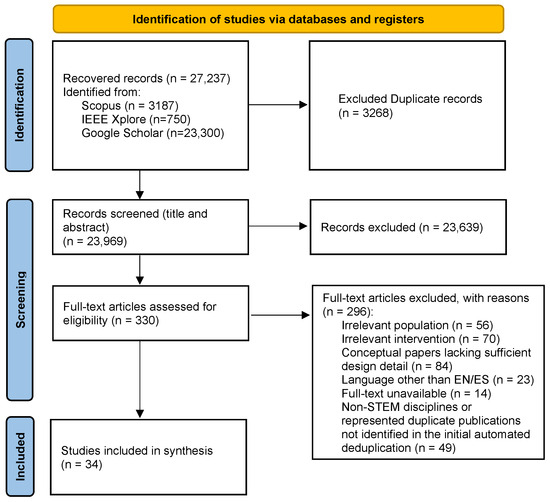
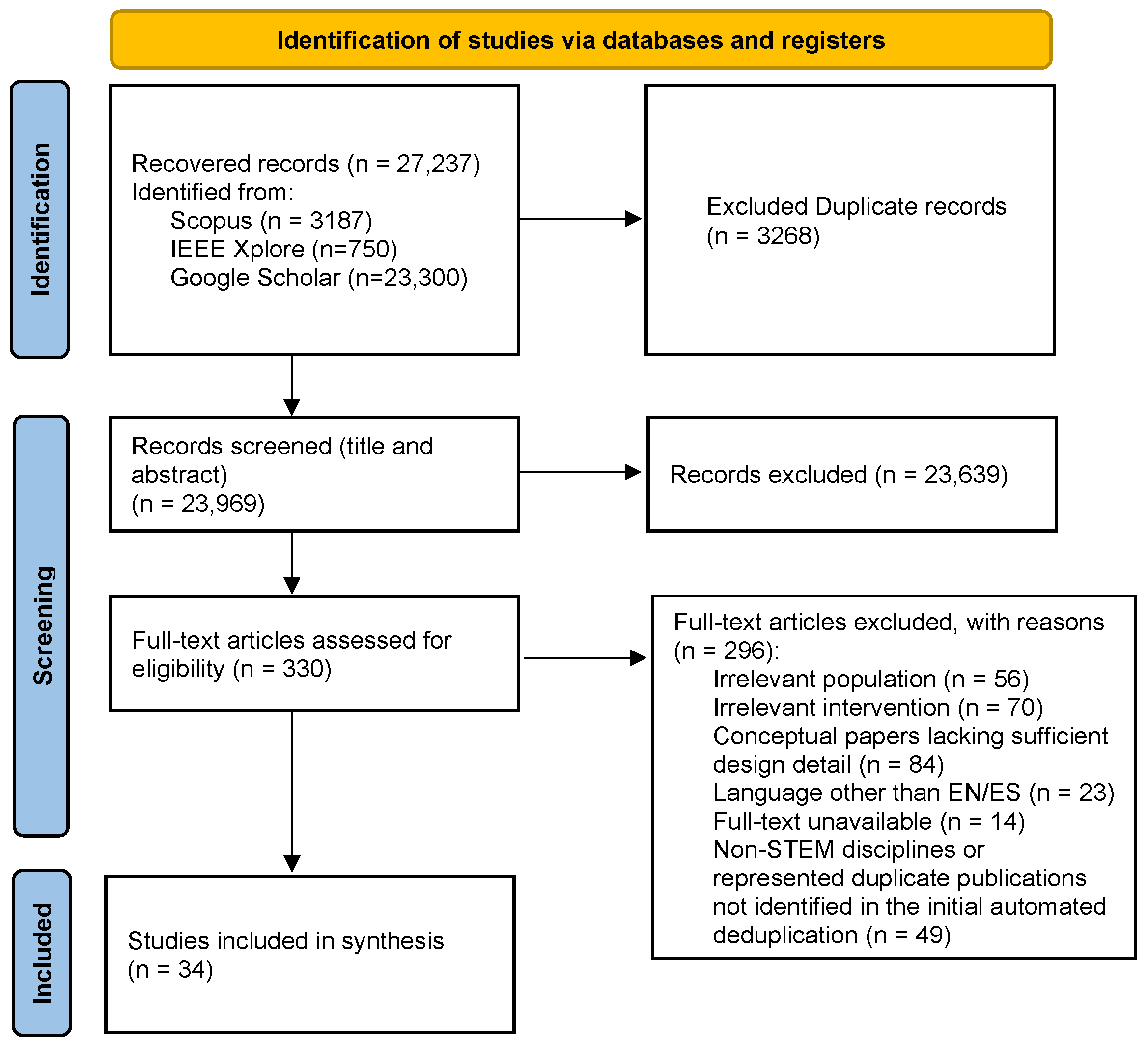

Disclaimer/Publisher’s Note: The statements, opinions and data contained in all publications are solely those of the individual author(s) and contributor(s) and not of MDPI and/or the editor(s). MDPI and/or the editor(s) disclaim responsibility for any injury to people or property resulting from any ideas, methods, instructions or products referred to in the content. |
© 2026 by the authors. Licensee MDPI, Basel, Switzerland. This article is an open access article distributed under the terms and conditions of the Creative Commons Attribution (CC BY) license.