


Abstract
The security of biometric data is a critical challenge in modern information security due to their uniqueness and non-revocability. Compromise of biometric characteristics leads to irreversible consequences; therefore, storing or transmitting them in plaintext is unacceptable. This paper addresses the confidentiality and integrity of fingerprint data using cryptographic protection methods. Considering the specific nature of biometrics, fingerprint features are used only to generate a cryptographic secret rather than being stored directly. To protect the derived secret, a modified threshold secret-sharing scheme based on non-positional polynomial notation and the Chinese Remainder Theorem is proposed. The method generates a cryptographic secret from fingerprint minutiae described by spatial coordinates and ridge orientation. Concatenating minutiae coordinates and converting them into binary form produces a unique value deterministically linked to a specific user. Compared to the classical Shamir scheme, the modified scheme reduces the computational complexity of secret reconstruction from O() to O(k log k), decreases data storage requirements by 30–40% through compact polynomial remainders, and increases successful secret reconstruction by 12–15% in the presence of noise in biometric samples. The results show that the proposed algorithm can be effectively applied in biometric authentication systems to protect personal data in distributed environments. Security analysis confirms resistance to major attack classes and demonstrates practical applicability in real-world systems.
1. Introduction
Modern authentication systems increasingly rely on biometric data such as fingerprints, iris patterns, voice, and behavioral characteristics, as they provide a higher level of reliability and usability compared to traditional passwords. At the same time, the widespread adoption of biometric technologies is accompanied by increased risks associated with data leakage, forgery, and unauthorized use of biometric information. Unlike passwords, biometric templates are immutable: once compromised, the original data cannot be restored, which makes the potential consequences of leakage particularly critical.
Modern information systems face threats arising at various stages of biometric data processing, including data acquisition, storage, and transmission. Even when cryptographic methods such as encryption are applied, the risk of data interception during transmission (man-in-the-middle attacks) or internal abuse of privileges on the server side remains. These circumstances highlight the need to develop protection methods that ensure both confidentiality and resistance to various types of attacks.
One promising approach to addressing these challenges is the use of cryptographic secret-sharing schemes, which allow confidential information to be divided into multiple parts, requiring a predefined number of shares to reconstruct the secret. Such an approach increases system resilience to the compromise of individual components and provides flexibility in access control management. The application of these methods in biometric systems is particularly relevant, as individual biometric features can be treated as parts of a unified secret, and the compromise of any single part should not jeopardize the security of the entire system.
Thus, given the continuous growth in the volume and diversity of biometric data, the threats of their compromise, and the impossibility of recovery after leakage, the scientific problem of developing reliable methods for protecting biometric information using cryptographic approaches is highly relevant. Therefore, research aimed at improving methods for the secure storage, transmission, and management of biometric data through the use of secret-sharing schemes is of significant interest to both the science and practice of information security.
2. Related Works
An analysis of recent studies indicates a sustained interest of the scientific community in the application of threshold secret-sharing schemes and related cryptographic methods for protecting biometric data. The theoretical foundations of this field were laid in the classical works of A. Shamir and G. Blakley, in which polynomial and geometric (k, n)-threshold secret-sharing schemes were first proposed, providing information-theoretic security when the number of available shares is below the threshold value [1,2]. These approaches have formed the basis of most modern methods for distributed storage and protection of confidential information.
In [3], threshold schemes are applied in authentication protocols with information-theoretic security, including individual biometric components. Despite the high level of theoretical security, the proposed solutions are primarily focused on the protocol level and do not address issues of integrity control for biometric shares or the robustness of secret reconstruction under distorted input data, which limits their practical applicability.
The survey paper [4] highlights the potential of combining cryptographic methods such as the Fuzzy Vault and secret sharing to enhance the confidentiality of biometric systems. However, this analysis is of a generalized nature and does not provide specific mechanisms for detecting share substitution or a formal assessment of error tolerance. Similar limitations are identified in [5], where distributed storage of biometric templates is implemented in a fragmented manner, without a detailed analysis of computational complexity and the reliability of secret reconstruction under partial data loss. In the review [6], modern privacy-preserving approaches, including distributed and threshold schemes, are systematized; however, issues related to the integration of integrity control mechanisms and error tolerance remain outside the scope of consideration.
Classical secret-sharing schemes in biometric systems are also analyzed in [7], where Shamir’s scheme is used to reconstruct a cryptographic key from biometric features. However, the security of this approach directly depends on the quality of the extracted features and does not take into account active attacks on secret shares. The method proposed in [8] provides fingerprint protection through visual secret sharing; however, it is inferior to traditional cryptographic approaches in terms of formal soundness and robustness to variations in biometric data. It lacks mechanisms for error tolerance and share integrity verification, which limits its practical applicability.
More advanced enhanced threshold secret-sharing schemes, in particular the scheme discussed in [9], which requires the mandatory participation of representatives of predefined subgroups, increase resistance to internal collusion and provide role-based access control. At the same time, the need for prior definition of subgroups, dependence on the honesty of the dealer, and the possible loss of secret availability in the absence of active participants reduce the flexibility of such schemes. In [10], a threshold scheme with a share verification mechanism is described, enabling the detection of share substitution or data corruption. However, its application to biometric templates characterized by variations and measurement errors is not considered; a formal analysis of error tolerance and the impact of input data distortions on the correctness of secret reconstruction is lacking. In addition, issues of computational efficiency and scalability in systems with a large number of users remain insufficiently studied.
Thus, the conducted literature analysis shows that, despite significant progress in the application of threshold secret-sharing schemes for protecting biometric data, unresolved issues remain regarding the simultaneous provision of robustness to variations in biometric features, share integrity control, error tolerance, and reliable secret reconstruction under partial data loss. These limitations define a relevant research problem focused on the development of modified secret-sharing schemes adapted to the specifics of biometric authentication and possessing formally justified security and robustness properties.
- Research objective and tasks
The objective of the study is to analyze and develop a secret-sharing scheme for use in biometric authentication that accounts for possible reconstruction errors, share integrity control, and the variability of biometric features.
- To achieve this objective, the following tasks are addressed:
- -
- Analysis of modern biometric authentication methods, including approaches based on threshold secret-sharing schemes.
- -
- Comparative review of existing biometric secret-sharing schemes, identifying their advantages, limitations, and unresolved issues.
- -
- Development of a modified secret-sharing algorithm based on NPN to improve robustness to distortions in biometric data.
- -
- Evaluation of the efficiency, reliability, and robustness of the proposed scheme in the context of biometric authentication, including error tolerance analysis and protection against share substitution.
3. Materials and Methods
The study employs a combined approach that integrates biometric image processing methods with cryptographic threshold secret-sharing algorithms.
At the biometric processing stage, an existing algorithm implemented using the Python 2025.1.1.1 programming language and the Pillow image processing library was used to extract and compare fingerprint minutiae. The algorithm performs preliminary fingerprint image binarization, simplified skeletonization of ridge patterns, and automatic detection of characteristic points—ridge endings and bifurcations—based on analysis of an 8-connected pixel neighborhood [11,12,13]. The output of this algorithm is a set of minutiae coordinates stored in a file format and used as input data in subsequent stages of biometric data protection.
The main scientific contribution of this work focuses on the development of a modified threshold secret-sharing algorithm. The obtained minutiae coordinates are converted into a binary representation, on the basis of which a cryptographic secret is formed using a CRC16 checksum, which is subsequently treated as the secret and divided into shares using the proposed algorithm.
Secret sharing is performed using polynomial arithmetic over the field GF(2) and the Chinese Remainder Theorem. To reconstruct the original cryptographic secret, a reconstruction method based on a threshold number of shares is developed, ensuring correct secret recovery when a predefined minimum number of parts is available.
4. Results
4.1. Application of a (k, n)-Threshold Scheme Based on NPN for the Proposed Algorithm
The main objective of the proposed algorithm is to implement the process of splitting a biometric fingerprint template into several independent shares in order to ensure its secure storage and enable subsequent reconstruction of the original data without loss of integrity and authenticity.
One effective solution for addressing this task is the use of a (k, n)-threshold secret-sharing scheme, in which the original template (e.g., a feature vector, a set of minutiae, or their hash representation) is divided into n parts such that reconstruction of the original secret is possible only when at least k (k ≤ n) shares are available. In this case, the compromise of individual system components does not allow an adversary to gain access to the user’s biometric data.
Unlike the classical Shamir scheme, this study employs a modified secret-sharing algorithm based on non-positional polynomial notation (NPN). The use of NPN makes it possible to enhance the cryptographic strength of the scheme, reduce the computational complexity of secret reconstruction, and improve the system’s resistance to unauthorized access.
The secret-sharing process, also referred to as a threshold scheme, is implemented using modular arithmetic and the Chinese Remainder Theorem. These mathematical tools provide reliable partitioning of the original secret into multiple fragments, with subsequent reconstruction possible only when a predefined number of trusted shares is available.
- Formal definition of a (k, n)-threshold secret-sharing scheme
Let there be a set of participants , , who jointly hold a secret . Secret sharing is performed using a -threshold scheme if the following conditions are satisfied:
- Each participant receives a unique secret share that is inaccessible to any other participant ();
- The secret can be uniquely reconstructed from any k distinct shares ;
- Knowledge of any or fewer shares does not reveal any information about the value of the original secret .
The set of polynomials satisfying the above conditions forms a -threshold secret-sharing scheme for . This scheme provides cryptographic security due to the mathematical properties of polynomials defined over a finite field, which guarantees the impossibility of secret reconstruction when fewer than shares are available.
A fingerprint is a unique biometric identifier widely used in modern authentication systems. However, its compromise is irreversible and critically dangerous: unlike a password, a biometric template cannot be changed. Therefore, ensuring the confidentiality and integrity of biometric data during storage and processing is one of the key challenges of modern information security.
To address this problem, the proposed algorithm employs a process for generating secret shares based on the principles of a (k, n)-threshold secret-sharing scheme, modified using non-positional polynomial notation (NPN).
4.2. Overall Architecture of the Algorithm
In the proposed approach, fingerprint minutiae coordinates are used to generate a cryptographic secret employed in a threshold secret-sharing scheme. The implementation of secret sharing and reconstruction is based on the Chinese Remainder Theorem and non-positional polynomial notation (NPN). The method is aimed at ensuring secure storage of biometric data and resistance to unauthorized access by distributing information among independent participants.
The proposed method implements a secret sharing and reconstruction process that includes the following main stages.
4.2.1. Formation of the Initial Secret
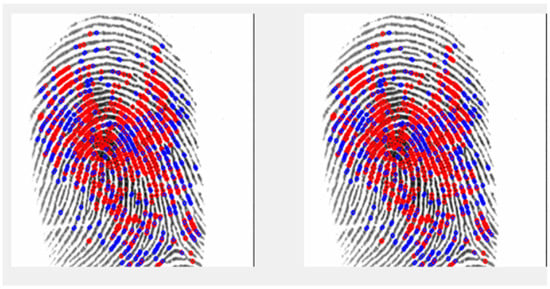
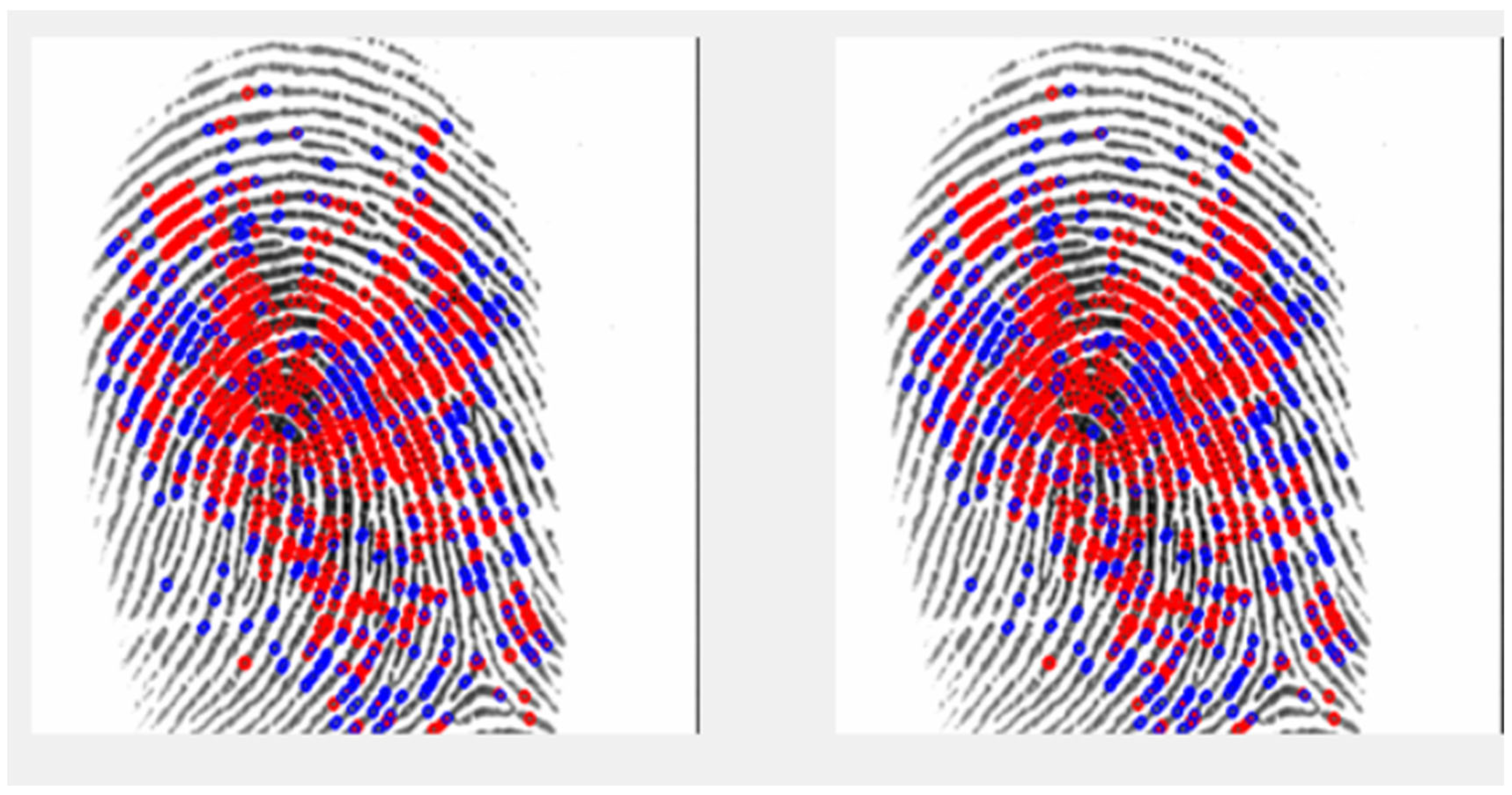
From the original fingerprint image obtained using an optical or capacitive sensor, feature detection and extraction (minutiae) are performed using established algorithms. Minutiae are characteristic points that describe local features of the papillary pattern. Each minutia is represented by a set of parameters including its spatial coordinates (x, y) and the ridge orientation at the corresponding point (Figure 1).
Figure 1.
Detection and extraction of fingerprint features (minutiae). The red dots denote extracted minutiae points, while the blue markers and lines correspond to the underlying papillary ridge structure of the fingerprint.
For subsequent cryptographic processing, the set of minutiae coordinates is represented as an ordered data sequence. Each minutia, defined by a pair of coordinates (x, y), is treated as an individual cryptographic secret and is converted into a binary form.
The resulting binary string serves as the basis for constructing the secret value S(x), which is then used in the secret-sharing process based on the Chinese Remainder Theorem. This approach ensures that the cryptographic secret is tightly bound to the unique biometric characteristics of a specific user, thereby eliminating the possibility of template forgery or substitution.
To enhance the reliability of data integrity control during secret formation, a hash-value computation mechanism is incorporated into the scheme. This mechanism makes it possible not only to detect data transmission errors but also to prevent simple data substitution attacks. The use of a hash value enables verification of the correctness of the binary representation of the secret prior to transmission through system modules and increases the overall resistance of the system to both accidental and intentional data distortions. Thus, the introduction of a hash function plays a crucial role in protecting information and maintaining its integrity at all stages of processing.
4.2.2. Construction of a Polynomial Function in NPN
The secret data are further represented as polynomials over the field GF(2), whose coefficients take values 0 or 1, and all arithmetic operations are performed modulo 2.
4.2.3. Share Generation and Secret Splitting
The share generation process is based on the use of NPN, which ensures data independence and redundancy. For each participant , the following value is computed:
where is the polynomial representation of the original secret, and are the working bases of NPN, which are irreducible polynomials over the field . The use of different working bases ensures that each share is formed independently of the others while preserving the mathematical integrity of the system.
4.2.4. Distribution of Shares Among Participants
The obtained values , where and , represent the secret shares distributed among the system participants. Each share is transmitted or stored in isolation, which ensures a high level of protection for confidential data. The participants may include various infrastructure components—databases, smart cards, distributed network nodes—as well as end users involved in the authentication process.
Since each share is stored separately, the holder of a single share cannot reconstruct the original secret, as it does not contain a sufficient amount of information. To recover the original secret, at least shares out of the total number are required.
This condition ensures the cryptographic strength of the sharing scheme, as well as the system’s resilience to unauthorized access and partial data compromise.
4.2.5. Secret Reconstruction and Authentication Process
After the successful generation and distribution of the secret shares, the reconstruction phase of the biometric secret is carried out in order to perform user authentication. This stage is executed only if at least k trusted shares are available, in accordance with the principle of the (k, n)-threshold scheme. From the distributed database or trusted modules, at least k shares required to reconstruct the original secret are retrieved. To reconstruct the original polynomial representing the encrypted secret , the following formula is used:
where are the stored remainders (shares), and are the corresponding working bases. Next, any k working bases are selected from the set .
Then:
- Their product is computed: P(x) =
- For each selected modulus , the following values are determined:
- , the multiplicative inverse of modulo , i.e., .
To reconstruct each block , any k of the n shares are selected, and the following formula, based on the Chinese Remainder Theorem, is applied:
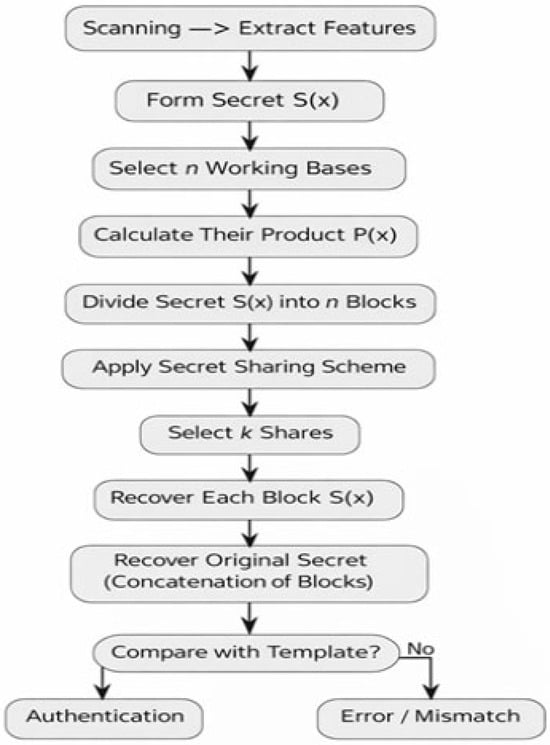
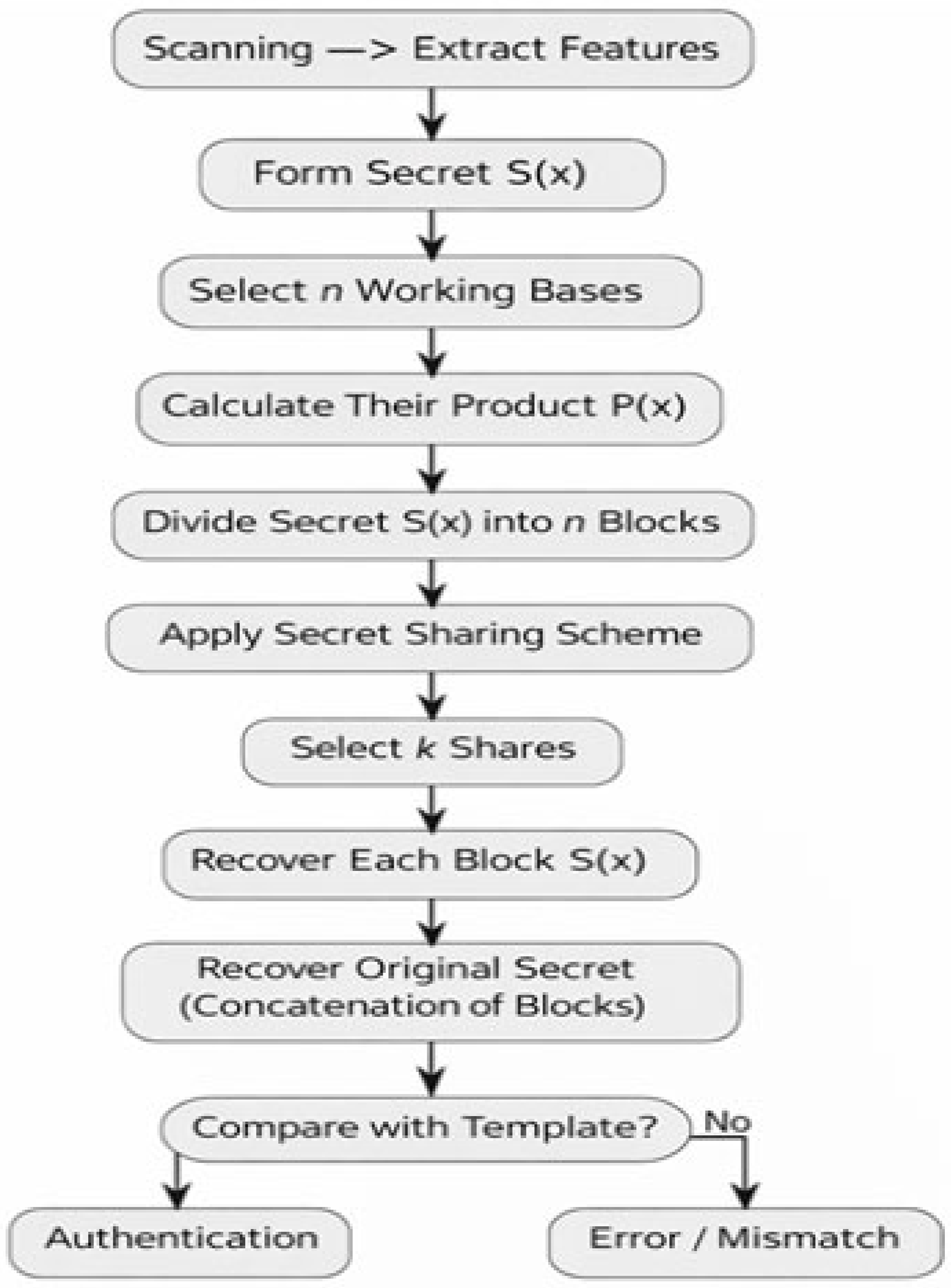
After all blocks have been successfully reconstructed, the original secret polynomial is formed by their sequential concatenation, which ensures the integrity and correctness of the recovered secret (Figure 2).
Figure 2.
Block diagram of the process of splitting and reconstructing a biometric template.
The reconstructed template is used for comparison with the reference sample stored in the system. The comparison is performed based on a set of features, including the relative positions of minutiae, ridge orientations, and the topological relationships between them. If the similarity between the reconstructed template and the reference exceeds a predefined matching threshold, access is granted to the user. Otherwise, authentication is denied.
In contrast to existing solutions, the proposed method:
- Separates the process into two independent stages—(i) extraction and matching of minutiae, and (ii) transformation of minutiae coordinates into elements of a cryptographic secret.
- Uses minutiae coordinates as mathematically stable features and ensures minimal data storage: large raw data, such as full coordinate sets or fingerprint images, do not need to be stored in their entirety. For integrity control, it is sufficient to store only a hash value and polynomial residues. As a result, the original information may remain in plaintext or be transmitted, while integrity verification is performed using a compact data set.
- Ensures reconstruction of the biometric template only when a threshold number of shares is available, thereby increasing the system’s resistance to compromise and forgery.
- Combines biometric and cryptographic layers of protection, preserving identification accuracy while ensuring the irreversibility of data reconstruction from individual shares.
Thus, the proposed authentication scheme is based on a modified secret-sharing algorithm using NPN, which provides an enhanced level of security for biometric data and optimizes computational operations during secret reconstruction in the biometric authentication process.
4.3. Threat Model and Security Assessment of the Proposed Scheme
- Types of threats
The proposed modified threshold scheme for sharing a biometric secret is exposed to several types of threats. First, external attacks on the storage and transmission of secret shares are possible, including data interception and man-in-the-middle attacks. Second, an internal threat arises in the case of malicious participants who possess one or more shares. In addition, there is a risk of substitution or modification of shares during storage or transmission, which may disrupt the secret reconstruction process and compromise the correctness of authentication.
4.3.1. Resistance to External Threats
The secret is stored and transmitted in the form of distributed shares, each of which is generated using threshold sharing based on the Chinese Remainder Theorem and non-positional polynomial notation (NPN). Even if one or several shares are intercepted, an adversary obtains no information about the coefficients of the original polynomial or the structure of the biometric secret, since reconstruction requires at least k out of n shares. This prevents the reconstruction of the biometric template based on partially available information.
4.3.2. Resistance to Internal Threats
Each share is stored as a pair , where are the working bases of the NPN and represent irreducible polynomials over the field GF(2). This format ensures one-way storage: a single share does not reveal the original secret. Up to participants cannot reconstruct the secret even through collusion, since combinations of shares below the threshold provide no advantage, and all possible reconstructions remain equiprobable.
Integrity control of the shares using a hash value prevents substitution and modification of data: invalid values are discarded at the reconstruction stage. This organization of share storage and verification provides a high level of protection against collusion among participants and internal attacks.
4.3.3. Protection Against Tampering and Transmission Errors
- Use of a hash value (CRC16)
Before computing the secret, the x and y coordinates are concatenated and converted into a binary representation. A CRC16 checksum (CCITT algorithm) is then computed over this sequence:
The CRC16 hash value performs a dual function: it enables the detection of random transmission errors, since any distortion of even a single data bit changes the CRC16 value, and at the same time prevents data tampering, because any intentional modification of the bit sequence makes the computed value inconsistent with the original one.
In the presented implementation, the CRC16 checksum is used exclusively for detecting transmission errors and verifying the integrity of the reconstructed data. It should be noted that this mechanism is not intended to provide cryptographic security.
The primary level of security in the proposed scheme is ensured by the threshold secret sharing mechanism. Without obtaining the required number of shares, reconstruction of the original secret becomes computationally infeasible. To increase the cryptographic strength in practical systems, the proposed scheme can be further enhanced by incorporating stronger cryptographic mechanisms, such as cryptographic hash functions (e.g., SHA-256). In addition, increasing the length of the binary secret can further improve the overall cryptographic robustness of the system.
- Polynomial remainders
Each 17-bit secret is treated as a polynomial over the field GF(2) and is divided by a set of predefined irreducible polynomials , yielding the corresponding polynomial remainders:
These remainders perform several functions:
- They provide an additional transformation that complicates data substitution without knowledge of the moduli.
- They enable the construction of a secret reconstruction scheme from multiple independent fragments.
- If at least one remainder is altered, the reconstruction process yields an incorrect result.
- Secret reconstruction and integrity verification
Secret reconstruction is performed using the Chinese Remainder Theorem over the field GF(2). Provided that the employed moduli are pairwise coprime, the reconstructed secret is uniquely determined by the set of obtained remainders. A violation of integrity or modification of at least one remainder results in a value different from the original secret. Subsequently, the reconstructed value is compared with the original secret . A mismatch between these values is interpreted as an indication of possible data tampering.
4.3.4. Evaluation of the Scheme Efficiency
The efficiency of the scheme was evaluated by modeling secret reconstruction from polynomial remainders and by verifying the CRC16 checksum. The results showed that:
- The secret is correctly reconstructed only when all remainders are valid.
- Any distortion of the input data or of individual remainders leads to a mismatch between the reconstructed secret and the original CRC16 value, demonstrating the scheme’s ability to detect errors and data tampering.
- Computation of the remainders, CRC16, and secret reconstruction is performed efficiently, confirming the practical applicability of the proposed scheme.
4.3.5. Probability of Guessing the Secret
To ensure cryptographic strength, the selected moduli must be pairwise coprime, and the degree of their product must be at least equal to the degree of the secret polynomial. When these conditions are satisfied, the remainders modulo the chosen polynomials do not reveal any bits of the secret value, and each possible secret corresponds to a unique set of remainders.
Thus, the entropy of the secret is preserved in full, and the space of possible values is maximized. The probability of randomly guessing the secret is given by
where L denotes the length of the secret.
As part of the conducted experiment, the original biometric data, after preliminary processing, were represented in binary form as 11110001001000000. To enhance cryptographic strength and eliminate possible correlations, a CRC16 checksum was applied, resulting in the binary sequence 1010010111110010. Based on these data, a cryptographic secret of length L = 17 bits was formed with a polynomial degree deg = 16: 11010010111110010. Thus, the entropy of the secret is preserved in full, and the probability of randomly guessing it is given by
which confirms the high level of security of the proposed scheme.
4.3.6. Analysis of the Probability of Successful Secret Reconstruction
Assume that each share is lost independently with probability . Let denote the number of preserved shares. Then follows a binomial distribution:
The probability of successful secret reconstruction is determined by the condition and is given by:
A similar formula is used in [14] when analyzing the reliability of secret-sharing schemes. This expression makes it possible to quantitatively evaluate the robustness of the scheme for different parameter values. Here, is the total number of shares, is the probability of losing a single share, and is the probability of correct preservation of a share; l may take any value in the range from 0 to 1. To illustrate the operation of the scheme, the value is often considered, corresponding to a symmetric scenario in which shares are lost and preserved with equal probability. The term denotes the binomial coefficient, i.e., the number of ways to choose i elements out of n.
Thus, the obtained formula makes it possible to analyze the probability of successful secret reconstruction as a function of the scheme parameters. In particular, for a fixed threshold increasing the number of shares improves the robustness of the scheme to losses, whereas an increase in the loss probability leads to a decrease in the probability of secret reconstruction (Table 1).
Table 1.
Effect of the number of shares n on the probability of secret reconstruction.
It can be seen from the table that, for a fixed threshold value , increasing the number of shares leads to an increase in the probability of successful secret reconstruction, whereas an increase in the share loss probability reduces the value of .
The values of the probability of successful secret reconstruction for various scheme configurations make it possible to assess the impact of the number of shares, the reconstruction threshold, and the share loss probability on the robustness of the system (Table 2).
Table 2.
Example calculations for different parameter values.
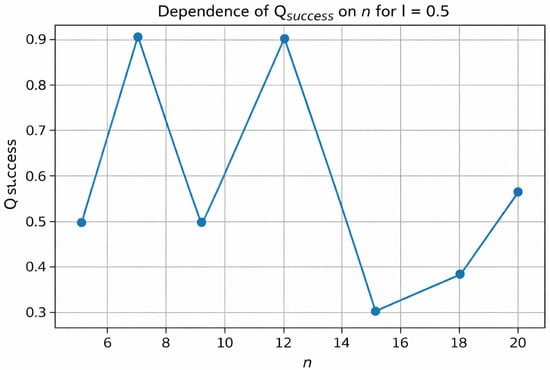
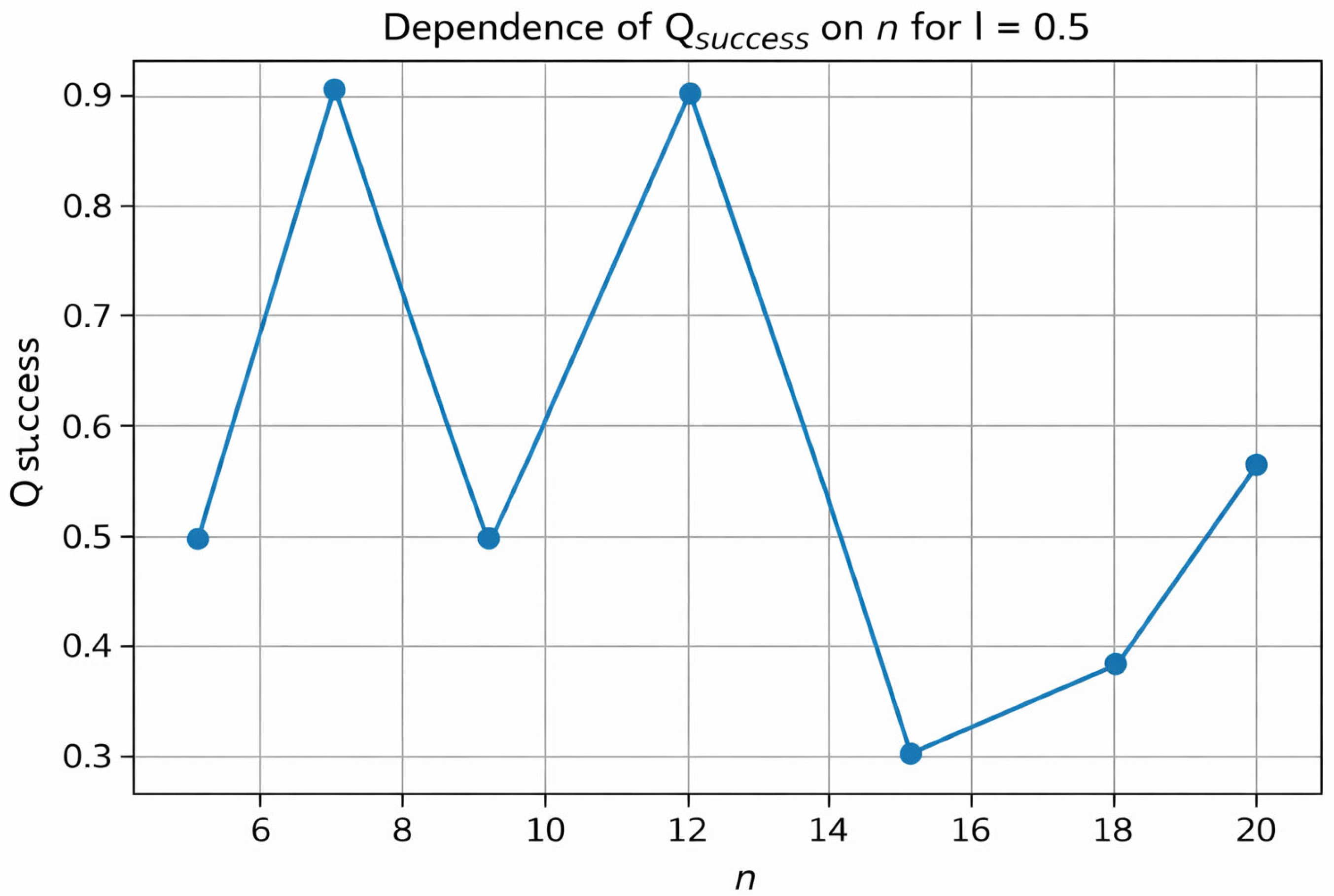
Figure 3 shows that, for fixed threshold values , the probability of successful secret reconstruction changes significantly as , increases, reaching a maximum at lower relative threshold values and decreasing as the threshold increases.
Figure 3.
Dependence of the probability of successful secret reconstruction on the number of shares for .
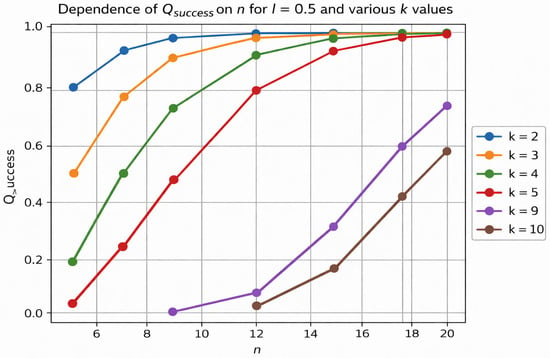
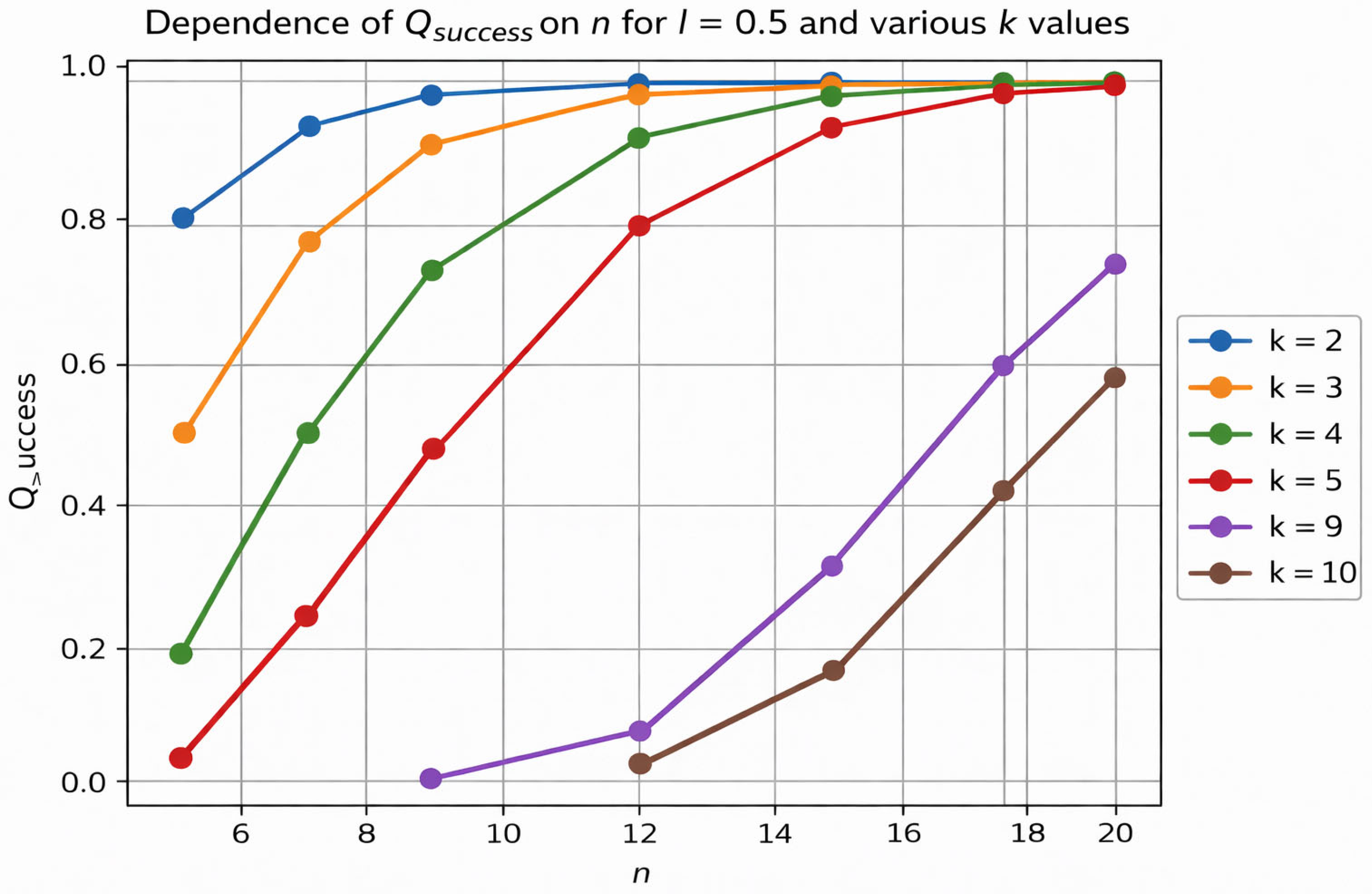
From the following table Table 3 and the graph Figure 4, it can be seen that the probability of successful secret reconstruction depends on both the number of shares and the threshold value . For small threshold values , stays close to 1 even when the number of shares n is relatively small, indicating high reliability of the scheme. Figure 4 clearly demonstrates how different values of affect the curves.
Table 3.
Values of the probability of successful secret reconstruction for l = 0.5 for differvalues of n and k.
Figure 4.
Values of the probability of successful secret reconstruction for l = 0.5 for different values of n and k.
Thus, the analysis shows that the probability of successful secret reconstruction significantly depends on the number of shares required for recovery and the probability of their loss. An increase in the number of lost shares noticeably reduces the reliability of the scheme. This emphasizes the importance of selecting optimal (n, k) parameters and ensuring secure storage for each share to maintain high resilience of the scheme.
4.4. Experimental Results
To evaluate the practical applicability of the proposed method, an experimental validation was performed using the FVC2002 (Fingerprint Verification Competition 2002) database, which is a widely accepted standard fingerprint dataset for assessing biometric systems. For each test instance, 8 genuine and 8 impostor fingerprints were used as reference samples. Standard performance metrics were calculated to assess the system, including FAR (False Acceptance Rate), FRR (False Rejection Rate), and EER (Equal Error Rate). The optimal decision threshold was chosen based on minimizing FAR and FRR errors (see Table 4).
Table 4.
Results of the experimental validation of the proposed method on the FVC2002 database.
The results indicate that the proposed system demonstrates high accuracy and reliability in recognition. An EER of 6.25% shows a strong ability to distinguish genuine fingerprints from impostors, and the optimal threshold of 50% minimizes the likelihood of FAR and FRR errors. Therefore, the experimental evaluation on the FVC2002 database confirms the practical applicability of the method. The average computational costs for processing a single secret are presented in Table 5.
Table 5.
Summary of Computational Costs. Experiments were conducted on a standard CPU platform with parameters m = 10, n = 5, k = 3.
The obtained results demonstrate the high efficiency of the proposed method and the negligible time required at all processing stages. Biometric data input requires on average 0.4809 ms, due to file reading and preprocessing operations. Secret generation is performed in 0.0022 ms and involves minimal computational effort thanks to the use of simple operations. CRC16 computation takes on average 0.004 ms, confirming the low overhead of integrity-check procedures. The secret splitting stage requires 0.0459 ms, while secret reconstruction takes 0.0914 ms, further demonstrating the efficiency of the employed algorithms. Overall, the total computational cost for processing a single secret remains extremely low, enabling the proposed method to be applied in real-time systems without significant computational constraints.
5. Discussion
The conducted study confirms that the proposed modified biometric authentication algorithm, utilizing NPN and Shamir’s secret sharing scheme, provides a high level of protection for biometric data. Representing minutiae as a coordinate-basec secret divided into independent shares minimizes the storage of original images and eliminates the possibility of reverse engineering the biometric template from one or several compromised shares. At the same time, reconstruction is only possible when a threshold number of shares is present, ensuring the mathematical irreversibility and cryptographic strength of the system.
A comparison with existing methods shows that the proposed algorithm offers several advantages: (1) the use of the Non-positional Notation (NPN) with working bases represented by irreducible polynomials over GF(2). This enables bitwise arithmetic operations and allows efficient parallelization of computations across the working bases, which reduces the computational cost of secret reconstruction; (2) the integration of the biometric feature extraction process directly with secret generation; (3) the presence of built-in integrity verification mechanisms capable of detecting share substitution; (4) the ability to maintain security when shares are stored in distributed environments. This approach makes it possible to represent binary biometric features in the form of polynomial structures and use them for the generation of local cryptographic secrets.
Thus, the proposed modification enables the integration of a user’s biometric characteristics into the mechanism of distributed storage of secret data. To clearly demonstrate the novelty and advantages of the proposed approach, Table 6 presents a comparative analysis with existing secret sharing schemes.
Table 6.
Comparison of the proposed NPN-based scheme with existing approaches.
Unlike the classical Shamir’s scheme [1] and visual secret sharing methods, it accounts for measurement errors and variations in biometric data, applies share integrity control, and remains resilient to both internal and external threats. The transition to bitwise arithmetic in GF(2) reduces computational overhead, making the method applicable to resource-constrained systems such as mobile devices, sensor networks, and IoT.
The practical significance of the algorithm lies in its potential for integration into distributed and cloud-based biometric authentication systems, where it is essential to simultaneously ensure data security, confidentiality, and integrity. Furthermore, this approach enhances user trust in biometric systems and reduces the risks of information compromise.
Among the limitations of the study, it should be noted that the experimental validation was conducted on a limited set of biometric data. To evaluate the scalability and efficiency of the algorithm in real-world conditions, testing on larger and more diverse datasets is required. Another promising direction is the adaptation of the scheme for other types of biometric features, as well as integration with distributed and cloud infrastructures to further enhance reliability and performance.
Thus, the proposed approach demonstrates a successful combination of cryptographic strength and consideration of biometric data characteristics, providing secure storage, transmission, and reconstruction of the biometric secret with high resilience to various types of attacks.
The proposed method can be integrated into modern biometric authentication systems where secure storage of user biometric templates is required. During registration, minutiae are extracted from a fingerprint image, and cryptographic secret shares are generated based on these features. These shares can be stored on multiple servers or in distributed storage, ensuring data decentralization.
During the authentication process, the system collects the required number of shares and reconstructs the secret. This approach enhances the security of biometric systems by protecting user templates from compromise and allows seamless integration with existing biometric feature processing pipelines. Additionally, the scheme demonstrates good scalability and robustness to biometric variability, making it suitable for real-world systems with large user bases.
- Practical deployment scenarios
The proposed scheme can be implemented in real biometric authentication systems through several deployment architectures:
- Cloud-based distributed storage: In this scenario, secret shares are distributed among multiple cloud providers or geographic regions. The authentication server retrieves the required threshold number of shares from different providers, reconstructs the biometric secret, and performs matching. This architecture provides resilience against compromise of any single cloud provider and complies with data sovereignty requirements.
- Edge computing deployment: For IoT and mobile applications, share generation can be performed directly on the user device, with subsequent distribution of shares to nearby edge nodes. This minimizes latency and reduces dependence on network connectivity. The computational efficiency of operations in GF(2) makes this feasible even on resource-constrained devices.
- Hybrid mobile authentication: In mobile banking or access control applications, one share may be stored on the user’s device (e.g., in a trusted execution environment), while additional shares are stored on secure servers. Authentication requires both the device share and server shares, providing two-factor security.
6. Conclusions
Modern biometric technologies are widely used due to their high accuracy, reliability, and ease of use. This article proposes and experimentally validates a modified biometric authentication algorithm based on threshold secret sharing using Non-positional Notation (NPN).
The proposed method ensures secure storage of biometric data: minutiae are stored as a coordinate secret divided into independent shares, none of which contain information about the original template. Reconstruction is possible only if a threshold number of shares is available, and cryptographic strength is ensured by the mathematical irreversibility of polynomial interpolation.
The reduction in computational complexity achieved by transitioning to GF(2) bitwise arithmetic enables the implementation of the algorithm in resource-constrained systems, including mobile devices, sensor networks, and IoT. The application of the proposed scheme enhances the security of biometric systems, reduces the risks of data breaches, and creates prospects for further expansion and integration into distributed infrastructures.
Author Contributions
Conceptualization, N.K. and S.N.; methodology, S.N.; software, S.B.; validation, S.B. and N.K.; formal analysis, N.K.; investigation, S.B.; resources, S.B.; data curation, S.B.; writing—original draft preparation, S.B.; writing—review and editing, N.K.; visualization, S.B.; supervision, S.N.; project administration, N.K.; funding acquisition, N.K. All authors have read and agreed to the published version of the manuscript.
Funding
This work was supported by the Grant financing project No. AP23487787 “Development of an algorithm for secure storage of biometric data of authentication systems in spatially distributed storages.”
Data Availability Statement
Data are contained within the article.
Acknowledgments
The authors are grateful to all lab members of “Information security laboratory” (Institute of Information and Computational Technologies) for their useful suggestions and support.
Conflicts of Interest
The authors declare no conflicts of interest.
References
- Shamir, A. How to share a secret. Commun. ACM 1979, 22, 612–613. [Google Scholar] [CrossRef] [Scilit]
- Blakley, G.R. Safeguarding cryptographic keys. In Proceedings of the National Computer Conference; IEEE: New York, NY, USA, 1979; pp. 313–317. [Google Scholar]
- Iwamura, K.; Kamal, A. Secure user authentication with information-theoretic security using secret sharing based secure computation. IEEE Access 2025, 13, 9015–9031. [Google Scholar] [CrossRef] [Scilit]
- Belhocine, Y.; Meraoumia, A.; Bendjenna, H.; Saigaa, M. Empowering biometric security: A paradigm shift in remote identification. Syst. Comput. 2025, 1, 44–67. [Google Scholar] [CrossRef] [Scilit]
- Patil, S.D.; Raut, R.; Jhaveri, R.H.; Ahanger, T.A.; Dhade, P.V.; Kathole, A.B.; Vhatkar, K.N. Robust authentication system with privacy preservation of biometrics. Secur. Commun. Netw. 2022, 2022, 7857975. [Google Scholar] [CrossRef] [Scilit]
- Melzi, P.; Rathgeb, C.; Tolosana, R.; Vera-Rodriguez, R.; Busch, C. An overview of privacy-enhancing technologies in biometric recognition. ACM Comput. Surv. 2024, 56, 1–28. [Google Scholar] [CrossRef] [Scilit]
- Lai, Y.-L.; Hwang, J.-Y.; Jin, Z.; Kim, S.; Cho, S.; Teoh, A.B.J. Symmetric keyring encryption scheme for biometric cryptosystem. Inf. Sci. 2019, 502, 492–509. [Google Scholar] [CrossRef] [Scilit]
- Ajnas, M.; Roshan, P.A. A secure fingerprint template generation mechanism using visual secret sharing with inverse halftoning. J. Vis. Commun. Image Represent. 2022, 94, 103854. [Google Scholar] [CrossRef] [Scilit]
- Kapalova, N.; Dyusenbayev, D.; Khompysh, A.; Algazy, K. Design of a secret sharing scheme with mandatory subgroup participation. Appl. Sci. 2025, 15, 9550. [Google Scholar] [CrossRef] [Scilit]
- Kapalova, N.; Haumen, A.; Algazy, K. Secret sharing scheme with share verification capability. Computers 2025, 14, 393. [Google Scholar] [CrossRef] [Scilit]
- Zhang, T.Y.; Suen, C.Y. A fast parallel algorithm for thinning digital patterns. Commun. ACM 1984, 27, 236–239. [Google Scholar] [CrossRef] [Scilit]
- Maltoni, D.; Maio, D.; Jain, A.K.; Prabhakar, S. Handbook of Fingerprint Recognition, 2nd ed.; Springer: New York, NY, USA, 2009. [Google Scholar]
- Jain, A.K. Fundamentals of Digital Image Processing; Prentice Hall: Englewood Cliffs, NJ, USA, 1989. [Google Scholar]
- Ali, S.; Wang, J.; Leung, V.C.M.; Ali, A. Decentralized ransomware recovery network: Enhancing resilience and security through secret sharing schemes. In Proceedings of the 9th International Conference on Internet of Things, Big Data and Security (IoTBDS), Angers, France, 28–30 April 2024; SciTePress: Setúbal, Portugal, 2024; pp. 294–301. [Google Scholar] [CrossRef] [Scilit]

Disclaimer/Publisher’s Note: The statements, opinions and data contained in all publications are solely those of the individual author(s) and contributor(s) and not of MDPI and/or the editor(s). MDPI and/or the editor(s) disclaim responsibility for any injury to people or property resulting from any ideas, methods, instructions or products referred to in the content. |
© 2026 by the authors. Licensee MDPI, Basel, Switzerland. This article is an open access article distributed under the terms and conditions of the Creative Commons Attribution (CC BY) license.