

You are currently on the new version of our website. Access the old version .

Cancers, Volume 10, Issue 12

2018 December - 65 articles

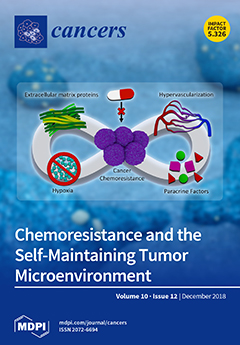
Cover Story: The resistance of cancer cells to commonly used therapeutics is a key clinical challenge. The behaviour of cancer cells is influenced by their environment, which evolves along with tumor progression. Chemoresistance can be stimulated by elements of the tumor microenvironment, including extracellular matrix proteins, hypervascularization, hypoxia, and paracrine factors. This environment is generated by cancer cells and other associated cells, and is notable for its self-maintenance behaviour, which exacerbates tumor development. Through a network of interactions, environmental cues promote cancer cell proliferation and the epithelial–mesenchymal transition, and affect drug availability, leading to a chemoresistant phenotype. This review discusses the self-perpetuating tumor microenvironment and its effects on chemoresistance. View this paper
  • Issues are regarded as officially published after their release is announced to the table of contents alert mailing list .
  • You may sign up for email alerts to receive table of contents of newly released issues.
  • PDF is the official format for papers published in both, html and pdf forms. To view the papers in pdf format, click on the "PDF Full-text" link, and use the free Adobe Reader to open them.

Articles (65)

  • Feature Paper
  • Review
  • Open Access
85 Citations
15,870 Views
15 Pages

19 December 2018

Women who inherit a deleterious BRCA1 or BRCA2 mutation face substantially increased risks of developing breast cancer, which is estimated at 70%. Although annual screening with magnetic resonance imaging (MRI) and mammography promotes the earlier de...

  • Article
  • Open Access
46 Citations
7,149 Views
19 Pages

CBP/β-Catenin/FOXM1 Is a Novel Therapeutic Target in Triple Negative Breast Cancer

  • Alexander Ring,
  • Cu Nguyen,
  • Goar Smbatyan,
  • Debu Tripathy,
  • Min Yu,
  • Michael Press,
  • Michael Kahn and
  • Julie E. Lang

19 December 2018

Background: Triple negative breast cancers (TNBCs) are an aggressive BC subtype, characterized by high rates of drug resistance and a high proportion of cancer stem cells (CSC). CSCs are thought to be responsible for tumor initiation and drug resista...

  • Article
  • Open Access
20 Citations
5,760 Views
18 Pages

Ponatinib Inhibits Multiple Signaling Pathways Involved in STAT3 Signaling and Attenuates Colorectal Tumor Growth

  • Fiona H. Tan,
  • Tracy L. Putoczki,
  • Jieqiong Lou,
  • Elizabeth Hinde,
  • Frédéric Hollande,
  • Julie Giraud,
  • Stanley S. Stylli,
  • Lucia Paradiso,
  • Hong-Jian Zhu and
  • Rodney B. Luwor
  • + 1 author

19 December 2018

Signal transducer and activator of transcription 3 (STAT3) signaling is a major driver of colorectal cancer (CRC) growth, however therapeutics, which can effectively target this pathway, have so far remained elusive. Here, we performed an extensive s...

  • Article
  • Open Access
48 Citations
6,254 Views
13 Pages

Frequency of Circulating Tumor Cells (CTC) in Patients with Brain Metastases: Implications as a Risk Assessment Marker in Oligo-Metastatic Disease

  • Annkathrin Hanssen,
  • Carlotta Riebensahm,
  • Malte Mohme,
  • Simon A. Joosse,
  • Janna-Lisa Velthaus,
  • Lars Arne Berger,
  • Christian Bernreuther,
  • Markus Glatzel,
  • Sonja Loges and
  • Harriet Wikman
  • + 4 authors

19 December 2018

Forty percent of non-small cell lung cancer (NSCLC) patients develop brain metastases, resulting in a dismal prognosis. However, patients in an oligo-metastatic brain disease setting seem to have better outcomes. Here, we investigate the possibility...

  • Review
  • Open Access
69 Citations
7,487 Views
16 Pages

NK Cell-Based Glioblastoma Immunotherapy

  • Irene Golán,
  • Laura Rodríguez de la Fuente and
  • Jose A. Costoya

18 December 2018

Glioblastoma (GB) is the most aggressive and most common malignant primary brain tumor diagnosed in adults. GB shows a poor prognosis and, unfortunately, current therapies are unable to improve its clinical outcome, imposing the need for innovative t...

  • Review
  • Open Access
17 Citations
9,490 Views
20 Pages

18 December 2018

The worldwide prevalence of obesity has doubled during the last 50 years, and according to the World Obesity Federation, one third of the people on Earth will be obese by the year 2025. Obesity is described as a chronic, relapsing and multifactorial...

  • Article
  • Open Access
33 Citations
7,775 Views
15 Pages

EphA3 Pay-Loaded Antibody Therapeutics for the Treatment of Glioblastoma

  • Carolin Offenhäuser,
  • Fares Al-Ejeh,
  • Simon Puttick,
  • Kathleen S. Ensbey,
  • Zara C. Bruce,
  • Paul R. Jamieson,
  • Fiona M. Smith,
  • Brett W. Stringer,
  • Benjamin Carrington and
  • Bryan W. Day
  • + 6 authors

17 December 2018

The EphA3 receptor has recently emerged as a functional tumour-specific therapeutic target in glioblastoma (GBM). EphA3 is significantly elevated in recurrent disease, is most highly expressed on glioma stem cells (GSCs), and has a functional role in...

  • Article
  • Open Access
34 Citations
8,159 Views
42 Pages

17 December 2018

Liver-specific knockout of Nrf1 in the mouse leads to spontaneous development of non- alcoholic steatohepatitis with dyslipidemia, and then its deterioration results in hepatoma, but the underlying mechanism remains elusive to date. A similar patholo...

  • Article
  • Open Access
9 Citations
4,693 Views
19 Pages

The Human Papillomavirus (HPV) E6 Oncoprotein Regulates CD40 Expression via the AT-Hook Transcription Factor AKNA

  • Joaquin Manzo-Merino,
  • Alfredo Lagunas-Martínez,
  • Carla O. Contreras-Ochoa,
  • Marcela Lizano,
  • Leonardo J. Castro-Muñoz,
  • Crysele Calderón-Corona,
  • Kirvis Torres-Poveda,
  • Alicia Román-Gonzalez,
  • Rogelio Hernández-Pando and
  • Vicente Madrid-Marina
  • + 1 author

17 December 2018

Persistent infection with high-risk Human Papillomavirus (HR-HPV) is the main requisite for cervical cancer development. Normally, HPV is limited to the site of infection and regulates a plethora of cellular elements to avoid the immune surveillance...

  • Article
  • Open Access
5 Citations
5,792 Views
15 Pages

In Silico Approach for Immunohistochemical Evaluation of a Cytoplasmic Marker in Breast Cancer

  • Claudia Mazo,
  • Estibaliz Orue-Etxebarria,
  • Ignacio Zabalza,
  • Maria d. M. Vivanco,
  • Robert M. Kypta and
  • Andoni Beristain

15 December 2018

Breast cancer is the most frequently diagnosed cancer in women and the second most common cancer overall, with nearly 1.7 million new cases worldwide every year. Breast cancer patients need accurate tools for early diagnosis and to improve tr...

of 7

Get Alerted

Add your email address to receive forthcoming issues of this journal.

XFacebookLinkedIn
Cancers - ISSN 2072-6694