


Abstract
BaTiO3-based ceramics are regarded as one of the promising lead-free alternatives to PZT-based ceramics, and their property enhancement remains one of the most important research directions. This study presents Ba0.96Ca0.04Ti1−xHfxO3-5BT (x = 0.05, 0.07, 0.08, 0.09, 0.10) ceramics with enhanced piezoelectric properties using a crystallographic texture strategy. Highly textured Ba0.96Ca0.04Ti1−xHfxO3-5BT ceramics were successfully prepared by the templated grain growth method, and the effects of Hf content in matrix on the phase structure, morphology, and properties of the textured ceramics were investigated. The textured Ba0.96Ca0.04Ti0.93Hf0.07O3-5BT samples achieved a piezoelectric coefficient d33 of 580 pC/N, an electromechanical coupling factor kt of 0.62, and a high unipolar normalized strain Smax/Emax of 1390 pm/V (measured at 10 kV/cm), together with a strain hysteresis Hs as low as 3.7% under 30 kV/cm, demonstrating excellent piezoelectric properties and favorable strain hysteresis. The excellent comprehensive performance can be attributed to the high-quality preferred orientation and the orthorhombic and tetragonal phase coexistence. Moreover, the multilayer textured Ba0.96Ca0.04Ti0.93Hf0.07O3-5BT ceramics were fabricated by internal electrode co-firing method. The multilayer samples with 10 layers produced a displacement of 581 nm under a driving voltage of 250 V. This study demonstrates that textured BCTH-5BT ceramics can serve as promising eco-friendly lead-free candidates for potential piezoelectric actuation applications.
1. Introduction
Piezoelectric actuators, as important devices capable of directly converting electrical energy into precise mechanical displacement, play a critical role in advanced fields such as precision positioning, adaptive optics, and micro/nano manipulation, owing to their fast response, high displacement resolution, large output force, compact size, and immunity to electromagnetic interference [1,2,3]. As modern manufacturing technology advances toward higher precision, greater integration, and increased intelligence, increasingly stringent demands are being placed on the displacement magnitude, driving force, and service reliability of piezoelectric actuators [4,5,6]. As the core of such devices, piezoelectric materials directly determine the displacement output capability through their piezoelectric coefficient and electromechanical coupling factor, while strain hysteresis, temperature stability, and fatigue behavior govern the precision and service lifetime of the device under real operating conditions. For decades, lead-based piezoelectric ceramics, exemplified by the lead zirconate titanate (PZT) system, have dominated the market owing to their superior overall piezoelectric performance. However, the severe threats posed by lead to human health and the ecological environment during material preparation, device utilization, and eventual disposal have driven the worldwide development of lead-free piezoelectric materials to the forefront of both academic and industrial research [7,8,9,10]. Consequently, the development of lead-free materials that combine high piezoelectric property, electromechanical coupling property, favorable strain hysteresis, and environmental friendliness has shown promising prospects for actuator devices.
Among the various lead-free piezoelectric systems, BaTiO3 (BT)-based ceramics are considered highly promising alternatives for substituting lead-based materials, due to their excellent piezoelectric performance, robust ferroelectric stability, and well-established fabrication techniques [11,12,13,14,15]. Crystallographic texturing of polycrystalline ceramics provides an effective strategy for achieving significant piezoelectric response enhancements [16,17]. Unlike traditional composition modification, crystallographic texture does not result in a substantial decrease in the Curie temperature. This characteristic enables piezoelectric ceramics to exhibit high piezoelectric response while avoiding a substantial reduction in the operating temperature range, thereby rendering the material promising for actuator applications [18,19,20,21,22]. Many studies have demonstrated that highly textured BT-based ceramics exhibit significantly enhanced piezoelectric and electromechanical coupling properties [20,22,23,24], while maintaining the cost-effectiveness and scalability advantages characteristic of polycrystalline ceramics. The textured (Ba0.968Ca0.032)(Ti0.96Sn0.005Hf0.035)O3 ceramics with a d33 of 353 pC/N were fabricated under the reducing atmosphere, and output characteristics of a cylindrical rotary linear piezoelectric motor were investigated [23]. Nonetheless, the overall piezoelectric properties remain significantly inferior to those exhibited by lead-based ceramics.
Multilayer piezoelectric actuators are typically composed of multiple piezoelectric material layers bonded layer-by-layer. Compared with bulk ceramics, multilayer piezoelectric ceramics can greatly reduce the driving voltage, which makes them highly suitable for device miniaturization and integration [25]. To further optimize the comprehensive performance of multilayer ceramics, including output displacement, strain hysteresis, and temperature stability, many studies on textured multilayer ceramics have been conducted in recent years [26,27,28,29,30]. These studies adopt crystallographic texturing strategy to enhance the intrinsic piezoelectric response of the ceramic layers, and realize multilayer structures via the internal electrode co-firing method, ultimately obtaining textured multilayer ceramics with superior comprehensive output performance. Notably, the [001]c-oriented (Ba0.95Ca0.05)(Ti0.94Zr0.055Sn0.005)O3 (BCTZS) multilayer ceramics with a texture degree of ~95% were fabricated [29]. The textured BCTZS MLAs had a displacement of 196 nm at 200 V (~2.4 times that of randomly oriented ones), and achieved low strain hysteresis. This work demonstrates the development potential of textured multilayer BT-based ceramics. However, there remain considerable improvements to be made in their microstructure (especially the electrode flatness and continuity) and the associated output performance.
From this perspective, a series of textured Ba0.96Ca0.04Ti1−xHfxO3-5BT ceramics (x = 0.05, 0.07, 0.08, 0.09, 0.10) with different Hf contents were designed and prepared through template grain growth method. The selection of compositions was inspired by randomly oriented ceramics of same A/B-site co-substitution system [14,31,32], and a series of matrix compositions located at the phase boundary at room temperature were identified. The phase structure, microstructural features, as well as the dielectric, piezoelectric and electromechanical coupling properties of the samples were systematically characterized. Focusing on the composition exhibiting the optimal overall piezoelectric performance, multilayer textured Ba0.96Ca0.04Ti0.93Hf0.07O3-5BT ceramics with 6 and 10 layers were subsequently fabricated. Their important characterization, including microstructure, co-firing matching behavior, and output performance were investigated. Furthermore, the voltage-dependent displacement of textured ceramics with different layer numbers were further compared. These investigations are of significance for the development of high-performance lead-free ceramics and advancing their practical progress.
2. Materials and Methods
Highly textured Ba0.96Ca0.04Ti1−xHfxO3-5BT piezoelectric ceramics (x = 0.05, 0.07, 0.08, 0.09, 0.10) were fabricated via the template grain growth (TGG) method. The BT templates with platelet-like morphology were synthesized using the topochemical microcrystal conversion method. The template possesses favorable plate-shaped morphology and excellent dispersion. The Ba0.96Ca0.04Ti1−xHfxO3 matrix (x = 0.05, 0.07, 0.08, 0.09, 0.10) was synthesized by the solid-state reaction method, and the specifications of raw materials used are BaCO3 (AR, Aladdin), CaCO3 (AR, Aladdin), TiO2 (AR, Aladdin) and HfO2 (99.9%, Aladdin). All raw materials were weighed according to the stoichiometric ratio, ball-milled for 24 h and then dried. The mixed raw powder was calcined at 1150 °C for 2 h to obtain the matrix powder, followed by secondary ball-milling for 48 h.
The slurry consists of a mixture of Ba0.96Ca0.04Ti1−xHfxO3 powders and Li2CO3 (0.75 mol.% relative to the matrix) as additive (total 19.8 vol.%), ethanol and xylene (70.0 vol.%) as the mixed solvent, blown Menhaden fish oil (2.5 vol.%) as the dispersant, polyvinyl butyral (4.0 vol.%) as the binder, and polyalkylene glycol (1.9 vol.%) and butyl benzyl phthalate (1.8 vol.%) as a mixed plasticizer. The Li2CO3 was used as a sintering assistant to promote oriented BCTH grain growth, enabling the achievement of a high texture degree at a relatively low sintering temperature. After thorough mixing by ball milling for 24 h, the BT templates (5 vol.% relative to the BCTH matrix) were added into the mixed slurry, followed by a further ball-milled process at a reduced rotation speed for 1 h. The tape-casting slurry was subjected to defoaming and viscosity adjustment before tape-casting. The tape-casting speed was set to 30 cm/min with the doctor-blade height of 200 μm. The lamination process was carried out at 75 °C under a pressure of 20 MPa, for a holding time of 20 min. Multilayer textured ceramics with internal electrodes were fabricated by the co-firing method. To ensure structural and chemical stability of electrodes under the relatively high sintering temperature of the BCTH-5BT system, Pt electrode was selected as the electrode material owing to its superior high-temperature stability. Pt electrode paste was screen-printed onto the dried green tapes, followed by lamination and hot-pressing. All green samples were heated to 600 °C and held for 2 h to remove the binder. Finally, all samples were sintered at 1400 °C for 4 h under air atmosphere.
Phase composition and texture degree were analyzed by X-ray diffraction (XRD), and the Lotgering factor was calculated to evaluate crystallographic texture. XRD Rietveld refinements were performed using GSAS-II. The background was fitted with a Chebyshev polynomial function, and diffraction peak profiles were modeled by pseudo-Voigt functions. The scale factor, background coefficients, and lattice parameters were refined sequentially, while isotropic atomic displacement parameters were constrained. Field-emission scanning electron microscopy (Helios NanoLab 600i, FEI, anjielun, Lexington, KY, USA) was utilized to observe sample microstructures, and electron backscatter diffraction (EBSD) measurements were carried out on the SEM system fitted with a detector. Sintered samples were ground and cleaned, followed by silver paste coating and thermal treatment for external electrodes. The poling electric field was applied parallel to the [001]C direction of the textured ceramics along the thickness direction. Poling treatment was conducted in silicone oil. Both bulk ceramics and multilayer samples were poled under an electric field of 5–7 kV/mm with holding time of 15 min. The temperature-dependent dielectric permittivity and dielectric loss were measured at different frequencies (500 Hz, 1 kHz, 10 kHz, and 100 kHz) in the temperature range of −50 to 150 °C using a precision LCR meter (E4980A, Agilent, Santa Clara, CA, USA). The piezoelectric coefficient d33 was measured by a quasi-static piezoelectric coefficient testing meter (ZJ-4A, Institute of Acoustics, Beijing, China). The electrical impedance spectrum of each poled ceramic was recorded using a precision LCR meter (E4980A, Agilent, Santa Clara, CA, USA). The thickness-mode electromechanical coupling factor kt was calculated as
where fr and fa are the resonance and antiresonance frequencies, identified from the impedance spectrum, respectively. The electric field-induced strain (S-E) curves were measured using a ferroelectric testing system (Premier II, Radiant Technologies, Albuquerque, NM, USA). The longitudinal displacement was detected by a laser Doppler vibrometer based on optical interferometry, with a displacement resolution of 0.03 nm. All electrical property parameters were statistically obtained from measurements of 5–6 samples. Mean values and standard deviations are calculated to reflect the measurement scatter across the tested samples.
3. Results and Discussion
3.1. Phase Structure and Microscopic Morphology
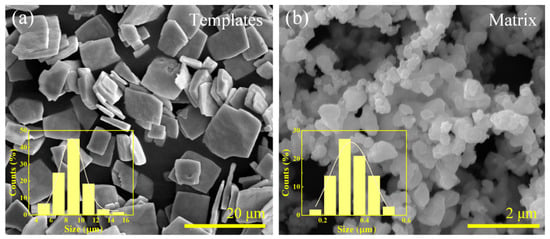
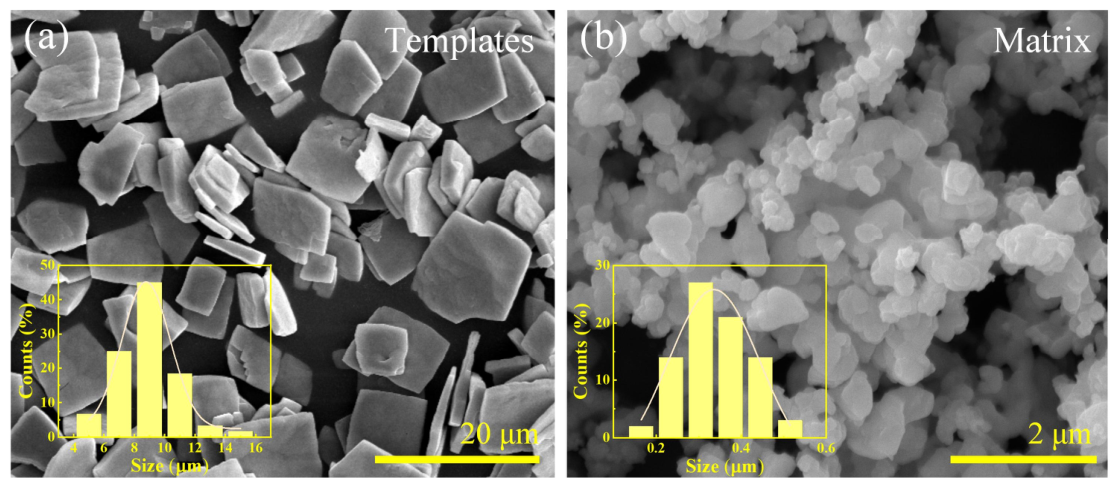
Figure 1 presents the SEM micrographs of BT template microparticles and prepared Ba0.96Ca0.04Ti0.93Hf0.07O3 matrix powder. The BT template particles exhibit a well-developed plate-like morphology with high aspect ratio of 6–8, which is important for inducing the oriented growth of the BCTH matrix to develop into crystallographically textured grains during the TGG route. The inset shows the particle-size distribution histogram of template particles, from which the average size is 8–12 μm. Furthermore, the matrix powder consists of isotropic equiaxed particles with a relatively uniform size of 0.3 μm. The significant size difference between large plate-shaped templates and fine matrix powder facilitates the epitaxial growth of matrix grains along the template during sintering, which is favorable for achieving a high degree of texture.
Figure 1.
SEM micrographs of (a) BT templates and (b) Ba0.96Ca0.04Ti0.93Hf0.07O3 matrix with inset histograms showing the particle size distribution.
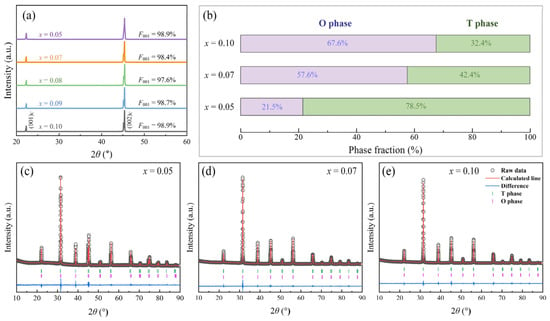
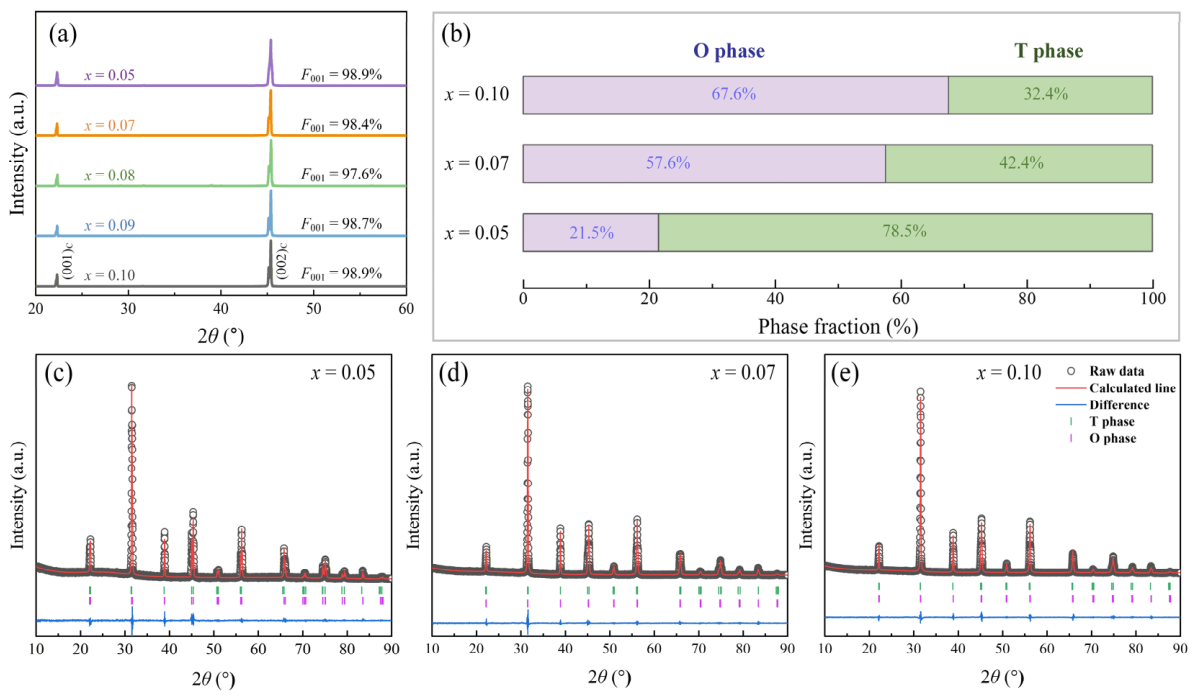
Figure 2 illustrates the XRD patterns of textured Ba0.96Ca0.04Ti1−xHfxO3-5BT ceramics, with the calculated texture degree of F001 marked. The F001 was determined using the Lotgering factor method, which relies on the relative intensities of the diffraction peaks. In the XRD patterns of all textured samples, only the (001)C and (002)C peaks can be observed, while the intensities of other diffraction peaks are markedly diminished. All samples exhibited a F001 exceeding 97.6%, indicating a highly developed [001]C crystallographic texture. To further obtain detailed phase structure information, the textured ceramic samples were ground into powder for XRD measurement (Figure 2c–e), followed by Rietveld refinement. The measured diffraction profiles match well with the calculated curves, and the difference curves remain flat, confirming the reliability of refinement results. The refinement verifies that all samples consist of coexisting orthorhombic (O), tetragonal (T) and phases. As the Hf content x increases, the phase fraction evolves significantly. As illustrated in Figure 2b, for samples with x = 0.05, the textured ceramic predominantly consists of the tetragonal phase, accounting for 78.5%, with the orthorhombic phase comprising 21.5%. As the value of x increases, the weight fraction of the orthorhombic phase progressively increases, while that of the tetragonal phase correspondingly decreases. At x = 0.07, the orthorhombic phase becomes the predominant phase, representing 57.6%, compared to 42.4%. The fraction of the orthorhombic phase in the textured samples rises continuously as Hf content further increases. Lattice parameters derived from the Rietveld refinement of XRD patterns indicate that the textured ceramics exhibit a coexistence of orthorhombic and tetragonal phases at room temperature. The corresponding specific lattice parameters are listed in Table 1.
Figure 2.
(a) XRD patterns of textured Ba0.96Ca0.04Ti1−xHfxO3-5BT ceramics with different Hf contents (x = 0.05, 0.07, 0.08, 0.09, 0.10), (b) the fractions of orthorhombic (O) and tetragonal (T) phases quantified by Rietveld refinement, (c–e) Rietveld-refined XRD patterns of ground powder from the textured samples.
Table 1.
Lattice parameters derived from the Rietveld refinement of XRD patterns.
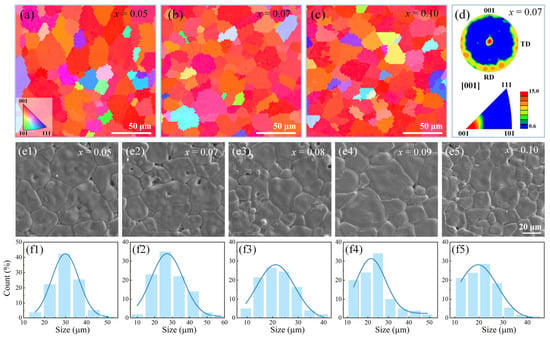
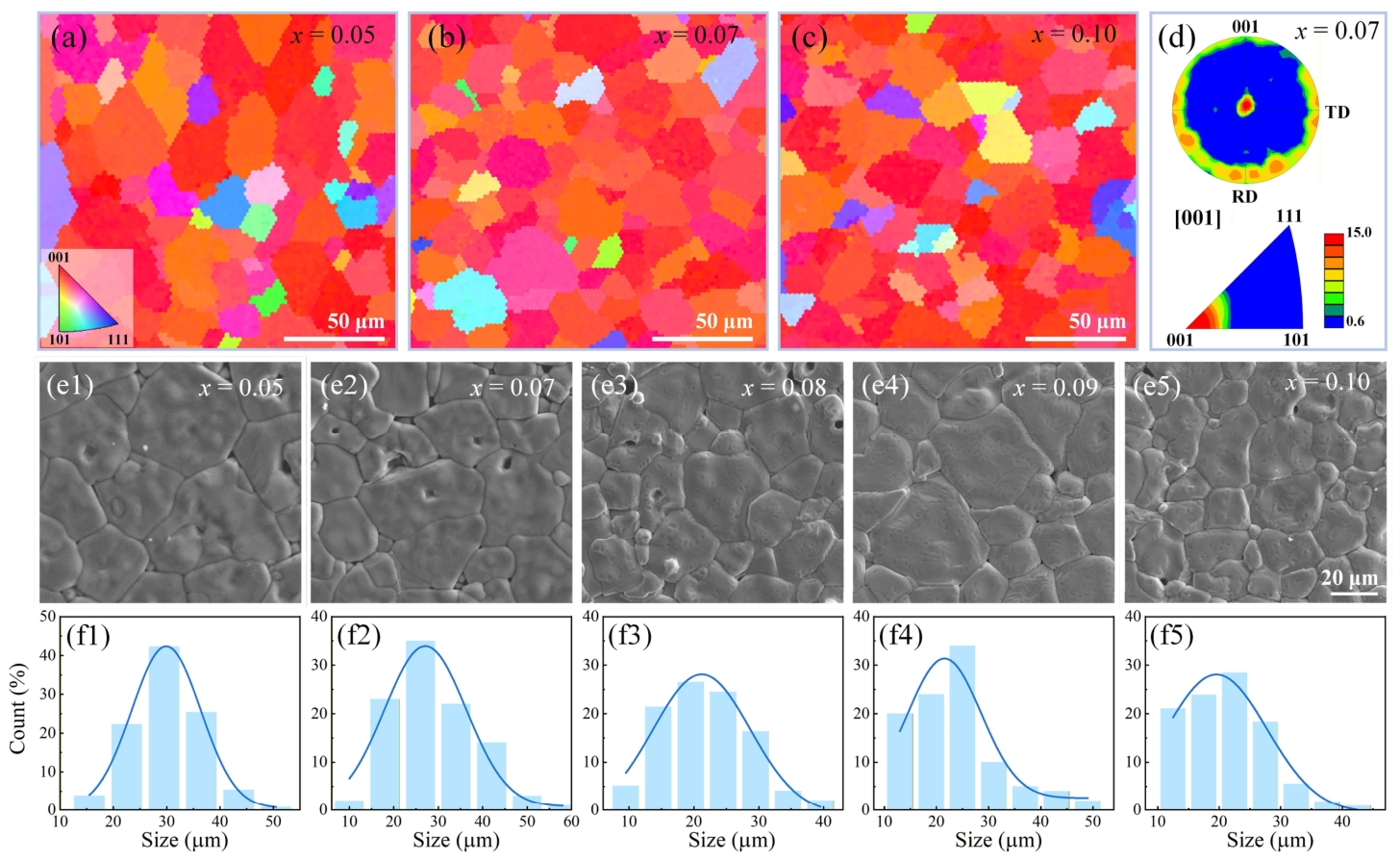
Following the grinding and polishing process of the sample surface, electron backscatter diffraction (EBSD) analysis was performed to obtain detailed information on grain orientation. Figure 3a–c presents the EBSD grain orientation inverse pole figure (IPF) maps for the textured Ba0.96Ca0.04Ti1−xHfxO3-5BT samples (x = 0.05, 0.07, 0.10). The predominance of red coloration in the grains indicates a strong [001]C crystallographic orientation. The pole figure (PF) and IPF results in Figure 3d further corroborate a strong orientation concentration in the samples, thereby verifying the pronounced texture observed in Figure 2a. Figure 3e1–e5 display SEM images of textured Ba0.96Ca0.04Ti1−xHfxO3-5BT samples (x = 0.05, 0.07, 0.08, 0.09, 0.10). These images reveal a relatively dense microstructure with well-defined grain boundaries, indicating the high quality of ceramic formation across all textured samples. Corresponding grain size distribution histograms, shown in Figure 3f1–f5, demonstrate that the majority of grains range from 15 to 30 μm and exhibit a relatively uniform distribution.
Figure 3.
(a–c) EBSD grain orientation IPF map of the textured BCTH-5BT samples (x = 0.05, 0.07, 0.10), (d) (001) pole figure and [001] inverse pole figure of the textured sample (x = 0.07), (e1–e5) surface SEM images of textured samples, and (f1–f5) the corresponding grain size distribution results.
3.2. Dielectric and Piezoelectric Properties
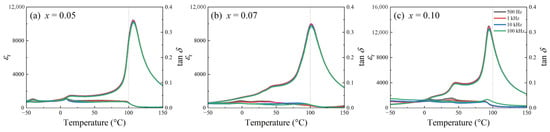
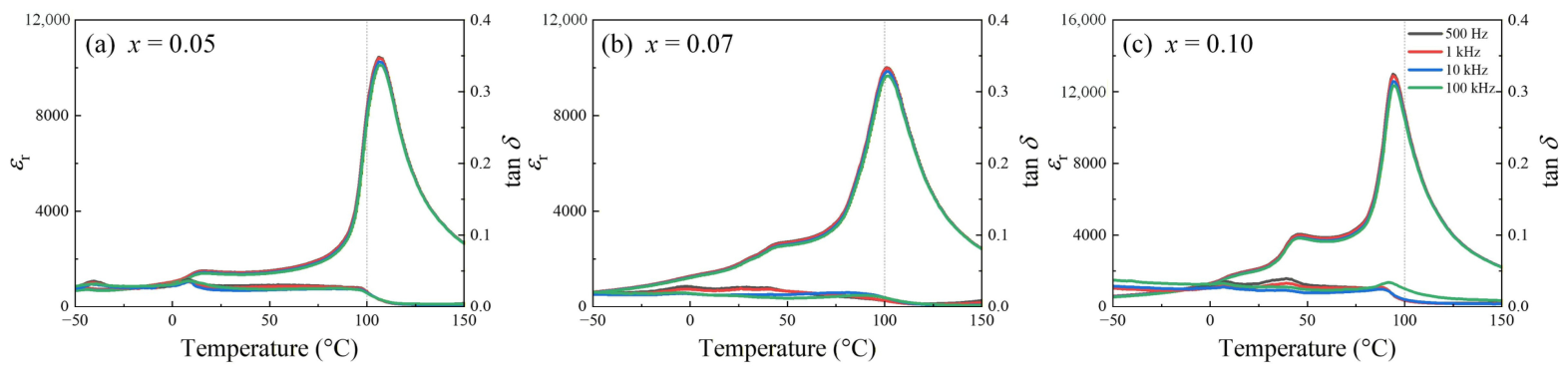
Figure 4 illustrates the temperature dependence of the relative dielectric permittivity (εr) and dielectric loss (tan δ) for textured Ba0.96Ca0.04Ti1−xHfxO3-5BT ceramics, measured within the temperature range of −50–150 °C at different frequencies (500 Hz, 1 kHz, 10 kHz, 100 kHz). It was found that the matrix composition exerts a significant influence on the dielectric properties of textured ceramics. Within the test temperature range, three distinct phase transition points can be observed, corresponding to the R–O transition, O–T transition and the T–C phase transition, respectively. As the Hf concentration in matrix increases from 0.05 to 0.10, the Curie temperature (TC) of the textured ceramics gradually decreases from 107 °C to 94 °C, and the maximum permittivity at the Curie temperature also decreases. Moreover, the O–T transition temperature gradually increases with increasing Hf content. The TO-T values increase from 16 °C (x = 0.05) to 46 °C (x = 0.10). The results indicate that the textured ceramics exhibit coexisting O and T phases at room temperature. For samples with Hf content of 0.05, the phase structure of the sample is dominated by the T phase. With increasing Hf concentration, the phase structure of textured samples gradually transforms to a predominantly O phase, which corroborates the Rietveld refined XRD results in Figure 2b. Regarding the room-temperature permittivity εr at 1 kHz, due to the influence of phase structure changes, it increases from 1444 (x = 0.05) to approximately 2144 (x = 0.07), and then slightly decreases to 2116 (x = 0.10), since the O–T phase transition temperature gradually increases from low temperature to near room temperature and continues to rise above room temperature. The tan δ values at 1 kHz range from 0.026 to 0.028 for textured BCTH-5BT ceramics with different compositions. Relatively low dielectric loss suppresses heat generation under alternating electric fields and power consumption.
Figure 4.
Temperature dependence of the relative permittivity (εr) and dielectric loss (tan δ) of textured Ba0.96Ca0.04Ti1−xHfxO3-5BT ceramics at different frequencies (500 Hz, 1 kHz, 10 kHz, 100 kHz) for the matrix compositions: (a) x = 0.05; (b) x = 0.07; (c) x = 0.10.
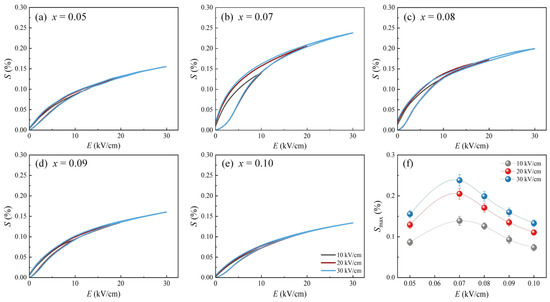
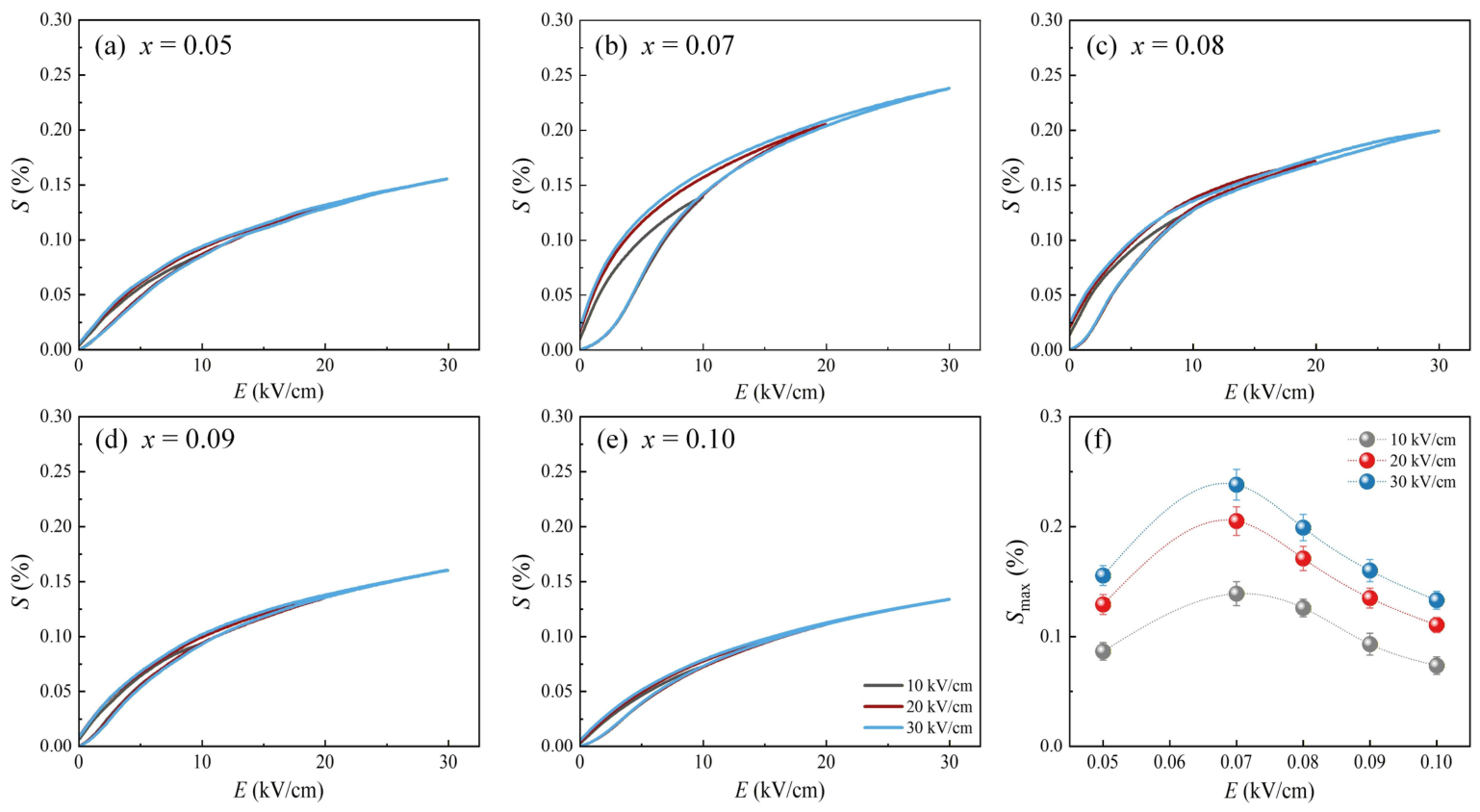
Figure 5a–e presents the unipolar strain–electric field (S–E) curves of textured BCTH-5BT ceramics under different electric fields (10, 20, and 30 kV/cm). For the sample with x = 0.05, the maximum strain values (Smax) under applied electric fields of 10, 20 and 30 kV/cm are 0.09%, 0.13% and 0.16%, respectively. Notably, the Ba0.96Ca0.04Ti0.93Hf0.07O3-5BT sample achieves the highest Smax of 0.24% under 30 kV/cm. For these samples with x = 0.08, 0.09 and 0.10, the corresponding Smax values under 30 kV/cm are 0.20%, 0.16% and 0.13%, respectively. This observed variation is likely attributable to differences in the phase structure of the ceramics. For textured Ba0.96Ca0.04Ti0.93Hf0.07O3-5BT ceramics, the O–T coexistence state dominated by the orthorhombic phase facilitates superior piezoelectric response. Figure 5f summarizes the relationship between maximum strain Smax and matrix composition across all textured samples under different electric fields. Importantly, for the textured Ba0.96Ca0.04Ti0.93Hf0.07O3-5BT sample, the intrinsic feature of the O–T coexistence phase might contribute to the observed large macroscopic strain Smax [20,33,34]. Therefore, the textured Ba0.96Ca0.04Ti0.93Hf0.07O3-5BT sample demonstrates excellent piezoelectric response under high electric fields, indicating its potential for achieving substantial output displacements.
Figure 5.
Unipolar strain–electric field curves of the textured Ba0.96Ca0.04Ti1−xHfxO3-5BT ceramic samples: (a) x = 0.05; (b) x = 0.07; (c) x = 0.08; (d) x = 0.09; (e) x = 0.10, and (f) the relationship between maximum strain Smax and matrix composition across all textured samples under different applied electric fields (10, 20, 30 kV/cm).
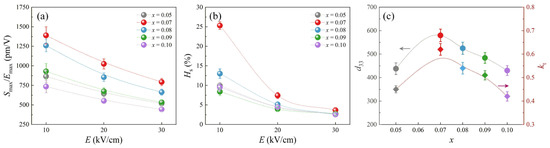
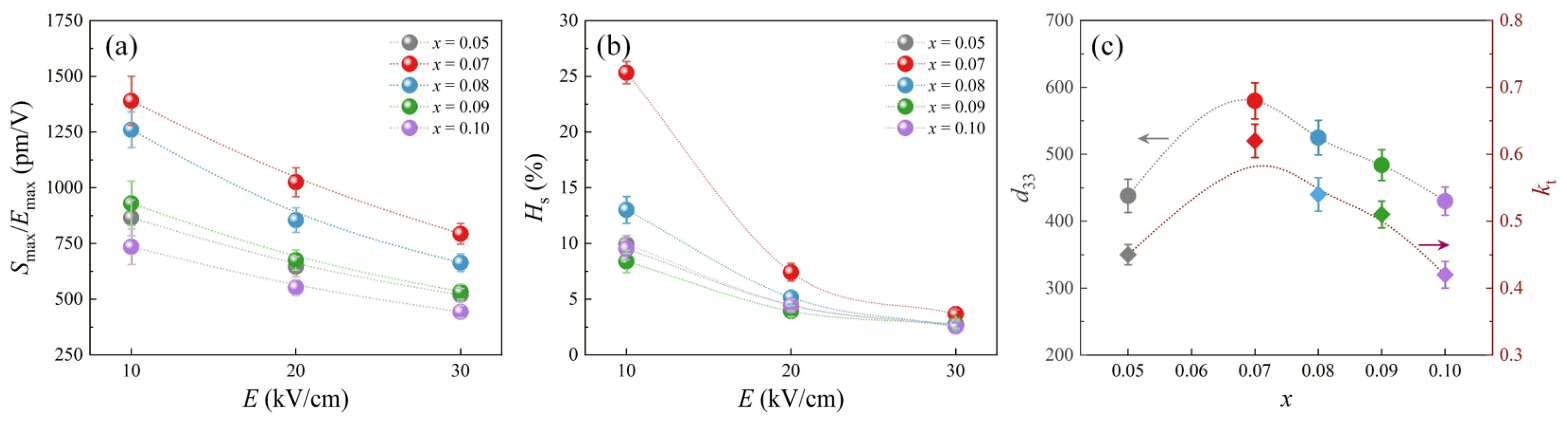
In precision actuators utilizing piezoelectric materials for energy conversion, excellent piezoelectric properties are critical for achieving favorable output displacement and high positioning accuracy. To facilitate a comparative analysis of the strain characteristics of textured BCTH-5BT ceramics, Figure 6a,b illustrates normalized strain coefficient Smax/Emax and strain hysteresis Hs, respectively. With Hf content increasing, Smax/Emax (under 10 kV/cm) initially increases, from 865 pm/V (at x = 0.05) up to 1390 pm/V (at x = 0.07), and then gradually decreases with further Hf increasing. The Smax/Emax value of Ba0.96Ca0.04Ti0.90Hf0.10O3-5BT textured sample falls back to 735 pm/V. The highest value of 1390 pm/V in this investigation is obtained in the BCTH-5BT sample with x = 0.07, indicating that it possesses excellent piezoelectric performance under a large electric field, thereby enabling greater output displacement at equivalent driving voltages.
Figure 6.
(a) Normalized strain coefficient Smax/Emax versus driving electric field; (b) strain hysteresis Hs versus driving electric field; (c) piezoelectric coefficient d33 and electromechanical coupling coefficient kt for textured BCTH-5BT ceramics with different Hf contents (x = 0.05, 0.07, 0.08, 0.09, 0.10).
Strain hysteresis is another important performance metric in applications involving precision positioning and actuation. It can be found that Hs differs significantly between low and high electric fields, which may be associated with the dynamic evolution of ferroelectric domain structures [35]. At low electric fields, domain wall motion and switching are limited by local potential barriers and pinning, so the strain response remains underdeveloped. Differences in domain evolution during ascending and descending fields induce strain hysteresis. At high electric fields, the enhanced driving field facilitates domain wall motion and switching, raising the maximum strain. When the increase in maximum strain outpaces that of the strain offset between the two branches, the normalized Hs decreases. The Hs values of all samples are in the range of 2.5–3.7% at 30 kV/cm. These results suggest that textured BCTH-5BT ceramics can concurrently achieve high strain magnitudes and low hysteresis, demonstrating their significant advantages in piezoelectric actuation applications.
Figure 6c shows the variation in the piezoelectric coefficient d33 and electromechanical coupling coefficient kt with x. For the textured BCTH-5BT sample with x = 0.07, d33 reaches 580 pC/N, and kt is 0.62, exhibiting excellent small-signal piezoelectric response and electromechanical coupling performance. The Hf content in the matrix exerts an important influence on the piezoelectric properties of textured ceramic by constructing O–T phase boundaries. To compare the piezoelectric properties of the samples in this work with those of PZT and BT-based systems, we compare the piezoelectric performance; the important parameters are listed in Table 2. The textured BCTH-5BT (x = 0.07) achieves a prominent Smax/Emax (1390 pm/V under 10 kV/cm, 1025 pm/V under 20 kV/cm) and a high electromechanical coupling factor, exceeding many existing textured BT-based systems and showing comparable strain properties to commercial PZT-5H. Moreover, its relatively high Curie temperature of 101 °C ensures acceptable thermal stability. Given the excellent piezoelectric performance of textured Ba0.96Ca0.04Ti0.93Hf0.07O3-5BT ceramics, this finding motivates the subsequent exploration of multilayer textured ceramics.
Table 2.
Comparison of piezoelectric properties of representative PZT and BT-based systems.
3.3. Multilayer Textured Ceramics
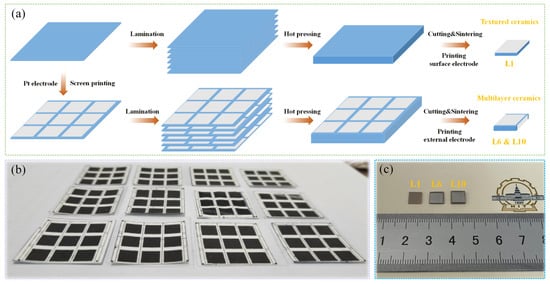
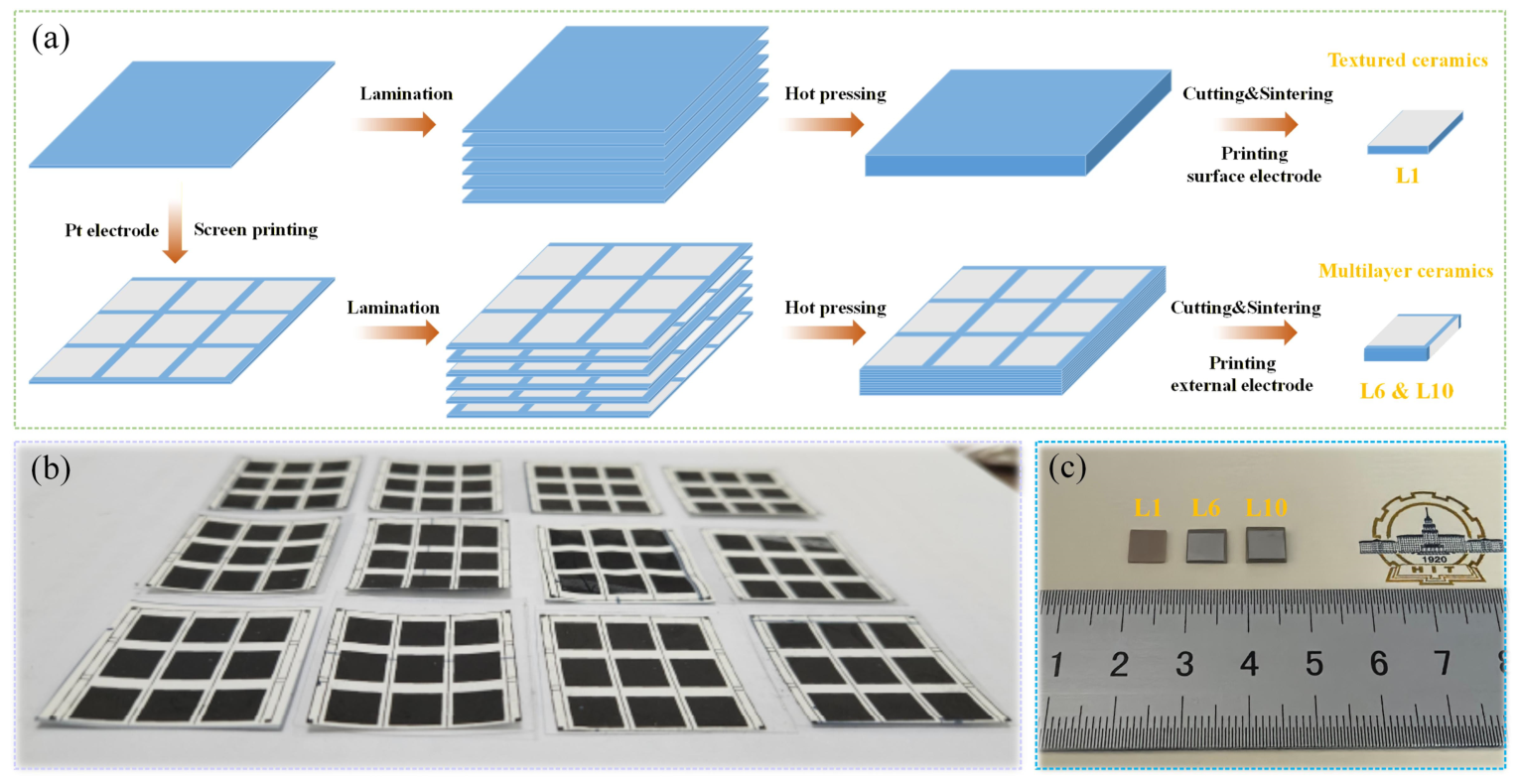
The textured BCTH-5BT ceramic with a matrix composition of x = 0.07 exhibits an excellent piezoelectric response under high electric fields. On this basis, multilayer textured Ba0.96Ca0.04Ti0.93Hf0.07O3-5BT ceramics were prepared using the metal internal-electrode co-firing process. The preparation process is illustrated in Figure 7a. Unlike bulk textured ceramics, which are directly laminated following cutting green cast tape, the multilayer ceramics require the deposition of platinum (Pt) electrode paste onto green sheets via a screen-printing technique, as depicted in Figure 7b. Subsequently, the laminated samples undergo hot pressing, are sectioned into smaller pieces, and are subjected to binder burnout. During the sintering process, the multilayer ceramics are co-fired with the embedded conductive Pt electrodes, resulting in a multilayer geometric configuration. As shown in the photograph of the ceramic sample in Figure 7c, the single-layer bulk ceramic sample is denoted as L1, with dimensions of 6 × 6 × 0.50 mm. The multilayer ceramics are denoted as L6 and L10, corresponding to 6 and 10 active ceramic layers, respectively. Their overall dimensions are 6 × 6 × 0.40 mm and 6 × 6 × 0.65 mm, and each ceramic layer has a thickness of 60 μm. It was found that the sintered textured ceramics and multilayer textured ceramics all have good ceramic-forming quality, and the surface Pt electrodes are uniform and flat, which will be beneficial for the multilayer ceramics to exhibit good output performance.
Figure 7.
(a) Schematic diagram of the fabrication process for the preparation of single-layer (L1) and multilayer textured BCTH-5BT ceramics with 6 and 10 layers (L6 and L10); (b) photograph of textured ceramic green sheets with screen-printed Pt electrode pattern; (c) photograph for all samples denoted as L1, L6, and L10.
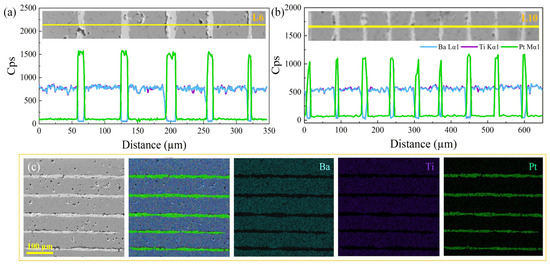
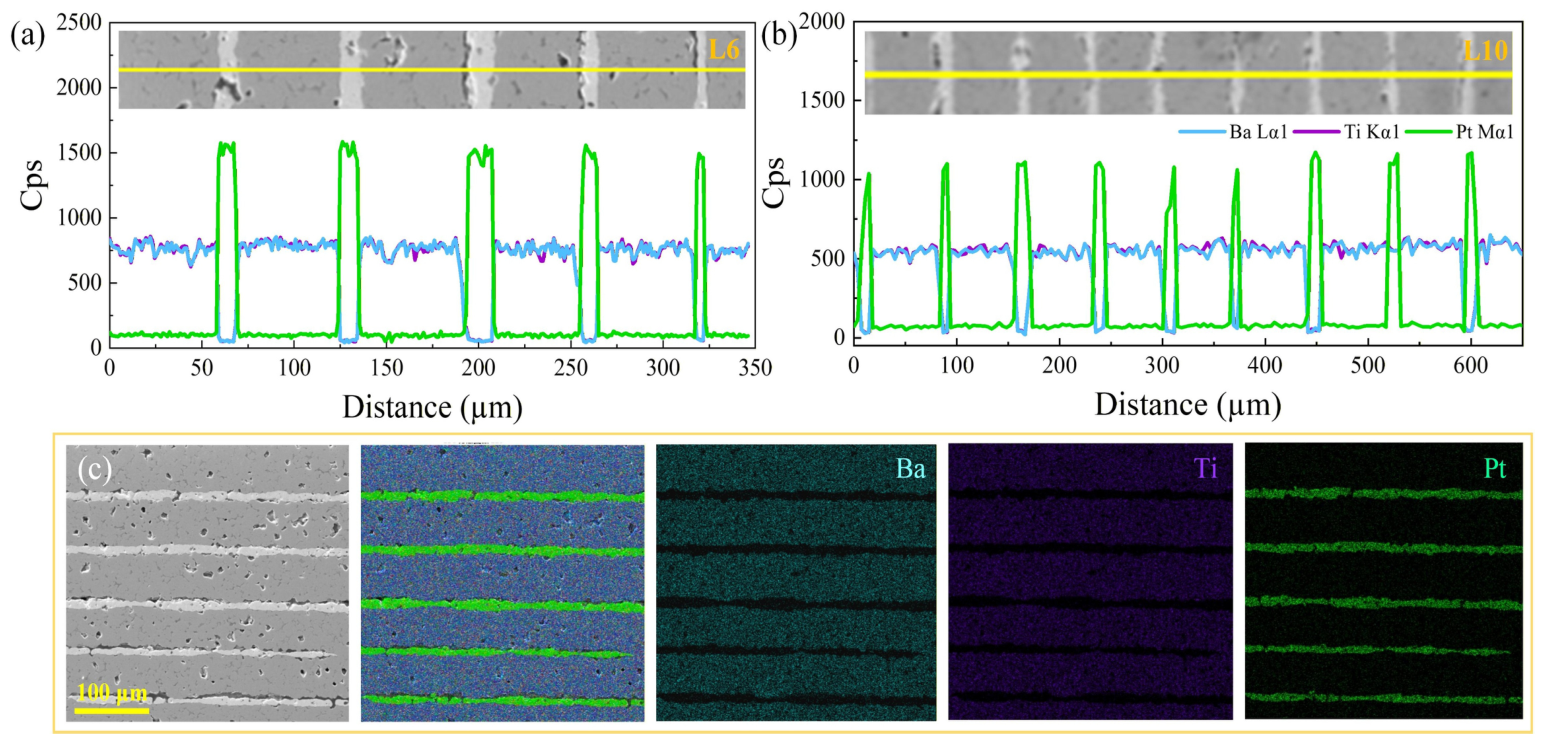
To obtain further information on the microstructural characteristics of the multilayer textured ceramic samples, cross-sectional specimens were analyzed using SEM coupled with an energy-dispersive spectroscopy (EDS) detector. The findings are presented in Figure 8. SEM images reveal that both the electrode and ceramic layers within the textured multilayer ceramics exhibit a distinct stacked configuration, featuring well-defined interfaces and dense interlayer bonding, which collectively indicate the superior structural integrity of the multilayer ceramics. Figure 8a,b also displays the cross-sectional EDS line scans for samples L6 and L10, respectively. Along the thickness direction, the elemental intensities of barium (Ba) and titanium (Ti) demonstrate periodic variations, with elevated concentrations within the ceramic layers with a thickness of approximately 60 μm. For BT-based ceramics, co-firing with base-metal electrodes is generally challenging due to their high sintering temperature. The Pt element shows a high concentration within the internal electrode layers and minimal presence in the ceramic layers, confirming a well-ordered periodic arrangement of ceramic and electrode layers. The quantitative line-scan elemental profiles presented in Figure 8a,b demonstrate that the Pt element concentration rises and falls sharply at the ceramic-electrode interface. No substantial elemental interdiffusion between Pt and the BCTH-5BT ceramic matrix is observed.
Figure 8.
EDS results of the polished cross-sections of multilayer textured BCTH-5BT ceramics: line scanning data of (a) L6; (b) L10; (c) elemental mapping for element types of Ba, Ti, and Pt.
This distribution is further corroborated by the EDS elemental mapping shown in Figure 8c, where Ba and Ti are predominantly localized within the textured ceramic regions, while Pt is confined to the internal electrode layers. The porosity within the multilayer ceramic is approximately 8%, determined by threshold segmentation in ImageJ v1.54f. Due to the relatively large grain size of textured BCTH grains, the number of grains within a single piezoelectric layer is limited. Textured grain refinement and thickening of the ceramic layer are promising strategies to further optimize the property uniformity and reliability of textured multilayer ceramics. These results confirm that the multilayer textured BCTH-5BT ceramics possess continuous and homogeneous ceramic layers and electrode layers, which are beneficial for achieving high output performance under applied electric fields.
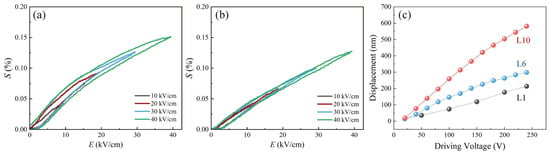
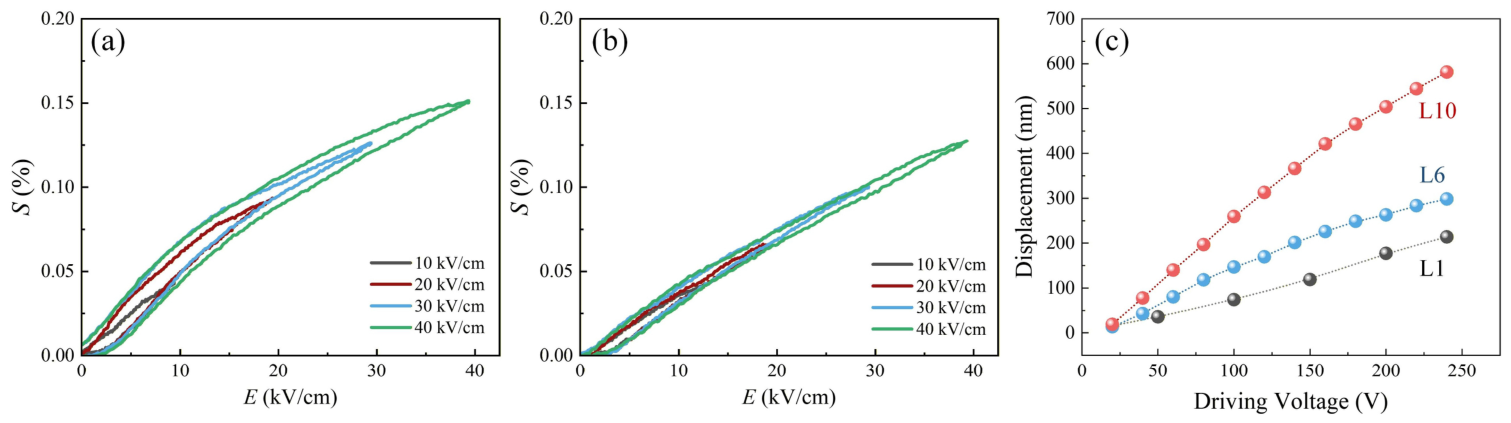
An electric field ranging from 10 to 40 kV/cm was applied to the L6 and L10 multilayer ceramics to acquire their unipolar S–E curves, as depicted in Figure 9a,b. Under the same electric field of 10 kV/cm, the Smax/Emax values of L6 and L10 are 481 and 405 pm/V, respectively, which is lower than that of L1, as shown in Figure 5b. This reduction in strain can be attributed to residual compressive stress originating from the co-firing process and the substantial decrease in the thickness of the piezoelectric functional layer [41]. In practical applications, multilayer ceramic structures can significantly reduce the driving voltage required to produce a given displacement, so the relationship between input voltage and output displacement is worthy of further investigation. Figure 9c shows the output displacement of L1, L6, and L10 as a function of the driving voltage. Within the driving voltage range of 0–250 V, output displacement of all samples varies nearly linearly with voltage, indicating good linearity of the multilayer ceramics. Notably, at the same driving voltage, devices with a greater number of layers produce larger total output displacements, highlighting the advantage of multilayer ceramics. Pt interlayers divide the ceramic into thin piezoelectric layers connected electrically in parallel and mechanically in series. Under the same driving voltage, the multilayer structure yields a higher electric field. For L6 and L10 with identical single-layer thickness, total displacement is the sum of strain from all layers. Specifically, the L10 sample demonstrates an output displacement of approximately 260 nm at 100 V, markedly surpassing the 74 nm displacement of L1 under the same voltage. Furthermore, at a driving voltage of 250 V, the output displacement of L10 reaches 581 nm. This value outperforms the reported textured BT-based systems [29].
Figure 9.
Unipolar S–E curves of multilayer textured ceramics: (a) L6; (b) L10; (c) output displacement of L1, L6, and L10 as a function of driving voltage.
4. Conclusions
In this work, [001]C textured Ba0.96Ca0.04Ti1−xHfxO3-5BT ceramics (x = 0.05, 0.07, 0.08, 0.09, 0.10) with different Hf contents were successfully fabricated using the TGG method. All specimens demonstrated a high texture degree exceeding 97%. EBSD analysis confirmed the excellent texture quality of the fabricated ceramics. Among all textured samples, the textured Ba0.96Ca0.04Ti0.93Hf0.07O3-5BT sample shows the optimal piezoelectric properties: a piezoelectric coefficient d33 of 580 pC/N, an electromechanical coupling factor kt of 0.62, and a unipolar normalized strain Smax/Emax of 1390 pm/V (at 10 kV/cm), Meanwhile, it achieves a low strain hysteresis Hs of only 3.7% at 30 kV/cm, realizing a favorable balance between high piezoelectric response and moderate strain hysteresis. The excellent comprehensive properties can be attributed to the preferred crystallographic orientation and the coexistence of orthorhombic and tetragonal phases. Utilizing this textured composition, multilayer textured ceramics were subsequently developed. The multilayer textured Ba0.96Ca0.04Ti0.93Hf0.07O3-5BT ceramics with 6 and 10 active layers (designated as L6 and L10) were fabricated through the internal electrode co-firing process. SEM and EDS analyses confirmed that both the ceramic layers and embedded Pt electrode layers exhibited uniform and continuous microstructures. Unipolar strain measurements of the multilayer samples were conducted, and the output displacements of L6 and L10 were compared under identical driving voltages. Notably, the L10 sample demonstrated a superior output displacement performance, achieving 581 nm at a driving voltage of 250 V. This work presents a feasible strategy for the development of lead-free ceramics with high-performance.
Author Contributions
Investigation, visualization, writing—original draft preparation, funding acquisition, Y.S.; data curation, writing—original draft preparation, Y.Z.; writing—review and editing, funding acquisition, L.L.; conception, funding acquisition, J.W.; investigation, funding acquisition, H.X.; writing—review and editing, J.M.; supervision, Y.Y.; resources, B.Y. All authors have read and agreed to the published version of the manuscript.
Funding
This research was funded by the National Science and Technology Major Project, grant number 2025ZD1606700, the National Natural Science Foundation of China, grant number 52402143 and 52302154, the Natural Science Foundation of Heilongjiang Province, grant number LH2024E025, the Heilongjiang Postdoctoral Foundation, grant number LBH-Z25186, Zhejiang Provincial Natural Science Foundation of China, grant number LQN26E020006.
Institutional Review Board Statement
Not applicable.
Informed Consent Statement
Not applicable.
Data Availability Statement
The original contributions presented in this study are included in the article. Further inquiries can be directed to the corresponding authors.
Conflicts of Interest
The authors declare no conflicts of interest. The funders had no role in the design of the study; in the collection, analyses, or interpretation of data; in the writing of the manuscript; or in the decision to publish the results.
Abbreviations
| BCTH | Ba0.96Ca0.04Ti1−xHfxO3 (x = 0.05, 0.07, 0.08, 0.09, 0.10) |
| BT | BaTiO3 |
| PZT | PbTiO3 |
| XRD | X-ray diffraction |
| SEM | Scanning electron microscopy |
| EBSD | Electron backscatter diffraction |
References
- Wang, L.; Chen, W.; Liu, J.; Deng, J.; Liu, Y. A review of recent studies on non-resonant piezoelectric actuators. Mech. Syst. Signal Process. 2019, 133, 106254. [Google Scholar] [CrossRef] [Scilit]
- Tian, X.; Liu, Y.; Deng, J.; Wang, L.; Chen, W. A review on piezoelectric ultrasonic motors for the past decade: Classification, operating principle, performance, and future work perspectives. Sens. Actuators A Phys. 2020, 306, 111971. [Google Scholar] [CrossRef] [Scilit]
- Mohith, S.; Upadhya, A.R.; Navin, K.P.; Kulkarni, S.M.; Rao, M. Recent trends in piezoelectric actuators for precision motion and their applications: A review. Smart Mater. Struct. 2021, 30, 13002. [Google Scholar] [CrossRef] [Scilit]
- Zhou, X.; Wu, S.; Wang, X.; Wang, Z.; Zhu, Q.; Sun, J.; Huang, P.; Wang, X.; Huang, W.; Lu, Q. Review on piezoelectric actuators: Materials, classifications, applications, and recent trends. Front. Mech. Eng. 2024, 19, 6. [Google Scholar] [CrossRef] [Scilit]
- Jin, H.; Gao, X.; Ren, K.; Liu, J.; Qiao, L.; Liu, M.; Chen, W.; He, Y.; Dong, S.; Xu, Z.; et al. Review on piezoelectric actuators based on high-performance piezoelectric materials. IEEE Trans. Ultrason. Ferroelectr. Freq. Control 2022, 69, 3057–3069. [Google Scholar] [CrossRef] [Scilit] [PubMed]
- Gao, X.; Yang, J.; Wu, J.; Xin, X.; Li, Z.; Yuan, X.; Shen, X.; Dong, S. Piezoelectric actuators and motors: Materials, designs, and applications. Adv. Mater. Technol. 2020, 5, 1900716. [Google Scholar] [CrossRef] [Scilit]
- Lai, L.; Li, B.; Tian, S.; Zhao, Z.; Zhang, S.; Dai, Y. Giant Electrostrain in lead-free textured piezoceramics by defect dipole design. Adv. Mater. 2023, 35, 2300519. [Google Scholar] [CrossRef] [Scilit] [PubMed]
- Yan, X.; Zheng, M.; Gao, X.; Zhu, M.; Hou, Y. Giant current performance in lead-free piezoelectrics stem from local structural heterogeneity. Acta Mater. 2020, 187, 29–40. [Google Scholar] [CrossRef] [Scilit]
- Leontsev, S.O.; Eitel, R.E. Progress in engineering high strain lead-free piezoelectric ceramics. Sci. Technol. Adv. Mat. 2010, 11, 044302. [Google Scholar] [CrossRef] [Scilit] [PubMed]
- Meng, Y.; Wang, Z.; Niu, X.; Jiang, Y.; Nong, P.; Tang, S.; Xie, J.; Hu, W.; Wang, D.; Peng, B.; et al. The design of BaTiO3 lead-free ceramics enabling an ultrahigh electrocaloric effect and a wide working-temperature range. J. Mater. Chem. A 2026, 14, 5045–5053. [Google Scholar] [CrossRef] [Scilit]
- Wu, H.; Zhang, Y.; Wu, J.; Wang, J.; Pennycook, S.J. Microstructural origins of high piezoelectric performance: A pathway to practical lead-free materials. Adv. Funct. Mater. 2019, 29, 1902911. [Google Scholar] [CrossRef] [Scilit]
- Wang, D.; Fan, Z.; Rao, G.; Wang, G.; Liu, Y.; Yuan, C.; Ma, T.; Li, D.; Tan, X.; Lu, Z.; et al. Ultrahigh piezoelectricity in lead-free piezoceramics by synergistic design. Nano Energy 2020, 76, 104944. [Google Scholar] [CrossRef] [Scilit]
- Rödel, J.; Webber, K.G.; Dittmer, R.; Jo, W.; Kimura, M.; Damjanovic, D. Transferring lead-free piezoelectric ceramics into application. J. Eur. Ceram. Soc. 2015, 35, 1659–1681. [Google Scholar] [CrossRef] [Scilit]
- Acosta, M.; Logo, O.; Novak, N.; Rojas, V.; Patel, S.; Vaish, R.; Koruza, J.; Logo, O.; Rossetti, G.A., Jr.; Rödel, J.; et al. BaTiO3-based piezoelectrics: Fundamentals, current status, and perspectives. Appl. Phys. Rev. 2017, 4, 041305. [Google Scholar] [CrossRef] [Scilit]
- Liu, W.; Ren, X. Large piezoelectric effect in Pb-free ceramics. Phys. Rev. Lett. 2009, 103, 257602. [Google Scholar] [CrossRef] [Scilit] [PubMed]
- Messing, G.L.; Poterala, S.; Chang, Y.; Frueh, T.; Kupp, E.R.; Watson, B.H.; Walton, R.L.; Brova, M.J.; Hofer, A.; Bermejo, R.; et al. Texture-engineered ceramics-Property enhancements through crystallographic tailoring. J. Mater. Res. 2017, 32, 3219–3241. [Google Scholar] [CrossRef] [Scilit]
- Messing, G.L.; Trolier-McKinstry, S.; Sabolsky, E.M.; Duran, C.; Kwon, S.; Brahmaroutu, B.; Park, P.; Yilmaz, H.; Rehrig, P.W.; Eitel, K.B.; et al. Templated grain growth of textured piezoelectric ceramics. Crit. Rev. Solid State 2004, 29, 45–96. [Google Scholar] [CrossRef] [Scilit]
- Yang, S.; Li, J.; Liu, Y.; Wang, M.; Qiao, L.; Gao, X.; Chang, Y.; Du, H.; Xu, Z.; Zhang, S.; et al. Textured ferroelectric ceramics with high electromechanical coupling factors over a broad temperature range. Nat. Commun. 2021, 12, 1414. [Google Scholar] [CrossRef] [Scilit] [PubMed]
- Lin, J.; Qian, J.; Ge, G.; Yang, Y.; Li, J.; Wu, X.; Li, G.; Wang, S.; Liu, Y.; Zhang, J.; et al. Multiscale reconfiguration induced highly saturated poling in lead-free piezoceramics for giant energy conversion. Nat. Commun. 2024, 15, 2560. [Google Scholar] [CrossRef] [Scilit] [PubMed]
- Kou, Q.; Yang, B.; Lei, H.; Yang, S.; Zhang, Z.; Liu, L.; Xie, H.; Sun, Y.; Chang, Y.; Li, F. Lead-free textured ceramics with ultrahigh piezoelectric properties by synergistic design. ACS Appl. Mater. Inter. 2023, 15, 37706–37716. [Google Scholar] [CrossRef] [Scilit] [PubMed]
- Sun, Y.; Zhang, Y.; Wu, J.; Liu, L.; Li, K.; Yang, Y.; Yu, S.; Yang, B. Concurrently enhanced piezoelectric properties and stability in textured PYN–PMN–PT ceramics for actuator applications. J. Am. Ceram. Soc. 2026, 109, e70464. [Google Scholar] [CrossRef] [Scilit]
- Sun, Y.; Wu, J.; Zhang, Y.; Liu, L.; Ma, J.; Yang, Y.; Yang, B. Enhanced piezoelectric properties of textured BCTS ceramics assisted with ZnO and Li2O. J. Alloy. Compd. 2026, 1079, 190053. [Google Scholar] [CrossRef] [Scilit]
- Tsai, C.; Liao, W.; Chu, S.; Hong, C.; Yu, M.; Wei, Z.; Lin, Y. Effect of BaTiO3 templates on the electrical characteristics of (Ba, Ca)(Ti, Sn, Hf)-based ceramics under the reducing atmosphere for actuator applications. Ceram. Int. 2021, 47, 7207–7217. [Google Scholar] [CrossRef] [Scilit]
- Sun, Y.; Chang, Y.; Wu, J.; Liu, Y.; Jin, L.; Zhang, S.; Yang, B.; Cao, W. Ultrahigh energy harvesting properties in textured lead-free piezoelectric composites. J. Mater. Chem. A 2019, 7, 3603–3611. [Google Scholar] [CrossRef] [Scilit]
- Uchino, K. Multilayer technologies for piezoceramic materials. In Advanced Piezoelectric Materials; Elsevier: Amsterdam, The Netherlands, 2017; pp. 423–451. [Google Scholar] [CrossRef] [Scilit]
- Kim, E.; Lee, T.; Kim, D.S.; Kim, S.; Yee, Y.; Han, S.H.; Kang, H.; Nahm, S. Textured Pb(Zr,Ti)O3-Pb[(Zn,Ni)1/3Nb2/3]O3 multilayer ceramics and their application to piezoelectric actuators. Appl. Mater. Today 2020, 20, 100695. [Google Scholar] [CrossRef] [Scilit]
- Bian, L.; Wang, Q.; He, S.; Wu, J.; Li, K.; Liu, Y.; Yang, B. Excellent strain and temperature stability in PNT-PZT multilayer textured ceramics. J. Eur. Ceram. Soc. 2024, 44, 5048–5054. [Google Scholar] [CrossRef] [Scilit]
- Cho, S.W.; Na, Y.; Baik, J.M.; Jeong, Y.H. Texture-controlled electrostain response in PNN-PZT multilayer piezoelectric ceramic actuators enabled by asymmetric stacking strategy. J. Eur. Ceram. Soc. 2025, 45, 117614. [Google Scholar] [CrossRef] [Scilit]
- Liu, Y.; Zhang, H.; Shi, W.; Li, K.; Yang, B.; Cao, W.; Tan, J. Ultra-low strain hysteresis in BaTiO3-based piezoelectric multilayer actuators via microstructural texture engineering. J. Mater. 2025, 11, 100882. [Google Scholar] [CrossRef] [Scilit]
- Liu, K.; Liu, F.; Zhang, W.; Dou, Z.; Ma, W.; Samart, C.; Takesue, N.; Tan, H.; Fan, P.; Ye, Z.; et al. Design and development of outstanding strain properties in NBT-based lead-free piezoelectric multilayer actuators by grain-orientation engineering. Acta Mater. 2023, 246, 118696. [Google Scholar] [CrossRef] [Scilit]
- Zhao, C.; Wu, W.; Wang, H.; Wu, J. Site engineering and polarization characteristics in (Ba1−yCay)(Ti1−xHfx)O3 lead-free ceramics. J. Appl. Phys. 2016, 119, 024108. [Google Scholar] [CrossRef] [Scilit]
- Zhao, C.; Hui, W.; Jie, X.; Wu, J. Composition-driven phase boundary and electrical properties in (Ba0.94Ca0.06)(Ti1–xMx)O3 (M = Sn, Hf, Zr) lead-free ceramics. Dalton Trans. 2016, 45, 6466. [Google Scholar] [CrossRef] [Scilit] [PubMed]
- Yao, Y.; Zhou, C.; Lv, D.; Wang, D.; Wu, H.; Yang, Y.; Ren, X. Large piezoelectricity and dielectric permittivity in BaTiO3-xBaSnO3 system: The role of phase coexisting. Europhys. Lett. 2012, 98, 27008. [Google Scholar] [CrossRef] [Scilit]
- Tian, Y.; Chao, X.; Jin, L.; Wei, L.; Liang, P.; Yang, Z. Polymorphic structure evolution and large piezoelectric response of lead-free (Ba,Ca)(Zr,Ti)O3 ceramics. Appl. Phys. Lett. 2014, 104, 112901. [Google Scholar] [CrossRef] [Scilit]
- Otonicar, M.; Dragomir, M.; Rojac, T. Dynamics of domain walls in ferroelectrics and relaxors. J. Am. Ceram. Soc. 2022, 105, 6479–6507. [Google Scholar] [CrossRef] [Scilit]
- Zhang, S.; Li, F. High performance ferroelectric relaxor-PbTiO3 single crystals: Status and perspective. J. Appl. Phys. 2012, 111, 031301. [Google Scholar] [CrossRef] [Scilit]
- Yan, Y.; Zhou, Y.; Priya, S. Enhanced electromechanical coupling in Pb(Mg1/3Nb2/3)O3 -PbTiO3 001C radially textured cylinders. Appl. Phys. Lett. 2014, 104, 012910. [Google Scholar]
- Jadhav, T.K.; Kapadi, N.J.; James, A.R.; Reddy, V.R.; Kambale, R.C. Tunable d33/d33* for MPB (Ba0.85Ca0.15) (Zr0.1Ti0.9)O3 lead-free piezoceramic by crystallographic texturing approach. Ceram. Int. 2024, 50, 9732–9743. [Google Scholar] [CrossRef] [Scilit]
- Lai, Y.; Tian, G.; Cai, Y.; Kuai, W.; Gai, Z.; Chen, Y.; Du, J.; Zhao, M.; Zheng, L. Ultrahigh strain and superior temperature stability in lead-free ceramics via synergetic texture technique and phase structure engineering. J. Eur. Ceram. Soc. 2024, 44, 7582–7589. [Google Scholar] [CrossRef] [Scilit]
- Zhang, X.; Wang, Z.; Li, P.; Liu, Y.; Du, J.; Hao, J.; Li, W.; Zhai, J. Simultaneous achievement of large strain, low hysteresis, and high-temperature stability in textured BT-based piezoelectric ceramics. J. Adv. Ceram. 2025, 14, 9221025. [Google Scholar] [CrossRef] [Scilit]
- Kaufmann, P.; Röhrig, S.; Supancic, P.; Deluca, M. Influence of ferroelectric domain texture on the performance of multilayer piezoelectric actuators. J. Eur. Ceram. Soc. 2017, 37, 2039–2046. [Google Scholar] [CrossRef] [Scilit]

Disclaimer/Publisher’s Note: The statements, opinions and data contained in all publications are solely those of the individual author(s) and contributor(s) and not of MDPI and/or the editor(s). MDPI and/or the editor(s) disclaim responsibility for any injury to people or property resulting from any ideas, methods, instructions or products referred to in the content. |
© 2026 by the authors. Licensee MDPI, Basel, Switzerland. This article is an open access article distributed under the terms and conditions of the Creative Commons Attribution (CC BY) license.