


Abstract
Background/Objectives: Coffee is an inexpensive intervention proposed to speed gastrointestinal recovery after abdominal surgery. Earlier syntheses concluded that it reduces ileus and shortens stay. We reassessed the randomized evidence under a conservative prespecified model. Methods: We searched PubMed, Embase, and Cochrane CENTRAL from inception to 11 November 2026 for randomized trials comparing postoperative coffee with no coffee, water, or usual care in adults undergoing abdominal or pelvic surgery. Co-primary outcomes were time to first stool and first flatus. Caffeinated coffee formed the primary comparison; decaffeinated arms were analyzed separately. Effects were pooled using restricted maximum likelihood with the Hartung–Knapp–Sidik–Jonkman adjustment, with RoB 2 and GRADE. Results: Twenty trials (1718 participants) were included. Coffee shortened time to first stool by 6.93 h (95% CI −9.81 to −4.05; I2 = 81%; 15 trials; low certainty). Restricting to trials using a volume-matched beverage comparator gave a smaller estimate (−4.72 h, 95% CI −6.93 to −2.50; I2 = 25%; 11 trials). Time to first flatus (−3.19 h, 95% CI −6.51 to 0.13; I2 = 93%), postoperative ileus (risk ratio 0.41, 95% CI 0.14 to 1.25), and adverse events (0.84, 0.50 to 1.43) did not differ significantly. Length of stay was 0.57 days shorter (95% CI −1.12 to −0.02), a fragile result of very low certainty. Conclusions: Coffee modestly accelerated the first bowel movement (low certainty) and was not associated with a clear increase in reported adverse events. The evidence does not establish that coffee prevents postoperative ileus or shortens hospital stay (PROSPERO registration number: CRD420261420132).
1. Introduction
Postoperative ileus, a transient impairment of coordinated gastrointestinal motility after surgery, is among the most common complications of abdominal and pelvic operations [1,2]. It delays oral intake, prolongs hospitalization, increases cost, and contributes to patient discomfort and readmission. Despite multimodal preventive measures, it remains difficult to avoid entirely [3]. Within enhanced recovery after surgery (ERAS) pathways, interventions that accelerate the return of gastrointestinal function are valued because they are simple, inexpensive, and applicable across surgical specialties [4].
Postoperative coffee is one such candidate [5]. It is widely available, well tolerated, and inexpensive, and both its caffeine and non-caffeine constituents have been proposed to stimulate colonic motility and gastrin-mediated secretion [6,7]. Over the past decade, randomized controlled trials (RCTs) have tested postoperative coffee across colorectal resection [8,9,10,11,12,13], cesarean delivery [14,15,16,17,18,19,20,21,22], gynecologic surgery [23,24,25,26,27], and other abdominal procedures, generally reporting earlier return of flatus and bowel movement without a rise in adverse events.
The most recent coffee-specific synthesis spanning abdominal surgery, published in 2021, pooled 13 trials, examined subgroups defined by surgery type, and concluded that coffee reduces postoperative ileus and shortens hospital stay [28]. Subsequent dedicated syntheses have each addressed a single specialty, colorectal surgery [29] or cesarean section [30], with the colorectal review also incorporating non-randomized studies, and a 2023 network meta-analysis of gastrointestinal surgery ranked coffee alongside chewing gum among prokinetic measures [31]. The randomized evidence has grown substantially since: nine of the 20 trials included here were published in 2022 or later, and three trials listed as ongoing in the 2021 review have since been published and are included here. What has not been examined is whether those earlier positive conclusions persist when the evidence is restricted to randomized trials, brought up to date, and estimated under a conservative random-effects model.
We therefore conducted an updated systematic review and meta-analysis restricted to randomized controlled trials, searched to November 2026, to re-estimate the effect of postoperative coffee on time to first stool and first flatus after abdominal and pelvic surgery, on postoperative ileus, time to solid diet, length of stay, and tolerability, and to examine whether estimates differ by surgery type and by the type of comparator employed.
2. Materials and Methods
This review was conducted in accordance with the Preferred Reporting Items for Systematic Reviews and Meta-Analyses (PRISMA 2020) statement and was registered prospectively in the International Prospective Register of Systematic Reviews (PROSPERO; registration number CRD420261420132). The protocol prespecified the population, interventions, comparators, outcomes, analysis model, and subgroups described below.
2.1. Eligibility Criteria
We included parallel-group or cluster RCTs enrolling adults undergoing abdominal or pelvic surgery (colorectal or small-bowel, cesarean, gynecologic, upper-gastrointestinal, or other abdominal procedures). Eligible interventions comprised postoperative consumption of coffee at any dose, formulation, or timing. Caffeinated coffee formed the primary comparison; trials or arms evaluating decaffeinated coffee were eligible but were held out of the primary pooled analyses and examined separately. The comparator was no coffee, water, or usual postoperative care. In the two three-arm trials that randomized patients to caffeinated coffee, decaffeinated coffee, and a shared control [9,12], only the caffeinated arm and its control contributed to the primary analyses, so that no control group was counted more than once. The decaffeinated arms of these two trials, together with the trials that compared decaffeinated coffee alone with control, formed the separate decaffeinated comparison (Table 1). We required at least one extractable gastrointestinal-recovery outcome. We excluded non-randomized and observational studies, case series, reviews, conference abstracts without extractable data, pediatric populations, non-abdominal surgery, and trials whose only comparator was another caffeinated beverage (addressed in sensitivity analysis).
Table 1.
Characteristics of the 20 included randomized controlled trials.
2.2. Information Sources and Search
We searched PubMed (MEDLINE), Embase, and the Cochrane Central Register of Controlled Trials (CENTRAL) from inception to 11 June 2026, with an update on 11 November 2026 using the same strategies for records added since the original search, combining controlled vocabulary and free-text terms for coffee or caffeine, gastrointestinal recovery or postoperative ileus, and a randomized-trial filter, without language restriction. The complete line-by-line search strategy for each database is provided in the Supplementary Materials (Section S1). We hand searched reference lists of included studies and prior meta-analyses and, on 11 November 2026, performed forward and backward citation tracking of the included trials and ten prior syntheses using OpenAlex (Section S2). We additionally searched ClinicalTrials.gov to 15 July 2026 for registered trials of coffee or caffeine for postoperative gastrointestinal recovery, and traced the current status of every trial listed as ongoing, or as a protocol without results, in the 2021 review [28], in order to identify completed but unpublished studies.
2.3. Study Selection and Data Extraction
Two reviewers (the authors) independently screened titles and abstracts, assessed full texts against the eligibility criteria, and extracted data into a piloted spreadsheet form, resolving disagreements by consensus. Extracted items comprised study and patient characteristics, intervention and comparator details, outcome estimates with measures of dispersion and timepoints, and risk-of-bias items. The primary outcomes were time to first passage of stool and time to first flatus. Time to first stool, reported by individual trials as time to first bowel movement, first defecation, or first passage of stool, was defined as the interval from the end of surgery to the first passage of stool; the same term is used throughout this report. Secondary outcomes were incidence of postoperative ileus, time to tolerance of solid diet, length of hospital stay, postoperative nausea and vomiting, and adverse events.
2.4. Risk of Bias and Certainty
Two reviewers independently assessed risk of bias with the Cochrane RoB 2 tool across its five domains, judging each outcome separately; the overall judgment for each study–outcome combination was derived by the standard algorithm (high if any domain was high; some concerns if any domain raised some concerns; otherwise low). Two reviewers independently rated the certainty of evidence for each outcome using GRADE, with disagreements resolved by consensus. Operational criteria for each GRADE domain are given in the footnote of Table 2.
Table 2.
GRADE summary of findings: postoperative coffee versus control after abdominal surgery.
2.5. Statistical Analysis
All analyses were performed in Python (version 3.10; Python Software Foundation, Beaverton, OR, USA) [32] using only the standard library (the math module and statistics.NormalDist); no third-party statistical packages were used, and the complete analysis code and the extracted dataset are openly available (see Data Availability Statement). Continuous outcomes were summarized as mean differences (MD) and dichotomous outcomes as risk ratios (RR). When trials reported medians with ranges or interquartile ranges, means and standard deviations were estimated using the methods of Wan et al.; for one trial that reported medians with 95% confidence intervals, the median was used as the mean and the standard deviation was recovered from the interval; trials reporting an outcome without any usable measure of dispersion were not pooled and were summarized narratively. Because these conversions assume roughly symmetric distributions, their influence was examined in a restricted analysis (below). Times reported in different units were harmonized (flatus, stool, and solid-diet times to hours; length of stay to days).
The prespecified primary model was a random-effects meta-analysis with between-study variance (tau-squared) estimated by restricted maximum likelihood (REML), implemented as a fixed-point iteration with Paule–Mandel estimation as a fallback if convergence failed (not required in any analysis; Section S3), and the Hartung–Knapp–Sidik–Jonkman (HKSJ) adjustment was applied to pooled estimates using a t distribution with k−1 degrees of freedom, which yields more reliable confidence intervals than DerSimonian–Laird when the number of trials is small [33]. Outcomes were pooled when at least three trials contributed; heterogeneity was quantified by I-squared and the REML tau-squared, with a 95% prediction interval (t distribution, k−2 degrees of freedom) where at least three trials were available. The two co-primary outcomes were not adjusted for multiplicity and are interpreted as co-primary rather than as a single confirmatory test. Prespecified subgroup analyses by surgery type (colorectal/small-bowel, cesarean, gynecologic) were performed when at least three trials contributed to each subgroup, with a test for subgroup interaction, and the decaffeinated comparison was pooled under the same rule; these were exploratory, were not adjusted for multiplicity, and were interpreted accordingly. Two additional post hoc analyses were performed to explore sources of heterogeneity: restriction to trials reporting means with standard deviations, excluding trials whose means and standard deviations were reconstructed from medians; and subgrouping by comparator type, contrasting a volume-matched beverage (water, caffeine-free tea, or a placebo drink) with usual care or no intervention. A further post hoc sensitivity analysis excluded the two trials identified only by citation tracking during revision, both published in journals not indexed in the searched databases. For dichotomous outcomes, single zero cells were handled by adding 0.5 to all cells of the affected trial and double-zero trials were excluded; this applied to both the primary inverse-variance RR and the sensitivity analyses. For rare events, we additionally computed a Mantel–Haenszel risk ratio without continuity correction. Prespecified sensitivity analyses comprised the DerSimonian–Laird estimator, fixed-effect pooling, leave-one-out omission, and restriction to trials not at high risk of bias. Because the DerSimonian–Laird and fixed-effect Mantel–Haenszel estimators rest on different modeling assumptions and tend to yield narrower intervals when trials are few and heterogeneous, they are reported as sensitivity analyses and were not used to override the prespecified inference. Small-study effects were examined by funnel-plot inspection and the Egger test only for outcomes with at least ten trials. All estimates were reproduced by the deposited code and verified with an independent likelihood-based implementation (Section S3).
2.6. Use of Artificial Intelligence
The authors used a generative artificial intelligence tool (a large language model; Claude Opus 4.8, Anthropic, San Francisco, CA, USA; accessed June and November 2026) during the preparation of this manuscript. It was used to assist with formatting author-extracted data into tables, to help write and debug the Python scripts used for the statistical analysis, and to provide language editing of author-written drafts. The tool was not used to design the study, to make eligibility or risk-of-bias judgments, or to create, alter, or interpret the original research data or results. All artificial-intelligence-assisted output was directed, reviewed, and verified by the authors, who take full responsibility for the accuracy and integrity of the content.
3. Results
3.1. Study Selection and Characteristics
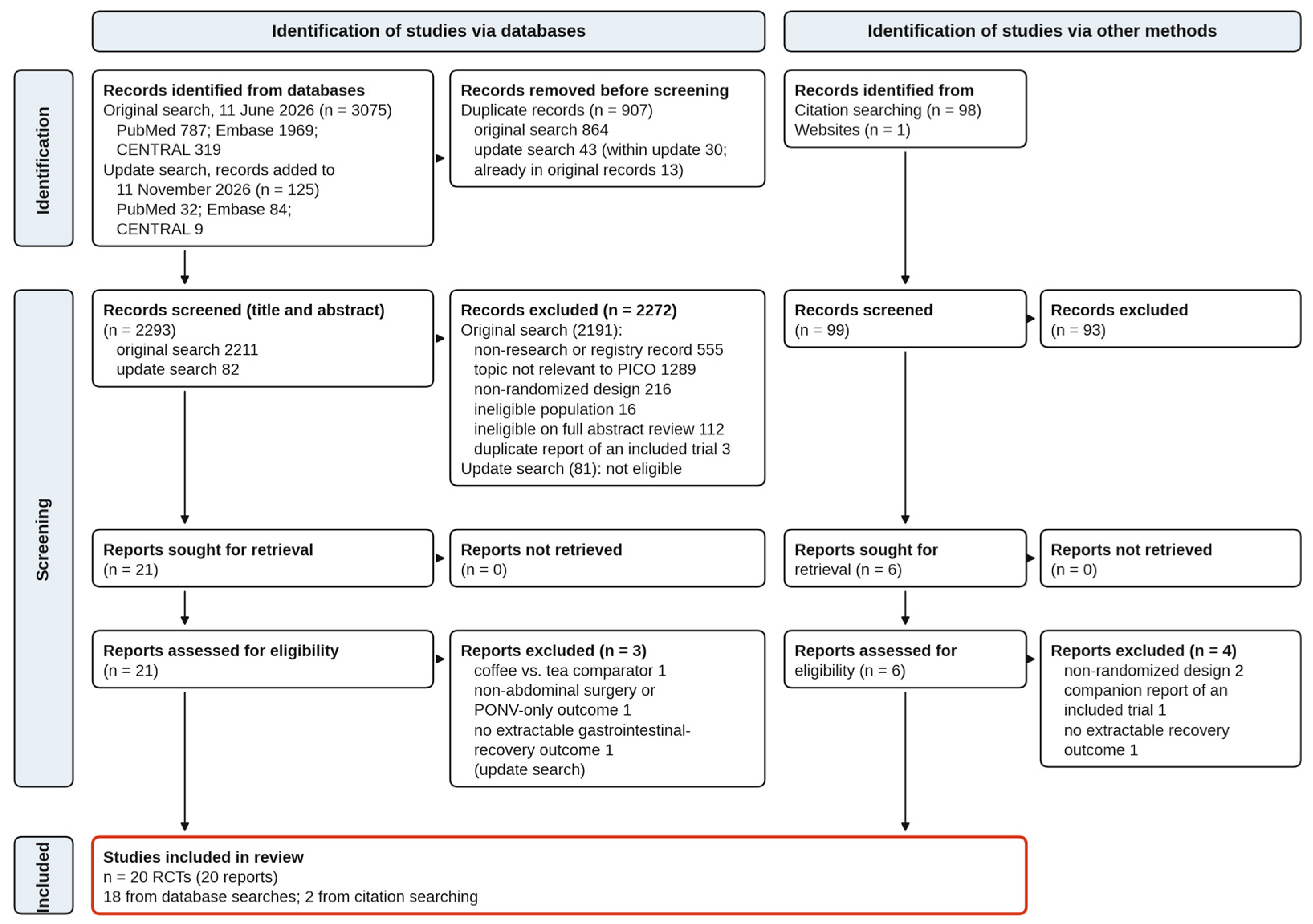
The search identified 3075 records; after the removal of 864 duplicates, 2211 titles and abstracts were screened, of which 2191 were excluded, leaving 20 full-text reports for eligibility assessment. Two reports were excluded (one comparing coffee with tea, one without an eligible abdominal gastrointestinal-recovery outcome), yielding 18 RCTs. The updated search added 82 records after de-duplication, and its one full-text report was excluded for lacking an extractable gastrointestinal-recovery outcome. Citation tracking and web searching identified six further reports, of which two RCTs were eligible [22,27], giving 20 included RCTs (Figure 1). The trials were conducted across Europe, the Middle East, South Asia, East and Southeast Asia, and North America, and spanned colorectal and small-bowel surgery (six trials), cesarean delivery (nine trials), and gynecologic surgery (five trials); the colorectal subgroup comprised the colorectal and small-bowel trials. Most evaluated caffeinated coffee against water or usual care. Two trials compared decaffeinated coffee alone with control, and two three-arm trials included a decaffeinated arm; these comparisons formed the prespecified decaffeinated subgroup, which reached three trials only for time to first stool (Section 3.2). Study characteristics are summarized in Table 1. Registry searching identified 14 registered trials of coffee or caffeine for postoperative gastrointestinal recovery that were recorded as completed or terminated, but for which no results had been posted and no publication was identified, including four of the trials listed as ongoing in the 2021 review [28]; three further trials listed as ongoing in that review have since been published and are included here.
3.2. Time to First Stool (Primary Outcome)
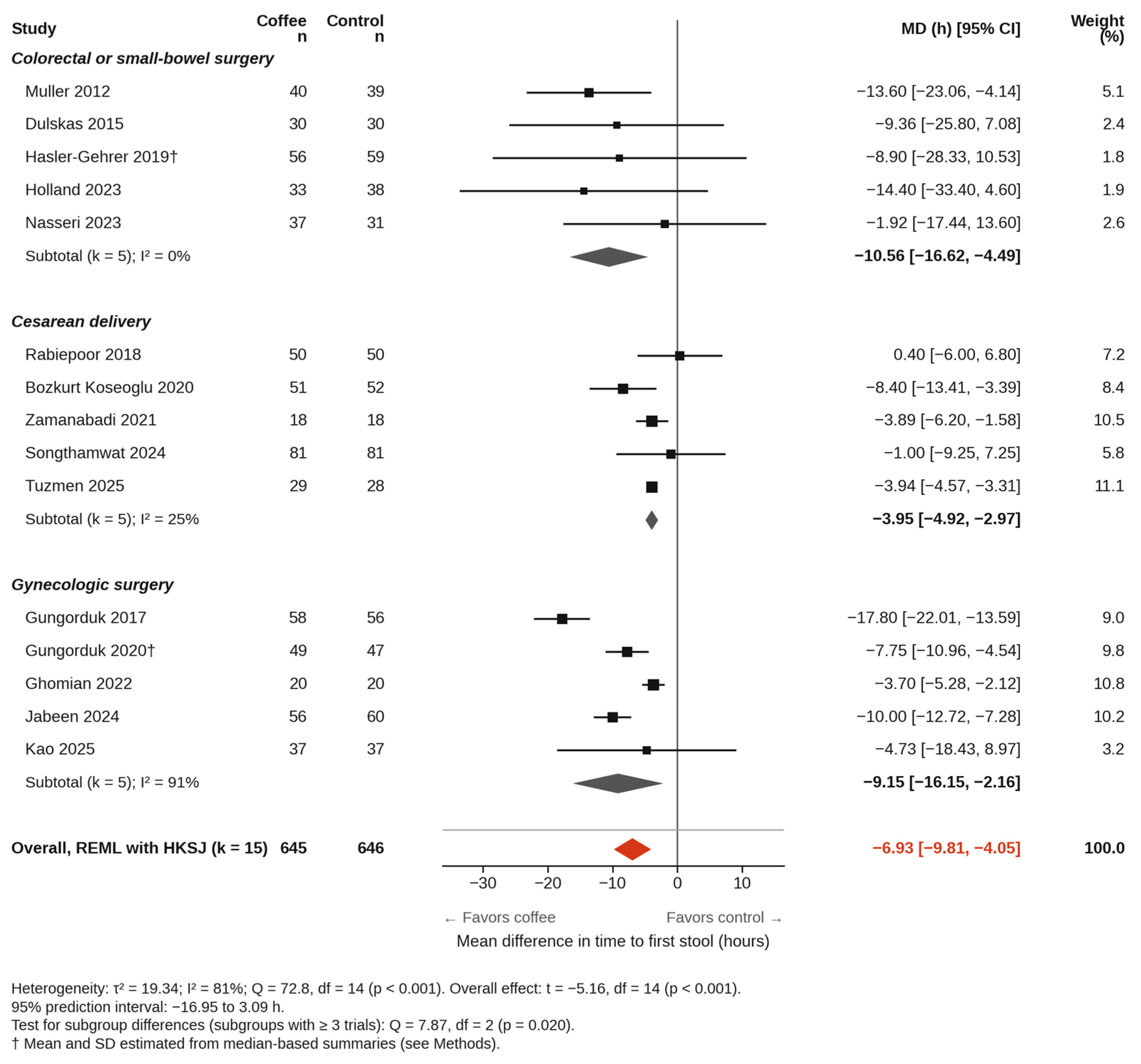
Fifteen trials (1291 participants) reported time to first stool; thirteen reported means with standard deviations and two required conversion from medians. Postoperative coffee shortened time to first bowel movement by a mean of 6.93 h (95% CI −9.81 to −4.05; p < 0.001), with substantial heterogeneity (I2 = 81%, REML tau2 = 19.3; Figure 2) and a 95% prediction interval of −16.95 to 3.09 h that crossed the null. The effect was directionally consistent and statistically robust across sensitivity analyses: DerSimonian–Laird pooling gave −6.83 h (95% CI −9.05 to −4.62), leave-one-out estimates ranged from −7.48 to −5.67 h, and restriction to the 11 trials not at high risk of bias gave −7.46 h (95% CI −10.80 to −4.12) (Figure S1). A prespecified, exploratory surgery-type subgroup analysis suggested a larger effect after colorectal surgery (−10.56 h, 95% CI −16.62 to −4.49) and gynecologic surgery (−9.15 h, 95% CI −16.15 to −2.16) than after cesarean delivery (−3.95 h, 95% CI −4.92 to −2.97); the test for subgroup difference gave p = 0.02. This test was one of several across outcomes, involved small subgroups (five trials each), and was not adjusted for multiplicity; heterogeneity within the gynecologic subgroup was high (I2 = 91%), and its interval excluded no effect only when Jabeen 2024 [27] was included. The Egger test showed no evidence of small-study effects (p = 0.10) (Figure S2). In post hoc analyses, restricting to the 13 trials that reported means with standard deviations, and thus excluding the two trials whose values were reconstructed from medians, gave a similar estimate (MD −6.81 h, 95% CI −10.18 to −3.44; I2 = 83%). Restricting to the 11 trials that used a volume-matched beverage comparator produced a smaller but far more homogeneous estimate (MD −4.72 h, 95% CI −6.93 to −2.50; I2 = 25%), whereas the four trials comparing coffee with usual care or no intervention were highly heterogeneous and imprecise (MD −9.84 h, 95% CI −19.07 to −0.62; I2 = 95%), indicating that a substantial part of the heterogeneity in this outcome is attributable to how the control condition was constituted. In the prespecified decaffeinated subgroup (three trials, 172 participants), the pooled estimate was imprecise and included no effect (MD −11.41 h, 95% CI −42.18 to 19.36; I2 = 78%).
Figure 1.
PRISMA 2020 flow diagram of study identification, screening, eligibility assessment, and inclusion.
3.3. Time to First Flatus (Primary Outcome)
Fourteen trials (1239 participants) reported time to first flatus; ten reported means directly and four required conversion from medians. The pooled estimate favored coffee but did not reach significance under the prespecified model (MD −3.19 h, 95% CI −6.51 to 0.13; p = 0.06), with very high heterogeneity (I2 = 93%; Figure 3) and a wide prediction interval (−14.12 to 7.75 h). The point estimate was similar under DerSimonian–Laird pooling (−3.18 h, 95% CI −6.16 to −0.20) and after excluding high-risk trials (−3.29 h, 95% CI −6.54 to −0.04), with intervals that narrowly excluded no effect. Leave-one-out point estimates ranged from −4.34 to −2.43 h (Figure S3); the interval excluded no effect only when one of the two minimally invasive colorectal trials in which the coffee group had a longer time to flatus was omitted, and omitting the larger of these reduced I2 to 76%, so the pooled flatus estimate should be read with caution given this heterogeneity. No subgroup difference by surgery type was detected (p = 0.46), and the Egger test was not significant (p = 0.51) (Figure S4). In a post hoc analysis restricted to the ten trials reporting means with standard deviations, the pooled estimate reached nominal significance (MD −5.00 h, 95% CI −7.70 to −2.30; I2 = 75%); because this analysis omits four trials and was not prespecified, it is regarded as exploratory and does not establish an effect on flatus. Among the 11 trials using a volume-matched beverage comparator, the estimate remained non-significant (MD −1.88 h, 95% CI −5.62 to 1.85; I2 = 92%). Excluding the two trials identified by citation tracking gave −2.66 h (95% CI −6.63 to 1.31; Table S2).
Figure 2.
Forest plot of the mean difference in time to first stool (hours) for coffee versus control [8,9,10,12,13,15,16,18,19,21,23,24,25,26,27]. Squares are study estimates sized by random-effects weight; horizontal lines are 95% confidence intervals; gray diamonds are subgroup estimates by surgery type; the red diamond is the overall pooled estimate (REML random-effects with the Hartung–Knapp–Sidik–Jonkman adjustment, k = 15). Negative values favor coffee. † Mean and SD estimated from median-based summaries.
3.4. Secondary Outcomes
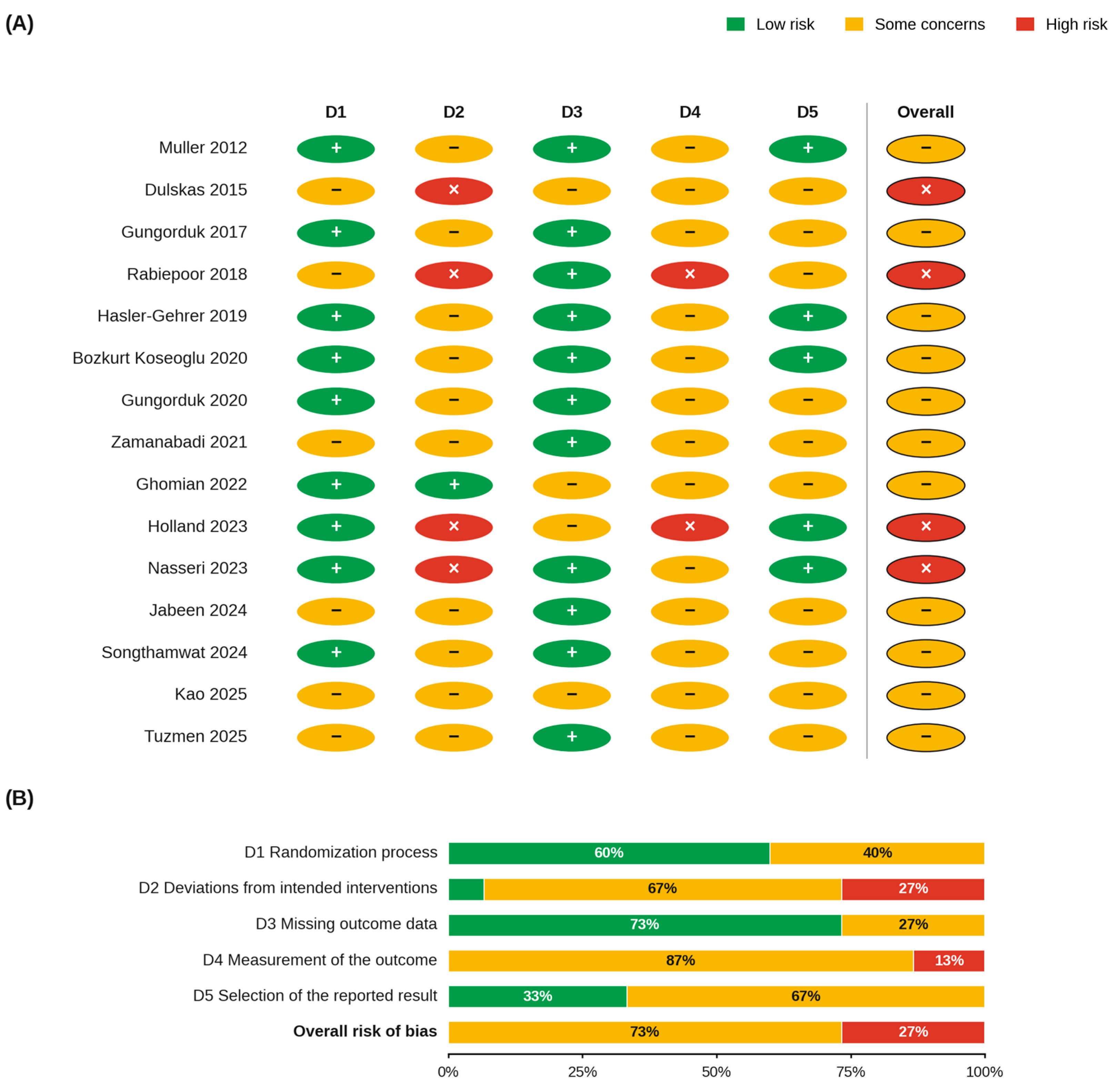
Under the prespecified model, only length of hospital stay reached nominal statistical significance, and that result was not robust. Postoperative ileus was reported by four trials (412 participants); coffee was associated with a lower risk that did not reach significance (RR 0.41, 95% CI 0.14 to 1.25; p = 0.085; I2 = 60%) (Figure S5). A Mantel–Haenszel estimate was narrower and significant (RR 0.43, 95% CI 0.29 to 0.64), but, with only four trials, this estimate rests on a different modeling assumption, is shown for completeness, and does not change the prespecified conclusion that the effect on ileus was not established. Time to tolerance of solid diet (five trials, 554 participants) favored coffee without reaching significance (MD −13.11 h, 95% CI −33.12 to 6.90; I2 = 91%; prediction interval −66.5 to 40.2 h) (Figure S6). Length of hospital stay (ten trials, 961 participants) was shorter with coffee (MD −0.57 days, 95% CI −1.12 to −0.02; p = 0.04; I2 = 95%; prediction interval −1.91 to 0.77 days) (Figure S7). This estimate depended on Jabeen 2024 [27], whose small standard deviations (5.6 to 7.8 h for mean stays of 72 and 101 h) gave it a large weight (14%); without it, the estimate was −0.41 days (95% CI −0.94 to 0.11), and significance was also lost when any one of five other trials was omitted (Figure S11). The Egger test showed no small-study effects (p = 0.38; Figure S10). Postoperative nausea and vomiting (four trials, 328 participants) did not differ (RR 0.68, 95% CI 0.15 to 2.98) (Figure S8). Adverse events (six trials, 439 participants) showed no signal of harm and low heterogeneity (RR 0.84, 95% CI 0.50 to 1.43; I2 = 19%) (Figure S9), although the confidence interval does not exclude a moderate increase. Outcome-specific risk-of-bias judgments for every outcome are provided in Table S1; risk-of-bias judgments for the primary outcome and GRADE certainty are summarized in the RoB 2 figure (Figure 4), which combines the per-study traffic-light plot with the domain summary, and in Table 2. Certainty was low for time to first stool and for adverse events and very low for the remaining outcomes, downgraded mainly for risk of bias from open-label designs, heterogeneity, and imprecision.
Figure 3.
Forest plot of the mean difference in time to first flatus (hours) for coffee versus control (REML with HKSJ, k = 14) [8,10,12,13,15,16,18,19,22,23,24,25,26,27]. Squares are study estimates sized by random-effects weight; horizontal lines are 95% confidence intervals; gray diamonds are subgroup estimates by surgery type; the red diamond is the overall pooled estimate. Negative values favor coffee. † Mean and SD estimated from median-based summaries.
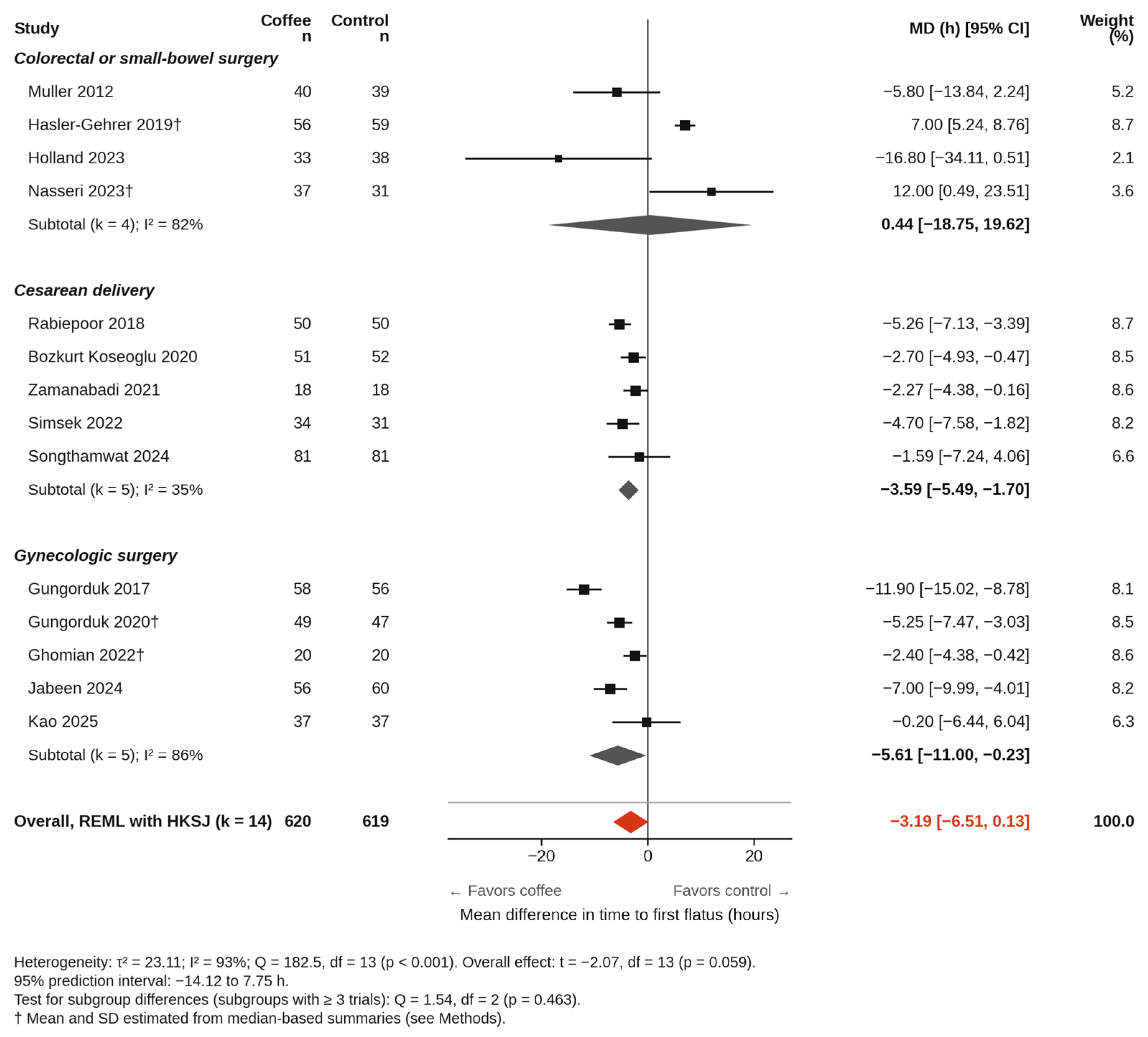
Figure 4.
Risk of bias (RoB 2) for the primary outcome, time to first stool [8,9,10,12,13,15,16,18,19,21,23,24,25,26,27]. (A) Traffic-light plot showing the judgment for each trial across the five RoB 2 domains (D1–D5) and the overall judgment. (B) Proportion of trials with each judgment for each domain and overall (unweighted). Green (+), low risk; yellow (−), some concerns; red (×), high risk.
4. Discussion
In this cross-specialty meta-analysis of 20 randomized trials, postoperative coffee consistently brought forward the first bowel movement, by approximately 6.9 h, after abdominal surgery, a finding stable across alternative estimators, leave-one-out omission, and restriction to lower-risk trials. Against a baseline time to first stool typically measured in days, a 6.9 h acceleration is statistically significant but of modest absolute magnitude; no minimal clinically important difference is established for this endpoint, so its patient-level importance is inferred rather than benchmarked, and the prediction interval indicates that the effect in a new setting could be null. The effect on time to first flatus pointed in the same direction but did not reach significance once the conservative HKSJ adjustment and very high heterogeneity were accounted for. Coffee was not associated with a clear increase in reported adverse events, with low heterogeneity for that outcome, although the small sample cannot exclude a moderate increase and safety remains incompletely characterized. Signals toward fewer episodes of postoperative ileus and earlier solid-diet tolerance were not established under the prespecified model, and the nominal reduction in hospital stay was fragile and of very low certainty. An earlier first bowel movement matters to patients mainly if it permits earlier feeding or discharge, which these trials did not show robustly; within ERAS pathways, where oral intake resumes early, a gain of a few hours is unlikely by itself to change discharge planning or costs.
The biological rationale for these findings is reasonably well grounded. Coffee stimulates gastrointestinal motility through several proposed mechanisms: caffeine promotes colonic contractile activity [6], while non-caffeine constituents such as chlorogenic acids and the stimulation of gastrin and cholecystokinin release may augment the gastrocolic reflex [7]. That decaffeinated coffee has accelerated bowel recovery in some trials hints that the effect is not attributable to caffeine alone; however, the pooled decaffeinated comparison rested on three small trials, was imprecise, and included no effect, so non-caffeine mediation remains a hypothesis. Conceptually, coffee joins other simple prokinetic adjuncts within ERAS (such as chewing gum and early oral feeding [31]) that aim to re-establish coordinated motility without pharmacologic risk, and its low cost and acceptability make it attractive where more expensive agents are impractical.
Pooling across specialties also permits the examination of whether benefit is uniform, an analysis the 2021 review likewise undertook [28]. For time to first stool, the effect appeared larger after colorectal and gynecologic surgery than after cesarean delivery, directionally consistent with that earlier review. This pattern is clinically plausible: bowel manipulation and the longer baseline recovery after intra-abdominal resection leave more room for a prokinetic effect than the comparatively rapid recovery after cesarean section, where the achievable absolute gain is correspondingly smaller. Because the subgroup test (p = 0.02) was one of several unadjusted comparisons, rested on small subgroups and partly on converted medians, did not extend to flatus, and depended for the gynecologic subgroup on a single recently identified trial, this signal should be regarded as hypothesis-generating rather than definitive. In our data, the type of comparator explained heterogeneity more effectively than the type of operation: restricting to volume-matched beverage controls reduced I-squared from 81% to 25%, suggesting that how the control condition was constituted matters at least as much as which procedure was performed.
The postoperative-ileus result deserves specific comment, as it is the most clinically salient secondary outcome. The prespecified model did not establish a reduction (RR 0.41, p = 0.085), whereas the Mantel–Haenszel estimate was significant (RR 0.43, 95% CI 0.29 to 0.64). With only four trials and 412 participants, few events, and very low certainty, these data are best read as an unconfirmed signal: the direction is consistently favorable, but the current evidence does not establish coffee as an effective intervention for preventing postoperative ileus, and an adequately powered trial with a prespecified ileus definition is needed to resolve it.
Our findings qualify rather than confirm prior work. The 2021 abdominal-surgery meta-analysis concluded that coffee reduces postoperative ileus and shortens hospital stay, and it examined surgery-type subgroups [28]; subsequent dedicated syntheses were each restricted to a single specialty [29,30], one of which also incorporated non-randomized studies, and a 2023 network meta-analysis ranked coffee among prokinetic measures rather than providing an updated randomized synthesis [31]. Restricting the evidence to randomized trials, extending the search to 2026, and estimating effects under REML with the HKSJ adjustment, we did not confirm those earlier positive conclusions: the reduction in postoperative ileus (RR 0.41, 95% CI 0.14 to 1.25) was not established, the reduction in length of stay (MD −0.57 days, 95% CI −1.12 to −0.02) was fragile and of very low certainty, and only the earlier first bowel movement persisted across analyses, at low certainty. Part of this divergence is methodological rather than empirical, since wider intervals follow from the conservative model and from excluding non-randomized data; we therefore frame these results as a more cautious reading of largely the same literature rather than as evidence that coffee is ineffective. For practice, these data are compatible with allowing postoperative coffee for patients who tolerate oral intake and wish to drink it, with the strongest evidence for an earlier first bowel movement (low certainty, with a prediction interval that does not exclude a null effect), with safety incompletely characterized, and with realistic expectations about the uncertain effect on length of stay; they do not support recommending coffee as a routine component of ERAS pathways. Whether coffee adds incremental benefit over established ERAS measures has not been directly tested.
The divergence between the primary and sensitivity models for flatus and ileus reflects a deliberate methodological choice. We prespecified REML with the HKSJ adjustment because, with few and heterogeneous trials, the DerSimonian–Laird and fixed-effect Mantel–Haenszel estimators rest on different modeling assumptions and typically yield narrower intervals; the wider HKSJ intervals are the more conservative summary, and the loss of significance for these outcomes under it should temper enthusiasm rather than be read as absence of any effect. Heterogeneity was high for most continuous outcomes. Beyond surgery type and comparator, trials differed in coffee dose (from one 100 mL cup containing 50 mg of caffeine to three 150 mL cups daily), timing of the first dose, background perioperative care, and outcome definitions; with few trials per stratum, these factors could not be separated, so the pooled estimates are averages across heterogeneous settings.
This study has several limitations. First, most trials were unavoidably open-label, because coffee cannot be fully masked, and several endpoints were patient-reported times; the resulting risk of performance and detection bias places most of the evidence at some concerns or high risk of bias and lowered GRADE certainty. Second, many trials reported medians with ranges or interquartile ranges, which we converted under approximate-normality assumptions; converted standard deviations are imprecise, and the pooled confidence intervals do not propagate this conversion uncertainty, a concern for skewed recovery-time distributions. Third, several trials did not report a usable measure of dispersion and could not be pooled, reducing power. Fourth, the number of trials per secondary outcome and within subgroups was small, so subgroup and small-study-effect analyses are underpowered and exploratory; publication bias could be formally examined only for the two primary outcomes and length of stay and remains unassessed for the other secondary outcomes. Fifth, dose, timing, and adherence were inconsistently reported, precluding any dose–response synthesis, and patient-centered outcomes such as readmission, functional recovery, and satisfaction were rarely reported. Sixth, the trials were conducted in elective settings across a limited set of regions, so generalizability to emergency, high risk, or other populations is uncertain; no trial involved gastric, bariatric, or other upper gastrointestinal surgery, after which reduced gastrin-producing mucosa and the risk of mucosal irritation could alter both the effect and the tolerability of coffee. Seventh, statistical and clinical heterogeneity was substantial, and the prediction intervals indicate that the effect in a new setting could plausibly be null, so point estimates should be applied cautiously to any individual procedure. Finally, registry searching identified 14 completed or terminated trials of coffee or caffeine for postoperative gastrointestinal recovery for which no results had been posted and no publication could be identified, four of them already listed as ongoing in the 2021 review [28]. Selective non-reporting on this scale means the published literature may overstate benefit, and formal small-study-effect testing was possible only for three outcomes; with small, predominantly positive trials, the pooled estimates may overstate the true effect, and Egger tests have limited power with 10 to 15 trials. Two trials identified only by citation tracking were published in non-indexed journals without reported registration; excluding them changed the conclusion only for length of stay, which lost its nominal significance (Table S2). In addition, because no minimal clinically important difference is established for time to first stool, the GRADE imprecision judgment rests on the optimal information size rather than on a clinical threshold, so the clinical importance of a 6.9 h acceleration, as distinct from its statistical precision, remains uncertain.
5. Conclusions
Across 20 randomized trials of abdominal surgery, postoperative coffee accelerated the return of the first bowel movement by roughly 6.9 h, and by approximately 4.7 h when restricted to trials using volume-matched beverage controls; this estimate carries low certainty and its prediction interval includes no effect. Reported adverse events were not increased, although safety remains incompletely characterized. The evidence does not establish coffee as an effective intervention for preventing postoperative ileus, and the apparent reduction in hospital stay was fragile. Coffee may be offered to patients who wish to drink it, but these data do not support routine use within ERAS pathways, where its incremental benefit is unproven; adequately powered blinded trials with standardized outcome definitions and complete reporting are needed to resolve its effect on clinically important endpoints.
Supplementary Materials
The following supporting information can be downloaded at https://www.mdpi.com/article/10.3390/nu18223846/s1 and https://doi.org/10.5281/zenodo.23531461. Section S1: Complete search strategies for PubMed (MEDLINE), Embase, and Cochrane CENTRAL, including the November 2026 update; Section S2: Citation tracking and update-search screening; Section S3: Computational implementation and verification of the meta-analysis; Table S1: Outcome-specific risk-of-bias (RoB 2) judgments for all outcomes; Table S2: Post hoc sensitivity analyses; Table S3: Reports assessed in full text after the original submission (update search, citation tracking, and web searching). Figure S1: Leave-one-out sensitivity analysis for time to first stool; Figure S2: Funnel plot for time to first stool; Figure S3: Leave-one-out sensitivity analysis for time to first flatus; Figure S4: Funnel plot for time to first flatus; Figure S5: Forest plot of postoperative ileus; Figure S6: Forest plot of time to tolerance of solid diet; Figure S7: Forest plot of length of hospital stay; Figure S8: Forest plot of postoperative nausea and vomiting; Figure S9: Forest plot of adverse events; Figure S10: Funnel plot for length of hospital stay; Figure S11: Leave-one-out sensitivity analysis for length of hospital stay.
Author Contributions
Conceptualization, S.-j.C. and G.C.; methodology, S.-j.C. and G.C.; software, S.-j.C.; validation, S.-j.C. and G.C.; formal analysis, S.-j.C.; investigation, S.-j.C. and G.C.; data curation, S.-j.C. and G.C.; writing (original draft preparation), S.-j.C.; writing (review and editing), G.C.; visualization, S.-j.C.; supervision, S.-j.C. All authors have read and agreed to the published version of the manuscript.
Funding
This research received no external funding.
Institutional Review Board Statement
Not applicable. This systematic review is a secondary analysis of previously published, aggregate data and did not involve new studies of human participants or animals performed by the authors.
Informed Consent Statement
Not applicable.
Data Availability Statement
The extracted dataset, the complete Python analysis code that reproduces every pooled estimate reported here, and the Supplementary Materials are openly available on Zenodo at https://doi.org/10.5281/zenodo.23531461.
Acknowledgments
During the preparation of this manuscript, the authors used a generative artificial intelligence tool (Claude Opus 4.8, Anthropic) for the purposes of formatting author-extracted data into tables, assisting with the writing and debugging of the Python analysis scripts, and language editing of author-written drafts, as described in Section 2.6. The authors have reviewed and edited the output and take full responsibility for the content of this publication. The authors received no writing, editorial, or technical assistance from any other person.
Conflicts of Interest
The authors declare no conflicts of interest.
References
- Venara, A.; Neunlist, M.; Slim, K.; Barbieux, J.; Colas, P.A.; Hamy, A.; Meurette, G. Postoperative ileus: Pathophysiology, incidence, and prevention. J. Visc. Surg. 2016, 153, 439–446. [Google Scholar] [CrossRef] [Scilit] [PubMed]
- Mazzotta, E.; Villalobos-Hernandez, E.C.; Fiorda-Diaz, J.; Harzman, A.; Christofi, F.L. Postoperative Ileus and Postoperative Gastrointestinal Tract Dysfunction: Pathogenic Mechanisms and Novel Treatment Strategies Beyond Colorectal Enhanced Recovery After Surgery Protocols. Front. Pharmacol. 2020, 11, 583422. [Google Scholar] [CrossRef] [Scilit] [PubMed]
- Abad-Gurumeta, A.; Gómez-Ríos, M.Á. Postoperative ileus. What cannot be cured must be endured? Minerva Anestesiol. 2023, 89, 125–127. [Google Scholar] [CrossRef] [Scilit] [PubMed]
- Gustafsson, U.O.; Scott, M.J.; Hubner, M.; Nygren, J.; Demartines, N.; Francis, N.; Rockall, T.A.; Young-Fadok, T.M.; Hill, A.G.; Soop, M.; et al. Guidelines for Perioperative Care in Elective Colorectal Surgery: Enhanced Recovery After Surgery (ERAS®) Society Recommendations: 2018. World J. Surg. 2019, 43, 659–695. [Google Scholar] [CrossRef] [Scilit] [PubMed]
- Pleticha, J.; Niesen, A.D.; Kopp, S.L.; Johnson, R.L. Caffeine supplementation as part of enhanced recovery after surgery pathways: A narrative review of the evidence and knowledge gaps. Can. J. Anaesth. 2021, 68, 876–879. [Google Scholar] [CrossRef] [Scilit] [PubMed]
- Rao, S.S.; Welcher, K.; Zimmerman, B.; Stumbo, P. Is coffee a colonic stimulant? Eur. J. Gastroenterol. Hepatol. 1998, 10, 113–118. [Google Scholar] [CrossRef] [Scilit] [PubMed]
- Boekema, P.J.; Samsom, M.; van Berge Henegouwen, G.P.; Smout, A.J. Coffee and gastrointestinal function: Facts and fiction: A review. Scand. J. Gastroenterol. 1999, 34, 35–39. [Google Scholar] [CrossRef] [Scilit] [PubMed]
- Müller, S.A.; Rahbari, N.N.; Schneider, F.; Warschkow, R.; Simon, T.; von Frankenberg, M.; Bork, U.; Weitz, J.; Schmied, B.M.; Büchler, M.W. Randomized clinical trial on the effect of coffee on postoperative ileus following elective colectomy. Br. J. Surg. 2012, 99, 1530–1538. [Google Scholar] [CrossRef] [Scilit] [PubMed]
- Dulskas, A.; Klimovskij, M.; Vitkauskiene, M.; Samalavicius, N.E. Effect of Coffee on the Length of Postoperative Ileus After Elective Laparoscopic Left-Sided Colectomy: A Randomized, Prospective Single-Center Study. Dis. Colon Rectum 2015, 58, 1064–1069. [Google Scholar] [CrossRef] [Scilit] [PubMed]
- Hasler-Gehrer, S.; Linecker, M.; Keerl, A.; Slieker, J.; Descloux, A.; Rosenberg, R.; Seifert, B.; Nocito, A. Does Coffee Intake Reduce Postoperative Ileus After Laparoscopic Elective Colorectal Surgery? A Prospective, Randomized Controlled Study: The Coffee Study. Dis. Colon Rectum 2019, 62, 997–1004. [Google Scholar] [CrossRef] [Scilit] [PubMed]
- Hayashi, K.; Tsunoda, A.; Shiraishi, A.; Kusanagi, H. Quantification of the effects of coffee on postoperative ileus after laparoscopic ventral rectopexy: A randomized controlled trial. Eur. Surg. 2019, 51, 325–332. [Google Scholar] [CrossRef] [Scilit]
- Nasseri, Y.; Kasheri, E.; Oka, K.; Zhu, R.; Smiley, A.; Cohen, J.; Ellenhorn, J.; Barnajian, M. Does coffee affect bowel recovery following minimally invasive colorectal operations? A three-armed randomized controlled trial. Int. J. Colorectal Dis. 2023, 38, 199. [Google Scholar] [CrossRef] [Scilit] [PubMed]
- Holland, C.; Shaffer, L.; Dobkin, E.; Hall, J. Coffee administration to promote return of bowel function after small bowel resection: A randomized, controlled trial. Am. J. Surg. 2023, 226, 156–160. [Google Scholar] [CrossRef] [Scilit] [PubMed]
- Göymen, A.; Şimşek, Y.; Özkaplan, Ş.E.; Özdurak, H.İ.; Akpak, Y.K.; Semiz, A.; Oral, S. Effect of Gum Chewing and Coffee Consumption on Intestinal Motility in Caesarean Sections. J. Clin. Anal. Med. 2017, 8, 411–415. [Google Scholar] [CrossRef] [Scilit]
- Rabiepoor, S.; Yas, A.; Navaei, J.; Khalkhali, H.R. Does coffee affect the bowel function after caesarean section? Eur. J. Obstet. Gynecol. Reprod. Biol. 2018, 220, 96–99. [Google Scholar] [CrossRef] [Scilit] [PubMed]
- Bozkurt Koseoglu, S.; Korkmaz Toker, M.; Gokbel, I.; Celikkol, O.; Gungorduk, K. Can coffee consumption be used to accelerate the recovery of bowel function after cesarean section? Randomized prospective trial. Ginekol. Pol. 2020, 91, 85–90. [Google Scholar] [CrossRef] [Scilit] [PubMed]
- Kanza Gül, D.; Şolt Kırca, A. Effects of acupressure, gum chewing and coffee consumption on the gastrointestinal system after caesarean section under spinal anaesthesia. J. Obstet. Gynaecol. 2021, 41, 573–580. [Google Scholar] [CrossRef] [Scilit] [PubMed]
- Zamanabadi, M.N.; Alizadeh, R.; Gholami, F.; Seyed Mehdi, S.A.; Aryafar, M. Effect of caffeine on postoperative bowel movement and defecation after cesarean section. Ann. Med. Surg. 2021, 68, 102674. [Google Scholar] [CrossRef] [Scilit] [PubMed]
- Songthamwat, M.; Jirawongprapa, Y.; Chotboon, C.; Summart, U.; Songthamwat, S. Effect of a 50 mg caffeine coffee intake on bowel function recovery in postoperative cesarean delivery patients: A randomized controlled trial. J. Med. Assoc. Thail. 2024, 107, 685–689. [Google Scholar] [CrossRef] [Scilit]
- Vafaei, N.; Panahi, R.; Mokhtari, M.; Rezaei, M.; Mokhtari, A.; Amjadian, M. Assessment of Coffee Consumption on Post-Cesarean Section Bowel Movements. J. Obstet. Gynecol. India 2024, 74, 530–535. [Google Scholar] [CrossRef] [Scilit] [PubMed]
- Tüzmen, H.D.; Yüksel, H.; Yazar, M.; Sayar, S.; Horasanlı, J.E. The effect of coffee consumption on postoperative pain and bowel motility following cesarean section: A randomized controlled trial. Eur. J. Obstet. Gynecol. Reprod. Biol. 2025, 314, 114723. [Google Scholar] [CrossRef] [Scilit] [PubMed]
- Yuksel Simsek, S.; Serbetcioglu, G.; Simsek, E.; Alemdaroglu, S.; Atasoy Karaka, L.; Dogan Durdag, G.; Kalayci, H.; Aydin, S.; Celik, H. Turkish coffee effect on postcaesarean section bowel motility. Med. Sci. Int. Med. J. 2022, 11, 651–655. [Google Scholar] [CrossRef] [Scilit]
- Güngördük, K.; Özdemir, İ.A.; Güngördük, Ö.; Gülseren, V.; Gokçü, M.; Sancı, M. Effects of coffee consumption on gut recovery after surgery of gynecological cancer patients: A randomized controlled trial. Am. J. Obstet. Gynecol. 2017, 216, 145.e1–145.e7. [Google Scholar] [CrossRef] [Scilit] [PubMed]
- Gungorduk, K.; Paskal, E.K.; Demirayak, G.; Köseoğlu, S.B.; Akbaba, E.; Ozdemir, I.A. Coffee consumption for recovery of intestinal function after laparoscopic gynecological surgery: A randomized controlled trial. Int. J. Surg. 2020, 82, 130–135. [Google Scholar] [CrossRef] [Scilit] [PubMed]
- Ghomian, N.; Khadem-Rezaiyan, M.; Behnam-Rasooli, Z.; Zomorshidi, M. The effect of coffee consumption compared with the usual diet on bowel function recovery after abdominal hysterectomy: A double-blind randomized clinical trial. Iran. J. Obstet. Gynecol. Infertil. 2022, 25, 1–10. (In Persian) [Google Scholar]
- Kao, C.H.; Lu, Y.Y.; Liu, K.F.; Chang, C.L. Effects of coffee consumption on the recovery of gastrointestinal functions after gynecological laparotomy-a randomized controlled trial. Health Care Women Int. 2026, 47, 679–691. [Google Scholar] [CrossRef] [Scilit] [PubMed]
- Jabeen, M.; Yasmeen, T.; Riaz, L.; Parveen, N.; Raza, A.; Butt, F. Role of caffeine as a bowel stimulant after major gynecological surgeries. Ann. Abbasi Shaheed Hosp. Karachi Med. Dent. Coll. 2024, 29, 152–158. [Google Scholar] [CrossRef] [Scilit]
- Watanabe, J.; Miki, A.; Koizumi, M.; Kotani, K.; Sata, N. Effect of Postoperative Coffee Consumption on Postoperative Ileus after Abdominal Surgery: An Updated Systematic Review and Meta-Analysis. Nutrients 2021, 13, 4394. [Google Scholar] [CrossRef] [Scilit] [PubMed]
- Vaghiri, S.; Prassas, D.; David, S.O.; Knoefel, W.T.; Krieg, A. Caffeine intake enhances bowel recovery after colorectal surgery: A meta-analysis of randomized and non-randomized studies. Updates Surg. 2024, 76, 769–782. [Google Scholar] [CrossRef] [Scilit] [PubMed]
- Yao, X.; Han, D.; Lu, Q. Effect of postoperative coffee consumption on gastrointestinal function after cesarean section, a systematic review and meta-analysis of randomized controlled trials. BMC Public Health 2026, 26, 819. [Google Scholar] [CrossRef] [Scilit] [PubMed]
- Sinz, S.; Warschkow, R.; Tarantino, I.; Steffen, T. Gum Chewing and Coffee Consumption but not Caffeine Intake Improve Bowel Function after Gastrointestinal Surgery: A Systematic Review and Network Meta-analysis. J. Gastrointest. Surg. 2023, 27, 1730–1745. [Google Scholar] [CrossRef] [Scilit] [PubMed]
- Masoumi, S.; Shahraz, S. Meta-analysis using Python: A hands-on tutorial. BMC Med. Res. Methodol. 2022, 22, 193. [Google Scholar] [CrossRef] [Scilit] [PubMed]
- Röver, C.; Knapp, G.; Friede, T. Hartung-Knapp-Sidik-Jonkman approach and its modification for random-effects meta-analysis with few studies. BMC Med. Res. Methodol. 2015, 15, 99. [Google Scholar] [CrossRef] [Scilit] [PubMed]

Disclaimer/Publisher’s Note: The statements, opinions and data contained in all publications are solely those of the individual author(s) and contributor(s) and not of MDPI and/or the editor(s). MDPI and/or the editor(s) disclaim responsibility for any injury to people or property resulting from any ideas, methods, instructions or products referred to in the content. |
© 2026 by the authors. Licensee MDPI, Basel, Switzerland. This article is an open access article distributed under the terms and conditions of the Creative Commons Attribution (CC BY) license.