


Abstract
Background/Objectives: Effective nutritional care is a critical component of oncology treatment. Behaviour change techniques (BCTs) are key elements that drive individual behaviour change and are commonly identified within clinical interventions and implementation strategies. Despite their relevance, the application of BCTs in oncology nutrition has not been systematically examined. This systematic review aimed to identify and synthesise the use of BCTs in nutrition interventions and their implementation strategies within adult oncology care. Methods: A search across 10 electronic databases was conducted from inception up to December 2024. Data extraction focused on intervention characteristics, plus implementation barriers, strategies, and outcomes, which were coded using relevant established taxonomies, i.e., Theoretical Domains Framework, Behaviour Change Techniques, and Proctor’s outcomes framework. Study quality was assessed using the QuADS tool. Results: After screening 4055 abstracts and 165 full texts, 38 articles representing 31 unique studies were included. Nutrition interventions (n = 31) spanned across risk screening/assessment, care planning/pathways, nutritional monitoring, and support guidelines. Among the 19 interventions that incorporated BCTs targeting patients and/or healthcare professionals (HCPs), 20 unique BCTs were identified across 97 instances. Separately, implementation strategies reported in 25 of the 38 articles included 96 BCT instances (18 unique) targeting HCPs. BCTs were frequently observed alongside positive outcomes across patient, service, and implementation levels. Conclusions: Application of BCTs in oncology nutrition practice remains implicit and inconsistent. For clinical practice, more explicit specifications of BCTs may support better integration of nutrition care in routine oncology settings. Future research is warranted to test the effectiveness of specific BCTs and their combinations. This can be supported by standardised reporting of intervention content and implementation strategies which can enable identification of patterns of success and optimise replicability.
1. Introduction
Cancer remains a leading cause of mortality worldwide, with over 35 million new cases projected in 2050, representing a 77% increase from the close to 20 million cases in 2022 [1]. While high-income countries are expected to experience the greatest absolute increase in cancer incidence, the most dramatic proportional rises are anticipated in low- and middle-income countries, where healthcare resources are often most limited [2]. This growing burden underscores the urgent need for scalable and cost-effective strategies to improve cancer care outcomes globally [3].
Malnutrition is highly prevalent among oncology patients and is associated with poorer treatment outcomes, reduced quality of life, and increased mortality [4]. In response, nutrition interventions, such as risk assessment and screening, care plans and pathways, nutritional monitoring, and adherence to evidence-based guidelines, are increasingly recognised as essential components of comprehensive cancer care, yet their integration into routine oncology practice remains limited [5].
Despite growing emphasis on nutritional care interventions, their implementation is often hindered by persistent barriers such as the absence of standardised guidelines, time constraints, and limited awareness among clinicians and patients [6]. Implementation science offers a structured approach to understanding and addressing these barriers, thereby supporting the successful integration of evidence-based practices [7]. Within this field, the Theoretical Domains Framework (TDF) [8] provides a systematic method for identifying and categorising implementation barriers [9]. Once these barriers are understood, targeted strategies can be developed to facilitate behaviour change among key actors, thereby enhancing the adoption of innovations and the effective translation of evidence into practice.
Behaviour change techniques (BCTs) are the active components of interventions designed to influence behaviour at the individual level [10]. They are used to address specific barriers faced by a given population (e.g., HCPs or patients). BCTs serve as building blocks for designing strategies that support both HCPs and patients in vital behaviour changes necessary for the successful uptake of novel interventions [11,12]. Despite the relevance of BCTs in the design and implementation of nutrition interventions, there is a lack of synthesis on how they are applied in oncology settings. Specifically, there is limited understanding of how BCTs are operationalised, which techniques are most effective, and whether they address known implementation barriers. Since these barriers can be coded using the TDF, we leveraged the TDF-BCT Theory and Techniques Tool to explore whether the observed sequence of change aligned with established behavioural mechanism.
This systematic review aimed to systematically identify, code, and synthesise evidence on the use of BCTs in nutrition interventions and their implementation as delivered in adult oncology care, using established theoretical frameworks to support analytical synthesis. The specific objectives were to:
- 1.
- Identify barriers faced by HCPs in implementing nutrition interventions, as reported in the literature, and code these barriers to the TDF;
- 2.
- Identify the BCTs used in nutrition interventions and their implementation strategies;
- 3.
- Identify associated outcomes at the patient, service, and implementation levels;
- 4.
- Explore how TDF-BCT linkages align with established mechanisms of behaviour change.
2. Materials and Methods
2.1. Design and Registration
This systematic review was conducted in accordance with the Preferred Reporting Items for Systematic Reviews and Meta-Analyses (PRISMA) guidelines [13]. The review protocol was registered prospectively in the PROSPERO database (CRD42023454210) [14]. A PRISMA checklist [13] was completed (Supplementary File S1).
2.2. Searches
A comprehensive search [15] was conducted across 10 electronic databases up to week 4, December 2024. These included: MEDLINE, AMED, APA PsychINFO, CINAHL, Embase, Emcare, ERIC, Joanna Briggs Institute (JBI), Ovid Nursing Database, Global Health and EBM Reviews: Cochrane Central Register of Controlled Trials. Search terms were developed in collaboration with a professional librarian to ensure comprehensive coverage of key concepts, including nutrition, cancer, and implementation.
2.3. Study Inclusion and Exclusion Criteria
Inclusion criteria included:
- Population: adults diagnosed with any type of cancer;
- Intervention: the implementation of nutrition interventions in routine clinical practice;
- Comparator: with or without a comparator group;
- Outcomes: implementation, service, and/or clinical outcomes;
- Study design/source: Range of methodologies including randomised control trials, quasi-experimental, retrospective controlled, observational, mixed-methods, qualitative, and implementation studies were included to enable a more comprehensive synthesis of evidence related to the implementation of nutrition interventions in cancer care.
Exclusion criteria included:
- Population: non-adult populations, cancer survivors, or individuals without cancer;
- Outcomes: lacking implementation components or relevant outcomes;
- Study design/source: Non-original research or studies without accessible full-texts, and editorials, reviews, letters and anecdotal reports, non-English language publications.
When protocol papers were identified, additional manual searches were conducted to locate subsequent publications reporting study outcomes. Reference lists of relevant review articles were also screened to identify further eligible studies.
The review process was managed using Covidence. Titles, abstracts, and full texts were screened independently by 2 reviewers (NCF, AL, FF, CR, HB), with disagreements resolved through discussion and/or consultation with a third reviewer. Inter-rater reliability was monitored throughout the screening process by comparing reviewer decisions and resolving discrepancies to ensure consistent application of eligibility criteria. For quality control, a random sample of 15 full text articles was independently reviewed by implementation science experts (AM and SL), with 100% agreement observed.
2.4. Study Quality Assessment
Study quality was assessed using the Quality Assessment with Diverse Studies (QuADS) tool [16]. Two independent reviewers scored each study (maximum score: 39). If scores differed by ≤5 points, an average was calculated; discrepancies >5 points were resolved through discussion.
2.5. Data Extraction Strategy
Following a similar approach to Morrow et al. [17], this review focused on identifying BCTs embedded within cancer-related nutrition interventions and within implementation strategies (i.e., strategies used to support the adoption of the nutrition interventions). Extracted data included study characteristics (design, sample size, setting, participants), intervention details, implementation barriers, strategies, and outcomes at the implementation, service, and patient levels. Generic data extraction was conducted by 1 reviewer and independently verified by a second. Extraction related to implementation science were performed by researchers with expertise in the field (SL, AM), while clinician researchers were responsible for extracting data related to clinical outcomes (NCF, AL, FF, CR, HB). Coding to the TDF, BCT Taxonomy v1 [18], and Proctor’s outcomes framework was conducted independently by reviewers (SL, AM). Discrepancies were resolved through discussion and, where necessary, consultation with a third reviewer (NT). To further ensure coding reliability, NT independently reviewed a random 10% sample of the coded data. The data extraction and coding template was developed and pilot tested using REDCap (Research Electronic Data Capture) [19] and Microsoft Excel [20] prior to application (SL, NCF).
2.6. Data Synthesis and Presentation
Data was synthesised using frequency counts and descriptive statistics. Where applicable, the TDF was used to categorise implementation barriers, with relevant domains and constructs selected based on study context [9]. BCTs embedded in interventions targeting patients and/or HCPs, and implementation strategies targeting HCPs, were identified and coded using established taxonomies [21]. A Sankey diagram was generated using SankeyMATIC [22] to visualise the spectrum of BCTs. Outcomes were categorised using Proctor’s framework into implementation, service, and patient-level outcomes [23], and were further classified as positive, neutral or negative based on author interpretation. BCTs linked to positive outcomes were examined in relation to their target populations, i.e., patients and/or HCPs.
To explore mechanistic pathways, full sequences of observed change were analysed in studies where BCTs were present in both intervention and implementation strategies and outcomes were reported at both implementation/service and patient levels. In addition, the TDF-BCT linkage tool [24] was used to map each BCT to corresponding TDF constructs, assessing whether observed linkages aligned with existing evidence or suggested novel associations.
3. Results
3.1. Study Characteristics
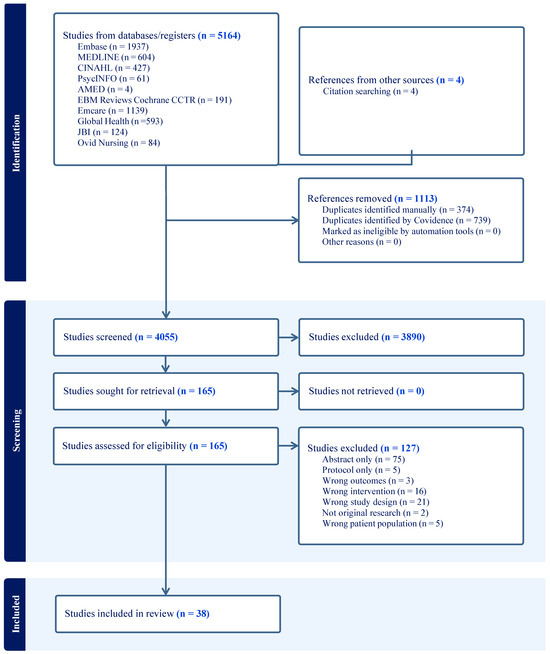
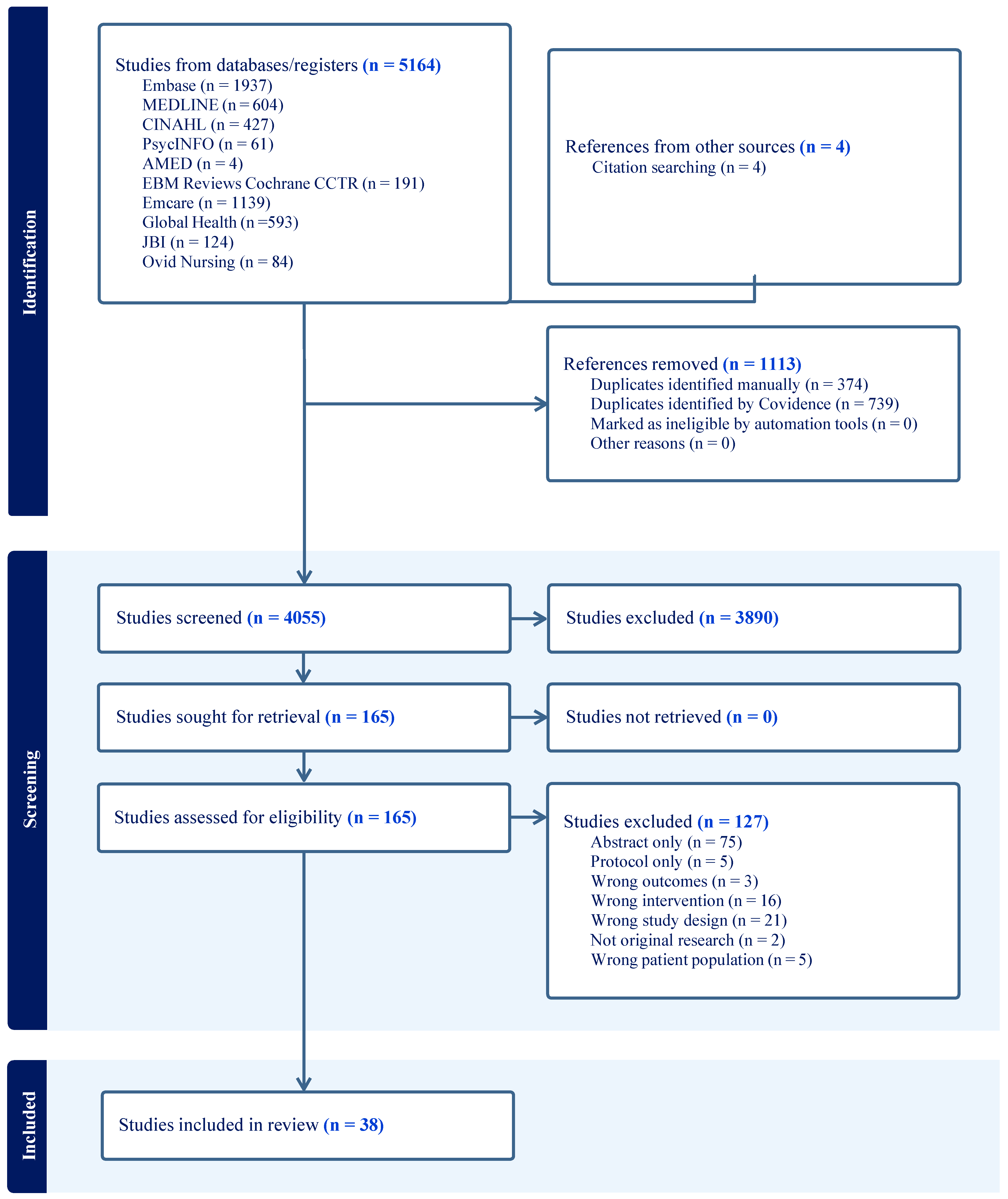
Table 1 provides an overview of the study characteristics. Of the 5168 records identified through the systematic search, 4055 abstracts met the inclusion criteria, and 165 records were screened at the full text level. A total of 38 full texts, derived from 31 unique studies, were included in the final review. The study selection process is presented in the PRISMA flow diagram (Figure 1). Across the 31 unique studies, the nutrition interventions implemented were categorised into 4 main types: risk screening/assessment (n = 5), care planning/pathways (n = 17), nutritional monitoring (n = 3), and support guidelines (n = 6).
Figure 1.
PRISMA flow diagram for study selection.
Most articles reported on studies conducted in Australia (n = 14), followed by the United States (n = 6), China (n = 5), France (n = 3), Singapore (n = 2), and the United Kingdom (n = 2). One article reported on separate studies conducted in Brazil, Croatia, Italy, Malaysia, Spain, and the Netherlands. Most articles focused on patient populations (n = 28). Nine articles addressed both HCP and patient perspectives [25,26,27,28,29,30,31,32,33], while 1 article specifically targeted oncologists [34]. The most common research design was pre-post (retrospective and prospective; n = 18), followed by RCTs (n = 7), including stepped-wedge and cluster-randomised designs. Other study designs included cross sectional, observational, and process evaluation studies. The risk of bias scores ranged from 25.5 (65%) to 37.5 (96%), with a median score of 31.5 (81%).
3.2. Barriers to Implementation (TDF)
Twenty-three articles (61%) explicitly reported barriers to the provision of nutritional care in oncology settings. Across these articles, 27 unique barriers were identified in a total of 62 instances and mapped to 11/14 domains of the TDF. A detailed breakdown is provided in Table 2.
The most frequently identified domain was ‘Environmental Context and Resources’, reported 39 times across 23 (61%) articles. This domain encompassed a range of systemic and logistical challenges that hinder effective nutritional care. Key barriers within this domain included a lack of standardised nutritional care guidelines and protocols, time constraints for clinicians, and inadequate resourcing.
The second most identified domain was ‘Knowledge,’ identified 9 times across 8 (21%) articles. Barriers within this domain highlighted critical gaps in both clinician and patient knowledge regarding nutritional care. Clinicians often lacked awareness of current nutritional care guidelines and procedures, whilst patients and their caregivers were uninformed about the importance of nutrition in cancer treatment.
Less frequently identified barriers included those within the ‘Skills’ domain, which highlighted a gap in clinicians’ ability to effectively assess and manage nutritional care, potentially compromising the quality of patient care. The ‘Social Influences’ domain revealed communication challenges among healthcare staff that could hinder the coordination required for delivering comprehensive nutritional care. Additionally, barriers related to ‘Beliefs About Capabilities’ suggest that clinicians might lack confidence in supporting patients to modify dietary behaviours, whilst patients themselves may feel uncertain about their ability to make such changes. Barriers related to ‘Beliefs About Consequences’ suggest that either group may not fully recognise the importance of nutrition as a vital component of cancer treatment.
Table 1.
Study characteristics and nutrition interventions.
Table 2.
Barriers.
3.3. BCTs in Nutrition Interventions
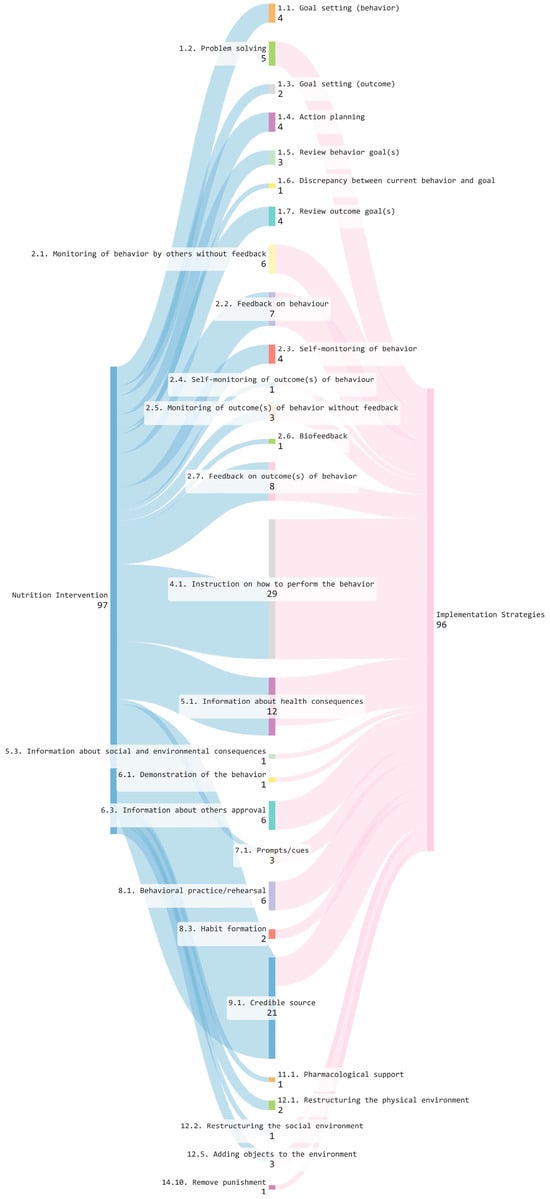
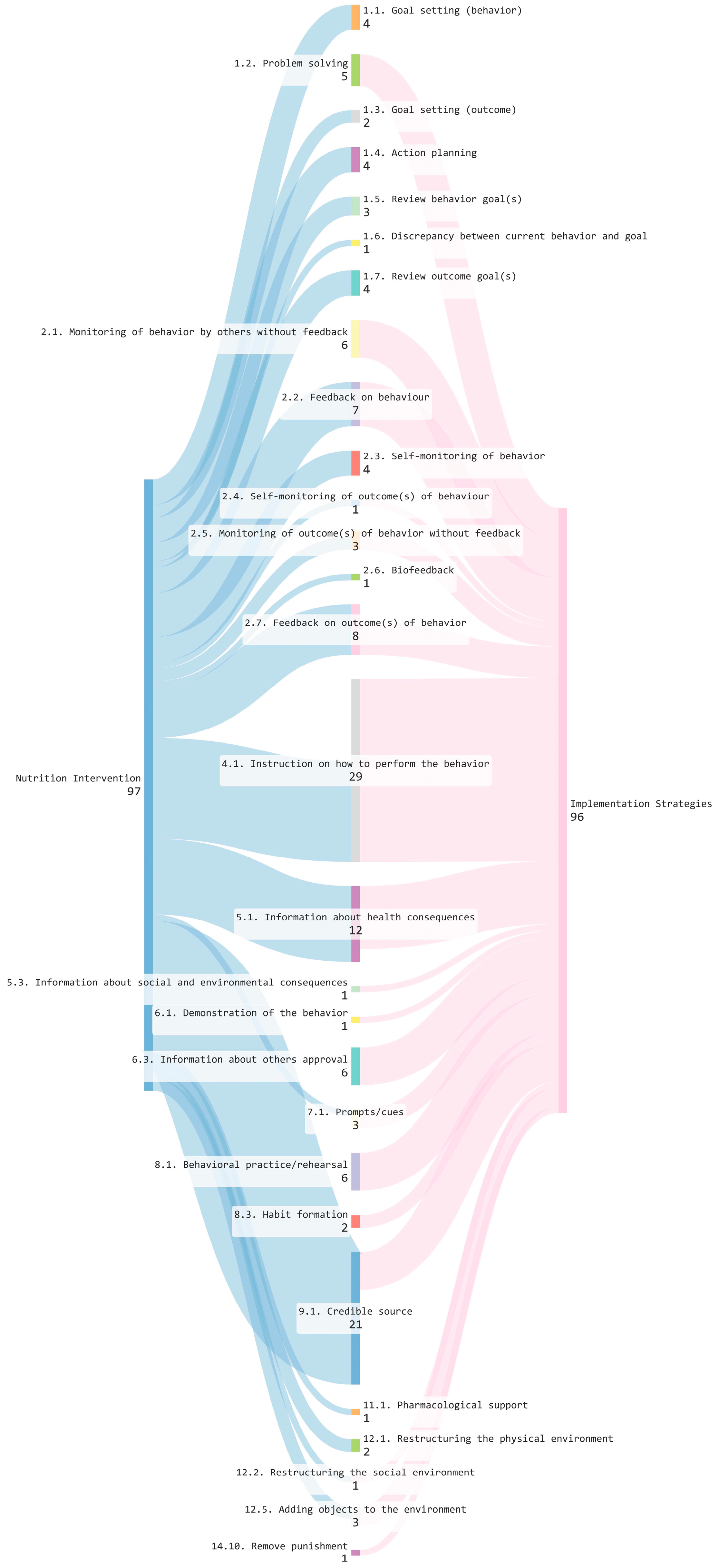
A variety of BCTs targeting patients and HCPs were identified across the nutrition interventions (Table 3). Of the 31 unique studies reviewed, 19 (61%) incorporated at least 1 BCT within their intervention components. In total, 20 unique BCTs spanning 8 groups of the taxonomy were identified, reflecting a diverse yet recurring application of BCTs. Across all studies, 97 instances of BCT use were identified (Supplementary File S2). The spectrum of BCTs identified in nutrition interventions is illustrated in Figure 2.
Table 3.
BCTs in Nutrition Interventions.
Figure 2.
Sankey diagram of BCTs identified in nutrition interventions and implementation strategies.
BCTs embedded within nutrition interventions were mostly patient-targeted (n = 90; 93% instances). The most frequently identified BCTs (appearing more than 5 times) were ‘Credible source’ (n = 17; 18%), ‘Instruction on how to perform the behaviour’ (n = 13; 13%), ‘Information about health consequences’ (n = 9; 9%), ‘Feedback on outcome(s) of behaviour’ (n = 8; 8%), and ‘Feedback on behaviour’ (n = 7; 7%). These findings suggest the presence of a core group of BCTs that were consistently applied across interventions targeting patients.
Of the 7 (7%) instances specifically targeted HCPs, the interventions focused on nutritional support guidelines, nutritional care planning/pathways, and nutritional monitoring. These HCP-targeted BCTs were embedded within only a few interventions (n = 4, 13%). For example, in the nutritional support guidelines described by Naseer et al. [31], nursing education on mealtime targeted HCPs which incorporated the BCTs ‘Instruction on how to perform the behaviour’, ‘Information about the health consequences’, and ‘Credible source’. The BCT ‘Instruction on how to perform the behaviour’ was also identified in 2 nutritional care planning/pathways interventions, as reported by Poveda [32] and Zhang [33]. Additionally, a nutritional monitoring intervention described by Findlay et al. [28] incorporated ‘Feedback on outcome(s) of behaviour’ and ‘Prompts/cues’.
3.4. BCTs in Implementation Strategies
A range of BCTs targeting HCPs embedded with the corresponding implementation strategies that aimed to support adoption of the nutritional interventions were also identified (Table 4). Across 25 (66%) of the 38 included articles, 96 instances of BCT use were identified (Supplementary File S3), resulting in 18 unique BCTs targeting HCPs, spanning 10 groups of the taxonomy (Figure 2).
Table 4.
BCTs targeting HCPs (in Implementation Strategies).
The most frequently observed BCT was ‘Instruction on how to perform the behaviour’ (n = 29; 30%), highlighting a strong emphasis on providing practical guidance to support implementation. This was followed by ‘Information about health consequences’ (n = 10; 10%), ‘Feedback on behaviour’ (n = 7; 7%), as well as ‘Monitoring of behaviour by others without feedback’, ‘Information about others’ approval’, ‘Behavioral practice/rehearsal’ and ‘Credible source’ (each n = 6; 6%). Other commonly observed BCTs included ‘Problem solving’ and ‘Feedback on outcome(s) of behaviour’ (each n = 5; 5%).
Less frequently observed techniques included ‘Monitoring of outcome(s) of behaviour without feedback’, ‘Prompts/cues’, and ‘Adding objects to the environment’ (each n = 3; 3%). Several BCTs were identified only once, such as ‘Remove punishment’, ‘Self-monitoring of outcome(s) of behaviour’, ‘Restructuring the social environment’, ‘Information about social and environmental consequences’ and ‘Demonstration of the behaviour’. Taken together, these findings indicate a predominant focus on instructional and informational strategies within implementation efforts by HCPs, with comparatively limited use of self-regulatory, social and environmental restructuring techniques.
3.5. BCTs Observed Alongside Positive Patient, Service, and Implementation Outcomes
3.5.1. Intervention BCTs & Patient Outcomes
Twelve (39%) studies reported patient-level outcomes, including symptomatology (e.g., weight loss), patient satisfaction, functional measures (e.g., nutritional status, quality of life), and mortality. The distribution of BCTs observed across these categories is shown in Supplementary File S4. Among these, 2 BCTs were most frequently observed alongside positive outcomes (‘Instruction on how to perform the behaviour’ n = 12; ‘Credible source’ n = 9). These findings suggest that instructional clarity and source credibility within cancer care nutritional interventions may be critical in facilitating behaviour change that translates into measurable patient improvements.
3.5.2. Implementation Strategy BCTs & Implementation and Service Outcomes
All 25 studies that applied BCTs as part of their implementation strategies reported on implementation and/or service outcomes. Commonly assessed domains included Fidelity (n = 18), Adoption (n = 16), Effectiveness (n = 14), Safety (n = 9), Feasibility (n = 7), and Timeliness (n = 6). A substantial majority (n = 21; 84%) documented positive findings across these domains, with the corresponding distribution of BCTs across categories presented in Supplementary File S5. The BCTs most often associated with positive implementation outcomes were also the ones more frequently used. In particular, ‘Instruction on how to perform the behaviour’ (n = 25) and ‘Information about health consequences’ (n = 9) appeared most frequently in studies with successful implementation outcomes. The prominence of these BCTs suggests the growing recognition of strategies that focus on both procedural guidance and contextual understanding for HCPs, to support the integration of nutritional care into clinical practice. A total of 22 (88%) studies reported outcomes related to Fidelity and/or Adoption. Of these, 19 studies reported positive outcomes, 2 studies reported neutral results [25,55] and 1 reported mixed outcomes [32]. ‘Instruction on how to perform the behaviour’ was the BCT most frequently observed alongside successful adoption (n =12) and fidelity (n = 12) (Supplementary File S5).
3.5.3. Full Sequence of Change
Only 2 (6%) studies explicitly demonstrated a full sequence of change, in which improvements in implementation outcomes led to enhanced service delivery and ultimately better patient-level outcomes. These examples provide compelling case illustrations of how BCTs, when embedded across both intervention content and implementation processes, can drive holistic system improvement. In the study by Zhang et al. [33], enteral nutrition was implemented using 12 applications of 6 distinct BCTs. This effort resulted in sequential improvements in adoption and fidelity of healthcare delivery by HCPs, followed by gains in service-level outcomes including effectiveness, timeliness, and safety, culminating in improved patient functional status. Similarly, Findlay et al. [28] employed 9 instances of 5 BCTs, achieving implementation success in terms of appropriateness, acceptability, feasibility, and fidelity. These improvements were subsequently linked to increased service effectiveness and enhanced patient satisfaction.
3.6. TDF-BCT Linkages
Only BCTs derived from implementation strategies were analysed using the TDF-BCT mapping tool, as the barriers identified primarily related to implementation at the HCP level. This ensured alignment between the target population of the barriers and the corresponding BCTs. Alignment is illustrated in Table 4. Of the 19 articles that reported both implementation barriers that matched a TDF domain and strategies that represented BCTs, 13 (68%) aligned with existing mechanism mappings, 5 (26%) [36,37,43,44,57] produced evidence for potential hypothesised mechanisms not previously established (i.e., not identified in the Theory and Techniques Tool), and 1 (5%) diverged from known linkages [23], where established mechanisms did not result in implementation success. All 5 hypothesised mechanisms (observed with positive implementation and/or service outcomes) were associated with the Environmental Context and Resources domain, addressed by BCTs included ‘Instruction on how to perform the behaviour’ (n = 4 instances), ‘Feedback on outcome(s) of behaviour’ (n = 2 instances), ‘Information about health consequences’ (n = 2 instances), ‘Credible source’ (n = 2 instances), and 1 instance each for ‘Monitoring of behaviour by others without feedback’, ‘Information about others approval’, and ‘Problem solving’.
4. Discussion
This review identified a wide range of BCTs used within oncology nutritional care, both in intervention content and in implementation strategies. Despite this diversity, a core group of BCTs consistently emerged across studies. For intervention content, commonly used techniques included ‘Credible source’, ‘Instruction on how to perform the behaviour’, and ‘Information about health consequences’. Similarly, implementation strategies frequently incorporated ‘Instruction on how to perform the behaviour’, ‘Information about health consequences’, and ‘Feedback on behaviour’. These techniques were frequently present in nutrition interventions with favourable patient outcomes, and in implementation strategies with favourable implementation or service outcomes, a pattern that underscores their central role in effective intervention design and delivery. QuADS assessments indicated moderate to high methodological quality across all included studies. While the total scores suggest most studies met a substantial proportion of QuADS criteria, cut-offs were based on those applied in previously published systematic reviews [63]. Due to the lack of official guidance, these user-defined thresholds are for convenience and are not empirically validated. They should therefore be considered pragmatic descriptors rather than formal indicators of study quality, consistent with the tool’s design for item-level appraisal rather than categorical classification [16]. Nonetheless, the predominance of studies meeting high-quality criteria support the credibility of the findings of this review.
Barriers to implementing nutrition interventions were most identified in relation to the ‘Environmental Context and Resources’ domain of the TDF. While this review focused on individual-level barriers, it is likely that broader system-level constraints exert a substantial influence on implementation success. These structural challenges may be more comprehensively captured through the application of multi-level frameworks such as the updated Consolidated Framework for Implementation Research (CFIR 2.0) [64], which offers a detailed lens for understanding constraints experienced by individuals [15], particularly within the Environmental Context and Resources domain.
Many of the implementation efforts engaged HCPs in addition to patients. This dual targeting is particularly important when nutrition interventions are aligned with clinical guidelines or best practice standards, which require active participation from both those delivering and receiving care. However, only 10 studies, approximately one-third, applied BCTs to both populations, suggesting that opportunities remain to better integrate patient and provider-focused strategies.
The emergence of ‘Instruction on how to perform the behaviour’ across both patient and HCP groups suggests that practical guidance may be a foundational component of effective nutritional care in cancer settings, but may be underutilised in current practice. Similarly, ‘Credible source’ was frequently linked with positive patient outcomes, highlighting the importance of trusted messengers in enhancing patient engagement, adherence, and clinical outcomes. Compared to BCTs identified in smoking cessation interventions [65], such as prompting commitment, social award, and identify associated techniques, the BCTs observed in nutrition interventions appear contextually distinct. This reinforces the need for context-specific understanding of the application of BCTs. Our findings suggest that future interventions should explicitly emphasise endorsement from credible authorities, such as dietitians, oncologists, and national cancer organisations, to reinforce the benefits and importance of nutritional care.
For HCPs, both ‘Instruction on how to perform the behaviour’ and ‘Information about health consequences’ appear to be particularly influential in supporting the adoption of nutrition interventions. These findings suggest that HCPs may be more likely to integrate nutrition into their practice when they receive both procedural training and have a clear understanding of the clinical rationale. This reinforces the need for implementation strategies that build skills and further HCP education about the value of nutritional care. Compared to a previous coding study of BCTs in implementation strategies for diabetes care [66], the difference in frequently identified BCTs underscores the context-specific nature of BCT application. This variation suggests that the selection and effectiveness of BCTs are influenced by the unique clinical characteristics of different conditions, despite the development of BCT taxonomies intended to be applicable across a range of behavioural domains (e.g., healthy eating, smoking, physical activity) [21]. In addition, it is important to recognise that dietetics and nutrition are distinct specialised disciplines, and limited resourcing within healthcare systems often results in the dissemination of nutrition-related information being delegated to non-dietetic HCPs, such as oncologists. This redistribution of responsibility points to the need for not only enhancing general HCP capability but also encourages interdisciplinary collaboration and resource allocation to support specialist input.
In contrast, the absence of BCTs related to Social support, Reward and threat, Identity, Self-belief, and Covert learning in nutrition interventions and their implementation strategies may reflect a tendency to prioritise more tangible and practical techniques over those involving deeper psychological or sustained social engagement [67]. These underutilised BCTs may hold untapped potential for enhancing engagement and sustained behaviour change, particularly in nutrition care within cancer care. This omission highlights a need for broader exploration and integration of diverse BCTs in future nutrition intervention and implementation strategy design, supported by more inclusive frameworks that enable their application and evaluation.
The identification of positive sequential changes in a small number of studies further illustrates how the integrated application of BCTs within both nutrition interventions and implementation strategies can help align implementation adoption (or alternatively its antecedents) and fidelity, with clinical effectiveness and eventually clinical outcomes and patient experience. This is particularly salient for complex health interventions such as nutritional care that require coordinated, multi-level change. Despite retrospective coding efforts, such positive sequential change was identified in only 2 studies. This low yield signals an urgent need for more systematic and robust implementation planning and data collection and reporting. Without these improvements, the field is unlikely to keep pace with the rapid scientific progress and may continue to fall short in uncovering the underlying patterns of implementation success.
The emergence of potential novel mechanisms suggests that existing TDF-BCT mapping may not fully capture the breadth of BCTs that could potentially address implementation barriers faced by healthcare providers, particularly those rooted in environmental context and resources. This again calls for more systematic approaches, such as integrating implementation frameworks (e.g., CFIR 2.0) to better identify, target, and accumulate evidence on mechanisms of change and ultimately to advance the field of implementation science. In the 2 studies that demonstrated a full sequence of change from implementation outcomes through to service and patient outcomes, a similar set of barriers was reported, primarily concerning the lack of clinician knowledge regarding nutritional care guidelines and time constraints. The implementation strategies employed in response largely focused on instructing clinicians on how to perform the desired behaviour, often delivered by credible sources or accompanied by peer endorsement. These findings can be interpreted through the lens of Kazdin’s criteria for establishing mechanisms of change [68]. Kazdin outlined 7 key criteria, i.e., strong association, specificity, consistency, experimental manipulation, timeline, gradient, and plausibility/coherence, that determines whether a proposed mechanism is truly causal [69]. In both above example studies, several of these criteria might have been partially fulfilled. While these studies did not explicitly articulate mechanisms of action, they provide early evidence that could be used to formulate novel mechanisms for testing in future research. Further mapping the strategies onto specific behavioural determinants (e.g., knowledge, environmental context and resources), identifying potential moderators (e.g., clinician baseline knowledge) and necessary preconditions for activating mechanisms (e.g., access to training materials, leadership buy-in) would enable a more rigorous identification of causal pathways that lead to proximal outcomes (e.g., clinician behaviour change) and distal outcomes (e.g., patient nutritional status) [70]. Although a formal causal mediation analysis was beyond the scope of the current review, this could be an important next step in advancing implementation science in the context of nutrition care.
The review has several strengths. It employed a comprehensive literature search, systematic data extraction, and rigorous coding using established implementation science frameworks. The use of the TDF-BCT mapping tool enabled a structured analysis of real-world BCT application in addressing implementation barriers, to assess the alignment with known mechanisms of behaviour change, while also identifying novel linkages, particularly in relation to the ‘Environmental Context and Resources’ domain. The involvement of a multidisciplinary team with expertise in both clinical nutrition and implementation science added depth and relevance to this evidence synthesis.
Despite its strengths, this review has some limitations that should be acknowledged. The patterns identified between BCTs and outcomes were observational in nature, limiting the ability to draw causal inferences. The effectiveness of individual BCTs or specific combinations was not experimentally evaluated, and as such, conclusions about their relative impact remain uncertain. A further limitation is the reliance on retrospective coding of published descriptions to theoretical frameworks, which is constrained by the completeness and clarity of reporting. As a result, while the review describes the frequency of reported BCTs, it was not possible to assess the quality, intensity, or functional role of each BCT within interventions, nor to distinguish whether BCTs were actively delivered, nominally included, or simply mentioned. In addition, implementation and service outcomes were often reported qualitatively, with limited use of standardised measures. This variability in reporting may have influenced the comparability of findings across studies.
Further research to explore and evaluate the effectiveness of specific BCTs or combinations to better identify the active ingredients that drive successful implementation and improved patient outcomes would be useful. It is equally important to investigate the contextual factors that influence the uptake, integration, and sustainability of nutrition interventions in oncology, as these factors are likely to vary across settings and populations. Notably, only around 60% of included articles reported implementation barriers faced by HCPs, and patient perspectives were largely absent. Addressing this gap by capturing a broader range of interest holder experiences will help to develop effective interventions and strategies. Collectively, these efforts will support the expanded and tailored application of BCTs across interest holder groups to enhance engagement, effectiveness, and sustainability of nutritional care in oncology.
5. Conclusions
This review provides a comprehensive synthesis of BCTs employed in nutrition interventions and their implementation within oncology care. While a wide range of BCTs were identified, a core group focused on practical guidance, trusted communication, and contextual understanding which consistently emerged as being frequently aligned with positive outcomes across patient, service, and implementation levels. For clinical practice, more explicit specifications of BCTs may facilitate improved integration of nutrition interventions in oncology care. Future research may help evaluate the effectiveness of specific individual BCTs and their combinations across both interventions and approaches to their implementation. Additionally, greater attention to contextual factors that influence implementation, inclusion of diverse interest holder perspectives, particularly those of patients and caregivers, and explicit adherence to reporting guidelines and implementation and behavioural frameworks would support more systematic accumulation of implementation evidence. Taken together, more rigorous implementation planning and standardised data collection and reporting are needed to enable robust testing of nutrition interventions and implementation strategies and to determine the underlying mechanisms that drive implementation success.
Supplementary Materials
The following supporting information can be downloaded at: https://www.mdpi.com/article/10.3390/nu18020242/s1, Supplementary File S1: PRISMA Checklist; Supplementary File S2: Behaviour Change Techniques within nutrition interventions components; Supplementary File S3: Behaviour Change Techniques in implementation strategies and their links to the Theoretical Domain Framework; Supplementary File S4: Behaviour Change Techniques identified in implementation strategies that aligned with positive patient outcomes; Supplementary File S5: Behaviour Change Techniques identified in implementation strategies that aligned with positive implementation and service outcomes.
Author Contributions
Conceptualization, S.L. and N.T.; methodology, S.L., N.T. and G.F.; database search, N.C.F.; screening, N.C.F., A.L., F.F., C.R. and H.B.; data extraction and risk of bias assessment, S.L., A.M., N.C.F., A.L., F.F., C.R. and H.B.; writing—original draft preparation, S.L.; writing—review and editing, N.T., G.F., C.R., A.L. and N.C.F.; visualization, S.L. All authors have read and agreed to the published version of the manuscript.
Funding
This research received no external funding.
Institutional Review Board Statement
Not applicable.
Informed Consent Statement
Not applicable.
Data Availability Statement
Not applicable.
Conflicts of Interest
The authors declare no conflicts of interest.
Abbreviations
The following abbreviations are used in this manuscript:
| BCT | Behaviour Change Technique |
| CFIR 2.0 | updated Consolidated Framework for Implementation Research |
| HCP | Healthcare Professional |
| QuADS | Quality Assessment with Diverse Studies |
| TDF | Theoretical Domains Framework |
References
- Bray, F.; Laversanne, M.; Sung, H.; Ferlay, J.; Siegel, R.L.; Soerjomataram, I.; Jemal, A. Global cancer statistics 2022: GLOBOCAN estimates of incidence and mortality worldwide for 36 cancers in 185 countries. CA Cancer J. Clin. 2024, 74, 229–263. [Google Scholar] [CrossRef] [Scilit]
- Yan, W.; Qin, C.; Tao, L.; Guo, X.; Liu, Q.; Du, M.; Zhu, L.; Chen, Z.; Liang, W.; Liu, M.; et al. Association between inequalities in human resources for health and all cause and cause specific mortality in 172 countries and territories, 1990–2019: Observational study. BMJ 2023, 381, e073043. [Google Scholar] [CrossRef] [Scilit]
- Zhu, Q.; Sun, K.; Yao, Y.; Li, X.; Dai, M.; Wei, W.; Bray, F.; Zheng, R. Global Disparities in Healthcare Resources and Cancer Burden: A Population-based Systematic Analysis of 171 Countries in 2022. Int. J. Surg. 2025, 111, 7549–7558. [Google Scholar] [CrossRef] [Scilit]
- Marshall, K.M.; Loeliger, J.; Nolte, L.; Kelaart, A.; Kiss, N.K. Prevalence of malnutrition and impact on clinical outcomes in cancer services: A comparison of two time points. Clin. Nutr. 2019, 38, 644–651. [Google Scholar] [CrossRef] [Scilit]
- Muscaritoli, M.; Arends, J.; Aapro, M. From guidelines to clinical practice: A roadmap for oncologists for nutrition therapy for cancer patients. Ther. Adv. Med. Oncol. 2019, 11, 1758835919880084. [Google Scholar] [CrossRef] [Scilit]
- Liposits, G.; Orrevall, Y.; Kaasa, S.; Österlund, P.; Cederholm, T. Nutrition in Cancer Care: A Brief, Practical Guide with a Focus on Clinical Practice. JCO Oncol. Pract. 2021, 17, e992–e998. [Google Scholar] [CrossRef] [Scilit]
- Bauer, M.S.; Kirchner, J. Implementation science: What is it and why should I care? Psychiatry Res. 2020, 283, 112376. [Google Scholar] [CrossRef] [Scilit]
- Cane, J.; O’Connor, D.; Michie, S. Validation of the theoretical domains framework for use in behaviour change and implementation research. Implement. Sci. 2012, 7, 37. [Google Scholar] [CrossRef] [Scilit]
- Atkins, L.; Francis, J.; Islam, R.; O’Connor, D.; Patey, A.; Ivers, N.; Foy, R.; Duncan, E.M.; Colquhoun, H.; Grimshaw, J.M.; et al. A guide to using the Theoretical Domains Framework of behaviour change to investigate implementation problems. Implement. Sci. 2017, 12, 77. [Google Scholar] [CrossRef] [Scilit]
- Michie, S.; Johnston, M. Behavior Change Techniques. In Encyclopedia of Behavioral Medicine; Gellman, M.D., Turner, J.R., Eds.; Springer: New York, NY, 2013; pp. 182–187. [Google Scholar]
- Prestwich, A.; Kenworthy, J.; Conner, M. Health Behavior Change: Theories, Methods and Interventions; Routledge: Abingdon-on-Thames, UK, 2024. [Google Scholar]
- Weight, C.; Laritz, R.; Collins, S.E.; Mooney, M.; Vinette, B.; Castiglione, S.A.; Straiton, N.; Chicoine, G.; Liang, S.; Konnyu, K.; et al. Using the behaviour change technique ontology to characterise the content of implementation strategies: A secondary analysis of 151 trials targeting evidence-based nursing practice. Transl. Behav. Med. 2025, 15, ibaf046. [Google Scholar] [CrossRef] [Scilit]
- Page, M.J.; McKenzie, J.E.; Bossuyt, P.M.; Boutron, I.; Hoffmann, T.C.; Mulrow, C.D.; Shamseer, L.; Tetzlaff, J.M.; Akl, E.A.; Brennan, S.E.; et al. The PRISMA 2020 statement: An updated guideline for reporting systematic reviews. BMJ 2021, 372, n71. [Google Scholar] [CrossRef] [Scilit]
- Fanning, N.; Landers, A.; Copland, M.; Brown, H.; Rother, C.; Fu, F.; Morrow, A.; Liang, S. Implementation strategies and outcomes of Nutritional Interventions in Cancer and Assessment of Their Impact PROSPERO: National Institute for Health and Care Research. 2024. Available online: https://www.crd.york.ac.uk/PROSPERO/view/CRD42023454210 (accessed on 14 November 2025).
- Fanning, N.C.; Liang, S.; Landers, A.; Brown, H.; Rother, C.; Taylor, N.; Fu, F.; Morrow, A. Implementation strategies for integrating nutritional interventions into cancer care: A systematic literature review. Clin. Nutr. 2025, 57, 106546. [Google Scholar] [CrossRef] [Scilit]
- Harrison, R.; Jones, B.; Gardner, P.; Lawton, R. Quality assessment with diverse studies (QuADS): An appraisal tool for methodological and reporting quality in systematic reviews of mixed- or multi-method studies. BMC Health Serv. Res. 2021, 21, 144. [Google Scholar] [CrossRef] [Scilit]
- Morrow, A.; Chan, P.; Tucker, K.M.; Taylor, N. The design, implementation, and effectiveness of intervention strategies aimed at improving genetic referral practices: A systematic review of the literature. Genet. Med. 2021, 23, 2239–2249. [Google Scholar] [CrossRef] [Scilit]
- Michie, S.; Richardson, M.; Johnston, M.; Abraham, C.; Francis, J.; Hardeman, W.; Eccles, M.P.; Cane, J.; Wood, C.E. The behavior change technique taxonomy (v1) of 93 hierarchically clustered techniques: Building an international consensus for the reporting of behavior change interventions. Ann. Behav. Med. 2013, 46, 81–95. [Google Scholar] [CrossRef] [Scilit]
- Harris, P.A.; Taylor, R.; Minor, B.L.; Elliott, V.; Fernandez, M.; O’Neal, L.; McLeod, L.; Delacqua, G.; Delacqua, F.; Kirby, J.; et al. The REDCap consortium: Building an international community of software platform partners. J. Biomed. Inform. 2019, 95, 103208. [Google Scholar] [CrossRef] [Scilit]
- Microsoft Corporation. Microsoft Excel. 2018. Available online: https://office.microsoft.com/excel (accessed on 14 November 2025).
- Michie, S.; Wood, C.E.; Johnston, M.; Abraham, C.; Francis, J.J.; Hardeman, W. Behaviour change techniques: The development and evaluation of a taxonomic method for reporting and describing behaviour change interventions (a suite of five studies involving consensus methods, randomised controlled trials and analysis of qualitative data). Health Technol. Assess. 2015, 19, 1–188. [Google Scholar] [CrossRef] [Scilit]
- Boyd, S. SankeyMATIC. Available online: https://sankeymatic.com/ (accessed on 14 November 2025).
- Proctor, E.; Silmere, H.; Raghavan, R.; Hovmand, P.; Aarons, G.; Bunger, A.; Griffey, R.; Hensley, M. Outcomes for implementation research: Conceptual distinctions, measurement challenges, and research agenda. Adm. Policy Ment. Health 2011, 38, 65–76. [Google Scholar] [CrossRef] [Scilit]
- Human Behaviour Change Project. Theory & Techniques Tool. 2018. Available online: https://theoryandtechniquetool.humanbehaviourchange.org/about (accessed on 14 November 2025).
- Beck, A.K.; Baker, A.L.; Carter, G.; Robinson, L.; McCarter, K.; Wratten, C.; Bauer, J.; Wolfenden, L.; Britton, B. Is fidelity to a complex behaviour change intervention associated with patient outcomes? Exploring the relationship between dietitian adherence and competence and the nutritional status of intervention patients in a successful stepped-wedge randomised clinical trial of eating as treatment (EAT). Implement. Sci. 2021, 16, 46. [Google Scholar] [CrossRef] [Scilit]
- Beck, A.K.; Baker, A.L.; Carter, G.; Wratten, C.; Bauer, J.; Wolfenden, L.; McCarter, K.; Britton, B. Assessing Adherence, Competence and Differentiation in a Stepped-Wedge Randomised Clinical Trial of a Complex Behaviour Change Intervention. Nutrients 2020, 12, 2332. [Google Scholar] [CrossRef] [Scilit]
- Deftereos, I.; Hitch, D.; Butzkueven, S.; Carter, V.; Fetterplace, K.; Fox, K.; Ottaway, A.; Pierce, K.; Steer, B.; Varghese, J.; et al. Implementing a standardised perioperative nutrition care pathway in upper gastrointestinal cancer surgery: A mixed-methods analysis of implementation using the Consolidated Framework for Implementation Research. BMC Health Serv. Res. 2022, 22, 256. [Google Scholar] [CrossRef] [Scilit]
- Findlay, M.; Rankin, N.M.; Shaw, T.; White, K.; Boyer, M.; Milross, C.; De Abreu Lourenco, R.; Brown, C.; Collett, G.; Beale, P.; et al. Best Evidence to Best Practice: Implementing an Innovative Model of Nutrition Care for Patients with Head and Neck Cancer Improves Outcomes. Nutrients 2020, 12, 1465. [Google Scholar] [CrossRef] [Scilit]
- McCarter, K.; Baker, A.L.; Britton, B.; Beck, A.K.; Carter, G.; Bauer, J.; Wratten, C.; Halpin, S.A.; Holliday, E.; Oldmeadow, C.; et al. Effectiveness of clinical practice change strategies in improving dietitian care for head and neck cancer patients according to evidence-based clinical guidelines: A stepped-wedge, randomized controlled trial. Transl. Behav. Med. 2018, 8, 166–174. [Google Scholar] [CrossRef] [Scilit]
- Murray, R.; Baker, A.; Halpin, S.; Britton, B.; McCarter, K.; Palazzi, K.; Beck, A.K. Therapeutic Alliance Between Dietitians and Patients with Head and Neck Cancer: The Effect of Training in a Health Behavior Change Intervention. Ann. Behav. Med. 2019, 53, 756–768. [Google Scholar] [CrossRef] [Scilit]
- Naseer, B.; Tan, S.S.; Ramli, S.S.; Ang, E. Protected mealtimes for adults with cancer in a hematology-oncology setting: An evidence-based implementation project. JBI Database Syst. Rev. Implement. Rep. 2017, 15, 1209–1219. [Google Scholar] [CrossRef] [Scilit]
- Poveda, V.B.; Marques da Silva, A.; Toyama, A.C.; Andrade da Silva, J.; Shimoda, G.T.; Puschel, V.A.A. Nasoenteric feeding discharge planning for cancer patients in a Brazilian teaching hospital: A best practice implementation project. JBI Database Syst. Rev. Implement. Rep. 2018, 16, 1269–1281. [Google Scholar] [CrossRef] [Scilit]
- Zhang, L.; Zhou, C.; He, L.; Wu, Y.; Xie, G.; Chen, P. Implementation of strategies to improve nutritional intervention for patients with cancer treatment-related oral mucositis: A best practice implementation project. JBI Evid. Implement. 2021, 19, 377–386. [Google Scholar] [CrossRef] [Scilit]
- Krznaric, Z.; Juretic, A.; Domislovic, V.; Barisic, A.; Kekez, D.; Vranesic Bender, D. Ten years of Croatian national guidelines for use of eicosapentaenoic acid and megestrol acetate in cancer cachexia syndrome—Evaluation of awareness and implementation among Croatian oncologists. Clin. Nutr. ESPEN 2019, 33, 202–206. [Google Scholar] [CrossRef] [Scilit]
- Adriaans, D.J.M.; Beijer, S.; Heesakkers, F.F.B.M.; de Craen-Kat, L.; Horevoorts, N.; Dierick-van Daele, A.; Teijink, J.A.W.; van Laarhoven, H.W.M.; van de Poll-Franse, L.; Nieuwenhuijzen, G.A.P. Effect of a pre-operative web-based dietary self-management intervention on patient satisfaction, body weight and quality of life of esophageal cancer patients: A prospective, observational study. Clin. Nutr. Open Sci. 2022, 43, 42–55. [Google Scholar] [CrossRef] [Scilit]
- Atkins, L.; Steer, B.; Ray, H.; Kiss, N. Implementing and sustaining an evidence-based nutrition service in a haematology unit for autologous stem cell transplant patients. Support. Care Cancer 2019, 27, 951–958. [Google Scholar] [CrossRef] [Scilit]
- Belluomini, L.; Avancini, A.; Trestini, I.; Insolda, J.; Sposito, M.; Menis, J.; Tregnago, D.; Milella, M.; Pilotto, S. Implementation outcomes of early nutritional screening and referral for patients with thoracic cancers. Clin. Nutr. Open Sci. 2024, 55, 168–172. [Google Scholar] [CrossRef] [Scilit]
- Blake, C.; Edwards, A.; Treleaven, E.; Brown, T.; Hughes, B.; Lin, C.; Kenny, L.; Banks, M.; Bauer, J. Evaluation of a novel pre-treatment model of nutrition care for patients with head and neck cancer receiving chemoradiotherapy. Nutr. Diet. 2022, 79, 206–216. [Google Scholar] [CrossRef] [Scilit]
- Britton, B.; Baker, A.L.; Wolfenden, L.; Wratten, C.; Bauer, J.; Beck, A.K.; McCarter, K.; Harrowfield, J.; Isenring, E.; Tang, C.; et al. Eating As Treatment (EAT): A Stepped-Wedge, Randomized Controlled Trial of a Health Behavior Change Intervention Provided by Dietitians to Improve Nutrition in Patients with Head and Neck Cancer Undergoing Radiation Therapy (TROG 12.03). Int. J. Radiat. Oncol. Biol. Phys. 2019, 103, 353–362. [Google Scholar] [CrossRef] [Scilit]
- Britton, B.; Baker, A.L.; Wolfenden, L.; Wratten, C.; Bauer, J.; Beck, A.K.; McCarter, K.; Handley, T.; Carter, G.L. Five-Year Mortality Outcomes for Eating As Treatment (EAT), a Health Behavior Change Intervention to Improve Nutrition in Patients with Head and Neck Cancer: A Stepped-Wedge, Randomized Controlled Trial. Int. J. Radiat. Oncol. Biol. Phys. 2024, 119, 1166–1170. [Google Scholar] [CrossRef] [Scilit]
- Carr, R.A.; Harrington, C.; Stella, C.; Glauner, D.; Kenny, E.; Russo, L.M.; Garrity, M.J.; Bains, M.S.; Sihag, S.; Jones, D.R.; et al. Early implementation of a perioperative nutrition support pathway for patients undergoing esophagectomy for esophageal cancer. Cancer Med. 2022, 11, 592–601. [Google Scholar] [CrossRef] [Scilit]
- Chen, X.; Ang, E.; Bte Nasir, N. Nutritional screening among patients with cancer in an acute care hospital: A best practice implementation project. Int. J. Evid. Based Healthc. 2012, 10, 377–381. [Google Scholar] [CrossRef] [Scilit] [PubMed]
- Cook, F.; Glen, K.; Ngo, A.T. Service improvement for a dietetic-led radiologically inserted gastrostomy service using the Plan-Do-Study-Act (PDSA) cycle. Clin. Nutr. Open Sci. 2023, 51, 118–127. [Google Scholar] [CrossRef] [Scilit]
- Deftereos, I.; Hitch, D.; Butzkueven, S.; Carter, V.; Arslan, J.; Fetterplace, K.; Fox, K.; Ottaway, A.; Pierce, K.; Steer, B.; et al. Implementation of a standardised perioperative nutrition care pathway in upper gastrointestinal cancer surgery: A multisite pilot study. J. Hum. Nutr. Diet. 2023, 36, 479–492. [Google Scholar] [CrossRef] [Scilit]
- Den, E.; Steer, B.; Quinn, P.; Kiss, N. Effect of an Evidence-Based Nutrition Care Pathway for Cancer Patients Undergoing Gastrointestinal and Pelvic Surgery. Nutr. Cancer 2021, 73, 2546–2553. [Google Scholar] [CrossRef] [Scilit]
- Ding, C.; Chen, Q.; Zhang, F.; Xu, B.; Zhang, H. Effect of a Personalized Enteral Nutrition Protocol on the Postoperative Nutritional Status in Patients Who Underwent Oral Cancer Surgery. Nutr. Cancer 2023, 75, 815–824. [Google Scholar] [CrossRef] [Scilit]
- Ettori, F.; Henin, A.; Zemmour, C.; Chow-Chine, L.; Sannini, A.; Bisbal, M.; Gonzalez, F.; Servan, L.; de Guibert, J.M.; Faucher, M.; et al. Impact of a computer-assisted decision support system (CDSS) on nutrition management in critically ill hematology patients: The NUTCHOCO study (nutritional care in hematology oncologic patients and critical outcome). Ann. Intensive Care 2019, 9, 53. [Google Scholar] [CrossRef] [Scilit] [PubMed]
- Garcia-Luna, P.P.; Rabat Restrepo, J.M.; Munoz-Ayllon, M.; de la Calle Gil, M.; Remon, P.; Sanchez-Torralvo, F.J.; Pachon, J.; Garcia-Gonzalez, J.J.; Garcia-Manrique, T.; Salvador-Bofill, J.; et al. Evaluation of Nutritional Interventions in the Care Plan for Cancer Patients: The NOA Project. Nutrients 2023, 15, 292. [Google Scholar] [CrossRef] [Scilit] [PubMed]
- Gilbert, T.; Bernard, L.; Alexandre, M.; Bin-Dorel, S.; Villeneuve, L.; Decullier, E.; Bonnefoy, M.; Anc Working, G. Impact of a Geriatric Intervention to Improve Screening and Management of Undernutrition in Older Patients Undergoing Surgery for Colorectal Cancer: Results of the ANC Stepped-Wedge Trial. Nutrients 2021, 13, 2347. [Google Scholar] [CrossRef] [Scilit]
- Han, N.W.; Jamhuri, N.; Rahman, Z.A.; Lai, B.S.M.H.; Samwil, S.N.M. Clinical audit on adherence to using Malnutrition Screening Tool and dietitian referral in the Oncology Outpatient Clinic, National Cancer Institute, Malaysia. Mal. J. Nutr. 2018, 24, 627–635. [Google Scholar]
- Kiss, N.; Gilliland, S.; Quinn, P.; Atkins, L.; Black, J.; Frowen, J. Evaluating the effectiveness of a nutrition assistant role in a head and neck cancer clinic. Nutr. Diet. 2019, 76, 21–27. [Google Scholar] [CrossRef] [Scilit]
- Ladna, M.; Madhok, I.; Bhat, A.; Ruiz, N.; Brown, J.; Wilson, J.; Jiang, P.; Taylor, R.; Radetic, M.; George, J.; et al. Impact of Order Set on Exocrine Pancreatic Insufficiency in Chronic Pancreatitis, Pancreatic Cancer, and Pancreatic Resection. Gastro Hep Adv. 2025, 4, 100541. [Google Scholar] [CrossRef] [Scilit]
- Levonyak, N.S.; Hodges, M.P.; Haaf, N.; Mhoon, V.; Lopez, R.; Little Jones, A.; Sanjeevaiah, A.; Kainthla, R.; Beg, M.S.; Kazmi, S.M. Implementation of a Quality Improvement Project to Increase Access to Dietitian Services for Patients with Gastrointestinal Cancer in a Safety-Net Hospital System. JCO Oncol. Pract. 2021, 17, e1048–e1054. [Google Scholar] [CrossRef] [Scilit]
- Levonyak, N.S.; Hodges, M.P.; Haaf, N.; Brown, T.J.; Hardy, S.; Mhoon, V.; Kainthla, R.; Beg, M.S.; Kazmi, S.M. Importance of addressing malnutrition in cancer and implementation of a quality improvement project in a gastrointestinal cancer clinic. Nutr. Clin. Pract. 2022, 37, 215–223. [Google Scholar] [CrossRef] [Scilit]
- Martin-McGill, K.J.; Marson, A.G.; Tudur Smith, C.; Young, B.; Mills, S.J.; Cherry, M.G.; Jenkinson, M.D. Ketogenic diets as an adjuvant therapy for glioblastoma (KEATING): A randomized, mixed methods, feasibility study. J. Neurooncol. 2020, 147, 213–227. [Google Scholar] [CrossRef] [Scilit]
- Moore, C.; Pegues, J.; Narisetty, V.; Spankovich, C.; Jackson, L.; Jefferson, G.D. Enhanced Recovery After Surgery Nutrition Protocol for Major Head and Neck Cancer Surgery. OTO Open 2021, 5, 2473974X211021100. [Google Scholar] [CrossRef] [Scilit] [PubMed]
- Pasmann, A.; Friend, P. Implementation of Nurse-Led Nutritional Screening in a Community Oncology Setting. Clin. J. Oncol. Nurs. 2024, 28, 143–147. [Google Scholar] [CrossRef] [Scilit]
- Paynter, E.; Whelan, E.; Curnuck, C.; Dhaliwal, S.; Sherriff, J. Pre-operative immunonutrition therapy in upper gastrointestinal cancer patients. Australas. Med. J. 2017, 10, 466. [Google Scholar] [CrossRef] [Scilit]
- Senesse, P.; Isambert, A.; Janiszewski, C.; Fiore, S.; Flori, N.; Poujol, S.; Arroyo, E.; Courraud, J.; Guillaumon, V.; Mathieu-Daude, H.; et al. Management of Cancer Cachexia and Guidelines Implementation in a Comprehensive Cancer Center: A Physician-Led Cancer Nutrition Program Adapted to the Practices of a Country. J. Pain. Symptom Manag. 2017, 54, 387–393e383. [Google Scholar] [CrossRef] [Scilit] [PubMed]
- Wang, Y. Nutrition assessment and management among gastrointestinal cancer patients receiving chemotherapy in a medical oncology ward: A best practice implementation project. JBI Database Syst. Rev. Implement. Rep. 2014, 12, 466–483. [Google Scholar] [CrossRef] [Scilit]
- Zeng, X.; Huang, X.; Wang, P.; Liao, J.; Wu, L.; Liu, J.; Wu, H.; Wei, R. The application of the PDCA cycle in the nutritional management of patients with nasopharyngeal carcinoma. Support. Care Cancer 2023, 31, 251. [Google Scholar] [CrossRef] [Scilit]
- Zhang, W.; Zhu, N.N.; Jiang, H.J.; Tao, X.B.; Lu, W.H.; Shen, H.C.; Wu, Y.D.; Li, K.K.; Huo, R. Prevention of underfeeding during enteral nutrition after gastrectomy in adult patients with gastric cancer: An evidence utilization project. JBI Evid. Implement. 2020, 19, 198–207. [Google Scholar] [CrossRef] [Scilit]
- McGee, R.G.; Wark, S.; Mwangi, F.; Drovandi, A.; Alele, F.; Malau-Aduli, B.S.; The ACHIEVE Collaboration. Digital learning of clinical skills and its impact on medical students’ academic performance: A systematic review. BMC Med. Educ. 2024, 24, 1477. [Google Scholar] [CrossRef] [Scilit] [PubMed]
- Damschroder, L.J.; Reardon, C.M.; Widerquist, M.A.O.; Lowery, J. The updated Consolidated Framework for Implementation Research based on user feedback. Implement. Sci. 2022, 17, 75. [Google Scholar] [CrossRef] [Scilit] [PubMed]
- Black, N.; Johnston, M.; Michie, S.; Hartmann-Boyce, J.; West, R.; Viechtbauer, W.; Eisma, M.C.; Scott, C.; de Bruin, M. Behaviour change techniques associated with smoking cessation in intervention and comparator groups of randomized controlled trials: A systematic review and meta-regression. Addiction 2020, 115, 2008–2020. [Google Scholar] [CrossRef] [Scilit]
- Presseau, J.; Ivers, N.M.; Newham, J.J.; Knittle, K.; Danko, K.J.; Grimshaw, J.M. Using a behaviour change techniques taxonomy to identify active ingredients within trials of implementation interventions for diabetes care. Implement. Sci. 2015, 10, 55. [Google Scholar] [CrossRef] [Scilit]
- Taylor, N.; McKay, S.; Long, J.C.; Gaff, C.; North, K.; Braithwaite, J.; Francis, J.J.; Best, S. Aligning intuition and theory: A novel approach to identifying the determinants of behaviours necessary to support implementation of evidence into practice. Implement. Sci. 2023, 18, 29. [Google Scholar] [CrossRef] [Scilit] [PubMed]
- Kazdin, A.E. Mediators and Mechanisms of Change in Psychotherapy Research. Annu. Rev. Clin. Psychol. 2007, 3, 1–27. [Google Scholar] [CrossRef] [Scilit] [PubMed]
- Lewis, C.C.; Boyd, M.R.; Walsh-Bailey, C.; Lyon, A.R.; Beidas, R.; Mittman, B.; Aarons, G.A.; Weiner, B.J.; Chambers, D.A. A systematic review of empirical studies examining mechanisms of implementation in health. Implement. Sci. 2020, 15, 21. [Google Scholar] [CrossRef] [Scilit]
- Lewis, C.C.; Klasnja, P.; Lyon, A.R.; Powell, B.J.; Lengnick-Hall, R.; Buchanan, G.; Meza, R.D.; Chan, M.C.; Boynton, M.H.; Weiner, B.J. The mechanics of implementation strategies and measures: Advancing the study of implementation mechanisms. Implement. Sci. Commun. 2022, 3, 114. [Google Scholar] [CrossRef] [Scilit] [PubMed]

Disclaimer/Publisher’s Note: The statements, opinions and data contained in all publications are solely those of the individual author(s) and contributor(s) and not of MDPI and/or the editor(s). MDPI and/or the editor(s) disclaim responsibility for any injury to people or property resulting from any ideas, methods, instructions or products referred to in the content. |
© 2026 by the authors. Licensee MDPI, Basel, Switzerland. This article is an open access article distributed under the terms and conditions of the Creative Commons Attribution (CC BY) license.