


Abstract
Background/Objectives: Dietary supplements (DSs) and over-the-counter (OTC) medications for mood improvement and stress relief are widely used, but little is known about how their use relates to coping preferences, trust in physicians, and communication with doctors. This exploratory cross-sectional study compared users and non-users of such products in Poland. Methods: Data were collected between October 2024 and May 2025 and included 798 adults recruited through a mixed-mode convenience sampling strategy (636 online and 162 in person). Participants were classified as current users (CUs; n = 184), past users (PUs; n = 297), or never-users (NUs; n = 317). The outcomes included hypothetical future coping strategies (under an assumption of unlimited resources), trust in physicians using an author-translated adaptation of the Trust in Doctors in General (T-DiG) scale and three-category communication-related attitudes. Multivariable models were adjusted for age, gender, education, medical or health science background, and recruitment mode. Results: Overall, 60.3% of respondents reported current or past use. Compared with NUs, both CUs and PUs had higher adjusted odds of selecting future DS/OTC use (CUs: aOR = 5.60, 95% CI 3.44–9.14, p < 0.001; PUs: aOR = 2.44, 95% CI 1.52–3.93, p < 0.001). PUs also had higher adjusted odds of selecting psychotherapy (aOR = 1.50, 95% CI 1.04–2.17, p = 0.031; overall p = 0.018). Product-use status was associated with selected items of T-DiG: communication competency (overall p = 0.031) and global trust (overall p < 0.001). Compared with NUs, CUs had lower adjusted scores on both subscales (aMD = −0.19, 95% CI −0.33 to −0.04, p = 0.010 and aMD = −0.40, 95% CI −0.59 to −0.21, p < 0.001, respectively). Overall product-group effects were also observed for the first two communication items: CUs had lower relative risk ratios than NUs for discussing product-related doubts first with their physician (RRR = 0.52, 95% CI 0.35–0.78, p = 0.001) and for feeling free to raise such doubts (RRR = 0.57, 95% CI 0.36–0.92, p = 0.022). Conclusions: Product-use status showed selective associations with hypothetical coping preferences, physician trust, and communication-related attitudes rather than a uniform pattern of reluctance to seek professional support. Current use was most strongly associated with lower trust and less favorable product-related communication attitudes. Given the cross-sectional design and hypothetical nature of the coping outcomes, these findings do not establish causality, temporal ordering, or actual healthcare-seeking behavior.
1. Introduction
Depressed mood and stress-related symptoms are common mental health complaints that do not necessarily indicate the presence of a mental disorder. They may refer to a wide range of self-perceived emotional, cognitive, somatic, and behavioral difficulties, such as tension, irritability, worry, fatigue, sleep problems, sadness, emotional exhaustion, reduced motivation, or a perceived inability to cope with daily demands [1,2,3,4]. These experiences are often transient and subclinical. However, when persistent, severe, or associated with significant distress and functional impairment, they may overlap with or develop into clinically significant mental health conditions, including depressive, anxiety, adjustment, or other stress-related disorders [5,6]. These phenomena are often understood as dimensional constructs that range from everyday psychological distress to symptom patterns meeting formal diagnostic criteria [7,8]. They represent a substantial and growing burden on mental health, affecting a significant proportion of the general population, and may be associated with impaired functioning and reduced quality of life [9,10,11].
There are various ways to cope with stress and depressed mood. Formal approaches primarily include psychiatric care and psychotherapy, while informal strategies often rely on social support, such as talking to family members or close friends [12]. Some individuals engage in complementary and alternative medicine (CAM) practices, including the use of dietary supplements (DSs) and over-the-counter (OTC) medications for mood improvement or stress relief [13,14,15]. The popularity of such preparations has increased in recent years. They are widely available on the European market (including in Poland), and their market value continues to grow annually [16,17,18]. Commonly used ingredients include Withania somnifera (ashwagandha), Melissa officinalis, Valeriana officinalis, Humulus lupulus (hops), Hypericum perforatum (St. John’s wort), or cannabidiol [13,19,20]. This trend is likely driven by their easy accessibility, extensive marketing, and the widespread perception that “natural” products are inherently safe [21,22]. Contrary to popular belief, the use of these products is not without risk. Certain ingredients may interact with prescribed medications, potentially compromising the treatment of chronic conditions and exposing patients to adverse health outcomes [23,24,25,26]. These concerns are further amplified by the relatively limited regulation of the DS market in Poland and other European countries, raising questions about product quality and patient safety [27,28,29,30]. Given that these products are frequently selected without medical supervision, their use also raises questions about whether and under what conditions patients involve physicians in decisions about self-management.
In this context, trust in physicians may be particularly relevant. Trust is a key determinant of health-related behaviors: it has been associated with subjective health outcomes, treatment adherence, patient satisfaction, and symptom severity [31,32,33]. Weber et al. identified ten domains of trust in physicians, i.e., fidelity, technical competence, communicative competence, interpersonal competence, honesty, confidentiality, global, behavioral, fairness, and system trust/accountability [34]. Instruments such as Trust in My Doctor (T-MD) and Trust in Doctors in General (T-DiG) have been developed to capture some of these dimensions, enabling a more nuanced assessment of patient trust [35].
The inclusion of communicative competence among the domains of trust underscores the close relationship between patient trust and patient–physician communication. Empirical studies further indicate that patients’ perceptions of physicians’ communication are associated with higher levels of trust [34,35,36]. This connection is clinically relevant because trust and effective communication may facilitate the disclosure of health-related behaviors that patients do not always report spontaneously. This relationship is particularly important in the context of DSs and OTC medications, as patients often do not disclose their use of such products to physicians [37,38]. In the context of products used for mood improvement or stress relief, communication may be relevant at two levels: not only whether patients disclose product use, but also whether they feel able to discuss the underlying mental health concerns that prompted such use.
The present study was a secondary analysis of the same survey dataset previously used to examine the prevalence and patterns of DSs and OTC medication used for mood improvement and stress relief [39]. The companion publication focused primarily on prevalence, product-use patterns, factors influencing product choice, safety-related practices, and disclosure of product use to physicians. In contrast, the present analysis focuses on physician trust domains, hypothetical future help-seeking and self-management preferences, and communication-related attitudes.
To our knowledge, these issues have not been systematically investigated in the context of mood- and stress-relief preparations. Existing evidence provides reasons to expect that users and non-users may differ in their attitudes and coping preferences. Research on CAM suggests that lower trust in conventional healthcare or physicians may be associated with greater reliance on non-conventional health products and practices, although the evidence remains heterogeneous and has not specifically focused on products used for mood improvement or stress relief [40,41,42]. In addition, psychological distress is often managed through strategies outside formal healthcare, including informal support and self-management [15,19,40]. Accordingly, it was hypothesized that users would be more likely to rely on informal coping strategies (H1), exhibit lower levels of trust in physicians (H2), and be less willing to discuss their potential use of such products and mental health problems with their doctor (H3). Examining these relationships may help improve the quality of care for individuals experiencing depressed mood and stress-related difficulties.
H1–H3 were formulated before the statistical analyses reported in the present manuscript. Because the study was exploratory and included author-developed and non-validated translated measures, the findings are interpreted as hypothesis-generating rather than confirmatory.
2. Materials and Methods
2.1. Study Design
This exploratory cross-sectional study was a secondary analysis of the survey dataset previously reported in the companion publication [39]. It used a Polish-language questionnaire and examined physician trust, hypothetical help-seeking and self-management preferences, and communication-related attitudes, which were not the primary outcomes of the companion analysis. Data collection took place from 8 October 2024 to 6 May 2025. A non-probability convenience sampling strategy combined online and in-person recruitment. No quotas or random sampling procedures were used.
2.2. Participants, Recruitment, and Eligibility
Online questionnaires were distributed through open recruitment on Facebook and Instagram and through institutional mail to students and employees of the Medical University of Gdańsk. In-person recruitment was conducted by four trained interviewers who approached adult passers-by on the streets of Gdańsk, Sopot, and Gdynia. The same Google Forms questionnaire was used in both modes: online respondents completed it independently, whereas in-person responses were read aloud, recorded by the interviewer, and entered directly into Google Forms. Interviewers marked the designated interviewer-initials field for these entries, which was used to identify recruitment mode. Records containing interviewer initials classified as in person and all remaining records as online. This coding rule yielded 162 in-person and 636 online records, and the corrected recruitment-mode variable was used consistently in descriptive comparisons and all adjusted models. The numbers of individuals who viewed the online invitation or were approached in person but did not submit the questionnaire were not recorded; therefore, a response rate cannot be calculated.
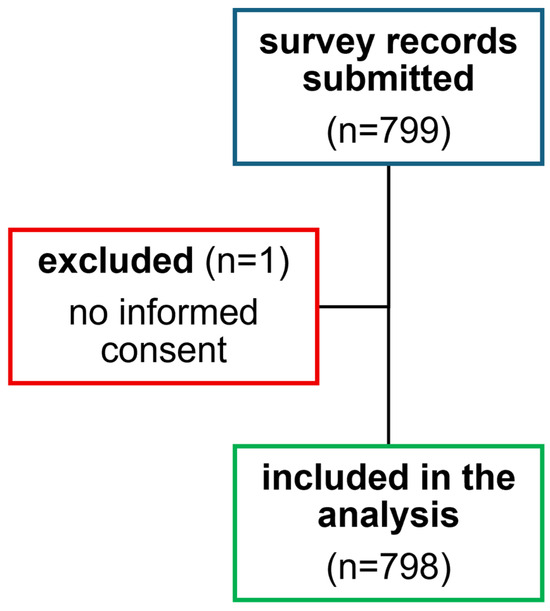
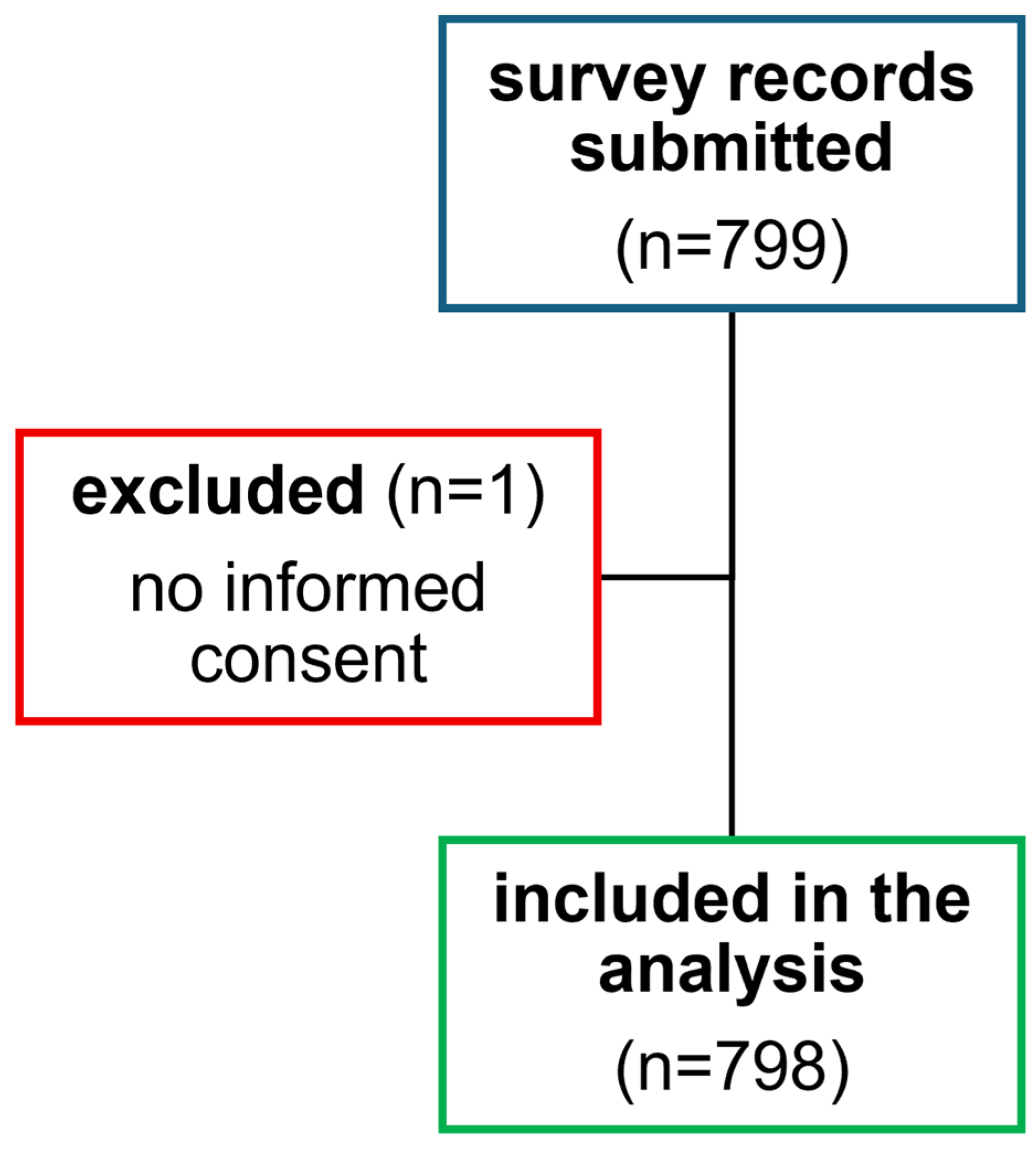
The inclusion criteria were age ≥ 18 years, informed consent, sufficient knowledge of Polish to understand the study information and complete the questionnaire, and internet access in the online survey variant. Ability to understand and complete the questionnaire was an operational eligibility requirement. Nationality and place of residence were not collected. The only exclusion criterion was refusal to participate at any stage. Of 799 submitted survey records, one record indicated lack of informed consent and contained only screening information—it was excluded. The remaining 798 consenting records met the analytic eligibility criteria, and no other responses were excluded. The participant flowchart is presented in Figure 1.
Figure 1.
Participant disposition flowchart.
Participation was voluntary and anonymous. Informed consent was obtained from all participants before survey initiation. The study was conducted in accordance with the Declaration of Helsinki. The original protocol was approved by the Institutional Ethics Committee of the Medical University of Gdańsk (KB/570/2023, 20 October 2023), before recruitment began on 8 October 2024. The subsequent approval, KB/570-515/2024 (26 November 2024), represented an administrative extension of the previous approval to allow continuation of the study. It did not constitute an amendment to the study procedures and introduced no changes to the recruitment process, questionnaire content, study protocol, or data-collection procedures.
No a priori sample-size calculation was performed because the study was exploratory. Recruitment continued until the prespecified end of the data-collection period (6 May 2025), and the final sample size was determined by the number of eligible consenting responses obtained during this period.
2.3. Questionnaire and Variables
The questionnaire was developed de novo in Polish by the research team for this exploratory study because no existing instrument addressed the exact combination of mood- and stress-relief product use, coping preferences, physician trust, and communication-related attitudes. The questionnaire was reviewed by the study supervisor and by experts of the Institutional Ethics Committee of the Medical University of Gdańsk as part of the ethics review process. It consisted of closed-ended questions, some of which allowed multiple responses and/or the addition of a free-text answer.
The initial section collected sociodemographic data, including gender, age, education, and medical or health science background. Because data were collected using two recruitment modes, online and in person, additional analyses were conducted to compare these subsamples with respect to sociodemographic characteristics and product-use status. All responses were collected in a single Google Forms database. No pilot study was conducted.
The primary independent variable was product-use status. Current use reflected participants’ self-classification as currently using a qualifying product. Past use indicated previous but not current use, without a minimum duration or frequency threshold. Participants were classified as current users (CUs) if they reported currently using such products, past users (PUs) if they reported previous, but not current use, and never-users (NUs) if they reported never having used such products. Products encompassed DSs and OTC medications. Subsequent questionnaire items depended on group assignment.
One set of dependent variables comprised preferred future coping strategies. Participants were asked which strategies they would choose to manage prolonged low mood or negative effects of stress if they had unlimited resources. Multiple responses were permitted. Options included psychotherapy, psychiatric consultation, conversation with a close person, use of a DS or OTC medication for mood improvement or stress relief, and consultation with a general practitioner (GP). Each option was analyzed as a separate binary outcome. These variables represent stated hypothetical preferences and not observed help-seeking behavior.
Trust in physicians was assessed using items from the T-DiG scale [35]. The items were translated into Polish by the authors for the purpose of this study. The translation has not undergone formal linguistic, cultural, or psychometric validation; therefore, all trust-related analyses are exploratory. At the time of the study, no validated Polish instrument specifically assessing trust in physicians was available. The list of items used in the study, together with their Polish translations and assigned subscales, is provided in Table A1. Responses used a 5-point scale ranging from 1 to 5. Negatively worded items were reverse-coded before calculating subscale scores such that higher scores indicated higher trust. Mean scores were calculated for each subscale. Subscale scores were calculated only for participants with complete responses to all items of the subscale. Higher scores indicate greater trust, and for stigma-based discrimination, higher scores indicate less perceived stigma-based discrimination. Internal consistency was assessed using Cronbach’s alpha, which was interpreted as reliability evidence only and not as evidence of construct validity.
The remaining dependent variables were author-developed items concerning willingness and perceived ability to discuss potential use of DSs or OTC medications for mood improvement or stress relief and current mental health difficulties with their doctor. Response options were “yes,” “no,” and “no opinion.” These items assessed stated communication-related attitudes rather than observed disclosure behavior. The term “my doctor” was not further operationalized, and the study did not assess whether respondents had a regular physician, recent physician contact, or which type of physician they had in mind.
The control variables used in adjusted models were age, gender, education, medical or health science background, and recruitment mode. Thus, the primary exposure was three-level product-use status, and the dependent variables were the binary coping preferences, seven T-DiG subscale scores, and three-category communication responses.
2.4. Statistical Analysis
Descriptive and initial nonparametric analyses were performed using R 4.5.1 (R Foundation for Statistical Computing, Vienna, Austria) and the RStudio environment 2025.05 (Posit team, Boston, MA, USA). Associations between product-use status and categorical variables were assessed using Pearson’s χ2 tests, with Cramér’s V reported as a measure of effect size. Because the question on preferred future coping strategies allowed multiple responses, each option was analyzed separately as a dichotomous variable. Trust scores were compared using Kruskal–Wallis H values. Statistical significance was set at p < 0.05.
Multivariable analyses were performed in Python 3.12.13 using pandas 2.2.3, NumPy 2.3.5, SciPy 1.17.0, and scikit-learn 1.8.0. NUs served as the reference product-use group. All models included an intercept and were adjusted for age (18–24, 25–39, 40–59, or ≥60 years), gender (female vs. non-female or undisclosed), education (higher vs. below higher education), medical or health science background (yes/no), and recruitment mode (online/in person). The non-female or undisclosed category comprised 149 male participants and six participants who selected another gender or did not disclose their gender. Categories were collapsed to reduce sparse-cell instability while retaining all participants.
Binary hypothetical coping outcomes were analyzed using unpenalized logistic regression with scikit-learn’s LogisticRegression and are reported as adjusted odds ratios (aORs). T-DiG subscale scores were analyzed using ordinary least-squares regression fitted with numpy.linalg.lstsq and HC3 heteroscedasticity-robust standard errors. The product-group coefficients represent adjusted mean differences (aMDs) relative to NUs. Three-category communication outcomes were analyzed using multinomial logistic regression fitted by maximum likelihood with scipy.optimize.minimize. “No” served as the response reference category, and results are reported as relative risk ratios (RRRs). All estimates are presented with 95% confidence intervals. Overall p-values for product-use status were calculated using likelihood-ratio tests for the binary and multinomial logistic models and HC3-robust joint Wald tests for the linear models. No penalization or regularization was applied. No data were imputed. T-DiG subscales were analyzed for participants with complete responses to all items forming the relevant subscale, whereas communication analyses used available responses for each item. All tests were two-sided, with p < 0.05 considered statistically significant. Given the exploratory nature of the study, no adjustment for multiple testing was applied.
3. Results
The study sample consisted of 798 participants. Most respondents were female (n = 643; 80.58%), followed by male respondents (n = 149; 18.67%). The remaining six participants (0.75%) identified with a gender other than male or female or declined to provide this information. Overall, 481 respondents (60.28%) reported lifetime use of DSs or OTC medications for mood improvement or stress relief. This group included 184 CUs (23.06%) and 297 PUs (37.22%). NUs accounted for 317 respondents (39.72%). Basic sociodemographic characteristics are presented in Table 1.
Table 1.
Sociodemographic characteristics of the study sample.
Of the 798 analyzed participants, 636 were recruited online and 162 in person. Recruitment modes differed in gender, age, education, medical or health science background, and product-use status (all p < 0.001; Cramér’s V = 0.139–0.570), with the largest difference observed for age. Online respondents were more often female, younger, and more likely to have a medical or health science background, whereas in-person respondents were older and more often reported never having used DSs or OTC medications for mood improvement or stress relief. Detailed results are presented in Table A2.
The reported product categories were heterogeneous. Among CUs (n = 184), 126 (68.5%) reported DSs only, 22 (12.0%) OTC medication only, 19 (10.3%) both, and 17 (9.2%) included a “do not know” response. Because selections could overlap, 147 (79.9%) reported a DS and 41 (22.3%) an OTC medication. Among PUs (n = 297), 150 (50.5%) reported DSs only, 54 (18.2%) OTC medication only, 49 (16.5%) both, and 44 (14.8%) included “do not know.” In sum, 200 (67.3%) reported DSs and 104 (35.0%) OTC medication. The ingredient lists included botanical products such as W. somnifera (ashwagandha), M. officinalis, V. officinalis, H. lupulus (hops), and H. perforatum (St. John’s wort), but herbal preparations were not a separate product-type category.
3.1. Preferred Future Coping Strategies
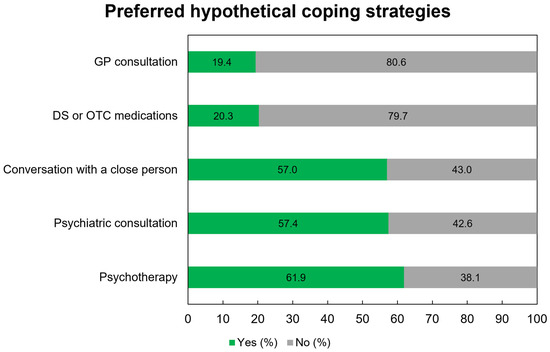
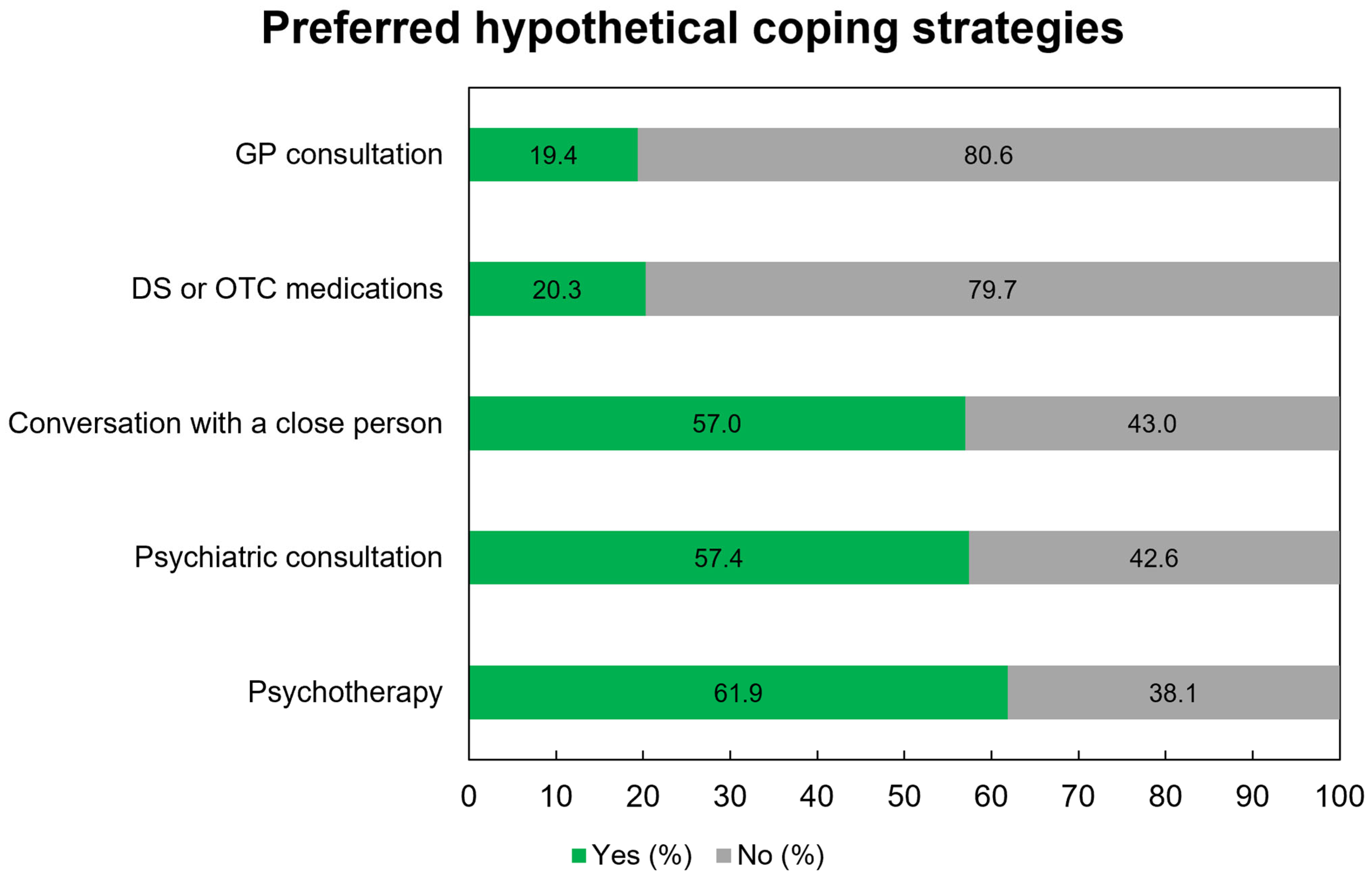
Participants most often selected psychotherapy (61.9%), psychiatric consultation (57.4%), and conversation with a close person (57.0%) as hypothetical future strategies under the assumption of unlimited resources, while 20.3% selected future use of DSs or OTC medication and 19.4% selected GP consultation (Figure 2).
Figure 2.
Preferred hypothetical future coping strategies among all participants under the assumption of unlimited financial and time resources.
In unadjusted three-group comparisons, product-use status was associated with psychotherapy, psychiatric consultation, conversation with a close person, and future use of a mood- or stress-relief preparation, but not GP consultation (Table 2). Effect sizes were small, with the largest association for future product use (Cramér’s V = 0.236). CUs and PUs did not differ significantly in past professional mental health support (Table A3).
Table 2.
Preferred hypothetical future coping strategies among current users (CUs), past users (PUs), and never-users (NUs) of DSs or OTC medications for mood improvement and stress relief—unadjusted comparisons.
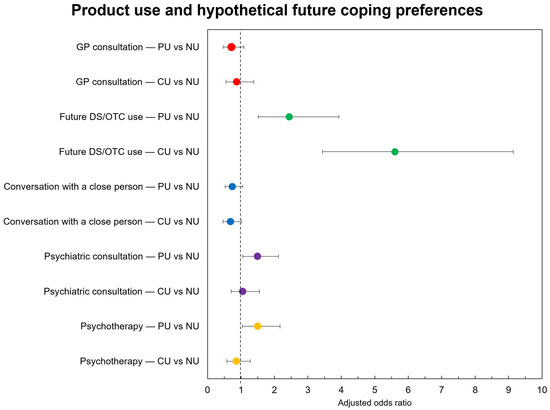
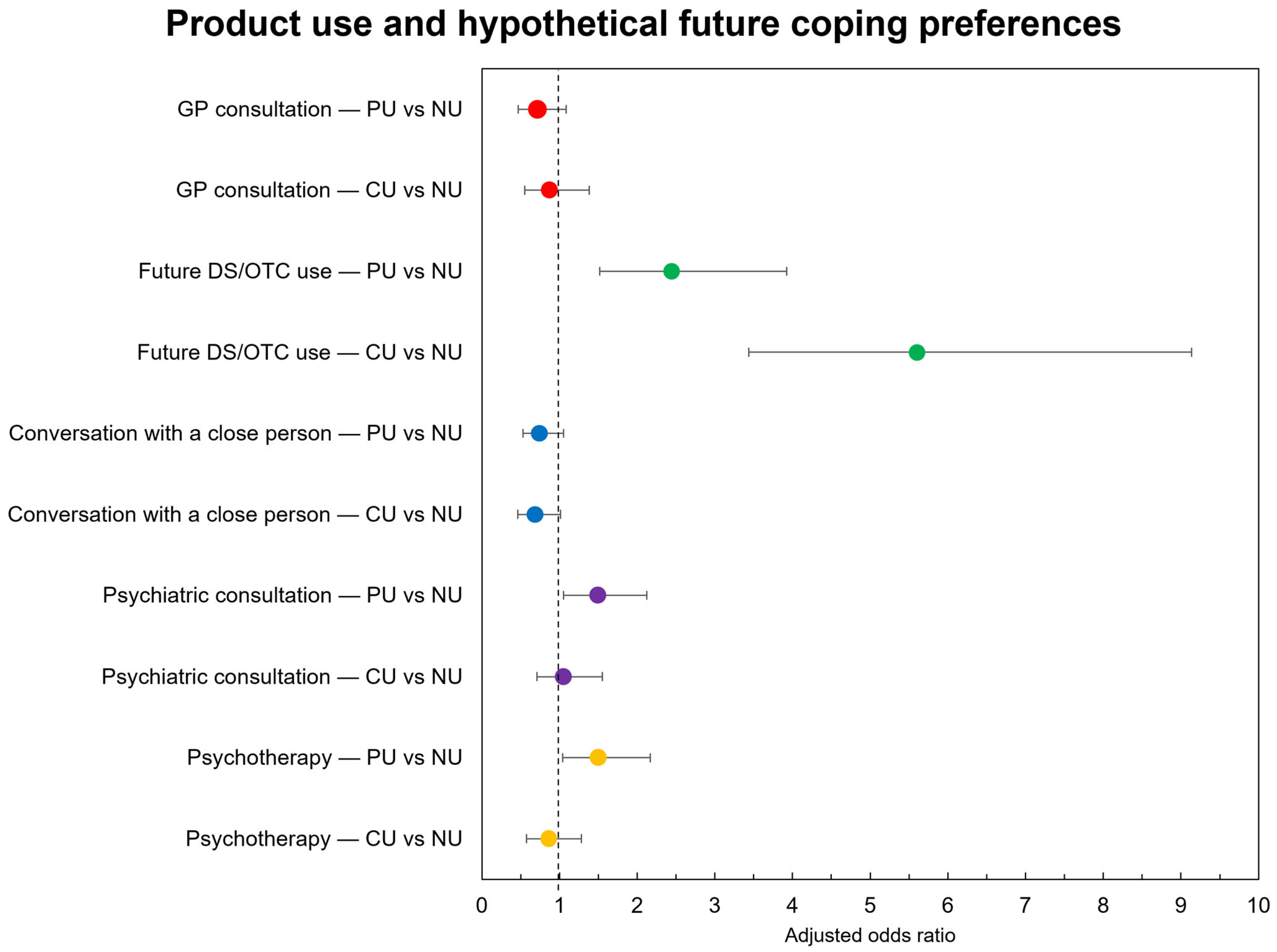
After covariate adjustment, the overall group effect remained significant for psychotherapy (p = 0.018) and future use of a mood- or stress-relief preparation (p < 0.001), but not for psychiatric consultation (p = 0.057), conversation with a close person (p = 0.105), or GP consultation (p = 0.285). Compared with NUs, PUs had higher adjusted odds of selecting psychotherapy (aOR = 1.50, 95% CI 1.04–2.17; p = 0.031), whereas CUs did not (aOR = 0.86, 95% CI 0.57–1.28; p = 0.457). Although the overall group effect for psychiatric consultation did not reach statistical significance (p = 0.057), PUs had nominally higher adjusted odds of selecting psychiatric consultation than NUs (aOR = 1.50, 95% CI 1.05–2.12; p = 0.024). Future product use was more strongly associated with both CUs (aOR = 5.60, 95% CI 3.44–9.14; p < 0.001) and PUs (aOR = 2.44, 95% CI 1.52–3.93; p < 0.001) than with NUs. These p-values are nominal and are interpreted in the context of the exploratory analysis. The results are presented in Table 3 and Figure 3.
Table 3.
Adjusted associations between product-use status and hypothetical future coping preferences.
Figure 3.
Adjusted odds ratios (aORs) and 95% confidence intervals for hypothetical future coping preferences according to product-use status. NUs served as the reference group. CUs—current users; PUs—past users; NUs—never-users; DSs—dietary supplements; OTC—over-the-counter medications; GP—general practitioner. Different colors added for better differentiation of the analyzed categories.
3.2. Trust in Physicians
Internal consistency of the author-translated T-DiG subscales ranged from 0.79 to 0.96 in available subscale data (Table 4).
Table 4.
Internal consistency and descriptive statistics of the Polish T-DiG subscales.
Unadjusted three-group comparisons identified significant differences for communication competency and global trust, whereas the remaining subscales were not statistically significant (Table 5).
Table 5.
Trust-related T-DiG subscale scores according to product-use status—unadjusted comparisons.
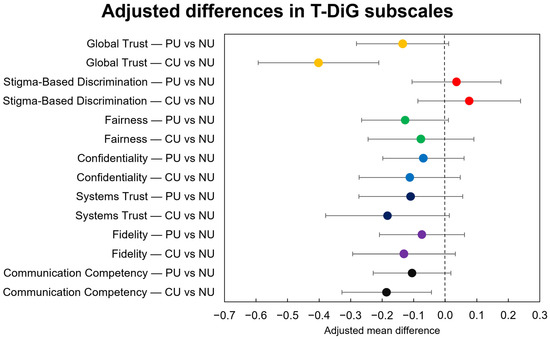
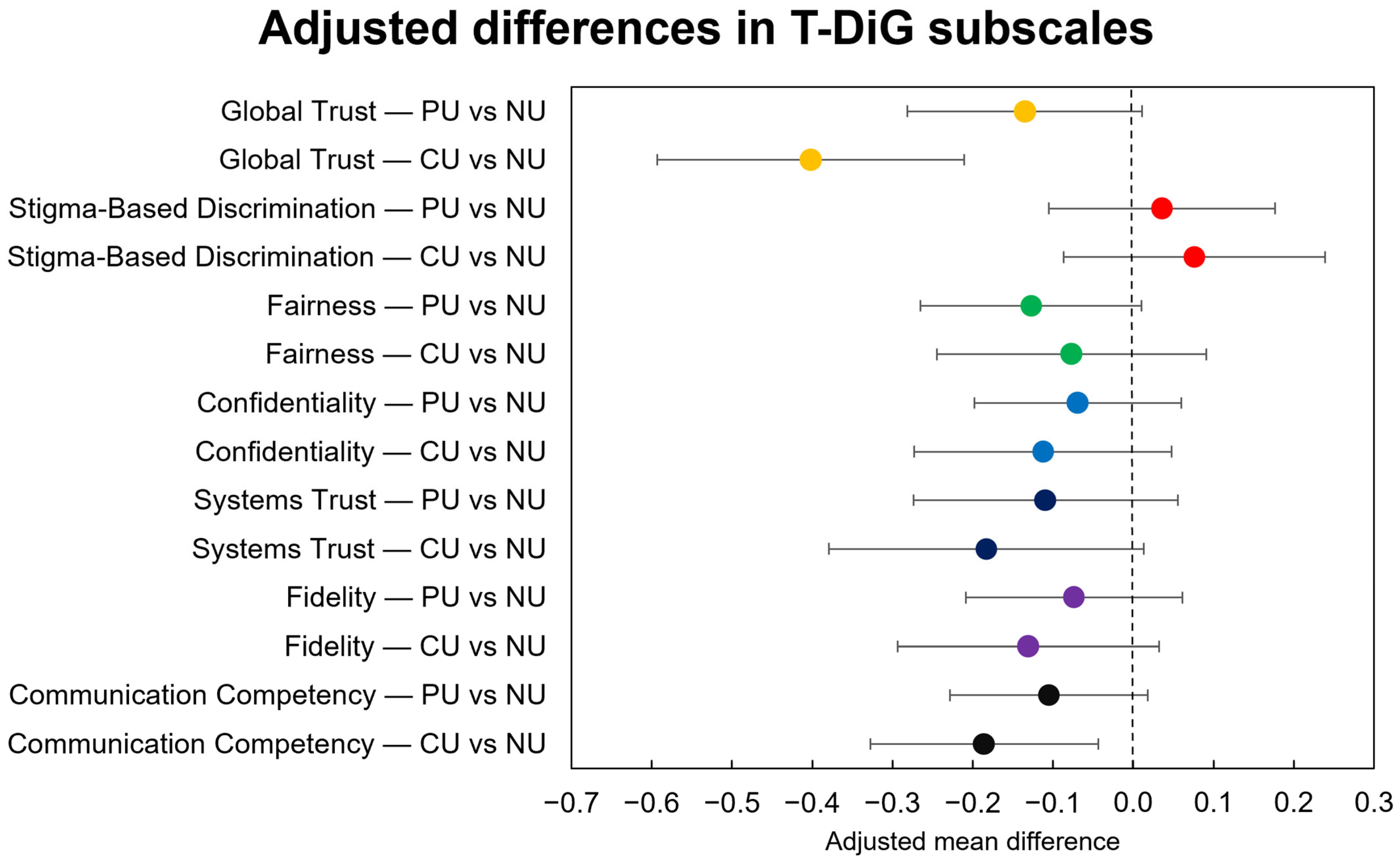
In adjusted linear models, product-use status was associated with communication competency (overall p = 0.031) and global trust (p < 0.001), but not with the other five subscales (all p ≥ 0.162). Compared with NUs, CUs had lower adjusted communication competency (aMD = −0.19, 95% CI −0.33 to −0.04; p = 0.010) and global trust scores (aMD = −0.40, 95% CI −0.59 to −0.21; p < 0.001). The corresponding PU-versus-NU estimates were not statistically significant. The results are presented in Table 6 and Figure 4.
Table 6.
Adjusted associations between product-use status and T-DiG subscale scores.
Figure 4.
Adjusted mean differences (aMDs) and 95% confidence intervals for T-DiG subscale scores according to product-use status. CUs—current users; PUs—past users; NUs—never-users. Different colors added for better differentiation of the analyzed categories.
3.3. Communication with Physician About Preparations
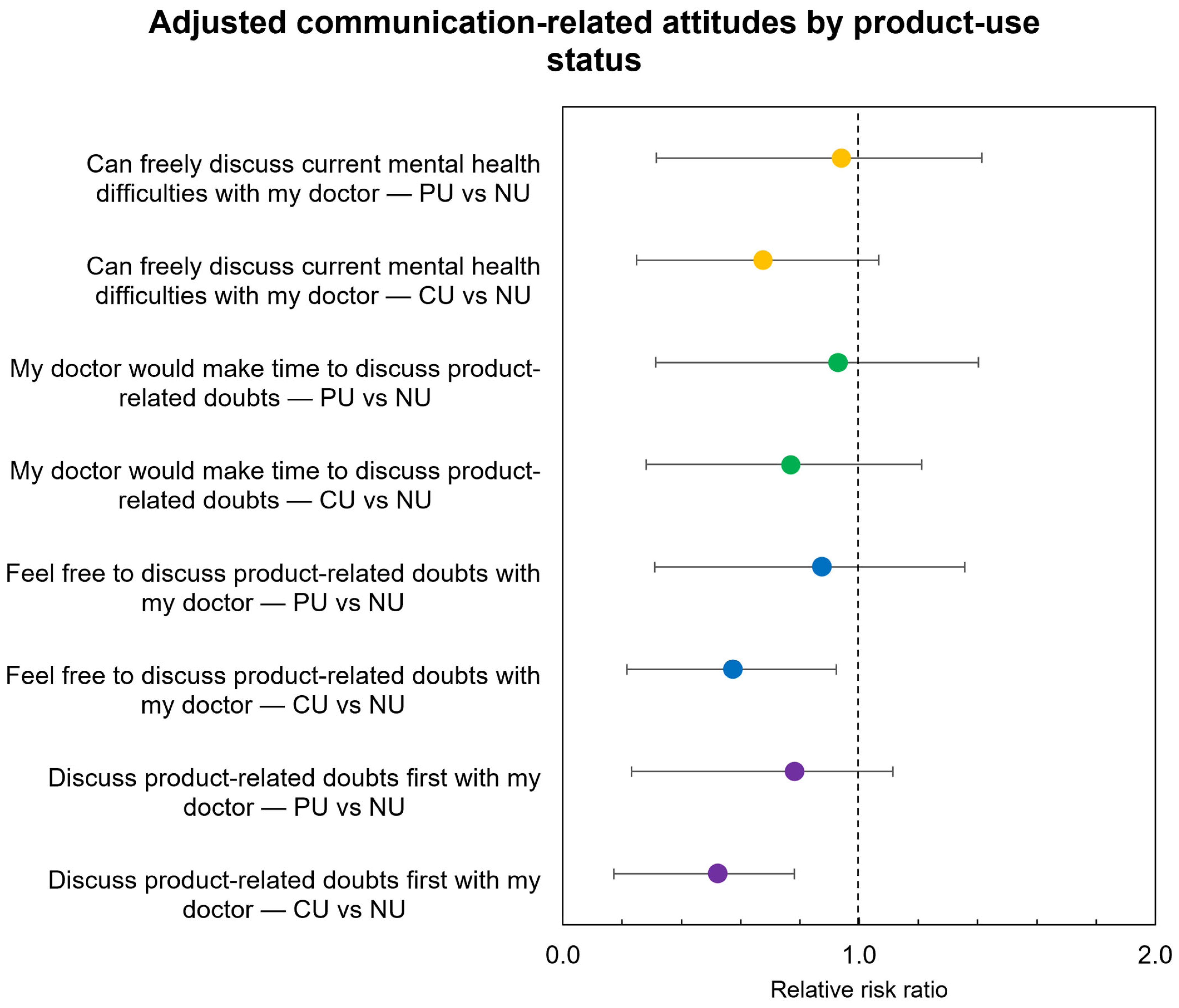
Unadjusted response distributions differed by product-use status for the first two communication items, but not for the third or fourth item (Table 7). NUs more often than CUs or PUs declared they would first discuss this issue with their doctor. They were also more likely than CUs or PUs to freely clarify any concerns with their doctor. No statistically significant differences were found on perceived doctor availability for a conversation or in willingness to have an open conversation with the doctor about current mental health issues.
Table 7.
Patient–physician communication regarding preparations for mood improvement or stress relief.
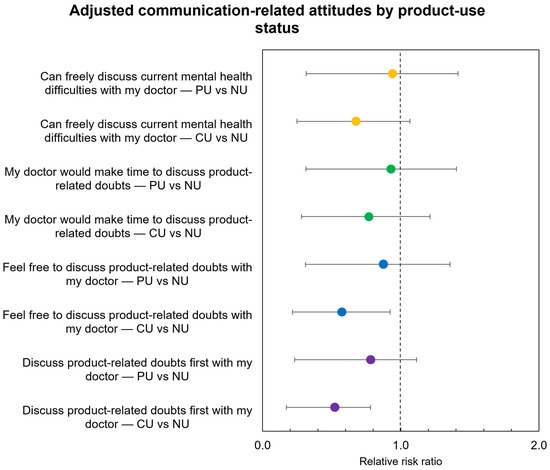
In adjusted multinomial models, the overall group effect remained significant for the first item (p < 0.001) and second item (p = 0.032), whereas the third (p = 0.809) and fourth (p = 0.113) were not significant (Table A4 and Figure 5).
Figure 5.
Adjusted relative risk ratios (RRRs) with 95% confidence intervals for responding “yes” versus “no” to communication-related items according to product-use status. NUs served as the reference group. CUs—current users; PUs—past users; NUs—never-users. Different colors added for better differentiation of the analyzed categories.
Across the unadjusted categorical analyses, effect sizes were generally small (Cramér’s V ≤ 0.236), and several initially significant associations attenuated after covariate adjustment. Therefore, the observed differences should be interpreted as modest group-level differences rather than as clearly separated profiles of users and non-users. Statistical significance should not be equated with large or clinically decisive group differences.
4. Discussion
The adjusted analyses indicated that product-use status was associated with selected, rather than uniformly different, hypothetical coping preferences. The strongest association concerned future use of a mood- or stress-relief preparation: both CUs and PUs had higher adjusted odds than NUs. Product-use status was also associated with psychotherapy preference overall, with PUs showing higher adjusted odds than NUs. The unadjusted differences in psychiatric consultation and conversation with a close person were no longer statistically significant after adjustment, and no adjusted group effect was observed for GP consultation. These findings do not support a simple conclusion that people with a history of product use independently prefer either formal or informal mental healthcare. Sample composition and recruitment mode explained part of the crude group differences.
Several explanations may account for this pattern, but they should be regarded as hypotheses rather than conclusions. One possible factor is unmeasured symptom severity. Walters et al. showed that individuals with mild-to-moderate psychological distress tend to prefer informal, human-contact-based forms of help, whereas those with severe distress are more likely to favor formal treatment options, such as psychotherapy or pharmacotherapy [40]. It is therefore possible that some users experienced a greater burden of mood- or stress-related symptoms, which may have prompted both the use of mood- or stress-relief products and greater openness to professional support. CAM use was also more common among individuals with self-diagnosis [41]. However, this interpretation should be treated with caution, as psychopathological symptoms were not directly assessed in the present study. This explanation should be examined in future research.
At the same time, a previous analysis conducted in the same sample showed that the main reason NUs did not use these products was that they coped with depressed mood or stress in other ways, rather than because they did not experience such problems [39]. This suggests that differences between users and NUs may reflect not only symptom burden, but also different coping repertoires or preferences for managing psychological distress. Moreover, previous population-based research has shown that individuals using complementary approaches for anxiety or depression often do so alongside rather than instead of conventional healthcare [41]. Taken together, these findings suggest that the use of DSs and OTC medications for mood improvement or stress relief should not necessarily be interpreted as avoidance of formal care. Rather, they may reflect a broader repertoire of coping responses among individuals actively attempting to manage depressed mood or stress.
Notably, PUs, but not CUs, were more likely to indicate psychotherapy as a preferred future strategy. This may suggest that previous use of such products does not consolidate reliance on self-management. However, because the study was cross-sectional and CUs and PUs did not differ significantly in previous professional help-seeking, this result should not be interpreted as evidence of a temporal transition from product use to professional care. Rather, the possibility that coping preferences may change over time should be treated as a hypothesis for future longitudinal research. Future studies should include a direct assessment of psychopathological symptoms to clarify whether the observed differences reflect variation in symptom burden, coping preferences, or other health-related attitudes.
The present findings suggest that users and NUs differ in their level of trust in physicians, with users reporting lower scores on several subscales of T-DiG. This is broadly consistent with part of the literature on CAM, in which lower trust in conventional healthcare or healthcare professionals has been associated with greater CAM use [42,43]. However, this relationship should not be interpreted as a simple rejection of conventional medicine. Adjustment also narrowed the trust findings. Independent group differences remained for communication competency and global trust, with CUs reporting lower scores than NUs, whereas differences on the other T-DiG domains were not statistically significant after adjustment. A classic population-based study found that dissatisfaction with conventional medicine did not predict alternative medicine use, suggesting that CAM use may also reflect broader health beliefs, preferences, or values [44]. In the mental health context, complementary approaches have been shown to be used alongside rather than instead of conventional care for anxiety and depression, and cross-national data indicate that CAM contacts among people with mental disorders often occur in those also receiving conventional healthcare [41,45].
CUs also appeared less open to discussing the use of DSs and OTC medications for mood improvement or stress relief with physicians. Compared with NUs, they were less likely to identify their doctor as the first point of contact for such concerns and reported lower comfort in raising them during consultations. Systematic review evidence suggests that disclosure of CAM use to medical providers is often incomplete, particularly for biologically based products such as herbal preparations and DSs. Commonly reported reasons for non-disclosure include lack of physician inquiry, perceived clinical irrelevance, fear of disapproval, lack of time, the belief that such products are safe, and doubts about physicians’ knowledge of complementary medicine [37,38]. Previous analysis of the same sample confirmed these findings and identified considering this information clinically irrelevant and fear of negative judgement as the main reasons for non-disclosure [39]. Although the present data do not allow conclusions about the direction of the relationship between trust and disclosure-related attitudes, they suggest that lower trust in physicians and reduced openness to discussing product use may coexist among users of DSs and OTC medications for mood improvement or stress relief. This may be clinically relevant, as undisclosed use of such preparations may limit physicians’ ability to identify potential interactions, assess treatment safety, and provide appropriate guidance.
Help-seeking preferences may be shaped not only by trust, but also by perceived need, symptom burden, previous treatment experiences, expected accessibility, and the anticipated route of care [46,47,48]. These factors were not assessed in the present study. Therefore, the observed pattern should not be interpreted as contradictory evidence, but rather as an indication that product use, trust in physicians, and willingness to seek mental healthcare may be shaped by different determinants. Future studies should assess previous treatment experiences, satisfaction with care, perceived access to services, and symptom severity to clarify these relationships.
Overall, psychotherapy and psychiatric consultation were the most frequently endorsed future strategies for managing depressed mood or stress. Although this preference may reflect openness to evidence-based forms of mental healthcare, it also draws attention to the capacity of the healthcare system to meet such needs, particularly in the context of workforce shortages and limited availability of specialist services in Poland. By contrast, GP consultation was selected by 19.4% of participants and did not differ significantly by product-use status after adjustment. Because the item asked about a hypothetical situation with unlimited resources, this result is not evidence of actual underuse of primary care. It does, however, indicate that primary care was less salient than psychotherapy or psychiatric consultation in the imagined coping scenario. Contemporary integrated-care models emphasize the role of primary care in the early identification, assessment, and initial management of common mental health problems, and integrated mental health services in primary care are increasingly viewed as a way to improve access and continuity of care [49,50,51,52,53]. Patients’ perceptions of physicians also warrant attention. A considerable part of the respondents did not believe that their physician would have sufficient time to discuss the use of DSs or OTC medications during consultations. This perception is consistent with broader literature showing that consultation time is often limited and may constrain effective patient–physician communication [54,55].
For clinicians, the practical implication is not to treat self-management as inherently opposed to formal care. Qualitative research among people recovering from mood and anxiety disorders suggests that self-management may include a broad range of clinical, functional, physical, existential, and social strategies that support recovery and everyday functioning [15,56,57,58,59]. However, when self-management involves DSs or OTC medications, its potential value depends on safe and informed use, including awareness of possible interactions and communication with healthcare professionals. From a clinical perspective, the findings seem to support routine, non-judgmental inquiry about DSs and OTC medications for mood improvement or stress relief, particularly because spontaneous disclosure cannot be assumed [38,39,41,60]. At the same time, clinicians should not infer from product use alone that a patient is unwilling to consider psychotherapy, psychiatric care, or other professional support.
This study has several strengths, including the relatively large sample, the distinction between current, past, and never-users, and the simultaneous examination of coping preferences, trust in physicians, and communication-related attitudes in a context that has not previously been systematically studied.
However, several limitations should be acknowledged. The cross-sectional design precludes conclusions about causality or temporal ordering. All data were self-reported and may be subject to recall and social desirability bias. This is particularly important in the context of depressive disorders and other mental health problems. The present study did not assess psychopathology using validated clinical instruments or clinical interviews. Therefore, the findings should only be interpreted as referring to self-perceived depressed mood and stress-related difficulties. Additionally, preferred coping strategies were assessed under a hypothetical assumption of unlimited resources and may not reflect actual help-seeking behavior. Importantly, psychopathological symptoms, prior treatment experiences, and other factors that may shape both product use and help-seeking preferences were not directly assessed. Another important limitation concerns the use of an author-translated Polish adaptation of the T-DiG scale, which has not undergone formal linguistic, cultural, or psychometric validation. Cronbach’s alpha reflects internal consistency only and does not establish construct validity [35]. Finally, the sample was predominantly female, with women accounting for 80.6% of respondents. This constitutes an important limitation and may reduce the generalizability of the findings. This imbalance may partly reflect both gender differences in dietary supplement-related behaviors and differential participation in online health surveys [61,62,63]. Another important limitation concerns the recruitment strategy. Online recruitment yielded a younger, predominantly female sample with a higher proportion of participants with a medical or health science background, whereas in-person recruitment included older respondents and a higher proportion of NUs. Although these characteristics and recruitment mode were included as control variables, residual and unmeasured confounding remains possible. Therefore, the sample should not be considered representative of the general Polish population. As a result, the observed prevalence of product use, coping preferences, trust-related scores, and communication attitudes should be interpreted with caution. Because no names, email addresses, or other personal identifiers were collected, repeated online participation could not be definitively identified or ruled out. This limitation resulted from the decision to preserve participant anonymity and avoid collecting sensitive identifying information.
Future research should use prospective or longitudinal designs that measure actual disclosure and healthcare use, incorporate validated measures of depression, anxiety, and perceived stress together with diagnoses and treatment history, and formally validate a Polish T-DiG translation before confirmatory trust analyses. More representative and balanced samples, studies in other healthcare settings or countries, and sufficiently powered product-specific analyses separating dietary supplements, botanical products, and OTC medications would help determine which associations are robust across populations and product categories.
5. Conclusions
In this exploratory cross-sectional sample, current, past, and never-users of DSs and OTC medications for mood improvement or stress relief showed outcome-specific associations after covariate adjustment. Product-use status was most strongly associated with stated future product use. CUs also had lower adjusted communication competency and global trust scores than NUs and were less likely to report willingness to discuss potential product-related doubts first with their doctor. Adjusted overall associations with psychiatric consultation, conversation with a close person, and GP consultation were not statistically significant.
These findings do not support a simple interpretation of DS or OTC medication use for mood improvement or stress relief as reluctance to engage with formal mental healthcare. Routine, non-judgmental inquiry about such products may help improve patient–physician communication and support safer care. Further studies should include direct assessment of psychopathological symptoms and explore how symptom burden, health-related attitudes, prior treatment experiences, and trust in physicians shape coping choices and disclosure behaviors.
Author Contributions
Conceptualization, A.B. and J.G.; methodology, A.B. and J.G.; validation, A.B. and M.B.; formal analysis, A.B. and M.B.; investigation, A.B. and J.G.; data curation, A.B. and M.B.; writing—original draft preparation, A.B.; writing—review and editing, J.G. and M.B.; visualization, A.B.; supervision, J.G. All authors have read and agreed to the published version of the manuscript.
Funding
This research received no external funding.
Institutional Review Board Statement
The study was conducted in accordance with the Declaration of Helsinki. The original protocol was approved by the Institutional Ethics Committee of the Medical University of Gdańsk (KB/570/2023, 20 October 2023). KB/570-515/2024 (26 November 2024) was an administrative extension/renewal for continuation of the previously approved study and introduced no changes to recruitment, questionnaire content, protocol, or study procedures.
Informed Consent Statement
Informed consent was obtained from all subjects involved in the study.
Data Availability Statement
The data, analysis code, and questionnaire materials are available from the corresponding authors upon reasonable request, subject to applicable ethical and data-protection conditions.
Acknowledgments
During the preparation of this manuscript, the authors used ChatGPT powered by GPT-5.6 Sol (OpenAI; work mode, max reasoning setting) to assist with developing and executing the Python-based statistical analyses. The authors reviewed all outputs and take full responsibility for the final content.
Conflicts of Interest
The authors declare no conflicts of interest.
Abbreviations
The following abbreviations are used in this manuscript.
| aMD | adjusted mean difference |
| aOR | adjusted odds ratio |
| CAM | complementary and alternative medicine |
| CUs | current users |
| CI | confidence interval |
| DSs | dietary supplements |
| GP | general practitioner |
| H1 | hypothesis 1 |
| H2 | hypothesis 2 |
| H3 | hypothesis 3 |
| NUs | never-users |
| OTC | over-the-counter medication |
| PUs | past users |
| RRR | relative risk ratio |
| SD | standard deviation |
| T-DiG | Trust in Doctors in General |
| T-MD | Trust in My Doctor |
Appendix A
Table A1.
Items from the Trust in Doctors in General scale with Polish translations (translated by authors for the purpose of the study, not formally validated).
Table A2.
Comparison of sociodemographic characteristics and product-use status by recruitment mode.
Table A3.
Complete response distributions for previous use of professional support for low mood or stress among current and past users of dietary supplements or OTC medications for mood improvement or stress relief.
Table A4.
Patient–physician communication regarding mood- and stress-relief preparations by product-use status.
References
- Schneiderman, N.; Ironson, G.; Siegel, S.D. Stress and Health: Psychological, Behavioral, and Biological Determinants. Annu. Rev. Clin. Psychol. 2005, 1, 607–628. [Google Scholar] [CrossRef] [Scilit] [PubMed]
- Yaribeygi, H.; Panahi, Y.; Sahraei, H.; Johnston, T.P.; Sahebkar, A. The Impact of Stress on Body Function: A Review. EXCLI J. 2017, 16, 1057–1072. [Google Scholar] [CrossRef] [Scilit] [PubMed]
- Maj, M.; Stein, D.J.; Parker, G.; Zimmerman, M.; Fava, G.A.; De Hert, M.; Demyttenaere, K.; McIntyre, R.S.; Widiger, T.; Wittchen, H. The Clinical Characterization of the Adult Patient with Depression Aimed at Personalization of Management. World Psychiatry 2020, 19, 269–293. [Google Scholar] [CrossRef] [Scilit] [PubMed]
- Attia, M.; Ibrahim, F.A.; Elsady, M.A.-E.; Khorkhash, M.K.; Rizk, M.A.; Shah, J.; Amer, S.A. Cognitive, Emotional, Physical, and Behavioral Stress-Related Symptoms and Coping Strategies among University Students during the Third Wave of COVID-19 Pandemic. Front. Psychiatry 2022, 13, 933981. [Google Scholar] [CrossRef] [Scilit] [PubMed]
- World Health Organization. Clinical Descriptions and Diagnostic Requirements for ICD-11 Mental, Behavioural and Neurodevelopmental Disorders; World Health Organization: Geneva, Switzerland, 2024. [Google Scholar]
- American Psychiatric Association. Diagnostic and Statistical Manual of Mental Disorders Fifth Edition Text Revision; American Psychiatric Association Publishing: Washington, DC, USA, 2022. [Google Scholar]
- Ayuso-Mateos, J.L.; Nuevo, R.; Verdes, E.; Naidoo, N.; Chatterji, S. From Depressive Symptoms to Depressive Disorders: The Relevance of Thresholds. Br. J. Psychiatry 2010, 196, 365–371. [Google Scholar] [CrossRef] [Scilit] [PubMed]
- Rodríguez, M.R.; Nuevo, R.; Chatterji, S.; Ayuso-Mateos, J.L. Definitions and Factors Associated with Subthreshold Depressive Conditions: A Systematic Review. BMC Psychiatry 2012, 12, 181. [Google Scholar] [CrossRef] [Scilit] [PubMed]
- Kiejna, A.; Piotrowski, P.; Adamowski, T.; Moskalewicz, J.; Wciórka, J.; Stokwiszewski, J.; Rabczenko, D.; Kessler, R. The Prevalence of Common Mental Disorders in the Population of Adult Poles by Sex and Age Structure–an EZOP Poland Study. Psychiatr. Pol. 2015, 49, 15–27. [Google Scholar] [CrossRef] [Scilit] [PubMed]
- Zhang, Z.; Chen, X.; Wu, S.; Chen, X.; Wang, X.; Liu, C.; Zeng, N.; Liu, Y.; Huo, T.; Liu, X.; et al. Global, Regional and National Burden of Anxiety and Depression Disorders from 1990 to 2021, and Forecasts up to 2040. J. Affect. Disord. 2026, 393, 120299. [Google Scholar] [CrossRef] [Scilit] [PubMed]
- Hohls, J.K.; König, H.-H.; Quirke, E.; Hajek, A. Anxiety, Depression and Quality of Life—A Systematic Review of Evidence from Longitudinal Observational Studies. Int. J. Environ. Res. Public Health 2021, 18, 12022. [Google Scholar] [CrossRef] [Scilit] [PubMed]
- D’Avanzo, B.; Barbato, A.; Erzegovesi, S.; Lampertico, L.; Rapisarda, F.; Valsecchi, L. Formal and Informal Help-Seeking for Mental Health Problems. A Survey of Preferences of Italian Students. Clin. Pract. Epidemiol. Ment. Health 2012, 8, 47–51. [Google Scholar] [CrossRef] [Scilit] [PubMed]
- Frost, R.; Zamri, A.; Mathew, S.; Salame, A.; Bhanu, C.; Bhamra, S.K.; Bazo-Alvarez, J.C.; Heinrich, M.; Walters, K. Understanding the Research Landscape of Over-the-Counter Herbal Products, Dietary Supplements, and Medications Evaluated for Depressive Symptoms in Adults: A Scoping Review. Front. Pharmacol. 2025, 16, 1609605. [Google Scholar] [CrossRef] [Scilit] [PubMed]
- Frost, R.; Uddin, S.; Mathew, S.; Thomas, V.; Salame, A.; Bhamra, S.K.; Bazo-Alvarez, J.C.; Bhanu, C.; Heinrich, M.; Walters, K. What over the Counter (OTC) Products Have Been Evaluated for Anxiety in Adults Aged 18–60? A Scoping Review. J. Ment. Health 2025, 34, 695–715. [Google Scholar] [CrossRef] [Scilit] [PubMed]
- Pilkington, K.; Wieland, L.S. Self-Care for Anxiety and Depression: A Comparison of Evidence from Cochrane Reviews and Practice to Inform Decision-Making and Priority-Setting. BMC Complement. Med. Ther. 2020, 20, 247. [Google Scholar] [CrossRef] [Scilit] [PubMed]
- Zimny-Zając, A.; Brańska, K.; Bujas, A.; Mikołajska, M.; Wójtowicz, P.; Żmudziak, M. Narodowy Test Żywienia Polaków 2024; Medonet: Warsaw, Poland, 2024. [Google Scholar]
- Zimny-Zając, A.; Brańska, K.; Mikołajska, M.; Wójtowicz, P. Narodowy Test Zdrowia 2025; Medonet: Warsaw, Poland, 2025. [Google Scholar]
- Czerwiński, A.; Liebers, D. Regulacja Rynku Suplementów Diety Czy Polska Ma Szansę Zostać Europejskim Liderem? Polski Instytut Ekonomiczny: Warsaw, Poland, 2019. [Google Scholar]
- Frost, R.; Mathew, S.; Thomas, V.; Uddin, S.; Salame, A.; Vial, C.; Cohen, T.; Bhamra, S.K.; Alvarez, J.C.B.; Bhanu, C.; et al. A Scoping Review of Over-the-Counter Products for Depression, Anxiety and Insomnia in Older People. BMC Complement. Med. Ther. 2024, 24, 275. [Google Scholar] [CrossRef] [Scilit] [PubMed]
- Brzozowska, A.; Grabowski, J.; Grzyb, A. Dietary Supplements for Mood Improvement and Stress Relief Producers’ and Merchants’ Declarations vs State of Knowledge. Arch. Psychiatry Psychother. 2025, 27, 63–74. [Google Scholar] [CrossRef] [Scilit]
- Wierzejska, R.E.; Wiosetek-Reske, A.; Siuba-Strzelińska, M.; Wojda, B. Health-Related Content of TV and Radio Advertising of Dietary Supplements—Analysis of Legal Aspects after Introduction of Self-Regulation for Advertising of These Products in Poland. Int. J. Environ. Res. Public Health 2022, 19, 8037. [Google Scholar] [CrossRef] [Scilit] [PubMed]
- Karbownik, M.S.; Paul, E.; Nowicka, M.; Nowicka, Z.; Kowalczyk, R.P.; Kowalczyk, E.; Pietras, T. Knowledge about Dietary Supplements and Trust in Advertising Them: Development and Validation of the Questionnaires and Preliminary Results of the Association between the Constructs. PLoS ONE 2019, 14, e0218398. [Google Scholar] [CrossRef] [Scilit] [PubMed]
- Spanakis, M.; Bakaros, E.; Papadopoulou, S.-N.; Fournaraki, A.; Symvoulakis, E.K. Pharmacoepidemiological Data on Drug–Herb Interactions: Serotonin Syndrome, Arrhythmias and the Emerging Role of Artificial Intelligence. Pharmacoepidemiology 2025, 4, 22. [Google Scholar] [CrossRef] [Scilit]
- Madabushi, R.; Frank, B.; Drewelow, B.; Derendorf, H.; Butterweck, V. Hyperforin in St. John’s Wort Drug Interactions. Eur. J. Clin. Pharmacol. 2006, 62, 225–233. [Google Scholar] [CrossRef] [Scilit] [PubMed]
- Levy, I.; Attias, S.; Ben-Arye, E.; Goldstein, L.; Schiff, E. Adverse Events Associated with Interactions with Dietary and Herbal Supplements among Inpatients. Br. J. Clin. Pharmacol. 2017, 83, 836–845. [Google Scholar] [CrossRef] [Scilit] [PubMed]
- Woroń, J.; Siwek, M. Unwanted Effects of Psychotropic Drug Interactions with Medicinal Products and Diet Supplements Containing Plant Extracts. Psychiatr. Pol. 2018, 52, 983–996. [Google Scholar] [CrossRef] [Scilit] [PubMed]
- Strocka, J.; Religioni, U.; Pinkas, J. Food Supplements Market in Poland and the European Union–Regulations and Consumption of Food Supplements in the Pre-COVID and COVID Era. Fam. Med. Prim. Care Rev. 2025, 27, 347–351. [Google Scholar] [CrossRef] [Scilit]
- Amidžić, M.; Fuentes, J.B.; Banović, J.; Torović, L. Notifications and Health Consequences of Unauthorized Pharmaceuticals in Food Supplements. Pharmacy 2023, 11, 154. [Google Scholar] [CrossRef] [Scilit] [PubMed]
- Wróbel, K.; Milewska, A.J.; Marczak, M.; Kozłowski, R. Dietary Supplements Questioned in the Polish Notification Procedure upon the Basis of Data from the National Register of Functional Foods and the European System of the RASFF. Int. J. Environ. Res. Public Health 2022, 19, 8161. [Google Scholar] [CrossRef] [Scilit] [PubMed]
- Makowska, M.; Jasiński, Ł. A Discussion of the Unresolved 2016/17 Plans for Regulating the Polish Dietary Supplements Market. Health Policy 2019, 123, 544–549. [Google Scholar] [CrossRef] [Scilit] [PubMed]
- Meyer, S.; Ward, P.; Coveney, J.; Rogers, W. Trust in the Health System: An Analysis and Extension of the Social Theories of Giddens and Luhmann. Health Sociol. Rev. 2008, 17, 177–186. [Google Scholar] [CrossRef] [Scilit]
- Birkhäuer, J.; Gaab, J.; Kossowsky, J.; Hasler, S.; Krummenacher, P.; Werner, C.; Gerger, H. Trust in the Health Care Professional and Health Outcome: A Meta-Analysis. PLoS ONE 2017, 12, e0170988. [Google Scholar] [CrossRef] [Scilit] [PubMed]
- Chandra, S.; Mohammadnezhad, M.; Ward, P. Trust and Communication in a Doctor- Patient Relationship: A Literature Review. J. Healthc. Commun. 2018, 3, 3. [Google Scholar] [CrossRef]
- Weber, L.R. Measuring Trust in One’s Physician: A Scoping Review. PLoS ONE 2024, 19, e0303840. [Google Scholar] [CrossRef] [Scilit] [PubMed]
- Richmond, J.; Boynton, M.H.; Ozawa, S.; Muessig, K.E.; Cykert, S.; Ribisl, K.M. Development and Validation of the Trust in My Doctor, Trust in Doctors in General, and Trust in the Health Care Team Scales. Soc. Sci. Med. 2022, 298, 114827. [Google Scholar] [CrossRef] [Scilit] [PubMed]
- Gu, L.; Tian, B.; Xin, Y.; Zhang, S.; Li, J.; Sun, Z. Patient Perception of Doctor Communication Skills and Patient Trust in Rural Primary Health Care: The Mediating Role of Health Service Quality. BMC Prim. Care 2022, 23, 255. [Google Scholar] [CrossRef] [Scilit] [PubMed]
- Foley, H.; Steel, A.; Cramer, H.; Wardle, J.; Adams, J. Disclosure of Complementary Medicine Use to Medical Providers: A Systematic Review and Meta-Analysis. Sci. Rep. 2019, 9, 1573. [Google Scholar] [CrossRef] [Scilit] [PubMed]
- Guzman, J.R.; Paterniti, D.A.; Liu, Y.; Tarn, D.M. Factors Related to Disclosure and Nondisclosure of Dietary Supplements in Primary Care, Integrative Medicine, and Naturopathic Medicine. J. Fam. Med. Dis. Prev. 2019, 5, 109. [Google Scholar] [CrossRef] [Scilit] [PubMed]
- Brzozowska, A.; Grabowski, J. Prevalence and Patterns of Use of Dietary Supplements and OTC Medications for Mood Improvement and Stress Relief among Adults in Poland. Sci. Rep. 2026; in press.
- Walters, K.; Buszewicz, M.; Weich, S.; King, M. Help-Seeking Preferences for Psychological Distress in Primary Care: Effect of Current Mental State. Br. J. Gen. Pract. 2008, 58, 694–698. [Google Scholar] [CrossRef] [Scilit] [PubMed]
- Kessler, R.C.; Soukup, J.; Davis, R.B.; Foster, D.F.; Wilkey, S.A.; Van Rompay, M.I.; Eisenberg, D.M. The Use of Complementary and Alternative Therapies to Treat Anxiety and Depression in the United States. Am. J. Psychiatry 2001, 158, 289–294. [Google Scholar] [CrossRef] [Scilit] [PubMed]
- Barbieri, V.; Lombardo, S.; Gärtner, T.; Piccoliori, G.; Engl, A.; Wiedermann, C.J. Trust in Conventional Healthcare and Utilization of Complementary and Alternative Medicine in South Tyrol, Italy: A Population-Based Cross-Sectional Survey. Ann. Ig. 2024, 36, 377–391. [Google Scholar] [CrossRef] [Scilit] [PubMed]
- van den Brink-Muinen, A.; Rijken, P.M. Does Trust in Health Care Influence the Use of Complementary and Alternative Medicine by Chronically Ill People? BMC Public Health 2006, 6, 188. [Google Scholar] [CrossRef] [Scilit] [PubMed]
- Astin, J.A. Why Patients Use Alternative Medicine. JAMA 1998, 279, 1548–1553. [Google Scholar] [CrossRef] [Scilit] [PubMed]
- de Jonge, P.; Wardenaar, K.J.; Hoenders, H.R.; Evans-Lacko, S.; Kovess-Masfety, V.; Aguilar-Gaxiola, S.; Al-Hamzawi, A.; Alonso, J.; Andrade, L.H.; Benjet, C.; et al. Complementary and Alternative Medicine Contacts by Persons with Mental Disorders in 25 Countries: Results from the World Mental Health Surveys. Epidemiol. Psychiatr. Sci. 2018, 27, 552–567. [Google Scholar] [CrossRef] [Scilit] [PubMed]
- Clement, S.; Schauman, O.; Graham, T.; Maggioni, F.; Evans-Lacko, S.; Bezborodovs, N.; Morgan, C.; Rüsch, N.; Brown, J.S.L.; Thornicroft, G. What Is the Impact of Mental Health-Related Stigma on Help-Seeking? A Systematic Review of Quantitative and Qualitative Studies. Psychol. Med. 2015, 45, 11–27. [Google Scholar] [CrossRef] [Scilit] [PubMed]
- Gulliver, A.; Griffiths, K.M.; Christensen, H. Perceived Barriers and Facilitators to Mental Health Help-Seeking in Young People: A Systematic Review. BMC Psychiatry 2010, 10, 113. [Google Scholar] [CrossRef] [Scilit] [PubMed]
- Gaebel, W.; Muijen, M.; Baumann, A.E.; Bhugra, D.; Wasserman, D.; van der Gaag, R.J.; Heun, R.; Zielasek, J. EPA Guidance on Building Trust in Mental Health Services. Eur. Psychiatry 2014, 29, 83–100. [Google Scholar] [CrossRef] [Scilit] [PubMed]
- Reist, C.; Petiwala, I.; Latimer, J.; Raffaelli, S.B.; Chiang, M.; Eisenberg, D.; Campbell, S. Collaborative Mental Health Care: A Narrative Review. Medicine 2022, 101, e32554. [Google Scholar] [CrossRef] [Scilit] [PubMed]
- Balasubramanian, B.A.; Cohen, D.J.; Jetelina, K.K.; Dickinson, L.M.; Davis, M.; Gunn, R.; Gowen, K.; deGruy, F.V.; Miller, B.F.; Green, L.A. Outcomes of Integrated Behavioral Health with Primary Care. J. Am. Board Fam. Med. 2017, 30, 130–139. [Google Scholar] [CrossRef] [Scilit] [PubMed]
- Funk, M.; Saraceno, B.; Drew, N.; Faydi, E. Integrating Mental Health into Primary Healthcare. Ment. Health Fam. Med. 2008, 5, 5–8. [Google Scholar] [PubMed]
- Wakida, E.K.; Talib, Z.M.; Akena, D.; Okello, E.S.; Kinengyere, A.; Mindra, A.; Obua, C. Barriers and Facilitators to the Integration of Mental Health Services into Primary Health Care: A Systematic Review. Syst. Rev. 2018, 7, 211. [Google Scholar] [CrossRef] [Scilit] [PubMed]
- Samochowiec, J.; Dudek, D.; Kucharska-Mazur, J.; Murawiec, S.; Rymaszewska, J.; Cubała, J.; Heitzman, J.; Zdunczyk, A.J.; Chatizow, J.; Bała, M. Wytyczne Postępowania w Depresji u Dorosłych Dla Lekarzy Rodzinnych; Polskie Towarzystwo Psychiatryczne & Naczelna Izba Lekarska: Warsaw, Poland, 2019. [Google Scholar]
- Irving, G.; Neves, A.L.; Dambha-Miller, H.; Oishi, A.; Tagashira, H.; Verho, A.; Holden, J. International Variations in Primary Care Physician Consultation Time: A Systematic Review of 67 Countries. BMJ Open 2017, 7, e017902. [Google Scholar] [CrossRef] [Scilit] [PubMed]
- Albahri, A.H.; Abushibs, A.S.; Abushibs, N.S. Barriers to Effective Communication between Family Physicians and Patients in Walk-in Centre Setting in Dubai: A Cross-Sectional Survey. BMC Health Serv. Res. 2018, 18, 637. [Google Scholar] [CrossRef] [Scilit] [PubMed]
- Villaggi, B.; Provencher, H.; Coulombe, S.; Meunier, S.; Radziszewski, S.; Hudon, C.; Roberge, P.; Provencher, M.D.; Houle, J. Self-Management Strategies in Recovery from Mood and Anxiety Disorders. Glob. Qual. Nurs. Res. 2015, 2, 2333393615606092. [Google Scholar] [CrossRef] [Scilit] [PubMed]
- Oehler, C.; Görges, F.; Rogalla, M.; Rummel-Kluge, C.; Hegerl, U. Efficacy of a Guided Web-Based Self-Management Intervention for Depression or Dysthymia: Randomized Controlled Trial with a 12-Month Follow-Up Using an Active Control Condition. J. Med. Internet Res. 2020, 22, e15361. [Google Scholar] [CrossRef] [Scilit] [PubMed]
- Brahim, L.O.; Lambert, S.D.; Feeley, N.; Coumoundouros, C.; Schaffler, J.; McCusker, J.; Moodie, E.E.M.; Kayser, J.; Kolne, K.; Belzile, E.; et al. The Effects of Self-Management Interventions on Depressive Symptoms in Adults with Chronic Physical Disease(s) Experiencing Depressive Symptomatology: A Systematic Review and Meta-Analysis. BMC Psychiatry 2021, 21, 584. [Google Scholar] [CrossRef] [Scilit] [PubMed]
- Sahni, P.S.; Singh, K.; Sharma, N.; Garg, R. Yoga an Effective Strategy for Self-Management of Stress-Related Problems and Wellbeing during COVID19 Lockdown: A Cross-Sectional Study. PLoS ONE 2021, 16, e0245214. [Google Scholar] [CrossRef] [Scilit] [PubMed]
- Stanojević-Ristić, Z.; Mrkić, I.; Ćorac, A.; Dejanović, M.; Mitić, R.; Vitković, L.; Rašić, J.; Valjarević, D.; Valjarević, A. Healthcare Professionals’ Knowledge and Behaviors Regarding Drug–Dietary Supplement and Drug–Herbal Product Interactions. Int. J. Environ. Res. Public Health 2022, 19, 4290. [Google Scholar] [CrossRef] [Scilit] [PubMed]
- Sierpiński, R.; Jankowski, M.; Raciborski, F.; Kamińska, A. Sociodemographic Differences in the Use of Dietary Supplements in a Representative Sample of Adults in Poland—A Secondary Analysis. Front. Nutr. 2025, 12, 1724264. [Google Scholar] [CrossRef] [Scilit]
- Szałata, K.; Czekalska, M.; Łabuzińska, L.; Bukowiec, M.; Worosz, W.; Sikorska, L.M.; Szpila, G.; Ćwil, A. Bias in Online Health Surveys: Identifying and Overcoming Challenges. E-Methodology 2025, 11, 20–28. [Google Scholar] [CrossRef] [Scilit]
- Strocka, J.; Religioni, U.; Kaźmierczak, J.; Drab, A.; Plagens-Rotman, K.; Merks, P.; Pinkas, J.; Ostrowski, J. Gender and Education Influences on Dietary Supplement Awareness in Poland: A Nationally Representative Survey. Med. Sci. Monit. 2024, 31, e946704. [Google Scholar] [CrossRef] [Scilit] [PubMed]

Disclaimer/Publisher’s Note: The statements, opinions and data contained in all publications are solely those of the individual author(s) and contributor(s) and not of MDPI and/or the editor(s). MDPI and/or the editor(s) disclaim responsibility for any injury to people or property resulting from any ideas, methods, instructions or products referred to in the content. |
© 2026 by the authors. Licensee MDPI, Basel, Switzerland. This article is an open access article distributed under the terms and conditions of the Creative Commons Attribution (CC BY) license.