


Highlights
What are the main findings?
- An integrative analysis of flavonoid-intake-induced global genomic modulations (i.e., genomic data) with GWAS genes associated with vascular dysfunction (i.e., genetic data) identified more than a hundred genes directly governing the vasculoprotective health effects of flavonoids in humans.
- Subsequent functional analyses and literature searches identified the following top-priority genes: ALDH2, APOE, CAPZA1, CYP11B2, GNA13, IL6, IRF5, LDLR, LPL, LSP1, MKNK1, MMP3, MTHFR, MYO6, NCR3, PPARG, SARM1, TCF20, TCF7L2, and TNF.
What is the implication of the main finding?
- Polymorphisms in these genes may potentially determine the interindividual variabilities in the vasculoprotective effects of dietary flavonoids in humans, which should be examined in future well-designed human nutrigenetic studies that will include only individuals with high levels of circulating metabolites of the tested flavonoids.
- The results of this study provide key insights into the identification of gene variants associated with a better vascular response to dietary flavonoids in humans, thereby building the foundation for precision nutrition research in the field of (poly)phenols.
Abstract
Flavonoids exert vasculoprotective effects in humans, but interindividual variability in their action has also been reported. This study aims to identify genes that are associated with vascular health effects of flavonoids and whose polymorphisms could explain interindividual variability in response to their intake. Applying the predetermined literature search criteria, we identified five human intervention studies reporting positive effects of flavonoids on vascular function together with global genomic changes analyzed using microarray methods. Genes involved in vascular dysfunction were identified from genome-wide association studies (GWAS). By extracting data from the eligible human intervention studies, we obtained 5807 differentially expressed genes (DEGs). The number of identified upstream regulators (URs) varied across the studies, from 227 to 1407. The search of the GWAS Catalog revealed 493 genes associated with vascular dysfunction. An integrative analysis of transcriptomic data with GWAS genes identified 106 candidate DEGs and 42 candidate URs, while subsequent functional analyses and a search of the literature identified 20 top priority candidate genes: ALDH2, APOE, CAPZA1, CYP11B2, GNA13, IL6, IRF5, LDLR, LPL, LSP1, MKNK1, MMP3, MTHFR, MYO6, NCR3, PPARG, SARM1, TCF20, TCF7L2, and TNF. In conclusion, this integrated analysis identifies important genes to design future nutrigenetic studies for development of precision nutrition for polyphenols.
1. Introduction
(Poly)phenols are the most abundant bioactive compounds of plant origin and are present in the human diet in relatively large amounts, ranging from less than 500 to more than 1500 mg/d [1,2]. In the US adult population, a dietary intake of approximately 900 mg per 1000 kcal/d has recently been reported [3]. (Poly)phenols present extraordinary heterogeneity in their chemical structures, with over 500 chemical entities identified in the human diet, which are divided into two classes: flavonoids and non-flavonoids [4,5]. Following intake of (poly)phenols, they are metabolized by both human enzymes and gastro-intestinal microbiota. Once in the gut and intestine, (poly)phenols can be absorbed by enterocytes, enter the liver, and be converted by Phase I (oxidation, hydrolysis, and reduction) and Phase II (glucuronidation, methylation, and sulfation) metabolic reactions. Derived metabolites enter general circulation and can reach tissues. Non-absorbed (poly)phenols enter the colon where they can be directly metabolized by gut microbiota and give rise to low-molecular-weight metabolites. These gut microbiota-derived metabolites can be absorbed by the enterocytes and be further metabolized by Phase I and Phase II metabolic reactions in the liver before entering general circulation [6].
Flavonoids are among the best studied plant food bioactives in terms of their health-promoting properties. Human studies have shown that a diet rich in flavonoids can reduce type 2 diabetes risk [7], improve insulin sensitivity and blood lipids [8], and have beneficial effects on vascular function [9]. Recently, a long-term, large-scale, randomized, double-blind, placebo-controlled trial with cocoa extract supplementation [500 mg flavanols/d, including 80 mg (−)-epicatechin] showed a significant reduction in cardiovascular disease death by 27% among older adults [10]. In addition, molecular mechanisms underlying vasculoprotective effects of flavonoids have been investigated using omics technologies, such as transcriptomics, epigenomics, proteomics, and metabolomics [11]. These state-of-the-art untargeted analytical methods enable the identification of global molecular modulations, while subsequent bioinformatic analyses of individual omics data indicate key cellular pathways and regulatory mechanisms involved.
Despite the general trend demonstrating positive effects of dietary flavonoids on vascular health in humans, some less convincing results have also been reported in the literature. Such data have allowed for the identification of subgroups of participants where the vasculoprotective effects of flavonoids were more pronounced [12]. Other studies identified factors underlying the interindividual variabilities in health-promoting effects of flavonoids that include sex, age, ethnicity, body mass index, health status, gut microbiome, and genetic factors [13]. Of these, genetic factors have been the least studied.
Vascular function, which is one of the key determinants of overall health, is largely influenced by age [14] and lifestyle [15,16], with genetic factors also playing a significant role. A clinical study has shown the association of endothelial nitric oxide synthase (Nitric Oxide Synthase 3, NOS3) gene G894T polymorphism with hypertension risk and complications [17]. Also, monocyte chemoattractant protein-1 (MCP-1; or C-C Motif Chemokine Ligand 2, CCL2) gene −2578A > G polymorphism has been associated with an increased risk of coronary atherosclerosis in an asymptomatic population [18]. On the other hand, studies on flavonoids, genetic polymorphisms, and vascular health are scarce. The most convincing results were obtained from the studies that were focused on polymorphisms of well-established genes that are directly associated with vascular function or genes involved in the metabolism of circulating lipoproteins. It has been shown that the Glu298Asp single nucleotide polymorphism (SNP) in the NOS3 gene differentially affects the vascular response to acute consumption of fruit and vegetables [19], and that polymorphisms in Apolipoprotein A1 (APOA1_rs964184) and Lipoprotein Lipase (LPL_rs12678919) genes determine the vasculoprotective effects of orange juice [20].
Given the small number of identified genetic polymorphisms that determine the interindividual variabilities in the effects of dietary flavonoids on vascular function, there is a need for additional studies focused on: (a) identification of candidate genes on dietary flavonoids and vascular function, and (b) testing of identified candidate genes in appropriately designed nutrigenetic studies. To address the first goal, i.e., identification of candidate genes for future nutrigenetic studies on dietary flavonoids and vascular function, one approach is through the integration of (i) data from human intervention studies with flavonoids showing modulations in global gene expression together with positive effects on vascular function and (ii) results from genome-wide association studies (GWAS) that have identified variants and risk alleles associated with vascular dysfunction, such as hypertension, atherosclerosis, or arterial stiffness. So far, such an innovative and powerful approach combining genomic and GWAS datasets has enabled the identification of candidate genes associated with, and directly governing, disease pathobiology [21,22], thus facilitating targeted studies to identify functional impact of major causal genes. Indeed, GWAS can identify hundreds of candidate genes associated with the development of disease, revealing a need for a systematic way to understand the causal mechanism(s) of these genes and a means to prioritize them for further study. The integration of genomic and GWAS data has recently allowed to identify candidate genes causal of coronary artery disease (CAD) [23]. The authors performed a comprehensive integrative analysis by combining CAD genome-wide association studies datasets (UK Biobank and CARDIoGRAMplusC4D) with transcriptomic data from the STARNET study (Stockholm–Tartu Atherosclerosis Reverse Network Engineering Task). The same approach has also been recently used to identify genes associated with atrial fibrillation (AF) [24]. The authors concluded that such an integrative omics strategy has improved the power of identifying AF-related genes compared to using GWAS alone.
Therefore, the aim of this study was to identify candidate genes whose polymorphisms potentially determine the interindividual variabilities of the effects of flavonoids on vascular health. To this end, we conducted integrative and functional analyses of genomic data from human intervention studies, presenting vasculoprotective effects of flavonoids and data from GWAS related to vascular dysfunction. Such a novel approach allowed us to identify top-priority candidate genes for future nutrigenetic studies on flavonoids and interindividual variability in vascular health effects, studies that will provide central leads for the development of precision nutrition for (poly)phenols.
2. Materials and Methods
This study is based on our previous systematic literature search and analysis of nutrigenomic effects of (poly)phenols related to cardiometabolic health in humans [25]. However, here we have only included the studies that demonstrated positive effects of flavonoids on vascular function and analyzed their genomic effects using microarray methods [26,27,28]. In addition, two recent studies of relevance for our analyses [29,30] were also included. In all of these studies, the analyses of global gene expression were conducted in samples of peripheral blood.
The analyses of upstream regulators (URs) of each set of differentially expressed genes (DEGs) were conducted using QIAGEN Ingenuity Pathway Analysis (IPA) on-line bioinformatic tool (https://digitalinsights.qiagen.com/, accessed on 28 July 2022, 29 July 2022, 5 August 2022, and 12 September 2022). For identification of genes that are associated with vascular dysfunction across published genome-wide association studies, we searched, in July 2022, GWAS Catalog (https://www.ebi.ac.uk/gwas/home, accessed on 16 July 2022) [31]. Pathway enrichment analyses were conducted using GeneTrail3.2 (https://genetrail.bioinf.uni-sb.de/, accessed on 19 July 2022) [32] as a platform to access the following two databases: Kyoto Encyclopedia of Genes and Genomes (KEGG) [33] and WikiPathways [34,35]. InteractiVenn (http://www.interactivenn.net/, accessed on 23 July 2022) [36] was used as a tool to retrieve elements that different datasets have in common. To identify variants with the highest frequencies of selected top-priority candidate genes, we interrogated the Variation Viewer database, National Center for Biotechnology Information, National Library of Medicine, National Institutes of Health, U.S. (https://www.ncbi.nlm.nih.gov/variation/view, accessed on 12 September 2022). Pharmacology-relevant variants of selected top-priority candidate genes were identified using the PharmGKB database (https://www.pharmgkb.org, accessed on 12 September 2022) [37,38].
GWAS-reported variants of selected top-priority candidate genes associated with vascular dysfunction were identified back in the GWAS Catalog (https://www.ebi.ac.uk/gwas/home, accessed on 16 July 2022) [31], while their frequencies in the global population and previously reported clinical significance were identified in the dbSNP database, National Center for Biotechnology Information, National Library of Medicine, National Institutes of Health, U.S. (https://www.ncbi.nlm.nih.gov/snp, accessed on 23 April 2023).
Gene names and symbols were searched in GeneCards database (https://www.genecards.org, accessed on 4 August 2022) [39]. The names of canonical pathways are presented as they appear in the interrogated databases.
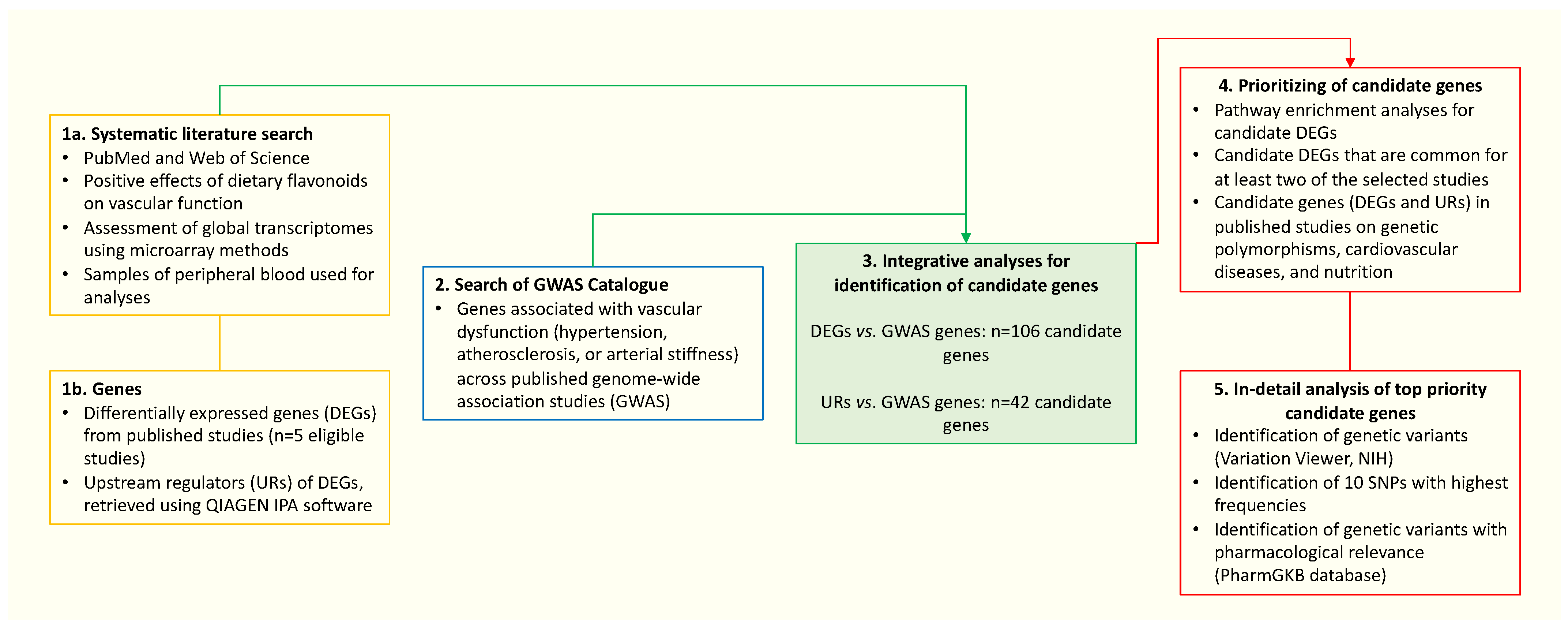
A flowchart of the study is presented in Figure 1.
Figure 1.
Flowchart of the study.
3. Results
3.1. Flavonoids Affect Global Gene Expression in Human Peripheral Blood Cells
3.1.1. General Overview of Selected Studies and DEGs
Based on our previously reported strategy for the systematic literature search [25], we identified five human intervention studies with flavonoids that analyzed global gene expression in peripheral blood cells and demonstrated at least one positive effect on vascular function. General information about each of these studies, referred to as Paper 1 to Paper 5 (Paper 1 [26]; Paper 2 [27]; Paper 3 [28]; Paper 4 [30]; Paper 5 [29]) is presented in Table 1. In these studies, flavonoids of different subclasses were studied: flavanones in Paper 1 and Paper 5, flavanols in Paper 2 and Paper 4, or anthocyanins in Paper 3. Study populations differed across the selected studies and included overweight men (Paper 1), non-obese healthy male smokers (Paper 2), healthy men (Paper 3 and Paper 4), or postmenopausal women (Paper 5). For each of these studies, at least one positive effect on vascular function was reported, in the same (as for Paper 3) or in an associated paper (Morand et al. [40] for Paper 1; Weseler et al. [41] for Paper 2; Sansone et al. [42] for Paper 4; Habauzit et al. [43] for Paper 5) (Table 1).
Table 1.
Human intervention studies (Papers 1–5) included in this integrative analysis, and associated papers reporting vascular function-related outcomes.
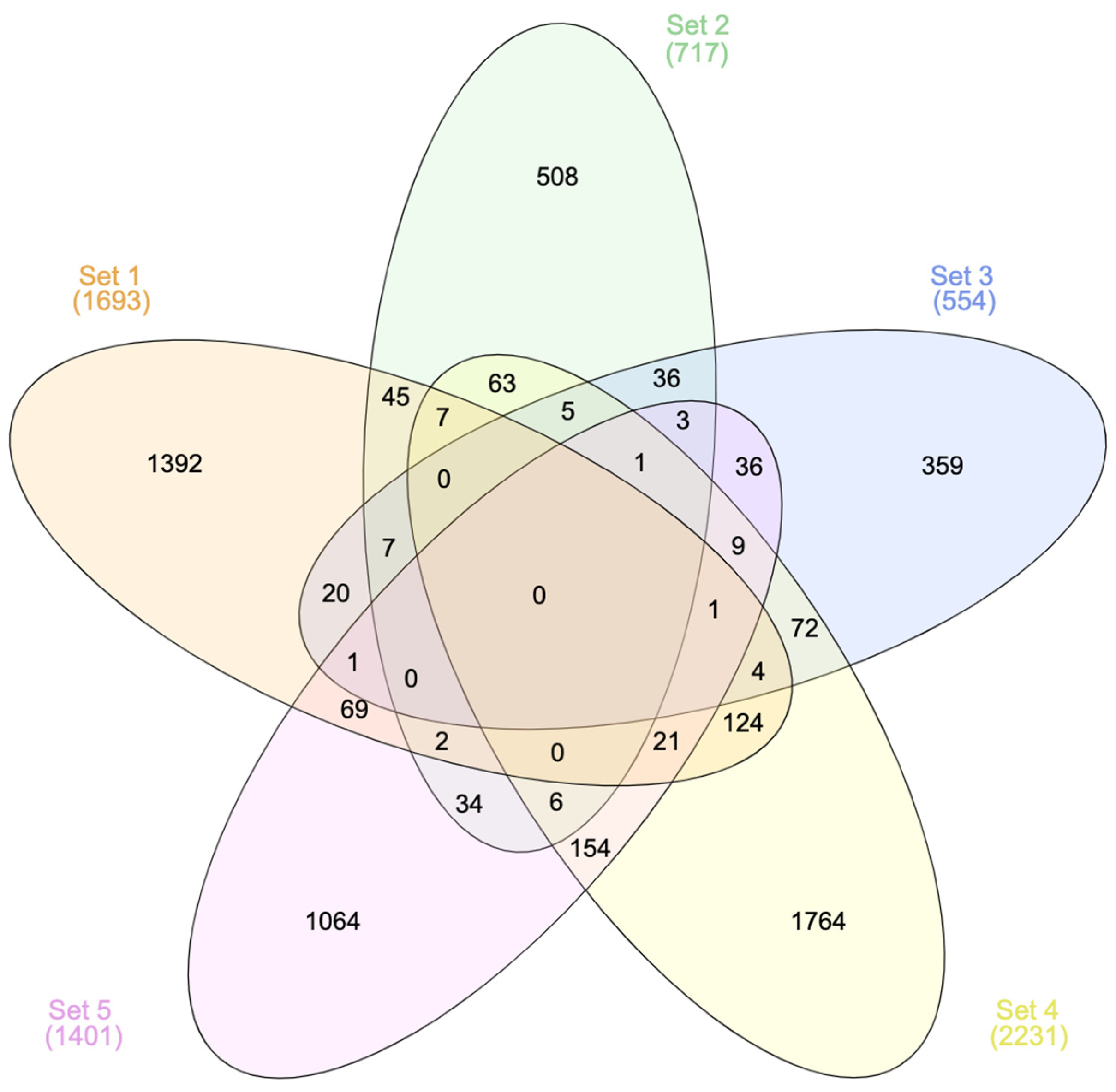
The number of DEGs varies across the studies: n = 1693; 717; 554; 2231; and 1401 for Papers 1; 2; 3; 4; and 5 respectively. After removing duplicates, the total number of flavonoid-modulated genes reached n = 5807 (Table S1). Comparative analysis of DEGs across the selected studies showed that n = 720 genes were in common for at least two studies, n = 67 genes were in common for at least three studies, and only two genes were in common for four studies. There were no DEGs that all five studies had in common (Figure 2; Table S2).
Figure 2.
Venn diagram representing the number of common genes across the selected studies. Sets 1–5 refer to the sets of DEGs extracted from Papers 1–5, respectively. General information about the papers (Paper 1 [26]; Paper 2 [27]; Paper 3 [28]; Paper 4 [30]; Paper 5 [29]) is presented in Table 1. The online tool InteractiVenn was used for conducting the analysis and visualizing the results.
3.1.2. Upstream Regulators of DEGs
When analyzing the modulations in global gene expression, for biological interpretation of obtained experimental data, it is of particular importance to predict the upstream regulators (URs) of DEGs. For this analysis, we used the Qiagen IPA on-line bioinformatic tool (https://digitalinsights.qiagen.com/, accessed on 28 July 2022, 29 July 2022, 5 August 2022, and 12 September 2022), applying the default settings suggested by the manufacturer. With this analysis, for each set of DEGs, i.e., for each paper separately, we obtained URs that include not only protein coding genes and miRNAs, but also different chemical compounds, drugs, toxins, etc. The number of identified URs varied across the studies, from 227 to 1407, i.e., n = 227; 503; 508; 1407, and 993 for Papers 1–5, respectively. The lists of URs are presented in Table S3.
3.2. Identification of Genes Associated with Vascular Dysfunction from GWAS Studies
Our next goal was to search for genes for which previous GWAS studies have identified variants and risk alleles that are associated with vascular dysfunction. To this aim, we searched the GWAS Catalog for the following traits: hypertension, atherosclerosis, and arterial stiffness. For hypertension, the initial search retrieved a total number of 575 associations. The search was subsequently refined in terms of excluding studies related to early-onset hypertension, pulmonary arterial hypertension, pseudotumor cerebri, treatment-resistant hypertension, preeclampsia, chemotherapy-induced hypertension, or hypertension risk in short sleep duration, leading to a final list of 461 associations, and 375 genes associated with hypertension across 33 GWAS studies with the following accession numbers: GCST000041, GCST000361, GCST000398, GCST000447, GCST000849, GCST000973, GCST001085, GCST001238, GCST001423, GCST002627, GCST003613, GCST004143, GCST004384, GCST004388, GCST006023, GCST006229, GCST007707, GCST008036, GCST008828, GCST009685, GCST010477, GCST010774, GCST011141, GCST011952, GCST011953, GCST011954, GCST012136, GCST90000060, GCST90000064, GCST90077646, GCST90086091, GCST90086092, GCST90086157. For atherosclerosis, the initial search retrieved a total number of 261 associations. The search was subsequently refined in terms of exclusion of a study on the interaction of traffic-related air pollution with peripheral arterial disease, leading to a final list of 102 associations, and 69 genes associated with atherosclerosis across 19 GWAS studies with the following accession numbers: GCST000720, GCST001231, GCST002504, GCST003154, GCST007425, GCST007435, GCST008474, GCST009134, GCST010549, GCST90013689, GCST90013731, GCST90018670, GCST90018890, GCST90043957, GCST90061371, GCST90061372, GCST90061374, GCST90061375, GCST90061376. For arterial stiffness, a total number of 62 associations and 58 genes were identified in six GWAS studies with the following accession numbers: GCST000370, GCST007846, GCST008403, GCST010654, GCST010655, GCST010656. Pulling together all of these genes, and after the removal of duplicates, we finally obtained a list of n = 493 genes that previous GWAS studies have associated with vascular dysfunction (Table S4).
3.3. Integration of Transcriptomic Data with GWAS Identified Genes
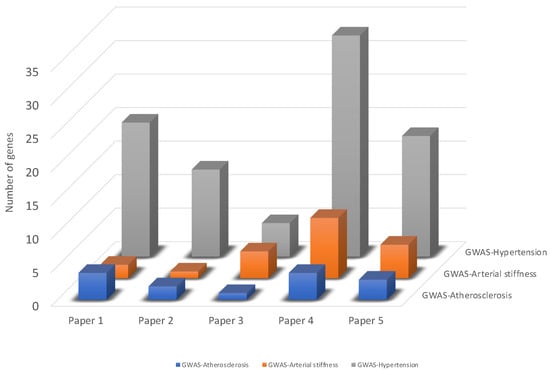
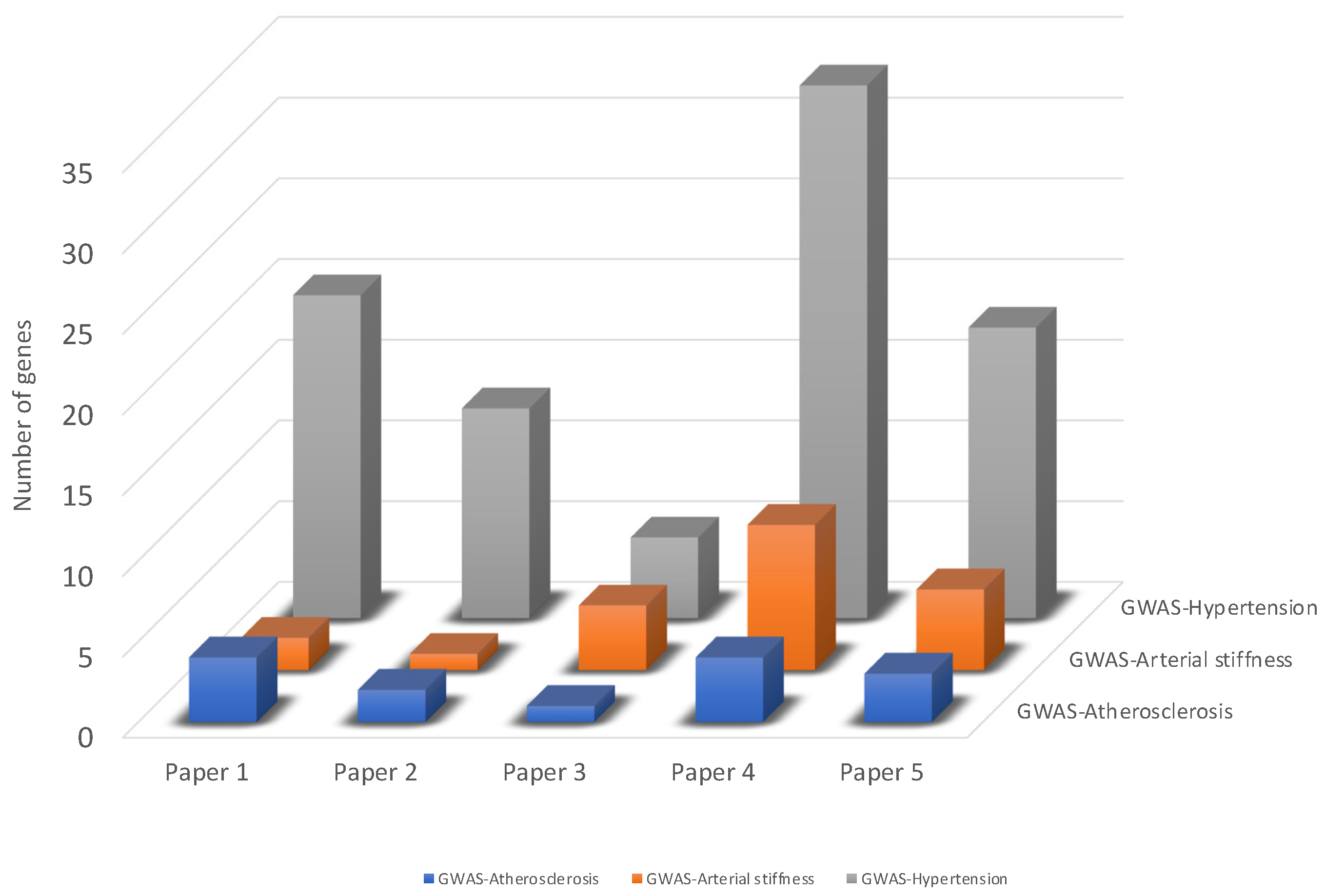
Aiming to identify which of the DEGs from the human intervention studies selected for our analyses may potentially have the capacity to underlie the interindividual variability of the vascular effects in response to flavonoids intake, we conducted an integrative analysis of transcriptomic data and the genes identified from GWAS. To this end, for each of the selected studies, we compared the DEGs with the trait-specific genes identified from GWAS, i.e., genes whose variants are associated with hypertension, atherosclerosis, or arterial stiffness. For Paper 1, we identified 20, 4, and 2 genes associated with hypertension, atherosclerosis, or arterial stiffness, respectively; for Paper 2—13, 2, and 1 genes; for Paper 3—5, 1, and 4 genes; for Paper 4—33, 4 and 9 genes; and for Paper 5—18, 3, and 5 genes associated with hypertension, atherosclerosis, or arterial stiffness, respectively (Figure 3; Table S5).
Figure 3.
Comparative analysis of DEGs and trait-specific genes identified from GWAS. For each of the selected papers (Papers 1–5), DEGs were compared with trait-specific genes identified from GWAS, i.e., genes whose variants are associated with hypertension, atherosclerosis, or arterial stiffness (Table S5). Papers 1–5 refer to the papers included in this integrative analysis. General information about the papers (Paper 1 [26]; Paper 2 [27]; Paper 3 [28]; Paper 4 [30]; Paper 5 [29]) is presented in Table 1.
When pulling together all of these genes, we identified n = 106 DEGs that potentially have the capacity to underlie the interindividual variability of the vascular effects in response to flavonoids intake, as candidate genes for future nutrigenetic studies on flavonoids and vascular health (Table S6A), here referred to as candidate DEGs.
Functional Analysis of Candidate DEGs
To better understand the biological functions of identified candidate DEGs (n = 106) and prioritize some of them for subsequent analyses, we performed functional analyses by determining their place in canonical pathways using pathway enrichment analyses. These analyses pinpointed several pathways of relevance for vascular dysfunction. Some of these pathways are directly involved in vascular dysfunction such as the VEGFA-VEGFR2 signaling pathway, which contains six candidate DEGs, regulation of actin cytoskeleton (four candidate DEGs), adherens junction (three candidate DEGs), focal adhesion (three candidate DEGs), apelin signaling pathway (two candidate DEGs), composition of lipid particles (two candidate DEGs), fluid shear stress and atherosclerosis (two candidate DEGs), or platelet activation (two candidate DEGs), while others are involved in inflammation, cell signaling, or antioxidant protection, such as the chemokine signaling pathway, NF-kappa B signaling pathway, toll-like receptor signaling pathway, MAPK signaling pathway, PI3K-Akt signaling pathway, or the NRF2 pathway. All of these pathways and their associated candidate DEGs are presented in Table 2. In summary, with these pathway enrichment analyses, we identified n = 26 DEGs that are placed in KEGG pathways and n = 25 DEGs that are placed in WikiPathways. After the removal of duplicate genes, there were n = 33 candidate DEGs placed in KEGG or WikiPathways that are relevant to vascular dysfunction (Table S7).
Table 2.
Functional analysis of candidate DEGs: candidate DEGs that are placed in canonical pathways relevant for vascular dysfunction.
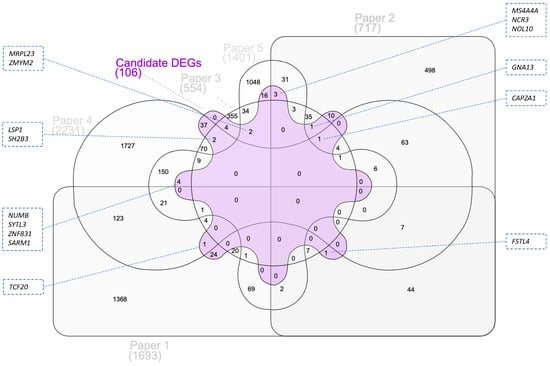
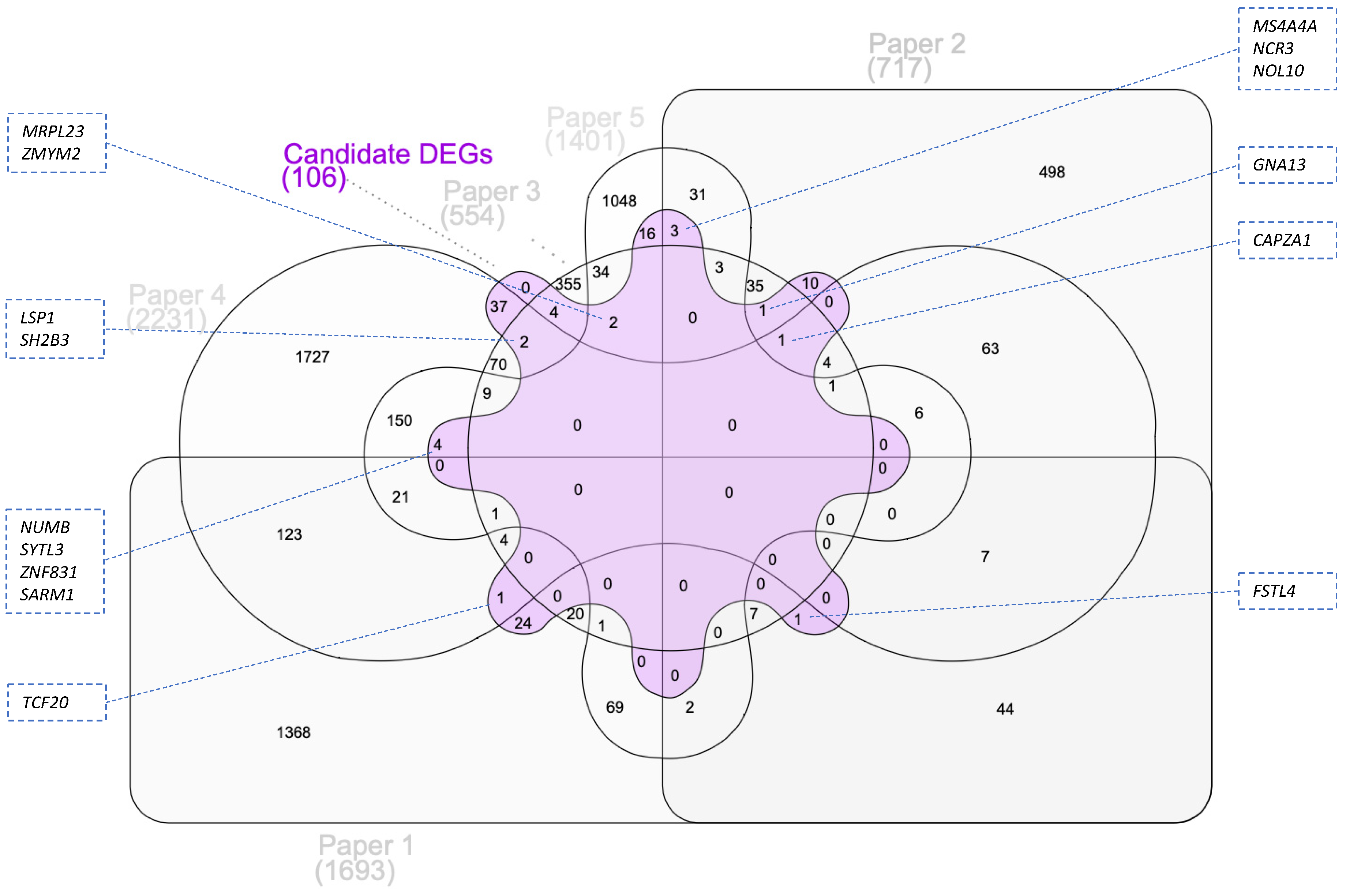
To identify genes with potentially greater influence on the interindividual variability of the vascular effects of flavonoids intake, and prioritize some of them for subsequent analyses, we searched for which of the candidate DEGs are among those that are common in the selected studies. To this end, we conducted a comparative analysis of the DEGs that at least two studies have in common (n = 720) and the candidate DEGs (n = 106) and obtained a list of n = 15 genes (CAPZA1, FSTL4, GNA13, LSP1, MRPL23, MS4A4A, NCR3, NOL10, NUMB, SARM1, SH2B3, SYTL3, TCF20, ZMYM2, ZNF831). These genes are presented in Figure 4. Of note, three of these genes (GNA13, NCR3, SARM1), are associated with pathways related to vascular dysfunction, which are presented in Table S7. In addition, we also conducted a comparative analysis of the DEGs that three or more studies had in common (n = 67) and the candidate DEGs (n = 106) and, in the intersection of the Venn diagram, we obtained only one gene, that is CAPZA1 (Figure 4).
Figure 4.
Identification of candidate DEGs which are among those that are common in the selected studies. A comparative analysis of DEGs that at least two studies have in common (n = 720) and candidate DEGs (n = 106) retrieved n = 15 genes with potentially greater influence on interindividual variability of the vascular effects of flavonoids intake: CAPZA1, FSTL4, GNA13, LSP1, MRPL23, MS4A4A, NCR3, NOL10, NUMB, SARM1, SH2B3, SYTL3, TCF20, ZMYM2, ZNF831. Papers 1–5 refer to the papers included in this integrative analysis. General information about these papers (Paper 1 [26]; Paper 2 [27]; Paper 3 [28]; Paper 4 [30]; Paper 5 [29]) is presented in Table 1. The online tool InteractiVenn was used for conducting the analysis and visualizing the results.
This analysis also pinpointed two interesting candidate DEGs that are associated with two of the analyzed traits each, namely CDKN2B-AS1 in Paper 4, which is associated with both hypertension and atherosclerosis, and HLA-DRB1 in Paper 5, which is associated with both atherosclerosis and arterial stiffness (Table S5).
3.4. Identification of Candidate Genes for Nutrigenetic Studies among the URs of DEGs
After having identified the URs of DEGs for each of the selected studies (Table S3), we aimed to identify for which of these regulators the previous GWAS studies had identified variants and risk alleles that are associated with vascular dysfunction. To this aim, we conducted comparative analyses between all GWAS genes and URs for each study separately, and identified n = 3 candidate URs for Publication 1 (APOE, EBF1, ZBTB10), n = 6 for Publication 2 (H19, KPNA2, LDLR, PBRM1, TNF, ZNF746), n = 7 for Publication 3 (ERAP1, FMN2, FOXO1, HIC1, RPTOR, TCF7L2, ZNF746), n = 25 for Publication 4 (APOE, ARNTL, CERS5, CXCL8, CYP11B2, EBF1, EDNRA, FOXC1, FOXO1, GSE1, IL6, IRF5, MKNK1, MMP3, MYO9B, NFATC2, NPAS3, PLCE1, PPARG, PTPN11, SMARCA4, TCF20, TCF7L2, TNF, ZBTB10), and n = 22 for Publication 5 (APOE, EBF1, FOXC1, IL6, IRF5, KPNA2, LDLR, LSP1, MYO6, NCOR2, NCR3, NFATC2, NR1H3, PNPT1, PPARG, PRDM16, PTPN11, RPTOR, SMARCA4, TNF, USP8, ZBTB10). After pulling together all of these genes and removing duplicates, we obtained n = 42 URs of flavonoid-modulated genes as potential candidate genes for future nutrigenetic studies on vascular effects of these bioactives (Table S6B), here referred to as candidate URs. Notably, the expression of some of these candidate URs is modulated with respective flavonoid interventions, such as: KPNA2 for Publication 2, ARNTL, MKNK1, MYO9B, TCF20 for Publication 4, and IRF5, NCR3 for Publication 5.
3.5. Candidate Genes (DEGs and URs) in Published Studies on Genetic Polymorphisms, Cardiovascular Diseases, and Nutrition
To further prioritize candidate genes for subsequent analyses, we conducted a literature search for published studies that showed associations of these genes’ polymorphisms with cardiovascular diseases and atherosclerosis. For this purpose, in mid-August 2022, we searched PubMed applying the following wording: ((XXX[Title/Abstract]) AND ((SNP[Title/Abstract] OR polymorphism[Title/Abstract]))) AND (cardiovascular[Title/Abstract] OR atherosclerosis[Title/Abstract]), where “XXX” was replaced by the gene of interest. This literature search showed that among candidate DEGs, the number of publications was the largest for MTHFR (n = 394), LPL (n = 92), LDLR (n = 74), ALDH2 (n = 47), and TCF7L2 (n = 34), while among candidate URs, the number of publications was the largest for APOE (n = 383), IL6 (n = 233), TNF (n = 140), LDLR (n = 74), MMP3 (n = 46), CYP11B2 (n = 45), TCF7L2 (n = 34), and PPRG (n = 24).
Furthermore, we also conducted a PubMed search to identify previously published studies that showed associations of candidate genes’ polymorphisms with diet and nutrition. For this purpose, we applied the following wording: ((SNP[Title/Abstract]) AND ((nutrition[Title/Abstract] OR nutrient[Title/Abstract] OR diet[Title/Abstract]))) AND (XXX[Title/Abstract]), where “XXX” was replaced by the gene of interest. This literature search showed that among candidate DEGs, the number of publications was the largest for MTHFR (n = 22), LPL (n = 14), LDLR (n = 5), and TCF7L2 (n = 5), while among candidate URs, the number of publications was the largest for APOE (n = 26), IL6 (n = 13), TNF (n = 10), PPARG (n = 6), LDLR (n = 5), and TCF7L2 (n = 5).
3.6. Selection of Top-Priority Candidate Genes and Their Polymorphisms Potentially Associated with Flavonoids and Vascular Health
Our next step was directed towards final prioritization of a subset of candidate genes. To this end, using the results from the above analyses, we conducted the following additional analyses: (a) intersection between candidate DEGs in two or more papers AND candidate DEGs in canonical pathways; (b) intersection between candidate DEGs in two or more papers AND candidate URs; (c) intersection between candidate DEGs AND top genes in published studies on genetic polymorphisms, cardiovascular diseases, and nutrition; (d) intersection between candidate URs AND top genes in published studies on genetic polymorphisms, cardiovascular diseases, and nutrition; (e) intersection between candidate DEGs in canonical pathways AND candidate URs; (f) intersection between candidate DEGs AND DEGs in three or more papers (i.e., candidate DEGs in three or more papers). The rationale behind conducting these analyses is the following: If a candidate gene takes some of the central positions within these integrative analyses, it is much more likely that it will significantly influence the vascular effects of flavonoids. These analyses allowed us to select n = 20 top-priority candidate genes: ALDH2, APOE, CAPZA1, CYP11B2, GNA13, IL6, IRF5, LDLR, LPL, LSP1, MKNK1, MMP3, MTHFR, MYO6, NCR3, PPARG, SARM1, TCF20, TCF7L2, and TNF.
For each of these top-priority candidate genes, we interrogated the Variation Viewer database to identify their variant types, molecular consequences, most severe clinical significances, and top 10 genetic variants with highest frequencies, which are presented in Table 3. Also, for each of these genes, we interrogated the PharmGKB database with the aim of identifying variants that have already been shown to have specific pharmacologic relevance, and the number of associations is also presented in Table 3.
Table 3.
Variant types, molecular consequences, most severe clinical significances, and top 10 genetic variants with highest frequencies, as well as the number of associations with pharmacologic relevance in selected n = 20 top-priority candidate genes.
In addition, GWAS-reported variants of selected top-priority candidate genes associated with vascular dysfunction were identified back in the GWAS Catalog, while their frequencies in the global population were identified in the dbSNP database (Table 4). In the same database, we also searched for the previously reported clinical significance of each of these variants and found that rs671 (ALDH2) is a risk factor, pathogenic, drug response, and protective; rs6418 (CYP11B2 and also GML) is benign; rs1799998 (CYP11B2 and also LY6E-DT) has association and is benign; rs6511720 (LDLR) is benign; rs17367504 (MTHFR) is benign; rs7903146 (TCF7L2) is a likely risk allele and risk factor. For other genetic variants included in Table 4, no clinical significance was reported in the dbSNP database. In addition, the role of each candidate gene, whether it is a DEG, UR, or both, is reported in Table 4.
Table 4.
GWAS-reported variants of selected top-priority candidate genes (DEGs, URs, or both) and their frequencies in the global population.
4. Discussion
Gene–diet interaction has long been considered one of the key determinants of interindividual variability in the effect of a number of dietary factors [44]. Among the classic examples are studies on the interactions between genetic polymorphism, intake of bioactives related to coffee consumption and the risk of acute myocardial infarction. These studies identified caffeine as a key factor for increased risk only for individuals with slow caffeine metabolism [45] that is associated with the −163A > C (rs762551) single nucleotide polymorphism of the Cytochrome P450 Family 1 Subfamily A Member 2 (CYP1A2) gene. This SNP has been shown to alter the inducibility and activity of the CYP1A2 enzyme, which accounts for approximately 95% of caffeine metabolism in the body. Individuals with the AC or CC genotype are categorized as slow metabolizers, while individuals with the AA genotype are categorized as fast metabolizers [46]. Furthermore, a recent study has shown an increased risk of hypertension and renal dysfunction with heavy coffee intake, but only among individuals with the AC and CC genotypes of CYP1A2 at rs762551 [47]. Consequently, an influence of genetic polymorphisms on the vasculoprotective properties of dietary flavonoids can also be expected, as one of the determinants of interindividual variability in the effect. A recent study identified for the first time genetic polymorphisms that determine the effect of orange juice consumption on circulating lipids and blood pressure. In the study group of 46 participants, medium or high excretors of flavanone metabolites, it was observed that for the APOA1_rs964184 polymorphism, the CC genotype is associated with a decrease in circulating triglycerides and blood pressure, both systolic and diastolic. Additionally, for the LPL_rs12678919 polymorphism, the AA genotype was associated with a change in blood lipids [20].
Given that vascular health is governed not only by genes directly associated with vascular tone, vascular permeability, and circulating lipoproteins, but also by genes involved in general metabolic dysregulation, it is realistic to expect that a greater number of genetic polymorphisms determine the interindividual variabilities of the vascular health effects of flavonoids, which highlights the need for their identification and further nutrigenetic studies. To address this issue, GWAS represent a valuable source of information, the approach of which involves genome-wide analysis of genotypes of a large number of individuals to identify variants associated with a specific disease or health-related trait compared to healthy individuals, i.e., identification of genotype–phenotype associations. So far, GWAS have identified hundreds of genetic variants that are associated with different diseases or health-related traits in humans [48]. More importantly, the data from numerous GWAS analyses are aggregated, structured, and standardized into a publicly accessible database [49], allowing them to be utilized in future research. A major limitation of GWAS is that they only provide a statistical association between a specific genetic variant and a given disease or trait. In other words, GWAS provide genes associated with specific diseases or traits and do not necessarily pinpoint causal variants and genes [48]. Understanding potential functional consequences of identified variants represents a considerable challenge, for which various approaches have been proposed [21,22,23,24,50,51]. One approach proposed in a recent study consisted of integrating GWAS and mRNA microarray data to computationally identify key disease pathways, upstream regulators, and downstream therapeutic targets in primary biliary cholangitis [52]. Specifically, GWAS analysis conducted on 1920 patients and 1770 healthy controls identified 261 genes associated with primary biliary cholangitis, in parallel to mRNA microarray analysis that was conducted in liver needle biopsy specimens from 36 patients and 5 controls and identified 1574 DEGs. Subsequent functional analyses, which included signaling networks analyses and analyses of upstream regulators, enabled the prediction of central regulators in disease susceptibility and identified potential downstream therapeutic targets [52].
To address our aim, which is to identify candidate genes which polymorphisms potentially determine the interindividual variabilities in the effects of flavonoids on vascular health, we employed an integrative analysis of GWAS (i.e., genetic) and mRNA microarray (i.e., genomic) data using (a) available global transcriptomic data of published human intervention studies on flavonoids and vascular health demonstrating a positive effect on vascular function and (b) genes associated with vascular dysfunction-related traits (hypertension, atherosclerosis, and arterial stiffness) identified from GWAS. In addition, for each set of genomic data, we identified the URs, molecules capable of regulating the expression of DEGs. Some of these URs are proteins, which are inherently prone to genetic variability, thus potentially serving as a source for significant interindividual variabilities in flavonoids and vascular health. Even though flavonoids are a large and diverse class of (poly)phenols, previous transcriptomic studies have shown that not only (poly)phenols from specific classes, but (poly)phenols in general can exhibit common molecular mechanisms of action [53], most likely because some of them are metabolized by gut microbiota to similar or identical metabolites that mediate their molecular mechanisms of action [54], which was the rationale behind our decision to include human intervention studies conducted with different dietary flavonoids. By employing integrative analysis of transcriptomic and GWAS datasets, we added an important step in the identification of candidate genes for future nutrigenetic studies. This integrative analysis identified 106 candidate DEGs and 42 candidate URs. Subsequent functional analyses and a literature search of these candidate DEGs and URs identified 20 top-priority candidates: ALDH2, APOE, CAPZA1, CYP11B2, GNA13, IL6, IRF5, LDLR, LPL, LSP1, MKNK1, MMP3, MTHFR, MYO6, NCR3, PPARG, SARM1, TCF20, TCF7L2, and TNF. It should be added that our study only focused on genes directly associated with the vascular effects of flavonoids and did not consider genes involved in their absorption and metabolism. Therefore, the results of our study should be verified by carefully designed human nutrigenetic studies that will only include individuals with high levels of circulating metabolites of the tested flavonoids. Such an approach would eliminate the influence of interindividual variabilities in the absorption and metabolism of flavonoids, phenomena that are well-identified but still poorly understood.
Among the top candidate genes and their known SNPs, there is evidence about their functionality related to vascular health. For example, the rs7903146 variant of the Transcription Factor 7 Like 2 (TCF7L2) gene was identified as associated with type 2 diabetes [55], and the T allele of this variant strongly predicts future type 2 diabetes. This allele is associated with enhanced expression of TCF7L2 in human islets as well as with impaired insulin secretion [56]. Furthermore associations between rs7903146 and (a) elevated serum triglycerides in patients with familial combined hyperlipidemia [57], (b) impaired postprandial lipid metabolism in healthy young males and elderly persons [58], (c) inflammation, metabolic dysregulation, and atherosclerotic cardiovascular diseases [59] were observed. TCF7L2 is a transcription factor and the ultimate effector of the Wnt signaling pathway, which plays an important protective role in the development of atherosclerotic cardiovascular diseases [59]. Regarding the results from global gene expression studies on flavonoids and vascular function, TCF7L2 has been identified as a differentially expressed gene in one study and as an upstream regulator in two studies. These observations suggest that the TCF7L2 gene is one of the potential key mediators of the interindividual differences to flavonoid intake.
Another polymorphism with proven functionality in vascular dysfunction is rs6511720 of the Low-Density Lipoprotein Receptor (LDLR) gene, for which a recent study has shown a significant association with susceptibility to coronary artery disease, as well as with regression of carotid intima-media thickness and changes in plasma lipids during rosuvastatin therapy [60]. A single-nucleotide polymorphism, rs1799998, in the aldosterone synthase gene, Cytochrome P450 Family 11 Subfamily B Member 2 (CYP11B2), has also been reported to associate with cardiovascular diseases, such as atrial fibrillation [61] or intracranial large artery stenosis [62]. In addition, it has been shown that this polymorphism is associated with a predisposition to the development of late in-stent restenosis in heterozygous patients with stable coronary artery disease [63]. Other polymorphisms that have not only been statistically associated with vascular dysfunction but have also been functionally related to it include Aldehyde Dehydrogenase 2 Family Member (ALDH2) rs671 and Methylenetetrahydrofolate Reductase (MTHFR) rs17367504. These genes are crucial in alcohol metabolism and folate/homocysteine metabolism, respectively. The rs671 polymorphism in ALDH2 was pinpointed as a risk factor for the occurrence of death from cardio-cerebrovascular complications in patients with type 2 diabetes [64] and has recently been characterized as a novel regulator of cholesterol biosynthesis [65]. For the MTHFR rs17367504, it was not only associated with hypertension in a previous GWAS but was also included in the calculation of genetic risk score (GRS) in a study aiming to evaluate whether the association between GRS and blood pressure was modified by usual coffee consumption. This study revealed that individuals with greater GRS present high blood pressure associated with higher coffee consumption, highlighting the particular importance of reducing coffee intake in individuals who are genetically predisposed to this cardiovascular disease risk factor [66]. Moreover, polymorphisms in LPL and APOE genes were suggested to modulate the effects of orange juice rich in flavanone on vascular function [20]. Taken together, these examples strongly suggest that the candidate genes identified using our integrative analyses of genomic and GWAS data are good candidates, demonstrating the power of such an approach for the identification of novel, still unexplored candidate genes involved in interindividual variability in response to flavonoid intake and vascular health.
There are several limitations to this study. The major limitation is the small number of genomic datasets used, five, corresponding to the only studies available that aimed to assess global genomic change induced by flavonoids in human volunteers associated with positive vascular health effects. Also, the number of studies is limited as we only used genomic data that were obtained using a microarray approach. In addition, recent studies have revealed that (poly)phenols exert their health effects by modulating the expression of not only protein coding genes but also the expression of protein non-coding genes, such as microRNAs or long non-coding RNAs [53,67], and by exerting changes in the DNA methylation profile [68]. Also, GWAS have identified vascular dysfunction-associated variants in the non-coding elements of the genome [69]. Therefore, integration of genomic data with GWAS data in future analyses should include information about changes in the expression of all types of RNA as well as the DNA methylation profile.
5. Conclusions
In conclusion, we performed an integrated bioinformatic analysis with large-scale GWAS and transcriptomic data to generate a refined list of candidate causal genes for interindividual variability in response to flavonoid intake. These results should serve as an important resource, facilitating the focusing of nutrigenetic research in the field of plant food bioactives to identify gene variants associated with a better health response to these bioactives, and therefore build a foundation for precision nutrition research in the field of (poly)phenols.
Supplementary Materials
The following supporting information can be downloaded at: https://www.mdpi.com/article/10.3390/nu16091362/s1, Table S1: Differentially expressed genes (DEGs) from the selected studies; Table S2: Common differentially expressed genes (DEGs) across the selected studies; Table S3: Upstream regulators (URs) across the selected studies; Table S4: Genes associated with vascular dysfunction, identified with previous genome-wide association studies (GWAS); Table S5: Comparative analysis of DEGs and trait-specific genes identified from GWAS; Table S6: Candidate DEGs and candidate URs; Table S7. Candidate DEGs placed in canonical pathways.
Author Contributions
Conceptualization, T.R. and D.M.; data curation, T.R., F.P. and D.M.; formal analysis, T.R., F.P. and D.M.; methodology, T.R. and D.M.; visualization, T.R., F.P. and D.M.; writing—original draft, T.R. and D.M.; writing—review & editing, T.R., F.P. and D.M. All authors have read and agreed to the published version of the manuscript.
Funding
This research received no external funding.
Institutional Review Board Statement
Not applicable.
Informed Consent Statement
Not applicable.
Data Availability Statement
The original contributions presented in the study are included in the article/Supplementary Material, further inquiries can be directed to the corresponding author.
Conflicts of Interest
The authors declare no conflicts of interest.
Acronyms
SNP—single nucleotide polymorphism; CAD—coronary artery disease; AF—atrial fibrillation; GWAS—genome-wide association studies; DEGs—differentially expressed genes; URs—upstream regulators; IPA—Ingenuity Pathway Analysis; KEGG—Kyoto Encyclopedia of Genes and Genomes; GRS—genetic risk score.
References
- Grosso, G.; Stepaniak, U.; Topor-Mądry, R.; Szafraniec, K.; Pająk, A. Estimated dietary intake and major food sources of polyphenols in the Polish arm of the HAPIEE study. Nutrition 2014, 30, 1398–1403. [Google Scholar] [CrossRef] [Scilit]
- Miranda, A.M.; Steluti, J.; Fisberg, R.M.; Marchioni, D.M. Dietary intake and food contributors of polyphenols in adults and elderly adults of Sao Paulo: A population-based study. Br. J. Nutr. 2016, 115, 1061–1070. [Google Scholar] [CrossRef] [Scilit]
- Huang, Q.; Braffett, B.H.; Simmens, S.J.; Young, H.A.; Ogden, C.L. Dietary Polyphenol Intake in US Adults and 10-Year Trends: 2007–2016. J. Acad. Nutr. Diet. 2020, 120, 1821–1833. [Google Scholar] [CrossRef] [Scilit]
- Del Rio, D.; Rodriguez-Mateos, A.; Spencer, J.P.; Tognolini, M.; Borges, G.; Crozier, A. Dietary (poly)phenolics in human health: Structures, bioavailability, and evidence of protective effects against chronic diseases. Antioxid. Redox Signal 2013, 18, 1818–1892. [Google Scholar] [CrossRef] [Scilit]
- Neveu, V.; Perez-Jiménez, J.; Vos, F.; Crespy, V.; du Chaffaut, L.; Mennen, L.; Knox, C.; Eisner, R.; Cruz, J.; Wishart, D.; et al. Phenol-Explorer: An online comprehensive database on polyphenol contents in foods. Database 2010, 2010, bap024. [Google Scholar] [CrossRef] [Scilit]
- Vivarelli, S.; Costa, C.; Teodoro, M.; Giambò, F.; Tsatsakis, A.M.; Fenga, C. Polyphenols: A route from bioavailability to bioactivity addressing potential health benefits to tackle human chronic diseases. Arch. Toxicol. 2023, 97, 3–38. [Google Scholar] [CrossRef] [Scilit]
- Guo, X.F.; Ruan, Y.; Li, Z.H.; Li, D. Flavonoid subclasses and type 2 diabetes mellitus risk: A meta-analysis of prospective cohort studies. Crit. Rev. Food Sci. Nutr. 2019, 59, 2850–2862. [Google Scholar] [CrossRef] [Scilit]
- Liu, F.; Sirisena, S.; Ng, K. Efficacy of flavonoids on biomarkers of type 2 diabetes mellitus: A systematic review and meta-analysis of randomized controlled trials. Crit. Rev. Food Sci. Nutr. 2023, 63, 4916–4941. [Google Scholar] [CrossRef] [Scilit]
- Kay, C.D.; Hooper, L.; Kroon, P.A.; Rimm, E.B.; Cassidy, A. Relative impact of flavonoid composition, dose and structure on vascular function: A systematic review of randomised controlled trials of flavonoid-rich food products. Mol. Nutr. Food Res. 2012, 56, 1605–1616. [Google Scholar] [CrossRef] [Scilit]
- Sesso, H.D.; Manson, J.E.; Aragaki, A.K.; Rist, P.M.; Johnson, L.G.; Friedenberg, G.; Copeland, T.; Clar, A.; Mora, S.; Moorthy, M.V.; et al. Effect of cocoa flavanol supplementation for the prevention of cardiovascular disease events: The COcoa Supplement and Multivitamin Outcomes Study (COSMOS) randomized clinical trial. Am. J. Clin. Nutr. 2022, 115, 1490–1500. [Google Scholar] [CrossRef] [Scilit]
- Bayram, B.; González-Sarrías, A.; Istas, G.; Garcia-Aloy, M.; Morand, C.; Tuohy, K.; García-Villalba, R.; Mena, P. Breakthroughs in the Health Effects of Plant Food Bioactives: A Perspective on Microbiomics, Nutri(epi)genomics, and Metabolomics. J. Agric. Food Chem. 2018, 66, 10686–10692. [Google Scholar] [CrossRef] [Scilit]
- Curtis, P.J.; Potter, J.; Kroon, P.A.; Wilson, P.; Dhatariya, K.; Sampson, M.; Cassidy, A. Vascular function and atherosclerosis progression after 1 y of flavonoid intake in statin-treated postmenopausal women with type 2 diabetes: A double-blind randomized controlled trial. Am. J. Clin. Nutr. 2013, 97, 936–942. [Google Scholar] [CrossRef] [Scilit]
- Morand, C.; Tomás-Barberán, F.A. Contribution of plant food bioactives in promoting health effects of plant foods: Why look at interindividual variability? Eur. J. Nutr. 2019, 58, 13–19. [Google Scholar] [CrossRef] [Scilit]
- Donato, A.J.; Machin, D.R.; Lesniewski, L.A. Mechanisms of Dysfunction in the Aging Vasculature and Role in Age-Related Disease. Circ. Res. 2018, 123, 825–848. [Google Scholar] [CrossRef] [Scilit]
- Barbosa, S.S.; Sousa, L.C.M.; de Oliveira Silva, D.F.; Pimentel, J.B.; Evangelista, K.; Lyra, C.O.; Lopes, M.; Lima, S. A Systematic Review on Processed/Ultra-Processed Foods and Arterial Hypertension in Adults and Older People. Nutrients 2022, 14, 1215. [Google Scholar] [CrossRef] [Scilit]
- Koenen, M.; Hill, M.A.; Cohen, P.; Sowers, J.R. Obesity, Adipose Tissue and Vascular Dysfunction. Circ. Res. 2021, 128, 951–968. [Google Scholar] [CrossRef] [Scilit]
- ALrefai, A.A.; Habib, M.S.; Yaseen, R.I.; Gabr, M.K.; Habeeb, R.M. Association of endothelial nitric oxide synthase (eNOS) gene G894T polymorphism with hypertension risk and complications. Mol. Cell Biochem. 2016, 421, 103–110. [Google Scholar] [CrossRef] [Scilit]
- Kim, M.P.; Wahl, L.M.; Yanek, L.R.; Becker, D.M.; Becker, L.C. A monocyte chemoattractant protein-1 gene polymorphism is associated with occult ischemia in a high-risk asymptomatic population. Atherosclerosis 2007, 193, 366–372. [Google Scholar] [CrossRef] [Scilit]
- George, T.W.; Waroonphan, S.; Niwat, C.; Gordon, M.H.; Lovegrove, J.A. The Glu298Asp single nucleotide polymorphism in the endothelial nitric oxide synthase gene differentially affects the vascular response to acute consumption of fruit and vegetable puree based drinks. Mol. Nutr. Food Res. 2012, 56, 1014–1024. [Google Scholar] [CrossRef] [Scilit]
- Fraga, L.N.; Milenkovic, D.; Coutinho, C.P.; Rozenbaum, A.C.; Lajolo, F.M.; Hassimotto, N.M.A. Interaction between APOE, APOA1, and LPL Gene Polymorphisms and Variability in Changes in Lipid and Blood Pressure following Orange Juice Intake: A Pilot Study. Mol. Nutr. Food Res. 2023, 67, e2200847. [Google Scholar] [CrossRef] [Scilit]
- Li, B.; Ritchie, M.D. From GWAS to Gene: Transcriptome-Wide Association Studies and Other Methods to Functionally Understand GWAS Discoveries. Front. Genet. 2021, 12, 713230. [Google Scholar] [CrossRef] [Scilit]
- Zhu, Z.; Zhang, F.; Hu, H.; Bakshi, A.; Robinson, M.R.; Powell, J.E.; Montgomery, G.W.; Goddard, M.E.; Wray, N.R.; Visscher, P.M.; et al. Integration of summary data from GWAS and eQTL studies predicts complex trait gene targets. Nat. Genet. 2016, 48, 481–487. [Google Scholar] [CrossRef] [Scilit]
- Hao, K.; Ermel, R.; Sukhavasi, K.; Cheng, H.; Ma, L.; Li, L.; Amadori, L.; Koplev, S.; Franzén, O.; d’Escamard, V.; et al. Integrative Prioritization of Causal Genes for Coronary Artery Disease. Circ. Genom. Precis. Med. 2022, 15, e003365. [Google Scholar] [CrossRef] [Scilit]
- Wang, B.; Lunetta, K.L.; Dupuis, J.; Lubitz, S.A.; Trinquart, L.; Yao, L.; Ellinor, P.T.; Benjamin, E.J.; Lin, H. Integrative Omics Approach to Identifying Genes Associated With Atrial Fibrillation. Circ. Res. 2020, 126, 350–360. [Google Scholar] [CrossRef] [Scilit]
- Ruskovska, T.; Budić-Leto, I.; Corral-Jara, K.F.; Ajdžanović, V.; Arola-Arnal, A.; Bravo, F.I.; Deligiannidou, G.E.; Havlik, J.; Janeva, M.; Kistanova, E.; et al. Systematic analysis of nutrigenomic effects of polyphenols related to cardiometabolic health in humans—Evidence from untargeted mRNA and miRNA studies. Ageing Res. Rev. 2022, 79, 101649. [Google Scholar] [CrossRef] [Scilit]
- Milenkovic, D.; Deval, C.; Dubray, C.; Mazur, A.; Morand, C. Hesperidin displays relevant role in the nutrigenomic effect of orange juice on blood leukocytes in human volunteers: A randomized controlled cross-over study. PLoS ONE 2011, 6, e26669. [Google Scholar] [CrossRef] [Scilit]
- Milenkovic, D.; Vanden Berghe, W.; Boby, C.; Leroux, C.; Declerck, K.; Szarc vel Szic, K.; Heyninck, K.; Laukens, K.; Bizet, M.; Defrance, M.; et al. Dietary flavanols modulate the transcription of genes associated with cardiovascular pathology without changes in their DNA methylation state. PLoS ONE 2014, 9, e95527. [Google Scholar] [CrossRef] [Scilit]
- Rodriguez-Mateos, A.; Istas, G.; Boschek, L.; Feliciano, R.P.; Mills, C.E.; Boby, C.; Gomez-Alonso, S.; Milenkovic, D.; Heiss, C. Circulating Anthocyanin Metabolites Mediate Vascular Benefits of Blueberries: Insights From Randomized Controlled Trials, Metabolomics, and Nutrigenomics. J. Gerontol. A Biol. Sci. Med. Sci. 2019, 74, 967–976. [Google Scholar] [CrossRef] [Scilit]
- Krga, I.; Corral-Jara, K.F.; Barber-Chamoux, N.; Dubray, C.; Morand, C.; Milenkovic, D. Grapefruit Juice Flavanones Modulate the Expression of Genes Regulating Inflammation, Cell Interactions and Vascular Function in Peripheral Blood Mononuclear Cells of Postmenopausal Women. Front. Nutr. 2022, 9, 907595. [Google Scholar] [CrossRef] [Scilit] [PubMed]
- Milenkovic, D.; Rodriguez-Mateos, A.; Lucosz, M.; Istas, G.; Declerck, K.; Sansone, R.; Deenen, R.; Köhrer, K.; Corral-Jara, K.F.; Altschmied, J.; et al. Flavanol Consumption in Healthy Men Preserves Integrity of Immunological-Endothelial Barrier Cell Functions: Nutri(epi)genomic Analysis. Mol. Nutr. Food Res. 2022, 66, e2100991. [Google Scholar] [CrossRef] [Scilit] [PubMed]
- Buniello, A.; MacArthur, J.A.L.; Cerezo, M.; Harris, L.W.; Hayhurst, J.; Malangone, C.; McMahon, A.; Morales, J.; Mountjoy, E.; Sollis, E.; et al. The NHGRI-EBI GWAS Catalog of published genome-wide association studies, targeted arrays and summary statistics 2019. Nucleic Acids Res 2019, 47, D1005–D1012. [Google Scholar] [CrossRef] [Scilit] [PubMed]
- Gerstner, N.; Kehl, T.; Lenhof, K.; Müller, A.; Mayer, C.; Eckhart, L.; Grammes, N.L.; Diener, C.; Hart, M.; Hahn, O.; et al. GeneTrail 3: Advanced high-throughput enrichment analysis. Nucleic Acids Res. 2020, 48, W515–W520. [Google Scholar] [CrossRef] [Scilit]
- Kanehisa, M.; Goto, S. KEGG: Kyoto encyclopedia of genes and genomes. Nucleic Acids Res. 2000, 28, 27–30. [Google Scholar] [CrossRef] [Scilit]
- Agrawal, A.; Balcı, H.; Hanspers, K.; Coort, S.L.; Martens, M.; Slenter, D.N.; Ehrhart, F.; Digles, D.; Waagmeester, A.; Wassink, I.; et al. WikiPathways 2024: Next generation pathway database. Nucleic Acids Res 2024, 52, D679–D689. [Google Scholar] [CrossRef] [Scilit]
- Slenter, D.N.; Kutmon, M.; Hanspers, K.; Riutta, A.; Windsor, J.; Nunes, N.; Mélius, J.; Cirillo, E.; Coort, S.L.; Digles, D.; et al. WikiPathways: A multifaceted pathway database bridging metabolomics to other omics research. Nucleic Acids Res. 2018, 46, D661–D667. [Google Scholar] [CrossRef] [Scilit] [PubMed]
- Heberle, H.; Meirelles, G.V.; da Silva, F.R.; Telles, G.P.; Minghim, R. InteractiVenn: A web-based tool for the analysis of sets through Venn diagrams. BMC Bioinform. 2015, 16, 169. [Google Scholar] [CrossRef] [Scilit] [PubMed]
- Whirl-Carrillo, M.; Huddart, R.; Gong, L.; Sangkuhl, K.; Thorn, C.F.; Whaley, R.; Klein, T.E. An Evidence-Based Framework for Evaluating Pharmacogenomics Knowledge for Personalized Medicine. Clin. Pharmacol. Ther. 2021, 110, 563–572. [Google Scholar] [CrossRef] [Scilit]
- Whirl-Carrillo, M.; McDonagh, E.M.; Hebert, J.M.; Gong, L.; Sangkuhl, K.; Thorn, C.F.; Altman, R.B.; Klein, T.E. Pharmacogenomics knowledge for personalized medicine. Clin. Pharmacol. Ther. 2012, 92, 414–417. [Google Scholar] [CrossRef] [Scilit]
- Stelzer, G.; Rosen, N.; Plaschkes, I.; Zimmerman, S.; Twik, M.; Fishilevich, S.; Stein, T.I.; Nudel, R.; Lieder, I.; Mazor, Y.; et al. The GeneCards Suite: From Gene Data Mining to Disease Genome Sequence Analyses. Curr. Protoc. Bioinform. 2016, 54, 1.30.31–31.30.33. [Google Scholar] [CrossRef] [Scilit]
- Morand, C.; Dubray, C.; Milenkovic, D.; Lioger, D.; Martin, J.F.; Scalbert, A.; Mazur, A. Hesperidin contributes to the vascular protective effects of orange juice: A randomized crossover study in healthy volunteers. Am. J. Clin. Nutr. 2011, 93, 73–80. [Google Scholar] [CrossRef] [Scilit]
- Weseler, A.R.; Ruijters, E.J.; Drittij-Reijnders, M.J.; Reesink, K.D.; Haenen, G.R.; Bast, A. Pleiotropic benefit of monomeric and oligomeric flavanols on vascular health--a randomized controlled clinical pilot study. PLoS ONE 2011, 6, e28460. [Google Scholar] [CrossRef] [Scilit]
- Sansone, R.; Rodriguez-Mateos, A.; Heuel, J.; Falk, D.; Schuler, D.; Wagstaff, R.; Kuhnle, G.G.; Spencer, J.P.; Schroeter, H.; Merx, M.W.; et al. Cocoa flavanol intake improves endothelial function and Framingham Risk Score in healthy men and women: A randomised, controlled, double-masked trial: The Flaviola Health Study. Br. J. Nutr. 2015, 114, 1246–1255. [Google Scholar] [CrossRef] [Scilit] [PubMed]
- Habauzit, V.; Verny, M.A.; Milenkovic, D.; Barber-Chamoux, N.; Mazur, A.; Dubray, C.; Morand, C. Flavanones protect from arterial stiffness in postmenopausal women consuming grapefruit juice for 6 mo: A randomized, controlled, crossover trial. Am. J. Clin. Nutr. 2015, 102, 66–74. [Google Scholar] [CrossRef] [Scilit] [PubMed]
- El-Sohemy, A. Nutrigenetics. Forum Nutr. 2007, 60, 25–30. [Google Scholar] [CrossRef] [Scilit] [PubMed]
- Cornelis, M.C.; El-Sohemy, A.; Kabagambe, E.K.; Campos, H. Coffee, CYP1A2 genotype, and risk of myocardial infarction. JAMA 2006, 295, 1135–1141. [Google Scholar] [CrossRef] [Scilit] [PubMed]
- Guest, N.; Corey, P.; Vescovi, J.; El-Sohemy, A. Caffeine, CYP1A2 Genotype, and Endurance Performance in Athletes. Med. Sci. Sports Exerc. 2018, 50, 1570–1578. [Google Scholar] [CrossRef] [Scilit]
- Mahdavi, S.; Palatini, P.; El-Sohemy, A. CYP1A2 Genetic Variation, Coffee Intake, and Kidney Dysfunction. JAMA Netw. Open 2023, 6, e2247868. [Google Scholar] [CrossRef] [Scilit] [PubMed]
- Tam, V.; Patel, N.; Turcotte, M.; Bossé, Y.; Paré, G.; Meyre, D. Benefits and limitations of genome-wide association studies. Nat. Rev. Genet. 2019, 20, 467–484. [Google Scholar] [CrossRef] [Scilit]
- Sollis, E.; Mosaku, A.; Abid, A.; Buniello, A.; Cerezo, M.; Gil, L.; Groza, T.; Güneş, O.; Hall, P.; Hayhurst, J.; et al. The NHGRI-EBI GWAS Catalog: Knowledgebase and deposition resource. Nucleic Acids Res. 2023, 51, D977–D985. [Google Scholar] [CrossRef] [Scilit]
- Cano-Gamez, E.; Trynka, G. From GWAS to Function: Using Functional Genomics to Identify the Mechanisms Underlying Complex Diseases. Front. Genet. 2020, 11, 424. [Google Scholar] [CrossRef] [Scilit]
- Zhu, M.; Zhao, S. Candidate gene identification approach: Progress and challenges. Int. J. Biol. Sci. 2007, 3, 420–427. [Google Scholar] [CrossRef] [Scilit] [PubMed]
- Ueno, K.; Aiba, Y.; Hitomi, Y.; Shimoda, S.; Nakamura, H.; Gervais, O.; Kawai, Y.; Kawashima, M.; Nishida, N.; Kohn, S.S.; et al. Integrated GWAS and mRNA Microarray Analysis Identified IFNG and CD40L as the Central Upstream Regulators in Primary Biliary Cholangitis. Hepatol. Commun. 2020, 4, 724–738. [Google Scholar] [CrossRef] [Scilit] [PubMed]
- Milenkovic, D.; Deval, C.; Gouranton, E.; Landrier, J.F.; Scalbert, A.; Morand, C.; Mazur, A. Modulation of miRNA expression by dietary polyphenols in apoE deficient mice: A new mechanism of the action of polyphenols. PLoS ONE 2012, 7, e29837. [Google Scholar] [CrossRef] [Scilit] [PubMed]
- Williamson, G.; Clifford, M.N. Colonic metabolites of berry polyphenols: The missing link to biological activity? Br. J. Nutr. 2010, 104 (Suppl. S3), S48–S66. [Google Scholar] [CrossRef] [Scilit] [PubMed]
- Saxena, R.; Gianniny, L.; Burtt, N.P.; Lyssenko, V.; Giuducci, C.; Sjögren, M.; Florez, J.C.; Almgren, P.; Isomaa, B.; Orho-Melander, M.; et al. Common single nucleotide polymorphisms in TCF7L2 are reproducibly associated with type 2 diabetes and reduce the insulin response to glucose in nondiabetic individuals. Diabetes 2006, 55, 2890–2895. [Google Scholar] [CrossRef] [Scilit] [PubMed]
- Lyssenko, V.; Lupi, R.; Marchetti, P.; Del Guerra, S.; Orho-Melander, M.; Almgren, P.; Sjögren, M.; Ling, C.; Eriksson, K.F.; Lethagen, A.L.; et al. Mechanisms by which common variants in the TCF7L2 gene increase risk of type 2 diabetes. J. Clin. Investig. 2007, 117, 2155–2163. [Google Scholar] [CrossRef] [Scilit] [PubMed]
- Huertas-Vazquez, A.; Plaisier, C.; Weissglas-Volkov, D.; Sinsheimer, J.; Canizales-Quinteros, S.; Cruz-Bautista, I.; Nikkola, E.; Herrera-Hernandez, M.; Davila-Cervantes, A.; Tusie-Luna, T.; et al. TCF7L2 is associated with high serum triacylglycerol and differentially expressed in adipose tissue in families with familial combined hyperlipidaemia. Diabetologia 2008, 51, 62–69. [Google Scholar] [CrossRef] [Scilit] [PubMed]
- Perez-Martinez, P.; Perez-Caballero, A.I.; Garcia-Rios, A.; Yubero-Serrano, E.M.; Camargo, A.; Gomez-Luna, M.J.; Marin, C.; Gomez-Luna, P.; Dembinska-Kiec, A.; Rodriguez-Cantalejo, F.; et al. Effects of rs7903146 variation in the Tcf7l2 gene in the lipid metabolism of three different populations. PLoS ONE 2012, 7, e43390. [Google Scholar] [CrossRef] [Scilit] [PubMed]
- Li, J.; Zhou, L.; Ouyang, X.; He, P. Transcription Factor-7-Like-2 (TCF7L2) in Atherosclerosis: A Potential Biomarker and Therapeutic Target. Front. Cardiovasc. Med. 2021, 8, 701279. [Google Scholar] [CrossRef] [Scilit]
- Kononov, S.; Mal, G.; Azarova, I.; Klyosova, E.; Bykanova, M.; Churnosov, M.; Polonikov, A. Pharmacogenetic loci for rosuvastatin are associated with intima-media thickness change and coronary artery disease risk. Pharmacogenomics 2022, 23, 15–34. [Google Scholar] [CrossRef] [Scilit]
- Gouissem, I.; Midani, F.; Soualmia, H.; Bouchemi, M.; Ouali, S.; Kallele, A.; Romdhane, N.B.; Mourali, M.S.; Feki, M. Contribution of the ACE (rs1799752) and CYP11B2 (rs1799998) Gene Polymorphisms to Atrial Fibrillation in the Tunisian Population. Biol. Res. Nurs. 2022, 24, 31–39. [Google Scholar] [CrossRef] [Scilit] [PubMed]
- Liu, M.; Sariya, S.; Khasiyev, F.; Tosto, G.; Dueker, N.D.; Cheung, Y.K.; Wright, C.B.; Sacco, R.L.; Rundek, T.; Elkind, M.S.V.; et al. Genetic determinants of intracranial large artery stenosis in the northern Manhattan study. J. Neurol. Sci. 2022, 436, 120218. [Google Scholar] [CrossRef] [Scilit] [PubMed]
- Azova, M.; Timizheva, K.; Ait Aissa, A.; Blagonravov, M.; Gigani, O.; Aghajanyan, A.; Tskhovrebova, L. Gene Polymorphisms of the Renin-Angiotensin-Aldosterone System as Risk Factors for the Development of In-Stent Restenosis in Patients with Stable Coronary Artery Disease. Biomolecules 2021, 11, 763. [Google Scholar] [CrossRef] [Scilit] [PubMed]
- He, Q.; Pan, J.; Wang, L.; Fang, Y.; Hu, R. Prospective study: Aldehyde dehydrogenase 2 gene is associated with cardio-cerebrovascular complications in type 2 diabetes patients. J. Diabetes Investig. 2021, 12, 1845–1854. [Google Scholar] [CrossRef] [Scilit] [PubMed]
- Zhong, S.; Li, L.; Liang, N.; Zhang, L.; Xu, X.; Chen, S.; Yin, H. Acetaldehyde Dehydrogenase 2 regulates HMG-CoA reductase stability and cholesterol synthesis in the liver. Redox Biol. 2021, 41, 101919. [Google Scholar] [CrossRef] [Scilit] [PubMed]
- Miranda, A.M.; Steluti, J.; Norde, M.M.; Fisberg, R.M.; Marchioni, D.M. The association between genetic risk score and blood pressure is modified by coffee consumption: Gene-diet interaction analysis in a population-based study. Clin. Nutr. 2019, 38, 1721–1728. [Google Scholar] [CrossRef] [Scilit]
- Jiang, Y.; Sun-Waterhouse, D.; Chen, Y.; Li, F.; Li, D. Epigenetic mechanisms underlying the benefits of flavonoids in cardiovascular health and diseases: Are long non-coding RNAs rising stars? Crit. Rev. Food Sci. Nutr. 2022, 62, 3855–3872. [Google Scholar] [CrossRef] [Scilit] [PubMed]
- Rajendran, P.; Abdelsalam, S.A.; Renu, K.; Veeraraghavan, V.; Ben Ammar, R.; Ahmed, E.A. Polyphenols as Potent Epigenetics Agents for Cancer. Int. J. Mol. Sci. 2022, 23, 11712. [Google Scholar] [CrossRef] [Scilit]
- Dechamethakun, S.; Muramatsu, M. Long noncoding RNA variations in cardiometabolic diseases. J. Hum. Genet. 2017, 62, 97–104. [Google Scholar] [CrossRef] [Scilit]

Disclaimer/Publisher’s Note: The statements, opinions and data contained in all publications are solely those of the individual author(s) and contributor(s) and not of MDPI and/or the editor(s). MDPI and/or the editor(s) disclaim responsibility for any injury to people or property resulting from any ideas, methods, instructions or products referred to in the content. |
© 2024 by the authors. Licensee MDPI, Basel, Switzerland. This article is an open access article distributed under the terms and conditions of the Creative Commons Attribution (CC BY) license (https://creativecommons.org/licenses/by/4.0/).