You are currently viewing a new version of our website. To view the old version click .

Nutrients, Volume 16, Issue 23

December-1 2024 - 279 articles

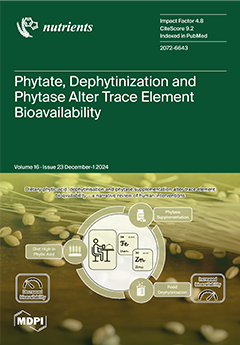
Cover Story: Phytic acid is abundant in plant-based diets and acts as a micronutrient inhibitor for humans and non-ruminant animals. Phytases are enzymes that break down phytic acid, releasing micronutrients and enhancing their bioavailability, particularly iron and zinc. Deficiencies in iron and zinc are significant public health problems, especially among populations with disease-associated malnutrition or those in developing countries consuming phytic acid-rich diets. This narrative review aims to summarize findings from human intervention studies on the effect of dietary phytic acid, food dephytinization and phytase supplementation upon micronutrient bioavailability. View this paper
  • Issues are regarded as officially published after their release is announced to the table of contents alert mailing list .
  • You may sign up for email alerts to receive table of contents of newly released issues.
  • PDF is the official format for papers published in both, html and pdf forms. To view the papers in pdf format, click on the "PDF Full-text" link, and use the free Adobe Reader to open them.

Articles (279)

  • Study Protocol
  • Open Access
3 Citations
2,296 Views
15 Pages

Describing Biological Vulnerability in Small, Vulnerable Newborns in Urban Burkina Faso (DenBalo): Gut Microbiota, Immune System, and Breastmilk Assembly

  • Lionel Olivier Ouédraogo,
  • Lishi Deng,
  • Cheick Ahmed Ouattara,
  • Anderson Compaoré,
  • Moctar Ouédraogo,
  • Alemayehu Argaw,
  • Carl Lachat,
  • Eric R. Houpt,
  • Queen Saidi and
  • Filomeen Haerynck
  • + 6 authors

9 December 2024

Background: Small vulnerable newborns (SVNs), including those born preterm, small for gestational age, or with low birth weight, are at higher risk of neonatal mortality and long-term health complications. Early exposure to maternal vaginal microbiot...

  • Article
  • Open Access
8 Citations
6,824 Views
21 Pages

Gut Microbiota: Association with Fiber Intake, Ultra-Processed Food Consumption, Sex, Body Mass Index, and Socioeconomic Status in Medical Students

  • Laura Moreno-Altamirano,
  • Karina Robles-Rivera,
  • Hugo G. Castelán-Sánchez,
  • Felipe Vaca-Paniagua,
  • María del Carmen Iñarritu Pérez,
  • Sandra Elvia Hernández-Valencia,
  • Carlos Cruz-Casarrubias,
  • Juan José García-García,
  • Miguel Ruíz de la Cruz and
  • Héctor Martínez-Gregorio
  • + 4 authors

9 December 2024

The gut microbiota plays a vital role in various physical and physiological processes, including immune system regulation, neurotransmitter production, inflammatory response modulation, and the inhibition of pathogenic organisms. An imbalance in the...

  • Article
  • Open Access
2 Citations
19,433 Views
19 Pages

9 December 2024

Background: Choline is an essential nutrient required for proper cell functioning. Due to its status as a precursor to acetylcholine, an important neurotransmitter connected to cognition and neuromuscular function, maintaining or enhancing choline le...

  • Article
  • Open Access
1 Citations
2,916 Views
15 Pages

8 December 2024

Background/Objectives: Despite the increasing intake of animal-based protein and the growing number of single-person households (SPHs) in Korean populations, no studies have analyzed the relationship of protein intake by source with metabolic syndrom...

  • Article
  • Open Access
3,207 Views
15 Pages

8 December 2024

Objectives: This study aimed to assess the impact of modifiable lifestyle behaviors on the association between sleep patterns and chronic kidney disease (CKD) risk. Methods: This study included 294,215 UK Biobank participants initially without CKD, f...

  • Review
  • Open Access
5 Citations
3,067 Views
18 Pages

8 December 2024

Eriodictyol is a flavanone compound commonly found in several edible plants. Ultrasound-assisted extraction and high-performance liquid chromatography (HPLC) are commonly used methods for the separation and analysis of eriodictyol. Many studies show...

  • Review
  • Open Access
3 Citations
4,168 Views
13 Pages

8 December 2024

Nowadays, the gluten-free diet (GFD) has become much more than the dietary treatment for celiac disease. Due to its presumed beneficial effects even in non-celiac subjects, it has become a new fashion statement and it is promoted by some healthcare p...

  • Article
  • Open Access
4 Citations
2,851 Views
19 Pages

7 December 2024

The Mediterranean Diet (MedDiet) is considered an Intangible Cultural Heritage by UNESCO; it is also the world’s most evidence-based eating pattern for promoting health and longevity. This study aims to investigate consumer segmentation based o...

  • Article
  • Open Access
3 Citations
2,102 Views
14 Pages

Risk Factors for Long-Term Nutritional Disorders One Year After COVID-19: A Post Hoc Analysis of COVID-19 Recovery Study II

  • Keiichiro Kawabata,
  • Kensuke Nakamura,
  • Naoki Kanda,
  • Muneaki Hemmi,
  • Shinya Suganuma,
  • Yoko Muto,
  • Arisa Iba,
  • Miyuki Hori,
  • Mariko Hosozawa and
  • Hiroyasu Iso

7 December 2024

Background/Objectives: COVID-19 patients develop various clinical symptoms, including malnutrition. However, the risk factors for long-term nutritional disorders remain unclear. Identifying these factors is crucial for preventing nutritional disorder...

  • Article
  • Open Access
1 Citations
5,736 Views
18 Pages

Evaluation of the Leaves and Seeds of Cucurbitaceae Plants as a New Source of Bioactive Compounds for Colorectal Cancer Prevention and Treatment

  • Mercedes Peña,
  • Ana Guzmán,
  • Cristina Mesas,
  • Jesús M. Porres,
  • Rosario Martínez,
  • Francisco Bermúdez,
  • Consolación Melguizo,
  • Laura Cabeza and
  • Jose Prados

7 December 2024

Background/Objectives: The Cucurbitaceae family represents an important source of bioactive compounds with antioxidant, antimicrobial, anti-inflammatory and antitumor activities. This study aims to investigate the potential application of Cucurbitace...

of 28

Get Alerted

Add your email address to receive forthcoming issues of this journal.

XFacebookLinkedIn
Nutrients - ISSN 2072-6643