


Abstract
This study aimed to develop the Food Acceptance Questionnaire (FAQ) to assess the masticatory ability of Thai older adults (≥60 years). Fifty participants were interviewed using open-ended questions about food they regularly consumed and avoided due to difficulty chewing. From a list of 140 items, 100 were recruited for a trial version of the FAQ. A total of 154 participants responded to the 5-point Likert scale on their chewing perception of each food item (1, impossible to chew; 5, most easily eaten). The average response of each food item was used as the chewing index (CI). The 100 food items were ranked and divided into five grades based on their CIs. Masticatory performance (MP) was objectively assessed by a visual scoring method using gummy jelly (UHA Mikakuto). Two foods from each grade that demonstrated the highest correlation with MP were selected to form the final 10-item FAQ. The FAQ score was calculated by summarizing the responses of 10 items. MP correlated strongly with the FAQ score (r = 0.57, p < 0.001), indicating its predictive validity. Furthermore, the FAQ indicates strong internal consistency (Cronbach’s alpha coefficient = 0.90), indicating high reliability. In conclusion, this newly developed 10-item FAQ is valid and reliable for assessing the masticatory ability of Thai older adults.
1. Background
The older population in most countries worldwide, including Thailand, has been increasing in recent years; as a result, Thailand has become an aged society [1]. Tooth loss is common among older adults, resulting in decreased masticatory ability and increased risk of systemic diseases, frailty, and mortality [2]. Masticatory performance (MP) is an essential indicator for assessing masticatory ability [3]. Most of the international research on MP to date has focused on the development of test methods and test materials for objective masticatory performance, such as sieve tests [4,5], hydrocolloid impression materials [6], paraffin wax cubes [7], optics [8], color-changeable chewing gum [9,10], and gummy jelly [11,12]. Objective assessments of the MP are believed to be more accurate than subjective assessments [13]. On the other hand, objective assessment requires special equipment and costs [14] and may be difficult to obtain in rural areas and underdeveloped countries.
The use of the Food Acceptance Questionnaire (FAQ), one of the methods used to assess subjective masticatory ability, can eliminate the limitations of objective assessment and may thus be a more convenient approach. Large population-based studies often employ FAQs due to their simplicity and low expenses [15,16]. The subjective masticatory ability assessment in response to the FAQ can be obtained through self-monitoring. Previous studies have used questionnaires to evaluate the difficulty of masticating ordinary foods, such as peanuts, raw carrots, apples, salami, bean curd, hard rice crackers, and steaks, and to determine food intake ability [16,17,18,19,20,21,22]. Hirai et al. reported that the correlation between the results of the gold-standardized masticatory performance test using sieve analysis [23] and Sato’s FAQ in patients with complete dentures showed a strong correlation between the chewing function score and chewing satisfaction [21], indicating that the FAQs were useful for evaluating masticatory ability. Shiga et al. reported a strong correlation between masticatory scores obtained from two types of FAQs and masticatory performance measured by the amount of glucose extracted during gummy jelly chewing [24]. Nevertheless, the FAQs used in these reports were limited to Japanese complete denture wearers, and the foods listed in these FAQs were Japanese foods [21,23]. FAQs were also invented by other nations, such as Korea [19], China [25], Canada [18,20], and the USA [22], and their common national foods influenced each questionnaire’s food lists. In Thailand, the use of the FAQ for assessing masticatory ability has been reported [26]; however, the characteristics of the FAQ are restricted to complete denture wearers and are not limited to older adults, and a questionnaire with high reliability and validity has not yet been obtained. In addition, the details of the FAQ development method are currently limited, and some studies reported the developing protocol but it might not be suitable for nationwide application [21,23,25].
Therefore, we focused on developing the FAQ for assessing the masticatory ability of Thai older adults with tooth loss. Because a food questionnaire with high predictive validity and reliability was needed, masticatory performance was determined by objective assessments using the gummy jelly test, and the results were compared for verification of the FAQ. In addition, we look forward to sharing our methodology as a prototype for developing FAQs in other regions.
2. Methods
The study protocol was approved by the Center for Ethics in Human Research of Khon Kaen University (#HE640294). Finite population correction coefficients were used to determine the sample size for creating the FAQ [27].
Sample size = N × [Z2 × p × (1 − p)/e2]/[N − 1 + (Z2 × p × (1 − p)/e2]
Assuming a population size of infinity, a confidence level of 95%, a margin of error of ±10%, and a response ratio of 0.5, the required sample size was 96. Assuming a dropout rate of 10%, a sample size of more than 106 persons was secured.
2.1. Participants
The participants were Thai men and women over 60 years old with partial dentate or complete edentulism who visited Khon Kaen University Dental Hospital from January 2020 to January 2022 for prosthodontic treatment. The inclusion criteria for subjects were missing one or more teeth (excluding third molars), no pain or severe inflammation in their teeth or periodontal tissue, and no problems with their dentures if they were wearing any dentures. The exclusion criteria were orofacial pain and significant cognitive or communication problems that may affect the ability to complete the questionnaire. The study objectives and procedures were explained. Those who met the inclusion criteria and were willing to provide written consent were enrolled. After exclusion, 154 participants exceeded the target sample size (75 men and 79 women).
The examiner conducted oral examinations with the participant lying on a dental chair in a supine position under sufficiently bright artificial lighting. The number of remaining teeth was assessed. The remaining teeth were defined as natural and treated teeth presenting in the oral cavity, including pontics and implants but excluding wisdom teeth, were impacted or had a high degree of torsion or slant.
2.2. FAQ Development
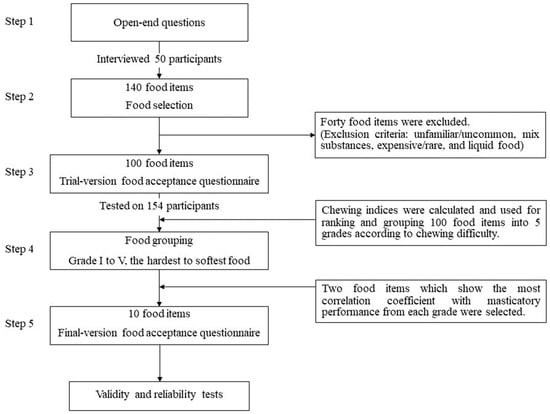
The following 5 steps were used for FAQ development (Figure 1):
Figure 1.
Flow diagram of food acceptance questionnaire development.
Step 1: Open-ended questions
The examiner asked 50 participants open-ended questions by interviewing them about their current food choices, such as “What is the food you cannot eat or avoid due to chewing difficulty?” and “What food can you normally eat in your daily life?”
Step 2: Food selection
All the food items were collected from the interviews of the previous step of the open-ended questions. We considered that some food items should be excluded. There are four criteria for food exclusion: unfamiliar/uncommon food, mixed food, expensive/rare food, and liquid food.
Step 3: Trial version FAQ
After eliminating the excluded food items, all remaining food items were used to create the trial version FAQ. The trial version FAQ contained all remaining food items, and the responses on each food item were made on a 5-point Likert scale according to chewing difficulty from scores 1 to 5 (“impossible to chew” to “most easily eaten”). If the participant’s opinion was “do not eat because of dislike” or “never eaten”, the response was “0”. The color photographs of all food items were attached to the questionnaire to standardize the interpretation of the size, texture, and cooking process. All participants were asked to assign a mark on the coded response according to their perception of chewing difficulty.
Step 4: Food Grouping
We calculated the chewing index (CI) of each food by averaging the frequency of the coded responses. If any response was “0”, it was excluded from the CI calculation. The foods were then arranged in ascending order from the lowest to the highest CI. After that, the food items were shared equally into 5 grades (grades I to V: the hardest to the softest food). This grade was determined following the method of Sato et al. [21].
Step 5: Final version FAQ
The correlation (Pearson’s correlation coefficient) between the responses and the MP of each food was calculated. We chose two food items from each grade that showed the highest correlation coefficients with the MP. Finally, ten food items were included in the final version of the FAQ. If those food items were 5% or more, a response of 0 (do not eat because of dislike or never eaten) was eliminated to avoid further problems with incomplete answers or misinterpretation. To calculate the food acceptance score (FAQ), all responses to ten food items from the FAQ were collected. The maximum possible FAQ is 50, and the minimum FAQ is 10.
2.3. MP Assessments
The participants were instructed to chew a piece of gummy jelly (UHA Mikakuto Co., Ltd., Osaka, Japan) freely 30 times and, after chewing, to expectorate all the chewed fragments onto a piece of gauze spread over a paper cup. The collected pieces of gummy jelly were wrapped and washed with running tap water, and the gauze was stretched on a paper cup. The pieces of gummy jelly were spread out to prevent overlap of the chewed particles and evaluated by the visual scoring method, which categorizes the pieces into ten levels (0–9). The examiner decided on the score by comparing it with the visual scoring sheet [28]. The participants who regularly wore removable dentures were instructed to keep their dentures in their mouths during the MP assessment.
2.4. Statistical Analyses
The normality of the data distribution was examined using the Kolmogorov‒Smirnov test. When the data were non-normally distributed, a square root or logarithmic transformation was performed.
Age, number of remaining teeth, and posterior support were divided into three groups, which were then compared via analysis of variance (ANOVA) and multiple comparisons (Tukey’s test) to assess the characteristics of the participants.
For predictive validity assessment, we investigated the correlation of the FAQ with the MP (Pearson’s correlation coefficient). For reliability assessment, internal consistency analyses (corrected item-total correlation and Cronbach’s alpha) were used.
All analyses were performed using the SPSS software program, version 25.0, for Windows (IBM Corporation, Armonk, NY, USA), and probability values < 5% were considered significant.
3. Results
3.1. Baseline Participant Characteristics
The detailed characteristics of the participants and the relationships between masticatory ability (MP and FAQ score) and confounding factors are shown in Table 1. There were no significant sex differences in the MP/FAQ score ratio. In terms of age, the MP/FAQ score tended to increase as age decreased, and there were statistically significant differences in the MP between age groups. There was no significant difference in the FAQ score between age groups. The number of remaining teeth ranged from 0 to 27 (average: 16.5 teeth). There were statistically significant differences in the MP/FAQ between the group with more than 20 teeth and the other two groups. In terms of posterior support, there were statistically significant differences in the MP/FAQ between the posterior support group and the nonposterior support/edentulous group. There was no significant difference between the without posterior support group and the edentulous group.
Table 1.
Participant characteristics and relationships between the masticatory performance/food acceptance score and other confounding factors.
3.2. FAQ Development
Step 1: Open-ended questions
One hundred forty food items were obtained from the interviews with the open-ended questionnaire (Appendix A, Table A1).
Step 2 and Step 3: Food selection and trial version of the FAQ
Forty food items were excluded, and one hundred food items remained and were included in the trial version of the FAQ.
Step 4: Food grouping
The distributions of the responses and the CI of each food item are shown in Appendix A, Table A2. One hundred food items were equally divided into five grades. Twenty food items were included in each grade.
Step 5: Final version FAQ
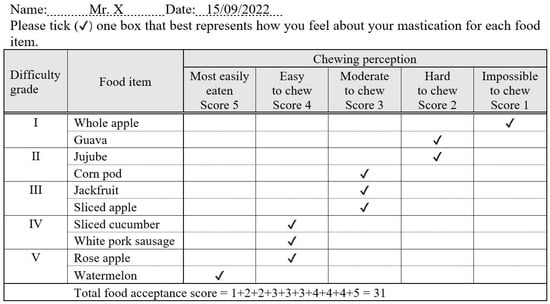
The correlation coefficients (Pearson’s correlation coefficients) between the responses and the MP of each food are also shown in Appendix A, Table A2. Two foods from each grade that showed the most correlation coefficients with the MP were selected. Ten food items were included in the final version of the FAQ, and the final version of the FAQ was represented (Figure 2).
Figure 2.
Final version Food Acceptance Questionnaire: an example of an answer to the questionnaire and food acceptance score calculation.
3.3. Statistical Analyses
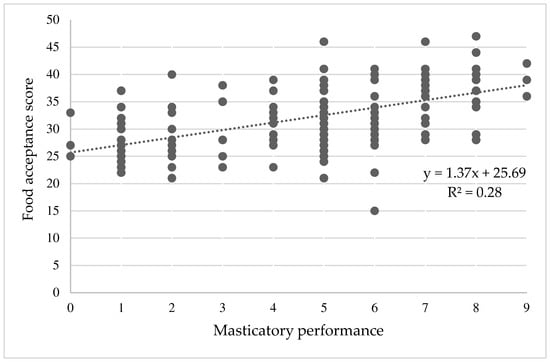
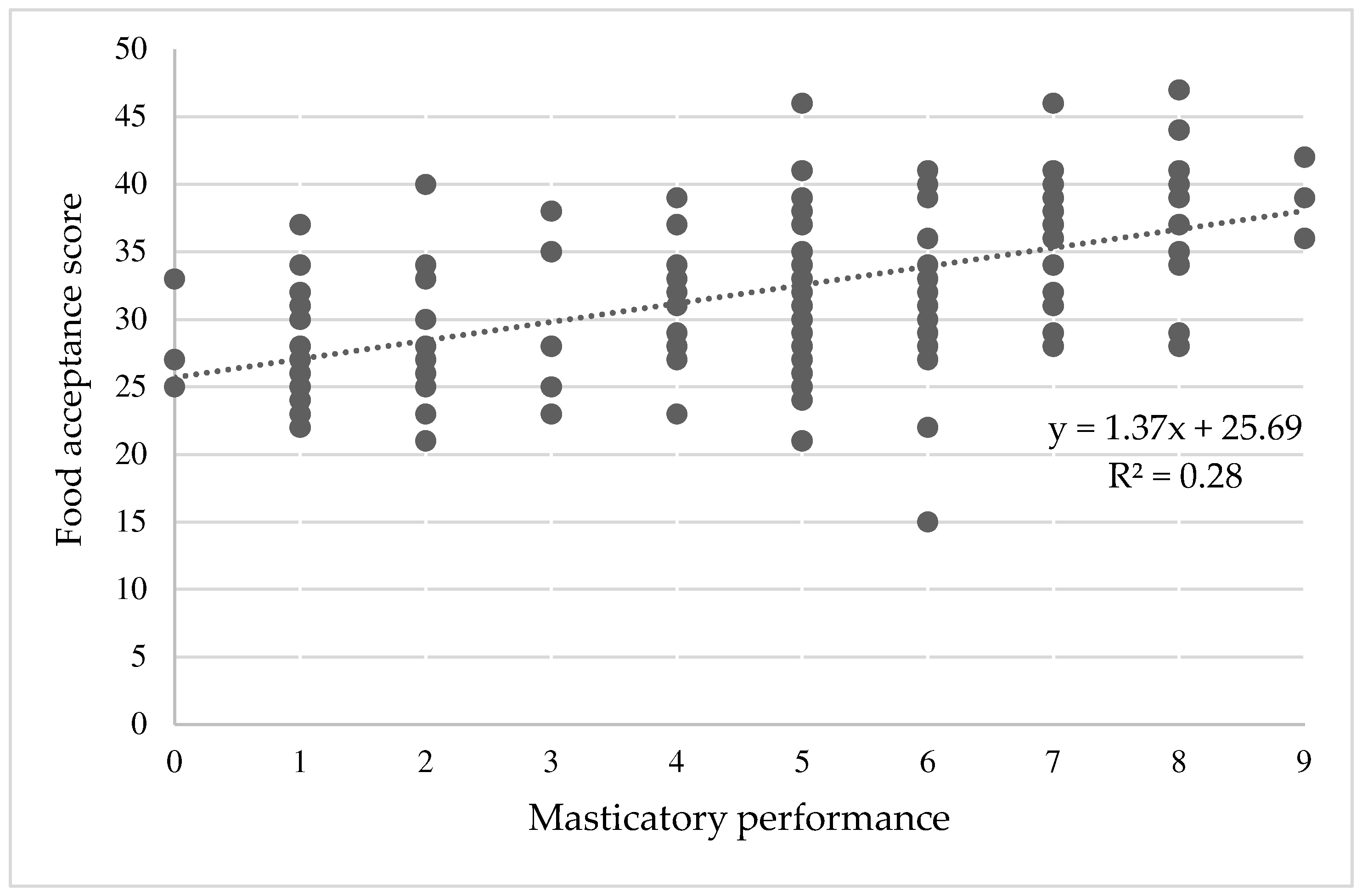
The relationship between the FAQ score and the MP score is presented in Figure 3. There was a significant correlation between the FAQ score and MP (r = 0.57, p < 0.001), indicating that participants with a higher FAQ score had greater MP.
Figure 3.
Relationship between food acceptance score and masticatory performance: the scatterplot with a positive correlation y, the value of the food acceptance score; x, the value of masticatory performance; R2, the coefficient of determination.
The internal consistency analysis of the 10 food items demonstrated excellent consistency (Cronbach’s alpha = 0.90), and the corrected item-total correlation and Cronbach’s alpha for each food item deleted are shown in Table 2.
Table 2.
Internal consistency of the Food Acceptance Questionnaire.
4. Discussion
It is generally agreed that an objective masticatory ability assessment is more accurate than a subjective assessment by the FAQ. However, using FAQ provides many benefits, such as convenience and low cost. Thus, the present study aimed to develop the validated FAQ as an alternative device for assessing masticatory ability, and we hope that the FAQ can be used as a guideline for FAQ development in other regions. Moreover, we preferred to cover all older adults with a wide range of masticatory functions, from very poor to superb. Our findings are supported by the wide variation in the MP of the study participants, as reflected by the even distribution of the visual score of gummy jelly.
This study selected gummy jelly as the standardized material for validating the FAQ and MP assessment because it has several advantages. The gummy jelly test has been proven to provide good measurement accuracy and discrimination ability [29]. We used the visual scoring method because this method is convenient and has sufficient validity [30].
In addition to FAQ development, which is the primary aim of this study, we also investigated the effect of some confounding factors on the MP/FAQ because we wanted to observe the tendency of the MP/FAQ to respond to such factors and the correspondence between the MP and FAQ. The results revealed that the MP/FAQ tended to decrease as age decreased and increased as the number of remaining teeth increased. Regarding posterior support, the MP/FAQ of the posterior support group was greater than that of the nonposterior support group and the edentulous group. These results coincided with those of previous studies [31,32,33,34,35]. Thus, we assumed that the developed FAQ could be a proper predictor of MP.
We adapted the food item grouping method from the original FAQ of Sato et al. [21]. The food items on the FAQ were categorized into five grades according to masticatory difficulty. However, our study included 10 food items, while Sato’s study included 20 food items. In addition, the difference from Satos’ questionnaire is the score calculation method. The FAQ in this study was calculated by summarizing the coded responses from the 5-point Likert scale selection of each food item, which can reflect more details of the scoring than Sato’s method. Sato’s FAQ asked the participants to describe the difficulty of eating, as follows: O, easy to chew; Δ, difficult to chew; or Χ, impossible to chew. To calculate the chewing function score, the total numbers of O, easy-to-chew responses were summed and presented as percentages. This study proved that 10 food items in the FAQ were sufficient for predicting MP, and the calculation method of the FAQ was validated by revealing a strong significant correlation between the FAQ and MP.
As mentioned above, we decided to categorize food into five grades according to chewing difficulty, from Grade I to Grade V, resembling the original FAQ of Sato et al. [21]. We considered the advantages of categorizing different food hardnesses and textures from the softest to the hardest food for the FAQ of Sato et al. As a result, the FAQ can reflect individual masticatory ability from the lowest to the highest. However, we noticed that the softer food items in Grade IV and Grade V, i.e., white pork sausage, rose apple, and watermelon, demonstrated low correlation coefficients to the MP (r = 0.37, 0.35, and 0.39, respectively). Thus, including these rather soft food items in the FAQ seemed worthless for discriminating the MP of an individual because nearly everyone can easily masticate. These soft food items might be excluded from the FAQ. In addition, the results of the internal consistency analyses of reliability supported the assumption that if watermelon was eliminated, the internal consistency remained excellent (Cronbach’s alpha if item deleted = 0.90). Nevertheless, we strongly considered including these soft food items because they are useful for patients with low masticatory ability and can help to provide a score for discrimination. Comparing the FAQ to the MP, including these soft food items, could help to cover all the information of patients who have low masticatory ability.
Similar to the original FAQ of Sato et al., there was no weighting of the difficulty of chewing food when calculating the FAQ. The difficulty of chewing food items was assigned the same weight as that of soft foods. In contrast, Hirai et al. presented their calculation method in which difficult-to-chew food has a larger coefficient weight, and the individual score is greater if more difficult-to-chew food can be chewed [23]. However, the calculation method of Hirai et al. seems to be complicated. Therefore, we decided to assign all food items to the same weight.
Regarding the participants’ characteristics, the participants in our study included both partially dentate and edentulous patients, while the participants in the study by Sato et al. had complete edentulism. In our study, 82% of participants were partially dentate and tended to have better chewing ability than did the edentulous participants in the study of Sato et al. However, we aimed to develop the FAQ for wide usage in even partially dentate or edentulous patients. Therefore, this instrument can provide an opportunity for evaluating perceived chewing difficulty in patients with minimal to complete tooth loss.
There are certain limitations in the present study that should be noted. Food acceptance and masticatory function, which are components of oral function, are influenced by various factors, such as the number of functional teeth, oral hygiene, occlusal force, salivary secretion, tongue-lip motor skill, swallowing function, experience with dentures, and stability and retention of dentures [3,36,37]. Additionally, older individuals with dentures often choose to exclude hard-to-chew foods from their daily diets [22,38]. However, none of these factors were taken into account in the analysis conducted in this study. Furthermore, because participants who did not completely answer all 10 food items were excluded from the calculation of the FAQ, the validity of the FAQ cannot be applied in the case of incomplete answers. Our study focused on this limitation if those food items with more than 5% dislike responses were not included in the FAQ. In addition, the FAQ developed in this study may not be suitable for populations who have limited food choices or vegetarianism. Some food items were Thai food; thus, this questionnaire cannot be used with other nations. A certain number of Thai people are Muslim and pork consumption is prohibited; as a result, they cannot rate the chewing difficulty of some food items, i.e., white pork sausage, and hence are unable to calculate the FAQ.
We considered designing a methodology for developing a FAQ that can be generalized and used in Thai older adults. One limitation was that most of the participants’ hometowns were located in the northeastern part of Thailand, which might have affected the inclusion of food items. The food items from the interviews tended to be local food. However, we eliminated this concern by setting the inclusion criteria for food selection for the trial version of the FAQ; thus, local food items were eliminated. However, we expect to prove the validity and test–retest reliability of the FAQ in other regional Thai populations for further study. The FAQ developed in the present study may not be widely applicable for assessing masticatory function, as it was tailored to Thai older adults at the University Dental Hospital and some foods included in the final version FAQ are Thai food. Indeed, we hope that this study can serve as a model for further developing FAQs in other regions.
5. Conclusions
This study presented the Food Acceptance Questionnaire development methodology and developed the 10-item FAQ for subjective masticatory function assessment in Thai older partial and complete edentulous patients. We found that the Food Acceptance Questionnaire is valid and reliable and can be used as an effective device to predict MP.
Author Contributions
Conceptualization, K.S., Y.H. and T.O.; methodology, Y.H. and T.O.; software, Y.H. and K.H.; validation, Y.H.; formal analysis, K.S., Y.H., J.P., W.P. and K.H.; investigation, K.S.; resources, K.S. and Y.H.; data curation, K.S.; writing—original draft presentation, K.S.; writing—review and editing, Y.H., J.P., W.P., K.H. and T.O.; visualization, K.S., Y.H. and T.O.; supervision, Y.H., K.H. and T.O.; project administration, K.S. and Y.H.; funding acquisition, K.S., Y.H. and T.O. All authors have read and agreed to the published version of the manuscript.
Funding
This research received no external funding.
Institutional Review Board Statement
This study was conducted in accordance with the Declaration of Helsinki and approved by the Center for Ethics in Human Research of Khon Kaen University (#HE640294, date of approval: 6 May 2021).
Informed Consent Statement
Written informed consent was obtained from all subjects involved in the study to publish this paper.
Data Availability Statement
The material described in the findings of this study, including all relevant raw data, will be freely available to any scientist wishing to use them for non-commercial purposes by contacting the corresponding author without breaching patient confidentiality.
Acknowledgments
We would like to express our appreciation to the authors’ institutions: the Department of Prosthodontics, Faculty of Dentistry, Khon Kaen University, Khon Kaen, Thailand, Thailand Oral Health Plan for the Elderly, Department of Health, Thailand, and the Division of Comprehensive Prosthodontics, Faculty of Dentistry and Graduate School of Medical and Dental Sciences, Niigata University, Niigata, Japan.
Conflicts of Interest
The authors declare no conflicts of interest.
Appendix A
Table A1.
140 food items from the interview of open-ended questions.
Table A2.
One hundred food items were classified into 5 grades of masticatory difficulty, the participants’ responses to the trial version Food Acceptance Questionnaire were distributed, the chewing index of each food was calculated, and the correlation coefficient with masticatory performance was calculated.
References
- Thailand’s Ministry of Social Development and Human Security, Department of Older Person (DOP). Available online: https://www.dop.go.th/th/know/side/1/1/2449 (accessed on 15 September 2022).
- Tanaka, T.; Takahashi, K.; Hirano, H.; Kikutani, T.; Watanabe, Y.; Ohara, Y.; Furuya, H.; Tetsuo, T.; Akishita, M.; Iijima, K. Oral Frailty as a Risk Factor for Physical Frailty and Mortality in Community-Dwelling Elderly. J. Gerontol. A Biol. Sci. Med. Sci. 2018, 73, 1661–1667. [Google Scholar] [CrossRef] [Scilit] [PubMed]
- Minakuchi, S.; Tsuga, K.; Ikebe, K.; Ueda, T.; Tamura, F.; Nagao, K.; Furuya, J.; Matsuo, K.; Yamamoto, K.; Kanazawa, M.; et al. Oral hypofunction in the older population: Position paper of the Japanese Society of Gerodontology in 2016. Gerodontology 2018, 35, 317–324. [Google Scholar] [CrossRef] [Scilit] [PubMed]
- Kapur, K.K.; Soman, S.; Yurkstas, A. Test foods for measuring masticatory performance of denture wearers. J. Prosthet. Dent. 1964, 14, 483–491. [Google Scholar] [CrossRef] [Scilit]
- Lucas, P.W.; Luke, D.A. Methods for analysing the breakdown of food in human mastication. Arch. Oral Biol. 1983, 28, 813–819. [Google Scholar] [CrossRef] [Scilit] [PubMed]
- Ohara, A.; Tsukiyama, Y.; Ogawa, T.; Koyano, K. A simplified sieve method for determining masticatory performance using hydrocolloid material. J. Oral Rehabil. 2003, 30, 927–935. [Google Scholar] [CrossRef] [Scilit]
- Sato, H.; Fueki, K.; Sueda, S.; Sato, S.; Shiozaki, T.; Kato, M.; Ohyama, T. A new and simple method for evaluating masticatory function using newly developed artificial test food. J. Oral Rehabil. 2003, 30, 68–73. [Google Scholar] [CrossRef] [Scilit] [PubMed]
- Fontijn-Tekamp, F.A.; Slagter, A.P.; Van Der Bilt, A.; Van, T.H.M.A.; Witter, D.J.; Kalk, W.; Jansen, J.A. Biting and chewing in overdentures, full dentures, and natural dentitions. J. Dent. Res. 2000, 79, 1519–1524. [Google Scholar] [CrossRef] [Scilit] [PubMed]
- Hayakawa, I.; Watanabe, I.; Hirano, S.; Nagao, M.; Seki, T. A simple method for evaluating masticatory performance using a color-changeable chewing gum. Int. J. Prosthodont. 1998, 11, 173–176. [Google Scholar] [PubMed]
- Silva, L.C.; Nogueira, T.E.; Rios, L.F.; Schimmel, M.; Leles, C.R. Reliability of a two-colour chewing gum test to assess masticatory performance in complete denture wearers. J. Oral Rehabil. 2018, 45, 301–307. [Google Scholar] [CrossRef] [Scilit]
- Igarashi, K.; Watanabe, Y.; Kugimiya, Y.; Shirobe, M.; Edahiro, A.; Kaneda, K.; Hasegawa, Y.; Ito, M.; Hirano, H.; Sakurai, K.; et al. Validity of a visual scoring method using gummy jelly for evaluating chewing efficiency in a large-scale epidemiological survey. J. Oral Rehabil. 2019, 46, 409–416. [Google Scholar] [CrossRef] [Scilit]
- Ohno, K.; Fujita, Y.; Ohno, Y.; Takeshima, T.; Maki, K. The factors related to decreases in masticatory performance and masticatory function until swallowing using gummy jelly in subjects aged 20–79 years. J. Oral Rehabil. 2020, 47, 851–861. [Google Scholar] [CrossRef] [Scilit]
- Miura, H.; Araki, Y.; Hirai, T.; Isogai, E.; Hirose, K.; Umenai, T. Evaluation of chewing activity in the elderly person. J. Oral Rehabil. 1998, 25, 190–193. [Google Scholar] [CrossRef] [Scilit]
- Katsuhiko, K.; Takahiro, O.; Neal, R.G.; Minoru, T. Assessment of Masticatory Performance: Methodologies and Their Application. Prosthodont. Res. Pract. 2004, 3, 33–45. [Google Scholar] [CrossRef] [Scilit]
- Cade, J.; Thompson, R.; Burley, V.; Warm, D. Development, validation and utilisation of food-frequency questionnaires—A review. Public Health Nutr. 2002, 5, 567–587. [Google Scholar] [CrossRef] [Scilit]
- Koshino, H.; Toshihiro, H.; Yoshifumi, T.; Yuichi, Y.; Maki, T.; Kazuo, I.; Toshio, H. Development of New Food Intake Questionnaire Method for Evaluating the Ability of Mastication in Complete Denture Wearers. Prosthodont. Res. Pract. 2008, 7, 12–18. [Google Scholar] [CrossRef] [Scilit]
- Baba, K.; John, M.T.; Inukai, M.; Aridome, K.; Igarahsi, Y. Validating an alternate version of the chewing function questionnaire in partially dentate patients. BMC Oral Health 2009, 9, 9. [Google Scholar] [CrossRef] [Scilit]
- Demers, M.; Bourdages, J.; Brodeur, J.M.; Benigeri, M. Indicators of masticatory performance among elderly complete denture wearers. J. Prosthet. Dent. 1996, 75, 188–193. [Google Scholar] [CrossRef] [Scilit]
- Hsu, K.J.; Yen, Y.Y.; Lan, S.J.; Wu, Y.M.; Chen, C.M.; Lee, H.E. Relationship between remaining teeth and self-rated chewing ability among population aged 45 years or older in Kaohsiung City, Taiwan. Kaohsiung J. Med. Sci. 2011, 27, 457–465. [Google Scholar] [CrossRef] [Scilit]
- Leake, J.L. An index of chewing ability. J. Public Health Dent. 1990, 50, 262–267. [Google Scholar] [CrossRef] [Scilit]
- Sato, Y.; Minagi, S.; Akagawa, Y.; Nagasawa, T. An evaluation of chewing function of complete denture wearers. J. Prosthet. Dent. 1989, 62, 50–53. [Google Scholar] [CrossRef] [Scilit]
- Wayler, A.H.; Kapur, K.K.; Feldman, R.S.; Chauncey, H.H. Effects of age and dentition status on measures of food acceptability. J. Gerontol. 1982, 37, 294–299. [Google Scholar] [CrossRef] [Scilit]
- Hirai, T.; Ishijima, T.; Koshino, H.; Anzai, T. Age-related change of masticatory function in complete denture wearers: Evaluation by a sieving method with peanuts and a food intake questionnaire method. Int. J. Prosthodont. 1994, 7, 454–460. [Google Scholar]
- Shiga, H.; Ishikawa, A.; Nakajima, K.; Tanaka, A. Relationship between masticatory performance using a gummy jelly and food intake ability in Japanese complete denture wearers. Odontology 2015, 103, 356–359. [Google Scholar] [CrossRef] [Scilit]
- Fan, Y.; Shu, X.; Lo, E.C.M.; Leung, K.C.M. Development and validation of a chewing function questionnaire for Chinese older adults. J. Dent. 2021, 104, 103520. [Google Scholar] [CrossRef] [Scilit]
- Sakultae, C.; Tumrasvin, W.; Limpuangthip, N. Development of Food Intake Questionnaire for Evaluating Masticatory Ability of Complete Denture Wearers. Khon Kaen Dent. J. 2021, 24, 49–60. [Google Scholar]
- Daniel, W.W.; Cross, C.L. Biostatistics: A Foundation for Analysis in the Health Sciences; Wiley: Hoboken, NJ, USA, 2018. [Google Scholar]
- Nokubi, T.; Yoshimuta, Y.; Nokubi, F.; Yasui, S.; Kusunoki, C.; Ono, T.; Maeda, Y.; Yokota, K. Validity and reliability of a visual scoring method for masticatory ability using test gummy jelly. Gerodontology 2013, 30, 76–82. [Google Scholar] [CrossRef] [Scilit]
- Ikebe, K.; Morii, K.; Matsuda, K.; Hazeyama, T.; Nokubi, T. Reproducibility and Accuracy in Measuring Masticatory Performance Using Test Gummy Jelly. Prosthodont. Res. Pract. 2005, 4, 9–15. [Google Scholar] [CrossRef] [Scilit]
- Murakami, K.; Hori, K.; Yoneda, H.; Sato, N.; Suwanarpa, K.; Sta Maria, M.T.; Marito, P.; Nokubi, T.; Ono, T. Compatibility of two types of gummy jelly tests for detecting decreased masticatory function. Gerodontology 2022, 39, 10–16. [Google Scholar] [CrossRef] [Scilit]
- Suwanarpa, K.; Hasegawa, Y.; Salazar, S.; Kikuchi, S.; Yoshimoto, T.; Paphangkorakit, J.; Hori, K.; Ono, T. Can masticatory performance be predicted by using food acceptance questionnaire in elderly patients with removable dentures? J. Oral Rehabil. 2021, 48, 582–591. [Google Scholar] [CrossRef] [Scilit]
- Kosaka, T.; Kida, M.; Kikui, M.; Hashimoto, S.; Fujii, K.; Yamamoto, M.; Nokubi, T.; Maeda, Y.; Hasegawa, Y.; Kokubo, Y.; et al. Factors Influencing the Changes in Masticatory Performance: The Suita Study. JDR Clin. Trans. Res. 2018, 3, 405–412. [Google Scholar] [CrossRef] [Scilit]
- Kosaka, T.; Ono, T.; Kida, M.; Kikui, M.; Yamamoto, M.; Yasui, S.; Nokubi, T.; Maeda, Y.; Kokubo, Y.; Watanabe, M.; et al. A multifactorial model of masticatory performance: The Suita study. J. Oral Rehabil. 2016, 43, 340–347. [Google Scholar] [CrossRef] [Scilit] [PubMed]
- Okada, K.; Enoki, H.; Izawa, S.; Iguchi, A.; Kuzuya, M. Association between masticatory performance and anthropometric measurements and nutritional status in the elderly. Geriatr. Gerontol. Int. 2010, 10, 56–63. [Google Scholar] [CrossRef] [Scilit]
- Marito, P.; Hasegawa, Y.; Tamaki, K.; Sta Maria, M.T.; Yoshimoto, T.; Kusunoki, H.; Tsuji, S.; Wada, Y.; Ono, T.; Sawada, T.; et al. The Association of Dietary Intake, Oral Health, and Blood Pressure in Older Adults: A Cross-Sectional Observational Study. Nutrients 2022, 14, 1279. [Google Scholar] [CrossRef] [Scilit]
- Ikebe, K.; Matsuda, K.; Kagawa, R.; Enoki, K.; Yoshida, M.; Maeda, Y.; Nokubi, T. Association of masticatory performance with age, gender, number of teeth, occlusal force and salivary flow in Japanese older adults: Is ageing a risk factor for masticatory dysfunction? Arch. Oral Biol. 2011, 56, 991–996. [Google Scholar] [CrossRef] [Scilit]
- Slagter, A.P.; Bosman, F.; van der Glas, H.W.; van der Bilt, A. Human jaw-elevator muscle activity and food comminution in the dentate and edentulous state. Arch. Oral Biol. 1993, 38, 195–205. [Google Scholar] [CrossRef] [Scilit]
- Garcia, R.I.; Perlmuter, L.C.; Chauncey, H.H. Effects of dentition status and personality on masticatory performance and food acceptability. Dysphagia 1989, 4, 121–126. [Google Scholar] [CrossRef] [Scilit]

Disclaimer/Publisher’s Note: The statements, opinions and data contained in all publications are solely those of the individual author(s) and contributor(s) and not of MDPI and/or the editor(s). MDPI and/or the editor(s) disclaim responsibility for any injury to people or property resulting from any ideas, methods, instructions or products referred to in the content. |
© 2024 by the authors. Licensee MDPI, Basel, Switzerland. This article is an open access article distributed under the terms and conditions of the Creative Commons Attribution (CC BY) license (https://creativecommons.org/licenses/by/4.0/).