


Abstract
This experiment evaluated the productivity and economic viability of wheat under an integrated net house with a closed hydroponic irrigation system versus an open field. The objective was to assess this water-saving innovation under the Arabian Peninsula’s resource-constrained environments. The integrated system achieved markedly superior results, producing a grain yield of 13.0 t/ha—a 117% increase over the open-field yield of 6.0 t/ha. Biomass yield reached 40.0 t/ha versus 16.0 t/ha in open fields, a 150% improvement. These gains were attributed to controlled growing conditions and balanced nutrient delivery, which optimized plant performance and reduced environmental stress. The system also demonstrated significant savings in resources, offering enhanced resource-use efficiency per unit of production. The estimated total values of productivity and resource savings were substantial when adjusted to the land area conserved. For ROI, BCR, and IRR, hydroponic wheat production scored 3.13, 4.13, and 312.8% in season (1) vs. 1.97, 2.97, and 197.1% for open-field production. In season (2), hydroponics scored 1.62, 2.63, and 163.0% vs. 0.043, 1.04, and 4.32% for open fields. Higher yields in 2022/2023 resulted from 30 vs. 10 min/day of irrigation due to higher relative humidity reflecting higher rainfall in the first season.
1. Introduction
Given the dominance of desert agriculture in the United Arab Emirates (UAE), open-field crop production is severely constrained by extreme heat, limited freshwater resources, low annual precipitation, and limited arable land (<5%) with negligible organic matter content (<0.02%) [1]. In addition, groundwater representing 70% of total water resources is declining at alarming rates due to excessive use and limited recharge [2]. These stresses limit the types of crops that can be grown in open fields and compromise yields in terms of quantity and quality, making investment in agriculture risky.
In total, 90% of food requirements for the UAE are imported. Agriculture contributes less than 0.1% to the GDP, and population growth is projected to reach 11 million by 2050 [3]. In 2023, United Arab Emirates’s total value of food and beverage imports rose to nearly AED 86 billion of the food it consumes [4]. According to UAE government figures, the UAE imported 1.7 million metric tons of wheat in 2022 [5], with Sharjah accounting for 330,000 tons of the total. Consequently, the adoption of hydroponic wheat production would help reduce food importation and achieve the goal and objectives of the 2018 national food security strategy [6].
Huge efforts over the past decades have been made to tackle prevalent environmental constraints and build a sustainable agriculture and animal wealth industry that is better able to contribute to food security and the national economy [3]. In this context, a hydroponic system combined with a solar powered net house is considered a possible alternative to conventional open-field production [7], especially in water-scarce areas. Hydroponics is gaining popularity because of its water- and nutrient-use efficiency and flexibility. It facilitates plant growth in artificial media with nutrient-rich water recirculation using solar energy. This method requires less nutrients, water, energy, and pesticides and produces high yields of crops in limited space with minimum resources [8].
Hydroponics is emerging as a promising approach to food production in hyper-arid ecosystems. It helps to eliminate the most important safe and healthy food production constraints resulting from pesticide residuals in contaminated soil or water resources. A standard hydroponic system consists of growing boxes, a reservoir equipped with a controlled solar submersible pump, a fertigation solution delivery system with a timer, and an air stone to oxygenate the nutrient solution [9].
Energy consumption plays a vital role in evaluating the sustainability of agricultural production systems. Research has shown that hydroponic cultivation typically requires more energy than conventional farming methods, with hydroponic systems using an average of 75% more energy per unit area [10]. Although transitioning to solar power can eliminate dependence on the electrical grid and reduce operational energy costs to zero, the significant upfront investment in solar equipment must be taken into account [11]. Despite these energy considerations, the economic feasibility of hydroponic systems is well documented. Studies indicate that although hydroponic systems demand higher initial capital compared to open-field farming, they often deliver greater yields and more efficient use of inputs, which can lead to higher long-term returns on investment [12]. Consequently, the adoption and expansion of hydroponic production largely depend on its economic performance [13] which should be thoroughly evaluated through a comparative benefit–cost analysis that incorporates relevant economic parameters. A comprehensive review highlights that while hydroponic systems reduce land-use and water requirements, they suffer from high investment costs, increased energy consumption, and need for technical expertise, making them economically challenging for broadacre staple crops. Similarly, hydroponic systems involve substantially higher initial setup and operational costs compared to soil-based agriculture, creating barriers to adoption despite long-term efficiency gains. These findings explain why hydroponics is commonly adopted for high-value vegetables rather than low-value grain crops.
The promotion of hydroponics—well-equipped net house wheat production technology—in the UAE directly addresses open-field constraints typical of hyper-arid ecosystems, namely limited fertile and small land holdings, severe water scarcity, high operational costs associated with labor, and the inherent energy demands of intensive crop production.
The overall goal of this study is to assess the challenges and opportunities of hydroponic wheat production as an alternative to open-field systems under the hyper-arid ecosystems of the UAE and beyond. This study will provide valuable information for farmers, researchers, and policy makers seeking to improve crop productivity and sustainability under hyper-arid ecosystems. There is little work on this subject in literature. The specific objectives of this study were to compare five bread wheat varieties under a solar-energy-powered hydroponics net house and open-field systems. The parameters measured were the grain and biomass yields, water and nutrient-use efficiency, land saving, and profitability.
Research Hypotheses
Under desert ecosystems, open-field crop productivity and cost-effectiveness are severely constrained by multiple abiotic stresses, including low soil fertility, water scarcity and salinity, windstorms, and extreme heat. To offset these constraints, agricultural inputs and irrigation requirements are typically intensified, significantly compromising cost-effectiveness and resource-use efficiency.
This study is designed to test and demonstrate that bread wheat productivity and cost-effectiveness under a solar-powered net house system combined with a closed hydroponic production system can effectively mitigate these abiotic stresses while improving cost-effectiveness and sustainability within desert ecosystems.
2. Materials and Methods
2.1. Study Site
Experiments were conducted during winter season of 2022/2023 and 2024/2025 at Al Dhaid Agricultural Innovation Center (AIC), Ministry of Climate Change and Environment (MOCCAE), UAE (25°16′ N, 55°55′ E, elevation 135 m above sea level). The climate is arid with a wide variation in the total annual rainfall (less than 100 mm annually), falling mostly in winter–early spring (January–March). Soils are coarse, dominated by sand which exceeds 90% in the subsoil at a depth of 30–60 cm, while the topsoil is close to sandy loam with silt around 13%. Soil water contents at field capacity (wt:wt)1 basis are 10.6% for topsoil (0–30 cm) and 7.2% for subsoil (30–60 cm) (14). The soil is alkaline (pH: 8.4–9.4) with high permeability. Soil salinity (ECe) ranges between 1.9 and 2.5 dS/m. Soil nutrients vary between 09 and 6.4 mg kg−1 for N, ˂1–8 mg kg−1 for P, and 15–60 mg kg−1 for K [14].
2.2. Experimental Design and Treatments
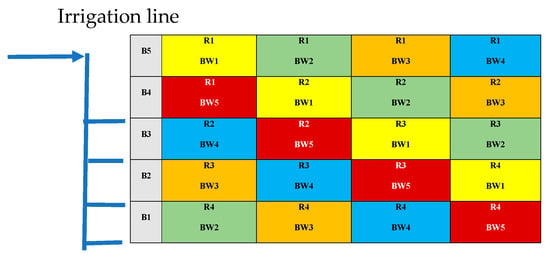
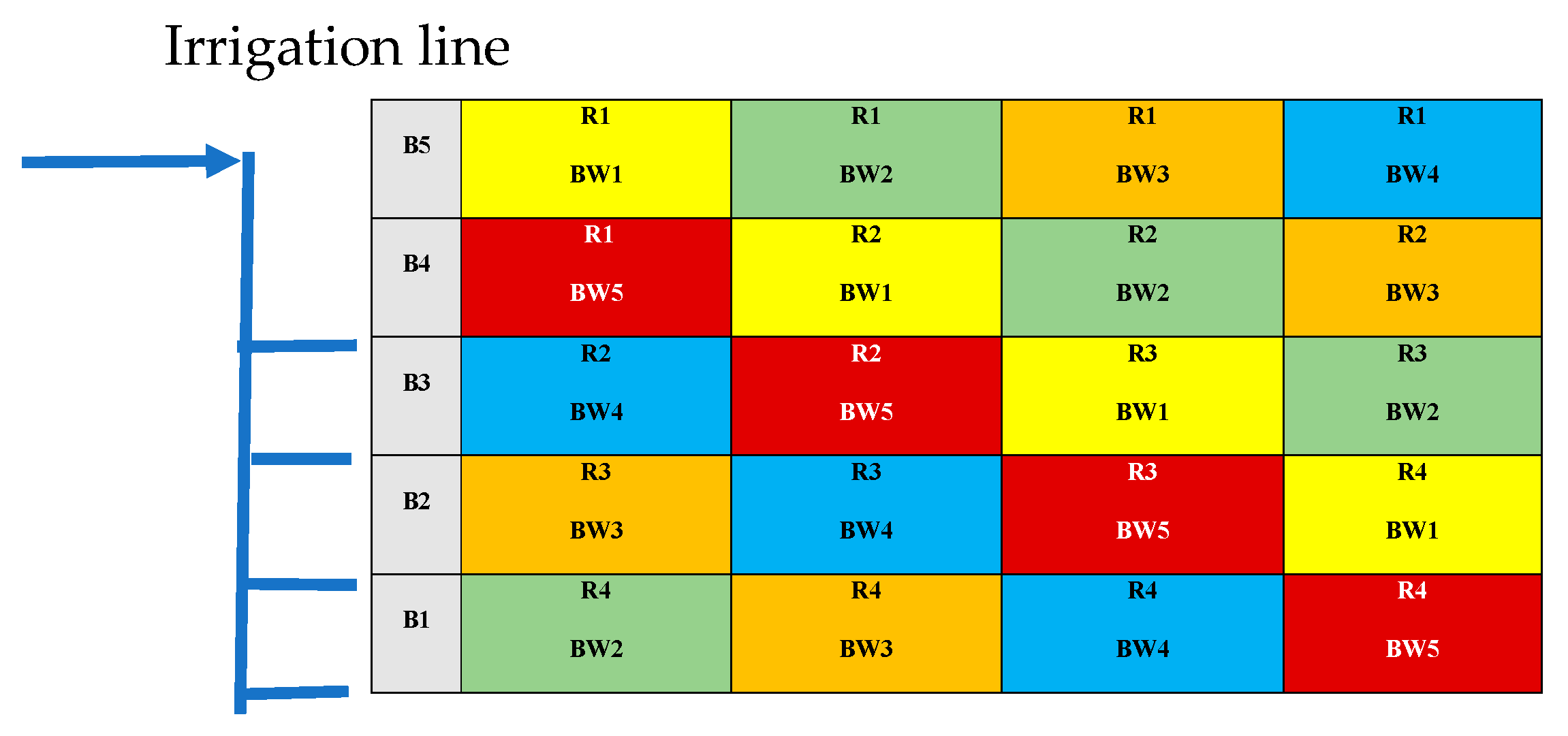
To assess the performance of five bread wheat varieties viz., Bread 388, Bread 514, Atlas, Bread 407, and Terbol varieties, supplied by ICARDA bread wheat breeding program, in terms of grain yield, biomass production, and harvest index, in addition to water, nutrient efficiency, and space utilization, two experiments were conducted using two different systems via hydroponics and conventional systems in 2022/2023 and 2024/2025. The experiments were laid out in a completely randomized design (CRD) replicated four times in both seasons (Figure 1). The date of seed sowing was on 18th of December 2022 and on 16th of November 2024. The harvesting was done after 135 days.
Figure 1.
The experimental layout for hydroponic and open-field trails in both seasons.
For field experiments, the bread wheat varieties were planted in rows in 2022/2023, while in 2024/2025 seeds were broadcasted. To ensure closed hydroponic experiments, a canal filled with a mixture of perlite and coco peat (v:v) was used. The seed rate was established based on 200 plants per m2, which is less than the optimum plant density of 300 plants per m2 in the open field, and the seed density was kept identical.
The seed rate comes from converting the desired plant population into the weight of plants needed, using thousand seed weight (TSW) and adjusting for germination percentage.
2.3. Closed Hydroponic Trails
A closed hydroponic system combined with a net house equipped with solar energy was arranged and connected. The plot (canals) (Figure 1) size in the first season was 0.2 m W × 1.0 m L, while in season 2 the plot size was 0.2 m W × 2.5 m L, and the whole plot area was harvested and the yield converted into t/ha. Nutrient-rich water was delivered to the plants at an hourly interval for five minutes per hour starting from 8:00 am to 17:00 pm (irrigation occurs 10 times a day × 5 min = 50 min/day). The mixing ratio of solutions A and B was 1:1 to standardize the nutrient delivery per plant. The nutrient solution concentration used in the closed hydroponic system was modified by ICARDA (Table 1). However, the solution was replaced within every fifteen to twenty-one days. After ~2–3 weeks, the nutrient balance no longer matched the intended formulation, even if EC (electrical conductivity) still seemed acceptable. This imbalance affects plant growth and physiological processes. Over time, the nutrient reservoirs slowly accumulate organic exudates from the roots.
Table 1.
Nutriental solution concentration (ICARDA’s formulation).
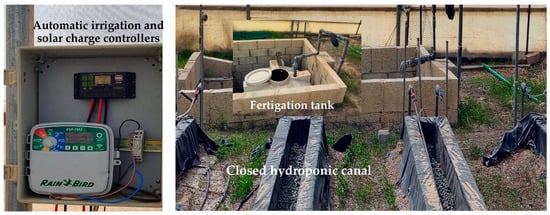
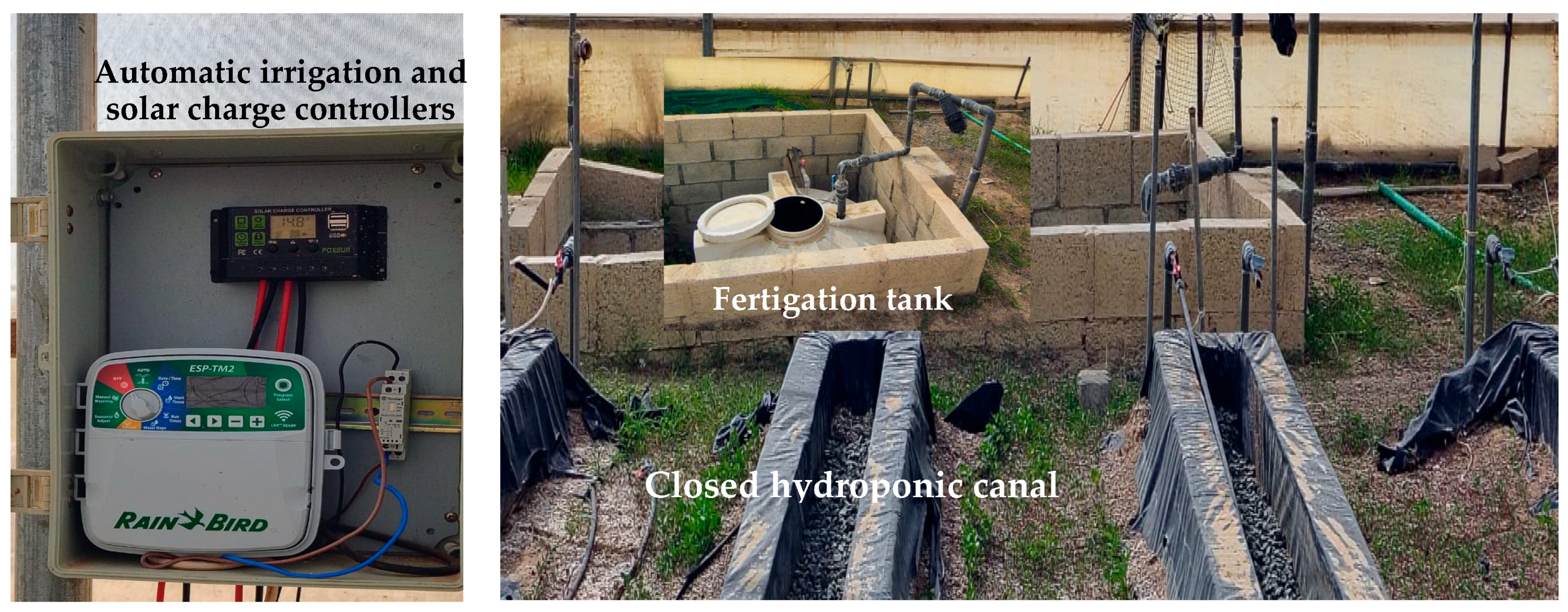
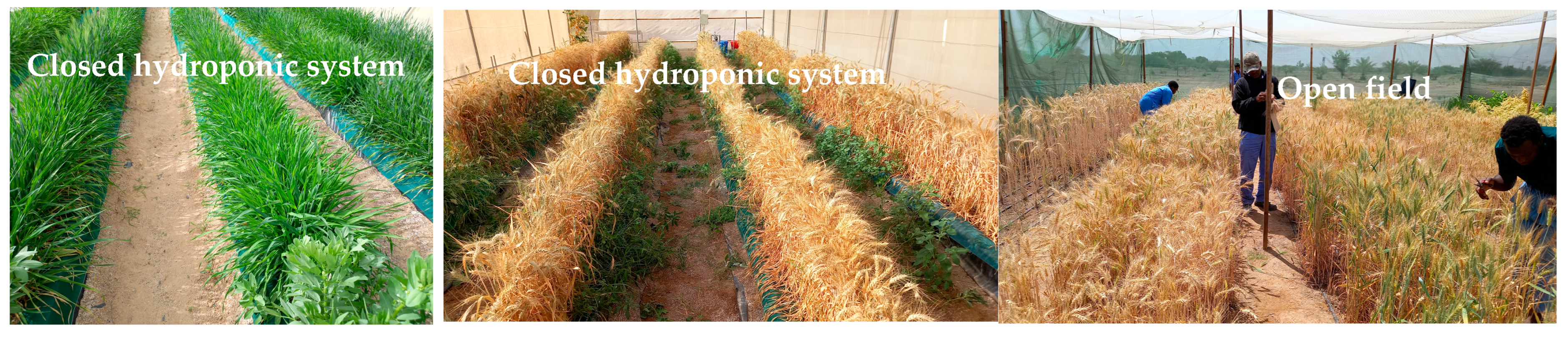
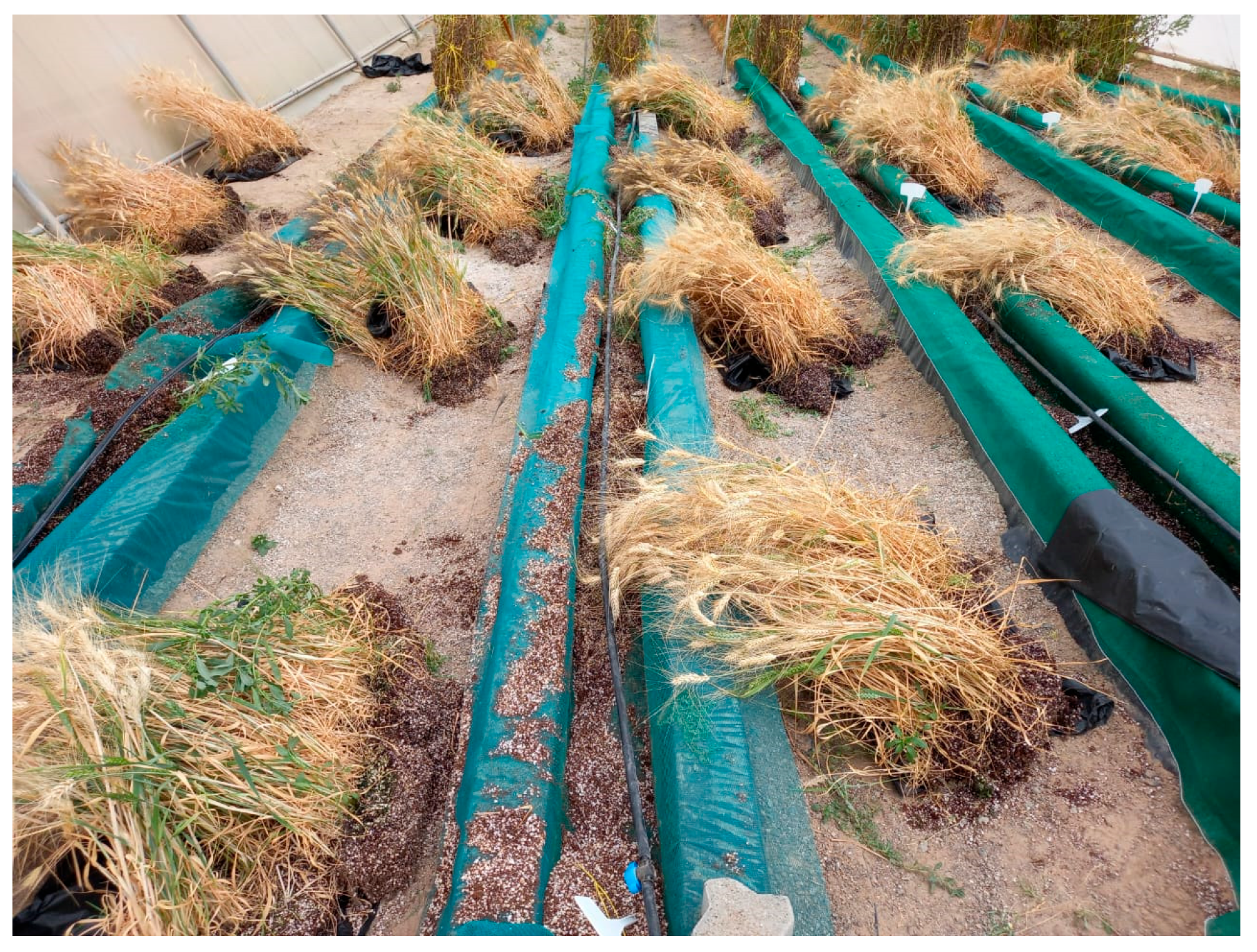
Daily monitoring and adjustments were made to maintain optimal pH levels (5.5–6.5) and electrical conductivity (EC) (1.0–3.0 dS/m) in the nutrient solution during the growth period as well as daily solution temperature, which was between 16.5 °C and 25.7 °C. In addition, for saving energy, solar energy was used where one panel was connected to a solar charge controller and hence to a submersible pump (Figure 2). Figure 3 and Figure 4 show bread wheat at vegetative and maturity stages under closed hydroponic and open-field systems as well as the harvesting process.
Figure 2.
Hydroponic system combined with net house equipped with solar energy.
Figure 3.
Bread wheat at vegetative and maturity stages under closed hydroponic and open-field systems.
Figure 4.
Crop harvesting.
2.4. Open-Field Trials
The selection of experimental locations was not consistent throughout the two years. The open-field trial conducted in the 2022/2023 season was established in an area that had previously hosted a rice experiment two years earlier. This field was subsequently deep ploughed to remove residual plant debris, a process that can redistribute soil layers and separate particles by size, thereby influencing the measured soil texture.
In contrast, the 2024/2025 field trial was carried out on the same research farm but not in the exact same micro-plots. Instead, planting took place in different sections of the field which may inherently vary in soil particle composition.
Open-field trails were conducted on the same sowing dates as the hydroponic experiments. In 2022/2023, each plot covered an area of 0.8 m W × 1.0 m L comprised of four rows, while in 2024/2025 each plot was 1.0 m W × 2.6 m L and consisted of five rows and with plant density of 200 plants per m2. In the first season, the harvested area was 0.4 m2, whereas the harvested area in the second season was 1.95 m2, and then the yield was converted to t/ha. Irrigation water was applied daily for 30 min/day in the first season because the land had not been cultivated for a long time and the moisture status was very low, while in the second season the irrigation schedule was set every 10 min/day due to the high moisture status from summer planting.
Organic soil amendments were incorporated at a rate of 20 t/ha before planting across all plots in both seasons. During the first growing season (2022/2023), NPK 20-20-20 (%) fertilizer was applied in two split doses: the first at 30 days after seedling emergence and the second at the flowering stage. In the second season (2024/2025), each plot received two fertilizer applications at the same growth stages—30 days after emergence and at flowering—using a closed hydroponic nutrient solution with the following composition: NPK 12-12-36 (%), MgSO4, Ca(NO3)2, and a micronutrient mix. The materials were prepared following the same A/B hydroponic solution ratios, consisting of 12.5 kg NPK 12-12-36, 6 kg MgSO4, and 12.0 kg Ca(NO3)2, corresponding to a nutrient ratio of 2:1:2. This mixture was applied in two split doses as follows:
- First dose: 0.1 kg per plot, applied 30 days after emergence as a basal application.
- Second dose: 0.05 kg per plot, applied at the flowering stage.
The crop was manually harvested from the two central rows of each plot in 2022/2023 and the three central rows in the second growing season. Prior to threshing, biomass production (grain + straw) was measured in kg/plot, and then the values were converted to t/ha. Threshing was carried out using a Kimseed thresher, and then the grains were separated by a Westrup air screen cleaner and weighed. The yield was expressed in t/ha.
2.5. Agronomical Parameters
The following agronomic parameters were determined: grain yield (t/ha), biomass production (t/ha), and harvest index (%).
2.6. Water-Use Efficiency (WUE)
Water-use efficiency was measured in accordance with the following equation (Equation (1)) [15]:
This equation explains that water-use efficiency (WUE) is built by combining plant productivity and water consumption into a single ratio. The idea is simple: How much plant material (biomass or yield) (kg) is produced per unit of water used (m3)?
2.7. Nutrient-Use Efficiently
It is a measure of the increase in crop yield per unit area divided by the units of fertilizer applied using the following equation (Equation (2)) [15]:
This is agronomically expressed as units of yield increase per unit of nutrients applied, i.e., this estimates how much grain (or biomass) per kg is produced per kg of nutrient applied.
The average results of both WUE and NUE in the different systems over the two years are presented in tabular form.
2.8. Resource Savings
2.8.1. Land Saved
Land needed/ha for open-field farming to produce the same yield as hydroponic farming was determined using the following equation (Equation (3)), which was derived from simple mathematic information:
Then, the land saved was calculated by subtracting closed hydroponic land (m2) from the open-field land needed. Further calculation was made to determine the percentage reduction (%) in land used as in equation (Equation (4)), which was derived by using basic mathematic calculations:
2.8.2. Water Savings
Using water-use efficiency (WUE) for closed hydroponic and open-field systems, the amount of water saved (%) was determined in hydroponically grown wheat vs. the open-field system as per [10] the following equation (Equation (5)):
2.8.3. Nutrient Savings
Nutrient-use efficiently (NUE) for closed hydroponic wheat production and the open-field system was used in determining the percentage of nutrients saved (%) in wheat production using a closed hydroponic system vs. open-field production as per the following equation (Equation (6)). This equation was obtained by using the basic rules of mathematics:
2.9. Cost–Benefit Analysis
2.9.1. Fixed Costs
Fixed costs include expenses such as land rental and equipment depreciation. For the hydroponically solar-powered net house, the initial investment costs were calculated by determining the useful life of the galvanized metal frame and concrete structure to be 25 years for the net house and 5 and 10 years for the irrigation pump and materials (pipelines and drippers) for the open-field system, respectively. Depreciation, which is the allocation of the cost of a fixed asset over its useful life, was estimated using the equation stated by [16] (Equation (7)), and the residual values were estimated to be 30% of the initial investment cost for the net house and 18.2% for the irrigation pump.
2.9.2. Variable Costs
These variable costs include all the operating costs like seeds, fertilizers, water, labor, and electricity for hydroponics and open-field production. For labor cost, the local market price was used.
2.9.3. Economic Viability
Economic Indicators
The total operating costs were determined from the fixed and variable costs as well as the total gross revenue (Equation (8)). In the economic analysis, the market prices for grain and biomass were used because there is no farm-gate price for wheat and its byproducts in the UAE, which is not a wheat-producing country.
Furthermore, the total investments, the return on investment and benefit–cost ratio (BCR), and internal rate of return (IRR) of integrated systems of a well-equipped solar net house with a hydroponic system and an open-field system were computed for wheat production at 240 m2.
- Gross Revenue
The gross revenue is defined as the total income generated from the sales of the investment products. For both systems, the gross revenue was calculated in accordance with the following equation (Equation (8)) using basic rules of mathematics.
Further calculation was performed to assess the profit by subtracting the total operation costs from gross revenue as follow (Equation (9)) [11]:
- Return on Investment (ROI)
Return on investment (ROI) is a ratio that measures the profitability of an investment by comparing the gain or loss to its cost. It is an important measure of an investment’s performance. It helps by assessing the potential return on investments (ROI), is usually presented as a percentage, and was calculated using the following formula (Equation (10)) as per [17]:
- Benefit–Cost Ratio (BCR)
Benefit–cost analysis is a financial metric used to evaluate the overall relationship between the costs and benefits. It measures the worth of the combined systems of hydroponic wheat production with a solar energy net house compared to open-field production. A benefit–cost ratio (BCR) greater than (1.0) indicates that the benefits exceed the costs, suggesting that the investment is viable. In this study, the BCR was determined to assess the viability of the integrated systems for wheat production and an open field using the following equation (Equation (11)) [11]:
- Internal rate of return (IRR)
Internal rate of return (IRR) is a metric used in financial analysis to estimate the profitability of potential investments. IRR is a discount rate that makes the net present value (NPV) of all cash flows equal to zero in a discounted cash flow analysis. A higher (IRR) signals a more attractive investment (Equation (12)). This formula was used for one season and was calculated as stated by Ref. [18].
IRR = (Future Value ÷ Present Value)^(1 ÷ Number of Periods) − 1
In principle, return on investment (ROI) and internal rate of return (IRR) are two conceptually different financial metrics, calculated using different formulas and serving different purposes:
- ROI measures total net benefit relative to investment.
- IRR measures the discount rate at which net present value (NPV) becomes zero across multiple years of cash flow.
Therefore, IRR should not normally be a simple multiple or transformation of ROI.
IRR breaks down to a simplified form when the benefit stream is one period (Section 3.3).
Thus, we obtain Equation (13) as described by [17]:
2.10. Statistical Analysis
The experiment was conducted as a completely randomized design (CRD) with four independent replications per variety × system × season combination. Data were analyzed using a three-way factorial analysis of variance (ANOVA) implemented in GenStat (24th Edition). Variety, system, and season were treated as fixed and crossed effects, and all two-way and three-way interactions were included in the model. System and season were not treated as blocking or random effects because the primary objective was to directly compare their effects on the measured traits. Model assumptions of normality and homogeneity of variance were evaluated using residual diagnostics, including residuals versus fitted values, residual histograms, and normal probability (Q–Q) plots; no major violations were detected. Residual diagnostic plots are provided in Supplementary Figures S1–S3. The full ANOVA tables, including degrees of freedom and F-values for all main effects and interactions, are provided in Supplementary Tables S1–S3.
3. Results
To assess the impact of closed hydroponic systems on wheat growth performance and resource efficiency, a series of experiments wer conducted alongside traditional open-field trials. These experiments evaluated land use, water consumption, and nutrient efficiency. Additionally, this study analyzed the economic viability of wheat production under both hydroponic and open-field cultivation methods in the UAE. Yield and cost data were extrapolated to a 240 m2 infrastructure, allowing for a comparative assessment of both systems over two growing seasons.
The comparative results across two growing seasons revealed statistically significant differences between the closed hydroponic and open-field systems for all measured parameters. Notably, grain yield, biomass production, and harvest index showed highly significant variations, with p-values less than 0.001 at a 5% significance level (Table 2). A significantly higher average yield of 13 t/ha was achieved under the closed hydroponic system, representing a 117% increase in grain production compared to the open-field method. The findings demonstrated that the closed hydroponic system positively influenced all agronomic traits and the harvest index, with statistically significant effects. This improvement is likely attributed to enhanced control over nutrient delivery, water management, and overall growing conditions provided by the closed hydroponic setup (Table 2).
Table 2.
Combined analysis of two systems across two growing seasons (2022/2023 and 2024/2025) for bread wheat production.
The higher grain yield and biomass recorded in the 2022/2023 season were likely associated with the greater irrigation applied during the open-field trial of that season. In the first season, irrigation was supplied for 30 min per day using 8 L/h drippers, whereas in the second season it was reduced to 10 min per day with the same drippers. The increased water application in 2022/2023 therefore contributed to the superior yield performance. Although silty clay soils inherently retain more water and require less frequent irrigation, the hydroponic system used the same planting medium and irrigation schedule across both seasons, yet the yields still declined. Due to higher RH% reflecting higher rainfall in the first season, both the closed hydroponic system and open-field cultivation increased both grain yield and total biomass compared with the second season, where higher RH% also played a significant role in the higher yields obtained during that period.
However, the biomass increase was proportionally larger than the increase in grain yield. As a result, the harvest index was lower under hydroponics (33.0%) than in the soil system (38.0%). This indicates that although hydroponics enhanced overall productivity, a smaller proportion of the total biomass was allocated to grain.
The harvest index (HI) increased notably from 34.0% in the 2022/2023 season to 37.0% in 2024/2025. This improvement reflects more efficient dry-matter partitioning in the later season, with a greater share of total biomass being allocated to grain production (Table 3).
Table 3.
Combined analysis of two seasons across two growing systems for bread wheat production.
The comparison of different bread wheat varieties illustrated significant differences in grain yield (p = 0.033), biomass production (p = 0.011), and harvest index (p < 0.001) across the two cultivation systems and growing seasons (Table 4). These findings indicated that the varieties responded differently under hydroponic and open-field farming conditions.
Table 4.
Analysis of system-averaged grain yield, biomass production, and harvest index for bread wheat varieties grown in 2022/2023 and 2024/2025.
Among the tested varieties, Bread 388 and Bread 514 recorded the highest average grain yield at 10.0 t/ha. In terms of biomass production, Bread 388 led with 31.0 t/ha, followed by Terbol at 30.0 t/ha. Both Terbol and Bread 407 produced comparable grain yields of 9.0 t/ha. In contrast, the Atlas variety consistently yielded significantly lower grain (8.0 t/ha) and biomass (25.0 t/ha) outputs. Regarding harvest index, Bread 514 exhibited the highest value (40.0%), followed by Bread 407 (38%) and Bread 388 (37.0 1%), but the three were not significantly different.
3.1. Interaction Effects
The general variance analysis (ANOVA) results showed that most interactions between variety, systems, and seasons were non-significant, which indicated that neither the systems nor the seasons influenced variety performance. Varieties performed similarly in the two systems across the two years, i.e., simply put, the “best” varieties in one environment were also the “best” for the other environment, which may be due to low genetic variability among varieties. This is often desirable in breeding because it means a variety performs stably across environments and there is no need to breed separately for different systems.
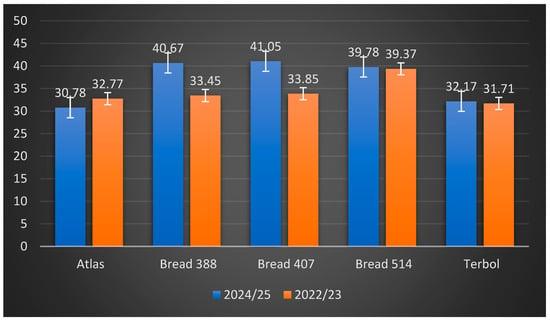
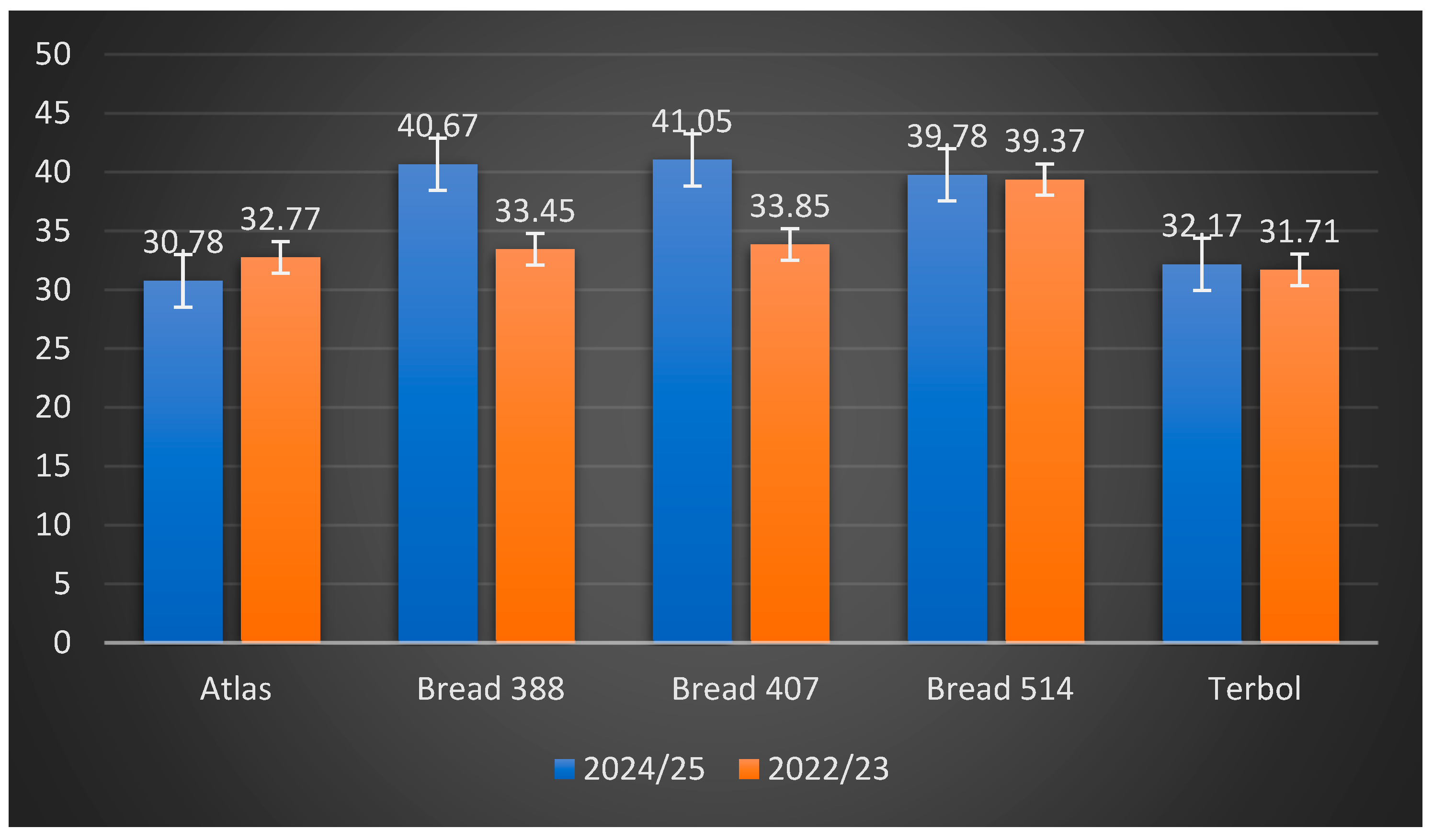
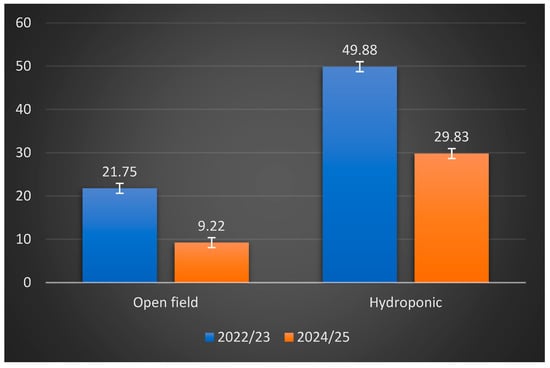
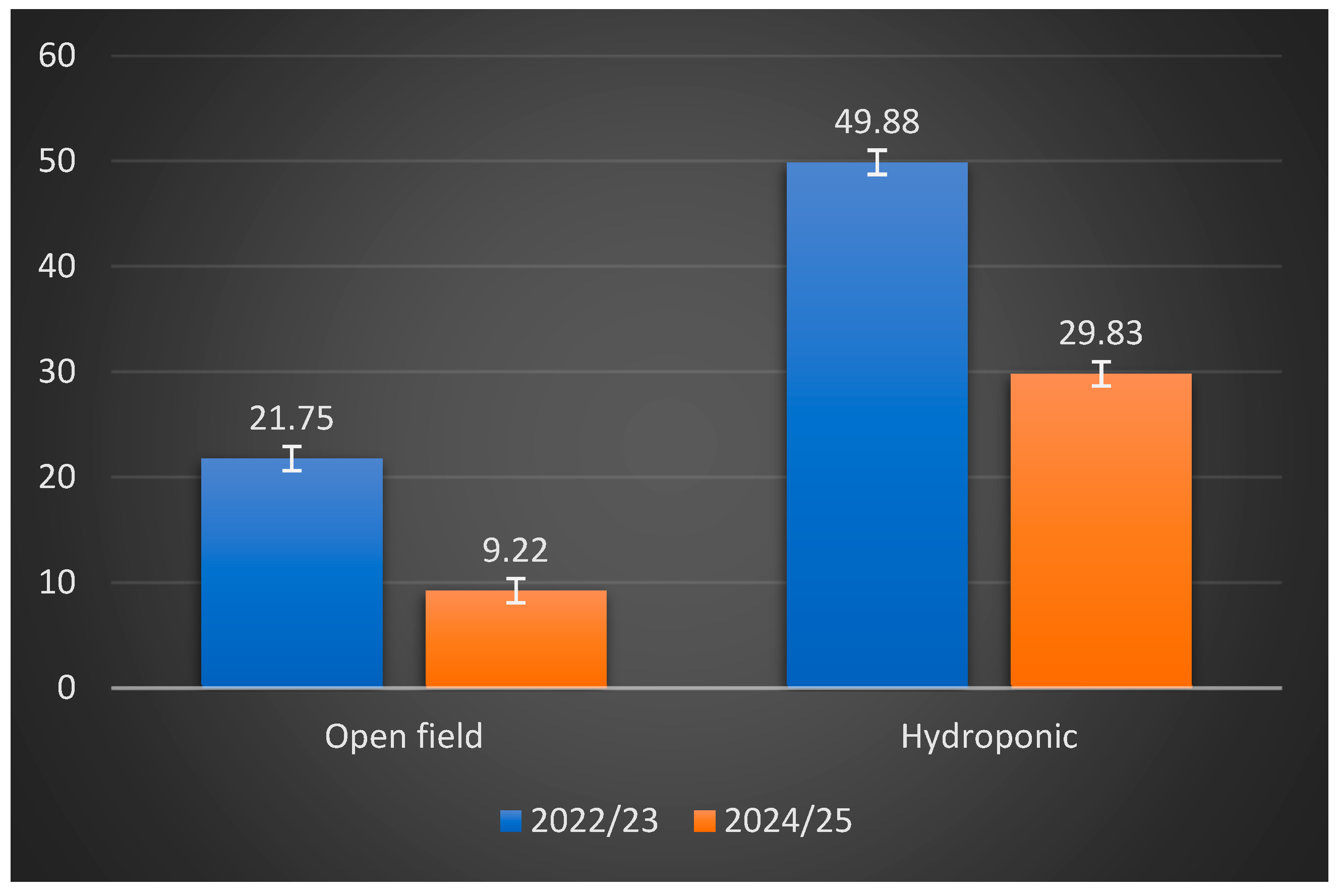
The findings only detected an interaction between varieties and seasons (p-value = 0.011) in harvest index (Figure 5). In biomass production, the data showed significant interaction between systems and seasons (p-value = 0.002) (Figure 6).
Figure 5.
Interaction between varieties and seasons for harvest index (%) (SEM +/− = 1.603).
Figure 6.
Interaction between seasons and systems for biomass production (t/ha) (±SEM = 1.149).
As indicated by the data (Table 5), the hydroponic system consistently delivered higher water- and fertilizer-use efficiency over the two seasons than the open-field farming method.
Table 5.
Average water- and fertilizer-use efficiency for the two systems across the seasons.
3.2. Economic Savings
This study estimated the economic feasibility of implementing a solar net house closed hydroponic system for bread wheat cultivation in the UAE, primarily through significant resource conservation compared to open-field farming. The system achieved 93.2% water savings and 46% higher fertilizer-use efficiency. Furthermore, it delivered 54% land savings, meaning substantially less open land is required to match the hydroponic system’s grain yield, i.e., the land required under closed hydroponics is 54% less than for an open field. These strong results highlight the beneficial effects of hydroponics in mitigating resource constraints in the UAE’s environment. Table 6 below summarizes the resources savings by using closed hydroponic vs. open-field farming and presents a comparison of land savings and water and fertilizer usage.
Table 6.
Summary of the resources saving by using a closed hydroponic system vs. open-field farming.
Closed hydroponic farming significantly reduced the use of resources compared to open-field farming, with water usage dropping by 48.2% and fertilizer usage by 64.4%, as detailed in Table 6.
3.3. Economic Analysis
The total operating costs (fixed and variable costs) were calculated for each season so as to be used in the estimation of the economic indicators (ROI, BCR, and IRR) Appendix A (Table A1). Both open-field and hydroponic systems demonstrated consistent economic viability across the two seasons studied. However, the hydroponic system exhibited superior performance metrics. Specifically, the ROI for the hydroponic system ranged from 3.128 to 1.629, while the open-field system showed a wider range of 1.970 to 0.043. The BCR was also markedly higher in the hydroponic system (4.13–2.63) compared to the open-field system (2.97–1.04) and IRR (312.8 163.0% vs. 197.1–4.3%). Performance declined for both systems in the second season, which may be attributable to unfavorable environmental conditions. This evidence suggests that closed hydroponic wheat production is a more economically sustainable and resilient method under the tested conditions (Table 7). IRR measures the discount rate at which net present value (NPV) becomes zero across multiple years of cash flow. Therefore, IRR should not normally be a simple multiplication or transformation of ROI.
Table 7.
The ROI, BCR, and IRR for closed hydroponic and open-field systems across two seasons.
So, IRR ≈ ROI × 100 in Table 7.
IRR breaks down to a simplified form when the benefit stream is one period.
IRR is normally calculated from a multi-year cash flow series, except if the analysis assumes either of the following:
- A single-year benefit scenario.
- Benefits accrue almost entirely in one period.
- Only a first-year net benefit is used (common in economic evaluations with incomplete multi-year data).
Then, the IRR formula simplifies dramatically:
This expression is numerically identical to ROI, except ROI is usually shown as a ratio, while IRR is shown as a percentage.
Thus, .
4. Discussion
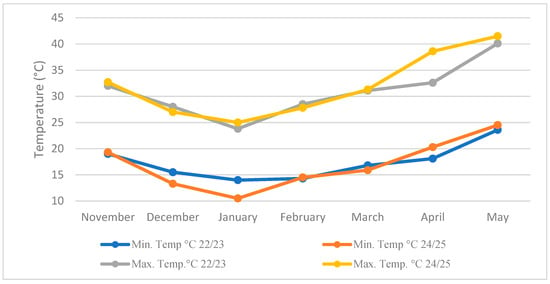
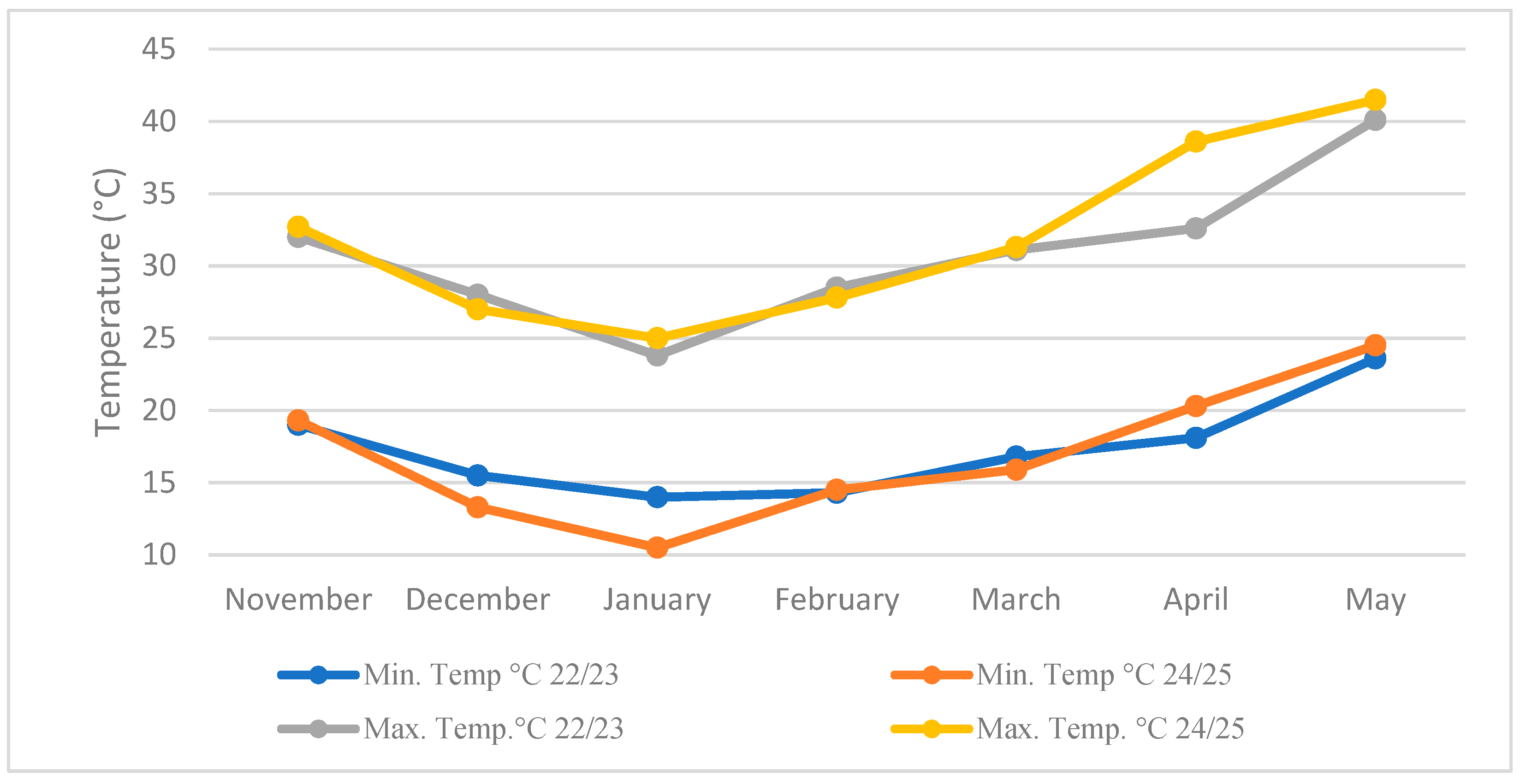
A closed hydroponics drip system in UAE desert farming saves about 54%% of land and produces a 117% increase in bread wheat yields. This method permits bread wheat cultivation, especially in a region with limited arable land. Similarly, a study conducted by [19] showed that hydroponic rice can increase land efficiency up to 10 times compared to conventional methods, and [20] pointed out that a method of growing plants in a nutrient-rich solution has been shown to increase crop yields and reduce water usage. The subsequent open-field season (2024/2025) was characterized by a substantial decrease in yield across all genotypes, suggesting a limiting environmental factor or abiotic stress that impacted crop performance. Temperature patterns during the two seasons followed the typical regional trend, with a decline from November to January followed by a steady increase through May. While minimum temperatures were comparable in both seasons, the 2024/25 season experienced slightly cooler lows in early winter and considerably higher maximum temperatures from February onward. Notably, maximum temperatures in April and May 2024/25 exceeded those of 2022/23 by 2–3 °C, reaching over 40 °C in May. These differences suggest a warmer late-season environment in 2024/25, which may influence crop growth and stress response (Figure 7).
Figure 7.
Minimum and maximum temperature during the growing of bread wheat under closed hydroponics and an open field.
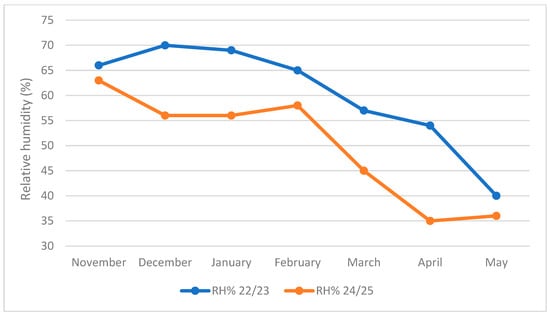
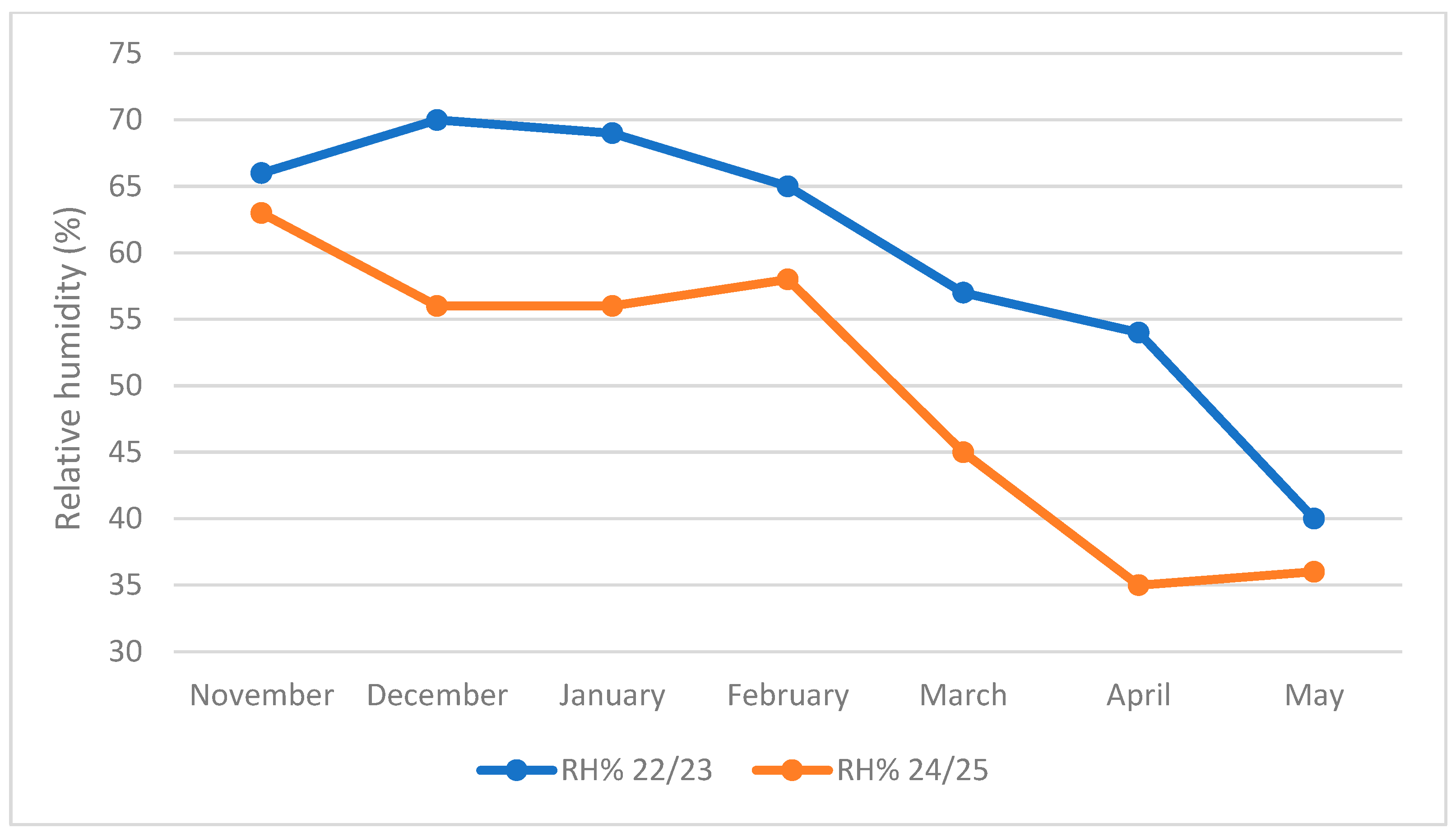
Relative humidity showed a declining trend from November to May in both seasons, with the 2024/2025 season consistently exhibiting lower RH (%) values, particularly from February onward. High RH (%) during early growth supported good wheat establishment and tillering, although the slightly lower early-season RH (%) in 2024/25 increased evaporative demand. The sharper drop in RH (%) during March–May in 2024/2025 resulted in higher atmospheric water demand during heading, anthesis, and grain filling. These conditions can reduce pollen viability, impair grain set, shorten the grain-filling period, and ultimately decrease grain size and yield. Overall, the lower RH% conditions in 2024/25 likely imposed greater water and heat stress on wheat, reducing its growth performance and yield potential compared with the 2022/23 season (Figure 8).
Figure 8.
Relative humidity during the growing of bread wheat under closed hydroponics and an open field.
Closed hydroponic farming in the UAE generates USD 2861.04 more per hectare of bread wheat production than open-field farming, which is a 117% increase in revenue from the same land area. Similarly, water savings due to hydroponically grown bread wheat, which is still not widely practiced, impressively reflected its efficiency with >90% water saved. Previous studies suggested that hydroponics farming techniques have been found to reduce water usage by up to 90% compared to open-field agriculture. This substantial water savings is due to the closed-loop system in hydroponics, which circulates and reuses water, minimizing waste and maximizing water usage [21,22].
Open-field farming often suffers from low fertilizer-use efficiency due to several factors such as high evaporation rate, poor water retention, and nutrient leaching. Meanwhile, transitioning to a closed hydroponic net house equipped with solar energy is a modern technique for bread wheat that has saved the amount of fertilizer used to produce bread wheat in the UAE by 46%. Similar results were obtained by [23], who found that drip fertigation results in 40% of fertilizer nutrients being saved and also increases yield in comparison with conventional nutrient applications. Closed hydroponic systems increased efficiency because nutrients were directly delivered to the root zone in a controlled solution, the recirculation system reusing nutrients and minimizing waste.
In the closed hydroponics experiments, optimal pH levels ranged from 5.5 to 6.5% and electrical conductivity (EC) between 1.0 and 3.0 dS/m throughout the growth stage, and the daily solution temperature fluctuated as the environmental conditions changed, being between 16.5 °C and 25.7 °C. Better control of a balanced nutrient solution with optimal pH% and EC dS/m significantly enhances crop performance, achieving the highest average grain yield (13 t/ha due to optimized growing conditions). These findings were recorded by [24], who explained that hydroponics systems accurately regulate growth conditions leading to increased plant growth rates and result in up to twice the crop yields compared to conventional farming.
The results of this study clearly indicate that the closed hydroponic system significantly impacts bread wheat yields. The outcomes reveal that bread wheat varieties generally show excellent development in nutrient-rich solutions, and the agronomic parameters vary within different systems. Ref. [25] stated that better control and management of nutrient solutions offer possibilities for increasing production and improving the quality of crops.
The varieties’ responses were highly dependent on the cultivation system. In a closed hydroponics system, all varieties experienced a massive grain yield and biomass production failure in the second year, indicating that environmental/system stress affected total growth. Furthermore, in an open field, the varieties generally maintained or improved their efficiency (HI) in the second year, suggesting that while total yield factors might fluctuate, their inherent ability to convert growth into grain was stable or even enhanced. The grain yields and biomass production increased in the nutrient-rich solution up to an EC of 3.0 dS/m, given that the growth and development of bread wheat plants in a nutrient solution with an EC of 3.0 dS/m were not inhibited. This nutrient-rich solution appears to be more favorable for bread wheat growth and development. Similar results were suggested by [26] with the growth of sweet potato at high EC levels (2.6 dS/m), whereas a study using wastewater with a high EC (7.98 dS/m) and TDS of 5582.50 ppm inhibited the growth of wheat [7]. Adjustment of pH twice a week improves the grain yield and the harvest index of bread wheat investigated in hydroponic culture, and it became evident that the nutrient supply is crucial in this context and strongly affects grain maturation. An experiment carried out in an Environmental Control and Life Support System (ECLSS) was analyzed and proved that soilless culture (hydroponics) techniques are required for growing wheat in space [27]. However, in addition to the progressive resource savings, the economic analysis demonstrated that closed hydroponic and open-field systems both proved consistently viable economically across both seasons, and wheat production was feasible under UAE environmental conditions, but hydroponics performed notably better. Both systems performed best in the first season, which might be due to less favorable environmental conditions in the second. These results indicate that hydroponic wheat production is a more resilient and economically sustainable choice under these conditions. BCRs were found to be higher than 1 in all cases.
It was recorded that hydroponics often requires a higher initial investment and energy costs compared to conventional methods. Nevertheless, the higher land-use efficiency and increased yield can realize more than double the revenue per square meter, and the solar-powered net house can compensate for these initial costs and make it more profitable in the long run, especially in urban or land-scarce environments [28]. Despite the many advantages offered by high-tech closed hydroponic systems, several challenges, such as high initial investment costs, substantial energy demands, and limited opportunities for scale-up, must be addressed to improve their sustainability and promote wider adoption. One of the main obstacles is the significantly higher energy requirement of closed hydroponic systems compared with traditional open-field farming.
To overcome this issue, ICARDA, through its APRP, has conducted research aimed at enhancing energy efficiency by integrating renewable solar energy technologies with net house structures. This approach seeks to improve the overall sustainability of closed hydroponic systems for bread wheat production. Maximizing the potential of closed hydroponic systems for wheat cultivation requires additional efforts, including supportive government policies, financial incentives, increased investment in research and development for wheat variety adaptation, system optimization, and comprehensive training programs to strengthen farmers’ technical skills. Confirmation of the results of this study in large-scale-production farmers’ fields would add value to this study.
5. Conclusions
The aim of this study was to compare wheat productivity and economic returns between a closed hydroponic net house system and open-field farming under water-scarce conditions. The results showed that closed hydroponic wheat production consistently outperformed open-field cultivation in key indicators:
- Grain and biomass yield: Closed hydroponics achieved 117% and 150% higher yields, respectively.
- Economic returns (ROI, BCR, IRR): Closed hydroponics recorded 3.13, 4.13, and 312.78%, compared with 1.97, 2.97, and 197.1% for open fields.
- Resource efficiency: Closed hydroponics produced open-field-equivalent yields in 1.0 ha using 2.534 m3/m2 of water and 0.26 kg/m2 of nutrients, compared to 4.896 m3/m2 and 0.73 kg/m2 in 2.2 ha in the open field.
The superior closed hydroponic performance was largely driven by precise fertigation management, accurate nutrient formulation, continuous monitoring, and efficient delivery, that reduced stress and maximized crop response.
Overall, this study confirms that closed hydroponic wheat cultivation is a practical and high-return option for hyper-arid ecosystems. Its adoption in solar-powered net houses could significantly strengthen UAE food security. With approximately 38,000 active farms, allocating just 0.1 ha per farm to hydroponic wheat—at an average productivity of 10 t/ha—would generate an estimated 38,000 tons of grain and 152,000 tons of straw, with productivity of 40 t/ha annually, compared with the country’s current production of around 100 tons and 300 tons, respectively.
Scaling potential: Further technological refinement and cost optimization are essential to enhance economic feasibility. Large-scale adoption can be accelerated through well-structured public–private–producer partnerships and targeted investments that support deployment of this water-efficient, high-yield production system to farmers’ fields in the UAE and GCC countries.
Supplementary Materials
The following supporting information can be downloaded at: https://www.mdpi.com/article/10.3390/su18052285/s1, Figure S1: Histogram of residuals, Fitted-value plot, normal plot, and half-normal plot for grain yield (t/ha); Figure S2: Histogram of residuals, Fitted-value plot, normal plot, and half-normal plot for biomass production (t/ha); Figure S3: Histogram of residuals, Fitted-value plot, normal plot, and half-normal plot for Harves index (%); Table S1: ANOVA analysis for grin yield (t/ha); Table S2: ANOVA analysis for biomass production (t/ha); Table S3: ANOVA analysis Harvest Index (%).
Author Contributions
Conceptualization, A.A.N. and M.M.; methodology, M.M., A.A.N. and A.N.; validation and formal analysis, K.A.-S., M.M., A.A.N. and A.N.; investigation, M.M., A.A.N. and A.N.; writing—original draft preparation, M.M. and A.A.N.; writing—review and editing, M.M. and A.A.N.; resources, A.A.N. and M.M.; project administration, A.A.N.; data curation, M.M., A.A.N., A.N., K.A.-S., H.A.A. and J.E.J. All authors have read and agreed to the published version of the manuscript.
Funding
The research activities were conducted by ICARDA’s Arabian Peninsula Regional Program (APRP). This research was funded by the Arab Fund for Economic and Social Development (AFESD) grant number GA 200121/BUS200352, the Kuwait Fund for Arab Economic Development (KFAED) grant number GA 200156/BUS200414 and the General Secretariat of the Gulf Cooperation Council (GCC) grant number GA 200198/BUS200496.
Institutional Review Board Statement
Not applicable.
Informed Consent Statement
Not applicable.
Data Availability Statement
The data presented in this study are openly available in ICARDA-APRP at https://icarda.org/research/projects/enhancing-agricultural-production-systems-and-conserving-natural-resources (access on 10 February 2026).
Acknowledgments
The authors would like to express their sincere appreciation to Degu, Wuletaw Tadesse, ICARDA principal bread wheat breeder, for generously providing the bread wheat germplasm used in this study. His continuous support, expertise and commitment to wheat improvement greatly contributed to the successful completion of this research, the Ministry of Climate Change and Environment (MOCCAE) of the United Arab Emirates for their support and close collaboration, and for the hospitality of the ICARDA’s Arabian Peninsula Regional Program (APRP) office in Ajman.
Conflicts of Interest
The authors declare no conflicts of interest. The funders had no role in the design of the study; in the collection, analyses, or interpretation of data; in the writing of the manuscript; or in the decision to publish the results.
Appendix A
Table A1.
Fixed and variable costs for open-field and closed hydroponic trails in 2022/2023 and 2024/2025.
References
- Nishanth, D.; Alshamsi, M.H.S.; Alkaabi, A.M.K.A.; AlKaabi, A.H.A.; Alnuaimi, S.H.K.; Nair, C.S.; Jaleel, A. Aquaponics as a climate smart technology for sustainable food production systemin United Arab Emirates. J. World Aquac. Soc. 2024, 55, e13049. [Google Scholar] [CrossRef] [Scilit]
- Shahin, S.M.; Salem, M.A. The Challenge of water scarcity and the future of food security in the United Arab Emirates (UAE). Nat. Resour. Conserv. 2015, 3, 1–6. [Google Scholar] [CrossRef] [Scilit]
- Ministry of Climate Change and Environment (MOCCAE). A Guide to Food Security in the UAE 2023; Ministry of Climate Change and Environment (MOCCAE): Dubai, United Arab Emirates, 2023. Available online: https://www.moccae.gov.ae (accessed on 1 February 2026).
- CBRE Middle East. UAE Food Sector Report H2 2024. 2025. Available online: https://www.cbre.ae/insights/viewpoints/uae-food-sector-report-h2-2024 (accessed on 1 February 2026).
- USDA. Global Agricultural Information Network (GAIN); Report No. TC2021-006, March 28; United States Department of Agriculture, Foreign Agricultural Service: Washington, DC, USA, 2021. Available online: https://gain.fas.usda.gov/ (accessed on 1 February 2026).
- Ali, B.M.; Manikas, L.; Sundarakani, B. Food security in the United Arab Emirates: External cereal supply risk. Cogent Econ. Financ. 2022, 10, 2149491. [Google Scholar] [CrossRef] [Scilit]
- Al Hammadi, F.H.A.A.; Karthishwaran, K.; Alyafei, M.A.M. Hydroponic wheat production using fresh water and wastewater under the semi-arid region. Emir. J. Food Agric. 2021, 33, 178–186. [Google Scholar] [CrossRef] [Scilit]
- Santosh, D.T.; Gaikwad, D.J. Advances in hydroponics: Types and Management. In Advances in Agricultural Technology; Sagar, M., Gaikwad, D.J., Santosh, D.T., Eds.; Griffon: Gatineau, QC, Canada, 2023; pp. 16–28. [Google Scholar]
- Sathyanarayana, S.R.; Gangadhar, W.V.; Badrinath, M.G.; Ravindra, R.M.; Shriramrao, A.C. Hydroponics: An intensified agriculture Practice to improve food production. Rev. Agric. Sci. 2022, 10, 101–114. [Google Scholar] [CrossRef] [Scilit] [PubMed]
- Singh, A.; Ashoka, P.; Nasima; Tyagi, V.; Panotra, N.; Kalpana, K.; Mubeen; Pandey, S.K. A comparative analysis of land, water and energy requirements for hydroponic and conventional cultivation of horticultural crops. J. Sci. Res. Rep. 2024, 30, 771–784. [Google Scholar] [CrossRef] [Scilit]
- El Habbaq, M.M.; Khater, E.G.; Bahnasawy, A.H.; Afify, M.T. Technical and Economical evaluation of the integration aquaculture system and lettuce plants production. J. Agric. Environ. Sci. 2024, 23, 22–24. [Google Scholar] [CrossRef] [Scilit]
- Shakeela, B.C.; Akshaya, T.; Akshaya, M.; Amisha, P.N.; Akshith, B.E.; Ganta, C.S.; Amatoor, R. Investment feasibility of hydroponic farming: Analyzing the return of investment (ROI) compared to traditional farming. Int. J. Innov. Sci. Res. Technol. 2025, 10, 1114. [Google Scholar] [CrossRef] [Scilit]
- Mishra, S.J.; Rout, D.; Shoo, D. Analyzing the economic viability of hydroponic farming: A comparative cost-benefit analysis. Int. J. Progress. Res. Eng. Manag. Sci. 2024, 4, 1806–1811. [Google Scholar]
- Osman, A.E.; Makawi, M.; Ahmed, R. Potential of the indigenous desert grasses of the Arabian Peninsula for forage production in a water-scarce region. Grass Forage Sci. 2008, 63, 495–503. [Google Scholar] [CrossRef] [Scilit]
- Regmi, A.; Rueda-Kunz, D.; Liu, H.; Trevino, J.; Kathi, S.; Simpson, C. Comparing resource use efficiencies in hydroponic and aeroponic production systems. Technol. Hortic. 2024, 4, e005. [Google Scholar] [CrossRef] [Scilit]
- Filho, A.F.M.; de Azevedo, C.A.V.; de Queiroz Almeida Azevedo, M.R.; Fernandes, J.D. Economic viability of lettuce (Lactuca sativa, L) grown in hydroponic system with different optimized nutrient solution. Aust. J. Crop Sci. 2018, 12, 422–429. [Google Scholar] [CrossRef] [Scilit]
- Haloho, R.D.; Palayukan, J.; Setiadi, A.; Rianto, E.; Luthfi, N. The Feasibility of Business of Buffalo Used in the Traditional Funeral Ceremony (Rambu solo) in West Sulawesi, Indonesia. Adv. Anim. Vet. Sci. 2024, 12, 523–531. [Google Scholar] [CrossRef] [Scilit]
- Wall Street Prep. Internal Rate of Return (IRR)|Formula + Calculator. Wall Street Prep. 27 March 2025. Available online: https://www.wallstreetprep.com/knowledge/irr-internal-rate-of-return/ (accessed on 1 February 2026).
- Lee, S.; Park, J.; Kim, H. Hydroponics rice cultivation: A solution for land use efficiency in urban agriculture. J. Urban Agric. 2020, 15, 245–260. [Google Scholar]
- Al Shrouf, A. Hydroponics, aeroponic and aquaponic as compared with conventional farming. Am. Sci. Res. J. Eng. Technol. Sci. 2017, 27, 247–255. [Google Scholar]
- Rajaseger, G.; Chan, K.L.; Tan, K.Y.; Ramasamy, S.; Khin, M.C.; Amaladoos, A.; Haribhai, P.K. Hydroponics: Current trends in sustainable crop production. Bioinformation 2023, 19, 925–938. [Google Scholar] [CrossRef] [Scilit]
- Naresh, R.; Sagar, K.J.; Beese, S.H.; Singh, M. Role of hydroponics in improving water-use efficiency and food security. Int. J. Environ. Clim. Change 2024, 14, 608–633. [Google Scholar] [CrossRef] [Scilit]
- Sathya, S.; Pitchai, J.G.; Indirani, R.; Kannathasan, M. Effect of fertigation on availability of nutrients (N, P and K) In soil—A Review. Agric. Revolut. 2008, 29, 214–219. [Google Scholar]
- Khatri, L.; Kunwar, A.; Bist, D.R. Hydroponics: Advantages and challenges in soilless farming. Big Data Agric. 2024, 6, 81–88. [Google Scholar] [CrossRef] [Scilit]
- Patil, S.T.; Kadam, U.S.; Mane, M.S.; Mahale, D.M.; Dekale, J.S. Hydroponic nutrient solution: A review. J. Pharmacogn. Phytochem. 2020, 9, 2095–2099. [Google Scholar]
- Sakamoto, M.; Suzuki, T. Effect of nutrient solution concentration on the growth of hydroponic sweetpotato. Agronomy 2020, 10, 1708. [Google Scholar] [CrossRef] [Scilit]
- Feller, U. Selection and hydroponic growth of bread wheat cultivars for bioregenerative life support systems. Adv. Space Res. 2013, 52, 536–546. [Google Scholar] [CrossRef] [Scilit]
- Sace, C.F.; Natividad, E.P., Jr. Economic analysis of an urban vertical garden for hydroponic production of Lettuce (Lactuca sativa). Int. J. Contemp. Appl. Sci. 2015, 2, 42–56. Available online: https://pdfcoffee.com/economic-analysis-of-an-urban-vertical-garden-for-hydroponic-production-of-lettuce-lactuca-sativa-pdf-free.html (accessed on 10 February 2026).

Disclaimer/Publisher’s Note: The statements, opinions and data contained in all publications are solely those of the individual author(s) and contributor(s) and not of MDPI and/or the editor(s). MDPI and/or the editor(s) disclaim responsibility for any injury to people or property resulting from any ideas, methods, instructions or products referred to in the content. |
© 2026 by the authors. Licensee MDPI, Basel, Switzerland. This article is an open access article distributed under the terms and conditions of the Creative Commons Attribution (CC BY) license.