How Environmental Management Systems Enable Sustainability Transition: The Roles of Green Transition and Policy Support in Driving Circular Product Innovation


Abstract
1. Introduction
2. Theoretical Framework and Hypotheses Development
2.1. Resource-Based View and Institutional Theory
2.2. Environmental Management System and Circular Product Innovation
2.3. Environmental Management System and Green Transition
2.4. Green Transition and Circular Product Innovation
2.5. The Moderation Effect of Organizational Sustainability Policy on the EMS–Green Transition
2.6. The Moderation Effect of Policy Support on the Green Transition and Circular Product Innovation
2.7. Organizational Characteristics: Firm Age and Firm Size
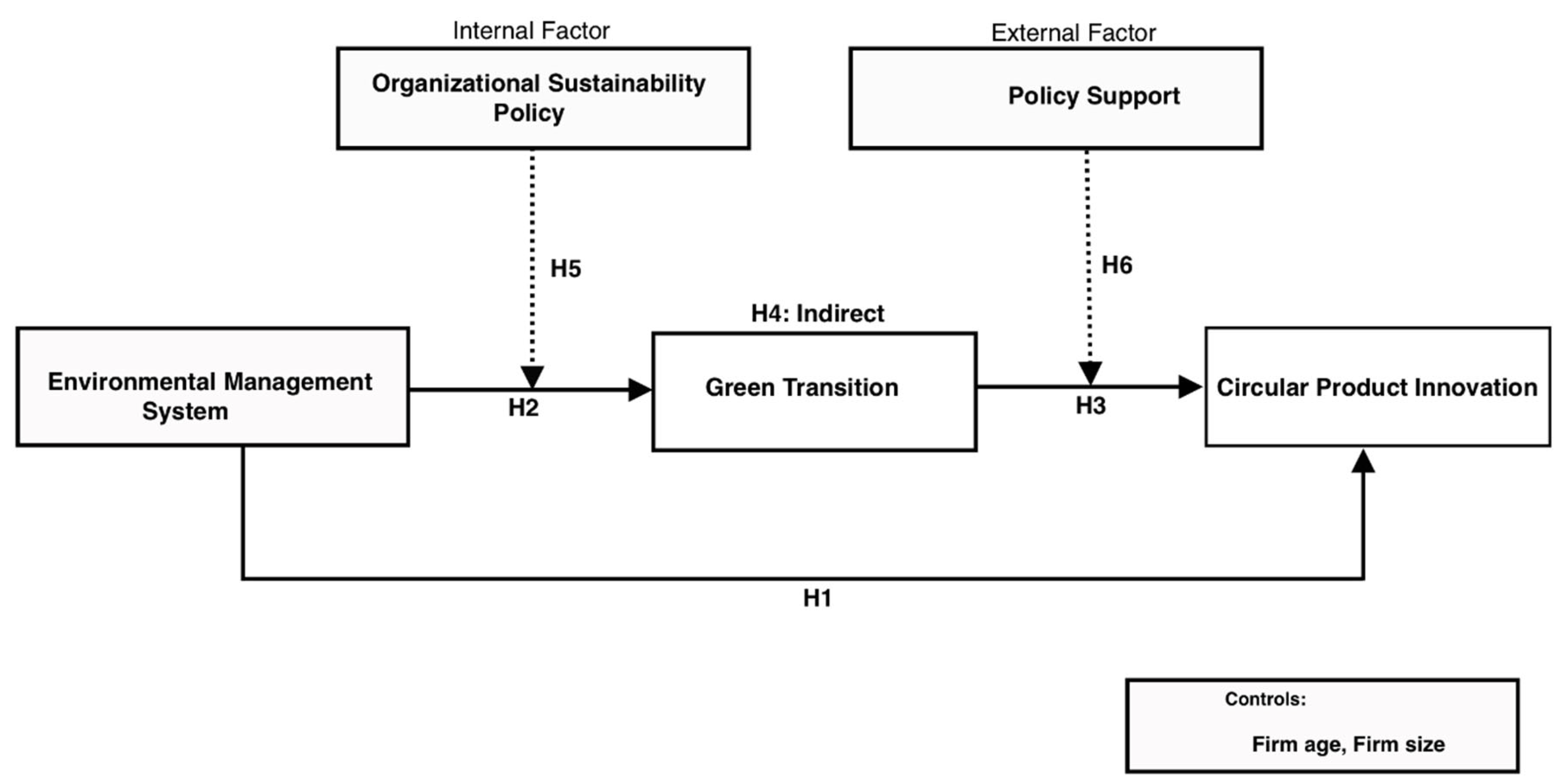
2.8. Conceptual Framework
3. Methods
3.1. Sample and Data Collection
3.2. Measures
3.3. Analytical Methods
3.4. Non-Response Bias and Common Method Bias (CMB)
4. Analysis and Results
4.1. Measurement Model Evaluation
4.2. Hypothesis Test: Direct and Mediation
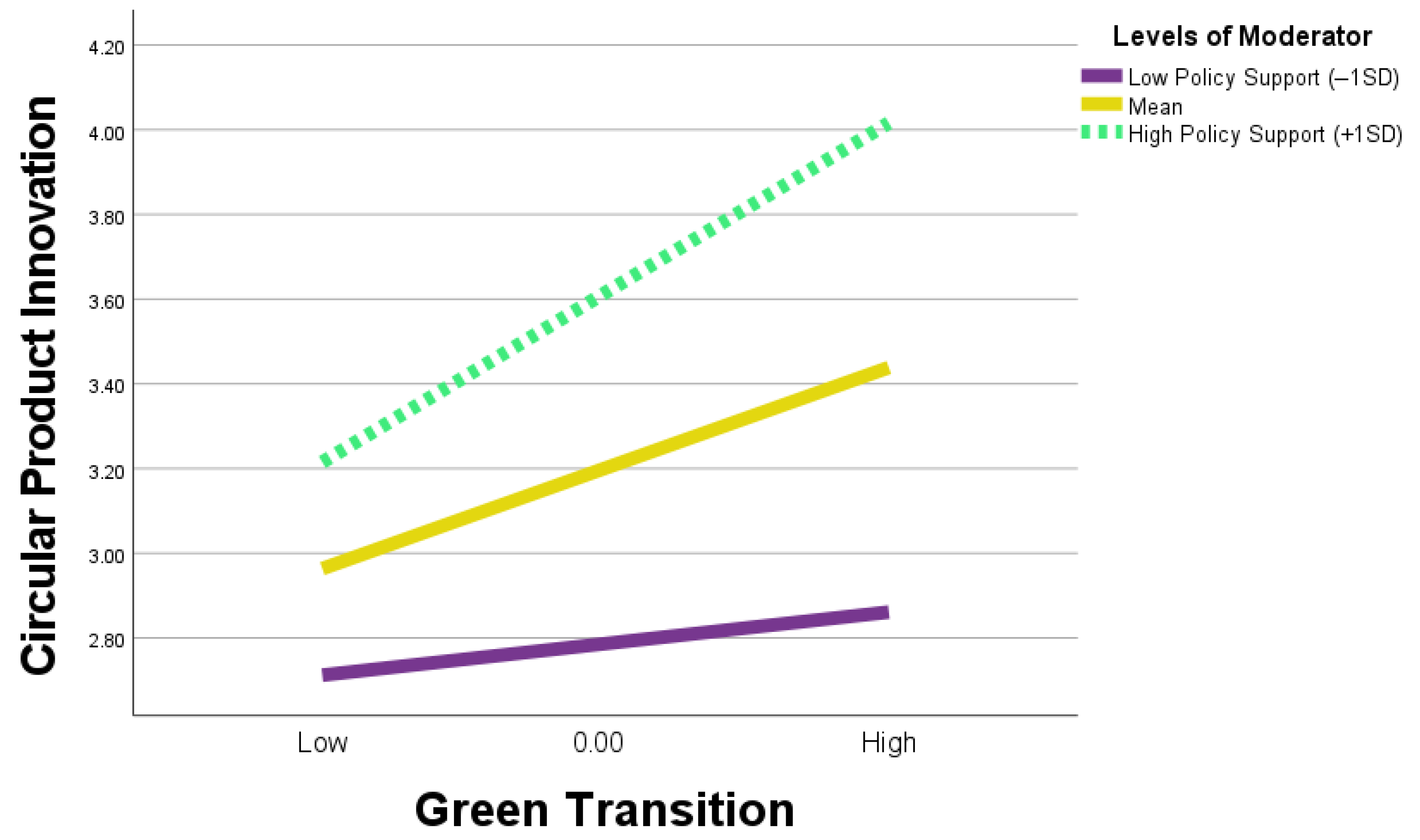
4.3. Hypothesis Test: Moderation Analysis
5. Discussions and Implications
5.1. Discussion of Findings
5.2. Theoretical Contributions
5.3. Practical Implications
5.4. Limitations and Future Research Directions
Author Contributions
Funding
Institutional Review Board Statement
Informed Consent Statement
Data Availability Statement
Conflicts of Interest
References
- Abdulsalam, T.A.; Tajudeen, R.B.; Subair, M.L.; Ogherohwo, T.F.; Raji, Y.M. Global Environmental Challenges in the Current Business Scenario: A Roadblock for Sustainable Development. In Green Economy and Sustainable Development; Gupta, V.P., Haghi, A.K., Sharief, S., Eds.; Springer Nature Switzerland: Cham, Switzerland, 2025; pp. 253–282. ISBN 978-3-031-92636-5. [Google Scholar]
- Dey, P.K.; Malesios, C.; De, D.; Budhwar, P.; Chowdhury, S.; Cheffi, W. Circular Economy to Enhance Sustainability of Small and Medium Sized Enterprises. In Supply Chain Sustainability in Small and Medium Sized Enterprises; Routledge: Oxford, UK, 2022. [Google Scholar]
- Cezarino, L.O.; Liboni, L.B.; Oliveira Stefanelli, N.; Oliveira, B.G.; Stocco, L.C. Diving into Emerging Economies Bottleneck: Industry 4.0 and Implications for Circular Economy. Manag. Decis. 2019, 59, 1841–1862. [Google Scholar] [CrossRef] [Scilit]
- Patwa, N.; Sivarajah, U.; Seetharaman, A.; Sarkar, S.; Maiti, K.; Hingorani, K. Towards a Circular Economy: An Emerging Economies Context. J. Bus. Res. 2021, 122, 725–735. [Google Scholar] [CrossRef] [Scilit]
- Austin, A.; Alataş, S.; Agbonifi, D. Financing Eco-Innovation in an Emerging Economy: The Role of Internal Resources, External Support and Government in Turkish SMEs. Sustain. Dev. 2025. [Google Scholar] [CrossRef] [Scilit]
- Elfghi, O.; Iyiola, K.; Alzubi, A.B.; Aljuhmani, H.Y. Improvisation and New Venture Performance: Unpacking the Roles of Entrepreneurial Self-Efficacy and Learning Orientation. Sustainability 2026, 18, 975. [Google Scholar] [CrossRef] [Scilit]
- Awad, I.M.; Nuseibeh, H.; Amro, A.A. Competitiveness in the Era of Circular Economy and Digital Innovations: An Integrative Literature Review. Sustainability 2025, 17, 4599. [Google Scholar] [CrossRef] [Scilit]
- Takacs, F.; Brunner, D.; Frankenberger, K. Barriers to a Circular Economy in Small- and Medium-Sized Enterprises and Their Integration in a Sustainable Strategic Management Framework. J. Clean. Prod. 2022, 362, 132227. [Google Scholar] [CrossRef] [Scilit]
- Zighan, S.; Alkalha, Z.; Jum’a, L. Barriers to Circular Economy Transitions in Emerging Markets: Insights From the GCC and Implications for Sustainable Development. Sustain. Dev. 2026, 34, 210–225. [Google Scholar] [CrossRef] [Scilit]
- Koirala, S. SMEs: Key Drivers of Green and Inclusive Growth; OECD Green Growth Papers; OECD: Paris, France, 2019. [Google Scholar]
- Mehmood, A.; Ahmed, S.; Viza, E.; Bogush, A.; Ayyub, R.M. Drivers and Barriers towards Circular Economy in Agri-Food Supply Chain. Bus. Strategy Dev. 2021, 4, 465–481. [Google Scholar] [CrossRef] [Scilit]
- Mamash, A.; Iyiola, K.; Aljuhmani, H.Y. The Role of Circular Economy Entrepreneurship, Cleaner Production, and Green Government Subsidy for Achieving Sustainability Goals in Business Performance. Sustainability 2025, 17, 3990. [Google Scholar] [CrossRef] [Scilit]
- Yasmeen, H.; Longsheng, C. Advancing Circular Economy in the Equipment Manufacturing Sector: The Role of Environmental Management Systems, Innovation and Policy Support. J. Environ. Manag. 2025, 380, 124967. [Google Scholar] [CrossRef] [Scilit]
- Jain, N.K.; Panda, A.; Choudhary, P. Institutional Pressures and Circular Economy Performance: The Role of Environmental Management System and Organizational Flexibility in Oil and Gas Sector. Bus. Strategy Environ. 2020, 29, 3509–3525. [Google Scholar] [CrossRef] [Scilit]
- Kekkonen, A.; Pesor, R.; Täks, M. Stepping towards the Green Transition. Sustainability 2023, 15, 4172. [Google Scholar] [CrossRef] [Scilit]
- Tang, K.; MacDermid, J.C.; Amick, B.C.; Beaton, D.E. The 11-Item Workplace Organizational Policies and Practices Questionnaire. Am. J. Ind. Med. 2011, 54, 834–846. [Google Scholar] [CrossRef] [Scilit] [PubMed]
- Israel, B.; Siwandeti, M. Agri-Food Supply Chain Capabilities and Smallholders’ on-Farm Economic Viability. Cogent Food Agric. 2024, 10, 2391565. [Google Scholar] [CrossRef] [Scilit]
- Le, T.T.; Tuyết, N.B.T.; Anh, T.L. Drive Sustainable Business Performance with Humane Entrepreneurship, Knowledge Management: The Mediation of Sustainable Business Advantage and Sustainable Business Model Innovation. Eur. J. Innov. Manag. 2024; ahead of print. [CrossRef] [Scilit]
- Ren, Q.; Albrecht, J. Toward Circular Economy: The Impact of Policy Instruments on Circular Economy Innovation for European Small Medium Enterprises. Ecol. Econ. 2023, 207, 107761. [Google Scholar] [CrossRef] [Scilit]
- De Arroyabe, J.F.; Arranz, N.; Schumann, M.; Arroyabe, M.F. The Development of CE Business Models in Firms. Technovation 2021, 106, 102292. [Google Scholar] [CrossRef] [Scilit]
- Ilyas, S.; Hu, Z.; Wiwattanakornwong, K. Unleashing the Role of Top Management and Government Support in Green Supply Chain Management. Environ. Sci. Pollut. Res. 2020, 27, 8210–8223. [Google Scholar] [CrossRef] [Scilit]
- Durman, S.; Iyiola, K.; Alzubi, A.B.; Aljuhmani, H.Y. Dynamic Capabilities in Action: Digital Capability, Business Model Innovation and Absorptive Capacity. Manag. Decis. 2025, 1–36. [Google Scholar] [CrossRef] [Scilit]
- ISO 14001; Environmental Management Systems-Requirements with Guidance for Use. ISO: Geneva, Switzerland, 2015.
- Barney, J. Firm Resources and Sustained Competitive Advantage. J. Manag. 1991, 17, 99–120. [Google Scholar] [CrossRef] [Scilit]
- Alsafadi, Y.; Aljuhmani, H.Y. The Influence of Entrepreneurial Innovations in Building Competitive Advantage: The Mediating Role of Entrepreneurial Thinking. Kybernetes 2023, 53, 4051–4073. [Google Scholar] [CrossRef] [Scilit]
- Mishra, R.; Kiran, K.B. Is Sustainable Performance in MSMEs Driven by Entrepreneurial Orientation through Knowledge Management and Dynamic Capabilities? J. Knowl. Manag. 2025, 30, 231–262. [Google Scholar] [CrossRef] [Scilit]
- Neiroukh, S.; Emeagwali, O.L.; Aljuhmani, H.Y. Artificial Intelligence Capability and Organizational Performance: Unraveling the Mediating Mechanisms of Decision-Making Processes. Manag. Decis. 2025, 63, 3501–3532. [Google Scholar] [CrossRef] [Scilit]
- AlAjlouni, A.O.; Aljuhmani, H.Y. Leveraging Business Intelligence for Enhanced Financial Performance: The Mediating Effect of Supply Chain Integration. In Achieving Sustainable Business Through AI, Technology Education and Computer Science: Volume 3: Business Sustainability and Artificial Intelligence Applications; Hamdan, A., Ed.; Springer Nature: Cham, Switzerland, 2024; pp. 79–89. ISBN 978-3-031-73632-2. [Google Scholar]
- Dimaggio, P.J.; Powell, W.W. The iron cage revisited: Institutional isomorphism and collective rationality in organizational fields. In Chapter 4 the Iron Cage Revisited: Institutional Isomorphism and Collective Rationality in Organizational Fields; Princeton University Press: Princeton, NJ, USA, 2021; pp. 111–134. ISBN 978-0-691-22927-0. [Google Scholar]
- Emeagwali, O.L.; Aljuhamni, H.Y. Introductory Chapter: Strategic Management—A Dynamic Approach. In Strategic Management—A Dynamic View; IntechOpen: London, UK, 2019; ISBN 978-1-83962-505-3. [Google Scholar]
- Arsawan, I.W.E.; Kartikasari, A.; Suhartanto, D.; Choirisa, S.F. Transitioning Towards Circular Economy Practices: The Role of Organizational Capabilities and Environmental Dynamism—Evidence From Indonesia. Bus. Strategy Environ. 2026, 35, 18–35. [Google Scholar] [CrossRef] [Scilit]
- Shibin, K.T.; Dubey, R.; Gunasekaran, A.; Hazen, B.; Roubaud, D.; Gupta, S.; Foropon, C. Examining Sustainable Supply Chain Management of SMEs Using Resource Based View and Institutional Theory. Ann. Oper. Res. 2020, 290, 301–326. [Google Scholar] [CrossRef] [Scilit]
- Oliver, C. Sustainable Competitive Advantage: Combining Institutional and Resource-Based Views. Strateg. Manag. J. 1997, 18, 697–713. [Google Scholar] [CrossRef] [Scilit]
- Aboalhool, T.; Alzubi, A.; Iyiola, K. Humane Entrepreneurship in the Circular Economy: The Role of Green Market Orientation and Green Technology Turbulence for Sustainable Corporate Performance. Sustainability 2024, 16, 2517. [Google Scholar] [CrossRef] [Scilit]
- Procacci, V.; Manzo, M.; Beck, T.; Manca, F. Sustainability Certifications as Enablers of Intellectual Capital and Digital Transformation in SMEs. VINE J. Inf. Knowl. Manag. Syst. 2025, 1–21. [Google Scholar] [CrossRef] [Scilit]
- Indiran, L.; Fu, C.; Fahim, N.A.; Ishak, M.K.; Aslan, M. Eco-Innovation Methodologies: A Literature Review. Discov. Sustain. 2025, 6, 1143. [Google Scholar] [CrossRef] [Scilit]
- Ricciardi, I.; Percuoco, M.; Prisco, A.; Galmarini, E. Innovative and Sustainable Product Development: A Comparative Study of Influencing Factors in Large Enterprises vs SMEs. J. Prod. Brand Manag. 2025, pp. 1–20. Available online: https://www.emerald.com/jpbm/article/doi/10.1108/JPBM-10-2024-5571/1306796 (accessed on 20 January 2026).
- Yuning, M.; Taozhen, H.; Saleem, N.; Hassan, A.H. Institutional Pressure and Low Carbon Innovation Policy: The Role of EMS, Environmental Interpretations and Governance Heterogeneity. Front. Environ. Sci. 2024, 12, 1385062. [Google Scholar] [CrossRef] [Scilit]
- Adiguzel, Z.; Sonmez Cakir, F. Empowering Sustainability: Green Entrepreneurial Orientation, Innovative Strategies, Culture and Operational Performance. Manag. Decis. 2025, 63, 3934–3966. [Google Scholar] [CrossRef] [Scilit]
- Llach, J.; León-Mateos, F.J.; Depino-Besada, N.; Sartal, A. Do Green Practices and Technologies Mediate Lean Manufacturing’s Impact on Industrial Performance? Evidence from the European Manufacturing Survey. Int. J. Lean Six Sigma 2024, 16, 723–751. [Google Scholar] [CrossRef] [Scilit]
- He, Q. The Influence of Organizational Policies on Firm Environmental Performance through Sustainable Technologies and Innovation and Stakeholder Concerns. Sci. Rep. 2025, 15, 10019. [Google Scholar] [CrossRef] [Scilit]
- Munir, T.; Watts, S. Exploring Eco-Friendly Business Practices and Corporate Innovation in Pakistan. Int. J. Innov. Sci. 2024, 17, 786–802. [Google Scholar] [CrossRef] [Scilit]
- Carreno, A. Strategic Alignment in Program Management: A Framework for Sustainable Business Transformation; Institute for Change Leadership and Business Transformation: Sydney, Australia, 2024. [Google Scholar]
- Zhang, Y.; Lim, W. Sustainable Strategy: Encouraging Implementation in Small Enterprises. Manag. Decis. 2024, 63, 2202–2222. [Google Scholar] [CrossRef] [Scilit]
- Li, C.; Sampene, A.; Khan, A.; Wiredu, J. Environmental Orientations to Innovation Ecosystem: The Role of Green Transition, Perceived Environmental Uncertainty and Green Transformational Leadership. Oper. Manag. Res. 2024, 18, 48–71. [Google Scholar] [CrossRef] [Scilit]
- Abuseta, H.; Iyiola, K.; Aljuhmani, H.Y. Digital Technologies and Business Model Innovation in Turbulent Markets: Unlocking the Power of Agility and Absorptive Capacity. Sustainability 2025, 17, 5296. [Google Scholar] [CrossRef] [Scilit]
- Besiktepe, D.; Gurgun, A.P. Regulatory Barriers of Circular Economy Adoption in Construction Industry: A Perspective from Türkiye. Smart Sustain. Built Environ. 2025, 4, 1–24. [Google Scholar] [CrossRef] [Scilit]
- Johnstone, L. The Construction of Environmental Performance in ISO 14001-Certified SMEs. J. Clean. Prod. 2020, 263, 121559. [Google Scholar] [CrossRef] [Scilit]
- Başçı, S.; Durucan, A. A Review of Small and Medium Sized Enterprises (SMEs) in Turkey. YSSR 2017, 3, 59–79. [Google Scholar]
- Podsakoff, P.M.; MacKenzie, S.B.; Lee, J.-Y.; Podsakoff, N.P. Common Method Biases in Behavioral Research: A Critical Review of the Literature and Recommended Remedies. J. Appl. Psychol. 2003, 88, 879–903. [Google Scholar] [CrossRef] [Scilit]
- Rajhi, M.; Aljuhmani, H.Y. Fostering Sustainable Innovation Through Communication Quality: The Sequential Role of Trust in Leadership and Organizational Commitment in Team-Based Enterprises. Sustainability 2026, 18, 554. [Google Scholar] [CrossRef] [Scilit]
- Le, T.T.; Behl, A.; Pereira, V. Establishing Linkages between Circular Economy Practices and Sustainable Performance: The Moderating Role of Circular Economy Entrepreneurship. Manag. Decis. 2022, 62, 2340–2363. [Google Scholar] [CrossRef] [Scilit]
- Brislin, R.W. The Wording and Translation of Research Instruments. In Field Methods in Cross-Cultural Research; Cross-Cultural Research and Methodology Series; Sage Publications, Inc.: Thousand Oaks, CA, USA, 1986; Volume 8, pp. 137–164. ISBN 978-0-8039-2549-6. [Google Scholar]
- Bouguerra, A.; Hughes, M.; Rodgers, P.; Stokes, P.; Tatoglu, E. Confronting the Grand Challenge of Environmental Sustainability within Supply Chains: How Can Organizational Strategic Agility Drive Environmental Innovation? J. Product Innov. Manag. 2024, 41, 323–346. [Google Scholar] [CrossRef] [Scilit]
- Hayes, A.F. Introduction to Mediation, Moderation, and Conditional Process Analysis; Guilford Press: New York, NY, USA, 2022. [Google Scholar]
- Iyiola, K.; Alzubi, A.; Dappa, K. The Influence of Learning Orientation on Entrepreneurial Performance: The Role of Business Model Innovation and Risk-Taking Propensity. J. Open Innov. Technol. Mark. Complex. 2023, 9, 100133. [Google Scholar] [CrossRef] [Scilit]
- Centobelli, P.; Cerchione, R.; Singh, R. The Impact of Leanness and Innovativeness on Environmental and Financial Performance. Int. J. Prod. Econ. 2019, 212, 111–124. [Google Scholar] [CrossRef] [Scilit]
- Lindell, M.K.; Whitney, D.J. Accounting for Common Method Variance in Cross-Sectional Research Designs. J. Appl. Psychol. 2001, 86, 114–121. [Google Scholar] [CrossRef] [Scilit]
- Hair, J.F.; Anderson, R.E.; Tatham, R.L.; Black, W.C. Multivariate Data Analysis with Readings; Prentice-Hall: Upper Saddle River, NJ, USA, 1998. [Google Scholar]
- Fornell, C.; Larcker, D.F. Evaluating Structural Equation Models with Unobservable Variables and Measurement Error. J. Mark. Res. 1981, 18, 39–50. [Google Scholar] [CrossRef] [Scilit]
- Hair, J.F.; Risher, J.J.; Sarstedt, M.; Ringle, C.M. When to Use and How to Report the Results of PLS-SEM. Eur. Bus. Rev. 2019, 31, 2–24. [Google Scholar] [CrossRef] [Scilit]
- Hu, L.; Bentler, P.M. Cutoff Criteria for Fit Indexes in Covariance Structure Analysis: Conventional Criteria versus New Alternatives. Struct. Equ. Model. Multidiscip. J. 1999, 6, 1–55. [Google Scholar] [CrossRef] [Scilit]
- Aljuhmani, H.Y.; Emeagwali, O.L.; Ababneh, B. The Relationships between CEOs’ Psychological Attributes, Top Management Team Behavioral Integration and Firm Performance. Int. J. Organ. Theory Behav. 2021, 24, 126–145. [Google Scholar] [CrossRef] [Scilit]
- Preacher, K.J.; Hayes, A.F. Asymptotic and Resampling Strategies for Assessing Indirect Effects. Behav. Res. Methods 2008, 40, 879–891. [Google Scholar] [CrossRef] [Scilit]
- Preacher, K.J.; Hayes, A.F. SPSS and SAS Procedures for Estimating Indirect Effects in Simple Mediation Models. Behav. Res. Methods Instrum. Comput. 2004, 36, 717–731. [Google Scholar] [CrossRef] [Scilit]
- Ageli, R.; Alzubi, A.B.; Aljuhmani, H.Y.; Iyiola, K. How and When Entrepreneurial Leadership Drives Sustainable Bank Performance: Unpacking the Roles of Employee Creativity and Innovation-Oriented Climate. Sustainability 2025, 17, 9259. [Google Scholar] [CrossRef] [Scilit]
- Saygili, E.; Uye Akcan, E.; Ozturkoglu, Y. An Exploratory Analysis of Sustainability Indicators in Turkish Small- and Medium-Sized Industrial Enterprises. Sustainability 2023, 15, 2063. [Google Scholar] [CrossRef] [Scilit]
- Rizos, V.; Behrens, A.; Van der Gaast, W.; Hofman, E.; Ioannou, A.; Kafyeke, T.; Flamos, A.; Rinaldi, R.; Papadelis, S.; Hirschnitz-Garbers, M.; et al. Implementation of Circular Economy Business Models by Small and Medium-Sized Enterprises (SMEs): Barriers and Enablers. Sustainability 2016, 8, 1212. [Google Scholar] [CrossRef] [Scilit]
- García-Quevedo, J.; Jové-Llopis, E.; Martínez-Ros, E. Barriers to the Circular Economy in European Small and Medium-sized Firms. Bus. Strat. Environ. 2020, 29, 2450–2464. [Google Scholar] [CrossRef] [Scilit]
- Ortiz, E.; Marín, S.; Thompson, P. The Role of Small- and Medium-Sized Practices in the Sustainable Transition of SMEs. Environ. Dev. Sustain. 2024, 26, 19299–19323. [Google Scholar] [CrossRef] [Scilit]
- Kalantzis, C.; Nikoloudis, C.; Aravossis, K. A Literature Review on Implementing Circular Economy Models through Open Innovation. Discov. Sustain. 2025, 6, 1429. [Google Scholar] [CrossRef] [Scilit]
- Kristensen, H.S.; Mosgaard, M.A.; Remmen, A. Integrating Circular Principles in Environmental Management Systems. J. Clean. Prod. 2021, 286, 125485. [Google Scholar] [CrossRef] [Scilit]



| n = 511 | Category | Frequency | % |
|---|---|---|---|
| Nature of business | Food processing and beverages | 127 | 24.85 |
| Textile and apparel | 109 | 21.33 | |
| Furniture, paper and printing | 41 | 8.03 | |
| Plastics/Chemicals | 38 | 7.44 | |
| General construction/building construction | 44 | 8.61 | |
| IT and digital services | 18 | 3.52 | |
| Electrical and electronics assembly | 53 | 10.37 | |
| Others | 81 | 15.85 | |
| Firm size (number of employees) | >50 | 10 | 1.95 |
| 50–150 | 309 | 60 | |
| Between 151 and 249 | 196 | 38.05 | |
| Firm age (years) | 3–5 | 17 | 3.30 |
| 6–10 | 104 | 20.19 | |
| 11–15 | 84 | 16.31 | |
| 16–20 | 199 | 38.65 | |
| Above 20 | 111 | 21.55 |
| Variables | Codes | Standardized Factor Loadings | AVE | CR | α |
|---|---|---|---|---|---|
| Environmental Management System | 0.514 | 0.808 | 0.805 | ||
| EMS1 | 0.684 | ||||
| EMS2 | 0.729 | ||||
| EMS3 | 0.754 | ||||
| EMS4 | 0.698 | ||||
| Green Transition | 0.649 | 0.880 | 0.876 | ||
| GT1 | 0.826 | ||||
| GT2 | 0.883 | ||||
| GT3 | 0.847 | ||||
| GT4 | 0.647 | ||||
| Organizational Sustainability Policy | 0.522 | 0.845 | 0.845 | ||
| OSP1 | 0.710 | ||||
| OSP2 | 0.755 | ||||
| OSP3 | 0.758 | ||||
| OSP4 | 0.680 | ||||
| OSP5 | 0.704 | ||||
| Policy Support | 0.677 | 0.911 | 0.903 | ||
| PS1 | 0.899 | ||||
| PS2 | 0.905 | ||||
| PS3 | 0.881 | ||||
| PS4 | 0.788 | ||||
| PS5 | 0.600 | ||||
| Circular Product Innovation | 0.618 | 0.889 | 0.886 | ||
| CPI1 | 0.810 | ||||
| CPI2 | 0.861 | ||||
| CPI3 | 0.820 | ||||
| CPI4 | 0.768 | ||||
| CPI5 | 0.656 | ||||
| Goodness of model fit metrics: X2/df = 2.548; CFI = 0.944, RMSEA = 0.059; TLI = 0.935; NFI = 0.911, IFI = 0.944 | |||||
| Construct | Mean | Std. | EMS | GTN | OSP | PS | CPI | Firm Age | Firm Size |
|---|---|---|---|---|---|---|---|---|---|
| EMS | 4.060 | 0.786 | (0.717) | ||||||
| GTN | 3.877 | 0.946 | 0.643 ** | (0.806) | |||||
| OSP | 3.883 | 0.832 | 0.423 ** | 0.616 ** | (0.722) | ||||
| PS | 3.782 | 0.938 | 0.485 ** | 0.481 ** | 0.352 ** | (0.823) | |||
| CPI | 3.805 | 0.837 | 0.643 ** | 0.571 ** | 0.535 ** | 0.535 ** | (0.786) | ||
| Firm age | - | - | 0.029 | 0.030 | 0.017 | 0.009 | 0.007 | - | |
| Firm size | - | - | 0.018 | 0.022 | 0.011 | 0.014 | 0.013 | 0.024 | - |
| Hypothesis | Relationships | β | S.E. | T-Values | LL | UL | R2 |
|---|---|---|---|---|---|---|---|
| H1 | EMS → CPI | 0.197 | 0.076 | 2.603 ** | 0.048 | 0.347 | 0.632 |
| H2 | EMS → GTN | 0.899 | 0.080 | 11.207 *** | 0.741 | 0.992 | |
| H3 | GTN → CPI | 0.495 | 0.042 | 11.711 *** | 0.411 | 0.578 | |
| H4 | EMS → GTN → CPI | 0.445 | 0.055 | 0.342 | 0.557 |
| Hypothesized Paths | Effect | S.E. | T-Values | 95% CI | |
|---|---|---|---|---|---|
| LL | UL | ||||
| Model 1: Green Transition | |||||
| Co: Firm age → GT | 0.010 | 0.016 | 0.029 (ns) | −0.099 | 0.047 |
| Co: Firm size → GT | 0.015 | 0.010 | 0.055 (ns) | −0.071 | 0.025 |
| EMS → GT | 0.592 | 0.079 | 7.473 *** | 0.436 | 0.748 |
| OSP → GT | 0.372 | 0.041 | 9.131 *** | 0.292 | 0.452 |
| H5: EMS × OSP → GT | 0.107 | 0.070 | 1.523 (ns) | −0.030 | 0.244 |
| R2 = 0.395 | |||||
| Model 2: Circular Product Innovation | |||||
| Co: Firm age → CPI | 0.008 | 0.013 | 0.023 (ns) | −0.077 | 0.111 |
| Co: Firm size → CPI | 0.009 | 0.017 | 0.30 (ns) | −0.073 | 0.083 |
| EMS → CPI | 0.488 | 0.049 | 9.953 *** | 0.392 | 0.585 |
| GT → CPI | 0.239 | 0.043 | 5.546 *** | 0.154 | 0.324 |
| PS → CPI | 0.064 | 0.066 | 0.975(ns) | −0.065 | 0.193 |
| H6: GT × PS → CPI | 0.095 | 0.048 | 2.096 * | 0.006 | 0.183 |
| R2 = 0.555 | |||||
| The specific conditional values of PS on GT-CPI | |||||
| −1SD (below the mean) | 0.074 | 0.053 | 1.403 (ns) | −0.029 | 0.179 |
| Mean | 0.238 | 0.043 | 5.511 *** | 0.153 | 0.322 |
| +1SD (above the mean) | 0.401 | 0.053 | 7.533 *** | 0.296 | 0.505 |
| Index of moderated mediation by PS | |||||
| EMS → GT → CPI | 0.021 | 0.014 | - | −0.043 | 0.049 |
Disclaimer/Publisher’s Note: The statements, opinions and data contained in all publications are solely those of the individual author(s) and contributor(s) and not of MDPI and/or the editor(s). MDPI and/or the editor(s) disclaim responsibility for any injury to people or property resulting from any ideas, methods, instructions or products referred to in the content. |
© 2026 by the authors. Licensee MDPI, Basel, Switzerland. This article is an open access article distributed under the terms and conditions of the Creative Commons Attribution (CC BY) license.
Share and Cite
Albannai, N.; Alzubi, A.B.; Aljuhmani, H.Y. How Environmental Management Systems Enable Sustainability Transition: The Roles of Green Transition and Policy Support in Driving Circular Product Innovation. Sustainability 2026, 18, 2060. https://doi.org/10.3390/su18042060
Albannai N, Alzubi AB, Aljuhmani HY. How Environmental Management Systems Enable Sustainability Transition: The Roles of Green Transition and Policy Support in Driving Circular Product Innovation. Sustainability. 2026; 18(4):2060. https://doi.org/10.3390/su18042060
Chicago/Turabian StyleAlbannai, Nabila, Ahmad Bassam Alzubi, and Hasan Yousef Aljuhmani. 2026. "How Environmental Management Systems Enable Sustainability Transition: The Roles of Green Transition and Policy Support in Driving Circular Product Innovation" Sustainability 18, no. 4: 2060. https://doi.org/10.3390/su18042060
APA StyleAlbannai, N., Alzubi, A. B., & Aljuhmani, H. Y. (2026). How Environmental Management Systems Enable Sustainability Transition: The Roles of Green Transition and Policy Support in Driving Circular Product Innovation. Sustainability, 18(4), 2060. https://doi.org/10.3390/su18042060