Article

Perceived Benefits, Technological Affordances, and Community Identity: An Integrated Model for Resident Participation in Sustainable Community Governance

Faculty of Humanities and Social Sciences, Harbin Institute of Technology, Harbin 150001, China
*
Author to whom correspondence should be addressed.
Sustainability 2026, 18(4), 2061; https://doi.org/10.3390/su18042061
Submission received: 8 January 2026 / Revised: 13 February 2026 / Accepted: 15 February 2026 / Published: 18 February 2026
(This article belongs to the Section Social Ecology and Sustainability)

Abstract

Against the backdrop of intertwined individualization, urbanization, and digitalization, the demographic heterogeneity within urban communities continues to increase. How to foster resident participation has become a crucial issue for achieving sustainable urban development. Using empirical data from the city of Harbin and employing stepwise multiple regression analysis, this study examines the mechanisms through which perceived benefits, technological empowerment, and community identity influence resident participation. The findings indicate the following: First, perceived benefits and technological empowerment not only directly promote resident participation but also exert a significant indirect influence by enhancing community identity. Second, there exists an asymmetric interaction effect between perceived benefits and technological empowerment, where community identity is shown to be synergistically promoted, but residents’ participation is directly inhibited. This reveals the dual role of digital technology in community settings, simultaneously strengthening emotional bonds and substituting for physical involvement. Third, community identity acts as a pivotal mediating mechanism in the interaction between instrumental and value-based rationality. In essence, resident participation is shaped by the ongoing, technology-mediated interplay and negotiation between these two rationalities. Building on this, the study proposes a dual cycle model of digital participation to integrate these nonlinear relationships. It emphasizes that community participation is not a linear causal process but a dynamically evolving system shaped by the mutual construction of social psychology and technological context. The conclusions provide a theoretical framework that is both explanatory and practical for community governance in the digital era.

1. Introduction

Historical experience since the Industrial Revolution has shown that technological change has been a key driver of transformation in public political life [1]. The profound development of digital technology is reshaping social structures with unprecedented breadth and intensity. Modernization and individualization transform social formations, ushering society into a highly fluid and uncertain liquid phase [2]. In this new social formation, traditional solid communities based on strong ties and stable geographical relations are dissolving and being replaced by individual atomization, weak social ties, and transient interactions. This structural shift presents a core challenge for urban community governance at the micro level, directly impacting the social sustainability and resilience of cities. Against a backdrop of increasingly tenuous social bonds and superficial, ephemeral public interactions, motivating residents to engage in public affairs and translating this willingness into sustained, stable participatory action has become a critical issue that must be addressed to advance effective and sustainable community governance. Addressing this issue is crucial not only for local governance efficacy but also for achieving the global Sustainable Development Goals (SDGs), particularly SDG 11 [3], which aims to “make cities and human settlements inclusive, safe, resilient and sustainable” by fostering participatory, integrated, and sustainable human settlement planning and management.
Researchers have primarily examined factors influencing community resident participation from three perspectives. First, the technological perspective posits that tools like big data, artificial intelligence, and blockchain can reduce inefficient governance and strengthen oversight. It makes residents more willing to participate in collective community actions and lowers their participation costs, stimulating engagement [4]. In particular, digital platforms are regarded as reshaping information, increasing the visibility and accessibility of public affairs, streamlining participation, and improving the efficiency of public involvement [5]. However, this techno-optimistic stance has drawn academic critique. A comparative study by Falco and Kleinhans [6] on digital participation platforms across several European countries reveals that the institutional integration of such tools remains far below policy expectations. As a result, most platforms are marginalized due to their disconnection from established decision-making processes. Second, the benefit-based perspective argues that the primary driver for resident participation is vested benefit [7]. According to this view, the decision to participate and the engagement level depend on the magnitude of the benefits individuals expect to gain from community outcomes [8]. However, since community members differ in their capacity to participate in the distribution of public goods and maximize their own benefits, significant disparities exist in their enthusiasm for community affairs [9]. Third, the social capital perspective highlights that structural elements like trust, relational networks, and norms of reciprocity [10], combined with affective elements, such as emotional attachment, sense of belonging, and shared culture [11], constitute crucial resources influencing participation. On the one hand, dense social networks and prevalent interpersonal trust within a community can substantially reduce uncertainty about cooperation on public matters, fostering a willingness to collaborate [12]. On the other hand, fostering a sense of community identity and belonging can motivate residents by instilling a sense of responsibility and prompting greater voluntary investment in community affairs [13]. Furthermore, the norms of reciprocity and obligatory expectations inherent in social capital encourage residents to internalize participation as a form of sustainable social responsibility, generating a stable and enduring motivational force for engagement [14].
In summary, technological, benefit-based, and social capital perspectives have been used to analyze the reasons for participation and the level of difficulty from different angles, proposing pathways to enhance resident participation by improving technical accessibility, activating benefits, or cultivating social capital. However, these single-perspective approaches and their governance strategies have not sufficiently resolved practical dilemmas in community governance or provided a holistic understanding of the micro-foundations required for sustainable community development. In their systematic study of digital platforms in U.S. communities, Afzalan and Muller [15] conclude that the capacity of technological tools to foster genuine community engagement hinges less on the range of features offered than on their alignment with established social structures, residents’ motivational networks, and institutional processes. Despite widespread digital transformation marked by the establishment of community digital platforms (e.g., community forums, mini-programs, and online deliberation systems) and despite many governance issues being closely tied to residents’ daily lives and immediate benefits [16], participation rates in many communities have not improved substantially. On one hand, technological tools often fall into disuse or are only used sporadically after being developed [17]. On the other hand, while material incentives or honorary recognition can boost participation in the short term, they often fail to foster stable, endogenous participatory habits [18]. This gap between theory and practice underscores the complexity of human action [19]. Linear explanations based on a single factor are often inadequate for understanding the logic of community participation and building long-term, sustainable participatory governance.
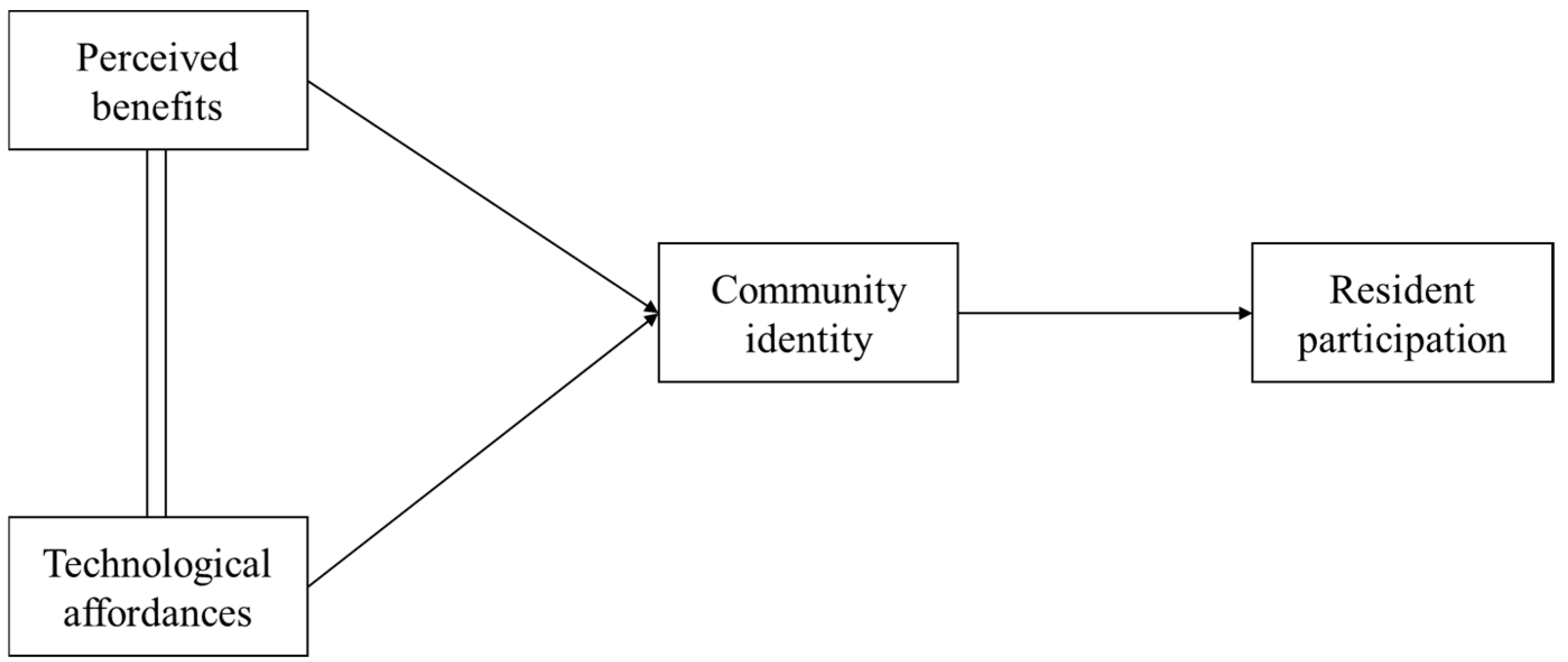
Building on the theory and reality discussed above, this paper proposes an integrated three-dimensional analytical framework of perceived benefits, technological affordances, and community identity to explain the driving mechanisms behind urban community residents’ participation in the context of a digital society. This framework unifies the instrumental conditions emphasized by the technological perspective, the utilitarian motivations highlighted by the benefit-based perspective, and the community identity central to the social capital perspective. This study systematically examines the complex, mutually constitutive relationships among resident participation, the benefits of participation, and residents’ reasons to participate, providing a more comprehensive and dynamic understanding of the factors affecting urban community engagement and offering theoretical insights for fostering collaborative and sustainable community governance.

2. Literature Review and Hypotheses Development

2.1. Perceived Benefits and Community Resident Participation

Perceived Benefits refer to an individual’s perception of the benefits of a product or item [20]. As Marx noted, “The pursuits of people are invariably linked to their benefits” [21]. In community governance, residents’ participation is likewise profoundly influenced by their level of benefit perception, which affects participation in two dimensions.
First, the intensity of perceived benefits determines a person’s tendency toward participation. When faced with community public affairs, residents often actively engage in matters concerning their personal benefits, whereas they remain relatively detached from those of broader public benefits [22]. This disparity reflects a process of rational calculation. Residents are more likely to develop participatory motives when community affairs directly impact personal or household benefits [23]. Conversely, when dealing with collective benefits whose benefits are not easily individualized, a free-rider mentality emerges, leading to insufficient motivation for participation [24].
Second, the type of perceived benefits affects a person’s motivation to participate. The motivations for resident participation in community public affairs include material and non-material benefits. Material benefits primarily refer to tangible gains derived from access to public resources. These include shares of community profits—financial surpluses generated from collective resource operations that benefit all residents—as well as environmental improvements and specific advantages brought about by facility development. Non-material benefits pertain to the satisfaction of values like recognition, respect, prestige, and self-actualization gained through participation [25]. Scholars have observed that resource acquisition and value pursuit are dominant motives for resident participation. Resource acquisition affects residents’ dependency on the governance system, while value pursuit influences their willingness to participate. It is possible to shift resident engagement from passive, dependent to active, independent by increasing the benefits residents gain from participation [26], improving the effectiveness of community governance.
In summary, perceived benefits constitute a foundational variable driving resident participation, a relationship well-established in existing literature. However, current discussions on this topic exhibit two potential limitations. First, most studies focus primarily on the presence or typology of benefits, without sufficiently investigating whether the content and composition of residents’ perceived benefits have undergone structural changes in digitally saturated community environments. For instance, novel rewards such as instant feedback and virtual prestige from digital interactions may represent a distinct dimension of benefits beyond the conventional material versus non-material dichotomy. Second, prior research often treats perceived benefits as a stable antecedent variable, overlooking their potential susceptibility to contextual influences. To address these gaps and test whether the central driving role of perceived benefits remains robust in the digital era, this study proposes the following hypothesis:
H1: 
Perceived benefits have a significant positive effect on the level of resident community participation.

2.2. Technological Affordances and Community Resident Participation

Technological affordance refers to leveraging digital technologies to empower individuals and organizations. It stimulates individuals’ actions and strengthens interconnectivity among organizations, facilitating goal achievement [27]. In the context of community governance, technological affordance enhances resident participation from three perspectives. First, it increases perceptual capacity. Digital platforms improve residents’ understanding of community public affairs through information push notification, issue publicity, and interactive feedback, increasing their perception and sensitivity to community dynamics and governance needs [28]. Second, technological affordance expands the scope of participation. Technology reduces temporal and spatial constraints on participation, enabling residents to participate in community discussions, voting, and consultations anytime and anywhere via online channels. It increases the number of participants and the diversity of participation [29]. Third, technological affordance strengthens participatory momentum. Digital tools lower residents’ thresholds to express opinions and take action and increase their trust in participation efficacy due to transparency and traceability, increasing residents’ motivation for sustained engagement [30]. Digital technology provides residents with more convenient and efficient participation channels, ensures information symmetry, and facilitates discussion on community governance, improving residents’ capabilities, opportunities, and motivations. Therefore, resident community participation shifts from passive to active. Residents with higher digital literacy can use technological tools to obtain information and express opinions more rapidly, enhancing participation efficiency and influence [31].
In short, technological affordances can significantly improve residents’ perception of community affairs and strengthen their willingness to participate using digital media. Based on this, the following hypothesis is proposed:
H2: 
Technological affordance has a significant positive effect on the level of resident community participation.
However, while existing research widely acknowledges the fundamental value of technological empowerment, it has primarily focused on its direct effects or treated it as a broadly positive contextual factor. This has led to a relative neglect of a nuanced analysis of its underlying pathways, particularly how technological empowerment may indirectly drive participation by altering residents’ own motivations or psychological states. In other words, technological empowerment likely does more than merely provide tools and channels for participation. Its deeper impact lies in reshaping the very manner and nature of interaction between residents and their community. This reshaping may not only directly influence behavior but also exert a more indirect and sustained effect on participation by fostering a sense of community identity. Consequently, there is a clear need to further investigate the specific psychological pathways and boundary conditions through which technological empowerment operates.

2.3. The Mediating Role of Community Identity

Community identity refers to members’ functional and emotional approval of their community [32]. It indicates the quality of the resident–community relationship and serves as the psychological and social foundation for individual participation in communal public life. Previous research has initially explored the direct effects of technological empowerment and perceived benefits on community participation, as well as the importance of community identity as a key psychological variable. Studies indicate that technological empowerment promotes participation through mechanisms such as information transparency, process facilitation, and enhanced interaction [33], while perceived benefits drive resident behavior through rational calculation [34]. Scholars also generally agree that community identity serves as a crucial internal driver for sustaining participation [35]. However, most studies have separately examined the relationships between external factors, such as technology or benefits, and community identity, without systematically integrating the theoretical pathways among technological empowerment, perceived benefits, and community identity. In particular, there is a lack of in-depth investigation into how external conditions influence participation behavior through internal psychological transformation. In fact, this mediating effect works through two paths.
First, technological affordance strengthens community identity by fostering an online community, which promotes participation. Digital platforms are information tools and social interactive spaces. Online neighborhood communication, coalescing around public community topics, and sharing collective memories and symbols (e.g., community group chats, online events, and discussions of historical issues) help bridge physical divides and cultivate residents’ sense of community belonging and membership identity at a virtual level [34]. This mechanism is supported by empirical evidence. Drawing on a multi-country longitudinal survey of 2789 Reddit users, Aubin et al. [36] found that participants engaged with localized social media (LSM) reported significantly higher levels of community attachment and political participation intentions. More notably, the study reveals for the first time that new residents are more likely than long-term residents to join localized online communities. This finding underscores the irreplaceable role of digital platforms in facilitating newcomers’ integration and fostering initial community identity. When residents frequently engage with community information and collaborate with others online, their understanding of the community and their emotional connection improve. This digitally nurtured sense of identity can offset interpersonal alienation common in urban communities, making residents more likely to view community affairs as their own business. Consequently, they transform the convenient participatory opportunities afforded by technology into more proactive and emotionally invested actions [8]. In other words, the positive effect of technological affordance on participation is partially due to nurturing and enhancing residents’ community identity.
Second, perceived benefit catalyzes community identity by shaping a sense of shared destiny, thereby motivating participation. Residents’ perception of their benefits in community affairs does not merely trigger isolated personal cost–benefit calculations. When residents recognize that their individual benefits are closely aligned with the collective benefits of the community, a perception of shared destiny is more likely [35]. This perception is crucial for developing collective identity. To safeguard and advance their related benefits, residents tend to focus more on the community environment and development [23]. This process enhances their sense of reliance on and responsibility toward the community. Benefit linkage facilitates a psychological expansion from self- benefit to community benefit, deepening community identity [37]. Thus, residents are likely to participate not only in affairs concerning their benefits but also engage in public affairs related to the community’s long-term development, moving beyond short-term personal gains and losses. This behavior reflects increased and sustained participation.
In summary, community identity is a crucial psychological bridge between technological affordances, perceived benefits, and resident community participation. Technological affordances and perceived benefits foster and strengthen residents’ sense of community identity through instrumental connection and shared fate, respectively. This enhanced community identity internalizes the external conditions created by technology and stimuli of benefits into a stable motivation for sustained and deep engagement in community life. Based on this, the following hypotheses are proposed:
H3: 
Community identity mediates the relationship between technological affordances, perceived benefits, and resident community participation.
H3a: 
A higher degree of technological affordances results in greater community identity and community participation.
H3b: 
A higher degree of residents’ perceived benefits results in greater community identity and community participation.

2.4. The Interaction Between Technological Empowerment and Perceived Benefits

In the complex community governance in the digital age, technological affordances and perceived benefits serve as two core elements that mutually reinforce each other. Technological affordance increases residents’ perception and pursuit of benefits [38]. Conversely, benefit perception leads to more purposeful and deeper technological affordance [39]. This suggests that the two may not influence community psychology and behavior independently but may interact with each other.
Technological affordance moderates the relationship between perceived benefits and community identity by expanding residents’ perception of community benefits. Digital platforms make implicit or fragmented links between public and personal benefits visible, tangible, and relatable through information push notifications, open discussions of issues, and transparent displays of resources [40]. For instance, online discussions and disclosures about the use of community public funds, parking space planning, or environmental improvements can concretize abstract collective benefits into issues closely tied to each household, enhancing residents’ perception of how matters relate to their benefits. In other words, benefit linkages highlighted by technological means are more likely to attract residents’ attention and stimulate their emotional investment. Therefore, the effect of benefit perception on community identity is more pronounced in communities with a high degree of technological affordance. Residents develop a sense of shared destiny through benefit linkages, which increases their trust in and belonging to the community because of information symmetry and process visibility enabled by technology. This facilitates a smoother psychological transition from benefit perception to community identity.
Perceived benefits also substantially influence the manner and depth of technological affordances, moderating their relationship with community identity. Residents’ benefit from community affairs can be improved by technology because it encourages them to use [41]. When perceived benefit is strong, residents are more inclined to use digital platforms to obtain key information, voice demands, seek consensus, and engage in deliberation [42]. Their technology use shifts from ubiquitous browsing to purposeful participation. This benefit-driven, deeply engaged technological behavior fosters substantive interaction and collaboration among residents, thereby strengthening social bonds and the sense of us more profoundly than superficial technological contact [43]. It can be argued that benefit perception injects motivation and objectives into technological affordance, transforming technology from a potential connective tool into a practical medium for building a community of shared benefits. This behavior significantly enhances its efficacy in cultivating community identity.
However, it must be noted that the interaction between technological empowerment and perceived benefits is not necessarily a linear or positively synergistic one. Theoretical reasoning and limited empirical evidence suggest that the nature of this interaction may vary depending on the specific outcome variable. For endogenous variables such as community identity, which focus on cognitive and affective dimensions, the two may act synergistically to foster the development of a psychological sense of community [44]. In contrast, for behavioral variables such as resident participation, which require the investment of time, effort, and resources, the interaction mechanism is likely more complex. On one hand, in environments with high technological empowerment and strong perceived benefits, residents may psychologically equate or substitute online activities, such as expression, voting, and following for deeper, more complex offline substantive participation, thereby reducing actual engagement [45]. On the other hand, the combination of highly technologized participation processes and strong benefit concerns may lead to information overload, decision fatigue, or distrust in digital procedures, which can hinder the translation of positive cognitions into sustained action [46]. It can thus be argued that while there is a theoretically promising interactive relationship between technological empowerment and perceived benefits, the precise direction of this effect, whether it yields positive synergy or complex inhibition remains subject to rigorous empirical verification. Based on this, the present study proposes the following hypotheses:
H4: 
There is a significant interaction effect between technological empowerment and perceived benefits.
H4a: 
The interaction between technological empowerment and perceived benefits has a positive effect on community identity.
H4b: 
The interaction between technological empowerment and perceived benefits has a negative effect on resident participation.
The proposed theoretical model is shown in Figure 1.

3. Study Design

3.1. Study Case

The data for this study were collected through a field survey conducted in the city of Harbin, located in Province H, China. The primary objective of this study is to explore and examine the mechanisms through which perceived benefits, technological empowerment, and community identity influence resident participation. Therefore, it was necessary to select a case that exemplifies the phenomena under study, such as community digital transformation and governance transition. Harbin is a typical transforming old industrial base in Northeast China. Its community landscape includes traditional danwei-based neighborhoods, older residential blocks, commercial housing estates, and hybrid communities. The city has undergone significant demographic changes, socio-spatial restructuring, and a profound shift from danwei-managed to community-based governance, making it highly representative of many large and medium-sized cities in China facing similar transitional challenges. Here, common conditions such as weakened traditional community ties, high demographic heterogeneity, and limited governance resources intersect with the rapid infiltration of digital technology. The city of Harbin exemplifies a proactive and systematic approach to promoting smart community initiatives. Rather than being an exception, it epitomizes the common challenges and representative practices faced by urban communities across China during digital transformation. This makes the city of Harbin a suitable sample for studying participation in urban community contexts.

3.2. Measurement

A self-administered questionnaire was designed to measure the study’s core constructs. The variables included resident participation, perceived benefit, technological affordance, and community identity. Resident participation refers to the voluntary involvement of residents (time, effort, or resources) in community public affairs or activities. Based on Huang and Gui’s [47] typology of community public affairs participation, this construct was measured using nine items. Perceived benefits in community affairs reflect residents’ expectations of gains from participation based on their personal interests within the community. To measure the level of perceived benefits, this study draws on Lei’s [48] research on community participation, operationalizing the concept along three dimensions: extrinsic, intrinsic, and relational rewards. Extrinsic rewards measure residents’ consideration of material or instrumental gains, including obtaining direct material rewards, practical services, influencing public affairs related to their material interests (e.g., environment, facilities) through a voice in community decision-making, and priority access to community resources. Intrinsic rewards focus on psychological satisfaction, such as gaining a sense of achievement and social enjoyment. Relational rewards pertain to social gains based on reciprocal interpersonal relationships. Together, these three dimensions form the measurement framework for this variable, comprising a total of nine items. Technological affordances denote the enhancement of individual or organizational capacity through digital technology. The measurement of this construct considered how digital tools, such as instant messaging applications, facilitate virtual information flows that shape residents’ daily lives and community engagement. According to research by Liao et al., member interactions in virtual brand communities comprise both human–machine and human–human interactions [49], this study assessed technological affordance using twelve items. Community identity refers to residents’ emotional sense of belonging, attachment, and recognition of shared community values. It is a purely affective and evaluative construct, conceptually distinct from perceived benefits, which are based on rational calculation. Drawing on the Place Identity subscale from Williams and Vaske’s [50] place attachment scale, this construct was measured with six items.
All core variables and their measurement items are listed in Table 1. These variables are measured using a 5-point Likert scale, ranging from “strongly disagree” to “strongly agree.” For each core variable, a composite score was derived for each respondent by calculating the arithmetic mean of the valid item scores under that variable. This score, which remains on a 1-to-5 scale, represents the respondent’s average level on that variable. A higher score indicates a greater degree or intensity of the variable. These composite scores are used in subsequent statistical analyses, such as correlation and regression analyses.

3.3. Data Collection and Sample Demographic Characteristic

Data collection was conducted in Harbin in 2025 using a questionnaire survey. Prior to the main survey, a pilot test was conducted in the authors’ local community, involving 110 residents. The target population of this study comprises adult permanent residents of Harbin. Adhering to the core principle of quasi-random sampling, we aimed to obtain a sample with broad geographical coverage. To ensure operational feasibility and a balanced representation of different urban areas, the survey adopted a geographically stratified random contact point sampling approach. First, several sub-district offices, communities, and residential compounds in Harbin were randomly selected as survey contact points. Subsequently, data were collected from eligible adult residents within these points through a combination of online methods (via the “Questionnaire Star” platform, randomly distributed in residential group chats) and offline methods (randomly distributed in community public spaces). This mixed distribution mode was designed to approximate quasi-random sampling as closely as possible, ensuring each individual had an equal probability of selection. A total of 1200 questionnaires were distributed using both methods, all of which were returned. After screening and removing invalid responses, 1011 valid questionnaires were obtained, yielding a valid response rate of 84.2%.
The demographic information of the study is presented in Table 2. The age group 18–30 constituted the largest proportion (46.2%), whereas those aged 51 and older represented the smallest (11.3%). Females slightly outnumbered males (52.6% vs. 47.4%). Regarding housing tenure, homeowners (with property rights) represented the highest proportion (51.0%), whereas temporary/other residents accounted for the lowest (18.9%). A majority (65.1%) reported no experience of unfair treatment, while 34.9% indicated they had experienced it. In terms of political affiliation, non-party affiliation was the most common category (77.7%), and members of democratic parties were the least common (3.6%). The monthly household income bracket of 5001–10,000 RMB accounted for the largest proportion of respondents (41.2%), whereas the bracket of over 50,000 RMB contained the smallest (3.0%). Regarding occupation, corporate employees were the largest group (50.6%), and retired individuals constituted the smallest (0.1%).

3.4. Study Method

This study primarily employed SPSS 27.0 for data analysis. First, reliability and validity tests were conducted on the sample data, including calculating Cronbach’s α coefficients, composite reliability (CR), and average variance extracted (AVE) for each scale to ensure the reliability and validity of the measurement instruments. Second, descriptive statistics and correlation analyses were performed to understand the basic distribution of the variables and their preliminary relationships, and variance inflation factors (VIF) were calculated to test for multicollinearity. To test the research hypotheses, this study adopted a hierarchical regression analysis approach. Prior to analyzing hypotheses involving interaction effects, the relevant variables were mean-centered to avoid multicollinearity issues. The regression analysis involved constructing a series of nested models to sequentially examine the effects of control variables, independent variables, mediating variables, and interaction terms on the dependent variable. Finally, to thoroughly examine the moderated mediation effect, this study utilized Hayes’ SPSS Process macro. The significance of the moderated mediation effect was determined by observing whether the 95% confidence intervals for the indirect effects of the mediation pathway included zero across different levels of the moderating variable.

4. Results

4.1. Reliability and Validity Tests

This study employed SPSS 27.0 to assess the reliability and validity of the sample data. The results are listed in Table 3. The scales demonstrated high internal consistency, with Cronbach’s α coefficients for all latent variables ranging from 0.866 to 0.925 and composite reliability (CR) values all exceeding 0.8. All average variance extracted (AVE) values were above 0.5, and all Kaiser–Meyer–Olkin (KMO) measures exceeded 0.8. As shown in Table 4, the square root of each construct’s AVE was greater than its correlations with other constructs in the corresponding row and column of the correlation matrix, confirming discriminant validity. Due to space constraints in the main text, the complete tables for factor loadings and model fit indices are provided in Appendix A as Table A1 and Table A2. These results collectively indicate that the measurement scales possess good reliability and validity. This study primarily employed a questionnaire survey method for data collection. Given that all questionnaires were administered in a single session and contained a substantial number of items, there was a potential risk of common method bias. To assess whether this bias was present, Harman’s single-factor test was conducted. The results indicated the presence of five factors with eigenvalues greater than 1. The largest factor accounted for 31.654% of the total variance, which is below the 40% threshold commonly used to indicate significant common method bias. Overall, no serious common method bias was found, and the research data can be used for subsequent analysis.

4.2. Descriptive Statistics

The means, standard deviations, and correlation coefficients among the variables are presented in Table 4. Significant correlations existed among the variables. The variance inflation factor (VIF) for all variables was smaller than 3. Since the threshold was 10, no multicollinearity existed. Perceived benefits, technological affordances, and community identity were significantly positively correlated with resident participation, supporting Hypotheses 1 and 2.

4.3. Regression Analysis

Hierarchical multiple regression analysis was used to test the research hypotheses. Since an interaction term between perceived benefits and technological affordances were used, the two variables were centered prior to regression analysis to mitigate potential multicollinearity. The regression results are presented in Table 5. Models 3 and 7 are the central analytical steps. Model 3 examines the impact of the interaction term between perceived benefits and technological empowerment on community identity. Model 7 assesses the effect of this interaction term on resident participation, after controlling for the mediating pathway.
Model 1 used community identity as the dependent variable and the control variables as independent variables. The results indicated that the control variables had no significant effect on community identity (p > 0.05). In Model 2, perceived benefit and technological affordances were added as independent variables. Perceived benefits (β = 0.359, p < 0.001) and technological affordances (β = 0.450, p < 0.001) had significant positive relationships with community identity. These findings support Hypotheses 3a and 3b, suggesting that residents with higher levels of perceived benefit and stronger technological affordances were more likely to engage with community topics and actively seek out and enrich community-related information and resources. Consequently, the residents were more likely to develop a sense of community identity.
Model 3 included the control variables, perceived benefit, technological affordances, and their interaction term. The results showed that perceived benefit (β = 0.364, p < 0.001) and technological affordances (β = 0.447, p < 0.001) were significantly positively correlated with community identity. The interaction term between perceived benefit and technological affordances (β = 0.059, p < 0.05) was also significantly positively correlated with community identity. This suggests that technological empowerment positively moderates the relationship between perceived benefits and community identity. In other words, higher levels of technological empowerment strengthen the positive impact of perceived benefits on community identity, thereby supporting Hypothesis 4a.
Control variables, independent variables (perceived benefit, technological affordances, community identity), and the interaction term between perceived benefit and technological affordances were added sequentially to the models. The results for Model 4 showed that the control variables had no significant effect on resident community participation (p > 0.05). In Model 5 (β = 0.631, p < 0.001) and Model 6 (β = 0.470, p < 0.001), significant positive relationships were observed between community identity and resident community participation. Model 7 contained all variables. A significant positive relationship occurred between community identity and resident participation (β = 0.479, p < 0.001), validating Hypotheses 3a and 3b. These results demonstrate that residents with stronger community identity are more likely to participate in community public affairs, confirming the mediating effect of community identity on resident participation.
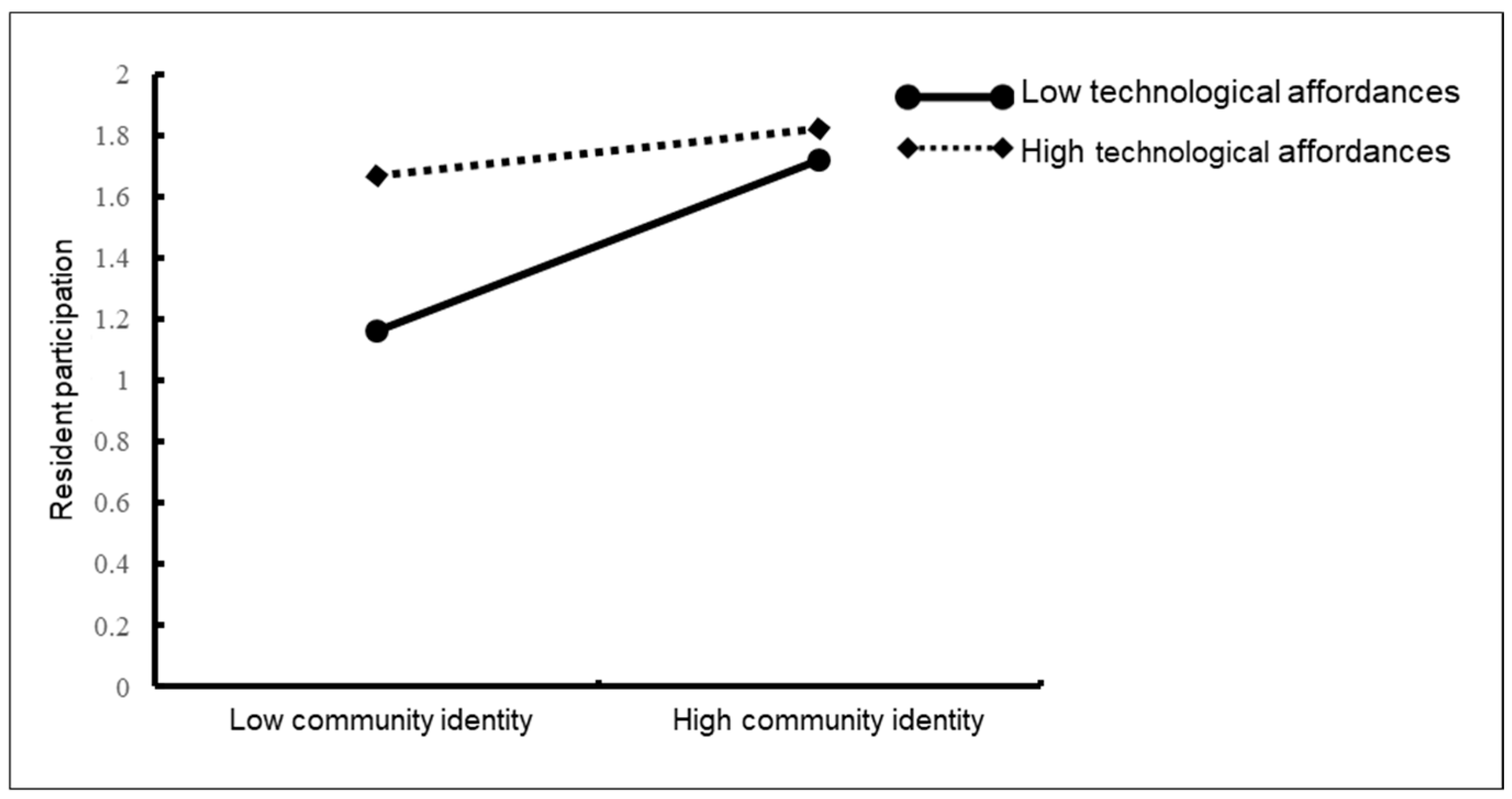
The regression results from Model 7 show that both perceived benefits (β = 0.179, p < 0.001) and technological empowerment (β = 0.152, p < 0.001) exert independent and positive main effects on resident participation. However, the coefficient for their interaction term is significantly negative (β = −0.100, p < 0.01). This result supports Hypothesis 4b, indicating that the interaction between perceived benefits and technological empowerment suppresses resident participation. As the level of technological empowerment increases, the positive impact of perceived benefits on participation is attenuated.
To further examine how the interaction between perceived benefits and technological empowerment influences resident participation, this study employed the moderated mediation model proposed by Hayes [51]. Using the PROCESS macro in SPSS, we generated high and low groups for the moderator by adding and subtracting one standard deviation from the mean. Significance tests were conducted using 1500 bootstrap samples with 95% confidence intervals. First, as shown in Table 6, we tested a model with perceived benefits as the independent variable (X), community identity as the mediator (M), resident participation as the dependent variable (Y), and technological empowerment as the moderator (W). The analysis found that at low levels of technological empowerment, the indirect effect of perceived benefits on resident participation through community identity was 0.249 (95% CI = [0.164, 0.334]), which was significant and substantial. At high levels of technological empowerment, however, this indirect effect decreased sharply to 0.056 (95% CI = [−0.027, 0.139]) and became statistically nonsignificant. This suggests that high technological empowerment may weaken the pathway through which perceived benefits promote participation via identity. To more comprehensively understand this interaction, we further examined the same model from a symmetric perspective. As shown in Table 7, we swapped the roles of the variables, setting technological empowerment as the independent variable (X) and perceived benefits as the moderator (W), while keeping community identity (M) and resident participation (Y) unchanged. The results revealed a highly consistent pattern: at low levels of perceived benefits, the indirect effect of technological empowerment on resident participation through community identity was significant and strong (indirect effect = 0.270, 95% CI = [0.197, 0.344]); at high levels of perceived benefits, this indirect effect weakened considerably (indirect effect = 0.087, 95% CI = [0.004, 0.170]). This symmetrical outcome further confirms the robustness of the core interaction effect. Taken together, Table 6 and Table 7 indicate that regardless of how variable roles are assigned, a high-level combination of technological empowerment and perceived benefits weakens their positive indirect influence on resident participation via community identity. This provides a key mechanistic explanation for the direct negative interaction effect observed earlier (H4b): rather than creating synergy, the combination of high technological empowerment and high perceived benefits may instead suppress the critical psychological process through which perceived benefits or technology use translate into community identity and, ultimately, into active participation.
The simple slope plot (Figure 2) reveals that under low technological empowerment, an increase in social identity is associated with a substantial rise in resident participation. The positive and steep slope indicates a strong positive effect of social identity on resident participation. Under high technological empowerment, social identity continues to enhance resident participation; however, the positive slope is notably flatter, suggesting that this effect is attenuated. Hence, technological empowerment exerts a negative moderating effect on the relationship between social identity and resident participation.

5. Conclusions and Discussion

As digital technologies become deeply integrated into daily life, understanding how and why residents engage in community affairs has become a central issue for promoting social sustainability and achieving effective grassroots governance. Community participation in the digital age does not follow a single logic but constitutes a complex process in which instrumental and value rationality are deeply intertwined. This study reveals that instrumental rationality, represented by perceived benefits and technological empowerment, and value rationality, centered on community identity, together form a motivational system driving resident participation, with the two exhibiting significant interactive tension in the digital context.
The research first confirms the independent driving effects of technological empowerment and perceived benefits on community psychology and behavior. Both perceived benefits and technological empowerment can directly and significantly enhance residents’ sense of belonging to the community, thereby influencing community identity, and can also effectively promote their participation.
The study further reveals an asymmetric interaction effect between perceived benefits and technological empowerment, which varies depending on the outcome variable. Specifically, regarding community identity which focuses on cognitive and affective internalization, the two exhibit a mutually reinforcing interactive pattern. Higher levels of technological empowerment strengthen the positive influence of perceived benefits on community identity, and vice versa. This suggests that in the process of building community identity, the efficiency-enhancing attributes of technological tools and residents’ benefit concerns can resonate positively. However, when it comes to resident participation, which entails actual behavioral costs, they show an inhibitory interactive pattern. Whether examined through direct effects or indirect pathways, the combination of high technological empowerment and high perceived benefits does not enhance participation as expected. Instead, it weakens the positive transmission of perceived benefits on participation through community identity and even exerts a direct negative interactive effect on participation behavior. This finding indicates that at the level of behavioral mobilization, an excessive overlap of instrumental rationality may hinder the smooth translation of value rationality into actual action. This inhibitory pattern aligns theoretically with the overjustification effect [52]. Excessive external incentives tend to suppress intrinsic motivation, thereby diminishing individuals’ willingness to engage in the behavior. Furthermore, this study reveals that while digital participation lowers the threshold for action, its lightweight and decontextualized nature fails to fully replicate the social identity construction processes inherent in offline interactions. This limitation impedes the effective translation of identification into sustained behavioral commitment. Consequently, although technological empowerment strengthens cognitive identification, it may inadvertently produce constraining effects during the behavioral transformation stage.
These findings closely link the study of community participation to broader theoretical dialogs on digital governance and social sustainability. First, this study directly challenges the simplified view of technology as a neutral tool or mere enabler, revealing its complexity as a structural force. It simultaneously functions in both the instrumental dimension of enhancing governance efficiency and the affective dimension of maintaining community cohesion, thereby deepening theoretical explanations of the complex nature of technological empowerment in digital governance. Second, the study addresses a fundamental tension within social sustainability. Sustainable communities rely not only on instrumental rationality to improve the efficiency of solving practical problems but also heavily depend on the social cohesion and collective identity fostered by value rationality to maintain long-term resilience. The integration of digital technologies may cause these two objectives to be misaligned in the short term, even creating friction. For example, gains in efficiency may come at the cost of diluting certain forms of deeper social interaction. Therefore, this study argues that pursuing sustainable community development in the digital age requires acknowledging and actively managing this dynamic balance between instrumental and value rationality.
To integrate the above findings, we propose the theoretical framework of the Dual-Cycle Model of Digital Participation. This model posits that healthy digital community governance relies on two interrelated and mutually reinforcing cycles. The instrumental efficiency cycle, wherein technological empowerment enhances the convenience of participation, enabling effective responses to specific benefit demands and further encouraging technology use. The social cohesion cycle, wherein technological empowerment facilitates meaningful online interactions, thereby fostering community identity, stimulating deeper and more sustained participation, and enriching community public life. A sustainable governance ecosystem requires deliberate design and policy interventions that transform short-term outcomes from the efficiency cycle, such as resolved issues and nascent trust, into long-term nourishment for the social cohesion cycle. This helps prevent digital governance from falling into the trap of short-sighted instrumentalization, thereby enhancing governance efficacy while solidifying the foundations of social sustainability.
Several core mechanisms revealed in this study have potential for cross-cultural interpretation. For instance, the instrumental-rational logic, whereby technological empowerment influences participation by enhancing information transparency and interaction convenience, may be widely applicable in societies with varying levels of digital penetration. Similarly, the cost and benefit calculus underlying perceived benefits, a foundational driver of participation rests on psychological mechanisms that also span cultural contexts. Furthermore, the theoretical perspective proposed in this study which highlights the complex interaction between instrumental and value rationality under technological mediation, offers a transferable analytical framework for understanding how technology shapes individual and community relations across diverse social and cultural settings. Therefore, the significance of this research lies not only in its specific findings but also in its contribution of a testable, mid-range theoretical framework for examining how technology, rationality, and affect intertwine to influence sustainable community participation.
Based on the above discussion, practical efforts must move beyond the notion that building a platform equals promoting participation. It is necessary to construct a sustainable governance ecosystem that bridges online efficiency and offline relationships through policy, practice, and technology. At the policy level, local governments should establish a community fund. Any project applying for this fund must follow a standard process, including online proposal collection, offline multi-stakeholder consultation meetings, joint implementation, and online feedback disclosure. This institutional design aims to use resources as a leverage to integrate digital interaction into the resolution of tangible community issues. At the practical level, community workers should initiate one specific, resident-relevant issue each month within the core community group. For example, how to improve children’s playground facilities. They should then guide the process through online discussions to form a proposal, offline meetings to finalize details, joint resident action, and sharing results with photos and descriptions in the community group. This closed-loop approach turns transient online attention into sustainable community social capital. At the technological level, platform developers should focus on creating lightweight tools aligned with the above processes, such as proposal and voting modules embedded in community apps, log functions for recording offline activities and outcomes, and accumulative contribution point systems. The core objective should be to facilitate and enable substantive human collaboration, not to replace it.
This study also has several limitations. First, regarding the data, the conclusions are primarily based on cross-sectional data from a single city. The specific geographic and demographic context of this location may constrain the generalizability of the findings. Future research should therefore conduct comparative studies across regions and contexts to further validate the conclusions. Second, methodologically, this study primarily relies on regression analyses based on variable means. Future work could construct structural equation models incorporating all variables to improve the overall model fit and explanatory power. Third, although methods such as anonymous surveys and Harman’s single-factor test were employed to mitigate common method bias, and no severe bias was detected, the risk cannot be entirely ruled out since all variables were measured using cross-sectional, self-reported data. Future research could employ longitudinal designs or multi-source data to further validate the robustness of the findings. These limitations also provide directions for future research.

Author Contributions

Conceptualization, S.B. and Y.W.; methodology, Y.W.; software, Y.W.; validation, Y.W.; formal analysis, Y.W.; investigation, Y.W.; resources, S.B. and Y.W.; data curation, Y.W.; writing—original draft preparation, Y.W.; writing—review and editing, S.B. and Y.W.; supervision, S.B. All authors have read and agreed to the published version of the manuscript.

Funding

This research was supported by the National Social Science Fund of China (general project) (GJSK20250006), titled “Research on the Mechanism and Countermeasures of AI-Generated Content in Online Collective Incidents.”

Institutional Review Board Statement

The study was conducted in accordance with the Declaration of Helsinki and approved by the Ethics Committee of Harbin Institute of Technology (protocol code HIT-2025079), approval date 13 October 2025.

Informed Consent Statement

Informed consent was obtained from all the subjects involved in this study.

Data Availability Statement

The raw data supporting the conclusions of this article will be made available by the authors on request. The data are not publicly available due to the data also forming part of an ongoing study and cannot be publicly shared for the time being.

Conflicts of Interest

The authors declare no conflicts of interest.

Appendix A

Table A1. Factor Loadings.
Observed
Variables
Latent
Variables
Factor
Loadings
Composite
Reliability (CR)
Average Variance
Extracted (AVE)
TZ1Resident participation0.7540.9170.553
TZ2Resident participation0.764
TZ3Resident participation0.825
QY1Resident participation0.731
QY2Resident participation0.767
QY3Resident participation0.687
GG1Resident participation0.688
GG2Resident participation0.752
GG3Resident participation0.712
GX3Perceived benefits0.8310.9270.585
GX2Perceived benefits0.734
GX1Perceived benefits0.748
NZ3Perceived benefits0.761
NZ2Perceived benefits0.887
NZ1Perceived benefits0.726
WZ3Perceived benefits0.758
WZ2Perceived benefits0.714
WZ1Perceived benefits0.707
RJ1Technological affordances0.7470.9310.533
RJ2Technological affordances0.683
RJ3Technological affordances0.695
RJ4Technological affordances0.802
RJ5Technological affordances0.646
RJ6Technological affordances0.771
RR1Technological affordances0.679
RR2Technological affordances0.664
RR3Technological affordances0.719
RR4Technological affordances0.642
RR5Technological affordances0.662
RR6Technological affordances0.736
GN1Community identity0.6740.8670.523
GN2Community identity0.623
GN3Community identity0.704
QG1Community identity0.850
QG2Community identity0.744
QG3Community identity0.722
Table A2. Model Fit Indices.
Model Fit IndicesValue
CMIN/DF4.770
RMSEA0.061
CFI0.907
IFI0.907
NFI0.885

References

  1. Volti, R.; Croissant, J. Society and Technological Change; Waveland Press: Long Grove, IL, USA, 2024; ISBN 1478652861. [Google Scholar]
  2. Pascucci, F.; Savelli, E.; Gistri, G. How digital technologies reshape marketing: Evidence from a qualitative investigation. Ital. J. Mark. 2023, 2023, 27–58. [Google Scholar] [CrossRef]
  3. United Nations. Transforming Our World: The 2030 Agenda for Sustainable Development; Working Papers; United Nations: New York, NY, USA, 2015. [Google Scholar]
  4. Clark, J.K. Public values and public participation: A case of collaborative governance of a planning process. Am. Rev. Public Adm. 2021, 51, 199–212. [Google Scholar] [CrossRef]
  5. Boulianne, S.; Oser, J.; Hoffmann, C.P. Powerless in the digital age? A systematic review and meta-analysis of political efficacy and digital media use. New Media Soc. 2023, 25, 2512–2536. [Google Scholar] [CrossRef]
  6. Falco, E.; Kleinhans, R. Digital participatory platforms for co-production in urban development: A systematic review. In Crowdsourcing: Concepts, Methodologies, Tools, and Application; IGI Global: Hershey, PA, USA, 2019; pp. 663–690. [Google Scholar]
  7. Abas, A.; Arifin, K.; Ali, M.A.M.; Khairil, M. A systematic literature review on public participation in decision-making for local authority planning: A decade of progress and challenges. Environ. Dev. 2023, 46, 100853. [Google Scholar] [CrossRef]
  8. Sultan, M.A. Social media activism and its impact on political participation: A double-edged sword. Soc. Sci. Rev. Arch. 2023, 1, 58–66. [Google Scholar]
  9. Madajewicz, M.; Tompsett, A.; Habib, M.A. How does delegating decisions to communities affect the provision and use of a public service? Evidence from a field experiment in Bangladesh. J. Dev. Econ. 2021, 150, 102609. [Google Scholar] [CrossRef]
  10. Foley, M.W.; Edwards, B.; Diani, M. Social capital reconsidered. In Beyond Tocqueville: Civil Society and the Social Capital Debate in Comparative Perspective; UPNE: Lebanon, New Hampshire, 2001; pp. 266–280. [Google Scholar]
  11. Adger, W.N. Social Capital, Collective Action, and Adaptation to Climate Change; Springer: Berlin/Heidelberg, Germany, 2010; pp. 327–345. [Google Scholar]
  12. Jiao, J.H. Dynamics of Interpersonal Trust: A Social Network Perspective; Radboud University: Nijmegen, The Netherlands, 2021; ISBN 9464168692. [Google Scholar]
  13. Valeri, M. Contemporary Religious Tourism: Multidisciplinary Insights, Environmental Engagement, and Community Impact; Springer Nature: Berlin/Heidelberg, Germany, 2025; ISBN 303179074X. [Google Scholar]
  14. Berger, J. Social capital is associated with cooperation and indirect norm enforcement in the field: Behavioural evidence from Switzerland. Eur. Sociol. Rev. 2024, 40, 511–522. [Google Scholar]
  15. Afzalan, N.; Muller, B. Online participatory technologies: Opportunities and challenges for enriching participatory planning. J. Am. Plan. Assoc. 2018, 84, 162–177. [Google Scholar] [CrossRef]
  16. Kutkov, O.; Zolotov, A.; Akimova, L.; Akimov, O. Digital transformation of social governance: Economic challenges and opportunities of smart cities. Econ. Financ. Manag. Rev. 2025, 1, 17–28. [Google Scholar]
  17. Ramezankhani, A. Public participation and promotion of community health. J. Combat. Med. 2023, 6, 48–53. [Google Scholar]
  18. Wang, C.; Zhang, X.; Sun, Q. The influence of economic incentives on residents’ intention to participate in online recycling: An experimental study from China. Resour. Conserv. Recycl. 2021, 169, 105497. [Google Scholar] [CrossRef]
  19. Thévenot, L. Complexity of an” equipped” humanity. In Complexities: Social Studies of Knowledge Practices; Duke University Press: Durham, NC, USA, 2002; p. 53. [Google Scholar]
  20. Natalia, O.; Tesniwati, R. The effect of perception of trust, perception of ease of use, perception of benefits, perception of risk and perception of service quality on interest in using mobile banking bank independent in Bekasi city. Int. J. Sci. Technol. Manag. 2021, 2, 1722–1730. [Google Scholar] [CrossRef]
  21. Marx, K.; Engels, F. Collected Works of Karl Marx and Frederick Engels; People’s Publishing House: Beijing, China, 1956; Volume 1, p. 82. [Google Scholar]
  22. Thomas, D.N. The Making of Community Work; Taylor & Francis: Abingdon, UK, 2024; ISBN 1040260381. [Google Scholar]
  23. Khan, S.; Eversole, R. Reproducing poverty through participation: Examining the constraints of community development strategies in fostering empowerment and social change. Community Dev. J. 2025, 60, 548–566. [Google Scholar]
  24. Olson, M., Jr. The Logic of Collective Action: Public Goods and the Theory of Groups, with a New Preface and Appendix; Harvard University Press: Cambridge, MA, USA, 1971; ISBN 0674283279. [Google Scholar]
  25. Silva, C.; Douglas, N.; Van Orden, K. Neighborhood belonging and thoughts of death among hispanics in the united states. Arch. Suicide Res. 2023, 27, 629–643. [Google Scholar] [CrossRef]
  26. He, B. Civic engagement through participatory budgeting in China: Three different logics at work. Public Adm. Dev. 2011, 31, 122–133. [Google Scholar] [CrossRef]
  27. Pluto-Kossakowska, J.; Fijałkowska, A.; Denis, M.; Jaroszewicz, J.; Krzysztofowicz, S. Dashboard as a platform for community engagement in a city development—A review of techniques, tools and methods. Sustainability 2022, 14, 10809. [Google Scholar] [CrossRef]
  28. Kloppenburg, S.; Gupta, A.; Kruk, S.R.; Makris, S.; Bergsvik, R.; Korenhof, P.; Solman, H.; Toonen, H.M. Scrutinizing environmental governance in a digital age: New ways of seeing, participating, and intervening. One Earth 2022, 5, 232–241. [Google Scholar] [CrossRef]
  29. Bruun, M.H. Algorithmic governance, public participation and trust: Citizen–state relations in a smart city project. Soc. Anthropol. 2024, 32, 13–30. [Google Scholar] [CrossRef]
  30. Sonnenfeld, A.; Stevenson, J.; Waddington, H.S. Does citizen engagement improve development outcomes? A realist-informed systematic review of participation and accountability mechanisms. J. Dev. Eff. 2024, 16, 27–60. [Google Scholar]
  31. Lu, C.; Gu, M.M. A systematic review and meta-analysis of factors and outcomes of digital citizenship among adolescents. Asia Pac. J. Educ. 2025, 45, 1130–1145. [Google Scholar]
  32. McMillan, D.W.; Chavis, D.M. Sense of community: A definition and theory. J. Community Psychol. 1986, 14, 6–23. [Google Scholar] [CrossRef]
  33. Jahan, N.; Kim, S.W. Understanding online community participation behavior and perceived benefits: A social exchange theory perspective. PSU Res. Rev. 2021, 5, 85–100. [Google Scholar] [CrossRef]
  34. Guevara Beltran, D.; Ayers, J.D.; Claessens, S.; Alcock, J.; Baciu, C.; Cronk, L.; Hudson, N.M.; Hurmuz-Sklias, H.; Miller, G.; Tidball, K. Shared fate was associated with sustained cooperation during the COVID-19 pandemic. PLoS ONE 2024, 19, e0307829. [Google Scholar] [CrossRef]
  35. Beckett, L.K.; Lu, F.; Sabati, S. Beyond inclusion: Cultivating a critical sense of belonging through community-engaged research. Social. Sci. 2022, 11, 132. [Google Scholar]
  36. Aubin Le Quéré, M.; Kairam, S.R. Welcome to the Neighborhood: Assessing localized social media use and pro-community attitudes in a multi-national survey. Social. Media Soc. 2025, 11, 20563051251333490. [Google Scholar] [CrossRef]
  37. Wang, Y.; Wu, B.; Li, J.; Yuan, Q.; Chen, N. Can positive social contact encourage residents’ community citizenship behavior? The role of personal benefit, sympathetic understanding, and place identity. Behav. Sci. 2024, 14, 307. [Google Scholar] [CrossRef]
  38. Megawati, V.; Otok, B.W.; Purnomo, J.D.T. Moderating technology acceptance model on resident empowerment in support for sustainable tourism. Sustainability 2025, 17, 4217. [Google Scholar] [CrossRef]
  39. Blocker, C.P.; Cannon, J.P.; Zhang, J.Z. Purpose orientation: An emerging theory transforming business for a better world. J. Acad. Mark. Sci. 2025, 53, 367–393. [Google Scholar] [CrossRef]
  40. Gawer, A. Digital platforms’ boundaries: The interplay of firm scope, platform sides, and digital interfaces. Long Range Plan. 2021, 54, 102045. [Google Scholar] [CrossRef]
  41. Sahanenko, S.; Popov, M.; Holynska, O.; Kolisnichenko, N.; Davtian, S.; Motyhin, D. Digital tools of territorial communities in improving the quality of services to the population. Stud. Appl. Econ. 2021, 39, 19. [Google Scholar] [CrossRef]
  42. Gil, O.; Cortés-Cediel, M.E.; Cantador, I. Citizen Participation and the Rise of Digital Media Platforms in Smart Governance and Smart Cities; IGI Global Scientific Publishing: Hershey, PA, USA, 2022; pp. 1186–1202. [Google Scholar]
  43. Li, R.; Wang, Q.; Qu, T. Transparency and citizen satisfaction: A meta-analysis and future research agenda. Public Manag. Rev. 2025, 1–35. [Google Scholar] [CrossRef]
  44. Liu, W.; Fan, X.; Ji, R.; Jiang, Y. Perceived community support, users’ interactions, and value co-creation in online health community: The moderating effect of social exclusion. Int. J. Environ. Res. Public Health 2020, 17, 204. [Google Scholar] [CrossRef] [PubMed]
  45. Greijdanus, H.; de Matos Fernandes, C.A.; Turner-Zwinkels, F.; Honari, A.; A Roos, C.; Rosenbusch, H.; Postmes, T. The psychology of online activism and social movements: Relations between online and offline collective action. Curr. Opin. Psychol. 2020, 35, 49–54. [Google Scholar] [CrossRef] [PubMed]
  46. Asimakopoulos, G.; Antonopoulou, H.; Giotopoulos, K.; Halkiopoulos, C. Impact of information and communication technologies on democratic processes and citizen participation. Societies 2025, 15, 40. [Google Scholar] [CrossRef]
  47. Huang, R.G.; Gui, Y. The impact of collective social capital on community participation: An analysis based on multi-layered data. Society 2011, 31, 1–21. [Google Scholar]
  48. Lei, Q. Social exchange: The community participation motivation of urban residents in China. Jianghan Forum 2024, 67, 125–132. [Google Scholar] [CrossRef]
  49. Liao, F.; Wei, Q.; Li, A.; Yang, J. Link virtual community interaction and citizenship behavior of fitness club customers: The role of psychological empowerment and sense of community. Sustainability 2023, 15, 2455. [Google Scholar] [CrossRef]
  50. Williams, D.R.; Vaske, J.J. The measurement of place attachment: Validity and generalizability of a psychometric approach. For. Sci. 2003, 49, 830–840. [Google Scholar] [CrossRef]
  51. Hayes, A.F. Introduction to Mediation, Moderation, and Conditional Process Analysis: A Regression-Based Approach; Guilford Publications: New York, NY, USA, 2017; ISBN 146253466X. [Google Scholar]
  52. Fisher, C.D. Boredom at work: A neglected concept. Hum. Relat. 1993, 46, 395–417. [Google Scholar] [CrossRef]
Figure 1. Theoretical model.
Sustainability 18 02061 g001
Figure 2. Simple slope plot.
Sustainability 18 02061 g002
Table 1. Measurement Items for Core Variables.
Core VariablesMeasurement ItemsMSD
Resident participationI participate in community affairs primarily due to mobilization by the sub-district office or residents’ committee3.121.31
I respond positively when invited by the sub-district office or residents’ committee to serve as a community core member2.911.37
I believe participating in community activities as arranged by the grassroots government is a resident’s responsibility2.871.25
When I identify community management problems, I report them through formal channels2.821.38
When community rights are infringed, I proactively seek help from social organizations or the media2.901.25
I believe unfair situations in the community can be effectively resolved through legal means2.941.28
I spontaneously participate in discussions on community affairs without needing mobilization2.911.16
I am willing to proactively provide voluntary service to the community2.651.39
I frequently offer suggestions or opinions to improve the community environment2.841.31
Perceived benefitsreceiving material rewards (e.g., gifts, subsidies) or practical services (e.g., free repairs, health check-ups)3.371.20
gaining greater voice or voting rights (e.g., over the use of public maintenance funds, the formulation of parking regulations, or proposals for public space renovation)3.291.16
receiving priority access to community resources (e.g., parking spaces, activity venues)3.241.21
getting to know neighbors and expanding social circles3.601.12
gaining recognition and respect from others3.261.23
feeling a sense of contribution and accomplishment to the community3.161.22
repaying help received from others in the past3.251.24
responding to others’ invitations to avoid causing them loss of face3.491.18
maintaining relationships with neighbors or community leaders3.271.35
Technological affordancesThe interface of the residential WeChat group is simple and easy to understand3.071.26
Searching for information via the WeChat group is not time-consuming or laborious3.231.26
The WeChat group’s functional design meets needs and is convenient to use3.051.31
The WeChat group helps solve daily problems2.951.15
Information posted in the WeChat group is valuable for understanding residential compound dynamics3.121.29
The WeChat group is an effective channel for obtaining community information3.051.16
Information shared by others is very useful to me3.231.21
I can always obtain helpful suggestions or resources through communication in the group3.091.13
Information provided by neighbors meets my practical needs2.761.35
Casual chat or discussions in the group provides emotional satisfaction3.021.25
I can feel a sense of community belonging through interactions in the group3.141.31
Helping others in the group provides a sense of accomplishment and recognition3.091.19
Community identityThe community’s convenience facilities meet my daily needs2.991.08
I am satisfied with the community’s management level2.961.17
The community’s environmental conditions meet my expectations2.541.29
I feel proud when my community receives positive recognition2.591.20
I have a deep emotional connection to my community3.121.09
The community gives me a sense of home2.841.23
Table 2. The demographic characteristics of the study.
DemographicsOptionFrequencyPercentage%
Age18–30 46746.2
31–5043042.5
>5111411.3
Gendermale47947.4
female53252.6
Housing ownershiphomeowners (with property rights)51651.0
rental30430.1
borrowed/other19118.9
Experience of unfair treatmentyes35334.9
no65865.1
Political affiliationCommunist party member13213.1
member of the democratic party363.6
mass (non-party members)78677.7
other575.6
Household income
(average monthly; CNY)
<500020520.3
5001–10,000 41741.2
10,001–20,00032432.0
20,001–50,000353.5
>50,000303.0
Occupationcivil servants/personnel of public institutions10410.3
corporate employees51250.6
self-employed/freelancer10510.4
student11911.8
retirees10.1
unemployed908.9
other807.9
Table 3. Reliability and Validity Test Results of the Scales.
VariableCronbach’s αCRAVEKMO
Resident participation0.9170.9170.5530.937
Perceived benefits0.9250.9270.5850.898
Technological affordances0.9230.9310.5330.925
Community identity0.8660.8670.5230.822
Table 4. Descriptive Statistics and Correlation Matrix of the Core Variables.
VariableMSD(1)(2)(3)(4)
(1) Resident participation2.881.010.743
(2) Perceived benefits3.320.960.379 **0.763
(3) Technological affordances3.070.910.368 **0.119 **0.711
(4) Community identity2.840.910.570 **0.431 **0.499 **0.730
Note: Bold values along the diagonal represent the square roots of the average variance extracted (AVE); ** p < 0.01.
Table 5. Regression Analysis Results.
VariableCommunity IdentityResident Participation
Model 1Model 2Model 3Model 4Model 5Model 6Model 7
Control variable
Age0.0350.0290.0320.0300.0080.0100.006
Gender0.0590.0300.0260.031−0.007−0.009−0.002
Housing ownership0.0520.0300.0290.0560.0230.0220.024
Experience of unfair treatment0.0780.0640.0650.018−0.031−0.024−0.027
Political affiliation0.0690.0020.0020.026−0.018−0.035−0.035
Household income0.0600.0490.050.033−0.0050.0040.002
Occupation−0.004−0.012−0.0120.0090.0110.0080.007
Independent variable
Perceived benefits 0.359 ***0.364 *** 0.191 ***0.179 ***
Technological affordances 0.450 ***0.447 *** 0.149 ***0.152 ***
Community identity 0.631 ***0.470 ***0.479 ***
Perceived benefits * Technological affordances 0.059 * −0.100 **
R0.1150.6290.6310.0650.5710.6020.608
R20.0130.3960.3990.0040.3270.3620.370
F1.93372.786 ***66.313 ***0.60560.726 ***56.753 ***53.224 ***
Note: * p < 0.05; ** p < 0.01; *** p < 0.001.
Table 6. Test of the moderating effect of technological affordances as a moderating variable.
Technological AffordancesIndirect EffectSELLCIULCI
low technological affordances0.2490.0430.1640.334
high technological affordances0.0560.042−0.0270.139
Table 7. Test of the moderating effect of perceived benefits as a moderating variable.
Perceived BenefitsIndirect EffectSELLCIULCI
low perceived benefits0.2700.0380.1970.344
high perceived benefits0.0870.0420.0040.170
Disclaimer/Publisher’s Note: The statements, opinions and data contained in all publications are solely those of the individual author(s) and contributor(s) and not of MDPI and/or the editor(s). MDPI and/or the editor(s) disclaim responsibility for any injury to people or property resulting from any ideas, methods, instructions or products referred to in the content.