1. Introduction
Within the context of organizational behavior research, burnout has typically been studied as a result of job demands and insufficient resources for employees [
1]. Specifically, research in this area suggests that burnout occurs when employees face long-term excessive workload demands or when there is an imbalance between what they put into the job (effort) and what they receive from it (reward). Although this line of research has generated substantial empirical support, it leaves a critical question unanswered: why do employees continue to experience burnout even when workloads appear manageable and formal reward systems are in place?
Prior research has primarily used stress models, such as the job demands–resources (JD-R) framework, which emphasizes the balance between job demands and available resources, and the effort–reward imbalance (ERI) model, which focuses on stress arising from perceived inequities between effort and compensation [
1,
2]. However, both frameworks pay limited attention to pressures that are not reducible to workload intensity or reward adequacy, especially those that threaten employees’ sense of role legitimacy and professional identity.
A growing body of research has begun to draw attention to illegitimate tasks (ILTs)—those perceived as unreasonable or unnecessary given one’s formal role—as a distinct source of strain [
3]. From a stress-as-offense-to-self perspective, ILTs function as implicit signals of disrespect, undermining employees’ sense of role legitimacy and, in turn, their professional dignity. This perspective conceptualizes stress as arising from threats to the self, particularly when work-related experiences convey devaluation or disrespect toward one’s role or identity. As a result, strain may emerge even in the absence of excessive workloads or explicit reward deficits [
4]. While ILTs have been examined primarily in relation to interpersonal mistreatment and role conflict [
5], their implications for burnout in routine, highly structured work systems remain underexplored.
The industrial manufacturing workplace provides an especially appropriate backdrop for studying the processes described above. Characterized by standardized production systems, rigid hierarchies, and tightly controlled workflows, industrial organizations often rely on informal task reallocations to maintain efficiency. In such environments, employees may be required to perform tasks that fall outside their formal responsibilities, are poorly justified, or conflict with established role boundaries. These practices blur distinctions between legitimate and illegitimate work, potentially transforming everyday task assignments into identity-based stressors.
These structural characteristics are clearly evident in settings such as Thailand’s Eastern Economic Corridor (EEC), a primary manufacturing area with both automotive and heavy industries. To meet intensive production needs, workers are subjected to long hours of overtime and few opportunities for career progression, while working in hierarchical environments that emphasize discipline and productivity. While existing research in Thailand has largely examined burnout at the individual level, our understanding of how work structures and task allocation practices jointly shape burnout in industrial organizations remains limited. From a sustainability perspective, such patterns raise concerns about workforce sustainability, as persistent burnout may signal the gradual depletion of human capital in industrial organizations. This study examines the Thai manufacturing sector as a representative industrial context characterized by routinized work systems and hierarchical task allocation.
In addition to the immediate stressors workers experience at their jobs, employee burnout is mediated by job satisfaction [
6], which reflects employees’ evaluations of the value, fairness, and legitimacy of their work roles. When employees are simultaneously exposed to high job demands, imbalanced rewards, and illegitimate task assignments, their assessment of work value may deteriorate, increasing vulnerability to emotional exhaustion and burnout [
1,
2,
4,
6]. Conceptualizing job satisfaction as a mediating mechanism thus provides a clearer picture of how structural and identity-related pressures are internalized and manifested as burnout.
Building on these gaps, this study examines how job demands, effort–reward imbalance, and ILTs jointly shape job satisfaction and burnout in industrial manufacturing organizations. Using an explanatory sequential mixed-methods design, we develop a theoretical understanding of identity-based strain, with practical implications for managing burnout in industrial work systems.
2. Literature Review
2.1. Theoretical Perspectives on Job Burnout
Job burnout can be described using various conceptual frameworks that focus on both individual and job dimensions. Maslach and Leiter [
7] divided risk factors into situational and individual factors, while Cordes and Dougherty [
8] further divided them into job characteristics, organizational characteristics, and personal characteristics. Although these frameworks helped lay the foundation for understanding burnout, most were developed from studies in Western countries and service-related occupations. Thus, they do not represent the specific characteristics of industrial labor in developing countries under routine work, shift work, and the pressure of higher manufacturing efficiency. As a result, burnout research has tended to privilege workload intensity and exchange-based stressors, while paying limited attention to how employees experience task legitimacy and role valuation within structurally constrained industrial work systems, where persistent strain may have cumulative implications for workforce sustainability.
This limitation necessitates considering theories that can more inclusively describe pressure across multiple dimensions, particularly in labor-intensive work environments. The core conceptual frameworks that can provide a broader understanding of burnout include the JD-R framework, the ERI model, and the concept of ILTs. In this study, job demands capture structural workload pressure, effort–reward imbalance reflects exchange-based unfairness, and ILTs represent identity-based violations embedded in work design.
All three frameworks help us elucidate the burnout phenomenon, particularly in the context of industries in developing countries, e.g., the EEC in Thailand, where operational labor is under high pressure. However, only a few studies have integrated these frameworks to fully describe burnout mechanisms. Our study is therefore necessary to fill this research gap and to improve our understanding of the context of real operations in the Thai manufacturing sector.
When considered together, the JD-R framework, the effort–reward imbalance model, and the illegitimate tasks concept provide conceptually distinct yet systematically integrated explanations of burnout. The JD-R framework focuses on structural pressures arising from workload and resource constraints, while the effort–reward imbalance model emphasizes exchange unfairness, reflecting the tension experienced when employees perceive their efforts as not being adequately rewarded. Conversely, illegitimate tasks reflect identity-based pressures embedded in job design structures, related to employees’ perceptions of whether assigned tasks are appropriate, legitimate, and aligned with their job roles.
However, the illegitimate tasks concept does not replace the JD-R or the effort–reward imbalance model; rather, it complements them by explaining sources of identity and role legitimacy stress that cannot be addressed solely by workload levels or reward adequacy. Integrating these three frameworks allows for an understanding of burnout as a cumulative result of structural pressures, exchange unfairness, and role legitimacy violations, particularly in hierarchical industrial contexts with routine work patterns, where job assignments are closely linked to job design and employee role expectations.
2.2. Job Demands and Their Implications for Job Satisfaction and Burnout
Job demands refer to work characteristics that require sustained physical and mental effort, creating emotional strain and increasing the risk of work fatigue [
9]. According to Karasek’s framework [
10], employees tend to experience greater stress and lower job satisfaction when working under high demands and low control. Empirical research has consistently supported this relationship. For example, Zhang and Duan [
11] found that job demands directly affected burnout in postdoctoral researchers worldwide. Additionally, Negussie and Kaur [
12] demonstrated that demands and social support affect job satisfaction levels. In addition, Majid et al. [
13] reported that medical personnel facing high demands tend to experience burnout more frequently. However, most research in this field focuses on the service and public health sectors, while the manufacturing sector, which involves routine and shift work and strict manufacturing goals, receives less attention, despite these factors potentially causing more severe stress. Furthermore, there are insufficient studies on the industrial context in developing countries. In routine manufacturing systems, job demands are often embedded in shift structures, standardized output targets, and time-based performance controls rather than discretionary workload alone [
10].
We propose the following hypotheses:
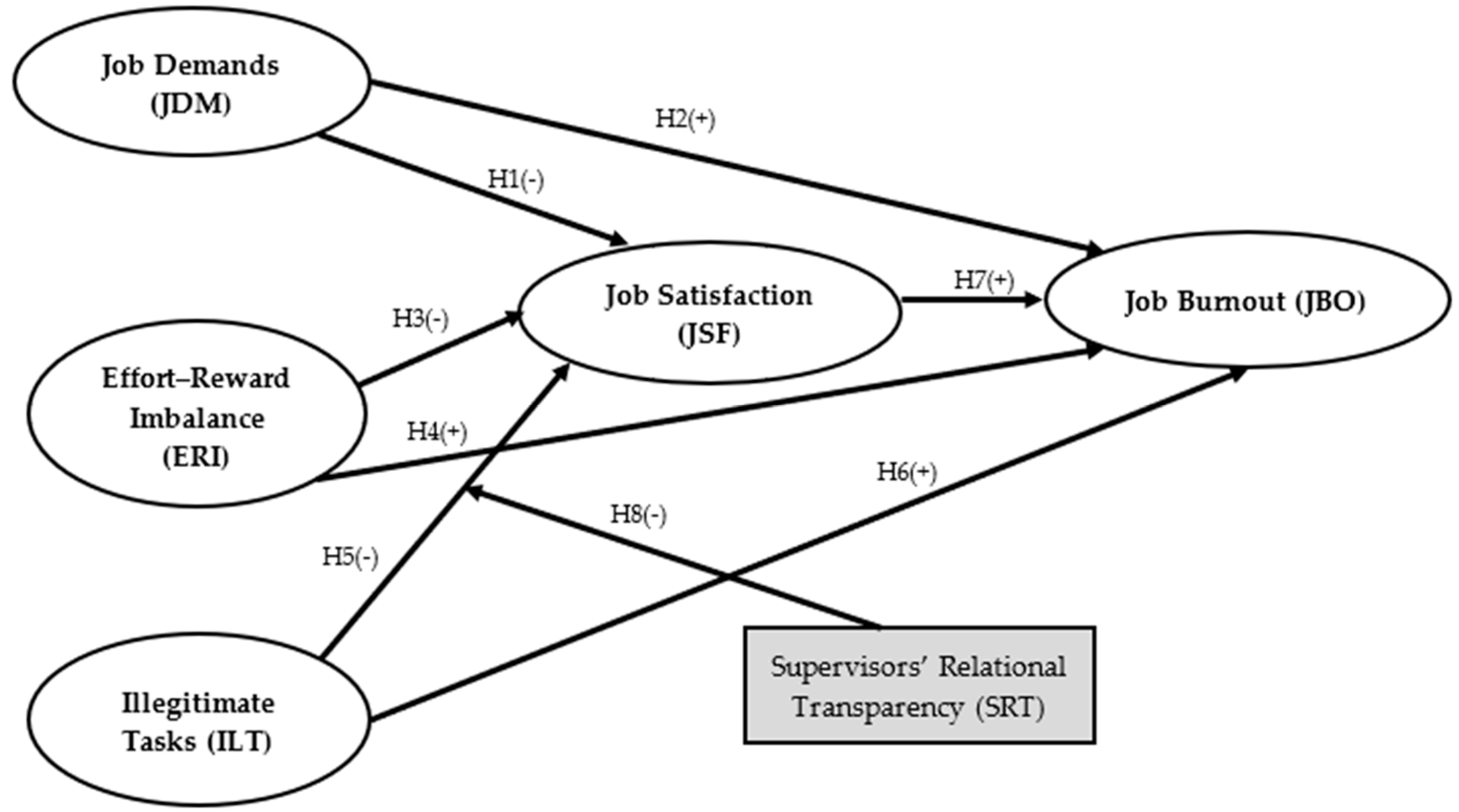
H1. In industrial manufacturing settings, job demands negatively influence job satisfaction.
H2. In industrial manufacturing settings, job demands positively influence job burnout.
2.3. Effort–Reward Imbalance, Job Satisfaction, and Job Burnout
The ERI model posits that stress emerges when employees’ invested efforts are not matched by adequate rewards regarding income, career advancement, or job security [
14]. Overcommitment leads employees to perceive the rewards they receive as not worth the fatigue, potentially increasing the risk of chronic stress. There is some empirical evidence to support this; for example, Ge et al. [
15] found that ERI affected satisfaction and engagement among health personnel. Similarly, Kuper et al. [
16] note that inadequate rewards are associated with stress and have negative health effects. Additionally, Alvarado et al. [
17] state that excessive effort directly contributes to emotional burnout, particularly among those with high levels of overcommitment.
Despite the strength of ERI as a theoretical model, supporting evidence remains very limited in the industrial context, particularly in developing countries such as Thailand, where, in the EEC, much of the labor force works long hours with low security and high expectations of efficiency. This may lead to more severe effects than in other occupations. In industrial contexts, effort–reward imbalance is frequently experienced not only through pay but also through limited advancement opportunities and perceived stagnation within rigid hierarchical systems.
Hence, we propose the following hypotheses:
H3. In industrial manufacturing settings, effort–reward imbalance negatively influences job satisfaction.
H4. In industrial manufacturing settings, effort–reward imbalance positively influences job burnout.
2.4. Illegitimate Tasks as Identity-Related Stressors
ILTs are tasks that should not be included in employees’ roles, or are unnecessary or unreasonable duties that undermine perceived role legitimacy, thereby eroding professional identity [
4,
18]. These tasks can be compared to other identity-related stressors that cannot be fully described by the JD-R and ERI frameworks. This is consistent with the job characteristics theory, which suggests that less meaningful jobs lead to lower levels of satisfaction and well-being [
19].
Some empirical studies, such as that by Omansky et al. [
20], report that ILTs negatively affect job satisfaction. Likewise, Ouyang et al. [
21] found that unreasonable tasks increased burnout through a sense of role violation. However, because most of these studies were conducted in Europe or China, it is unclear whether the same results would hold in the context of Thai labor, particularly in the EEC, which has more structural limitations.
Hence, we propose the following hypotheses:
H5. In industrial manufacturing settings, illegitimate tasks negatively influence job satisfaction.
H6. In industrial manufacturing settings, illegitimate tasks positively influence job burnout.
2.5. Job Satisfaction as a Predictor of Burnout
Most prior research has found a negative relationship between job satisfaction and burnout, with studies conducted primarily in sectors such as healthcare, education, and public services reporting that job dissatisfaction predicts higher levels of burnout (e.g., Yu-Hsia and Mei-Hsiang [
22], Wang et al. [
23] and Zanabazar et al. [
24]). Despite this evidence from non-manufacturing sectors, studies focusing on the manufacturing sector, particularly in developing countries such as Thailand, are quite limited. Job characteristics in this sector include high structural stress, e.g., routine work, shift work, and strict manufacturing goals, which tend to reduce job autonomy and perceived work meaningfulness, thereby lowering job satisfaction and increasing vulnerability to burnout.
Hence, we propose the following hypothesis:
H7. In industrial manufacturing settings, job satisfaction negatively influences job burnout.
2.6. Supervisor Relational Transparency as a Moderating Mechanism
In the context of employee well-being and burnout, this study focuses on supervisors’ relational transparency in communication, as supervisors play a critical role in shaping how employees perceive and respond to work-related stressors, including unfair or illegitimate task assignments. Supervisor relational transparency can strengthen trust, perceptions of fairness, and job satisfaction despite the presence of demanding work conditions. Wong and Laschinger [
25] found that supervisor relational transparency positively affected job satisfaction, whereas Giallonardo et al. [
26] and Qureshi et al. [
27] reported that transparent and sincere communication could reduce the negative effects of work pressure.
In industrial environments, such as the EEC, which involve a high number of ILTs, supervisors who exhibit communication transparency may be able to significantly mitigate the negative effects on job satisfaction.
Hence, we propose the following hypothesis:
H8. In industrial manufacturing settings, supervisor relational transparency negatively moderates the relationship between illegitimate tasks and job satisfaction.
Although previous studies have described the effects of job demands, ERI, and ILT separately from employees’ behavioral outcomes, these studies did not describe the “common cause mechanisms” of job demands, ERI, and ILTs on burnout in an industrial context such as the EEC, and lack the integration between quantitative and qualitative data needed to understand employees’ real experiences. Thus, an integrated causal model was introduced in this study to fill this gap.
Based on the reviewed literature, we developed a conceptual framework that integrates the structural pressures of work, ERI, and ILTs, along with the transmitted and supervisory roles, to examine the occurrence of burnout in Thai industries (
Figure 1).
3. Methodology
We employed an explanatory sequential mixed-methods design based on the concepts of Creswell and Creswell [
28] and Tashakkori and Teddlie [
29]. First, a quantitative method was used to assess both work- and organization-related factors affecting burnout. Next, a qualitative approach was used to deepen understanding and develop burnout prevention strategies aligned with sustainable work practices in the industrial manufacturing context of the EEC. The integration of the results in both phases occurred at two points: (1) connections using the quantitative results as the base to set the interview questions, and (2) the combined results using data from the qualitative approach for interpretation, before adding the meaning of the quantitative method for applicable strategic proposals.
The research was approved by the Kasetsart University Research Ethics Committee, Approval No. COE67/045. The participants received full information about the study and assurance that their identities would not be disclosed in the research report, and provided informed consent.
3.1. Phase 1: Quantitative Examination of the Determinants of Job Burnout
The population for the quantitative part of the study comprised employees from large manufacturing plants in the EEC, a key industrial region characterized by high work intensity and ongoing concerns regarding labor sustainability. Large manufacturing plants were defined by ministerial regulations as having registered capital exceeding THB 200 million and ≥200 employees, encompassing a total of 242,187 employees [
30].
The sample size was set based on the criteria of Hair et al. [
31], who suggested using a sample size of at least 20 times the number of observed variables. In the model for this research, 16 observed variables were included. We also used the criteria of Kline [
32] and Hair et al. [
33], according to which a sample of 400–500 participants can reduce sampling error and significantly enhance model stability. These criteria indicate that the achieved sample size of 504 respondents is adequate for the estimation and evaluation of the proposed covariance-based SEM. A formal post hoc power analysis was not conducted, as the achieved sample size exceeded established benchmarks for covariance-based SEM and provided sufficient statistical power for stable parameter estimation. All data were collected between June and August 2025.
Proportional stratified sampling was used to obtain the proportion of representatives from each industrial group that was consistent with the population structure. Then, multi-stage sampling was used to select the subject plants at each stage. Simple random sampling was used to select employees. This sampling approach was designed to reduce sampling bias and increase representativeness.
We used a questionnaire developed from theories and standard instruments, consisting of latent variables, i.e., “Job Burnout” [
34], “Job Demands” [
10], “Effort–Reward Imbalance” [
2], “Illegitimate Tasks” [
3], “Job Satisfaction” [
35], and “Supervisor Relational Transparency” [
36], as well as others from additional relevant studies.
Content validity was assessed by five experts. All variables had IOC values > 0.70, which is acceptable for psychometric practice [
37]. Reliability testing with a pilot sample of 30 participants yielded a Cronbach’s α of 0.801–0.966, indicating excellent reliability according to Nunnally and Bernstein’s criteria [
38].
We employed a process approach to mitigate common method bias (CMB) by using an anonymous questionnaire with random question order. We also used Harman’s Single-Factor Test to detect CMB, with results showing that the single factors accounted for 39.584% of the variance, indicating that CMB was unlikely to influence the validity of the findings [
39]. As for the test results using the Common Latent Factor, the maximum difference in regression coefficients before and after controlling for common method variance was 0.05, which was below the criterion of 0.20. This implied that CMB did not significantly affect model stability [
40]. Both methods were used to provide complementary and more robust assessments of common method bias.
Descriptive statistics were used to examine the primary data, followed by exploratory factor analysis (EFA) and confirmatory factor analysis (CFA) to analyze the structure of the variables. Covariance-based analysis was used for the equation model because the model was developed based on unambiguous theories, with the objective of testing causal model fit and the confirmatory measurement model using AMOS. The model fit criteria were χ
2/df ≤ 3, CFI ≥ 0.90, and RMSEA ≤ 0.08. These are the standard values for evaluating theoretical model fit [
32,
33,
41].
Although alternative mediation structures were conceptually considered, such as treating burnout as a mediator between work-related stressors and job satisfaction or testing partial mediation models, the present study adopts a theory-testing design with explanatory extension. In this study, burnout is treated as a cumulative strain outcome arising from prolonged exposure to structural, exchange-based, and identity-related stressors rather than as an intermediate psychological process variable. In contrast, job satisfaction represents an evaluative mechanism through which employees cognitively and affectively assess the legitimacy, fairness, and value of their work roles. Modeling burnout as a mediator would therefore risk conflating evaluative judgments with downstream strain outcomes, reducing conceptual clarity within the stress-as-offense-to-self framework, which explicitly distinguishes evaluative threats to the self from downstream strain reactions.
3.2. Phase 2: Development of Burnout Prevention Strategies (Qualitative Phase)
The qualitative phase of the study was conducted after the analysis of the quantitative results and aimed to deepen understanding of the quantitative results and to identify contextual factors that could not be fully captured by the questionnaire, according to the principles of the explanatory sequential mixed-methods model. Purposive sampling was used to select 10 informants with direct experience of burnout in the industrial sector, i.e., plant executives, HR executives, and employee representatives. The number of informants was sufficient for thematic analysis, based on theoretical saturation criteria, which typically occur with a sample size of 6–12 informants [
42]. The informants represented multiple organizational levels (executive, HR, and employee representatives), allowing theoretical saturation across perspectives rather than relying solely on sample size. This indicated sufficient theoretical coverage of the burnout mechanisms.
Semi-structured interviews and non-participant observation were used to collect data that revealed real work conditions in plants. The interview guidelines were developed from the quantitative results, and the JD-R and ERI theoretical frameworks were used to elicit informants’ experiences of job demands, job satisfaction, illegitimate tasks, reward systems, and relationship patterns with supervisors. Each interview took 30–45 min, and was conducted in plants within the EEC during June–August 2025.
Thematic analysis was used to examine the qualitative data, following the approach of Braun and Clarke [
43]. Interviews focused on informants’ experiences of work demands, illegitimate tasks, reward structures, and supervisory practices rather than directly eliciting predefined strategies. Burnout prevention strategies were subsequently derived by synthesizing recurring themes that reflected key sources of burnout and translating these themes into practical preventive approaches. To strengthen data trustworthiness, related measures, i.e., member checking, peer debriefing, audit trails, and triangulation, were also implemented. This helped to synthesize strategies for preventing burnout using the empirical evidence, in line with the Thai industrial context. Data triangulation was conducted using interview data, observational data, and quantitative findings from the preceding survey phase to reduce potential bias arising from reliance on a single data source. Thus, the findings were trustworthy and accurately depicted the informants’ experiences.
3.3. Phase 3: Evaluation of the Proposed Strategies
In the final stage, all 10 experts, entrepreneurs, and HR executives evaluated the appropriateness of the developed burnout-prevention strategies using expert judgment against three criteria: relevance, feasibility, and practical utility. The evaluation used a rating scale. The evaluation was conducted using a five-point Likert-type rating scale, ranging from 1 (very low) to 5 (very high). The mean, standard deviation, and content interpretation were used for data analysis to summarize the opinions of the experts and to adjust suitable strategies for real use in the Thai industrial sector. This phase served as an expert validation step.
4. Results
4.1. Demographic Profile
Of the total quantitative sample of 504 respondents, 51.4% were male, and 48.6% were female. Most were 30–39 years old (50.2%), followed by 40–49 years old (26.8%). Most were single (55.2%) and had graduated with a bachelor’s degree (85.1%).
For the economic situation-occupations category, the most common average income among the informants ranged from THB 20,001 to 30,000 (38.3%). The majority were employees (77.0%), reflecting the predominance of operational-level labor in large manufacturing plants. The informants were distributed across several departments, i.e., HR (19.6%), marketing (15.7%), IT/information (15.7%), and finance/accounting (14.7%), revealing the diversity of the work fields within the subject large plants. The largest group of informants worked in the electrical appliances and equipment industry (21.8%), including the automotive and parts industry (20.8%). This is consistent with the EEC’s primary economic structure.
4.2. Measurement Model Results
Item parceling was conducted before the measurement model analysis, but only unidimensional latent variables were considered in the parceling to reduce model complexity and increase estimation stability [
32,
44]. Parceling was applied only to theoretically unidimensional constructs to preserve construct interpretability. This decision was empirically supported by high and homogeneous factor loadings within each parceled construct, indicating unidimensionality and justifying item aggregation to enhance model parsimony and estimation stability.
For the measurement model evaluation, the CFA model fit included χ
2/df = 1.803, CFI = 0.988, NFI = 0.973, GFI = 0.961, IFI = 0.988, TLI = 0.984, RMSEA = 0.040, and RMR = 0.023. Based on the criteria, these values were good, implying that the model was appropriate [
33,
41] (
Table 1). These values indicate good model fit, suggesting that the hypothesized relationships adequately represent the observed covariance structure and that the proposed model is theoretically and empirically acceptable. All indicators had factor loadings between 0.61 and 0.94, exceeding the minimum threshold of 0.50, indicating convergent validity [
33]. Reliability coefficients (Cronbach’s α) ranged between 0.801 and 0.966. Composite reliability (CR) ranged from 0.759 to 0.950, indicating that all variables exceeded the criterion of 0.70 and reflecting adequate measurement reliability [
33]. AVE ranged from 0.520 to 0.872, exceeding the threshold of 0.50, implying that the latent variables contained good internal congruence [
45] (
Table 1).
With respect to illegitimate tasks, the construct was measured using two theoretically grounded items drawn from established scales. While this limited number of indicators may constrain construct coverage, the high factor loadings and reliability estimates observed in the measurement model suggest adequate measurement quality for theory-testing purposes. This limitation is therefore acknowledged and discussed as an avenue for future scale refinement.
Regarding discriminant validity, the results of the Fornell–Larcker criterion indicated that the square root of the AVE for each variable was greater than the correlations with other variables [
45] (
Table 2). HTMT ranged from 0.269 to 0.576, below the threshold of 0.85. Thus, the model clearly demonstrated discriminant validity [
46], indicating clear conceptual differences among the variables (
Table 3).
4.3. Structural Model Results
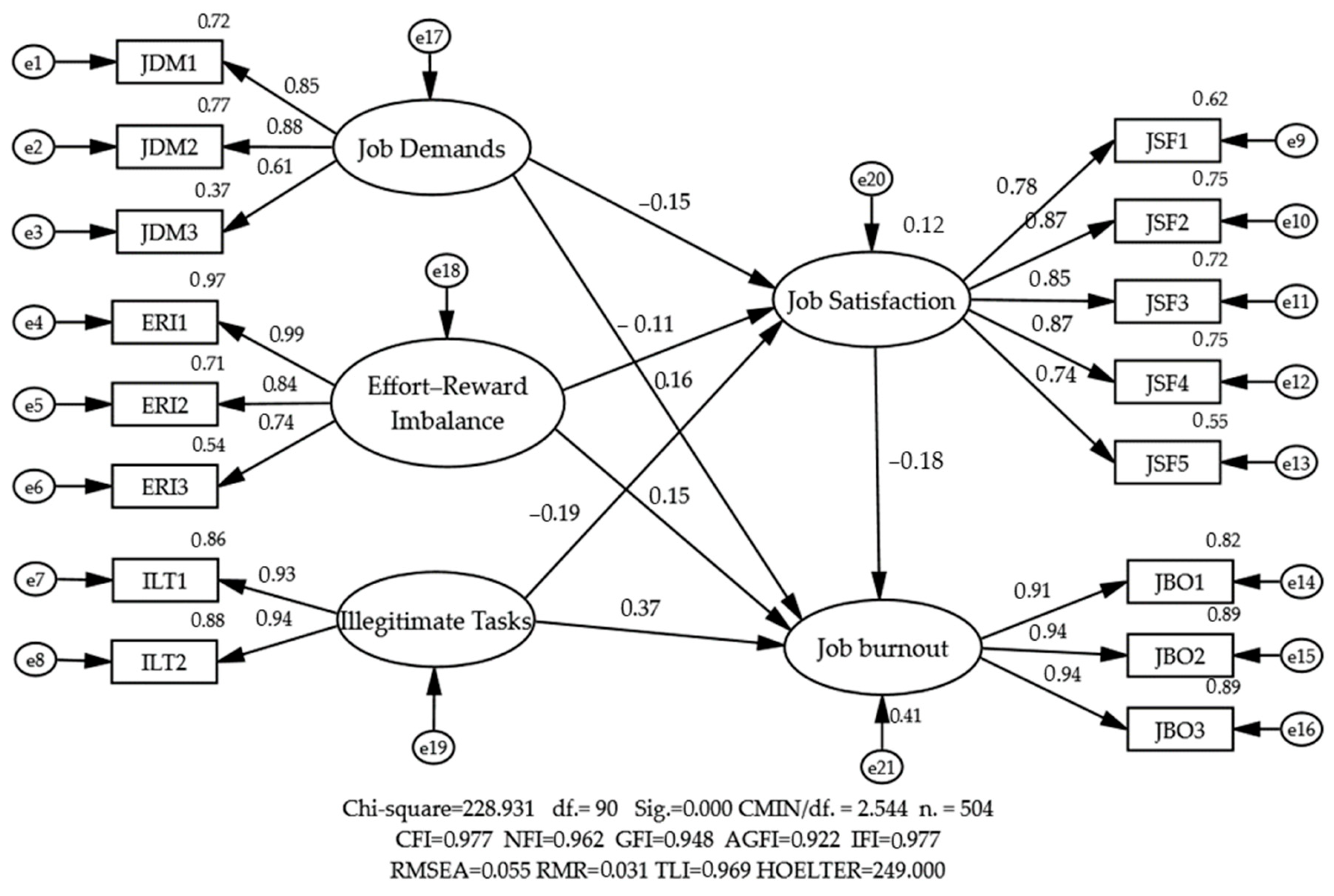
Figure 2 illustrates the structural model used in this study, consisting of five latent variables: job demands (JDM), job satisfaction (JSF), illegitimate tasks (ILT), effort–reward imbalance (ERI), and job burnout (JBO), with 16 observed indicators. Supervisor relational transparency (SRT) was modeled separately as a moderating variable through an interaction term rather than as a core latent construct. After minor theory-consistent modifications guided by the modification indices, and without altering the hypothesized causal structure, the final model demonstrated a satisfactory level of fit. The Chi-square value was 228.931 with 90 degrees of freedom, and the CMIN/df ratio of 2.544 falls within the acceptable range.
In addition to these statistics, the other fit indices also confirmed that the model performs well (CFI = 0.977, GFI = 0.948, RMSEA = 0.055, NFI = 0.962, IFI = 0.977, RMR = 0.031, TLI = 0.969, and Hoelter = 249). All values meet commonly accepted cut-off criteria.
Table 4 displays the path coefficients of the structural model, including the interaction effect between illegitimate tasks and supervisor relational transparency.
According to the results, ILT influenced JBO the most (β = 0.37, p < 0.001), followed by JDM (β = 0.16, p < 0.001) and ERI (β = 0.15, p < 0.001). JSF directly and negatively affected JBO (β = −0.18, p < 0.001), implying that JSF can relieve the effects of work pressure. In addition, the results show that SRT plays a meaningful moderating role in the relationship between ILT and JSF (β = −0.11, p = 0.014). Specifically, higher levels of transparent communication from supervisors help attenuate the detrimental effects of illegitimate tasks on employees’ job satisfaction.
Regarding the dependent variables, the results indicated that the model explained their variance at acceptable levels. Specifically, the R
2 value for JBO (0.41) indicates moderate explanatory power, whereas the R
2 value for JSF (0.12) reflects a modest but acceptable level of explanatory power for attitudinal outcomes in organizational research [
33]. These results demonstrate that the model has adequate explanatory capacity for burnout-related outcomes and suggest that burnout in industrial settings reflects not only individual strain but also structural conditions relevant to workforce sustainability.
4.4. Qualitative Findings: Mechanism-Based Burnout Prevention Strategies
To gain a deeper understanding of employees’ lived experiences of burnout within industrial work systems, in-depth interviews were conducted with key informants at the executive, supervisor, and employee levels in the manufacturing industry. Based on the mechanisms identified in the quantitative phase, the SEM results were used to guide the development of interview questions and to structure the classification of burnout prevention strategies into three interconnected levels: individual, supervisory, and organizational.
The informants expressed similar reflections, noting that they perceived meaningful work with continuous opportunities for development functions as a key factor in mitigating exhaustion and burnout. Employees tend to maintain their work motivation if they see opportunities for learning and future career advancement, even under high work pressure.
One informant stated the following:
“Receiving an opportunity from the organization to learn new skills and performing meaningful work create job satisfaction as well as motivation.”
Likewise, executives noted that investment in personnel capacity development encourages employees to feel they are growing alongside the organization, which can reduce the risk of burnout in the long term.
- 2.
Supervisory-level strategies: Supervisor relational transparency and emotional support.
The results of the analysis indicated that open communication with supervisors, listening to employees’ opinions, and creative suggestions are all crucial mechanisms that reduce work stress. The informants stated that transparent and accessible supervisors can provide employees with psychological safety and trust in the workplace.
One employee reflected as follows:
“Open communication from supervisors assures us that our voices are heard and significantly reduces stress.”
Additionally, emotional support from supervisors, e.g., counseling and demonstrating understanding of employees’ problems, can reduce isolation and accumulated pressure, both of which are factors associated with burnout.
- 3.
Organizational-level strategies: Flexible and fair work design for sustainable work systems and reduced illegitimate tasks.
The informants emphasized the significance of fair and unambiguous work systems, particularly rewards and incentives, job allocation, and transparent evaluations that conform to employees’ efforts, which can reduce the feeling of unfairness, a factor that contributes to burnout.
An informant from an administrative unit pointed out the following:
“We have a transparent evaluation system to assure our employees that their effort is evaluated fairly.”
In the meantime, using technology and automated systems to reduce redundant tasks, along with setting unambiguous roles and duties, can reduce illegitimate tasks and enhance work efficiency. One employee provided the opinion below:
“Technology can reduce redundant tasks and can help us work faster, which gives us time to focus on more important jobs.”
Furthermore, flexibility and appropriate relaxation time are viewed as structural conditions of work–life balance and reduce the risk of burnout.
The qualitative findings indicate that effective burnout prevention in industrial settings extends beyond individual coping and depends on the sustainability of supervisory practices and organizational work design.
4.5. Integrated Interpretation of the Quantitative and Qualitative Results
The qualitative results described the internal mechanisms linking job demands, resources, and burnout in the Thai industrial context across three analytical levels. These findings further explain how the identified mechanisms are translated into multi-level burnout prevention strategies in the Thai manufacturing context (
Table 5).
Individual level: The qualitative data reflected that perceived meaningful work and continuous development opportunities act as psychological resources, i.e., job resources that mitigate the effects of high work pressure. This mechanism was revealed by the SEM results, which found that job satisfaction was negatively related to burnout, particularly emotional exhaustion. To illustrate, clear goals and advancement opportunities can sustain employees’ motivation and mental stamina in the long term despite heavy workloads and high expectations.
Supervisory level: The qualitative results indicated that supervisor relational transparency, open communication, and emotional support act as relational job resources, reducing accumulated stress and strengthening psychological safety. This mechanism is described in the quantitative results, which revealed that, although job demands and effort–reward imbalance increased burnout, reachable supervisors and sincere support could reduce this negative effect, consistent with the moderating role of supervisor relational transparency identified in the SEM analysis.
Organizational level: The qualitative data demonstrated that through fair, transparent, and flexible design, particularly regarding evaluation, rewards and incentives, and specifying roles and duties, effective HR management can play a significant role in reducing feelings of unfairness and ambiguous work. It is a crucial mechanism connected to the quantitative results, which found that illegitimate tasks and ERI positively affected burnout. Furthermore, using technology and automation to reduce redundant tasks can lead to fewer structural job demands, resulting in increased effort on valuable jobs and a closer fit with employees’ roles.
The integrated findings indicate that burnout prevention in industrial settings cannot be addressed by a single intervention but requires the alignment of resources across the individual, supervisory, and organizational levels. This multi-level alignment reflects the sustainability of industrial work systems, in which employee well-being is maintained through coherent work design, supervisory practices, and organizational structures. The integration of quantitative and qualitative findings confirms and extends the JD-R and ERI model framework in the Thai industrial context.
5. Discussion
Burnout in industrial settings cannot be fully understood when it is conceptualized primarily as a workload-driven outcome [
1]. In industrial settings characterized by intensive production systems and rigid hierarchies, burnout emerges from the convergence of structurally embedded pressures that shape how work is assigned, evaluated, and experienced. Rather than operating as isolated stressors, job demands, ERI, and illegitimate tasks interact to produce a qualitatively different form of strain—one rooted in ambiguous role boundaries and diminished role legitimacy. From a sustainability perspective, burnout in industrial settings reflects not only individual strain but also underlying deficiencies in work design that have implications for social sustainability. The accumulation of workloads, unfair exchange practices, and violations of job roles reflect labor management practices inconsistent with the principles of decent work and may contribute to the long-term devaluation of human resources. In this context, burnout can serve as an early warning indicator of fragile work design systems and declining workforce sustainability.
Consistent with the JD-R framework, the results demonstrate how job demands undermine employee well-being in industrial settings. However, this research extends JD-R by showing that some types of pressure are not “tasks” but are related to identity and dignity in work roles, with ILTs being the most powerful predictor of burnout in the model [
3,
4]. By foregrounding ILTs, our findings introduce the stress-as-offense-to-self perspective into OB scholarship and demonstrate its relevance beyond interpersonal mistreatment to routine work design in industrial hierarchies. From an applied perspective, this implies that burnout prevention efforts must address how tasks are allocated and justified, rather than focusing solely on workload reduction.
These results also point to effort–reward imbalance as a systematic source of strain [
2], reflecting fragile evaluation and reward systems in industrial organizations. This relationship implies that perceived unfairness or injustice in the exchange dimension can intensify burnout, even when employees are temporarily able to cope with high workloads.
Job satisfaction emerged as a key psychological mechanism linking work pressures to burnout, indicating that burnout is not merely a direct effect of job demands but also reflects employees’ evaluations of the legitimacy and value of their work experiences [
6,
47]. Theoretically, this suggests that burnout is not merely an outcome of excessive demands but a response to how employees evaluate the legitimacy and worth of their work roles. From a practical standpoint, job satisfaction can serve as an early attitudinal signal of burnout and, by extension, a leading indicator of declining workforce sustainability in industrial organizations.
Beyond these direct and mediated relationships, the findings point to the situational importance of supervisor relational transparency in shaping employees’ responses to ILTs. The observed moderating effect suggests that transparent communication from supervisors can soften the adverse impact of illegitimate task assignments on job satisfaction. When supervisors provide task rationale, acknowledge the legitimacy of employees’ roles, and engage in open communication with employees, they have an opportunity to help employees understand why a particular task was assigned, which may otherwise be viewed as an illegitimate request. From a stress-as-offense-to-self perspective, supervisor relational transparency functions as a signal of respect, helping to reduce identity-based strain even when structural task violations cannot be fully avoided.
In hierarchical industrial environments, where task reallocation is commonly treated as part of everyday operational practice, such relational processes become particularly important for maintaining employees’ sense of role legitimacy and the perceived value of their work.
We argue that burnout in industrial hierarchies cannot be adequately explained by workload or reward imbalance alone. By foregrounding ILTs as identity-based stressors, this study reframes burnout as a response to violations of role legitimacy embedded in work design rather than merely an accumulation of demands [
4,
5]. Therefore, burnout can serve as a health indicator for workers, but it can also serve as a warning sign of unsustainable ways of designing work in industrial organizations at the system level.
In terms of applying the research findings to other contexts, it is important to distinguish between context-specific and general explanatory elements. Contextual characteristics of industrial organizations in Thailand, particularly in the EEC area, such as hierarchical structures, overtime culture, and limited career advancement opportunities, are context-specific factors that may influence the level and pattern of burnout and may not directly transcribe to contexts with different labor structures. However, the mechanism of stress arising from identity and role legitimacy violations through illegitimate tasks has the potential to explain burnout in a broader context. The perception of assigned tasks as inappropriate or illegitimate can occur in organizations with diverse management styles and work structures. Distinguishing between contextual factors and underlying explanatory mechanisms helps us to understand the scope of research applications and highlights the potential theoretical value of these findings in understanding identity-based stress and burnout in different organizational contexts.
6. Theoretical Implications
This research does not treat all stressors as simply additional to one another; instead, it views ILTs as an entirely different form of qualitative stressor that will also impact how we conceptualize burnout in an industrial OB context. JD-R, ERI, and ILTs were integrated into a single model. The results extend the JD-R and ERI frameworks by focusing on identity-related stressors, which have received limited attention in industrial contexts. These findings call for burnout models that explicitly integrate work structures with employees’ evaluations of work value, particularly in industrial contexts characterized by fixed hierarchies and narrowly defined roles. The findings further suggest that the impact of identity-based stressors varies depending on the relational context in which they are experienced. In particular, supervisor relational transparency appears to shape how employees interpret the legitimacy of their roles, suggesting that burnout models should consider not only structural sources of strain but also the communicative processes through which work demands are understood. From a theoretical perspective, these insights position burnout not only as a stress outcome but also as an indicator of the sustainability of industrial work systems, highlighting how persistent violations of role legitimacy can undermine the long-term viability of industrial work arrangements.
This study extends the JD-R and effort–reward imbalance frameworks at three distinct levels. First, at the conceptual level, the research proposes viewing burnout not merely as a result of workload or resource imbalance, but as an identity-based sustainability signal reflecting a violation of the legitimacy of job roles and values within the structured work system. Second, at the explanatory level, structural analysis reveals that illegitimate tasks have a more severe and consistent influence on burnout than job demands and effort–reward imbalance. This finding suggests that stress mechanisms in industrial contexts are not solely due to workload or exchange unfairness, but are closely tied to employees’ perceptions of task appropriateness and role legitimacy. Finally, at the contextual level, the research extends the JD-R and ERI frameworks to the context of hierarchical industrial organizations in developing countries, particularly the manufacturing sector in Thailand’s Eastern Economic Corridor (EEC), where routine work patterns and structural controls, combined with limited opportunities for advancement, render illegitimate tasks a salient form of identity pressure embedded in job design. These findings suggest that contemporary work stress theory needs to consider structural and socio-economic contexts that are different from the Western or service sector contexts that formed the basis of previous research.
7. Practical Implications
To promote the sustainability of industrial work systems, organizations should focus on creating clear role expectations and defining task responsibilities (particularly when informal negotiations occur via hierarchy). Regarding work design, organizations will likely achieve greater success in developing sustainable work systems by periodically reviewing job descriptions and task assignments to determine whether employees’ formally assigned job roles align with their work demands. Supervisors play a critical role in legitimizing task assignments by explaining task rationale, aligning assignments with formal job roles, and recognizing employees’ contributions. At the organizational level, transparent evaluation and reward systems that acknowledge both task completion and role-consistent contributions can further reduce the risk of burnout associated with illegitimate task assignments. Such practices support not only short-term burnout prevention but also the long-term sustainability of industrial work systems by preserving employees’ sense of role legitimacy and work value.
8. Policy Implications
At the sectoral level, industrial development initiatives such as the EEC may benefit from incorporating workforce well-being indicators—such as role clarity, workload sustainability, and reward transparency—into organizational assessment frameworks. Policy frameworks that encourage firms to adopt role clarity standards, transparent reward practices, and work–life balance guidelines can support both employee sustainability and long-term industrial performance.
At the policy level, this study highlights the need for governance tools that prioritize workforce sustainability alongside productivity. Relevant agencies could integrate workforce well-being indicators into investment incentives, ESG assessments, or labor audits, thereby expanding the focus from regulatory compliance to the evaluation of job design quality, particularly in terms of role clarity, workload sustainability, and task legitimacy. Indicators related to role clarity, workload sustainability, and a reduction in illegitimate task assignments may serve as key performance indicators (KPIs) for organizations operating in industrial zones. Such policy tools could position burnout prevention as a shared responsibility within broader governance frameworks for long-term industrial sustainability.
9. Limitations and Suggestions for Future Research
This study was conducted among employees in the manufacturing industry in Thailand. As a consequence, the findings should be interpreted with caution and may not be directly generalizable to other industries or other areas with different cultural and labor conditions. Furthermore, self-evaluation forms and cross-sectional research may introduce self-report bias and limit the ability to draw definitive causal conclusions. For these reasons, future research should collect multi-source or longitudinal data to understand burnout dynamics, including comparisons across industries, and should evaluate whether the mechanisms of ILTs and ERI are the same or different in other contexts. Future research may also examine how burnout functions as an early indicator of workforce sustainability and how changes in work design over time influence the long-term viability of industrial work systems.
One methodological limitation of this study is that illegitimate tasks were measured using only two items, which may not fully reflect the construct coverage compared to measures with more items. However, these items were developed from accepted and widely used measurement scales in previous research, and the empirical results demonstrated high reliability and construct validity, indicating the adequacy of the measurement. Future research should consider expanding the number of items to cover a wider range of illegitimate tasks or using qualitative research to refine measurement instruments that are more relevant to the industrial work context. This would enhance understanding of how illegitimate tasks contribute to burnout and workforce sustainability over time.
10. Conclusions
This study demonstrates that illegitimate tasks emerge as the most influential predictor of burnout, compared to job demands and effort–reward imbalance, within the examined industrial organizational context. The research indicates that burnout is not solely caused by workload or unfair exchange practices, but is fundamentally rooted in violations of the legitimacy of employee roles and identities embedded in job design.
From a sustainability perspective, burnout can be understood as an early warning signal of weaknesses in human capital sustainability and work system design, rather than merely a personal health problem. Persistent deficiencies in job design and role allocation reflect the fragility of workforce management practices and may gradually undermine long-term human capital sustainability, with significant implications for social sustainability and decent work in the industrial sector.
In practical and policy terms, this research emphasizes that effective burnout prevention requires attention to clear, equitable, and role-consistent job design, as well as the establishment of policies and regulatory mechanisms that consider workforce sustainability alongside productivity, at both the organizational and industrial levels.