


Abstract
Integrating renewable energy sources into modern power grids enhances sustainability but reduces the inherent inertia provided by synchronous generators, leading to larger frequency fluctuations and degraded dynamic stability. To address this issue, this paper proposes an advanced inertia-damping emulation (IDE) strategy based on a coordinated hybrid energy storage system (HESS) comprising supercapacitors (SCs) and fuel cell-battery-based hybrid electric vehicles (FC-BHEVs) for frequency regulation in low-inertia power grids. SCs provide fast virtual inertia support owing to their high-power density, whereas the FC-BHEVs provide virtual damping support through sustained power compensation. A supplementary integral controller is further incorporated to restore the system frequency to its nominal value and overcome the limitations of primary frequency control. The proposed framework also considers communication time delays and practical power and energy constraints in the frequency-control process. The proposed strategy is evaluated in an islanded microgrid under renewable penetration, load disturbances, and parameter uncertainties, and is further validated in an interconnected two-area multi-source power system under generation outages, random load variations, renewable power fluctuations, and communication delays. MATLAB simulation results demonstrate that the proposed HESS-based strategy achieves superior frequency regulation, reduced frequency deviations, improved damping, faster recovery, and enhanced inter-area power exchange stability compared with conventional inertia emulation and IDE methods, demonstrating its effectiveness and robustness for enhancing the frequency stability of future renewable-dominated power grids.
1. Introduction
The growing penetration of renewable energy sources (RESs) such as photovoltaic (PV) and wind power necessitates the use of power electronic converters as an interface with the modern power grid [1]. However, conventional converters lack inherent grid-supporting capabilities like inertia provision and primary/secondary frequency regulation. This deficiency exacerbates frequency stability challenges, particularly in microgrids (MGs) with high RES penetration, where significant frequency fluctuations can occur, threatening the stability of grid operation [2].
To address frequency stability issues in low-inertia MGs, numerous studies have proposed an inertia emulation (IE) concept that is supported by diverse energy storage systems (ESSs) [3,4,5,6,7,8,9,10,11]. Battery-based IE control strategies have been proposed to enhance the frequency stability of MGs in [3,4]. While batteries offer high energy density, their limited power density can pose a significant challenge in meeting power demands during transient conditions. In [5,6], flywheel ESSs are used to provide additional inertia to the grid by utilizing the stored energy in their mechanical parts. Nevertheless, they are associated with drawbacks including a relatively high rate of self-discharge and high maintenance costs, which limit their suitability in the face of frequent events requiring long-term power support or significant energy capacity [7]. DC-link capacitors coupled with a voltage source converter can be considered an inherent ESS. This is because they behave analogously to the rotational inertia of a conventional synchronous generator (SG) [8,9]. Similarly, in [10], the voltage of supercapacitor (SC) energy storage has been proportionally linked to the MG frequency to boost system inertia in accordance with permissible SC voltage variation. However, the limited voltage fluctuation range of both the DC-link and the SC restricts their ability to provide sufficient transient energy during cascaded frequency excursions. Additionally, an IE control strategy utilizing a superconducting magnetic energy storage (SMES) system for islanded MGs is proposed in [11]. Although both SC energy storage and SMES offer a high-power density, making them suitable for IE, their low energy density limits their ability to support long-term power deviation (i.e., damping emulation). To this end, it is challenging for either long-term ESSs like batteries or short-term ESSs like SC and SMES to independently provide effective frequency support [12]. This is because maintaining stable grid frequency requires a combination of high power and high energy densities, which is not viable to achieve with a single ESS.
Therefore, to mitigate the limitations associated with utilizing a single ESS, hybrid energy storage systems (HESSs) have gained significant attention [13,14]. Incorporating SMES and batteries exhibits complementary attributes, making their combination in a HESS an effective solution for frequency regulation purposes [15]. This hybrid configuration can result in an ideal ESS, characterized by high energy density, high power density, and extended cycle life; however, its practical deployment is constrained by the high capital cost of SMES [16]. A novel application of HESS is presented in [17], where a power management scheme is proposed to emulate the behavior of a real SG. Further studies in [18] demonstrate the effectiveness of an energy management system in improving frequency stability by efficiently allocating power across various scenarios. However, these studies have overlooked the impact of high RES penetration in MGs under consideration. Additionally, while they focus on developing power-sharing algorithms for HESS to prolong battery lifespan, they rely heavily on external ESSs, which can impose high system costs. In [19], an improved virtual SG (VSG) is proposed with the purpose of decreasing ESS capacity. However, this improvement relies on additional energy recovery control at the expense of degraded grid frequency stability support. Among the various HESS configurations, the combination of SCs and electric vehicle (EV)-based batteries is particularly attractive because of their complementary power and energy characteristics. SCs provide high power density and rapid charging/discharging capability, making them suitable for fast transient and inertial support, whereas EV batteries provide higher energy capacity and can therefore contribute to sustained power support. Previous studies have demonstrated the potential of combining SCs and battery-based energy resources in EV and power-system applications. In [20], a fuel cell (FC)-SC–battery-based hybrid EV (HEV) was investigated for virtual synchronous generator control, highlighting the potential of vehicle-based energy resources for providing fast grid-support functions. The complementary characteristics of batteries and SCs for EV applications have also been investigated in [21,22], demonstrating the benefits of combining high-power SCs with high-energy battery storage. These studies establish the technical basis for exploiting SCs and EV-based energy resources as complementary components; however, further development is required to coordinate inertia emulation, damping emulation, and supplementary frequency restoration within a unified control framework while considering practical operating constraints and communication effects.
EVs emerge as a key component in renewable energy systems, offering unique advantages when integrated into MGs. Beyond their primary role as controllable loads, EVs can function as mobile energy storage devices, thereby enhancing grid flexibility and stability. In this sense, several studies have explored the potential impact of EVs equipped with integrated batteries on the frequency stability of MGs [23,24]. Because these EVs already function as energy storage units, the need for additional dedicated storage devices can be significantly reduced. Beyond frequency regulation, EV batteries can serve as multi-service distributed energy storage resources, providing flexibility for multiple grid and energy management objectives. In such applications, appropriate scheduling and coordination are essential for exploiting the available battery capacity while considering operational constraints and the different timescales of battery services. Recent work has investigated two-timescale online optimization of behind-the-meter battery storage for stacked revenue through multiple energy services, demonstrating the importance of coordinating fast and slow battery decisions to simultaneously exploit different service opportunities while managing battery utilization [25]. These developments further highlight the potential of EV batteries as flexible distributed storage resources that can participate in multiple services rather than being dedicated solely to frequency regulation. In the present study, this flexibility is exploited specifically for frequency-support applications, where the vehicle-based energy resource provides sustained damping and supplementary frequency-restoration support within the proposed coordinated IDE framework. Moreover, although previous studies have demonstrated the potential of SC–EV hybrid energy storage for frequency support, the coordinated integration of inertia emulation, damping emulation, and supplementary frequency restoration using vehicle-based HESS, together with delay-aware evaluation under islanded and interconnected operating conditions, remains insufficiently investigated.
In addition to the electrical and control characteristics of battery-based energy storage, battery thermal management is an important consideration for the practical deployment of EV-based energy resources, particularly under high-power and repeated charging/discharging conditions. The operating temperature of lithium-ion batteries significantly affects their performance, reliability, lifetime, and safety; therefore, effective thermal management is essential for maintaining suitable operating conditions. Recent research has investigated advanced liquid-cooling configurations to improve battery thermal performance. For example, the authors of [26] proposed a liquid cooling plate with non-uniform spiral-fin structures, which enhanced heat dissipation and temperature uniformity under high-rate battery operation while maintaining relatively low parasitic power consumption. Such developments highlight the importance of effective thermal management technologies for ensuring the reliable operation of battery-based resources in EVs and energy storage applications. Recent studies have further advanced the understanding and thermal management of lithium-ion batteries from both material characterization and cooling system perspectives. The authors of [27] investigated the anisotropic thermal conductivity of prismatic lithium-ion batteries, providing insights into their internal heat-transfer characteristics. From the cooling system perspective, the authors of [28] investigated direct and indirect liquid cooling using new manifold designs, while an optimization approach was developed for battery thermal management based on thermal-resistance-network analysis and cold-plate arrangement [29]. These studies provide useful insights into the thermal behavior and cooling of power batteries and further emphasize the importance of effective thermal management for reliable battery operation. Nevertheless, the primary focus of the present study is the coordinated frequency-regulation capability of the proposed IDE based on HESS at the power system level. Accordingly, detailed electro-thermal and battery thermal management modeling is beyond the scope of the present work.
Furthermore, FCs, particularly proton exchange membrane FCs (PEMFCs), provide an important energy-conversion technology for HEV and renewable energy applications because of their high energy-conversion efficiency and suitability for sustained power generation. The performance of PEMFCs is strongly influenced by the flow-field configuration within the bipolar plates, which governs reactant distribution, mass transfer, water management, and consequently, the cell power output. Recent research has demonstrated that advanced flow-channel structures can effectively improve PEMFC performance. For example, the authors of [30] investigated non-uniform bluff-body structures embedded in bipolar-plate flow channels and demonstrated that their optimized configurations can regulate the flow field, enhance mass transfer, and improve the uniformity of multiphysical fields within the membrane electrode assembly, thereby improving PEMFC output performance [30]. These developments highlight the importance of appropriate fuel-cell design and flow-field management for achieving reliable and efficient operation of fuel-cell-based energy resources. In the present study, the FC component is incorporated with the EV battery to form FC-battery HEVs (FC-BHEVs), providing complementary energy and power characteristics for sustained frequency-support applications.
Therefore, this paper proposes a decoupled control strategy that coordinates HESS to improve frequency stability in low-inertia grids. SCs are chosen to provide fast frequency support because of their high power density and rapid response. Compared with SMES, they also offer practical advantages, including low maintenance requirements, technological reliability, the absence of cryogenic cooling, and lower implementation costs. The slower and more sustained frequency support requirement is assigned to FC-BHEVs, whose energy characteristics complement the fast response of the SCs. Accordingly, the SCs provide IE to compensate for quick, high-frequency power variations, while the FC-BHEVs provide damping emulation (DE) to address slower and more sustained frequency deviations. Coordinating these two functions forms the proposed HESS-based inertia-damping emulation (IDE) strategy, enabling the system to respond effectively to both short- and long-term power imbalances. Furthermore, as summarized in [31], an analogy exists between the damping characteristics of VSG and the supplementary secondary control action, which is responsible for restoring frequency to its nominal value after a disturbance. In accordance with this conclusion, a supplementary integral controller is incorporated into the damping path of the proposed IDE strategy to restore the frequency to its nominal value following a disturbance. The damping and integral control actions are matched with the FC-BHEVs, taking advantage of their ability to provide sustained power support. The resulting controlled IDE strategy therefore combines fast inertia support, sustained damping, and frequency restoration within a coordinated framework, providing improved frequency regulation, particularly under high RES penetration.
Moreover, to prevent undesirable frequent charging/discharging of the considered energy storage devices and to improve the long-term capability of EV batteries, a suitable deadband is considered with the proposed control strategy. In addition to the islanded MG validation, the suggested controlled IDE framework is also assessed in an interconnected two-area multi-source power system to confirm its scalability and dynamic stability against generation outages, random load variations, parameter uncertainties, and RES changes. The comprehensive assessment examines not only local frequency regulation but also inter-area tie-line power stability under more challenging operating conditions. Although the use of HESSs to separate fast and slow power components has been widely investigated, the proposed framework goes beyond conventional power sharing and energy management schemes by coordinating the available resources according to their specific frequency support functions. Rather than treating the separation of fast and slow dynamics itself as the main contribution, the proposed strategy combines function-oriented inertia and damping allocation with supplementary frequency restoration and non-ideal communication conditions within a unified control framework. The key contributions of this article are summarized as follows.
- A coordinated HESS-based IDE framework is developed in which SCs provide the derivative-based virtual inertia response, while the FC-BHEVs provide sustained virtual damping support, matching the different dynamic requirements of the two frequency support functions.
- An enhanced vehicle energy storage model based on a battery-fuel cell hybrid configuration is incorporated into the proposed framework, providing complementary power and energy characteristics for sustained frequency support applications. The operational constraints are considered in the corresponding HEV model. In addition, supplementary integral control is coordinated with the proposed IDE strategy to achieve frequency restoration while effectively utilizing the available vehicle-based energy resource.
- The damping support mechanism is managed with supplementary integral control, enabling the same framework to address transient damping and post-disturbance frequency restoration without requiring a separate energy recovery controller [19,32].
- Communication latency is explicitly incorporated into the control framework, including separate delay representation in the inertia support and secondary LFC paths of the interconnected system, rather than assuming ideal instantaneous signal transmission.
- The influence of the key control parameters is examined through performance index sensitivity and pole-based stability analysis, while the proposed framework is comprehensively validated in both islanded and interconnected power systems under load disturbances, RES fluctuations, generation outages, parameter uncertainties, and communication delays, demonstrating its robustness, applicability, and scalability under diverse operating conditions.
The paper is organized as follows. Section 2 presents the system configuration for the studied low-inertia MG, including the model of SCs and HEVs. The proposed IDE strategy based on HESS is detailed and analyzed in Section 3. Section 4 demonstrates the effectiveness of the proposed IDE control strategy with/without supplementary integral control technique through simulation results across various scenarios in an islanded MG. Section 5 further investigates the scalability and dynamic stability of the proposed controlled IDE strategy in an interconnected two-area multi-source power system. Finally, Section 6 provides a summary of the key conclusions drawn from the study.
2. System Configuration and Modeling
The test system being studied is an islanded MG that includes a conventional reheat-turbine thermal power plant, RESs (wind and PV), SCs, HEVs, and loads. The conventional reheat-turbine thermal power plant is powered by an SG, which contributes to MG frequency regulation. Furthermore, any imbalance between supply and demand will lead to frequency deviations caused by disturbances that must be regulated by the SG. In this context, the swing equation, which captures the dynamics of the conventional generator through the interaction between inertia and load variations, can be expressed as follows [33]:
where and represent the changes in mechanical and electrical power in per-unit for the SG, respectively, and H denotes the inertia coefficient in per-unit, which is defined as:
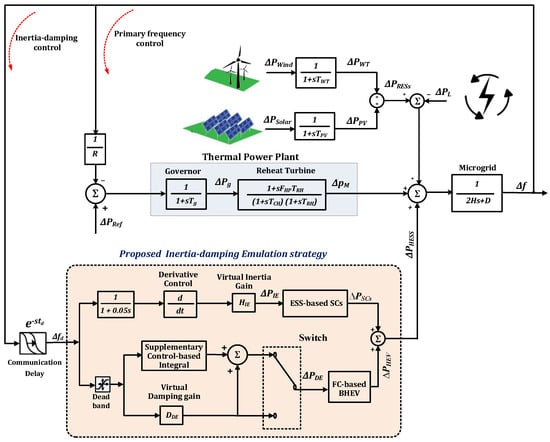
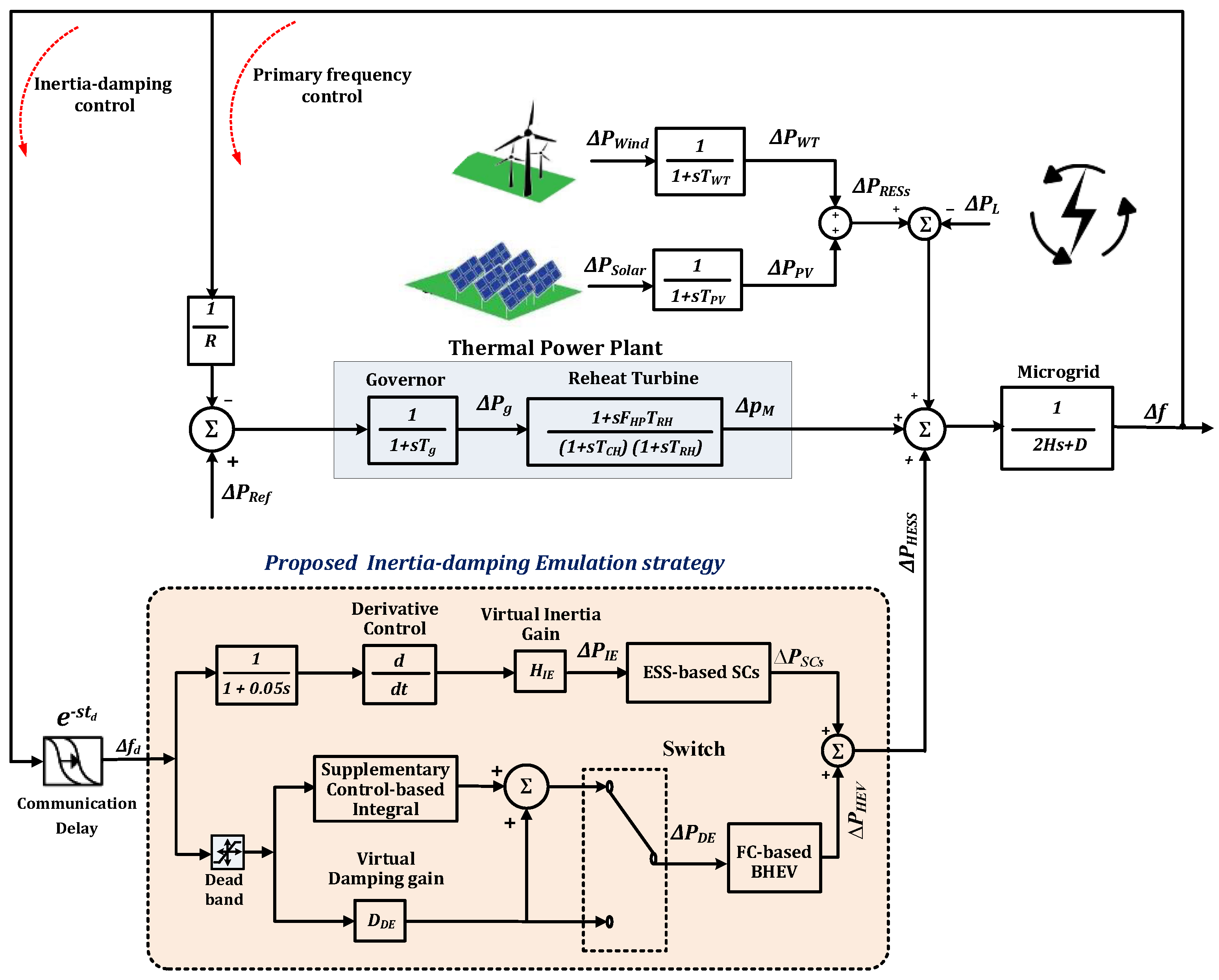
The stored kinetic energy in the synchronous generator’s rotor is referred to , indicates the system’s base power, J signifies the mass moment of inertia of the synchronous generator, and represents the angular frequency [33]. Figure 1 illustrates the dynamic model of the investigated system with the proposed inertia-damping emulation strategy. The symbols and coefficients of the studied MG are provided in Table 1. The proposed IDE strategy is based on a HESS combining SC and EV batteries, which are described in the following subsections.
Figure 1.
Dynamic model of the investigated MG incorporating the proposed controlled IDE strategy and considering communication delay.
Table 1.
Parameters of the investigated MG with the proposed IDE strategy.
2.1. Supercapacitor Energy Storage Model
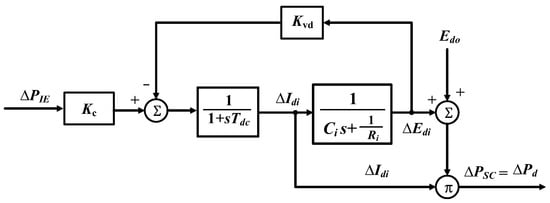
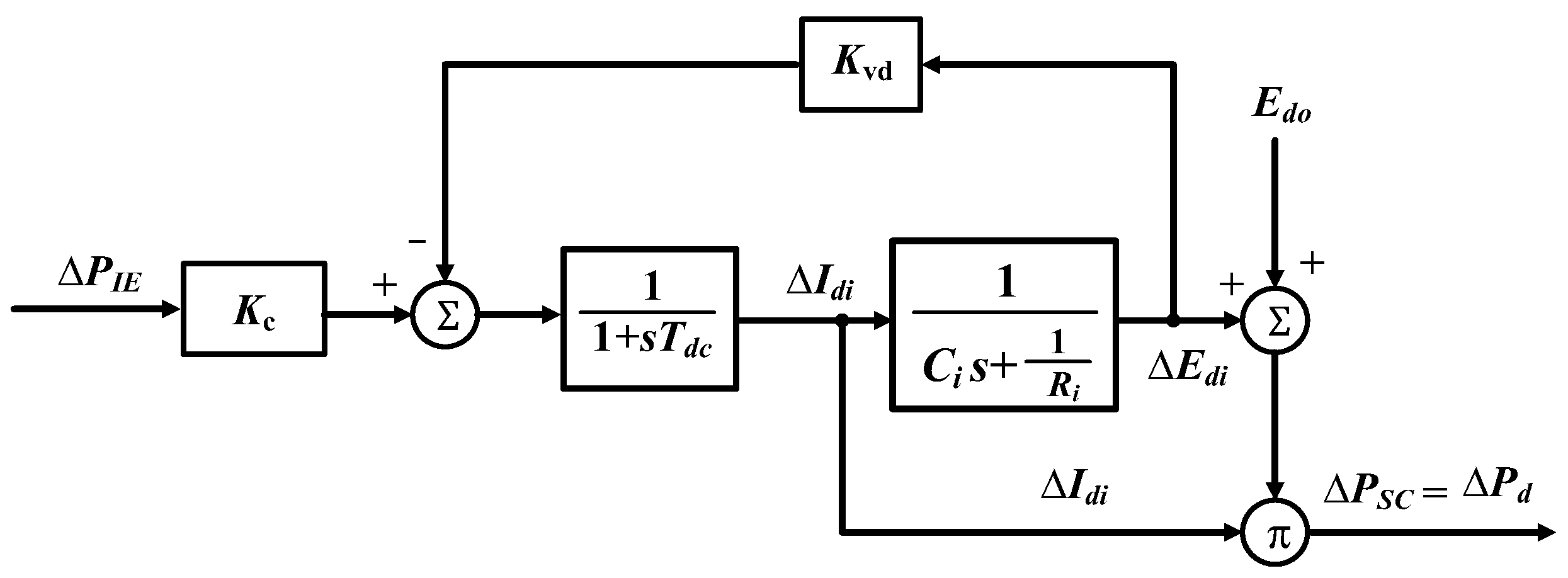
In the proposed IDE strategy, the virtual inertia is supported by SCs, leveraging their exceptional fast-response capability. As a result, SCs, with their rapid power delivery, are prepared to be the most effective solution for swiftly responding to sudden changes in system dynamics, ensuring stable and reliable operation. The mathematical model of the SC energy storage is formulated as shown in Figure 2. The set point of the SC voltage must be rapidly restored following a load disturbance to ensure the SC is prepared to respond to the next disturbance. To accomplish this, the deviation in SC voltage is monitored and utilized as a corrective feedback signal within the SC control loop, enabling swift voltage recovery, as demonstrated in Figure 2. The inertia power change for the proposed strategy serves as the control signal to the SC. Therefore, the current variation, is given by [34]:
Figure 2.
Dynamic model of SC energy storage.
The capacitor voltage deviation, is then given by:
At any given moment, the power flowing into the SC is given by , while the preliminary power flow into the capacitor is . The voltage and current magnitudes before the load disturbance are expressed as and , respectively. The power flow into the SC, when a load disturbance happens, is provided as follows.
This results in the incremental power change in the SC being as follows
The term is disregarded, as in the storage state to maintain the nominal voltage at a standard level. The incremental power change in per-unit in the SC is then expressed as
where the PR represents the rated power of the SC. In this study, the parameters of the SC energy storage used in the proposed IDE strategy are given in Table 1.
It should be mentioned that a communication time delay is included as presented in Figure 1 in the frequency feedback path to account for the non-instantaneous acquisition, transmission, and processing of the measured frequency signal before it reaches the proposed control scheme. A delay of Td = 0.1 s is considered throughout this study, allowing the proposed strategy to be evaluated under non-ideal signal transmission rather than assuming instantaneous communication.
2.2. Fuel Cell-Battery Hybrid Electric Vehicles Model
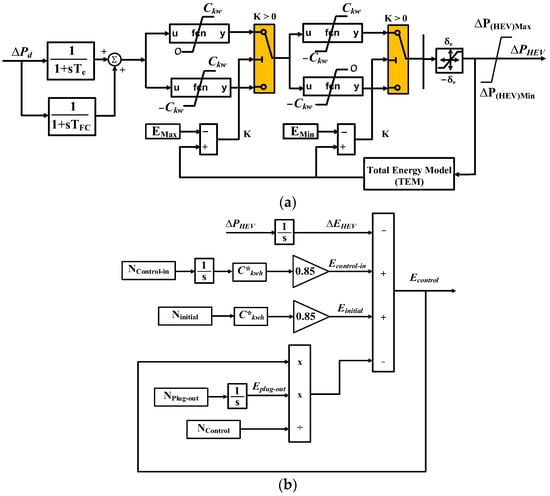
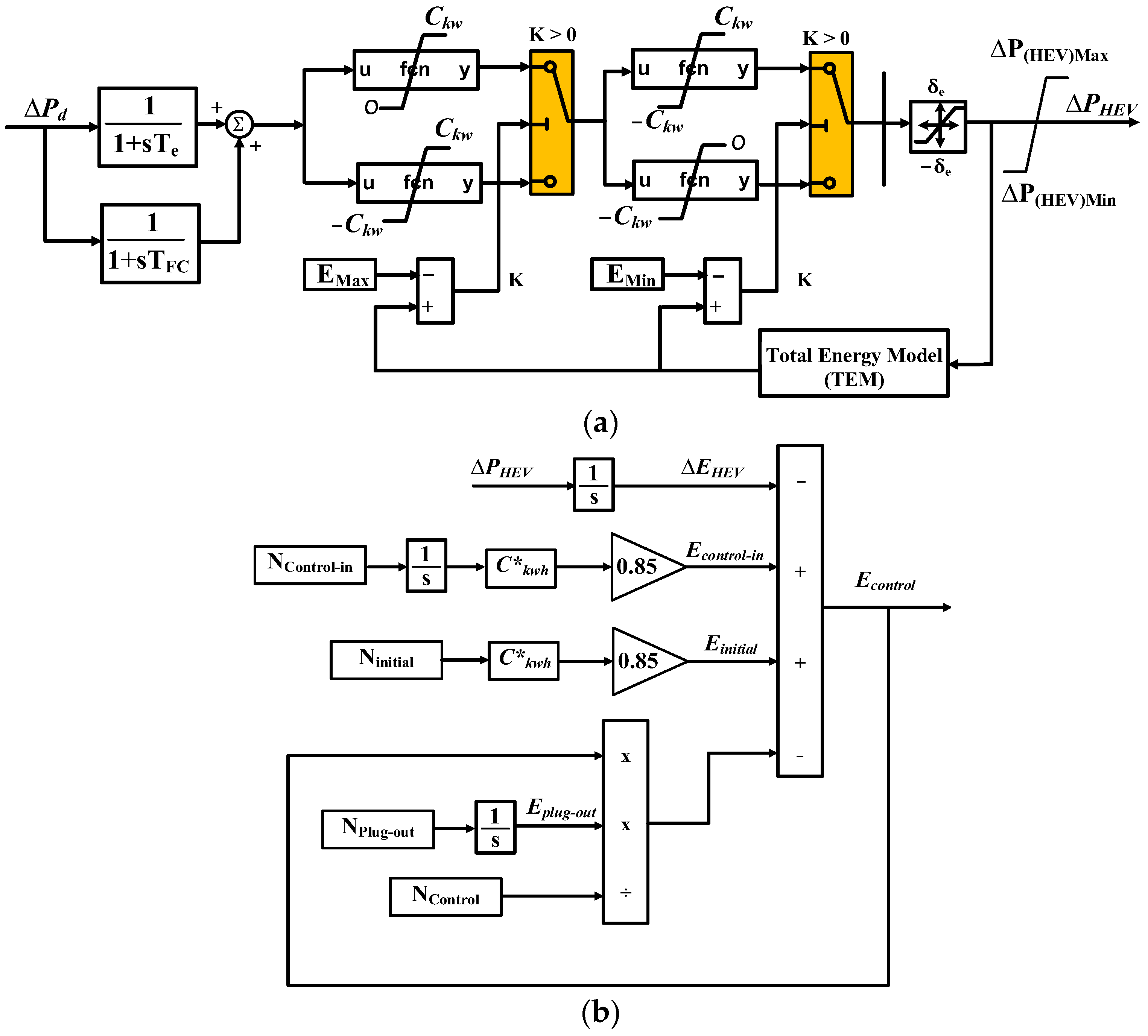
This study employs a model of FC-BHEVs, as illustrated in Figure 3a, to provide sustained power support for virtual damping within the proposed IDE strategy. Frequency control through the integration of HEVs is realized by strategically managing their discharging and charging processes in reaction to the frequency control signal, subject to the availability of connected HEVs, the allowable state-of-charge (SOC) range, and the power capability of their interfacing converters [23,35]. In this way, the aggregated HEV fleet can operate as a distributed energy storage resource while preserving the operating requirements of individual HEVs. To complement the HEV battery response, an FC is integrated in parallel with the HEV battery dynamics, as shown in Figure 3a. The two resources have different response characteristics: the HEV battery provides relatively fast power compensation, whereas the FC contributes to a slower and more sustained response. Their combined operation reduces the dependence on the HEV batteries alone and provides additional flexibility for delivering the damping-support power required by the IDE strategy.
Figure 3.
Mathematical models of HEV: (a) FC-BHEVs and (b) TEM.
The FC-BHEVs model determines the total charging or discharging power available from the controllable HEV fleet. Its response to the frequency-control signal is governed by the number of HEVs available for regulation and their corresponding energy limits, which are defined according to the permissible SOC range. Following charging, the HEV’s ability to react to the frequency-control signal is limited by its energy capacity, specifically the MWh limit outlined in Equation (9) [35,36].
where represents the controllable HEVs’ total energy, while the maximum and minimum energy capacity bounds, and , respectively, are determined based on the control strategy and the given SOC. These limits are calculated using Equations (10) and (11), reflecting the energy constraints within which the controllable HEVs can operate.
The total energy model (TEM), depicted in Figure 3b, calculates the overall reserved energy of all adjustable HEVs as . The number of adjustable HEVs () involved in energy exchange with the studied power system is determined using the following calculation.
where the preliminary number of adjustable HEVs is defined as . The total number of HEVs transitioning from the charging mode to the controllable mode, as well as from the charging state to the driving state, are represented as , and , respectively. The respective values for these parameters are provided in Table 1. For additional details on the TEM, readers seeking more information are encouraged to refer to [23,35]. represents the inverter capacity of the HEVs, meaning the HEV can only be energized within the limits of ±. denotes the discharging and charging power of the adjustable HEV.
For the simulation, an aggregated model of the controllable HEV fleet is implemented in MATLAB/Simulink 2024b, as shown in Figure 3. Instead of modeling each vehicle individually, the fleet is represented by an equivalent aggregated energy resource whose available charging/discharging power and stored energy are determined from the number of controllable vehicles, their rated inverter power, and the aggregate SOC. The frequency-control signal is applied to the aggregated model, which determines the corresponding power exchange with the microgrid subject to the available energy and power limits. In this study, the vehicle energy resource is represented by a battery–FC configuration, allowing the battery and FC to provide complementary short- and sustained-power support, respectively.
To make the model computationally tractable for system-level frequency-response analysis, several assumptions are adopted. First, the HEV fleet is represented by an aggregated model, and individual vehicle-to-vehicle differences are not explicitly modeled. Second, controllable vehicles are assumed to respond coherently to the frequency-control signal, subject to the aggregate power and energy constraints. Third, the battery and FC models are represented at the power system level, while detailed electrochemical, thermal, degradation, and vehicle driving dynamics are neglected. Fourth, the availability of controllable vehicles is represented through the defined number of adjustable vehicles and the corresponding SOC-dependent energy limits. Finally, the converter is assumed to track the commanded power within its rated charging/discharging limits. These assumptions allow the proposed HEV resource to be integrated into the power system frequency-dynamics model while retaining the key power and energy constraints relevant to frequency regulation.
3. Proposed Inertia-Damping Emulation Control Strategies-Based HESS
3.1. Conventional Inertia Emulation Concept
In conventional power systems, the inertial response is usually supplied by the kinetic energy stored in SGs. In modern power grids, replacing SGs with RESs can lead to a substantial reduction in overall system inertia due to the absence of rotating mass [1,37]. This ongoing decline in inertia poses a significant risk to the system’s stability and reliability, especially for islanded MGs. Thus, the IE concept has been proposed in the literature to improve the frequency stability of low-inertia MGs dominated by RESs. The core concept of the IE is based on derivative control, which calculates the rate of change of frequency (RoCoF) to deliver additional active power to the MG’s set point whenever a frequency deviation occurs. Therefore, the active power injected or absorbed by the inverter-based ESS is controlled using the IE concept and can be defined as follows [8]:
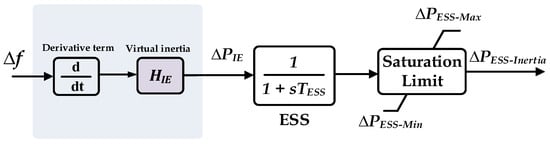
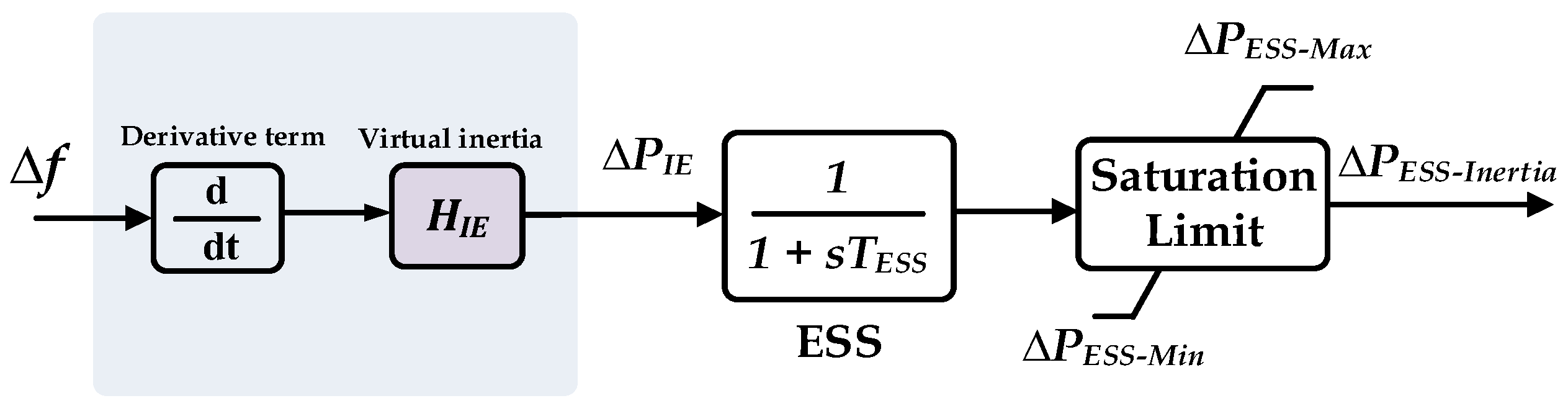
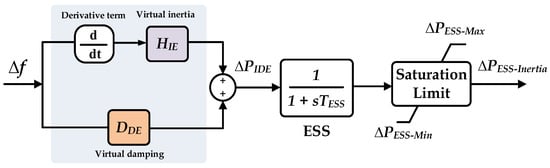
where HIE is the inertia emulation constant, and Δf represents the frequency deviation. A typical IE system based on a single ESS is illustrated in Figure 4, which emulates the inertial characteristics of a real SG. From Figure 4, the IE power when including ESS dynamics can be expressed as follows:
where TESS stands for the time constant of the inverter-based ESS. Lately, it has been noted that the absence of DE can significantly degrade the performance of the IE control strategy in MGs characterized by low inertia and damping [38]. This issue becomes even more severe when the MG has a low load-damping factor during periods of low power consumption, potentially leading to system instability and collapse. Therefore, further research [23,39,40] has explored the vital influence of DE on MG’s frequency dynamics, which will be analyzed in the subsequent section. Hence, to fully imitate the swing equation in (1), Equation (14) can be further modified to include the DE power term as follows:
where DDE is the DE constant.
Figure 4.
Dynamic structure of the conventional IE-based single ESS.
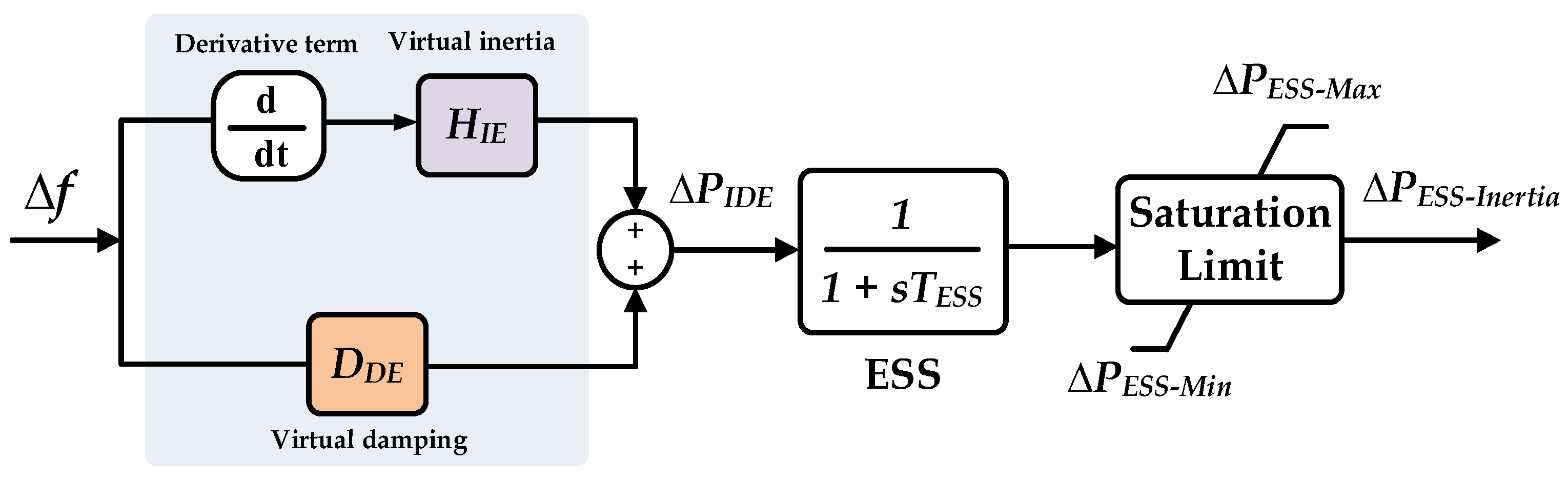
The improved dynamic structure of the conventional IE strategy is revealed in Figure 5, and its relevant output power is presented in Equation (16). This model incorporates the emulated damping part to achieve rapid settling or stabilization times by responding to the system frequency deviation Δf. This ensures quicker restoration of frequency during disturbances. As evident from Figure 4 and Figure 5, conventional IE or IDE techniques are mainly dependent on a single ESS, which proves inadequate as it simultaneously responds to both low- and high-frequency dynamics. To address this limitation, the proposed strategies based on HESS will be introduced.
Figure 5.
The dynamic structure of the conventional IDE-based single ESS.
3.2. Proposed Inertia-Damping Emulation Strategy
The fundamental objective behind the proposed IDE strategy-based HESS is to suitably allocate each power support term to its complementary ESS. To fully understand the nature of each component of either inertia or damping emulation, the block diagram of the studied MG presented in Figure 1 can be expressed in transfer function form as follows:
Equation (17) defines the MG frequency deviation caused by the power imbalance (ΔPimb) in the MG, where Deq = D + DDE, Heq = H + HIE, and ΔPimb = ΔPM + ΔPRESs − ΔPL. The transfer functions of the reheat turbine and the speed governor are represented as GRH (s) and GG (s), respectively. By defining GP→f (s) = Δf (s)/ΔPimb, the time-domain expression for the system frequency variation can be derived from Equation (17) to analyze the maximum frequency deviation in the MG during frequency events. It is observed that the time constants TG and TCH are significantly smaller compared to TRH. As a result, the influence of TG and TCH can be approximately neglected. Consequently, the transfer function relating the power imbalance to the system frequency deviation can be simplified and expressed as:
where;
The maximum frequency deviation (Δfmax) can be represented in terms of the undamped natural frequency ωn and the damping ratio ζ as:
where:
Moreover, by applying the initial-value theorem to Equation (18), the RoCoF following a step power imbalance is quantified as
Similarly, the final-value theorem can be used to determine the system steady-state frequency deviation Δf (∞) as
Additionally, the settling time ts is often used to evaluate how quickly the system responds during frequency regulation. Specifically, it refers to the time it takes for the frequency deviation (Δf) to stay within 2% of its final steady-state value. This settling time can be calculated as follows:
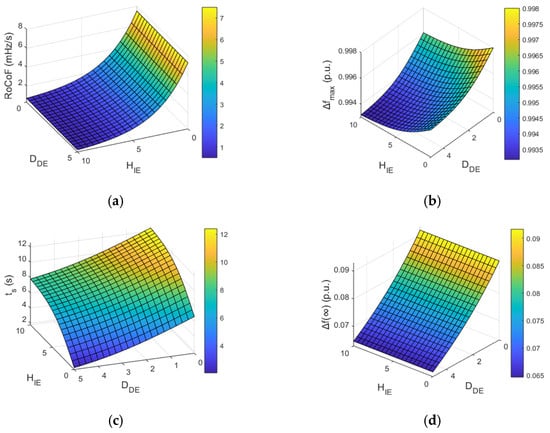
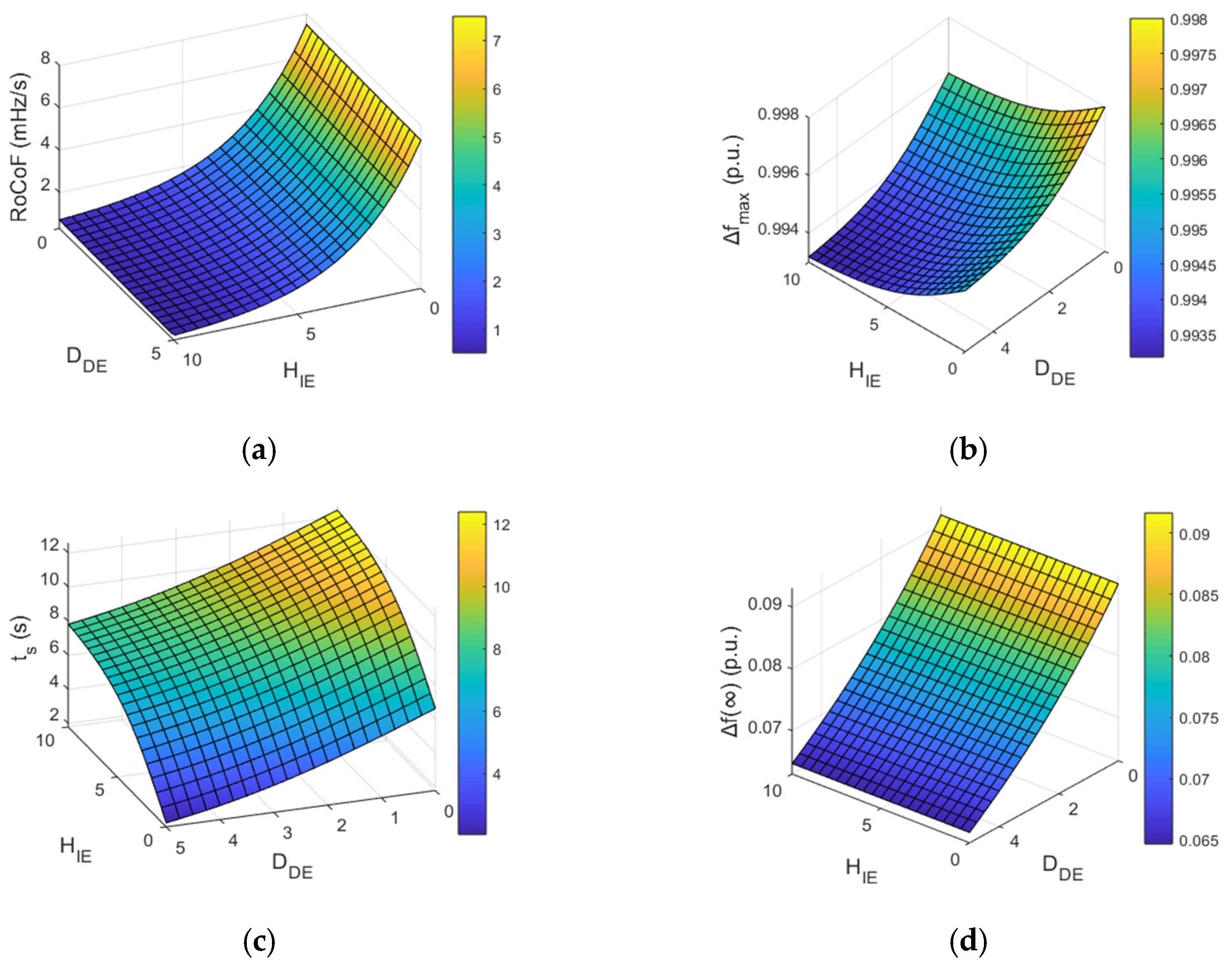
According to (20)–(24), the following remarks can be attained: (1) improving the RoCoF depends mainly on system inertia; (2) the system steady-state frequency deviation Δf (∞) affected by damping and does not influenced by inertia; (3) both damping and inertia coefficients influence the enhancement of frequency deviation and settling time; (4) inertia support is associated with fast-varying power deviation, as it depends on the derivative of frequency; (5) damping support is associated with slow-varying power deviation, as it depends on the frequency variation. These analytical observations are validated by the 3D plots depicted in Figure 6. Specifically, Figure 6a shows that an increase in HIE significantly reduces the RoCoF, confirming its role in initial frequency stability. Furthermore, Figure 6b indicates that increased inertia reduces the magnitude of frequency deviations; however, as illustrated in Figure 6c, it simultaneously slows down the frequency regulation dynamics, prolonging the frequency restoration period. This limitation is effectively mitigated by incorporating the property of the DE alongside the IE property, as evidenced in Figure 6b,d. Increasing DDE leads to reductions in frequency deviation and its steady-state value, highlighting the damping’s critical role in improving system resilience.
Figure 6.
Impact of various HIE and DDE values on the studied MG performance indices: (a) RoCoF, (b) Δfmax, (c) ts, and (d) Δf (∞).
Based on these insights, the proposed IDE strategy utilizes a HESS to allocate the available resources according to the dynamic requirements of frequency regulation. The SCs, characterized by their high power density and rapid response, are assigned to virtual inertia support and therefore compensate for fast, short-term power imbalances. On the other hand, the FC-BHEVs provide virtual damping support, offering a more sustained power response to slower frequency variations. This coordinated allocation enables the proposed HESS to reproduce the complementary inertia and damping characteristics of the swing-equation dynamics while improving both the transient and steady-state frequency response of low-inertia MGs.
To account for non-ideal signal transmission in the practical implementation of the proposed control strategy, a communication time delay Td is considered in the measured frequency signal, as illustrated in Figure 1. The delayed frequency deviation supplied to the controller is therefore expressed as
where denotes the frequency deviation available to the controller after communication latency. A value of Td = 0.1 s is considered in the IDE loop throughout the study. Accordingly, the inertia and damping support commands are generated from the delayed frequency signal rather than assuming instantaneous signal transmission.
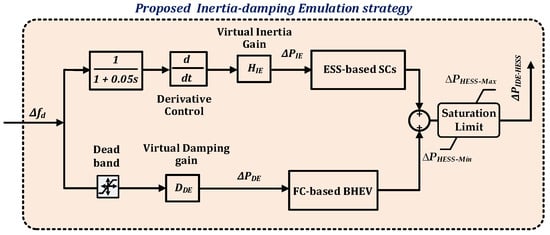
Figure 7 illustrates the dynamic framework of the proposed HESS-based IDE strategy, in which the inertia and damping support functions are assigned to storage resources according to their dynamic characteristics. The SCs provide the fast inertia response, whereas the coordinated FC-BHEV provides the damping support required for sustained frequency regulation. Since the measured frequency is subject to the communication delay defined above, both control actions are derived from . The total power exchanged by the HESS is constrained by its maximum charging and discharging capacities to ensure that the commanded support remains within the allowable operating range of the storage resources. During a frequency disturbance, the SC and FC-BHEV power contributions can be expressed as follows:
Figure 7.
A dynamic structure of the proposed IDE-based HESS.
As indicated in Equation (26), the SC branch includes its converter dynamics and is responsible for the rapid inertia response following a frequency disturbance. In contrast, the damping component in Equation (27) is provided through the parallel HEV battery and FC dynamics. This arrangement allows the two resources to contribute jointly to the sustained damping requirement, reducing reliance on the HEV batteries alone.
To avoid unnecessary HEV battery participation in small frequency fluctuations, a deadband of |fdead|= 0.05 Hz is incorporated into the damping-control loop, as shown in Figure 7. The FC-BHEV-based damping support is therefore activated only when the frequency deviation exceeds the specified deadband, reducing frequent shallow charging and discharging actions and the associated battery cycling. The FC operates in parallel with the HEV battery and shares the damping-support requirement once the damping loop is activated. Together with the SOC-dependent energy constraints and charging/discharging power limits of the aggregated HEV model, this coordinated operation limits unnecessary battery utilization while maintaining the required frequency-support capability. The overall HESS power is also restricted to ±0.2 p.u. to ensure that the combined response remains within its prescribed operating capacity.
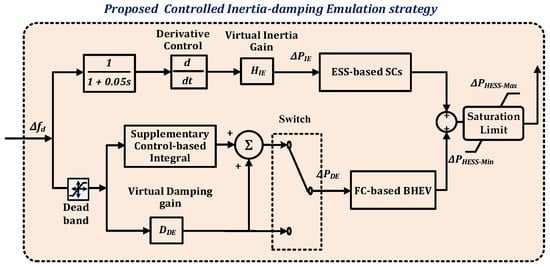
In response to the suggested IDE strategy following a disturbance in an islanded MG, the IE will take initial action and respond rapidly by delivering nearly instantaneous power to mitigate the frequency drop. Subsequently, the DE will continue to supply power to the system in proportion to the frequency deviation, ensuring a stabilizing effect on the MG. This response is comparable to the behavior of a real SG, which follows a similar process but includes a secondary control mechanism responsible for restoring the frequency to its nominal value after a disturbance. Building upon the established analogy between damping characteristics of the VSG and the supplementary secondary control action of conventional SG, and in alignment with the suggested strategy, a new controlled IDE-based HESS is proposed. A supplementary integral control alongside the proposed IDE strategy is incorporated to enhance the frequency stability of the low-inertia MGs. Thus, this research also proposes a control strategy that coordinates the DE strategy with the supplementary integral control, akin to secondary frequency control, to enhance operational conditions. This coordination will be supported by FC-BHEV, taking advantage of their capability to provide long-term frequency regulation, which results in the controlled IDE strategy-based HESS as revealed in Figure 8. This new controlled strategy aims to enhance the frequency stability of the studied MG, particularly under high RES penetration, by exploiting the existing energy resources (i.e., FC-BHEVs), without a need for additional energy recovery control to restore the system frequency to its nominal value, as required in [19,32]. To further include the integral term with the proposed IDE strategy, Equation (27) will be modified as follows:
where Ki denotes the integral control gain. It should be noted that the integral term will also be incorporated into the conventional IDE strategy based on ESS for comparison in the following section and will be referred to as controlled IDE-based ESS.
Figure 8.
A dynamic structure of the proposed controlled IDE-based HESS.
It should be emphasized that the supplementary integral control introduced in the proposed controlled IDE strategy is not intended to replace conventional automatic generation control (AGC) or system-level secondary frequency control. Conventional AGC generally operates at the system or control-area level, typically using the area control error (ACE), which combines frequency deviation and tie-line power deviation to restore the scheduled frequency and inter-area power exchange. In contrast, the integral action proposed in this study is embedded within the HESS-based IDE controller and uses the local frequency-deviation signal to generate an additional power-support command through the vehicle-based energy resource. Its purpose is to provide frequency restoration within the considered low-inertia microgrid while exploiting the available distributed energy resource.
Accordingly, the proposed integral action should be regarded as a supplementary local frequency-restoration mechanism rather than a replacement for AGC. In the islanded microgrid considered, no conventional AGC/ACE loop is present; therefore, the proposed integral action provides the secondary-like restoration required to eliminate the residual frequency deviation following disturbances. For the interconnected two-area system, the proposed controller is evaluated as an additional distributed resource that supports local frequency regulation and does not modify the fundamental area-level secondary-control structure. In practical deployment, coordination with existing AGC would be required through appropriate participation factors, power limits, and control-layer coordination to prevent competing control actions or over-regulation.
3.3. System Stability Analysis with the Proposed Strategy
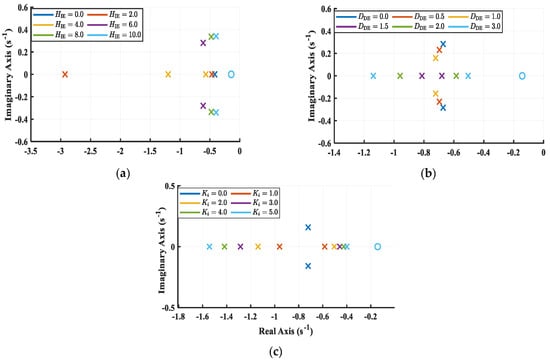
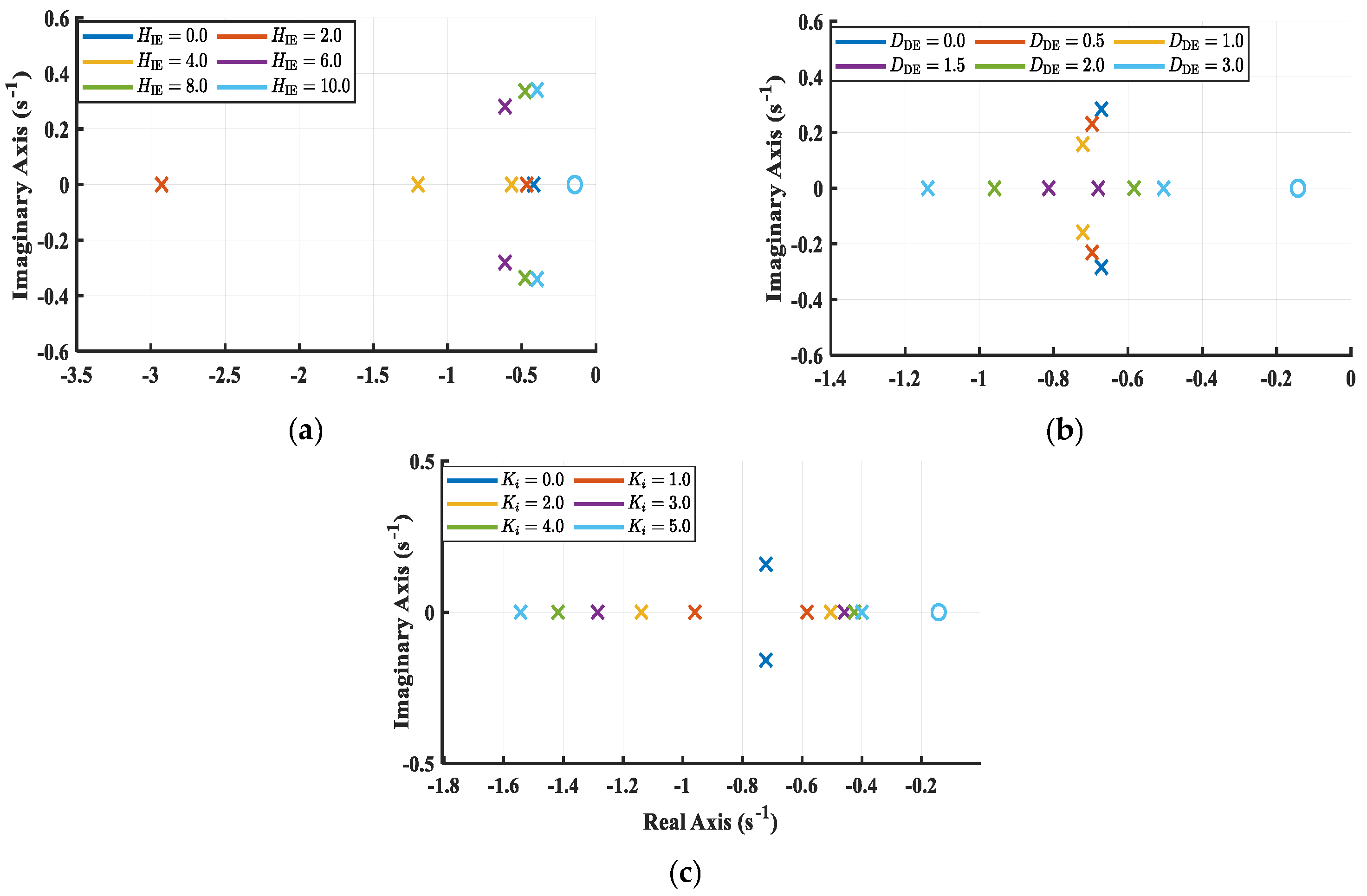
To further clarify and validate the previously observed deductions, this subsection examines the stability trends through system pole-zero maps analysis under varying emulated inertia, damping, and integral control parameters, as revealed in Figure 9. Figure 9a shows that as inertia increases, the poles shift closer to the imaginary axis, becoming less negative. This trend indicates that higher inertia significantly reduces the initial RoCoF, providing improved initial stability during disturbances. However, the proximity to the imaginary axis implies a slower dynamic response, which may result in extended settling times and potentially reduced damping performance. At the extreme case (HIE = 0), the poles are significantly further left in the complex plane, indicating a faster but potentially less robust frequency response. In Figure 9b, the impact of changing the DDE is illustrated. Increasing damping shifts poles leftward, further into the left half-plane, indicating improved system stability. Enhanced damping results in faster suppression of frequency oscillations and shorter settling times, reflecting improved dynamic stability.
Figure 9.
Pole-zero maps illustrating the influence of varying control parameters on the MG frequency stability: (a) Effect of varying HIE; (b) Effect of varying DDE; (c) Effect of varying Ki.
Conversely, at lower damping values, the poles move closer to the imaginary axis, potentially leading to sustained oscillations and slower system response. Notably, the absence of damping (DDE = 0) positions the poles closer to the imaginary axis, emphasizing the critical role damping plays in stabilizing frequency responses. Figure 9c demonstrates the effect of varying Ki. As the integral gain increases, poles migrate further leftward in the complex plane, improving long-term stability and significantly reducing the steady-state frequency error. This leftward movement highlights the integral control’s effectiveness in achieving precise frequency regulation following disturbances, ensuring that the frequency quickly returns to its nominal value after transient conditions are over.
It can be concluded that the sensitivity results in Figure 6 and Figure 9 highlight the importance of selecting the virtual inertia and damping gains within an appropriate operating range. Increasing HIE improves the initial inertial response, but an excessively large value may slow the frequency dynamics and move the dominant poles closer to the imaginary axis. Conversely, insufficient DDE weakens the damping of frequency oscillations and brings the dominant poles closer to the stability boundary, whereas adequate damping shifts them further into the left-half plane. Therefore, the control gains should be selected as a coordinated set rather than independently, providing a suitable compromise between RoCoF suppression, frequency-deviation mitigation, settling time, and closed-loop stability.
4. Simulation Results and Discussion
This study evaluates the proposed two strategies, i.e., the proposed IDE strategy-based HESS and the proposed controlled IDE strategy, which incorporates supplementary integral control alongside the proposed IDE strategy, for enhancing the frequency stability of the investigated MG considering high RES penetration and HESS combining SCs and FC-BHEVs. A communication time delay of Td = 0.1 s is maintained throughout all simulation scenarios; hence, the reported frequency responses are obtained under non-ideal signal transmission conditions. The comparison is rigorously conducted within the context of MG frequency control, particularly considering the substantial integration of high levels of RESs. A detailed MATLAB/SIMULINK model is employed to construct the MG model, which integrates RESs, as illustrated in Figure 1. The frequency regulation of the considered MG is rigorously validated across a range of diverse operating conditions through the following scenarios.
4.1. Scenario A: Impact of the Proposed IDE Based on HESS on the System Performance
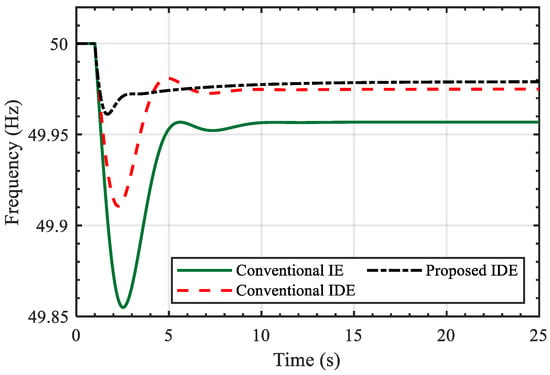
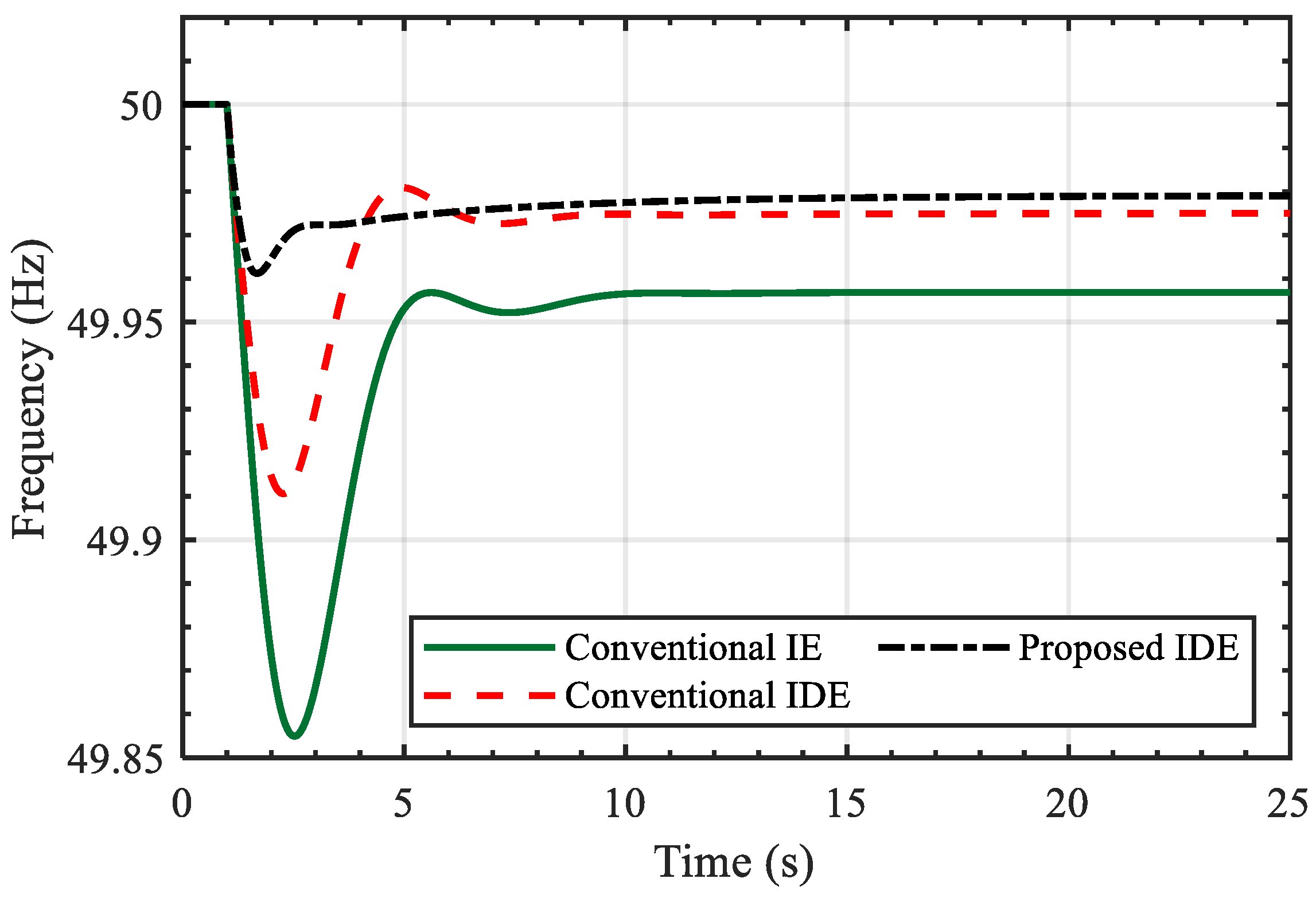
In this scenario, the proposed IDE strategy based on HESS (i.e., supporting the virtual inertia by SCs and the virtual damping by FC-BHEVs) is compared with two established strategies from the literature: the conventional IE based on traditional ESS [8] and the conventional IDE based on HESS [39], providing a thorough evaluation of their relative performance. Moreover, a 1.8% step change in load is applied at 1 s to mimic a sudden load shedding or forced outage of the power station, while the system inertia is reduced by 20% to model the effects of high RES penetration. Figure 10 illustrates the frequency of the studied MG under various inertia/damping emulation strategies. The conventional IDE strategy improves the transient response compared with the conventional IE approach, while the proposed HESS-based IDE provides the smallest frequency excursion and a more strongly damped response despite the incorporated communication delay. These results confirm the benefit of coordinating the fast SC-based inertia support with the sustained damping contribution of the FC-BHEVs.
Figure 10.
The MG frequency response in the case of scenario A.
4.2. Scenario B: Impact of Cascaded Load Disturbance on the Performance of the Proposed IDE Based on HESS
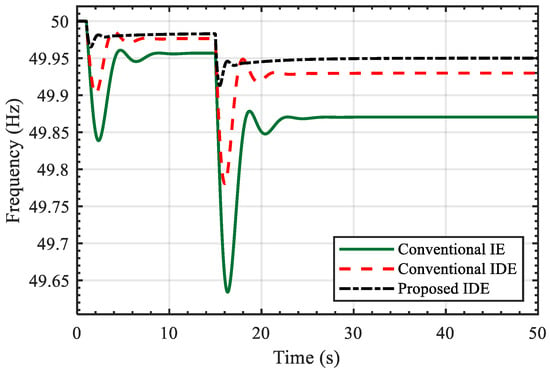
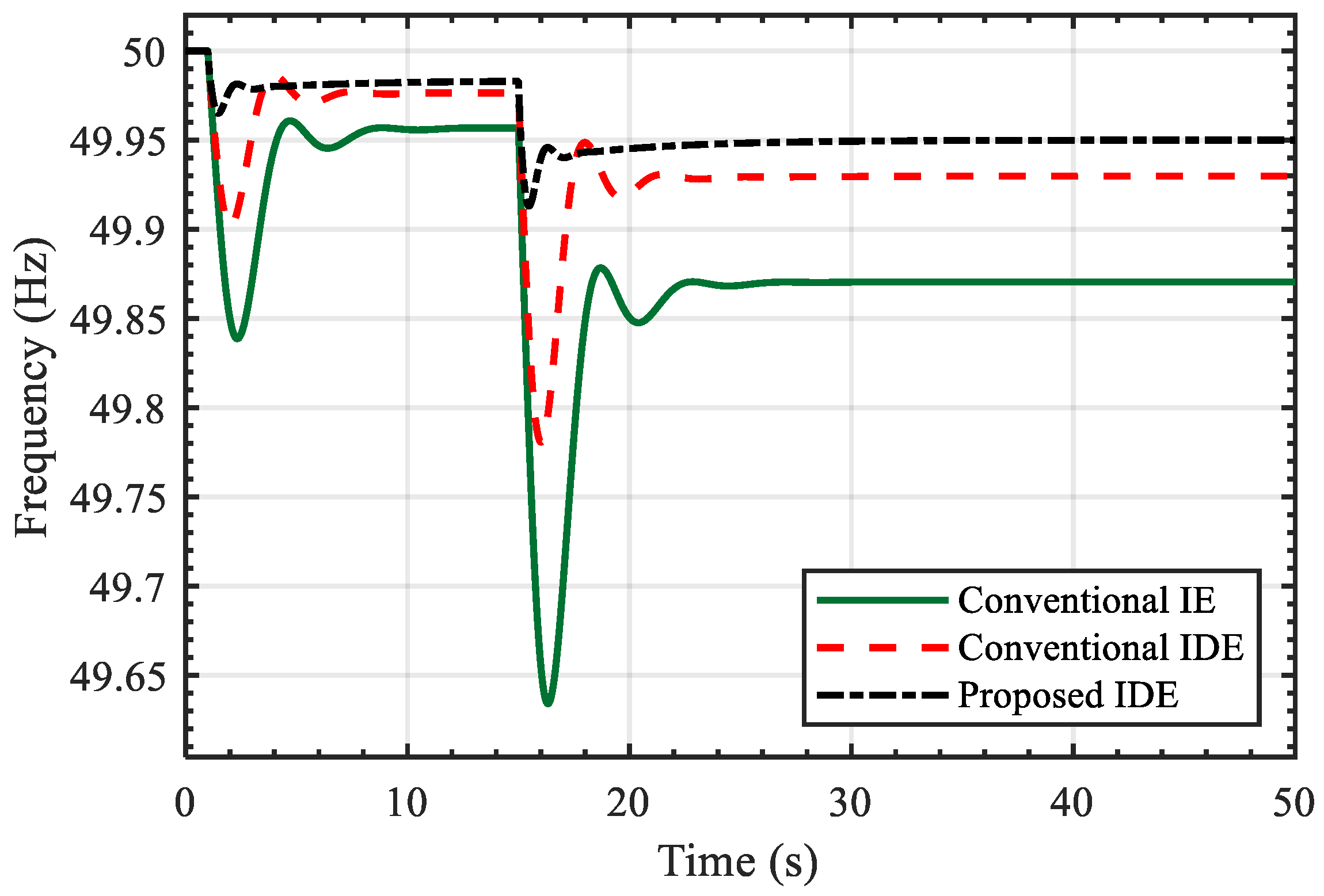
In this scenario, a cascaded load disturbance is applied by incrementally changing the load by 1.8% at 1 s and then incrementally changing the load by 3.6% at 15 s. Moreover, a 25% reduction in the system inertia is applied, simulating a high penetration of RESs. Figure 11 compares the frequency responses obtained with the proposed HESS-based IDE using SCs for virtual inertia and FC-BHEVs for virtual damping, the conventional IDE strategy, and the conventional IE strategy. The proposed IDE strategy exhibits smaller frequency excursions and faster damping following both load disturbances, even with the 0.1 s communication delay included in the control loop. Moreover, the results clearly show that primary frequency control alone is insufficient to fully restore the frequency to its nominal value after a disturbance, as it operates based on local measurements without accounting for system-wide conditions. As such, secondary (or supplementary) frequency control becomes essential in bringing the frequency back to its nominal value, working in tandem with the faster-acting primary control to ensure comprehensive system stabilization. Therefore, this study proposes a controlled IDE strategy that incorporates supplementary integral control, alongside the proposed IDE strategy based on HESS, as detailed in the following scenarios.
Figure 11.
The MG frequency response in the case of scenario B.
4.3. Scenario C: Impact of the Proposed Controlled IDE Strategy Based on HESS on the System Performance
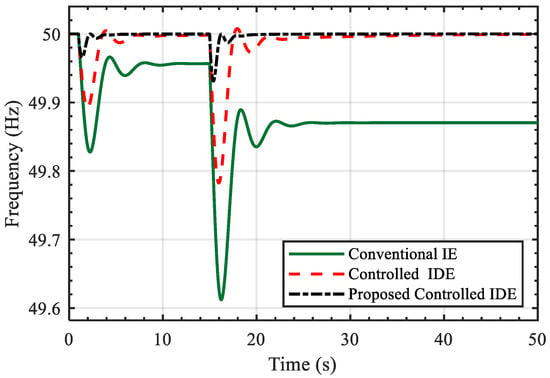
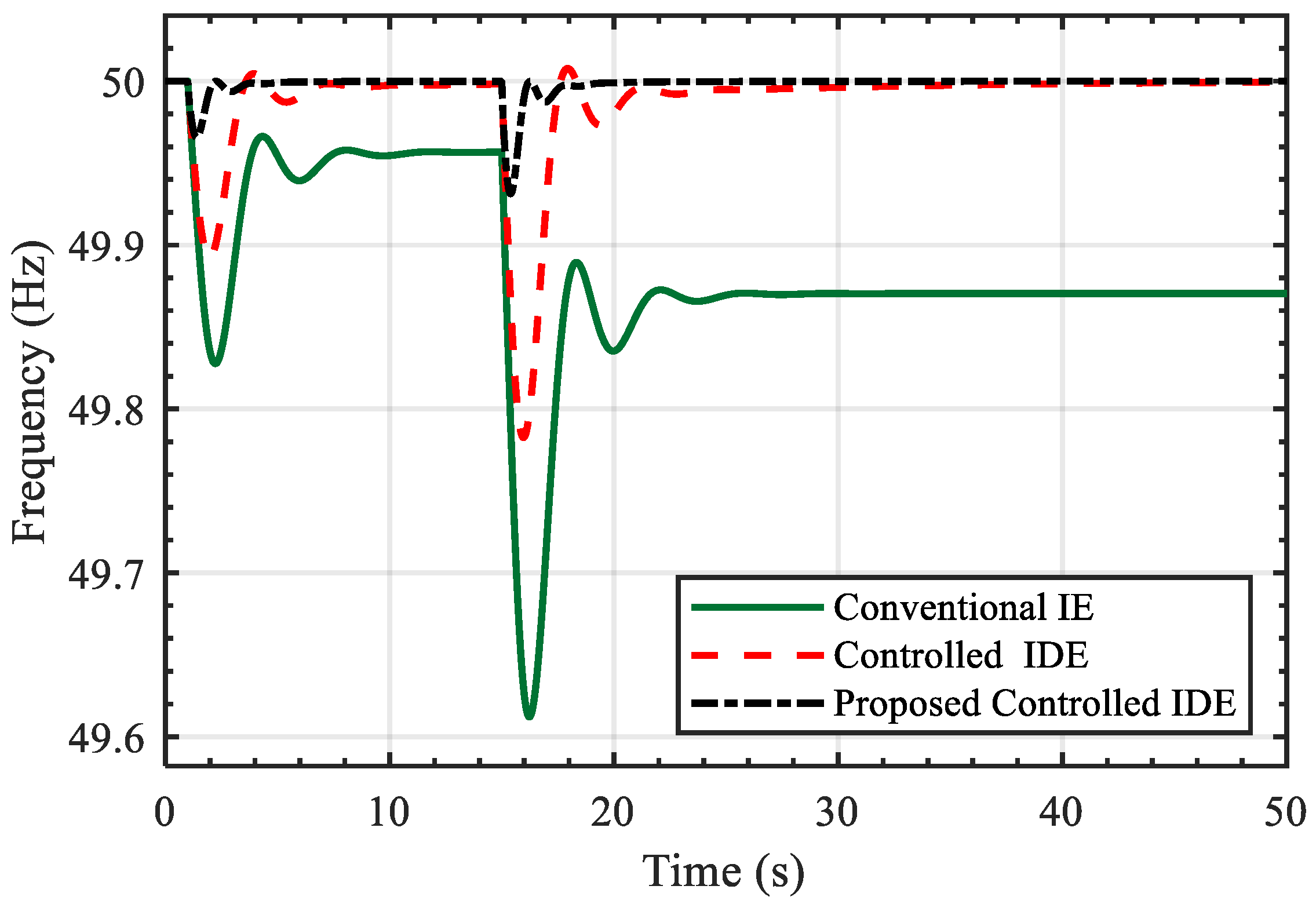
In this scenario, the performance of the proposed controlled IDE strategy based on HESS, which incorporates supplementary integral control, alongside the proposed IDE strategy based on HESS, is examined under a 1.8% sudden load change at 1 s, a 3.6% sudden load change at 15 s, and a 35% reduction in the system inertia. Figure 12 displays the frequency response of the investigated MG with the proposed controlled IDE strategy based on HESS, the controlled IDE strategy based on ESS (i.e., the supplementary integral control is also added with the conventional IDE), and the conventional IE strategy. The proposed controlled IDE provides the smallest transient frequency excursions following both disturbances and restores the frequency close to its nominal value more rapidly. This response demonstrates the complementary roles of the HESS-based IDE support and supplementary integral action in improving both transient regulation and post-disturbance frequency restoration under communication latency.
Figure 12.
The MG frequency response in the case of scenario C.
4.4. Scenario D: Evaluation of the System Performance with the Proposed Controlled IDE Based on HESS Against High RESs
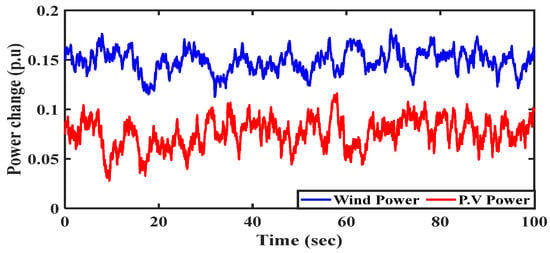
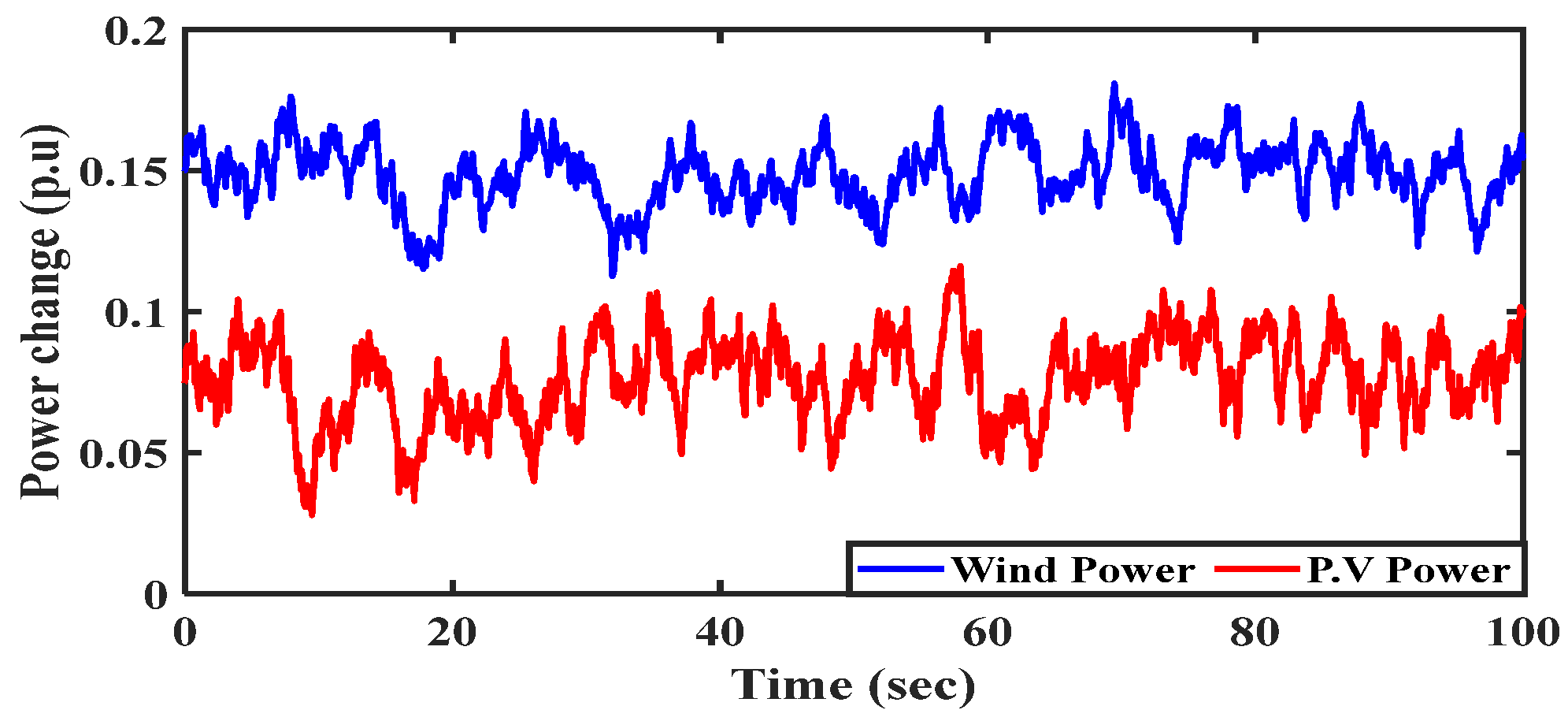
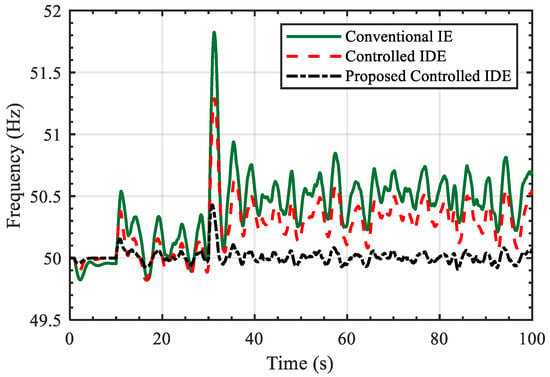
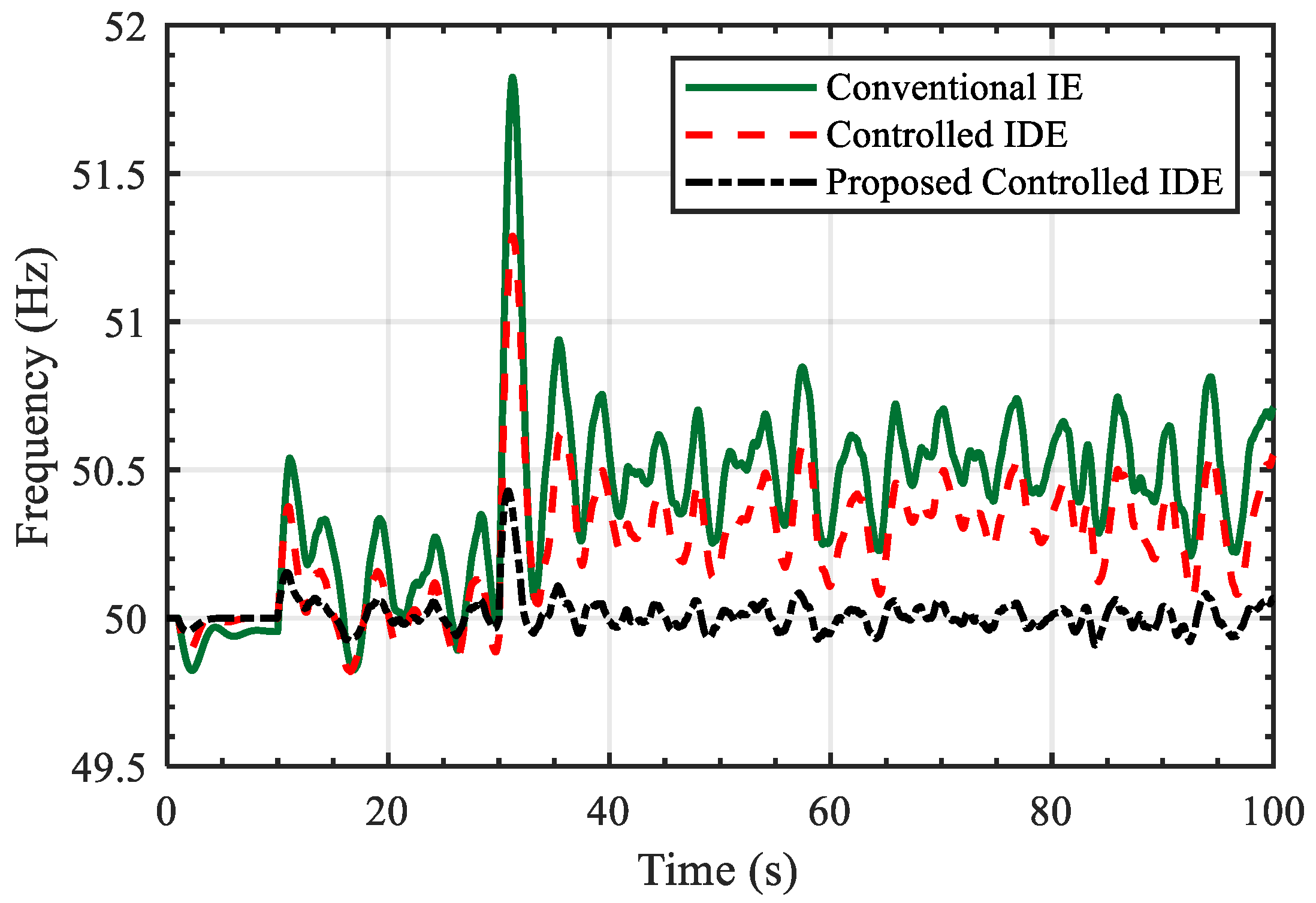
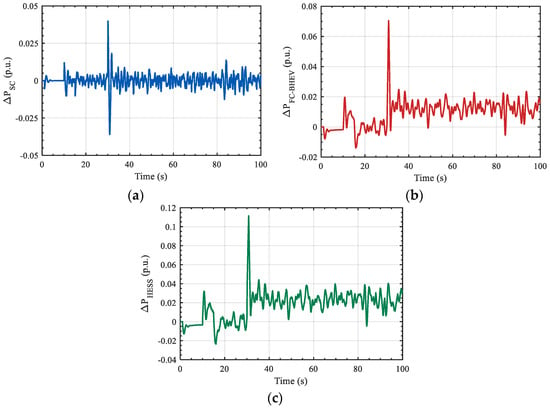
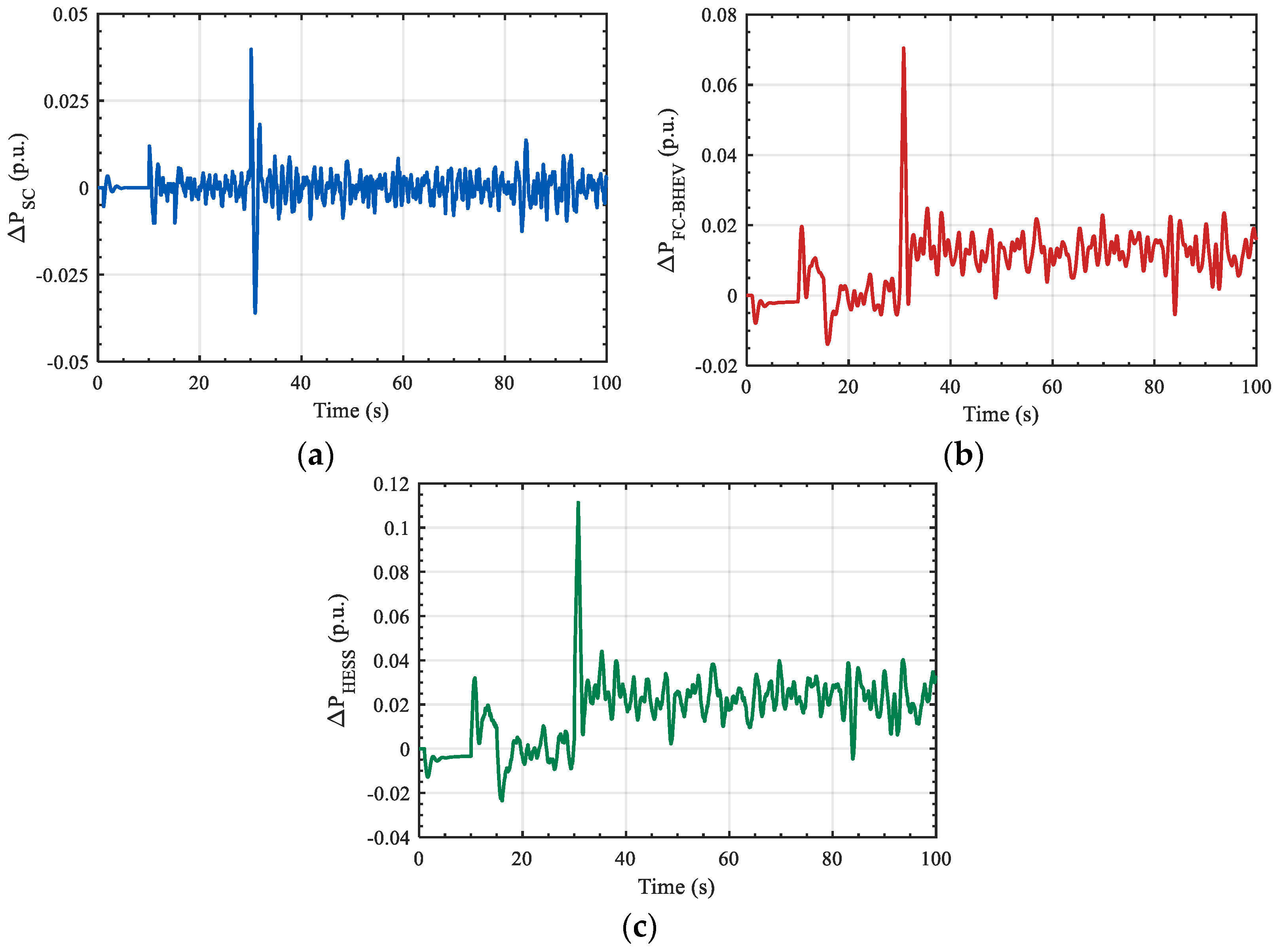
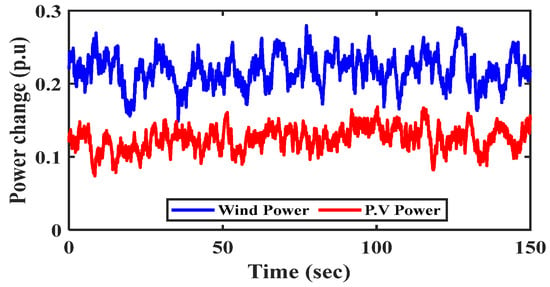
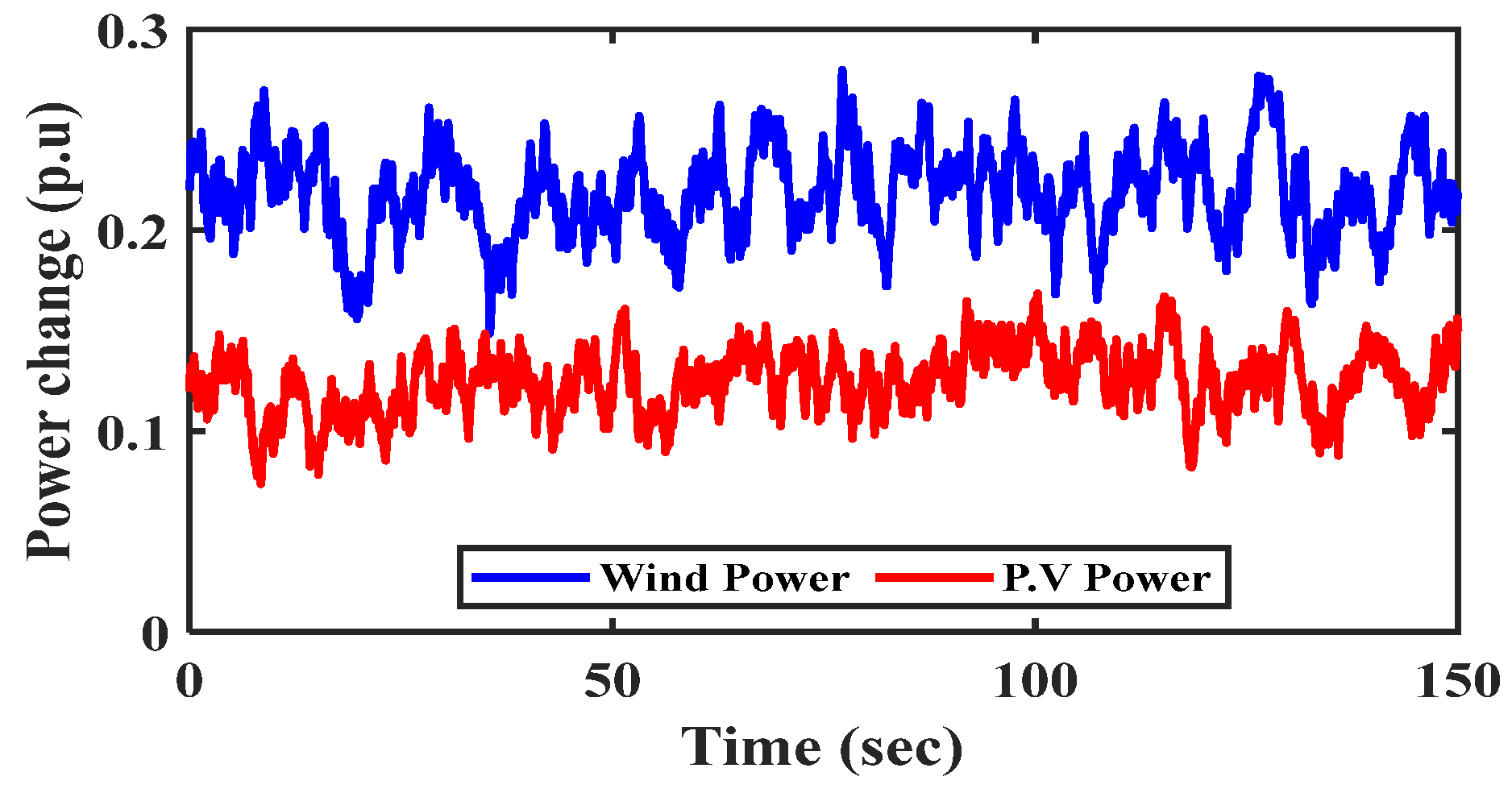
In this scenario, the performance of the proposed controlled IDE strategy based on HESS is evaluated under a range of challenging conditions, including a sudden 3.6% load change at t = 1 s, the connection of PV solar power (as shown in Figure 13) starting at t = 10 s, the integration of wind power (as shown in Figure 13) at t = 30 s, a 35% reduction in system inertia, and a 25% decrease in system damping. Figure 14 shows the frequency response of the studied MG with the proposed controlled IDE strategy based on HESS, the conventional controlled IDE strategy, and the conventional IE strategy. Figure 14 shows that the conventional IE and controlled IDE strategies experience considerably larger frequency excursions following the load and renewable power variations. In contrast, the proposed controlled IDE-based HESS maintains the frequency much closer to its nominal value and substantially suppresses the oscillations introduced by the variable RES power, despite the 35% inertia reduction, 25% damping reduction, and communication delay. To further assess the practical operation of the proposed HESS, Figure 15 presents the power contributions of the SCs and FC-BHEVs together with the resulting total HESS output under Scenario D. The SCs provide rapid, short-duration power support during sudden disturbances, consistent with their IE role, whereas the FC-BHEVs deliver a slower and more sustained response for damping support. Their coordinated contributions from the total HESS response, which remains within the prescribed ±0.2 p.u. power limit throughout the considered disturbances. In addition, the FC-BHEV operation is constrained by the SOC-dependent energy limits defined through the TEM, ensuring that the frequency support action remains within the available power and energy capabilities of the coordinated resources.
Figure 13.
The change in solar PV and wind power in scenario D.
Figure 14.
The MG frequency response in the case of scenario D.
Figure 15.
Power responses of the coordinated HESS under Scenario D: (a) SC output power, (b) FC-based BHEV output power, and (c) total HESS output power.
4.5. Simulation-Based Evaluation of Frequency Deviation Mitigation
Based on the theoretical analysis and simulation results presented in the previous sections, the proposed IDE-based HESS strategy consistently demonstrates superior performance in enhancing frequency regulation across all examined scenarios.
- ▪
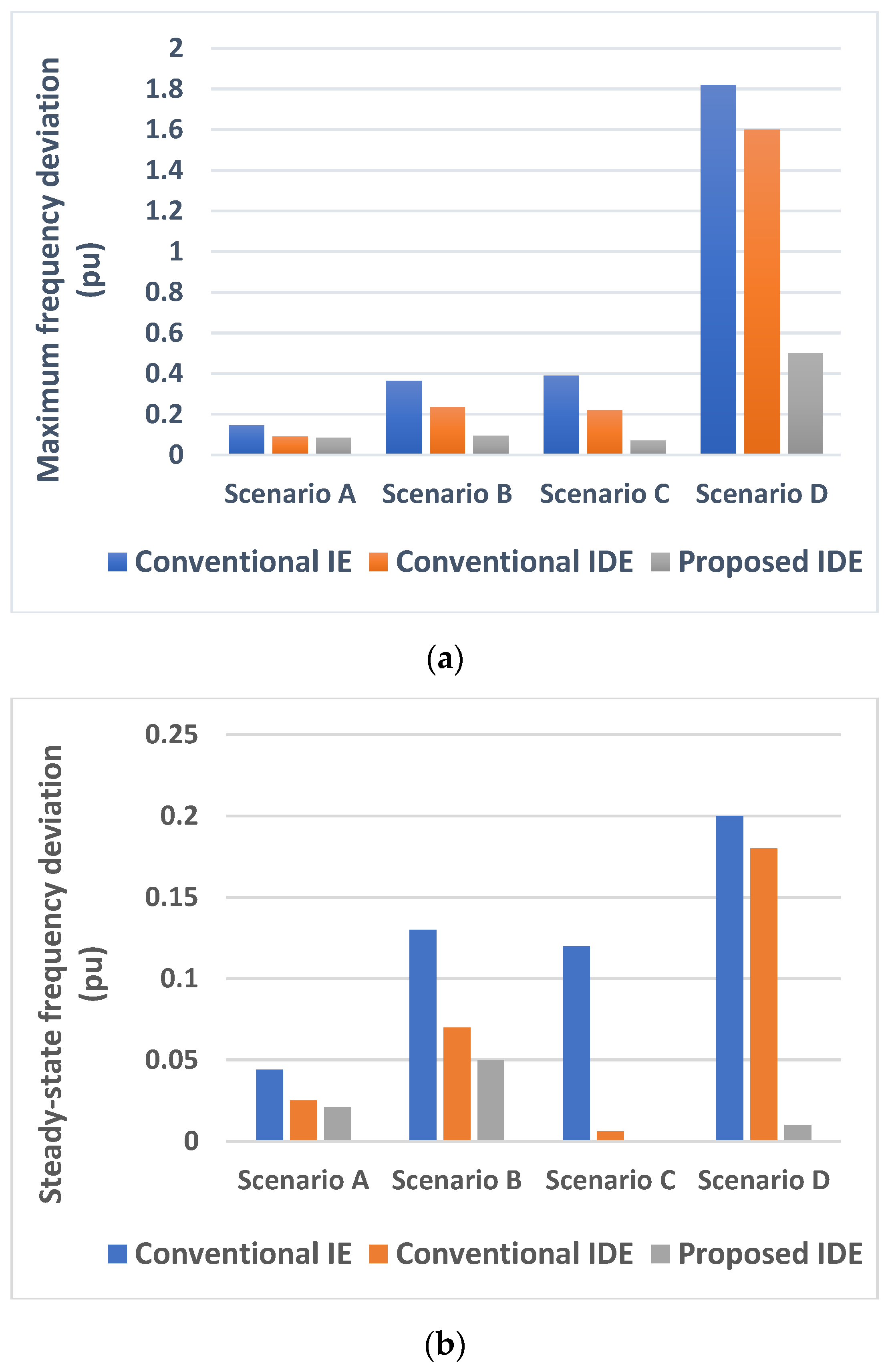
- For Scenario A, the conventional IDE reduces the maximum frequency deviation by approximately 38.6% compared to the conventional IE, while the proposed IDE-based HESS achieves a further improvement of approximately 42.5%. In terms of steady-state frequency deviation, the conventional and proposed IDE-based configurations provide improvements of approximately 42.2% and 51.1%, respectively, compared with the conventional IE.
- ▪
- In Scenario B, the conventional IDE and proposed IDE-based HESS strategies yield reductions of approximately 35.62% and 73.97%, respectively, in the maximum frequency deviation compared with the conventional IE. In terms of the steady-state frequency deviation, the corresponding improvements are approximately 46.15% and 61.54%, respectively.
- ▪
- For Scenario C, the controlled IDE achieves an approximately 43.6% reduction in maximum frequency deviation compared with the conventional IE, while the proposed controlled IDE-based HESS provides a significantly higher reduction of approximately 82.1%. Regarding the steady-state frequency deviation, the controlled IDE achieves an improvement of approximately 95%, whereas the proposed controlled IDE-based HESS completely eliminates the steady-state deviation, corresponding to a 100% improvement.
- ▪
- Similarly, in Scenario D, the controlled IDE-based ESS reduces the maximum frequency deviation by approximately 12.1% compared with the conventional IE, whereas the proposed controlled IDE-based HESS achieves a significantly higher reduction of approximately 72.5%. Regarding the steady-state frequency deviation, the proposed controlled IDE-based HESS maintains the frequency much closer to the nominal value of 50 Hz, providing a substantial improvement over both the conventional IE and controlled IDE configurations. The proposed controlled IDE-based HESS achieves approximately a 95% reduction in steady-state frequency deviation compared with the conventional IE-based ESS.
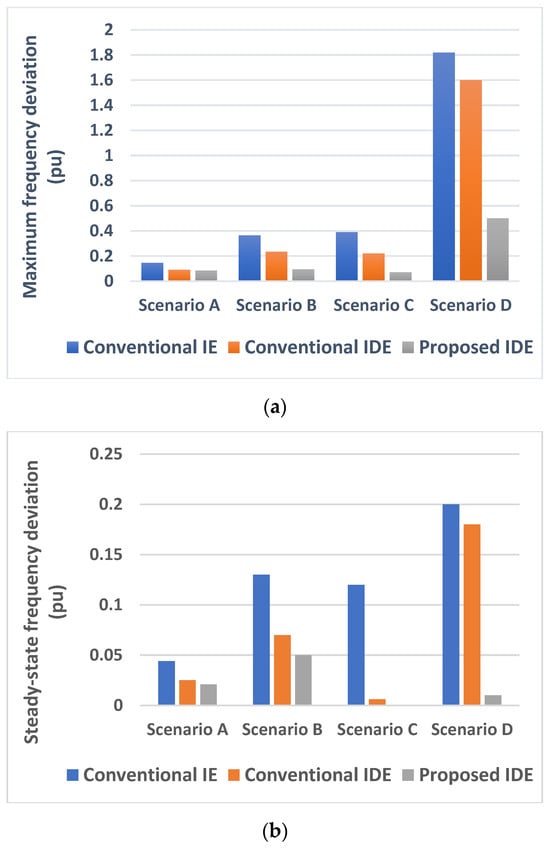
These consistent and substantial improvements confirm the robustness and effectiveness of the proposed IDE-based HESS in mitigating both transient and steady-state frequency deviations under a wide range of operating conditions. To further support the analysis, the simulation results are graphically presented in Figure 16 using a bar chart format.
Figure 16.
(a) Maximum frequency deviation and (b) steady-state frequency deviation for Conventional IE, Conventional IDE, and Proposed IDE-based HESS across all scenarios.
5. Scalability and Dynamic Stability Evaluation of the Proposed Controlled IDE in Interconnected Two-Area Power System
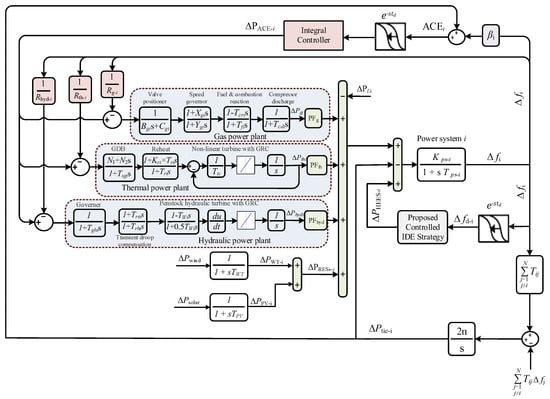
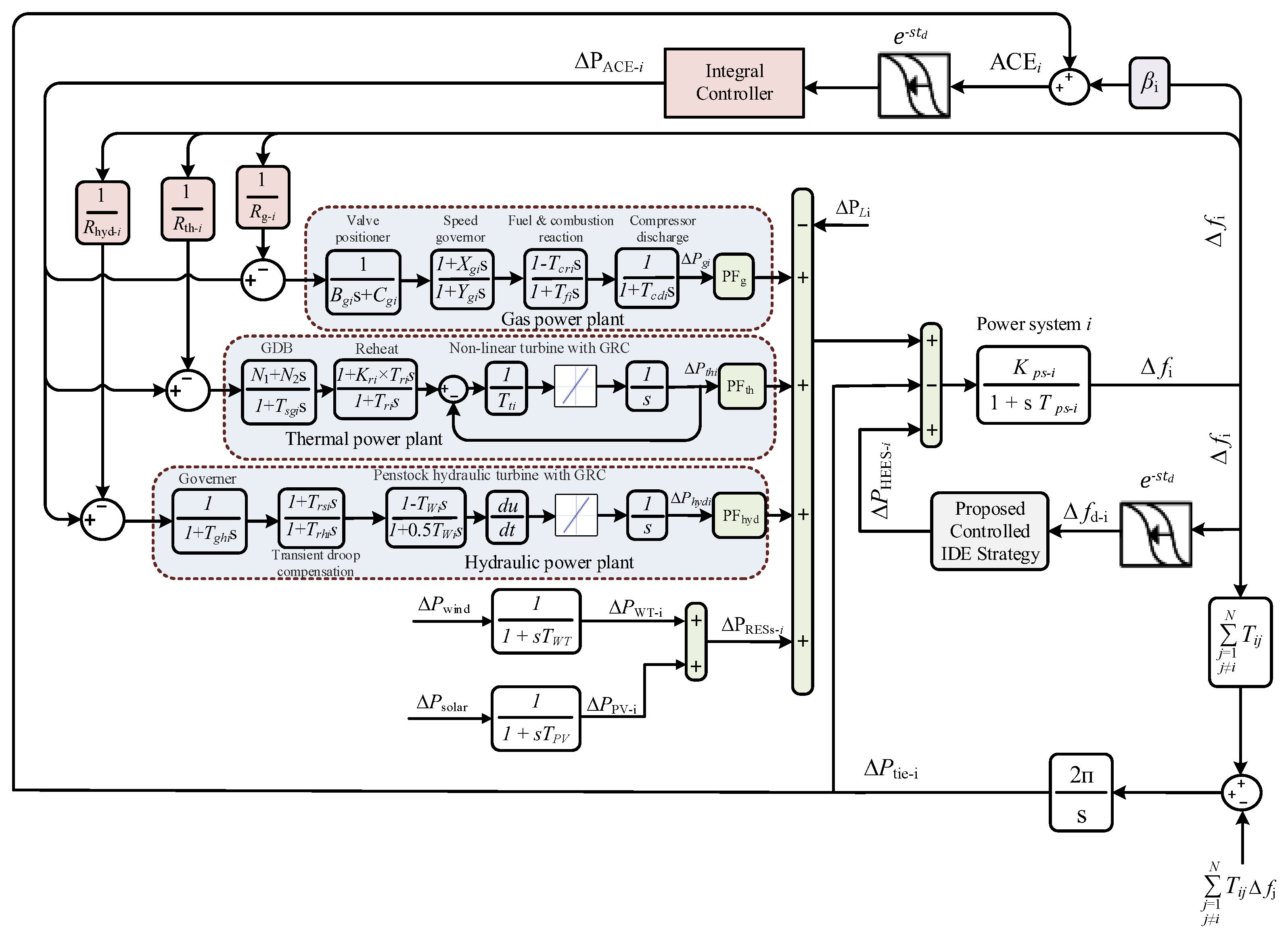
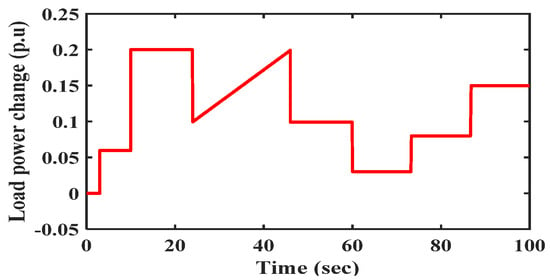
To validate the effectiveness of the proposed controlled IDE system, a two-area interconnected multi-source power system has been further examined under different operating conditions. The considered interconnected power system has two identical areas, which comprise conventional generation (reheat thermal, hydro, gas), RESs (wind, solar), aggregated EVs, SCs, and loads. More details about system modeling and configuration can be found in [41,42]. Figure 17 depicts the transfer function representation of the considered two-area interconnected power system [43]. Communication latency is also incorporated into the interconnected two-area model. In each area, a communication delay of Td,IE = 0.1 s is included in the inertia support loop to represent the delay associated with frequency measurement, signal transmission, and implementation of the fast frequency support command. In addition, a delay of Td,LFC = 0.2 s is introduced into the secondary LFC loop to account for the communication involved in frequency restoration and inter-area power regulation. The following are the three case studies that are tested in the studied system.
Figure 17.
Dynamic model of the investigated multi-sources power system including the proposed controlled IDE strategy and communication delays.
5.1. Case 1
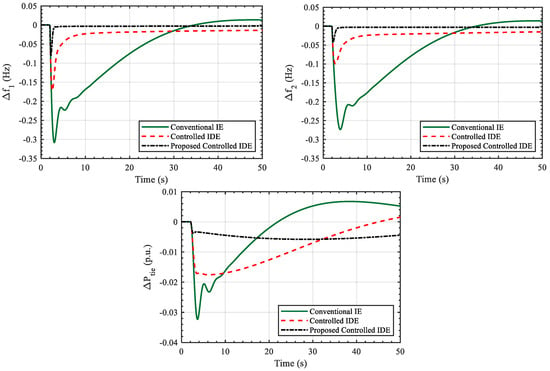
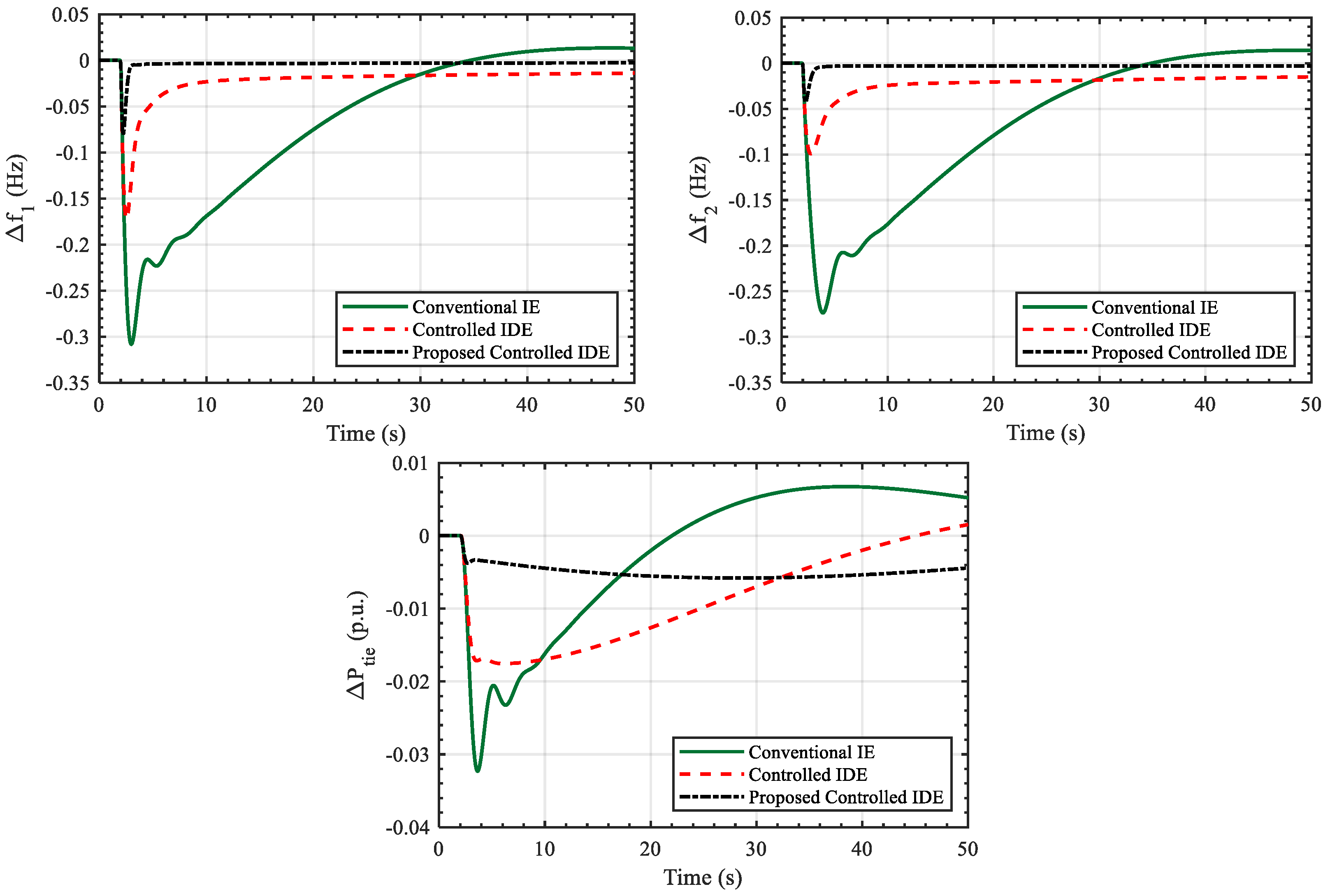
In this case, the system operates with nominal parameters, and two-step load disturbances are applied simultaneously at t = 2 s, where Area 1 experiences a load increase of 0.1 pu and Area 2 experiences 0.05 pu. As shown in Figure 18, the proposed controlled IDE-based HESS provides a noticeably improved response despite the communication delays included in both control layers. In Area 1, the maximum frequency deviation is reduced from approximately 0.308 Hz with conventional IE and 0.172 Hz with controlled IDE to about 0.081 Hz with the proposed strategy, corresponding to reductions of approximately 73.7% and 53.0%, respectively. A similar improvement is observed in Area 2, where the maximum deviation decreases from approximately 0.274 Hz and 0.099 Hz to about 0.043 Hz. The proposed strategy also limits the maximum tie-line power deviation to approximately 0.0058 p.u., compared with 0.0175 p.u. for controlled IDE and 0.0323 p.u. for conventional IE. These results demonstrate effective local frequency regulation and inter-area coordination under the considered communication delays.
Figure 18.
The two-area interconnected power system response for case 1.
5.2. Case 2
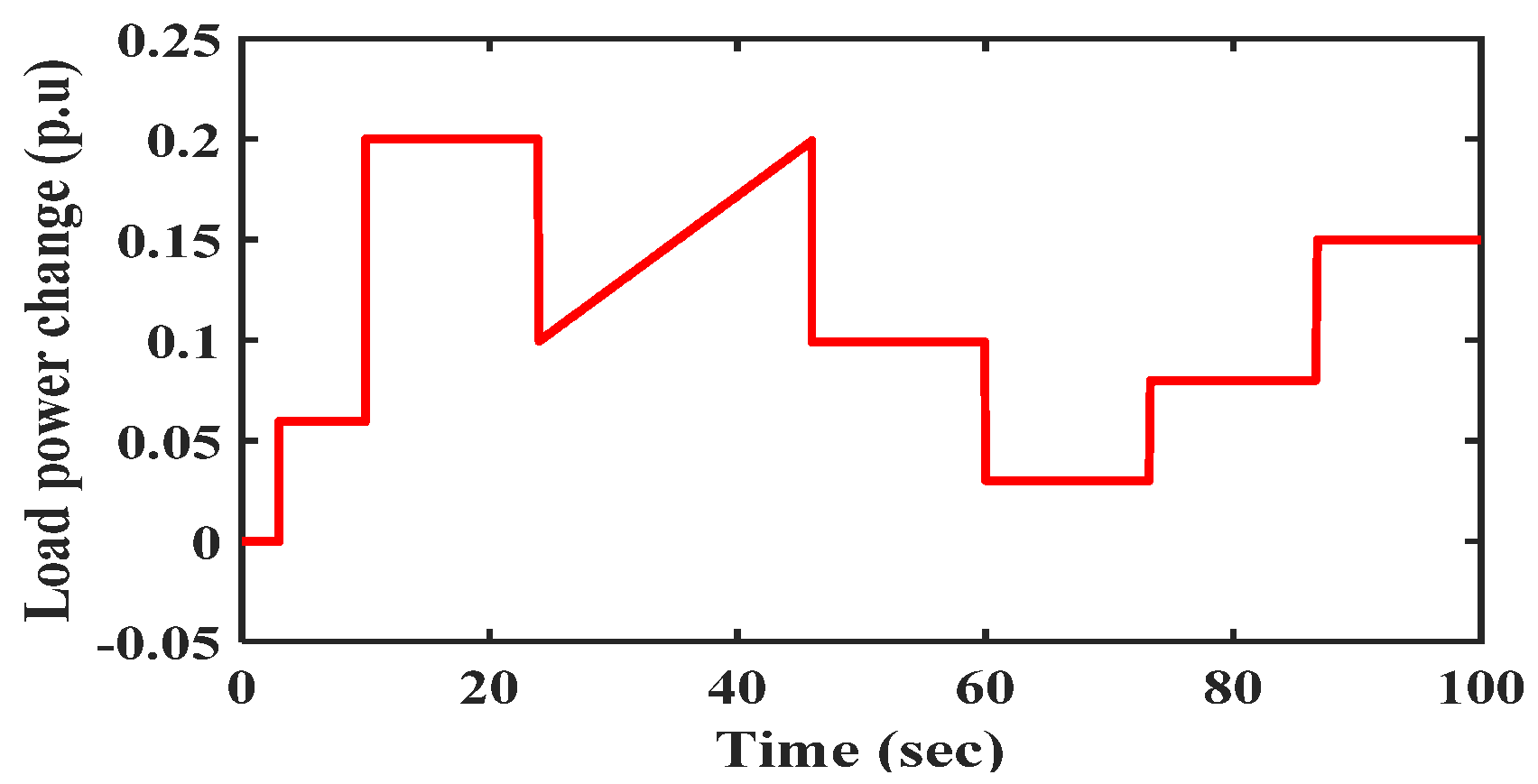
This case introduces more challenging operating conditions that combine load variability, reduced parameter values, and partial loss of generating units. Area 1 is subjected to random load variations, as depicted in Figure 19, while Area 2 experiences a 0.1 pu step disturbance at t = 2 s. In addition, the thermal unit in Area 1 and the gas unit in Area 2 are disconnected, creating a substantial reduction in available inertial and primary frequency support. To represent model uncertainties and degraded controller responsiveness, the sensitivity coefficients Kps and Tps are reduced to 80% of their nominal values. Under these conditions, Figure 20 shows that the maximum frequency deviation in Area 1 is reduced from approximately 0.701 Hz with conventional IE and 0.266 Hz with controlled IDE to about 0.116 Hz with the proposed controlled IDE-based HESS. This corresponds to reductions of approximately 83.4% and 56.4%, respectively. In Area 2, the corresponding maximum deviations are approximately 0.627, 0.167, and 0.084 Hz. The proposed strategy also restricts the maximum absolute tie-line power deviation to approximately 0.017 p.u., compared with about 0.043 p.u. and 0.090 p.u. for the controlled IDE and conventional IE strategies, respectively. The improved responses under simultaneous load variability, generation outages, parameter uncertainty, and communication latency demonstrate the stronger damping and inter-area regulation provided by the proposed strategy.
Figure 19.
Random power load changes in area 1 for case 2.
Figure 20.
The two-area interconnected power system response for case 2.
5.3. Case 3
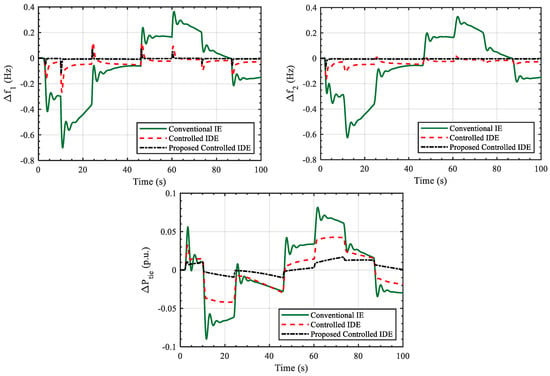
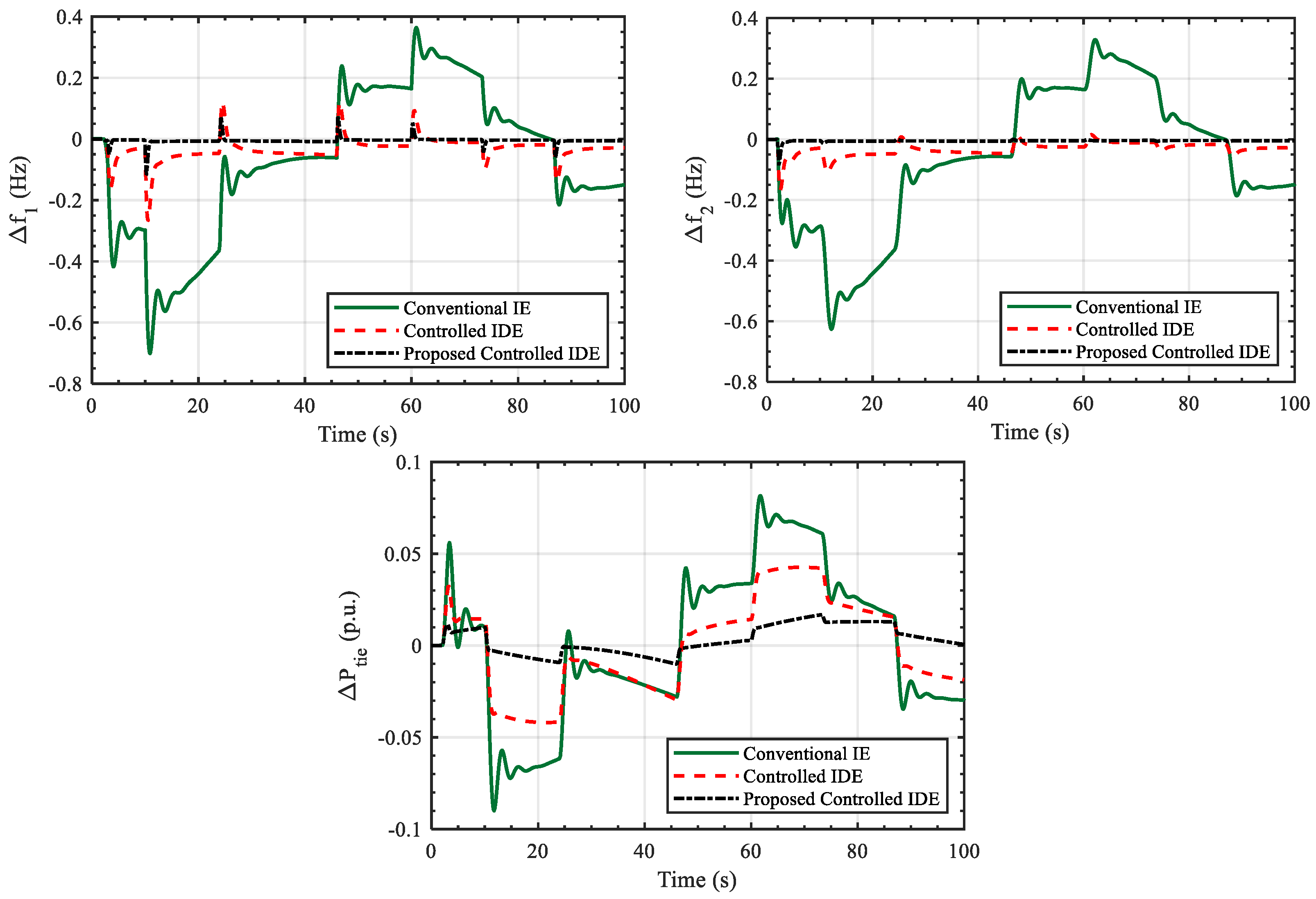
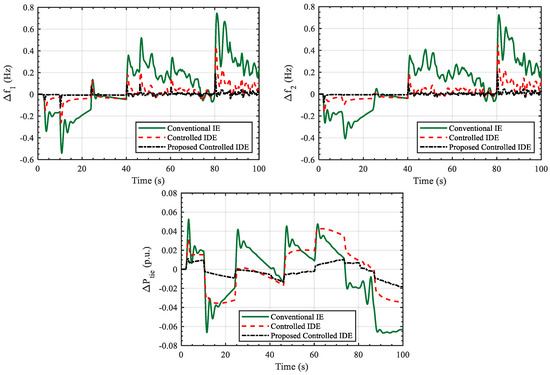
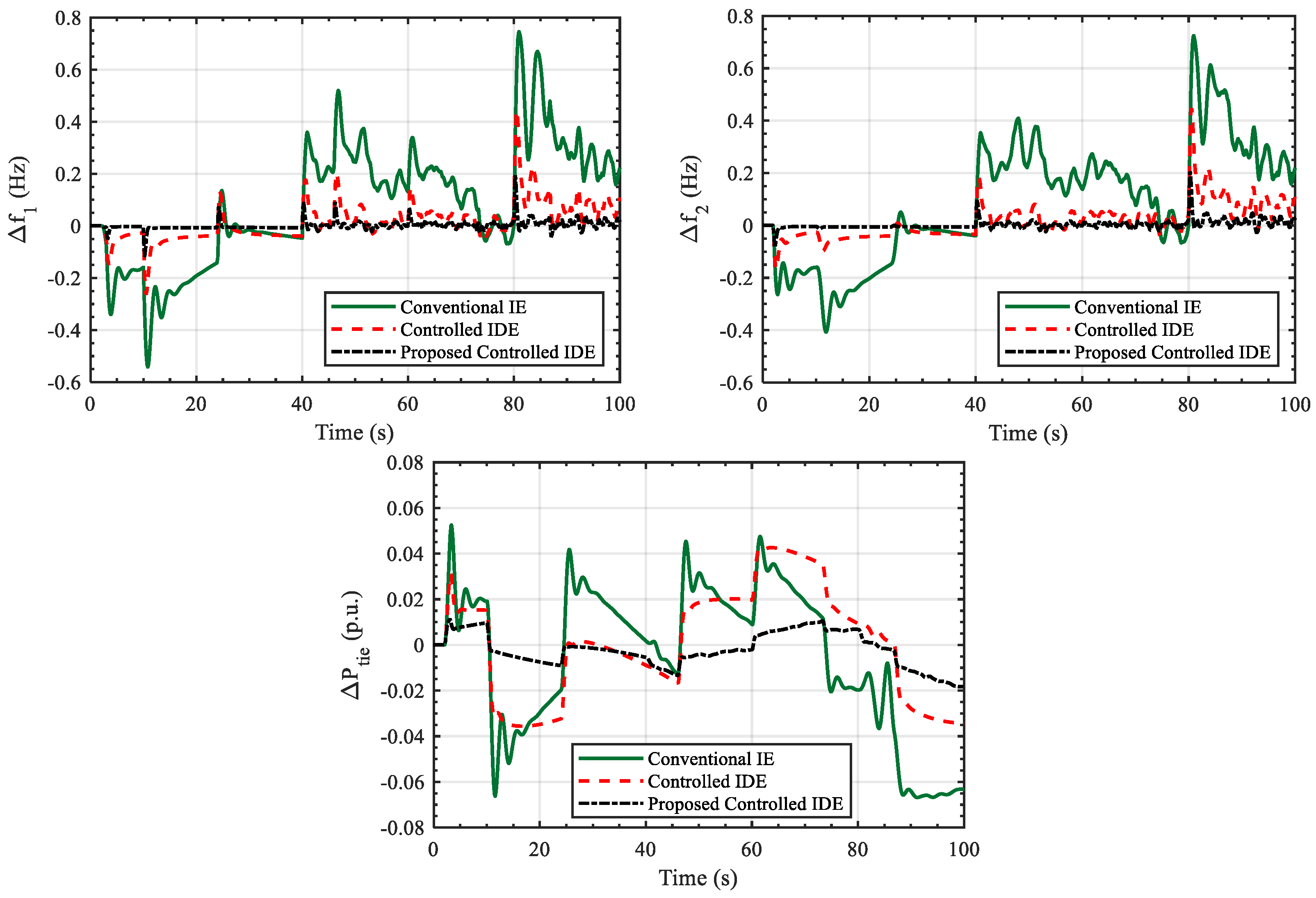
This case extends the analysis to deeper uncertainty conditions and incorporates RESs into both areas. The same load pattern used in Case 2 is applied: a random load variation in Area 1 and a 0.1 pu step increase in Area 2 at 2 s. All generation units remain connected in this scenario to isolate the effects of uncertainty and RES integration. The system parameters are intentionally stressed further by reducing Kps and Tps to 60% and decreasing the droop coefficient R to 70% of its nominal value. Simultaneously, wind and PV power injections are enabled as revealed in Figure 21, adding natural variability to the dynamic response. Despite these severe operating conditions and the communication delays in both the inertia-support and secondary LFC loops, the proposed controlled IDE-based HESS limits the maximum frequency deviation to approximately 0.193 Hz in Area 1 and 0.204 Hz in Area 2. In comparison, the controlled IDE reaches approximately 0.443 and 0.446 Hz, while the conventional IE reaches approximately 0.746 and 0.725 Hz in Areas 1 and 2, respectively. The maximum absolute tie-line power deviation is also reduced to approximately 0.0187 p.u., compared with 0.0427 p.u. for controlled IDE and 0.0669 p.u. for conventional IE. These results confirm that the proposed strategy retains effective frequency damping and inter-area power regulation under simultaneous RES variability, parameter uncertainty, load variation, and non-ideal communication, as demonstrated by the frequency and tie-line power responses in Figure 22.
Figure 21.
The change in solar PV and wind power for case 3.
Figure 22.
The two-area interconnected power system response for case 3.
6. Conclusions
This paper suggested an advanced IDE strategy based on a coordinated HESS composed of SCs and FC-BHEVs to enhance the frequency stability of renewable-dominated power grids. In the proposed coordinated control, SCs are adopted to provide virtual inertia because of their high power density and fast dynamic response, while the FC-BHEVs are utilized to provide virtual damping owing to their complementary energy characteristics and suitability for sustained power support. This coordinated allocation enables the HESS to effectively address both short-term and long-term frequency regulation requirements. To further improve frequency restoration, a supplementary integral control mechanism was incorporated into the proposed IDE strategy, forming a controlled IDE-based HESS. This enhanced strategy compensates for the limitations of primary frequency control and restores the system frequency to its nominal value after disturbances without requiring additional energy recovery control. By exploiting the FC-BHEVs as pre-existing distributed energy resources, the proposed framework also reduces the need for dedicated long-term storage devices while preserving reliable dynamic performance. The effectiveness of the proposed strategies was validated in both islanded and interconnected power systems under challenging operating conditions, including load disturbances, high RES penetration, generation outages, parameter uncertainties, renewable power fluctuations, and communication delays. The consideration of communication delays and the power and energy constraints of the HESS provides a more practical assessment of the proposed control framework. Simulation results confirmed that the proposed IDE-based HESS and controlled IDE-based HESS provide superior frequency regulation, reduced frequency deviations, improved damping, faster recovery, and enhanced steady-state performance compared with conventional IE and IDE strategies. Experimental or hardware-in-the-loop validation of the proposed coordinated IDE framework, including the dynamic interaction of the SC and battery–FC resources, will be considered in future work.
Author Contributions
Conceptualization, H.A. and G.M.; methodology, H.A. and G.M.; software, H.A.; validation, H.A. and G.M.; formal analysis, H.A. and G.M.; investigation, H.A. and G.M.; resources, H.A. and G.M.; data curation, H.A. and G.M.; writing—original draft preparation, H.A. and G.M.; writing—review and editing, H.A. and G.M.; visualization, H.A. and G.M. All authors have read and agreed to the published version of the manuscript.
Funding
This research received no external funding.
Institutional Review Board Statement
Not applicable.
Informed Consent Statement
Not applicable.
Data Availability Statement
All data generated or analyzed during this study are included in this article.
Conflicts of Interest
The authors declare no conflicts of interest.
References
- Astereki, A.A.; Monadi, M.; Seifossadat, S.G.; Saffarian, A.; Rouzbehi, K. Virtual inertia provision in modern power grids: A comprehensive review. Renew. Sustain. Energy Rev. 2026, 226, 116256. [Google Scholar] [CrossRef] [Scilit]
- Hu, J.; Shan, Y.; Cheng, K.W.; Islam, S. Overview of Power Converter Control in Microgrids—Challenges, Advances, and Future Trends. IEEE Trans. Power Electron. 2022, 37, 9907–9922. [Google Scholar] [CrossRef] [Scilit]
- Ali, H.; Magdy, G.; Xu, D. A new optimal robust controller for frequency stability of interconnected hybrid microgrids considering non-inertia sources and uncertainties. Int. J. Electr. Power Energy Syst. 2021, 128, 106651. [Google Scholar] [CrossRef] [Scilit]
- Nour, M.; Magdy, G.; Bakeer, A.; Telba, A.; Beroual, A.; Khaled, U.; Ali, H. A New Fractional-Order Virtual Inertia Support Based on Battery Energy Storage for Enhancing Microgrid Frequency Stability. Fractal Fract. 2023, 7, 855. [Google Scholar] [CrossRef] [Scilit]
- Karrari, S.; Baghaee, H.R.; Carne, G.D.; Noe, M.; Geisbuesch, J. Adaptive inertia emulation control for high-speed flywheel energy storage systems. IET Gener. Transm. Distrib. 2020, 14, 5047–5059. [Google Scholar] [CrossRef] [Scilit]
- Reißner, F.; Carne, G.D. Virtual Synchronous Machine integration on a Commercial Flywheel for Frequency Grid Support. IEEE Trans. Power Electron. 2024, 39, 12086–12090. [Google Scholar] [CrossRef] [Scilit]
- Sarasúa, J.I.; Martínez-Lucas, G.; Lafoz, M. Analysis of alternative frequency control schemes for increasing renewable energy penetration in El Hierro Island power system. Int. J. Electr. Power Energy Syst. 2019, 113, 807–823. [Google Scholar] [CrossRef] [Scilit]
- Fang, J.; Li, H.; Tang, Y.; Blaabjerg, F. Distributed Power System Virtual Inertia Implemented by Grid-Connected Power Converters. IEEE Trans. Power Electron. 2018, 33, 8488–8499. [Google Scholar] [CrossRef] [Scilit]
- Peng, Q.; Fang, J.; Yang, Y.; Liu, T.; Blaabjerg, F. Maximum Virtual Inertia From DC-Link Capacitors Considering System Stability at Voltage Control Timescale. IEEE J. Emerg. Sel. Top. Circuits Syst. 2021, 11, 79–89. [Google Scholar] [CrossRef] [Scilit]
- Sarojini, R.K.; Kaliannan, P. Inertia Emulation Through Supercapacitor for a Weak Grid. IEEE Access 2021, 9, 30793–30802. [Google Scholar] [CrossRef] [Scilit]
- Magdy, G.; Bakeer, A.; Alhasheem, M. Superconducting energy storage technology-based synthetic inertia system control to enhance frequency dynamic performance in microgrids with high renewable penetration. Prot. Control Mod. Power Syst. 2021, 6, 1–13. [Google Scholar] [CrossRef] [Scilit]
- Fang, Z.; Shek, J.K.; Sun, W. A review of grid-connected hybrid energy storage systems: Sizing configurations, control strategies, and future directions. J. Energy Storage 2025, 118, 116226. [Google Scholar] [CrossRef] [Scilit]
- Wang, Z.; Feng, Z.; Hu, C.; Li, X.; Zhu, Y. Enhancing battery performance under motor overload drive with a battery–supercapacitor hybrid energy storage system. J. Power Sources 2025, 642, 236680. [Google Scholar] [CrossRef] [Scilit]
- Patel, S.; Ghosh, A.; Ray, P.K.; Gurugubelli, V. Effective Power Management Strategy and Control of a Hybrid Microgrid with Hybrid Energy Storage Systems. IEEE Trans. Ind. Appl. 2023, 59, 7341–7355. [Google Scholar] [CrossRef] [Scilit]
- Huang, S.; Xiong, L.; He, Y.; Zhou, Y.; Gao, F.; Huang, W.; Jia, Q.; Li, Y. Energy storage system and applications in power system frequency regulation. J. Energy Storage 2025, 131, 117506. [Google Scholar] [CrossRef] [Scilit]
- Emrani, A.; Berrada, A. A comprehensive review on techno-economic assessment of hybrid energy storage systems integrated with renewable energy. J. Energy Storage 2024, 84, 111010. [Google Scholar] [CrossRef] [Scilit]
- Fang, J.; Tang, Y.; Li, H.; Li, X. A Battery/Ultracapacitor Hybrid Energy Storage System for Implementing the Power Management of Virtual Synchronous Generators. IEEE Trans. Power Electron. 2018, 33, 2820–2824. [Google Scholar] [CrossRef] [Scilit]
- Sarojini, R.K.; Palanisamy, K.; Sanjeevikumar, P.; Nielsen, J.B.-H. Inertia emulation control technique based frequency control of grid-connected single-phase rooftop photovoltaic system with battery and supercapacitor. IET Renew. Power Gener. 2020, 14, 1156–1163. [Google Scholar] [CrossRef] [Scilit]
- Sun, C.; Ali, S.Q.; Joos, G.; Bouffard, F. Design of Hybrid-Storage-Based Virtual Synchronous Machine with Energy Recovery Control Considering Energy Consumed in Inertial and Damping Support. IEEE Trans. Power Electron. 2022, 37, 2648–2666. [Google Scholar] [CrossRef] [Scilit]
- Ali, H.; Zaery, M.; Abido, M.A. Predefined-Time Virtual Synchronous Generator Control for Voltage Stability Enhancement in DC Microgrids using Hybrid Electric Vehicle Support. Transp. Res. Procedia 2026, 96, 932–939. [Google Scholar] [CrossRef] [Scilit]
- Hussain, A.; Aamir, M.F. Hybrid energy storage system integrating lithium-ion batteries and supercapacitors for enhanced electric vehicle performance. Energy Storage Convers. 2026, 3, 3933. [Google Scholar] [CrossRef] [Scilit]
- Kouchachvili, L.; Yaïci, W.; Entchev, E. Hybrid battery/supercapacitor energy storage system for the electric vehicles. J. Power Sources 2018, 374, 237–248. [Google Scholar] [CrossRef] [Scilit]
- Magdy, G.; Ali, H.; Xu, D. A new synthetic inertia system based on electric vehicles to support the frequency stability of low-inertia modern power grids. J. Clean. Prod. 2021, 297, 126595. [Google Scholar] [CrossRef] [Scilit]
- Abuelrub, A.; Hamed, F.; Hedel, J.; Al-Masri, H.M.K. Feasibility Study for Electric Vehicle Usage in a Microgrid Integrated with Renewable Energy. IEEE Trans. Transp. Electrif. 2023, 9, 4306–4315. [Google Scholar] [CrossRef] [Scilit]
- Chen, S.; Zhang, S.; He, S.; Yang, H. Two-Timescale Online Optimization of Behind-the-Meter Battery Storage for Stacked Revenue by Providing Multi-Services. IEEE Trans. Smart Grid 2025, 16, 2222–2233. [Google Scholar] [CrossRef] [Scilit]
- Qi, W.; Liu, Y.; Wang, X.; Ge, S.; Yu, J.; He, Z.; Tuo, J.; Wang, H.; Zhou, S.; Jin, C.; et al. Performance enhancement of battery thermal management based on liquid cooling plate channels embedded with non-uniform spiral fin structures. Appl. Therm. Eng. 2026, 300, 131501. [Google Scholar] [CrossRef] [Scilit]
- Sheng, L.; Lan, H.; Tao, B.; Zhang, Z.; Wang, H. Anisotropic thermal conductivity quantification in prismatic lithium-ion batteries. J. Energy Storage 2026, 162, 122112. [Google Scholar] [CrossRef] [Scilit]
- Jedari Salehzadeh, F.; Heyhat, M.M. Direct and indirect cooling of Lithium-ion batteries with New manifold designs. Therm. Sci. Eng. Prog. 2025, 68, 104325. [Google Scholar] [CrossRef] [Scilit]
- An, Z.; Zhao, S.; Du, X.; Pea, H.J.M.; Ding, Y.; Zhang, D.; Fu, J. Optimization design of lithium-ion battery thermal management system based on thermal resistance network analysis and cold plate arrangement. Therm. Sci. Eng. Prog. 2025, 68, 104335. [Google Scholar] [CrossRef] [Scilit]
- Qi, W.; Yu, L.; Zhao, S.; Guo, Y.; Ge, S.; Zhang, Y.; Cheng, J.; He, Z. Mechanism of PEMFC output performance improvement via non-uniform bluff body structures in bipolar plate flow channels: Flow field regulation and mass transfer enhancement. Renew. Energy 2026, 271, 126020. [Google Scholar] [CrossRef] [Scilit]
- Liu, J.; Miura, Y.; Ise, T. Comparison of Dynamic Characteristics Between Virtual Synchronous Generator and Droop Control in Inverter-Based Distributed Generators. IEEE Trans. Power Electron. 2016, 31, 3600–3611. [Google Scholar] [CrossRef] [Scilit]
- Askarov, A.; Rudnik, V.; Ruban, N.; Radko, P.; Ilyushin, P.; Suvorov, A. Enhanced Virtual Synchronous Generator with Angular Frequency Deviation Feedforward and Energy Recovery Control for Energy Storage System. Mathematics 2024, 12, 2691. [Google Scholar] [CrossRef] [Scilit]
- Kundur, P. Power System Stability and Control; McGraw-Hill: New York, NY, USA, 1994. [Google Scholar]
- Liu, R.; Wang, S.; Liu, G.; Wen, S.; Zhang, J.; Ma, Y. An Improved Virtual Inertia Control Strategy for Low Voltage AC Microgrids with Hybrid Energy Storage Systems. Energies 2022, 15, 442. [Google Scholar] [CrossRef] [Scilit]
- Xu, L.; Dou, C.; Yue, D.; Zhang, Y.; Zhang, B.; Li, H. Hybrid Modeling and Switching Control of Electric Vehicle Aggregation for Frequency Regulation. IEEE Trans. Sustain. Energy 2025, 16, 1860–1873. [Google Scholar] [CrossRef] [Scilit]
- Kumari, S.; Shankar, G. Maiden application of cascade tilt-integral–tilt-derivative controller for performance analysis of load frequency control of interconnected multi-source power system. IET Gener. Transm. Distrib. 2019, 13, 5326–5338. [Google Scholar] [CrossRef] [Scilit]
- Jafari, M.; Gharehpetian, G.B.; Anvari-Moghaddam, A. On the Role of Virtual Inertia Units in Modern Power Systems: A Review of Control Strategies, Applications and Recent Developments. Int. J. Electr. Power Energy Syst. 2024, 159, 110067. [Google Scholar] [CrossRef] [Scilit]
- Fini, M.H.; Golshan, M.E.H. Determining optimal virtual inertia and frequency control parameters to preserve the frequency stability in islanded microgrids with high penetration of renewables. Electr. Power Syst. Res. 2018, 154, 13–22. [Google Scholar] [CrossRef] [Scilit]
- Kerdphol, T.; Rahman, F.S.; Watanabe, M.; Mitani, Y.; Turschner, D.; Beck, H.-P. Enhanced Virtual Inertia Control Based on Derivative Technique to Emulate Simultaneous Inertia and Damping Properties for Microgrid Frequency Regulation. IEEE Access 2019, 7, 2169–3536. [Google Scholar] [CrossRef] [Scilit]
- Sati, S.E.; Al-Durra, A.; Zeineldin, H.; EL-Fouly, T.H.; El-Saadany, E.F. A novel virtual inertia-based damping stabilizer for frequency control enhancement for islanded microgrid. Int. J. Electr. Power Energy Syst. 2024, 155, 109580. [Google Scholar] [CrossRef] [Scilit]
- Zare, K.; Hagh, M.T.; Morsali, J. Effective oscillation damping of an interconnected multi-source power system with automatic generation control and TCSC. Int. J. Electr. Power Energy Syst. 2015, 65, 220–230. [Google Scholar] [CrossRef] [Scilit]
- Morsali, J.; Zare, K.; Hagh, M.T. Performance comparison of TCSC with TCPS and SSSC controllers in AGC of realistic interconnected multi-source power system. Ain Shams Eng. J. 2016, 7, 143–158. [Google Scholar] [CrossRef] [Scilit]
- Magdy, G.; Ali, H.; Xu, D. Effective Control of Smart Hybrid Power Systems: Cooperation of Robust LFC and Virtual Inertia Control Systems. CSEE J. Power Energy Syst. 2022, 8, 1583–1593. [Google Scholar] [CrossRef] [Scilit]

Disclaimer/Publisher’s Note: The statements, opinions and data contained in all publications are solely those of the individual author(s) and contributor(s) and not of MDPI and/or the editor(s). MDPI and/or the editor(s) disclaim responsibility for any injury to people or property resulting from any ideas, methods, instructions or products referred to in the content. |
© 2026 by the authors. Licensee MDPI, Basel, Switzerland. This article is an open access article distributed under the terms and conditions of the Creative Commons Attribution (CC BY) license.