


Abstract
To address the issue of “studying agriculture but not engaging in agricultural work” in Chinese agricultural universities, this study developed a practical teaching quality framework based on the CIPP model. The framework includes four dimensions: goal identity, resource support, process experience, and ability and emotional gain. A questionnaire survey was conducted among 433 students majoring in agricultural economics and management. The study combined structural equation modeling (SEM) and fuzzy-set qualitative comparative analysis (fsQCA) to explore how practical teaching quality influences behavioral intention to serve “agriculture, rural areas, and farmers”. The findings are as follows: (1) All four dimensions significantly positively influence behavioral intention, but the pathways differ. Process experience has the strongest direct effect (β = 0.51). Resource support (β = 0.125) and ability-emotional gain (β = 0.155) are partially mediated by student satisfaction, while goal identity is completely indirectly driven through satisfaction. (2) Three configurations for high behavioral intention are identified: the all-dimensional driven type (coverage 52.8%), the emotion-experience driven type (coverage 7.5%), and the experience-ability compensation type (coverage 12.5%), with an overall consistency of 93.46%; (3) The study confirms the applicability of the CIPP model and customer satisfaction theory in agricultural education. It reveals a multiple transmission mechanism of “quality–satisfaction–behavioral intention”. The study provides a theoretical basis and practical paradigm for constructing a precision practical teaching system and strengthening talent support for rural revitalization.
1. Introduction
According to the United Nations Food and Agriculture Organization report (2021), global food security faces severe challenges, and the COVID-19 pandemic has further exacerbated supply chain vulnerabilities. In this context, agricultural higher education bears the important mission of cultivating professionals. However, rural brain drain has become a global problem. Research indicates that, whether in developed or developing countries, the agricultural sector faces the dilemma of low willingness among youth to work in it [1].
The international academic community has accumulated a substantial body of empirical research on the correlation between agricultural education and students’ career choices. Practical teaching is widely recognized as a key link connecting theoretical knowledge with rural realities and shaping students’ values and career intentions [2,3]. China’s rural revitalization strategy has assigned a special mission to practical teaching in agricultural universities. This strategy emphasizes the need to prioritize practical teaching to cultivate professionals who can apply digital agriculture, modern seed industry, and precision planting technologies in rural areas. This policy direction addresses a real challenge in China’s agricultural talent system: although the number of agricultural graduates is large, the employment structure shows a clear trend of “de-agriculturalization”. This mismatch leads to the inefficient use of professional education resources relative to the actual talent needs of rural areas.
Chinese agricultural universities have conducted various explorations in practical teaching and have achieved certain results, but the following shortcomings still exist. Firstly, there is an orientation deviation. Most evaluations focus on general teaching quality, lacking specific investigation into the mission of serving “agriculture, rural areas, and farmers”. Particularly, they neglect how practical teaching bridges the intention gap between “professional training” and “grassroots employment”. Secondly, the influence mechanism is unclear. The synergistic effects of key elements—such as agriculture-related case studies, rural training bases, and project-based learning—on student satisfaction and service willingness are not well understood. This leads to inefficient alignment between resource investment and talent output. Thirdly, there are methodological bottlenecks. Traditional linear regression struggles to analyze the non-linear pathways driven by multiple synergistic factors and fails to capture the complex causal pathways driven by multiple synergistic factors, which restricts the precision of optimization strategies for practical teaching. Fourthly, there is a lack of cross-cultural comparison. Given the global significance of China’s rural revitalization strategy and the particularity of its institutional context, addressing this research gap is crucial for enriching global agricultural education theory and practice, yet related research remains insufficient.
Based on this, this study first constructed a four-dimensional quality framework of “goal identity, resource support, process experience, and ability and emotional gain” based on the CIPP model to quantify its impact on satisfaction and behavioral intention. Then, it used fsQCA4.1 to identify the differentiated configuration paths of contextual variables such as grade and student origin with quality elements, analyzing the multiple causal patterns driving high behavioral intention to serve “agriculture, rural areas, and farmers”. Contributions are expected in both theoretical and practical dimensions. Theoretically, by verifying the CIPP model in the Chinese context and revealing the “dual-path driving mechanism”, it provides new knowledge from a non-Western context for international agricultural education research. Practically, the formed “categorized policy implementation” framework not only provides precise guidance for cultivating rural revitalization talent in China but also offers a transferable solution for developing countries facing similar talent drain challenges, holding a reference value for advancing global sustainable development goals.
2. Literature Review
2.1. Research on Practical Teaching Quality
Research on practical teaching quality demonstrates a developmental trend from single-dimensional evaluation towards systematic and intelligent construction. Huang Luyan (2014) constructed a four-dimensional quality system based on the school-enterprise co-construction model [4]; Wang Juntao (2017) proposed a three-stage control mechanism [5]; Yang Fang et al. (2018) introduced the PDCA cycle to build a quality monitoring system [6]; Liang (2021) developed a practical teaching management system for higher vocational education covering system management, classroom management, and information repository management, promoting the digitization of management processes [7]; Wang et al. (2021) established a more comprehensive practical teaching evaluation system from five dimensions: teaching objectives, content, process, support, and effects [8]; Wu (2021), by analyzing the practical teaching system for the food science and engineering major, revealed the key role of standardized monitoring in improving teaching quality [9]; Zhu Yongjun et al. (2022) further designed a “four-in-one” intelligent cloud platform to achieve closed-loop control of the entire process [10]. In recent years, research has become more refined. Li Min (2023) emphasized teaching objective orientation and multi-party collaboration [11]; Wang Hudan et al. (2023) focused on the field expansion and method innovation of practical teaching in ideological and political courses [12]; Zhu Danjun (2024) proposed expanding the space for cultivating application-oriented talents by coordinating quality limiting factors [13]; and Liu Haiyan et al. (2024) pointed out that practical teaching quality evaluation is of significant importance for improving the quality of application-oriented talent cultivation [14].
In international research, the CIPP model is widely applied in the systematic evaluation of educational programs. In fields such as e-learning, vocational education, and public health practical teaching, the CIPP model is used to assess program objective alignment, resource allocation, teaching process, and outcome achievement [15,16,17,18]. Furthermore, international studies emphasize the significant impact of service tangibility on student satisfaction [19,20]. In specific areas such as entrepreneurship education and ideological and political courses, international research also utilizes methods like AHP and the entropy weight method to determine indicator weights and construct quantifiable evaluation systems [21,22,23].
In terms of evaluation methods, Shi Li et al. (2020) and Vimal et al. (2023) verified the practicality of BP neural networks in practical teaching evaluation [2,24]; Wu Liyue et al. (2021) emphasized multi-stakeholder participation in evaluation [25]. International research more frequently employs structural equation modeling, mixed methods research, etc. Gopal R, Punjani K K, El-Sayad G analyzed the relationships among service quality, satisfaction, and behavioral intention through SEM, reflecting methodological diversity and technical advancement [26,27,28].
2.2. Research on Behavioral Intention
Research on behavioral intention exhibits the characteristics of a complex mechanism involving multiple factors and pathways. In contexts such as entrepreneurship education, leisure sports, and online learning, key influencing factors including course instructors, practical platforms, consumption motivation, and course, characteristics have been identified (Guo Hongqin et al., 2020; Shao Xuemei et al., 2021; Xing Zhenzhen, 2025) [29,30,31]. The mediating role of student satisfaction has become a core topic, with Xiao Yinan et al. (2018), Zhai Chunjuan et al. (2020), and Cao Zhiyong et al. (2025) progressively verifying the mediating and even chain-mediating effects of satisfaction between teaching quality and behavioral intention [32,33,34].
International research similarly emphasizes the central position of student satisfaction [3,35,36,37]. Punjani K K et al. (2022) [27] found that computer self-efficacy influences online learning intention through the mediation of attitude [7]; El-Sayad G et al. (2021) pointed out that teaching presence indirectly affects satisfaction through behavioral and emotional engagement [28]; both Stankovska G and Punjani K K verified the mechanism of service quality influencing behavioral intention through satisfaction [20,27].
2.3. Literature Review Commentary
Existing achievements have laid a foundation for research on the relationship between practical teaching quality and behavioral intention. The dimensions of practical teaching quality have extended from the early focus on hardware resource investment to include goal design, process experience, ability internalization, and other dimensions. Multiple studies confirm that student satisfaction is a key hub connecting teaching quality and behavioral intention. However, deficiencies still exist when focusing on the agricultural university context. First, the specificity of agricultural orientation is neglected; most practical teaching quality research fails to incorporate core elements of agricultural education such as adaptability to “agriculture, rural areas, and farmers” policies and the development of agriculture-related cases, resulting in a disconnection between the indicator system and the talent needs of rural revitalization. Second, there is insufficient depth in theoretical explanation; behavioral intention research mostly follows the theory of planned behavior, failing to fully elucidate the paradox of “high satisfaction-low service intention”. Third, there are shortcomings in methodological innovation and application; configurational analysis techniques such as fsQCA can reveal differentiated driving paths, but current research still overly relies on linear regression, making it difficult to capture the nonlinear synergistic effects of resource investment and emotional internalization.
Based on this, this study grounds itself in the mission of agricultural universities. First, it reconstructs the dimensions of practical teaching quality in agricultural universities, integrating agricultural characteristic indicators into the CIPP four-dimensional framework to construct a specialized evaluation system for the Agricultural and Forestry Economics and Management major. Second, it deepens theoretical integration by simultaneously introducing customer satisfaction theory to analyze how practical teaching quality drives behavioral intention through the mediation of satisfaction, thereby addressing the “intention-behavior” paradox. Finally, it adopts a SEM-fsQCA hybrid model to quantify the independent effects of the four-dimensional qualities while identifying different configuration paths, providing a basis for categorized policy implementation, and offering a research framework with both international perspective and local adaptability to resolve the dilemma of “studying agriculture but not engaging in agricultural work”.
3. Research Hypotheses and Research Design
3.1. Conceptual Definition
3.1.1. Practical Teaching Quality in Agricultural Universities
The CIPP model is an educational evaluation framework proposed by the American scholar Stufflebeam in the 1960s. Its core is to support educational decision-making through a four-stage systematic evaluation [38], including Context evaluation, Input evaluation, Process evaluation, and Product evaluation [18,39,40,41,42].
Based on the CIPP model evaluation framework, the practical teaching quality in agricultural universities is deconstructed. At the context level, the deep integration of teaching objectives with the “agriculture, rural areas, and farmers” policies forms “goal identity”, strengthening the core directional focus of practical abilities and enabling students to clearly recognize and identify with the mission of serving rural revitalization. At the input level, relying on the collaborative support of on- and off-campus training bases, agriculture-related faculty, digital simulation systems, and learning resources, a “resource support” framework is constructed to facilitate the implementation of practical activities. At the process level, through contextualized teaching of agriculture-related cases, the implementation of comprehensive problem-solving tasks, and team collaboration feedback mechanisms, students’ “process experience” in real-world scenarios related to “agriculture, rural areas, and farmers” is enhanced. At the product level, the focus lies on substantial ability improvement. These abilities include agricultural and forestry market analysis, digital decision-making, agriculture-related project design, and the transformation of rural industrial knowledge, while “ability and emotional gain” deepens their emotional identification and value internalization rooted in the context of “agriculture, rural areas, and farmers”.
Thus, the essence of practical teaching quality is a theoretical framework composed of goal identity, resource support, process experience, and ability and emotional gain, providing systematic theoretical support for the formation of behavioral intention to serve “agriculture, rural areas, and farmers”.
3.1.2. Behavioral Intention to Serve “Agriculture, Rural Areas, and Farmers”
Customer satisfaction theory originated from consumer behavior research in the 1970s. Its core viewpoint is that satisfaction is an emotional state formed after customers compare the “perceived effect” of a product or service with their “expectations”, and it is a key mediating variable connecting service quality with subsequent behavioral intentions [43]. Its classical model can be summarized as the logical chain of “antecedent factors–customer satisfaction–behavioral intention”, where behavioral intention is the direct output of satisfaction, such as positive behaviors like willingness to recommend and repeat purchases.
In the practical teaching of the Agricultural and Forestry Economics and Management major, students can be regarded as customers, and practical teaching services as products, constructing a mapping relationship of “practical teaching quality antecedent factors–student satisfaction–behavioral intention to serve “agriculture, rural areas, and farmers”. Among these, antecedent factors include goal identity, resource support, process experience, and ability and emotional gain. When these factors meet or exceed students’ expectations, their satisfaction with practical teaching significantly improves, which in turn is directly transformed into behavioral intention to serve “agriculture, rural areas, and farmers”, specifically manifested as recommending practical courses, participating in agriculture-related competitions, prioritizing agricultural and forestry-related positions, and a sense of responsibility to serve rural revitalization.
3.2. Research Hypotheses
3.2.1. The Relationship Between Practical Teaching Quality and Student Satisfaction
Goal identity is reflected in the alignment between teaching objectives and the needs of rural revitalization, as well as the depth of policy integration. When teaching objectives accurately target the core competencies in the field of agricultural and forestry economics and management, and policy orientation is deeply integrated into teaching content, students will more clearly perceive the practical value, thereby enhancing teaching satisfaction. Resource support encompasses the professionalism of both on- and off-campus practical resources and instructional guidance. High-quality resource inputs directly enhance students’ sense of gain by providing immersive learning scenarios and reducing practical obstacles. Process experience reflects the dynamic effectiveness of teaching implementation, with its efficacy demonstrated through key aspects such as the depth of contextualized application of agricultural-related cases, the challenge of solving comprehensive agricultural problems, the completeness of teamwork, and the timeliness of teacher feedback. An efficient implementation process deepens the evaluation of learning experiences by strengthening cognitive resonance and participation effectiveness. Ability and emotional gain measures the effectiveness of the students’ competency enhancement, with its efficacy reflected through key indicators such as agricultural and forestry market analysis skills, proficiency in applying digital decision-making tools, and the degree of improvement in professional confidence. Explicit ability improvement constitutes a direct basis for students to evaluate teaching effectiveness.
H1a.
Goal identity has a positive impact on student satisfaction with practical teaching.
H1b.
Resource support has a positive impact on student satisfaction with practical teaching.
H1c.
Process experience has a positive impact on student satisfaction with practical teaching.
H1d.
Ability and emotional gain has a positive impact on student satisfaction with practical teaching.
3.2.2. The Relationship Between Practical Teaching Quality and Behavioral Intention to Serve “Agriculture, Rural Areas, and Farmers”
Resource support enhances the students’ identification with the cause of “agriculture, rural areas, and farmers” through off-campus real agricultural projects and agricultural data resources, thereby stimulating behavioral intention to engage in agricultural and rural work. Process experience engages students in resolving practical contradictions. These include issues like production-marketing coordination and green agricultural development. Through comprehensive problem-solving tasks and discussions on rural revitalization challenges, students develop a stronger sense of social responsibility and self-efficacy. This transformation fosters a genuine commitment to serving rural areas. Ability and emotional gain, by enhancing the students’ capacity for designing agricultural projects and transforming rural industrial knowledge, applies knowledge to the context of rural industrial revitalization, clarifies their behavioral path, and strengthens confidence in taking action to serve “agriculture, rural areas, and farmers”.
H2a.
Resource support has a positive impact on behavioral intention to serve “agriculture, rural areas, and farmers”.
H2b.
Process experience has a positive impact on behavioral intention to serve “agriculture, rural areas, and farmers”.
H2c.
Ability and emotional gain has a positive impact on behavioral intention to serve “agriculture, rural areas, and farmers”.
3.2.3. The Relationship Between Student Satisfaction and Behavioral Intention to Serve “Agriculture, Rural Areas, and Farmers”
Student satisfaction serves as psychological feedback on teaching effectiveness. Its efficacy is reflected through dimensions such as the achievement of expected competencies, accessibility of resources, clarity of career cognition, and rationality of overall arrangements. When practical teaching experiences exceed student expectations and deepen their identification with agriculture-related professions, it directly drives specific behavioral intentions, including recommending courses, participating in competitions, choosing relevant career positions, and serving rural areas.
H3.
Student satisfaction with practical teaching has a positive impact on behavioral intention to serve “agriculture, rural areas, and farmers”.
3.2.4. Hypotheses on the Mediating Effect of Student Satisfaction
The influence of practical teaching quality on behavioral intention to serve “agriculture, rural areas, and farmers” is essentially a psychological process. This process transforms cognition into behavior, with student satisfaction playing a central mediating role. Specifically, goal identity integrates teaching objectives with “agriculture, rural areas, and farmers” policies. Satisfaction helps internalize this value recognition into willingness to act. Resource support provides both on- and off-campus resources and faculty guidance. The sense of gain generated through satisfaction catalyzes commitment to service. Process experience involves discussing agriculture-related cases and practicing comprehensive tasks. These activities rely on emotional resonance strengthened by satisfaction to deepen behavioral motivation. Ability and emotional gain cultivates professional competence and career confidence. Satisfaction validates the effectiveness of these gains, enabling the integration of knowledge and action. Based on this, the following are proposed:
H4a.
Student satisfaction mediates between goal identity and behavioral intention to serve “agriculture, rural areas, and farmers”.
H4b.
Student satisfaction mediates between resource support and behavioral intention to serve “agriculture, rural areas, and farmers”.
H4c.
Student satisfaction mediates between process experience and behavioral intention to serve “agriculture, rural areas, and farmers”.
H4d.
Student satisfaction mediates between ability and emotional gain and behavioral intention to serve “agriculture, rural areas, and farmers”.
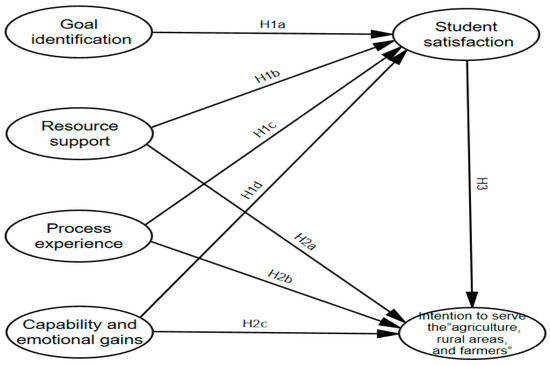
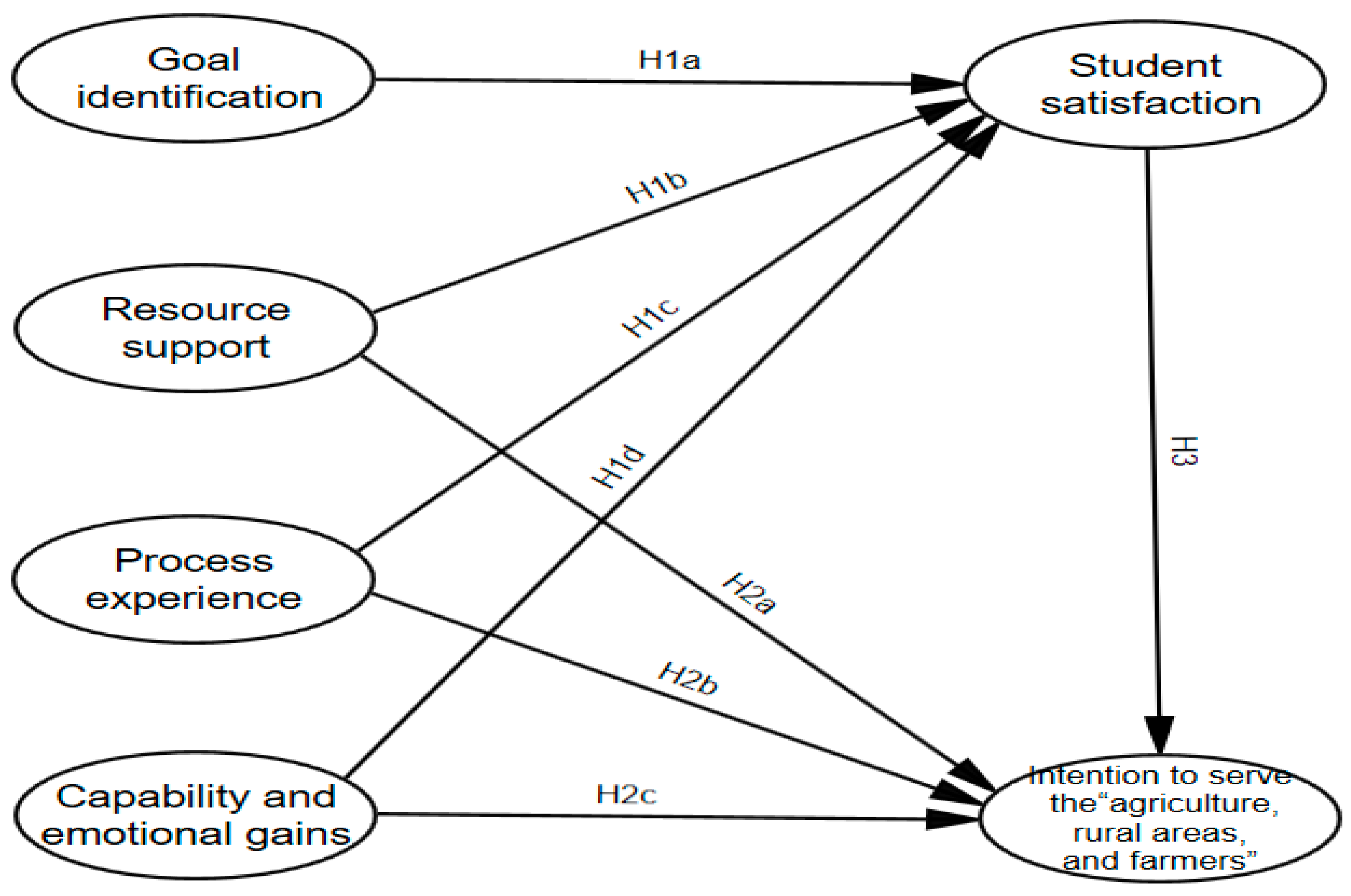
The specific conceptual model and research hypotheses are shown in Figure 1.
Figure 1.
Research model on the influence of practical teaching quality on behavioral intentions. Note: The arrows represent hypothesized paths.
3.3. Research Design
3.3.1. Sample Selection and Data Collection
To ensure regional representativeness and disciplinary relevance of the sample, this study selected two agricultural universities from each of China’s eastern, central, and western regions according to agricultural economic regional characteristics. An anonymous online survey was conducted from 10 to 25 July 2025, focusing on third- and fourth-year Agricultural Economics and Management majors over 18 years of age. The selected institutions included Qingdao Agricultural University and Zhejiang A&F University from the eastern region, Jiangxi Agricultural University and Henan Agricultural University from the central region, and Inner Mongolia Agricultural University and Sichuan Agricultural University from the western region. Eighty questionnaires were distributed to each institution, totaling 480 questionnaires. Ultimately, 433 valid questionnaires were collected, yielding a valid response rate of 90.21%.
The sample selection aimed to maximize its representativeness of the Chinese agricultural university population. In terms of institution selection, based on the National Bureau of Statistics’ division of China’s three major economic zones, two provincial key agricultural universities with leading status and extensive influence within their respective regions were selected from each zone. The agricultural economics and management programs in these universities are mostly national or provincial first-class undergraduate program construction sites. Their educational level, student quality, and the regional agricultural economic environment they serve possess high typicality within their respective zones. Specifically, eastern institutions are located in the economically developed coastal areas. Their practical teaching is more likely to focus on modern agriculture, international trade, and digital agriculture. Central institutions are located in the national core grain-producing areas, focusing on food security, agricultural production efficiency, and supply chain management. Western institutions are situated in ecologically fragile and border areas, emphasizing ecological protection, characteristic agriculture and animal husbandry, and rural revitalization practices. This stratified sampling framework, based on regional socio-economic development levels, ensures that the sample covered the main types of agricultural universities under China’s different development models, thereby providing a solid foundation for the generalization of the research conclusions.
In terms of effective sample size, the final collection of 433 valid questionnaires covered senior students from six representative universities, adequately reflecting the overall characteristics of the research population. The sample demonstrated relatively balanced distributions across key variables such as grade level and student origin, providing sufficient data support for further configurational analysis.
The gender distribution of the sample showed females accounting for 67.3% and males 32.7%, which aligns with the gender structure characteristics of students in the Agricultural and Forestry Economics and Management major. The grade distribution indicates that fourth-year students comprise 52.2% and third-year students 47.8%, demonstrating balanced coverage between the two stages (Table 1). Multiple response analysis regarding the types of practical teaching shows that the top three types by student participation frequency were social surveys or industry surveys (response rate 78.3%), innovation and entrepreneurship projects (response rate 69.6%), and classroom experiments (response rate 62.1%). This distribution conforms to the typical characteristics of the practical teaching system in agricultural universities (Table 2).
Table 1.
Distribution of demographic characteristics in the study sample.
Table 2.
Frequency and response distribution of student participation in various practical teaching modes.
3.3.2. Variable Definition and Measurement
This study, based on the CIPP evaluation model, constructed a practical teaching quality framework comprising four core dimensions. Goal identity measures the students’ perception of the alignment between practical teaching objectives and the national strategy for rural revitalization as well as personal development needs. The theoretical foundation of this construct originates from the Context evaluation in the CIPP model, emphasizing the alignment between educational objectives and environmental demands. Its measurement focuses on core content such as the relevance of teaching objectives to the “agriculture, rural areas, and farmers” policy and the support level of the curriculum system for cultivating innovative thinking.
Resource support assesses the students’ evaluation of the adequacy and effectiveness of the software and hardware resources provided by the school for practical teaching. It corresponds to the Input evaluation in the CIPP model, focusing on the planning and allocation of resources. The measurement dimensions cover the completeness of on-campus simulation systems, the authenticity and accessibility of off-campus training bases, the professionalism of instructor guidance, and the completeness of learning resources.
Process experience reflects the students’ subjective evaluation of the interactivity, challenge level, and depth of participation during the implementation of practical teaching. This construct corresponds to the Process evaluation in the CIPP model, focusing on the execution quality of teaching activities. The measurement emphasis includes the contextualization degree of agriculture-related case teaching, the challenge level of comprehensive problem-solving tasks, the effectiveness of team collaboration, and the timeliness of teacher feedback.
Ability and emotional gain measures the students’ perceived improvement in professional knowledge, skills, and emotional attitudes towards serving “agriculture, rural areas, and farmers” through practical teaching. This construct corresponds to the Product evaluation in the CIPP model, assessing the achievement degree of teaching objectives. Measurement content includes dimensions such as the ability to analyze agricultural and forestry markets, the application level of digital decision-making tools, the ability to design agriculture-related projects, and professional confidence in serving rural revitalization.
Based on the theoretical analysis framework and combined with expert consultation and in-depth interview results, this study developed a structured measurement scale containing 28 items (details in Table 3). The scale covers the four core dimensions of practical teaching quality, with student satisfaction as the mediating variable and behavioral intention to serve “agriculture, rural areas, and farmers” as the dependent variable [44,45]. All variables were measured using a 5-point Likert scale, with options ranging from “completely disagree” to “completely agree” corresponding to scores of 1 to 5 points, respectively. The specific quantification criteria were: 1 = completely disagree, 2 = relatively disagree, 3 = agree, 4 = relatively agree, 5 = completely agree.
Table 3.
Names, measurement, and descriptive statistics of relevant variables.
4. Results
4.1. Reliability and Validity Test of the Questionnaire
First, exploratory factor analysis was conducted to test the scale’s structural validity. The results showed a KMO value of 0.906 and Bartlett’s test of sphericity was significant at the p < 0.001 level, indicating suitability for factor analysis. Using principal component analysis, six common factors were extracted. The first factor explained 38.496% of the variance (less than 50% of the total variance explained of 83.897%), confirming no significant common method bias in the data. As shown in Table 4, the Cronbach’s α coefficients for each subscale ranged from 0.93 to 0.953, all exceeding the reliability threshold of 0.7, indicating good internal consistency of the scale. Confirmatory factor analysis was further conducted to test convergent and discriminant validity. In terms of convergent validity, all observed variables had standardized factor loadings on their corresponding latent variables exceeding 0.7, composite reliability (CR) values greater than 0.7, and average variance extracted (AVE) values greater than 0.5, meeting the standards for convergent validity. For discriminant validity (Table 5), the square roots of the AVE for each latent variable were greater than their correlations with other constructs, demonstrating sufficient discriminant validity of the scale [46].
Table 4.
Reliability and convergent validity test results of measurement scales.
Table 5.
Distinctive validity test results of latent variables.
4.2. Overall Model Fit Test
For the theoretical model of practical teaching quality affecting the behavioral intention to serve “agriculture, rural areas, and farmers”, overall fit indices were used to test its adequacy (Table 6). The chi-square/degrees of freedom ratio (CMIN/DF) was 2.764, the root mean square error of approximation (RMSEA) was 0.064, the comparative fit index (CFI) was 0.954, the Tucker–Lewis index (TLI) was 0.948, the incremental fit index (IFI) was 0.954, and the standardized root mean square residual (RMR) was 0.073. All indicators met the standard requirements, confirming that the overall model fit was good and satisfied the prerequisites for structural equation path analysis.
Table 6.
Overall goodness-of-fit index test results for structural equation model.
4.3. Measurement Invariance Test
To test the applicability of the measurement model across different student groups, this study employed multi-group confirmatory factor analysis to conduct measurement invariance tests for grade and student origin separately. Four models were established sequentially in a progressive order: the configural invariance model (same factor structure), the weak invariance model (adding equality constraints on factor loadings), the strong invariance model (further constraining the equality of observed variable intercepts), and the strict invariance model (adding equality constraints on error variances). The analysis results (Table 7) show that all models achieved ideal fit standards. Model comparisons revealed that during the progression from configural to strict invariance, ΔCFI did not exceed 0.01, and ΔRMSEA did not exceed 0.015, meeting the statistical requirements for measurement invariance [47,48]. This indicates that the measurement tool used in this study has cross-group equivalence across different grade and student origin groups, laying a methodological foundation for subsequent between-group comparison analyses.
Table 7.
Results of cross-group (grade level and place of origin) invariance testing for the measurement model.
4.4. Hypothesis Testing
4.4.1. Direct Effects
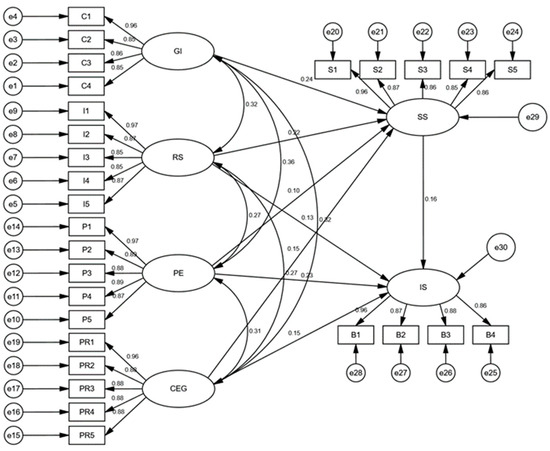
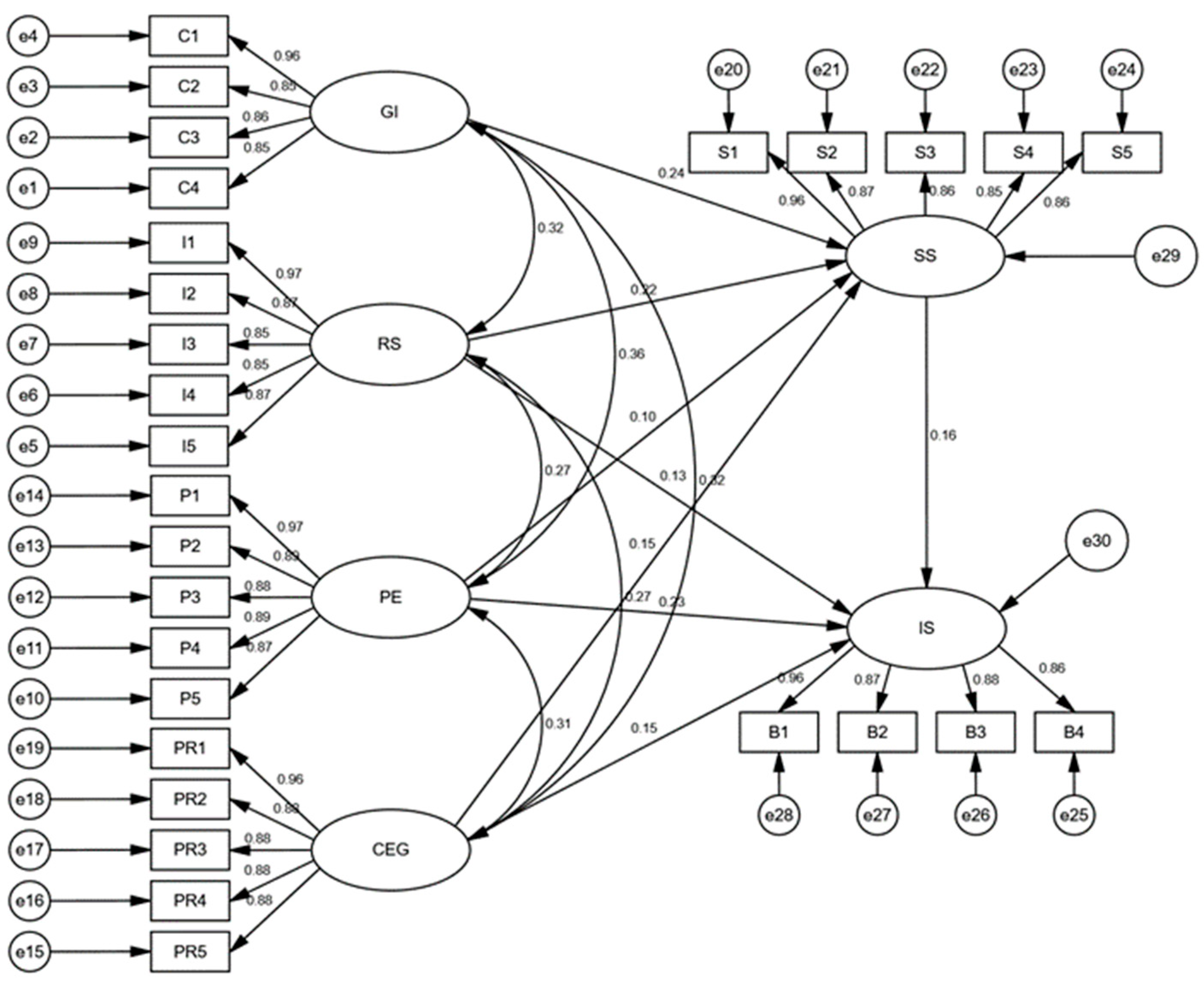
Using the maximum likelihood estimation method to estimate the parameters of the theoretical model, the standardized path relationships between various latent variables of practical teaching quality and the behavioral intention to serve “agriculture, rural areas, and farmers” were obtained. The causal relationships are visualized in the structural equation path diagram shown in Figure 2, with specific parameter estimates provided in Table 8.
Figure 2.
Path coefficient diagram of structural equation model showing how practical teaching quality influences intentions to serve “agriculture, rural areas, and farmers”.
Table 8.
Path coefficients and hypothesis testing results for the structural equation model.
From the model estimation results, the effect paths of the four dimensions of practical teaching quality on student satisfaction all passed significance tests. Among them, goal identity (β = 0.237) and resource support (β = 0.215) had the highest standardized coefficients, indicating that the alignment between objectives and “agriculture, rural areas, and farmers” policies, as well as the guarantee of internal and external resources, are the core drivers for enhancing student satisfaction in agricultural university practical teaching. Although process experience (β = 0.102) and ability-emotional gain (β = 0.153) were significant, their effect sizes were relatively low, reflecting that case-based teaching and ability enhancement indirectly influence experiential evaluation through other paths. Research hypotheses H1a–d are all supported.
The behavioral intention to serve “agriculture, rural areas, and farmers” is synergistically influenced by multiple paths. Among the direct paths, process experience had the most significant effect (β = 0.228), highlighting the direct impact of agricultural problem-solving tasks and discussions on rural revitalization contradictions on behavioral commitment. Although resource support (β = 0.125) and ability-emotional gain (β = 0.155) had significant direct effects, their effect sizes were lower than that of process experience, demonstrating the efficiency advantage of transforming situational experiences into actions through ability internalization. In indirect paths, student satisfaction played a key mediating role (β = 0.158), particularly in the process of goal identity influencing behavioral intention. Research hypotheses H2a–c, and H3 are all supported.
4.4.2. Mediating Effects
We used the Bootstrap method with 5000 repeated samplings and a 95% confidence interval to test the mediating effects (Table 9). The direct effect of goal identity on behavioral intention to serve “agriculture, rural areas, and farmers” was not significant, but the mediating effect through student satisfaction was significant, indicating that goal identity relies entirely on satisfaction to achieve behavioral transformation. Thus, hypothesis H4a is supported. Although resource support and ability-emotional gain had significant direct effects, satisfaction still played a partial mediating role. Therefore, hypotheses H4b and H4d are supported. The mediating effect of process experience did not reach a significant level, reflecting that its influence is primarily achieved through direct pathways. Thus, hypothesis H4c is not supported.
Table 9.
Bootstrap results for the mediating effect of student satisfaction.
The total effect values of each dimension on behavioral intention reveal differentiated mechanisms. Process experience demonstrated the strongest effect, with its direct path contributing 93.4%. Agricultural problem-solving tasks and discussions on rural revitalization contradictions were directly transformed into action intentions to serve “agriculture, rural areas, and farmers” through contextualized practical experiences. Resource support followed, with its direct path accounting for 78.6%, indicating that the provision of resources from off-campus real projects provides fundamental support for behavioral intention. Goal identity showed the weakest effect and was entirely mediated by satisfaction, suggesting that the alignment between teaching objectives and “agriculture, rural areas, and farmers” policies needs to indirectly strengthen commitment to agricultural professions through emotional identification. In summary, agricultural universities should prioritize strengthening procedural practical experiences to efficiently cultivate servants for “agriculture, rural areas, and farmers” [49].
5. Discussion
5.1. Multiple Configuration Paths
The SEM model reveals the causal pathways between practical teaching quality and behavioral intention to serve “agriculture, rural areas, and farmers”. However, the multiple concurrencies of influencing factors in real-world contexts necessitate moving beyond the limitations of single-variable relationship analysis. fsQCA, by examining the combined effects of antecedent conditions, can effectively complement the SEM model’s blind spots in analyzing variable interaction mechanisms [50,51]. Methodological research confirms [52] that the synergistic application of SEM and fsQCA can significantly enhance the explanatory depth and theoretical saturation regarding the dependent variable. Therefore, this study introduces the fsQCA method to further investigate multiple configuration paths.
5.1.1. Variable Selection and Calibration
This study selected grade level, place of origin, the four dimensions of practical teaching quality, and student satisfaction as antecedent variables. The selection basis was as follows. First, the four dimensions of practical teaching quality had sufficient theoretical and empirical research foundations; second, analysis showed that grade level (NJ) and place of origin (SY) positively influenced the behavioral intention to serve “agriculture, rural areas, and farmers”, hence they were included as antecedent variables. Variable calibration followed Ragin’s direct calibration method. For continuous latent variables, the dimension mean scores were calculated and then calibrated using full membership point 5, crossover point 3, and full non-membership point 1 as standards; for dichotomous variables (grade level, place of origin), original numerical coding was used: third-year is assigned 0, fourth-year is assigned 1; urban is assigned 0, rural is assigned 1. To avoid cases with 0.5 membership being excluded, all calibrated data with 0.5 membership were adjusted to 0.501 [53].
5.1.2. Necessary Condition Analysis of Single Antecedent Variables
Following the standard testing procedure of QCA methodology, necessary condition analysis was first conducted on each individual antecedent variable to determine whether they constitute necessary conditions for the behavioral intention to serve “agriculture, rural areas, and farmers”. The test results (Table 10) show that the consistency levels of all antecedent variables were below the 0.9 decision threshold [54], indicating that none of the four dimensions of practical teaching quality, student satisfaction, grade level, or place of origin are necessary conditions for the outcome variable. Further investigation into the sufficiency paths of multivariate combinations is required.
Table 10.
Necessary condition analysis for behavioral intention to serve “Agriculture, Rural Areas, and Farmers”.
5.1.3. Configurational Analysis
Based on the set-theoretic principles of QCA methodology, this study employed configurational analysis. The analysis examined how combinations of antecedent variables sufficiently influence behavioral intention to serve “agriculture, rural areas, and farmers”. Specifically, it tests whether combinations of antecedent conditions form a subset of the outcome set. Standardized path analysis was conducted using a consistency threshold of 0.8, PRI threshold of 0.7, and frequency threshold of 1 [55,56]. By combining the parsimonious solution and intermediate solution (details in Table 11) [57,58], core conditions and peripheral conditions in the configurations were identified, ultimately deriving three sufficient paths with an overall coverage rate of 58.43% and overall consistency of 93.38%, meeting the quantitative standards for establishing sufficient relationships.
Table 11.
Conditional configurations of behavioral intention to serve “Agriculture, Rural Areas, and Farmers”.
Configuration 1: All-dimensional driven type. This path indicates that when the four conditions of goal identity, resource support, process experience, and ability and emotional gain are all present, it can most systematically drive students to form the intention to serve “agriculture, rural areas, and farmers”. This confirms the systematic thinking of the CIPP model, illustrating that for most students, the success of practical teaching is a holistic systematic project, and any significant shortcoming in any dimension may weaken the final outcome. The presence of satisfaction indicates that this systematic advantage ultimately needs to be translated into behavioral intention through students’ positive emotional experiences.
This requires educational administrators to commit to building a “four-dimensional synergistic” practical teaching system, conducting top-level design, avoiding focusing solely on one aspect, such as investing only in hardware resources while neglecting goal guidance or process design, and ensuring that policy, resources, teaching, and outcome assessment form a joint force.
Configuration 2: Emotion-experience driven type. This path is particularly critical for urban lower-grade students. Within it, strong process experience and satisfaction are core, while the relative absence of goal identity and ability and emotional gain does not hinder the formation of behavioral intention. This indicates that for student groups with a relatively weak foundation in agricultural sentiment, the emotional resonance and value identification triggered by the immersive, highly interactive practical process itself can substitute for systematic policy cognition and clear ability confidence, becoming the initial motivation that inspires their service intention. For urban lower-grade student sources, policy should prioritize investment in high-quality process design rather than hastily conducting policy promotion. Efforts should vigorously develop compelling rural revitalization case libraries and organize immersive rural research, aiming to achieve emotional resonance by enhancing “process experience”, thereby laying a foundation for their subsequent professional learning and value internalization.
Configuration 3: Experience-ability compensation type. This path is primarily driven by process experience and ability-emotional gain, and remains effective even when goal identity and resource support are not prominent. This reveals a special mechanism among senior rural students. Relying on their existing rural life experience and the solid ability improvement gained through practical teaching, they form an “experience-ability” compensation effect, offsetting the lack of systematic policy guidance and resource support. They believe more in “what I can do” rather than “what others tell me I should do”. For such students, the policy focus should shift from “value indoctrination” to “ability empowerment and experience certification”. They should be provided with more challenging real-world projects. Platforms for showcasing and transforming outcomes should be built, and their existing practical experience should be incorporated into the credit recognition system, thereby strengthening their perception of “having a place to use their skills” and thus solidifying their confidence in returning to their hometowns for development.
5.1.4. Robustness Test
To verify the reliability of the research conclusions, a robustness test was conducted by adjusting key analysis parameters [59,60], with specific results shown in Table 12. First, after increasing the consistency threshold from 0.80 to 0.85, the obtained configuration paths were completely consistent with the original results, and the consistency and coverage of each path and the overall solution showed no significant changes. Subsequently, after raising the case frequency cutoff value from 2 to 3, the results showed that the core condition composition of the configuration paths was largely consistent with the original results, with no substantive changes, and the consistency level and coverage of the overall solution also remained stable. This demonstrates that the conclusions of this study have good robustness.
Table 12.
Robustness test of configurational analysis results.
5.2. Theoretical Implications
The results of this study provide important insights and deepening for the theoretical development in the field of practical teaching evaluation, particularly for the application of the CIPP model and customer satisfaction theory in the context of agricultural education.
Firstly, this study expands and refines the explanatory boundaries of the CIPP model in the field of higher education. The traditional CIPP model, as a comprehensive evaluation framework, focuses on systematic description. This study, through empirical testing, reveals that its four dimensions have differentiated effect pathways on students’ behavioral intention. More importantly, it found that “process evaluation” has a strong direct effect on behavioral intention, without necessarily being fully mediated by satisfaction. This finding indicates that in agricultural practical education, the immersion, challenge, and value identification inherent in a high-quality participation process itself can independently and directly stimulate the students’ behavioral intention, extending beyond the notion that student experience must influence behavioral intention through satisfaction [33]. This supplements the CIPP model with causal mechanism evidence regarding the core value of the “process” dimension.
Secondly, this study deepens the understanding of the mediating role of student satisfaction. The research found that satisfaction plays a partial mediating role between the “context” and “input” dimensions and behavioral intention, but the mediating effect for the “process” dimension is not significant. This indicates that student satisfaction more accurately reflects the students’ outcome expectations regarding teaching objectives and resource support, and when the practical process itself is highly attractive, its driving effect can surpass outcome expectations. This, when transplanting customer satisfaction theory from the commercial field to the educational field, endows it with new contextualized meaning: satisfaction is an important, but not the only, emotional transmission mechanism for educational effectiveness.
Finally, by integrating SEM and fsQCA methods, this study jointly reveals the complexity of the theoretical mechanism from both the “net effect” and “configuration effect” levels. The SEM results verify the linear, covariance-based causal relationships between variables [15,23,26], while the “multiple concurrent causality” paths discovered by fsQCA indicate that the same “high behavioral intention” can be achieved through different combinations of conditions. For example, the “emotion-experience driven” path demonstrates that high process experience can compensate for deficiencies in other dimensions, while the “experience-ability compensation” path reveals alternative driving mechanisms for specific student groups. This integrated analytical framework itself represents an advancement in methodology, indicating that in research on complex educational phenomena, it is necessary both to test the universal paths of theories and to identify different typological patterns leading to the same outcome.
6. Conclusions and Prospects
6.1. Conclusions
This study reveals a dual-path driving mechanism through which the quality of practical teaching in agricultural universities influences students’ willingness to serve at the grassroots level. There exists both a systematic emotional transformation path dependent on student satisfaction and a value identification path directly triggered by in-depth practical experience. This finding breaks through the limitation of traditional satisfaction models that regard emotional experience as a single mediator, providing a new perspective for understanding complex educational behaviors.
At the theoretical level, this study, by integrating the CIPP model and satisfaction theory and introducing the perspective of configurational analysis, promotes a paradigm shift in educational evaluation research from “net-effect thinking” to “multiple concurrent causality thinking”. This provides a referable methodological framework for studying other complex educational phenomena.
At the practical level, the policy implications of this study transcend the specific context of China’s rural revitalization and provide important references for developing countries globally facing similar challenges. In the process of promoting agricultural modernization and rural development, all countries face the structural contradiction between talent cultivation and rural brain drain. The categorized policy implementation framework proposed in this study achieves value identification through emotional resonance for groups with weak foundations, and accelerates behavioral transformation through ability empowerment for groups with experience. It provides a theoretical basis and action logic for countries to optimize their agricultural education systems and build a precision policy toolbox.
6.2. Research Limitations and Prospects
This study, through mixed methods, revealed the complex mechanism between practical teaching quality and students’ behavioral intention to serve “agriculture, rural areas, and farmers”, but there are still several limitations that need to be objectively recognized. These limitations also point the way for future research.
Firstly, the study’s sample representation has limitations. We used stratified sampling that included six agricultural universities from eastern, central, and western China. However, all selected institutions are public undergraduate universities. Their agricultural economics and management programs are also mostly designated as key or strength programs. This sampling strategy helps ensure typicality but may introduce selection bias. Therefore, generalizing the conclusions to private institutions, higher vocational colleges, or non-strength programs requires caution.
Secondly, at the research design level, cross-sectional data were a core limitation of this study. Although the theoretically constructed model revealed predictive relationships between variables, and configurational analysis also identified multiple causal paths, the single time point of data collection restricts rigorous causal inference. For example, there may be reverse causality where students’ pre-existing service tendencies influence their evaluation of teaching quality. Future research could adopt longitudinal tracking designs, measuring core variables at multiple time points, or use teaching intervention experiments to confirm the causal chains between variables.
Thirdly, the theoretical boundaries of the research need to be clearly defined. This study is rooted in the strategic context of China’s rural revitalization. The goal identity in practical teaching is inseparable from the “agriculture, rural areas, and farmers” policies with Chinese characteristics, and the formation of students’ service intention is also shaped by China’s unique urban–rural relations and social values. Therefore, the generalizability of the specific configuration paths identified in this study requires further testing and adaptation when applied to countries with different policy environments, educational systems, and cultural backgrounds.
Finally, regarding theoretical deepening, this study primarily focused on the core dimensions of practical teaching quality while involving limited details of the specific implementation process in teaching. These micro-level teaching elements may have a moderating effect on the research conclusions and are worthy of in-depth exploration in future studies.
Based on the above limitations, future research can advance from three dimensions: first, conducting cross-cultural comparative studies to explore the similarities and differences in the driving mechanisms of agricultural education in different national contexts; second, introducing macro variables such as regional economic development levels and agricultural industry characteristics to construct multilevel linear models and examine the cross-level interaction effects between macro contexts and micro teaching mechanisms; third, conducting in-depth case studies or action research targeting the typical configuration paths identified in this study to provide more operable implementation paradigms for practical teaching reform in universities. Through the expansion of these research paths, it is expected to further enrich the theoretical system in the field of agricultural education and provide references for agricultural talent cultivation practices worldwide.
Author Contributions
L.W.: Conceptualization, Funding acquisition, Supervision, Methodology, Writing—Original draft, Writing—Review and editing. P.Z.: Data curation, Formal analysis, Methodology, Validation, Visualization, Writing—Review and editing. L.C.: Supervision, Writing—review and editing. H.L.: Supervision, Writing—review and editing. J.L.: Conceptualization, Methodology, Validation, Writing—review and editing. All authors have read and agreed to the published version of the manuscript.
Funding
Undergraduate Education Reform Project of Shandong Province (Focused Project): Research and Practice on First-Class Major Program Development: Taking the Major “Economics and Management of Agriculture and Forestry” as an Example (Z2023302).
Institutional Review Board Statement
Ethical review and approval for this study were waived in accordance with the relevant Chinese regulations (available at: https://www.gov.cn/zhengce/zhengceku/2023-02/28/content_5743658.htm), which permit exemption for research using anonymous data.
Informed Consent Statement
Informed consent for participation was obtained from all subjects involved in the study.
Data Availability Statement
The raw data supporting the conclusions of this article will be made available by the authors on request.
Acknowledgments
The authors express their gratitude to the editors and reviewers for their insightful and beneficial feedback.
Conflicts of Interest
The authors declare no conflicts of interest.
References
- Gautam, Y.; Andersen, P. Rural livelihood diversification and household well-being: Insights from Humla, Nepal. J. Rural. Stud. 2016, 44, 239–249. [Google Scholar] [CrossRef] [Scilit]
- Kumar, M.G.V.; N, V.; Čepová, L.; Raja, M.A.M.; Balaram, A.; Elangovan, M. Evaluation of the Quality of Practical Teaching of Agricultural Higher Vocational Courses Based on BP Neural Network. Appl. Sci. 2023, 13, 1180. [Google Scholar] [CrossRef] [Scilit]
- Ohene Afriyie, E.; Snowden, M.; Winful, E.C.; Opoku-Asante, K.; Ocloo, E.C.; Quaye, J.N.A.; Opuni, F.F.; Hyams-Ssekasi, D.; Halsall, J.P. Does the entrepreneurship learning approach influence self-efficacy? The role of students’ entrepreneurial competence and satisfaction. J. Innov. Entrep. 2025, 14, 112. [Google Scholar] [CrossRef] [Scilit]
- Huang, L. Research on the Practice Teaching Quality System Based on School-Enterprise Co-construction. Sci. Technol. Inf. 2014, 12, 171. [Google Scholar]
- Wang, J. Analysis on the Construction of Practical Teaching Quality Evaluation System in Newly-built Undergraduate Colleges under the Background of Transformation and Development. Educ. Mod. 2017, 4, 325–326+337. [Google Scholar]
- Yang, F.; Yang, J.; Dai, E. Construction of Practical Teaching Quality Monitoring System for Business Administration Majors in Application-oriented Undergraduate Colleges. Contemp. Educ. Forum 2018, 4, 100–105. [Google Scholar]
- Liang, Y. Design and Implementation of Practical Teaching Management System Based on Web in Higher Vocational Colleges. J. Phys. Conf. Ser. 2021, 1852, 022078. [Google Scholar] [CrossRef] [Scilit]
- Wang, J.; Yang, M. Design of practical teaching quality evaluation system based on rough set and big data mining. In Proceedings of the 2nd International Conference on Industrial IoT, Big Data, and Supply Chain, Macao, China, 19 December 2021. [Google Scholar]
- Wu, Y.; Yang, N.; Shi, Y.; Wang, G. Quality monitoring and evaluation system of the practical teaching of food science and engineering specialty in local application-oriented undergraduate colleges under the background of new engineering—A case study of Bengbu University. Open J. Soc. Sci. 2021, 9, 181–190. [Google Scholar] [CrossRef]
- Zhu, Y.; Cai, B.; Song, C. Construction of Practical Teaching Quality Monitoring System for High-level Professional Groups Based on Big Data. Jiangsu High. Vocat. Educ. 2022, 22, 98–102. [Google Scholar]
- Li, M.; Bao, S. Analysis on the Path to Improve the Quality of Practical Teaching of “Great Ideological and Political Course”. Ideol. Theor. Educ. 2023, 9, 72–77. [Google Scholar]
- Wang, H.; Yi, R. Reflections on Improving the Quality of Practical Teaching of Ideological and Political Courses in Colleges and Universities. Sch. Party Build. Ideol. Educ. 2023, 6, 55–57. [Google Scholar]
- Zhu, D. Construction of Teaching Quality Monitoring System for Professional Degree Postgraduates. Res. Print. Digit. Media Technol. 2024, 3, 196–205. [Google Scholar]
- Liu, H.; Lü, W. Problems and Countermeasures of Practical Teaching Quality Evaluation in Application-Oriented Undergraduate Colleges. Wide View 2024, 5, 19–23. [Google Scholar]
- Prayogo, D. CIPP evaluation model and its effect on e-learning. Al-Ishlah J. Pendidik. 2022, 14, 177–188. [Google Scholar] [CrossRef] [Scilit]
- Suharno, S.; Pardiman, P.; Harijanto, D.; Ashar, A. Monitoring strategy and evaluation of education and training program with the CIPP method. Nazhruna J. Pendidik. Islam 2022, 5, 1228–1241. [Google Scholar] [CrossRef] [Scilit]
- Agus, A.; Juliadharma, M.; Djamaluddin, M. Application of the CIPP model in evaluation of the inclusive education curriculum in Madrasah Aliyah. Nidhomul Haq J. Manaj. Pendidik. Islam 2023, 8, 31–50. [Google Scholar] [CrossRef] [Scilit]
- Ameryoun, A.; Jambarsang, S.; Akhoundi, H.; Askari, R. Evaluating the educational program of bachelor of science in healthcare management using CIPP model: A case study at Yazd University of Medical Sciences. Res. Dev. Med. Educ. 2023, 12, 24. [Google Scholar] [CrossRef] [Scilit]
- Kanori, E.; Kimani, G.; Kalai, J. Service Tangibility, Teaching and Learning, and Students’ Satisfaction at the University of Nairobi, Kenya. J. Pedagog. Andragogy Heutagogy Acad. Pract. 2020, 1, 16–28. [Google Scholar]
- Stankovska, G.; Ziberi, F.; Dimitrovski, D. Service Quality and Student Satisfaction in Higher Education; Bulgarian Comparative Education Society: Sofia, Bulgaria, 2024. [Google Scholar]
- Lei, L. Research on the Construction of Quality Evaluation System of Ideological and Political Courses in Colleges and Universities Based on CIPP Model. In Proceedings of the 2025 2nd International Conference on Informatics Education and Computer Technology Applications, Kuala Lumpur, Malaysia, 17–19 January 2025; pp. 154–159. [Google Scholar]
- Fan, X.; Tian, S.; Lu, Z.; Cao, Y. Quality evaluation of entrepreneurship education in higher education based on CIPP model and AHP-FCE methods. Front. Psychol. 2022, 13, 973511. [Google Scholar] [CrossRef] [Scilit]
- Zhao, T.; Yu, L.; Jiang, X.; Yang, S.; Zhang, X.; Zhang, M.; Zhang, Y.; Yan, T.; Wu, H.; Xu, F. Construction of a public health practice teaching quality evaluation system based on the CIPP model using the Analytic Hierarchy Process (AHP) and entropy weight method. BMC Med. Educ. 2025, 25, 368. [Google Scholar] [CrossRef] [Scilit]
- Shi, L.; Chen, C.; Shao, Y. Research on the Evaluation of College Students’ Practical Teaching Effect Based on BP Neural Network. J. Yangzhou Univ. (High. Educ. Res. Ed.) 2020, 24, 112–118. [Google Scholar]
- Wu, L.; Hou, G. Construction of Higher Vocational Practical Teaching Quality Evaluation System from the Perspective of Stakeholders. J. Yueyang Vocat. Tech. Coll. 2021, 36, 7–12. [Google Scholar]
- Gopal, R.; Singh, V.; Aggarwal, A. Impact of online classes on the satisfaction and performance of students during the pandemic period of COVID-19. Educ. Inf. Technol. 2021, 26, 6923–6947. [Google Scholar] [CrossRef] [Scilit]
- Punjani, K.K.; Mahadevan, K. Transitioning to online learning in higher education: Influence of Awareness of COVID-19 and Self-Efficacy on Perceived Net Benefits and Intention. Educ. Inf. Technol. 2022, 27, 291–320. [Google Scholar] [CrossRef] [Scilit]
- El-Sayad, G.; Md Saad, N.H.; Thurasamy, R. How higher education students in Egypt perceived online learning engagement and satisfaction during the COVID-19 pandemic. J. Comput. Educ. 2021, 8, 527–550. [Google Scholar] [CrossRef] [Scilit]
- Guo, H.; Luo, D. Research on Entrepreneurial Education Satisfaction and Its Improvement Strategies—An Empirical Analysis Based on 10 Local Undergraduate Universities in Zhejiang Province. Res. High. Educ. Eng. 2020, 5, 165–171+200. [Google Scholar]
- Shao, X.; Qiu, L.; Zhang, Q.; Tian, Y. The Influence of Leisure Sports Consumption Motivation on Behavioral Intention: The Dual Mediating Effect of Leisure Involvement and Experience Quality. J. Xi’an Phys. Educ. Univ. 2021, 38, 174–181+225. [Google Scholar]
- Xing, Z. The Influence of Multidimensional Characteristics of Online Education Courses on College Students’ Continuous Learning Behavioral Intention. Theory Pract. Educ. 2025, 45, 61–64. [Google Scholar]
- Xiao, Y.; Li, J. Research on Influencing Factors of College Students’ Satisfaction with Practical Teaching. J. Jishou Univ. (Soc. Sci. Ed.) 2018, 39 (Suppl. S1), 214–216. [Google Scholar]
- Zhai, C.; Kong, H. Research on the Influence of Higher Education Service Quality on Student Satisfaction and Their Behavioral Intention. Heilongjiang Res. High. Educ. 2020, 38, 53–58. [Google Scholar]
- Cao, Z.; Qiu, Q.; Tang, Y. Research on Influencing Factors and Mechanism of Practical Teaching Satisfaction in Application-oriented Undergraduate Universities—A Test Based on Chain Mediating Model. Shandong High. Educ. 2025, 3, 24–31+90. [Google Scholar]
- Aslan, M.; Aslan, H. The interplay of brand identification, satisfaction, and psychological well-being: A mediational role of positive WOM behavior in higher education. BMC Psychol. 2025, 13, 577. [Google Scholar] [CrossRef] [Scilit] [PubMed]
- Hanaysha, J.R.; Eli, T.B. Impact of teacher lecturing skills, ICT resources, physical classroom environment and library facilities on university image: Student satisfaction as a mediator. Learn. Teach. High. Educ. Gulf Perspect. 2024, 19, 15–34. [Google Scholar] [CrossRef] [Scilit]
- Islam, S.; Nisho, T.F.; Akter, S. Impact of transformational leadership on university brand performance: The moderating role of academic buoyancy and the mediating role of academic performance and satisfaction. Int. J. Educ. Manag. 2025. [Google Scholar] [CrossRef] [Scilit]
- Wang, L.; Su, M. Research on Influencing Factors of Practical Teaching Satisfaction in University Management Majors—Taking Qingdao Agricultural University as an Example. Mod. Bus. Trade Ind. 2022, 43, 239–240. [Google Scholar]
- Neyazi, N.; Arab, M.P.; Farzianpour, F.; Majdabadi, M.M. Evaluation of selected faculties at Tehran University of Medical Sciences using CIPP model in students and graduates point of view. Eval. Program Plan. 2016, 59, 88–93. [Google Scholar] [CrossRef] [Scilit]
- Knott, K.; Fricas, J. Comprehensive initial evaluation of an innovative yearlong population health internship for undergraduates. Public Health Nurs. 2022, 39, 1255–1270. [Google Scholar] [CrossRef] [Scilit]
- Peng, J.; Wang, J.; Li, G.; Li, B.; Liu, Y.; Feng, L.; Sun, X.; Zhen, X. Construction of a quality evaluation index system for public health undergraduate talent cultivation based on the CIPP evaluation model. Chin. J. Public Health 2024, 40, 1370–1374. [Google Scholar]
- Li, Y.; Wang, F. Construction of a quality assurance framework for college students’ online course learning based on CIPP. Heilongjiang Res. High. Educ. 2024, 42, 148–154. [Google Scholar] [CrossRef]
- Johnson, M.D.; Fornell, C. A framework for comparing customer satisfaction across individuals and product categories. J. Econ. Psychol. 1991, 12, 267–286. [Google Scholar] [CrossRef] [Scilit]
- Zeng, Z. Research on the Practical Teaching System of Application-Oriented Undergraduate Colleges. Master’s Thesis, Yunnan Normal University, Kunming, China, 2020. [Google Scholar]
- Wang, W.; Yang, Y. An Empirical Study on the Influencing Factors of College Students’ Entrepreneurial Intention Based on Factor Analysis—A Sample Study Based on University of Science and Technology Beijing. High. Educ. Explor. 2018, 3, 123–128. [Google Scholar]
- Liu, Y.; Wang, Y. Consumers’ Perceived Value, Satisfaction and Behavioral Intention of Characteristic Agricultural Products—Based on a Survey of Donkey Meat Consumption among Urban Residents in Shandong and Hebei Provinces. J. China Agric. Univ. 2021, 26, 232–244. [Google Scholar]
- McArdle, J.J. Latent Variable Modeling of Differences and Changes with Longitudinal Data. Annu. Rev. Psychol. 2009, 60, 577–605. [Google Scholar] [CrossRef] [Scilit]
- Li, S.; Zhang, H. A study on the impact of destination brand love on residents’ and tourists’ environmentally responsible behavior—Based on goal framing theory. Tour. Trib. 2025, 1, 1–27. [Google Scholar]
- Ma, Y.; Xie, Y.; Kang, P.; Wu, C. Research on the Mechanism of Influencing Factors of China’s Emergency Industry Development: Based on Structural Equation Model. Sci. Res. Manag. 2020, 41, 257–267. [Google Scholar]
- Afonso, C.; Silva, G.M.; Gonçalves, H.M.; Duarte, M. The role of motivations and involvement in wine tourists’ intention to return: SEM and fsQCA findings. J. Bus. Res. 2018, 89, 313–321. [Google Scholar] [CrossRef] [Scilit]
- Mikalef, P.; Pateli, A. Information technology-enabled dynamic capabilities and their indirect effect on competitive performance: Findings from PLS-SEM and fsQCA. J. Bus. Res. 2017, 70, 1–16. [Google Scholar] [CrossRef] [Scilit]
- Gligor, D.; Bozkurt, S. FsQCA versus regression: The context of customer engagement. J. Retail. Consum. Serv. 2020, 52, 101929. [Google Scholar] [CrossRef] [Scilit]
- Ragin, C.C. Redesigning Social Inquiry: Fuzzy Sets and Beyond; University of Chicago Press: Chicago, IL, USA, 2009. [Google Scholar]
- Rihoux, B.; Ragin, C.C. Configurational Comparative Methods: Qualitative Comparative Analysis (QCA) and Related Techniques; Sage: Thousand Oaks, CA, USA, 2009. [Google Scholar]
- Schneider, C.Q.; Wagemann, C. Set-Theoretic Methods for the Social Sciences: A Guide to Qualitative Comparative Analysis; Cambridge University Press: Cambridge, UK, 2012. [Google Scholar]
- Zhang, M.; Chen, W.; Lan, H. “Why” Chinese Enterprises Completely Acquire Overseas High-Tech Enterprises: A Fuzzy Set Qualitative Comparative Analysis (fsQCA) Based on 94 Cases. China Ind. Econ. 2019, 4, 117–135. [Google Scholar]
- Chuah, S.H.W.; Tseng, M.L.; Wu, K.J.; Cheng, C.F. Factors influencing the adoption of sharing economy in B2B context in China: Findings from PLS-SEM and fsQCA. Resour. Conserv. Recycl. 2021, 175, 105892. [Google Scholar] [CrossRef] [Scilit]
- Woodside, A.G. Moving beyond multiple regression analysis to algorithms: Calling for adoption of a paradigm shift from symmetric to asymmetric thinking in data analysis and crafting theory. J. Bus. Res. 2013, 66, 463–472. [Google Scholar] [CrossRef] [Scilit]
- Guo, J.; Zhu, C.; Liu, A.; Tang, X. The development mechanism of moral identity among Chinese college students. J. High. Educ. 2025, 46, 73–83. [Google Scholar]
- Gao, D.; Liu, Y.; Li, X. Development and validation of the depression scale for junior high school students. Psychol. Res. 2025, 18, 376–384. [Google Scholar]

Disclaimer/Publisher’s Note: The statements, opinions and data contained in all publications are solely those of the individual author(s) and contributor(s) and not of MDPI and/or the editor(s). MDPI and/or the editor(s) disclaim responsibility for any injury to people or property resulting from any ideas, methods, instructions or products referred to in the content. |
© 2025 by the authors. Licensee MDPI, Basel, Switzerland. This article is an open access article distributed under the terms and conditions of the Creative Commons Attribution (CC BY) license (https://creativecommons.org/licenses/by/4.0/).