


Abstract
The use of bacterial inoculants is an attractive alternative that could reduce the consumption of chemical fertilizers in crops. In the production system of quality coffee seedlings, it is essential to achieve an adequate balance of nutrients that allows for healthy plants that are resistant to subsequent handling. The objective of this work was to evaluate the effect of Rhizobium sp. inoculation on the growth, nutrition and quality of coffee seedlings cultivated with different doses of phosphoric fertilization. Inoculation tests were carried out under nursery conditions using Coffea arabica L. cv. “Isla 5–15” and Coffea canephora Pierre ex Froehner cv. “Robusta” seeds inoculated with the Rhizobium sp. Rpr2 strain. Sixty days after sowing, the hypocotyldonal graft was performed, and the resulting plants were also treated with the bacterial inoculant. Plants were then planted in substrate with different doses of phosphorus (P): 25, 50, 75 and 100%. At seven months of cultivation, variables of growth (plant height, stem diameter, number of leaf pairs, main root length, root volume, dry mass of the aerial part, root and total), phosphoric nutrition (leaf and root P contents) and posture quality index were evaluated. The inoculation stimulated the aerial part (37%), root growth (34%), the quality index of the grafted postures (30%), and phosphorus absorption (42%) and allowed a decrease from 25 to 75% of the mineral fertilizer. For the first time in Cuba, the benefits of rhizobial inoculation on the nutrition and quality of coffee seedlings were demonstrated. The inoculation of grafted coffee seedlings with Rhizobium sp. Rpr2 through the inoculation method proposed in this study can be recommended as a new easy, cost-effective and efficient inoculation approach to obtain additional benefits for coffee growth, improving the absorption of nutritive elements and the quality characteristics of the coffee seedlings.
1. Introduction
Coffee (Coffea arabica L.) is native to Africa and belongs to the Rubeaceae family [1]. Its culture is one of the most important in the world due to the quality of its beverage being one of the most consumed and globally traded commodities [2,3]. World coffee production reached 10.5 million tons in 2020, while in Cuba, it was 7500 tons [4]. Worldwide, Coffea arabica and Coffea canephora var. Robusta account for 70% and 30% of total production, respectively [1,5]. Cuba is, according to the International Coffee Organization [3], among the producers in Central America and the Caribbean; however, the quality of production and the export of the coffee is low in comparison with other countries in the region. Several factors have impacted coffee plantations, such as low prices in the world market, old plantations and lack of financing and investment to renew the culture. Climate change (increase in temperature), poor soil nutrition and disease have also negatively affected coffee production in Cuba [6,7]. Little access to international markets has forced Cuba to develop research aimed at replacing chemical inputs in crop nutrition [6].
Nutrition in field crop establishment and seedling production has limited crop expansion and productivity in Cuba. In coffee growing, obtaining quality seedlings is one of the main elements necessary to obtain good stability and productivity of the crop [6,7]. The production of coffee seedlings is performed in nurseries. Under these nursery conditions, healthy plants with a high genetic standard which represent high-quality seedlings are produced [8]. To guarantee this quality pattern of the seedlings, investment in nutrition must be made, which promotes greater success in transplanting in the field, associated with greater rooting, thus guaranteeing better absorption of nutrients and high survival rates [8,9,10,11,12,13].
An adequate nutritional balance of the substrate used in the nursery phase is an indispensable requirement for obtaining healthy plants with high yields [14]. In Cuba, mineral fertilization is fundamentally used intensively in the production of seedlings and in the management of coffee in the field, which makes the production process more expensive [15,16]. The search for methods and strategies that allow sustainable production has been the focus of current production [12]. To meet this goal, several studies have confirmed that it is possible to obtain good development of coffee seedlings using biostimulants [13,15,16]. The development of new production models incorporating sustainable practices includes the use of bacteria [6] and plant extracts to control diseases [17], and they have contributed to culture today.
Plant growth promoting rhizobacteria (PGPR) is a group of bacteria capable of actively colonizing the plant root system and improving its growth and yield [18]. PGPR such as rhizobia, solubilize phosphates from the soil by producing organic acids [18,19]. Phosphorus (P) is an essential macronutrient in plant physiology, participates in photosynthesis and respiration and is part of cellular structures and energy molecules [18]. PGPR increases the availability of the element to plants and promotes plant growth [20]. In the coffee plant, P is important in the early stages of its development as it significantly improves and increases its root system [19]. However, more than 80% of the P applied as fertilizer is lost through precipitation or immobilization processes [21].
Rhizobia have been traditionally studied for their ability to establish a symbiotic relationship with leguminous plants and fix nitrogen [22]. However, some studies have revealed the beneficial effects of rhizobia on non-leguminous plants such as grass and nightshade [23,24]. There is little research on the effect of Rhizobium inoculation on coffee plants [22,25,26,27]. It is not known how the use of these bacteria affects the phosphorus nutrition of coffee plants, from that which is added as fertilizer and that which is available in the soil.
The objective of this present study was to evaluate the effect of inoculation with Rhizobium sp. on the growth, nutrition and quality of coffee plants grown with different doses of phosphate fertilization.
2. Materials and Methods
2.1. Seeds, Bacterial Strain and Substrate
A total of 0.5 kg of seeds of two species of coffee, Coffea arabica L. “Isla 5–15” (Coffea arabica Isla 5–15) and Coffea canephora Pierre ex Froehner “Robusta” (Coffea canephora Robusta), with 18% humidity, were employed. The seeds belong to the seed bank of the Basic Unit of Cooperative Production “La Caoba”. The selected seeds did not include any that were morphologically defective, such as snails, triangles, monsters, small kernels and brocaded or damaged seeds [6].
Rhizobium sp. The Rpr2 strain, which belongs to the bacteria collection of the Microbiology Laboratory of the Department of Plant Physiology and Biochemistry INCA and was isolated from rice rhizosphere cv. INCA LP-5 and reported as a phosphorus solubilizer, was used in the experiments [28]. The strain was inoculated in Erlenmeyer flasks containing 10 mL of liquid yeast mannitol (LM) medium, which was incubated at 150 rpm and 28 °C for 20 h. The purity of the inoculum was monitored by Gram staining. The rhizobial concentration was adjusted to 5 × 10⁹ CFU mL−1, starting from the known initial concentration. This was determined by the serial dilution method (10−4–10−5), which was cultured in Petri dishes with solid LM medium and incubated for 48 h at 30 °C.
An inoculation assay was carried out on river sand previously washed and sieved. Its chemical characterization appears in Table 1. The substrate was disinfected with water at 80 °C for 24 h prior to sowing.
Table 1.
Chemical characteristics of the substrate used in the pregerminator.
At the time of hypocotyledonal grafting, another substrate for the plants was used. It was compounded for a mixture of cachaza and soil, 3:1 (v/v), and was characterized at the end of the experiment. For this, samples of 1 kg of substrate were taken and air-dried. The following were determined at the beginning and end of the experiment: pH (H2O) by the potentiometric method, assimilable phosphorus and potassium content by the Oniani technique, organic matter content by the Walkley-Black technique and the content of exchangeable cations with 1 N ammonium acetate pH 7 [29].
2.2. Rhizobium Inoculation in Seeds
The coffee seeds were embedded in water (600 mL per 0.5 kg of seeds) for one hour, and then, the seeds were dried and embedded in the inoculant of the Rhizobium sp. Rpr2 strain for 20 min, thus leaving the bacteria on the surface of the seed with the ability to grow in the spermosphere (region surrounding the seed) in response to the production of exudates by the seeds [20]. Inoculated and uninoculated seeds were covered with a 0.5–1 cm layer of sand.
As part of the seedling production process, Coffea arabica cv. Isla 5–15 seeds were sown first, and Coffea canephora cv. Robusta seeds were sown ten days later. In both cases, the seeds were placed in pre-germination beds (1.20 m wide × 0.30 m deep × 18 m long) containing 6 m3 of washed river sand previously sieved with a sieve (11.7 mm opening, 1.04 mm diameter).
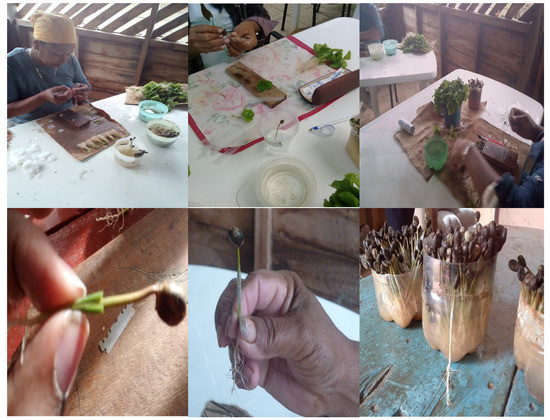
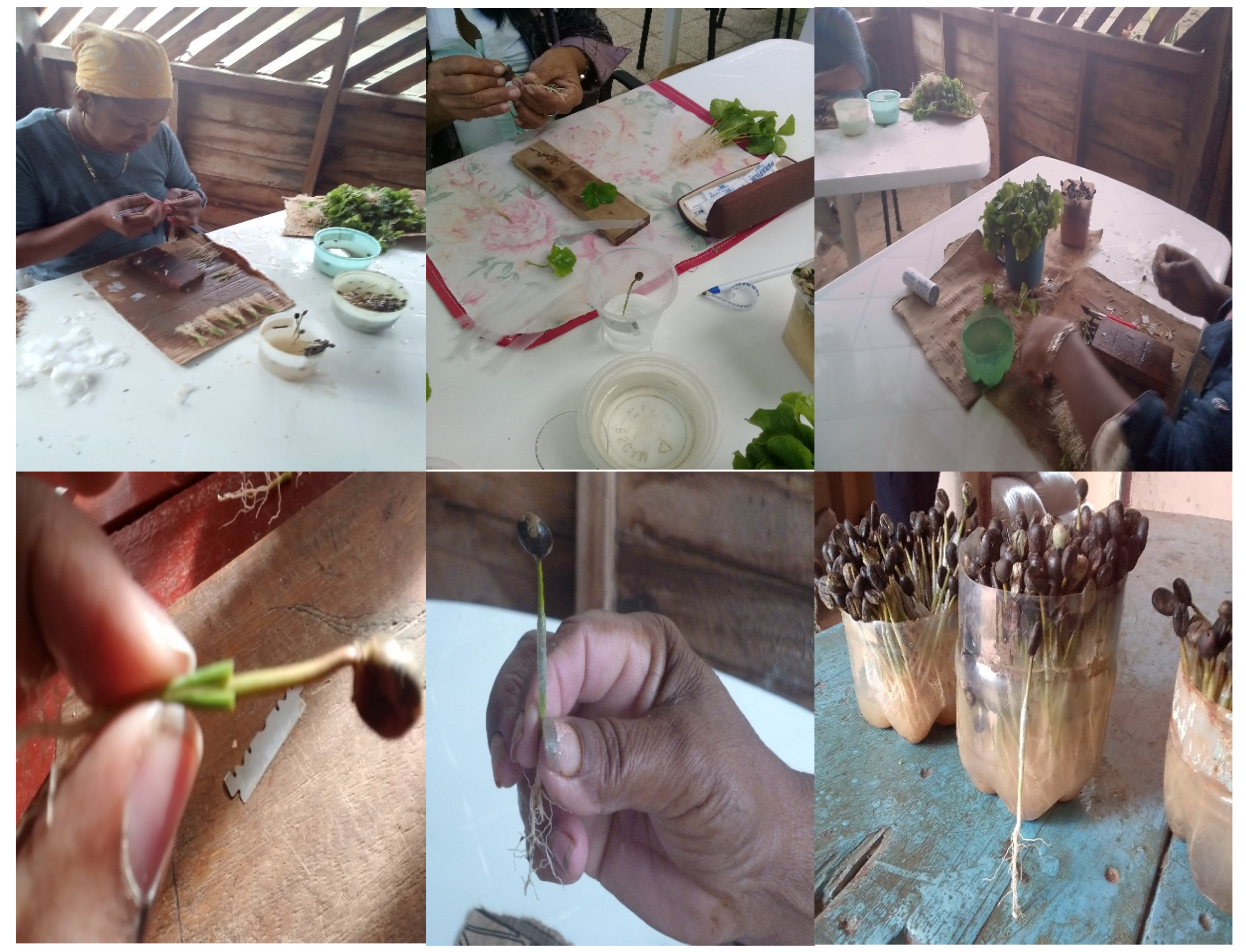
The pre-germinating beds were placed where they were protected with saran cloth to ensure 50% shading and avoid direct sunlight. Sixty days after planting, hypocotyledonal grafting was performed following the methodology described by Cantos et al. [25]. At that time, rootstock Coffea canephora cv. Robusta plants were selected with fully developed cotyledonal leaves and budwood Coffea arabica cv. Island 5–15 plants in the “matchstick” stage, a term that describes coffee plants in the absence of cotyledonal leaves [30]. To carry out hypocotyledonal grafting, the area of the rootstock Coffea canephora cv. Robusta plants and the roots of Coffea arabica cv. Isla 5–15 plants were removed. A longitudinal cut was made on the stem of both plants in the shape of a wedge and approximately 2.5 cm long. The two plants were then matched and secured with hook-and-loop tape [31] (Figure 1).
Figure 1.
Development of the grafting process of the rootstock Coffea canephora cv. Robusta plants in the “butterfly” stage and grafting of the Coffea arabica cv. Isla 5–15 plants in the “phosphorite” stage.
At the time of hypocotyledonal grafting, the roots were soaked in 1 mL of Rhizobium sp. Rpr2 inoculant for thirty minutes at room temperature and under shade [19]. Subsequently, they were planted in a substrate mixture of cachaza and soil in a 3:1 ratio (v/v), as previously described. The substrate was contained in polyethylene bags (29 cm long × 19 cm wide, volume 2.5 L) with four holes near the bottom to promote drainage. The coffee seedlings were watered to field capacity, and frequent irrigation was carried out during their establishment.
At the time of hypocotyledonal grafting, pest-free substrate described previously was supplemented with phosphorus (P) with the carrier triple phosphate triple with four levels of P fertilization: 25 (2.72 kg m3), 50 (5.45 kg m3), 75 (8.17 kg m3) and 100% (at a rate of 10.9 kg m3 of mixture), which coincided with the treatments of the experiment. The grafted plants were transferred to a shade house nursery where they remained for seven months. The water used for irrigation at the Provincial Soil Institute of Santiago de Cuba was analyzed and was recommended as suitable for irrigation because it had a concentration of (PPM of TSS = 179.38; Meq of Na = 0.31; Meq of Cl = 1.1; % of Mg = 28.16; CSR = 0.04; RAS = 1.43 pH = 7.0).
Seven months after planting, plant height (cm), stem diameter (mm), number of leaf pairs, main root length (cm) and root volume were evaluated. Root volume was calculated using Archimedes’ principle [32]. The dry mass of the aerial part, root and total (g) [33], the quality index of the stands [34] and the leaf and root P contents were also determined spectrophotometrically using the molybdenum blue method [35].
2.3. Experimental Design and Statistical Analysis
A completely randomized experimental design was used, with five fertilization levels (treatments), each with four replicates. Thirty-two grafted plants were evaluated in each treatment. The experimental data were processed using the professional package SSPS version 21 for Windows. Normality and homogeneity of variance were tested using the Kolmogorov–Smirnov and Levene tests, respectively. Subsequently, analysis of variance was performed, and Tukey’s multiple range comparison test (p < 0.05) was used to determine differences between treatments.
3. Results
When verifying the ANOVA results (Table 2), it was observed that for all the evaluated variables, the treatments exerted a highly significant effect (p < 0.01), which indicates that there is a variable effect when we buy the control (100% P) with the other four applied treatments (25, 50, 75 and 100% P with Rhizobium sp. strain Rpr2).
Table 2.
ANOVA results obtained when evaluating the effect of inoculation with Rhizobium sp. strain Rpr2 and P dose on plant growth of C. arabica L. cv. Isla 5–15 grafted onto C. canephora cv. Robusta after seven months of cultivation.
The results in the propagator showed that inoculation with the strain increased the height, stem diameter, number of pairs of leaves and root length of the grafted coffee plants with respect to the control without inoculation, with greater incidence at the highest levels of P applied (75 and 100%). Similar results were obtained for root volume, except when the lowest level of P (25%) was used, a treatment that did not show significant differences with respect to the control (Table 3).
Table 3.
Effect of inoculation with Rhizobium sp. strain Rpr2 and P dose on plant growth of C. arabica L. cv. Isla 5–15 grafted onto C. canephora cv. Robusta after seven months of cultivation.
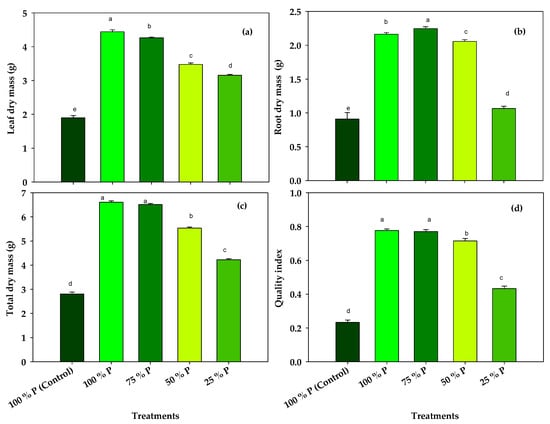
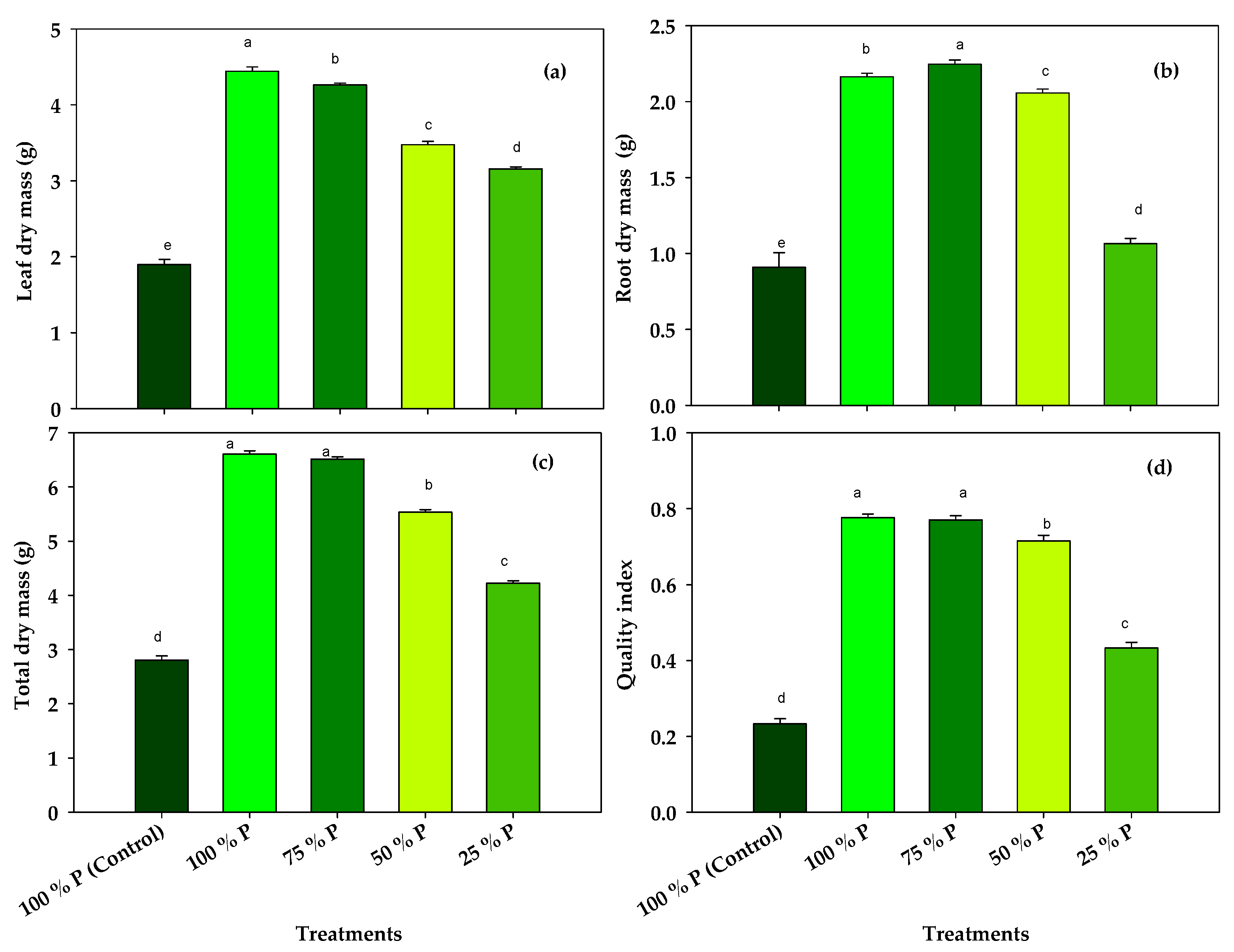
The use of Rhizobium sp. The Rpr2 strain increased the dry mass of the aerial part, root and total parts of the plants at the different doses of phosphorus fertilization to which they were exposed (Figure 2). In general, the best results were obtained in the treatments with P levels of 100 and 75% in the presence of the bacteria, with significant differences with respect to the control without inoculation and with 50 and 25% P (Figure 2). However, adding the bacteria regardless of the P dose used always brought an increase in the performance of the seedlings in relation to the plants where rhizobium was not added.
Figure 2.
Effect of Rhizobium sp. Rpr2 strain inoculation and P dose on leaf dry mass (a), root dry mass (b), total dry mass (c) and quality index (d) of C. arabica L. cv. Isla 5–15 grafted onto C. canephora cv. Robusta at seven months of cultivation. Control-100%, plants not inoculated with Rhizobium sp. strain Rpr2 and grown in the presence of 100% phosphoric fertilizer. Equal letters do not differ significantly (Tukey p < 0.05; n = 32).
When evaluating the effect of the inoculation of Rhizobium sp. Rpr2 and different doses of P on the content of this macronutrient in coffee plants, an increase in this element was evidenced in both leaves and roots, especially when the highest doses of fertilization were used, where there was a directly proportional relationship between the content of foliar and root P and the dose of P applied to the substrate (Table 3).
When evaluating the characteristics of pH, organic matter and P content before the installation of the experiment and after the conclusion of the experiment, the data are presented in Table 3. The data show that there was an increase in these variables evaluated with the application of the treatments in relation to the initial and final time (7 months). It was observed that the pH levels for all substrates used were increased to more basic values, which in theory facilitates the absorption of nutrients. A small increase in organic matter and a decrease in P levels were observed, which were directly related to the increase in the doses used and were also associated with the uptake of P by the plant (Table 4).
Table 4.
Some chemical characteristics of the substrate used in the trial with coffee plants and doses of P at the beginning and end of the experiment.
The results of this research suggest that the use of bacterial inoculants based on Rhizobium sp. Rpr2 could constitute an alternative to increase the quality of the grafts and reduce the application of mineral fertilizer in the coffee production system. To date, there is no evidence in the scientific literature showing the response of C. arabica cv. Isla 5–15 grafted onto C. canephora cv. Robusta to inoculation with rhizobia, contextualized in a more efficient management of phosphoric fertilization. These results constitute the first evidence in Cuba showing the possibility of doing so.
4. Discussion
Rhizobia are bacteria that have been traditionally studied for their ability to establish a symbiotic relationship with leguminous plants and to induce nodule formation where they fix nitrogen (N) [36]. The use of these bacteria in some studies has revealed their beneficial effects on nonleguminous plants such as corn (Zea mays L.) [37] and rice (Oryza sativa L.) [38]. However, few studies have addressed the role of rhizobia in coffee nutrition.
The inoculation of coffee grafted seedlings with Rhizobium sp. Rpr2 through the inoculation method presented in this study can be recommended for coffee farming by significantly reducing and improving nutrient absorption and significantly stimulating the growth of coffee seedlings. When using bacterial inoculants under production conditions (in this case, coffee production), it is very important to ensure that the part of the plant that is in contact with the bacteria is colonized by the greatest possible number of bacteria [38]. Once the bacteria is inoculated, it will have to face a microbiota that can be hostile to its survival and will also be in contact with abiotic factors that can also considerably reduce the concentration of this bacterium in its interaction with the plant [22]. In addition, Zuan et al. [24] have shown that the concentration of bacteria in inoculants is much higher than the bacteria that are deposited on the surface of the treated plant organ and that one of the essential requirements for a bacterial inoculant to be successful in the market and in the field is its high concentration of viable cells. Taking all this into account, it was decided to use a relatively high concentration of bacteria to ensure a relatively high concentration of bacteria in the coffee tree.
Rhizobium sp. Rpr2, the strain that was used in this research, was isolated from the rhizosphere of rice plants cultivated in soil with a pH close to neutrality and a high content of organic matter and available phosphorus [28]. These conditions are similar to those present in the substrates used in this study, which would favor the establishment of the bacteria, an essential aspect during the plant-bacteria interaction [39].
Previously, it was demonstrated that Rhizobium sp. The Rpr2 strain produces hormones such as indol-acetic acid, which increase the growth of the root system by increasing the size, weight, number of branches and surface area in contact with the soil [28,40]. Then, the inoculation of this bacteria could explain the decrease in P content in the substrate shown in the inoculated treatments (Table 4). Phytostimulation is one of the principal mechanisms that uses rhizobia to improve plant growth [41]. For the variables height, number of pairs of leaves and root length, the most encouraging results corresponded to those plants that were inoculated with Rhizobium sp. Rpr2 strain in the presence of 100 and 75% P. Something similar occurred in root volume in plants that were treated with the bacterium and grown in the presence of 75% P. The results coincide with previous evidence in Cuba, which assures that coffee seedlings in the seedling stage respond positively to inoculation with Rhizobium [6,22]. However, those studies did not evaluate the effect of the bacterial strain on the reduction of phosphorus fertilization of the crop. The results of the present research are the first in the country to demonstrate that the use of Rhizobium-based inoculants on coffee plants would allow the reduction of phosphorus fertilization on the crop between 25 and 75% during the seedling stage.
Previous research with C. arabica cv. Isla 6-14 at the nursery stage, inoculated with arbuscular mycorrhizal fungi and FitoMas-E, reported mineral fertilizer (NPK) reductions from 100% to 25% [42]. In that study, the highest total dry matter value was 4.83 g in plants grown with 75% fertilization [42]. However, in the present investigation, higher values of total dry mass (6.51 g) were achieved in those plants treated with the same dose of phosphorus fertilizer and inoculation.
Studies on the effect of the inoculation of rhizobia isolated from Desmodium triflorum, Desmodium cannum, Centrosema virginianum and reference strains isolated from Astragalus sinicus and Glycine max showed an increase in the dry mass of the aerial and root of Moringa oleifera Lam (Moringa) under controlled conditions with respect to the absolute control and the fertilized control [43]. This indicates that it is possible that the inoculation of bacterial strains promotes plant growth of crops from which they did not originate. This could be the case for Rhizobium sp. Rp2 strain used in the present investigation, which was isolated from the rhizosphere of rice plants cv. INCA LP-5 [28].
On the other hand, the non-inoculated control treatment fertilized with 100% of the P dose reached the lowest values in all the variables evaluated (Table 3). This could be due to the combined effect of conventional fertilization with organic fertilizer. High doses of chemical fertilizers increase the content of salts in the soil solution, which impedes the access of water to the roots and restricts its absorption. This causes an inhibition of growth in plant height and stem diameter due to water deficit [44]. However, this effect was not shown in plants inoculated and grown in the presence of 100% P, perhaps as a result of the positive effect of the strain in increasing the efficiency of nutrient uptake into the plant.
The results also showed that the inoculation of the rhizobial strain increased the quality index of the grafted stands (Figure 2d). This indicates a better balance between aerial and root growth. The highest values of the variable were obtained with the use of the bacterial strain in the presence of 100, 75 and 50% P. The cultivars Icatú vermelho and Caturra vermelho, grafted onto Coffea canephora cv. Robusta or with the variety caturra rojo showed lower quality index values than those obtained in this research [14,29]. This indicates that inoculation with Rhizobium sp. The Rp2 strain allows higher quality seedlings to be obtained.
The quality index Is an important indicator of plant development in nurseries that takes into account different growth variables [45] and is directly proportional to the quality of the seedlings [29]. For this reason, it is frequently used to determine the quality of seedlings under these growing conditions.
The phosphorus content in leaves and roots is in the range suitable for cultivation (0.15–0.35%) [46]. Recent research indicates that the use of plant growth-promoting bacteria enhances the efficiency of plants to absorb P [20]. This has been demonstrated by several authors in coffee plants with the Castillo and Catimor varieties when inoculated with Kocuria and Bacillus in the presence of chemical and organic fertilization [47,48].
Another aspect to highlight was that, both in the growth variables (Figure 1) and in the P content in the tissues (Table 3), significant differences were observed between the non-inoculated control treatment with 100% fertilization and the one where the plants were exposed to the same dose of fertilizer and inoculated with the rhizobial strain.
It was observed that, in the presence of Rhizobium, there was an increased efficiency in the use of phosphate fertilizer contained in the substrate, increasing the uptake of P for the plant (Table 3) and decreasing the P content in the substrate in proportion to the doses of P used (Table 4). This could allow the nitrogen fixation of the Rhizobium sp. Rpr2 strain in association with coffee plants. P is essential for this process since it is used in photosynthesis, which provides metabolic energy for the reduction of molecular nitrogen to ammonia [27]. In an environment with N, plants prefer to acquire it without symbiosis with Rhizobium, but, in this experiment, the substrate had no N, and, even though coffee is not a legume plant, it showed the effect of using Rhizobium on the supply of N and P.
N fixation only occurs through the acquisition and transport of phosphates by plants [27]. P forms various regulatory networks in the N-fixing zone of the roots and, thus, maintains inorganic P (Pi) homeostasis in response to N availability at the nodule attachment site. Therefore, the regulatory process of P in the plant defines the efficiency of Rhizobium nodulation, which consequently induces the presence of Pi in the plant root.
This suggests that the use of the strain allowed a greater absorption of P present in the substrate, possibly due to a more prominent development of the plant’s root system, which would subsequently translate into an increase in the growth of coffee plants. Previous research has shown that the use of Rhizobium sp. increases the nutrient content of plants by promoting root growth [6,19,22,43,49,50].
5. Conclusions
This work constitutes further evidence of the versatility of rhizobia as PGPR and their potential for the development of inoculants for crops different from legumes such as coffee. Here, we verified that a strain from the rhizosphere of rice could also become a commercial product for the inoculation of this crop.
For the first time in Cuba, the benefits of rhizobial inoculation on the nutrition and quality of coffee seedlings were demonstrated. The inoculation of strain Rhizobium sp. Rpr2 enhances the vegetative growth of grafted coffee seedlings and their phosphorus content with lower doses of phosphoric fertilization, which suggests that it is possible to reduce phosphoric mineral fertilization from 25 to 75% in the seedling stage of coffee. Further studies could verify the versatility of bacterial inoculants based on Rhizobium sp. Rpr2 in other coffee cultivars as well as their effect on nitrogenous and phosphoric nutrition.
Author Contributions
Conceptualization, S.N.V., J.G.A. and M.C.N.G.; Data curation, S.N.V., J.G.A., I.H.F., E.P.S., R.M.P., R.N.T.H. and A.M.M.L.; Formal analysis, S.N.V., R.D.J.F.A., R.M.M.C. and R.M.P.; Funding acquisition, E.P.S., R.M.M.C., R.M.P., R.N.T.H., A.M.M.L. and L.M.-A.; Investigation, S.N.V., J.G.A., R.D.J.F.A., I.H.F., M.C.N.G., R.N.T.H. and L.M.-A.; Methodology, S.N.V., J.G.A., I.H.F., M.C.N.G., E.P.S., R.M.M.C., R.M.P., R.N.T.H., R.F.R., A.M.M.L. and L.M.-A.; Project administration, R.M.M.C. and R.N.T.H.; Resources, M.C.N.G., R.M.M.C., R.M.P., R.F.R. and A.M.M.L.; Software, J.G.A., E.P.S., R.F.R. and L.M.-A.; Supervision, M.C.N.G.; Validation, R.D.J.F.A., I.H.F., E.P.S., R.M.P., R.N.T.H., R.F.R., A.M.M.L. and L.M.-A.; Visualization, J.G.A., R.D.J.F.A., E.P.S., R.N.T.H., R.F.R., A.M.M.L. and L.M.-A.; Writing—original draft, S.N.V., J.G.A., R.D.J.F.A., I.H.F., M.C.N.G., E.P.S., R.M.M.C., R.M.P., R.N.T.H., R.F.R., A.M.M.L. and L.M.-A.; Writing—review & editing, S.N.V., J.G.A., R.D.J.F.A., I.H.F., M.C.N.G., E.P.S., R.M.M.C., R.M.P., R.N.T.H., R.F.R., A.M.M.L. and L.M.-A. All authors have read and agreed to the published version of the manuscript.
Funding
This research received no external funding.
Institutional Review Board Statement
Not applicable.
Informed Consent Statement
Not applicable.
Conflicts of Interest
The authors declare no conflict of interest.
References
- Farah, A.; Dos Santos, T.F. The Coffee Plant and Beans: An Introduction; Elsevier Inc.: Amsterdam, The Netherlands, 2015; Available online: https://www.researchgate.net/profile/Adriana_Farah2/publication/267967496_The_coffee_plant_and_beans_Introduction_Chapter_1/links/546541710cf2f5eb17ff3901/The-coffee-plant-and-beans-Introduction-Chapter-1.pdf (accessed on 7 February 2023).
- Avila-Victor, C.M.; Ordaz-Chaparro, V.M.; Arjona-Suárez, E.d.J.; Iracheta-Donjuan, L.; Gómez-Merino, F.C.; Robledo-Paz, A. In Vitro Mass Propagation of Coffee Plants (Coffea arabica L. var. Colombia) through Indirect Somatic Embryogenesis. Plants 2023, 12, 1237. [Google Scholar] [CrossRef] [Scilit]
- Jaramillo, R.A. La Agroclimatología Del Cafeto. In Clima Andino y Café en Colombia; CENICAFE: Manizales, Colombia, 2005; pp. 149–157. Available online: https://biblioteca.cenicafe.org/bitstream/10778/859/1/Portada.pdf (accessed on 7 February 2023).
- International Coffee Organization. World Coffee Production. Available online: https://www.ico.org/prices/po-production.pdf (accessed on 23 February 2023).
- Flores, D. Mexico Coffee Annual Production Flat with Quality Exports and Robusta Bean Imports Both Rising. Available online: https://apps.fas.usda.gov/newgainapi/api/report/downloadreportbyfilename?filename=Coffee%20Annual_Mexico%20City_Mexico_5-14-2012.pdf (accessed on 17 November 2022).
- Nápoles, V.S.; Milanés, R.S.; Hernández, F.I.; Morales, M.B.; Nápoles, G.M.C. Rhizobia increase germination of Coffea arabica and Coffea canephora seeds. Second evidence from Cuba. Agron. Mesoam. 2022, 33, 45719. [Google Scholar] [CrossRef] [Scilit]
- Galembeck, F.; Galembeck, A.; Santos, L.P.D. NPK: Essentials for sustainability. Química Nova 2020, 42, 1199–1207. [Google Scholar] [CrossRef] [Scilit]
- Tatagiba, S.D.; Pezzopane, J.E.M.; Reis Reis, E.F. Crescimento vegetativo de mudas de café arabica (Coffea arabica L.) submetidas a diferentes níveis de sombreamento. Coffee Sci. 2010, 5, 251–261. Available online: http://www.sbicafe.ufv.br/handle/123456789/5413 (accessed on 10 February 2022).
- Paiva, L.C.; Guimarães, R.J.; Souza, C.A.S. Influência de diferentes níveis de sombreamento sobre o crescimento de mudas de cafeeiro (Coffea arabica L.). Ciênc. e Agrotecnologia 2003, 27, 134–140. [Google Scholar] [CrossRef] [Scilit]
- Unigarro, M.C.A.; Imbachi, Q.L.C.; Cañon, H.M.; Acuña, Z.J.R. Response to applying kaolinite particles in coffee variety seedlings during the nursery stage. J. Saudi Soc. Agric. Sci. 2023; in press. [CrossRef] [Scilit]
- Grossnickle, S.; MacDonald, J. Seedling quality: History, application, and plant attributes. Rev. For. 2018, 9, 283. [Google Scholar] [CrossRef] [Scilit]
- Anzueto, F. Guide of Good Practices in Coffee Cultivation for Climate Change Adaptation. Coffee & Climate. 2020. 1–43p. Available online: https://coffeeandclimate.org/wp-content/uploads/2020/06/200611-Gu%C3%ADa-buenas-pr%C3%A1cticas-en-el-cultivo-del-caf%C3%A9-Gu%C3%ADa-buenas-pr%C3%A1cticas-en-el-cultivo-del-caf%C3%A9.pdf (accessed on 10 January 2022).
- Díaz, M.A.; López, P.Y.; Suárez, P.C.; Díaz, S.L. Effect of PhytoMas-E and two proportions of organic matter on the growth of coffee seedlings in nursery. C. Agricola 2021, 48, 14–22. Available online: http://scielo.sld.cu/pdf/cag/v48n1/0253-5785-cag-48-01-14.pdf (accessed on 10 February 2022).
- Guevara, F.W.; Machado, C.G.; Bustamante, G.C.A. Relationship between substrate fertility and growth of coffee (Coffea arabica l.) seedlings in Contramaestre, Santiago de Cuba. Sci. Your PC 2021, 1, 94–110. Available online: https://www.redalyc.org/journal/1813/181368034007/html/ (accessed on 10 February 2022).
- Valverde, L.A. Application of Biostimulants in the Development of Arabica Coffee (Coffea arabica) Plants in Nursery Stage. Bachelor’s Thesis, Universidad Estatal Del Sur De Manabí, Manabi, Ecuador, 2018; 71p. Available online: http://repositorio.unesum.edu.ec/bitstream/53000/1378/1/UNESUM-ECUA-ING.AGROPE-2018-20.pdf (accessed on 9 February 2022).
- Díaz, M.A.; Suárez, C.; Díaz, D. Influence of the bionutrient FitoMas-E on the production of coffee (Coffea arabica L.) seedlings. C Agrícola 2016, 43, 29–35. Available online: http://scielo.sld.cu/pdf/cag/v43n4/cag04416.pdf (accessed on 10 January 2022).
- Morales-Aranibar, L.; Yucra, F.E.Y.; Estrada, N.M.P.; Flores, P.Q.; Zevallos, R.N.M.; Zegarra, J.C.L.; Trujillo, U.P.; Aranibar, C.G.M.; Gonzales, H.H.S.; Aguilera, J.G.; et al. Production of New Biopesticides from Cymbopogon citratus for the Control of Coffee Rust (Hemileia vastatrix) under Laboratory and Field Conditions. Plants 2023, 12, 1166. [Google Scholar] [CrossRef] [Scilit]
- Zhu, J.; Li, M.; Whelan, M. Phosphorus activators contribute to legacy phosphorus availability in agricultural soils: A review. Sci. Total Environ. 2018, 612, 522–537. [Google Scholar] [CrossRef] [Scilit] [PubMed]
- Reyes, C.A. Plant Growth Promoting Rhizobacteria (PGPR) and their contribution to the mineral nutrition of tomato (Lycopersicon sculentum L.). Doctoral Thesis, University of Concepción, Chillan, Chile, 2019; 93p. Available online: http://repositorio.udec.cl/bitstream/11594/935/1/Tesis%20Rizobacterias%20promotoras.pdf (accessed on 9 February 2022).
- Cisneros, R.C.A.; Martín, F.J.; Realpe, F.M.; Fuenmayor, J.C. Influence of microorganisms on phosphorus availability in coffee (Coffea arabica) seedlings. Biotechnol. Agric. Agroind. Sect. 2017, 15, 19–26. [Google Scholar] [CrossRef] [Scilit]
- Stringlis, I.A.; Proietti, S.; Hickman, R.; Van, V.M.C.; Zamioudis, C.; Corné, P.M.J. Root transcriptional dynamics induced by beneficial rhizobacteria and microbial immune elicitors reveal signatures of adaptation to mutualists. Plant J. 2018, 93, 166–180. [Google Scholar] [CrossRef] [Scilit]
- Nápoles, V.S.; Milanes, R.S.; González, C.L.; Alarcón, M.C.O.; Fernández, A.R.; Aguilera, J.G. Rhizobia inoculation favors the growth of Coffea arabica L. seedlings grafted in a nursery. Res. Soc. Dev. 2021, 10, e10110615722. [Google Scholar] [CrossRef] [Scilit]
- Flores-Félix, J.D.; Menéndez, E.; Rivera, L.P.; Marcos-García, M.; Martínez-Hidalgo, P.; Mateos, P.F.; Martínez-Molina, E.; de la Encarnación, M.; García-Fraile, P.; Rivas, R. Use of Rhizobium leguminosarum as a potential biofertilizer for Lactuca sativa and Daucus carota crops. J. Plant Nutr. Soil Sci. 2013, 176, 876–882. [Google Scholar] [CrossRef] [Scilit]
- Zuan, A.T.K.; Ghazali, A.H.A.; Mia, M.A.B. Progress of N2 Fixation by Rice–Rhizobium Association. In Nitrogen Fixing Bacteria: Sustainable Growth of Nonlegumes; Maheshwari, D.K., Dobhal, R., Dheeman, S., Eds.; Microorganisms for Sustainability; Springer: Singapore, 2022; p. 36. [Google Scholar] [CrossRef] [Scilit]
- Cantos, C.G.; Pinargote, C.J.P.; Palma, P.R. Influence of the phytohormone kinetin on the growth of Coffea arabica L. seedlings grafted on robusta rootstock in nursery. Cuba. J. For. Sci. 2018, 6, 134–145. Available online: https://cfores.upr.edu.cu/index.php/cfores/article/view/327/html (accessed on 10 January 2022).
- Cisneros, R.C.A.; Sánchez de Prager, M.; Menjivar, F.J.C. Effect of phosphate solubilizing bacteria on coffee seedling development. Agron Mesoam. 2017, 28, 149–158. [Google Scholar] [CrossRef] [Scilit]
- Ma, Y.; Chen, R. Nitrogen and Phosphorus Signaling and Transport During Legume–Rhizobium Symbiosis. Front. Plant Sci. 2021, 12, 683601. [Google Scholar] [CrossRef] [Scilit] [PubMed]
- Hernández, F.I.; Nápoles, G.M.C. Resident rhizobia in the rhizosphere of rice plants (Oryza sativa L.) cultivar INCA LP-5. Cultiv. Trop. 2017, 38, 39–49. Available online: http://scielo.sld.cu/pdf/ctr/v38n1/ctr05117.pdf (accessed on 10 January 2022).
- Paneque, P.V.M.; Calaña, N.J.M.; Calderón, V.M.; Borges, B.Y.; Hernández, G.T.C.; Caruncho, C.M. Manual de Técnicas Analíticas para Análisis de Suelo, Foliar, Abonos Orgánicos y Fertilizantes Químicos. Natl. Inst. Agric. Sci. 2010, 157. Available online: https://fertilizantesfertvit.files.wordpress.com/2018/09/analisis-de-suelos-y-abonos-organicos.pdf (accessed on 10 February 2022).
- Julca, O.A.; Andía, A.E.; Estelita, C.S.; Borjas, V.R. Behavior of Coffea arabica L. grafted on Coffea canephora in the presence of nematodes in nursery. Revista Investigaciones Altoandinas 2018, 20, 267–280. [Google Scholar] [CrossRef] [Scilit]
- Sernaque, A.S.; Charcape, J.M.; León, J.M.; Barrionuevo, R.; De La Cruz, A.J.; Correa, V.A. Percentage of bud break in Caesalpinia spinosa "taya" by "t" and "wedge" grafting in Tambogrande, Piura-Peru. Mangrove Mag. 2020, 17, 89–93. Available online: https://www.google.com/url?sa=t&rct=j&q=&esrc=s&source=web&cd=&cad=rja&uact=8&ved=2ahUKEwiL5YH1r634AhUHZDABHem5CnsQFnoECAQQAQ&url=https%3A%2F%2Ferp.untumbes.edu.pe%2Fjournals%2Findex.php%2Fmanglar%2Farticle%2Fdownload%2F151%2F260&usg=AOvVaw25FwPh0pa7_8bdZNnyGuzK (accessed on 10 February 2022).
- Córdoba, D.; Vargas, J.J.; López, J.; Muñoz, A. Root growth in young Pinus pinceana Gordon plants in response to soil moisture. Agrociencia 2011, 45, 493–506. Available online: http://www.scielo.org.mx/pdf/agro/v45n4/v45n4a8.pdf (accessed on 10 January 2022).
- Borjas, V.R.; Andía, A.E.; Alarcón, Á.G.; Estelita, C.S.; Julca, O.A. Growth and quality of coffee (Coffea arabica) seedlings grafted on Coffea canephora against nematodes in nursery. J. Selva Andin. Biosph. 2018, 6, 28–41. Available online: http://www.scielo.org.bo/pdf/jsab/v6n2/v6n2_a02.pdf (accessed on 10 January 2022).
- Dickson, A.; Leaf, L.; Hosner, F. Quality Appraisal of White Spruce and White Pine Seedling Stock in Nurseries. For. Chron. 1960, 36, 10–13. Available online: https://pubs.cif-ifc.org/doi/pdf/10.5558/tfc36010-1 (accessed on 9 February 2022). [CrossRef] [Scilit]
- Cáñez, C.M.G.; García, A.A.M. Validation of an analytical method for the determination of phosphorus by ultraviolet—visible spectrophotometry. J. Biol. Health Sci. Biotech 2015, XVII, 32–39. Available online: https://www.google.com/url?sa=t&rct=j&q=&esrc=s&source=web&cd=&cad=rja&uact=8&ved=2ahUKEwik94ftlKv4AhVmczABHb2iCpMQFnoECAMQAQ&url=https%3A%2F%2Fbiotecnia.unison.mx%2Findex.php%2Fbiotechnology%2Farticle%2FviewFile%2F15%2F14&usg=AOvVaw1nhMR_6K4hGA_wt9uCXgpW (accessed on 10 February 2022).
- Ibrahim, H.M.; El-Sawah, A.M. The Mode of Integration Between Azotobacter and Rhizobium Affect Plant Growth, Yield, and Physiological Responses of Pea (Pisum sativum L.). J. Soil Sci. Plant Nutr. 2022, 22, 1238–1251. [Google Scholar] [CrossRef] [Scilit]
- Pérez-Pérez, R.; Oudot, M.; Serrano, L.; Hernández, I.; Nápoles, M.; Sosa, D.; Pérez-Martínez, S. Rhizospheric Rhizobia Identification in Maize (Zea mays L.) Plants. Agron. Colomb. 2019, 37, 255–262. [Google Scholar] [CrossRef] [Scilit]
- Hernández, I.; Taulé, C.; Pérez-Pérez, R.; Battistoni, F.; Fabiano, E.; Rivero, D.; Nápoles, M.C. Endophytic rhizobia promote the growth of Cuban rice cultivar. Symbiosis 2021, 85, 175–190. [Google Scholar] [CrossRef] [Scilit]
- Čapek, P.; Manzoni, S.; Kaštovská, E.; Wild, B.; Diáková, K.; Bárta, J.; Schnecker, J.; Biasi, C.; Martikainen, P.J.; Alves, R.J.E.; et al. A plant—microbe interaction framework explaining nutrient effects on primary production. Nat. Ecol. Evol. 2018, 2, 1588–1596. [Google Scholar] [CrossRef] [Scilit] [PubMed]
- Hernández Forte, I.; Nápoles García, M.C. Rhizobia Promote Rice (Oryza sativa L.) Growth: First Evidence in Cuba. In Sustainability in Plant and Crop Protection; Zúñiga-Dávila, D., González-Andrés, F., Ormeño-Orrillo, E., Eds.; Microbial Probiotics for Agricultural Systems; Springer: Berlin/Heidelberg, Germany, 2019. [Google Scholar] [CrossRef] [Scilit]
- Chi, F.; Yang, P.F.; Han, F.; Jing, Y.X.; Shen, S.H. Proteomic analysis of rice seedlings infected by Sinorhizobium meliloti 1021. Proteomics 2010, 10, 1861–1874. [Google Scholar] [CrossRef] [Scilit]
- Barroso, F.L.; Abad, M.M.; Rodríguez, H.P.; Jerez, M.E. Application of Fitomas-E and Ecomic® for the reduction of mineral fertilizer consumption in the production of coffee seedlings. Cultiv. Trop. 2015, 36, 158–167. Available online: http://scielo.sld.cu/pdf/ctr/v36n4/ctr21415.pdf (accessed on 9 February 2022).
- Bécquer, C.J.; Cancio, T.; Nápoles, J.A.; Muir, I.; Ávila, U.; Álvarez, O.; Madrigal, Y. Selection of rhizobia for their effect on germination and incipient development of Moringa oleifera Lam. Phase I: Controlled conditions. Cuba. J. Agric. Sci. 2018, 52, 473–484. Available online: http://scielo.sld.cu/pdf/cjas/v52n4/2079-3480-cjas-52-04-473.pdf (accessed on 10 February 2022).
- Espinoza, C.A.L.; Vásconez, M.G.H.; Tapia, R.C.S.; Duicela, G.L.A. Growth, development and concentration of macronutrients in coffee genotypes (Coffea robusta P.) with different doses of organic fertilizer. Cienc. Lat. Rev. Científica Multidiscip. 2021, 5, 11718–11734. [Google Scholar] [CrossRef] [Scilit]
- Basave, V.E.; García, C.L.C.; Castro, R.A.; Calixto, V.C.G.; Sigala, R.J.A.; García, P.J.L. Plant Quality of Cedrela odorata L. associated with nursery cultural practices. Rev. Mex. Cienc. For. 2016, 7, 65–80. Available online: http://www.scielo.org.mx/pdf/remcf/v7n36/2007-1132-remcf-7-36-00065.pdf (accessed on 9 February 2022).
- Guerreo, L.J. Technical Guide Technical Assistance directed in: Sampling and Fertilization Recommendations in Tropical Crops. Agrobanco UNALM. Satipo, Peru. 2021, 28p. Available online: https://www.agrobanco.com.pe/data/uploads/ctecnica/039-a-tropicales.pdf (accessed on 9 February 2022).
- Quispe, M.F.J. Biofertilization of Mycorrhizal Fungi and PGPR Bacteria in coffee seedlings (Coffea arabica L.) Var. Catimor at nursery level, in Mazamari Satipo. Bachelor’s Thesis, Universidad Nacional del Centro del Perú, Mantaro, Peru, 2021; 52p. Available online: https://repositorio.uncp.edu.pe/bitstream/handle/20.500.12894/7262/T010_48465644_T.pdf?sequence=1&isAllowed=y (accessed on 10 February 2022).
- Osorio, F.B.D.; Binz, A.; Lima, R.F.; Giongo, A.; Saccol de Sá, E.L. Promotion of rice growth by rhizobia at different levels of nitrogenous fertilization. Ciência Rural 2016, 46, 478–485. [Google Scholar] [CrossRef] [Scilit]
- Moreno, R.A.; García, M.V.; Reyes, C.J.L.; Vásquez, A.J.; Cano, R.P. Plant growth-promoting rhizobacteria: A biofertilization alternative for sustainable agriculture. Colomb. J. Biotechnol. 2018, 20, 68–83. [Google Scholar] [CrossRef] [Scilit]
- Raheem, A.; Shaposhnikov, A.; Belimov, A.; Dodd, I.C.; Ali, B. Auxin production by rhizobacteria was associated with improved yield of wheat (Triticum aestivum L.) under rought stress. Arch. Agronom. Soil Sci. 2018, 64, 574–587. [Google Scholar] [CrossRef] [Scilit]

Disclaimer/Publisher’s Note: The statements, opinions and data contained in all publications are solely those of the individual author(s) and contributor(s) and not of MDPI and/or the editor(s). MDPI and/or the editor(s) disclaim responsibility for any injury to people or property resulting from any ideas, methods, instructions or products referred to in the content. |
© 2023 by the authors. Licensee MDPI, Basel, Switzerland. This article is an open access article distributed under the terms and conditions of the Creative Commons Attribution (CC BY) license (https://creativecommons.org/licenses/by/4.0/).