


Abstract
Due to its multipurpose usability, short production cycle, and low capital requirement in cultivation, hemp represents an excellent material applicable to the Sustainable Development Goals (SDGs) defined by the United Nations Organization as a strategy “to achieve a future better and more sustainable for all”. Hemp seeds represent the only edible part of Cannabis sativa and have a distinctly different nutritional composition from other representative foods such as rice and wheat (high protein content, low carbohydrate content, polyunsaturated fatty acids, dietary fiber, and gluten-free). Hemp seeds are mainly used for the production of oil; the waste obtained after extraction, reduced to a fine powder and rich in bioactive components, is added to durum wheat flour and used for the preparation of fortified bread. The aim of this study was to use varying percentages of hemp seed flour for bread production and determine the impact of fortification on texture, organoleptic characteristics, crumb color, changes in crumb texture, total polyphenols, the scavenging activity of free radicals, and amino acid content. The solid residue remaining after oil extraction from hemp seeds (generally discarded as waste or added to feed) was triturated and sieved to 0.530 mm (Hemp 1) or 0.236 mm (Hemp 2). Samples of fortified bread were obtained by replacing variable percentages of durum wheat semolina with the two hemp flours (5%, 7.5%, and 10%). The total phenolic content of the fortified bread was between 0.73 and 1.73 mg GAE/g, and the antiradical activity was between 1.17 and 3.18 mmol TEAC/100 g on the basis of the growing fortification. A comparison of Ciclope semolina bread with hemp flour-enriched bread showed a large increase in amino acid content in the fortified samples. In particular, bread enriched with 10% hemp flour 2 showed a higher content of glutamic acid, tyrosine, proline, and essential amino acids such as leucine and isoleucine compared to other samples with the same percentage of substitution. The amount of hemp seed flour influenced the color of the crumb by increasing the yellow index from 18.24 (100% Ciclope) to 21.33 (bread with 5% hemp flour 2). The results of the sensory analysis were very good, demonstrating the high acceptability of fortified breads at higher percentages.
Keywords:
hemp waste; food fortification; Ciclope; Futura 75; hemp flour; dough mixing; amino acids; fatty acids 1. Introduction
The progressive and inexorable intensification of agricultural systems, influenced by the growing world population, has contributed to creating pressure on the environment, reducing soil fertility and biodiversity, with the simultaneous production of large quantities of waste. Frequent and intense natural disasters linked to climate change have caused direct (reduced yields) and indirect (increased parasitic attacks) damage to crops, helping to accelerate the increase in cultivated areas and, above all, the intensification of production. In this regard, international organizations have started to strongly encourage the food industry to find new end uses for agro-industrial waste.
It is therefore necessary, with a view to sustainability, to increase the attention being paid to the residues of the agrifood process, which are potentially very interesting for the exploitation of bioactive molecules for the food industry. There have been numerous attempts to include agrifood by-products in food to improve it nutritionally and, therefore, identify it as fortified food [1,2].
Cereal-based products, especially pasta and bread, are well-suited for nutrient supply through food fortification. Furthermore, the development of new functional products based on fortified bread and flour may have an impact on the influence of metabolism and other health conditions [3]. Unfortunately, fortification often affects the quality of cereal-based products in relation to texture, color, cooking quality, and sensory properties. One of the main challenges faced by the food industry is to improve the healthiness of foods without compromising their sensory attributes [4].
Bakery products, such as bread and pasta, are foods based on simple ingredients such as wheat flour, yeast, water, and salt. Nevertheless, bread is one of the basic food products in the human diet, constituting a valuable source of many important nutrients necessary for the proper functioning of the body. Because of its simpleness and its wide consumption, bread is appropriate to be enriched and fortified with healthy bioactive compounds [5,6].
Industrial Cannabis sativa L. plants, with a low level of d-9-tetrahydrocannabinol (THC, <0.2%), are grown to obtain fiber, seeds, and their derivatives, such as oil [7]. It is an important agricultural commodity in Canada [6,8], the USA [9], and China [10]. Hemp fiber is widely used in the modern production of paper and fabrics in these countries. The edible part of Cannabis sativa is the seeds, which have become an attractive by-product for the production of hemp seed food products that have become available to consumers. In China, toasted hemp seeds are sold in markets, although most seeds are exported (untoasted) as bird seeds. In Eastern European countries, hemp seed oil is used as a butter substitute, typically by those who cannot afford dairy products [11].
Hemp seeds have a high nutritional value thanks to their high content of easily and quickly digestible proteins, essential amino acids, and a good ratio between omega-6 and omega-3 polyunsaturated fatty acids (PUFA) [12,13]. Prociuk et al. studied the effects of a hempseed-enriched diet on cholesterol levels. They observed a reduction in plasma cholesterol, probably related to increased levels of plasma γ-linolenic acid [14]. Other authors investigated the beneficial effects of hemp seeds to improve pain symptoms in patients with osteoarthritis [15].
As evidenced by previous analyses [16,17,18], an oil rich in fatty acids, mainly linoleic and α-linolenic acids, is obtained from seeds. After oil extraction, seeds can be ground to obtain edible flours. Hemp seeds flour is an example of a promising bio-sustainability waste raw material with a high nutritional value that can be obtained from industrial by-products.
Foods fortified with these “non-wheat flours” have an additional supply of fiber, minerals, proteins, and polyphenols. Therefore, food fortification increases the nutritional and potential beneficial properties of the final product and enhances by-products of agrifood industries as new sources of bioactive components from the perspective of a circular economy and a biorefinery approach both for environmental and economic reasons. In this regard, many authors have already investigated the impact of hemp seed flour enrichment on the technological, nutritional, and sensorial characteristics of bakery products [19,20] and pasta [21,22,23].
Hemp seeds can be consumed as whole hulled seeds or hulled seeds (hemp seed kernel) and as processed products (oil, flour, and protein powder). In particular, Yano H. et al. studied the nutritional value of hemp flour and its seeds. In fact, these were compared, in terms of quality and protein content, to soybeans. Additionally, oil meal, obtained after the extraction of the oil, was considered a material particularly rich in proteins. Its amino acid composition, rich in cysteine and the optimal sulfhydryl (-SH)/disulfide (S-S) ratio, important in the food production process, was also considered. Their work highlights hemp seed as material rich in protein (the major protein in the hemp seeds is edestin, which accounts for approximately 70% of hemp, and is known for its digestibility, but also methionine and cysteine), unsaturated fatty acids and dietary fiber, and low levels of carbohydrates, very similar to soybeans. The seeds typically contain 25–35% lipids with a perfectly balanced composition of fatty acids (FA); 20–25% easily digestible protein rich in essential elements amino acids; 20–30% carbohydrates, many of which consist mainly of dietary fiber insoluble; as well as vitamins and minerals (the main macronutrients present in hemp seeds were phosphorus (P), potassium (K), magnesium (Mg), calcium (Ca), and sodium (Na), while among the in-trace elements, iron (Fe), manganese (Mn), zinc (Zn), and copper (Cu) were observed). Therefore, the addition of hemp protein concentrate has the ability to significantly improve the nutritional value of starch-based bread [7,24].
One of the objectives of this study was to reuse hemp seed processing waste after oil extraction. In particular, the technological and nutritional characteristics of bread samples obtained with “Ciclope” durum wheat semolina were evaluated, compared to those of breads fortified with 5%, 7.5%, and 10% hemp seed flour.
2. Materials and Methods
2.1. Raw Materials
The Ciclope durum wheat variety, registered in the National Register of Varieties in 2006, was established by researchers from the former Experimental Institute for Cereal Crops in Catania, today the Cereal and Industrial Crops Research Center of CREA, in Acireale (Catania, Sicily). Its qualitative and technological properties, in particular the high gluten index, make the Ciclope variety particularly suitable for industrial transformation processes. In this work, the first transformation involved the grinding of the kernels performed with an experimental mill, Bona Labormill 4RB. The semolina obtained had a granulometry of approximately 250 µm, and the extraction yield stood at 55–60%. Instead, the hemp flours were obtained from the milling waste of the hemp seeds for the purpose of oil extraction; the entire transformation process took place at the Molino Crisafulli Soc. Coop. RL, Caltagirone, Sicily. Based on the type of sieve used, two types of flour were obtained, differing in particle size: 530 µm, namely Hemp 1, and 236 µm, namely Hemp 2.
2.2. Bread Rheological Characteristics
Moisture content was determined according to the AACC 08-01 method (AACC, 2000) [25]. The farinograph indices were determined according to the AACC 54-21 method (AACC, 2000) by a farinograph (Brabender instrument, Duisburg, Germany) equipped with the software Farinograph® (Brabender instrument, Duisburg, Germany). According to the standard procedure, the following farinograph indices were determined: water absorption required to achieve a dough consistency of 500 ± 20 Brabender Units (B.U.) (WA), dough development time (DT), and dough stability (S) were measured. The alveographic test was used to analyze the effect of additions on the dough rheological behavior performed by the Chopin alveograph (Chopin, Villeneuve La Garenne, France) according to the standard alveographic method, UNI n° 10453 [26]. Each sample was analyzed in five repetitions, and deformation energy W (strength) and P/L (tenacity/extensibility ratio) were calculated. Wet and dry gluten and gluten index were determined using a Glutomatic System (Glutomatic 2200, Centrifuge 2015, Glutork 2020; Perten Instruments AB, Huddinge, Sweden) according to the standard gluten index method, UNI 10690 [27].
2.3. Technological and Qualitative Analysis for Fortified Bread
2.3.1. Bread-Making Test
In order to determine the optimal development of the doughs, an experimental bread-making test was performed using the AACC 10.10 method [25], modified for durum wheat. Three different percentages of hemp flour integration were considered (5%, 7.5%, and 10% w/w) in addition to Ciclope durum wheat semolina. Bread made from 100% Ciclope durum wheat semolina was used as a control (CTRL) (Table 1). The bread-making process was carried out in the laboratory at a constant temperature (25 °C). The production of each fortified bread sample involved the use of 200 g of flour (xg of Ciclope durum wheat + xg of hemp flour), brewer’s yeast (3%), sugar (6%), NaCl (2%), ascorbic acid (80 p.p.m), and shortening (3%) added to distilled water. The quantity of water to be added to obtain the mixtures was calculated through farinographic analysis. The entire bread-making process involved four leavening phases for a total time of 4 h and 20 min. The leavening process took place in a leavening chamber with controlled temperature and humidity, respectively, at 29 ± 1.41 °C and 82.5% ± 3.54%. During the first phase, lasting 2.15 h, the doughs were placed in the leavening compartment. The second phase, lasting 50 min, concerned the samples subjected to the first rolling. After the set time, the dough was rolled out a second time and then left to rise for another 25 min. The last leavening phase, which lasted 50 min, involved the dough being rolled up manually and placed in individual metal molds. Then, the loaves were baked for 18 min at 215–220 °C in a continuous oven (Pavailler Engineering S.r.l., Galliate, Italy). Concerning the bread, the following properties were tested for each bread sample: volume (BV) (determined according to the rapeseed displacement in a loaf volume meter, AACC 10.05.01 method), height (BH) (DigiMaxTM digital caliper, Scienceware, Wayne, NJ, USA), and weight (BW) were measured.
Table 1.
Raw materials and fortified bread samples (5%, 7.5%, and 10% of substitution with 0.530 mm (Hemp 1) and 0.236 mm (Hemp 2) flours).
2.3.2. Sensorial Analysis of Bread
Once the transformation process was completed, sensory analysis was carried out on the bread samples obtained. The different types of bread (CTRL and 5%, 7.5%, and 10% of bread fortified with Hemp 1 and Hemp 2 flour) were evaluated by 10 previously trained tasters aged between 25 and 62 years old. The loaves were cut into slices, one-centimeter-thick, and placed in containers previously labeled with numbers. Loaf height and crust thickness were measured using a digital caliper (Digi-MaxTM, Scienceware®, Wayne, NJ, USA). Weight was measured using a digital scale (OHAUS mod. Adventurer pro AV2102C, Pine Brook, NJ, USA). The elasticity, hardness, friability, and apparent softness were also evaluated. The crumb, elasticity, friability, cohesion, and humidity were also evaluated, and the crumb porosity was estimated using the Mohs scale. In order to determine a general evaluation, a scale of values ranging from 1 to 10 was used, where 6 represents the minimum threshold of acceptability. All the analyses concerning one batch of loaves were conducted in triplicate.
2.3.3. Bread Color Estimate
The crust and crumb color data of the loaves were measured through the use of a Minolta CR-300 colorimeter (Osaka, Japan) in the L*, a*, and b* color space with illuminant D65. The Brown index was calculated as 100 − L* [28].
2.4. Chemical Characterization
2.4.1. Chemicals and Reagents
DPPH, 6-hydroxy-2.5.7.8-tetramethylchroman-2-carboxylic acid (Trolox), gallic acid, heptylamine 99%, Folin–Ciocalteu reagent, methanol, chloroform, hydrochloric acid, sodium hydroxide, formic acid, potassium hydroxide, toluene, and hexane was purchased from Sigma-Aldrich (Steinheim, Germany). Supelco 37 Component FAMEs Mix, a mix of 17 Amino acid standards containing L-alanine, L-arginine, L-aspartic acid, L-cystine, L-glutamic acid, L-glycine, L-histidine, L-isoleucine, L-leucine, L-lysine, L-methionine L-phenylalanine, L-proline, L-serine, and L-threonine, was used. L-tyrosine and L-valine (0.5 μmole mL−1 except for L-cystine at 0.25 μmole mL−1) (Supelco Bellefonte, Bellefonte, PA, USA) were used. L-Tryptophan, L-asparagine, and L-glutamine pure standards were acquired from Merck (Darmstadt, Germany). Purified water was obtained through a Milli-Q Integral 5 system (Millipore, Merck KGaA, Darmstadt, Germany).
2.4.2. Total Phenolic Content (TPC)
The Folin–Ciocalteu method was used in order to determine total phenolic content (TPC), as previously described [23]. A calibration curve was obtained with gallic acid standard solutions [0.001 to 0.25 mg/mL] (y = 10.955x + 0.1405, R2 = 0.992). Results were expressed as mg gallic acid equivalents per g (mg GAE g−1) of the sample. The method used a methanolic/water (80:20) extraction of samples. The TPC was measured four times for each sample.
2.4.3. Fatty Acid Composition
Fatty acid composition was determined according to the previous procedure [28,29]. ISQ™ 9000 Quadrupole GC-MS System (Thermo Fisher Scientific, Waltham, MA, USA) gas chromatography-mass spectrometry (GC/MS) was used for the determination of fatty acid methyl esters (FAMEs) after methylation. Analyses were performed in triplicate, and FAMEs were identified by comparing their retention times with the external standard mix solution (Supelco 37 Component FAME Mix). The amount of individual fatty acid methyl esters was expressed as a relative percentage (%).
2.4.4. Amino Acids (AAs) Quantification by HPLC-FLD Method
As already reported [23], the procedure for quali-quantitative determination in dried bread samples involves the preventive acid hydrolysis of the proteins at 110 °C for 24 h. Following that, the derivation of amino acids using FMOC-Cl (9 fluorenyl-methyl chloroformate) is required before HPLC-FLD analysis. Analyses of the derivatized amino acids were performed using an Agilent 1100 series HPLC chromatography system equipped with a fluorescence FLD detector. Derivatized amino acids were quantified using calibration curves of commercial AAs standard solutions in a range from 0.025 mM to 0.4 mM (Table S1). The results were expressed in grams of amino acids per 100 g of sample.
2.4.5. Antiradical Properties of Bread
The antiradical activity of samples was measured using the DPPH method previously reported [30,31,32]. The DPPH method is an assay for the study of in vitro antiradical activity and is commonly used for the evaluation of scavenger activity towards free radicals. Scavenging activity can be monitored by spectrophotometric analysis of the absorbance at a wavelength of 517 nm using a UV-Vis spectrophotometer (Varian Cary® 50) and methanol as the blank. The results were also reported as TEAC (Trolox equivalent antioxidant activity) and expressed as a mmol Trolox equivalent (TE)/100 g of the sample. Trolox was used as standard in a range of 5 to 400 μM (y = 0.0037x + 0.1655 and R2 = 0.987). All experimental procedures were replicated three times.
2.5. Data Analysis
Data were submitted to Bartlett’s test for the homogeneity of variance and then analyzed using one or two-way analysis of variance (ANOVA). Means were statistically separated on the basis of the Student–Newmann–Kewls test. When the ‘F’ test of ANOVA for treatment was significant, the probability was at least 0.05 (CoHort Software, CoStat version 6.451).
3. Results
3.1. Bread Quality
Rheological Characteristics
As already highlighted in previous work [28], the qualitative characteristics of gluten influence the technological properties of doughs. In fact, the two protein subunits that constitute gluten, glutenins, and gliadins, respectively, provide dough toughness and extensibility. In this study, the results of the rheological characteristics obtained on the doughs (Table 2) show that the addition of hemp flour positively influenced its qualitative and technological properties. In fact, the different percentages of substitution of the Ciclope durum wheat semolina with the two types of hemp flour led to significant differences in the doughs highlighted through the determination of the alveographic and farinographic indices. It is known that the alveographic indices W and P/L provide important indications regarding qualitative gluten characteristics. In particular, the value of the P/L ratio shows the correspondence between toughness and extensibility. A P/L value close to unity provides indications regarding the bread-making aptitude of a flour [33,34]. Table 2 shows the significant variations that occurred in the dough following the integration of Ciclope semolina with hemp flour. These variations were highlighted by the rheological analyses by determining the alveographic (W and P/L) and farinographic (WA, DT, and S) parameters. Comparing the CTRL sample (100% Ciclope semolina) and those enriched with hemp flour, different behavior of the Hemp 1 and Hemp 2 flours was observed. Regarding the alveographic parameter W, it is possible to detect a decrease in its value in all samples. In particular, in the replacement of Hemp 2_5 bread, the W value decreased by approximately 15%. In Hemp 1, a decrease in the value of W was observed up to a maximum of 10% in Hemp_1 10. As far as the P/L alvographic parameter is concerned, an increase in its value was observed in all samples, in particular up to 40% in the Hemp 1_10 sample. In Hemp 2, its value only increased up to 15% in Hemp_2 10. Table 2 shows that the value of the water absorption farinographic index decreased as the percentages of substitution increased, only in Hemp 1_7.5 and in Hemp 1_10. In Hemp 2 bread, the values remained almost unchanged compared to the CTRL. Regarding the development time, all added samples showed a decrease in values up to 40%. Concerning the stability parameter, the value rose to 50% in Hemp 1 but dropped from 15% (Hemp 2_5) to 50% in Hemp 2_10.
Table 2.
Alveographic and farinographic indices of bread doughs. Sample bread doughs CTRL (durum wheat Ciclope) and 5%, 7.5%, and 10% of bread fortified with Hemp 1 and Hemp 2 flour (Hemp 1_5, Hemp 1_7.5, Hemp 1_10, Hemp 2_5, Hemp 2_7.5, and Hemp 2_10, respectively).
3.2. Color, Form, and Organoleptic Characteristics of the Fortified Breads
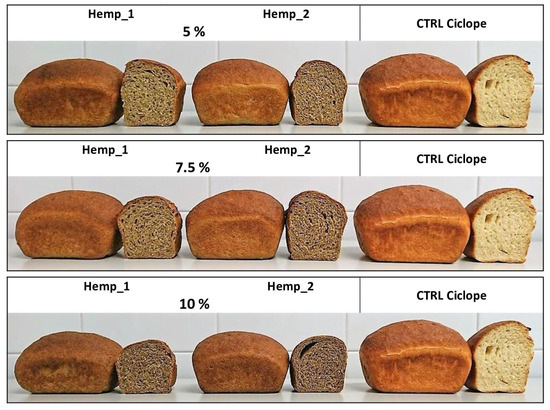
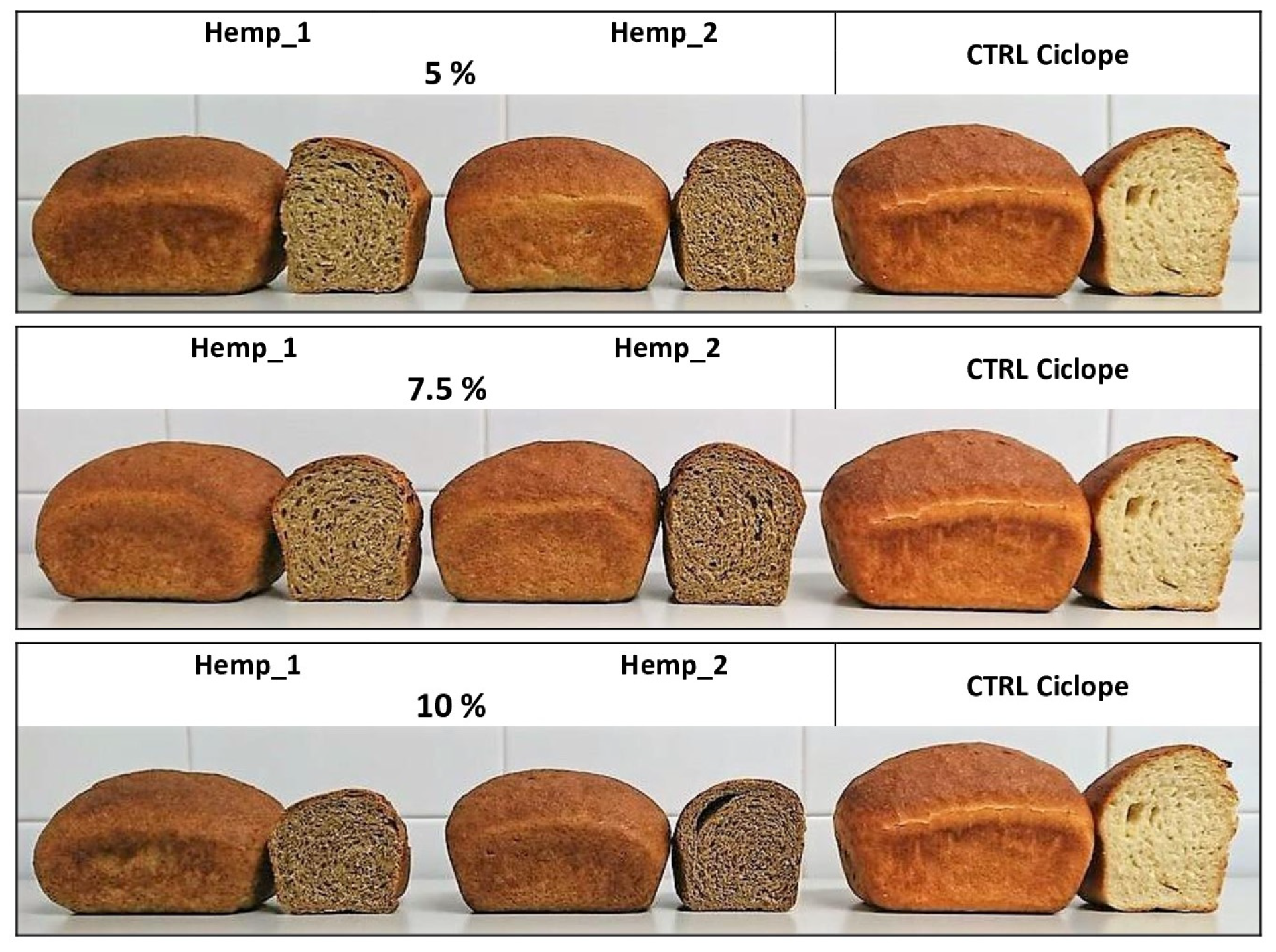
The first parameter of quality evaluated by consumers is the color of the food. The objective values of CIELAB on the crust and crumb, height, and volume of the bread samples are reported in Table 3. The color indices were affected by hemp flour and levels of fortification. Excluding Hemp 1 at 5% substitution, all samples had L* values lower than CTRL for both crust and crumb. The a* value represents the green–red spectrum, and negative values lie towards green. For the crust, the values ranged from 10.63 (Hemp 2_10) to 12.68 (Hemp 1_5), while for the crumb, the values ranged from 2.04 (Hemp 2 _10) to 0.26 (Hemp 1_5). Concerning the blue–yellow spectrum (b*), for the crust, the bread sample Hemp 2 at 10% substitution showed a decrease in the yellow index of 12.3%, while the bread sample Hemp_2 at 5% substitution provided a darker crumb. The CTRL showed values of L* 43.06, a* 14.34, and b* 23.0 for the crust, while L* 73.12, a* −2, and b* 18.24 were recorded for the crumb. For the control bread sample prepared with Ciclope semolina, an average volume of 427 cm3 and a height of 8.1 cm represented good bread-making quality. Regarding the fortified bread samples, the baking test results showed that the partial volumes were diminishing, namely from 427 cm3 for CTRL bread to 300 cm3 in Hemp_1 10. The reason for this phenomenon can be seen in the change in the gluten protein content in this bread after replacing part of the wheat flour with hemp flour, which does not have it, as well as in the increased content of fiber which reduced the ability to retain fermentation gases [35]. Regarding the height of the enriched bread samples, in comparison with the CTRL, the values showed a decrease of approximately 30%, particularly for Hemp 1_10. Concerning the pitting of the crumb, no significant variations in the size of the pits were observed following the addition of hemp flour (Figure 1).
Table 3.
Baking test parameters and color of durum wheat bread (CTRL) and 5%, 7.5%, and 10% of bread fortified with Hemp 1 and Hemp 2 flour (Hemp 1_5, Hemp 1_7.5, Hemp 1_10, Hemp 2_5, Hemp 2_7.5, and Hemp 2_10, respectively). * Mohs scale, ranging from 1 to 8, for higher and lower porosity, respectively.
Figure 1.
Bread obtained with the experimental bread-making test.
Sensory parameters were evaluated in bread two hours after baking and self-cooling.
As shown in Table 4, the amount of fiber and protein present in the two types of hemp flour influenced the quality of the finished product in terms of a decrease in the elasticity values of both the crust and the crumb. Crust thickness decreased with respect to the CTRL (5.0) but was still higher than 4.0 in all samples except Hemp 2_10. The decrease in crust hardness values, as the integration percentages increased, was justified by the presence of the oil content in the hemp flour, which improved the consistency of the finished product [20]. All bread samples had good elasticity, thickness, crispness, and apparent softness, with very little variation between the two hemp flours. The overall judgment was always higher than 6 (threshold of acceptability).
Table 4.
Sensory attributes of the crust and crumb of the Ciclope bread (CTRL) and fortified breads 5%, 7.5%, and 10% with Hemp 1 and Hemp 2 flour, and their overall judgment.
3.3. Chemical Characterization of Bread Samples
Chemical characterization of raw material was discussed in published research [23] (Table S2). The antioxidant activity of the bread samples and the antiradical activity were measured; in particular, as shown in Table 5, a high total phenolic content (TPC) was mostly highlighted in bread Hemp 1_10 and bread Hemp 2_10 samples (1.73 ± 0.029–1.64 ± 0.222 mgGAE/g, respectively). The analysis shown in these samples also showed high values of antiradical activity (3.18 ± 0.071–2.72 ± 0.018 mmol TE/100 g, respectively) and % Scavenging (46.27 and 42.08). The lipid profile (Table 6) was evaluated by GC-MS analysis, and linoleic acid, palmitic acid, and oleic acid were mostly found in all samples. Table 7 also highlights the amino acid content in the bread samples, and a majority of tyrosine, glutamine, proline, and isoleucine was identified, with increasing concentration in essential AAs according to the fortification percentage.
Table 5.
Total phenolic content and antiradical activity of Ciclope bread (CTRL) and 5%, 7.5%, and 10% of bread fortified with Hemp 1 and Hemp 2 flour.
Table 6.
Fatty acids content of Ciclope bread (CTRL) and 5%, 7.5%, and 10% of bread fortified with Hemp 1 and Hemp 2 flour (Hemp 1_5, Hemp 1_7.5, Hemp 1_10, Hemp 2_5, Hemp 2_7.5, and Hemp 2_10, respectively).
Table 7.
Amino acids content (g/100 g) in Ciclope bread (CTRL) and hemp fortified breads at 5%, 7.5%, and 10% (Hemp 1_5, Hemp 1_7.5, Hemp 1_10, Hemp 2_5, Hemp 2_7.5, and Hemp 2_10, respectively); sum of amino acids g/100 g (∑AA); sum of essential amino acids g/100 g (∑AA).
4. Discussion
The possible use of by-products from the food chain is a significant problem for a large number of countries, including those in the developing world, which causes economic and environmental consequences. Generally, most of this waste is sent to landfills or used as livestock feed. The presence of useful bioactive chemical constituents has enabled a second use of these by-products for the production of functional foods. Hemp seeds have a high-protein, low-carbohydrate, unsaturated fatty acid, and dietary fiber nutritional composition, are gluten-free, and are distinctively different from other representative foods such as rice and wheat. Pasta, jam, cakes, beverages, and many other foods may be produced with hemp seeds as a base, and these foods are eaten by athletes, those concerned with their health, or anyone looking for a meat–protein alternative [18,19,20,21,22,23,24].
In this work, the rheological and chemical characteristics of bread fortified with different percentages of hemp flour were evaluated. The study of the technological properties of the Ciclope durum wheat doughs enriched with hemp flour has provided important indications regarding the qualitative and functional characteristics of the breads obtained, in accordance with the results reported by Rusu et al. [19]. The most significant difference found in the different types of dough bread concerned their decrease in terms of extensibility as the integration percentages increased, as reported by Melilli et al. [28]. In fact, it was possible to detect an increase in the values of the alveographic P/L in all samples, up to 40% in the Hemp 1_10 sample. The farinographic stability index highlighted how the addition of the three different additions of hemp flour led to an increase in its values, especially in Hemp 1_5 and in Hemp 1_10 bread samples. In general, considering all the rheological and technological parameters, the inclusion of bioactive compounds in durum wheat semolina has certainly provided fortified bread good potential in relation to health benefits, as reported by Sciacca et al. [3].
Chemical analyses showed that bread fortification using hemp flour at different percentages increased the antiradical and antioxidant activity and also improved amino acid and lipidic profiles and sensory and good cooking qualities. The Folin–Ciocalteau method was used for the evaluation of total phenolic content.
High values of TPC in bread samples fortified with a higher percentage of hemp flour (bread Hemp 1_10 and bread Hemp 2_10) and lower values in the CTRL bread sample (0.54 ± 0.028 mg GAE/g) were highlighted. The supplementation of hemp flour in bread also enhanced the antiradical and antioxidant activity. The highest increase in antiradical activity was observed in bread samples containing 10% of Hemp 1 flour fortification (3.18 ± 0.071 mmol TEAC/100 g), while the lowest was recorded for the CTRL bread sample (0.32 ± 0.018 mmol TEAC/100 g).
This study also focused on the aminoacidic composition of the studied samples. The contents of some amino acids considered essential in the human diet can be low in wheat proteins, especially lysine and threonine. Enriching functional bread with different proportions of hemp flour has the potential to boost the content of essential amino acids. Aminoacidic analysis revealed an increase in the amino acid content of the fortified bread compared to CTRL (100% Ciclope flour). In particular, the analyses showed higher content of lysine and threonine, usually deficient in products based on cereals. The lysine content was found to be 0.03 g/100 g in the CTRL, a lower value than those found in bread samples added to 10% of hemp flour (0.95–1.61 g/100 g in bread Hemp 1_10 and in bread Hemp 2_10, respectively); while higher values of threonine were found in bread Hemp 1_10 (1.83 g/100 g) compared to the CTRL (1.1 g/100 g). High levels of total essential amino acids were found in the samples of fortified bread, 4.09 and 4.68 g/100 g in bread Hemp 1_10 and in Bread Hemp 2_10, respectively, compared to values found in durum wheat bread (1.71 g/100 g). This increase in amino acid values shows how much fortification can improve the protein characteristics of a fortified bakery product compared to one made only of durum wheat.
An increase in mono and polyunsaturated fatty acids was also observed in fortified bread samples with respect to the CTRL. The total ω 3 contents varied between 8.1 and 9.99% in bread Hemp 2 samples and between 6.7–8.9% in bread Hemp 1 samples. Linoleic, palmitic, and oleic were the fatty acids present in the largest amount in the bread Hemp 1_10 sample (59.18–14.03–14.8%, respectively). The CTRL sample had a lower amount of total ω 3 (3.4%).
5. Conclusions
This study demonstrates that incorporating hemp seed flour into bread enhances its nutritional properties and aligns with the increasing demand for fortified products and the growing interest in utilizing agri-food waste in the food chain.
Through the fortification process, a notable increase in proteins and essential amino acids, lipids, unsaturated fatty acids, dietary fiber, and minerals has been achieved without significantly impacting the rheological effects of the final product. Despite consumers’ growing interest in these fortified products, their development and design must balance the percentage of plants/extracts or by-products and the sensory attributes to ensure consumer satisfaction. Enriching durum wheat flour with 10% hemp flour yielded favorable results, striking a balance to maintain excellent rheological characteristics in bread while simultaneously increasing the omega-3 essential fatty acid content and enhancing antioxidant properties. Since traditional bread in Sicilian and Mediterranean cultures is primarily made from durum wheat, incorporating 10% hemp flour represents a valuable strategy to increase its nutritional properties to the advantage of human health benefits.
Supplementary Materials
The following supporting information can be downloaded at: https://www.mdpi.com/article/10.3390/su151712899/s1. Table S1: retention time (min.), coefficient of determination (R2), and linear regression model of external standards used for amino acids quantification; Table S2: chemical characterization of raw materials.
Author Contributions
Conceptualization F.S., N.V. and M.G.M.; methodology F.S., N.V. and M.G.M.; formal analysis. F.S., V.D.S., C.B. and M.G.M.; investigation, S.B., F.S., N.V. and N.P.; resources. N.V.; data curation. F.S., V.D.S., C.B. and M.G.M.; writing—original draft preparation. F.S., M.G.M. and V.D.S.; writing—review and editing F.S., N.V., N.P., V.D.S., C.B. and M.G.M.; supervision. N.V., F.S., N.P., V.D.S. and M.G.M.; project administration. F.S. and M.G.M. All authors have read and agreed to the published version of the manuscript.
Funding
This work was financially supported for 50% by the FEASR—PSR Sicilia 2014–2020 (Rural Development Programme of Sicilia) and for 50% by Project “NUTRAGE (Nutrizione, Alimentazione e Invecchiamento Attivo DBA.AD005.225 (FOE 2021).
Institutional Review Board Statement
Not applicable.
Informed Consent Statement
Not applicable.
Data Availability Statement
Not applicable.
Acknowledgments
The authors would like to thank the “National Biodiversity Future Center” (identification code CN00000033, CUP B73C22000790001) on ‘Biodiversity’, financed under the National Recovery and Resilience Plan (NRRP).
Conflicts of Interest
The authors declare no conflict of interest.
References
- Branca, F.; Arena, D.; Argento, S.; Frustaci, F.; Ciccarello, L.; Melilli, M.G. Recovery of healthy compounds in waste bracts of globe artichoke heads. Acta Hortic. 2022, 1354, 361–366. [Google Scholar] [CrossRef] [Scilit]
- Del Gatto, A.; Mengarelli, C.; Foppa Pedretti, E.; Duca, D.; Pieri, S.; Mangoni, L.; Signor, M.; Raccuia, S.A.; Melilli, M.G. Adaptability of Sunflower (Helianthus Annuus L.) High Oleic Hybrids to Different Italian Areas for Biodiesel Production. Ind. Crops Prod. 2015, 75, 108–117. [Google Scholar] [CrossRef] [Scilit]
- Sciacca, F.; Palumbo, M.; Pagliaro, A.; Di Stefano, V.; Scandurra, S.; Virzì, N.; Melilli, M.G. Opuntia cladodes as functional ingredient in durum wheat bread: Rheological, sensory, and chemical characterization. CyTA J. Food 2021, 19, 96–104. [Google Scholar] [CrossRef] [Scilit]
- Garbetta, A.; D’Antuono, I.; Melilli, M.G.; Sillitti, C.; Linsalata, V.; Scandurra, S.; Cardinali, A. Inulin enriched durum wheat spaghetti: Effect of polymerization degree on technological and nutritional characteristics. J. Funct. Foods 2020, 71, 104004. [Google Scholar] [CrossRef] [Scilit]
- Dewettinck, K.; Van Bockstaele, F.; Kühne, B.; Van de Walle, D.; Courtens, T.M.; Gellynck, X. Nutritional value of bread: Influence of processing, food interaction and consumer perception. J. Cereal. Sci. 2008, 48, 243e257. [Google Scholar] [CrossRef] [Scilit]
- Callaway, J.C. Hempseed as a nutritional resource: An overview. Euphytica 2004, 140, 65–72. [Google Scholar] [CrossRef] [Scilit]
- Farinon, B.; Molinari, R.; Costantini, L.; Merendino, N. The seed of industrial hemp (Cannabis sativa L.): Nutritional Quality and Potential Functionality for Human Health and Nutrition. Nutrients 2020, 12, 1935. [Google Scholar] [CrossRef] [Scilit]
- Oomah, B.D.; Busson, M.; Godfrey, D.V.; Drover, J.C.G. Characteristics of hemp (Cannabis sativa L.) seed oil. Food Chem. 2022, 76, 33–43. [Google Scholar] [CrossRef] [Scilit]
- Alden, D.M.; Proops, J.L.R.; Gay, P.W. Industrial hemp’s double dividend: A study for the USA. Ecol. Econ. 1998, 25, 291–301, ISSN 0921-8009. [Google Scholar] [CrossRef] [Scilit]
- Tang, C.H.; Ten, Z.; Wang, X.S.; Yang, X.Q. Physicochemical and functional properties of hemp (Cannabis sativa L.) protein isolate. J. Agr. Food Chem. 2006, 54, 8945–8950. [Google Scholar] [CrossRef] [Scilit]
- Aluko, R.E. Chapter 7—Hemp Seed (Cannabis sativa L.) Proteins: Composition, Structure, Enzymatic Modification, and Functional or Bioactive Properties. Sustain. Protein Source 2017, 121–132. [Google Scholar] [CrossRef] [Scilit]
- Krüger, M.; van Eeden, T.; Beswa, D. Cannabis sativa Cannabinoids as Functional Ingredients in Snack Foods-Historical and Developments Aspects. Plants 2022, 11, 3330. [Google Scholar] [CrossRef] [Scilit] [PubMed]
- Montero, L.; Ballesteros-Vivas, D.; Gonzalez-Barrios, A.F.; Sánchez-Camargo, A.D.P. Hemp seeds: Nutritional value, associated bioactivities and the potential food applications in the Colombian context. Front. Nutr. 2023, 9, 1039180. [Google Scholar] [CrossRef] [Scilit]
- Prociuk, M.A.; Edel, A.L.; Richard, M.N.; Gavel, N.T.; Ander, B.P.; Dupasquier, C.M.; Pierce, G.N. Cholesterol-induced stimulation of platelet aggregation is prevented by a hempseed-enriched diet. Can. J. Physiol. Pharmacol. 2008, 86, 153–159. [Google Scholar] [CrossRef] [Scilit] [PubMed]
- Maurotti, S.; Mare, R.; Pujia, R.; Ferro, Y.; Mazza, E.; Romeo, S.; Pujia, A.; Montalcini, T. Hemp Seeds in Post-Arthroplasty Rehabilitation: A Pilot Clinical Study and an In Vitro Investigation. Nutrients 2021, 13, 4330. [Google Scholar] [CrossRef] [Scilit]
- Mikulcová, V.; Kašpárková, V.; Humpolíček, P.; Buňková, L. Formulation, Characterization and Properties of Hemp Seed Oil and Its Emulsions. Molecules 2017, 22, 700. [Google Scholar] [CrossRef] [Scilit]
- Kriese, U.; Schumann, E.; Weber, W.E.; Beyer, M.; Brühl, L.; Matthäus, B. Oil content, tocopherol composition and fatty acid patterns of the seeds of 51 Cannabis sativa L. genotypes. Euphytica 2004, 137, 339–351. [Google Scholar] [CrossRef] [Scilit]
- Siano, F.; Moccia, S.; Picariello, G.; Russo, G.; Sorrentino, G.; Di Stasio, M.; La Cara, F.; Volpe, M. Comparative Study of Chemical, Biochemical Characteristic and ATR-FTIR Analysis of Seeds, Oil and Flour of the Edible Fedora Cultivar Hemp (Cannabis sativa L.). Molecules 2018, 24, 83. [Google Scholar] [CrossRef] [Scilit]
- Rusu, I.E.; Marc Vlaic, R.A.; Mureşan, C.C.; Mureşan, A.E.; Mureşan, V.; Pop, C.R.; Chiş, M.S.; Man, S.M.; Filip, M.R.; Onica, B.M.; et al. Hemp (Cannabis sativa L.) Flour-Based Wheat Bread as Fortified Bakery Product. Plants 2021, 10, 1558. [Google Scholar] [CrossRef] [Scilit]
- Pojić, M.; Hadnadev, T.D.; Hadnadev, M.; Rakita, S.; Brlek, T. Bread Supplementation with Hemp Seed Cake: A By-Product of ¯ Hemp Oil Processing. J. Food Qual. 2015, 38, 431–440. [Google Scholar] [CrossRef] [Scilit]
- Merlino, M.; Tripodi, G.; Cincotta, F.; Prestia, O.; Miller, A.; Gattuso, A.; Verzera, A.; Condurso, C. Technological, Nutritional, and Sensory Characteristics of Gnocchi Enriched with Hemp Seed Flour. Foods 2022, 11, 2783. [Google Scholar] [CrossRef] [Scilit] [PubMed]
- Teterycz, D.; Sobota, A.; Przygodzka, D.; Lysakowska, P. Hemp seed (Cannabis sativa L.) enriched pasta: Physicochemical properties and quality evaluation. PLoS ONE 2021, 16, e0248790. [Google Scholar] [CrossRef] [Scilit]
- Bonacci, S.; Di Stefano, V.; Sciacca, F.; Buzzanca, C.; Virzì, N.; Argento, S.; Melilli, M.G. Hemp Flour Particle Size Affects the Quality and Nutritional Profile of the Enriched Functional Pasta. Foods 2023, 12, 774. [Google Scholar] [CrossRef] [Scilit]
- Yano, H.; Fu, W. Hemp: A Sustainable Plant with High Industrial Value in Food Processing. Foods 2023, 12, 651. [Google Scholar] [CrossRef] [Scilit] [PubMed]
- AACC. Approved Methods of Analysis, 11th Edition. Cereals & Grains Association. Available online: https://www.cerealsgrains.org/resources/Methods/Pages/54PhysicalDoughTests.aspx (accessed on 23 June 2022).
- UNI 10453; Durum Wheat and Semolina—Determination of Rheological Properties Using an Alveograph. UNI: Milan, Italy, 1995.
- UNI 10690; Durum Wheat and Semolina—Determination of Gluten Quality. Gluten Index Method. UNI: Milan, Italy, 1979.
- Melilli, M.G.; Di Stefano, V.; Sciacca, F.; Pagliaro, A.; Bognanni, R.; Scandurra, S.; Virzì, N.; Gentile, C.; Palumbo, M. Improvement of Fatty Acid Profile in Durum Wheat Breads Supplemented with Portulaca oleracea L. Quality Traits of Purslane-Fortified Bread. Foods 2020, 9, 764. [Google Scholar] [CrossRef] [Scilit]
- Di Stefano, V.; Bongiorno, D.; Buzzanca, C.; Indelicato, S.; Santini, A.; Lucarini, M.; Fabbrizio, A.; Mauro, M.; Vazzana, M.; Arizza, V.; et al. Fatty Acids and Triacylglycerols Profiles from Sicilian (Cold Pressed vs. Soxhlet) Grape Seed Oils. Sustainability 2021, 13, 13038. [Google Scholar] [CrossRef] [Scilit]
- Di Stefano, V.; Pitonzo, R.; Novara, M.E.; Bongiorno, D.; Indelicato, S.; Gentile, C.; Avellone, G.; Bognanni, R.; Scandurra, S.; Melilli, M.G. Antioxidant activity and phenolic composition in pomegranate (Punica granatum L.) genotypes from south Italy by UHPLC-Orbitrap-MS approach. J. Sci. Food Agric. 2019, 99, 1038–1045. [Google Scholar] [CrossRef] [Scilit]
- Melilli, M.G.; Pagliaro, A.; Bognanni, R.; Scandurra, S.; Di Stefano, V. Antioxidant activity and fatty acids quantification in Sicilian purslane germplasm. Nat. Prod. Res. 2019, 34, 26–33. [Google Scholar] [CrossRef] [Scilit]
- Cardullo, N.; Muccilli, V.; Di Stefano, V.; Bonacci, S.; Sollima, L.; Melilli, M.G. Spaghetti Enriched with Inulin: Effect of Polymerization Degree on Quality Traits and α-Amylase Inhibition. Molecules 2022, 27, 2482. [Google Scholar] [CrossRef] [Scilit]
- Palumbo, M.; Spina, A.; Boggini, G. Bread-making quality of Italian durum wheat. Ital. J. Food Sci. 2002, 14, 2. [Google Scholar]
- Di Stefano, V.; Buzzanca, C.; Melilli, M.G.; Indelicato, S.; Mauro, M.; Vazzana, M.; Arizza, V.; Lucarini, M.; Durazzo, A.; Bongiorno, D. Polyphenol Characterization and Antioxidant Activity of Grape Seeds and Skins from Sicily: A Preliminary Study. Sustainability 2022, 14, 6702. [Google Scholar] [CrossRef] [Scilit]
- Gavurníková, S.; Havrlentová, M.; Mendel, Ľ.; Čičová, I.; Bieliková, M.; Kraic, J. Parameters of Wheat Flour, Dough, and Bread Fortified by Buckwheat and Millet Flours. Agriculture (Pol’nohospodárstvo) 2011, 57, 144–153. [Google Scholar] [CrossRef] [Scilit]

Disclaimer/Publisher’s Note: The statements, opinions and data contained in all publications are solely those of the individual author(s) and contributor(s) and not of MDPI and/or the editor(s). MDPI and/or the editor(s) disclaim responsibility for any injury to people or property resulting from any ideas, methods, instructions or products referred to in the content. |
© 2023 by the authors. Licensee MDPI, Basel, Switzerland. This article is an open access article distributed under the terms and conditions of the Creative Commons Attribution (CC BY) license (https://creativecommons.org/licenses/by/4.0/).