


Abstract
The circular economy is a widely accepted concept that various governments have started to adopt. Still, a major consumer of resources, the construction industry, struggles to implement business models that answer to the opportunity and generate value beyond economical. At the same time, the industry is at a threshold of intensifying their production by industrialized manufacture. This type of construction offers practical benefits and should be developed whilst prioritizing a sustainably built environment. A circular economy business model (CBM) offers all stakeholders long term value and revenue whilst moving towards a sustainable environment. The business model canvas (BMC) is a tool to shed light on the essential characteristics of a CBM, its value, and alignment in a multi-life cycle perspective. It can contribute to accelerating circular innovation in construction. This study aims to provide an overview of archetypical CBMs in construction based on a literature review and a systematic coding exercise using the BMC. The archetypes found are used to describe the characteristics of industrialized manufacture in the various circular economy construction scenarios.
1. Introduction
Circular Economy thinking in the built environment is prioritized by the European Commission [1] in the Circular Economy Action Plan. It is a realistic scenario for the near future of construction. Simultaneously, the construction industry struggles to implement circular economy business models (CBMs) to generate economic and business opportunities [2,3,4,5,6].
The magnitude of the challenge is visible in the industries’ share in global resource occupation: construction is responsible for an estimated 40% of resource extraction [7] and up to 30% of waste production [8]. New construction, and later, the end-of-life (EoL) re-destination of resources inevitably consumes energy and emits pollution along the way. Furthermore, the rashness of global resource consumption exceeds the pace of regeneration. This will influence resource supply and ultimately risk their availability for construction [2]. Ergo, as circular economy thinking appeals to the efficient usage of available resources now and in the future [9], it is essential to adopt the concept to build a sustainable environment.
Nevertheless, the industry is moving toward circular construction at a snail’s pace. This is caused by the construction industries’ characteristics, including the long life and innovation cycle of buildings, the existence of many stakeholders beyond producer, and user with split incentives and the complex composition of parts that a building typically is [5]. In addition, the relatively small body of circular economy literature and examples of working circular business models on construction specifically causes a sparse concept adoption [2]. The value of circular economy business models lies in their power to enable a variety of stakeholders to communicate about innovations in a shared language [4]. A distinct translation of findings in the literature on CBMs to practical implications for industrialized construction, which is unavailable to date due to the emerging nature of the topic in this field. It will enable informed business model innovation and induce a development towards more CBMs in a sustainable construction practice.
This study intends to offer that translation. It sits exactly between the two realms (academic and industry practice) and is meant to bridge the gap in between. Based on a systematic literature review, this study addresses the following research question: What scenarios, in the shape of archetypical CBMs in construction, are to be expected in a circular economy, and how do they translate to industrialized building manufacture? By answering that question, the state-of-the-art in construction informs an interpretation that is of a more practical nature specifically for circular industrial construction, which is to date unique.
The paper is divided into five parts: it starts with a description of the research background in Section 2, followed by a description of the research method in Section 3 and presentation of the result in Section 4. The conclusion with the discussion (Section 5) and conclusion (Section 6) are at the end of the paper.
2. Background
2.1. Industrialized Construction
The term “industrialized construction” is often used interchangeably with prefabricated construction, however strictly, it is not the same. Following Richard, prefabrication is a subset of industrialized construction. In 2005, the author defined industrialization as “catering a large market, by investing in technologies that simplify production and also reduce cost” [10]. Other authors refine the definition by saying manufacture takes place in a specialized and controlled facility [11,12,13,14]; site work is minimized [12,13,15]; mechanical equipment is used [12,14,15]; and a systematic approach is involved [12].
The reasons to turn to industrialized construction are manifold. Most frequently, the potential of increased productivity, production speed, and the control on quality and lead-times is mentioned [10,11,13,14,16]. In a European society that is characterized by a lack of skilled-labor and a pressing need for new construction on urbanized and spatially limited locations, industrialized construction can offer a solution that is less dependent on labor and offer construction workers a healthier and safer working environment [11,12,13,14,16]. Although significant capital investments to facilitate an industrial factory environment are made with a long-term perspective [14], reduced production cost can be a direct result that leads to more affordable buildings [12,13,16]. Furthermore, it can alleviate environmental effects as a result of conventional construction activities [11,12].
State-of-the-art industrialized construction represents a sophisticated way to produce buildings, using various materials, integrated in transportable components, serving a multitude of functions. Industrialized construction appears in five degrees: prefabrication, mechanization, robotics, automation and reproduction [10]. The drawback of resulting constructions can be an irreversible mix of materials held together by permanent connections. Examples of building components are laminated glass or core-insulated concrete panels and structural and airtight sealants. Though these examples contribute to time-efficient construction and their performance is close to guaranteed, once in place, they lack the generosity to host evolved customer needs as well as the design flexibility to physically change or offer disassembly options at end-of-life (EoL) [17].
Industrialized construction is a powerful means to mass produce efficiently, though the impact on resource use, waste production, and environmental impact are to be included in the development of sustainable solutions for industrial construction. CBMs offer a shared language to discuss alternatives between stakeholders and their impact on a scale beyond the project scope.
2.2. Circular Business Models
Following various schools of thought [18,19,20], the essence of a circular economy lies in a closed resource loop. The Ellen MacArthur Foundation framed the concept as “regenerative by intention and design” [21]. Based on a literature review Geissdoerfer et al. [22] identified the relationship between Circular Economy and sustainability as the first being a subset or driver of the latter. For this paper, the definition of a circular economy (CE) by the authors of the mentioned review was used: CE is defined as “a regenerative system in which resource input and waste, emission, and energy leakage are minimized by slowing, closing, and narrowing material and energy loops. This can be achieved through long-lasting design, maintenance, repair, reuse, remanufacturing, refurbishing, and recycling.” The three essential principles for a Circular Economy, as posed by the Ellen MacArthur Foundation [23], echo in this definition: (i) Design out waste and pollution, (ii) Keep products and materials in use, and (iii) Regenerate natural systems.
Business models play an important practical role in the transition towards a circular economy. The definition in this paper for circular business models is based on two other papers. A CBM can be defined as the rationale of how an organization creates, delivers, and captures value to close and slow material loops [24,25]. “These CBMs are by nature networked: they require collaboration, communication, and coordination within complex networks of interdependent but independent actors/stakeholders” [24]. Value creation relates to the three principles of a circular economy by the Ellen MacArthur Foundation in a product or service perspective. Furthermore, the CBM defines how the offering is provided and revenue is generated. This results in a “win-win-win” situation, that creates value for the acting stakeholders and the environment [26].
In current business practice the development of business models and the use of the Business Model Canvas (BMC) [27] are standard [4,28]. Also, the framework is used to define strategies and cases in various academic publications related to CBMs and sustainable business models (SBMs) [3,25,28,29,30,31]. The BMC offers organizations a common language to create a shared understanding of specific business models and to innovate. It uses nine building blocks to define the value and the delivery of a business proposition in a framework. The building blocks include: the value proposition, the value delivery (customer segment, channel, customers’ relationship, key resources, key activities, and key partnerships) and the value capture (revenue stream, cost structure). The tool can contribute to accept CE thinking in business strategic. As a result of introducing one or more of the CE principles to the value proposition, the value delivery follows by stating circular design [6] and stewardship [25] strategies. Incentives to close resource loops are an integral part of the model in the value capture building blocks. Industrialized construction organizations can use the BMC to innovate their businesses towards contributing to a sustainable future. Now the question arises: what scenarios in a circular economy construction practice can be expected, and how can industrialized manufacture use this for their own business model development?
3. Method
The circular economy can be a means to achieve sustainability now and in the future. This implies a systemic change to the current linear system, both on an organizational level and on a practical level. In order to contribute towards that change in industrial construction, the research question in this paper is: What scenarios, in the shape of archetypical CBMs in construction, are to be expected in a circular economy? How do they translate to industrialized construction? The research question was broken down in two sub-questions:
- What archetypical CBMs in construction are to be expected?
- How do the archetypical CBMs for construction translate to performance criteria for industrialized construction?
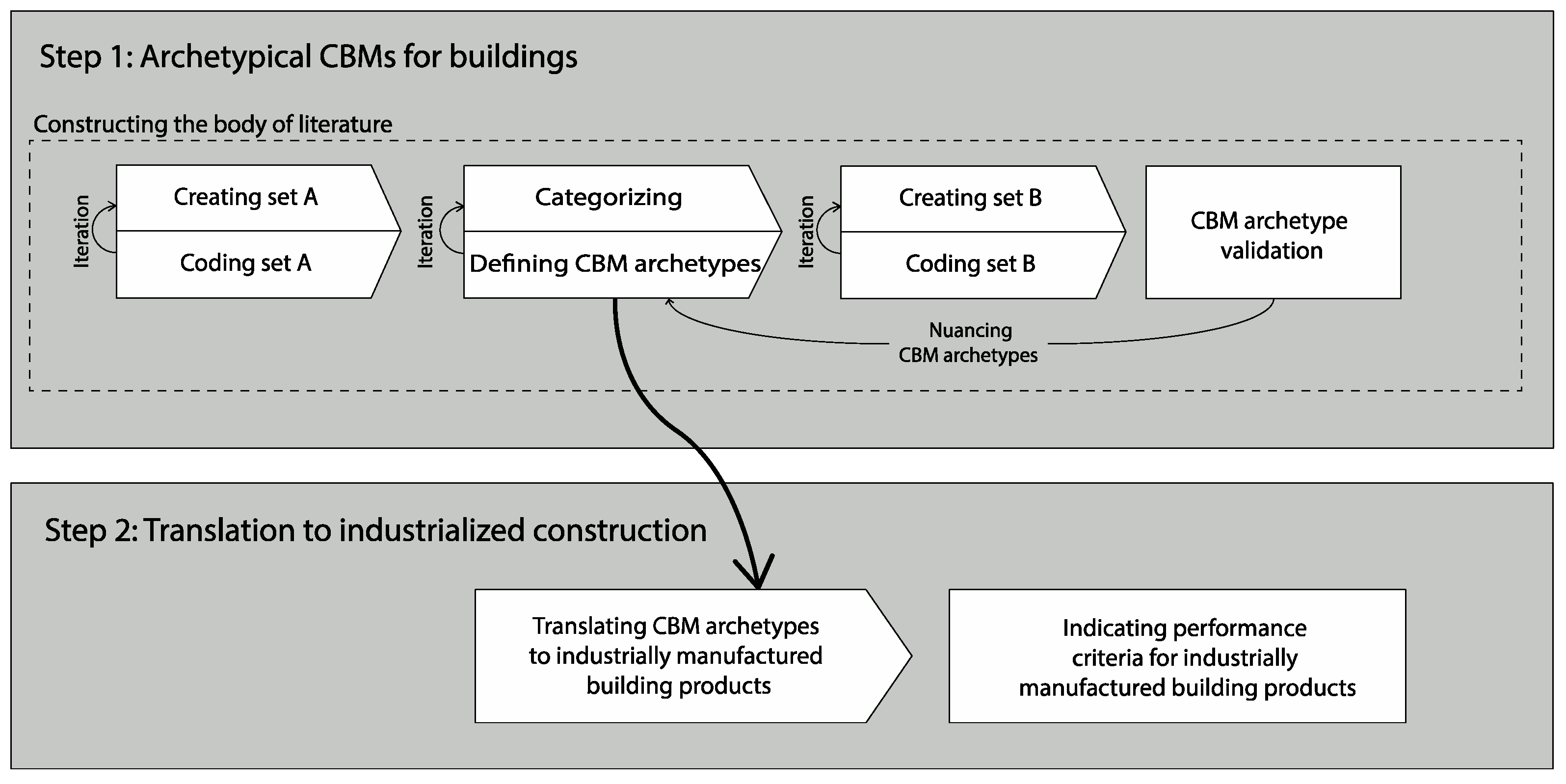
The sub-questions are aligned with the two-step approach used for this study. Figure 1 depicts the two steps graphically.
Figure 1.
Graphical representation of the method.
3.1. Step 1: Archetypical CBMs in Construction
Following the Oxford Dictionary, an archetype is the most typical example or original model from which copies are made. Any practical example of a CBM in construction can be traced back to its core essence: the archetype. Case study examples of the same archetype share characteristics that distinguish them from the other case study examples. The reason to indicate the core essence of a CBM lies in the value of comparing constructs systematically and learn from the result. Though this knowledge is scarce, on account of the emerging nature of the topic [5] and the slowly and unpredictably innovating industry as a context [32], it is essential for sustainable development.
3.1.1. Constructing the Body of Literature
The body of literature was generated through a filtered search in academic databases. The search generated a number of 575 publications relating to combinations of the search terms indicated in Table 1. The systematic approach, ensured an inclusive basis for the extraction of two comprehensive datasets, consisting of (i) constructs and (ii) case study examples of CBMs in construction.
Table 1.
Filtering criteria academic databases.
After importing the references in a reference manager software and deleting the doubles, 370 unique items were left. The items and their abstracts were manually checked for doubling and relevance. Literature referring to topics including automobile, agriculture, food, bio-technology, medicine, sports, (fast) consumer goods, and IT solutions are irrelevant for this study and excluded.
Furthermore, relevant hand-picked academic and grey literature were added to the selection [6,19,25,29,33,34,35], resulting in a total of 60 publications. These publications represent a minor share of the sample and add no selection bias in developing the archetypical CBMs occurs. The publications offer the practical examples that will help illustrate the findings in academic literature.
Two data sets were derived from this body of literature:
- Set A comprises theoretical circular constructs with a general and strategic nature and caters to the development of CBM archetypes for construction;
- Set B comprises case study examples relating to circular economy construction and was used to validate the developed archetypes.
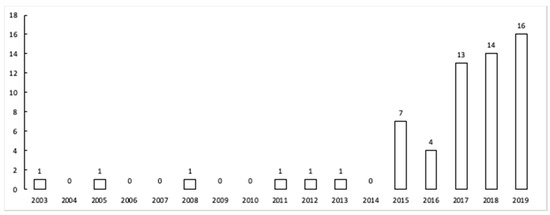
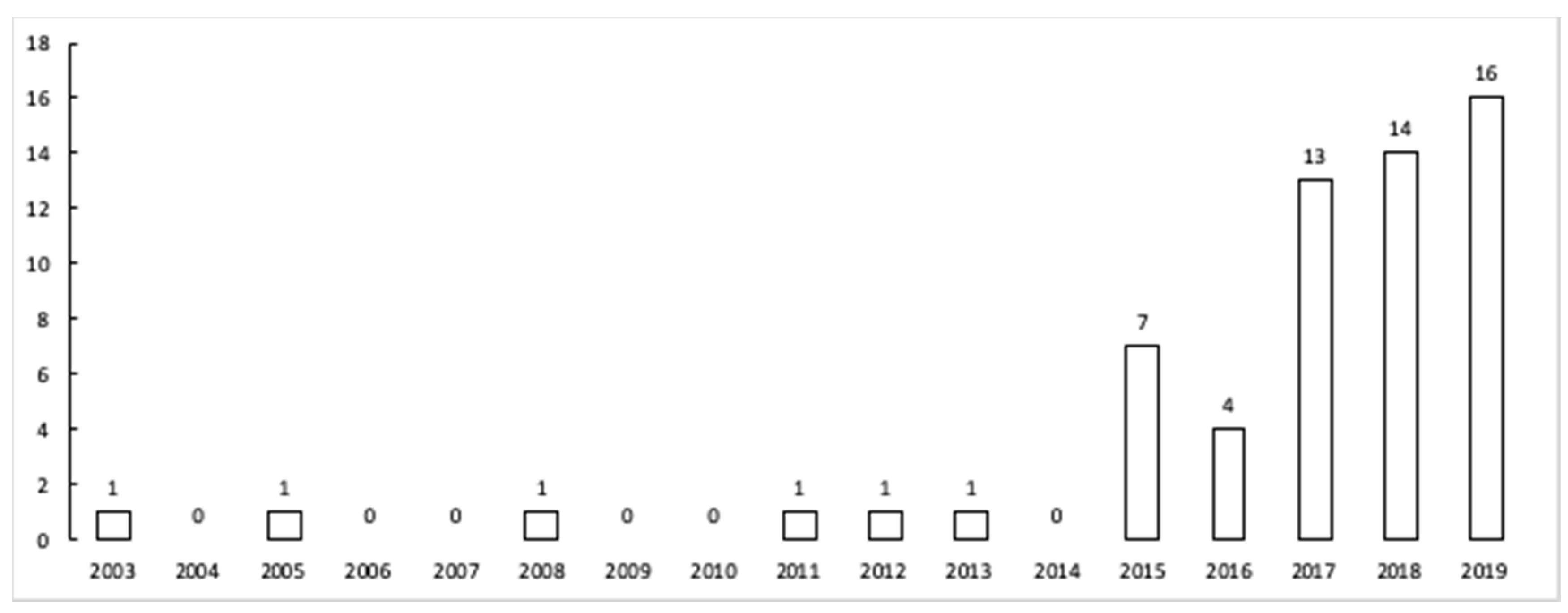
Figure 2 shows an overview of the used literature plotted against year of publication. The trend suggests that the research on circular economy in construction is far from saturated. This aligns with the trend for research on circular economy in general, as identified by Geissdoerfer et al. [22]. The archetypes presented in this paper contribute to the emerging scientific research on circular economy in construction by offering a basis for categorization of case study assessment. This is where the limitation of this method is visible: the expectation that more literature, and thus, a more complete body of literature is imminent suggests that a more thorough investigation is possible in the future. It is therefore recommended by the authors to realign the outcome of this research with future scientific research on CBMs in construction. Furthermore, although the publications used and the sets generated from them represent the state-of-the-art, it cannot be guaranteed that all possible examples are included due to a lack of documentation in scientific publications. As a matter of fact, it is reasonable to assume that a minor share of practical examples is described in a scientifically accessible manner. Still, the systematic approach to generate the body of literature on CBMs in construction offers the most comprehensive result given current circumstances, and is therefore a suitable basis for review.
Figure 2.
Publications on circular construction included in this literature review plotted by publication date.
3.1.2. Creating and Coding Set A
Set A comprises elements found in the literature that are defined as archetypes, strategies, concepts, typologies, and frameworks of business models, products, and services contributing to a circular economy. They share a similar general and theoretical nature and explicitly lack a practical, applied, or employed nature. The elements describe a theoretical way to create value and possibly revenue. Some of them refer to general circular strategies, such as design for disassembly, to describe the activity in the concept and define usership and ownership changes in general terms to describe target segments and responsibilities. In 17 of the 60 publications, 149 theoretic CBM constructs were found. Constructs with the same essence with slightly different spelling, such as “industrial symbiosis” and “Industrialized symbioses”, are interpreted as the same element in the dataset. This resulted in Set A including 79 unique elements as presented in Table A1 in Appendix A [2,3,6,7,9,19,22,29,36,37,38,39,40,41,42,43,44,45].
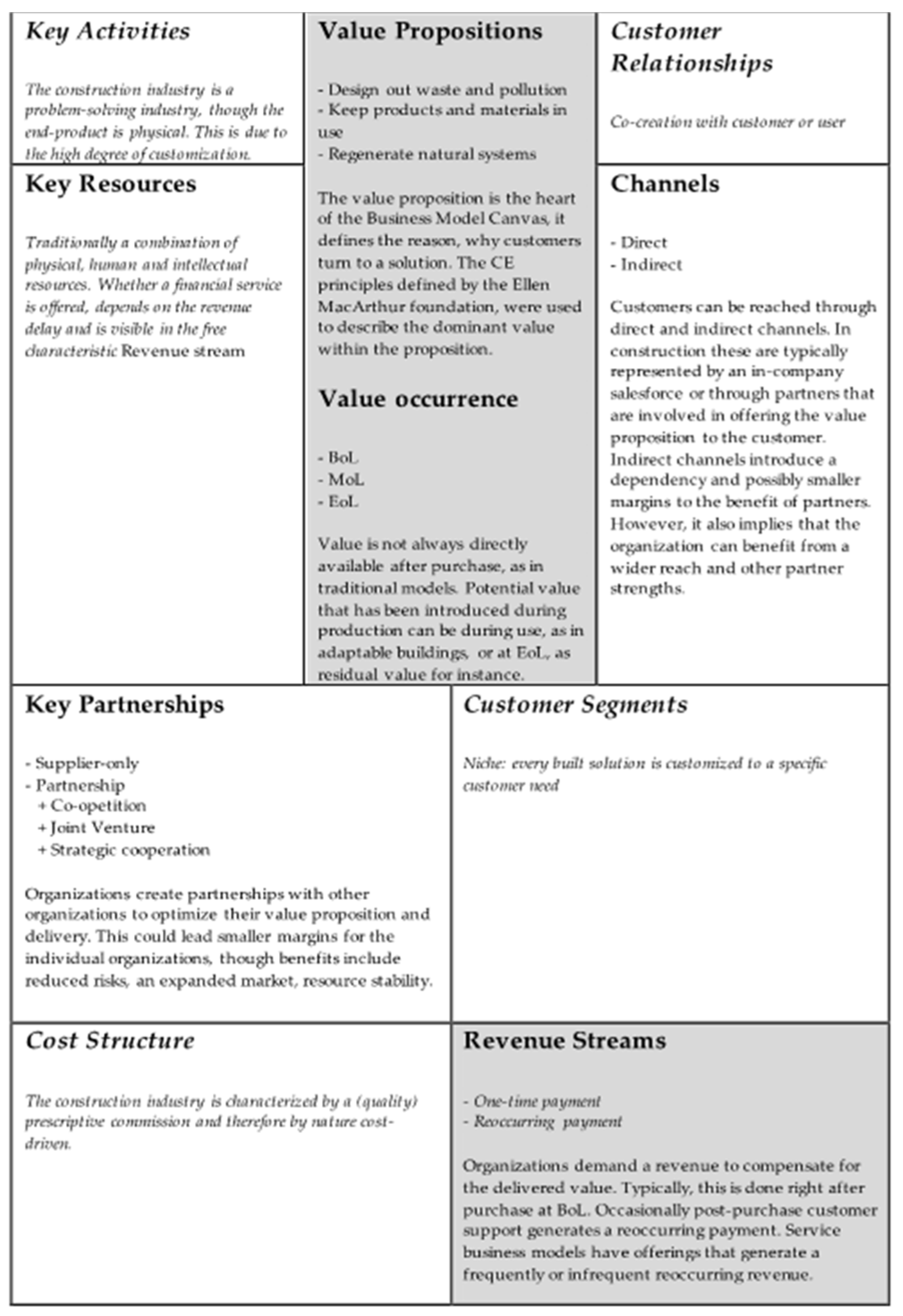
The elements in Set A were systematically coded using the building blocks of the BMC [27]. An overview of the building blocks and their inclusion in the coding process is found in Figure A1 in Appendix B. Initially, all nine building blocks were used. However, in the iterative process of coding, five building blocks were fixed based on an assumption of characteristics of constructing buildings in an industrial context.
The building blocks Channel and Key partnerships introduced a circle reference to the code. The delivery direct or indirect channel is influenced by the partnerships in the business model, as explained in the following example. If a manufacturer of building components teams up with a secondary resource supplier to benefit from a stable resource flow, customers can be found effectively in relation to the demolition projects that secondary resources originate from. Therefore, the secondary resource supplier will at least play a role in the sales apparatus of the building components. In general, any kind of partnership introduces the option of an indirect channel, whereas that option is not present in a pure supplier model. This is an undesired circle reference.
Coding the elements in Set A using the two final BMC building blocks lead to a possibility of 12 unique codes or categories. The result was not conclusive as explained by the following example. The elements “Recovery and recycling” and “Narrowing resource loops” are two different concepts. The former refers to salvaging secondary raw materials from EoL situations, to use in new production. The latter refers to designing efficiently in the Beginning of Life cycle (BoL), when the building is not produced yet. Although the concepts differ essentially, this was not visible in the codes (Table 2). A term pin-pointing the occurrence of value relating to the building’s life cycle was needed to differentiate between the essence of various concepts. The term value proposition was detailed, by adding the term occurrence of value to obtain a conclusive method.
Table 2.
Twin codes for conceptually different elements.
Table 3 shows the final composition of the code with three terms, two or three options each, thus 18 possible categories.
Table 3.
Code composition, options and denotation.
3.1.3. Archetype Definition
Coding Set A resulted in five unique codes that relate to just as many CBM archetypes for buildings, as shown in Table 4. The terms marked X are not decisive in the determination of the category. The categories were labelled with names relating to the archetypical characteristics in the category. The definition of the CBM’s for buildings are given in Section 4.1.
Table 4.
Codes, categories, and CBM archetypes for buildings.
3.1.4. Creating and Coding Set B and Archetype Validation
Set B comprises case studies, buildings, products, prototypes, and pilots relating to circular economy construction that have a practical or employed nature. In 11 of the 60 publications, 17 elements were found (Table A2 [3,6,7,34,40,41,43,46,47,48,49] in Appendix A) and attributed with the developed archetypes. The archetype attribution was done using the coding method used also for set A.
3.2. Step 2: Translation to Industrialized Construction
For industrialized manufacturers, the CBM archetypes in construction offer insight in the realistic scenarios in a circular building industry. The archetypes are extended to a formulation of the industrialized manufacturer’s scope of work. Circular design strategies and methods described in the literature [6,50] were used to specify requirements for products and services in industrialized construction. Design for Sustainability (DfX) is defined in the literature as “a range of strategies that could be adopted to design for a circular economy, as in some cases, it takes a more holistic and radical approach towards product development. DfX is the most commonly-used term to represent a holistic approach and most holistic and radical approach towards product development” [50].
4. Results
4.1. CBM Archetypes for Buildings
The five archetypes are defined as follows:
“Smart input” refers to the intelligent use of secondary or renewable raw materials in the production process. Focus is put on resource efficiency and the reduction of net material and energy consumption and pollution. The underlying aim in this archetype is to give way to regenerating natural resources. Practical examples of this archetype include industrial symbioses and construction based on renewable materials.
“Smart output” refers to capturing residual value of raw materials and components in retrofit and demolition for reuse in a different context. The result of this archetype can be a resource for a “Smart input” CBM. Though, characteristic in both archetypes is that they in the currently appear as reactive and linear models. These reactive CBMs are typical to an economy in transition. This archetype aims to reduce the net amount of construction and demolition waste (CDW). A practical example includes a business model that offers selective demolition service to retrieve resources from demolition sites.
“Stewardship” refers to taking responsibility for resources beyond the product context, in a multi-cyclic perspective and the functional performance of the building (or building product). This fully pro-active CBM aims to offer a full-service building (or product) to a customer. Practical examples include shared workspaces and Design Built Maintain Remove (DBMR) contracts.
“Adaptable building” is a model focused on extending the use phase of a major part of the construction. It delivers adaptability that facilitates technical, functional, and spatial flexibility and upgradability in order to extend user satisfaction.
“Never-ending building” focusses on extending the use phase of the entire construction, delivering longevity, durability, and easy maintenance and repair. This model seeks to reduce end-user dissatisfaction by offering a timeless quality.
In the validation process, a number of elements were labelled with more than one archetype, for instance Park 20|20. In general, the elements that relate to different archetypes are complete buildings, representing a combination of building products, materials and uses, and thus a combination of business models. This aligns with the expectation that buildings are a composition of products delivered by various organizations using various business models.
As the word stewardship implies, producer responsibility in the eponymous archetype stretches from the BoL to the EoL and beyond. This is reflected in the revenue as the extended responsibility is considered as a service that is compensated for in a reoccurring manner. The opposite can be seen in the archetypes “Smart input” and “Smart output”, in which the producer is involved over a short period of time only and a one-time compensation is expected. “Adaptable building” and “Never-ending building” are business models that offer the potential to be circular in one or more building life cycles. In “Never-ending building”, the potential is compensated as one-time revenue, whereas “Adaptable building” requires additional action to cash in on the opportunity and reoccurring compensation is expected.
4.2. Translation to Industrialized Construction
Table 5 shows the archetypes and their implication on the scope of industrialized construction. To bridge the gap between theory and practice, a translation to performance criteria using circular design strategies and DfX methods is made. According to Moreno et al. [50], the taxonomy for DfX strategies, which is based on a literature review [51], “considers the […] approaches to designing for multiple lifecycles, as well as to achieve holistic circular design.” The DfX methods, complemented by the circular design strategies as used by van Stijn and Gruis [6], were applied to create tangible performance criteria for circular industrialized construction.
Table 5.
Performance criteria for industrially manufactured building products for archetypical CBMs for buildings.
5. Discussion
The CBM archetypes for construction are a confirmation of previously developed CBM taxonomies that have a focus on consumer products. Although the other taxonomies relate to a different type of product, the similarities are obvious. Three taxonomies that are referred to as a categorization of “business models in relation to economic gains” [50] are compared here to the CBM archetypes for construction: five circular business models [19], business model strategies for CE [36], and business models for the CE [52].
“Never-ending building” aligns with “Product life extension” [19], “Classic long-life model” and “Encourage sufficiency” [36], and “Slowing resource loops” [52]. All refer to waste as a loss of value and extending product life, with minor intervention, is a way to prevents this. The concepts referred to differ from the “Never-ending building”, as such that a distinction from an adaptable model is not made, except from “Extending Product Value” in [36]. Here the intention is to extend the perceived value of the product and not necessarily the physical manifestation of the product. This implies a degree of flexibility or adaptability at the core of the product, which is the case in “Adaptable building”.
“Sharing” [19] and “Intensifying resource loops” [52] are business models that are separately mentioned, whereas in the CBM archetypes for construction from this study, the concept is a subset of the archetype “Stewardship”. This is similar to the business model strategies as proposed by Bocken et al. [36].
“Stewardship”, “Smart output”, and “Smart input” are concepts presented under a different name in all three of the taxonomies.
The translation as presented in Table 5 should serve as an addition to the design brief of new construction, preferably when the design process is initiated, regardless whether a manufacturer of industrialized construction is part of the process yet. When the manufacturer does get involved in the design and or construction depending on the moment in time, the translation can be used as an additional performance specification.
6. Conclusions
This paper shows an overview of the CBM archetypes in construction based on a systematic review of academic and grey literature on theoretic constructs and practical examples in circular construction. Furthermore, it focusses on the requirements for industrialized manufacturing for construction in a circular economy. It contributes to academic research by offering an overview of archetypical CBMs in construction and to the industry practice by giving insight in the practical implications of industrialized production for circular construction. This was done in a two-step approach, starting with a focus on theory and then translating this into practice.
This paper shows how the archetypes were used to translate the plausible circular economy scenarios for construction into the implications for industrialized construction and its manufacture. In turn this insight can be used to inform the design brief or offer the specification for execution in industrialized construction, but also to shape roadmaps for innovation.
The alignment of taxonomies suggests that the archetypes resulting from this literature review are an inclusive representation for construction. Thus, an essential connection was made between circular business model theory and industrialized construction practice. The translation enables anticipation and focused business model innovation of manufacturers towards plausible scenarios of a circular economy future.
Author Contributions
Writing C.H.; supervision A.P.; review and editing C.H. and A.P. All authors have read and agreed to the published version of the manuscript.
Funding
This research was funded by Byldis B.V. in Veldhoven (NL)
Conflicts of Interest
The author declares no conflict of interest. The funders had no role in the design of the study; in the collection, analyses, or interpretation of data; in the writing of the manuscript, or in the decision to publish the results.
Appendix A
Table A1.
Elements in set A Theoretical CBM constructs.
Table A2.
Case studies and archetype attribution.
Appendix B
Figure A1.
Free and fixed characteristics for CBMs in construction based on the BMC [27].
References
- European Commission. Report by the EC to the European Parliament, the Council, the European Economic and Social Committee and the Committee of Regions on the implementation of the Circular Economy Action Plan; European Commission: Brussels, Belgium, 2019. [Google Scholar]
- Adams, K.T.; Osmani, M.; Thorpe, T.; Thornback, J. Circular economy in construction: Current awareness, challenges and enablers. In Proceedings of the Institution of Civil Engineers—Waste and Resource Management; Thomas Telford Ltd.: London, UK, 2017; pp. 1–11. [Google Scholar]
- de Angelis, R. Business models in the circular economy: Concepts, examples and theory; Springer: Berlin, Germany, 2018. [Google Scholar]
- Urbinati, A.; Chiaroni, D.; Chiesa, V. Towards a new taxonomy of circular economy business models. J. Clean. Prod. 2017, 168, 487–498. [Google Scholar] [CrossRef] [Scilit]
- Hart, J.; Adams, K.; Giesekam, J.; Tingley, D.D.; Pomponi, F. Barriers and drivers in a circular economy: The case of the built environment. Procedia CIRP 2019, 80, 619–624. [Google Scholar] [CrossRef] [Scilit]
- Stijn, A.V.; Gruis, V.H. Circular Housing Retrofit Strategies and Solutions: Towards Modular, Mass-Customised and ’Cyclable’ Retrofit Products C3—IOP Conference Series: Earth and Environmental Science; IOP Publishing Ltd: Bristol, UK, 2019. [Google Scholar]
- Leising, E.; Quist, J.; Bocken, N. Circular Economy in the building sector: Three cases and a collaboration tool. J. Clean. Prod. 2018, 176, 976–989. [Google Scholar] [CrossRef] [Scilit]
- European Commission, Environment, Waste, Construction and Demolition Waste. Available online: https://ec.europa.eu/environment/waste/construction_demolition.htm (accessed on 10 December 2019).
- Ellen MacArthur Foundation. Growth Within: A Circular Economy Vision for a Competitive Europe. 2015. Available online: https://www.ellenmacarthurfoundation.org/publications (accessed on 10 December 2019).
- Richard, R.-B. Industrialised building systems: Reproduction before automation and robotics. Autom. Constr. 2005, 14, 442–451. [Google Scholar] [CrossRef] [Scilit]
- Li, Z.; Shen, G.Q.; Xue, X. Critical review of the research on the management of prefabricated construction. Habitat Int. 2014, 43, 240–249. [Google Scholar] [CrossRef] [Scilit]
- Mydin, M.; Phius, A.; Sani, N.M.; Tawil, N. Potential of Green Construction in Malaysia: Industrialised Building System (IBS) vs Traditional Construction Method; EDP Sciences: Les Ulis, France, 2014; Volume 3, p. 1009. [Google Scholar]
- El-Abidi, K.; Ofori, G.; Zakaria, S.A.S.; Aziz, A.R.A. Using Prefabricated Building to Address Housing Needs in Libya: A Study based on Local Expert Perspectives. Arab. J. Sci. Eng. 2019, 44, 8289–8304. [Google Scholar] [CrossRef] [Scilit]
- Kamaruddin, S.S.; Mohammad, M.F.; Mahbub, R. Barriers and Impact of Mechanisation and Automation in Construction to Achieve Better Quality Products. Procedia - Soc. Behav. Sci. 2016, 222, 111–120. [Google Scholar] [CrossRef] [Scilit]
- Ismail, F.; Yusuwan, N.M.; Baharuddin, H.E.A. Management Factors for Successful IBS Projects Implementation. Procedia - Soc. Behav. Sci. 2012, 68, 99–107. [Google Scholar] [CrossRef] [Scilit]
- Kamar, K.A.M.; Azman, M.N.A.; Nawi, M.N.M. IBS Survey 2010: Drivers, Barriers and critical success factors in adopting idustrialised building systems (IBS) construction by G7 Contractors in Malaysia. Eng. Sci. Technol. Int J. 2014, 9, 490–501. [Google Scholar]
- Jaganathan, S.; Nessan, L.J.; Ibrahim, R.; Mohammad, A.H. Integrated design approach for imporving architectural forms in industrialized building systems. Front. Archit. Res. 2013, 2, 377–386. [Google Scholar] [CrossRef] [Scilit]
- McDonough, W.; Braungart, M. Cradle to Cradle: Remaking the Way We Make Things, 1st ed.; North Point Press: New York, NY, USA, 2002. [Google Scholar]
- Lacy, P.; Rutqvist, J. Waste to Wealth—The Circular Economy Advantage; Palgrave Macmillan Ltd.: Basingstoke, Hampshire, UK, 2015. [Google Scholar]
- Rau, T.; Oberhuber, S. Material Matters; Bertram + de Leeuw Uitgevers B.V.: Haarlem, The Netherlands, 2016. [Google Scholar]
- Ellen MacArthur Foundation. Towards the Circular Economy—Economic and Business Rationale for an Accelerated Transition. 2013. Available online: https://www.ellenmacarthurfoundation.org/publications (accessed on 10 December 2019).
- Geissdoerfer, M.; Savaget, P.; Bocken, N.M.P.; Hultink, E.J. The ciruclar Economy—A new sustainability paradigm. J. Clean. Prod. 2017, 143, 757–768. [Google Scholar] [CrossRef] [Scilit]
- Ellen MacArthur Foundation, Circular Economy, Concept. Available online: https://www.ellenmacarthurfoundation.org/circular-economy/concept (accessed on 10 December 2019).
- Antikainen, M.; Valkokari, K. A Framework for Sustainable Circular Business Model Innovation. Technol. Innov. Manag. Rev. 2016, 6, 5–12. [Google Scholar] [CrossRef]
- Bocken, N.; Schuit, C.; Kraaijenhagen, C. Experimenting with a circular business model: Lessons from eight cases. Environ. Innov. Soc. Transitions 2018, 28, 79–95. [Google Scholar] [CrossRef] [Scilit]
- Antikainen, M.; Valkokari, K.; Korhonen, H.; Wallenius, M. Exploring networked innovation in order to shape sustainable markets. In Proceedings of the XXIV ISPIM Conference—Innovating in Global Markets: Challenges for Sustainable Growth in Helsinki, Helsinki, Finland, 16–19 June 2013. [Google Scholar]
- Osterwalder, A.; Pigneur, Y. Business Model Generation: A Handbook for Visionaries, Game Changers, and Challengers; John Wiley & Sons: Hoboken, NJ, USA, 2010. [Google Scholar]
- França, C.L.; Broman, G.; Robèrt, K.-H.; Basile, G.; Trygg, L. An approach to business model innovation and design for strategic sustainable development. J. Clean. Prod. 2017, 140, 155–166. [Google Scholar] [CrossRef] [Scilit]
- Bin Mohd Noor, M.Z. FlexZhouse: New business model for affordable housing in Malaysia. In A+BE Architecture and the Built Environment; TU Delft Open: Delft, The Netherlands, 2017. [Google Scholar]
- Esmaeilian, B.; Wang, B.; Lewis, K.; Duarte, F.; Ratti, C.; Behdad, S. The future of waste management in smart and sustainable cities: A review and concept paper. Waste Manag. 2018, 81, 177–195. [Google Scholar] [CrossRef] [Scilit]
- Ünal, E.; Urbinati, A.; Chiaroni, D.; Manzini, R. Value Creation in Circular Business Models: The case of a US small medium enterprise in the building sector. Resour. Conserv. Recycl. 2019, 146, 291–307. [Google Scholar] [CrossRef] [Scilit]
- Cullen, S.; Keeffe, G.; Kinnane, O. Mapping Responsive Envelopes: Material culture evolution and climatically responsive building facades. In Face Time: The Emergence of the Facade as the Integrative Factor in Holistic Building Design; Tectonic Press: Los Angeles, CA, USA, 2016. [Google Scholar]
- Icibaci, L. Re-use of Building Products in the Netherlands; Delft University of Technology: Delft, The Netherlands, 2019. [Google Scholar]
- Ruiz-González, F.; Nadargi, D.; Philippe, K.; Goiti, E.; Ocejo, M.; Vegas, I. Novel Circular Economy Business Model of High-Added Value Products for Energy Efficiency: From C&DW to Aerogels; Delft University of Technology: Delft, The Netherlands, 2017. [Google Scholar]
- Wang, K.; Vanassche, S.; Ribeiro, A.; Peters, M.; Oseyran, J. Business Models for Building Material Circularity: Learnings from Frontrunner Cases; Delft University of Technology: Delft, The Netherlands, 2017. [Google Scholar]
- Bocken, N.; De Pauw, I.; Bakker, C.; Van Der Grinten, B. Product design and business model strategies for a circular economy. J. Ind. Prod. Eng. 2016, 33, 308–320. [Google Scholar] [CrossRef] [Scilit]
- Aid, G.; Eklund, M.; Anderberg, S.; Baas, L. Expanding roles for the Swedish waste management sector in inter-organizational resource management. Resour. Conserv. Recycl. 2017, 124, 85–97. [Google Scholar] [CrossRef] [Scilit]
- Mulrow, J.; Derrible, S.; Ashton, W.S.; Chopra, S.S. Industrial Symbiosis at the Facility Scale. J. Ind. Ecol. 2017, 21, 559–571. [Google Scholar] [CrossRef] [Scilit]
- Jabbour, A.B.L.D.S.; Luiz, J.V.R.; Luiz, O.R.; Jabbour, C.J.C.; Ndubisi, N.O.; De Oliveira, J.H.C.; Junior, F.H. Circular economy business models and operations management. J. Clean. Prod. 2019, 235, 1525–1539. [Google Scholar] [CrossRef] [Scilit]
- Romnée, A.; Vandervaeren, C.; Breda, O.; De Temmerman, N. A Greenhouse That Reduces Greenhouse Effect: How to Create a Circular Activity with Construction Waste? IOP Publishing Ltd.: Bristol, UK, 2019. [Google Scholar]
- Azcárate-Aguerre, J.F.; Den Heijer, A.; Klein, T. Integrated facades as a Product-Service System -Business process innovation to accelerate integral product implementation. J. Facade Des. Eng. 2018, 6, 41–56. [Google Scholar]
- Di Biccari, C.; Abualdenien, J.; Borrmann, A.; Corallo, A. A BIM-Based Framework to Visually Evaluate Circularity and Life Cycle Cost of buildings; IOP Publishing Ltd.: Bristol, UK, 2019. [Google Scholar]
- Ploeger, H.; Prins, M.; Straub, A.; Brink, R.V.D. Circular economy and real estate: The legal (im)possibilities of operational lease. Facil. 2019, 37, 653–668. [Google Scholar] [CrossRef] [Scilit]
- Iacovidou, E.; Purnell, P. Mining the physical infrastructure: Opportunities, barriers and interventions in promoting structural components reuse. Sci. Total. Environ. 2016, 557, 791–807. [Google Scholar] [CrossRef] [Scilit]
- Rose, C.M.; Stegemann, J.A. Characterising existing buildings as material banks (E-BAMB) to enable component reuse. Proc. Inst. Civ. Eng. - Eng. Sustain. 2019, 172, 129–140. [Google Scholar] [CrossRef] [Scilit]
- Bertino, G.; Menconi, F.; Zraunig, A.; Terzidis, E.; Kisser, J. Innovative circular solutions and services for new buildings and refurbishments. In C3-WIT Transactions on the Built Environment; WIT Press: Southampton, UK, 2019. [Google Scholar]
- Mangialardo, A.; Micelli, E. Off-site Retrofit to Regenerate Multi-family Homes: Evidence from Some European Experiences. In New Metropolitan Perspectives. ISHT 2018. Smart Innovation, Systems and Technologies; Calabrò, F., Della Spina, L., Bevilacqua, C., Eds.; Springer: Cham, Germany, 2019; Volume 101. [Google Scholar]
- Nußholz, J.L.; Rasmussen, F.N.; Milios, L. Circular building materials: Carbon saving potential and the role of business model innovation and public policy. Resour. Conserv. Recycl. 2019, 141, 308–316. [Google Scholar] [CrossRef] [Scilit]
- Rodriguez, R.R.; Alfaro-Saiz, J.-J.; Verdecho, M.-J. A Performance-Based Scenario Methodology to Assess Collaborative Networks Business Model Dynamicity. In Digital Transformation for a Sustainable Society in the 21st Century; Springer Science and Business Media LLC: Berlin, Germany, 2015. [Google Scholar]
- Moreno, M.; Rios, C.D.L.; Rowe, Z.; Charnley, F. A Conceptual Framework for Circular Design. Sustainability 2016, 8, 937. [Google Scholar] [CrossRef] [Scilit]
- Rios, I.C.D.L.; Charnley, F. Skills and capabilities for a sustainable and circular economy: The changing role of design. J. Clean. Prod. 2017, 160, 109–122. [Google Scholar] [CrossRef] [Scilit]
- Geissdoerfer, M.; Morioka, S.; De Carvalho, M.M.; Evans, S. Business models and supply chains for the circular economy. J. Clean. Prod. 2018, 190, 712–721. [Google Scholar] [CrossRef] [Scilit]

© 2020 by the authors. Licensee MDPI, Basel, Switzerland. This article is an open access article distributed under the terms and conditions of the Creative Commons Attribution (CC BY) license (http://creativecommons.org/licenses/by/4.0/).