


Abstract
Tomato production is severely affected by bacterial wilt caused by Ralstonia solanacearum. This study assessed the biocontrol potential of bacterial strains isolated from the cladodes, roots, and rhizosphere of Opuntia dillenii for the sustainable management of bacterial wilt in tomato. An in vitro screening identified antagonistic strains, which were subsequently assessed under greenhouse conditions. Among the isolates, Priestia flexa C10 and Bacillus subtilis R6 showed the strongest antagonistic activity against R. solanacearum, with inhibition zones of 22.5 and 20.0 mm, respectively. Under pathogen pressure, the inoculated control exhibited a wilt incidence of 47.5%, whereas B. subtilis R6 and P. flexa C10 reduced disease incidence to 40% and 45%, respectively. Both strains also improved plant growth. Under non-inoculated conditions, B. subtilis R6 showed the greatest growth-promoting effect, increasing plant height (35.9%), leaf number (24.6%), root biomass (94.5%), and root length (59.4%). Under pathogen pressure, P. flexa C10 notably enhanced root biomass (49.8%) and root length (30.6%), while B. subtilis R6 increased root biomass by 80.4%. These findings indicate that while P. flexa C10 and B. subtilis R6 offer limited direct suppression of bacterial wilt, they significantly promote tomato vegetative growth and could serve as valuable plant growth-promoting inoculants to mitigate disease-induced stress.
1. Introduction
The global population is projected to reach 9.7 billion by 2050, posing significant challenges for ensuring sustainable and sufficient food production [1]. Achieving this objective remains a major challenge because agricultural productivity is severely constrained by plant pests and diseases, which cause substantial yield and economic losses worldwide [2], and climate change (Climate-Driven Agricultural Decline Index, https://cadi.econai.org/index.html, accessed on 31 May 2026). Among the crops most affected by phytopathogens, tomato (Solanum lycopersicum L.) occupies a prominent position due to its high economic and nutritional importance. Global tomato production is estimated at approximately 180 million tons annually, with a market value exceeding 80 billion US dollars [3]. However, tomato production and post-harvest conservation are seriously threatened by numerous fungal and bacterial diseases that significantly reduce both yield and fruit quality [4].
Among bacterial pathogens, species from several genera are particularly destructive. Notably, Ralstonia solanacearum, ranked among the top five plant pathogens and second only to Pseudomonas syringae. It is widely distributed worldwide, though Europe and North America remain partially free from the pathogen (EPPO Global Database, https://gd.eppo.int/taxon/RALSSL/distribution, accessed on 31 May 2026). It infects over 200 plant species across more than 50 families, including major crops such as potato, eggplant, pepper, tobacco, banana, and tomato [5]. Upon invading tomato tissues—predominantly through mechanical injuries or lateral root emergence sites—R. solanacearum aggressively colonizes the xylem architecture. The subsequent rapid systemic proliferation throughout the vascular network irreversibly disrupts water transport, culminating in lethal wilting [6]. The epidemiology of this disease is exceptionally severe in tropical and subtropical agroecosystems, where elevated temperatures and high humidity synergistically enhance pathogen persistence and dissemination. Consequently, bacterial wilt acts as a critical bottleneck for tomato production across West Africa [7]. The regional agronomic and economic impacts are staggering. In Nigeria, documented yield penalties in infected fields range from 60% to 100% [8]. Parallel devastation, with crop losses reaching up to 100%, has been recorded in Côte d’Ivoire, even forcing the complete abandonment of tomato farming in certain peri-urban districts of Abidjan [9]. In Burkina Faso, the circulation of multiple pathogenic phylotypes and biovars routinely triggers yield depressions of up to 90% in susceptible cultivars [10]. Localized assessments in Benin mirror this catastrophic trend, identifying race I strains as the primary etiological agents driving baseline crop losses of 72%, which frequently escalate to total harvest failure under severe epidemic conditions [11].
Despite the importance of this disease, its management remains difficult because of the broad host range, high genetic diversity, and persistence of R. solanacearum in soil and water. Conventional control methods such as crop rotation, soil solarization, resistant cultivars, and chemical pesticides have shown limited effectiveness under field conditions. Crop rotation is often constrained by the broad host range of the pathogen, while solarization requires labor-intensive preparation and favorable climatic conditions. Resistant cultivars may also fail because some strains can colonize host tissues without inducing visible symptoms [12]. In addition, the intensive and prolonged use of chemical pesticides has generated serious environmental and health concerns, including toxicity to non-target organisms, environmental contamination, biodiversity loss, development of pathogen resistance, and potential risks to human health [13].
In this context, the search for sustainable alternatives has led to growing interest in biological control based on the use of plant-growth-promoting bacteria (PGPB). Among the PGPB reported as biological control agents against Ralstonia solanacearum, species belonging to the genera Bacillus, Pseudomonas, Streptomyces, and Priestia have shown promising potential for suppressing bacterial wilt [5,14,15]. For instance, Priestia aryabhattai RN11 reduced bacterial wilt incidence by 40% and 90% during the dry and rainy seasons, respectively, whereas Streptomyces sp. RN24 and Kitasatospora sp. SOL195 suppressed soil populations of R. solanacearum by more than 90% [14]. Likewise, members of the genera Bacillus, Pseudomonas, and Streptomyces have been identified among the most effective bacterial biocontrol agents used against bacterial wilt and other soil-borne diseases [5,15].
These bacteria can exert an antagonistic effect against plant pathogens through various mechanisms, such as the production of antibiotic lipopeptides, the induction of systemic resistance, the release of hydrolytic enzymes and volatile organic compounds, and the modulation of the indigenous microbiota of the soil or the plants into which they are inoculated [16].
This study adopts an ecological and sustainable approach and aims to evaluate the antibacterial potential of bacterial strains isolated from Opuntia dillenii (Ker Gawl.) Haw. (Caryophyllales; Cactaceae) against R. solanacearum. These strains had previously been isolated, identified, and characterized for their PGP traits, as well as various extracellular enzymatic activities, by Brun et al. [17].
2. Materials and Methods
2.1. Origin of Bacterial Strains
The bacterial strains used in this study were previously isolated from the endosphere and rhizosphere of O. dillenii collected in the coastal region of Benin reported by Brun et al. [17]. A selection of 21 of these bacterial strains were retained for the present study (Table 1). All isolates were preserved at −20 °C in Luria–Bertani broth (LBB; Roth AG, Arlesheim, Switzerland) supplemented with 30% glycerol until use.
Table 1.
Origin, taxonomic identification, plant growth-promoting traits of 21 bacterial strains isolated from cladodes, roots, and rhizosphere of O. dillenii.
2.2. Origin of Phytopathogenic Strains
R. solanacearum strain Rs08-B-0125 was obtained from the Laboratory of Analysis and Research for Crop Protection (LAR-DC) at the National Institute for Agricultural Research of Benin (INRAB).
2.3. In Vitro Screening of R. solanacearum Antagonist Strains
Ralstonia solanacearum strain was reactivated on SMSA (Selective Medium South Africa) [18] and incubated at 30 °C for 48 h. The bacterial cells were harvested and resuspended in sterile distilled water under aseptic conditions. The concentration of the suspension was then adjusted spectrophotometrically at OD600 to approximately 108 CFU mL−1 according to the procedure described by Dossoumou et al. [11]. This suspension was used to inoculate the surface of Petri dishes containing nutrient agar in a homogeneous manner. Antagonistic activity was assessed by disc diffusion testing. Four sterile discs, 6 mm in diameter (Whatman No. 1 filter paper, Roth AG), were placed aseptically on the surface of the inoculated agar using sterile forceps. On each disc, 10 µL of an antagonist bacterial suspension derived from a 48 h preculture was placed. In each Petri dish, two different antagonist strains were tested simultaneously, each represented by two discs. Each strain was assessed in triplicate (n = 3), with each replicate corresponding to a separate Petri dish. The dishes were incubated at 30 °C for 48 to 72 h. Antagonistic activity was determined by measuring the diameter (in mm) of the inhibition zones formed around the discs after incubation [19].
2.4. In Vivo Evaluation of the Antagonistic Potential of the Selected Bacterial Strains
2.4.1. Experimental Design and Greenhouse Conditions
Greenhouse trials (25–29 °C) were conducted at LAR-DC between 12 December 2025 and 16 January 2026. The study employed a randomized complete block design (RCBD) comprising four blocks. Each block contained five single-pot replicates per treatment, totaling 20 plants per treatment (). Tomato seeds (Solanum lycopersicum L., cv. Akikonkouin; Jardin Pour Tous, Benin) were germinated in nursery trays. Three-week-old seedlings were transplanted into individual pots containing 500 g of a steam-sterilized soil-compost substrate (2:1, v/v; compost sourced from INRAB, Abomey-Calavi Benin). A uniform moisture regime was maintained by applying 20 mL of sterile distilled water per pot daily.
The evaluation comprised two complementary setups. To assess the independent effect of the antagonist strains on plant growth without pathogen pressure, a supplementary trial was conducted once (evaluating treatments C, C10, and R6). In parallel, the pathogen-challenge experiment evaluated biocontrol efficacy under disease pressure. To ensure reproducibility and account for biological variability, this pathogen-challenge experiment (evaluating treatments Rs, C10 + Rs, and R6 + Rs) was conducted as two independent trials (Trial 1 and Trial 2) performed simultaneously in distinct physical blocks within the greenhouse.
2.4.2. Pathogen Inoculation and Disease Assessment
For pathogen-inoculated treatments, pots were pre-inoculated with 20 mL of the R. solanacearum suspension ( CFU mL−1, prepared as detailed in Section 2.3) 48 h prior to seedling transplantation. Immediately following transplantation, the rhizosphere of each seedling was drenched with 20 mL of the respective antagonist bacterial suspension ( CFU mL−1).
Plants were visually inspected weekly for typical bacterial wilt symptoms over a 35-day monitoring period post-transplantation (dpt). At the end of the experiment, the incidence of bacterial wilt (IBW) was calculated as
where NWP represents the total number of wilted plants recorded throughout the trial, and NIP is the initial number of inoculated plants.
To assess latent R. solanacearum infections in asymptomatic plants at the conclusion of the assay [18], a 10 cm basal stem segment was excised approximately 1 cm above the root collar. Stem sections were surface-sterilized (wiped with 70% ethanol, followed by flaming in 90% ethanol). The basal end was aseptically sectioned, and the freshly exposed vascular tissue was imprinted sequentially five times onto SMSA plates. Following a 48 h incubation at 30 °C, the emergence of colonies exhibiting typical R. solanacearum morphology on the highly selective SMSA medium confirmed vascular colonization. The bacterial colonization index (BCI) was calculated as
where NCP denotes the number of asymptomatically colonized plants.
2.4.3. Growth Parameters
The effect of bacterial strains on tomato plant growth was assessed 35 days after transplanting. Plant height and root length were measured with a ruler. The number of leaves was counted. Root biomass was measured using a precision scale (G&G Electronic Scale, Changshu, China) [20].
2.5. Statistical Analyses
Data were analyzed using R software (version 4.4.3). Growth parameters, including plant height, number of leaves, root length, and fresh root biomass, were analyzed using a two-way analysis of variance (ANOVA), with treatment and experimental replicate as fixed factors. When significant treatment effects were detected (p < 0.05), means were separated using the Student–Newman–Keuls (SNK) post hoc test. Wilt incidence and bacterial colonization index, expressed as proportions, were analyzed using generalized linear models (GLMs) with a binomial error distribution and a logit link function. The significance of treatment effects was assessed using analysis of deviance tests. Boxplots were generated using the ggplot2 4.0.3. package to visualize the distribution of the measured variables. All statistical tests were conducted at a significance level of 5%.
3. Results
3.1. Antagonistic Effects of Bacterial Strains Against R. solanacearum
Analysis of the in vitro screening results revealed substantial variability in the antagonistic activity of the tested bacterial strains against Ralstonia solanacearum. Based on the diameter of inhibition zones, the isolates could be classified into three distinct groups. The first group comprised P. flexa C10 and B. subtilis R6, which exhibited strong antagonistic activity, with inhibition zones of 22.5 and 20.0 mm, respectively. The second group included P. flexa C5, M. yunnanensis C11, M. arborescens S1, P. flexa S4, and B. subtilis S7, all displaying moderate inhibition, with inhibition zones of approximately 10 mm. The third group consists of strains that did not induce any measurable inhibition of R. solanacearum growth under the test conditions.
Thus, based on these results, the bacterial strains belonging to the first group appear to be the most promising for conducting in vivo trials, due to their strong ability to inhibit the growth of R. solanacearum in vitro (Table 2).
Table 2.
Inhibitory effect of bacterial strains on R. solanacearum.
3.2. Potential of Preselected Bacterial Strains to Control R. solanacearum In Vivo
3.2.1. Bacterial Wilt Index
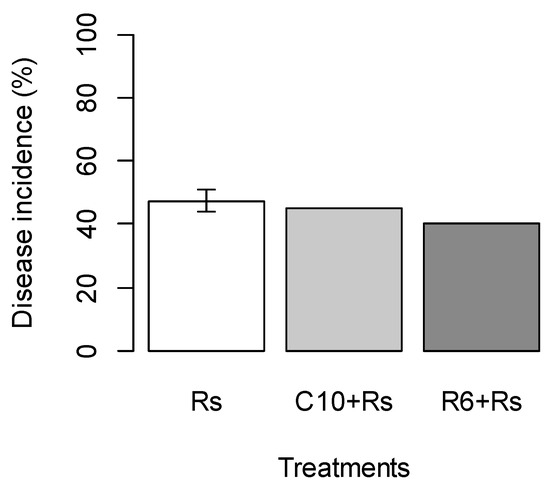
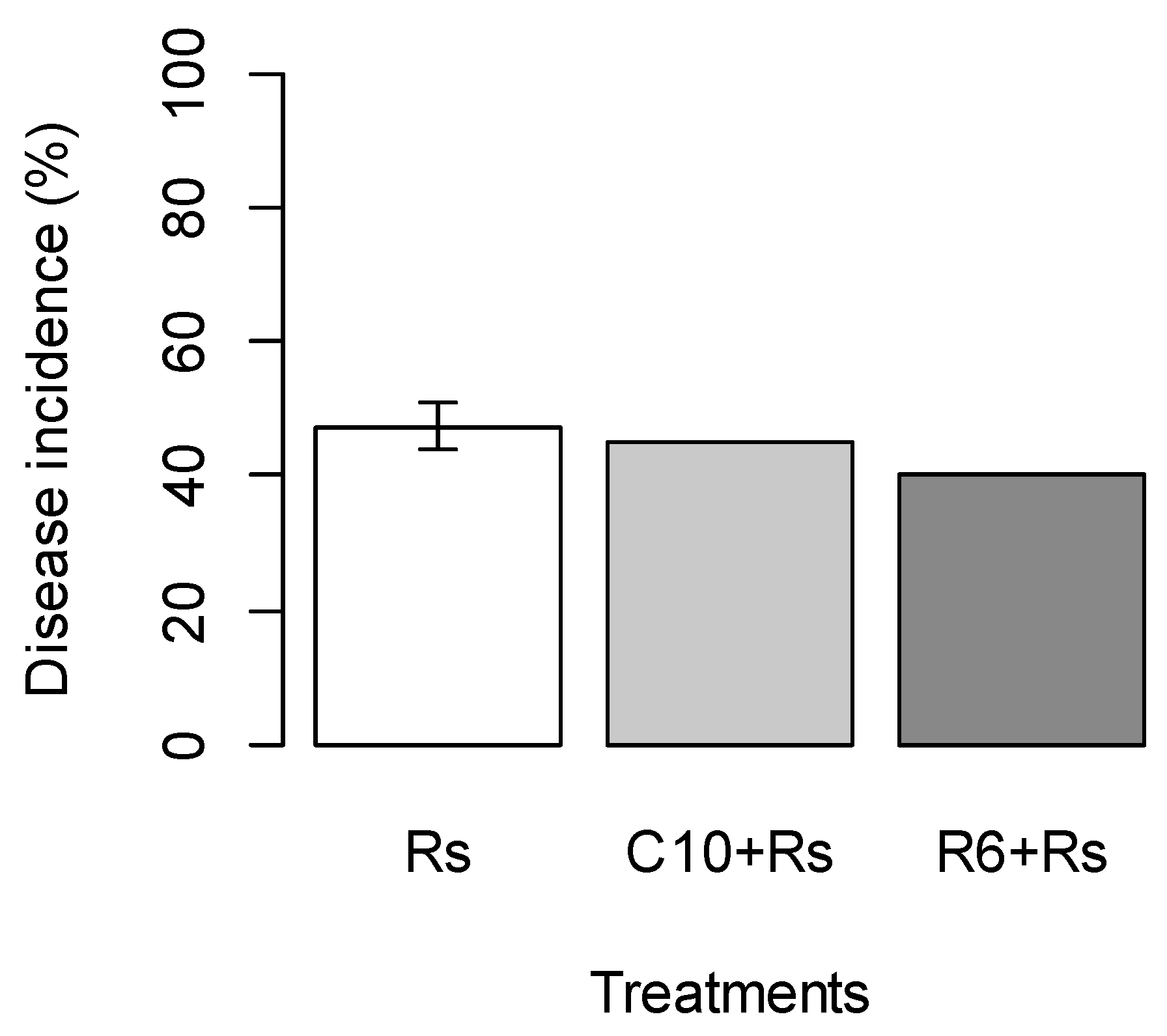
The bacterial wilt incidence varied among treatments. The highest disease incidence was observed in the inoculated control (Rs), with a mean value of 47.5%, whereas incidences of 45.0% and 40.0% were recorded for plants treated with P. flexa C10 and B. subtilis R6, respectively (Figure 1). A generalized linear model (GLM) with a binomial error distribution indicated that treatment had no significant effect on bacterial wilt incidence (χ2 = 0.47, df = 2, p = 0.789).
Figure 1.
Percentage of wilted seedlings by treatment. Key: Rs: R. solanacearum; C10 + Rs: P. flexa C10 + R. solanacearum; R6 + Rs: B. subtilis R6 + R. Solanacearum.
3.2.2. Bacterial Colonization Index
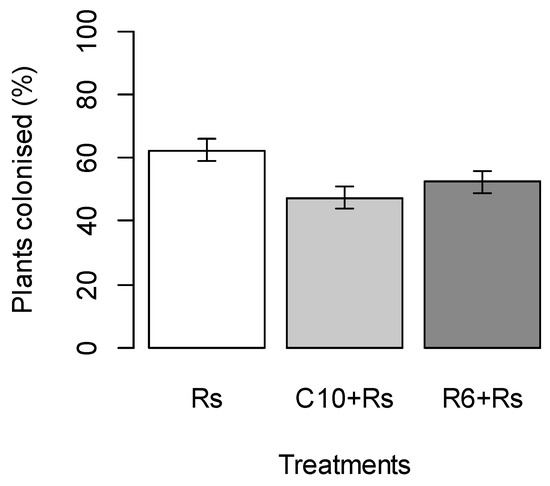
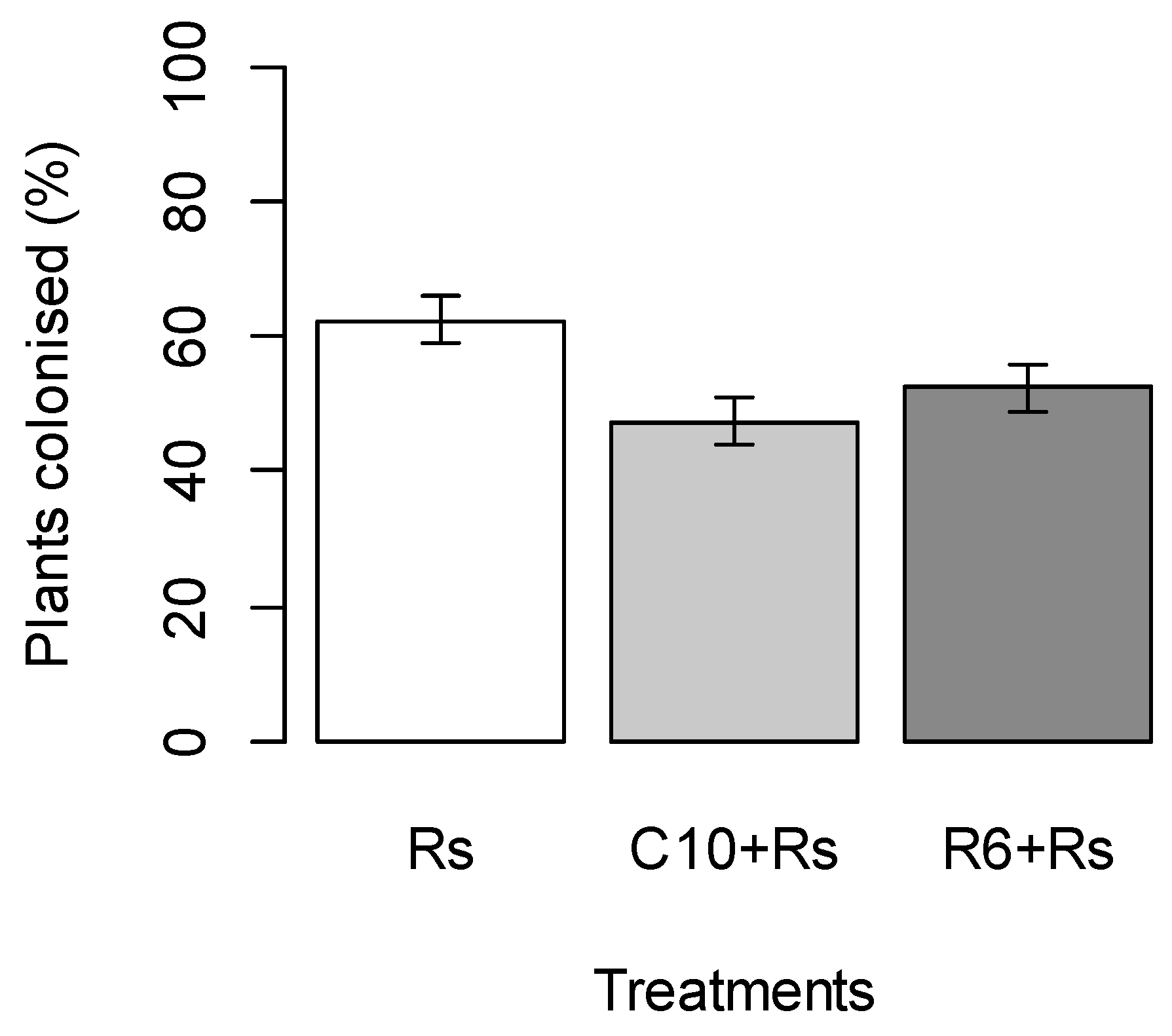
The bacterial colonization index varied among treatments. The highest colonization index was observed in the inoculated control (Rs), with a mean value of 62.5%, whereas values of 47.5% and 52.5% were recorded for plants treated with P. flexa C10 and B. subtilis R6, respectively (Figure 2). A generalized linear model (GLM) with a binomial error distribution indicated that treatment had no significant effect on bacterial colonization (χ2 = 1.89, df = 2, p = 0.388).
Figure 2.
Percentage of plants colonized by treatment. Key: Rs: R. solanacearum; C10 + Rs: P. flexa C10 + R. solanacearum; R6 + Rs: B. subtilis R6 + R. solanacearum.
3.2.3. Effect of Treatments on the Height of Tomato Plants
Under non-inoculated greenhouse conditions (Table 3), Bacillus subtilis R6 markedly promoted plant growth, increasing plant height by 35.9% compared with the healthy control (C), whereas Priestia flexa C10 resulted in a slight reduction (6.9%).
Table 3.
Growth-promoting effects of antagonist bacterial strains on tomato seedlings under non-inoculated greenhouse conditions (single trial).
Under pathogen pressure (Table 4), the two-way ANOVA revealed a highly significant effect of treatment on plant height (), whereas neither trial () nor the treatment trial interaction () had a significant effect. In the presence of Ralstonia solanacearum, inoculation with P. flexa C10 and B. subtilis R6 increased plant height by 14.1% and 14.0%, respectively, relative to the inoculated control (Rs).
Table 4.
Growth parameters of tomato seedlings treated with bacterial inoculants under Ralstonia solanacearum challenge (dual independent greenhouse trials).
3.2.4. Effect of Treatments on the Number of Leaves
In the absence of the pathogen (Table 3), Bacillus subtilis R6 and Priestia flexa C10 increased the number of leaves by 24.6% and 14.8%, respectively, compared with the healthy control (C).
Under pathogen challenge (Table 4), the two-way ANOVA revealed a highly significant effect of treatments on the number of leaves (), whereas trial () and the treatment trial interaction () had no significant effect. In the presence of Ralstonia solanacearum, inoculation with P. flexa C10 and B. subtilis R6 increased the number of leaves by 14.5% and 10.7%, respectively, relative to the inoculated control (Rs).
3.2.5. Effect of Treatments on Fresh Root Biomass
Under non-inoculated conditions (Table 3), Priestia flexa C10 and Bacillus subtilis R6 increased fresh root biomass by 74.7% and 94.5%, respectively, compared with the healthy control (C).
Under pathogen pressure (Table 4), the two-way ANOVA revealed a significant effect of treatment on fresh root biomass (), whereas trial had no significant effect (). The treatment trial interaction was significant (). In the presence of Ralstonia solanacearum, inoculation with P. flexa C10 and B. subtilis R6 increased fresh root biomass by 49.8% and 80.4%, respectively, relative to the inoculated control (Rs).
3.2.6. Effect of Treatments on Root Length
In the absence of the pathogen (Table 3), Priestia flexa C10 and Bacillus subtilis R6 increased root length by 49.3% and 59.4%, respectively, compared with the healthy control (C).
Under pathogen challenge (Table 4), the two-way ANOVA revealed a significant effect of treatment on root length (), whereas trial had no significant effect (). The treatment trial interaction was significant (). In the presence of Ralstonia solanacearum, inoculation with P. flexa C10 and B. subtilis R6 increased root length by 30.6% and 14.6%, respectively, relative to the inoculated control (Rs).
4. Discussion
Worldwide, tomato cultivation represents a crop of major nutritional, economic, and public health importance. However, its productivity is severely limited by various phytosanitary constraints, particularly soil-borne diseases such as bacterial wilt caused by R. solanacearum. Given the limitations of conventional control methods, this study adopts a biological control approach, aiming to evaluate the potential of indigenous bacteria from the rhizosphere and endosphere of Opuntia dillenii for controlling this pathogen.
The antagonistic activity observed in vitro may be partly associated with siderophore production previously reported for these strains [17]. Similar observations have been reported for members of the genera Bacillus and Priestia, particularly Priestia aryabhattai, where strong inhibition of R. solanacearum has been associated with high siderophore production, sometimes combined with the release of diffusible antimicrobial metabolites [14]. Iron sequestration may therefore have contributed to pathogen inhibition under the conditions of the present study [21], although this mechanism was not directly evaluated.
Despite their strong in vitro antagonistic activity, B. subtilis R6 and P. flexa C10 exhibited only moderate efficacy under greenhouse conditions. Although disease incidence and pathogen colonization exhibited a downward numerical trend, these reductions were not statistically significant. This indicates that rather than directly interfering with pathogen establishment or multiplication, the strains primarily confer an indirect benefit by bolstering plant resilience, mitigating physiological stress, and modifying the rhizosphere microbial environment. Such effects are commonly attributed to ecological competition and modifications of the rhizosphere microbial environment rather than to direct antibacterial activity [22]. Consequently, these strains may be more valuable as components of integrated disease management strategies than as standalone biocontrol agents [23,24].
The improvements observed in plant height, leaf number, root length, and fresh root biomass in both healthy and pathogen-challenged plants indicate that the tested strains possess plant growth-promoting (PGP) properties. These beneficial effects are generally associated with mechanisms such as phytohormone production, particularly indole-3-acetic acid (IAA), nutrient solubilization, siderophore production, biological nitrogen fixation, and ACC deaminase activity, all of which contribute to improved plant growth and physiological performance [25]. In non-inoculated plants, the marked increases in plant height and leaf production induced by B. subtilis R6 suggest direct growth stimulation through enhanced nutrient availability and recycling. This interpretation agrees with previous studies demonstrating the ability of phosphate-solubilizing and enzyme-producing bacteria to improve nutrient acquisition and plant development [26,27]. In addition, the phosphatase activity and hydrolytic enzymes produced by B. subtilis R6 likely contributed to phosphorus mobilization and organic matter mineralization, functions commonly associated with plant growth-promoting bacteria [28].
Under pathogen pressure, the positive effects of P. flexa C10 and B. subtilis R6 on vegetative growth, root development, and fresh root biomass suggest a mitigation of the physiological stress induced by R. solanacearum. Similar responses have been reported for plant growth-promoting bacteria that enhance plant tolerance to biotic stress through improved nutrition, hormonal regulation, and induced systemic resistance [29]. The beneficial effect of P. flexa C10 is likely linked to its capacity to produce IAA, thereby stimulating root development and compensating for pathogen-induced damage [30]. Conversely, B. subtilis R6 appears to act mainly through nutritional and structural mechanisms involving EPS production, nitrogen fixation, phosphatase activity, and hydrolytic enzymes, which collectively enhance root performance and plant resilience [31]. The substantial increase in root biomass observed, particularly in plants treated with P. flexa C10, is noteworthy because a well-developed root system improves water and nutrient uptake and contributes significantly to maintaining plant productivity under disease pressure [32,33].
The discrepancy observed between the in vitro and greenhouse performance of biocontrol strains is widely reported and is mainly explained by the complexity of plant–microorganism–environment interactions, which are not fully replicated under controlled laboratory conditions [34]. The effectiveness of biocontrol agents under greenhouse or field conditions depends not only on their antagonistic potential but also on their ability to colonize plant tissues successfully and establish stable populations within rhizosphere microbial communities, which often constitutes a major limitation to their practical application [35,36].
A limitation of this study is that the mechanisms underlying the biocontrol and plant-growth-promoting effects of the selected strains were not investigated at the molecular level. No genomic analyses were performed to identify the genes or metabolic pathways responsible for pathogen suppression, plant colonization, or growth promotion. Therefore, the mechanisms proposed in this study are based on phenotypic observations and known characteristics of related bacterial species. Future genomic and functional studies are needed to confirm these hypotheses and provide a deeper understanding of the biological processes involved.
5. Conclusions
This study evaluated two indigenous bacterial strains, Priestia flexa C10 and Bacillus subtilis R6, associated with Opuntia dillenii, for their potential to alleviate bacterial wilt impacts and promote tomato growth. Both strains reduced disease development and improved plant performance under pathogen pressure. P. flexa C10 was particularly effective in enhancing root biomass and root length, whereas B. subtilis R6 showed the strongest overall plant growth-promoting effect, notably increasing plant height, leaf number, root biomass, and root length. Although the observed reductions in disease development were numerical rather than statistically significant, both strains effectively buffered the plants against pathogen pressure and significantly improved overall plant performance. Therefore, these strains may be most valuable as biostimulant components within integrated crop management strategies rather than as standalone biocontrol agents.
Author Contributions
Conceptualization, Y.K.B., A.D.P.N., R.S. and F.L.; methodology, Y.K.B., J.C., M.E.D., A.D.P.N. and F.L.; formal analysis, Y.K.B.; investigation, Y.K.B.; resources, A.D.P.N. and F.L.; data curation, Y.K.B.; writing—original draft preparation, Y.K.B.; writing—review and editing, Y.K.B., J.C., M.E.D., K.R.K., R.S., A.D.P.N. and F.L.; visualization, Y.K.B.; supervision, A.D.P.N. and F.L.; funding acquisition, F.L. All authors have read and agreed to the published version of the manuscript.
Funding
These works were funded by the Swiss Confederation through an Excellence award to Yves Kévin Brun (Grant No 2025.0433) and the Research Strategic Fund of the HES-SO University of Applied Sciences and Arts Western Switzerland.
Institutional Review Board Statement
Not applicable.
Informed Consent Statement
Not applicable.
Data Availability Statement
The original contributions presented in this study are included in the article. Further inquiries can be directed to the corresponding authors.
Conflicts of Interest
The authors declare no conflicts of interest.
References
- Hamad, A.; Tayel, A. Food 2050 Concept: The Trends That Shape the Future of Our Food. J. Future Foods 2026, 6, 1053–1066. [Google Scholar] [CrossRef] [Scilit]
- Ali, M.A.; Ahmed, T.; Ibrahim, E.; Rizwan, M.; Chong, K.P.; Yong, J.W.H. A Review on Mechanisms and Prospects of Endophytic Bacteria in Biocontrol of Plant Pathogenic Fungi and Their Plant Growth-Promoting Activities. Heliyon 2024, 10, e31573. [Google Scholar] [CrossRef] [Scilit] [PubMed]
- Yu, J.; Liu, J.; Sun, C.; Wang, J.; Ci, J.; Jin, J.; Ren, N.; Zheng, W.; Wei, X. Sensing Technology for Greenhouse Tomato Production: A Systematic Review. Smart Agric. Technol. 2025, 11, 101020. [Google Scholar] [CrossRef] [Scilit]
- Rakhalaru, P.; Mampholo, B.M.; Mamphogoro, T.P.; Thantsha, M.S. Endophytic and Epiphytic Microorganisms as Biocontrol Agents: Mechanisms, Applications, and Metagenomic Approaches in Tomato Cultivation. Molecules 2025, 30, 3816. [Google Scholar] [CrossRef] [Scilit] [PubMed]
- Thakur, A.; Sharma, S.; Banyal, D.K.; Parwan, S.; Sanjta, S. Ralstonia solanacearum: An Overview on Distribution, Variability, Bio-Management and Host Plant Resistance Approaches. AATCC 2025, 13, 270–284. [Google Scholar] [CrossRef] [Scilit]
- Youmbi, D.Y.; Eke, P.; Kouokap, L.R.K.; Dinango, V.N.; Tamghe, G.G.; Wakam, L.N.; Boyom, F.F. Endophytic Bacteria from Euphorbia antiquorum L. Protect Solanum lycopersicum L. against Bacterial Wilt Caused by Ralstonia solanacearum. Egypt. J. Biol. Pest Control 2022, 32, 77. [Google Scholar] [CrossRef] [Scilit]
- Kumar, D.; Un Nabi, S.; Dar, M.; Khan, K. Ralstonia solanacearum: A Wide Spread and Global Bacterial Plant Wilt Pathogen. J. Pharmacogn. Phytochem. 2018, 7, 85–90. [Google Scholar]
- Popoola, A.; Ganiyu, S.; Enikuomehin, O.; Bodunde, J.; Adedibu, O.; Durosomo, H.; Karunwi, O. Isolation and Characterization of Ralstonia solanacearum Causing Bacterial Wilt of Tomato in Nigeria. Nig. J. Biotechnol. 2015, 29, 1. [Google Scholar] [CrossRef] [Scilit][Green Version]
- Fondio, L.; Djidji, A.H.; N’gbesso, M.; Kone, D. Evaluation de neuf variétés de tomate (Solanum lycopersicum L.) par rapport au flétrissement bactérien et à la productivité dans le Sud de la Côte d’Ivoire. Int. J. Biol. Chem. Sci. 2013, 7, 1078–1086. [Google Scholar] [CrossRef] [Scilit][Green Version]
- Traoré, O.; Wonni, I.; Cellier, G.; Boro, F.; Allibert, A.; Zombré, C.T.; Ouédraogo, L.S.; Somda, I. Genetic and Pathogenic Diversity of Ralstonia solanacearum Species Complex Strains Isolated in Burkina Faso. J. Phytopathol. 2023, 171, 1–11. [Google Scholar] [CrossRef] [Scilit]
- Dossoumou, M.E.; Sikirou, R.; Adandonon, A.; Gonroudobou, J.; Baba-Moussa, L. Tomato Hybrid and Local Varieties Screened for Resistance to Bacterial Wilt Caused by Ralstonia solanacearum under Screen House and Field Conditions. AJPS 2021, 12, 1222–1235. [Google Scholar] [CrossRef]
- Shah, S.S.T.H.; Shan, W.; Wang, Y.; Zheng, Z.; Feng, S.; Wang, L.; Hu, X.; Li, L. Eco-Friendly Biocontrol of Ralstonia solanacearum and Plant Growth Promotion in Tobacco Using Garbage Enzyme and Bacillus velezensis A1. Mol. Biotechnol. 2026, 68, 854–871. [Google Scholar] [CrossRef] [Scilit] [PubMed]
- Triantafyllou, A.; Kamou, N.; Papadopoulou, A.; Leontidou, K.; Mellidou, I.; Karamanoli, K. Evaluation of the Biocontrol Potential of PGPB Strains Isolated from Drought-Tolerant Tomatoes against Fungal Pathogens. J. Plant Pathol. 2023, 105, 1013–1029. [Google Scholar] [CrossRef] [Scilit]
- Fonseca, J.S.D.; Sousa, T.F.; Almeida, S.V.R.D.; Silva, C.N.; Castro, G.D.S.; Yamagishi, M.E.B.; Koolen, H.H.F.; Hanada, R.E.; Silva, G.F.D. Amazonian Bacteria from River Sediments as a Biocontrol Solution against Ralstonia solanacearum. Microorganisms 2024, 12, 1364. [Google Scholar] [CrossRef] [Scilit] [PubMed]
- Nabti, E.-H.; Saci, S.; Bensidhoum, L.; Mokrani, S.; Basher, N.S.; Ibrahim, N.A.; Derguini, A.; Aleissa, M.S.; Idres, T.; Houali, K. Plant Growth-Promoting Bacteria as Biological Controls for Sustainable Crop Protection against Agricultural Biodeterioration. Discov. Sustain. 2026, 7, 669. [Google Scholar] [CrossRef] [Scilit]
- Dobrzyński, J.; Naziębło, A. Paenibacillus as a Biocontrol Agent for Fungal Phytopathogens: Is P. polymyxa the Only One Worth Attention? Microb. Ecol. 2024, 87, 134. [Google Scholar] [CrossRef] [Scilit] [PubMed]
- Brun, Y.K.; Noumavo, A.D.P.; Colombet, J.; Atchadé, E.B.; Baba-Moussa, L.; Lefort, F. Molecular Characterization of Plant Growth-Promoting Bacteria Associated with Opuntia dillenii (Ker Gawl.) Haw (Cactaceae) in the Coastal Zone of Benin. Microorganisms 2026, 14, 1376. [Google Scholar] [CrossRef] [Scilit] [PubMed]
- Engelbrecht, M.C. Modification of a Semi-Selective Medium for the Isolation and Quantification of Pseudomonas solanacearum. Bact. Wilt Newsl. 1994, 10, 3–5. Available online: https://eurekamag.com/research/002/435/002435145.php (accessed on 31 May 2026).
- Sun, Y.; Su, Y.; Meng, Z.; Zhang, J.; Zheng, L.; Miao, S.; Qin, D.; Ruan, Y.; Wu, Y.; Xiong, L.; et al. Biocontrol of Bacterial Wilt Disease in Tomato Using Bacillus subtilis Strain R31. Front. Microbiol. 2023, 14, 1281381. [Google Scholar] [CrossRef] [Scilit] [PubMed]
- Sultana, F.; Hossain, M.M. Assessing the Potentials of Bacterial Antagonists for Plant Growth Promotion, Nutrient Acquisition, and Biological Control of Southern Blight Disease in Tomato. PLoS ONE 2022, 17, e0267253. [Google Scholar] [CrossRef] [Scilit] [PubMed]
- Shao, Z.; Gu, S.; Zhang, X.; Xue, J.; Yan, T.; Guo, S.; Pommier, T.; Jousset, A.; Yang, T.; Xu, Y.; et al. Siderophore Interactions Drive the Ability of Pseudomonas spp. Consortia to Protect Tomato against Ralstonia solanacearum. Hortic. Res. 2024, 11, uhae186. [Google Scholar] [CrossRef] [Scilit] [PubMed]
- Sheoran, A.R.; Lakra, N.; Saharan, B.S.; Luhach, A.; Kumar, R.; Seth, C.S.; Duhan, J.S. Enhancing Plant Disease Resistance: Insights from Biocontrol Agent Strategies. J. Plant Growth Regul. 2025, 44, 436–459. [Google Scholar] [CrossRef] [Scilit]
- Villavicencio-Vásquez, M.; Espinoza-Lozano, F.; Espinoza-Lozano, L.; Coronel-León, J. Biological Control Agents: Mechanisms of Action, Selection, Formulation and Challenges in Agriculture. Front. Agron. 2025, 7, 1578915. [Google Scholar] [CrossRef] [Scilit]
- Riseh, R.S.; Fathi, F.; Vazvani, M.G.; Tarkka, M.T. Plant Colonization by Biocontrol Bacteria and Improved Plant Health: A Review. Front. Biosci. (Landmark) 2025, 30, 23223. [Google Scholar] [CrossRef] [Scilit] [PubMed]
- Wahab, A.; Bibi, H.; Batool, F.; Muhammad, M.; Ullah, S.; Zaman, W.; Abdi, G. Plant Growth-Promoting Rhizobacteria Biochemical Pathways and Their Environmental Impact: A Review of Sustainable Farming Practices. Plant Growth Regul. 2024, 104, 637–662. [Google Scholar] [CrossRef] [Scilit]
- Pan, L.; Cai, B. Phosphate-Solubilizing Bacteria: Advances in Their Physiology, Molecular Mechanisms and Microbial Community Effects. Microorganisms 2023, 11, 2904. [Google Scholar] [CrossRef] [Scilit] [PubMed]
- Sun, X.; Tian, X.; Jia, M.; Hu, X.; Zhang, C.; Zhao, L. Phosphate-Solubilizing Bacteria: A Review of Diversity, Mechanisms, and Applications in Sustainable Agriculture. Front. Microbiol. 2026, 17, 1778470. [Google Scholar] [CrossRef] [Scilit] [PubMed]
- Rawat, P.; Sharma, A.; Shankhdhar, D.; Shankhdhar, S.C. Comparative Response of Phosphate Solubilizing Indigenous Bacillus licheniformis, Pantoea dispersa and Staphylococcus sp. From Rice Rhizosphere for Their Multifarious Growth Promoting Characteristics. Geomicrobiol. J. 2022, 39, 445–452. [Google Scholar] [CrossRef] [Scilit]
- Santoyo, G.; Guzmán-Guzmán, P.; Parra-Cota, F.I.; Santos-Villalobos, S.D.L.; Orozco-Mosqueda, M.D.C.; Glick, B.R. Plant Growth Stimulation by Microbial Consortia. Agronomy 2021, 11, 219. [Google Scholar] [CrossRef] [Scilit]
- Abou Jaoudé, R.; Luziatelli, F.; Ficca, A.G.; Ruzzi, M. A Plant’s Perception of Growth-Promoting Bacteria and Their Metabolites. Front. Plant Sci. 2024, 14, 1332864. [Google Scholar] [CrossRef] [Scilit] [PubMed]
- Hashem, A.; Tabassum, B.; Fathi Abd_Allah, E. Bacillus subtilis: A Plant-Growth Promoting Rhizobacterium That Also Impacts Biotic Stress. Saudi J. Biol. Sci. 2019, 26, 1291–1297. [Google Scholar] [CrossRef] [Scilit] [PubMed]
- Chandrasekaran, M. Arbuscular Mycorrhizal Fungi Mediated Enhanced Biomass, Root Morphological Traits and Nutrient Uptake under Drought Stress: A Meta-Analysis. JoF 2022, 8, 660. [Google Scholar] [CrossRef] [Scilit] [PubMed]
- Kou, X.; Han, W.; Kang, J. Responses of Root System Architecture to Water Stress at Multiple Levels: A Meta-Analysis of Trials under Controlled Conditions. Front. Plant Sci. 2022, 13, 1085409. [Google Scholar] [CrossRef] [Scilit] [PubMed]
- Charron-Lamoureux, V.; Lebel-Beaucage, S.; Pomerleau, M.; Beauregard, P.B. Rooting for Success: Evolutionary Enhancement of Bacillus for Superior Plant Colonization. Microb. Biotechnol. 2024, 17, e70001. [Google Scholar] [CrossRef] [Scilit] [PubMed]
- Adjei, M.O.; Yu, R.; Cao, X.; Fan, B. The Mechanisms of Bacillus subtilis as a Plant-Beneficial Rhizobacterium in Plant–Microbe Interactions. Microorganisms 2025, 13, 2823. [Google Scholar] [CrossRef] [Scilit] [PubMed]
- Gayithri, M.; Singh, S.; Pradhan, B.; Boorla, V.; Chand, S. Multifunctional Roles of Bacillus spp. in Sustainable Agriculture: Advances in Biocontrol, Omics, and Ecological Applications. Microb. Ecol. 2026, 89, 55. [Google Scholar] [CrossRef] [Scilit] [PubMed]

Disclaimer/Publisher’s Note: The statements, opinions and data contained in all publications are solely those of the individual author(s) and contributor(s) and not of MDPI and/or the editor(s). MDPI and/or the editor(s) disclaim responsibility for any injury to people or property resulting from any ideas, methods, instructions or products referred to in the content. |
© 2026 by the authors. Licensee MDPI, Basel, Switzerland. This article is an open access article distributed under the terms and conditions of the Creative Commons Attribution (CC BY) license.