

You are currently viewing a new version of our website. To view the old version click .

Pharmaceutics, Volume 12, Issue 9

September 2020 - 122 articles

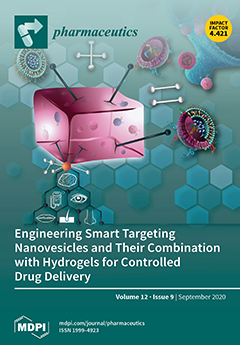
Cover Story: Exosomes are naturally derived nanovesicles that can target specific cells and tissues without particular modifications, whereas liposomes are well-established drug carriers that can deliver heavy loads. These types of nanovesicles present many advantages, but each has its own drawbacks. To overcome their shortcomings, a membrane fusion between exosomes and liposomes can generate superior hybrid nanovesicles. This novel hybrid delivery system can be armed with both the smart targeting behavior of exosomes and the high loading capacity of liposomes. Moreover, to enhance, control, and prolong drug release, these nanovesicles can be loaded in naturally derived hydrogels, which can then be administered in better routes, such as oral, nasal, parenteral, ocular, topical, and brain delivery routes. View this paper.
  • Issues are regarded as officially published after their release is announced to the table of contents alert mailing list .
  • You may sign up for email alerts to receive table of contents of newly released issues.
  • PDF is the official format for papers published in both, html and pdf forms. To view the papers in pdf format, click on the "PDF Full-text" link, and use the free Adobe Reader to open them.

Articles (122)

  • Article
  • Open Access
29 Citations
4,764 Views
20 Pages

Polypeptide Self-Assembled Nanoparticles as Delivery Systems for Polymyxins B and E

  • Dmitrii Iudin,
  • Natalia Zashikhina,
  • Elena Demyanova,
  • Viktor Korzhikov-Vlakh,
  • Elena Shcherbakova,
  • Roman Boroznjak,
  • Irina Tarasenko,
  • Natalya Zakharova,
  • Antonina Lavrentieva and
  • Yury Skorik
  • + 1 author

Polymyxins are peptide antibiotics that are highly efficient against many multidrug resistant pathogens. However, the poor stability of polymyxins in the bloodstream requires the administration of high drug doses that, in turn, can lead to polymyxin...

  • Review
  • Open Access
145 Citations
12,504 Views
29 Pages

Recent Advances in the Development of In Situ Gelling Drug Delivery Systems for Non-Parenteral Administration Routes

  • Barbara Vigani,
  • Silvia Rossi,
  • Giuseppina Sandri,
  • Maria Cristina Bonferoni,
  • Carla M. Caramella and
  • Franca Ferrari

In situ gelling drug delivery systems have gained enormous attention over the last decade. They are in a sol-state before administration, and they are capable of forming gels in response to different endogenous stimuli, such as temperature increase,...

  • Review
  • Open Access
64 Citations
7,785 Views
19 Pages

Glioblastoma multiforme (GBM) is the most common and malignant type of brain tumor. In fact, tumor recurrence usually appears a few months after surgical resection and chemotherapy, mainly due to many factors that make GBM treatment a real challenge,...

  • Article
  • Open Access
9 Citations
5,410 Views
13 Pages

Ex-Vivo Trans-Corneal and Trans-Scleral Diffusion Studies with Ocular Formulations of Glutathione as an Antioxidant Treatment for Ocular Diseases

  • María Sebastián-Morelló,
  • Adrián M. Alambiaga-Caravaca,
  • María Aracely Calatayud-Pascual,
  • Vicent Rodilla,
  • Cristina Balaguer-Fernández,
  • María Miranda and
  • Alicia López-Castellano

Exposure to sunlight and contact with atmospheric oxygen makes the eye particularly susceptible to oxidative stress, which can potentially produce cellular damage. In physiological conditions, there are several antioxidant defense mechanisms within t...

  • Article
  • Open Access
9 Citations
4,529 Views
15 Pages

Serine Protease-Mediated Cutaneous Inflammation: Characterization of an Ex Vivo Skin Model for the Assessment of Dexamethasone-Loaded Core Multishell-Nanocarriers

  • Janna Frombach,
  • Fiorenza Rancan,
  • Katharina Kübrich,
  • Fabian Schumacher,
  • Michael Unbehauen,
  • Ulrike Blume-Peytavi,
  • Rainer Haag,
  • Burkhard Kleuser,
  • Robert Sabat and
  • Kerstin Wolk
  • + 1 author

Standard experimental set-ups for the assessment of skin penetration are typically performed on skin explants with an intact skin barrier or after a partial mechanical or chemical perturbation of the stratum corneum, but they do not take into account...

  • Article
  • Open Access
44 Citations
5,507 Views
18 Pages

Encapsulation of Nedaplatin in Novel PEGylated Liposomes Increases Its Cytotoxicity and Genotoxicity against A549 and U2OS Human Cancer Cells

  • Salma El-Shafie,
  • Sherif Ashraf Fahmy,
  • Laila Ziko,
  • Nada Elzahed,
  • Tamer Shoeib and
  • Andreas Kakarougkas

Following the discovery of cisplatin over 50 years ago, platinum-based drugs have been a widely used and effective form of cancer therapy, primarily causing cell death by inducing DNA damage and triggering apoptosis. However, the dose-limiting toxici...

  • Review
  • Open Access
33 Citations
6,580 Views
18 Pages

Role of OATP1B1 and OATP1B3 in Drug-Drug Interactions Mediated by Tyrosine Kinase Inhibitors

  • Dominique A. Garrison,
  • Zahra Talebi,
  • Eric D. Eisenmann,
  • Alex Sparreboom and
  • Sharyn D. Baker

Failure to recognize important features of a drug’s pharmacokinetic characteristics is a key cause of inappropriate dose and schedule selection, and can lead to reduced efficacy and increased rate of adverse drug reactions requiring medical int...

  • Article
  • Open Access
23 Citations
4,835 Views
24 Pages

Their stability and low cost make catanionic vesicles suitable for application as drug delivery systems. In this work we prepared catanionic vesicles using biocompatible surfactants: two cationic arginine-based surfactants (the monocatenary Nα-...

  • Article
  • Open Access
45 Citations
4,950 Views
18 Pages

Berberine-Loaded Liposomes for the Treatment of Leishmania infantum-Infected BALB/c Mice

  • Alba Calvo,
  • Esther Moreno,
  • Esther Larrea,
  • Carmen Sanmartín,
  • Juan Manuel Irache and
  • Socorro Espuelas

Berberine (BER)—an anti-inflammatory quaternary isoquinoline alkaloid extracted from plants—has been reported to have a variety of biologic properties, including antileishmanial activity. This work addresses the preparation of BER-loaded...

  • Review
  • Open Access
431 Citations
23,015 Views
23 Pages

Transfersomes: A Promising Nanoencapsulation Technique for Transdermal Drug Delivery

  • Shakthi Apsara Thejani Opatha,
  • Varin Titapiwatanakun and
  • Romchat Chutoprapat

Transdermal delivery systems have gained much interest in recent years owing to their advantages compared to conventional oral and parenteral delivery systems. They are noninvasive and self-administered delivery systems that can improve patient compl...

of 13

Get Alerted

Add your email address to receive forthcoming issues of this journal.

XFacebookLinkedIn
Pharmaceutics - ISSN 1999-4923