

You are currently viewing a new version of our website. To view the old version click .

Pharmaceutics, Volume 12, Issue 9

September 2020 - 122 articles

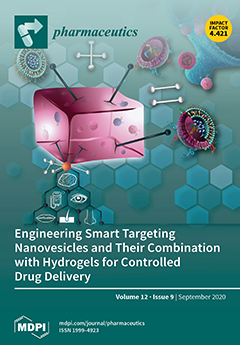
Cover Story: Exosomes are naturally derived nanovesicles that can target specific cells and tissues without particular modifications, whereas liposomes are well-established drug carriers that can deliver heavy loads. These types of nanovesicles present many advantages, but each has its own drawbacks. To overcome their shortcomings, a membrane fusion between exosomes and liposomes can generate superior hybrid nanovesicles. This novel hybrid delivery system can be armed with both the smart targeting behavior of exosomes and the high loading capacity of liposomes. Moreover, to enhance, control, and prolong drug release, these nanovesicles can be loaded in naturally derived hydrogels, which can then be administered in better routes, such as oral, nasal, parenteral, ocular, topical, and brain delivery routes. View this paper.
  • Issues are regarded as officially published after their release is announced to the table of contents alert mailing list .
  • You may sign up for email alerts to receive table of contents of newly released issues.
  • PDF is the official format for papers published in both, html and pdf forms. To view the papers in pdf format, click on the "PDF Full-text" link, and use the free Adobe Reader to open them.

Articles (122)

  • Article
  • Open Access
67 Citations
12,279 Views
20 Pages

We aimed to develop a berberine formulation to enhance the intestinal absorption and plasma concentrations of berberine through the inhibition of P-glycoprotein (P-gp)-mediated efflux and the intestinal metabolism of berberine in rats. We used pluron...

  • Article
  • Open Access
32 Citations
4,961 Views
18 Pages

Biodegradable Electrospun Nonwovens Releasing Propolis as a Promising Dressing Material for Burn Wound Treatment

  • Mateusz Stojko,
  • Jakub Włodarczyk,
  • Michał Sobota,
  • Paulina Karpeta-Jarząbek,
  • Małgorzata Pastusiak,
  • Henryk Janeczek,
  • Piotr Dobrzyński,
  • Gabriela Starczynowska,
  • Arkadiusz Orchel and
  • Jerzy Stojko
  • + 5 authors

The selection of dressing is crucial for the wound healing process. Traditional dressings protect against contamination and mechanical damage of an injured tissue. Alternatives for standard dressings are regenerating systems containing a polymer with...

  • Article
  • Open Access
8 Citations
3,458 Views
15 Pages

Recycling of Almond By-Products for Intestinal Inflammation: Improvement of Physical-Chemical, Technological and Biological Characteristics of a Dried Almond Skins Extract

  • Maria Rosaria Lauro,
  • Stefania Marzocco,
  • Shara Francesca Rapa,
  • Teresa Musumeci,
  • Virgilio Giannone,
  • Patrizia Picerno,
  • Rita Patrizia Aquino and
  • Giovanni Puglisi

Background: Almond skins are rich in bioactive compounds that undergo oxidation/degradation phenomena and are poorly soluble in water, reducing in vivo absorption and bioavailability, factors that influence the pharmacological activity of an active p...

  • Article
  • Open Access
25 Citations
4,529 Views
17 Pages

Poly(Aspartic Acid) Functionalized Poly(ϵ-Caprolactone) Microspheres with Enhanced Hydroxyapatite Affinity as Bone Targeting Antibiotic Carriers

  • Stijn G. Rotman,
  • Thomas F. Moriarty,
  • Benjamin Nottelet,
  • Dirk W. Grijpma,
  • David Eglin and
  • Olivier Guillaume

Bone infection is a feared complication for patients with surgically fixed bone fractures and local antibiotic delivery is important in prophylaxis and treatment of these infections. Recent studies indicated that Staphylococcus aureus can penetrate b...

  • Review
  • Open Access
36 Citations
5,895 Views
18 Pages

Drugs Modulating CD4+ T Cells Blood–Brain Barrier Interaction in Alzheimer’s Disease

  • Norwin Kubick,
  • Patrick C. Henckell Flournoy,
  • Ana-Maria Enciu,
  • Gina Manda and
  • Michel-Edwar Mickael

The effect of Alzheimer’s disease (AD) medications on CD4+ T cells homing has not been thoroughly investigated. CD4+ T cells could both exacerbate and reduce AD symptoms based on their infiltrating subpopulations. Proinflammatory subpopulations...

  • Article
  • Open Access
26 Citations
5,613 Views
27 Pages

Uncovering New Drug Properties in Target-Based Drug–Drug Similarity Networks

  • Lucreţia Udrescu,
  • Paul Bogdan,
  • Aimée Chiş,
  • Ioan Ovidiu Sîrbu,
  • Alexandru Topîrceanu,
  • Renata-Maria Văruţ and
  • Mihai Udrescu

Despite recent advances in bioinformatics, systems biology, and machine learning, the accurate prediction of drug properties remains an open problem. Indeed, because the biological environment is a complex system, the traditional approach—based...

  • Article
  • Open Access
31 Citations
6,125 Views
9 Pages

Image-Based Artificial Intelligence Methods for Product Control of Tablet Coating Quality

  • Cosima Hirschberg,
  • Magnus Edinger,
  • Else Holmfred,
  • Jukka Rantanen and
  • Johan Boetker

Mimicking the human decision-making process is challenging. Especially, many process control situations during the manufacturing of pharmaceuticals are based on visual observations and related experience-based actions. The aim of the present work was...

  • Article
  • Open Access
6 Citations
4,480 Views
15 Pages

The aim of this paper was to investigate whether a surface coating technique could be developed that can predict the phase behavior of amorphous solid dispersions (ASDs) coated on beads. ASDs of miconazole (MIC) and poly(vinylpyrrolidone-co-vinyl ace...

  • Article
  • Open Access
9 Citations
4,224 Views
15 Pages

Development of a Solid Formulation Containing a Microemulsion of a Novel Artemisia Extract with Nematocidal Activity for Oral Administration

  • Ines Perez-Roman,
  • Filip Kiekens,
  • Damian Cordoba-Diaz,
  • Juan Jose Garcia-Rodriguez and
  • Manuel Cordoba-Diaz

Background: Intestinal nematode infections are usually treated with benzimidazole drugs, but the emergence of resistance to these drugs has led to an increasing demand of new anthelmintic strategies. A new microemulsion formulation (ME) consisting of...

  • Review
  • Open Access
51 Citations
6,053 Views
27 Pages

Dendrimers and Dendritic Materials: From Laboratory to Medical Practice in Infectious Diseases

  • Miguel Ángel Ortega,
  • Alberto Guzmán Merino,
  • Oscar Fraile-Martínez,
  • Judith Recio-Ruiz,
  • Leonel Pekarek,
  • Luis G. Guijarro,
  • Natalio García-Honduvilla,
  • Melchor Álvarez-Mon,
  • Julia Buján and
  • Sandra García-Gallego

Infectious diseases are one of the main global public health risks, predominantly caused by viruses, bacteria, fungi, and parasites. The control of infections is founded on three main pillars: prevention, treatment, and diagnosis. However, the appear...

of 13

Get Alerted

Add your email address to receive forthcoming issues of this journal.

XFacebookLinkedIn
Pharmaceutics - ISSN 1999-4923